
(No.9) To You in Weeks 10 to 12 of RHS | When Facial Paralysis Strikes in the U.S.: [Practical Guide · Save for Reference] The Rita Routine and Practical Tips to Protect Your Recovery

This article is a practical guide, gathering together the self-care methods I kept up every day during recovery after the onset of RHS (Ramsay Hunt syndrome), along with the things to watch for in daily life.
Weeks 10 to 12 may not be a time when dramatic changes happen every single day. But in the places you can't see, both the nerves and the muscles are still quietly working toward recovery. What matters in this period, you might say, is less about "trying even harder" and more about arranging a "way of living that doesn't get in the way of recovery."
*Self-care methods may or may not suit you, depending on the stage of your symptoms and on individual differences. Always consult your doctor or physical therapist, and stay within the range of "gentle and comfortable." What's written here is, throughout, the Rita point of view — the lived experience of one patient.
The Rita Way of Taping the Eyelid, Cheek, and Corner of the Mouth
(with video)
Taping — the important bedtime ritual that protects an eye that won't fully close from dryness and injury. In the earliest days after onset, my eye wouldn't close at all, so I kept it taped through the daytime too.
I also taped the cheek and the corner of my mouth on the paralyzed side, within a range that didn't strain the skin, to support them. Just this made both speaking and eating so much easier.
Rather than explaining in words, it's quickest to simply show you, so I made a video of how I actually do the taping.
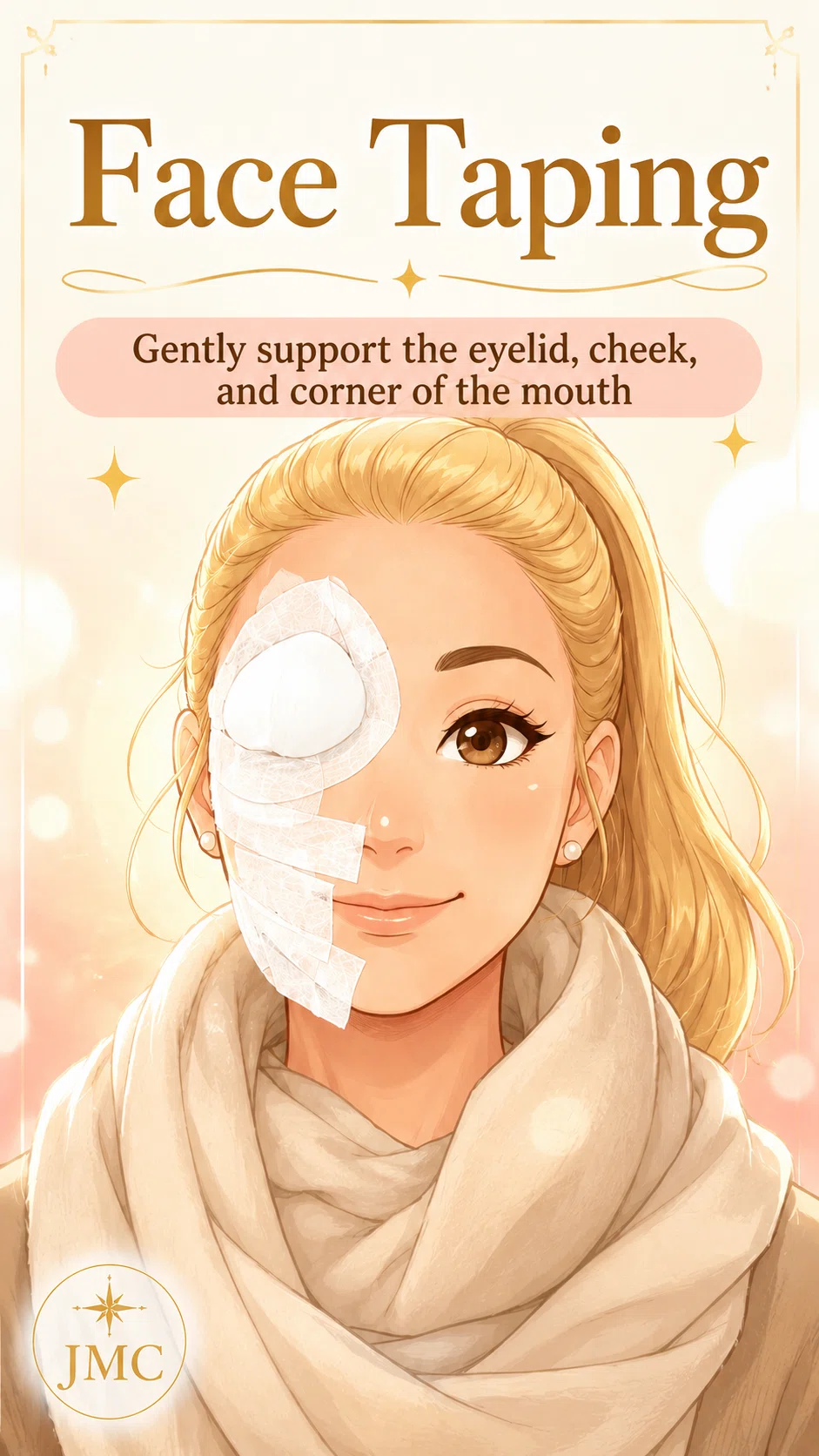
Here are the six points.
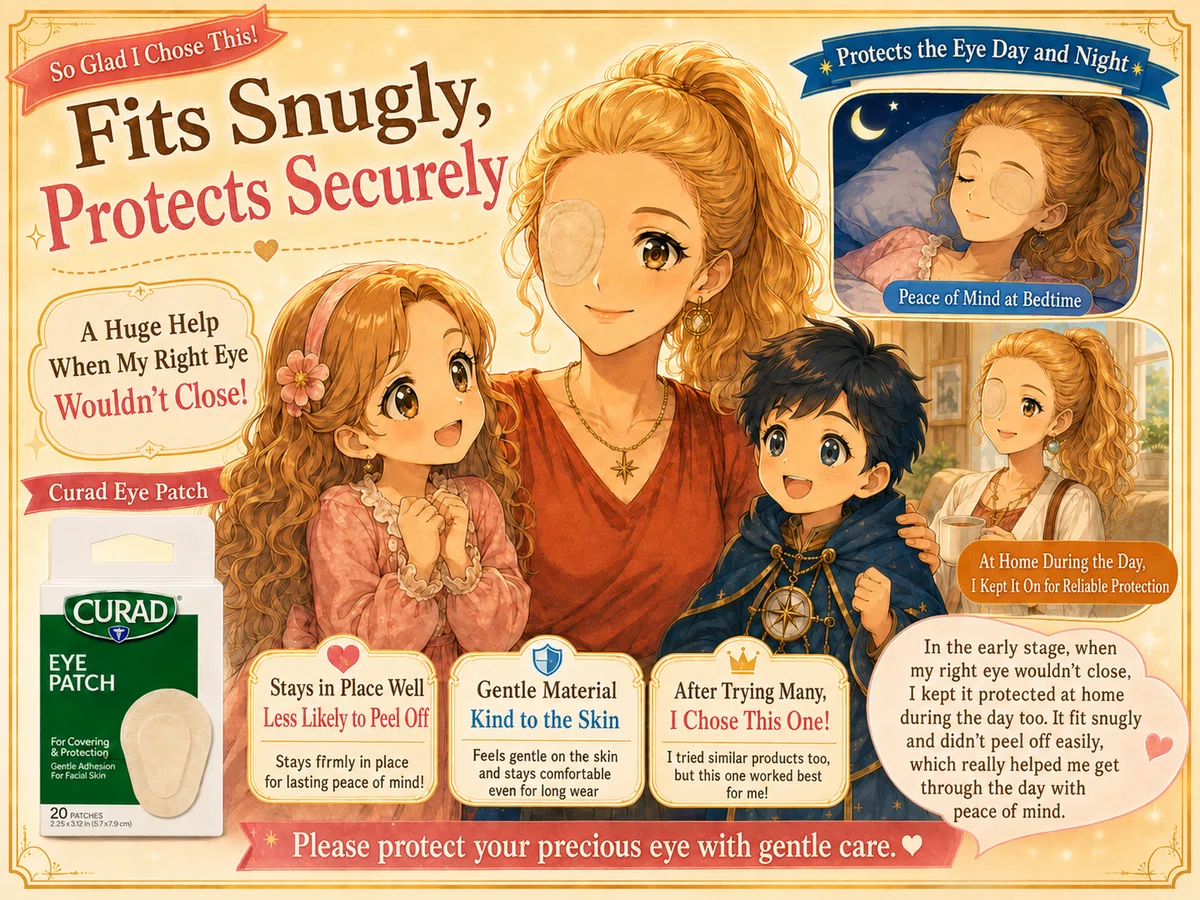
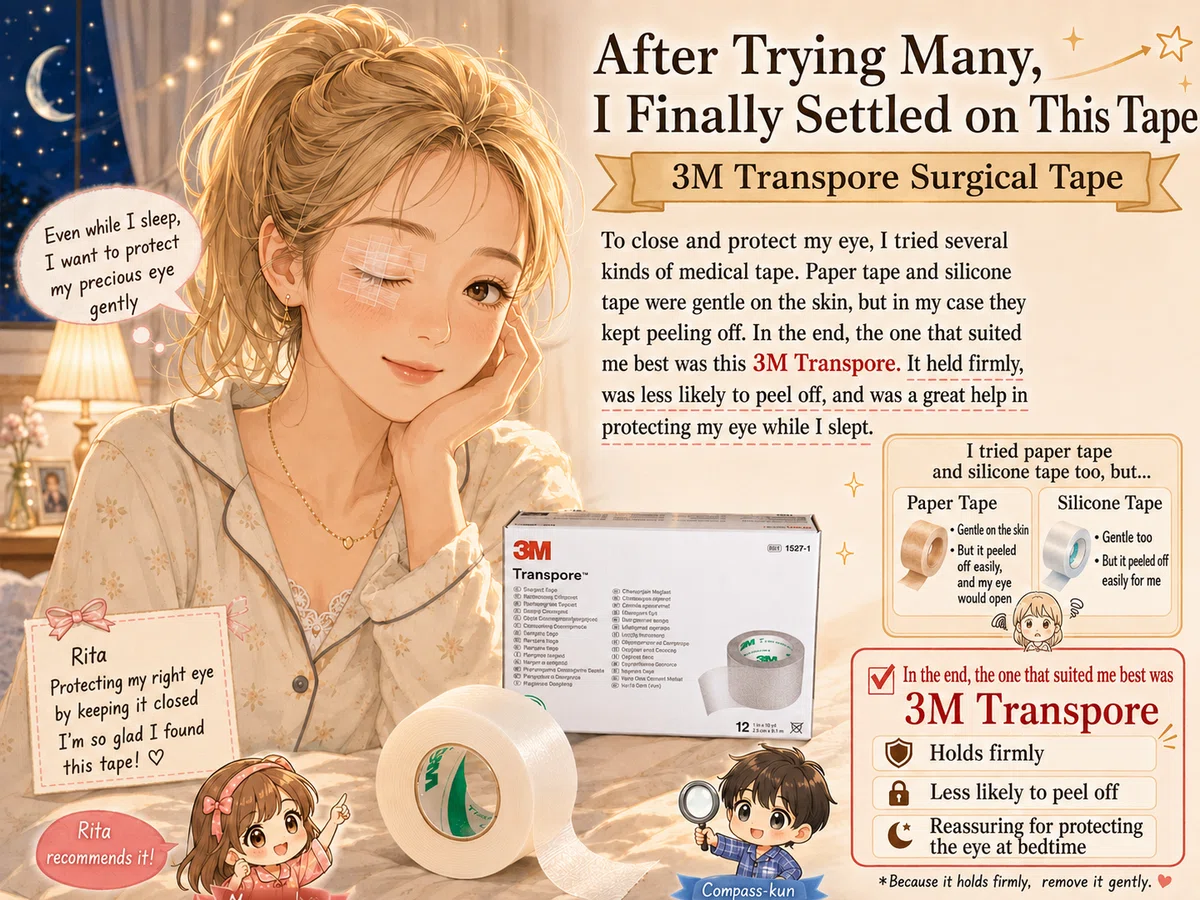
① Use tape that is gentle on the skin and, at the same time, stays securely in place. For closing the eyelid first, I recommend the "3M Transpore Surgical Tape" I introduced in No.7 — and placing a "disposable eye patch" over the top holds it even more securely.
You can see the No.7 article by clicking the image.
For lifting the cheek and the corner of the mouth, I also recommend the same "3M Transpore Surgical Tape."
② Gently close the eyelid with your finger first, then secure it from above.
③ When taping the eye during the daytime, don't forget your eye drops and your nighttime ointment.
④ Lift the cheek and the corner of the mouth up firmly.
⑤ When you remove the tape, never pull it off roughly. Peel it off slowly and carefully, working from the bottom upward. If you peel it off carelessly, you may accidentally pull out your eyelashes, so please be gentle.
⑥ Even an eye that won't close will gradually open a little as time passes. When it does, be careful that the eye and the tape don't touch.
The Rita Routine | 3 Times a Day, 6 Steps
Now, let me introduce the actual Rita Routine I created using the tools I introduced in No.7. I did this 3 times a day — morning, noon, and night — spending about 1 to 2 minutes on each step. Aim for about 10 minutes per session. More than anything, try to catch that feeling of "Ahhh… this feels good." That's the sensation I want you to pay attention to. All right, everyone — let's do this together. 🎵
① Warm and Roll (germanium roller)
Dip the tip of the roller in hot water to warm it. Once it reaches a temperature that feels comfortably warm, gently roll it over the paralyzed right half of your face. Please be extremely careful that it isn't too hot. Your precious face can still be very sensitive, even when it is paralyzed. There's no particular order you need to follow while rolling, but rolling from the bottom upward might even give your face a little lifting effect.

② Scalp Massage (a scalp facial)
Your scalp and your face are connected as one continuous sheet of skin. From above the ear, work upward toward the crown of your head, as if gently lifting the skin. Since I wanted to avoid massaging my face directly, sending stimulation from the scalp let me feel less strain on the face.
Set the intensity to the very lowest.
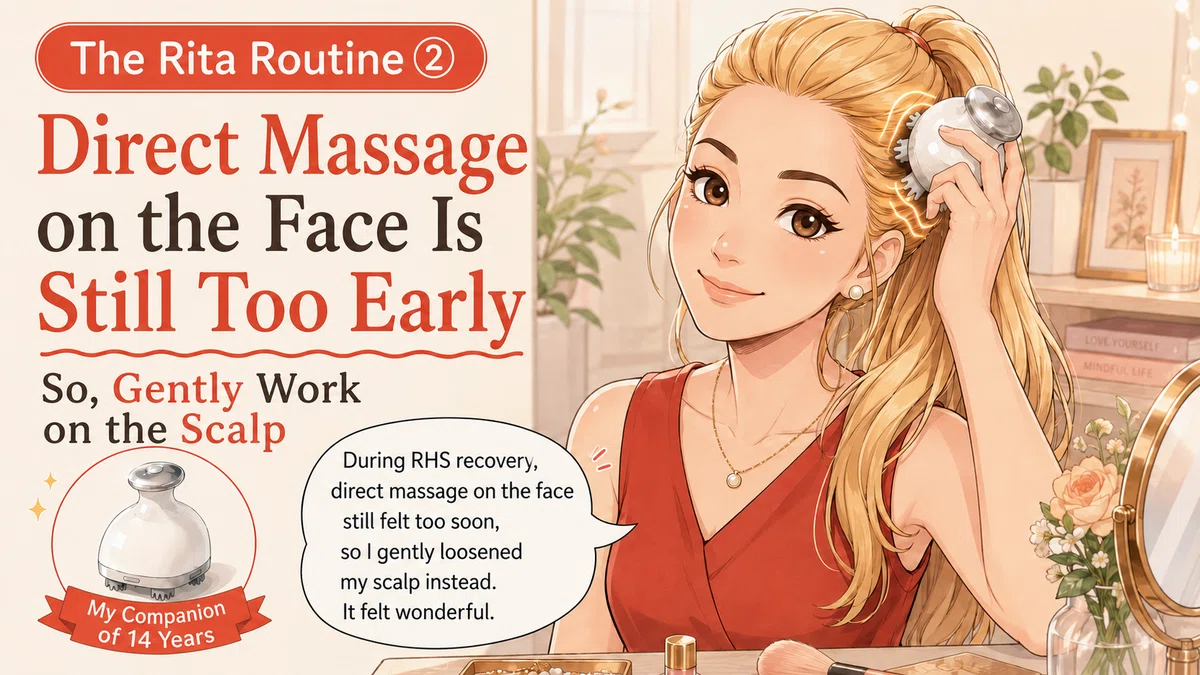
③ Red Light Therapy (Baby Quasar MD Plus)
Slowly bring the red light to the paralyzed side. Always protect your eye with both a disposable eye patch and an eye mask while using it. An eyelid that can't fully close is defenseless against light, too. This is something you must never skip.
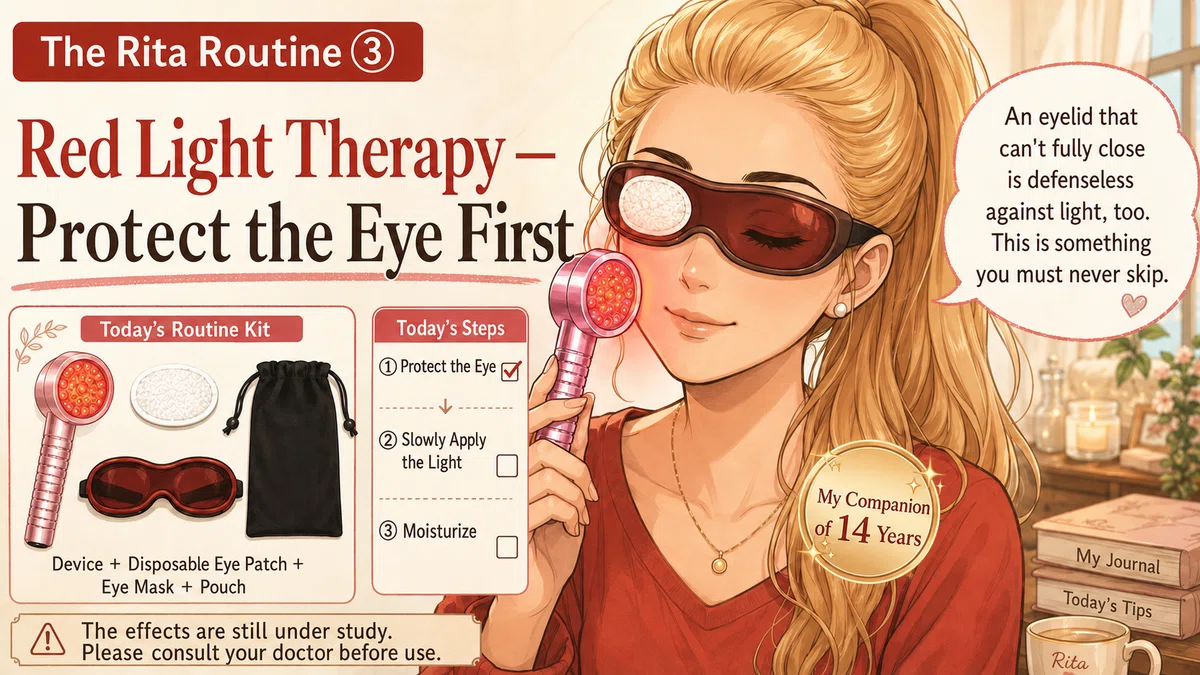
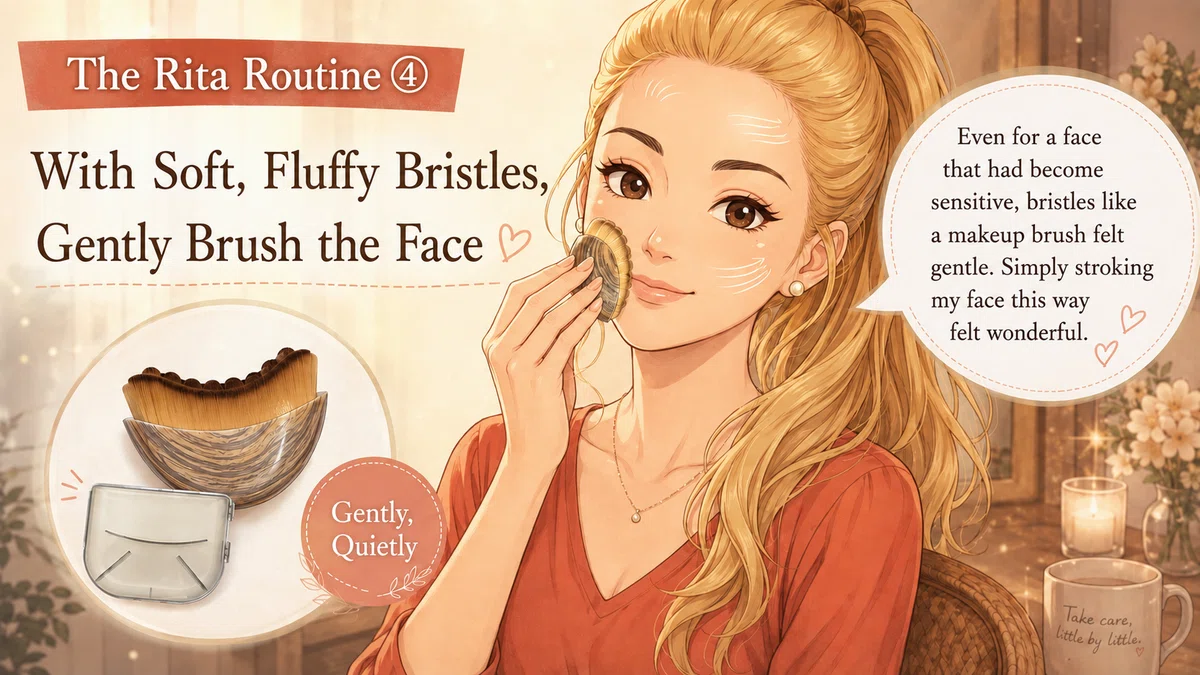
④ Brush Gently (facial brush)
With the soft, fluffy bristles, gently brush your entire face as though you were softly stroking it. And while you do, say to your face: "Thank you for your work today." It feels wonderful.
And now, the two steps that use no tools at all. This is where today's real point begins.
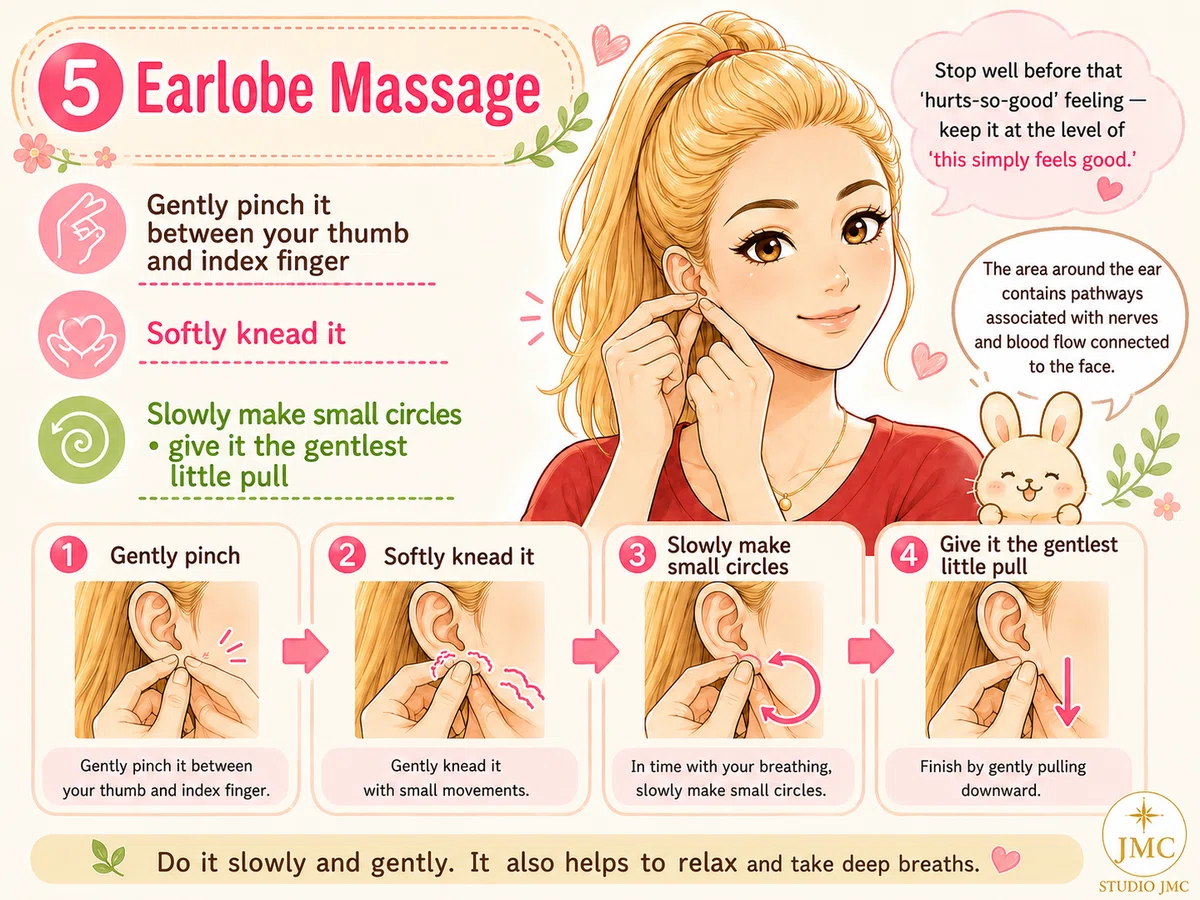
⑤ Earlobe Massage
Gently pinch your earlobe between your thumb and index finger and softly knead it. Slowly make small circles, or give it the gentlest little pull. Around the ear, the pathways of nerves and blood flow that connect to the face are all gathered. The ear on the paralyzed side is often especially sensitive, so keep the pressure just short of "hurts-so-good" — at the level of "this simply feels good."
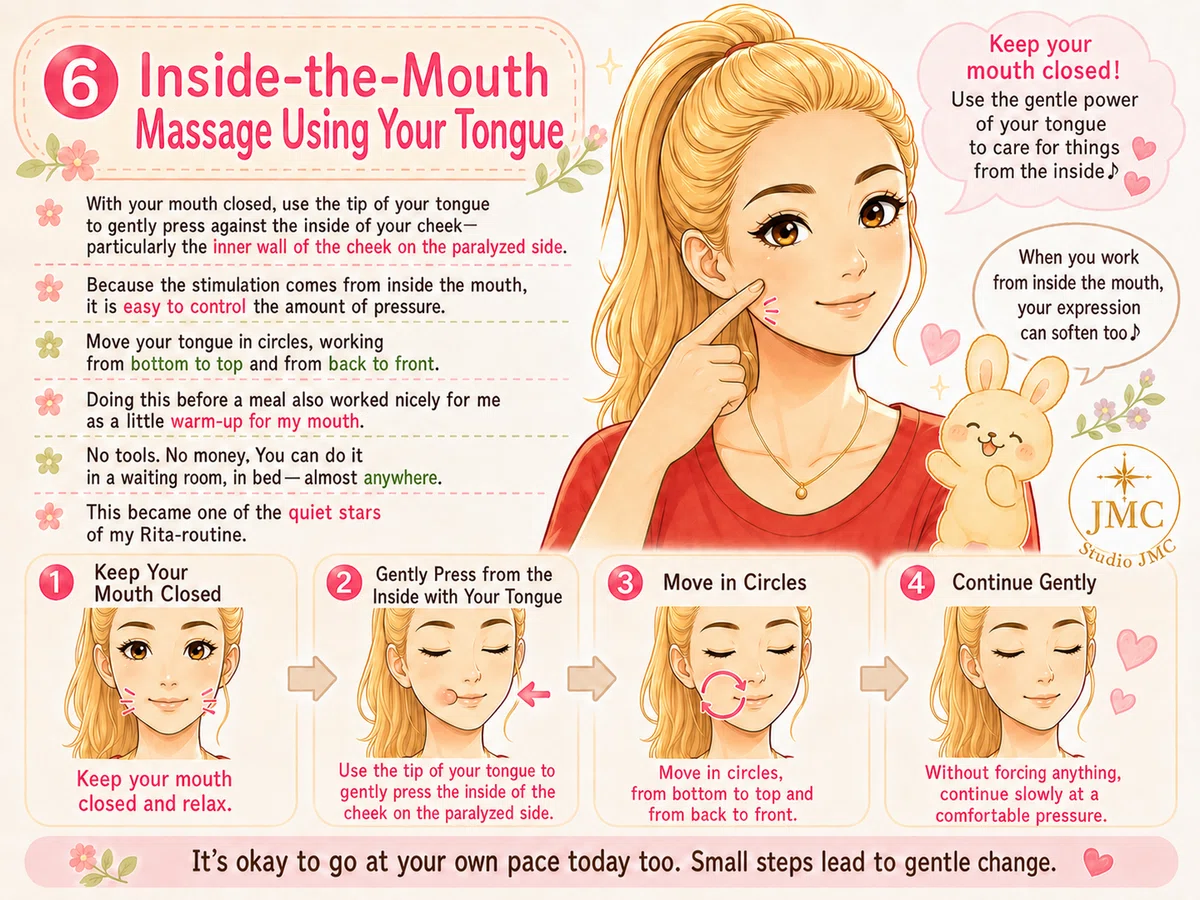
⑥ An Oral Massage, Done from the Inside with the Tongue
With your mouth closed, use the tip of your tongue to press against the inside of your cheek — the inner wall on the paralyzed side — slowly, from within.
Because the stimulation comes from inside the mouth, it's easy to control the amount of pressure, making this something you can keep up without straining. Trace circles, from bottom to top and from back to front. Doing it before a meal also became a little warm-up for the mouth.
It needs no tools and no money, and you can do it anywhere — in a waiting room, or in bed. It's the hidden star of the Rita Routine.
*Steps ⑤ and ⑥ are methods I worked out by listening to my own body and experimenting along the way.
They may not suit every condition or stage of recovery, so please check with your doctor or PT first.
6 Important Tips for Everyday Life During Recovery
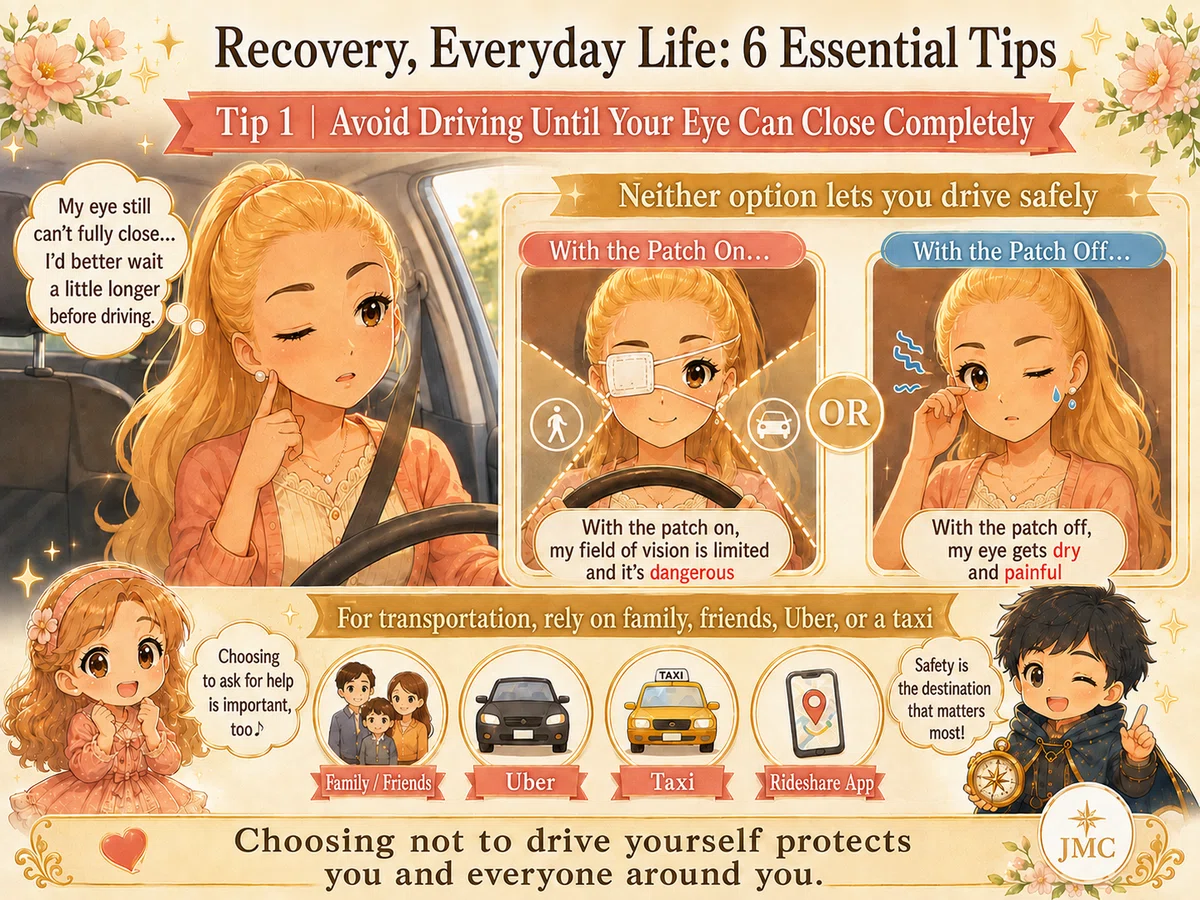
Tip 1 | Avoid Driving Until Your Eye Can Close Completely
This is the first Tip, and it comes directly from one of my own mistakes.
Even though my right eye still couldn't close completely, I was so used to driving that I set off without much thought, driving myself all the way to the acupuncture clinic.
I started driving with an eye patch on — and my field of vision was so narrow that it was frightening. Thinking it was dangerous, I took the eye patch off partway — and now my eye was dry, and it hurt.
With the patch on, you lose your vision; with the patch off, the cornea is at risk.
In other words, whichever you choose, you can't drive safely.
When you absolutely need to get somewhere, the choice of "not driving yourself" — relying on family or friends, or using a ride service like a taxi or Uber — protects you, and protects everyone else around you too.
Tip 2 | Be Twice as Careful in the Kitchen
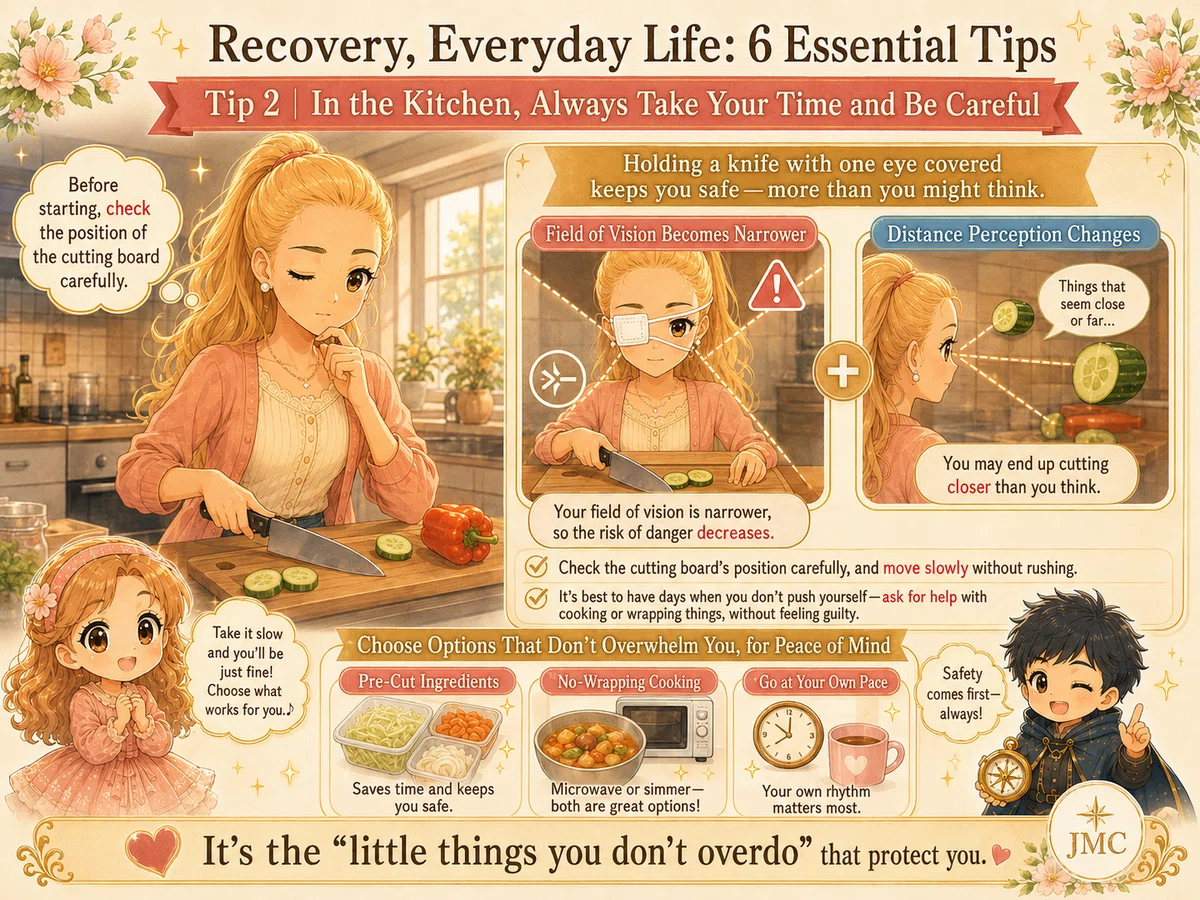
Holding a knife while seeing mainly through one eye — and with a sense of distance that isn't what you're used to — is more dangerous than you might think. Make sure you know exactly where your cutting board is. Don't rush; go slowly. There's no need to push yourself, and it's perfectly okay to have days when you rely on pre-cut ingredients or on cooking that needs no knife at all.
Tip 3 | Use Earbuds or Earphones Only in the Healthy Ear
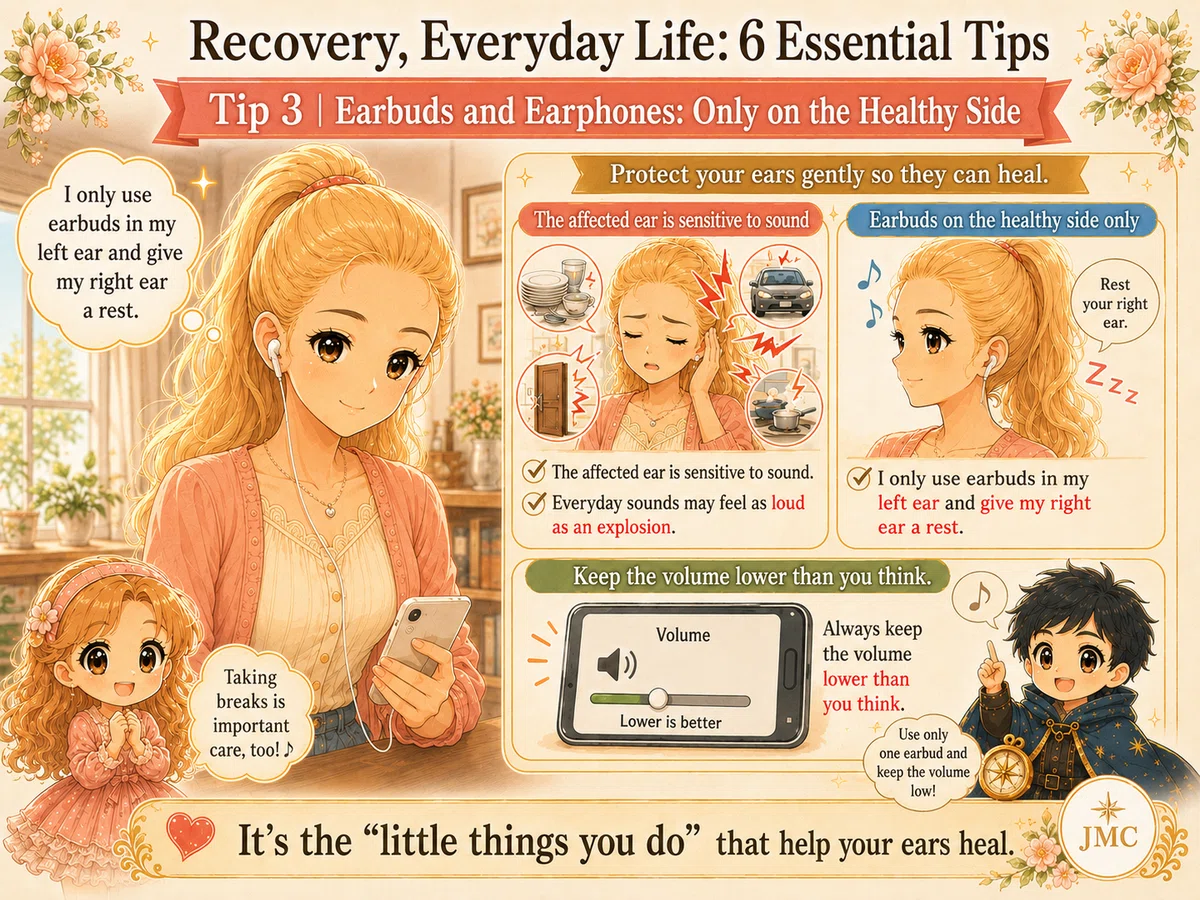
The ear on the paralyzed side becomes very sensitive to sound. (In my case, everyday sounds came through my right ear almost like a roar.) I used an earbud only in my left ear and let my right ear rest as much as possible. And I kept the volume much lower than usual.
Tip 4 | Keep Your Mouth Even Cleaner Than Usual
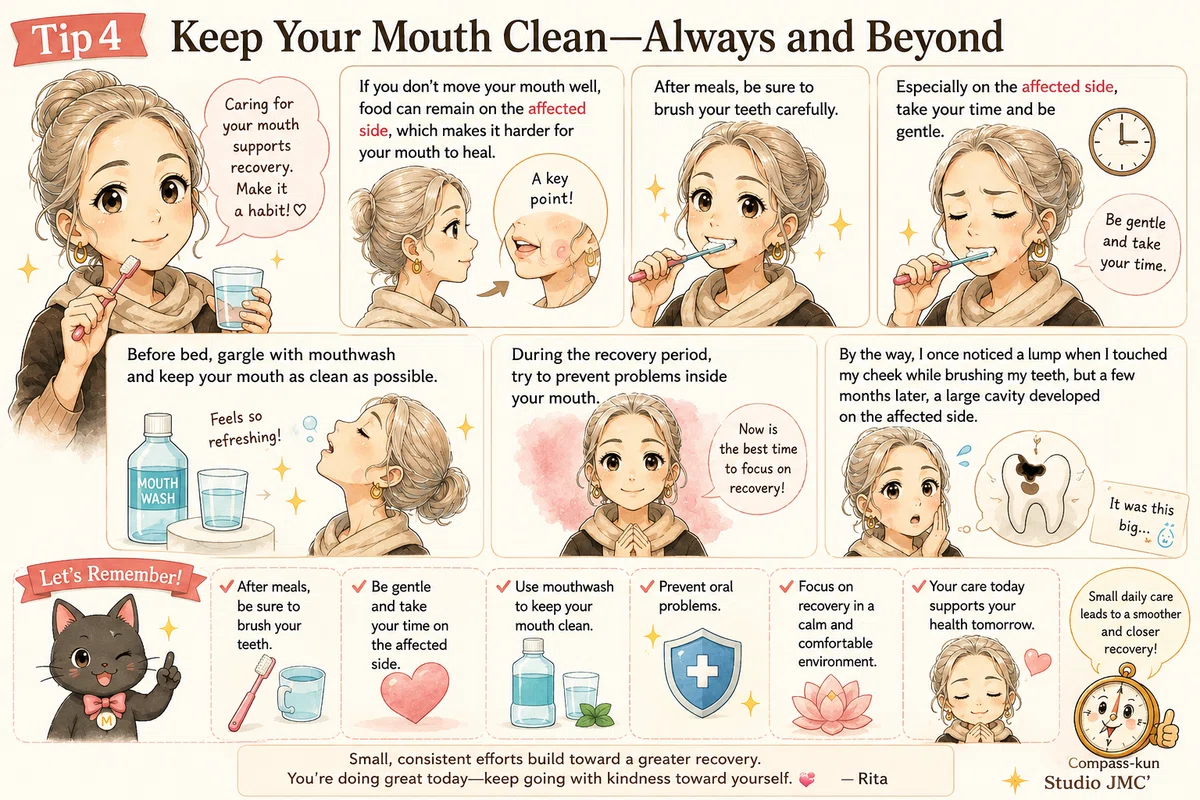
When your mouth doesn't move well, food can easily remain trapped on the paralyzed side. Brush your teeth carefully after eating. On the paralyzed side especially, take a little more time and be more careful than usual. Finish by rinsing with mouthwash, and keep the inside of your mouth as clean as you can — the last thing you need, while your body is focused on recovery, is another problem inside your mouth. And by the way — I thought I'd been careful with my brushing too, but a few months later a large cavity was discovered on my paralyzed side. Sigh.
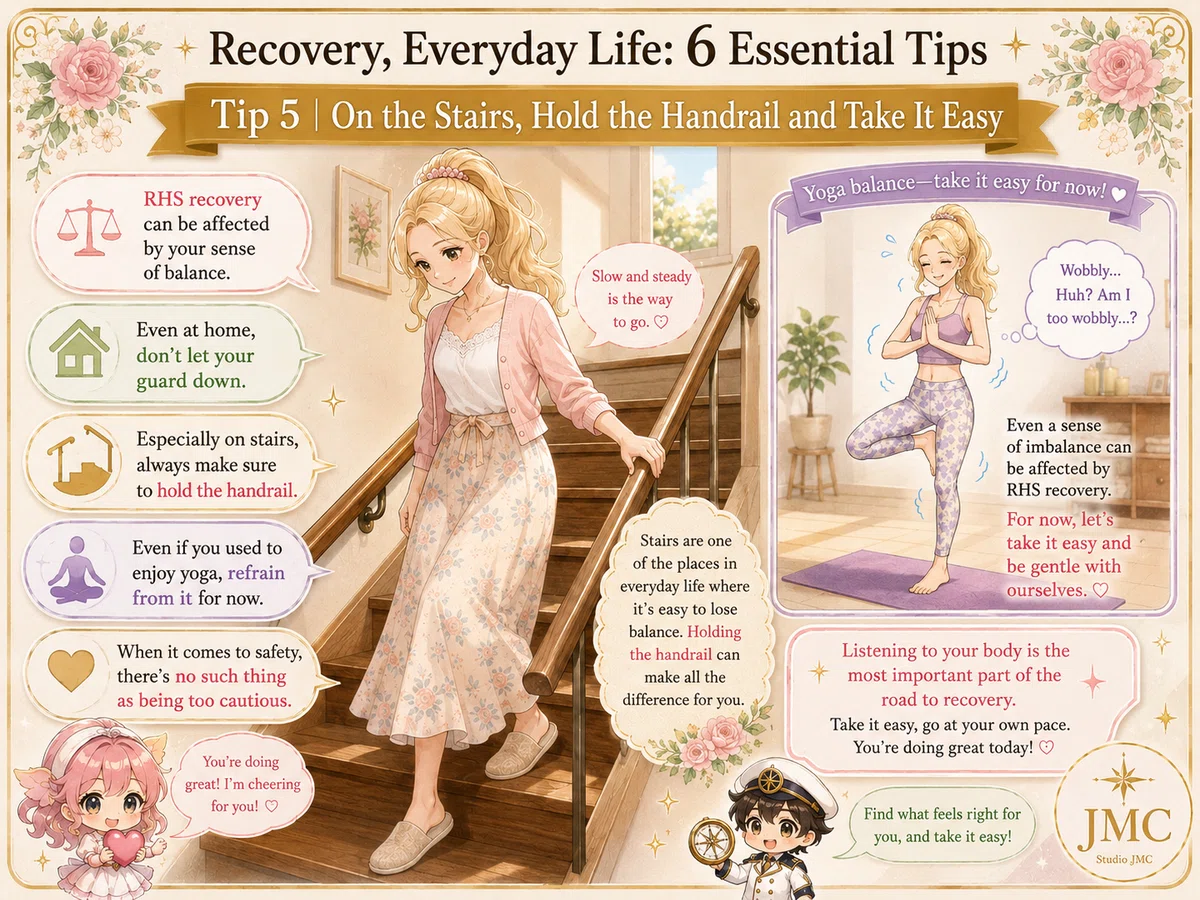
Tip 5 | Use the Handrail and Take the Stairs Slowly
Believe it or not, RHS can have a major effect on your sense of balance. And it's often in the places you know best — your usual routes, your own home — that you let your guard down. On stairs especially, always use the handrail. Even I had to remind myself not to overestimate the balance I'd built through yoga. There isn't a single urgent errand more important than your safety.
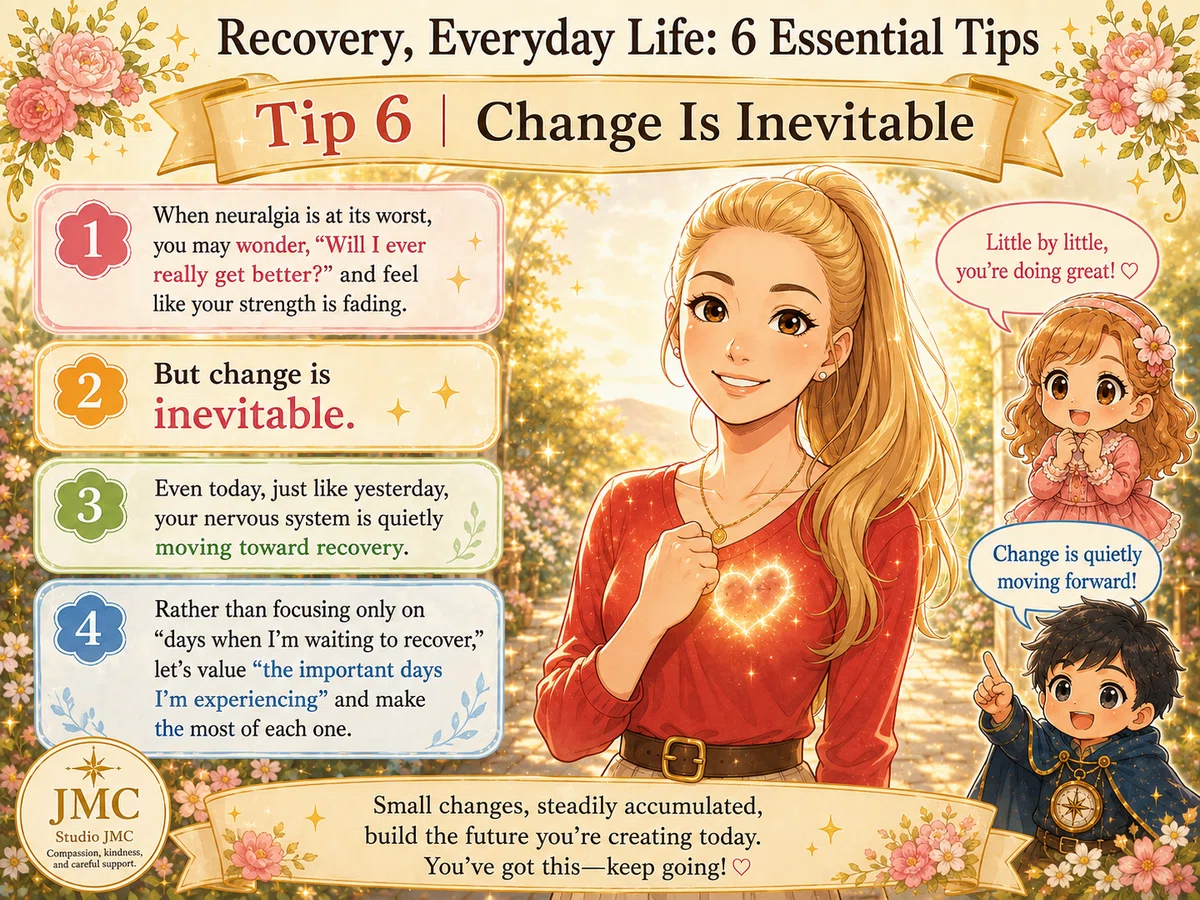
Tip 6 | Change Will Come
When the paralysis is severe, even the very power to believe — "Am I really going to recover?" — begins to weaken. I struggled with that dilemma many times myself.
But change will come. Even on a day that looks exactly like yesterday, your nerves are quietly moving toward recovery beneath the surface.
Instead of seeing each day only as "another day of waiting to recover," let's treasure it as "a day of living through a precious, meaningful experience."
Thank You for Reading All the Way to the End ❤️
You made it! Taping, the routine, everyday-life Tips — we covered a lot again today. Thank you so much for staying with me through all of it.
And somehow, before I knew it, we've already reached the ninth article in this series. To be able to look back on this journey and move forward together with you — that truly makes Rita happy.
Even a road I once traveled alone becomes something different when I look back on it together with someone else. It's no longer a road traveled alone.
And finally, the one thing I most want to tell you at this stage of your recovery.
When the paralysis is severe, your power to believe — "Will I really recover?" — begins to fade. Mine did too.
There may be no showy miracle right away. Careful taping. A routine you quietly keep up, day after day. And the small bits of wisdom and ingenuity of everyday life.
But beyond the accumulation of all those little things, change is waiting for you — surely.
"More than any special tool, it's the small habits you practice every day.
Don't rush; take care with the everyday craft of living today.
And beyond those small efforts, small change is always there to be found."
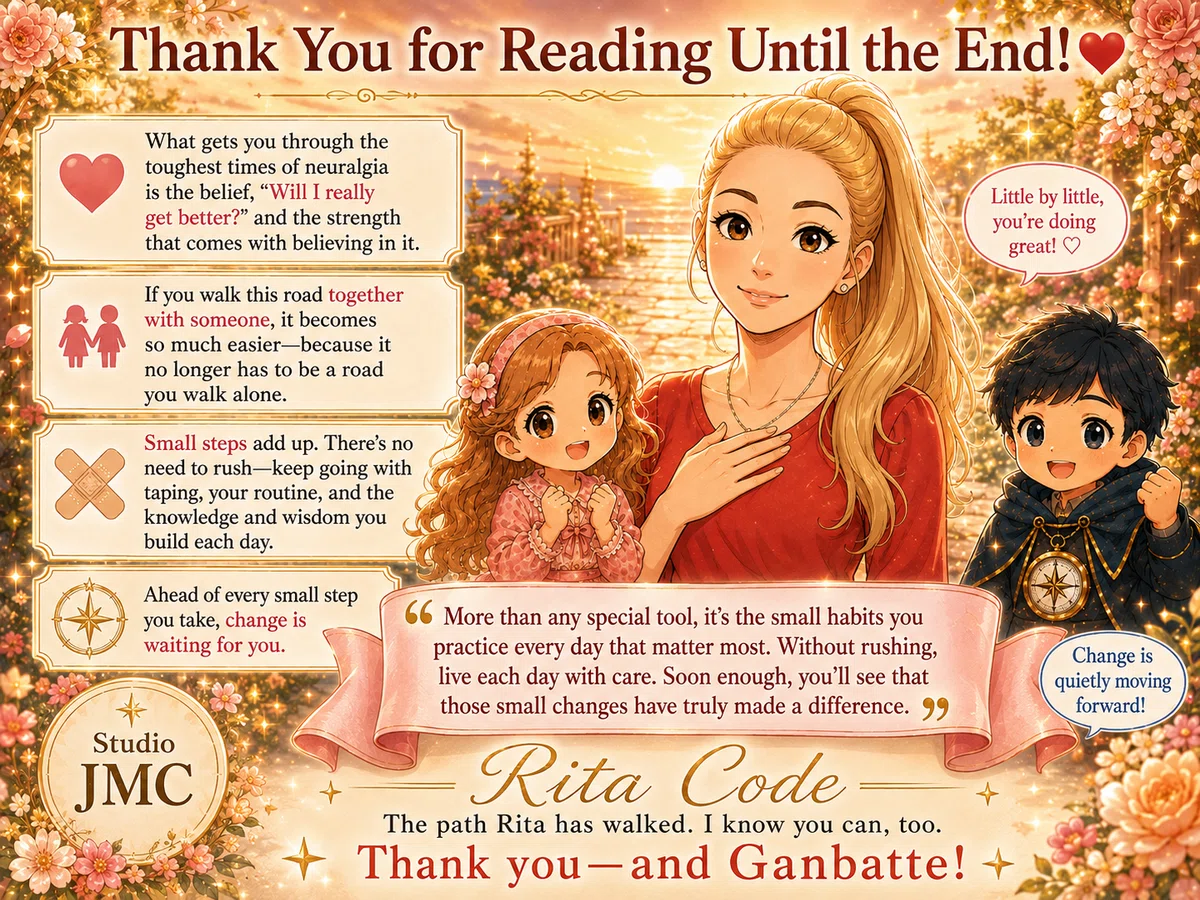
This is a road Rita walked too. And you can do it — truly, truly, I believe you can.
Thank you — and Ganbatte!
Recap Manga: (No.9) To You in Weeks 10 to 12 of RHS
Before we finish, let's take a quick look back at No.9 through a manga.
Click the "Open Viewer (ビューアを開く)" button below to read the recap manga. Because it follows the Japanese manga reading format, once you open the viewer, use the left arrow to move to the next page.
Next Time | Final Episode · Bonus Chapter | Another Prescription: Vipassana Meditation
With the next article, this series finally comes to a close. And the last thing I want to talk about is something you'll never receive at a hospital or a pharmacy — yet it was one of the things that supported my recovery from its very deepest place: Vipassana meditation.
The idea that meditation might help in recovery from facial paralysis like RHS is, I think, something rarely talked about elsewhere.
But for me, the connection is unmistakable. It was precisely because of the "training in observing every corner of the body" that I acquired during a 10-day meditation retreat that I was able to feel, deep inside the paralyzed right side of my face, the faintest changes from within — the quiet sign of nerves trying to reach out and grow once more.
And whenever anxiety or fear threatened to swallow me, meditation brought me back, again and again, to the here and now.
Facial paralysis, and a meditation technique dating back some 2,600 years. At first glance, the two seem completely unrelated. So how did they become connected for me? To close out the Rita Code account of this illness, I'd like to take my time and tell you.
And it is this meditation, together with yoga, that becomes the doorway to Studio JMC's next journey.
The final episode — I hope you'll join me for it.
👉 Click the screen to continue to the next article.

Rita Code | Studio JMC
🇯🇵 Click here for the Japanese version
