
[English Version] A hardcore fan from Japan has expressed their passion for Shenmue through a 120,000-character review—the only one of its kind in the world.

If you’ve found your way to this article, I kindly ask for your help in sharing it with others.
Special thanks to Shenmue Dojo for the inspiration!
This is a masterclass in Shenmue analysis.
Please check out this article too.
Shenmue: An Anomalously Advanced Masterpiece
I am a hardcore Japanese Shenmue fan, and I have come here to address a particular narrative that deeply concerns me. For some reason, Shenmue is frequently dismissed as being "outdated" or "old," but I want to passionately argue that, even by today’s standards, it remains an abnormally advanced and visionary piece of work.
To get straight to the point: by nature, I am a very impatient person. My temperament is built for the high-speed intensity of arcade games, and I generally have little patience for slow-paced, leisurely gameplay. Therefore, my fascination with Shenmue doesn’t stem from a love of "relaxing" in its world. Rather, I am electrified by its sheer purity, its staggering ambition, its radical innovation, and its monumental significance in the grand tapestry of video game history.
It is often claimed that Shenmue I: Yokosuka is boring. To be honest, I won’t go so far as to say that every single moment of the Yokosuka chapter is entertaining in a conventional sense. I also don't necessarily prioritize the specific elements that critics like Mr. Kurabe from IGN Japan often highlight as its best features. However, the concept of a game being "interesting" is multifaceted. When you consider the character modeling, the high-resolution textures for its time, the fluid motion-captured animations, the desperate situation SEGA faced, the tragic destiny of the Dreamcast console, the massive media hype, the technological foresight, the sheer audacity of the project, the fact that it remained unfinished, and even the "memetic" entertainment value of the forklift segments—all set against its historical background—there is simply no other video game in history that is as rich in conversation, as exhilarating, as unique, and as special as Shenmue.
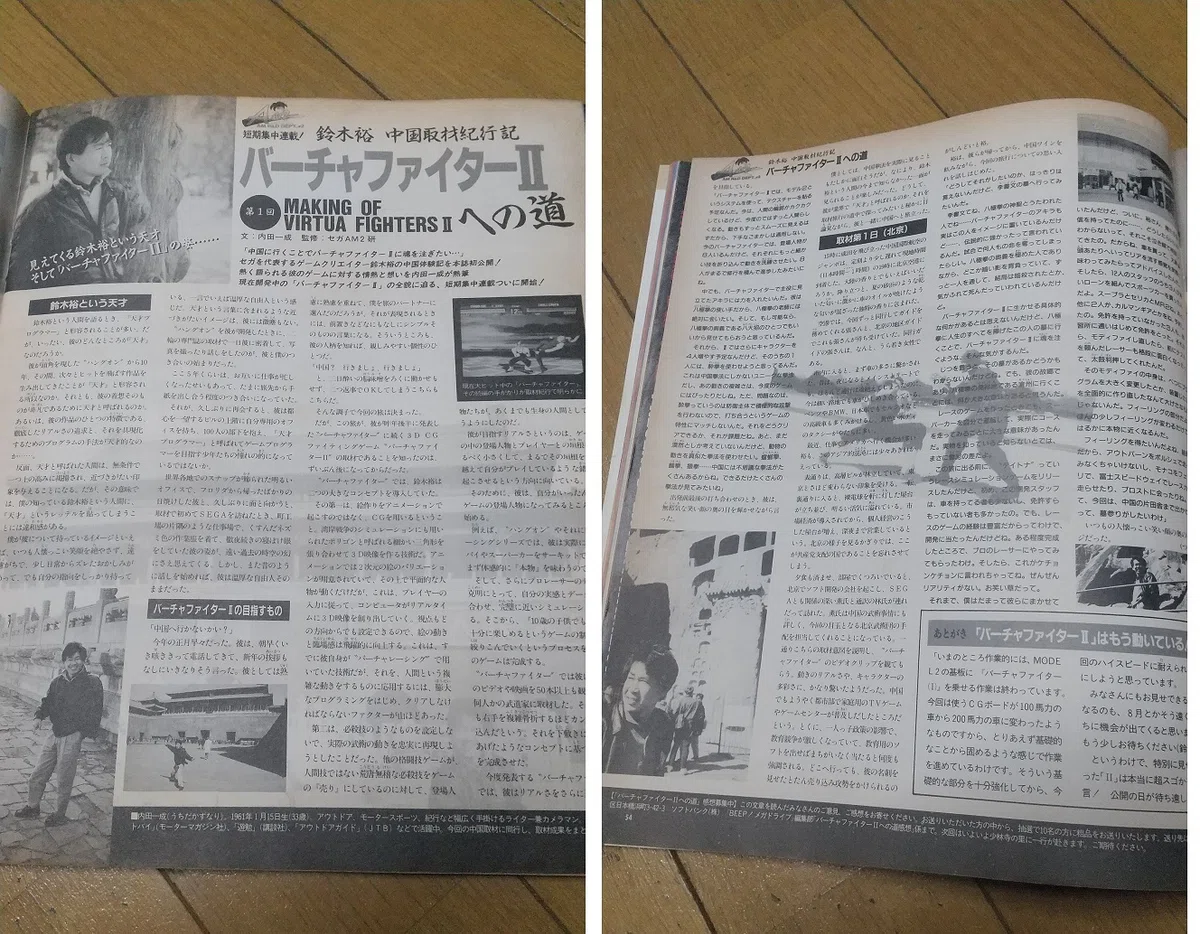
My journey with this game began around 1994, even before the announcement of Virtua Fighter 2. At that time, the magazine BEEP! Mega Drive was serializing Yu Suzuki’s "China Research Diary." I recall reading those monthly installments with immense anticipation. The transition from those real-world travelogues to the earth-shattering moment when the first images of Virtua Fighter 2 were revealed is a shock that remains permanently etched into my soul.
I believe the very foundation of Shenmue was Yu Suzuki’s burning desire to translate his personal experiences and discoveries from his travels in China into a digital medium. I was beyond thrilled at the prospect that the experiences I read about in those articles were actually being transformed into a playable reality.
One final technical note: if you connect an original Dreamcast to a modern LCD television using standard composite video cables, the output results in extremely poor image quality that does not represent the game's true beauty. Please do not mistake that degraded visual state for the actual aesthetic of Shenmue. Since I lack the equipment to capture high-quality footage from the original hardware, I am—somewhat reluctantly—using images from the PS4 version for this presentation.
Shenmue: A Cultural Triumph and the Misunderstood Legacy of SEGA’s Investment
People often talk about the financial side of Shenmue as if it were a disaster, but they fail to see the larger picture. In reality, SEGA simply took the massive profits they had accumulated from global hits like Virtua Fighter and reinvested that capital into their next creative frontier. This is the natural cycle of a visionary company, yet the casual audience seems incapable of grasping such a complex, multifaceted understanding of business and art.
The general public tends to think in binary, simplistic terms. Is politics Left or Right? Should a child learn piano or swimming? They categorize games with the same shallow labels: "This is a Soulslike," "This is a fighting game," or "This is an open-world game." Once they are conditioned by headlines claiming "Shenmue was a 7-billion-yen failure" or "Shenmue is outdated," they become trapped in a loop of shallow thinking, unable to look past the surface-level narrative to see the groundbreaking reality.
Let’s look at the facts. Virtua Fighter 4 was a massive success, and the original Shenmue: Yokosuka actually sold over a million copies. Contrary to popular belief, Yu Suzuki did not run the company into the red during the Shenmue era. The financial troubles came much later, with the failure to complete Shenmue Online or the unfortunate cancellation of Psy-Phi due to a lack of orders. These separate historical events should never be conflated with the production of the original masterpieces.
For some reason, people only want to criticize Shenmue for its supposed lack of sales. But we must ask: where should a game company spend the money it has earned? The ideal answer is to take profits from games and pour them back into the creation of even better games. Shenmue was the embodiment of this ideal; it was a pure, courageous investment in the future of the medium. The results speak for themselves: SEGA inherited the systems, the logic, and the technology of Shenmue to create the Yakuza (Like a Dragon) and Judgment series. Why do media outlets and streamers refuse to acknowledge this vital lineage and evaluate Shenmue accordingly?
What is truly egregious is the state of franchises like Dragon Quest or Pokémon. Despite earning astronomical amounts of money, those games remain stagnant and "old" in their design. They have contributed nothing to the technical evolution of the industry. Dragon Quest, in particular, seems to exist merely as a financial cushion to offset the deficits incurred by Final Fantasy.
Compare Shenmue’s production costs to the modern landscape: mobile game developers who take the money and run, or CEOs who pocket 30 billion yen in personal salary while their products lack soul. In that light, wasn't Shenmue’s budget a far more wholesome and honest use of funds? Today, we see companies spending billions on "template" games that lack originality and end up as massive financial disasters. It is fundamentally wrong to treat Shenmue with the same disdain as those soulless failures.
The "70 billion yen" figure is also a myth, often confused with the total marketing budget for the Dreamcast hardware itself, which is far from the reality of the game's actual production cost. Shenmue was an investment in culture and technology; it was SEGA "giving back" to its players and its employees. It was a masterpiece that resulted in a "cultural surplus" for the future. Even Shenmue II stands as a definitive masterpiece in video game history—a total success in terms of game design. If the series couldn't continue at that time, it wasn't because of a lack of quality, but likely because the staff had reached the absolute limits of human exhaustion and burnout after such a monumental undertaking.
The Fallacy of "Old": Why Shenmue Remains More Modern Than Today's Hits
The "newness" of a video game is not determined by the calendar year printed on its box. True modernity is defined by the underlying "grammar" and the structural philosophy the game employs. Many people fail to see that a game released decades ago can be fundamentally more advanced than a title released yesterday.
For instance, Minecraft is conceptually newer than the latest Pokémon entry. Pac-Land is architecturally newer than the repetitive "run games" cluttering modern app stores. Princess Maker possesses a more sophisticated grammar than eBaseball Powerful Pro Yakyuu 2024-2025, and Virtual On: Oratorio Tangram remains more innovative than Tekken 8.
Even within the fighting game genre, Street Fighter II was a "new" game because it invented a revolution, whereas Street Fighter 6 is effectively an "old" game because it merely optimizes that 30-year-old grammar. In contrast, Virtua Fighter 2 introduced a grammar of 3D spatiality that Street Fighter 6—which still restricts movement to a 2D plane and only recently adopted 3D models—has yet to truly embrace. Therefore, logically, Virtua Fighter 2 is the "newer" game. We must distinguish between "Innovation" and "Optimization."
I want the world to understand this: Shenmue II is fundamentally newer than Dragon Quest XI. Since the rise of the Pokémon generation, the video game industry has undergone a radical shift toward extreme conservatism. Even on a purely aesthetic level, the dissonance is absurd. Streamers who would never dare call the Game Boy Advance-style grammar of Pokémon "old" have the audacity to dismiss Shenmue: Yokosuka as "outdated." This is a complete fabrication of reality. The grammar of Pokémon remains stuck in the 1980s, yet Shenmue’s grammar contains elements that modern titles still haven't managed to catch up to.
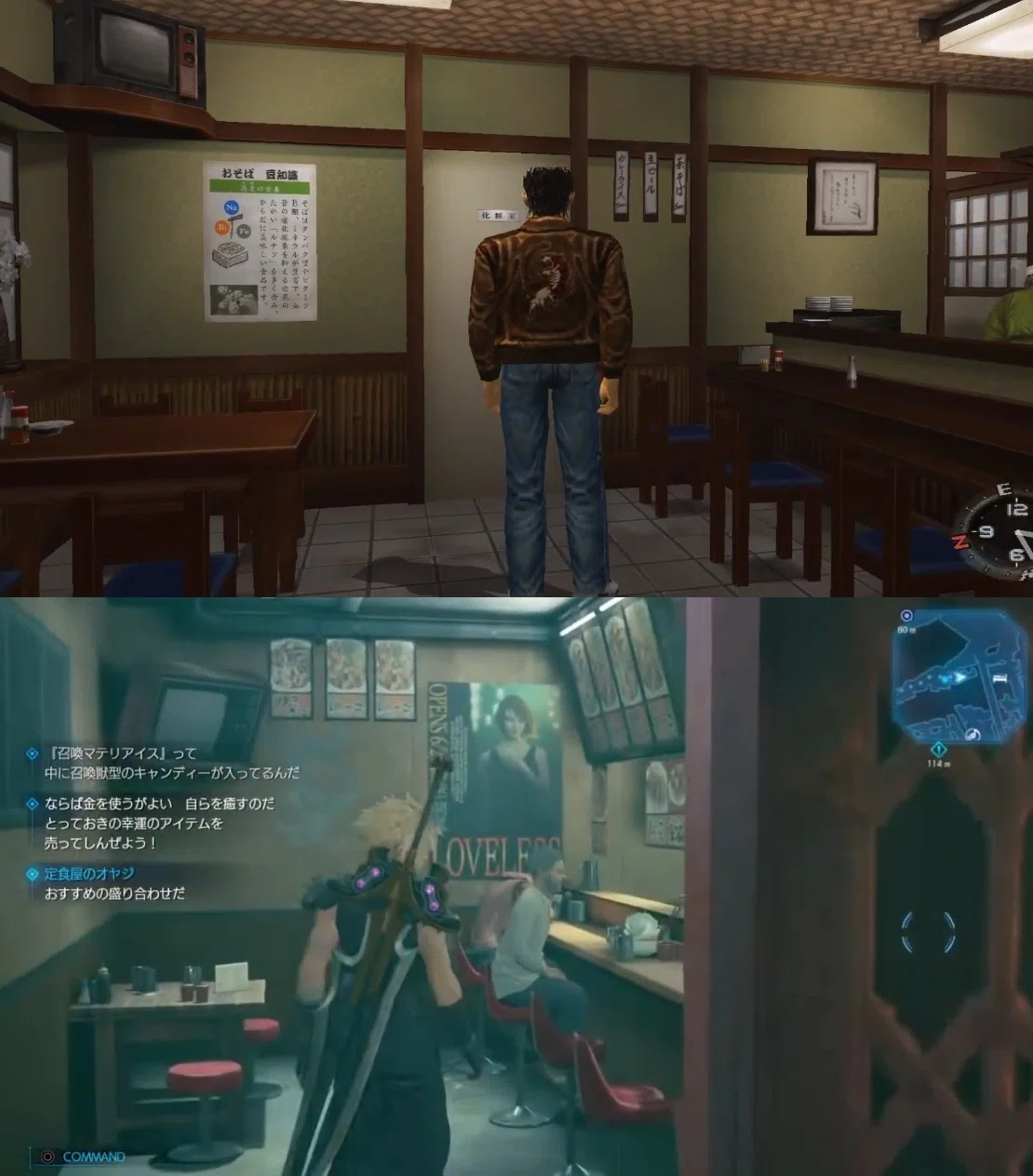
Look at the visual comparisons. If you place Final Fantasy VII Remake (2020) alongside Shenmue: Yokosuka (1999), it is blindingly obvious that Final Fantasy VII follows a more restrictive, "older" design philosophy. The same applies to Like a Dragon Gaiden (2023). Not only is the visual language similar, but the core gameplay loop of the Yakuza and Judgment series is essentially the same as Shenmue. And yet, a bizarre "inversion phenomenon" occurs where only Shenmue is labeled "old."
Shenmue was so revolutionary that the generations raised on OutRun, Dragon Quest, and Pokémon simply could not comprehend its depth. Originally, those who understood Shenmue’s new grammar were "progressive," and those who couldn't were "conservative." Today, that logic has been flipped: those who failed to understand it now claim "Shenmue is old," and they dismiss those of us who recognized its brilliance as "nostalgic elitists."
This is historically and logically illiterate. The Pokémon generation, having failed to grasp Shenmue, continues to play RPGs rooted in 1980s grammar. They do not seek evolution; they reject it. They rejected the realistic physics of F355 Challenge and the intricate life-simulation of Shenmue. They mistake old formulas for new ones and attack those who discuss history as being "stuck in the past." That, in itself, is the true definition of nostalgia—clinging to a stagnant past while calling it "new."
To call Shenmue "old" or its fans "nostalgic" is a dishonest goalpost-shifting that I cannot accept. I am not claiming Shenmue is "newer" than Cyberpunk 2077 in terms of raw tech; I am talking about systems and paradigms. Media outlets are quick to label every new IP as "Soulslike," so why can't they have the integrity to say, "This has become Shenmue-esque"?
Of course, by 2026 standards, Shenmue has dated elements. I am not here to blindly praise every single flaw. But Shenmue is a monumental achievement that cannot—and should not—be defined by such a shallow, chronological perspective.
comparison image Doesn’t it look identical.?
The Madness of Audiovisual Perfection: Why Shenmue Defies Conventional Critique
The true essence and thrill of Shenmue lie in what I can only describe as the "madness of its audiovisual expression." Most people attempt to critique video games using a standard set of metrics: character development, RPG mechanics, action-adventure loops, or UI systems. But to view Shenmue through such a narrow lens is to miss its soul entirely. The defining characteristic of Shenmue I: Yokosuka and Shenmue II is the "abnormality of maintaining a singular, uncompromising level of quality throughout the entire experience."
When critics dismiss Shenmue by complaining about "clunky controls" or "slow pacing," they are using the wrong yardstick. It is the equivalent of watching a masterpiece by Akira Kurosawa or Isao Takahata and dismissing it because "it’s old," "the resolution is low," or "the audio recording quality isn't modern." Such comments are fundamentally disconnected from the artistic intent.
Take, for example, the iconic sequence where Ryo and Ren are handcuffed together for an extended period. In any other game of that era—including titles like Metal Gear Solid 2—you would see a noticeable drop in animation quality or simplified physics during such a complex scene. But in Shenmue II, there is no compromise. The motion, the sound, and the overall fidelity remain flawless. It is a legendary scene that stands as a testament to the history of the medium.
Whether it is a metal pipe or a soda can, every object in the world reacts with the same high-quality movement and superb sound design. Even the sound of a metal pipe hitting the ground has a distinct, satisfying resonance. It strikes me as odd that when I listen to modern streamers or games journalists, they almost never discuss the importance of sound. Yet, in my view, it is the quality of the sound effects that truly dictates the "feel" and immersion of a video game.
Furthermore, the leap in quality between the early development stages of the first game and the final release of Shenmue II was staggering. While the early models were already impressive for their time, Shenmue II reached a level of hyper-realism and detail that was virtually unparalleled. I highly praised this evolution at the time, but the world at large seemed content with the "good enough" fidelity of Final Fantasy X or Metal Gear Solid 2, failing to recognize the sheer technical heights Yu Suzuki’s team had scaled.
The sight of NPCs realistically opening umbrellas when it rains is a hauntingly beautiful and "abnormal" spectacle for a game from 1999. Video games are not solely defined by interactive gameplay; there is a profound joy in simply observing a world crafted with such care. Typically, as hardware evolves, older games begin to look "cheap." However, the audio, motion-captured movements, and textures of Shenmue possess a timeless, permanent value.
Like the pixel art of Metal Slug, Shenmue possesses a greatness that does not wither with age. The character modeling of the protagonists, the intricate textures of the environment, and the weight of the motions in event scenes remain breathtaking no matter how many times you view them. The texture work alone is beyond anything reasonable for that hardware. The way a hand realistically grips a leaf—that specific "snap" of motion—is something I never grow tired of watching.
Just as Metal Slug remains visually stunning even in the 4K era, Shenmue belongs to a rare category of games that will never be produced again. In my youth, I used to call Metal Slug, Grandia, and Shenmue the "Three Great Games of Death by Overwork," referring to the insane level of human labor required to create them. Games of this caliber should not be discussed in terms of mere "likes or dislikes." What are the media outlets like IGN or the famous streamers doing if they can't see this?
It is the same "madness of visual expression" found in Isao Takahata’s The Tale of the Princess Kaguya. The story is only one part of the experience; the obsession with the frame is where the true power lies. Modern video games might look impressive at a glance, but they often feel like products of "healthy labor"—developed by teams hanging onto a standard engine, following a spec sheet to create parts that fit together perfectly. You don’t feel the heat, the sweat, or the obsession from the screen. For me, "nothing is as interesting as a touch of madness."
The essence of Shenmue is that it is a crazy, abnormal, and beautifully broken project. Once you have experienced a game built with the uncompromising spirit of Shenmue II, it becomes difficult to find conventional, "well-adjusted" video games interesting ever again.
Beyond "Open World": Shenmue as the Pioneer of Full-Scale 3D Reality
When people discuss Shenmue today, they often settle for the simplistic label of it being the "ancestor of the Open World genre." Frankly, such a superficial classification is intellectually lazy and misses the point entirely. Why is it that no one seems capable of discussing Shenmue in its true context? It was the pioneer of the "Full-Scale 3D Environment" and the first to introduce a functional "Time Axis" into a 3D space, effectively transforming a video game from a mere set of levels into an independent, living world.
Back in 1999, the term "Open World" didn't even exist in our vocabulary. When people try to explain Shenmue now, they are forced to retrofit it into existing modern categories, but there simply isn't a word that adequately describes a game like Shenmue, which fundamentally transcends multiple genres. As a result of this linguistic limitation, it is clumsily shoved into the "Open World" box. If we must label it, we should simply call it the "Progenitor of the AAA Title" and leave it at that.
Before Shenmue arrived, the spatial logic of video games was warped. Even Spikeout Final Edition, arguably the greatest masterpiece of the 90s, suffered from skewed spatial proportions. In Shenmue, however, the interior and exterior spaces are connected with logical, physical consistency. Even as late as Yakuza 5 (Like a Dragon 5), the dimensions of doors, signs, and benches weren't unified in a realistic scale; it still hadn't achieved true "full-scale" status. Yet, for some inexplicable reason, this monumental achievement of Shenmue—its commitment to authentic, real-world proportions—is almost never part of the conversation.
My obsession with this level of detail goes back to Virtua Fighter 2. When I played that game, I often found myself wanting to step off the fighting stage without a battle, just to walk behind the arena and inspect the modeling and texture work of the swaying trees in the background. I was captivated by the physical construction of that world.
The same feeling hit me when playing the Long Beach circuit in the Dreamcast version of F355 Challenge. While driving, I harbored a deep desire to stop the car, step out of the cockpit, walk into the surrounding skyscrapers, and take an elevator all the way to the rooftop. I believed that the simple act of existing within and exploring such a space was enough to constitute a game in itself. When Shenmue was announced, I was overjoyed because I realized: "Finally, the game that lets me do exactly that is arriving!"
The moment I started the game, I didn't just run to the next objective; I immediately tilted the stick to look up and stared directly at the architecture, confirming that the world was built to a true human scale.
The Chronological Revolution: Why "Waiting" in Shenmue is the Ultimate Innovation
There is a fundamental element of Shenmue that is almost entirely ignored in modern discourse: the introduction of a functional time axis. We must stop the ignorant narrative that equates "waiting" with "outdated design." In an interview, Director Yu Suzuki once explained his vision with mathematical clarity: "Having mastered 3D space with Virtua Fighter, I wanted to add one more dimension, one more variable to the equation. That variable was 'T'—Time."
This was a radical paradigm shift. In Shenmue, the player does not exert absolute control over the game world; instead, the player must adapt themselves to the rhythm of the world. I am convinced that if Nintendo had released this game, the media would have constructed a grand narrative around it. If Nintendo had pioneered this, "the addition of a time axis" would be hailed today as the pinnacle of game design innovation. We would see endless video essays from influencers profoundly analyzing "the philosophical meaning of waiting for the bus."
However, because it was SEGA, the response was shallow and dismissive. Streamers and critics lazily labeled it with phrases like "Waiting is boring," "Waiting is old-fashioned," or "Going to sleep every night is a chore." There is a blatant double standard at play here. If the exact same mechanics were in a Nintendo title, they would be praised as a "new way to play." People often resort to the tired stereotype that "SEGA games are just edgy and niche." When Nintendo does it, it's "innovative"; when SEGA does it, it's just "sharp and unrefined." Yet, look at Animal Crossing—there are countless players who adhere to a strict "no time-travel" policy, embracing the wait. Look at the vast, slow sea travel in The Legend of Zelda: The Wind Waker. That was incredibly "edgy" gameplay, which I personally admired, yet it didn't face the same derogatory "outdated" labeling that haunts Shenmue.
Shenmue remains an abnormally advanced title precisely because of this time axis. It is the engine that drives the dynamic weather, the setting sun, and the complex schedules of NPCs. You see characters going about their business during the day and then making their way home in the evening. To create a world that truly breathes—one that possesses a "lived-in" feel—a dedicated time axis is an absolute necessity. In Shenmue I: Yokosuka, the intersection of time and NPC behavior functions as a "system of autonomous world-building" to a degree that even Shenmue II didn't fully replicate.
Time in Shenmue is not a mere visual effect; it is the force that moves the universe. Almost no modern video game, even today, is as thorough in its commitment to this principle. Suzuki-san introduced a "time-dependent event structure." This forced players to truly "kill time" within the virtual space. Knowing that an event only triggers at a specific hour transformed "waiting" from a lapse in activity into a deliberate act of "gameplay" and "strategy."
This concept of a "world-dominant" game—where the world’s rules take precedence over the player's convenience—is a philosophy that is rarely adopted and even more rarely discussed in the current industry. In the beginning, Ryo wakes up alone in his house. Eventually, as the story progresses, he finds himself being woken up by different people. If this were a Nintendo game, the internet would be flooded with deep-dive videos titled "The Inescapable Reality of Sleep" or "The Emotional Significance of Being Woken Up by Others."
If we are to offer a fair critique, the issue was never the "act of waiting" itself; the problem was the "lack of diverse activities to engage in while waiting." Aside from playing Space Harrier at the arcade or practicing moves alone, the game struggled to bridge those gaps seamlessly. Having to travel all the way back home just to sleep was undeniably a clunky implementation of a brilliant idea. However, these technical growing pains should not obscure the fact that Shenmue's temporal ambition was decades ahead of its time.
The Guilin Arc: A Radical Masterpiece of Pure "Walking" that Transcends Genre
The Guilin chapter in Shenmue II (Disc 4) represents a form of gameplay that simply does not fit into conventional labels like RPG, Action, Adventure, or even Open World. It is an anomaly of pure expression. In almost every other video game, "movement" is merely a utilitarian means to an end—a way to get from Point A to Point B. However, in the Guilin arc, the act of walking itself becomes the core gameplay. It is not a scripted event; rather, the physical act of walking through the landscape is designed to weave the narrative together. This was likely the first successful example in history where "just walking" was established as a viable form of digital entertainment.
The contrast is breathtaking: moving from the deafening bustle of Hong Kong and the claustrophobic chaos of Kowloon into the extreme, static serenity of Guilin is a masterstroke of pacing. This final act of Shenmue II is a singular moment in video game history that could never be replicated in film or manga. There are no battles, no complex puzzles, no part-time jobs—nothing. To rush through this part of the game is a tragedy. Even though all typical "game-like" stimuli have been surgically removed, the experience provides an incredible sense of euphoria just by walking and talking with Shenhua. Every single frame of this journey is a work of art. When played on original Dreamcast hardware via VGA output, the scenery is hauntingly beautiful, even if the sheer visual ambition causes the frame rate to struggle. Unlike Mr. Kurabe, I am a staunch supporter of the fantasy elements in the series, and I am desperate to see the continuation of this vision.
The textures in Guilin possess a power that is fundamentally different from the high-resolution, three-dimensional textures of modern games. The sheer obsession evident in the texture work and the meticulous care in every motion-captured movement is a testament to the monumental ambition behind the project. Guilin is a manifestation of creative "madness." I have never seen anything like it. I was genuinely shocked to see comments on YouTube claiming that "Guilin was a lazy, low-effort part of the game." My reaction was the exact opposite: I feared Yu Suzuki was going to work his staff to death. It is deeply frustrating that what I see as an pinnacle of human effort, the casual audience perceives as "cut corners."
I personally spent hours zooming in on every surface, marveling at the textures. Unfortunately, if you use standard video cables on a modern TV, the image becomes a blurry mess, and you lose about half of the intended impact. For the true experience, a VGA Box is mandatory to connect the Dreamcast to a high-quality display. It is a shame that so many people judge the game without having seen it in its intended clarity.
This brings up a painful double standard: why was Death Stranding hailed as a masterpiece of "walking" while Shenmue was ridiculed for it? The fact that people call Shenmue II "too niche" while giving Hideo Kojima a pass is nothing more than media bias and "Kojima bias." When a creator has that kind of cultural capital, the media constructs a favorable narrative for them. There must have been countless players who wondered, "What is actually fun about just walking in Death Stranding?" but the influencers and journalists only spoke in positive terms, rushing to explain the "profound meaning of the journey."
When it’s a Kojima game, it’s "deep," "artistic," and "innovative." When it’s Shenmue, it’s "just walking," "bland," and "pointless." The interpretation is night and day. I interpreted the lack of battles in Guilin differently; perhaps, because the budget was tight and they couldn't build massive set pieces, they leaned into the criticism of the "errand boy" genre and decided to make the ultimate, purest version of an "errand" game as a form of artistic defiance.
Since the 90s, "linear RPGs" have been criticized negatively. Yet, Shenmue II Disc 4 is a "linear" experience in the truest, most literal sense. Even now, in 2026, IGN Japan is hosting discussions on whether "linear games are outdated." The reality is that 25 years ago, Shenmue had already mastered and established the artistic potential of a linear gameplay loop. It brought a completely new level of spatial and temporal awareness to the medium, proving once again that it was decades ahead of its time.
The Philosophy of the Step: Why "Clunky" Walking in Shenmue is a Technical Marvel
It is undeniably true that Shenmue feels "difficult to walk in" by modern, homogenized standards. However, what people fail to understand is that every single step in this game has profound meaning. I desperately want the media and critics to stop complaining and start explaining the unprecedented brilliance of Shenmue’s walking motions. We are talking about a game that introduced a rigorous "sense of grounding," where the character’s feet firmly grip the terrain. Whether it is the way Ryo's weight shifts or the fact that he descends stairs one individual step at a time, these were groundbreaking innovations.
In most games, even today, feet often "clip" through the geometry of stairs, but in Shenmue, they do not. The sensation of descending a staircase with such physical accuracy is a magnificent achievement in virtual presence. Consider the horses in The Legend of Zelda: Breath of the Wild. Because Nintendo aimed for a high degree of realism, those horses are notoriously difficult to control and feel quite "clunky" to many. Yet, the media remains silent on this comparison. Why is it that when Zelda’s horse is hard to control, it is "realistic," but when Shenmue’s movement is hard to control, it is "outdated"?
There is a clear double standard here. In Dragon Quest XI, the horses are not realistic, making them "easy" to operate, but they lack soul. If anyone dared to criticize the difficult controls of the horses in Breath of the Wild, Nintendo fans would immediately retaliate, saying, "You’re just bad at the game," or "You don't appreciate the realism." To be blunt: regarding Shenmue, many modern streamers and reviewers are simply "too unskilled" at the controls. I want these broadcasters to improve their mastery of the game’s mechanics before dismissing them. Intrinsically, Shenmue does not demand the high-speed precision of an action game like Zelda; once you acclimate to its rhythm, the movement is actually quite simple and deliberate.
This is a game built on the purity of "just walking." For example, the sequence after arriving in Kowloon where you must simply follow Ren to the herbal medicine shop is a legendary piece of game design. It was the pioneer of the "follow mission," but executed with an atmospheric weight that remains a landmark in gaming history. Part of why walking in Shenmue is so exhilarating is the sheer quality of the foley work. The game features an abnormal variety of sound effects—the sound of Ryo’s footsteps changes minutely depending on the specific texture of the road surface beneath him. Whether it is Dragon Quest or any other major title, I am constantly disappointed that streamers and writers never talk about the audio design. They seem to forget a fundamental truth: it is the quality of the sound effects that ultimately determines whether a video game feels "fun" or "real."
The reason Animal Crossing is so captivating follows the same logic. When Animal Crossing+ was first released, it was a shock to the system. It featured real-time synchronization, no overarching plot, no urgent goals, and no inherent meaning in its individual actions. In its original form, it was an incredibly "niche" and "hardcore" game.
I will admit, I didn't realize that Shenmue was a game where you "shouldn't run" during my very first playthrough of the Yokosuka chapter. But after playing it several times, a realization struck me: although Ryo wants to avenge his father as quickly as possible, the game itself is designed so that you must not rush. By the time I started Shenmue II, I had already made a firm resolution: "I will play this entire game without running a single time." To travel is to walk. The perceived "difficulty of movement" is not a flaw—it is an essential, inseparable element that constitutes the very soul of the Shenmue experience.
The Philosophy of "Blank Space": Why Shenmue’s Emptiness is its Greatest Strength
In the modern discourse of video game criticism, there is a fundamental misunderstanding regarding the necessity of vast fields and seemingly "empty" environments. To truly foster the sensation that a living, breathing world exists beyond the screen, the inclusion of "blank space" (or "Yohaku" in Japanese aesthetics) is absolutely essential. The true purpose of a massive, sprawling field is to create the psychological impression that "this world continues infinitely into the horizon." Without these margins of non-utilitarian space, the illusion of a world’s existence simply fails to take root.
However, modern game design often commits a fatal error: developers feel compelled to cram every corner of the map with items, shrines, or collectibles. When you place a "gameplay reward" in every nook and cranny, the space ceases to be a "world" and instead becomes a "checklist." The vastness loses its inherent meaning because the player's movement is always dictated by the pursuit of a functional reward. This is a nuanced point that many people struggle to grasp.
What did Shenmue achieve in this regard? Its greatest innovation was the deliberate creation of "blank space." Take, for instance, the Kowloon Walled City in Shenmue II. You can enter almost every single room in those massive apartment complexes. The significance does not lie in what you "find" inside those rooms; the significance is that the rooms exist. By allowing access to spaces that serve no direct mechanical purpose, the game functions as a masterpiece of world-building, using those rooms as atmospheric margins to convince the player of the world's autonomy.
This is the very element that modern games journalists and streamers fail to understand. These shallow commentators often argue that "a dead-end is useless unless there’s an item there," or complain that "empty spaces make it impossible to create efficient walkthrough videos." Their perspective is incredibly narrow. In Shenmue, you can open almost every drawer and pick up nearly any object to examine it. From a purely "progression-oriented" standpoint, these actions are meaningless. However, as "blank space," they are vital. They ground the player in a reality that doesn't revolve solely around their convenience.
Back in the day, even as I had minor complaints about Shenmue II, my perspective shifted drastically after playing Resident Evil: Code: Veronica. That game felt suffocatingly small and unimaginative because it lacked any sense of "margin." Every dead-end had a prescribed purpose, and every path was purely functional. It felt incredibly dull by comparison. I realized then that I had been spoiled by the luxury of Shenmue. I could never understand why titles like Metal Gear Solid 2, Final Fantasy X, or the standard Resident Evil sequels received higher acclaim when Shenmue II was so far ahead in terms of ambition and world-scale.
Even a masterpiece like Nintendo’s The Legend of Zelda: Breath of the Wild struggles with this balance. In Kakariko Village, there is a sleeping area for Impa on the second floor. From a purely mechanical gameplay perspective, that space is "unnecessary," yet it is crucial for making the world feel inhabited. However, for the most part, Breath of the Wild ultimately treats its vast fields as mere containers for heart upgrades, inventory expansions, and material gathering. By filling the vastness with constant "gameplay meaning," the sheer scale of the world eventually stops functioning as an atmospheric force and starts feeling like a series of tasks. In contrast, Shenmue understood that for a world to feel truly infinite, it must be allowed to simply exist without always serving the player.
The Masterpiece of Visual Integration: Why Shenmue’s Continuity Still Surpasses Modern Titles
When we discuss the evolution of video games, we must look closely at the concept of "visual consistency." In this regard, Shenmue achieved a level of integration that many modern developers still struggle to reach. It unified the entire gameplay experience under a single, high-fidelity visual language.
To understand the magnitude of this achievement, look at Final Fantasy VII. In that game, the character Sephiroth appears in multiple, completely different forms—a highly detailed model for pre-rendered cinematic movies, a mid-tier model for field exploration, and a blocky, stylized model for battle. Even in modern titles like Sakura Wars (2019), it is common to see drastic shifts in art style between cutscenes and exploration. For some reason, the general audience accepts these jarring inconsistencies without question or discomfort.
Shenmue, however, rejected this fragmented approach. From the very beginning, it ensured that the visuals remained unified across every single scene. Whether you are in the middle of a high-stakes cinematic event or simply walking through the streets of Dobuita, the character models maintain the same rigorous quality. Shenmue realized a true fusion of cinematic camera work and real-time gameplay. It dared to provide models that were detailed enough to withstand the scrutiny of a movie-like close-up while remaining fully playable.
Consider a contemporary hit like Metaphor: ReFantazio. Despite its critical acclaim, if we analyze it objectively, its structure is remarkably "old" compared to Shenmue I: Yokosuka. Look at its components:
A field map that is little more than a menu for selection.
Area-based city environments with restrictive, fixed camera angles.
A turn-based command battle system where the impact sounds are thin and lack any sense of evolution or visceral excitement.
Frequent interruptions by traditional anime cutscenes.
A visual style that fluctuates wildly between 2D anime, 2D illustrations, and 3D models.
Surprisingly low-polygon character models.
Despite these flaws, Metaphor is praised as "new" simply because it has high-resolution output and a stylishly designed UI. In reality, it is built on an architectural foundation that is far more primitive and "cheap" than Shenmue. In many modern games, the "cinematic" parts and the "gameplay" parts are two completely separate entities. The movies look like films, but the gameplay feels like a different world entirely.
Shenmue obliterated that boundary. In Shenmue, the cinematic direction and the interactive gameplay exist in a state of perfect, seamless continuity. The transition from an emotional dialogue scene to the player taking control is invisible because the visual assets are identical. This is not just a technical feat; it is a fundamental shift in how a digital world is experienced. It is baffling that people call Shenmue "old" when modern "AAA" titles are still relying on the same disconnected, fragmented presentation methods that Shenmue solved over two decades ago.
The Sublime Inconvenience: Shenmue’s Peerless Role-Playing Philosophy
The true brilliance of Shenmue I: Yokosuka lies in its masterful ability to transform physical and temporal "inconvenience" into a profound form of gameplay. It doesn't just ask you to play a role; it forces you to inhabit a life. Consider the magnificent daily cycle: you finish your grueling part-time job, wait for the bus to take you home, stop by the local arcade—where the moody, atmospheric lighting perfectly captures that specific era’s vibe—spend some time in diversion, and then walk back through the lonely, quiet streets at night. Finally, you find yourself alone in a park, practicing your martial arts in the dark. The visceral sound of the Rimon Chouchuu (Hidden Foot and Elbow Strike) and the heavy thud of the Shinkaku (power stomp) resonating in the stillness of the night is hauntingly beautiful. You eventually return home, exhausted, to start it all again.
People often mock the forklift segments as a mere meme, but they are missing the forest for the trees. This entire sequence of events is a masterpiece of role-playing. It is about the weight of time and the texture of a mundane existence. Before Shenmue, such a video game experience simply did not exist—and frankly, even today, it remains a rare and singular achievement that few developers dare to imitate.
Recently, we have seen a rise in titles that have effectively "become Shenmue-esque," such as Red Dead Redemption 2. When Rockstar’s masterpiece was released, it faced heavy criticism for its "sluggish" controls and "clunky" animations. However, those critics failed to see that the "labor" and "effort" required to perform simple tasks were deliberate choices. They were designed to bridge the gap between the character’s physical struggle and the player’s own experience.
Rockstar made a bold, visionary decision to prioritize gritty reality over mere efficiency or smooth playability. They understood that experiencing inconvenience and hardship is the only way to truly ground a player in a world. This philosophy is remarkably close to the path Yu Suzuki blazed with Shenmue.
I recently listened to an IGN Japan podcast (Episode #389 of Shaberisugi GAMER) where the writers discussed "Enjoyable Inconvenience vs. Annoying Inconvenience" in titles like Dragon’s Dogma 2 and DEATH STRANDING. They touched upon topics like limited fast travel and inventory weight restrictions. As I listened to their arguments, I couldn't help but think: "Wait, everything you are praising as a modern innovation is exactly what Shenmue accomplished twenty-five years ago!" It is frustrating that the industry is finally catching up to concepts that Shenmue had already perfected and implemented in 1999, yet the credit is rarely given where it is due.
The Fluidity of Genre: Why Shenmue Defies Every Conventional Definition of Gaming
One of the most profound aspects of Shenmue—and one that is almost never properly articulated—is that the very genre of the game shifts fundamentally depending on your physical location within its world. In a typical title like Dragon Quest, the core gameplay loop and genre remain static from the opening cinematic to the final credits. Even a series like Yakuza (Like a Dragon), which is famous for its abundance of mini-games, still functions within a rigid "action-adventure" framework where the mini-games are clearly separated from the primary system.
Shenmue, however, undergoes a complete metamorphosis every time Ryo Hazuki moves to a new setting. The Hazuki residence functions as a classic "Point-and-Click Adventure." The harbor transforms into a "Blue-Collar Job Simulator." Hong Kong takes on the qualities of a "Visual Novel/Dating Sim." Kowloon shifts into a hardcore "Action-Adventure," and Guilin becomes a serene "Walking Simulator." The truly bizarre and unique reality of Shenmue is that it possesses no fixed, central game system.
In the world of commercial game development, this is absolute madness. No sane producer would ever approve such a project today because the risks are catastrophic: production costs skyrocket, development timelines stretch into decades, and the average player becomes hopelessly confused. From a marketing standpoint, it’s a nightmare—how do you even sell a game that refuses to be categorized? While most games are built around a "Core Loop," Shenmue was built around "Experience." It sought to replicate the texture of life rather than the mechanics of a genre.
Surprisingly, many long-time fans haven't even realized this. This lack of understanding is why some players complained about Shenmue III’s ending, asking for old characters like Nozomi to return or demanding more forklift action. They don't see that the series is about the journey and the evolution of the experience, not the repetition of fan service. The essence of Shenmue is "World Autonomy," but we lack the vocabulary to describe a world that simply is without being tied to a genre.
On YouTube, you often see newcomers asking, "What genre is Shenmue?" Those of us from the Famicom/NES generation, who witnessed the birth of new genres every year, don't feel the need to categorize games so strictly. But modern players are conditioned to view games through the lens of established boxes. Shenmue doesn't belong to a genre; it is the entity that creates genres. It is frequently mislabeled as a "Life Sim," but it is actually a "Genre-Fluid" odyssey. The very fact that people ask the question proves they haven't yet grasped its soul. The "Shenmue-ness" of the game is defined by the fact that no "typical Shenmue gameplay" actually exists.
Unlike most RPGs, you don't earn money through combat. If you need travel funds, the game genre changes based on how you earn them. This is incredibly rare—you cannot simply "grind" through battles if you are broke. The developers chose the arduous path of creating entirely new gameplay systems specifically for each location after the setting was decided. Because the experience is constantly changing, Shenmue is technically a game that "fans of consistency" find hard to follow. It was designed to prevent you from getting comfortable.
Recently, Final Fantasy VII Rebirth has faced criticism for having "too many mini-games," which proves that the gaming public still hasn't caught up to the Shenmue model. In FFVII Rebirth, a rhythm game might suddenly appear, but people treat it as a "distraction from the main system." This stems from the belief that the "Main System" must remain fixed and sacred.
In Shenmue, however, the forklift is NOT a mini-game. It is a narrative necessity. To earn passage on a ship, you must work. It is the functional equivalent of a role-playing battle, but grounded in reality. This is entirely different from modern mini-games. We must distinguish the core "Role-Playing Labor" from trivial distractions. The forklift races, the darts, the New Year's money—each serves a different purpose in the fabric of the world. (Though I immediately recognized the forklift race was essentially a hidden version of F355 Challenge!)
The world simply wasn't ready for Shenmue's "Inconvenient Modernity." Take the book-airing segment in Shenmue II. That isn't a mini-game; it is the physical embodiment of the "Wutoku" (Martial Virtues). It teaches the player the virtue of patience and warns them not to rush. It brilliantly aligns the player's frustration with Ryo's own internal struggle. Even the act of airing out books serves as a secret training session for the balance required to walk across narrow beams later. Even Darts in Shenmue II is woven into the story, used as a way to gamble for information from NPCs.
Admittedly, some of these part-time jobs are not "fun" in a traditional sense. It is nearly impossible to make every single diverse gameplay system perfectly polished and entertaining. Because Shenmue requires the player to constantly adapt to new modes of interaction, it demands an immense amount of development time. To a harsh critic, you could say "Shenmue has no core gameplay." It is a series of half-baked systems linked together. But for those of us who understand, it is the only game that truly captures the unpredictable, multifaceted nature of a human journey.
From Fixed Perspectives to Total Visual Freedom: The Liberation of the Camera in Shenmue
The evolution of the camera system in Shenmue I: Yokosuka represents a monumental shift in the history of interactive media. Before its arrival, many seminal titles like Alone in the Dark, Mansion of Hidden Souls, and the early Legend of Zelda series relied heavily on "fixed camera angles." These games dictated exactly what the player was allowed to see, often hiding the limitations of the hardware behind static perspectives. Shenmue, however, shattered these boundaries by granting the player a "Free Camera" system. It invited us to scrutinize every inch of its world: How was this specific object modeled? How were these textures meticulously painted? The game gave us the unprecedented ability to zoom in and observe every single object with microscopic intensity.
In the era of Shenmue, the background ceased to be a mere "navigation path" or a simple backdrop to facilitate movement. It was transformed into a primary "object of observation" in its own right. The sheer sensory joy of looking up at the sky or the towering architecture is something that truly feels magnificent. It wasn't just about seeing; it was about the physical sensation of "beholding" a virtual reality.
I want the world to recognize the exquisite feeling of walking through a world while having the agency to tilt the camera and gaze at the surroundings from a diagonal-upward angle. This sense of vertical freedom is something that many modern players take for granted, but even within SEGA's own lineage, it took a surprisingly long time to replicate. For instance, the Yakuza (Like a Dragon) series didn't actually allow players to walk around while freely looking up at the sky until Yakuza 6.
In the original Yakuza on the PlayStation 2, players were largely restricted to looking at the ground while navigating the streets. Despite this fundamental difference in spatial philosophy, many people at the time lazily claimed that the original Yakuza was "just like Shenmue." This comparison was technically and artistically incorrect. The fact that such a narrative persisted is a perfect, albeit frustrating, example of just how little the general public and the casual audience understood the profound technical innovations that Yu Suzuki had pioneered. Shenmue wasn't just a game with a city; it was a game that taught us how to look at a world.
The Architecture of Infinite Expansion: Why Shenmue is the Digital Kowloon Walled City
Before the advent of Shenmue, the standard methodology for game development followed a predictable logic: developers created maps specifically designed to fit the needs of a pre-written scenario or a rigid gameplay plan. Shenmue, however, completely inverted this process with a radical new approach. Yu Suzuki’s team built the entire town first—creating a living, breathing environment—and only afterward did they brainstorm the events and gameplay mechanics that would fit into those specific locations. This shift from a "subtractive" design philosophy to an "additive" or "expansionist" philosophy was revolutionary.
In traditional game design, you subtract elements to reach a state of completion, but Shenmue functions like an "ever-expanding construction project." It possesses a unique, almost haunted quality where no matter how much content is added, the player feels that "it is still not enough." This is a stark contrast to a game like Dragon Quest XI, which feels like a closed, finished loop that leaves the player satisfied and done. Even with the staggering volume of content and events packed into Shenmue II, it paradoxically stimulates the player’s imagination to such an extent that we are left with a lingering sense of dissatisfaction—we want more, we want to see what's behind every door, we want to interact with every object. Ironically, it is this very "dissatisfaction" born from excessive ambition that often leads critics to lower the game's overall score.
Because Shenmue follows this "expansionist" model, it is a game that is structurally incapable of reaching a definitive "completion." The more you add to the world, the more gaps you create that demand even further additions. It was a project destined from its inception to be a beautiful, unfinished masterpiece. For example, there are countless stunning locations and apartments in the game that we never truly get to visit for a narrative purpose. I find myself wishing for an event where I could simply barge into a companion's apartment and kill time playing Flicky on their console. My main grievance with the Yokosuka chapter isn't the pacing, but the lack of scripted events—the world is so incredibly attractive and detailed, yet it feels as though there aren't enough gameplay moments to fill every corner of its magnificent map.
While many modern games have since adopted the "search for a cat" quest trope, Shenmue was doing it with a level of environmental storytelling that was far ahead of its time. This same depth is found in the "Gashapon" (capsule toy) machines. These aren't just collectibles; they are the physical manifestation of SEGA’s entire corporate history compressed into tiny plastic orbs. Back in 1999, people mocked the image of Ryo—a serious young man on a quest for revenge—obsessively pumping coins into toy machines, asking, "How old is this guy supposed to be?" Yet, look at the world today: real-life city centers are now overflowing with capsule toy machines. Once again, Shenmue predicted a cultural shift decades in advance.
The same applies to the inclusion of Darts; Shenmue featured it as a lifestyle activity long before it became a mainstream social hobby in Japan. Even the procedural flow of gathering information showcases a brilliant sense of freedom. Before heading to the harbor, after being ambushed by Charlie, the information you hold shifts dynamically. You have to get letters decoded, and the game allows you to seek progress through various channels: you can use a public payphone, ask around at the tobacco shop, or use the rotary phone at the Hazuki residence. Searching for your next destination in the phone book provides a genuine sense of "detective agency" and "freedom." This isn't just a menu-driven quest; it is a high-level form of role-playing that turns the mundane act of investigation into a compelling piece of gameplay history.
A Design Deadlock: The Impossible Architecture of Shenmue
From its very inception, Shenmue was an abnormally difficult game to produce, mired in a situation that can only be described as a "total design deadlock." Unlike typical video games that rely on established tropes to keep the player engaged, Shenmue deliberately stripped away almost every conventional tool available to a game designer, forcing the developers to build a masterpiece while their hands were effectively tied behind their backs.
In a standard RPG, the gameplay loop is simple: you explore, you fight, and you find rewards. In the early stages of Shenmue, specifically within the Hazuki residence, you can find somewhat "orthodox" gameplay elements—such as searching for hidden keys or opening drawers that act like traditional treasure chests. However, once Ryo steps outside his own home and into the wider world, the developers faced a wall of limitations. They could not allow the player to break into other people's homes and loot their belongings; that would completely shatter the realistic, moral grounding of the character.
Furthermore, the "traditional" way of filling space in a game—placing enemies in the field for the player to grind against—was impossible due to the grounded, modern setting. You couldn't just have random thugs spawning on every street corner for the player to farm for gold. This meant that the most common method of progression—earning money through combat—was entirely off the table. They couldn't even place literal "treasure chests" in the middle of a Japanese suburb without it looking absurd.
This created a massive logistical nightmare for the story’s pacing. If Ryo had enough money, he could simply buy a ticket and fly to Hong Kong in the first ten minutes of the game. To prevent the story from ending prematurely, the developers had to keep Ryo in a state of constant financial struggle. Yet, they couldn't just give the player a high-paying job immediately, as that would ruin the tension of the quest. They were trapped in a paradox: every common game system was unusable because it conflicted with the game’s commitment to "reality."
Despite being caught in this absolute deadlock where "normal" game design was impossible, Shenmue II achieved the unthinkable. The team centered the entire experience around the specific "locations" themselves, using sheer willpower, grit, and an almost fanatical level of dedication to make the game work. They replaced generic combat encounters with deep atmospheric immersion and replaced loot-driven exploration with life-simulated labor. It is a truly abnormal piece of software that exists only because the developers refused to take the easy way out, proving that their obsession with "experience" was stronger than the limitations of the medium.
The Soul of the Journey: Why Shenmue is the Ultimate Odyssey of Distance and Displacement
In the world of video games, many titles claim to offer adventure, but very few truly capture the visceral, aching sensation of having "traveled so far from home." This profound sense of a journey is the heartbeat of the Shenmue experience. It is only because the game meticulously established the mundane, repetitive "daily life" of Shenmue I: Yokosuka—from the morning ritual at the Hazuki residence to the familiar streets of Dobuita—that the transition feels so heavy. When Ryo finally arrives in Hong Kong, checks into a cramped, unfamiliar hostel, or reaches out to show a faded photograph to a stranger, the realization hits the player with immense force: "I have come so remarkably far."
This is the true brilliance of the series: you only fully grasp the meaning and warmth of Yokosuka once you have left it behind. It is deeply regrettable that many people who only played the first chapter walked away without understanding its purpose. Yokosuka exists to provide the weight of nostalgia for the rest of the journey. In the Yakuza (Like a Dragon) series, the setting often remains static, and in vast open-world games like Red Dead Redemption 2, the ability to simply gallop back across the map erases the feeling of true displacement. In those games, you never feel truly "lost" or "far away." We must remember that in cinema and gaming alike, true "fun" or "resonance" is not found in the plot points alone, but in this atmosphere of distance.
This is why Shenmue I and Shenmue II must be recognized and evaluated as a single, inseparable entity. To judge one without the other is to judge a bridge by looking at only one bank of the river.
Shenmue provides a unique sense of euphoria and exhilaration every time you set foot in a new location. Think of the transitions:
The gritty industrial atmosphere of the Harbor.
The overwhelming sensory overload of arriving in Hong Kong.
The ominous, dark presence of the Kowloon Walled City.
The ethereal, silent beauty of Guilin.
When you finally arrive at the gates of Kowloon, the feeling is one of genuine triumph: "I finally made it!" This specific sensation of atmospheric impact is something that even the most advanced modern AAA titles fail to replicate. Whether it is the vibrant streets of Wan Chai or the future locations we were destined to visit—like the terrifying "Mud Cells of Fujian" or the gravity-defying "Hanging Temple"—the locations themselves carry the entire weight of the experience.
I firmly believe that Shenmue is not a game to be played solely for its narrative plot. Think about it: does a real-life journey across the globe have a scripted "story"? Of course not. In reality, travel is about the sensory experience, the people met, and the change in the air. Ideally, a game wouldn't even need a traditional story if the world itself was evocative enough. Shenmue came closer to that ideal than any other work in history.
In Shenmue, the act of "inquiring after people" transcends mere progression; it is the very core, the living tissue of the gameplay itself.
When Shenmue III was released, it faced widespread criticism from contemporary reviewers who dismissed it as nothing more than a tedious cycle of "asking one person, only to be sent to another." Yet, this superficial critique begs a fundamental counter-question: If Shenmue is reduced to such terms, then are modern AAA titles, with their ubiquitously displayed destinations, not merely "games where you do nothing but stare at a map marker and walk forward"? The magic of Shenmue lies in the fact that it simulates an organic community; someone always knows someone else, and it is strictly through this intricate, fragile web of human relationships that the narrative gently breathes and moves forward. While critics may dismiss these interactions as mere fetch-quests, they are in fact a profound exploration of social connectivity.
In sharp contrast, modern AAA titles are obsessed with a dogma of hyper-efficiency: never allow the player to get lost, never let them become stuck, and ensure they reach their destination with the absolute minimum amount of friction. Within this market-driven philosophy, the act of speaking to people has been degraded into a series of hollow icons—a mechanical signpost meant purely to advance the script.
Yet, in reality, the authentic act of looking for someone, visiting them, and asking for their help is a deeply human experience that exists in direct opposition to efficiency. It is not a thoughtless errand; it is a social ritual. Shenmue understands that to truly visit a place and to sincerely inquire after a human being is a slow, clumsy, and deliberate experience. This irreplaceable sensation of warmth, vulnerability, and genuine curiosity—the true essence of visiting and seeking out another soul—is something that simply does not exist in any other video game on the planet.
The Sublime Luminance of Shenmue: A Masterclass in Lighting and Visual Texture
One of the most profound and underappreciated elements of the Shenmue series is the sheer brilliance of its lighting design. It possesses a unique, almost ethereal way of illuminating its world that you simply cannot find in any other title. The way light is handled in interior spaces—where the shadows feel heavy and purposeful—and the mesmerizing glow of the neon signs reflecting against the urban sprawl of the 1980s create an atmosphere of incredible depth.
There is a specific, unmistakable quality to the coloration and the lustrous sheen of the surfaces in this game. Even something as seemingly mundane as the way light hits a window pane is rendered with such care that it elevates the entire visual experience. I find the transition between the two games to be fascinating: while the first Shenmue in Yokosuka featured a moist, subdued, and somewhat grounded color palette that perfectly matched its rainy, suburban setting, Shenmue II exploded into a world of vibrant, garish, and bold colors. Personally, I much prefer the intensified and flashy aesthetic of Shenmue II, as it truly showcases the technical ambition of the Dreamcast hardware.
When discussing the history of video game aesthetics, I firmly believe that the title with the most unique, rich, and "thick" coloration—accompanied by a truly magnificent lighting engine—was the arcade version of Virtua Fighter 4. The visual density of that game was unparalleled. If you compare the original Virtua Fighter 4 with modern titles like Sifu, the difference is night and day; for example, the hand-painted quality and the dramatic lighting of the clouds in Jeffry McWild’s stage were nothing short of breathtaking.
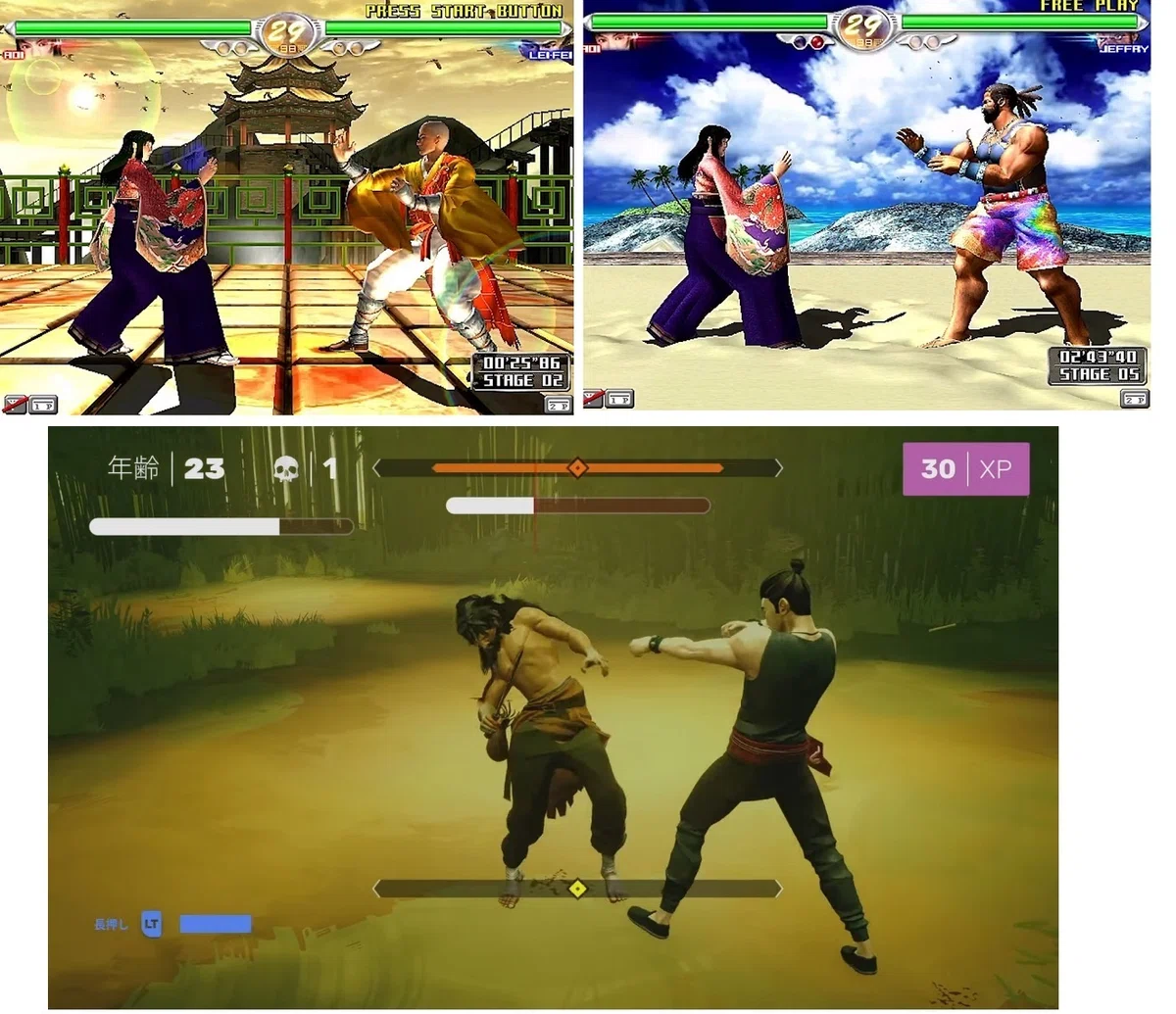
It is deeply regrettable that most modern AAA titles developed for the global market tend to rely on a washed-out, desaturated "sepia" or brownish-grey color palette that feels utterly lifeless. There is a severe lack of vibrancy in today’s gaming landscape. I desperately want to see developers return to the philosophy of Virtua Fighter 4—to create video games that are lush, glossy, and bursting with vivid, saturated colors that make the screen feel truly alive. We need more titles that aren't afraid to embrace a bold, lustrous visual identity rather than following the safe, muted trends of the present day.
The Transcendental Quality of Shenmue’s Animation: Why It Remains the Benchmark of "Action Character Performance"
1. The Fallacy of Modern Motion Capture: "Human Data" vs. "Character Performance"
There is a common misconception that modern motion capture, with its massive data points and high-fidelity sensors, is inherently superior. However, looking at modern titles, we often see a strange phenomenon where the movement feels less like a "character" and more like a "person just wearing a suit." It feels raw, unedited, and hollow—essentially just digitized human data.
Shenmue, however, operates on an entirely different plane of existence. The animations in Shenmue are not merely recorded movements; they are "Character Motifs." Every frame is meticulously crafted to express the specific identity of the individual. Modern capture often feels "exposed"—you can see the actor’s weight and hesitation—whereas Shenmue delivers a deliberate, stylized, and punchy performance that modern technology, for all its complexity, ironically fails to replicate. It isn't just "motion"; it is "Acting" in its purest digital form.
2. The Anomalous Perfection of Ren Wuying
Take a close look at Ren Wuying’s movements. It is nothing short of extraordinary—bordering on the insane—that this level of animation quality is maintained consistently across the entire game. In modern gaming, we are used to "stiffness" in non-combat NPCs or "glitches" in transition frames. But Ren moves with a fluid, dangerous grace that perfectly captures his charismatic yet volatile personality.
To find this level of consistency in 1999–2001 was a miracle. It wasn’t just about the technology of the Dreamcast; it was about the obsessive-compulsive dedication of the animators who understood that a character's "coolness" is defined by the silhouette of their movement, not the resolution of their skin.
3. The "Era Paradox": Shenmue vs. The PS2 Titans
To truly understand the "Abnormality" of Shenmue’s quality, one must compare it to its contemporaries: Metal Gear Solid 2: Sons of Liberty and Final Fantasy X.
The "Standard" Reality: If you critique the animations in MGS2 or FFX today, the common defense is, "What do you expect? It’s a PS2 game." Those titles were the pinnacle of their time, but they remain "Era-Bound." They look like "PS2-era movements"—stiff, segmented, and clearly showing the limitations of the hardware.
The "Shenmue" Anomaly: Shenmue was released earlier, yet it feels like it was sent back from the future. While MGS2 is "good for its time," Shenmue’s animations remain "Completed Works of Art" even by 2026 standards.
Because Shenmue’s animation quality reached the "Final Destination" of character acting so early, we inadvertently judge it by modern standards. We don't say "It’s good for a Dreamcast game"; we find ourselves comparing it to modern AAA titles. This is the ultimate proof of its greatness—it is a game so advanced that time has failed to age its soul.
The Masterclass of the QTE: Why Shenmue’s Innovation is Misunderstood
There is a pervasive and fashionable narrative in modern gaming circles that "QTEs are inherently poor game design," but this is a fundamental misconception. To dismiss all QTEs because of a few bad examples is as logically flawed as claiming all fighting games are boring just because you didn't enjoy Street Fighter V. We must stop generalizing across entire genres and instead recognize that within the realm of QTEs, there is a vast spectrum between mediocre implementation and brilliant execution. When people ask, "Is a QTE even necessary here?" it is usually because the game they are playing simply executed it poorly.
The true purpose of the QTE was to grant the player agency and intervention in what would otherwise be a passive, non-interactive cinematic movie. The problem arises when developers try to force QTEs into the middle of a traditional action game where they don't belong. However, for a title built on the "Shenmue model"—one that prioritizes cinematic immersion and life-simulation—the QTE is not an annoyance; it is a vital and exhilarating centerpiece of the experience.
One of the most striking aspects of Shenmue’s QTEs is the sheer sensory feedback. The shattering of glass, accompanied by perfectly timed sound effects and fluid character motions, is a masterclass in audiovisual synchronization. In Shenmue, the QTE is the "Hana" (the flower or the star) of the show. There is absolutely no drop in quality between a standard gameplay scene and a high-stakes QTE sequence. Every motion, every sound, and every frame of animation is maintained with an uncompromising level of polish across the entire game.
Furthermore, the interface itself is superior. The sharp, rhythmic "Pi, Pi!" sound effects that trigger during a command prompt possess a distinct, flashy energy that you rarely find in Western-developed titles. The combination of lightning-fast motion-captured movements, flawless pacing, punchy sound effects, and raw momentum makes the QTEs in Shenmue I: Yokosuka and Shenmue II an absolute joy to play. They aren't just buttons to press; they are moments of high-octane excitement that prove, when handled by a master like Yu Suzuki, the QTE is a legitimate and thrilling evolution of the medium.
The Abnormal Perfection of Shenmue’s Character Modeling: Why the Dreamcast Original Remains Unsurpassed
When we look back at the history of 3D graphics, the character modeling in Shenmue stands out as something truly "abnormal"—a level of craftsmanship so high that it defies the technical logic of its era. To provide context, you only need to look at contemporary titles like Skies of Arcadia (Eternal Arcadia) to see the standard level of graphics for that time. In comparison, the main cast of Shenmue—Ryo Hazuki, Shenhua, Lan Di, Ren, and Xiuying—possesses a visual depth and a presence that you never grow tired of looking at. And we must constantly remind ourselves: "This was running on the Dreamcast!"
What is truly staggering is that this wasn't the result of modern post-processing. If you use an original Dreamcast console via a VGA Box connected to an analog-compatible LCD monitor—running at a native 640×480 resolution in "dot-by-dot" mode—the image quality is almost indistinguishable from the PS4 upscaled version. It is simply a smaller surface area, but the raw assets are that high-quality. The most tragic mistake is when people connect a Dreamcast to a modern high-definition television using a standard AV composite cable. This creates a blurry, degraded image that leads people to falsely claim, "Old games like the Dreamcast had terrible graphics." In reality, if you output a Dreamcast through a VGA Box to a PC/AT compatible CRT monitor via a D-Sub 15-pin cable, the clarity and sharpness are nearly identical to a modern digital remaster.
The Dreamcast was a piece of hardware that was vastly superior to its competitors. It boasted incredible sound fidelity, high-quality video output, vibrant color reproduction, and native VGA support. These technical triumphs were the foundation of the Shenmue experience. There is a famous saying among Americans that "Windows was the worst export the US ever produced," and I feel similarly about the PlayStation 2. Despite being the best-selling console in history due to mass-market psychology, the original PS2 hardware was technically abysmal: the colors were muddy, the textures were chronically blurry, the AV output was subpar, and the sound quality was thin. (Thankfully, from the PS4 onward, Sony began making truly good hardware).
When you see modern screenshots of Metal Gear Solid 2 or Final Fantasy X, you are looking at "beautified" versions—images that have been digitally upscaled and cleaned for modern displays. If you played those games on an actual PS2 console via an AV Multi or Component cable on a CRT monitor back in the day, they never looked that pristine. The public memory of those games has been artificially enhanced by modern remasters. However, the original graphics of Shenmue on the Dreamcast are so fundamentally perfect that they require no such beautification. Even today, the raw, unenhanced output of Shenmue stands as a testament to a level of quality that was decades ahead of its time.
The Philosophy of the Threshold: Why Every Openable Door in Shenmue Changed the World
One of the most profound and visceral thrills of playing Shenmue is the simple, yet revolutionary act of opening every single door you encounter. This isn't just about moving from one room to another; it is about the uncompromising physical consistency of the world. Whether it is the traditional sliding paper fusuma doors inside the Hazuki residence, the heavy front entrance of a house, or even the intimidating, rusted doors of a shady office in the backstreets, the game allows you to cross those thresholds manually. The most magnificent part is that the moment you push or slide that door open, you can actually see the interior world waiting for you without any interruption.
There is a tactile satisfaction in the animation itself—the way Ryo’s hand reaches out, the smooth motion of the door swinging on its hinges, and that sharp, crisp sound of a door closing firmly behind you. This level of detail provides a sensory feedback that tethers the player to the reality of the game. To understand how advanced this was, we must look at the industry standards of the time. In a contemporary title like Resident Evil: Code: Veronica, opening a door meant the game would stop, a pre-rendered transition movie would play, and the screen would fade to black before loading the next area. You never actually "opened" the door yourself; the door was merely a disguised loading screen that severed your connection to the space you just left.
Even in modern development, this remains an incredibly difficult feat to implement. If you look at a recent title like Sakura Wars (2019), even with the power of modern hardware, the characters often transition between rooms without any door-opening animations at all. Seeing this makes one realize that the sheer man-hours and programming effort required to synchronize character motions with environmental objects like doors is immense. Most developers still choose to cut corners here to save on costs and development time.
Shenmue, however, refused to take the easy way out. By ensuring that the player physically interacts with every entrance and exit, the game achieves a seamless "sense of connectivity" between its various areas. You aren't just jumping between disconnected stages or maps; you are navigating a continuous, holistic space where every room is a part of a larger, living organism. This commitment to the "act of entering" is precisely why the world of Shenmue feels more tangible and alive than almost any other virtual environment ever created.
The Pioneer of Real-Time Weather: How Shenmue Simulated a Living, Breathing Atmosphere
One of the most groundbreaking features of Shenmue I: Yokosuka was its early and incredibly ambitious implementation of a "Real-Time Weather System." Long before dynamic weather became a standard checkbox for open-world games, Shenmue was already simulating a world where the sky could darken and rain would begin to fall naturally as you navigated the streets. It wasn't just a visual trick; it was a fundamental part of the world's clock.
The environmental variety didn't stop at a light drizzle. You would also witness beautiful, silent snowfalls that blanketed the town of Yokosuka. The genius of this system lies in how it fundamentally alters the player's sensory experience based on the specific time of day and the atmospheric conditions of their visit. Depending on when you choose to explore, the very soul of the town shifts, offering a different emotional resonance every time you step outside the Hazuki residence.
What is truly staggering—and frankly bordering on obsessive—is that even though the weather doesn't transition instantly before your eyes in a single frame, the game possesses an unbelievable amount of unique assets to handle these changes. When the seasons shift and the snow begins to fall, the developers didn't just add a particle effect of white flakes; they actually swapped out the background textures of the entire world to reflect a true winter landscape. Every rooftop, every street corner, and every garden hedge is redrawn with a layer of snow to maintain total immersion. This level of meticulous detail is a unique joy found specifically in the Yokosuka chapter—a level of environmental texture-swapping that was so labor-intensive it wasn't even fully replicated in Shenmue II. It stands as a testament to the sheer "madness" of the original team’s dedication to realism.
The Hidden Depth of Combat: Why Shenmue’s Battle System is a Lost Art
When analyzing the combat mechanics of Shenmue II, it becomes clear that the game is built upon a foundation of incredible tactical sophistication. It is possible to execute highly complex strings of offense that feel like a direct evolution of professional fighting games. For instance, you can lead with a Rimon Chouchuu (Hidden Foot and Elbow Strike), and if the opponent manages to guard it, you can immediately set up a Gaimon Chouchuu (Outer Gate Elbow Strike) to maintain pressure. Furthermore, you can strategically use the environment to your advantage—by backing an opponent against a wall to prevent them from recoiling, you can trap them in place and land a devastating "Brawl Upper." You even have the option to follow up with "Down Attacks" on a prone opponent. The sheer level of intricacy here is a mirror image of the Virtua Fighter engine, offering a depth that is virtually non-existent in other adventure games.
The tragic reality, however, is that there is a massive generational gap in gaming literacy today. Most modern players have never touched a Virtua Fighter title, and this disconnect is painfully obvious when watching newcomers play the PS4 remasters. When I watch these gameplay videos, I am struck by a profound sense of disappointment; these players lack the fundamental "DNA" of the Sega fighting game era. They don't even attempt basic command inputs like "Forward, Forward + Punch" ($\to \to P$), and they seem completely oblivious to the fundamental principles of spacing, timing, and frame advantage that the game was designed around.
Even prominent critics, such as IGN Japan’s Esra Krabbe, have failed to adequately showcase or explain that Shenmue allows for this remarkably sophisticated level of combat. The media treats the battles as a clunky side-activity, entirely missing the technical brilliance hidden beneath the surface. To be fair, if we were to isolate the combat mechanics alone, Shenmue is undeniably clunky in its responsiveness compared to a dedicated fighter. Virtua Fighter 4, for example, is lightyears ahead in terms of fluidity, comfort, and mechanical perfection. However, that does not excuse the fact that the rich, strategic combat system in Shenmue remains largely ignored and misunderstood by a generation that has forgotten how to truly "fight" in a virtual space.
The Sonic Dimension of Shenmue: When Perfection Transcends the Medium
When we turn our attention to the music of Shenmue, we are once again confronted with something that exists on an entirely different dimension from its contemporaries. The sheer scale and volume of the soundtrack are staggering; it was composed and produced with a level of luxury and meticulous care that defied all common sense in the video game industry at the time. Every single piece of music was crafted with an obsessive attention to detail, resulting in a gargantuan library of tracks that remains one of the most ambitious undertakings in the history of the medium.
What makes the score particularly fascinating is how it anticipated modern trends. Unlike many games of that era that relied on catchy, repetitive melodies, Shenmue incorporated elements of minimal music and ambient soundscapes. This was environmental music in the truest sense—designed to breathe with the world rather than just play over it. However, if I were to be brutally honest about the individual compositions themselves, I would have to say that the songs, as standalone pieces, feel somewhat "ordinary." Why is this the case?
The reason is a strange paradox: by striving so hard to transcend the limitations and tropes of "Video Game Music," the soundtrack eventually moved beyond that unique, specialized niche. It shed the skin of what made game music "special" and evolved into something that sounds like "regular music." Once that threshold is crossed, the context of the evaluation changes entirely.
The music no longer competes with other game soundtracks; instead, it enters the arena of general musical composition. This is where the tragedy lies for the composer, Takenobu Mitsuyoshi. I mean no disrespect to his incredible talent, but once the music is no longer "game music," his work is suddenly being compared to world-class giants like Ryuichi Sakamoto. When you remove the safety net of the "game music" label, you are forced to compete with the masters of contemporary and cinematic composition. Shenmue’s music was so sophisticated that it accidentally invited a level of scrutiny that very few composers in the world could ever hope to withstand.
The Tragedy of the Pioneer: Why the World Failed to Understand Shenmue
When Shenmue I: Yokosuka was released in 1999, it existed on an entirely different plane of reality compared to its contemporaries. At that time, the Japanese gaming market was dominated by titles like Dragon Quest VII and Final Fantasy VIII. To place Dragon Quest VII alongside Shenmue is to see two completely different philosophies of what a digital world should be. However, the Japanese audience of the late '90s had been conditioned by over a decade of "symbolic" or "shorthand" game design. For them, playing a video game was a race: clear the story faster than anyone else, brag about the ending, and then sell the copy back to the shop. They tried to apply this same frantic, goal-oriented mindset to Shenmue, and predictably, they failed to grasp its soul.
Structurally, Shenmue was the ultimate evolution of the adventure genre—taking the DNA of classics like Snatcher or Mansion of Hidden Souls and transforming them into a living, breathing, real-time 3D experience. Consider the incredible density of the opening sequence within the Hazuki residence. Just to reach the basement, the game demands a series of deliberate, tactile actions: You pay your respects at the family Buddhist altar (the "Ding" of the bell echoing in the quiet house), you search for a flashlight, you look for batteries (which you can also choose to go out and buy), you descend into the dark basement, and you strike a match to light a candle. The way the mirrors in that basement reflected the flickering light and Ryo’s presence was a technical marvel. The entire process of finally discovering the Phoenix Mirror was a masterclass in atmospheric build-up.
Even a simple task like obtaining a single scroll is treated with immense reverence. You must find a stepladder, place it properly, carefully lower a heavy framed wooden plaque (Ranma-gaku) from above the door, retrieve the hidden scroll, and then—crucially—return the plaque to its original position.
In Shenmue, nothing is "symbolic." Nothing is skipped for the sake of convenience. The game refuses to treat the acquisition of an item as the sole objective. In Shenmue, the "act" itself is the purpose of the gameplay. It shares this core philosophy with Animal Crossing, which is a massive commercial success, yet for some reason, when Shenmue did it, it was criticized for having "bad pacing" or being "too tedious."
If you look at the simplified, menu-based interactions of Dragon Quest I & II, people today rarely complain that those systems are "old" or "obsolete." Yet Shenmue, which offers a far more sophisticated and realistic interaction with the world, is constantly labeled as "dated." This is an unforgivable injustice. Most modern games are not actually providing a "gameplay experience"; they are merely providing a "process for handling objectives." They prioritize the destination while completely ignoring the beauty of the journey.
The Tragedy of Early Arrival: Brand Power, Audience Literacy, and the Fall of Shenmue
It is a compelling argument to suggest that if Shenmue I and II had been released together as a single, cohesive experience, the historical narrative surrounding the series might have been entirely different. However, the true culprit behind the harsh criticism of the first chapter was not the game's quality, but rather the fact that the general public lacked the "cultural soil" or the necessary literacy to cultivate such a radical experience. Shenmue committed the "sin" of being over-hyped by massive marketing campaigns before the audience was spiritually prepared for it. It sold approximately 500,000 copies—a massive number—but that very scale of exposure created a backlash. It left a lasting image of a "failed IP," a stigma so strong that the actual content of the game became irrelevant to the conversation.
Consider the "Souls-like" genre. Games like Demon’s Souls began as a slow, quiet simmer. They weren't shoved down the throats of the masses. Without a pre-established brand, a game like that would usually be dismissed as "tedious" or "impossibly difficult." But once a category is established, the narrative shifts; people say, "Oh, it's a Souls-like," and suddenly the very elements they would have criticized are shielded from scrutiny. If Demon’s Souls had been marketed with the same aggressive intensity as Shenmue and sold 500,000 copies to an unprepared audience, it likely would have faced a similar wave of resentment.
Modern masterpieces succeed because their creators spent years building the "bias" necessary for the public to accept them. Death Stranding is a hyper-maniacal, unconventional work, yet it was accepted because the world was primed and ready for "a Hideo Kojima game." The audience had developed the literacy to receive his vision. In contrast, Shenmue threw its full weight at the world before the world knew how to catch it. As a result, it became "famous for being a game that didn't sell," rather than being famous for its soul.
We see this same phenomenon with The Legend of Zelda: Breath of the Wild (Nintendo’s brand power), Elden Ring (FromSoftware’s accumulated prestige), and Death Stranding (Kojima’s celebrity). These games were embraced because the "light" or "casual" users had their expectations meticulously managed and prepared by the brand's history. People praise Breath of the Wild for "creating a world," "valuing quiet moments," and "making travel feel rhythmic and pleasurable." But isn't that exactly what Shenmue achieved decades prior? If Breath of the Wild had been released under the name Shining Force, the critics would likely have sneered, "Sega has made another misunderstood, niche game that only appeals to a few eccentrics." Very few people are capable of separating the raw quality of a game from the prestige of the brand that carries it.
Ultimately, Shenmue was a victim of its era and its context, not its content. The sheer quality of Shenmue II is so immense that if it had been published by Nintendo, it would undoubtedly be enshrined as the greatest legendary masterpiece in the history of the medium. (Of course, to those of us who know, it already is a masterpiece).
It is also fascinating to look at the cinematic failure of the Final Fantasy: The Spirits Within film around that same time. Personally, I evaluate that film higher than Final Fantasy VII simply because of the sheer audacity and technical achievement of completing such a visual feat. This difference in perspective is perhaps the fundamental divide between "Sega fans" and the "casual masses." At the end of the day, casual audiences seem only to care about superficial character tropes and popular appeal, whereas we saw a vision of the future. I still maintain that The Spirits Within is, in many ways, the "Number One" Final Fantasy.
Deconstructing the Shenmue Identity: Was it Intentionally Niche or an Ambitious Prototype?
There is a persistent narrative that Shenmue was designed from its inception to be a "Life Simulator" defined by its slow tempo, clunky movement, and deliberate, "mossy" controls. People often point to these elements as the core identity of the series. However, I have deep reservations about this interpretation. Was Yu Suzuki truly aiming for a "mundane gameplay" experience? Or was the understated nature of the Yokosuka chapter simply a byproduct of a lack of development know-how and a severe shortage of time during such an unprecedented undertaking?
When you look at Shenmue II, the game becomes significantly flashier, and the overall tempo accelerates. If that is the case, perhaps we should stop praising the "clunkiness" as a stylistic choice and instead view it through a critical lens: as a "work in progress" or a sign of "technical immaturity" that should be subtracted from our final evaluation. I have always suspected that Suzuki’s original intent was to create a spirited, orthodox "Adventure Epic" rather than a moralistic or literary piece of slow-cinema. The reason Ryo Hazuki seems so "moral" today is simply because subsequent protagonists in titles like Yakuza, Mafia, or GTA are so much more violent. At his core, Ryo is no different from Kiryu Kazuma—he is a man who punches his way forward to get answers.
Critics like Esra Krabbe from IGN Japan often remark that "Shenmue isn't for everyone" or that it was "a niche project produced with a lavish budget." I disagree. I believe Sega had no intention of making a niche game; they intended to create a massive, mainstream hit—a "Royal Road" blockbuster. If a game sells, it becomes "for everyone." After all, are Monster Hunter or Evangelion inherently "mainstream"? Of course not. If you had a boardroom meeting before their respective releases asking which had more mass-market potential—Shenmue II or Elden Ring—everyone would have bet on Shenmue II. Unlike the abstract complexity of Final Fantasy VII, Shenmue is a blend of Star Wars, Castle in the Sky (Laputa), and the manga Kenji. It is the ultimate orthodox fantasy, and structurally, it should have had higher mass appeal than FFVII.
Ultimately, the conversation surrounding games is often hollow, dominated by people who refuse to call Pokémon "dated" simply because it sells well. They judge based on revenue, not essential gameplay. In reality, Shenmue’s lack of popularity likely boils down to two simple things: "frustrating navigation" and a "lack of character appeal." Furthermore, Japanese players couldn't find "fantasy" in a perfect recreation of 1980s Japan because it was too familiar. Ironically, Western players felt that fantasy because it was a window into a foreign culture, but for the domestic audience, there was no freshness.
The modern Metacritic system is a "deductive" scoring method that ignores "innovation" and "cultural value." Under today’s criteria, a safe, iterative Pokémon game might score a 95, while Shenmue: Yokosuka would get a 65. But in terms of cultural value to the history of the medium, the scores should be reversed. Pokémon changes nothing; Shenmue changed the history of game design forever. For those of us who grew up between 1980 and 2000, we witnessed a revolution every single year. We don't get excited by a "90-point template game." While Shenmue was undoubtedly unfinished in many parts, it allowed us to envision the future of the medium. Much like the Wright brothers' first flight, the thrill wasn't in the perfection of the machine, but in the relentless pursuit of an ideal. Titles like Final Fantasy VIII or Metal Gear Solid felt like they had already reached their ceiling—they offered no "room to grow" or "vision for the future."
The Inevitability of Shenmue: Why Video Game History Cannot Escape Its Shadow
It is practically unavoidable that any serious discussion about the evolution of video games eventually converges on Shenmue. This is not a matter of nostalgia; it is simply because Shenmue pioneered and executed so many fundamental elements of modern gaming long before anyone else. Comparing a new open-world title to Shenmue is no different from comparing a new kart racer to Mario Kart. It is baffling and intellectually dishonest to see people roll their eyes and say, "Enough about Shenmue," when they don't apply that same exhaustion to Nintendo’s flagship titles.
Look at the landscape of gaming: when Chocobo GP was released, the conversation was dominated by Mario Kart. When Team Sonic Racing arrived, it was evaluated entirely through the lens of Mario Kart. This is a natural law of criticism. If you discuss beat-'em-ups, you talk about Double Dragon and Final Fight. If you discuss fighting games, everything traces back to Street Fighter II. Because Shenmue II effectively "completed" so many pioneering concepts of 3D environmental design and systemic interaction, it is historically impossible to discuss the medium's progression without passing through the gate of Yu Suzuki’s masterpiece.
In recent media discussions, such as those on IGN Japan, we see freelance writers who talk of nothing but Mario Kart, yet no one shouts, "Stop comparing things to Nintendo!" or "Enough with the Mario talk!" That is considered the standard. When a new Pokémon title is released, critics lazily describe it as "Minecraft meets Animal Crossing." If that is acceptable, then describing modern titles as "Shenmue plus [X]" should be the gold standard of context. Why is it that Shenmue alone is treated as a taboo subject? People dismiss my technical analysis of Shenmue’s systems as "mere nostalgia," failing to realize that I am talking about structural mechanics, not childhood memories. These same critics then go home to play Kirby, Pokémon, Mario, or Street Fighter—franchises fueled entirely by nostalgia—while hypocritically mocking historical analysis as "old-fashioned."
Even pro-gamers and famous streamers today are well into their 40s. They are the same generation as us. They tell us not to get so invested in "old" games at our age, yet they spend their nights sweating over Street Fighter 6. If young people want to dismiss everything from the Shōwa era as "retro junk," then they should stop playing as Mario or Link—both of whom are icons born in the Shōwa era.
I believe critics like Esra Krabbe are being far too polite and hesitant. He should feel empowered to say, "This element is Shenmue," or "This scene feels exactly like Shenmue." If it's okay to say Sonic Racing is "just like Mario Kart," then we should be able to say Judgment is "just like Shenmue." We should be able to look at Like a Dragon Gaiden or the Wall Market section of Final Fantasy VII Remake and boldly state: "This is Shenmue."
Recently, the British Academy of Film and Television Arts (BAFTA) named Shenmue I: Yokosuka as the most influential game of all time. In response, some commentators on IGN Japan argued that while Dragon Quest or Super Mario are influential, Shenmue is merely an "only-one" title—a genre unto itself with no true followers—and therefore shouldn't top an influence ranking. I strongly disagree with this narrow interpretation. Krabbe and others seem to think that only the "Yokosuka-style" slow-life gameplay counts as Shenmue.
However, I do not separate the "slow-life adventure" from the technical revolution of full-scale 3D environments, real-time weather systems, and the unprecedented collaboration with the film industry. They are one and the same. Every time a new game featuring a full-scale 3D world is released, it is inherently a descendant of Shenmue. The greatest legacy of Shenmue is not just the "life sim" aspect; it is the very methodology of constructing a persistent 3D space. As the work that laid the literal foundation for modern 3D gaming, its number one ranking is not just an opinion—it is a historical fact.
The Unreachable Peak: Why the Industry "Gave Up" on Catching Shenmue
When we look at the features of Shenmue that modern games have discarded, it is a profound mistake to claim those elements were "dropped because they were old." The reality is much more clinical: the industry simply decided that the sheer cost and labor required to replicate those details were not "worth the investment." In terms of pure ambition and technical density, those discarded elements remain at the absolute cutting edge, even today.
Critics who point at the missing pieces and label them as "outdated" are fundamentally misunderstanding the history of the medium. Shenmue was an anomaly because it established an overwhelming number of revolutionary standards simultaneously. It didn't just innovate; it terraformed the landscape of gaming with:
Full-scale 3D environmental architecture.
Pioneering full-voice acting for every single character.
The introduction of a persistent time axis (which is the only reason the town feels alive).
Real-time weather transitions.
The establishment of QTEs as a way to grant player agency during cinematic sequences.
Early implementation of procedural generation technologies.
Maps designed with "negative space" to convey atmosphere.
The ability to speak to every single pedestrian in the world.
A life-cycle that required the player to return home and sleep every night.
The physical requirement to open every door and touch every doorknob manually.
The implementation of lip-syncing and a unified character model for both cutscenes and gameplay.
The introduction of genuine, professional-grade motion capture.
A historic collaboration with the film industry to elevate visual storytelling.
Arcade-quality "mini-games" that were actually full-featured SEGA classics.
A physical, grounded walking animation that felt every step and ascended stairs one by one.
The birth of the "original AAA title" as we know it.
If media critics want to be honest, they should explain how a game like Yakuza 6 (Ryū ga Gotoku 6) relates to this lineage. They should specify what was "deleted," what was "improved," and what was "compromised." For instance: (1) They deleted the time axis. (2) They improved the ease of navigation for better accessibility. (3) They kept the format of full-scale environments and in-game arcades. (4) They compromised by increasing the combat frequency and placing traditional treasure chests to satisfy mainstream RPG players. I don't deny the validity of Yakuza’s compromise, but we must acknowledge that modern titles exist because they used Shenmue as a "counter-example"—a cautionary tale of doing "too much."
To look at the elements that later games chose not to inherit and conclude that "Shenmue is old" is a logical fallacy. The truth is that for over 20 years, no game has had the courage or the budget to fully inherit the "Grammar of Shenmue." Because the lineage was broken and no direct clones appeared, the public misidentifies this isolation as being "outdated." In reality, Shenmue was so far ahead that nobody could catch up. It is not "old"; it is "unreached."
Critics who say "we knew those elements wouldn't work" are usually people who have never built anything themselves. Shenmue had to do it first so that the rest of the industry could learn what works and what doesn't. Its identity was rooted in doing what no one else dared to try. While it was "resting," other games eventually caught up to some of its surface-level ideas, leaving the sequels in the awkward position of being followers in a world they once led.
We must also distinguish between "influence" and "popularity." Titles like Dragon Quest have immense popularity (diffusion power), but are they the source of influence? If we look at survival horror, Alone in the Dark is the ancestor, while Resident Evil is the successful clone. Influence should be credited to the pioneer, the title that created the template for others like Boku no Natsuyasumi or FFVII to follow.
When Esra Krabbe praises the "Yokosuka-style" gameplay, he is only looking at one small piece of the puzzle. The true scale of Shenmue’s influence is felt whenever we see the Wall Market in FFVII Remake or the streets of Yakuza and think, "This feels like Shenmue." To label it simply as the "Origin of Open World" is to trivialize and diminish the complexity of its innovation. Shenmue is a multi-layered masterpiece that remains, without a shadow of a doubt, the most influential title in the history of video games.
Decoding the Anomaly: Why Historical Context is Essential to the Shenmue Experience
When we engage with the history of video games, there is a certain unspoken rule of critical empathy. If a modern player picks up The Legend of Zelda: Ocarina of Time or Final Fantasy VII and complains that they feel "old" or "clunky," they are immediately met with the same defensive refrain: "You have to understand how groundbreaking this was at the time," or "Consider the historical context." For those titles, the defense is natural and universal. However, Shenmue occupies a tragic and lonely space in this conversation. Because Shenmue pushed so far beyond the comprehension of the casual audience in 1999, it effectively severed itself from the era's established context. It was an anomaly so extreme that there is no shared language to explain why it was "amazing for its time."
Paradoxically, because Shenmue’s visual fidelity and systemic complexity were so far ahead of their time, modern players make the mistake of comparing it directly to contemporary AAA titles. They judge it by the standards of 2026 rather than 1999. In the recent discussions on IGN Japan, we see this disconnect clearly. While Esra Krabbe is a staunch defender of the series, he often leaves newcomers like Imai-san to navigate the game's "inconveniences" without proper guidance. Modern players are conditioned by the "modern grammar" of gaming—constant sprinting, ubiquitous quest markers, and instant fast travel. To them, the deliberate pace of Shenmue feels like a broken machine rather than a masterpiece.
I believe playing Shenmue today requires the same specialized guidance as a gallery visitor being led by a professional curator. To truly "see" the game, one should place Ocarina of Time and Final Fantasy VIII on either side of Shenmue as historical bookends. Only then can you perceive the sheer leap in logic and technology.
The ideal way to introduce the game would involve a mentor-like figure providing real-time curation, similar to how a curator explains a masterpiece: "Imai-san, please, move the camera slowly. Do not rush. Do not sprint through this world. Notice how Ryo turns when you press down on the D-pad; that weight is intentional. The fact that you can open every drawer isn't 'filler'—it is about creating the meaning of 'negative space' in a digital world. Understand that the introduction of a real-time clock isn't just a gimmick; it is the heartbeat of a living society."
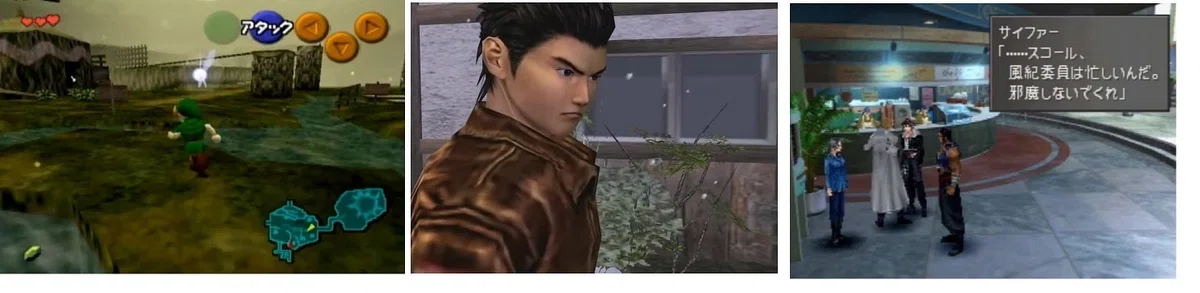
Finally, I must express my deep frustration with the current online culture that treats video games as mere "disposable content." There is a toxic obsession with "no spoilers," "no backseating," and the idea that a "blind playthrough" is the only valid way to experience a game. This mindset is fundamentally flawed when applied to a work as complex and historical as Shenmue. To reject guidance for the sake of "purity" is to remain blind to the game's actual achievements. We must move away from simply "consuming" the game and return to "understanding" it through the lens of its era.
The Great Divide: F355 Challenge, Shenmue, and the Loss of the "Evolutionary Spirit"
The release of F355 Challenge and Shenmue marked a definitive turning point in gaming history—a moment where the "literacy" of the video game audience was split cleanly in two. On one side stood the "Understanders," those who craved the raw edge of innovation. On the other were the "Casuals," largely composed of the OutRun, Dragon Quest, and Pokémon generations, who proved to be intellectually rigid and culturally conservative. These players lacked the "absorptive capacity" to embrace a paradigm shift, preferring the comfort of established symbols over the terrifying beauty of a new reality.
For me, F355 Challenge is the absolute favorite—a masterpiece I could play for tens of thousands of sessions without ever feeling a hint of boredom. I still carry the visceral shock I felt when I first sat in that cockpit at the SEGA arcade located atop the Isetan department store at Kyoto Station. While many praise Shenmue II, I firmly believe that the single greatest achievement in the history of the medium is F355 Challenge.
The reaction from the casual masses was tellingly defensive. When faced with F355 Challenge, they complained: "Is this supposed to be realistic? It's too difficult! I'd rather just play OutRun." When faced with Shenmue, they whimpered: "Am I just supposed to walk around? What am I even supposed to do? I hate waiting! I’d rather just play Dragon Quest." It was a shocking betrayal. Arcade gamers, who had supposedly spent the 1980s and 90s prioritizing high-end hardware and cutting-edge innovation, suddenly recoiled. When presented with the world’s most advanced video game experience—a title that pushed sound, physics, and sensory immersion to their absolute limits—they chose the path of least resistance. They decided they didn't actually want that level of intensity or high-fidelity experience. Since that moment, the progress of video games—in terms of sound design, sheer impact, momentum, and psychological elation—has effectively stalled, with only the "resolution" of graphics continuing to improve.
Our generation understood that home consoles were "products of compromise." When we played the Mega Drive (Genesis), we knew in our hearts that this wasn't the true experience we were chasing; it was just a shadow of the arcade. We demanded constant evolution. In contrast, the Pokémon generation was the first to accept the technical poverty of the Game Boy as a "genuine gaming experience." Pokémon Gold and Silver offered a technical quality lower than that of the Famicom (NES) era. The children, who should have been the ones demanding the future, became the most conservative demographic of all. This birthed the rapid "conservatization" of the global gaming audience.
Consider the difference between Tetris on the Game Boy and Tetris on the System 16 arcade board. In the 80s, any child with a shred of honesty thought, "I don't want to play this pathetic, blurry Game Boy version; I want the power and color of the System 16 version!" I am simply explaining this historical reality, yet I am mocked for being "maniacal" or "preachy." People see my words as a "mysterious obsession" because they cannot fathom the era when video games were about breaking through the very limits of human expression and technology.
F355 Challenge was never intended to be a mere recreation of "onboard camera footage." It was built to be a real-life experience. Today’s "sim racers" make the fatal mistake of thinking that "simulation" equals "calculation" alone. They obsess over tire temperatures, physics models, and mathematical precision, but they fail to simulate the experience—the momentum, the adrenaline, the violence of the sound, and the sheer elation of speed. As a result, modern sims feel like you are just watching a high-resolution video of someone else driving. They are stagnant and boring because they lack "soul." Whether it was After Burner II or Power Drift, Yu Suzuki wasn't just making "video games"; he was constructing "experiences."
Even playing the "Shenmue version" of After Burner II cannot convey even half of the original machine's greatness. That is the fundamental truth: in video games, the physicality of the experience is everything. Without it, the medium is just empty data.
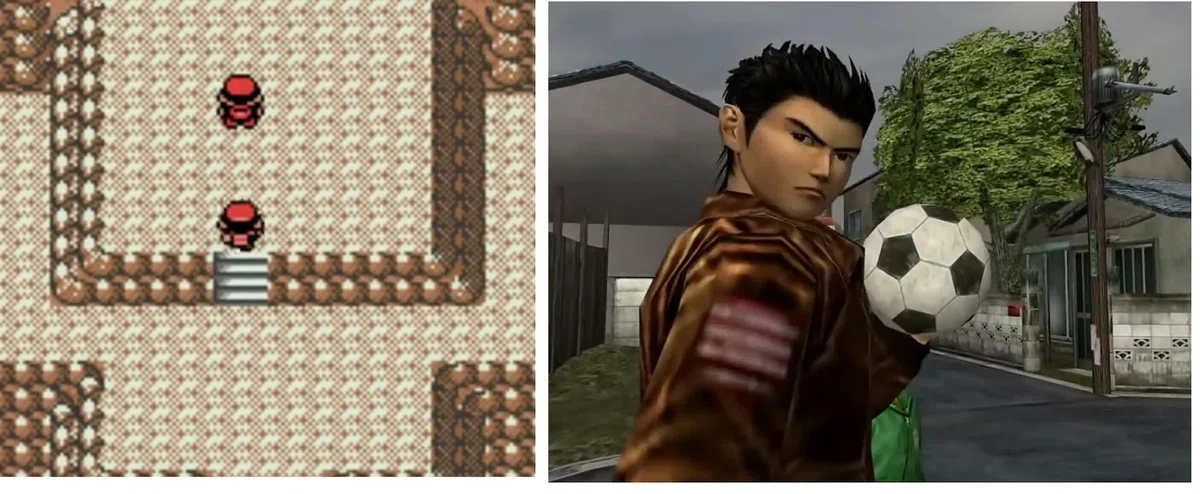
Beyond Nostalgia: The Lost Future of the Ultimate Sensory Experience
I want to make one thing absolutely clear: I am not sitting here indulging in some sentimental trip down memory lane or wallowing in mere nostalgia. My argument is far more demanding and forward-looking than that. What I am truly asking for—what I am desperate to experience—is a modern evolution of F355 Challenge that has been pushed forward by twenty-seven years of technological progress. I want to hear the roar of an engine that reflects nearly three decades of acoustic innovation. I want to play a video game that actually feels like the legitimate successor to that level of intensity and ambition.
During the height of my obsession, I was actually far more intoxicated by the raw power of F355 Challenge than I was by Shenmue. Back then, I used to close my eyes and imagine a magnificent future where these two philosophies would eventually merge into a single, ultimate video game. I envisioned a world with the systemic depth of Shenmue and the visceral, high-fidelity mechanical simulation of F355 Challenge. Yet, here we are, twenty-seven years later, and such a masterpiece has never been born. The industry simply stopped reaching for that specific peak of experiential perfection.
In my mind, the ideal version of OutRun 2—the one that should have existed by now—would be something transcendent. It wouldn't just be an arcade racer; it would be a game where you sit behind the wheel of a perfectly modeled Ferrari, with Ryo Hazuki and Shenhua riding beside you as companions. You would be tearing through the breathtaking landscapes of Guilin, rendered with the incredible, high-density textures and atmospheric lighting that Shenmue pioneered. It would be a fusion of cinematic travel and professional-grade driving simulation.
The actual OutRun 2 that we received is certainly a well-crafted game, and I acknowledge its quality. But for someone who has tasted the raw "experience" of Suzuki’s peak work, it is simply not enough to satisfy the soul. You can play it maybe 500 times before you start to see the limits and grow weary of its simplicity. It lacks that bottomless depth, that terrifying momentum, and that "abnormal" level of detail that makes you feel like you are touching the very edge of reality. I am still waiting for the video game industry to finally catch up to the future we were promised twenty-seven years ago.
The Polar Extremes of Yu Suzuki: From Hypersonic Thrills to the Ultimate Slow Life
When analyzing the creative trajectory of Director Yu Suzuki, one cannot help but be struck by the sheer, almost violent extremity of his stylistic shifts. For the vast majority of his legendary career, Suzuki was the undisputed king of the arcade business model—a world where the primary objective was to extract 100 yen from a player every three minutes. He was the mastermind behind titles that defined the "Golden Age" of SEGA, such as Space Harrier, After Burner II, and Power Drift. These games were built on the fundamental philosophy of "instantaneous gratification" and "hypersonic sensory overload." They were designed to provide a burst of pure, concentrated adrenaline through high-speed scrolling and overwhelming visual momentum.
This is why the transition to Shenmue is so baffling and fascinating. Suzuki, the man who spent decades perfecting the art of the "quick fix" and the three-minute thrill, suddenly pivoted to a game defined by its deliberate, slow-tempo direction and painstaking attention to the mundane details of daily life. I often wonder if the meditative pace of Shenmue was a subconscious reaction—a creative rebound, so to speak—against the relentless pressure of the high-speed arcade era. The pendulum of his creativity didn't just swing; it snapped to the opposite pole with an intensity that no other creator in the history of the video game industry has ever dared to replicate.
Personally, this presents a major internal contradiction for me. I am an incredibly impatient person by nature. I have the temperament of a fighter who can only sustain focus for a three-minute round before my nerves start to fray. By all logical accounts, the slow-burning, patient methodology of Shenmue should be completely incompatible with my personality. I crave the "instant pleasure" that Suzuki’s older titles provided. And yet, the fact that such a polar opposite experience managed to captivate me speaks to the terrifying power and magnetism of Suzuki's vision, even when it defies every instinct I have as a player.
The fundamental and perhaps most fatal flaw in the production of Shenmue lies in the fact that Yu Suzuki simultaneously embodied the roles of both the Producer and the Director.
In the realm of professional baseball, this is the precise equivalent of a single individual attempting to serve as both the General Manager, who oversees the long-term financial health of the franchise, and the Field Manager, who is responsible for day-to-day tactical victories. When the creative director is also granted absolute control over the purse strings, an inevitable systemic failure occurs: the budget will invariably be consumed without limit or restraint, and the sheer operational burden placed on that single individual becomes utterly unsustainable.
Consider the success of Studio Ghibli. Their cinematic triumphs were only made possible because Toshio Suzuki, acting as a true producer, possessed the authority to manage and rein in the directors, establishing a crucial checks-and-balances system that prevented their creative impulses from spiraling into financial ruin. Had Hayao Miyazaki been left entirely to his own devices to create whatever pleased his whim without such oversight, his films likely would have failed to achieve mainstream popularity or broad demographic appeal. A prime example of this is Porco Rosso; despite its critical acclaim, it remains a deeply personal, masculine fantasy that largely failed to resonate with or attract female audiences.
Historically, the inability to have one’s creative reins pulled is the defining tragic destiny of true auteur directors—men of towering genius like Akira Kurosawa or Isao Takahata, whose visions were simply too grand for conventional studios to contain. Within the entire history of the video game industry, Yu Suzuki is arguably the only creator to have ever ascended to this exact same mythic, uncontrollable tier of authorship. What Shenmue desperately required, above all else, was an external, authoritative figure capable of pulling those reins.
Tragically, this structural error was repeated decades later with the development of Shenmue III. Suzuki stated during its production that he had decided to channel 100% of his energy into making the game’s world-building stand out. However, what the project actually required was a pragmatic producer who had the authority to look him in the eye and say, "Your sole priority right now must be channeling your energy into bringing this story to a definitive conclusion."
And yet, there is a profound paradox at the heart of this tragedy. Shenmue is a monumental achievement that could never have been birthed within a healthy, normal corporate framework. It required a project that pushed beyond the boundaries of human limitation, and it is precisely because it fractured those limits that it transformed into a timeless, universal masterpiece.
We must also confront the staggering, almost unfathomable workload Suzuki endured during Sega's golden age. He was not merely directing Shenmue: Ichisoku Yokosuka; he was simultaneously spearheading the development of F355 Challenge. He then repeated this impossible feat by concurrently directing both Shenmue II and Virtua Fighter 4, all while holding his executive position as a department manager. This went far beyond mere staff fatigue; it was a schedule that defied human capability and redefine the very concept of overwork. Ultimately, the severe physical, mental, and creative exhaustion left in the wake of that era is undoubtedly the primary reason why this legendary director found himself unable to produce any major video games for such a long time afterward.
The Cult of Consensus: Why Modern Gaming Fans Have Lost the Art of Criticism
When observing the current state of the gaming community, it is difficult to ignore how certain fanbases—particularly those surrounding Nintendo—have devolved into something resembling a cult. This shift is exacerbated by a wave of superficial YouTube content designed solely for "view-count bait." These creators, lacking any fundamental understanding of history, label Shenmue a "failure" as if it were a fallen empire, They call its mechanics "outdated," yet they conveniently ignore that titles like Yakuza (Ryū ga Gotoku) are built on much more archaic foundations. Seeing these sensationalist thumbnails and lazy narratives is truly exhausting.
The comment sections reveal a disturbing reality: fans of Nintendo, Dragon Quest, and Final Fantasy have been shielded from genuine criticism for so long that they have failed to develop a healthy "culture of critique." This intellectual fragility leads to absurd situations. For instance, in a recent talk show, a writer mentioned using a MOD in Dragon Quest I & II to speed up "Metal Slime" hunting because the original grind was tedious. In response, 50-year-old fans launched vituperative personal attacks on the writer’s character, treating the use of a MOD as a sacrilegious act. It is a pathetic sight: grown men acting like "fanboys," shutting down any nuanced discussion with thought-terminating clichés like "If you don't like it, don't play it," or "If you have a complaint, make your own game."
This environment where the media only provides "saint-like" coverage is dangerous. I fear that fans of Shohei Ohtani might face a similar psychological crisis in the future because they aren't exposed to balanced reporting. (In contrast, fans of Hiromitsu Ochiai are "adults" because they grew up surrounded by critical press). Shenmue fans are different. Because the series has been relentlessly criticized for decades, the fans have built a powerful immunity to negativity. In fact, most Shenmue fans actually agree with the critics on many points:
The movement is clunky.
The pacing is glacial.
There are periods where there is "nothing to do."
There are too few scripted events.
There is far too little combat (though we aren't asking for Kirby-levels of constant action).
The part-time jobs are boring as games.
Having to go home and sleep every night is a chore.
However, the beauty of Shenmue exists in a realm "outside of its flaws." Because fans acknowledge these weaknesses, their appreciation for the work remains unshakable. They don't feel personally attacked when the game is criticized. This is perfectly exemplified by critics like Esra Krabbe from IGN Japan. Criticism shouldn't be about boosting or tanking sales; the act of critique itself is the objective.
Unfortunately, the rise of "Streamer Culture" has destroyed this.
Streamers almost never criticize "hegemonic" titles because they fear losing their audience.
Their content becomes a collection of "flattery videos" designed to appease sponsors and algorithms.
Their fanbases act as a voluntary police force to silence dissenting opinions.
Casual viewers stop thinking for themselves, succumbing to "herd mentality" and "peer pressure" just because a streamer said a game is "fun."
As a result, a "mood of total adoration" is manufactured regardless of the game’s actual quality.
We have reached a point where people can no longer distinguish between "structural understanding/fact-checking" and "hostile criticism." Anyone who doesn't offer "total affirmation" is branded an "anti" or "hater." If you criticize a top-selling game, you are accused of "contrarianism," with the illogical defense being "it sold well, so it can't be wrong." It is deeply ironic that these "cult-like" fanbases label Shenmue as a "cult game" when they are the ones who have lost their objectivity. In movies and music, people still discuss the actual "content," but in gaming, adults only talk about sales figures and stock prices. Video games have drifted away from being "entertainment" to being "business," and from "business" to "financial instruments." In this climate, the actual substance of the game has become completely irrelevant.
English Translation: Beyond the Pedantry of Tweaks: Why Only Shenmue Commands 120,000 Words of Pure Systemic Analysis
When you browse the exhaustively long reviews for titles like Dragon Quest or Monster Hunter on platforms like Amazon or Steam, you notice a recurring and somewhat tedious pattern. These reviewers obsess over the "twigs and leaves" of the experience—listing endless complaints about the plot progression, nitpicking the intricacies of the in-game economy, debating the fine-tuning of battle balance, or lamenting the specific drop rates of rare items. They spend thousands of words on what are essentially "suggestions for minor adjustments." However, even if every one of those granular complaints were addressed and the game were rebalanced to perfection, the fundamental, essential essence of the gameplay would remain exactly the same. It is a shallow form of criticism that mistakes "adjustment" for "innovation."
In contrast, my discourse on Shenmue is of a different breed entirely. I have managed to write 120,000 words on this series without ever once resorting to talk of "difficulty spikes," "character balance," or even the legendary status of its director. My writing is stripped of "character love," free from the fog of "nostalgic bias," and contains zero "emotional pleas." There is likely no other video game in existence that can sustain a 120,000-word analysis based purely on its structural architecture and systemic ambition. Only Shenmue offers a world so deep and a philosophy so radical that it can be discussed as a technological and cultural milestone without ever needing to rely on subjective sentimentality.
To truly "enter" the world of Shenmue and understand its weight, there were traditionally several distinct pathways or "roots":
Being a dedicated fan of Yu Suzuki’s previous arcade masterpieces.
Being a loyal SEGA enthusiast who understood the company’s "challenger" spirit.
Being a collector or devotee of SEGA’s high-spec hardware.
Being a seeker of high-end, cutting-edge gaming experiences that pushed the limits of the era.
Being a fan of true "new frontiers" in video games—not just a new title, but a completely new paradigm.
The "Nintendo Boys" who were lured in by the massive marketing and found themselves accidentally wandering into a world they weren't prepared for (a category where I would place someone like Esra Krabbe).
Except for the sixth category, I entered Shenmue through every single one of these roots simultaneously. For me, the reasons are as complex and intertwined as a bowl of spaghetti. Because my connection to the game is built upon a layered foundation of arcade history, hardware evolution, and a thirst for systemic innovation, it is impossible to summarize my fascination in a single sentence. Shenmue isn't just a game I played; it is a convergence of everything I valued in the evolution of the digital medium.
The Tragedy of the Unfinished: Why Shenmue Struggles as a Functional Work of Art
In any medium—be it literature, cinema, or architecture—a work that remains unfinished is rarely afforded the status of a masterpiece; it is perpetually haunted by its own incompleteness. Shenmue suffers from a fundamental crisis that goes beyond mere mechanics: it lacks a clear, driving "motivation" for the average player to see it through. In a traditional RPG like Dragon Quest, the player is propelled by a singular, heroic motivation: to grow stronger, defeat the Demon King, and reach the credits. If a player knew from the very beginning that no matter how much they leveled up, they would never be allowed to face the final boss, they would never invest the time to grind in the first place. This, I believe, is the true heart of the problem with Shenmue. It isn't just about whether the gameplay is "fun" or "slow"; it is about the broken promise of a destination.
Personally, I have never been a person who seeks out narratives. Since I was a child, I have had "zero interest in stories." I rarely watch movies or read manga, and I have never finished a single novel in my entire life. My history as a gamer is defined by playing titles where the story is secondary—or even non-existent—and the raw mechanics are everything. Therefore, when I speak about my desire for the end of Shenmue, I am not necessarily pleading for the conclusion of a plot or the resolution of a script. What I am demanding is the "completion of the game" itself as a functional, structural entity. I want the systemic journey to reach its logical finish line.
I previously stated that I would not comment on the future of the franchise, but inevitably, any deep discussion of its merits leads back to the necessity of a sequel. At this stage, the technical fidelity is irrelevant. It does not need to be a cutting-edge AAA spectacle. Even if the graphics are low-polygon and the production is done on a shoestring budget, we simply need to bring this journey to a close. We need to finish what was started so that Shenmue can finally be judged as a complete work of video game history.
I apologize if my thoughts have become somewhat fragmented and disorganized as I’ve delved into these complexities. I would like to bring this discussion to a conclusion here for now.
I hope this brief and humble explanation has been of some use to you. Thank you very much for your patience and for accompanying me through this long exploration of such a unique title.
A Japanese version is also available! It’s packed with images and visuals, so I’d love for you to check it out as well.
I also have an article on Shenmue III, so please check that out as well!
