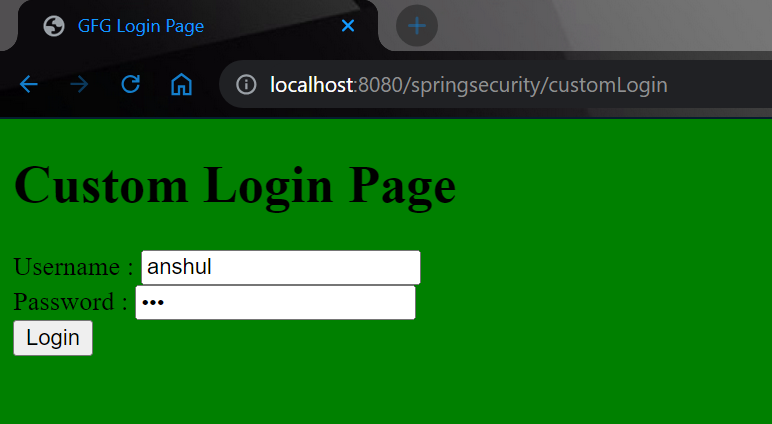
Spring Security is a framework that enables developers to secure Spring-based web applications by integrating authentication and authorization mechanisms. In this article, we will implement a complete registration and login process using Spring Security with Spring MVC and JDBC Authentication.
We will build a web application where:
- A user can register through a form, and the details are stored in a MySQL database.
- A registered user can log in using Spring Security authentication.
Step-by-Step Implementation
Step 1: Project Setup and Server Configuration
IDE: Spring Tool Suite 4 (STS)
Server: Apache Tomcat 9+
Build Tool: Maven
Create a Dynamic Web Project in STS and configure Tomcat. You can refer to this article to learn How to Create a Dynamic Web Project in STS/Eclipse.
Step 2: Create Database and Tables
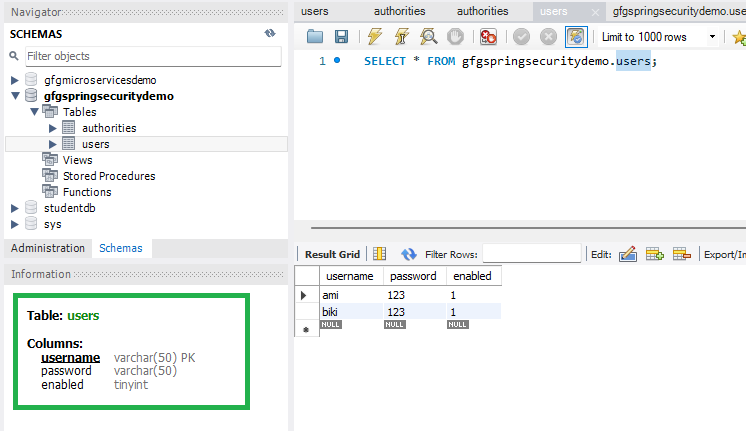
Create a new schema gfgspringsecuritydemo in MySQL Workbench and add the following tables:
users Table:
CREATE TABLE users (
username VARCHAR(50) NOT NULL PRIMARY KEY,
password VARCHAR(100) NOT NULL,
enabled BOOLEAN NOT NULL
);
authorities Table:
CREATE TABLE authorities (
username VARCHAR(50) NOT NULL,
authority VARCHAR(50) NOT NULL,
CONSTRAINT fk_authorities_users FOREIGN KEY (username) REFERENCES users(username)
);
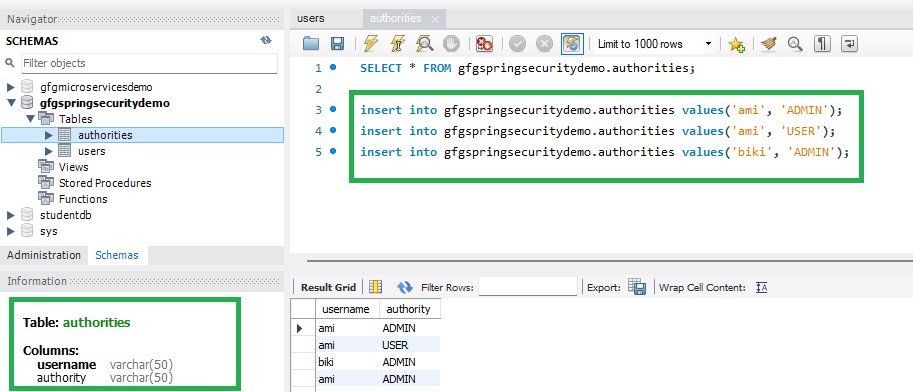
Note: Column names and schema must match the above definitions as per Spring Security JDBC authentication standards.
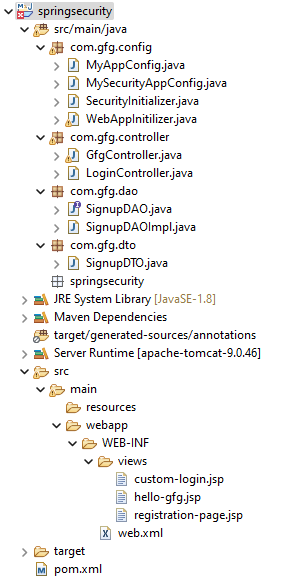
Step 3: Project Folder Structure
Step 4: Add Dependencies in pom.xml
Add the following dependencies to your pom.xml file
- Spring Web MVC
- Java Servlet API
- Spring Security Config
- Spring Security Web
- Spring JDBC
- MySQL Connector Java
<dependencies>
    <!-- Spring MVC -->
    <dependency>
        <groupId>org.springframework</groupId>
        <artifactId>spring-webmvc</artifactId>
        <version>5.3.24</version>
    </dependency>

    <!-- Servlet API -->
    <dependency>
        <groupId>javax.servlet</groupId>
        <artifactId>javax.servlet-api</artifactId>
        <version>4.0.1</version>
        <scope>provided</scope>
    </dependency>

    <!-- Spring Security -->
    <dependency>
        <groupId>org.springframework.security</groupId>
        <artifactId>spring-security-config</artifactId>
        <version>5.7.3</version>
    </dependency>
    <dependency>
        <groupId>org.springframework.security</groupId>
        <artifactId>spring-security-web</artifactId>
        <version>5.7.3</version>
    </dependency>

    <!-- Spring JDBC -->
    <dependency>
        <groupId>org.springframework</groupId>
        <artifactId>spring-jdbc</artifactId>
        <version>5.3.24</version>
    </dependency>

    <!-- MySQL Connector -->
    <dependency>
        <groupId>mysql</groupId>
        <artifactId>mysql-connector-java</artifactId>
        <version>8.0.28</version>
    </dependency>
</dependencies>
Step 5: Configuring Dispatcher Servlet
Now we are going to configure Dispatcher Servlet with our Spring MVC application. Go to the src > main > java and create a class WebAppInitilizer.
WebAppInitilizer.java
package com.gfg.config;

import org.springframework.web.servlet.support.AbstractAnnotationConfigDispatcherServletInitializer;

public class WebAppInitializer extends AbstractAnnotationConfigDispatcherServletInitializer {

    @Override
    protected Class<?>[] getRootConfigClasses() {
        return null;
    }

    @Override
    protected Class<?>[] getServletConfigClasses() {
        return new Class[] { MyAppConfig.class };
    }

    @Override
    protected String[] getServletMappings() {
        return new String[] { "/" };
    }
}
Step 6: Application Configuration
Create another class in the same location (src > main > java) and name it MyAppConfig.
MyAppConfig.java
package com.gfg.config;

import javax.sql.DataSource;
import org.springframework.context.annotation.*;
import org.springframework.jdbc.core.JdbcTemplate;
import org.springframework.jdbc.datasource.DriverManagerDataSource;
import org.springframework.security.crypto.bcrypt.BCryptPasswordEncoder;
import org.springframework.security.crypto.password.PasswordEncoder;
import org.springframework.web.servlet.config.annotation.EnableWebMvc;
import org.springframework.web.servlet.view.InternalResourceViewResolver;

@Configuration
@EnableWebMvc
@ComponentScan("com")
public class MyAppConfig {

    @Bean
    InternalResourceViewResolver viewResolver() {
        InternalResourceViewResolver resolver = new InternalResourceViewResolver();
        resolver.setPrefix("/WEB-INF/views/");
        resolver.setSuffix(".jsp");
        return resolver;
    }

    @Bean
    public JdbcTemplate jdbcTemplate() {
        return new JdbcTemplate(dataSource());
    }

    @Bean
    DataSource dataSource() {
        DriverManagerDataSource ds = new DriverManagerDataSource();
        ds.setUrl("jdbc:mysql://localhost:3306/gfgspringsecuritydemo");
        ds.setUsername("root");
        ds.setPassword("143@Arpilu");
        ds.setDriverClassName("com.mysql.cj.jdbc.Driver");
        return ds;
    }

    @Bean
    PasswordEncoder passwordEncoder() {
        return new BCryptPasswordEncoder();
    }
}
Step 7: Create Controller
LoginController.java
package com.gfg.controller;

import org.springframework.beans.factory.annotation.Autowired;
import org.springframework.security.crypto.password.PasswordEncoder;
import org.springframework.stereotype.Controller;
import org.springframework.web.bind.annotation.*;
import com.gfg.dao.SignupDAO;
import com.gfg.dto.SignupDTO;

@Controller
public class LoginController {

    @Autowired
    private PasswordEncoder passwordEncoder;

    @Autowired
    private SignupDAO signupDAO;

    @GetMapping("/customLogin")
    public String customLogin() {
        return "custom-login";
    }

    @GetMapping("/userRegister")
    public String userRegistration(@ModelAttribute("signupdto") SignupDTO signupDTO) {
        return "registration-page";
    }

    @PostMapping("/process-registration")
    public String processRegistration(SignupDTO signupDTO) {
        signupDTO.setPassword(passwordEncoder.encode(signupDTO.getPassword()));
        signupDAO.saveUser(signupDTO);
        return "redirect:/customLogin";
    }
}
Step 8: DAO Layer
Interface: SignupDAO.java
package com.gfg.dao;

import com.gfg.dto.SignupDTO;

public interface SignupDAO {
    void saveUser(SignupDTO signupDTO);
}
Implementation: SignupDAOImpl.java
package com.gfg.dao;

import org.springframework.beans.factory.annotation.Autowired;
import org.springframework.jdbc.core.JdbcTemplate;
import org.springframework.stereotype.Repository;
import com.gfg.dto.SignupDTO;

@Repository
public class SignupDAOImpl implements SignupDAO {

    @Autowired
    private JdbcTemplate jdbcTemplate;

    @Override
    public void saveUser(SignupDTO signupDTO) {
        String sql = "INSERT INTO users VALUES(?,?,?)";
        String sql2 = "INSERT INTO authorities VALUES(?,?)";
        jdbcTemplate.update(sql, signupDTO.getUsername(), signupDTO.getPassword(), true);
        jdbcTemplate.update(sql2, signupDTO.getUsername(), "USER");
    }
}
Step 9: DTO Class
File: SignupDTO.java
package com.gfg.dto;

public class SignupDTO {

    private String username;
    private String password;

    public String getUsername() { return username; }
    public void setUsername(String username) { this.username = username; }

    public String getPassword() { return password; }
    public void setPassword(String password) { this.password = password; }

    @Override
    public String toString() {
        return "SignupDTO [username=" + username + ", password=" + password + "]";
    }
}
Step 10: Spring Security Configuration
File: MySecurityAppConfig.java
package com.gfg.config;

import javax.sql.DataSource;
import org.springframework.beans.factory.annotation.Autowired;
import org.springframework.security.config.annotation.authentication.builders.AuthenticationManagerBuilder;
import org.springframework.security.config.annotation.web.builders.HttpSecurity;
import org.springframework.security.config.annotation.web.configuration.*;
import org.springframework.security.crypto.password.PasswordEncoder;

@SuppressWarnings("deprecation")
@EnableWebSecurity
public class MySecurityAppConfig extends WebSecurityConfigurerAdapter {

    @Autowired
    private DataSource dataSource;

    @Autowired
    private PasswordEncoder passwordEncoder;

    @Override
    protected void configure(AuthenticationManagerBuilder auth) throws Exception {
        auth.jdbcAuthentication()
            .dataSource(dataSource)
            .passwordEncoder(passwordEncoder);
    }

    @Override
    protected void configure(HttpSecurity http) throws Exception {
        http.authorizeHttpRequests()
                .antMatchers("/gfg").authenticated()
            .and()
                .formLogin().loginPage("/customLogin")
            .and()
                .httpBasic();
    }
}
Step 11: Security Initializer
SecurityInitializer.java
package com.gfg.config;

import org.springframework.security.web.context.AbstractSecurityWebApplicationInitializer;

public class SecurityInitializer extends AbstractSecurityWebApplicationInitializer {
}
Step 12: JSP Views
registration-page.jsp
<%@ taglib prefix="form" uri="http://www.springframework.org/tags/form" %>
<!DOCTYPE html>
<html>
<head><title>Registration</title></head>
<body bgcolor="green">
    <h1>Register Here</h1>
    <form:form action="process-registration" method="POST" modelAttribute="signupdto">
        Username: <input type="text" name="username" />
        <br/>
        Password: <input type="password" name="password" />
        <br/>
        <input type="submit" value="Register" />
    </form:form>
</body>
</html>
custom-login.jsp
<%@ taglib prefix="form" uri="http://www.springframework.org/tags/form" %>
<!DOCTYPE html>
<html>
<head><title>Login</title></head>
<body bgcolor="green">
    <h1>Login Page</h1>
    <form action="login" method="POST">
        Username: <input type="text" name="username" />
        <br/>
        Password: <input type="password" name="password" />
        <br/>
        <input type="submit" value="Login" />
    </form>
</body>
</html>
Step 13: Run the Application
Run the application using: Run As → Run on Server
Then open in browser:
http://localhost:8080/springsecurity/userRegister
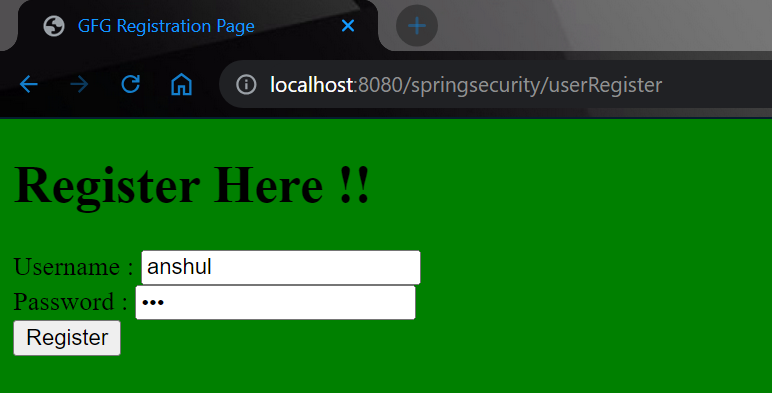
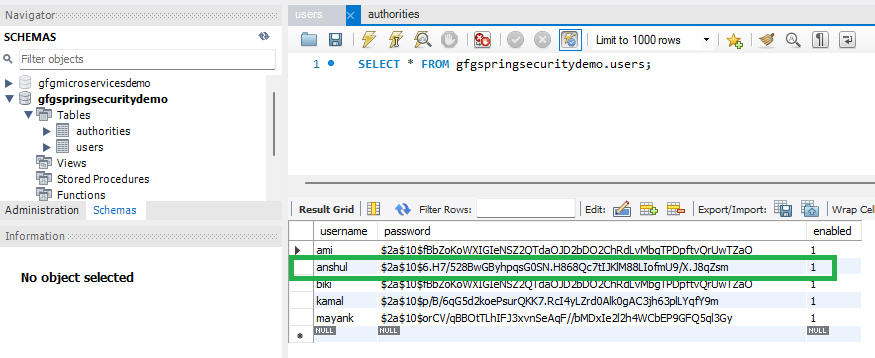
After clicking the registration button you can see the username and password have been stored in our database. You may notice that we are storing the password in an encrypted format.
And it will redirect you to the login page.
Now login with your database credentials
- Username: anshul
- Password: 123