
Spring Security provides security features for Java web applications by handling authentication and authorization. One of the commonly used methods in Spring Security 5 is antMatchers(), which helps secure endpoints based on roles, authorities, or authentication status.
- Used to secure endpoints based on roles and authentication.
- Supports wildcard URL pattern matching.
- In Spring Security 6 and Spring Boot 3, antMatchers() has been removed and replaced with requestMatchers()
How antMatchers() Works
The mapping rules in antMatchers() support special characters for flexible matching
- ? : matches one character
- * : matches zero or more characters
- ** : matches zero or more directories in a path
Examples:
- org/g?g -> matches org/gfg, org/geg, etc.
- org/*.jsp -> matches all .jsp files in the org directory
- org/**/test.jsp -> matches all test.jsp files under the org path
Methods applied on antmatchers()
- hasAnyRole(): Checks whether the authenticated user has a specific role to access the endpoint.
- hasRole(): Allows access if the user has any one of the specified roles.
- hasAuthority(): Checks whether the user has a specific authority or permission.
- hasAnyAuthority(): Allows access if the user has any one of the specified authorities
- authenticated(): Allows access only to authenticated (logged-in) users.
- anonymous(): Allows access only to users who are not authenticated or logged in.
Implementation of Securing Endpoints Using antMatchers()
Step 1: Create Spring MVC Project and Configure Tomcat
- Create a Dynamic Web Project in STS or Eclipse.
- Configure the Apache Tomcat Server.
Before moving to the project let’s have a look at the complete project structure for our Spring MVC application.
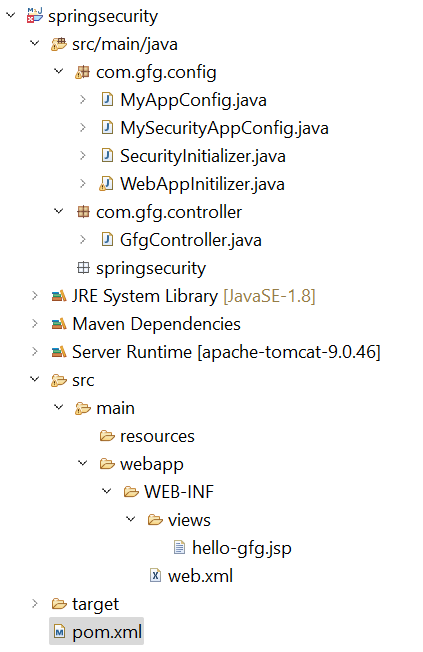
Step 2: Add Dependencies to pom.xml File
Add the following dependencies to your pom.xml file
- Spring Web MVC
- Java Servlet API
- Spring Security Config
- Spring Security Web
pom.xml:
<?xml version="1.0" encoding="UTF-8"?>

<project xmlns="https://maven.apache.org/POM/4.0.0" xmlns:xsi="https://www.w3.org/2001/XMLSchema-instance"
  xsi:schemaLocation="https://maven.apache.org/POM/4.0.0 https://maven.apache.org/xsd/maven-4.0.0.xsd">
  <modelVersion>4.0.0</modelVersion>

  <groupId>com.gfg.springsecurity</groupId>
  <artifactId>springsecurity</artifactId>
  <version>0.0.1-SNAPSHOT</version>
  <packaging>war</packaging>

  <name>springsecurity Maven Webapp</name>
  <!-- FIXME change it to the project's website -->
  <url>http://www.gfg.com</url>

  <properties>
    <project.build.sourceEncoding>UTF-8</project.build.sourceEncoding>
    <maven.compiler.source>1.7</maven.compiler.source>
    <maven.compiler.target>1.7</maven.compiler.target>
  </properties>

  <dependencies>

    <!-- https://mvnrepository.com/artifact/org.springframework/spring-webmvc -->
    <dependency>
        <groupId>org.springframework</groupId>
        <artifactId>spring-webmvc</artifactId>
        <version>5.3.24</version>
    </dependency>

    <!-- https://mvnrepository.com/artifact/javax.servlet/javax.servlet-api -->
    <dependency>
        <groupId>javax.servlet</groupId>
        <artifactId>javax.servlet-api</artifactId>
        <version>4.0.1</version>
        <scope>provided</scope>
    </dependency>

    <!-- https://mvnrepository.com/artifact/org.springframework.security/spring-security-config -->
    <dependency>
        <groupId>org.springframework.security</groupId>
        <artifactId>spring-security-config</artifactId>
        <version>5.7.3</version>
    </dependency>

    <!-- https://mvnrepository.com/artifact/org.springframework.security/spring-security-web -->
    <dependency>
        <groupId>org.springframework.security</groupId>
        <artifactId>spring-security-web</artifactId>
        <version>5.7.3</version>
    </dependency>

  </dependencies>

  <build>
    <finalName>springsecurity</finalName>
    <pluginManagement><!-- lock down plugins versions to avoid using Maven defaults (may be moved to parent pom) -->
      <plugins>
        <plugin>
          <artifactId>maven-clean-plugin</artifactId>
          <version>3.1.0</version>
        </plugin>
        <!-- see https://maven.apache.org/ref/3.9.11/maven-core/default-bindings.html#Plugin_bindings_for_war_packaging -->
        <plugin>
          <artifactId>maven-resources-plugin</artifactId>
          <version>3.0.2</version>
        </plugin>
        <plugin>
          <artifactId>maven-compiler-plugin</artifactId>
          <version>3.8.0</version>
        </plugin>
        <plugin>
          <artifactId>maven-surefire-plugin</artifactId>
          <version>2.22.1</version>
        </plugin>
        <plugin>
          <artifactId>maven-war-plugin</artifactId>
          <version>3.2.2</version>
        </plugin>
        <plugin>
          <artifactId>maven-install-plugin</artifactId>
          <version>2.5.2</version>
        </plugin>
        <plugin>
          <artifactId>maven-deploy-plugin</artifactId>
          <version>2.8.2</version>
        </plugin>
      </plugins>
    </pluginManagement>
  </build>
</project>
Step 3: Configuring Dispatcher Servlet
Go to the src > main > java and create a class WebAppInitilizer.
- Dispatcher Servlet handles incoming HTTP requests.
- AbstractAnnotationConfigDispatcherServletInitializer replaces web.xml.
WebAppInitilizer.java
package com.gfg.config;

import org.springframework.web.servlet.support.AbstractAnnotationConfigDispatcherServletInitializer;

public class WebAppInitilizer extends
               AbstractAnnotationConfigDispatcherServletInitializer {

    @Override
    protected Class<?>[] getRootConfigClasses() {
        // TODO Auto-generated method stub
        return null;
    }

    @Override
    protected Class<?>[] getServletConfigClasses() {
        Class[] configFiles = {MyAppConfig.class};
        return configFiles;
    }

    @Override
    protected String[] getServletMappings() {
        String[] mappings = {"/"};
        return mappings;
    }
}
Step 4: Configure Spring MVC
Create another class in the same location (src > main > java) and name it MyAppConfig.
- @EnableWebMvc enables Spring MVC features.
- InternalResourceViewResolver resolves JSP view files.
MyAppConfig.java
package com.gfg.config;

import org.springframework.context.annotation.Bean;
import org.springframework.context.annotation.ComponentScan;
import org.springframework.context.annotation.Configuration;
import org.springframework.web.servlet.config.annotation.EnableWebMvc;
import org.springframework.web.servlet.view.InternalResourceViewResolver;

@Configuration
@EnableWebMvc
@ComponentScan("com")
public class MyAppConfig {

    @Bean
    InternalResourceViewResolver viewResolver() {
        InternalResourceViewResolver resolver = new InternalResourceViewResolver();
        resolver.setPrefix("/WEB-INF/views/");
        resolver.setSuffix(".jsp");
        return resolver;
    }
}
Step 5: Create Spring MVC Controller
Go to the src > main > java and create a class GfgController.
- /gfg endpoint will be secured.
- @ResponseBody returns plain text response.
GfgController.java
package com.gfg.controller;

import org.springframework.stereotype.Controller;
import org.springframework.web.bind.annotation.GetMapping;
import org.springframework.web.bind.annotation.ResponseBody;

@Controller
public class GfgController {

    // Secure this one
    @GetMapping("/gfg")
    public String helloGfg() {
        return "hello-gfg";
    }

    // Don't secure this
    @GetMapping("/gfg/welcome")
    @ResponseBody
    public String welcomeGfg() {
        return "Welcome to GeeksforGeeks";
    }
}
Step 6: Create View
Go to the src > main > webapp > WEB-INF > right-click > New > Folder and name the folder as views. Then views > right-click > New > JSP File.
- JSP files are used as view pages.
- WEB-INF prevents direct browser access to JSP files.
<!DOCTYPE html>
<html>
<body bgcolor="green">
    <h1>Hello GeeksforGeeks!</h1>
</body>
</html>
Step 7: Setup Spring Security
Go to the src > main > java and create a class SecurityInitializer.
- Registers Spring Security filter chain.
- Enables Spring Security integration in the application.
SecurityInitializer.java
package com.gfg.config;

import org.springframework.security.web.context.AbstractSecurityWebApplicationInitializer;

// This class will help to register spring security filter chain with our application
public class SecurityInitializer extends AbstractSecurityWebApplicationInitializer {

}
Step 8: Configure Spring Security Using antMatchers()
Configure spring security: Go to the src > main > java and create a class MySecurityAppConfig.
- /gfg endpoint requires authentication.
- In-memory authentication is used for testing.
MyAppConfig.java
package com.gfg.config;

import org.springframework.beans.factory.annotation.Autowired;
import org.springframework.security.config.annotation.authentication.builders.AuthenticationManagerBuilder;
import org.springframework.security.config.annotation.web.builders.HttpSecurity;
import org.springframework.security.config.annotation.web.configuration.EnableWebSecurity;
import org.springframework.security.config.annotation.web.configuration.WebSecurityConfigurerAdapter;
import org.springframework.security.crypto.password.PasswordEncoder;

@SuppressWarnings("deprecation")
@EnableWebSecurity
public class MySecurityAppConfig extends WebSecurityConfigurerAdapter {

    @Autowired
    private PasswordEncoder passwordEncoder;

    @Override
    protected void configure(AuthenticationManagerBuilder auth) throws Exception {
        auth.inMemoryAuthentication()
            .withUser("gfg")
            .password(passwordEncoder.encode("gfg123"))
            .roles("admin");
    }

    @Override
    protected void configure(HttpSecurity http) throws Exception {
        http
            .authorizeHttpRequests()
            .antMatchers("/gfg").authenticated()
            .antMatchers("/gfg/welcome").permitAll()
            .and()
            .formLogin().loginPage("/customLogin")
            .and()
            .httpBasic();
    }
}
Step 9: Run the Application
To run our Spring MVC Application right-click on your project > Run As > Run on Server. After that use the following URL to run your controller.
http://localhost:8080/springsecurity/gfg
And it will ask for authentication to use the endpoint and a pop-up screen will be shown like this.

Now sign in with the following credentials
- Username: gfg
- Password: gfg123
And now you can access your endpoint. You will get the output like this.
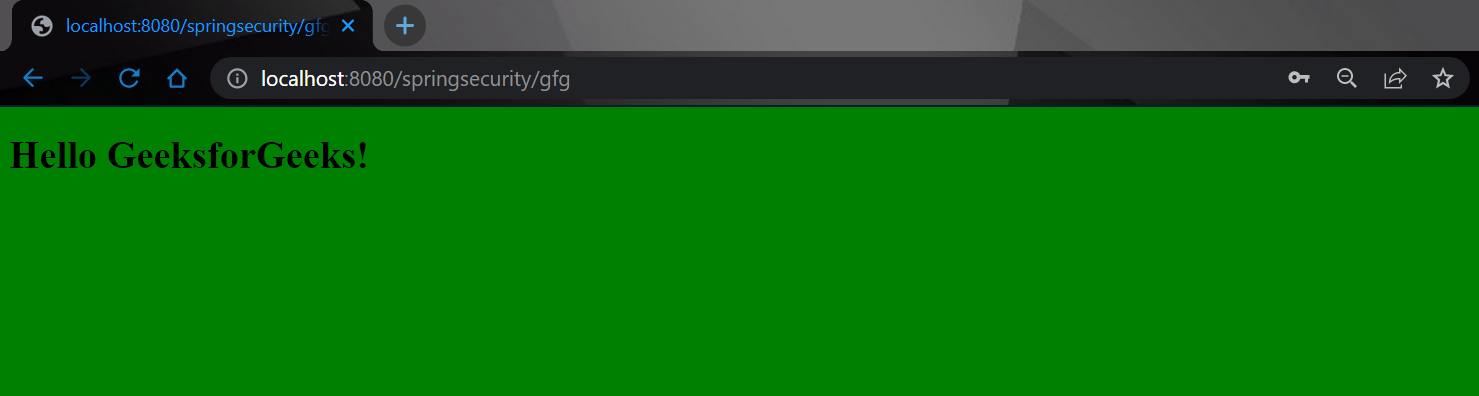
But when you hit the following endpoint you can access it without any authentication.
http://localhost:8080/springsecurity/gfg/welcome
You will get the output like this.

