

アフェクト
Affect, 情動/感情/感動
☆ アフェクト[Affect]=情動/感情/感動=アフェクトゥス(ラテン語のaffectusまたはadfectusに由来)とは、バルーフ・スピノザの哲学で用いられ、アンリ・ベルクソン、ジ ル・ドゥルー ズ、フェリックス・ガタリによって展開された概念である(→「感情/情動」)。これは身体的あるいは具現化された経験に重点を置く。心理学や他の分野では、アフェ クトという言 葉は異なる意味を持つ。 スピノザにとって、その『倫理学(エチカ)』第二部および第三部で論じられているように、アフェクトとは心身の状態であり、感情や情動と関連しているが (ただし完全 に同義ではない)。彼はアフェクトには主に三種類あると述べている:快楽または喜び(ラエティティア)、苦痛または悲しみ(トリスティティア)、そして欲 望(クピディタス)または食欲である。[2] ジル・ドゥルーズ、フェリックス・ガタリ、そして彼らの翻訳者ブライアン・マッスミによる後の哲学的用法は、明らかにスピノザに由来するものの、アフェク トと従来感情と呼ばれるものとの区別をスピノザよりも鋭くする傾向がある。アフェクトは把握や概念化が難しい。スピノザが言うように「精神の情動 (animi pathema)とは混同された観念」であり、身体の生命力の増減によってのみ知覚されるからだ[3]。「アフェクト」という用語は、人文 社会科学におけ る「アフェクティブ・ターン」の核心をなす概念である。
★ スピノザのアフェクトゥスの定義:
「感
情=アフェクトゥスの定義:I.
欲望とは、ある特定の活動へと、それ自体の与えられた変容によって決定づけられていると捉えられる限りにおいて、人間の真の本質である。II.
快とは、人間がより低い完全性からより高い完全性へと移行することである。III.
苦痛とは、人間がより高い完全性からより低い完全性へと移行することである。IV.
驚嘆とは、ある事物の概念(イマギナティオ)であり、そこで心は停滞する。なぜなら、問題となっている特定の概念は他の概念と何ら関連を持っていないから
である。V.
軽蔑とは、何であれ、心にほとんど影響を与えないものの概念であり、その存在によって、心はそこに実際に存在する性質よりも、実際には存在しない性質を想
像するよう導かれるものである。VI. 愛とは、外部の原因という観念を伴う快楽である。VII.
憎悪とは、外的な原因の観念を伴う苦痛である。VIII. 好意とは、偶然的に快の原因となるものの観念を伴う快である。IX.
嫌悪とは、偶発的に苦痛の原因となるものの観念を伴う苦痛である。X. 崇敬とは、我々が賞賛する者に対する愛である。XI.
嘲笑とは、私たちが憎む対象に、私たちが軽蔑する性質が存在すると認識することから生じる快楽である。XII.
希望とは、過去または未来の何事かについての観念から生じる不安定な快楽であり、その結末について我々は一定程度疑いを抱いているものである。XIII.
恐怖とは、過去または未来の何事かについての観念から生じる不安定な苦痛であり、その結末について我々は一定程度疑いを抱いているものである。XIV.
確信とは、過去または未来の何らかの事象の観念から生じる快であり、そこから疑いの原因がすべて取り除かれているものである。XV.
絶望とは、過去または未来の何らかの事象の観念から生じる苦であり、そこから疑いの原因がすべて取り除かれているものである。XVI.
喜びとは、私たちの期待を超えた結果をもたらした過去の事柄の観念を伴う快楽である。XVII.
失望とは、過去の事柄の観念を伴う苦痛であり、その事柄の結果が我々の希望に反するものである。XVIII.
憐れみとは、悪の観念を伴う苦痛であり、その悪は、我々が自分と似ていると捉える他者に降りかかったものである。XIX.
称賛とは、他者に善行を行った者に対する愛である。XX. 憤りは、他者に悪を行った者に対する憎しみである。XXI.
偏愛とは、ある人に対する愛ゆえに、その人を過大評価することである。XXII.
軽蔑とは、ある人を憎むゆえに、その人を過小評価することである。XXIII.
嫉妬とは、他者の幸運に苦痛を感じ、他者の不幸を喜ぶように人を駆り立てる点において、憎悪である。XXIV.
同情(misericordia)とは、他者の幸運に喜びを感じ、他者の不幸に苦痛を感じるよう人を駆り立てる点において、愛である。XXV.
自己承認とは、人が自分自身と自身の行動力を省察することから生じる快である。XXVI.
謙虚さとは、人が自身の身体的または精神的な弱さを省察することから生じる苦である。XXVII. 悔悛とは、自らの心の自由な決定によって行ったと信じる何らかの行為の観念を伴う苦痛である。XXVIII.
傲慢とは、自己愛から自分自身を過大評価することである。XXIX. 自己卑下とは、苦痛を理由に自分自身を過小評価することである。XXX.
名誉とは、他者から称賛されると信じている、自分自身の何らかの行為という観念を伴う快楽である。XXXI.
恥とは、他者から非難されていると信じる、自らの何らかの行為という観念を伴う苦痛である。XXXII.
後悔とは、あるものを所有したいという欲望または渇望であり、その物事への記憶によって維持されつつ、同時に、その存在を排除する他の事柄への記憶によっ
て制約されるものである。XXXIII.
模倣とは、他者が同じ欲望を抱いているという我々の認識によって、我々の中に生じさせる何かへの欲望である。XLV.
贅沢とは、豪奢な生活に対する過度な欲望、あるいは愛である。XLVI. 放蕩とは、飲酒に対する過度な欲望および愛好である。XLVII. 貪欲とは、富に対する過度な欲望および愛好である。XLVIII. 情欲とは、性交に関する欲望および愛好である。」——スピノザ「エチカ」第III部;感情の起源および本性について.
★★︎感情/情動の語彙の成分分析▶︎情動の文化理論▶︎︎情動と理性▶︎情動と感情の語彙集▶︎︎▶︎
★★身体▶︎︎エンボディメント・身体化・ 具体化▶︎身体の人類学▶︎︎マルセル・モースの身体技法▶身体観︎▶︎
★★理性︎▶︎▶︎︎▶︎▶︎︎▶︎▶︎︎▶︎▶︎︎▶︎▶︎
| Affect (from Latin
affectus or adfectus) is a concept, used in the philosophy of Baruch
Spinoza and elaborated by Henri Bergson, Gilles Deleuze and Félix
Guattari, that places emphasis on bodily or embodied experience. The
word affect takes on a different meaning in psychology and other fields. For Spinoza, as discussed in Parts Two and Three of his Ethics, affects are states of mind and body that are related to (but not exactly synonymous with) feelings and emotions, of which he says there are three primary kinds: pleasure or joy (laetitia),[1] pain or sorrow (tristitia)[1] and desire (cupiditas) or appetite.[2] Subsequent philosophical usage by Gilles Deleuze, Félix Guattari and their translator Brian Massumi, while derived explicitly from Spinoza, tends to distinguish more sharply than Spinoza does between affect and what are conventionally called emotions. Affects are difficult to grasp and conceptualize because, as Spinoza says, "an affect or passion of the mind [animi pathema] is a confused idea" which is only perceived by the increase or decrease it causes in the body's vital force.[3] The term "affect" is central to what has become known as the "affective turn" in the humanities and social sciences. |
アフェクト[Affect](ラテン語のaffectusまたはadfectusに由
来)とは、バルーフ・スピノザの哲学で用いられ、アンリ・ベルクソン、ジル・ドゥルーズ、フェリックス・ガタリによって展開された概念である。これは身体
的あるいは具現化された経験に重点を置く。心理学や他の分野では、アフェクトという言葉は異なる意味を持つ。 スピノザにとって、その『倫理学(エチカ)』第二部および第三部で論じられているように、アフェクトとは心身の状態であり、感情や情動と関連しているが (ただし完全 に同義ではない)。彼はアフェクトには主に三種類あると述べている:快楽または喜び(ラエティティア)、苦痛または悲しみ(トリスティティア)、そして欲 望(クピディタス)または食欲である。[2] ジル・ドゥルーズ、フェリックス・ガタリ、そして彼らの翻訳者ブライアン・マッスミによる後の哲学的用法は、明らかにスピノザに由来するものの、アフェク トと従来感情と呼ばれるものとの区別をスピノザよりも鋭くする傾向がある。アフェクトは把握や概念化が難しい。スピノザが言うように「精神の情動 (animi pathema)とは混同された観念」であり、身体の生命力の増減によってのみ知覚されるからだ[3]。「アフェクト」という用語は、人文社会科学におけ る「アフェクティブ・ターン」の核心をなす概念である。 |
| In Spinoza In Baruch Spinoza's Ethics, Part III Definition 3, the term "affect" (affectus, traditionally translated as "emotion")[4] is the modification or variation produced in a body (including the mind) by an interaction with another body which increases or diminishes the body's power of activity (potentia agendi): By affect I understand affections of the body by which the body's power of acting is increased or diminished, aided or restrained, and at the same time, the ideas of these affections.[5] Affect is thus a special case of the more neutral term "affection" (affectio), which designates the form "taken on" by some thing,[6] the mode, state or quality of a body's relation to the world or nature (or infinite "substance"). In Part III, "Definitions of the Emotions/Affects", Spinoza defines 48 different forms of affect, including love and hatred, hope and fear, envy and compassion. They are nearly all manifestations of the three basic affects of: - desire (cupiditas) or appetite (appetitus), defined as "the very essence of man insofar as his essence is conceived as determined to any action from any given affection of itself";[7] - pleasure (laetitia), defined as "man's transition from a state of less perfection to a state of greater perfection";[7] and - pain or sorrow (tristitia), defined as "man's transition from a state of greater perfection to a state of less perfection".[7] In Spinoza's view, since God's power of activity is infinite, any affection which increases the organism's power of activity leads to greater perfection. Affects are transitional states or modes in that they are vital forces by which the organism strives to act against other forces which act on it and continually resist it or hold it in check.[8] |
スピノザにおいて バルーク・スピノザの『倫理学』第三部定義3において、「アフェクト」(affectus、従来「感情」と訳されてきた)[4]とは、ある身体(精神を含 む)が別の身体と相互作用した際に生じる変化や変動を指す。この相互作用は、身体の活動力(potentia agendi)を増大させたり減衰させたりするものである: 情動とは、身体の作用力を増大または減少させ、促進または抑制する身体への影響、および同時にそれらの影響の観念を指す。[5] したがってアフェクトは、より中立的な用語「アフェクティオ(affectio)」の特殊な場合である。アフェクティオとは、何らかのものが「取り込む」 形態[6]、すなわち身体が世界や自然(あるいは無限の「実体」)と関わる様態・状態・性質を指す。第三部「情動/アフェクトの定義」において、スピノザ は愛と憎しみ、希望と恐怖、羨望と憐憫を含む48種類の異なるアフェクトを定義する。これらはほぼ全て、以下の三つの基本アフェクトの現れである: - 欲望(cupiditas)または食欲(appetitus)。これは「人間の本質そのもの、すなわちその本質が、自己の与えられた情動からいかなる行動 にも決定づけられるものとして捉えられる限りにおいて」と定義される。[7] - 喜び(ラエティティア)。「人間の状態がより低い完全性からより高い完全性へ移行すること」と定義される;[7] - 苦痛または悲しみ(トリスティティア)。「人間の状態がより高い完全性からより低い完全性へ移行すること」と定義される。[7] スピノザの見解では、神の活動力は無限であるため、有機体の活動力を増大させるあらゆる情動はより大きな完全性へと導く。情動は過渡的な状態あるいは様態 であり、それは有機体が作用する他の力、すなわち絶えず抵抗したり抑制したりする力に対して、有機体が作用しようと努める生命力である。[8] |
| In Bergson Henri Bergson contends in Matter and Memory (1896) that we do not know our body only "from without" by perceptions, but also "from within" by affections (French: affections).[9] |
ベルクソンにおいて アンリ・ベルクソンは『物質と記憶』(1896年)において、我々は身体を単に知覚によって「外部から」知るだけでなく、情動(フランス語: affections)によって「内部から」も知るのだと主張している。[9] |
| In Deleuze and Guattari The terms "affect" and "affection" came to prominence in Gilles Deleuze and Félix Guattari's A Thousand Plateaus, the second volume of Capitalism and Schizophrenia. In his notes on the terminology employed, the translator Brian Massumi gives the following definitions of the terms as used in the volume: AFFECT/AFFECTION. Neither word denotes a personal feeling (sentiment in Deleuze and Guattari). L'affect (Spinoza's affectus) is an ability to affect and be affected. It is a prepersonal intensity corresponding to the passage from one experiential state of the body to another and implying an augmentation or diminution in that body's capacity to act. L'affection (Spinoza's affectio) is each such state considered as an encounter between the affected body and a second, affecting, body (with body taken in its broadest possible sense to include "mental" or ideal bodies).[10] Deleuze takes up the term affect from Spinoza and transforms it to meet the central ethical and political problem he poses. Fundamentally, Deleuze uses the term "affect" in two ways: affect as becoming and affect as capacities.[11] Becoming as capacities corresponds to Spinoza's notion of affection, which designates a being's capacities to affect other beings and be affected by them. In A Thousand Plateaus, Deleuze and Guattari, famously argue that a tick has three affects: (1) a capacity to be affected by light, which drives the tick to climb onto a branch, (2) a capacity to be affected by the smell of mammals, which prompts the tick to drop onto a passing host, (3) and lastly a capacity to dig into the animal's skin.[12] The use of affects as becomings[13] delineates affects as drivers of "events or undergoings that have disruptive and creative effects both on an individual’s internal composition and its external relationships with other things."[14] One of the main results of viewing affects as becomings is that they are no longer seen as merely personal feelings, as "they go beyond the strength of those who undergo them"[13] In this respect, affects, according to Deleuze, are not simple affections, as they are independent from their subject. Artists create affects and percepts, "blocks of space-time", whereas science works with functions, according to Deleuze, and philosophy creates concepts. |
ドゥルーズとガタリにおいて 「アフェクト」と「アフェクション」という用語は、ジル・ドゥルーズとフェリックス・ガタリの『資本主義と統合失調症』第二巻『千の平原』で注目されるよ うになった。翻訳者ブライアン・マッスミは用語解説の中で、本書におけるこれらの用語を次のように定義している: アフェクト/アフェクション。いずれの語も個人的感情(ドゥルーズ=ガタリにおける「感情」)を指さない。ラ・アフェクト(スピノザのaffectus) とは、影響を与え、また影響を受ける能力である。これは身体の経験状態から別の状態への移行に対応する前個人的強度であり、その身体の行動能力の増大また は減衰を意味する。アフェクション(スピノザのaffectio)とは、影響を受けた身体と、影響を与える第二の身体(身体を可能な限り広義に解釈し、 「精神的」あるいは観念的な身体も含む)との遭遇として捉えられた、そうした各状態を指す。[10] ドゥルーズはスピノザからアフェクトという概念を取り上げ、自身が提起する核心的な倫理的・政治的問題に対応させるべく変容させる。基本的にドゥルーズは 「アフェクト」という用語を二つの意味で用いる:生成としてのアフェクトと能力としてのアフェクトである。[11] 能力としての生成は、スピノザの「アフェクション」概念に対応する。これはある存在が他の存在に影響を与え、またそれらから影響を受ける能力を指す。『千 の平原』において、ドゥルーズとガタリは有名な議論を展開している。ダニには三つのアフェクトがあると:(1) 光によって影響を受ける能力。これがダニを枝に登らせる。(2) 哺乳類の匂いによって影響を受ける能力。これがダニを通りかかる宿主へ落下させる。(3) 最後に、動物の皮膚へ食い込む能力。[12] 情動を「生成」[13]として扱うことは、情動を「個人の内的構成と外的関係性の双方に破壊的かつ創造的な影響を及ぼす出来事や経験」[14]の駆動要因 として位置づける。情動を「生成」と捉える主な成果の一つは、情動が単なる人格感情ではなく「それを経験する者の力を超えるもの」[13]として認識され る点にある。この点において、ドゥルーズによれば、情動は単純な感情ではない。なぜなら情動は主体から独立しているからだ。芸術家は情動と知覚、すなわち 「時空間の塊」を創造する。一方、科学は機能と働き、哲学は概念を創造する。 |
| Affective turn Since 1995,[15][16] a number of authors in the social sciences and humanities have begun to explore affect theory as a way of understanding spheres of experience (including bodily experience) which fall outside of the dominant paradigm of representation (based on rhetoric and semiotics); this movement has been called the affective turn.[17] Consequently, these approaches are interested in the widest possible variety of interactions and encounters, interactions and encounters that are not necessarily limited to human sensibility.[18] The translator of Deleuze and Guattari's A Thousand Plateaus, Canadian political philosopher Brian Massumi, has given influential definitions of affect (see above) and has written on the neglected importance of movement and sensation in cultural formations and our interaction with real and virtual worlds.[19] Likewise, geographer Nigel Thrift has explored the role of affect in what he terms "non-representational theory".[20] In 2010, The Affect Theory Reader was published by Melissa Gregg and Gregory J. Seigworth and has provided the first compendium of affect theory writings.[21] Researchers such as Mog Stapleton, Daniel D. Hutto and Peter Carruthers[22][23][24] have pointed to the need to investigate and to develop the notions of affect and emotion. They hold that these are important in the developing paradigm of embodiment in cognitive science, in consciousness studies and the philosophy of mind. This step will be necessary for cognitive science, Mog Stapleton maintains, to be "properly embodied" cognitive science. |
情動的(アフェクト的)転回 1995年以降[15][16]、社会科学と人文科学の多くの研究者が、表象の支配的パラダイム(修辞学と記号論に基づく)の外側に位置する経験領域(身 体的経験を含む)を理解する手段として情動理論を探求し始めた。この動きは情動的転回と呼ばれている。[17] したがって、これらのアプローチは可能な限り多様な相互作用や遭遇に関心を持ち、それらは必ずしも人間の感性に限定されない。[18] デリューズとガタリの『千の平原』の翻訳者であるカナダの政治哲学者ブライアン・マッスミは、情動に関する影響力のある定義(前述参照)を示し、文化的形 成や現実世界・仮想世界との相互作用における運動と感覚の軽視された重要性について論じている。[19] 同様に、地理学者ナイジェル・スリフトは、彼が「非表象理論」と呼ぶものにおけるアフェクトの役割を探求している。[20] 2010年にはメリッサ・グレッグとグレゴリー・J・セイワースによる『アフェクト理論読本』が出版され、アフェクト理論の著作を初めて網羅した。 [21] モグ・ステイプルトン、ダニエル・D・ハット、ピーター・キャルーサーズといった研究者たち[22] [23][24]は、情動と感情の概念を調査・発展させる必要性を指摘している。彼らは、これらが認知科学における身体性の発展するパラダイム、意識研 究、心哲学において重要だと主張する。モグ・ステイプルトンは、認知科学が「真に身体化された」認知科学となるためには、このステップが不可欠だと述べて いる。 |
| Affect theory Affectionism Conatus Immanent evaluation Passions |
情動理論 情動主義 コナトゥス 内在的評価 情動 |
| 1. Part III, Proposition 56.
Spinoza, Benedictus de (2001) [1677]. Ethics. Trans. by W.H. White and
A.H. Stirling. London: Wordsworth Editions. p. 141. ISBN
978-1-84022-119-0. Retrieved 27 November 2011. 2. "In truth I cannot recognize any difference between human appetite and desire". Spinoza, Benedictus de (2001) [1677]. Ethics [heading= Affect. Trans. by W.H. White and A.H. Stirling. London: Wordsworth Editions. p. 146. ISBN 978-1-84022-119-0. Retrieved 27 November 2011. 3. Existendi vis or power of existence. Spinoza, Benedictus de (2001) [1677]. Ethics. Trans. by W.H. White and A.H. Stirling. London: Wordsworth Editions. p. 158. ISBN 978-1-84022-119-0. Retrieved 27 November 2011. 4. Of the two "standard" English translations, the version by Samuel Shirley uses "emotion" for affectus, whereas the more recent rendering by Edwin Curley uses "affect". Spinoza, Benedictus de (2002) [1677]. Complete Works. Trans. by Samuel Shirley. Indianapolis and Cambridge: Hackett Publishing. p. 278. ISBN 978-0-87220-620-5. Retrieved 27 November 2011. Spinoza, Benedictus de (1994). A Spinoza Reader: The Ethics and Other Works. Trans. by Edwin M. Curley. Princeton and Chichester: Princeton University Press. p. 154. ISBN 978-0-691-00067-1. Retrieved 27 November 2011. 5. Spinoza, Benedictus de (1994). A Spinoza Reader: The Ethics and Other Works. Trans. by Edwin M. Curley. Princeton and Chichester: Princeton University Press. p. 154. ISBN 978-0-691-00067-1. Retrieved 27 November 2011. 6. Samuel Shirley, "Translator's Preface". Spinoza, Benedictus de (1992). The Ethics; Treatise on the Emendation of the Intellect; Selected Letters. Trans. by Samuel Shirley. Hackett Publishing. p. 24. ISBN 978-0-87220-130-9. Retrieved 27 November 2011. 7. Spinoza, Benedictus de (1994). A Spinoza Reader: The Ethics and Other Works. Trans. by Edwin M. Curley. Princeton and Chichester: Princeton University Press. p. 311. ISBN 978-0-691-00067-1. Retrieved 27 November 2011. 8. Kisner, Matthew J. (2011). Spinoza on Human Freedom: Reason, Autonomy and the Good Life. Cambridge: Cambridge University Press. p. 20. ISBN 978-0-521-19888-2. Retrieved 28 November 2011. 9. Henri Bergson, Matter and Memory (1896), ch. 1. 10. Deleuze, Gilles; Guattari, Félix (1987) [1980]. A Thousand Plateaus: Capitalism and Schizophrenia. Vol. 2. Trans. and foreword by Brian Massumi. Minneapolis and London: University of Minnesota Press. p. xvi. ISBN 978-0-8166-1401-1. OCLC 16472336. 11. Aktas, Ahmet (2025-05-01). "Was Spinoza a Deleuzian? Rethinking the Politics of Emotions and Affects". Theory, Culture & Society. 42 (3): 99–101. doi:10.1177/02632764241301334. ISSN 0263-2764. 12. Deleuze, Gilles; Guattari, Félix; Deleuze, Gilles (2007). A thousand plateaus: capitalism and schizophrenia (12. print ed.). Minneapolis, Minn.: Univ. of Minnesota Press. p. 257. ISBN 978-0-8166-1401-1. 13. Deleuze, Gilles; Guattari, Félix; Tomlinson, Janis; Burchell III, Graham (2014). What Is Philosophy?. European Perspectives: A Series in Social Thought and Cultural Criticism. New York: Columbia University Press. p. 164. ISBN 978-0-231-07989-1. 14. Aktas, Ahmet (2025-05-01). "Was Spinoza a Deleuzian? Rethinking the Politics of Emotions and Affects". Theory, Culture & Society. 42 (3): 95–114. doi:10.1177/02632764241301334. ISSN 0263-2764. 15. Massumi, Brian (1995). "The Autonomy of Affect". Cultural Critique. Autumn (31): 83–109. doi:10.2307/1354446. JSTOR 1354446. 16. Sedgwick, Eve Kosofsky; Frank, Adam (1995). "Shame in the Cybernetic Fold: Reading Silvan Tomkins". Critical Inquiry. 21 (2): 496–522. doi:10.1086/448761. S2CID 143473392. 17. Patricia Ticineto Clough, Jean Halley (eds.), The Affective Turn: Theorizing the Social, Duke University Press, 2007, p. 1; Paul Hoggett, Simon Thompson (eds.), Politics and the Emotions: The Affective Turn in Contemporary Political Studies, Bloomsbury, 2012, p. 1. 18. Seyfert, Robert (2012). "Beyond Personal Feelings and Collective Emotions: A Theory of Social Affect". Theory, Culture & Society. 29/6: 35. doi:10.1177/0263276412438591. S2CID 143590063. 19. Massumi, Brian (2002). Parables for the Virtual: Movement, Affect, Sensation. Durham and London: Duke University Press. ISBN 978-0-8223-2897-1. Retrieved 27 November 2011. 20. Thrift, Nigel J. (2007). Non-representational Theory: Space, Politics, Affect. London: Routledge. ISBN 978-0-415-39320-1. Retrieved 27 November 2011. 21. Gregg, M.; Seigworth, G. (2010). The Affect Theory Reader. North Carolina: Duke University Press. ISBN 978-0822347767. Retrieved 30 April 2013. 22. Stapleton, M (2012). "Steps to a "Properly Embodied". Cognitive Science, Cognitive Systems Research. 22–23: 1–11. doi:10.1016/j.cogsys.2012.05.001. S2CID 1694792. 23. Hutto, D. Intersubjective Engagements without Theory of Mind: A Cross-Species Comparison[1] 24. Carruthers, P. (2000). Phenomenal Consciousness: A Naturalistic Theory. Cambridge: Cambridge University Press. |
1.
第3部、命題56。スピノザ、ベネディクトゥス・デ(2001年)[1677年]。『倫理学』。W.H.ホワイト及びA.H.スターリング訳。ロンドン:
ワーズワース・エディションズ。141頁。ISBN 978-1-84022-119-0。2011年11月27日取得。 2. 「実のところ、人間の食欲と欲望の間に異なる点を見いだせない」。「実のところ、人間の食欲と欲望の間に異なる点を見いだせない」。「実のところ、人間の 食欲と欲望の間に異なる点を見いだせない」。「実のところ、人間の食欲と欲望の間に異なる点を見いだせない」。「実のところ、人間の食欲と欲望の間に異な る点を見いだせない」。「実のところ、人間の食欲と欲望の間に異なる点を見いだせない」。「実のところ、人間の食欲と欲望の ISBN 978-1-84022-119-0. 2011年11月27日閲覧。 3. 存在の力(Existendi vis)。スピノザ、ベネディクトゥス・デ(2001年)[1677年]。『倫理学』。W.H.ホワイト及びA.H.スターリング訳。ロンドン:ワーズ ワース・エディションズ。p. 158. ISBN 978-1-84022-119-0。2011年11月27日閲覧。 4. 二つの「標準的」英訳のうち、サミュエル・シャーリーの訳は affectus を「emotion(感情)」と訳しているが、より新しいエドウィン・カーリーの訳は「affect(情動)」と訳している。スピノザ、ベネディクトゥ ス・デ(2002年)[1677年]。全集。サミュエル・シャーリー訳。インディアナポリスおよびケンブリッジ:ハケット出版。278頁。ISBN 978-0-87220-620-5。2011年11月27日閲覧。スピノザ、ベネディクトゥス・デ(1994)。『スピノザ読本:倫理学その他の著 作』。エドウィン・M・カーリー訳。プリンストンおよびチチェスター:プリンストン大学出版局。p. 154. ISBN 978-0-691-00067-1. 2011年11月27日閲覧。 5. スピノザ, ベネディクトゥス・デ (1994). 『スピノザ読本: 倫理学とその他の著作』. エドウィン・M・カーリー訳. プリンストン・チチェスター: プリンストン大学出版局. p. 154. ISBN 978-0-691-00067-1。2011年11月27日閲覧。 6. サミュエル・シャーリー「訳者序文」。スピノザ、ベネディクトゥス・デ(1992)。『倫理学;知性の修正に関する論文;選集書簡』。サミュエル・シャー リー訳。ハケット出版。p. 24。ISBN 978-0-87220-130-9。2011年11月27日閲覧。 7. スピノザ、ベネディクトゥス・デ(1994)。『スピノザ読本:倫理学その他の著作』。エドウィン・M・カーリー訳。プリンストンおよびチチェスター:プ リンストン大学出版局。p. 311。ISBN 978-0-691-00067-1。2011年11月27日閲覧。 8. マシュー・J・キスナー(2011)。『人間の自由に関するスピノザ:理性、自律、そして善き生活』。ケンブリッジ:ケンブリッジ大学出版局。p. 20。ISBN 978-0-521-19888-2。2011年11月28日閲覧。 9. アンリ・ベルクソン『物質と記憶』(1896年)、第1章。 10. ジル・ドゥルーズ、フェリックス・ガタリ(1987年)[1980年]。千の平原:資本主義と統合失調症. 第2巻. ブライアン・マッスミ訳・序文. ミネアポリス・ロンドン:ミネソタ大学出版局. p. xvi. ISBN 978-0-8166-1401-1. OCLC 16472336. 11. アクタス、アフメット (2025-05-01). 「スピノザはドゥルーズ主義者だったのか? 感情とアフェクトの政治学を再考する」『理論・文化・社会』42巻3号: 99–101頁. doi:10.1177/02632764241301334. ISSN 0263-2764. 12. ドゥルーズ、ジル; ガタリ、フェリックス; ドゥルーズ、ジル (2007). 『千のプラトー:資本主義と統合失調症』 (12. 印刷版). ミネアポリス、ミネソタ州: ミネソタ大学出版局. p. 257. ISBN 978-0-8166-1401-1. 13. ジル・ドゥルーズ、フェリックス・ガタリ、ジャニス・トムリンソン、グラハム・バーチェル III (2014). 『哲学とは何か?』. ヨーロッパの視点:社会思想と文化批評のシリーズ. ニューヨーク:コロンビア大学出版局. p. 164. ISBN 978-0-231-07989-1. 14. アクタス、アフメット (2025-05-01). 「スピノザはドゥルーズ主義者だったか?感情と感情の政治を再考する」. 理論、文化、社会. 42 (3): 95–114. doi:10.1177/02632764241301334. ISSN 0263-2764. 15. マッスミ, ブライアン (1995). 「情動の自律性」. 『文化批評』. 秋号 (31): 83–109. doi:10.2307/1354446. JSTOR 1354446. 16. セジウィック、イヴ・コソフスキー; フランク、アダム (1995). 「サイバネティックな折り目の中の恥:シルヴァン・トンプキンスを読む」. 『クリティカル・インクワイアリー』. 21 (2): 496–522. doi:10.1086/448761. S2CID 143473392. 17. パトリシア・ティシネート・クラフ、ジャン・ハーレー(編)、『感情の転換:社会を理論化する』、デューク大学出版局、2007年、p. 1;ポール・ホゲット、サイモン・トンプソン(編)、『政治と感情:現代政治学における感情の転換』、ブルームズベリー、2012年、p. 1。 18. サイファート、ロバート (2012). 「人格感情と集団的感情を超えて:社会感情の理論」. 『理論、文化、社会』. 29/6: 35. doi:10.1177/0263276412438591. S2CID 143590063. 19. マスミ、ブライアン (2002). 仮想のための寓話:運動、情動、感覚。ダーラム及びロンドン:デューク大学出版局。ISBN 978-0-8223-2897-1。2011年11月27日取得。 20. スリフト、ナイジェル・J. (2007). 非表象理論:空間、政治、情動。ロンドン:ラウトリッジ。ISBN 978-0-415-39320-1。2011年11月27日取得。 21. グレッグ, M.; サイグワース, G. (2010). 『情動理論読本』. ノースカロライナ: デューク大学出版局. ISBN 978-0822347767. 2013年4月30日取得。 22. ステイプルトン, M (2012). 「『適切に身体化された』状態への段階」. 認知科学, 認知システム研究. 22–23: 1–11. doi:10.1016/j.cogsys.2012.05.001. S2CID 1694792. 23. Hutto, D. 心の理論を伴わない相互主観的関与:種間比較[1] 24. Carruthers, P. (2000). 現象的意識:自然主義的理論. ケンブリッジ: ケンブリッジ大学出版局. |
| Sources Deleuze, Gilles. 1983. Cinema 1: The Movement Image. Trans. Hugh Tomlinson and Barbara Habberjam. London and New York: Continuum, 2005. ISBN 0-8264-7705-4. Deleuze, Gilles; Guattari, Félix (1987) [1980]. A Thousand Plateaus: Capitalism and Schizophrenia. Vol. 2. Trans. and foreword by Brian Massumi. Minneapolis and London: University of Minnesota Press. p. xvi. ISBN 978-0-8166-1401-1. OCLC 16472336. Massumi, Brian (2002). Parables for the Virtual: Movement, Affect, Sensation. Durham and London: Duke University Press. ISBN 978-0-8223-2897-1. Retrieved 27 November 2011. Seyfert, Robert (2012). "Beyond Personal Feelings and Collective Emotions: A Theory of Social Affect". Theory, Culture & Society. 29 (6): 27–46. doi:10.1177/0263276412438591. S2CID 143590063. Spinoza, Benedictus de (2002) [1677]. Complete Works. Trans. by Samuel Shirley. Indianapolis and Cambridge: Hackett Publishing. p. 278. ISBN 978-0-87220-620-5. Retrieved 27 November 2011. Skoggard, I. and Waterston, A. (2015), "Introduction: Toward an Anthropology of Affect and Evocative Ethnography." Anthropol Conscious, 26: 109–120. doi:10.1111/anoc.12041 Spinoza, Benedictus de (1994). A Spinoza Reader: The Ethics and Other Works. Trans. by Edwin M. Curley. Princeton and Chichester: Princeton University Press. p. 154. ISBN 978-0-691-00067-1. Retrieved 27 November 2011. Thrift, Nigel J. (2007). Non-representational Theory: Space, Politics, Affect. London: Routledge. ISBN 978-0-415-39320-1. Retrieved 27 November 2011. |
出典 ドゥルーズ、ジル。1983年。『シネマ 1:運動するイメージ』。ヒュー・トムリンソン、バーバラ・ハバージャム訳。ロンドンおよびニューヨーク:Continuum、2005年。ISBN 0-8264-7705-4。 ドゥルーズ、ジル;ガタリ、フェリックス (1987) [1980]。『 千のプラトー:資本主義と統合失調症。第 2 巻。ブライアン・マッスミによる翻訳および序文。ミネアポリスおよびロンドン:ミネソタ大学出版。p. xvi。ISBN 978-0-8166-1401-1。OCLC 16472336。 マッスミ、ブライアン(2002年)。『仮想のための寓話:運動、情動、感覚』。ダーラムおよびロンドン:デューク大学出版局。ISBN 978-0-8223-2897-1。2011年11月27日取得。 セイファート、ロバート(2012年)。「個人的感情と集団的情緒を超えて:社会的情動の理論」。理論、文化、社会。29 (6): 27–46。doi:10.1177/0263276412438591。S2CID 143590063。 スピノザ、ベネディクトゥス・デ(2002)[1677]。全集。サミュエル・シャーリー訳。インディアナポリス及びケンブリッジ:ハケット出版。p. 278。ISBN 978-0-87220-620-5。2011年11月27日閲覧。 スコガード、I. と ウォーターストン、A. (2015)、「序論:情動の人類学と喚起的民族誌に向けて」. 『人類学と意識』26: 109–120. doi:10.1111/anoc.12041 スピノザ、ベネディクトゥス・デ(1994)。『スピノザ読本:倫理学とその他の著作』。エドウィン・M・カーリー訳。プリンストンおよびチチェスター: プリンストン大学出版局。p. 154. ISBN 978-0-691-00067-1。2011年11月27日閲覧。 スリフト、ナイジェル・J.(2007)。『非表象理論:空間、政治、情動』。ロンドン:ラウトリッジ。ISBN 978-0-415-39320-1。2011年11月27日閲覧。 |
| https://en.wikipedia.org/wiki/Affect_(philosophy) |
︎▶︎感情政治学/感情の政治(Affective politics) |
| Affective
politics explores how emotions, feelings, and moods shape political
behavior, power, and identity, moving beyond purely rational views to
show how politicians strategically use emotions (like fear, hope,
outrage) to influence citizens, and how citizens' collective feelings
(affective polarization, solidarity) create political realities,
especially in digital spaces. It studies how emotional appeals in
media, policy-making, and discourse create shared "feeling rules,"
influence governance, and build or challenge social bonds, impacting
everything from voting to national security. Affective politics is a field of study and a political practice that recognizes emotions—such as fear, anger, joy, and hope—not as distractions from rational thought, but as the primary drivers of political views, actions, and collective identities. |
感
情政治学(Affective
politics)は、感情や気分が政治行動、権力、アイデンティティをどう形作るかを研究する。純粋に合理的な見解を超え、政治家が恐怖や希望、怒りと
いった感情を戦略的に利用して市民に影響を与える方法、そして市民の集合的感情(感情的分極化や連帯感)が特にデジタル空間において政治的現実をどう生み
出すかを示す。メディアや政策決定、言説における感情的訴求が、いかに共有された「感情ルール」を生み出し、統治に影響を与え、社会的絆を構築あるいは挑
戦するのかを研究する。投票行動から国家安全保障に至るまで、あらゆる事象に影響を及ぼすのである。 感情政治学とは、恐怖や怒り、喜び、希望といった感情を、理性的な思考の妨げではなく、政治的見解や行動、集団的アイデンティティの主要な原動力として認 識する研究分野であり、政治的実践である。 |
| Key Aspects of Affective
Politics: Emotional Appeals: Politicians and actors deliberately use emotional rhetoric (e.g., inciting outrage, fostering compassion) to persuade and mobilize people, often by framing issues to trigger specific reactions. Digital Media's Role: Social media amplifies affective dynamics, making it crucial for understanding modern political communication, misinformation, and polarization. Affective Polarization: A key concept where partisans strongly dislike and distrust opponents, creating deep emotional divides rather than just policy disagreements. Emotions as Social Practices: Drawing from scholars like Sara Ahmed, it sees emotions not just as individual feelings but as social practices that produce political realities, power structures, and subjectivities. Ontological Security: How collective emotions (grief, solidarity) help communities cope with trauma and rebuild stability, with political leaders playing a role in restoring trust. Reciprocal Relationship: A two-way street where politicians use voters, but voters also "use" politicians to experience certain feelings, and shared feelings create collective political identities. |
感情政治の主要な側面: 感情的訴求:政治家や関係者は、意図的に感情的なレトリック(例:怒りを煽る、同情を育む)を用いて人々を説得し動員する。多くの場合、特定の反応を引き 起こすよう問題を設定する。 デジタルメディアの役割:ソーシャルメディアは感情的な力学を増幅させる。現代の政治コミュニケーション、誤情報、分極化を理解する上で極めて重要だ。 感情的分極化: 支持者が対立する陣営を強く嫌悪し不信感を抱く核心概念であり、単なる政策上の意見の相違ではなく深い感情的な断絶を生む。社会的実践としての感情: サラ・アーメドら研究者の見解に基づき、感情を単なる個人の感情ではなく、政治的現実・権力構造・主体性を生み出す社会的実践と捉える。 存在論的安心感:集団的感情(悲嘆、連帯感)が、コミュニティがトラウマに対処し安定を再構築するのをどう助けるか。政治指導者は信頼回復に役割を果た す。 相互関係:双方向の関係性。政治家が有権者を利用する一方で、有権者も特定の感情を経験するために政治家を「利用」する。共有された感情が集団的政治的ア イデンティティを形成する。 |
| Examples in Action: Bismarck's Doctored Telegram: A historical example of manipulating emotions (French outrage) to instigate war. Neoliberalism: How dependency discourses evoke emotions (shame, undeservingness) to enforce particular social values and identities. Post-Truth Era: How feelings of being unheard, rather than just facts, drive political belief and action. |
実例: ビスマルクの改ざん電報:戦争を煽るために感情(フランスの怒り)を操作した歴史的事例。 新自由主義:依存関係に関する言説が感情(恥、不適格感)を喚起し、特定の社会的価値観やアイデンティティを強要する仕組み。 ポスト・トゥルース時代:単なる事実ではなく、声を聞いてもらえないという感情が政治的信念と行動を駆り立てる仕組み。 |
| In
essence, affective politics argues that emotions are not just
background noise but a central, dynamic force in politics, shaping how
we understand the world and act within it. |
本質的に、感情政治学は、感情は単なる背景の雑音ではなく、政治におけ
る中心的で動的な力であり、私たちが世界をどう理解し、その中でどう行動するかを形作るものであると主張する。 |
★アフェクト理論
| Affect theory may
refer to theories from philosophy, psychology, or the humanities.
Definitions and applications vary across psychology, psychoanalysis,
neuroscience, medicine, interpersonal communication, literary theory,
critical theory, media studies, and gender studies, among other fields. In psychology, affect is a theory that seeks to organize affects, sometimes used interchangeably with emotions or subjectively experienced feelings, into discrete categories and to typify their physiological, social, interpersonal, and internalized manifestations. Psychological affect theory is usually attributed to the psychologist Silvan Tomkins, introduced in the first two volumes of his book Affect Imagery Consciousness (1962). Tomkins uses the concept of affect to refer to the "biological portion of emotion," defined as the "hard-wired, preprogrammed, genetically transmitted mechanisms that exist in each of us," which, when triggered, precipitate a "known pattern of biological events".[1] However, it is also acknowledged that, in adults, the affective experience is a result of interactions between the innate mechanism and a "complex matrix of nested and interacting ideo-affective formations."[2] |
アフェクト理論とは、哲学、心理学、あるいは人文学における理論を指す場合がある。その定義や応用は、心理学、精神分析学、神経科学、医学、対人コミュニケーション、文学理論、批判理論、メディア研究、ジェンダー研究など、分野によって異なる。 心理学において、アフェクト理論とは、アフェクト(感情や主体的に体験される感情と同義に用いられることもある)を個別のカテゴリーに分類し、その生理的、社会的、対人関係的、および内面化された現れを類型化しようとする理論である。 心理学におけるアフェクト理論は、通常、心理学者シルヴァン・トムキンスによるものとされ、彼の著書『アフェクト・イメージ・コンシャスネス』(1962 年)の最初の2巻で提唱された。トムキンスは「アフェクト」という概念を用いて、「感情の生物学的側面」を指し、これを「私たち一人ひとりに存在する、生 来の、あらかじめプログラムされた、遺伝的に伝達されたメカニズム」と定義している。これが引き金となると、「既知の生物学的事象のパターン」を引き起こ す。[1] しかし、成人においては、情動的体験は、生来のメカニズムと「入れ子状に重なり合い、相互作用する観念・情動的形成の複雑なマトリックス」との相互作用の 結果であることも認められている。[2] |
| Affect theory in psychology Silvan Tomkins's nine affects See also: Affect (psychology) According to the psychologist Silvan Tomkins, there are nine primary affects. Tomkins characterized affects by low/high intensity labels and by their physiological expression:[3] Positive: Enjoyment/Joy (reaction to success/impulse to share) – smiling, lips wide and out Interest/Excitement (reaction to new situation/impulse to attend) – eyebrows down, eyes tracking, eyes looking, closer listening Neutral: Surprise/Startle (reaction to sudden change/resets impulses) – eyebrows up, eyes blinking Negative: Anger/Rage (reaction to threat/impulse to attack) – frowning, a clenched jaw, a red face Disgust (reaction to bad taste/impulse to discard) – the lower lip raised and protruded, head forward and down Dissmell (reaction to bad smell/impulse to avoid – similar to distaste) – upper lip raised, head pulled back Distress/Anguish (reaction to loss/impulse to mourn) – crying, rhythmic sobbing, arched eyebrows, mouth lowered Fear/Terror (reaction to danger/impulse to run or hide) – a frozen stare, a pale face, coldness, sweat, erect hair Shame/Humiliation (reaction to failure/impulse to review behaviour) – eyes lowered, the head down and averted, blushing |
心理学におけるアフェクト理論 シルヴァン・トムキンスの9つのアフェクト 関連項目:アフェクト(心理学) 心理学者シルヴァン・トムキンスによれば、9つの主要なアフェクトが存在する。トムキンスは、アフェクトを「低/高」の強度ラベルと、その生理的表現によって特徴づけた: [3] 肯定的: 喜び/楽しみ(成功への反応/共有したいという衝動)――笑顔、唇を広く外側に広げる 興味/興奮(新しい状況への反応/注意を向けたいという衝動)――眉を下げ、視線を追う、じっと見つめる、耳を澄ます 中立: 驚き/驚愕(急激な変化への反応/衝動のリセット)――眉を上げ、まばたきをする 否定的: 怒り/激怒(脅威への反応/攻撃の衝動)――眉をひそめ、顎を食いしばり、顔を赤らめる 嫌悪(不快な味への反応/排除の衝動)――下唇を上げて突き出し、頭を前方に下げる 悪臭への嫌悪(悪臭への反応/回避の衝動――嫌悪と類似)――上唇を上げる、頭を後ろに引く 苦痛/苦悩(喪失への反応/悲しむ衝動)――泣く、リズミカルなすすり泣き、眉を上げる、口元を下げる 恐怖/戦慄(危険に対する反応/逃げたり隠れたりしたい衝動)――凍りついたような視線、青ざめた顔、冷たさ、汗、逆立った髪 恥/屈辱(失敗に対する反応/自分の行動を振り返りたい衝動)――目を伏せる、頭を下げて視線をそらす、顔を赤らめる |
| Prescriptive applications According to Tomkins, optimal mental health involves maximizing positive affects and minimizing negative affects.[4] Affect should also be properly expressed so to make the identification of affect possible to others.[5] Affect theory is also used prescriptively in investigations about intimacy and intimate relationships. Kelly describes relationships as agreements to work collaboratively toward maximizing positive affect and minimizing negative affect.[6] Like the "optimal mental health" blueprint, this blueprint requires that members of the relationship express affect to one another in order to identify progress. These blueprints can also describe natural and implicit goals. For example, Donald Nathanson uses the "affect" to create a narrative for one of his patients:[5] I suspect that the reason he refuses to watch movies is the sturdy fear of enmeshment in the affect depicted on the screen; the affect mutualization for which most of us frequent the movie theater is only another source of discomfort for him. ... His refusal to risk the range of positive and negative affect associated with sexuality robs any possible relationship of one of its best opportunities to work on the first two rules of either the Kelly or the Tomkins blueprint. Thus, his problems with intimacy may be understood in one aspect as an overly substantial empathic wall, and in another aspect as a purely internal problem with the expression and management of his own affect. Tomkins claims that "Christianity became a powerful universal religion in part because of its more general solution to the problem of anger, violence, and suffering versus love, enjoyment, and peace.".[7] Affect theory is also referenced heavily in Tomkins's script theory. |
規範の応用 トムキンスによれば、最適な精神的健康とは、肯定的な感情を最大化し、否定的な感情を最小化することである。[4] また、他者がその感情を認識できるよう、感情は適切に表現されるべきである。[5] 情動理論は、親密さや親密な関係に関する研究においても規範的に用いられている。ケリーは、関係を「肯定的な情動を最大化し、否定的な情動を最小化するた めに協力して取り組むという合意」と説明している。[6] 「最適な精神的健康」の青写真と同様に、この青写真においても、関係の当事者たちは進捗を把握するために互いに情動を表現することが求められる。 これらの青写真は、自然で暗黙的な目標を記述することもできる。例えば、ドナルド・ナサソンは「アフェクト」を用いて、ある患者の物語を構築している:[5] 彼が映画を観ることを拒む理由は、スクリーンに描かれるアフェクトに巻き込まれることへの根強い恐怖にあるのではないかと私は推測する。私たちの多くが映 画館に通う理由であるアフェクトの相互化は、彼にとってはただ不快感の源に過ぎないのだ。……彼が性に関連する肯定的・否定的な感情の幅に身をさらすこと を拒むことは、あらゆる可能性のある関係において、ケリーやトムキンスの青写真の最初の2つのルールに取り組むための最良の機会の一つを奪ってしまう。し たがって、彼の親密さに関する問題は、ある側面では過度に強固な共感の壁として、また別の側面では、自身の感情の表現と管理に関する純粋に内的な問題とし て理解できる。 トムキンスは、「キリスト教が強力な普遍的宗教となったのは、怒り、暴力、苦悩と、愛、喜び、平和との対立という問題に対して、より一般的な解決策を提示したことも一因である」と主張している。[7] 感情理論は、トムキンスのスクリプト理論においても多用されている。 |
| Attempts to typify affects in psychology Humor is a subject of debate in affect theory. In studies of humor's physiological manifestations, humor provokes highly characteristic facial expressions.[original research?] Some research has shown evidence that humor may be a response to a conflict between negative and positive affects,[8] such as fear and enjoyment, which results in spasmodic contractions of parts of the body, mainly in the stomach and diaphragm area, as well as contractions in the upper cheek muscles. Further affects that seem to be missing for Tomkins's taxonomy include relief, resignation, and confusion, among many others. The affect joy is observed through the display of smiling. These affects can be identified through immediate facial reactions that people have to a stimulus, typically well before they could process any real response to the stimulus. The findings from a study on negative affect arousal and white noise by Stanley S. Seidner "support the existence of a negative affect arousal mechanism through observations regarding the devaluation of speakers from other Spanish ethnic origins".[9] |
心理学における情動の類型化の試み ユーモアは情動理論において議論の的となっている。ユーモアの生理学的現れに関する研究では、ユーモアは極めて特徴的な表情を引き起こすことが示されてい る。[独自研究か?] 一部の研究では、ユーモアが恐怖や喜びといった否定的感情と肯定的感情の葛藤に対する反応である可能性を示す証拠が示されている[8]。その結果、主に胃 や横隔膜の領域において、また頬の上部の筋肉においても、痙攣的な収縮が生じる。さらに、トムキンスの分類法には、安堵、諦観、混乱など、他にも多くの感 情が欠落しているように見える。 「喜び」という情動は、笑顔の表出を通じて観察される。これらの情動は、刺激に対する即時の顔面反応を通じて識別可能であり、通常、その刺激に対する実際の反応を処理するはるか以前に現れる。 スタンリー・S・サイドナーによる「負の情動喚起とホワイトノイズ」に関する研究の結果は、「他のスペイン系民族出身の話し手に対する評価の低下に関する観察を通じて、負の情動喚起メカニズムの存在を裏付けている」[9]。 |
| Critical theory See also: Affect (philosophy) Affect theory is also explored in philosophy, psychoanalytic theory, gender studies, and art theory. Cultural theorists Eve Sedgwick, Lauren Berlant, Elizabeth Povinelli, and Sara Ahmed have been described as "affect theorists" who write from critical theory perspectives. They define affects as "structures of feeling", a concept borrowed from the socialist writer Raymond Williams. A structure of feeling is a framework for thinking about meanings as they are actively lived and felt, through elements such as impulse, restraint, and tone.[10] Berlant describes affect as a "sense of a shared affective quality through which the present is rendered sensible and apprehended."[11] Critical theorist Ahmed describes affect as "sticky" in her essay "Happy Objects" to explain the sustained connection between "ideas, values, and objects."[12] Ahmed and Ann Cvetkovich use affect to indicate "public feelings,"[13][14] or feelings that emerge and develop in dialogue with social and political structures of power and within and among communities. A political and relational theory of emotion, it is also influenced from some strands of Marxist autonomists including Franco Berardi, Michael Hardt and Antonio Negri,[15] as well as Marxist feminists such as Selma James and Silvia Federici, who consider the cognitive and material manifestations of particularized gendered, performed roles including caregiving. Affect is also treated as central in capitalist systems, including people's attachment to commodities and "dreams" of class mobility.[16] In addition, the non-discursive and non-deliberative attributes of affect may produce social interactions and experiences that are non-reducible to specific endpoints, and at times may allow people to experience new modes of existence separated from their main life goals.[17] Scholars who explored affect theory as an approach to art include Ruth Leys and Charles Altieri. In “The Turn to Affect”, Leys explained how the shift to the “neuroscience of emotions” based on the affect theory has a deleterious effect of equating precognitive, nonrational responses to critical and reflective insights.[18] She maintained that there are no precognitive insights, nothing that acts as inhuman, presubjective, visceral forces, and intensities that shape our thoughts and judgments.[18] Affect theory is part of Altieri's critique of contemporary literary criticism, which he believes is obsessed with historical and socio-political critiques. For him, this focus leads to “over-readings” of meaning.[19] Instead, he focused on affect in relation to aesthetic experience.[18] In his conceptualization, Altieri used the term “rapture” to explain the aesthetics of effects.[20] He also drew from cognitive and neuroscience studies to distinguish “affect” or “feeling” and “emotion”.[21] |
批判理論 関連項目:アフェクト(哲学) アフェクト理論は、哲学、精神分析理論、ジェンダー研究、芸術理論においても考察されている。文化理論家のイヴ・セジウィック、ローレン・バーラント、エ リザベス・ポヴィネリ、サラ・アーメドは、批判理論の視点から執筆する「アフェクト理論家」と評されている。彼女たちは、アフェクトを「感情の構造」と定 義しており、この概念は社会主義作家レイモンド・ウィリアムズから借用したものである。「感情の構造」とは、衝動、抑制、トーンといった要素を通じて、意 味が能動的に体験され、感じられる様子を考えるための枠組みである。[10] バーラントは、アフェクトを「現在が知覚可能となり、把握されるための、共有された感情的性質の感覚」と説明している。[11] 批判理論家のアーメッドは、エッセイ『Happy Objects』において、アフェクトを「粘着性のある」ものと表現し、「思想、価値観、そして物体」の間の持続的なつながりを説明している。[12] アーメッドとアン・ツヴェトコヴィッチは、アフェクトを用いて「公的な感情」[13][14]、すなわち社会的・政治的な権力構造との対話の中で、またコ ミュニティの内部やコミュニティ間で生じ、発展する感情を指し示している。 感情に関する政治的かつ関係性的な理論であるこの概念は、フランコ・ベラルディ、マイケル・ハート、アントニオ・ネグリといったマルクス主義的個別主義者 の一派[15]や、ケア活動を含む特定のジェンダー化された「言語遂行的役割」の認知的・物質的現れを考察するセルマ・ジェームズやシルヴィア・フェデリ チといったマルクス主義フェミニストたちからも影響を受けている。アフェクトは、商品への愛着や階級移動の「夢」など、資本主義システムにおいても中心的 な要素として扱われている[16]。さらに、アフェクトの非言説的かつ非審議的な属性は、特定の結末に還元できない社会的相互作用や体験を生み出し、時に は人々が主要な人生の目標とは切り離された新たな存在様式を体験することを可能にする場合もある。[17] 芸術へのアプローチとしてアフェクト理論を探求した学者には、ルース・レイズやチャールズ・アルティエリがいる。「アフェクトへの転換(The Turn to Affect)」において、レイズは、アフェクト理論に基づく「感情の神経科学」への移行が、批判的かつ省察的な洞察と、認知に先立つ非合理的な反応とを 同一視するという有害な影響をもたらすことを説明した。[18] 彼女は、予認知的な洞察など存在せず、私たちの思考や判断を形作る、非人間的で、主体形成以前の、本能的な力や強度といったものは何もないと主張した。 [18] アフェクト理論は、アルティエリによる現代文学批評への批判の一部であり、彼は現代の文学批評が歴史的・社会政治的な批判に固執しすぎていると見なしてい る。彼にとって、この焦点は意味の「過剰解釈」につながる。[19] 代わりに、彼は美的体験に関連するアフェクトに注目した。[18] アルティエリは自身の概念化において、「恍惚(ラプチャー)」という用語を用いて、効果の美学を説明した。[20] また、彼は認知科学や神経科学の研究を参考にし、「アフェクト」あるいは「感情」と「情緒」を区別した。[21] |
| Interpersonal communication This nonverbal mode of conveying feelings and influence is held to play a central role in intimate relationships. The Emotional Safety model of couples therapy seeks to identify the affective messages that occur within the couple's emotional relationship (the partners' feelings about themselves, each other, and their relationship); most importantly, messages regarding (a) the security of the attachment and (b) how each individual is valued. One practical application of affect theory has been its incorporation into couples therapy.[22][23] Two characteristics of affects have powerful implications for intimate relationships: 1. According to Tomkins, a central characteristic of affects is affective resonance, which refers to a person's tendency to resonate and experience the same affect in response to viewing a display of that affect by another person, sometimes thought to be "contagion". Affective resonance is considered to be the original basis for all human communication (before there were words, there was a smile and a nod). 2. Also according to Tomkins, affects provide a sense of urgency to the less powerful drives. Thus, affects are powerful sources of motivation. In Tomkins' words, affects make good things better and bad things worse. |
対人コミュニケーション 感情や影響力を伝えるこの非言語的な手段は、親密な関係において中心的な役割を果たすと考えられている。カップルセラピーの「感情的安全モデル」は、カッ プルの感情的な関係(パートナーが自分自身、相手、そしてその関係について抱く感情)の中で生じる感情的なメッセージを特定しようとするものである。最も 重要なのは、(a)愛着の安定性、および(b)各個人がどのように評価されているかに関するメッセージである。 情動理論の実用的な応用例の一つとして、カップルセラピーへの取り入れが挙げられる。[22][23] 情動には、親密な関係に強力な影響を及ぼす二つの特徴がある: 1. トムキンスによれば、情動の中心的な特徴は「情動的共鳴」であり、これは他者が示す情動を目にした際、それに対して共鳴し、同じ情動を経験する傾向を指 す。これは時に「伝染」とも考えられている。情動的共鳴は、あらゆる人間コミュニケーションの根源であると考えられている(言葉が生まれる前から、笑顔や うなずきは存在していた)。 2. またトムキンスによれば、情動は、それほど強力ではない欲求に切迫感を与える。したがって、情動は強力な動機付けの源である。トムキンスの言葉を借りれば、情動は良いことをさらに良くし、悪いことをさらに悪くする。 |
| Criticism Some scholars have taken issue with the claims and methodologies of affect theorists. Ruth Leys has objected to affect theory's implications for artistic and literary criticism, as well as to its appropriation in some forms of trauma theory.[24] Aubrey Anable has also criticised affect theory for its imprecision, claiming that its "language of intensity, becoming, and in-betweenness and its emphasis on the unpresentable give it a maddening incoherence, or shade too easily into purely subjective responses to the world".[25] Jason Josephson Storm, a professor of religious studies, argued that affect theory in the humanities has failed to distinguish itself from poststructuralism and ignores empirical evidence that affects are culturally constructed.[26] |
批判 一部の学者は、アフェクト理論家たちの主張や方法論に異議を唱えている。ルース・レイズは、アフェクト理論が芸術・文学批評に及ぼす影響や、一部のトラウ マ理論におけるその流用に対して異議を唱えている。[24] オーブリー・アナブルもまた、アフェクト理論の曖昧さを批判し、その「強度、生成、中間性といった言語や、表象不可能なものへの強調が、苛立たしいほどの 一貫性の欠如をもたらし、あるいは世界に対する純粋に主体的な反応へとあまりにも容易に転じてしまう」と主張している。[25] 宗教学教授のジェイソン・ジョセフソン・ストームは、人文学におけるアフェクト理論はポスト構造主義との区別を明確にできておらず、アフェクトが文化的に 構築されたものであるという実証的証拠を無視していると論じた。[26] |
| Selective exposure theory Mood management theory Affect consciousness |
選択的露出理論 気分管理理論 感情意識 |
| References 01. Nathanson, Donald L. (1992), Shame and Pride: Affect, Sex, and the Birth of the Self (Chapter 2), New York: W.W. Norton, ISBN 0-393-03097-0 Nathanson, Donald L. (March 15, 1998). "From Empathy to Community". The Annual of Psychoanalysis. 25. Chicago Institute for Psychoanalysis. Archived from the original on August 7, 2009. Retrieved November 10, 2014. Nathanson, Donald L. (1992), Shame and Pride: Affect, Sex, and the Birth of the Self, New York: W.W. Norton, ISBN 0-393-03097-0 Tomkins, Silvan S. (1962), Affect Imagery Consciousness: The Positive Affects (Vol. 1, ch. 9), New York: Springer, ISBN 0-8261-0442-8 Nathanson, Donald L. (1997). "A Goal is an Image" (PDF). Bulletin of the Tomkins Institute. 4: 1–4. Archived (PDF) from the original on 2014-12-23. Retrieved 2014-11-10. Kelly, VC (1996), "Affect and the redefinition of intimacy", in Nathanson, DL (ed.), Knowing feeling: Affect, script, and psychotherapy, New York: W.W. Norton, pp. 55–104 Tomkins, Silvan S. (1991), Affect Imagery Consciousness: Anger and Fear (Vol. 3), New York: Springer, ISBN 0-8261-0543-2 McGraw, A. P.; et al. (August 31, 2012), "Too close for comfort, or too far to care? Finding humor in distant tragedies and close mishaps.", Psychological Science, 23 (10): 1215–1223, doi:10.1177/0956797612443831, ISSN 1467-9280, PMID 22941877, S2CID 2480808 Seidner, Stanley S. (1991), Negative Affect Arousal Reactions from Mexican and Puerto Rican Respondents, Washington, D.C.: ERIC, archived from the original on 2010-06-15, retrieved 2009-06-16 10. Williams, Raymond (1977). Marxism and Literature. Oxford, UK: Oxford University Press. pp. 1–224. Berlant, Lauren (2008). "Thinking about feeling historical". Emotion, Space and Society. 1 (1): 4–9. The affect theory reader. Gregg, Melissa, 1978-, Seigworth, Gregory J., 1961-. Durham, NC: Duke University Press. 2010. ISBN 9780822347583. OCLC 639574068. Cvetkovich, Ann (November 2012). Depression: A public feeling. Duke University Press. Ahmed, Sara (April 2004). "Collective Feelings: Or, the Impressions Left by Others". Theory, Culture and Society. 21 (2). doi:10.1177/026327640404213. Negri, A; Hardt, M (1999). "Value and affect". boundary 2, Duke University Press. 26 (2): 77–88. Berlant, Lauren. (2011).Cruel Optimism In line with these theorists, many scholars identify the role of affect in shaping social values, gender ideals, and collective groups. Affect is seen as instrumental for events and symbols that produce shared identities, and is therefore central in contemporary politics. "Archived copy". Archived from the original on 2021-06-04. Retrieved 2023-10-31.. Durham, NC: Duke University Press. Hizi, Gil. (2021). "Zheng Nengliang and Pedagogies of Affect in Contemporary China". Social Analysis 65 (1): 23-43. doi:10.3167/sa.2021.650102 Creech, Jennifer; Haakenson, Thomas O. (2022). How to Make the Body: Difference, Identity, and Embodiment. London: Bloomsbury Publishing. p. 171. ISBN 978-1-350-19404-5. Lucas, Duncan A. (2018). Affect Theory, Genre, and the Example of Tragedy: Dreams We Learn. Cham, Switzerland: Springer. p. 5. ISBN 978-3-319-94863-8. 20. Carrillo-Rangel, David; Nieto-Isabel, Delfi I.; Acosta-García, Pablo (2019). Touching, Devotional Practices, and Visionary Experience in the Late Middle Ages. Cham, Switzerland: Springer Nature. pp. xii. ISBN 978-3-030-26028-6. McMahon, Darrin M.; Moyn, Samuel (2014). Rethinking Modern European Intellectual History. Oxford: OUP USA. p. 185. ISBN 978-0-19-976923-0. Catherall, Don R. (2007). Emotional Safety: Viewing Couples Through the Lens of Affect. New York: Routledge, ISBN 0-415-95451-7 Kelly, Vernon C. (2012). The Art of Intimacy and the Hidden Challenge of Shame. Rockland, Maine: Maine Authors Publishing. Leys, Ruth (2011). "The Turn to Affect: A Critique". Critical Inquiry. 37 (3): 434–472. doi:10.1086/659353. JSTOR 10.1086/659353. S2CID 45102060. Anable, Aubrey (2018). "Feeling History". Playing with Feelings: Video Games and Affect. University of Minnesota Press. pp. 1–36. doi:10.5749/j.ctt20mvgwg.4. ISBN 9781452956800. JSTOR 10.5649/j.ctt20mvgwg.4. 26. Storm, Jason Josephson (2021). Metamodernism: The Future of Theory. Chicago: University of Chicago Press. p. 4. ISBN 978-0-226-78665-0. Archived from the original on 2023-03-26. Retrieved 2023-03-21. |
参考文献 01. ナタンソン, ドナルド・L. (1992), 『恥と誇り:情動、性、そして自己の誕生』(第2章), ニューヨーク: W.W.ノートン, ISBN 0-393-03097-0 ナタンソン, ドナルド・L. (1998年3月15日). 「共感から共同体へ」。『精神分析年報』25号。シカゴ精神分析研究所。2009年8月7日にオリジナルからアーカイブされた。2014年11月10日に閲覧。 ドナルド・L・ナタンソン(1992年)、『恥と誇り:情動、性、そして自己の誕生』、ニューヨーク:W.W.ノートン、 ISBN 0-393-03097-0 トムキンス、シルヴァン・S.(1962年)、『情動・イメージ・意識:肯定的な情動』(第1巻、第9章)、ニューヨーク:スプリンガー、ISBN 0-8261-0442-8 ナタンソン、ドナルド・L. (1997). 「目標とはイメージである」(PDF). 『トムキンス研究所紀要』. 4: 1–4. 2014年12月23日にオリジナルからアーカイブ(PDF)された。2014年11月10日に閲覧。 ケリー, V.C. (1996), 「感情と親密さの再定義」, ナタンソン, D.L. (編), 『感情を知る:感情、スクリプト、そして心理療法』, ニューヨーク:W.W.ノートン, pp. 55–104 トムキンス、シルヴァン・S. (1991), 『感情・イメージ・意識:怒りと恐怖』(第3巻), ニューヨーク:スプリンガー, ISBN 0-8261-0543-2 マクグロー、A. P. 他 (2012年8月31日), 「近すぎて居心地が悪いのか、それとも遠すぎて気にかからないのか?「遠くの悲劇や身近な不運にユーモアを見出すこと」, 『Psychological Science』, 23 (10): 1215–1223, doi:10.1177/0956797612443831, ISSN 1467-9280, PMID 22941877, S2CID 2480808 サイドナー、スタンリー・S. (1991), 『メキシコ人およびプエルトリコ人回答者における否定的感情の喚起反応』, ワシントンD.C.: ERIC, 2010年6月15日にオリジナルからアーカイブ, 2009年6月16日に取得 10. ウィリアムズ、レイモンド (1977). 『マルクス主義と文学』. 英国オックスフォード: オックスフォード大学出版局。pp. 1–224。 バーラント、ローレン(2008)。「歴史的な感情について考える」。『Emotion, Space and Society』。1 (1): 4–9。 『アフェクト理論リーダー』。グレッグ、メリッサ(1978-)、セイワース、グレゴリー・J.(1961-)。ノースカロライナ州ダーラム:デューク大学出版局。2010年。ISBN 9780822347583。OCLC 639574068。 ツヴェトコヴィッチ、アン(2012年11月)。『うつ病:公的な感情』。デューク大学出版局。 アフメド、サラ(2004年4月)。「集団的感情:あるいは、他者が残した印象」。『理論、文化、社会』。21 (2)。doi:10.1177/026327640404213。 ネグリ、A;ハート、M(1999)。「価値とアフェクト」。『boundary 2』、デューク大学出版局。26 (2): 77–88。 バーラント、ローレン。(2011)。『残酷な楽観主義』 これらの理論家たちと同様に、多くの研究者は、社会的価値観、ジェンダーの理想、集団の形成においてアフェクトが果たす役割を指摘している。アフェクト は、共有されたアイデンティティを生み出す出来事や象徴にとって不可欠なものと見なされており、したがって現代政治において中心的な位置を占めている。 「アーカイブされたコピー」。2021年6月4日にオリジナルからアーカイブされた。2023年10月31日に閲覧。ノースカロライナ州ダーラム:デュー ク大学出版局。 ヒジ、ギル。(2021)。「現代中国における『正能量』とアフェクトの教育学」。『Social Analysis』65 (1): 23-43. doi:10.3167/sa.2021.650102 クリーチ、ジェニファー;ハーケンソン、トーマス・O.(2022)。『身体をどう作り出すか:異なる点、アイデンティティ、そして身体化』。ロンドン:ブルームズベリー・パブリッシング。p. 171。ISBN 978-1-350-19404-5。 ルカーチ、ダンカン・A. (2018)。『アフェクト理論、ジャンル、そして悲劇の事例:『Dreams We Learn』』。スイス、シャム:シュプリンガー。p. 5。ISBN 978-3-319-94863-8. 20. カリージョ=ランゲル、デビッド;ニエト=イサベル、デルフィ・I.;アコスタ=ガルシア、パブロ(2019)。『中世後期の接触、敬虔な実践、そして幻 視体験』。スイス、シャム:スプリンガー・ネイチャー。xii頁。ISBN 978-3-030-26028-6. マクマホン、ダリン・M.;モイン、サミュエル(2014)。『近代ヨーロッパ知の歴史の再考』。オックスフォード:OUP USA。p. 185。ISBN 978-0-19-976923-0。 キャサレル、ドン・R.(2007)。『感情的な安全:アフェクトのレンズを通してカップルを見る』。ニューヨーク:ラウトリッジ、ISBN 0-415-95451-7 ケリー、ヴァーノン・C.(2012)。『親密さの芸術と羞恥心の隠れた課題』。メイン州ロックランド:メイン・オーサーズ・パブリッシング。 レイズ、ルース(2011) 。「アフェクトへの転換:批判」。『クリティカル・インクワイアリー』。37 (3): 434–472。doi:10.1086/659353。JSTOR 10.1086/659353。S2CID 45102060。 アナブル、オーブリー(2018)。「歴史を感じる」。『感情と遊ぶ:ビデオゲームとアフェクト』。ミネソタ大学出版局。pp. 1–36。doi:10.5749/j.ctt20mvgwg.4。ISBN 9781452956800。JSTOR 10.5649/j.ctt20mvgwg.4。 26. ストーム、ジェイソン・ジョセフソン(2021)。『メタモダニズム:理論の未来』。シカゴ:シカゴ大学出版局。p. 4。ISBN 978-0-226-78665-0。2023年3月26日にオリジナルからアーカイブされた。2023年3月21日に閲覧。 |
| https://en.wikipedia.org/wiki/Affect_theory |
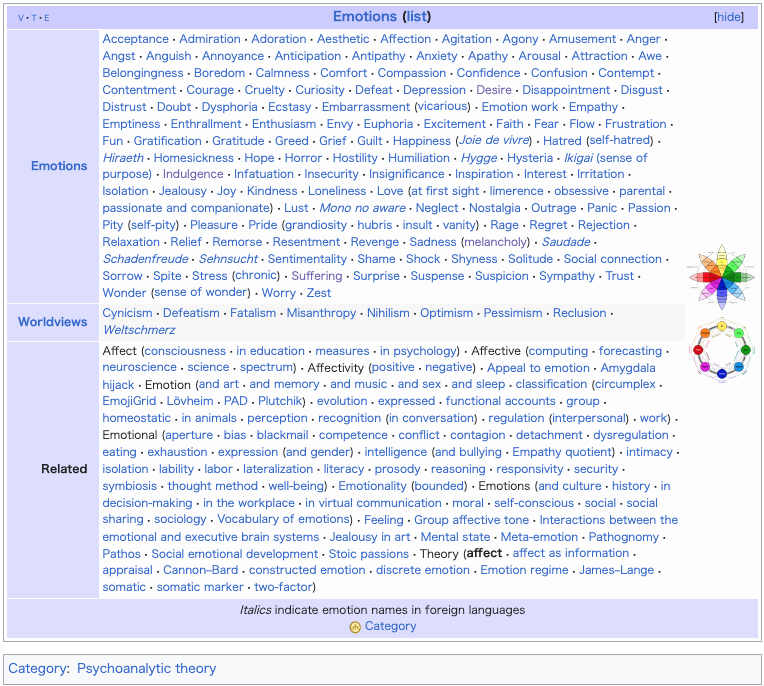
★ウィキペディアにおける感情(emotion)のエントリー一覧
★心理学におけるアフェクション[Affection]
☆Two children showing affection

| Affection
or fondness is a "disposition or state of mind or body"[1] commonly
linked to a feeling or type of love. It has led to multiple branches in
philosophy and psychology that discuss emotion, disease, influence, and
state of being.[2] Often, "affection" denotes more than mere goodwill
or friendship. Writers on ethics generally use the word to refer to
distinct states of feeling, both lasting and temporary. Some contrast
it with passion as being free from the distinctively sensual element.[3] Affection can elicit diverse emotional reactions such as embarrassment, disgust, pleasure, and annoyance. The emotional and physical effect of affection also varies between the giver and the receiver.[4][5] |
「愛情」[Affection]
あるいは「好意」とは、「心や体の傾向や状態」[1]であり、一般に愛という感情やその一種と結びつけられる。これに基づき、哲学や心理学の分野では、感
情、疾病、影響、存在状態などを論じる複数の研究分野が派生している[2]。多くの場合、「愛情」は単なる好意や友情以上のものを指す。倫理学の著述家た
ちは、一般的にこの言葉を、永続的なものも一時的なものも含む、明確な感情の状態を指すために用いる。一部では、これには特有の官能的な要素が含まれてい
ないという点で、情熱と対比されることもある[3]。 愛情は、恥ずかしさ、嫌悪感、喜び、苛立ちなど、多様な感情的反応を引き起こし得る。また、愛情がもたらす感情的・身体的影響は、与える側と受ける側で異なる[4][5]。 |
Restricted definition A young girl kisses a baby on the cheek. Sometimes the term is restricted to emotional states directed towards living entities, including humans and animals. Affection is often compared with passion,[6] stemming from the Greek word pathos. Consequently, references to affection are found in the works of philosophers such as René Descartes,[7] Baruch Spinoza,[8] and early British ethicists. Despite these associations, it is commonly differentiated from passion on various grounds. Some definitions of affection exclude feelings of anxiety or heightened excitement, elements typically linked to passion. In this narrower context, the term holds significance in ethical frameworks, particularly concerning social or parental affections, forming a facet of moral duties[3] and virtue. Ethical perspectives may hinge on whether affection is perceived as voluntary.[9] |
限定的な定義 少女が赤ちゃんの頬にキスをする。 この用語は、人間や動物を含む生き物に向けられた感情状態に限定されることもある。愛情はしばしば「情熱」[6]と比較されるが、これはギリシャ語の「パ トス(pathos)」に由来する。その結果、ルネ・デカルト[7]、バルーク・スピノザ[8]、そして初期の英国の倫理学者たちの著作にも、愛情に関す る言及が見られる。こうした関連性があるにもかかわらず、様々な根拠に基づき、愛情は情熱とは一般的に区別されている。愛情の定義の中には、情熱に典型的 に結びつけられる要素である不安や高揚した興奮といった感情を除外するものもある。このより狭い文脈において、この用語は倫理的枠組み、特に社会的あるい は親としての愛情に関して重要な意味を持ち、道徳的義務[3]や美徳の一側面を形成している。倫理的視点は、愛情が自発的なものと捉えられるかどうかにか かっている場合がある[9]。 |
| Expression Further information: Public display of affection Affection can be communicated by looks, words, gestures, or touches. It conveys love and social connection. The five love languages explains how couples can communicate affections to each other.[10] Affectionate behavior may have evolved from parental nurturing behavior due to its associations with hormonal rewards.[11][verification needed] Such affection has been shown to influence brain development in infants, especially their biochemical systems and prefrontal development.[12] Affectionate gestures can become undesirable if they insinuate potential harm to one's welfare. However, when welcomed, such behavior can offer several health benefits.[clarification needed] Some theories suggest that positive sentiments enhance individuals' inclination to engage socially, and the sense of closeness fostered by affection contributes to nurturing positive sentiments among them.[13] Benefits of affection Affection exchange is an adaptive human behavior that benefits well-being. Expressing affection brings emotional, physical, and relational gains for people and their close connections. Sharing positive emotions yields health advantages like reduced stress hormones, lower cholesterol, lower blood pressure, and a stronger immune system.[14] Expressing affection, not merely feeling affection, is internally rewarding. Even if not reciprocated, givers still experience its effects. Parental relationships Affectionate behavior is frequently considered[by whom?] an outcome of parental nurturing, tied to hormonal rewards. Both positive and negative parental actions may have connections to[vague] health issues in later life. Neglect and abuse result in poorer well-being and mental health, contrasting with affection's positive effects. A 2013 study highlighted the impact of early child abuse and lack of affection on physical health.[15] |
表現 詳細情報:公の場での愛情表現 愛情は、視線、言葉、身振り、あるいは触れ合いによって伝えられる。それは愛や社会的つながりを伝えるものだ。「5つの愛の言語」は、カップルが互いに愛 情を伝え合う方法を説明している。[10] 愛情表現は、ホルモンによる報酬との関連から、親の養育行動から進化した可能性がある。[11][検証が必要] このような愛情表現は、乳児の脳の発達、特に生化学的システムや前頭前野の発達に影響を与えることが示されている。[12] 愛情表現は、相手の福祉に害を及ぼす可能性をほのめかす場合、望ましくないものとなり得る。しかし、歓迎される場合、そのような行動はいくつかの健康上の 利点をもたらす。[説明が必要] いくつかの理論では、肯定的な感情が個人の社会的関与への意欲を高め、愛情によって育まれる親密感が、相互の間に肯定的な感情を育むことに寄与すると示唆 されている。[13] 愛情の恩恵 愛情のやり取りは、幸福に寄与する適応的な人間の行動である。愛情を表現することは、本人とその親しい関係者に、感情的、身体的、そして人間関係上の利益 をもたらす。肯定的な感情を分かち合うことは、ストレスホルモンの減少、コレステロール値の低下、血圧の低下、免疫力の向上といった健康上の利点をもたら す。[14] 単に愛情を感じるだけでなく、それを表現すること自体が内的な満足感をもたらす。たとえ相手から報われなくても、与える側は依然としてその効果を実感す る。 親子の関係 愛情表現は、しばしば[誰によって?]、ホルモンによる報酬と結びついた、親による養育の結果と見なされている。親の肯定的・否定的な行動のいずれもが、 [曖昧]な形で、後年の健康問題と関連している可能性がある。ネグレクトや虐待は、愛情の肯定的な効果とは対照的に、ウェルビーイングやメンタルヘルスの 悪化をもたらす。2013年の研究では、幼少期の虐待や愛情の欠如が身体的健康に与える影響が浮き彫りにされた。[15] |
| Affectionism Affectionism is a school of thought that considers affections to be of central importance. Although it is not found in mainstream Western philosophy, it does exist in Indian philosophy.[16] |
アフェクション主義 アフェクション主義とは、情動を極めて重要視する思想の一派である。西洋哲学の主流には見られないが、インド哲学には存在している。[16] |
| Affectional bond – Attachment behavior one person has for another Affectional orientation – Classification of a person's romantic attraction towards others Affective filter – Hypotheses of second-language acquisition Affective videogames – Emotion modeling in AI Attraction – Study of the attraction between people that leads to friendship or romance Crush – Feelings of romantic love felt by young people Doctrine of the affections – Theory in the aesthetics of painting, music, and theatre, widely used in the Baroque era Emotion – Conscious subjective experience The Four Loves – 1960 book by C. S. Lewis Hug – Form of endearment Infatuation – Intense but shallow attraction List of emotions – Contrast of one emotion from another Social connection – Term in psychology referring to the experience of feeling close and connected to others Terms of endearment – Phrase expressing affection |
感情的絆 – ある人が他者に対して示す愛着行動 感情的指向 – 他者に対する個人の恋愛的惹きつけの分類 感情フィルター – 第二言語習得に関する仮説 感情を喚起するビデオゲーム – AIにおける感情モデリング 惹きつけ – 友情や恋愛につながる人同士の惹きつけに関する研究 片思い – 若者が感じる恋愛感情 情動説 – 絵画、音楽、演劇の美学における理論。バロック時代に広く用いられた 感情 – 意識的な主体的な体験 『四つの愛』 – C. S. ルイスによる1960年の著書 ハグ – 愛情表現の一形態 一時の恋心 – 強烈だが浅い惹かれ合い 感情の一覧 – ある感情と別の感情との対比 社会的つながり – 他者との親密さやつながりを感じる経験を指す心理学用語 愛情表現 – 愛情を表す言葉 |
| References 01. "Affection". Dictionary.com. Retrieved 19 November 2017. "Francis Hutcheson on the Emotions". Stanford Encyclopedia of Philosophy. 17th and 18th Century Theories of Emotions. Retrieved 19 November 2017. Wikisource One or more of the preceding sentences incorporates text from a publication now in the public domain: Chisholm, Hugh, ed. (1911). "Affection". Encyclopædia Britannica. Vol. 1 (11th ed.). Cambridge University Press. pp. 299–300. "The Effects of Affection". Research Matters. Retrieved 2015-08-30. "The effects of affection". ASU News. February 14, 2007. Fernández, Damián J. (1 January 2010). Cuba and the Politics of Passion. University of Texas Press. ISBN 9780292782020. Retrieved 19 November 2017 – via Google Books. Descartes, René. "The Passions of the Soul" (PDF). Early Modern Philosophy. Archived (PDF) from the original on 2022-10-09. Retrieved 19 November 2017. LeBuffe, Michael (19 November 2017). "Spinoza's Psychological Theory". In Zalta, Edward N. (ed.). The Stanford Encyclopedia of Philosophy. Metaphysics Research Lab, Stanford University. Retrieved 19 November 2017. Sidgwick, Henry. "The Methods of Ethics" (PDF). Early Modern Philosophy. Archived (PDF) from the original on 2022-10-09. Retrieved 19 November 2017. 10. David O., Oduse. "Understanding The Five Love Languages And How It Affects Your Relationships". Dating Reporter's Blog. Archived from the original on 2021-04-10. Retrieved 2021-02-27. Floyd, Kory; Hesse, Colin; Mark A., Generous (2021). "Affection exchange theory: A bio-evolutionary look at affectionate communication". In Braithwaite, Dawn (ed.). Engaging theories in interpersonal communication: multiple perspectives (3rd ed.). New York, NY: Routledge. ISBN 978-1-003-19551-1. OCLC 1248603023. Gerhardt, Sue (24 October 2014). Why love matters : how affection shapes a baby's brain. Routledge. ISBN 978-1-317-63579-6. OCLC 883460873. Lawton, Leora; Silverstein, Merril; Bengtson, Vern (Feb 1994). "Affection, Social Contact, and Geographic Distance between Adult Children and Their Parents" (PDF). Journal of Marriage and the Family. 56 (1): 57–68. doi:10.2307/352701. JSTOR 352701. Archived from the original (PDF) on 2012-03-16. Boudreau, Diane (February 8, 2013). "Study: Expressing love can improve your health". ASU News. Rivero, Enrique (September 30, 2013). "Lack of parental warmth, abuse in childhood linked to multiple health risks in adulthood". UCLA Newsroom. 16. Merrell-Wolff, Franklin (1995). Transformations in Consciousness: The Metaphysics and Epistemology: Containing His Introceptualism. State University of New York Press. p. 45. ISBN 0-7914-2675-0. |
参考文献 01. 「Affection(愛情)」。Dictionary.com。2017年11月19日閲覧。 「感情に関するフランシス・ハッチェソンの見解」。『スタンフォード哲学百科事典』。17世紀および18世紀の感情論。2017年11月19日閲覧。 ウィキソース 上記の文の1つ以上には、現在パブリックドメインとなっている出版物のテキストが組み込まれている:チザム、ヒュー編(1911年)。「Affection」。『ブリタニカ百科事典』。第1巻(第11版)。ケンブリッジ大学出版局。299–300頁。 「感情の影響」。Research Matters。2015年8月30日閲覧。 「感情の影響」。ASU News。2007年2月14日。 フェルナンデス、ダミアン・J.(2010年1月1日)。『キューバと情熱の政治』。テキサス大学出版局。ISBN 9780292782020。2017年11月19日閲覧 – Google Books経由。 デカルト、ルネ。「魂の情動」(PDF)。『近世哲学』。2022年10月9日にオリジナルからアーカイブ(PDF)。2017年11月19日閲覧。 ルビュフ、マイケル(2017年11月19日)。「スピノザの心理理論」。ザルタ、エドワード・N.(編)。『スタンフォード哲学百科事典』。スタンフォード大学形而上学研究所。2017年11月19日閲覧。 シジウィック、ヘンリー。「『倫理学の方法』」(PDF)。『近世哲学』。2022年10月9日にオリジナルからアーカイブ(PDF)。2017年11月19日閲覧。 10. デビッド・O・オドゥース。「5つの愛の言語とその人間関係への影響を理解する」。『デート・レポーター』ブログ。2021年4月10日にオリジナルからアーカイブされた。2021年2月27日閲覧。 フロイド、コーリー;ヘッセ、コリン;マーク・A・ジェネラス(2021年)。「愛情交換理論:愛情表現のコミュニケーションに対する生物進 化論的考察」。ブレイスウェイト、ドーン(編)『対人コミュニケーションにおける魅力的な理論:多様な視点』(第3版)。ニューヨーク州ニューヨーク:ラ ウトリッジ。ISBN 978-1-003-19551-1。OCLC 1248603023。 ガーハート、スー(2014年10月24日)。『愛がなぜ重要なのか:愛情が赤ちゃんの脳をどのように形成するか』。ラウトリッジ。ISBN 978-1-317-63579-6。OCLC 883460873。 ロートン、レオラ;シルバースタイン、メリル;ベングトソン、ヴァーン(1994年2月)。「成人した子供と親との間の愛情、社会的接触、および地理的距 離」(PDF)。『Journal of Marriage and the Family』56巻1号:57–68頁。doi:10.2307/352701。JSTOR 352701。2012年3月16日にオリジナル(PDF)からアーカイブされた。 ブードロー、ダイアン(2013年2月8日)。「研究:愛を表現することは健康を改善する」。ASUニュース。 リベロ、エンリケ(2013年9月30日)。「親からの愛情の欠如や幼少期の虐待は、成人期の複数の健康リスクと関連している」。UCLAニュースルーム。 16. メレル=ウォルフ、フランクリン(1995)。『意識の変容:形而上学と認識論――彼のイントロセプティビズムを含む』。ニューヨーク州立大学出版局。p. 45。ISBN 0-7914-2675-0。 |
| https://en.wikipedia.org/wiki/Affection |
☆ バルーフ・スピノザの哲学において、コナトゥス/コナート (conatus; ラテン語で「 "effort; endeavor; impulse, inclination, tendency; undertaking; striving"」)とは、あるものが存在し続け、それ自体を高めようとする生得的な傾向のことである。これは心であった り、物質であったり、あるいはその両方の組み合わせであったりするが、汎神論的な自然観においては神の意志と結びつけられることが多い。コナトゥスは、生 物の本能的な生きようとする意志を指すこともあれば、運動や慣性に関するさまざまな形而上学的理論を指すこともある。今日では、古典力学が慣性力や運動量 保存といった概念を用いているため、技術的な意味でコナトゥスが使われることはほとんどない(→「コナトゥス/コナート」)。
| In the philosophy of
Baruch Spinoza, conatus
(/koʊˈneɪtəs/; wikt:conatus; Latin for "effort;
endeavor; impulse, inclination, tendency; undertaking; striving") is an
innate inclination of a thing to continue to exist and enhance itself.
This thing may be mind, matter, or a combination of both, and is often
associated with God's will in a pantheist view of nature. The conatus
may refer to the instinctive will to live of living organisms or to
various metaphysical theories of motion and inertia. Today, conatus is
rarely used in the technical sense, since classical mechanics uses
concepts such as inertia and conservation of momentum that have
superseded it. It has, however, been a notable influence on later
thinkers such as Arthur Schopenhauer and Friedrich Nietzsche. |
バルーフ・スピノザの哲学において、コナトゥス
(/koʊ↪Lmtəs/; wikt:conatus;
ラテン語で "effort; endeavor; impulse, inclination, tendency; undertaking;
striving")とは、あるものが存在し続け、それ自体を高めようとする生得的
な傾向のことである。これは心であった
り、物質であったり、あるいはその両方の組み合わせであったりするが、汎神論的な自然観においては神の意志と結びつけられることが多い。コ
ナトゥスは、生
物の本能的な生きようとする意志を指すこともあれば、運動や慣性に関
するさまざまな形而上学的理論を指すこともある。今日では、古典力学が慣性力や運動量
保存といった概念を用いているため、技術的な意味でコナトゥスが使われることはほとんどない。しかし、アルトゥール・ショーペンハウアーやフリードリヒ・
ニーチェのような後世の思想家には大きな影響を与えた。 |
Definition and origin René Descartes used the term conatus in his mechanistic theory of motion. The Latin cōnātus comes from the verb cōnor, which is usually translated into English as, to endeavor; used as an abstract noun, conatus is an innate inclination of a thing to continue to exist and enhance itself. Although the term is most central to Spinoza's philosophy, many other early modern philosophers including René Descartes, Gottfried Leibniz, and Thomas Hobbes made significant contributions, each developing the term differently.[1] Whereas the medieval Scholastic philosophers such as Jean Buridan developed a notion of impetus as a mysterious intrinsic property of things,[2] René Descartes (1596–1650) developed a more modern, mechanistic concept of motion which he called the conatus.[3] For Descartes, in contrast to Buridan, motion and rest are properties of the interactions of matter according to eternally fixed mechanical laws, not dispositions and intentions, nor as inherent properties or forces of things, but rather as a unifying, external characteristic of the physical universe itself.[4] Descartes specifies two varieties of the conatus: conatus a centro,[b] or a theory of gravity and conatus recedendi[c] which represents centrifugal forces.[5] Descartes, in developing his First Law of Nature, also invokes the idea of a conatus se movendi, or "conatus of self-preservation", a generalization of the principle of inertia, which was formalized by Isaac Newton and made into the first of his three Laws of Motion fifty years after the death of Descartes."[6] Thomas Hobbes criticized previous definitions of conatus for failing to explain the origin of motion, defining conatus to be the infinitesimal unit at the beginning of motion: an inclination in a specified direction.[7] Furthermore, Hobbes uses conatus to describe cognition functions in the mind,[8] describing emotion as the beginning of motion and the will as the sum of all emotions, which forms the conatus of a body and its physical manifestation is the perceived "will to survive".[1] In a notion similar that of Hobbes, Gottfried Leibniz differentiates between the conatus of the body and soul,[9] primarily focusing however on the concept of a conatus of body in developing the principles of integral calculus to explain Zeno's paradoxes of motion.[10] Leibniz later defines the term monadic conatus, as the state of change through which his monads perpetually advance.[11] This conatus is a sort of instantaneous or virtual motion that all things possess, even when they are static. Motion, meanwhile, is just the summation of all the conatuses that a thing has, along with the interactions of things. By summing an infinity of such conatuses (i.e., what is now called integration), Leibniz could measure the effect of a continuous force.[12] |
定義と由来 ル ネ・デカルトは機械論的運動論において、コナトゥス(conatus)という言葉を使った。 ラテン語のcōnātusは動詞cōnorに由来し、通常英語では「努力する」と訳される。抽象名詞として使用されるconatusは、物事が存在し続 け、それ自体を高めようとする生得的な傾向である。この用語はスピノザの哲学において最も中心的なものであるが、ルネ・デカルト、ゴットフリート・ライプ ニッツ、トマス・ホッブズなど他の多くの近世哲学者も重要な貢献をしており、それぞれが異なる形でこの用語を発展させている[1]。 ジャン・ビュリダンのような中世のスコラ哲学者たちが物事の神秘的な本質的性質としての原動力の概念を発展させたのに対して[2]、ルネ・デカルト (1596-1650)はより近代的で機械論的な運動の概念を発展させ、それを彼はコナトゥスと呼んだ。 [デカルトにとって、ビュリダンとは対照的に、運動と静止は永遠に固定された機械的法則に従った物質の相互作用の特性であり、気質や意図ではなく、物事の 固有の性質や力でもなく、むしろ物理的宇宙そのものの統一的で外的な特性であった。 [デカルトはコナトゥスについて、コナトゥス・ア・セントロ(conatus a centro)[b]、すなわち重力の理論と、コナトゥス・レセデンディ(conatus recedendi)[c]、すなわち遠心力の理論の2種類を規定している。 [これはアイザック・ニュートンによって定式化され、デカルトの死から50年後に彼の3つの運動法則のうちの最初の法則となった。 トマス・ホッブズは運動の起源を説明できていないとして、それまでのコナトゥスの定義を批判し、コナトゥスを運動の始まりにおける無限小の単位、すなわち 指定された方向への傾きであると定義した[7]。さらにホッブズはコナトゥスを用いて心における認識機能を説明しており[8]、情動を運動の始まりとし て、意志をすべての感情の総和として記述しており、それが身体のコナトゥスを形成し、その物理的な表れが知覚された「生存しようとする意志」であると述べ ている。 [ライプニッツはホッブズと類似した概念において、肉体と魂のコナトゥスを区別しており[9]、ゼノンの運動のパラドックスを説明するために積分学の原理 を発展させる際に、主として肉体のコナトゥスの概念に焦点を当てた[10]。ライプニッツは後に、モナドが永続的に進む変化の状態としてモナド的コナトゥ スという言葉を定義している[11]。このコナトゥスは、静止しているときでさえも、すべての事物が持つ、ある種の瞬間的な、あるいは仮想的な運動であ る。一方、運動とは、事物の相互作用とともに、事物が持つすべてのコナトゥスの総和にすぎない。ライプニッツは、このようなコナトゥスの無限大を合計する こと(すなわち、現在では積分と呼ばれていること)によって、連続的な力の効果を測定することができた[12]。 |
 In Spinoza's philosophy Main article: Philosophy of Baruch Spinoza Conatus is a central theme in the philosophy of Benedict de Spinoza (1632–1677), which is derived from principles that Hobbes and Descartes developed.[13] Contrary to most philosophers of his time, Spinoza rejects the dualistic assumption that mind, intentionality, ethics, and freedom are to be treated as things separate from the natural world of physical objects and events.[14] One significant change he makes to Hobbes' theory is his belief that the conatus ad motum, (conatus to motion), is not mental, but material.[8] Spinoza also uses conatus to refer to rudimentary concepts of inertia, as Descartes had earlier.[1] According to Spinoza, "each thing, as far as it lies in itself, strives to persevere in its being" (Ethics, part 3, prop. 6). Since a thing cannot be destroyed without the action of external forces, motion and rest, too, exist indefinitely until disturbed.[15] His goal is to provide a unified explanation of all these things within a naturalistic framework, man and nature must be unified under a consistent set of laws; God and nature are one, and there is no free will. For example, an action is free, for Spinoza, only if it arises from the essence and conatus of an entity. However, an action can still be free in the sense that it is not constrained or otherwise subject to external forces.[16] Human beings are thus an integral part of nature.[15] Spinoza explains seemingly irregular human behaviour as really natural and rational and motivated by this principle of the conatus.[15] Some have argued that the conatus consists of happiness and the perpetual drive toward perfection.[17] Conversely, a person is saddened by anything that opposes his conatus. Others have associated desire, a primary affect, with the conatus principle of Spinoza. Desire is then controlled by the other affects, pleasure and pain, and thus the conatus strives towards that which causes joy and avoids that which produces pain.[8] |
スピノザの哲学 主な記事 スピノザの哲学 ホッブズとデカルトが発展させた原理から派生したベネディクト・デ・スピノザ(1632-1677)の哲学において、コナトゥスは中心的なテーマである [13]。スピノザは同時代のほとんどの哲学者とは異なり、心、意図性、倫理、自由が物理的な物や出来事からなる自然界とは別のものとして扱われるべきで あるという二元論的な仮定を否定している。 [14]ホッブズの理論に対して彼が行った重要な変更の一つは、コナトゥス・アド・モトゥム(運動に対するコナトゥス)は精神的なものではなく、物質的な ものであるという彼の信念である[8]。スピノザはまた、コナトゥスを、デカルトが以前に持っていたような慣性の初歩的な概念に言及するために用いている [1]。スピノザによれば、「それぞれの事物は、それ自体の中にある限り、その存在にとどまろうと努める」(『倫理学』第3部、小論6)。スピノザの目標 は、自然主義的な枠組みの中でこれらすべての物事について統一的な説明を提供することであり、人間と自然は一貫した一連の法則の下で統一されなければなら ず、神と自然は一体であり、自由意志は存在しない。例えば、スピノザにとって、ある行為が自由であるのは、それがある実体の本質とコナトゥスから生じる場 合だけである。スピノザは、一見不規則に見える人間の行動を、実に自然で合理的なものであり、このコナトゥスの原理によって動機づけられたものであると説 明している[15]。コナトゥスは幸福と完璧に向かう永続的な衝動からなると主張する者もいる[17]。また、第一次感情である欲望をスピノザのコナトゥ スの原理と関連付ける者もいる。そして欲望は他の情動である快楽と苦痛によって制御され、その結果コナトゥスは喜びをもたらすものに向かって努力し、苦痛 をもたらすものを避けるのである[8]。 |
| Later usages and related concepts After the development of classical mechanics, the concept of a conatus, in the sense used by philosophers other than Spinoza,[8] an intrinsic property of all physical bodies, was largely superseded by the principles of inertia and conservation of momentum. Similarly, Conatus recendendi became centrifugal force, and conatus a centro became gravity.[5] However, Giambattista Vico, inspired by Neoplatonism, explicitly rejected the principle of inertia and the laws of motion of the new physics. For him, conatus was the essence of human society,[18] and also, in a more traditional, hylozoistic sense, as the generating power of movement which pervades all of nature,[19] which was composed neither of atoms, as in the dominant view, nor of extension, as in Descartes, but of metaphysical points animated by a conatus principle provoked by God.[20] Arthur Schopenhauer (1788–1860) developed a principle notably similar to that of Spinoza's conatus.[1][21] This principle, Wille zum Leben, or of a "Will to Live", described the specific phenomenon of an organism's self-preservation instinct.[22] Schopenhauer qualified this, however, by suggesting that the Will to Live is not limited in duration, but rather, "the will wills absolutely and for all time", across generations.[23] Rejecting the primacy of Schopenhauer's Will to Live, Friedrich Nietzsche (1844–1900) developed a separate principle the Will to Power, which comes out of a rejection of such notions of self-preservation.[24] In systems theory, the Spinozistic conception of a conatus has been related to modern theories of autopoiesis in biological systems.[25] However, the scope of the idea is definitely narrower today, being explained in terms of chemistry and neurology where, before, it was a matter of metaphysics and theurgy.[26] |
その後の用法と関連概念 古典力学の発展後、スピノザ以外の哲学者によって使用された意味でのコナトゥスの概念、すなわちすべての物体に内在する性質[8]は、慣性および運動量保 存の原理によってほとんど取って代わられた。同様に、Conatus recendendiは遠心力となり、Conatus a centroは重力となった[5]。しかし、新プラトン主義に触発されたジャンバッティスタ・ヴィーコは、新物理学の慣性原理と運動法則を明確に否定し た。彼にとっては、コナトゥスは人間社会の本質であり[18]、また、より伝統的な、ヒロイゾ的な意味では、自然のすべてに浸透している運動の生成力であ り[19]、それは支配的な見解のような原子でも、デカルトのような延長でもなく、神によって引き起こされたコナトゥスの原理によって運動する形而上学的 な点から構成されていた。 [20] アルトゥール・ショーペンハウアー(1788-1860)は、スピノザのコナトゥスの原理とよく似た原理を開発した。 [しかし、ショーペンハウアーは、「生きる意志」は期間限定的なものではなく、世代を超えて「意志は絶対的かつ永遠に意志し続ける」ものであることを示唆 し、これを修飾した[23]。フリードリヒ・ニーチェ(1844-1900)は、ショーペンハウアーの「生きる意志」の優位性を否定し、そのような自己保 存の概念の否定から生まれた「力への意志」という別の原理を開発した。 [システム理論においては、スピノザ的なコナトゥスの概念は生物学的システムにおけるオートポイエーシスの現代的な理論に関連している[25]。しかし、 その考え方の範囲は今日では確実に狭くなっており、以前は形而上学や神学の問題であったのに対して、化学や神経学の観点から説明されている[26]。 |
| https://en.wikipedia.org/wiki/Conatus | https://en.wikipedia.org/wiki/Conatus |
| Conation Teleonomy |
志向(コネーション) 目的論 |
| Notes 01. Ethics, part 3, prop. 6 "tendency towards the center" "tendency away from the center" LeBuffe 2006 Grant 1964, pp. 265–292 Garber 1992, pp. 150, 154 Garber 1992, pp. 180, 184 Kollerstrom 1999, pp. 331–356 Wolfson 1934, pp. 197–202. Hobbes 1998, III, xiv, 2 Bidney 1962, p. 87-93. Arthur 1998. 10. Leibniz 1988, p. 135 Arthur 1994, sec. 3 Gillispie 1971, pp. 159–161 Morgan 2006, p. ix Jarrett 1991, pp. 470–475 Allison 1975, p. 124-125. Lachterman 1978 DeBrabander 2007, pp. 20–1 Goulding 2005, p. 22040 Vico 1710, pp. 180–186 20. Landucci 2004, pp. 1174, 1175 Schopenhauer 1958, p. 357 Rabenort 1911, p. 16 Schopenhauer 1958, p. 568 Durant & Durant 1963, chp. IX Sandywell 1996, pp. 144–5 26.Mathews 1991, p. 110 |
注 01. 『倫理学』第3部、命題6 「中心に向かう傾向」 「中心から離れる傾向」 LeBuffe 2006 Grant 1964, pp. 265–292 Garber 1992, pp. 150, 154 ガーバー 1992, pp. 180, 184 コラーストロム 1999, pp. 331–356 ウルフソン 1934, pp. 197–202. ホッブズ 1998, III, xiv, 2 ビドニー 1962, p. 87-93. アーサー 1998. 10. ライプニッツ 1988, p. 135 アーサー 1994, sec. 3 ギリスピー 1971, pp. 159–161 モーガン 2006, p. ix ジャレット 1991, pp. 470–475 アリソン 1975, p. 124-125. ラクターマン 1978 デブラバンダー 2007, pp. 20–1 グールディング 2005, p. 22040 ヴィーコ 1710, pp. 180–186 20. ランドゥッチ 2004, pp. 1174, 1175 ショーペンハウアー 1958, p. 357 ラベノルト 1911, p. 16 ショーペンハウアー 1958, p. 568 デュラント & デュラント 1963, 第IX章 サンディウェル 1996, pp. 144–5 26.マシューズ 1991, p. 110 |
| References Allison, Henry E. (1975), Benedict de Spinoza, San Diego: Twayne Publishers, ISBN 978-0-8057-2853-8 Arthur, Richard (1994), "Space and relativity in Newton and Leibniz", The British Journal for the Philosophy of Science, 45 (1): 219–240, doi:10.1093/bjps/45.1.219, Thomson Gale Document Number:A16109468 Arthur, Richard (1998), "Cohesion, Division and Harmony: Physical Aspects of Leibniz's Continuum Problem (1671–1686)", Perspectives on Science, 6 (1): 110–135, doi:10.1162/posc_a_00546, S2CID 141579187, Thomson Gale Document Number:A54601187 Bidney, David (1962), The Psychology and Ethics of Spinoza: A Study in the History and Logic of Ideas, New York: Russell & Russell DeBrabander, Firmin (March 15, 2007), Spinoza and the Stoics: Power, Politics and the Passions, London; New York: Continuum International Publishing Group, ISBN 978-0-8264-9393-4 Duchesneau, Francois (Spring–Summer 1998), "Leibniz's Theoretical Shift in the Phoranomus and Dynamica de Potentia", Perspectives on Science, 6 (2): 77–109, doi:10.1162/posc_a_00545, S2CID 141935224, Thomson Gale Document Number: A54601186 Durant, Will; Durant, Ariel (1963), "XXII: Spinoza: 1632–77", The Story of Civilization, vol. 8, New York: Simon & Schuster, archived from the original on 2007-04-23, retrieved 2007-03-29 Dutton, Blake D. (2006), "Benedict De Spinoza", The Internet Encyclopedia of Philosophy, retrieved 2007-01-15 Garber, Daniel (1992), Descartes' Metaphysical Physics, Chicago: University of Chicago Press, ISBN 978-0-226-28217-6 Gillispie, Charles Coulston, ed. (1971), "Leibniz, Gottfried Wilhelm", Dictionary of Scientific Biography, New York, retrieved 2007-03-27 Goulding, Jay (2005), Horowitz, Maryanne (ed.), "Society", New Dictionary of the History of Ideas, 5, Detroit: Charles Scribner's Sons, Thomson Gale Document Number:CX3424300736 Grant, Edward (1964), "Motion in the Void and the Principle of Inertia in the Middle Ages", Isis, 55 (3): 265–292, doi:10.1086/349862, S2CID 120402625 Hobbes, Thomas (1998), De Corpore, New York: Oxford Publishing Company, ISBN 978-0-19-283682-3 Jarrett, Charles (1991), "Spinoza's Denial of Mind-Body Interaction and the Explanation of Human Action", The Southern Journal of Philosophy, 29 (4): 465–486, doi:10.1111/j.2041-6962.1991.tb00604.x Jesseph, Doug (2006), "Hobbesian Mechanics" (PDF), Oxford Studies in Early Modern Philosophy, 3: 119–152, doi:10.1093/oso/9780199203949.003.0005, ISBN 978-0-19-920394-9, archived from the original (PDF) on 2006-11-07, retrieved 2007-03-10 Kollerstrom, Nicholas (1999), "The Path of Halley's Comet, and Newton's Late Apprehension of the Law of Gravity", Annals of Science, 59 (4): 331–356, doi:10.1080/000337999296328 Lachterman, D. (1978), Robert Shahan; J.I. Biro. (eds.), The Physics of Spinoza's Ethics in Spinoza: New Perspectives, Norman: University of Oklahoma Press Landucci, Sergio (2004), "Vico, Giambattista", in Gianni Vattimo (ed.), Enciclopedia Garzantine della Filosofia, Milan: Garzanti Editore, ISBN 978-88-11-50515-0 LeBuffe, Michael (2006-03-20), "Spinoza's Psychological Theory", Stanford Encyclopedia of Philosophy, Edward N. Zalta (ed.), retrieved 2007-01-15 Leibniz, Gottfried Wilhelm, Freiherr von (December 31, 1988) [1695], "Exposition and Defence of the New System", in Morris, Mary, M.A. (ed.), Leibniz: Philosophical Writings, J.M. Dent & Sons, p. 136, ISBN 978-0-460-87045-0 Mathews, Freya (1991), The Ecological Self, Routledge, ISBN 978-0-415-10797-6 Morgan, Michael L. (2006), The Essential Spinoza, Indianapolis/Cambridge: Hackett Publishing Company, Inc., p. ix, ISBN 978-0-87220-803-2 Osler, Margaret J. (2001), "Whose ends? Teleology in early modern natural philosophy", Osiris, 16 (1): 151–168, doi:10.1086/649343, S2CID 143776874, Thomson Gale Document Number:A80401149 Polt, Richard (1996), "German Ideology: From France to Germany and Back", The Review of Metaphysics, 49 (3), Thomson Gale Document Number:A18262679 Rabenort, William Louis (1911), Spinoza as Educator, New York City: Teachers College, Columbia University Sandywell, Barry (1996), Reflexivity and the Crisis of Western Reason, vol. 1: Logological Investigations, London and New York: Routledge, pp. 144–5, ISBN 978-0-415-08756-8 Schmitter, Amy M. (2006), "Hobbes on the Emotions", Stanford Encyclopedia of Philosophy, retrieved 2006-03-04 Schopenhauer, Arthur (1958), Payne, E.F.J. (ed.), The World as Will and Representation, vol. 1, Clinton, Massachusetts: The Colonial Press Inc. Vico, Giambattista (1710), L.M. Palmer (ed.), De antiquissima Italiorum sapientia ex linguae originibus eruenda librir tres, Ithaca: Cornell University Press Wolfson, Harry Austryn (1934). The philosophy of Spinoza : unfolding the latent processes of his reasoning. Cambridge, Mass.: Harvard University Press. ISBN 978-0-674-66595-8. Ziemke, Tom (2007), "What's life got to do with it?", in Chella, A.; Manzotti, R. (eds.), Artificial Consciousness, Exeter, UK: Imprint Academic, ISBN 9781845406783 |
参考文献 アリソン、ヘンリー・E. (1975), 『ベネディクト・デ・スピノザ』, サンディエゴ: トウェイン・パブリッシャーズ, ISBN 978-0-8057-2853-8 アーサー、リチャード (1994), 「ニュートンとライプニッツにおける空間と相対性」, 『英国科学哲学雑誌』, 45 (1): 219–240, doi:10.1093/bjps/45.1.219, トムソン・ゲイル文書番号:A16109468 アーサー, リチャード (1998), 「凝集、分裂、そして調和:ライプニッツの連続体問題(1671–1686)の物理的側面」, 『Perspectives on Science』, 6 (1): 110–135, doi:10.1162/posc_a_00546, S2CID 141579187, Thomson Gale Document Number:A54601187 ビドニー、デビッド(1962年)、『スピノザの心理学と倫理学:観念の歴史と論理に関する研究』、ニューヨーク:ラッセル&ラッセル デブラバンダー、ファーミン(2007年3月15日)、『スピノザとストア派:権力、政治、そして情熱』、ロンドン;ニューヨーク:コンティニュアム・イ ンターナショナル・パブリッシング・グループ、ISBN 978-0-8264-9393-4 デュシェノー、フランソワ(1998年春〜夏)、「『フォラノムス』および『ダイナミカ・デ・ポテンティア』におけるライプニッツの理論的転換」、『パー スペクティブス・オン・サイエンス』、6 (2): 77–109, doi:10.1162/posc_a_00545, S2CID 141935224, トムソン・ゲイル・ドキュメント番号: A54601186 デュラント、ウィル;デュラント、アリエル(1963)、「XXII:スピノザ:1632–77」、『文明の物語』第8巻、ニューヨーク:サイモン&シュ スター、2007年4月23日にオリジナルからアーカイブ、2007年3月29日に閲覧 ダットン、ブレイク・D. (2006)、「ベネディクト・デ・スピノザ」、『インターネット哲学百科事典』、2007年1月15日に閲覧 ガーバー、ダニエル (1992)、『デカルトの形而上学的物理学』、シカゴ:シカゴ大学出版局、ISBN 978-0-226-28217-6 ギリスピー、チャールズ・コールストン編(1971)、「ライプニッツ、ゴットフリート・ヴィルヘルム」、『科学者伝記辞典』、ニューヨーク、2007年 3月27日閲覧 グールディング、ジェイ(2005)、ホロウィッツ、メアリーアン(編)、「社会」、『思想史新辞典』第5巻、デトロイト:チャールズ・スクリブナーズ・ サンズ、トムソン・ゲイル文書番号:CX3424300736 グラント、エドワード(1964)、「中世における真空中の運動と慣性の原理」、『イシス』、55 (3): 265–292、doi:10.1086/349862、S2CID 120402625 ホッブズ、トマス(1998)、『De Corpore』、ニューヨーク:オックスフォード・パブリッシング・カンパニー、ISBN 978-0-19-283682-3 ジャレット、チャールズ(1991)、「スピノザによる心身相互作用の否定と人間行動の説明」、『ザ・サザン・ジャーナル・オブ・フィロソフィー』、29 (4): 465–486, doi:10.1111/j.2041-6962.1991.tb00604.x ジェセフ、ダグ(2006)、「ホッブズ的力学」(PDF)、『オックスフォード・スタディーズ・イン・アーリー・モダン・フィロソフィー』、3: 119–152, doi:10.1093/oso/9780199203949.003.0005, ISBN 978-0-19-920394-9, 2006年11月7日にオリジナル(PDF)からアーカイブされ、2007年3月10日に取得 コラーストロム, ニコラス (1999), 「ハレー彗星の軌道と、ニュートンによる万有引力の法則の遅れた理解」, 『Annals of Science』, 59 (4): 331–356, doi:10.1080/000337999296328 ラクターマン, D. (1978), ロバート・シャハン; J.I. ビロ (編), 『スピノザの『倫理学』における物理学』, 『スピノザ:新たな視点』所収, ノーマン: オクラホマ大学出版局 ランドゥッチ、セルジオ(2004)、「ヴィコ、ジャンバッティスタ」、ジャンニ・ヴァッティモ(編)、『ガルザンティーナ哲学百科事典』、ミラノ:ガル ザンティ・エディトーレ、ISBN 978-88-11-50515-0 ルビュフ、マイケル(2006年3月20日)、「スピノザの心理論」、スタンフォード哲学百科事典、エドワード・N・ザルタ(編)、2007年1月15日 閲覧 ライプニッツ、ゴットフリート・ヴィルヘルム・フォン・フライヘル(1988年12月31日) [1695]、「新体系の解説と擁護」、モリス、メアリー、M.A.(編)、『ライプニッツ:哲学著作集』、J.M.デント・アンド・サンズ、136頁、 ISBN 978-0-460-87045-0 マシューズ、フレイヤ(1991年)、『生態学的自己』、ラウトリッジ、ISBN 978-0-415-10797-6 モーガン、マイケル・L.(2006年)、『エッセンシャル・スピノザ』、インディアナポリス/ケンブリッジ:ハケット・パブリッシング・カンパニー、 p. ix、ISBN 978-0-87220-803-2 オスラー、マーガレット・J.(2001)、「誰の目的か? 近世自然哲学における目的論」、『オシリス』、16 (1): 151–168、doi:10.1086/649343、S2CID 143776874、トムソン・ゲイル・ドキュメント番号:A80401149 ポルト、リチャード(1996)、「『ドイツ・イデオロギー』:フランスからドイツへ、そして再びフランスへ」、『形而上学評論』、49 (3)、トムソン・ゲイル文書番号:A18262679 ラベノルト、ウィリアム・ルイス(1911)、『教育者としてのスピノザ』、ニューヨーク市:コロンビア大学ティーチャーズ・カレッジ サンディウェル、バリー(1996)、『反射性と西洋的理性の危機』、第1巻:論理学的探究、ロンドンおよびニューヨーク:ラウトリッジ、pp. 144–5、ISBN 978-0-415-08756-8 シュミッター、エイミー・M.(2006)、「感情に関するホッブズ」、スタンフォード哲学百科事典、2006年3月4日取得 ショーペンハウアー、アルトゥール(1958)、ペイン、E.F.J.(編)、『意志と表象としての世界』第1巻、マサチューセッツ州クリントン:ザ・コ ロニアル・プレス社 ヴィーコ、ジャンバッティスタ(1710年)、L.M. パーマー(編)、『言語の起源から探るイタリア人の最も古い知恵に関する三巻書』、イサカ:コーネル大学出版局 ウルフソン、ハリー・オースティン(1934年)。『スピノザの哲学:その推論の潜在的な過程の展開』。マサチューセッツ州ケンブリッジ:ハーバード大学 出版局。ISBN 978-0-674-66595-8. ツィームケ、トム(2007)、「生命はそれと何の関係があるのか?」、チェラ、A.;マンゾッティ、R.(編)、『人工意識』、英国エクセター:インプ リント・アカデミック、ISBN 9781845406783 |
| Bove, Laurent (1992),
L'affirmation absolue d'une existence : essai sur la stratégie du
conatus Spinoziste, Université de Lille III: Lille, OCLC 57584015 Duff, Robert Alexander (1903), Spinoza's Political and Ethical Philosophy, J. Maclehose and Sons, ISBN 9780678006153, retrieved 2007-03-19 Tuusvuori, Jarkko S. (March 2000), Nietzsche & Nihilism: Exploring a Revolutionary Conception of Philosophical Conceptuality, University of Helsinki, ISBN 978-951-45-9135-8 Wendell, Rich (1997), Spinoza's Conatus doctrine: existence, being, and suicide, Waltham, Mass., OCLC 37542442 |
ボヴェ、ローラン(1992)、『存在の絶対的肯定:スピノザ的コナ
トゥスの戦略に関するエッセイ』、リール第三大学:リール、OCLC 57584015 ダフ、ロバート・アレクサンダー(1903)、『スピノザの政治・倫理哲学』、J. マクレホーズ・アンド・サンズ、 ISBN 9780678006153、2007年3月19日取得 トゥウスヴォリ、ヤルッコ・S.(2000年3月)、『ニーチェとニヒリズム:哲学的概念性の革命的構想の探求』、ヘルシンキ大学、ISBN 978-951-45-9135-8 ウェンデル、リッチ(1997年)、『スピノザのコナトゥス論:存在、実在、そして自殺』、マサチューセッツ州ウォルサム、OCLC 37542442 |
| In the philosophy of mind,[1]
and in psychology, conation
refers to the ability to apply intellectual energy to a task to achieve
its completion or reach a solution.[2] Conation may be distinguished
from other mental phenomena, particularly cognition, and sensation,[1]
and has been described as "neglected" in comparison with these
phenomena. It may overlap to some extent with the concept of
motivation, but "the ability to focus and maintain persistent effort"
has been seen as more pertinent to conation.[2] Definitions Merriam-Webster's online dictionary defines conation as "an inclination (as an instinct or drive) to act purposefully".[3] The word comes from the Latin words conari (to try) and conatio (an attempt).[4] Hannah et al. define "moral conation" as "the capacity to generate responsibility and motivation to take moral action in the face of adversity and persevere through challenges".[5] History Edwin Boring included a review of the history of the concept in his History of Experimental Psychology, published in 1929, referring to James Ward's typology of cognition, conation, and feeling,[2] and to conation as George Stout's "famous doctrine". The division of the mind into cognition, conation (or desire), and feeling was also described by Immanuel Kant.[6] However, Norman Schur more recently included the word "conation" among his 1000 most challenging (or oft-forgotten or unknown) words in the English language.[7] For George Berkeley in his essay De Motu, it was a term to be avoided, because "we do not rightly understand" its meaning.[8] Research Neuropsychology researchers Ralph M. Reitan and Deborah Wolfson looked at the performance of specific tasks which were "judged to require conative ability" in a research study published in 2000 and surmised that "conation, which has been a neglected dimension of behavior in neuropsychological assessment, may be the missing link between cognitive ability and prediction of performance capabilities in everyday life".[2] See also Attentional control Conatus Determination https://en.wikipedia.org/wiki/Conation |
心
の哲学[1]や心理学において、コネーション(conation)とは、知的エネルギーを課題に適用し、その完了や解決に到達する能力のことである
[2]。コネーションは、他の精神現象、特に認知や感覚[1]と区別されることがあり、これらの現象と比較して「軽視されている」と表現されてきた。それ
は動機づけの概念とある程度重なるかもしれないが、「持続的な努力に集中し、それを維持する能力」はコネーションにより適切であると考えられてきた
[2]。 定義 メリアム・ウェブスターのオンライン辞書は、コネイションを「目的を持って行動しようとする(本能や衝動としての)傾き」と定義している[3]。この言葉 はラテン語のconari(試みる)とconatio(試み)に由来する[4]。ハンナらは「道徳的コネイション」を「逆境に直面したときに道徳的行動を とる責任と動機を生み出し、困難を忍耐強く乗り越える能力」と定義している[5]。 歴史 エドウィン・ボーリングは、1929年に出版された『実験心理学史』の中で、この概念の歴史を概説しており、ジェームズ・ウォードの認知、コネーション、 フィーリングの類型論[2]、ジョージ・スタウトの「有名な教義」としてのコネーションに言及している。しかし、ノーマン・シュアーはより最近、 「conation」という単語を彼の1000の最も挑戦的な(あるいはしばしば忘れられた、あるいは知られていない)英語の単語の中に含めている [7]。 ジョージ・バークレーは彼のエッセイ「De Motu」の中で、「conation」はその意味を「正しく理解していない」ため、避けるべき用語であると述べている[8]。 研究 神経心理学の研究者であるラルフ・M・レイタンとデボラ・ウルフソンは、2000年に発表された研究において、「コネイション能力を必要とすると判断され た」特定のタスクのパフォーマンスを調査し、「神経心理学的評価において行動の軽視されてきたコネイションは、認知能力と日常生活におけるパフォーマンス 能力の予測との間に欠けているリンクかもしれない」と推測している[2]。 以下も参照。 注意制御 コナトゥス 決定 |
★Immanent evaluation(内在的評価)
| Immanent evaluation is
a philosophical concept used by Gilles Deleuze in his essay "Qu'est-ce
qu'un dispositif ?" (1989), where it is seen as the opposite of
transcendent judgment. Deleuze writes about Michel Foucault: "Foucault ... makes allusion to 'aesthetic' criteria, which are understood as criteria for life and replace on each occasion the claims of transcendental [sic] judgement [jugement transcendant] with an immanent evaluation [évaluation immanente]".[1] |
内在的評価[Immanent evaluation]とは、ジル・ドゥルーズがエッセイ『ディスポジティフとは何か?』(1989年)で用いた哲学的概念であり、そこでは超越的判断の対極として捉えられている。 ドゥルーズはミシェル・フーコーについて次のように記している。「フーコーは……『美的』基準に言及しており、それは生命のための基準として理解され、そ の都度、超越的[sic]判断[jugement transcendant]の主張を内在的評価[évaluation immanente]に置き換えるものである」。[1] |
| References 1. Gilles Deleuze. 1992. "What Is a dispositif?" In: Michel Foucault: Philosopher. Ed. T. J. Armstrong. Hartfordshire: Harvester Wheatsheft, 159–168, esp. 163; original: "Qu'est-ce qu'un dispositif ?" in Association pour le Centre Michel Foucault, Michel Foucault, philosophe, Seuil, 1989, p. 189. |
参考文献 1. ジル・ドゥルーズ。1992年。「ディスポジティフとは何か?」『ミシェル・フーコー:哲学者』T. J. アームストロング編。ハートフォードシャー:ハーベスター・ウィートシェフト、159–168頁、特に163頁;原著:「Qu『est-ce qu』un dispositif ?」『ミシェル・フーコー、哲学者』(Association pour le Centre Michel Foucault編、Seuil、1989年)、189頁。 |
| https://en.wikipedia.org/wiki/Immanent_evaluation |
|
☆哲学におけるパッション(情熱/ 受苦)[Passions (philosophy)]
| In philosophy and religion, the passions
are understood to be the emotions, instincts and desires that drive a
human being (including lust, anger, aggression, jealousy, etc.).
Different philosophical traditions hold different views about the
passions. The philosophical notion of passion, in contrast, is
generally identified with instinctually driven emotional states, in
many ancient philosophies and religious doctrines, the passions are the
basis for deadly sins and seen as leading to various social and
spiritual ills. In Western philosophical traditions, the passions are
often placed in opposition to reason.[1][2] Some seventeenth-century philosophers worked within an intellectual "milieu" in which the passions were regarded as a potent element of human nature, capable of disrupting any civilized order, including philosophy, unless they were tamed, outwitted, overruled, or seduced.[3] Natural philosophy deals with the actions and operations of passions, and the task of moral philosophy is to explore whether and how the passions can, or should be bridled, and how their indifference is transformed into good or evil by virtue of the domination of right reason.[4] Reason is advocated in the control of passion, something seen as desirable and necessary for the development of a mature, civilized human being. This is achieved by the cultivation of virtue. Four virtues in particular have long been seen as of special value in this area of philosophy. The majority of philosophies and religions advocate at the very least tempering the passions to keep them within acceptable bounds. However, most of the religions recommend both the restraint and the transformation of the passions to the point where they no longer arise. Including Christianity, Jainism, Buddhism, Islam and Hinduism. The institution of the monastery within various religions is a means by which human beings may temporarily or permanently seclude themselves from circumstances exacerbating the arising of passion and provide a supportive environment for doing spiritual work. Contemporary philosopher Roberto Mangabeira Unger has developed a view of the passions that disassociates them from human nature, and instead gives them a formless life that serve non-instrumental dealings with each other. Rather than the guiding force behind our relations with the world, they organize and are organized around the need and danger that is at the heart of our relations with each other. In this way, Unger rejects the traditional view of the passions as something counter to reason and which are associated with certain expressions; rather, he sees them at the service of reason and their expression formed within certain contexts.[5] |
哲学や宗教において、情動[passions]
とは、人間を駆り立てる感情、本能、欲望(情欲、怒り、攻撃性、嫉妬などを含む)と理解されている。哲学の伝統によって、情動に対する見解は異なる。哲学
における情動の概念は、一般的に本能に駆られた感情状態と同一視されるが、多くの古代哲学や宗教教義では、情動は大罪の根源とされ、さまざまな社会的・精
神的な弊害をもたらすものと見なされている。西洋の哲学的伝統において、情動はしばしば理性と対立するものとして位置づけられる。[1][2] 17世紀の一部の哲学者は、情動が人間の本性の強力な要素であり、それが抑制され、出し抜かれ、打ち消され、あるいは誘惑されない限り、哲学を含むあらゆ る文明的秩序を乱す可能性があると見なされる知的「環境」の中で活動していた。[3] 自然哲学は情動の作用や働きを扱うものであり、道徳哲学の課題は、情動を抑制できるか、あるいは抑制すべきか、また正しい理性の支配によって、その無関心 さがどのように善や悪へと転換されるかを探求することにある。[4] 情動の制御においては理性が提唱されており、それは成熟した文明的な人間を育成するために望ましく、かつ必要不可欠なものと見なされている。これは徳の修 養によって達成される。特に四つの美徳は、この哲学の分野において長きにわたり特別な価値を持つものと見なされてきた。 ほとんどの哲学や宗教は、少なくとも情動を和らげ、許容範囲内に収めることを提唱している。しかし、ほとんどの宗教は、情動がもはや生じなくなるまで、そ の抑制と変容の両方を推奨している。これにはキリスト教、ジャイナ教、仏教、イスラム教、ヒンドゥー教が含まれる。様々な宗教における修道院という制度 は、人間が情動の発生を助長する状況から一時的あるいは恒久的に身を隔て、精神的な修行を行うための支援的な環境を提供する手段である。 現代の哲学者ロベルト・マンガベイラ・ウンガーは、情動を人間の本性から切り離し、代わりに、互いとの非手段的な関わりに奉仕する「形のない生命」として 捉える見解を展開している。情欲は、世界との関係における原動力というよりは、相互関係の中核にある必要性と危険性を取りまとめ、またそれらを中心に組織 化されるものである。このように、ウンガーは、情欲を理性に反するものであり、特定の表現と結びついたものとする伝統的な見解を退ける。むしろ、彼は情欲 を理性の奉仕者であり、その表現は特定の文脈の中で形成されるものと見なしている。[5] |
| Background The subject of the passions has long been a consideration in Western philosophy. According to European philosopher Michel Meyer, they have aroused harsh judgments as the representation of a force of excess and lawlessness in humanity that produces troubling, confusing paradoxes. Meyer sees philosophers as having treated the passions as a given expression of human nature, leaving the question of whether the passions "torture people because it blinds them, or, on the contrary, does it permit them to apprehend who and what we really are?"[6] |
背景 「情動」というテーマは、西洋哲学において古くから考察されてきた。ヨーロッパの哲学者ミシェル・マイヤーによれば、情熱は、人間の中に存在する過剰かつ 無法な力の表れとして、厄介で混乱を招くパラドックスを生み出すものとして、厳しい批判を浴びてきた。マイヤーは、哲学者たちが情熱を人間性の当然の表れ として扱ってきた一方で、「情熱は、人々を盲目にして苦しめるのか、それとも逆に、私たちが本来何者であるかを理解することを可能にするのか」という問い を放置してきたと見なしている[6]。 |
| Spinoza The seventeenth century Dutch philosopher Spinoza contrasted "action" with "passion," as well as the state of being "active" with the state of being "passive." A passion, in his view, happens when external events affect us partially such that we have confused ideas about these events and their causes. A "passive" state is when we experience an emotion which Spinoza regarded as a "passivity of the soul."[7] The body's power is increased or diminished. Emotions are bodily changes plus ideas about these changes which can help or hurt a human.[7] It happens when the bodily changes we experience are caused primarily by external forces or by a mix of external and internal forces. Spinoza argued that it was much better for the individual himself to be the only adequate cause of bodily changes, and to act based on an adequate understanding of causes-and-effects with ideas of these changes logically related to each other and to reality. When this happens, the person is "active," and Spinoza described the ideas as adequate. But most of the time, this does not happen, and Spinoza saw emotions as more powerful than reason. Spinoza tried to live the life of reason which he advocated.[8][9][10] |
スピノザ 17世紀のオランダの哲学者スピノザは、「行為」と「情動」を対比させるとともに、「能動的」な状態と「受動的」な状態も対比させた。彼の見解によれば、 情動とは、外部の出来事が私たちに部分的に影響を及ぼし、その結果、それらの出来事やその原因について混乱した観念を抱くときに生じるものである。「受動 的」な状態とは、私たちが感情を経験する状態であり、スピノザはこれを「魂の受動性」と見なした[7]。その際、身体の力は増大したり減退したりする。感 情とは、身体的な変化に加え、人間にとって有益あるいは有害となり得る、その変化に関する観念のことである。[7] これは、私たちが経験する身体的な変化が、主に外部の力、あるいは外部と内部の力の組み合わせによって引き起こされる際に生じる。スピノザは、個人自身が 身体的な変化の唯一の適切な原因となり、原因と結果についての適切な理解に基づいて行動し、その変化に関する観念が互いに、そして現実と論理的に関連して いる状態である方が、はるかに望ましいと論じた。これが起こる時、その人格は「能動的」であり、スピノザはその観念を「充足的」と表現した。しかし、ほと んどの場合、これは起こらず、スピノザは感情を理性よりも強力なものだと見なしていた。スピノザは、自身が提唱した理性の生き方を実践しようと努めた。 [8][9][10] |
| Affect Passion: An Essay on Personality Philosophy of desire Baruch Spinoza Passion (emotion) Philosophy of Spinoza René Descartes's Passions of the Soul Stoic passions |
情動 『情熱:人格に関するエッセイ』 欲望の哲学 バルーク・スピノザ 情熱(感情) スピノザの哲学 ルネ・デカルトの『魂の情熱』 ストア派の情熱 |
| References 01. Taliaferro, Charles (2023), Zalta, Edward N.; Nodelman, Uri (eds.), "Philosophy of Religion", The Stanford Encyclopedia of Philosophy (Fall 2023 ed.), Metaphysics Research Lab, Stanford University, retrieved 2024-04-10 "Faith and Reason | Internet Encyclopedia of Philosophy". Retrieved 2024-04-10. "Stoicism - Routledge Encyclopedia of Philosophy". www.rep.routledge.com. Retrieved 2024-04-10. James, Susan (16 October 1997). Passion and Action: The Emotions in Seventeenth-Century Philosophy. OUP Oxford. ISBN 978-0-19-151912-3. 05. Unger, Roberto Mangabeira (1986). Passion: An Essay on Personality. New York: Free Press. ISBN 0-02-933180-3. Michel Meyer, Philosophy and the Passions, a translation of Le Philosophe et les passions *(Livre de poche), Penn State Press, 2000. Preface, introduction and translation by Robert F. Barsky, website Benedict de Spinoza (1883) [1677]. "Part III: On the Origin and Nature of the Emotions: Definitions". Ethics. Translated by R.H.M. Elwes. Retrieved 2009-12-09 – via MTSU Philosophy WebWorks. By emotion I mean the modifications of the body, whereby the active power of the said body is increased or diminished, aided or constrained, and also the ideas of such modifications. N.B. If we can be the adequate cause of any of these modifications, I then call the emotion an activity, otherwise I call it a passion, or state wherein the mind is passive. Phelps, M. Stuart (Feb 21, 1877). "Spinoza. Oration by M. Ernest Renan, delivered at the Hague, Feb. 21, 1877 by Translated by M. Stuart Phelps [pp. 763-776]". New Englander and Yale Review Volume 0037 Issue 147 (November 1878). Retrieved 2009-09-08. "HOW SPINOZA LIVED". The New York Times. March 17, 1878. Retrieved 2009-09-08. 10. "NEW LIGHT ON SPINOZA -- Joseph Freudenthal's Book, Published in German, Gives Facts". The Chicago Tribune. Nov 19, 1899. Archived from the original on March 24, 2010. Retrieved 2009-09-08. |
参考文献 01. チャールズ・タリアフェロ(2023)、エドワード・N・ザルタ、ウリ・ノデルマン(編)、『宗教哲学』、『スタンフォード哲学百科事典』(2023年秋版)、スタンフォード大学形而上学研究ラボ、2024年4月10日閲覧 「信仰と理性 | インターネット哲学百科事典」。2024年4月10日閲覧。 「ストア派 - ラウトリッジ哲学百科事典」。www.rep.routledge.com。2024年4月10日閲覧。 ジェームズ、スーザン(1997年10月16日)。『情熱と行動:17世紀哲学における感情』。OUPオックスフォード。ISBN 978-0-19-151912-3。 05. ウンガー、ロベルト・マンガベイラ(1986年)。『情熱:人格に関するエッセイ』。ニューヨーク:フリー・プレス。ISBN 0-02-933180-3。 ミシェル・マイヤー、『哲学と情熱』、『Le Philosophe et les passions』*(Livre de poche)の翻訳、ペンシルベニア州立大学出版局、2000年。ロバート・F・バースキーによる序文、解説および翻訳、ウェブサイト ベネディクト・デ・スピノザ(1883年)[1677年]。「第3部:感情の起源と本質について:定義」。『倫理学』。R.H.M.エルウェ ス訳。2009年12月9日取得 – MTSU Philosophy WebWorks経由。ここでいう情動とは、身体の変容を意味する。それによって当該身体の能動力が増大または減退し、助長または抑制されるものであり、 また、そのような変容の観念も指す。注:もし我々がこれらの変容のいずれかの十分な原因となり得るならば、私はその情動を「活動」と呼ぶ。そうでない場合 は、「情動」、すなわち心が受動的な状態と呼ぶ。 フェルプス、M・スチュアート(1877年2月21日)。「スピノザ。M・エルネスト・ルナンによる演説、1877年2月21日ハーグにて発表、M・ス チュアート・フェルプス訳 [pp. 763-776]」。『ニュー・イングリッシャー・アンド・イェール・レビュー』第0037巻第147号(1878年11月)。2009年9月8日閲覧。 「スピノザの生き方」。『ニューヨーク・タイムズ』。1878年3月17日。2009年9月8日閲覧。 10. 「スピノザに関する新たな見解――ドイツ語で出版されたヨーゼフ・フロイデンタールの著書が事実を明らかにする」。『シカゴ・トリビューン』。1899年11月19日。2010年3月24日にオリジナルからアーカイブされた。2009年9月8日閲覧。 |
| Solomon, Robert (1976). The Passions. Hackett Publishing. ISBN 0872202267. |
ソロモン、ロバート(1976)。『情熱』。ハケット・パブリッシング。ISBN 0872202267。 |
| https://en.wikipedia.org/wiki/Passions_(philosophy) |
★
リ ンク
★ フレデリック・ロルドン[Frédéric Lordon]とスピノザ的想像力
フ レデリック・ロルドン[Frédéric Lordon](1962年1月15日生まれ)は、フランスの経済学者・哲学者[1]であり、パリの欧州社会学・政治学センター(CESPS)に 所 属するフランス国立科学研究センター(CNRS)の研究部長である。彼はフランスの「ニュイ・ドゥブー(Nuit debout)」運動における影響力のある人物であり、フランスおよび欧州の政治についてフランスの放送・印刷メディアに定期的に寄稿しているほか、 『ル・モンド・ディプロマティーク』紙に定期的な論説コラムを執筆している。[2][3][4] 彼は著書や論文、メディア出演を通じて、資本主義に代わる選択肢として共産主義を擁護しており、スピノザにインスパイアされた唯物論に基づいて社会科学の 基盤を再構築するプロジェクトに取り組んでいる。[5] 彼は、今日のフランスにおける急進的左派の最も著名な知的指導者の一人と見なされている。[6](→「フレデリック・ロルドン」)
★
リ ンク(承前)
文 献
そ の他の情報
Copyleft, CC, Mitzub'ixi Quq Chi'j, 1996-2099
☆
 ☆
☆

