Evidence-based_medicine

根拠にもとづく医療
Evidence-based_medicine
解説:池田光穂
★エビデンスに基づく医療[Evidence-based medicine] (EBM)は、医療現場ではエビデンスに基づく実践(EBP)とも呼ばれる[1]が、「個々の患者のケアに関する意思決定を行うにあたり、現在の最良のエ ビデンスを誠実かつ明示的、かつ慎重に活用すること」である。これは、個々の臨床的専門知識と、系統的な研究から得られた利用可能な最良の外部臨床エビデ ンスとを統合することを意味する。[2] EBMの目的は、臨床医の経験、患者の価値観、および利用可能な最良の科学的情報を統合し、臨床管理に関する意思決定の指針とすることである。[出典必 要] この用語は当初、医学の実践を教育し、個々の医師による個々の患者に対する意思決定を改善するためのアプローチを表すために用いられた。[3] EBMピラミッドは、専門家の意見のような信頼性の低いものから、システマティックレビューのような信頼性の高いものまで、医学におけるエビデンスの階層 を視覚化するのに役立つツールである。[4] エビデンスに基づく医療の採用は、人権に基づく公衆衛生アプローチにおいて必要不可欠であり、健康への権利を享受するための前提条件である。[5]
| Evidence-based
medicine (EBM), sometimes known within healthcare as evidence-based
practice (EBP),[1] is "the conscientious, explicit and judicious use of
current best evidence in making decisions about the care of individual
patients. It means integrating individual clinical expertise with the
best available external clinical evidence from systematic research."[2]
The aim of EBM is to integrate the experience of the clinician, the
values of the patient, and the best available scientific information to
guide decision-making about clinical management. [citation needed] The
term was originally used to describe an approach to teaching the
practice of medicine and improving decisions by individual physicians
about individual patients.[3] The EBM Pyramid is a tool that helps in visualizing the hierarchy of evidence in medicine, from least authoritative, like expert opinions, to most authoritative, like systematic reviews.[4] Adoption of evidence-based medicine is necessary in a human rights-based approach to public health and a precondition for accessing the right to health.[5] |
エビデンスに基づく医療[Evidence-based
medicine](EBM)は、医療現場ではエビデンスに基づく
実践(EBP)とも呼ばれる[1]が、「個々の患者のケアに関する意思決定を行うにあたり、現在の最良のエビデンスを誠実かつ明示的、かつ慎重に活用する
こと」である。これは、個々の臨床的専門知識と、系統的な研究から得られた利用可能な最良の外部臨床エビデンスとを統合することを意味する。[2]
EBMの目的は、臨床医の経験、患者の価値観、および利用可能な最良の科学的情報を統合し、臨床管理に関する意思決定の指針とすることである。[出典必
要] この用語は当初、医学の実践を教育し、個々の医師による個々の患者に対する意思決定を改善するためのアプローチを表すために用いられた。[3] EBMピラミッドは、専門家の意見のような信頼性の低いものから、システマティックレビューのような信頼性の高いものまで、医学におけるエビデンスの階層 を視覚化するのに役立つツールである。[4] エビデンスに基づく医療の採用は、人権に基づく公衆衛生アプローチにおいて必要不可欠であり、健康への権利を享受するための前提条件である。[5] |
| Background, history, and definition Medicine has a long history of scientific inquiry into the prevention, diagnosis, and treatment of human disease.[6][7] In the 11th century AD, Avicenna, a Persian physician and philosopher, developed an approach to EBM that was mostly similar to current ideas and practises.[8][9] The concept of a controlled clinical trial was first described in 1662 by Jan Baptist van Helmont in reference to the practice of bloodletting.[10] Wrote Van Helmont:[citation needed] Let us take out of the Hospitals, out of the Camps, or from elsewhere, 200, or 500 poor People, that have fevers or Pleuritis. Let us divide them in Halfes, let us cast lots, that one halfe of them may fall to my share, and the others to yours; I will cure them without blood-letting and sensible evacuation; but you do, as ye know ... we shall see how many Funerals both of us shall have... The first published report describing the conduct and results of a controlled clinical trial was by James Lind, a Scottish naval surgeon who conducted research on scurvy during his time aboard HMS Salisbury in the Channel Fleet, while patrolling the Bay of Biscay. Lind divided the sailors participating in his experiment into six groups, so that the effects of various treatments could be fairly compared. Lind found improvement in symptoms and signs of scurvy among the group of men treated with lemons or oranges. He published a treatise describing the results of this experiment in 1753.[11] An early critique of statistical methods in medicine was published in 1835, in Comtes Rendus de l'Académie des Sciences, Paris, by a man referred to as "Mr Civiale".[12] In 1990, Gordon Guyatt, then a young internal medicine residency coordinator at McMaster University, introduced a teaching method he initially termed "Scientific Medicine." This approach emphasized applying critical appraisal techniques directly to bedside clinical decision-making, building on the work of his mentor, David Sackett. However, the concept met resistance from colleagues, as it implied that existing clinical practices lacked scientific rigor, even though this was likely true. To address this, Guyatt rebranded the approach as "Evidence-Based Medicine", a term first formally introduced in a 1991 editorial in the ACP Journal Club. Although the name was coined in 1991, it took several years after and a concerted efforts of many other teams to define the foundations of this method.[13][14][15][16][17] Although more popular in medicine, the concept of "evidence-based" is spreading to other disciplines, such as the humanities, and to languages other than English, albeit at a slower pace.[18] |
背景、歴史、および定義 医学には、人間の疾病の予防、診断、および治療に関する科学的な探究の長い歴史がある。[6][7] 西暦11世紀、ペルシャの医師であり哲学者であるアヴィセンナは、現在の考え方や実践とほぼ同様のEBM(根拠に基づく医療)へのアプローチを確立した。[8] [9] 対照臨床試験の概念は、1662年にヤン・バプティスト・ファン・ヘルモントによって、瀉血の慣行に関連して初めて記述された。[10] ファン・ヘルモントは次のように記している:[出典必要] 病院や軍営、あるいはその他の場所から、発熱や胸膜炎を患っている貧しい人々を200人、あるいは500人選び出そう。彼らを二分し、くじ引きをして、半 数を私の担当とし、残りをあなたの担当としよう。私は瀉血や目に見える排泄を伴わずに彼らを治す。だが、あなたはいつものように……私たち二人がそれぞれ 何人の葬式を執り行うことになるか、見てみよう…… 対照臨床試験の実施方法と結果を記述した最初の公表報告は、スコットランド出身の海軍軍医ジェームズ・リンドによるものである。彼は、ビスケー湾を巡回中 のチャンネル艦隊所属のHMSソールズベリー号に乗船中に、壊血病に関する研究を行った。リンドは、様々な治療法の効果を公平に比較できるよう、実験に参 加した水兵を6つのグループに分けました。リンドは、レモンやオレンジで治療を受けたグループの男たちにおいて、壊血病の症状と徴候の改善を確認した。彼 は1753年に、この実験の結果を記した論文を発表した。[11] 医学における統計手法に対する初期の批判は、1835年にパリの『Comtes Rendus de l'Académie des Sciences』誌に、「シヴィアル氏」と呼ばれる人物によって発表された。[12] 1990年、当時マクマスター大学の若き内科レジデント・コーディネーターであったゴードン・ガイアットは、当初「科学的医学(Scientific Medicine)」と名付けた教育手法を導入した。このアプローチは、彼の師であるデビッド・サケットの研究を基に、批判的評価の手法を臨床現場での意 思決定に直接適用することを重視していた。しかし、この概念は、たとえそれが事実であったとしても、既存の臨床実践に科学的厳密性が欠けていることを示唆 するものであったため、同僚からの反発に遭った。この問題に対処するため、ガイアットはこのアプローチを「エビデンスに基づく医療(Evidence- Based Medicine)」と改称した。この用語は、1991年の『ACP Journal Club』誌の論説で初めて正式に導入された。名称は1991年に考案されたものの、この手法の基礎を確立するには、その後数年の歳月と、他の多くのチー ムによる協調的な取り組みが必要であった。[13][14][15][16] [17] 「エビデンスに基づく」という概念は医学分野でより広く普及しているが、人文科学などの他の分野や、英語以外の言語にも広がりつつある。ただし、そのペースは緩やかである。[18] |
| Clinical decision-making Alvan Feinstein's publication of Clinical Judgment in 1967 focused attention on the role of clinical reasoning and identified biases that can affect it.[19] In 1972, Archie Cochrane published Effectiveness and Efficiency, which described the lack of controlled trials supporting many practices that had previously been assumed to be effective.[20] In 1973, John Wennberg began to document wide variations in how physicians practiced.[21] Through the 1980s, David M. Eddy described errors in clinical reasoning and gaps in evidence.[22][23][24][25] In the mid-1980s, Alvin Feinstein, David Sackett and others published textbooks on clinical epidemiology, which translated epidemiological methods to physician decision-making.[26][27] Toward the end of the 1980s, a group at RAND showed that large proportions of procedures performed by physicians were considered inappropriate even by the standards of their own experts.[28] |
臨床的意思決定 1967年にアルバン・ファインスタインが『Clinical Judgment』を出版したことで、臨床推論の役割が注目され、それに影響を及ぼしうるバイアスが特定された。[19] 1972年、アーチー・コクランは『Effectiveness and Efficiency』を出版し、それまで有効であると想定されていた多くの診療行為を裏付ける対照試験が欠如していることを指摘した。[20] 1973年、ジョン・ウェンバーグは、医師の診療方法に広範なばらつきがあることを実証し始めた。[21] 1980年代を通じて、デビッド・M・エディは臨床推論における誤りやエビデンスの欠如について論じた。[22][23][24] [25] 1980年代半ば、アルビン・ファインスタイン、デビッド・サケットらは、疫学的手法を医師の意思決定に応用した臨床疫学の教科書を出版した。[26] [27] 1980年代末には、RANDの研究グループが、医師によって行われる処置の大部分が、その分野の専門家の基準からしても不適切であると見なされることを 示した。[28] |
| Evidence-based guidelines and policies Main article: Medical guideline David M. Eddy first began to use the term 'evidence-based' in 1987 in workshops and a manual commissioned by the Council of Medical Specialty Societies to teach formal methods for designing clinical practice guidelines. The manual was eventually published by the American College of Physicians.[29][30] Eddy first published the term 'evidence-based' in March 1990, in an article in the Journal of the American Medical Association (JAMA) that laid out the principles of evidence-based guidelines and population-level policies, which Eddy described as "explicitly describing the available evidence that pertains to a policy and tying the policy to evidence instead of standard-of-care practices or the beliefs of experts. The pertinent evidence must be identified, described, and analyzed. The policymakers must determine whether the policy is justified by the evidence. A rationale must be written."[31] He discussed evidence-based policies in several other papers published in JAMA in the spring of 1990.[31][32] Those papers were part of a series of 28 published in JAMA between 1990 and 1997 on formal methods for designing population-level guidelines and policies.[33] |
エビデンスに基づくガイドラインと政策 本記事:医療ガイドライン デビッド・M・エディは、1987年に、臨床実践ガイドラインを策定するための正式な手法を教えるため、米国専門医学会協議会(Council of Medical Specialty Societies)の委託を受けて開催されたワークショップやマニュアルにおいて、「エビデンスに基づく(evidence-based)」という用語 を初めて使用した。このマニュアルは、後に米国医師会(American College of Physicians)によって出版された。[29] [30] エディは1990年3月、『Journal of the American Medical Association(JAMA)』誌に掲載された論文で初めて「エビデンスに基づく」という用語を公表した。この論文では、エビデンスに基づくガイド ラインおよび集団レベルの政策の原則が示されており、エディはこれを「政策に関連する利用可能なエビデンスを明示的に記述し、標準的な診療慣行や専門家の 信念ではなく、エビデンスと政策を結びつけること」と説明した。関連するエビデンスを特定し、記述し、分析しなければならない。政策立案者は、その政策が エビデンスによって正当化されるかどうかを判断しなければならない。その根拠を文書化しなければならない」[31]と述べた。彼は1990年春にJAMA に掲載された他のいくつかの論文でも、エビデンスに基づく政策について論じた。[31][32] これらの論文は、1990年から1997年にかけてJAMAに掲載された、集団レベルのガイドラインや政策を設計するための形式的手法に関する28編のシ リーズの一部であった。[33] |
| Medical education The term 'evidence-based medicine' was introduced slightly later, in the context of medical education. In the autumn of 1990, Gordon Guyatt used it in an unpublished description of a program at McMaster University for prospective or new medical students.[34] Guyatt and others first published the term two years later (1992) to describe a new approach to teaching the practice of medicine.[3] In 1996, David Sackett and colleagues clarified the definition of this tributary of evidence-based medicine as "the conscientious, explicit and judicious use of current best evidence in making decisions about the care of individual patients. ... [It] means integrating individual clinical expertise with the best available external clinical evidence from systematic research."[2] This branch of evidence-based medicine aims to make individual decision making more structured and objective by better reflecting the evidence from research.[35][36] Population-based data are applied to the care of an individual patient,[37] while respecting the fact that practitioners have clinical expertise reflected in effective and efficient diagnosis and thoughtful identification and compassionate use of individual patients' predicaments, rights, and preferences.[2] Between 1993 and 2000, the Evidence-Based Medicine Working Group at McMaster University published the methods to a broad physician audience in a series of 25 "Users' Guides to the Medical Literature" in JAMA. In 1995 Rosenberg and Donald defined individual-level, evidence-based medicine as "the process of finding, appraising, and using contemporaneous research findings as the basis for medical decisions."[38] In 2010, Greenhalgh used a definition that emphasized quantitative methods: "the use of mathematical estimates of the risk of benefit and harm, derived from high-quality research on population samples, to inform clinical decision-making in the diagnosis, investigation or management of individual patients."[39][2] The two original definitions[which?] highlight important differences in how evidence-based medicine is applied to populations versus individuals. When designing guidelines applied to large groups of people in settings with relatively little opportunity for modification by individual physicians, evidence-based policymaking emphasizes that good evidence should exist to document a test's or treatment's effectiveness.[40] In the setting of individual decision-making, practitioners can be given greater latitude in how they interpret research and combine it with their clinical judgment.[2][41] In 2005, Eddy offered an umbrella definition for the two branches of EBM: "Evidence-based medicine is a set of principles and methods intended to ensure that to the greatest extent possible, medical decisions, guidelines, and other types of policies are based on and consistent with good evidence of effectiveness and benefit."[42] |
医学教育 「エビデンスに基づく医療(エビデンス・ベースド・メディシン)」という用語は、医学教育の文脈において、やや遅れて導入された。1990年の秋、ゴード ン・ガイアットは、マクマスター大学で医学部志望者や新入生を対象としたプログラムに関する未発表の記述の中で、この用語を用いた。[34] ガイアットらは、2年後の1992年に、医療の実践を教えるための新しいアプローチを説明するために、この用語を初めて公表した。[3] 1996年、デビッド・サケットらは、エビデンスに基づく医療の一分野であるこの概念の定義を、「個々の患者のケアに関する意思決定において、現在の最良 のエビデンスを誠実かつ明示的、かつ賢明に活用すること。……[これは]、個々の臨床的専門知識と、系統的な研究から得られた利用可能な最良の外部臨床エ ビデンスとを統合することを意味する」と明確にした。[2] エビデンスに基づく医療のこの分野は、研究によるエビデンスをより適切に反映させることで、個々の意思決定をより構造化され、客観的なものにすることを目 指している。[35][36] 集団ベースのデータが個々の患者のケアに応用される一方で[37]、医療従事者が有する臨床的専門知識——すなわち、効果的かつ効率的な診断、そして個々 の患者の置かれた状況、権利、および希望を思慮深く把握し、思いやりを持って対応すること——が尊重される。[2] 1993年から2000年にかけて、マクマスター大学のエビデンスに基づく医療ワーキンググループは、JAMA誌に連載された25編の「医学文献利用ガイ ド(Users' Guides to the Medical Literature)」を通じて、幅広い医師層に向けてその手法を発表した。1995年、ローゼンバーグとドナルドは、個人レベルのエビデンスに基づく 医療を「医学的決定の根拠として、最新の研究結果を見つけ、評価し、活用するプロセス」と定義した。[38] 2010年、グリーンハルグは定量的手法を強調した定義を用いた。「集団サンプルを対象とした質の高い研究から導き出された、利益と害のリスクに関する数 学的推定値を用い、個々の患者の診断、検査、または管理における臨床的意思決定に情報を提供すること」[39][2] これら2つの本来の定義[どれ?]は、エビデンスに基づく医療が集団に対して適用される場合と、個人に対して適用される場合との間で、重要な違いがあるこ とを浮き彫りにしている。個々の医師による変更の余地が比較的少ない状況下で、多数の人々に適用されるガイドラインを策定する際、エビデンスに基づく政策 決定では、検査や治療の有効性を裏付ける確かなエビデンスが存在すべきであると強調される。[40] 個別の意思決定の場面では、医療従事者は研究をどのように解釈し、それを自身の臨床的判断と組み合わせるかについて、より大きな裁量権を与えられる。 [2][41] 2005年、エディはEBMの2つの分野に対する包括的な定義を提示した。「エビデンスに基づく医療とは、医療上の決定、ガイドライン、およびその他の種 類の政策が、有効性と有益性に関する良質なエビデンスに基づいており、かつそれと整合していることを可能な限り確保することを目的とした一連の原則および 手法である。」[42] |
| Progress In the area of evidence-based guidelines and policies, the explicit insistence on evidence of effectiveness was introduced by the American Cancer Society in 1980.[43] The U.S. Preventive Services Task Force (USPSTF) began issuing guidelines for preventive interventions based on evidence-based principles in 1984.[44] In 1985, the Blue Cross Blue Shield Association applied strict evidence-based criteria for covering new technologies.[45] Beginning in 1987, specialty societies such as the American College of Physicians, and voluntary health organizations such as the American Heart Association, wrote many evidence-based guidelines. In 1991, Kaiser Permanente, a managed care organization in the US, began an evidence-based guidelines program.[46] In 1991, Richard Smith wrote an editorial in the British Medical Journal and introduced the ideas of evidence-based policies in the UK.[47] In 1993, the Cochrane Collaboration created a network of 13 countries to produce systematic reviews and guidelines.[48] In 1997, the US Agency for Healthcare Research and Quality (AHRQ, then known as the Agency for Health Care Policy and Research, or AHCPR) established Evidence-based Practice Centers (EPCs) to produce evidence reports and technology assessments to support the development of guidelines.[49] In the same year, a National Guideline Clearinghouse that followed the principles of evidence-based policies was created by AHRQ, the AMA, and the American Association of Health Plans (now America's Health Insurance Plans).[50] In 1999, the National Institute for Clinical Excellence (NICE) was created in the UK[51] to circulate evidence and guidance on treatments within the NHS.[52] In the area of medical education, medical schools in Canada, the US, the UK, Australia, and other countries[53][54] now offer programs that teach evidence-based medicine. A 2009 study of UK programs found that more than half of UK medical schools offered some training in evidence-based medicine, although the methods and content varied considerably, and EBM teaching was restricted by lack of curriculum time, trained tutors and teaching materials.[55] Many programs have been developed to help individual physicians gain better access to evidence. For example, UpToDate was created in the early 1990s.[56] The Cochrane Collaboration began publishing evidence reviews in 1993.[46] In 1995, BMJ Publishing Group launched Clinical Evidence, a 6-monthly periodical that provided brief summaries of the current state of evidence about important clinical questions for clinicians.[57] |
進展 エビデンスに基づくガイドラインや政策の分野において、有効性のエビデンスを明確に求める姿勢は、1980年に米国癌学会(American Cancer Society)によって導入された。[43] 米国予防医療専門委員会(USPSTF)は、1984年にエビデンスに基づく原則に基づいた予防的介入に関するガイドラインの公表を開始した。[44] 1985年、ブルークロス・ブルーシールド協会は、新技術の保険適用について厳格なエビデンスに基づく基準を適用した。[45] 1987年以降、米国医師会(American College of Physicians)などの専門医学会や、米国心臓協会(American Heart Association)などの民間保健団体が、多くのエビデンスに基づくガイドラインを作成した。1991年、米国のマネージドケア組織であるカイ ザー・パーマネンテは、エビデンスに基づくガイドラインプログラムを開始した。[46] 1991年、リチャード・スミスは『ブリティッシュ・メディカル・ジャーナル』に論説を寄稿し、英国にエビデンスに基づく政策の概念を導入した。[47] 1993年、コクラン・コラボレーションは、システマティック・レビューとガイドラインを作成するための13カ国からなるネットワークを構築した。 [48] 1997年、米国医療研究品質局(AHRQ、当時は医療政策研究局(AHCPR)として知られていた)は、ガイドライン策定を支援するためのエビデンス報 告書や技術評価を作成するため、エビデンスに基づく実践センター(EPC)を設立した。[49] 同年、AHRQ、米国医師会(AMA)、および米国医療保険計画協会(現:アメリカ医療保険計画協会)により、エビデンスに基づく政策の原則に従った「全 米ガイドライン・クリアリングハウス」が設立された。[50] 1999年、英国では国民保健サービス(NHS)内で治療に関するエビデンスと指針を普及させるため、国立臨床卓越研究所(NICE)が設立された。 [51][52] 医学教育の分野では、カナダ、米国、英国、オーストラリア、その他の国々の医学部[53][54]が、現在エビデンスに基づく医療(EBM)を教えるプロ グラムを提供している。2009年の英国のプログラムに関する研究では、英国の医学部の半数以上が何らかのEBM研修を提供していることが判明したが、そ の方法や内容はかなり異なっており、EBM教育はカリキュラム時間の不足、訓練を受けた指導者の不足、教材の不足によって制限されていた。[55] 個々の医師がエビデンスをより容易に利用できるよう支援するための多くのプログラムが開発されてきた。例えば、UpToDateは1990年代初頭に創設 された[56]。コクラン・コラボレーションは1993年にエビデンスのレビューの出版を開始した[46]。1995年、BMJパブリッシング・グループ は、臨床医にとって重要な臨床的課題に関するエビデンスの現状を簡潔にまとめた半年刊誌『Clinical Evidence』を創刊した。[57] |
| Current practice By 2000, use of the term evidence-based had extended to other levels of the health care system. An example is evidence-based health services, which seek to increase the competence of health service decision makers and the practice of evidence-based medicine at the organizational or institutional level.[58] The multiple tributaries of evidence-based medicine share an emphasis on the importance of incorporating evidence from formal research in medical policies and decisions. However, because they differ on the extent to which they require good evidence of effectiveness before promoting a guideline or payment policy, a distinction is sometimes made between evidence-based medicine and science-based medicine, which also takes into account factors such as prior plausibility and compatibility with established science (as when medical organizations promote controversial treatments such as acupuncture).[59] Differences also exist regarding the extent to which it is feasible to incorporate individual-level information in decisions. Thus, evidence-based guidelines and policies may not readily "hybridise" with experience-based practices orientated towards ethical clinical judgement, and can lead to contradictions, contest, and unintended crises.[25] The most effective "knowledge leaders" (managers and clinical leaders) use a broad range of management knowledge in their decision making, rather than just formal evidence.[26] Evidence-based guidelines may provide the basis for governmentality in health care, and consequently play a central role in the governance of contemporary health care systems.[27] |
現在の実践 2000年までに、「エビデンスに基づく」という用語の使用は、医療システムの他のレベルにも広がっていた。その一例が「エビデンスに基づく医療サービ ス」であり、これは組織や機関のレベルにおいて、医療サービスの意思決定者の能力向上とエビデンスに基づく医療の実践の促進を目指すものである。[58] エビデンスに基づく医療の多様な潮流は、医療政策や意思決定に正式な研究によるエビデンスを取り入れることの重要性を重視するという点で共通している。し かし、ガイドラインや支払方針を推進する前に、どの程度の有効性の確かなエビデンスを必要とするかという点で意見が分かれるため、エビデンスに基づく医療 と、事前の妥当性や確立された科学との整合性といった要素も考慮に入れる「科学に基づく医療」(医療団体が鍼治療のような議論の分かれる治療法を推進する 場合など)とを区別することがある。[59] 意思決定に個人レベルの情報をどの程度組み込むことが現実的かという点についても相違が存在する。したがって、エビデンスに基づくガイドラインや政策は、 倫理的な臨床判断を重視する経験に基づく実践と容易に「融合」せず、矛盾、対立、そして意図せぬ危機を招く可能性がある。[25] 最も効果的な「ナレッジ・リーダー」(管理者や臨床リーダー)は、単なる形式的なエビデンスだけでなく、幅広いマネジメント知識を意思決定に活用してい る。[26] エビデンスに基づくガイドラインは、医療におけるガバナンスの基盤となり得るため、現代の医療システムのガバナンスにおいて中心的な役割を果たしている。 [27] |
| Methods Steps The steps for designing explicit, evidence-based guidelines were described in the late 1980s: formulate the question (population, intervention, comparison intervention, outcomes, time horizon, setting); search the literature to identify studies that inform the question; interpret each study to determine precisely what it says about the question; if several studies address the question, synthesize their results (meta-analysis); summarize the evidence in evidence tables; compare the benefits, harms and costs in a balance sheet; draw a conclusion about the preferred practice; write the guideline; write the rationale for the guideline; have others review each of the previous steps; implement the guideline.[24] For the purposes of medical education and individual-level decision making, five steps of EBM in practice were described in 1992[60] and the experience of delegates attending the 2003 Conference of Evidence-Based Health Care Teachers and Developers was summarized into five steps and published in 2005.[61] This five-step process can broadly be categorized as follows: 1. Translation of uncertainty to an answerable question; includes critical questioning, study design and levels of evidence[62] 2. Systematic retrieval of the best evidence available[63] 3. Critical appraisal of evidence for internal validity that can be broken down into aspects regarding:[37] - Systematic errors as a result of selection bias, information bias and confounding - Quantitative aspects of diagnosis and treatment - The effect size and aspects regarding its precision - Clinical importance of results - External validity or generalizability 4. Application of results in practice[64] 5. Evaluation of performance[65][needs update][66] |
方法 手順 明確かつエビデンスに基づいたガイドラインを策定するための手順は、1980年代後半に次のように提唱された。まず、研究課題を明確化する(対象集団、介 入、対照介入、アウトカム、時間軸、実施環境)。次に、その課題に関する知見が得られる研究を特定するために文献検索を行う。各研究を解釈し、その研究が 課題について具体的に何を示しているかを正確に判断する。複数の研究が課題を取り上げている場合は、それらの結果を統合する(メタアナリシス)。エビデン ス表を用いてエビデンスを要約する;バランスシートを用いて利益、有害事象、および費用を比較する;推奨される実践について結論を導き出す;ガイドライン を作成する;ガイドラインの根拠を記述する;各ステップを他者にレビューしてもらう;ガイドラインを実施する。[24] 医学教育および個人レベルの意思決定を目的として、1992年に実践におけるEBMの5つのステップが記述された[60]。また、2003年の「エビデン スに基づく医療教育者・開発者会議」に参加した代表者の経験は、5つのステップに要約され、2005年に発表された[61]。この5段階のプロセスは、大 まかに次のように分類できる: 1. 不確実性を回答可能な質問に変換すること。これには、批判的質問、研究デザイン、エビデンスのレベルが含まれる[62] 2. 入手可能な最良のエビデンスを体系的に検索すること[63] 3. エビデンスの内部妥当性に関する批判的評価。これは以下の側面に分類できる: [37] - 選択バイアス、情報バイアス、交絡による系統的誤差 - 診断および治療の定量的側面 - 効果量とその精度に関する側面 - 結果の臨床的意義 - 外部妥当性または一般化可能性 4. 結果の実践への応用[64] 5. パフォーマンスの評価[65][更新が必要][66] |
| Evidence reviews Systematic reviews of published research studies are a major part of the evaluation of particular treatments. The Cochrane Collaboration is one of the best-known organisations that conducts systematic reviews. Like other producers of systematic reviews, it requires authors to provide a detailed study protocol as well as a reproducible plan of their literature search and evaluations of the evidence.[67] After the best evidence is assessed, treatment is categorized as (1) likely to be beneficial, (2) likely to be harmful, or (3) without evidence to support either benefit or harm.[68] A 2007 analysis of 1,016 systematic reviews from all 50 Cochrane Collaboration Review Groups found that 44% of the reviews concluded that the intervention was likely to be beneficial, 7% concluded that the intervention was likely to be harmful, and 49% concluded that evidence did not support either benefit or harm. 96% recommended further research.[69] In 2017, a study assessed the role of systematic reviews produced by Cochrane Collaboration to inform US private payers' policymaking; it showed that although the medical policy documents of major US private payers were informed by Cochrane systematic reviews, there was still scope to encourage the further use.[70] |
エビデンスのレビュー 公表された研究論文のシステマティック・レビューは、特定の治療法の評価において重要な役割を果たしています。コクラン・コラボレーションは、システマ ティック・レビューを実施する最も著名な組織の一つである。他のシステマティック・レビュー作成機関と同様、同組織は著者に、詳細な研究プロトコルに加 え、文献検索およびエビデンス評価の再現可能な計画書の提出を求めている。[67] 最良のエビデンスが評価された後、治療法は (1) 有益である可能性が高い、(2) 有害である可能性が高い、または (3) 有益・有害のいずれをも支持するエビデンスがない、のいずれかに分類される。[68] 2007年にコクラン・コラボレーションの全50のレビュー・グループから得られた1,016件のシステマティック・レビューを分析した結果、44%のレ ビューが介入は有益である可能性が高いと結論付け、7%が有害である可能性が高いと結論付け、49%がエビデンスは有益性または有害性のいずれをも支持し ないと結論付けた。96%がさらなる研究を推奨していた。[69] 2017年の研究では、米国の民間保険者の政策決定に情報を提供するためのコクラン・コラボレーションによるシステマティック・レビューの役割が評価され た。その結果、米国の主要な民間保険者の医療政策文書はコクランのシステマティック・レビューを参考にしていたものの、その利用をさらに促進する余地が依 然としてあることが示された。[70] |
| Assessing the quality of evidence Main article: Levels of evidence Evidence-based medicine categorizes different types of clinical evidence and rates or grades them[71] according to the strength of their freedom from the various biases that beset medical research. For example, the strongest evidence for therapeutic interventions is provided by systematic review of randomized, well-blinded, placebo-controlled trials with allocation concealment and complete follow-up involving a homogeneous patient population and medical condition. In contrast, patient testimonials, case reports, and even expert opinion have little value as proof because of the placebo effect, the biases inherent in observation and reporting of cases, and difficulties in ascertaining who is an expert (however, some critics have argued that expert opinion "does not belong in the rankings of the quality of empirical evidence because it does not represent a form of empirical evidence" and continue that "expert opinion would seem to be a separate, complex type of knowledge that would not fit into hierarchies otherwise limited to empirical evidence alone.").[72] Several organizations have developed grading systems for assessing the quality of evidence. For example, in 1989 the U.S. Preventive Services Task Force (USPSTF) put forth the following system:[73] Level I: Evidence obtained from at least one properly designed randomized controlled trial. Level II-1: Evidence obtained from well-designed controlled trials without randomization. Level II-2: Evidence obtained from well-designed cohort studies or case-control studies, preferably from more than one center or research group. Level II-3: Evidence obtained from multiple time series designs with or without the intervention. Dramatic results in uncontrolled trials might also be regarded as this type of evidence. Level III: Opinions of respected authorities, based on clinical experience, descriptive studies, or reports of expert committees. Another example are the Oxford CEBM Levels of Evidence published by the Centre for Evidence-Based Medicine. First released in September 2000, the Levels of Evidence provide a way to rank evidence for claims about prognosis, diagnosis, treatment benefits, treatment harms, and screening, which most grading schemes do not address. The original CEBM Levels were Evidence-Based On Call to make the process of finding evidence feasible and its results explicit. In 2011, an international team redesigned the Oxford CEBM Levels to make them more understandable and to take into account recent developments in evidence ranking schemes. The Oxford CEBM Levels of Evidence have been used by patients and clinicians, as well as by experts to develop clinical guidelines, such as recommendations for the optimal use of phototherapy and topical therapy in psoriasis[74] and guidelines for the use of the BCLC staging system for diagnosing and monitoring hepatocellular carcinoma in Canada.[75] In 2000, a system was developed by the Grading of Recommendations Assessment, Development and Evaluation (GRADE) working group. The GRADE system takes into account more dimensions than just the quality of medical research.[76] It requires users who are performing an assessment of the quality of evidence, usually as part of a systematic review, to consider the impact of different factors on their confidence in the results. Authors of GRADE tables assign one of four levels to evaluate the quality of evidence, on the basis of their confidence that the observed effect (a numeric value) is close to the true effect. The confidence value is based on judgments assigned in five different domains in a structured manner.[77] The GRADE working group defines 'quality of evidence' and 'strength of recommendations' based on the quality as two different concepts that are commonly confused with each other.[77] Systematic reviews may include randomized controlled trials that have low risk of bias, or observational studies that have high risk of bias. In the case of randomized controlled trials, the quality of evidence is high but can be downgraded in five different domains.[78] Risk of bias: A judgment made on the basis of the chance that bias in included studies has influenced the estimate of effect. Imprecision: A judgment made on the basis of the chance that the observed estimate of effect could change completely. Indirectness: A judgment made on the basis of the differences in characteristics of how the study was conducted and how the results are actually going to be applied. Inconsistency: A judgment made on the basis of the variability of results across the included studies. Publication bias: A judgment made on the basis of the question whether all the research evidence has been taken to account.[79] In the case of observational studies per GRADE, the quality of evidence starts off lower and may be upgraded in three domains in addition to being subject to downgrading.[78] Large effect: Methodologically strong studies show that the observed effect is so large that the probability of it changing completely is less likely. Plausible confounding would change the effect: Despite the presence of a possible confounding factor that is expected to reduce the observed effect, the effect estimate still shows significant effect. Dose response gradient: The intervention used becomes more effective with increasing dose. This suggests that a further increase will likely bring about more effect. Meaning of the levels of quality of evidence as per GRADE:[77] High Quality Evidence: The authors are very confident that the presented estimate lies very close to the true value. In other words, the probability is very low that further research will completely change the presented conclusions. Moderate Quality Evidence: The authors are confident that the presented estimate lies close to the true value, but it is also possible that it may be substantially different. In other words, further research may completely change the conclusions. Low Quality Evidence: The authors are not confident in the effect estimate, and the true value may be substantially different. In other words, further research is likely to change the presented conclusions completely. Very Low Quality Evidence: The authors do not have any confidence in the estimate and it is likely that the true value is substantially different from it. In other words, new research will probably change the presented conclusions completely. |
エビデンスの質の評価 主な記事:エビデンスのレベル エビデンスに基づく医療(EBM)では、さまざまな種類の臨床エビデンスを分類し、医学研究を悩ませる様々なバイアスからどの程度自由であるかという強さ に基づいて、それらを評価・格付けする[71]。例えば、治療的介入に関する最も強力なエビデンスは、均質な患者集団および病態を対象とし、割り付けの隠 蔽と完全な追跡調査が行われた、無作為化され、厳格な盲検化が施され、プラセボ対照試験のシステマティック・レビューによって提供される。対照的に、患者 の体験談、症例報告、さらには専門家の意見でさえも、プラセボ効果、症例の観察や報告に内在するバイアス、そして誰が専門家であるかを特定することの難し さといった理由から、証拠としての価値はほとんどない (ただし、一部の批判者は、専門家の意見は「実証的証拠の一形態ではないため、実証的証拠の質のランク付けには属さない」と主張し、さらに「専門家の意見 は、実証的証拠のみに限定された階層には収まらない、別個の複雑な知識の類型であるように思われる」と続けている。) [72] いくつかの組織が、エビデンスの質を評価するための格付けシステムを開発している。例えば、1989年に米国予防医療専門委員会(USPSTF)は、以下のシステムを提唱した:[73] レベルI:適切に設計された無作為化比較試験(RCT)から得られたエビデンス。 レベルII-1:無作為化を伴わない、適切に設計された対照試験から得られたエビデンス。 レベルII-2:適切に設計されたコホート研究または症例対照研究から得られたエビデンス。できれば複数の施設または研究グループによるものであることが望ましい。 レベルII-3:介入の有無にかかわらず、複数の時系列デザインから得られたエビデンス。非対照試験における劇的な結果も、この種のエビデンスとみなされる場合がある。 レベルIII:臨床経験、記述的研究、または専門家委員会の報告に基づく、権威ある専門家らの見解。 もう一つの例として、エビデンスに基づく医療センター(Centre for Evidence-Based Medicine)が発表したオックスフォードCEBMエビデンスレベルが挙げられる。2000年9月に初めて公表されたこのエビデンスレベルは、予後、 診断、治療の利益、治療の有害事象、およびスクリーニングに関する主張のエビデンスをランク付けする方法を提供しており、これはほとんどの格付けスキーム では扱われていない。当初のCEBMレベルは「Evidence-Based On Call(エビデンスに基づくオンコール)」と呼ばれ、エビデンスを見つけるプロセスを実行可能にし、その結果を明確にすることを目的としていた。 2011年、国際的な研究チームがオックスフォードCEBMエビデンスレベルを再設計し、より理解しやすくするとともに、エビデンス格付けスキームにおけ る最近の進展を反映させた。オックスフォードCEBMエビデンスレベルは、患者や臨床医だけでなく、乾癬における光線療法および外用療法の最適な使用に関 する推奨事項[74]や、カナダにおける肝細胞癌の診断および経過観察のためのBCLC病期分類システムの使用に関するガイドラインなど、臨床ガイドライ ンを策定する専門家によっても利用されてきた。[75] 2000年、推奨事項の評価・策定・評価(GRADE)ワーキンググループによって、あるシステムが開発された。GRADEシステムは、医学研究の質だけ でなく、より多くの側面を考慮に入れるものである[76]。このシステムでは、通常はシステマティックレビューの一環としてエビデンスの質の評価を行う ユーザーが、結果に対する確信度への様々な要因の影響を考慮することが求められる。GRADE表の作成者は、観察された効果(数値)が真の効果に近いとい う確信度に基づき、エビデンスの質を4段階のいずれかに分類する。この確信度は、5つの異なる領域において構造化された方法で下された判断に基づいてい る。[77] GRADE作業部会は、しばしば混同されがちな「エビデンスの質」と、それに基づく「推奨の強さ」を、2つの異なる概念として定義している。[77] システマティック・レビューには、バイアスのリスクが低いランダム化比較試験も、バイアスのリスクが高い観察研究も含まれることがある。ランダム化比較試験の場合、エビデンスの質は高いが、5つの異なる領域において格下げされる可能性がある。[78] バイアスのリスク:対象研究におけるバイアスが効果の推定値に影響を与えた可能性に基づいて下される判断。 不正確性:観察された効果推定値が完全に変化する可能性に基づいて下される判断。 間接性:研究の実施方法と結果の実際の適用方法との間の特性の違いに基づいて下される判断。 不整合性:対象研究間の結果のばらつきに基づいて下される判断。 出版バイアス:すべての研究エビデンスが考慮されているかどうかに基づいて下される判断。[79] GRADEにおける観察研究の場合、エビデンスの質は当初低いレベルから始まり、格下げの対象となるほか、3つの領域において格上げされる可能性がある。[78] 大きな効果:方法論的に優れた研究により、観察された効果が非常に大きいため、それが完全に変化する可能性は低いことが示されている。 妥当な交絡因子が効果を変える場合:観察された効果を減少させると予想される交絡因子が存在しても、効果推定値は依然として有意な効果を示している。 用量反応勾配:使用された介入は、用量が増加するにつれてより効果的になる。これは、さらなる用量増加により、より大きな効果が得られる可能性が高いことを示唆している。 GRADEに基づくエビデンスの質のレベルの意味: [77] 高品質なエビデンス:著者らは、提示された推定値が真の値に極めて近いと確信している。言い換えれば、今後の研究によって提示された結論が完全に覆される可能性は極めて低い。 中程度の品質のエビデンス:著者らは、提示された推定値が真の値に近いと確信しているが、実質的に異なる可能性もある。言い換えれば、今後の研究によって結論が完全に覆される可能性がある。 低品質のエビデンス:著者らは効果推定値に確信を持っておらず、真の値は大幅に異なる可能性がある。言い換えれば、今後の研究によって提示された結論が完全に覆される可能性が高い。 極めて低品質のエビデンス:著者らは推定値に全く確信を持っておらず、真の値はそれとは大幅に異なる可能性が高い。言い換えれば、新たな研究によって提示された結論が完全に覆される可能性が高い。 |
| Categories of recommendations In guidelines and other publications, recommendation for a clinical service is classified by the balance of risk versus benefit and the level of evidence on which this information is based. The U.S. Preventive Services Task Force uses the following system:[80] Level A: Good scientific evidence suggests that the benefits of the clinical service substantially outweigh the potential risks. Clinicians should discuss the service with eligible patients. Level B: At least fair scientific evidence suggests that the benefits of the clinical service outweighs the potential risks. Clinicians should discuss the service with eligible patients. Level C: At least fair scientific evidence suggests that the clinical service provides benefits, but the balance between benefits and risks is too close for general recommendations. Clinicians need not offer it unless individual considerations apply. Level D: At least fair scientific evidence suggests that the risks of the clinical service outweigh potential benefits. Clinicians should not routinely offer the service to asymptomatic patients. Level I: Scientific evidence is lacking, of poor quality, or conflicting, such that the risk versus benefit balance cannot be assessed. Clinicians should help patients understand the uncertainty surrounding the clinical service. GRADE guideline panelists may make strong or weak recommendations on the basis of further criteria. Some of the important criteria are the balance between desirable and undesirable effects (not considering cost), the quality of the evidence, values and preferences and costs (resource utilization).[78] Despite the differences between systems, the purposes are the same: to guide users of clinical research information on which studies are likely to be most valid. However, the individual studies still require careful critical appraisal[81] |
推奨の分類 ガイドラインやその他の出版物において、臨床サービスに関する推奨は、リスクとベネフィットのバランス、およびその根拠となるエビデンスのレベルによって 分類される。米国予防医療作業部会(U.S. Preventive Services Task Force)は、以下の分類体系を採用している[80] レベルA:確かな科学的エビデンスにより、臨床サービスのベネフィットが潜在的なリスクを大幅に上回ることが示唆されている。臨床医は、対象となる患者と当該サービスについて話し合うべきである。 レベルB:少なくとも妥当な科学的根拠に基づき、当該臨床サービスの利益が潜在的なリスクを上回ると示唆されている。臨床医は、適格な患者と当該サービスについて話し合うべきである。 レベルC:少なくとも妥当な科学的根拠に基づき、当該臨床サービスが利益をもたらすことは示唆されているが、利益とリスクのバランスが拮抗しており、一般的な推奨を行うには不十分である。個別の事情が適用されない限り、臨床医はこれを提案する必要はない。 レベルD:少なくとも中程度の科学的根拠に基づき、当該臨床サービスのリスクが潜在的な利益を上回ると示唆されている。臨床医は、無症状の患者に対して当該サービスを日常的に提供すべきではない。 レベルI:科学的根拠が欠如しているか、質が低いか、あるいは矛盾しているため、リスクと利益のバランスを評価できない。臨床医は、当該臨床サービスを取り巻く不確実性について患者が理解できるよう支援すべきである。 GRADEガイドラインのパネルメンバーは、さらなる基準に基づき、強い推奨または弱い推奨を行うことがある。重要な基準には、望ましい効果と望ましくな い効果のバランス(コストは考慮しない)、エビデンスの質、価値観や選好、およびコスト(資源の活用)などが含まれる。[78] システム間の違いはあるものの、その目的は同じである。すなわち、臨床研究情報の利用者に、どの研究が最も妥当である可能性が高いかを示すことである。しかし、個々の研究については、依然として慎重な批判的評価が必要である[81] |
| Statistical measures Evidence-based medicine attempts to express clinical benefits of tests and treatments using mathematical methods. Tools used by practitioners of evidence-based medicine include: Likelihood ratio Main article: Likelihood ratios in diagnostic testing The pre-test odds of a particular diagnosis, multiplied by the likelihood ratio, determines the post-test odds. (Odds can be calculated from, and then converted to, the [more familiar] probability.) This reflects Bayes' theorem. The differences in likelihood ratio between clinical tests can be used to prioritize clinical tests according to their usefulness in a given clinical situation. AUC-ROC The area under the receiver operating characteristic curve (AUC-ROC) reflects the relationship between sensitivity and specificity for a given test. High-quality tests will have an AUC-ROC approaching 1, and high-quality publications about clinical tests will provide information about the AUC-ROC. Cutoff values for positive and negative tests can influence specificity and sensitivity, but they do not affect AUC-ROC. Number needed to treat (NNT)/Number needed to harm (NNH). NNT and NNH are ways of expressing the effectiveness and safety, respectively, of interventions in a way that is clinically meaningful. NNT is the number of people who need to be treated in order to achieve the desired outcome (e.g. survival from cancer) in one patient. For example, if a treatment increases the chance of survival by 5%, then 20 people need to be treated in order for 1 additional patient to survive because of the treatment. The concept can also be applied to diagnostic tests. For example, if 1,339 women age 50–59 need to be invited for breast cancer screening over a ten-year period in order to prevent one woman from dying of breast cancer,[82] then the NNT for being invited to breast cancer screening is 1339. |
統計的指標 エビデンスに基づく医療(EBM)は、検査や治療の臨床的有益性を数学的手法を用いて表現しようとするものである。エビデンスに基づく医療の実践者が用いるツールには、以下のものがある: 尤度比 本記事:診断検査における尤度比 特定の診断に対する検査前のオッズに尤度比を乗じることで、検査後のオッズが算出される。(オッズは、[より馴染みのある]確率から計算し、その後確率に 変換することも可能である。) これはベイズの定理を反映している。臨床検査間の尤度比の差は、特定の臨床状況における有用性に基づいて臨床検査の優先順位を決定するために利用できる。 AUC-ROC 受信者動作特性曲線下面積(AUC-ROC)は、特定の検査における感度と特異度の関係を反映する。質の高い検査ではAUC-ROCが1に近づき、臨床検 査に関する質の高い論文ではAUC-ROCに関する情報が提供される。陽性および陰性の判定基準値は特異度と感度に影響を与える可能性があるが、AUC- ROCには影響しない。 治療必要数(NNT)/有害事象発生必要数(NNH)。NNTとNNHは、介入の有効性と安全性を、それぞれ臨床的に意味のある形で表現する方法である。 NNTとは、1人の患者において望ましい転帰(例:がんからの生存)を達成するために治療を必要とする人の数である。例えば、ある治療によって生存率が 5%向上する場合、その治療によって1人の患者が追加で生存するためには、20人の患者を治療する必要がある。この概念は診断検査にも適用できる。例え ば、50~59歳の女性1人が乳がんにより死亡するのを防ぐために、10年間にわたり1,339人の女性を乳がん検診に招待する必要がある場合[82]、 乳がん検診への招待に関するNNTは1,339となる。 |
| Quality of clinical trials Evidence-based medicine attempts to objectively evaluate the quality of clinical research by critically assessing techniques reported by researchers in their publications. Trial design considerations: High-quality studies have clearly defined eligibility criteria and have minimal missing data.[83][84] Generalizability considerations: Studies may only be applicable to narrowly defined patient populations and may not be generalizable to other clinical contexts.[83] Follow-up: Sufficient time for defined outcomes to occur can influence the prospective study outcomes and the statistical power of a study to detect differences between a treatment and control arm.[85] Power: A mathematical calculation can determine whether the number of patients is sufficient to detect a difference between treatment arms. A negative study may reflect a lack of benefit, or simply a lack of sufficient quantities of patients to detect a difference.[85][83][86] |
臨床試験の質 エビデンスに基づく医療では、研究者が論文で報告した手法を批判的に評価することで、臨床研究の質を客観的に評価しようと試みている。 試験デザインの考慮事項:質の高い研究では、参加基準が明確に定義されており、欠測データが最小限に抑えられている。[83][84] 一般化可能性の考慮事項:研究は、狭く定義された患者集団にのみ適用可能であり、他の臨床的状況には一般化できない場合がある。[83] 追跡調査:定義されたアウトカムが発生するのに十分な時間を確保することは、前向き研究の結果や、治療群と対照群の間の差異を検出するための研究の統計的検出力に影響を与える可能性がある。[85] 検出力:数学的な計算により、治療群間の差異を検出するのに患者数が十分であるかどうかを判断できる。陰性の研究結果は、有益性の欠如を反映している場合もあれば、単に差異を検出するのに十分な患者数が確保できていないだけの場合もある。[85][83][86] |
| Limitations and criticism There are a number of limitations and criticisms of evidence-based medicine.[87][88][89] Two widely cited categorization schemes for the various published critiques of EBM include the three-fold division of Straus and McAlister ("limitations universal to the practice of medicine, limitations unique to evidence-based medicine and misperceptions of evidence-based-medicine")[90] and the five-point categorization of Cohen, Stavri and Hersh (EBM is a poor philosophic basis for medicine, defines evidence too narrowly, is not evidence-based, is limited in usefulness when applied to individual patients, or reduces the autonomy of the doctor/patient relationship).[91] In no particular order, some published objections include: Research produced by EBM, such as from randomized controlled trials (RCTs), may not be relevant for all treatment situations.[92] Research tends to focus on specific populations, but individual persons can vary substantially from population norms. Because certain population segments have been historically under-researched (due to reasons such as race, gender, age, and co-morbid diseases), evidence from RCTs may not be generalizable to those populations.[93] Thus, EBM applies to groups of people, but this should not preclude clinicians from using their personal experience in deciding how to treat each patient. One author advises that "the knowledge gained from clinical research does not directly answer the primary clinical question of what is best for the patient at hand" and suggests that evidence-based medicine should not discount the value of clinical experience.[72] Another author stated that "the practice of evidence-based medicine means integrating individual clinical expertise with the best available external clinical evidence from systematic research."[2] Use of evidence-based guidelines often fits poorly for complex, multimorbid patients. This is because the guidelines are usually based on clinical studies focused on single diseases. In reality, the recommended treatments in such circumstances may interact unfavorably with each other and often lead to polypharmacy.[94][95] The theoretical ideal of EBM (that every narrow clinical question, of which hundreds of thousands can exist, would be answered by meta-analysis and systematic reviews of multiple RCTs) faces the limitation that research (especially the RCTs themselves) is expensive; thus, in reality, for the foreseeable future, the demand for EBM will always be much higher than the supply, and the best humanity can do is to triage the application of scarce resources. Research can be influenced by biases such as political or belief bias,[96][97] publication bias and conflict of interest in academic publishing. For example, studies with conflicts due to industry funding are more likely to favor their product.[98][99] It has been argued that contemporary evidence based medicine is an illusion, since evidence based medicine has been corrupted by corporate interests, failed regulation, and commercialisation of academia.[100] Systematic Reviews methodologies are capable of bias and abuse in respect of (i) choice of inclusion criteria (ii) choice of outcome measures, comparisons and analyses (iii) the subjectivity inevitable in Risk of Bias assessments, even when codified procedures and criteria are observed.[101][102] An example of all these problems can be seen in a Cochrane Review.[103] A lag exists between when the RCT is conducted and when its results are published.[104] A lag exists between when results are published and when they are properly applied.[105] Hypocognition (the absence of a simple, consolidated mental framework into which new information can be placed) can hinder the application of EBM.[106] Values: while patient values are considered in the original definition of EBM, the importance of values is not commonly emphasized in EBM training, a potential problem under current study.[107][108][109][110] A 2018 study, "Why all randomised controlled trials produce biased results", assessed the 10 most cited RCTs and argued that trials face a wide range of biases and constraints, from trials only being able to study a small set of questions amenable to randomisation and generally only being able to assess the average treatment effect of a sample, to limitations in extrapolating results to another context, among many others outlined in the study.[87] |
限界と批判 エビデンスに基づく医療(EBM)には、多くの限界や批判が存在する。[87][88][89] EBMに対する様々な批判を分類する、広く引用されている2つの枠組みとして、ストラウスとマカリスターによる3つの区分(「医療の実践に普遍的な限界、 エビデンスに基づく医療に特有の限界、およびエビデンスに基づく医療に対する誤解」) [90]、およびコーエン、スタヴリ、ハーシュによる5つの分類(EBMは医学の哲学的基盤として不十分である、エビデンスの定義が狭すぎる、エビデンス に基づいていない、個々の患者に適用した場合の有用性に限りがある、あるいは医師と患者の関係における自律性を損なう)[91]である。 順不同ではあるが、公表されている反論には以下のようなものがある: 無作為化比較試験(RCT)など、EBMによって生み出された研究結果は、すべての治療状況に適用できるとは限らない。[92] 研究は特定の集団に焦点を当てる傾向があるが、個人は集団の基準から大きく外れることがある。特定の集団(人種、性別、年齢、併存疾患などの理由により) は歴史的に研究が不十分であったため、RCTからのエビデンスはそれらの集団に一般化できない可能性がある。[93] したがって、EBMは集団に対して適用されるものであるが、それによって臨床医が個々の患者の治療法を決定する際に自身の臨床経験を活用することを妨げる べきではない。ある著者は、「臨床研究から得られた知見は、目の前の患者にとって何が最善かという主要な臨床的疑問に直接答えるものではない」と指摘し、 エビデンスに基づく医療が臨床経験の価値を軽視すべきではないと提言している。[72] 別の著者は、「エビデンスに基づく医療の実践とは、個々の臨床的専門知識と、系統的な研究から得られた最良の外部臨床エビデンスとを統合することを意味す る」と述べている。[2] エビデンスに基づくガイドラインの適用は、複雑で多疾患を抱える患者にはしばしば不適切である。これは、ガイドラインが通常、単一の疾患に焦点を当てた臨 床研究に基づいているためである。現実には、そのような状況下で推奨される治療法は互いに悪影響を及ぼし合い、多剤併用につながることが多い。[94] [95] EBMの理論上の理想(数十万にも及ぶ可能性のあるあらゆる限定的な臨床的疑問が、複数のRCTのメタ分析やシステマティックレビューによって解決される という考え方)は、研究(特にRCT自体)には多額の費用がかかるという制約に直面している。したがって現実には、当面の間、EBMへの需要は常に供給を 大幅に上回り続けることになり、人類にできる最善の策は、限られた資源の配分を優先順位付けすることである。 研究は、政治的バイアスや信念バイアス[96][97]、出版バイアス、学術出版における利益相反などのバイアスの影響を受ける可能性がある。例えば、産 業界からの資金提供による利益相反がある研究は、自社の製品を有利に扱う傾向が強い[98][99]。エビデンスに基づく医療は、企業の利益、規制の不 備、および学術界の商業化によって歪められているため、現代のエビデンスに基づく医療は幻想であるとの主張がなされている。[100] システマティック・レビューの手法には、(i)対象選定基準の選択、(ii)アウトカム指標、比較対象、分析方法の選択、(iii)定型化された手順や基 準が遵守された場合でも避けられないバイアスリスク評価における主観性、といった点において、バイアスや悪用が生じる可能性がある。[101][102] これらすべての問題の例は、コクラン・レビューに見ることができる。[103] RCTが実施されてからその結果が公表されるまでにはタイムラグが存在する。[104] 結果が公表されてから適切に適用されるまでにはタイムラグが存在する。[105] ヒポコグニション(新しい情報を組み込むための単純で統合された精神的枠組みの欠如)は、EBMの適用を妨げる可能性がある。[106] 価値観:EBMの本来の定義では患者の価値観が考慮されているものの、EBMの研修において価値観の重要性が十分に強調されていないことが、現在検討されている潜在的な問題である。[107][108][109][110] 2018年の研究「なぜすべてのランダム化比較試験(RCT)は偏った結果を生むのか」では、最も多く引用された10件のRCTを評価し、試験には幅広い バイアスや制約が存在すると論じている。具体的には、ランダム化に適したごく限られた質問しか検討できないこと、一般的にサンプルにおける平均的な治療効 果しか評価できないこと、結果を別の文脈に外挿することの限界など、本研究で概説されている多くの問題点が挙げられている。[87] |
| Application of evidence in clinical settings Despite the emphasis on evidence-based medicine, unsafe or ineffective medical practices continue to be applied, because of patient demand for tests or treatments, because of failure to access information about the evidence, or because of the rapid pace of change in the scientific evidence.[111] For example, between 2003 and 2017, the evidence shifted on hundreds of medical practices, including whether hormone replacement therapy was safe, whether babies should be given certain vitamins, and whether antidepressant drugs are effective in people with Alzheimer's disease.[112] Even when the evidence unequivocally shows that a treatment is either not safe or not effective, it may take many years for other treatments to be adopted.[111] There are many factors that contribute to lack of uptake or implementation of evidence-based recommendations.[113] These include lack of awareness at the individual clinician or patient (micro) level, lack of institutional support at the organisation level (meso) level or higher at the policy (macro) level.[114][115] In other cases, significant change can require a generation of physicians to retire or die and be replaced by physicians who were trained with more recent evidence.[111] Physicians may also reject evidence that conflicts with their anecdotal experience or because of cognitive biases – for example, a vivid memory of a rare but shocking outcome (the availability heuristic), such as a patient dying after refusing treatment.[111] They may overtreat to "do something" or to address a patient's emotional needs.[111] They may worry about malpractice charges based on a discrepancy between what the patient expects and what the evidence recommends.[111] They may also overtreat or provide ineffective treatments because the treatment feels biologically plausible.[111] It is the responsibility of those developing clinical guidelines to include an implementation plan to facilitate uptake.[116] The implementation process will include an implementation plan, analysis of the context, identifying barriers and facilitators and designing the strategies to address them.[116] |
臨床現場におけるエビデンスの活用 エビデンスに基づく医療が重視されているにもかかわらず、患者による検査や治療の要望、エビデンスに関する情報へのアクセス不足、あるいは科学的エビデン スの急速な変化といった理由から、安全でない、あるいは効果のない医療行為が依然として行われ続けている。[111] 例えば、2003年から2017年の間に、ホルモン補充療法の安全性、乳児への特定のビタミン投与の是非、アルツハイマー病患者に対する抗うつ薬の有効性 など、数百もの医療行為に関するエビデンスが変化した。[112] たとえエビデンスが、ある治療法が安全でない、あるいは有効でないことを明確に示していたとしても、他の治療法が採用されるまでには何年もかかる場合があ る。[111] エビデンスに基づく推奨事項が十分に受け入れられず、実施されない要因は多岐にわたる。[113] これには、個々の臨床医や患者(ミクロ)レベルでの認識不足、組織レベル(メソ)での制度的支援の欠如、あるいは政策(マクロ)レベルでの問題などが含ま れる。[114][115] また、大きな変化をもたらすには、ある世代の医師が退職または死去し、より新しいエビデンスに基づいて訓練を受けた医師に交代する必要がある場合もある。 [111] 医師は、自身の経験則と矛盾するエビデンスを拒否したり、認知バイアス(例えば、治療を拒否した患者が死亡したといった、稀ではあるが衝撃的な結果に対す る鮮明な記憶(利用可能性ヒューリスティック))によってエビデンスを拒否したりすることもある。[111] 医師は、「何か手を打つ」ため、あるいは患者の感情的なニーズに応えるために、過剰治療を行うことがある。[111] また、患者の期待とエビデンスが推奨する内容との間に乖離があることを理由に、医療過誤訴訟を懸念することもある。[111] さらに、その治療が生物学的に妥当であると感じられるという理由だけで、過剰治療を行ったり、効果のない治療を提供したりすることもある。[111] 臨床ガイドラインを作成する者は、その採用を促進するための実施計画を含める責任がある。[116] 実施プロセスには、実施計画、状況の分析、障壁と促進要因の特定、およびそれらに対処するための戦略の策定が含まれる。[116] |
| Education Training in evidence based medicine is offered across the continuum of medical education.[61] Educational competencies have been created for the education of health care professionals.[117][61][118] The Berlin questionnaire and the Fresno Test[119][120] are validated instruments for assessing the effectiveness of education in evidence-based medicine.[121][122] These questionnaires have been used in diverse settings.[123][124] A Campbell systematic review that included 24 trials examined the effectiveness of e-learning in improving evidence-based health care knowledge and practice. It was found that e-learning, compared to no learning, improves evidence-based health care knowledge and skills but not attitudes and behaviour. No difference in outcomes is present when comparing e-learning with face-to-face learning. Combining e-learning and face-to-face learning (blended learning) has a positive impact on evidence-based knowledge, skills, attitude and behavior.[125] As a form of e-learning, some medical school students engage in editing Wikipedia to increase their EBM skills,[126] and some students construct EBM materials to develop their skills in communicating medical knowledge.[127] |
教育 エビデンスに基づく医療に関する研修は、医学教育の全段階にわたって提供されている。[61] 医療従事者の教育のために、教育上の能力基準が策定されている。[117][61][118] ベルリン・アンケートおよびフレズノ・テスト[119][120]は、エビデンスに基づく医療教育の有効性を評価するための検証済みの評価ツールである。[121][122] これらの質問票は、多様な場面で使用されてきた。[123][124] 24件の試験を対象としたキャンベルのシステマティックレビューでは、エビデンスに基づく医療の知識と実践の向上におけるeラーニングの有効性が検討され た。その結果、eラーニングは、学習を行わない場合と比較して、エビデンスに基づく医療の知識とスキルは向上させるが、態度や行動は向上させないことが判 明した。eラーニングと対面学習を比較した場合、アウトカムに差は見られなかった。eラーニングと対面学習を組み合わせたもの(ブレンディッド・ラーニン グ)は、エビデンスに基づく知識、スキル、態度、行動に肯定的な影響を与える。[125] eラーニングの一形態として、一部の医学生はEBMスキルを向上させるためにウィキペディアの編集に取り組んでおり[126]、また一部の学生は医学知識 を伝えるスキルを養うためにEBM教材を作成している。[127] |
| Anecdotal evidence Clinical decision support system (CDSS) Clinical epidemiology Consensus (medical) Epidemiology Evidence-based dentistry Evidence-based design Evidence-based nursing Evidence-based policy Evidence-based practices Evidence-based management Evidence-based research (Metascience) Hierarchy of evidence Medical algorithm Paradigm shift – the social process by which scientific evidence is eventually adopted Personalized medicine Policy-based evidence making Precision medicine Scientific evidence |
事例に基づく証拠 臨床意思決定支援システム(CDSS) 臨床疫学 コンセンサス(医学) 疫学 エビデンスに基づく歯科医療 エビデンスに基づく設計 エビデンスに基づく看護 エビデンスに基づく政策 エビデンスに基づく実践 エビデンスに基づく管理 エビデンスに基づく研究(メタサイエンス) エビデンスの階層 医療アルゴリズム パラダイムシフト – 科学的エビデンスが最終的に採用されるに至る社会的プロセス 個別化医療 政策に基づくエビデンスの構築 精密医療 科学的エビデンス |
| References 01. Abela, Stefan (13 January 2023). "Evidence-Based Practice in the NHS". Leadership and Management in Healthcare. Springer Nature. ISBN 978-3-031-21024-2. Evidence-based practice (EBP) sometimes referred to as evidence-based medicine (EBM) is an approach to practice which allows clinicians to optimise their decisions using evidence Sackett DL, Rosenberg WM, Gray JA, Haynes RB, Richardson WS (January 1996). "Evidence based medicine: what it is and what it isn't". BMJ. 312 (7023): 71–72. doi:10.1136/bmj.312.7023.71. PMC 2349778. PMID 8555924. Evidence-Based Medicine Working Group (November 1992). "Evidence-based medicine. A new approach to teaching the practice of medicine". JAMA. 268 (17): 2420–2425. Bibcode:1992JAMA..268.2420G. CiteSeerX 10.1.1.684.3783. doi:10.1001/JAMA.1992.03490170092032. PMID 1404801. "Evidence-Based Medicine Pyramid". Med Scholarly. Archived from the original on 3 December 2023. Retrieved 28 September 2023. Beracochea, Elvira; Weinstein, Corey; Evans, Dabney (1 November 2010). Rights-Based Approaches to Public Health. Springer Publishing Company. pp. 202, 209. ISBN 978-0-8261-0570-7. People cannot be healthy when governments do not respect universal human rights and implement evidence-based health policies that would realize the rights of their citizens....Respecting human rights implies the need to provide effective and evidence-based strategies. Brater DC, Daly WJ (May 2000). "Clinical pharmacology in the Middle Ages: principles that presage the 21st century". Clinical Pharmacology and Therapeutics. 67 (5): 447–450. doi:10.1067/mcp.2000.106465. PMID 10824622. S2CID 45980791. Daly WJ, Brater DC (2000). "Medieval contributions to the search for truth in clinical medicine". Perspectives in Biology and Medicine. 43 (4): 530–540. doi:10.1353/pbm.2000.0037. PMID 11058989. S2CID 30485275. Shoja MM, Rashidi MR, Tubbs RS, Etemadi J, Abbasnejad F, Agutter PS (August 2011). "Legacy of Avicenna and evidence-based medicine". International Journal of Cardiology. 150 (3): 243–246. doi:10.1016/j.ijcard.2010.10.019. PMID 21093081. Akhondzadeh S (January 2014). "Avicenna and evidence based medicine". Avicenna Journal of Medical Biotechnology. 6 (1): 1–2. PMC 3895573. PMID 24523951. 10. John Baptista Van Helmont (1662). Oriatrike, or Physick Refined (English translation of Ortus medicinae). Translated by John Chandler. Lind J (2018). Treatise on the scurvy. Gale Ecco. ISBN 978-1-379-46980-3. "Statistical research on conditions caused by calculi by Doctor Civiale. 1835". International Journal of Epidemiology. 30 (6): 1246–1249. December 2001 [1835]. doi:10.1093/ije/30.6.1246. PMID 11821317. Archived from the original on 29 April 2005. Sur, RL; Dahm, P (October 2011). "History of evidence-based medicine". Indian Journal of Urology. 27 (4): 487–9. doi:10.4103/0970-1591.91438. PMC 3263217. PMID 22279315. Guyatt GH. Evidence-Based Medicine [editorial]. ACP Journal Club 1991:A-16. (Annals of Internal Medicine; vol. 114, suppl. 2). "Development of evidence-based medicine explored in oral history video, AMA, Jan 27, 2014". 27 January 2014. Sackett DL, Rosenberg WM (November 1995). "The need for evidence-based medicine". Journal of the Royal Society of Medicine. 88 (11): 620–624. doi:10.1177/014107689508801105. PMC 1295384. PMID 8544145. The history of evidence-based medicine. Cologne, Germany: Institute for Quality and Efficiency in Health Care (IQWiG). 2016. NBK390299. Watine, J (September 2010). "Translations of the "Evidence-Based Medicine" concept in different languages: is it time for international standardisation?". Clinical Chemistry and Laboratory Medicine. 48 (9): 1227–8. doi:10.1515/CCLM.2010.266. PMID 20618091. Alvan R. Feinstein (1967). Clinical Judgement. Williams & Wilkins. 20. Cochrane A.L. (1972). Effectiveness and Efficiency: Random Reflections on Health Services. Nuffield Provincial Hospitals Trust. Wennberg J (December 1973). "Small area variations in health care delivery". Science. 182 (4117): 1102–1108. Bibcode:1973Sci...182.1102W. doi:10.1126/science.182.4117.1102. PMID 4750608. S2CID 43819003. Eddy DM (1982). "18 Probabilistic Reasoning in Clinical Medicine: Problems and Opportunities". In Kahneman D, Slovic P, Tversky A (eds.). Judgment Under Uncertainty: Heuristics and Biases. Cambridge University Press. pp. 249–267. ISBN 978-0-521-28414-1. Eddy DM (August 1982). "Clinical policies and the quality of clinical practice". The New England Journal of Medicine. 307 (6): 343–347. doi:10.1056/nejm198208053070604. PMID 7088099. Eddy DM (1984). "Variations in physician practice: the role of uncertainty". Health Affairs. 3 (2): 74–89. doi:10.1377/hlthaff.3.2.74. PMID 6469198. Eddy DM, Billings J (1988). "The quality of medical evidence: implications for quality of care". Health Affairs. 7 (1): 19–32. doi:10.1377/hlthaff.7.1.19. PMID 3360391. Feinstein AR (1985). Clinical Epidemiology: The Architecture of Clinical Research. W.B. Saunders Company. ISBN 978-0-7216-1308-6. Sackett D (2006). Haynes BR (ed.). Clinical Epidemiology: How to Do Clinical Practice Research. Lippincott Williams & Wilkins. ISBN 978-0-7817-4524-6. Chassin MR, Kosecoff J, Solomon DH, Brook RH (November 1987). "How coronary angiography is used. Clinical determinants of appropriateness". JAMA. 258 (18): 2543–2547. doi:10.1001/jama.258.18.2543. PMID 3312657. Eddy DM (1992). A Manual for Assessing Health Practices and Designing Practice Policies. American College of Physicians. ISBN 978-0-943126-18-0. 30. Institute of Medicine (1990). Field MJ, Lohr KN (eds.). Clinical Practice Guidelines: Directions for a New Program. Washington, DC: National Academy of Sciences Press. p. 32. Bibcode:1990nap..book.1626I. doi:10.17226/1626. ISBN 978-0-309-07666-1. PMC 5310095. PMID 25144032. Eddy DM (April 1990). "Clinical decision making: from theory to practice. Practice policies—guidelines for methods". JAMA. 263 (13): 1839–1841. doi:10.1001/jama.263.13.1839. PMID 2313855. Eddy DM (April 1990). "Clinical decision making: from theory to practice. Guidelines for policy statements: the explicit approach". JAMA. 263 (16): 2239–40, 2243. doi:10.1001/jama.1990.03440160101046. PMID 2319689. 40. Eddy DM (1996). Clinical Decision Making: From Theory to Practice. A Collection of Essays. American Medical Association. ISBN 978-0-7637-0143-7. Howick JH (23 February 2011). The Philosophy of Evidence-based Medicine. Wiley. p. 15. ISBN 978-1-4443-4266-6. Katz DL (2001). Clinical Epidemiology & Evidence-Based Medicine: Fundamental Principles of Clinical Reasoning & Research. Sage. ISBN 978-0-7619-1939-1. Grobbee DE, Hoes AW (2009). Clinical Epidemiology: Principles, Methods, and Applications for Clinical Research. Jones & Bartlett Learning. ISBN 978-0-7637-5315-3. Doi SA (2012). Understanding Evidence in Health Care: Using Clinical Epidemiology. South Yarra, VIC, Australia: Palgrave Macmillan. ISBN 978-1-4202-5669-7. Rosenberg W, Donald A (April 1995). "Evidence based medicine: an approach to clinical problem-solving". BMJ. 310 (6987): 1122–1126. doi:10.1136/bmj.310.6987.1122. PMC 2549505. PMID 7742682. Greenhalgh T (2010). How to Read a Paper: The Basics of Evidence-Based Medicine (4th ed.). John Wiley & Sons. p. 1. ISBN 978-1-4443-9036-0. Eddy DM (March 1990). "Practice policies: where do they come from?". JAMA. 263 (9): 1265, 1269, 1272 passim. doi:10.1001/jama.263.9.1265. PMID 2304243. Tonelli MR (December 2001). "The limits of evidence-based medicine". Respiratory Care. 46 (12): 1435–1440. PMID 11728302. Eddy DM (2005). "Evidence-based medicine: a unified approach". Health Affairs. 24 (1): 9–17. doi:10.1377/hlthaff.24.1.9. PMID 15647211. Eddy D (1980). "ACS report on the cancer-related health checkup". CA. 30 (4): 193–240. doi:10.3322/canjclin.30.4.194. PMID 6774802. S2CID 221546339. "About the USPSTF". Archived from the original on 15 August 2014. Retrieved 21 August 2014. Rettig RA, Jacobson PD, Farquhar CM, Aubry WM (2007). False Hope: Bone Marrow Transplantation for Breast Cancer: Bone Marrow Transplantation for Breast Cancer. Oxford University Press. p. 183. ISBN 978-0-19-974824-2. Davino-Ramaya C, Krause LK, Robbins CW, Harris JS, Koster M, Chan W, Tom GI (2012). "Transparency matters: Kaiser Permanente's National Guideline Program methodological processes". The Permanente Journal. 16 (1): 55–62. doi:10.7812/tpp/11-134. PMC 3327114. PMID 22529761. Smith R (October 1991). "Where is the wisdom...?". BMJ. 303 (6806): 798–799. doi:10.1136/bmj.303.6806.798. PMC 1671173. PMID 1932964. "The Cochrane Collaboration". Retrieved 21 August 2014. "Agency for Health Care Policy and Research". Retrieved 21 August 2014. 50. "National Guideline Clearinghouse". Archived from the original on 19 August 2014. Retrieved 21 August 2014. "National Institute for Health and Care Excellence". Retrieved 21 August 2014. Darzi, Ara (1 July 2008). "Evidence-based medicine and the NHS: a commentary". Journal of the Royal Society of Medicine. 101 (7). SAGE Publications: 342–344. doi:10.1258/jrsm.2008.nh8004. PMC 2442146. PMID 18591686. Elsewhere, in order to improve dissemination of evidence and facilitate the accessibility of treatments for patients, the independent National Institute for Health and Clinical Excellence (NICE) was created. NICE regularly produces national guidance on the promotion of good health and the prevention and treatment of ill health and in particular has considered quality of life issues even when the cost-effectiveness of treatments is debated. Ilic D, Maloney S (February 2014). "Methods of teaching medical trainees evidence-based medicine: a systematic review". Medical Education. 48 (2): 124–135. doi:10.1111/medu.12288. PMID 24528395. S2CID 12765787. Maggio LA, Tannery NH, Chen HC, ten Cate O, O'Brien B (July 2013). "Evidence-based medicine training in undergraduate medical education: a review and critique of the literature published 2006–2011". Academic Medicine. 88 (7): 1022–1028. doi:10.1097/ACM.0b013e3182951959. PMID 23702528. Meats E, Heneghan C, Crilly M, Glasziou P (April 2009). "Evidence-based medicine teaching in UK medical schools". Medical Teacher. 31 (4): 332–337. doi:10.1080/01421590802572791. PMID 19404893. S2CID 21133182. "UpToDate". Retrieved 21 August 2014. "Clinical Evidence". Archived from the original on 20 August 2008. Retrieved 21 August 2014. Gray, J. A. Muir (2009). Evidence-based Health Care & Public Health. Churchill Livingstone. ISBN 978-0-443-10123-6. "AAFP promotes acupuncture". Science-Based Medicine. 9 October 2018. Retrieved 12 January 2019. 60. Cook DJ, Jaeschke R, Guyatt GH (1992). "Critical appraisal of therapeutic interventions in the intensive care unit: human monoclonal antibody treatment in sepsis. Journal Club of the Hamilton Regional Critical Care Group". Journal of Intensive Care Medicine. 7 (6): 275–282. doi:10.1177/088506669200700601. PMID 10147956. S2CID 7194293. Dawes M, Summerskill W, Glasziou P, Cartabellotta A, Martin J, Hopayian K, et al. (January 2005). "Sicily statement on evidence-based practice". BMC Medical Education. 5 (1) 1. doi:10.1186/1472-6920-5-1. PMC 544887. PMID 15634359. Richardson WS, Wilson MC, Nishikawa J, Hayward RS (1995). "The well-built clinical question: a key to evidence-based decisions". ACP Journal Club. 123 (3): A12–A13. doi:10.7326/ACPJC-1995-123-3-A12. PMID 7582737. Rosenberg WM, Deeks J, Lusher A, Snowball R, Dooley G, Sackett D (1998). "Improving searching skills and evidence retrieval". Journal of the Royal College of Physicians of London. 32 (6): 557–563. doi:10.1016/S0035-8819(25)01804-5. PMC 9662986. PMID 9881313. Epling J, Smucny J, Patil A, Tudiver F (October 2002). "Teaching evidence-based medicine skills through a residency-developed guideline". Family Medicine. 34 (9): 646–648. PMID 12455246. Ivers N, Jamtvedt G, Flottorp S, Young JM, Odgaard-Jensen J, French SD, et al. (June 2012). "Audit and feedback: effects on professional practice and healthcare outcomes". The Cochrane Database of Systematic Reviews. 6 (6) CD000259. doi:10.1002/14651858.CD000259.pub3. PMC 11338587. PMID 22696318. Ivers N, Yogasingam S, Lacroix M, Brown KA, Antony J, Soobiah C, et al. (March 2025). "Audit and feedback: effects on professional practice". Cochrane Database Syst Rev. 2025 (3) CD000259. doi:10.1002/14651858.CD000259.pub4. PMC 11934852. PMID 40130784. Tanjong-Ghogomu E, Tugwell P, Welch V (2009). "Evidence-based medicine and the Cochrane Collaboration". Bulletin of the NYU Hospital for Joint Diseases. 67 (2): 198–205. PMID 19583554. Archived from the original on 1 June 2013. "Grading of Recommendations and Levels of Evidence", Treatment for Post-Traumatic Stress Disorder, Operational Stress Injury, or Critical Incident Stress: A Review of Guidelines [Internet], Canadian Agency for Drugs and Technologies in Health, 27 April 2015, retrieved 31 March 2025 El Dib RP, Atallah AN, Andriolo RB (August 2007). "Mapping the Cochrane evidence for decision making in health care". Journal of Evaluation in Clinical Practice. 13 (4): 689–692. doi:10.1111/j.1365-2753.2007.00886.x. PMID 17683315. 70. Singh A, Hussain S, Najmi AK (November 2017). "Role of Cochrane Reviews in informing US private payers' policies". Journal of Evidence-Based Medicine. 10 (4): 293–331. doi:10.1111/jebm.12278. PMID 29193899. S2CID 22796658. "EBM: Levels of Evidence". Essential Evidence Plus. Retrieved 23 February 2012. Tonelli MR (November 1999). "In defense of expert opinion". Academic Medicine. 74 (11): 1187–1192. doi:10.1097/00001888-199911000-00010. PMID 10587679. U.S. Preventive Services Task Force (August 1989). Guide to clinical preventive services: report of the U.S. Preventive Services Task Force. DIANE Publishing. pp. 24–. ISBN 978-1-56806-297-6. OCEBM Levels of Evidence Working Group (May 2016). "The Oxford Levels of Evidence 2'". Archived from the original on 5 December 2013. Retrieved 9 December 2013. Paul C, Gallini A, Archier E, Castela E, Devaux S, Aractingi S, et al. (May 2012). "Evidence-based recommendations on topical treatment and phototherapy of psoriasis: systematic review and expert opinion of a panel of dermatologists". Journal of the European Academy of Dermatology and Venereology. 26 (Suppl 3): 1–10. doi:10.1111/j.1468-3083.2012.04518.x. PMID 22512675. S2CID 36103291. "Welcome to the GRADE working group". www.gradeworkinggroup.org. Archived from the original on 7 February 2006. Retrieved 24 September 2007. Balshem H, Helfand M, Schünemann HJ, Oxman AD, Kunz R, Brozek J, et al. (April 2011). "GRADE guidelines: 3. Rating the quality of evidence". Journal of Clinical Epidemiology. 64 (4): 401–406. doi:10.1016/j.jclinepi.2010.07.015. PMID 21208779. Schünemann H, Brożek J, Oxman A, eds. (2009). GRADE handbook for grading quality of evidence and strength of recommendation (Version 3.2 ed.). "GRADEPro". Cochrane Informatics and Knowledge Management Department. Archived from the original on 5 March 2016. Retrieved 1 March 2016. Schünemann H, Brożek J, Guyatt G, Oxman A, eds. (2013). GRADE handbook for grading quality of evidence and strength of recommendations. Updated October 2013. The GRADE Working Group. Retrieved 3 September 2019. DeVito, Nicholas J.; Goldacre, Ben (April 2019). "Catalogue of bias: publication bias". BMJ Evidence-Based Medicine. 24 (2): 53–54. doi:10.1136/bmjebm-2018-111107. ISSN 2515-4478. PMID 30523135. 80. Sherman M, Burak K, Maroun J, Metrakos P, Knox JJ, Myers RP, et al. (October 2011). "Multidisciplinary Canadian consensus recommendations for the management and treatment of hepatocellular carcinoma". Current Oncology. 18 (5): 228–240. doi:10.3747/co.v18i5.952. PMC 3185900. PMID 21980250. "Appraise the evidence | BMJ Best Practice". Retrieved 10 February 2025. "Patient Compliance with statins" Bandolier Review 2004 Archived 4 March 2016(Date mismatch) at the Wayback Machine Bellomo, Rinaldo; Bagshaw, Sean M. (2006). "Evidence-based medicine: classifying the evidence from clinical trials—the need to consider other dimensions". Critical Care. 10 (5): 232. doi:10.1186/cc5045. ISSN 1466-609X. PMC 1751050. PMID 17029653. Greeley, Christopher (December 2016). "Demystifying the Medical Literature". Academic Forensic Pathology. 6 (4): 556–567. doi:10.23907/2016.055. ISSN 1925-3621. PMC 6474497. PMID 31239931. Akobeng, A. K. (August 2005). "Understanding randomised controlled trials". Archives of Disease in Childhood. 90 (8): 840–844. doi:10.1136/adc.2004.058222. ISSN 1468-2044. PMC 1720509. PMID 16040885. "Statistical Power". Bandolier. 2007. Krauss A (June 2018). "Why all randomised controlled trials produce biased results". Annals of Medicine. 50 (4): 312–322. doi:10.1080/07853890.2018.1453233. PMID 29616838. S2CID 4971775. Timmermans S, Mauck A (2005). "The promises and pitfalls of evidence-based medicine". Health Affairs. 24 (1): 18–28. doi:10.1377/hlthaff.24.1.18. PMID 15647212. Jureidini J, McHenry LB (March 2022). "The illusion of evidence based medicine". BMJ. 376: o702. doi:10.1136/bmj.o702. PMID 35296456. S2CID 247475472. 90. Straus SE, McAlister FA (October 2000). "Evidence-based medicine: a commentary on common criticisms" (PDF). CMAJ. 163 (7): 837–841. PMC 80509. PMID 11033714. Cohen AM, Stavri PZ, Hersh WR (February 2004). "A categorization and analysis of the criticisms of Evidence-Based Medicine" (PDF). International Journal of Medical Informatics. 73 (1): 35–43. CiteSeerX 10.1.1.586.3699. doi:10.1016/j.ijmedinf.2003.11.002. PMID 15036077. Archived from the original (PDF) on 3 July 2010. Upshur RE, VanDenKerkhof EG, Goel V (May 2001). "Meaning and measurement: an inclusive model of evidence in health care". Journal of Evaluation in Clinical Practice. 7 (2): 91–96. doi:10.1046/j.1365-2753.2001.00279.x. PMID 11489034. Rogers WA (April 2004). "Evidence based medicine and justice: a framework for looking at the impact of EBM upon vulnerable or disadvantaged groups". Journal of Medical Ethics. 30 (2): 141–145. doi:10.1136/jme.2003.007062. PMC 1733835. PMID 15082806. Greenhalgh, Trisha; Howick, Jeremy; Maskrey, Neal (13 June 2014). "Evidence based medicine: a movement in crisis?". BMJ. 348 g3725. doi:10.1136/bmj.g3725. PMC 4056639. PMID 24927763. Sheridan, Desmond J.; Julian, Desmond G. (July 2016). "Achievements and Limitations of Evidence-Based Medicine". Journal of the American College of Cardiology. 68 (2): 204–213. doi:10.1016/j.jacc.2016.03.600. PMID 27386775. Scheitle, Christopher P. (2023). The faithful scientist: experiences of anti-religious bias in scientific training. New York: New York University Press. ISBN 978-1-4798-2371-0. Cym, Rule Anthony (2019). Risk and Reason in Clinical Diagnosis. Oxford University Press. ISBN 978-0-19-094402-5. Every-Palmer S, Howick J (December 2014). "How evidence-based medicine is failing due to biased trials and selective publication". Journal of Evaluation in Clinical Practice. 20 (6): 908–914. doi:10.1111/jep.12147. PMID 24819404. Friedman LS, Richter ED (January 2004). "Relationship between conflicts of interest and research results". Journal of General Internal Medicine. 19 (1): 51–56. doi:10.1111/j.1525-1497.2004.30617.x. PMC 1494677. PMID 14748860. 100. Jureidini J, McHenry LB (March 2022). "The illusion of evidence based medicine". BMJ. 376: o702. doi:10.1136/bmj.o702. PMID 35296456. Kicinski M, Springate DA, Kontopantelis E (September 2015). "Publication bias in meta-analyses from the Cochrane Database of Systematic Reviews". Statistics in Medicine. 34 (20): 2781–2793. Bibcode:2015StMed..34.2781K. doi:10.1002/sim.6525. PMID 25988604. S2CID 25560005. Egger M, Smith GD, Sterne JA (November–December 2001). "Uses and abuses of meta-analysis". Clinical Medicine. 1 (6): 478–484. doi:10.7861/clinmedicine.1-6-478. PMC 4953876. PMID 11792089. Popp M, Reis S, Schießer S, Hausinger RI, Stegemann M, Metzendorf MI, et al. (June 2022). "Ivermectin for preventing and treating COVID-19". The Cochrane Database of Systematic Reviews. 2022 (6) CD015017. doi:10.1002/14651858.CD015017.pub3. PMC 9215332. PMID 35726131. Yitschaky O, Yitschaky M, Zadik Y (May 2011). "Case report on trial: Do you, Doctor, swear to tell the truth, the whole truth and nothing but the truth?". Journal of Medical Case Reports. 5 (1) 179. doi:10.1186/1752-1947-5-179. PMC 3113995. PMID 21569508. "Knowledge Transfer in the ED: How to Get Evidence Used". Best Evidence Healthcare Blog. Retrieved 8 October 2013. Mariotto A (January 2010). "Hypocognition and evidence-based medicine". Internal Medicine Journal. 40 (1): 80–82. doi:10.1111/j.1445-5994.2009.02086.x. PMID 20561370. S2CID 24519238. Yamada S, Slingsby BT, Inada MK, Derauf D (1 June 2008). "Evidence-based public health: a critical perspective". Journal of Public Health. 16 (3): 169–172. doi:10.1007/s10389-007-0156-7. ISSN 0943-1853. S2CID 652725. Kelly MP, Heath I, Howick J, Greenhalgh T (October 2015). "The importance of values in evidence-based medicine". BMC Medical Ethics. 16 (1) 69. doi:10.1186/s12910-015-0063-3. PMC 4603687. PMID 26459219. Fulford KW, Peile H, Carroll H (March 2012). Essential Values-Based Practice. Cambridge University Press. ISBN 978-0-521-53025-5. 110. Engebretsen, Eivind; Baker, Mona (2022). Rethinking Evidence in the Time of Pandemics: Scientific vs Narrative Rationality and Medical Knowledge Practices. Cambridge: Cambridge University Press. doi:10.1017/9781009030687. ISBN 978-1-316-51660-7. Epstein D (22 February 2017). "When Evidence Says No, But Doctors Say Yes". ProPublica. Retrieved 24 February 2017. Herrera-Perez D, Haslam A, Crain T, Gill J, Livingston C, Kaestner V, et al. (June 2019). "A comprehensive review of randomized clinical trials in three medical journals reveals 396 medical reversals". eLife. 8 e45183. doi:10.7554/eLife.45183. PMC 6559784. PMID 31182188. Frantsve-Hawley J, Rindal DB (January 2019). "Translational Research: Bringing Science to the Provider Through Guideline Implementation". Dental Clinics of North America. 63 (1): 129–144. doi:10.1016/j.cden.2018.08.008. PMID 30447788. S2CID 53950224. Sharp CA, Swaithes L, Ellis B, Dziedzic K, Walsh N (August 2020). "Implementation research: making better use of evidence to improve healthcare". Rheumatology. 59 (8): 1799–1801. doi:10.1093/rheumatology/keaa088. PMID 32252071. Carrier J (December 2017). "The challenges of evidence implementation: it's all about the context". JBI Database of Systematic Reviews and Implementation Reports. 15 (12): 2830–2831. doi:10.11124/JBISRIR-2017-003652. PMID 29219863. Loza E, Carmona L, Woolf A, Fautrel B, Courvoisier DS, Verstappen S, et al. (October 2022). "Implementation of recommendations in rheumatic and musculoskeletal diseases: considerations for development and uptake". Annals of the Rheumatic Diseases. 81 (10): 1344–1347. doi:10.1136/ard-2022-223016. PMID 35961760. S2CID 251540204. Albarqouni L, Hoffmann T, Straus S, Olsen NR, Young T, Ilic D, et al. (June 2018). "Core Competencies in Evidence-Based Practice for Health Professionals: Consensus Statement Based on a Systematic Review and Delphi Survey". JAMA Network Open. 1 (2): e180281. doi:10.1001/jamanetworkopen.2018.0281. hdl:11250/2587900. PMID 30646073. S2CID 58637188. Shaughnessy AF, Torro JR, Frame KA, Bakshi M (May 2016). "Evidence-based medicine teaching requirements in the USA: taxonomy and themes". Journal of Evidence-Based Medicine. 9 (2): 53–58. doi:10.1111/jebm.12186. PMID 27310370. S2CID 2898612. Fritsche L, Greenhalgh T, Falck-Ytter Y, Neumayer HH, Kunz R (December 2002). "Do short courses in evidence based medicine improve knowledge and skills? Validation of Berlin questionnaire and before and after study of courses in evidence based medicine". BMJ. 325 (7376): 1338–1341. doi:10.1136/bmj.325.7376.1338. PMC 137813. PMID 12468485. 120. Ramos KD, Schafer S, Tracz SM (February 2003). "Validation of the Fresno test of competence in evidence based medicine". BMJ. 326 (7384): 319–321. doi:10.1136/bmj.326.7384.319. PMC 143529. PMID 12574047. Fresno test Shaneyfelt T, Baum KD, Bell D, Feldstein D, Houston TK, Kaatz S, et al. (September 2006). "Instruments for evaluating education in evidence-based practice: a systematic review". JAMA. 296 (9): 1116–1127. doi:10.1001/jama.296.9.1116. PMID 16954491. Straus SE, Green ML, Bell DS, Badgett R, Davis D, Gerrity M, et al. (October 2004). "Evaluating the teaching of evidence based medicine: conceptual framework". BMJ. 329 (7473): 1029–1032. doi:10.1136/bmj.329.7473.1029. PMC 524561. PMID 15514352. Kunz R, Wegscheider K, Fritsche L, Schünemann HJ, Moyer V, Miller D, et al. (2010). "Determinants of knowledge gain in evidence-based medicine short courses: an international assessment". Open Medicine. 4 (1): e3–e10. doi:10.2174/1874104501004010003 (inactive 23 February 2026). PMC 3116678. PMID 21686291. West CP, Jaeger TM, McDonald FS (June 2011). "Extended evaluation of a longitudinal medical school evidence-based medicine curriculum". Journal of General Internal Medicine. 26 (6): 611–615. doi:10.1007/s11606-011-1642-8. PMC 3101983. PMID 21286836. Rohwer A, Motaze NV, Rehfuess E, Young T (2017). "E-learning of evidence-based health care (EBHC) to increase EBHC competencies in healthcare professionals: a systematic review". Campbell Systematic Reviews. 4: 1–147. doi:10.4073/csr.2017.4. Azzam A, Bresler D, Leon A, Maggio L, Whitaker E, Heilman J, et al. (February 2017). "Why Medical Schools Should Embrace Wikipedia: Final-Year Medical Student Contributions to Wikipedia Articles for Academic Credit at One School". Academic Medicine. 92 (2): 194–200. doi:10.1097/ACM.0000000000001381. PMC 5265689. PMID 27627633. 127. Maggio LA, Willinsky JM, Costello JA, Skinner NA, Martin PC, Dawson JE (December 2020). "Integrating Wikipedia editing into health professions education: a curricular inventory and review of the literature". Perspectives on Medical Education. 9 (6): 333–342. doi:10.1007/s40037-020-00620-1. PMC 7718341. PMID 33030643. |
参考文献 01. Abela, Stefan (2023年1月13日). 「NHSにおけるエビデンスに基づく実践」. 『医療におけるリーダーシップとマネジメント』. Springer Nature. ISBN 978-3-031-21024-2. エビデンスに基づく実践(EBP)は、エビデンスに基づく医療(EBM)とも呼ばれることがあり、臨床医がエビデンスを用いて意思決定を最適化することを 可能にする実践アプローチである Sackett DL, Rosenberg WM, Gray JA, Haynes RB, Richardson WS (1996年1月). 「エビデンスに基づく医療:その正体と誤認」. BMJ. 312 (7023): 71–72. doi:10.1136/bmj.312.7023.71. PMC 2349778. PMID 8555924. エビデンスに基づく医療ワーキンググループ(1992年11月)。「エビデンスに基づく医療。医療実践を教えるための新しいアプローチ」。 JAMA. 268 (17): 2420–2425. Bibcode:1992JAMA..268.2420G. CiteSeerX 10.1.1.684.3783. doi:10.1001/JAMA.1992.03490170092032. PMID 1404801. 「エビデンスに基づく医療のピラミッド」。Med Scholarly。2023年12月3日にオリジナルからアーカイブ。2023年9月28日閲覧。 ベラコチェア、エルヴィラ; ワインスタイン、コーリー;エヴァンス、ダブニー(2010年11月1日)。『公衆衛生における権利に基づくアプローチ』。スプリンガー・パブリッシン グ・カンパニー。pp. 202, 209。ISBN 978-0-8261-0570-7。政府が普遍的な人権を尊重せず、市民の権利を実現するエビデンスに基づく保健政策を実施しない限り、人々は健康でい られない... 。人権を尊重することは、効果的かつエビデンスに基づいた戦略を提供する必要性を意味する。 Brater DC, Daly WJ (2000年5月). 「中世の臨床薬理学:21世紀を予見する原則」. 『Clinical Pharmacology and Therapeutics』. 67 (5): 447–450. doi:10.1067/mcp.2000.106465. PMID 10824622. S2CID 45980791. Daly WJ, Brater DC (2000). 「臨床医学における真理の探求への中世の貢献」. Perspectives in Biology and Medicine. 43 (4): 530–540. doi:10.1353/pbm.2000.0037. PMID 11058989. S2CID 30485275. Shoja MM, Rashidi MR, Tubbs RS, Etemadi J, Abbasnejad F, Agutter PS (2011年8月). 「アヴィセンナの遺産とエビデンスに基づく医療」. International Journal of Cardiology. 150 (3): 243–246. doi:10.1016/j.ijcard.2010.10.019. PMID 21093081. Akhondzadeh S (2014年1月). 「アヴィセンナとエビデンスに基づく医療」. 『アヴィセンナ・ジャーナル・オブ・メディカル・バイオテクノロジー』. 6 (1): 1–2. PMC 3895573. PMID 24523951. 10. ジョン・バプティスタ・ファン・ヘルモント (1662). 『Oriatrike, or Physick Refined』(『Ortus medicinae』の英訳)。ジョン・チャンドラー訳。 Lind J (2018). 『壊血病に関する論考』. Gale Ecco. ISBN 978-1-379-46980-3. 「シヴィアーレ医師による結石症に関する統計的研究. 1835年」. International Journal of Epidemiology. 30 (6): 1246–1249. 2001年12月 [1835年]. doi:10.1093/ije/30.6.1246. PMID 11821317. 2005年4月29日にオリジナルからアーカイブ. Sur, RL; Dahm, P (2011年10月). 「エビデンスに基づく医療の歴史」. 『Indian Journal of Urology』. 27 (4): 487–9. doi:10.4103/0970-1591.91438. PMC 3263217. PMID 22279315. Guyatt GH. エビデンスに基づく医療 [社説]. ACP Journal Club 1991:A-16. (Annals of Internal Medicine; vol. 114, suppl. 2). 「オーラル・ヒストリー動画で探るエビデンスに基づく医療の発展、AMA、2014年1月27日」。2014年1月27日。 Sackett DL, Rosenberg WM (1995年11月). 「エビデンスに基づく医療の必要性」. Journal of the Royal Society of Medicine. 88 (11): 620–624. doi:10.1177/014107689508801105. PMC 1295384. PMID 8544145. エビデンスに基づく医療の歴史。ドイツ、ケルン:医療の質と効率性研究所(IQWiG) . 2016. NBK390299. ワティン, J (2010年9月). 「『エビデンスに基づく医療』概念の各言語への翻訳:国際標準化の時期か?」. 『臨床化学・臨床検査医学』. 48 (9): 1227–8. doi:10.1515/CCLM.2010.266. PMID 20618091. アルヴァン・R・ファインスタイン (1967). 『臨床的判断』. ウィリアムズ・アンド・ウィルキンス. 20. コクラン A.L. (1972). 『有効性と効率性:医療サービスに関するランダムな考察』. ナフィールド地方病院トラスト. ウェンバーグ J (1973年12月). 「医療提供における小地域間の変動」. Science. 182 (4117): 1102–1108. Bibcode:1973Sci...182.1102W. doi:10.1126/science.182.4117.1102. PMID 4750608. S2CID 43819003. Eddy DM (1982). 「18 臨床医学における確率的推論:問題と機会」. Kahneman D, Slovic P, Tversky A (編). 『不確実性下での判断:ヒューリスティクスとバイアス』. ケンブリッジ大学出版局. pp. 249–267. ISBN 978-0-521-28414-1. Eddy DM (1982年8月). 「臨床方針と臨床実践の質」. The New England Journal of Medicine. 307 (6): 343–347. doi:10.1056/nejm198208053070604. PMID 7088099. Eddy DM (1984). 「医師の診療におけるばらつき:不確実性の役割」. 『ヘルス・アフェアーズ』. 3 (2): 74–89. doi:10.1377/hlthaff.3.2.74. PMID 6469198. Eddy DM, Billings J (1988). 「医学的エビデンスの質:医療の質への示唆」. Health Affairs. 7 (1): 19–32. doi:10.1377/hlthaff.7.1.19. PMID 3360391. Feinstein AR (1985). 『臨床疫学:臨床研究の構造』. W.B. Saunders Company. ISBN 978-0-7216-1308-6. Sackett D (2006). Haynes BR (編). 『臨床疫学:臨床実践研究の進め方』. Lippincott Williams & Wilkins. ISBN 978-0-7817-4524-6. Chassin MR, Kosecoff J, Solomon DH, Brook RH (1987年11月). 「冠動脈造影の活用法。適切性の臨床的決定要因」. JAMA. 258 (18): 2543–2547. doi:10.1001/jama.258.18.2543. PMID 3312657. Eddy DM (1992). 『医療実践の評価と診療方針の策定マニュアル』. アメリカ内科学会. ISBN 978-0-943126-18-0. 30. 米国医学研究所 (1990). Field MJ, Lohr KN(編). 『臨床診療ガイドライン:新プログラムへの指針』. ワシントンDC:全米科学アカデミー出版局. p. 32. Bibcode:1990nap..book.1626I. doi:10.17226/1626. ISBN 978-0-309-07666-1. PMC 5310095. PMID 25144032. エディ DM (1990年4月). 「臨床的意思決定:理論から実践へ。実践方針—方法論に関するガイドライン」. JAMA. 263 (13): 1839–1841. doi:10.1001/jama.263.13.1839. PMID 2313855. Eddy DM (1990年4月). 「臨床的意思決定:理論から実践へ。方針声明のためのガイドライン:明示的アプローチ」. JAMA. 263 (16): 2239–40, 2243. doi:10.1001/jama.1990.03440160101046. PMID 2319689. 40. Eddy DM (1996). 『臨床的意思決定:理論から実践へ。エッセイ集』. アメリカ医師会. ISBN 978-0-7637-0143-7. Howick JH (2011年2月23日). 『エビデンスに基づく医療の哲学』. Wiley. p. 15. ISBN 978-1-4443-4266-6. Katz DL (2001). 『臨床疫学とエビデンスに基づく医療:臨床推論と研究の基本原則』. Sage. ISBN 978-0-7619-1939-1. Grobbee DE, Hoes AW (2009). 『臨床疫学:臨床研究のための原則、方法、および応用』. Jones & Bartlett Learning. ISBN 978-0-7637-5315-3. Doi SA (2012). 『医療におけるエビデンスの理解:臨床疫学の活用』. サウス・ヤラ、 VIC, Australia: Palgrave Macmillan. ISBN 978-1-4202-5669-7. Rosenberg W, Donald A (1995年4月). 「Evidence based medicine: an approach to clinical problem-solving」. BMJ. 310 (6987): 1122–1126. doi:10.1136/bmj.310.6987.1122. PMC 2549505. PMID 7742682. Greenhalgh T (2010). 『論文の読み方:エビデンスに基づく医療の基礎』(第4版). John Wiley & Sons. p. 1. ISBN 978-1-4443-9036-0. Eddy DM (1990年3月). 「診療方針:その起源は?」 . JAMA. 263 (9): 1265, 1269, 1272 随所. doi:10.1001/jama.263.9.1265. PMID 2304243. トネリ MR (2001年12月). 「エビデンスに基づく医療の限界」. Respiratory Care. 46 (12): 1435–1440. PMID 11728302. Eddy DM (2005). 「エビデンスに基づく医療:統一的なアプローチ」. Health Affairs. 24 (1): 9–17. doi:10.1377/hlthaff.24.1.9. PMID 15647211. Eddy D (1980). 「がん関連健康診断に関するACS報告書」. CA. 30 (4): 193–240. doi:10.3322/canjclin.30.4.194. PMID 6774802. S2CID 221546339. 「USPSTFについて」。2014年8月15日にオリジナルからアーカイブ。2014年8月21日閲覧。 Rettig RA, Jacobson PD, Farquhar CM, Aubry WM (2007). 『偽りの希望:乳がんに対する骨髄移植』. オックスフォード大学出版局. p. 183. ISBN 978-0-19-974824-2. Davino-Ramaya C, Krause LK, Robbins CW, Harris JS, Koster M, Chan W, Tom GI (2012) . 「透明性が重要:カイザー・パーマネンテの全国ガイドライン・プログラムにおける方法論的プロセス」. 『パーマネンテ・ジャーナル』. 16 (1): 55–62. doi:10.7812/tpp/11-134. PMC 3327114. PMID 22529761. スミス R (1991年10月). 「 知恵はどこにあるのか…?」. BMJ. 303 (6806): 798–799. doi:10.1136/bmj.303.6806.798. PMC 1671173. PMID 1932964. 「コクラン・コラボレーション」. 2014年8月21日閲覧. 「医療政策・研究庁(Agency for Health Care Policy and Research)」。2014年8月21日閲覧。 50. 「ナショナル・ガイドライン・クリアリングハウス(National Guideline Clearinghouse)」。2014年8月19日にオリジナルからアーカイブ。2014年8月21日閲覧。 「国立医療・介護優秀性研究所(National Institute for Health and Care Excellence)」。2014年8月21日閲覧。 ダルジ、アラ(2008年7月1日)。「エビデンスに基づく医療とNHS:解説」。『王立医学会誌』。101 (7)。SAGE Publications:342–344。doi:10.1258/jrsm.2008.nh8004。PMC 2442146。PMID 18591686。また、エビデンスの普及を促進し、患者が治療を受けやすくするために、独立機関である国立医療・臨床卓越研究所(NICE)が設立され た。NICEは、健康増進および疾病の予防・治療に関する全国的な指針を定期的に策定しており、特に、治療の費用対効果が議論される場合でも、生活の質 (QOL)の問題を考慮している。 Ilic D, Maloney S (2014年2月)。「医学生へのエビデンスに基づく医療の教育方法:系統的レビュー」。Medical Education. 48 (2): 124–135. doi:10.1111/medu.12288. PMID 24528395. S2CID 12765787. Maggio LA, Tannery NH, Chen HC, ten Cate O, O'Brien B (2013年7月). 「医学部教育におけるエビデンスに基づく医療の教育:2006–2011年に発表された文献のレビューと批判」. Academic Medicine. 88 (7): 1022–1028. doi:10.1097/ACM.0b013e3182951959. PMID 23702528. Meats E, Heneghan C, Crilly M, Glasziou P (2009年4月). 「英国の医学部におけるエビデンスに基づく医療教育」. Medical Teacher. 31 (4): 332–337. doi:10.1080/01421590802572791. PMID 19404893. S2CID 21133182. 「UpToDate」。2014年8月21日閲覧。 「Clinical Evidence」 . 2008年8月20日にオリジナルからアーカイブ。2014年8月21日閲覧。 Gray, J. A. Muir (2009). 『エビデンスに基づく医療と公衆衛生』. Churchill Livingstone. ISBN 978-0-443-10123-6. 「AAFPが鍼治療を推奨」。Science-Based Medicine. 2018年10月9日。2019年1月12日閲覧。 60. Cook DJ, Jaeschke R, Guyatt GH (1992). 「集中治療室における治療的介入の批判的評価:敗血症におけるヒトモノクローナル抗体療法。ハミルトン地域集中治療グループ・ジャーナルクラブ」. Journal of Intensive Care Medicine. 7 (6): 275–282. doi:10.1177/088506669200700601. PMID 10147956. S2CID 7194293. Dawes M, Summerskill W, Glasziou P, Cartabellotta A, Martin J, Hopayian K, et al. (2005年1月). 「エビデンスに基づく診療に関するシシリー声明」。BMC Medical Education. 5 (1) 1. doi:10.1186/1472-6920-5-1. PMC 544887. PMID 15634359. Richardson WS, Wilson MC, Nishikawa J, Hayward RS (1995). 「 適切に構築された臨床的問い:エビデンスに基づく意思決定の鍵」. ACP Journal Club. 123 (3): A12–A13. doi:10.7326/ACPJC-1995-123-3-A12. PMID 7582737. Rosenberg WM, Deeks J, Lusher A, スノーボール R、ドゥーリー G、サケット D (1998). 「検索スキルとエビデンスの抽出能力の向上」. Journal of the Royal College of Physicians of London. 32 (6): 557–563. doi:10.1016/S0035-8819(25)01804-5. PMC 9662986. PMID 9881313. Epling J, Smucny J, Patil A, Tudiver F (2002年10月). 「研修医が作成したガイドラインを通じたエビデンスに基づく医療スキルの指導」. Family Medicine. 34 (9): 646–648. PMID 12455246. Ivers N, Jamtvedt G, Flottorp S, Young JM, Odgaard-Jensen J, French SD, et al. (2012年6月). 「監査とフィードバック:専門的実践および医療アウトカムへの影響」. The Cochrane Database of Systematic Reviews. 6 (6) CD000259. doi:10.1002/14651858.CD000259.pub3. PMC 11338587. PMID 22696318. Ivers N, Yogasingam S, Lacroix M, Brown KA, Antony J, Soobiah C, et al. (2025年3月). " 監査とフィードバック:専門的実践への影響」. Cochrane Database Syst Rev. 2025 (3) CD000259. doi:10.1002/14651858.CD000259.pub4. PMC 11934852. PMID 40130784. Tanjong-Ghogomu E, Tugwell P, Welch V (2009). 「エビデンスに基づく医療とコクラン・コラボレーション」. Bulletin of the NYU Hospital for Joint Diseases. 67 (2): 198–205. PMID 19583554. 2013年6月1日にオリジナルからアーカイブ. 「推奨の格付けとエビデンスのレベル」、外傷後ストレス障害、作戦ストレス障害、または重大事象ストレスの治療:ガイドラインのレビュー [インターネット]、カナダ医薬品・医療技術庁、2015年4月27日、2025年3月31日取得 El Dib RP、Atallah AN、Andriolo RB (2007年8月)。「医療における意思決定のためのコクラン・エビデンスのマッピング」。Journal of Evaluation in Clinical Practice. 13 (4): 689–692. doi:10.1111/j.1365-2753.2007.00886.x. PMID 17683315. 70. Singh A、Hussain S、Najmi AK(2017年11月)。「米国の民間保険者の政策形成におけるコクラン・レビューの役割」。Journal of Evidence-Based Medicine. 10 (4): 293–331. doi:10.1111/jebm.12278. PMID 29193899. S2CID 22796658. 「EBM:エビデンスのレベル」. Essential Evidence Plus. 2012年2月23日閲覧. Tonelli MR (1999年11月). 「専門家の意見の擁護」. Academic Medicine. 74 (11): 1187–1192. doi:10.1097/00001888-199911000-00010. PMID 10587679. 米国予防サービスタスクフォース (1989年8月). 『臨床予防サービスガイド:米国予防サービスタスクフォース報告書』. DIANE Publishing. pp. 24–. ISBN 978-1-56806-297-6. OCEBMエビデンスレベル作業部会 (2016年5月). 「オックスフォード・エビデンスレベル2'」. 2013年12月5日にオリジナルからアーカイブ. 2013年12月9日閲覧. Paul C, Gallini A, アーチャー E、カステラ E、ドヴォー S、アラクティンギ S、他(2012年5月)。「乾癬の局所療法および光線療法に関するエビデンスに基づく推奨:系統的レビューおよび皮膚科医パネルの専門家意見」。欧州皮 膚科学・性病学会誌。26 (Suppl 3): 1–10. doi:10.1111/j.1468-3083.2012.04518.x. PMID 22512675. S2CID 36103291. 「GRADEワーキンググループへようこそ」. www.gradeworkinggroup.org. 2006年2月7日にオリジナルからアーカイブ。2007年9月24日閲覧。 Balshem H, Helfand M, Schünemann HJ, Oxman AD, Kunz R, Brozek J, et al. (2011年4月). 「GRADEガイドライン:3. エビデンスの質の評価」. Journal of Clinical Epidemiology. 64 (4): 401–406. doi:10.1016/j.jclinepi.2010.07.015. PMID 21208779. Schünemann H, Brożek J, Oxman A, 編 (2009). 『エビデンスの質と推奨の強さを評価するためのGRADEハンドブック』(第3.2版). 「GRADEPro」. Cochrane Informatics and Knowledge Management Department. 2016年3月5日にオリジナルからアーカイブ. 2016年3月1日に閲覧. Schünemann H, Brożek J, Guyatt G, Oxman A, 編 (2013). 『エビデンスの質と推奨の強さを評価するためのGRADEハンドブック』. 2013年10月更新. GRADEワーキンググループ. 2019年9月3日に閲覧. DeVito, Nicholas J.; Goldacre, Ben (2019年4月). " バイアスのカタログ:出版バイアス」. BMJ Evidence-Based Medicine. 24 (2): 53–54. doi:10.1136/bmjebm-2018-111107. ISSN 2515-4478. PMID 30523135. 80. シャーマン M、ブラク K、マローン J、メトラコス P、ノックス JJ、マイヤーズ RP、他(2011年10月)。「肝細胞癌の管理と治療に関するカナダの学際的コンセンサス勧告」。Current Oncology. 18 (5): 228–240. doi:10.3747/co.v18i5.952. PMC 3185900. PMID 21980250. 「エビデンスの評価 | BMJ Best Practice」. 2025年2月10日閲覧. 「スタチンの服薬遵守」Bandolier Review 2004 2016年3月4日アーカイブ(日付不一致)ウェイバックマシン Bellomo, Rinaldo; Bagshaw, Sean M. (2006). 「エビデンスに基づく医療:臨床試験からのエビデンスの分類—他の側面を考慮する必要性」. Critical Care. 10 (5): 232. doi:10.1186/cc5045. ISSN 1466-609X. PMC 1751050. PMID 17029653. グリーリー、クリストファー(2016年12月)。「医学文献の謎を解き明かす」。Academic Forensic Pathology. 6 (4): 556–567. doi:10.23907/2016.055. ISSN 1925-3621. PMC 6474497. PMID 31239931. Akobeng, A. K. (2005年8月). 「Understanding randomised controlled trials」. Archives of Disease in Childhood. 90 (8): 840–844. doi:10.1136/adc.2004.058222. ISSN 1468-2044. PMC 1720509. PMID 16040885. 「統計的検出力」。Bandolier. 2007. Krauss A (2018年6月)。「なぜすべてのランダム化比較試験は偏った結果を生むのか」。Annals of Medicine. 50 (4): 312–322. doi:10.1080/07853890.2018.1453233. PMID 29616838. S2CID 4971775. ティマーマンズ S、マウク A(2005年)。「エビデンスに基づく医療の約束と落とし穴」。『ヘルス・アフェアーズ』。24 (1): 18–28. doi:10.1377/hlthaff.24.1.18. PMID 15647212. ジュレイディニ J、マクヘンリー LB(2022年3月)。「エビデンスに基づく医療の幻想」. BMJ. 376: o702. doi:10.1136/bmj.o702. PMID 35296456. S2CID 247475472. 90. Straus SE, McAlister FA (2000年10月). 「エビデンスに基づく医療:一般的な批判に関する論評」 (PDF). CMAJ. 163 (7): 837–841. PMC 80509. PMID 11033714. Cohen AM, Stavri PZ, Hersh WR (2004年2月). 「エビデンスに基づく医療に対する批判の分類と分析」 (PDF). International Journal of Medical Informatics. 73 (1): 35–43. CiteSeerX 10.1.1.586.3699. doi:10.1016/j.ijmedinf.2003.11.002. PMID 15036077. 2010年7月3日にオリジナル (PDF) からアーカイブ。 Upshur RE, VanDenKerkhof EG, Goel V (2001年5月). 「意味と測定:医療におけるエビデンスの包括的モデル」. Journal of Evaluation in Clinical Practice. 7 (2): 91–96. doi:10.1046/j.1365-2753.2001.00279.x. PMID 11489034. Rogers WA (2004年4月). 「エビデンスに基づく医療と正義:脆弱な立場や不利な立場にある集団に対するEBMの影響を検討するための枠組み」. Journal of Medical Ethics. 30 (2): 141–145. doi:10.1136/jme.2003.007062. PMC 1733835. PMID 15082806. グリーンハルグ, トリシャ; ハウイック, ジェレミー; マスクレイ, ニール (2014年6月13日). 「エビデンスに基づく医療:危機に瀕する運動か?」 . BMJ. 348 g3725. doi:10.1136/bmj.g3725. PMC 4056639. PMID 24927763. シェリダン, デズモンド・J.; ジュリアン, デズモンド・G. (2016年7月). 「エビデンスに基づく医療の成果と限界」. Journal of the American College of Cardiology. 68 (2): 204–213. doi:10.1016/j.jacc.2016.03.600. PMID 27386775. シェイトル, クリストファー・P. (2023). 『忠実な科学者:科学教育における反宗教的偏見の体験』. ニューヨーク: ニューヨーク大学出版局. ISBN 978-1-4798-2371-0. サイム, ルール・アンソニー (2019). 『臨床診断におけるリスクと理性』. オックスフォード大学出版局. ISBN 978-0-19-094402-5. エブリ=パーマー S、ハウイック J(2014年12月)。「偏った臨床試験と選択的出版により、エビデンスに基づく医療がいかに失敗しているか」。『Journal of Evaluation in Clinical Practice』20(6): 908–914. doi:10.1111/jep.12147. PMID 24819404. フリードマン LS、リヒター ED(2004年1月)。「利益相反と研究結果の関係」。『Journal of General Internal Medicine』。19 (1): 51–56. doi:10.1111/j.1525-1497.2004.30617.x. PMC 1494677. PMID 14748860. 100. Jureidini J, McHenry LB (2022年3月). 「エビデンスに基づく医療の幻想」. BMJ. 376: o702. doi:10.1136/bmj.o702. PMID 35296456. Kicinski M, Springate DA, Kontopantelis E (2015年9月). 「コクラン・システマティック・レビュー・データベースにおけるメタアナリシスの出版バイアス」. Statistics in Medicine. 34 (20): 2781–2793. Bibcode:2015StMed..34.2781K. doi:10.1002/sim.6525. PMID 25988604. S2CID 25560005. Egger M, Smith GD, Sterne JA (2001年11月–12月). 「メタアナリシスの利用と乱用」. Clinical Medicine. 1 (6): 478–484. doi:10.7861/clinmedicine.1-6-478. PMC 4953876. PMID 11792089. Popp M, Reis S, Schießer S, Hausinger RI, Stegemann M, Metzendorf MI, et al. (2022年6月). 「COVID-19の予防および治療のためのイベルメクチン」. The Cochrane Database of Systematic Reviews. 2022 (6) CD015017. doi:10.1002/14651858.CD015017.pub3. PMC 9215332. PMID 35726131. Yitschaky O、Yitschaky M、Zadik Y(2011年5月)。「臨床試験に関する症例報告:先生、あなたは真実、全き真実、そして真実以外の何物も語らないと誓いますか?」。『Journal of Medical Case Reports』。5 (1) 179. doi:10.1186/1752-1947-5-179. PMC 3113995. PMID 21569508. 「救急部門における知識の移転:エビデンスを活用する方法」. Best Evidence Healthcare Blog. 2013年10月8日閲覧. Mariotto A (2010年1月). 「認知機能低下とエビデンスに基づく医療」. Internal Medicine Journal. 40 (1): 80–82. doi:10.1111/j.1445-5994.2009.02086.x. PMID 20561370. S2CID 24519238. 山田S、スリングスビーBT、稲田MK、デラウフD(2008年6月1日)。「エビデンスに基づく公衆衛生:批判的視点」。『Journal of Public Health』。16 (3): 169–172. doi:10.1007/s10389-007-0156-7. ISSN 0943-1853. S2CID 652725. ケリー MP、ヒース I、ハウイック J、グリーンハルグ T(2015年10月)。「エビデンスに基づく医療における価値観の重要性」。『BMC Medical Ethics』。16 (1) 69. doi:10.1186/s12910-015-0063-3. PMC 4603687. PMID 26459219. Fulford KW, Peile H, Carroll H (2012年3月). 『Essential Values-Based Practice』. ケンブリッジ大学出版局. ISBN 978-0-521-53025-5. 110. Engebretsen, Eivind; Baker, Mona (2022). 『パンデミックの時代におけるエビデンスの再考:科学的合理性と物語的合理性、そして医療知識の実践』. ケンブリッジ:ケンブリッジ大学出版局. doi:10.1017/9781009030687. ISBN 978-1-316-51660-7. Epstein D (2017年2月22日). 「When Evidence Says No, But Doctors Say Yes」. ProPublica. 2017年2月24日閲覧。 Herrera-Perez D, Haslam A, Crain T, Gill J, Livingston C, Kaestner V, et al. (2019年6月). 「3つの医学雑誌における無作為化臨床試験の包括的レビューにより、396件の医学的見解の転換が明らかになった」。eLife. 8 e45183. doi:10.7554/eLife.45183. PMC 6559784. PMID 31182188. フランツヴェ=ホーリー J、リンダル DB(2019年1月)。「トランスレーショナル・リサーチ:ガイドラインの実施を通じて医療提供者に科学を届ける」。Dental Clinics of North America. 63 (1): 129–144. doi:10.1016/j.cden.2018.08.008. PMID 30447788. S2CID 53950224. Sharp CA, Swaithes L, Ellis B, Dziedzic K, Walsh N (2020年8月). 「実施研究:医療を改善するためのエビデンスのより良い活用」. Rheumatology. 59 (8): 1799–1801. doi:10.1093/rheumatology/keaa088. PMID 32252071. Carrier J (2017年12月). 「エビデンス導入の課題:すべては文脈次第である」. JBI Database of Systematic Reviews and Implementation Reports. 15 (12): 2830–2831. doi:10.11124/JBISRIR-2017-003652. PMID 29219863. Loza E, Carmona L, Woolf A, Fautrel B, Courvoisier DS, Verstappen S, et al. (2022年10月). 「リウマチ性および筋骨格系疾患における推奨事項の実施:策定と普及に関する考察」 . Annals of the Rheumatic Diseases. 81 (10): 1344–1347. doi:10.1136/ard-2022-223016. PMID 35961760. S2CID 251540204. Albarqouni L, Hoffmann T, Straus S, Olsen NR, Young T, Ilic D, et al. (2018年6月). 「医療従事者のためのエビデンスに基づく実践における中核的コンピテンシー:システマティックレビューおよびデルファイ調査に基づくコンセンサスステート メント」. JAMA Network Open. 1 (2): e180281. doi:10.1001/jamanetworkopen.2018.0281. hdl:11250/2587900. PMID 30646073. S2CID 58637188. Shaughnessy AF, Torro JR, Frame KA, Bakshi M (2016年5月) . 「米国におけるエビデンスに基づく医療の教育要件:分類とテーマ」. Journal of Evidence-Based Medicine. 9 (2): 53–58. doi:10.1111/jebm.12186. PMID 27310370. S2CID 2898612. Fritsche L, Greenhalgh T, Falck-Ytter Y, Neumayer HH, Kunz R (2002年12月). 「エビデンスに基づく医療の短期コースは知識と技能を向上させるか? ベルリン質問票の妥当性検証およびエビデンスに基づく医療コースの前後比較研究」. BMJ. 325 (7376): 1338–1341. doi:10.1136/bmj.325.7376.1338. PMC 137813. PMID 12468485. 120. Ramos KD, Schafer S, Tracz SM (2003年2月). 「エビデンスに基づく医療におけるフレズノ能力テストの妥当性検証」. BMJ. 326 (7384): 319–321. doi:10.1136/bmj.326.7384.319. PMC 143529. PMID 12574047. フレズノ・テスト Shaneyfelt T, Baum KD, Bell D, Feldstein D, Houston TK, Kaatz S, 他(2006年9月)。「エビデンスに基づく診療教育を評価するためのツール:系統的レビュー」。JAMA. 296 (9): 1116–1127. doi:10.1001/jama.296.9.1116. PMID 16954491. Straus SE, Green ML, Bell DS, Badgett R, Davis D, Gerrity M, et al. (2004年10月). 「エビデンスに基づく医療の教育の評価:概念的枠組み」. BMJ. 329 (7473): 1029–1032. doi:10.1136/bmj.329.7473.1029. PMC 524561. PMID 15514352. Kunz R, Wegscheider K, Fritsche L, Schünemann HJ, Moyer V, Miller D, et al. (2010). 「エビデンスに基づく医療短期コースにおける知識獲得の決定要因:国際的評価」. Open Medicine. 4 (1): e3–e10. doi:10.2174/1874104501004010003 (2026年2月23日現在無効). PMC 3116678. PMID 21686291. West CP, Jaeger TM, McDonald FS (2011年6月). 「医学部におけるエビデンスに基づく医療カリキュラムの縦断的評価の拡張」。Journal of General Internal Medicine. 26 (6): 611–615. doi:10.1007/s11606-011-1642-8. PMC 3101983. PMID 21286836. Rohwer A, Motaze NV, Rehfuess E, Young T (2017). 「医療従事者のエビデンスに基づく医療(EBHC)能力を向上させるためのEBHC eラーニング:システマティック・レビュー」. Campbell Systematic Reviews. 4: 1–147. doi:10.4073/csr.2017.4. Azzam A, Bresler D, Leon A, Maggio L, Whitaker E, Heilman J, et al. (2017年2月). 「医学部がウィキペディアを取り入れるべき理由:ある医学部における最終学年の医学生による単位取得を目的としたウィキペディア記事への寄稿」. Academic Medicine. 92 (2): 194–200. doi:10.1097/ACM.0000000000001381. PMC 5265689. PMID 27627633. 127. Maggio LA, Willinsky JM, Costello JA, Skinner NA, Martin PC, Dawson JE (2020年12月). 「医療専門職教育へのウィキペディア編集の統合:カリキュラム調査と文献レビュー」. Perspectives on Medical Education. 9 (6): 333–342. doi:10.1007/s40037-020-00620-1. PMC 7718341. PMID 33030643. |
| Bibliography Doi SA (2012). Understanding evidence in health care: Using clinical epidemiology. South Yarra, VIC, Australia: Palgrave Macmillan. ISBN 978-1-4202-5669-7. Grobbee DE, Hoes AW (2009). Clinical Epidemiology: Principles, Methods, and Applications for Clinical Research. Jones & Bartlett Learning. ISBN 978-0-7637-5315-3. Howick JH (2011). The Philosophy of Evidence-based Medicine. Wiley. ISBN 978-1-4051-9667-3. Katz DL (2001). Clinical Epidemiology & Evidence-Based Medicine: Fundamental Principles of Clinical Reasoning & Research. Sage. ISBN 978-0-7619-1939-1. Stegenga J (2018). Care and Cure: An Introduction To Philosophy of Medicine. University of Chicago Press. ISBN 978-0-226-59517-7. |
参考文献 Doi SA (2012). 『医療におけるエビデンスの理解:臨床疫学の活用』. オーストラリア、ビクトリア州サウス・ヤラ:Palgrave Macmillan. ISBN 978-1-4202-5669-7. Grobbee DE, Hoes AW (2009). 『臨床疫学:臨床研究のための原理、方法、および応用』。ジョーンズ・アンド・バートレット・ラーニング。ISBN 978-0-7637-5315-3。 Howick JH (2011). 『エビデンスに基づく医療の哲学』。ワイリー。ISBN 978-1-4051-9667-3。 Katz DL (2001). 『臨床疫学とエビデンスに基づく医療:臨床推論と研究の基本原則』. Sage. ISBN 978-0-7619-1939-1. Stegenga J (2018). 『ケアと治療:医学哲学入門』. University of Chicago Press. ISBN 978-0-226-59517-7. |
| Evidence-Based Medicine: An Oral History Centre for Evidence-based Medicine at the University of Oxford |
|
| https://en.wikipedia.org/wiki/Evidence-based_medicine |
★「根拠にもとづく医療概念の検討」より
EBM, Evidence Based Medicine の外来語としてそのまま定着した言葉で、いーびーえむ、と呼び「根拠にもとづく医療」がその意味である。
どのような医学=医療においても、それぞ れの文化や社会が規定する根拠ないしは合意(コンセンサス)にもとづいておこなわれるので、EBM というのは、西洋近代医療に特有の概念に由来する医学である。
英国の医学者(疫学者)である、アーチ・ コクランは、西洋近代医学が本当に効果をもつのかという疑問を、第二次大戦期の捕虜としての軍医体 験から抱いた(→科学としての戦争神学)。つまり、かなりの低栄養状態と貧弱な医療資源 のもとでも、人間の治癒力は病気に抵抗する効力があり、それが医学的治療の効果に対して、大きな役割を果たしているのかどうかという疑問である。
コクランは、だからといって人間の治癒力 万歳とか、自然治癒力の生物医学的な秘密を探ろうとはしなかった。むしろ彼は、人間の治癒力と、医 学的治療効果の相対的な力の差を実際に「測定」し、後者(=医学的治療効果)の効力を正当に評価したいと願ったのだ。
コクランの関心や西洋近代医療、とくに臨 床医学の治療的効果に対する相対的なものの見方は、同じ英国の公衆衛生学者であるトマス・マッケオ ン、さらにはチャドウィック(もっと広く思想史的にみればジェレミー・ベンサムなどにも通底する)と共通するものがある。
そこで考え出されたのが、統計的手法であ る「ランダム化対照試験」(Randomised Controlled Trial, RCT)を使うことによる、医療の実施効果による、医療の効果についてである。
EBMとは、治療法の選択は、統計という 高水準の根拠にもとづかねばならないという基本理念を表したものである。EBMすなわち「根拠にも とづく医療」というスローガンを掲げたのはマックマスター大学のゴードン・ガイヤーとディビッド・サケットであり、それは1992年のことであった (JAMA, 2420:268, 1992)。[ちなみにマックマスター大学は「PBL, 問題にもとづく学習」(思想背景はこちら)の発祥の地でもある。]
EBMは、この実験的手法を体系化したも のである。
もちろん、第二次大戦の捕虜経験から生ま れたEBMが、熱病のように今日の医学者の間に感染し、呪文のごとく語られるのに半世紀かかったの には、臨床統計学的資料収集にまつわる制限があったからである。それは、国勢調査や世論調査のような大規模な社会調査と異なり、今日の医療が取り扱う病 気・疾患の数は膨大なものであり、その臨床基準もしばしば変わる。そのために個々の病気と治療に関するRCTにかなうデータの収集には、膨大な時間と手間 がかかったからである。
EBMが実際に使えるようになった背景に は、1960年代以降の臨床データのコンピュータのデータベースへの蓄積、コンピュータ補助医療 (computer assisted medicine, CAM)の発達、さらには、インターネットによる世界の医療データベース間の相互参照の結果生まれたものである。
EBMによる情報革命は、医療実践の形態 に情報論的転回をもたらしたばかりでなく、医療システムや医師そのものの権威構造を変えつつある。
医療システムの信頼性は、規格化・標準化 された医療の維持水準と、誤診や治療過誤といったリスクレベルにより定義されるようになったのであ る。
「EBMは医療の革命である」とか「患者 に福音をもたらす」という道徳企業家や原理主義者の言うことを鵜呑みにせず、医療システムのあり方 や、そのなかで振る舞う医療者や患者の行動を変えつつある〈社会要因〉として把握しない限り、このシステム論的制約(=EBMそれ自体)の秘密を理解する ことはできないだろう。
■ 医学的推論はEBMの 誕生後に変化したのか?(2018年時点での日本の理論家の解説より)
以 下の図式は「医学の本質」とされているEBM登場後にした植田真一郎による「治療に活かせる解釈キホン」を図式化したものだという(座談会「臨床研究の本 質を知るのはけっこう楽しい」医学界新聞3279, 2018年7月2日)。
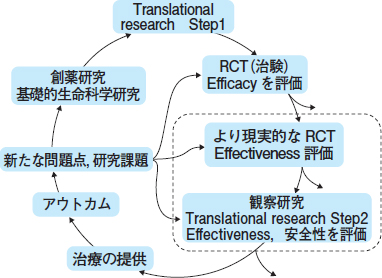
植 田真一郎*.論文 を正しく読むのはけっこう難しい——診療に活かせる解釈のキホンとピットフォール.医学書院;2018.(下線で紹介ページにリンクする/作図で ネット上の出典にリンクする)
*1985 年横浜市大医学部卒。同大病院,市中病院で研修後,91年より5年間日本臨床薬理学会海外派遣研究員として英グラスゴー大内科薬物療法学講座留学,96年 横浜市大第二内科助手,2001年より琉球大学大学院医学研究科臨床薬理学講座教授。
リンク【文献】
Oxford Center for Evidenced-Based Medicine, Glossary of Terms in Evidence-Baced Medicine.

Copyleft,
CC, Mitzub'ixi Quq Chi'j, 1996-2099

