
フレッド・エガン
Frederick Russell
Eggan, 1906-1991
Fred
Eggan, 1906-1991,[撮影時期不詳] Photo Archive of the University of Chicago
☆フレデリック・ラッセル・エガン[Frederick Russell
Eggan]
(1906年9月12日、ワシントン州シアトル生まれ –
1991年5月7日)は、英国の社会人類学の原理をネイティブ・アメリカンの部族研究に革新的に応用したことで最もよく知られるアメリカの人類学者であ
る。彼は、英国の社会人類学者A・R・ラドクリフ=ブラウンがシカゴ大学に在籍していた当時、その寵愛を受けた教え子であった。彼のフィールドワークは、
米国南西部のプエブロ族を対象としたものであった。エガンは後に自身もシカゴ大学で教鞭を執った。同大学での教え子にはソル・タックスがいた。
彼の最も有名な著作には、編著『北米部族の社会人類学』(1937年)や『アメリカン・インディアン』(1966年)などがある。
1939年に結婚した妻のドロシー・ウェイ・エガン(1901–1965)もまた、人類学者であった。
| Frederick Russell
Eggan (September 12, 1906, in Seattle, Washington – May 7, 1991) was an
American anthropologist best known for his innovative application of
the principles of British social anthropology to the study of Native
American tribes. He was the favorite student of the British social
anthropologist A. R. Radcliffe-Brown during Radcliffe-Brown's years at
the University of Chicago. His fieldwork was among Pueblo peoples in
the southwestern U.S. Eggan later taught at Chicago himself. His
students there included Sol Tax. His best known works include his edited volume Social Anthropology of North American Tribes (1937) and The American Indian (1966). His wife, Dorothy Way Eggan (1901–1965), whom he married in 1939, was also an anthropologist. |
フレデリック・ラッセル・エガン[Frederick Russell
Eggan](1906年9月12日、ワシントン州
シアトル生まれ –
1991年5月7日)は、英国の社会人類学の原理をネイティブ・アメリカンの部族研究に革新的に応用したことで最もよく知られるアメリカの人類学者であ
る。彼は、英国の社会人類学者A・R・ラドクリフ=ブラウンがシカゴ大学に在籍していた当時、その寵愛を受けた教え子であった。彼のフィールドワークは、
米国南西部のプエブロ族を対象としたものであった。エガンは後に自身もシカゴ大学で教鞭を執った。同大学での教え子にはソル・タックスがいた。 彼の最も有名な著作には、編著『北米部族の社会人類学』(1937年)や『アメリカン・インディアン』(1966年)などがある。 1939年に結婚した妻のドロシー・ウェイ・エガン(1901–1965)もまた、人類学者であった。 |
| Introduction Frederick Eggan[1] was a North American anthropologist in the 20th century and part of the anthropology department at the University of Chicago. He is a world-renowned social anthropologist, most famous for his works in the Southwest involving the Hopi Indians and many of the social changes that take place within the Western Pueblos. Ernest L. Schusky[2] claims Fred Eggan is a founder of modern American anthropoly's eclectic approach, which combines the functionalism of Radcliffe-Brown with the historical approach of Franz Boas. In a paper titled “Among the Anthropologist,” Eggan answers a question posed by Margaret Mead: “Shouldn’t we all be branches of one human science?”[3] Eggan states that anthropology should center on man and his works, while providing a spectrum of specialized fields which interlock with those of the social and behavioral sciences. |
はじめに フレデリック・エガン[1]は、20世紀の北米の人類学者であり、シカゴ大学人類学部の所属であった。彼は世界的に著名な社会人類学者であり、ホピ族イン ディアンに関する研究や、西部プエブロ地域で生じた多くの社会変容に関する研究で最もよく知られている。アーネスト・L・シュスキー[2]は、フレッド・ エガンが、ラドクリフ=ブラウンの機能主義とフランツ・ボアズの歴史的アプローチを融合させた、現代アメリカ人類学の折衷的アプローチの創始者であると主 張している。「人類学者の間で」と題された論文の中で、エガンはマーガレット・ミードが投げかけた「我々は皆、一つの人間科学の分派であるべきではない か」という問いに答えている。[3] エガンは、人類学は人間とその営みを中核とすべきであると同時に、社会科学や行動科学の分野と相互に連携する多様な専門分野を提供すべきであると述べてい る。 |
| Background Frederick Eggan was born in Seattle, Washington, on September 12, 1906, to Alfred Eggan and Olive Smith. Eggan earned his master's degree in psychology with a minor in anthropology from the University of Chicago in the early 20th century.[1] He received his PhD in anthropology from the same university several years later with a doctoral thesis entitled “Social Organization of the Western Pueblos” analyzing the social organization of Pueblo Indians in the Southwest. Fred was an active member in the discipline of anthropology at a critical time when new technologies and methods were being invented for archeological purposes. He mentions these innovations in his paper on “Social Anthropology and the Method of Controlled Comparison.” [4] He speaks of the new aids to anthropological research such as radiocarbon dating, genetics, and the experimental method which are just a few of the many rapid technological advances that had taken place to aid the discipline in this time. Eggan married Dorothy Way in 1938;[5] she was also an anthropologist of the Hopi.[6] Fred died in his house in Santa Fe, New Mexico from heart failure on May 7, 1991; he was 84. |
経歴 フレデリック・エガンは1906年9月12日、ワシントン州シアトルで、アルフレッド・エガンとオリーブ・スミスの間に生まれた。エガンは20世紀初頭、 シカゴ大学にて心理学の修士号を取得し、人類学を副専攻とした。[1] 数年後、同大学にて人類学の博士号を取得した。博士論文の題目は「西部プエブロの社会組織」であり、南西部のプエブロ・インディアンの社会組織を分析した ものである。フレッドは、考古学の目的で新しい技術や手法が次々と生み出されていた重要な時期に、人類学分野で精力的に活動していた。彼は論文「社会人類 学と統制比較法」の中で、こうした革新について言及している。[4] 彼は、放射性炭素年代測定、遺伝学、実験法といった人類学研究の新たな補助手段について言及している。これらは、当時この学問分野を支援するために起こっ た数多くの急速な技術的進歩のほんの一部に過ぎない。エガンは1938年にドロシー・ウェイと結婚した[5]。彼女もまたホピ族を研究対象とする人類学者 であった[6]。フレッドは1991年5月7日、ニューメキシコ州サンタフェの自宅で心不全により死去した。享年84歳であった。 |
| Employment history [1] Fred Eggan served as chairman at the University of Chicago of the department of anthropology; he was also president of the American Anthropological Association. He was also employed as a [5] professor of psychology, sociology, and history at Wentworth Junior College and Military Academy in Missouri before he obtained his PhD. Eggan also worked as a research assistant to Radcliffe-Brown at the University of Chicago, researching the social organization of Native American tribes.[7] During his time teaching at the University of Chicago, Frederick held several positions. He was employed as an assistant professor (1940–1942), an associate professor (1942–1948), and professor (1948–1963). Fred retired from teaching in 1974. He addressed the connection between anthropology and the educational system in the following terms “Anthropology and education should have close working relations.[8] Educators are occupied by the task of keeping the operations going, particularly in this period of changing models, and have little time or opportunity to step outside their educational institutions and them as a system in the society as a whole. He was also the [5] director of the Philippine Studies Program at the University of Chicago.[6] Eggan also held a prominent position for the Philippine government during World War II as chief of research. |
職歴 [1] フレッド・エガンはシカゴ大学の人類学部の学部長を務め、アメリカ人類学会の会長も務めた。また、博士号を取得する前は、ミズーリ州のウェントワース・ ジュニア・カレッジ兼陸軍士官学校で[5]心理学、社会学、歴史学の教授として勤務していた。エガンはまた、シカゴ大学でラドクリフ=ブラウンの研究助手 として、ネイティブ・アメリカン部族の社会組織に関する研究を行った。[7] シカゴ大学での教職期間中、フレデリックはいくつかの役職を歴任した。助教授(1940年~1942年)、准教授(1942年~1948年)、教授 (1948年~1963年)として勤務した。フレッドは1974年に教職を退いた。彼は人類学と教育制度の関連性について、次のように述べている。「人類 学と教育は緊密な協力関係を持つべきである。[8] 教育者は、特にモデルが変化しているこの時期において、教育活動を維持するという任務に追われており、教育機関の外へ、そして社会全体における教育制度そ のものへと目を向ける時間や機会がほとんどない。」また、彼はシカゴ大学のフィリピン研究プログラムの[5]ディレクターも務めた。[6] エガンは第二次世界大戦中、フィリピン政府において調査部長として重要な地位に就いていた。 |
| Awards and honors [1] Frederick Eggan was president of the American Anthropological Association from 1953 to 1954.[9] He was also awarded the Weatherhead Resident Scholar in 1979 by the School for Advanced Research for his work entitled “The Great Basic Background of Hopi Culture History.[10] He also received the Viking Fund medal in 1956. Towards the end of Frederick Eggan’s career in the 1960s,[7] he was elected to the American Philosophical Society, American Academy of Arts and Sciences, as well as to the National Academy of Sciences. |
受賞歴と栄誉 [1] フレデリック・エガンは、1953年から1954年にかけてアメリカ人類学会の会長を務めた。[9] また、1979年には「ホピ文化史の偉大なる基本的背景」と題する研究に対し、高等研究学院からウェザーヘッド・レジデント・スカラーの称号を授与され た。[10] さらに、1956年にはバイキング基金メダルを受賞している。1960年代、フレデリック・エガンの研究活動の終盤[7]には、アメリカ哲学協会、アメリ カ芸術科学アカデミー、および全米科学アカデミーの会員に選出された。 |
| Key field work Frederick Eggan has participated in several field studies at many different locations.[7] Some of these sites include: Santa Fe where he lived with the Hopi Indians for a summer (1932), Mississippi and Oklahoma where his research was focused on primarily the Choctaw, Cheyenne, and Arapaho Indians (1933), and the Northern Philippines where he studied social changes in the Ifugao, Bontok, Tinguian, and Ilocano Indians (1934–1935). |
主な現地調査 フレデリック・エガンは、異なる場所で数多くの現地調査に参加してきた。[7] その調査地には、ホピ族インディアンと共に夏を過ごしたサンタフェ(1932年)、主にチョクトー族、シャイアン族、アラパホ族インディアンを研究対象と したミシシッピ州とオクラホマ州(1933年)、そしてイフガオ族、ボントック族、ティンギアン族、イロカノ族インディアンの社会変化を調査したフィリピ ン北部(1934年~1935年)などが含まれる。 |
| Research emphasis [11] Eggan’s research has been primarily focused on “Native American kinship and social systems”, making use of [12] archeological, linguistic, and general ethnographic evidence. With his work in North America,[7] Eggan attempted to create a theory to illuminate Boasian empiricism, which was a theory developed by Franz Boas that [13] all knowledge was derived from sense-experience. Eggan's work in Santa Fe analyzed each Western Pueblo social structure and compared and contrasted them to the Eastern Pueblos. His most important contribution to archeology, and possibly anthropology in general, was his [7] demonstrations how the variations currently observed in the Pueblo social structures are related to cultural adaptations to ecological niches. Eggan's time spent studying the Cheyenne and Arapaho served as a basis for one of his most famous works, “Social Anthropology and the Method of Controlled Comparison.” [7] He demonstrated how it was possible for the Cheyenne to change from a predominantly agricultural based lineage type kinship system to a system that was predominantly nomadic involving a heavy dependence on hunting and gathering in bands to increase their efficiency.[7] Eggan theorized from his extensive research that this was a result of being forced by other tribes onto the Plains out of their land, which was in present-day Minnesota. The result of Eggan's work in the Philippines can be found in his paper on “Cultural Drift and Social Change.” It is in this paper that he claims [14] as one travels from the interior down to the coast, there are patterned series of changes in a definite direction in many important cultural institutions such as social, political, economic, and religious. |
研究の重点 [11] エガンの研究は主に「ネイティブ・アメリカンの親族関係と社会制度」に焦点を当てており、[12] 考古学的、言語学的、および一般的な民族誌的証拠を活用している。北米における研究を通じて[7]、エガンはフランツ・ボアズが提唱した「すべての知識は 感覚的経験に由来する」というボアズの実証主義を解明する理論の構築を試みた。サンタフェにおけるエガンの研究では、各西部プエブロの社会構造を分析し、 東部プエブロとの比較対照を行った。考古学、ひいては人類学全般に対する彼の最も重要な貢献は、現在のプエブロ社会構造に見られる多様性が、生態学的ニッ チへの文化的適応とどのように関連しているかを[7]実証したことである。エガンがシャイアン族とアラパホ族の研究に費やした時間は、彼の最も有名な著作 の一つである『社会人類学と統制比較法』の基礎となった。[7] 彼は、シャイアン族が、主に農業を基盤とする血縁系統型親族制度から、効率を高めるために狩猟採集を主とする遊牧的な制度へと移行することがいかに可能で あったかを示した。[7] エガンは、自身の広範な研究から、これは現在のミネソタ州にあった彼らの土地から、他の部族によって平原へと追いやられた結果であると理論化した。エガン のフィリピンにおける研究の成果は、論文「文化的ドリフトと社会変容」に見ることができる。同論文において彼は[14]、内陸部から海岸部へと移動するに つれ、社会、政治、経済、宗教といった多くの重要な文化的制度において、明確な方向性を持つ一連の変化が規則的に生じると主張している。 |
| Selected papers Eggan, Fred (1934). "The Maya Kinship System and Cross-Cousin Marriage". American Anthropologist. 36 (2): 188–202. doi:10.1525/aa.1934.36.2.02a00050. JSTOR 661687. Ed. Social Anthropology of North American Tribes. Chicago: University of Chicago Press. The Cheyenne and Arapaho kinship systems. In Social Anthropology of North American Tribes, ed. F. Eggan, pp. 35–95. Chicago: University of Chicago Press. Eggan, Fred (1937). "Historical Changes in the Choctaw Kinship System". American Anthropologist. 39 (1): 34–52. doi:10.1525/aa.1937.39.1.02a00040. JSTOR 662072. Eggan, Fred (1941). "Some Aspects of Culture Change in the Northern Philippines". American Anthropologist. 43 (1): 11–18. doi:10.1525/aa.1941.43.1.02a00030. JSTOR 662983. The Hopi and the lineage principle. In Social Structure: Studies Presented to A.R. Radcliffe-Brown, ed. M. Fortes, pp. 121–144. Oxford: Clarendon Press. Social Organization of the Western Pueblos. Chicago: University of Chicago Press. The ethnological cultures and their archaeological backgrounds. In Archaeology of the Eastern United States, ed. J. B. Griffin, pp. 35–45. Chicago: University of Chicago Press. Eggan, Fred (October 1954). "Social Anthropology and the Method of Controlled Comparison". American Anthropologist. 56 (5): 743–763. doi:10.1525/aa.1954.56.5.02a00020. Ed. Social Anthropology of North American Tribes. Chicago: University of Chicago Press. 2nd edition. Social anthropology: methods and results. In Social Anthropology of North American Tribes, ed. F. Eggan, pp. 485–551. Chicago: University of Chicago Press. Eggan, Fred (1956). "Ritual Myths among the Tinguian". The Journal of American Folklore. 69 (274): 331–339. doi:10.2307/536339. JSTOR 536339. With W. L. Warner. A. R. Radcliffe-Brown, 1881–1955. Am. Anthropol. 58:544–547. Glottochronology: a preliminary appraisal of the North American data. In Proceedings, 32nd International Congress of Americanists, pp. 645–653. Copenhagen: Munksgaard. With R. H. Lowie. Kinship terminologies. Encyclopædia Britannica vol. 13, pp. 407–409. Eggan, Fred (1963). "Cultural Drift and Social Change". Current Anthropology. 4 (4): 347–355. doi:10.1086/200393. JSTOR 2739890. S2CID 144853174. Alliance and descent in a western Pueblo society. In Process and Pattern in Culture, ed. R. Manners, pp. 175–184. Chicago: Aldine Press. The American Indian: Perspectives for the Study of Social Change. Chicago: Aldine Press. From history to myth: a Hopi example. In Studies in Southwestern Ethnolinguistics, ed. D. Hymes, pp. 33–53. The Hague: Mouton. Lewis Henry Morgan's Systems: a reevaluation. In Kinship Studies in the Morgan Centennial Year, ed. P. Reining, pp. 1–16. Washington, D.C.: Anthropological Society of Washington. Eggan, Fred (October 1974). "Among the Anthropologists". Annual Review of Anthropology. 3 (1): 1–20. doi:10.1146/annurev.an.03.100174.000245. S2CID 146647130. Pueblos: introduction. In Handbook of the North American Indians, Vol. 9: Southwest, ed. A. Ortiz, pp. 224–235. Washington, D.C.: Smithsonian Institution Press. With T. N. Pandey. Zuni history: 1850–1970. In Handbook of North American Indians, Vol. 9: Southwest, ed. A. Ortiz, pp. 474–484. Washington, D.C.: Smithsonian Institution Press. Beyond the bicentennial: the future of the American Indian in the perspectives of the past. J. Anthropol. Res. 34:161–180. Shoshone kinship structures and their significance for anthropological theory. J. Steward Anthropol. Soc. 11:165–193. Comparative social organization. In Handbook of North American Indians, Vol. 10: Southwest, ed. A. Ortiz, pp. 723–743. Washington, D.C.: Smithsonian Institution Press. Eggan, Fred (1941). "Some Aspects of Culture Change in the Northern Philippines". American Anthropologist. 43 (1): 11–18. doi:10.1525/aa.1941.43.1.02a00030. JSTOR 662983. |
主要論文 エガン、フレッド(1934)。「マヤの親族制度と交差いとこ婚」。『アメリカン・アンソロポロジスト』。36 (2): 188–202. doi:10.1525/aa.1934.36.2.02a00050. JSTOR 661687. 編『北米部族の社会人類学』シカゴ:シカゴ大学出版局。 シャイアン族とアラパホ族の親族制度。F. エガン編『北米部族の社会人類学』所収、35–95頁。シカゴ:シカゴ大学出版局。 エガン、フレッド(1937)。「チョクトー族の親族制度における歴史的変遷」。『アメリカン・アンソロポロジスト』。39 (1): 34–52. doi:10.1525/aa.1937.39.1.02a00040. JSTOR 662072. エガン、フレッド(1941)。「フィリピン北部における文化変容の諸相」。『アメリカン・アンソロポロジスト』。43 (1): 11–18. doi:10.1525/aa.1941.43.1.02a00030. JSTOR 662983. ホピ族と血縁原則。『社会構造:A.R. ラドクリフ=ブラウンへの献呈論文集』M. フォルテス編、121–144頁。オックスフォード:クラレンドン・プレス。 『西部プエブロの社会組織』。シカゴ:シカゴ大学出版局。 民族学的文化とその考古学的背景。J. B. グリフィン編『米国東部の考古学』所収、35–45頁。シカゴ:シカゴ大学出版局。 エガン、フレッド(1954年10月)。「社会人類学と統制比較法」。『アメリカン・アンソロポロジスト』。56 (5): 743–763。doi:10.1525/aa.1954.56.5.02a00020. 編. 『北米部族の社会人類学』. シカゴ:シカゴ大学出版局. 第2版. 社会人類学:方法と結果. 『北米部族の社会人類学』所収(F. エガン編)、pp. 485–551. シカゴ:シカゴ大学出版局。 エガン、フレッド(1956)。「ティンギアン族の儀礼神話」。『アメリカ民俗学雑誌』。69 (274): 331–339. doi:10.2307/536339. JSTOR 536339. W. L. ワーナーとの共著。A. R. ラドクリフ=ブラウン、1881–1955年。『アメリカ人類学』58:544–547。 グロットクロノロジー:北米データの予備的評価。『第32回国際アメリカ学会議議事録』、645–653頁。コペンハーゲン:ムンクスゴー。 R. H. ローウィーとの共著。親族用語。ブリタニカ百科事典 第13巻、pp. 407–409。 エガン、フレッド (1963)。「文化的ドリフトと社会変化」。『カレント・アンソロポロジー』。4 (4): 347–355。doi:10.1086/200393。JSTOR 2739890. S2CID 144853174. 西部プエブロ社会における同盟関係と血縁。R. マナーズ編『文化の過程と様式』所収、175–184頁。シカゴ:アルディーン・プレス。 『アメリカインディアン:社会変遷研究の視点』。シカゴ:アルディーン・プレス。 歴史から神話へ:ホピ族の事例。『南西部民族言語学研究』(D. ハイムズ編、33–53頁)。ハーグ:ムートン。 ルイス・ヘンリー・モーガンの体系:再評価。『モーガン生誕100周年記念親族研究』(P. ライニング編、1–16頁)。ワシントンD.C.:ワシントン人類学会。 エガン、フレッド(1974年10月)。「人類学者たちの間で」。『Annual Review of Anthropology』3巻1号:1–20頁。doi:10.1146/annurev.an.03.100174.000245。S2CID 146647130。 プエブロ族:序論。『北米インディアン事典』第9巻:南西部、A. オルティス編、224–235頁。ワシントンD.C.:スミソニアン協会出版局。 T. N. パンディとの共著。『ズニ族の歴史:1850–1970』。『北米インディアン事典』第9巻:南西部、A. オルティス編、474–484頁。ワシントンD.C.:スミソニアン協会出版局。 建国200周年を超えて:過去からの視点におけるアメリカン・インディアンの未来。『人類学研究誌』34:161–180。 ショショーニ族の親族構造と人類学理論におけるその意義。J. Steward Anthropol. Soc. 11:165–193. 比較社会組織。『北米インディアン事典』第10巻:南西部、A. オルティス編、723–743頁。ワシントンD.C.:スミソニアン協会出版局。 エガン、フレッド(1941)。「フィリピン北部における文化変容の諸相」。『アメリカン・アンソロポロジスト』。43 (1): 11–18. doi:10.1525/aa.1941.43.1.02a00030. JSTOR 662983. |
| References 01. Heise, Kenan (9 May 1991). "Anthropology Expert Fred Eggan, 84". Chicago Tribune. Schusky, Ernest L. (February 1989). "Fred Eggan: anthropologist full circle". American Ethnologist. 16 (1): 142–157. doi:10.1525/ae.1989.16.1.02a00100. Eggan, Fred (October 1974). "Among the Anthropologists". Annual Review of Anthropology. 3 (1): 1–20. doi:10.1146/annurev.an.03.100174.000245. S2CID 146647130. Eggan, Fred (October 1954). "Social Anthropology and the Method of Controlled Comparison". American Anthropologist. 56 (5): 743–763. doi:10.1525/aa.1954.56.5.02a00020. 05. "News from the Special Collections Research Center." The University of Chicago Library News. The University of Chicago, 28 Oct. 2009. Web. 13 Nov. 2012. Narvaez, Alfonso A. (9 May 1991). "Fred Russell Eggan Is Dead at 84; A Retired Anthropology Professor". The New York Times. Vogt, Evon Z. "Frederick Russell Eggan." All Available Biographical Memoirs. National Academic Press, n.d. Web. 11 Nov. 2012. Eggan, Fred (1957). "Social Anthropology and the Educational System". The School Review. 65 (3): 247–259. doi:10.1086/442396. JSTOR 1083485. S2CID 143965350. "Fred Eggan." SAR, Resident Scholar. Sar (School for Advanced Research), n.d. Web. 17 Nov. 2012. 10. “Viking Fund Medal." The Wenner-Gren Foundation. The Wenner-Gren Foundation, n.d. Web. 14 Nov. 2012. "Fred Russel Eggan." Columbia Electronic Encyclopedia, 01 Nov. 2011 Social organization of the western Pueblos. Eggan, Fred. Oxford, England: Univ. of Chicago Press. (1950). xvii 373 pp. "empiricism." The American Heritage® Stedman's Medical Dictionary. Houghton Mifflin Company. 18 Nov. 2012. 14. Eggan, Fred (1963). "Cultural Drift and Social Change". Current Anthropology. 4 (4): 347–355. doi:10.1086/200393. JSTOR 2739890. S2CID 144853174. |
参考文献 01. ハイゼ、ケナン(1991年5月9日)。「人類学の権威、フレッド・エガン氏、84歳」。シカゴ・トリビューン。 シュスキー、アーネスト・L.(1989年2月)。「フレッド・エガン:人類学者の円環」。『アメリカン・エスノロジスト』。16 (1): 142–157。doi:10.1525/ae.1989.16.1.02a00100. エガン、フレッド(1974年10月)。「人類学者たちの中で」。『Annual Review of Anthropology』。3 (1): 1–20. doi:10.1146/annurev.an.03.100174.000245. S2CID 146647130. エガン、フレッド(1954年10月)。「社会人類学と統制比較法」。『アメリカン・アンソロポロジスト』。56巻5号:743–763頁。doi:10.1525/aa.1954.56.5.02a00020. 05. 「特別コレクション研究センターからのニュース」。『シカゴ大学図書館ニュース』。シカゴ大学、2009年10月28日。Web。2012年11月13日。 ナルバエス、アルフォンソ・A. (1991年5月9日). 「フレッド・ラッセル・エガン氏、84歳で死去;引退した人類学教授」. 『ニューヨーク・タイムズ』. ヴォグト、エヴォン・Z. 「フレデリック・ラッセル・エガン」. 『All Available Biographical Memoirs』. ナショナル・アカデミック・プレス、発行年不明。Web. 2012年11月11日。 エガン、フレッド(1957年)。「社会人類学と教育制度」。『スクール・レビュー』。65巻3号:247–259頁。doi:10.1086/442396。JSTOR 1083485。S2CID 143965350。 「フレッド・エガン」。SAR、常駐研究員。SAR(School for Advanced Research)、発行年不明。ウェブ。2012年11月17日。 10. 「バイキング基金メダル」。ウェナー・グレン財団。ウェナー・グレン財団、発行年不明。ウェブ。2012年11月14日。 「フレッド・ラッセル・エガン」。コロンビア電子百科事典、2011年11月1日 西プエブロ族の社会組織。エガン、フレッド。イギリス・オックスフォード:シカゴ大学出版局。(1950年)。xvii 373頁。 「経験主義」。『アメリカン・ヘリテージ® ステッドマン医学辞典』。ホートン・ミフリン社。2012年11月18日。 14. エガン、フレッド (1963). 「文化的ドリフトと社会変化」. 『カレント・アンソロポロジー』. 4 (4): 347–355. doi:10.1086/200393. JSTOR 2739890. S2CID 144853174. |
| https://en.wikipedia.org/wiki/Fred_Eggan |
☆


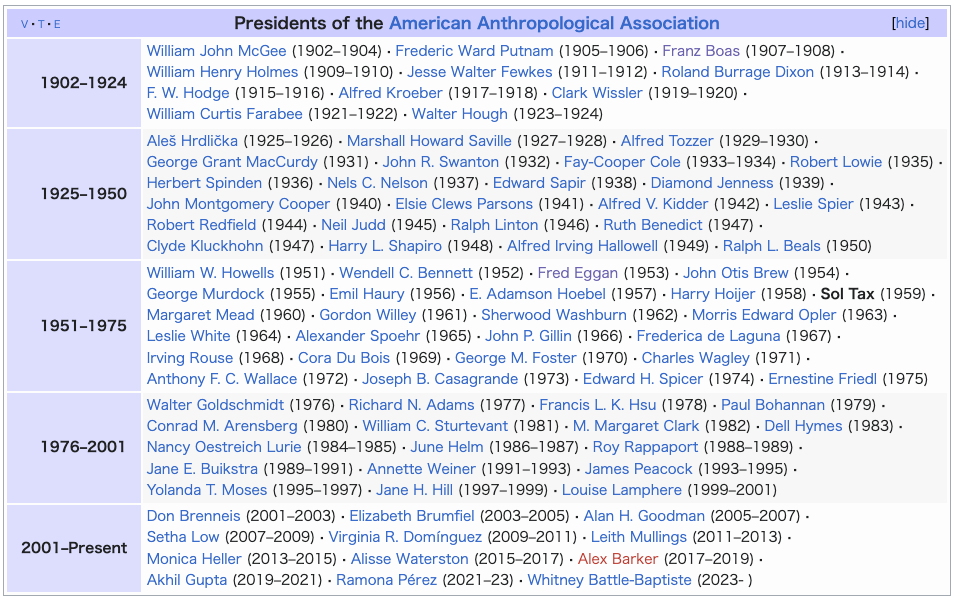
☆アメリカ人類学連合の歴代会長
リ ンク
文 献
そ の他の情報
CC
Copyleft,
CC, Mitzub'ixi Quq Chi'j, 1996-2099
