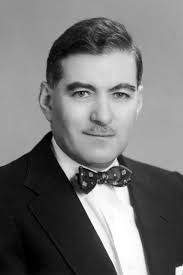
ソル・タックス
Sol Tax (30 October 1907 – 4 January 1995)
☆ ソル・タックス[Sol Tax](1907年10月30日 - 1995年1月4日)はアメリカの人類学者。行動人類学(アクション人類学)の創始者であり、フォックス・プロジェクトと題した「行動人類学」研究と、学術誌『カレント・アン トロポロジー』の創刊で知られる。1935年にシカゴ大学で博士号を取得し、フレッド・エガン[Fred Eggan, 1906-1991]とともにアルフレッド・ラドクリフ=ブラウンの教え子であっ た。
| Sol
Tax (30 October
1907 – 4 January 1995) was an American anthropologist. He is best known
for creating action anthropology and his studies of the Meskwaki, or
Fox Indians, for "action-anthropological" research titled the Fox
Project, and for founding the academic journal Current Anthropology. He
received his doctorate from the University of Chicago in 1935 and,
together with Fred Eggan, was a student of Alfred Radcliffe-Brown. |
ソル・タックス[Sol
Tax](1907年10月30日 –
1995年1月4日)は、アメリカの人類学者である。彼は、アクション人類学を創始したこと、メスクワキ族(フォックス・インディアン)に関する研究、す
なわち「フォックス・プロジェクト」と題された「アクション人類学的」研究、そして学術誌『カレント・アンソロポロジー』を創刊したことで最もよく知られ
ている。1935年にシカゴ大学で博士号を取得し、フレッド・エガンと共にアルフレッド・ラドクリフ=ブラウンの教え子であった。 |
| Early life Tax grew up in Milwaukee, Wisconsin. During his formative years he was involved in a number of social clubs. Among these was the Newsboys Republic with which his first encounter was when he was "arrested" for breaking their rules. Tax began his undergraduate education at the University of Chicago but had to leave for lack of funds. He returned to school at the University of Wisconsin–Madison, where he studied with Ralph Linton. He later earned a doctorate at the University of Chicago in 1935.[2] He joined the faculty of that institution in 1940 where he spent several decades teaching.[2] Tax was a mentor to noted anthropologist Joan Ablon at the University of Chicago. |
幼少期 タックスはウィスコンシン州ミルウォーキーで育った。青年期には、いくつかの社交クラブに所属していた。その中には「ニュースボーイズ・リパブリック」が あり、彼がこのクラブと初めて関わったのは、その規則を破ったとして「逮捕」された時だった。タックスはシカゴ大学で学部教育を始めたが、資金不足のため 中退せざるを得なかった。その後、ウィスコンシン大学マディソン校に戻り、ラルフ・リントンに師事した。1935年にはシカゴ大学で博士号を取得した [2]。1940年に同大学の教員となり、数十年にわたり教鞭を執った[2]。タックスはシカゴ大学において、著名な人類学者ジョーン・アブロンの指導教 官を務めた。 |
| Career He was the main organizer for the 1959 Darwin Centennial Celebration held at the University of Chicago. He was an organizer, along with the National Congress of American Indians, including Native American organizer Willard LaMere,[3] of the 1961 American Indian Chicago Conference. He assisted in authoring the resulting Statement of Indian Purpose, the first major statement of the policy of tribal self-determination. |
経歴 彼は、シカゴ大学で開催された1959年のダーウィン生誕100周年記念行事の主要な主催者であった。また、ネイティブ・アメリカンの活動家ウィラード・ ラメール[3]を含む全米インディアン会議と共に、1961年の「シカゴ・アメリカン・インディアン会議」の主催者の一人となった。彼は、この会議の成果 として生まれた『インディアン目的宣言』の起草を支援した。これは、部族の自己決定に関する政策を定めた最初の主要な声明である。 |
| University of Chicago Tax intermittently served as Chair of the Department of Anthropology along with Robert Redfield after the retirement of Fay-Cooper Cole in the late 1940s. Cole had built up the Archaeology Laboratory Skeletal Collection, which began during the earliest iterations of the department in the late 1890s through the 1940s. The collection of human remains of both Indigenous and non-Indigenous people, bone fragments, and artifacts were compiled, studied, stored, and possibly exhibited on the campus. The skeletal collection contained human remains and archaeological objects taken and collected by faculty, students, curators, and donors through excavations of Illinois burial mounds such as the Fisher Mounds, Starved Rock, Kincaid, Algeria, Globe, Arizona, among materials from private donors. The collection also contained human remains from the University's Anatomy Department and Medical School.[4] Donations accounted for a significant portion of the collection. Skeletal remains of 400 Indigenous people, as well as 10,000 bone fragments, stone, pottery and shell implements and artifacts largely excavated from Fisher and Adler Mounds, were donated in 1930 by George Langford, an engineer from Joliet who as also an amateur anthropologist, an honorary Research Associate in the Department of Anthropology at the University of Chicago, and later Curator of Plant Fossils at Field Museum.[5] The politics of the department had changed with the faculty body, and Redfield and Tax determined that the Skeletal Collection no longer served the research purposes of the department, and the storage space could be better used. They tasked a graduate student in the department to inventory and report on the collection.[4] Around 1950, much of the skeletal collection was unofficially dispersed to other institutions like Indiana University, Illinois State Museum, Beloit College, and the Field Museum. Under NAGPRA guidelines, these institutions are now responsible for deaccessioning and repatriating Native American human remains and funerary objects.[6] The remaining skeletal materials do not account for extent of the historical collection; the department's report recommended that the majority be "dumped."[4][7] The contemporary University of Chicago Archaeology Laboratory continues to hold non-Native American human remains, the paleoanthropology laboratory contains a large osteology collection.[8] |
シカゴ大学 1940年代後半にフェイ・クーパー・コールが退職した後、タックスはロバート・レッドフィールドと共に、人類学部の学部長を断続的に務めた。コールは、 1890年代後半の学部創設初期から1940年代にかけて、考古学研究所の骨格コレクションを築き上げていた。先住民および非先住民の人骨、骨片、遺物か らなるこのコレクションは、キャンパス内で収集、研究、保管され、おそらく展示もされていた。この骨格コレクションには、フィッシャー・マウンド、スター ブド・ロック、キンケイド、アルジェリア、グローブ、アリゾナといったイリノイ州の古墳の発掘を通じて、教員、学生、学芸員、寄贈者らが採取・収集した人 骨や考古学的遺物に加え、個人寄贈者からの資料も含まれていた。このコレクションには、同大学の解剖学部門および医学部からの人骨も含まれていた。[4] 寄贈品はコレクションの相当な部分を占めていた。400体の先住民の骨格遺骸に加え、1万点の骨片、石器、 陶器、貝殻製の道具や遺物(その多くはフィッシャー・マウンドやアドラー・マウンドから発掘されたもの)が、1930年にジョリエット出身のエンジニアで あり、アマチュア人類学者でもあったジョージ・ラングフォードによって寄贈された。彼はシカゴ大学人類学部の名誉研究員であり、後にフィールド博物館の植 物化石学キュレーターを務めた。[5] 同学科の政治情勢は教員構成の変化に伴い変化し、レッドフィールドとタックスは、骨格コレクションがもはや学科の研究目的に役立たず、保管スペースをより 有効に活用できると判断した。彼らは学科の大学院生に、コレクションの目録作成と報告を命じた。[4] 1950年頃、骨格コレクションの多くは、インディアナ大学、イリノイ州立博物館、ベロイト大学、フィールド博物館などの他機関へ非公式に分散された。 NAGPRA(先住民遺骨・埋葬物保護法)のガイドラインに基づき、これらの機関は現在、先住民の人骨および葬祭用遺物の除籍と返還の責任を負っている。 [6] 残存する骨格資料は、かつてのコレクションの全容を反映するものではない。同学科の報告書は、その大部分を「廃棄」するよう推奨していた。[4] [7] 現在のシカゴ大学考古学研究所は、先住民以外の人骨を引き続き保有しており、古人類学研究所には大規模な骨学コレクションが収蔵されている。[8] |
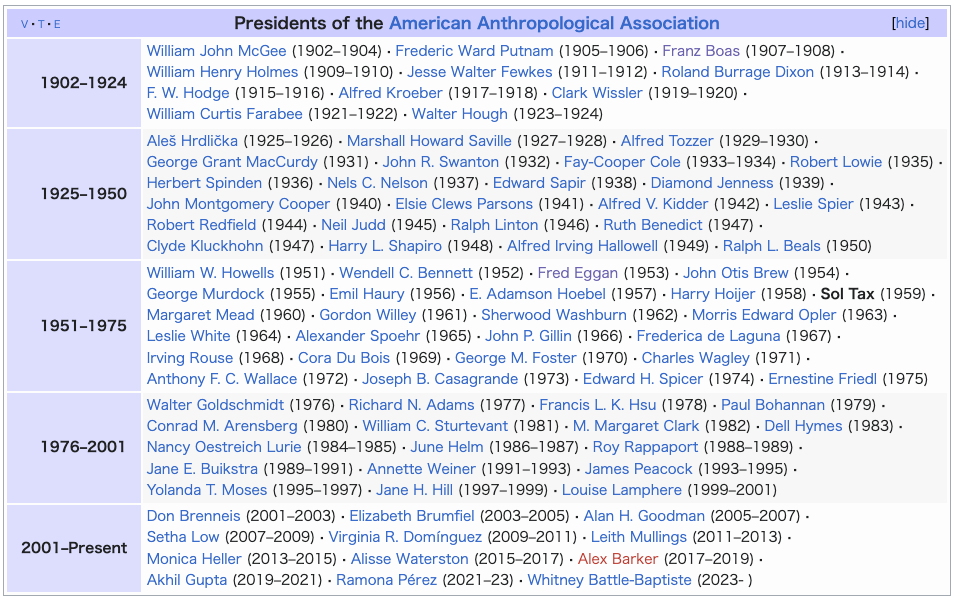
| Honors The American Anthropological Association presented to him and Bela Maday its Franz Boas award for exemplary service to anthropology in 1977. He was the association's president in 1959.[9][10] |
受賞歴 1977年、アメリカ人類学会は、人類学への顕著な貢献を称え、彼とベラ・マデイにフランツ・ボアズ賞を授与した。彼は1959年に同学会の会長を務めた。[9][10] |
Action Anthropology An example of Action Anthropology: the 1961 American Indian Chicago Conference (AICC) at the University of Chicago. Tax helped bring together members of 90 tribes. Photo by F. Peter Weil, courtesy of the NAES College Collection at the Northwestern University Libraries Sol Tax is known as a founder of "Action Anthropology", a school of anthropological thought that forwent the traditional doctrine of non-interference in favor of co-equal goals of "learning and helping" from studied cultures.[11] As an example, he was a lead organizer of the influential 1961 American Indian Chicago Conference (AICC).[3] The meeting brought together 460 American Indians from 90 tribes from June 13 to June 20, 1961, at the University of Chicago to help "all Indians of the whole nation to express their own views" and draft a shared "Declaration of Indian Purpose."[12] President John F. Kennedy received the declaration in a ceremony at the White House in 1962. The spirit of self-determination expressed in the document became a cornerstone of Native activism in the years that followed, including the Red Power movement and the expansion of Native American gaming.[13] In 1974, when the Chicago Native American Committee established the Native American Educational Services College (NAES College), Tax served on its original academic review committee. As the college grew, the academic review committee was converted into a board of directors in 1978. Tax accepted an invitation to join, and he served on the committee until 1993, not long before his death. NAES credited Tax with playing a "key role in helping define a vision of Indian higher education as the basis for community development in culturally relevant terms." Tax's particular contribution was the core idea of field projects in the NAES curriculum.[14] |
アクション人類学 アクション人類学の例:1961年にシカゴ大学で開催されたアメリカ先住民シカゴ会議(AICC)。タックスは90の部族のメンバーを集めるのに尽力した。写真:F. ピーター・ワイル、ノースウェスタン大学図書館NAESカレッジ・コレクション提供 ソル・タックスは、「アクション人類学」の創始者として知られる。これは、研究対象となる文化から「学び、支援する」という対等な目標を掲げ、従来の「不 干渉」の教義を放棄した人類学思想の一派である。[11] その一例として、彼は1961年に開催された影響力のある「アメリカン・インディアン・シカゴ会議(AICC)」の主要な主催者の一人であった。[3] この会議は、1961年6月13日から20日にかけてシカゴ大学で開催され、90の部族から460人のアメリカ先住民が集結した。「全国民のすべての先住 民が自らの見解を表明する」ことを支援し、共通の「先住民の目的宣言」を起草するためであった。[12] 1962年、ジョン・F・ケネディ大統領はホワイトハウスでの式典でこの宣言書を受け取った。この文書に表された自己決定の精神は、その後のレッド・パ ワー運動やネイティブ・アメリカンのギャンブル事業の拡大を含め、その後のネイティブ・アクティビズムの礎となった。[13] 1974年、シカゴ・ネイティブ・アメリカン委員会がネイティブ・アメリカン教育サービス・カレッジ(NAESカレッジ)を設立した際、タックスはその初 代学術審査委員会の委員を務めた。カレッジが成長するにつれ、学術審査委員会は1978年に理事会へと改組された。タックスはその招きを受け入れ、 1993年、亡くなる直前の時期まで同委員会で活動した。NAESは、タックスが「文化的に適切な観点から、地域社会開発の基盤となる先住民高等教育のビ ジョンを定義する上で重要な役割を果たした」と評価している。タックスの特筆すべき貢献は、NAESのカリキュラムにおけるフィールド・プロジェクトとい う中核的なアイデアであった。[14] |
| Works (1937, revised 1955) contributions to Social Anthropology of North American Tribes, ed. by Fred Eggan. Chicago: University of Chicago Press. Rubinstein, Robert A., ed. 2001. Doing Fieldwork: The Correspondence of Robert Redfield and Sol Tax, New Brunswick, NJ: Transaction Books. (1953, revised 1972) Penny Capitalism; a Guatemalan Indian economy ISBN 978-0-374-97785-6. Tax is said to have coined the term 'Penny capitalism'.[15] (1988) Pride and Puzzlement: A Retro-introspective Record of 60 Years of Anthropology Annual Review of Anthropology |
著作 (1937年、1955年改訂) 『北米部族の社会人類学への寄稿』、フレッド・エガン編。シカゴ:シカゴ大学出版局。 ルービンスタイン、ロバート・A. 編。2001年。『フィールドワークの実践:ロバート・レッドフィールドとソル・タックスの書簡集』、ニュージャージー州ニューブランズウィック:トランザクション・ブックス。 (1953年、1972年改訂) 『ペニー・キャピタリズム:グアテマラ先住民経済』 ISBN 978-0-374-97785-6。タックスは「ペニー・キャピタリズム」という用語を考案したとされている。[15] (1988) 『誇りと困惑:人類学60年の回顧的内省記録』 『Annual Review of Anthropology』 |
| Bronislaw Malinowski Award Sol Tax Distinguished Service Award |
ブロニスラフ・マリノフスキー賞 ソル・タックス功労賞 |
| References 01. "Obituary: Sol Tax, Anthropology". Chicago Chronicle. Retrieved 13 March 2015. Randy Kennedy (January 8, 1995). "Sol Tax, 87, Anthropologist Who Founded Journal, Dies". The New York Times. Laukaitis, John J. (2009). "American Indian organizational education in Chicago: the Community Board Training Project, 1979-1989". American Educational History Journal. 36 (1–2): 445+. Retrieved 17 October 2020. Inventory and Report on the Archaeology Laboratory, n.d., Fred Eggan Papers. Hanna Holborn Gray Special Collections Research Center, University of Chicago Library, Chicago, IL. 05. "News of the Quadrangles". University of Chicago Magazine. 22 (5). "About". Office of the Native American Graves Protection & Repatriation Act. Retrieved 2024-11-15. "For Name's Sake - Anthropology Collection". "Bioarchaeology | UCAN | Archaeology". ucan. Retrieved 2024-11-15. "Franz Boas Award for Exemplary Service to Anthropology". American Anthropological Association. 2008-10-27. Archived from the original on 2008-11-20. Retrieved 2008-10-31. The Franz Boas Award for Exemplary Service to Anthropology, formerly the Distinguished Service Award, was established in 1976. This award is presented annually by the Association to its members whose careers demonstrate extraordinary achievements that have well served the anthropological profession. Service to the Association is commonly recognized, as are outstanding applications of anthropological knowledge to improving the human condition. Great teachers of anthropology at all levels have received this award. Although the activities of the recipients will vary from year to year, all awardees have made many sacrifices, usually without personal reward, and sometimes against personal safety. They have all used anthropology for the benefit of others. 10. "Franz Boas Award for Exemplary Service to Anthropology". American Anthropological Association. 2008-10-23. Retrieved 2008-10-31. Hinshaw, Robert A. (1980). Currents in Anthropology: Essays in Honor of Sol Tax. USA: de Gruyter. ISBN 978-3-11-179474-7. Lurie, Nancy Oestreich (December 1961). "The Voice of the American Indian: Report on the American Indian Chicago Conference" (PDF). Current Anthropology. 2 (5): 478–500. doi:10.1086/200229. JSTOR 2739788. S2CID 143508407. Retrieved 17 October 2020. Niermann, Thomas A. (July 2006). The American Indian Chicago Conference, 1961: A Native response to government policy and the birth of Indian self-determination (PhD). Dept. of History, University of Kansas. Retrieved 29 October 2020. Laukaitis, John J. (2015). Community Self-Determination (First ed.). Albany: SUNY Press. pp. 123–124. ISBN 9781438457680. 15. "Ethnographic Field School in Guatemala " . faculty.chass.ncsu.edu. June 25, 2018. |
参考文献 01. 「訃報:ソル・タックス、人類学」。『シカゴ・クロニクル』。2015年3月13日閲覧。 ランディ・ケネディ(1995年1月8日)。「学術誌を創刊した人類学者、ソル・タックス氏(87)死去」。『ニューヨーク・タイムズ』。 ジョン・J・ラウカイティス(2009年)。「シカゴにおけるアメリカ先住民の組織教育:コミュニティ・ボード・トレーニング・プロジェク ト、1979-1989年」。『アメリカ教育史ジャーナル』。36 (1–2): 445+。2020年10月17日閲覧。 考古学研究所の目録および報告書、発行年不詳、フレッド・エガン文書。ハンナ・ホルボーン・グレイ特別コレクション研究センター、シカゴ大学図書館、イリノイ州シカゴ。 05. 「クアドラングルズからのニュース」。『シカゴ大学マガジン』。22 (5)。 「概要」。ネイティブ・アメリカン墓地保護・遺骨返還法事務局。2024年11月15日閲覧。 「名前のために - 人類学コレクション」。 「生物考古学 | UCAN | 考古学」。ucan。2024年11月15日閲覧。 「人類学への模範的貢献に対するフランツ・ボアズ賞」。アメリカ人類学会。2008年10月27日。2008年11月20日にオリジナルから アーカイブ。2008年10月31日閲覧。人類学への模範的貢献に対するフランツ・ボアズ賞(旧称:功労賞)は、1976年に創設された。この賞は、人類 学の分野に多大な貢献をした卓越した業績を示すキャリアを持つ会員に対し、協会が毎年授与するものである。協会への貢献は広く認められており、人類学的知 識を人類の生活向上に活用した傑出した事例も同様に評価される。あらゆるレベルの人類学の優れた教育者がこの賞を受賞している。受賞者の活動内容は年に よって異なるが、すべての受賞者は多くの犠牲を払い、通常は個人的な見返りもなく、時には身の危険を冒してまで活動してきた。彼らは皆、他者の利益のため に人類学を活用してきた。 10. 「人類学への模範的貢献に対するフランツ・ボアズ賞」。アメリカ人類学会。2008年10月23日。2008年10月31日閲覧。 ヒンショー、ロバート・A. (1980). 『人類学の潮流:ソル・タックスへの敬意を込めて』。米国:デ・グルイター。ISBN 978-3-11-179474-7。 ルーリー、ナンシー・オエストライク (1961年12月)。「アメリカ先住民の声:シカゴ・アメリカ先住民会議に関する報告」(PDF)。『カレント・アンソロポロジー』。2 (5): 478–500. doi:10.1086/200229. JSTOR 2739788. S2CID 143508407. 2020年10月17日閲覧。 ニールマン、トーマス・A.(2006年7月)。『1961年シカゴ・アメリカン・インディアン会議:政府政策に対する先住民の反応とインディアン自決の誕生』(博士論文)。カンザス大学歴史学部。2020年10月29日閲覧。 ラウカイティス、ジョン・J.(2015)。『コミュニティの自決』(初版)。アルバニー:SUNYプレス。123–124頁。ISBN 9781438457680。 15. 「グアテマラにおける民族誌フィールドスクール - faculty.chass.ncsu.edu。 |
| External links Sol Tax - Fort Berthold Action Anthropology Project, National Anthropological Archives, Smithsonian Institution Sol Tax - Fox field notes and Fox Project records 1932–1959, National Anthropological Archives, Smithsonian Institution Obituary: Sol Tax, Anthropology Tax, Sol. 1963. Penny Capitalism: A Guatemalan Indian Economy. The University of Chicago Press. Guide to the Sol Tax Papers 1923-1989 at the University of Chicago Special Collections Research Center Guide to the Native American Educational Services Sol Tax Papers 1908-1993 at the University of Chicago Special Collections Research Center |
外部リンク ソル・タックス - フォート・バーソールド・アクション人類学プロジェクト、スミソニアン協会国立人類学アーカイブ ソル・タックス - フォックス族のフィールドノートおよびフォックス・プロジェクト記録 1932–1959、スミソニアン協会国立人類学アーカイブ 訃報:ソル・タックス、人類学 タックス、ソル。1963年。『ペニー・キャピタリズム:グアテマラ先住民経済』。シカゴ大学出版局。 シカゴ大学特別コレクション研究センター所蔵 ソル・タックス文書(1923-1989)ガイド シカゴ大学特別コレクション研究センター所蔵 ネイティブ・アメリカン教育サービス・ソル・タックス文書(1908-1993)ガイド |
| https://en.wikipedia.org/wiki/Sol_Tax |
☆アメリカ人類学連合の歴代会長
☆フレッド・エガン


| Frederick Russell
Eggan (September 12, 1906, in Seattle, Washington – May 7, 1991) was an
American anthropologist best known for his innovative application of
the principles of British social anthropology to the study of Native
American tribes. He was the favorite student of the British social
anthropologist A. R. Radcliffe-Brown during Radcliffe-Brown's years at
the University of Chicago. His fieldwork was among Pueblo peoples in
the southwestern U.S. Eggan later taught at Chicago himself. His
students there included Sol Tax. His best known works include his edited volume Social Anthropology of North American Tribes (1937) and The American Indian (1966). His wife, Dorothy Way Eggan (1901–1965), whom he married in 1939, was also an anthropologist. |
フレデリック・ラッセル・エガン[Frederick Russell
Eggan](1906年9月12日、ワシントン州
シアトル生まれ –
1991年5月7日)は、英国の社会人類学の原理をネイティブ・アメリカンの部族研究に革新的に応用したことで最もよく知られるアメリカの人類学者であ
る。彼は、英国の社会人類学者A・R・ラドクリフ=ブラウンがシカゴ大学に在籍していた当時、その寵愛を受けた教え子であった。彼のフィールドワークは、
米国南西部のプエブロ族を対象としたものであった。エガンは後に自身もシカゴ大学で教鞭を執った。同大学での教え子にはソル・タックスがいた。 彼の最も有名な著作には、編著『北米部族の社会人類学』(1937年)や『アメリカン・インディアン』(1966年)などがある。 1939年に結婚した妻のドロシー・ウェイ・エガン(1901–1965)もまた、人類学者であった。 |
| Introduction Frederick Eggan[1] was a North American anthropologist in the 20th century and part of the anthropology department at the University of Chicago. He is a world-renowned social anthropologist, most famous for his works in the Southwest involving the Hopi Indians and many of the social changes that take place within the Western Pueblos. Ernest L. Schusky[2] claims Fred Eggan is a founder of modern American anthropoly's eclectic approach, which combines the functionalism of Radcliffe-Brown with the historical approach of Franz Boas. In a paper titled “Among the Anthropologist,” Eggan answers a question posed by Margaret Mead: “Shouldn’t we all be branches of one human science?”[3] Eggan states that anthropology should center on man and his works, while providing a spectrum of specialized fields which interlock with those of the social and behavioral sciences. |
はじめに フレデリック・エガン[1]は、20世紀の北米の人類学者であり、シカゴ大学人類学部の所属であった。彼は世界的に著名な社会人類学者であり、ホピ族イン ディアンに関する研究や、西部プエブロ地域で生じた多くの社会変容に関する研究で最もよく知られている。アーネスト・L・シュスキー[2]は、フレッド・ エガンが、ラドクリフ=ブラウンの機能主義とフランツ・ボアズの歴史的アプローチを融合させた、現代アメリカ人類学の折衷的アプローチの創始者であると主 張している。「人類学者の間で」と題された論文の中で、エガンはマーガレット・ミードが投げかけた「我々は皆、一つの人間科学の分派であるべきではない か」という問いに答えている。[3] エガンは、人類学は人間とその営みを中核とすべきであると同時に、社会科学や行動科学の分野と相互に連携する多様な専門分野を提供すべきであると述べてい る。 |
| Background Frederick Eggan was born in Seattle, Washington, on September 12, 1906, to Alfred Eggan and Olive Smith. Eggan earned his master's degree in psychology with a minor in anthropology from the University of Chicago in the early 20th century.[1] He received his PhD in anthropology from the same university several years later with a doctoral thesis entitled “Social Organization of the Western Pueblos” analyzing the social organization of Pueblo Indians in the Southwest. Fred was an active member in the discipline of anthropology at a critical time when new technologies and methods were being invented for archeological purposes. He mentions these innovations in his paper on “Social Anthropology and the Method of Controlled Comparison.” [4] He speaks of the new aids to anthropological research such as radiocarbon dating, genetics, and the experimental method which are just a few of the many rapid technological advances that had taken place to aid the discipline in this time. Eggan married Dorothy Way in 1938;[5] she was also an anthropologist of the Hopi.[6] Fred died in his house in Santa Fe, New Mexico from heart failure on May 7, 1991; he was 84. |
経歴 フレデリック・エガンは1906年9月12日、ワシントン州シアトルで、アルフレッド・エガンとオリーブ・スミスの間に生まれた。エガンは20世紀初頭、 シカゴ大学にて心理学の修士号を取得し、人類学を副専攻とした。[1] 数年後、同大学にて人類学の博士号を取得した。博士論文の題目は「西部プエブロの社会組織」であり、南西部のプエブロ・インディアンの社会組織を分析した ものである。フレッドは、考古学の目的で新しい技術や手法が次々と生み出されていた重要な時期に、人類学分野で精力的に活動していた。彼は論文「社会人類 学と統制比較法」の中で、こうした革新について言及している。[4] 彼は、放射性炭素年代測定、遺伝学、実験法といった人類学研究の新たな補助手段について言及している。これらは、当時この学問分野を支援するために起こっ た数多くの急速な技術的進歩のほんの一部に過ぎない。エガンは1938年にドロシー・ウェイと結婚した[5]。彼女もまたホピ族を研究対象とする人類学者 であった[6]。フレッドは1991年5月7日、ニューメキシコ州サンタフェの自宅で心不全により死去した。享年84歳であった。 |
| Employment history [1] Fred Eggan served as chairman at the University of Chicago of the department of anthropology; he was also president of the American Anthropological Association. He was also employed as a [5] professor of psychology, sociology, and history at Wentworth Junior College and Military Academy in Missouri before he obtained his PhD. Eggan also worked as a research assistant to Radcliffe-Brown at the University of Chicago, researching the social organization of Native American tribes.[7] During his time teaching at the University of Chicago, Frederick held several positions. He was employed as an assistant professor (1940–1942), an associate professor (1942–1948), and professor (1948–1963). Fred retired from teaching in 1974. He addressed the connection between anthropology and the educational system in the following terms “Anthropology and education should have close working relations.[8] Educators are occupied by the task of keeping the operations going, particularly in this period of changing models, and have little time or opportunity to step outside their educational institutions and them as a system in the society as a whole. He was also the [5] director of the Philippine Studies Program at the University of Chicago.[6] Eggan also held a prominent position for the Philippine government during World War II as chief of research. |
職歴 [1] フレッド・エガンはシカゴ大学の人類学部の学部長を務め、アメリカ人類学会の会長も務めた。また、博士号を取得する前は、ミズーリ州のウェントワース・ ジュニア・カレッジ兼陸軍士官学校で[5]心理学、社会学、歴史学の教授として勤務していた。エガンはまた、シカゴ大学でラドクリフ=ブラウンの研究助手 として、ネイティブ・アメリカン部族の社会組織に関する研究を行った。[7] シカゴ大学での教職期間中、フレデリックはいくつかの役職を歴任した。助教授(1940年~1942年)、准教授(1942年~1948年)、教授 (1948年~1963年)として勤務した。フレッドは1974年に教職を退いた。彼は人類学と教育制度の関連性について、次のように述べている。「人類 学と教育は緊密な協力関係を持つべきである。[8] 教育者は、特にモデルが変化しているこの時期において、教育活動を維持するという任務に追われており、教育機関の外へ、そして社会全体における教育制度そ のものへと目を向ける時間や機会がほとんどない。」また、彼はシカゴ大学のフィリピン研究プログラムの[5]ディレクターも務めた。[6] エガンは第二次世界大戦中、フィリピン政府において調査部長として重要な地位に就いていた。 |
| Awards and honors [1] Frederick Eggan was president of the American Anthropological Association from 1953 to 1954.[9] He was also awarded the Weatherhead Resident Scholar in 1979 by the School for Advanced Research for his work entitled “The Great Basic Background of Hopi Culture History.[10] He also received the Viking Fund medal in 1956. Towards the end of Frederick Eggan’s career in the 1960s,[7] he was elected to the American Philosophical Society, American Academy of Arts and Sciences, as well as to the National Academy of Sciences. |
受賞歴と栄誉 [1] フレデリック・エガンは、1953年から1954年にかけてアメリカ人類学会の会長を務めた。[9] また、1979年には「ホピ文化史の偉大なる基本的背景」と題する研究に対し、高等研究学院からウェザーヘッド・レジデント・スカラーの称号を授与され た。[10] さらに、1956年にはバイキング基金メダルを受賞している。1960年代、フレデリック・エガンの研究活動の終盤[7]には、アメリカ哲学協会、アメリ カ芸術科学アカデミー、および全米科学アカデミーの会員に選出された。 |
| Key field work Frederick Eggan has participated in several field studies at many different locations.[7] Some of these sites include: Santa Fe where he lived with the Hopi Indians for a summer (1932), Mississippi and Oklahoma where his research was focused on primarily the Choctaw, Cheyenne, and Arapaho Indians (1933), and the Northern Philippines where he studied social changes in the Ifugao, Bontok, Tinguian, and Ilocano Indians (1934–1935). |
主な現地調査 フレデリック・エガンは、異なる場所で数多くの現地調査に参加してきた。[7] その調査地には、ホピ族インディアンと共に夏を過ごしたサンタフェ(1932年)、主にチョクトー族、シャイアン族、アラパホ族インディアンを研究対象と したミシシッピ州とオクラホマ州(1933年)、そしてイフガオ族、ボントック族、ティンギアン族、イロカノ族インディアンの社会変化を調査したフィリピ ン北部(1934年~1935年)などが含まれる。 |
| Research emphasis [11] Eggan’s research has been primarily focused on “Native American kinship and social systems”, making use of [12] archeological, linguistic, and general ethnographic evidence. With his work in North America,[7] Eggan attempted to create a theory to illuminate Boasian empiricism, which was a theory developed by Franz Boas that [13] all knowledge was derived from sense-experience. Eggan's work in Santa Fe analyzed each Western Pueblo social structure and compared and contrasted them to the Eastern Pueblos. His most important contribution to archeology, and possibly anthropology in general, was his [7] demonstrations how the variations currently observed in the Pueblo social structures are related to cultural adaptations to ecological niches. Eggan's time spent studying the Cheyenne and Arapaho served as a basis for one of his most famous works, “Social Anthropology and the Method of Controlled Comparison.” [7] He demonstrated how it was possible for the Cheyenne to change from a predominantly agricultural based lineage type kinship system to a system that was predominantly nomadic involving a heavy dependence on hunting and gathering in bands to increase their efficiency.[7] Eggan theorized from his extensive research that this was a result of being forced by other tribes onto the Plains out of their land, which was in present-day Minnesota. The result of Eggan's work in the Philippines can be found in his paper on “Cultural Drift and Social Change.” It is in this paper that he claims [14] as one travels from the interior down to the coast, there are patterned series of changes in a definite direction in many important cultural institutions such as social, political, economic, and religious. |
研究の重点 [11] エガンの研究は主に「ネイティブ・アメリカンの親族関係と社会制度」に焦点を当てており、[12] 考古学的、言語学的、および一般的な民族誌的証拠を活用している。北米における研究を通じて[7]、エガンはフランツ・ボアズが提唱した「すべての知識は 感覚的経験に由来する」というボアズの実証主義を解明する理論の構築を試みた。サンタフェにおけるエガンの研究では、各西部プエブロの社会構造を分析し、 東部プエブロとの比較対照を行った。考古学、ひいては人類学全般に対する彼の最も重要な貢献は、現在のプエブロ社会構造に見られる多様性が、生態学的ニッ チへの文化的適応とどのように関連しているかを[7]実証したことである。エガンがシャイアン族とアラパホ族の研究に費やした時間は、彼の最も有名な著作 の一つである『社会人類学と統制比較法』の基礎となった。[7] 彼は、シャイアン族が、主に農業を基盤とする血縁系統型親族制度から、効率を高めるために狩猟採集を主とする遊牧的な制度へと移行することがいかに可能で あったかを示した。[7] エガンは、自身の広範な研究から、これは現在のミネソタ州にあった彼らの土地から、他の部族によって平原へと追いやられた結果であると理論化した。エガン のフィリピンにおける研究の成果は、論文「文化的ドリフトと社会変容」に見ることができる。同論文において彼は[14]、内陸部から海岸部へと移動するに つれ、社会、政治、経済、宗教といった多くの重要な文化的制度において、明確な方向性を持つ一連の変化が規則的に生じると主張している。 |
| Selected papers Eggan, Fred (1934). "The Maya Kinship System and Cross-Cousin Marriage". American Anthropologist. 36 (2): 188–202. doi:10.1525/aa.1934.36.2.02a00050. JSTOR 661687. Ed. Social Anthropology of North American Tribes. Chicago: University of Chicago Press. The Cheyenne and Arapaho kinship systems. In Social Anthropology of North American Tribes, ed. F. Eggan, pp. 35–95. Chicago: University of Chicago Press. Eggan, Fred (1937). "Historical Changes in the Choctaw Kinship System". American Anthropologist. 39 (1): 34–52. doi:10.1525/aa.1937.39.1.02a00040. JSTOR 662072. Eggan, Fred (1941). "Some Aspects of Culture Change in the Northern Philippines". American Anthropologist. 43 (1): 11–18. doi:10.1525/aa.1941.43.1.02a00030. JSTOR 662983. The Hopi and the lineage principle. In Social Structure: Studies Presented to A.R. Radcliffe-Brown, ed. M. Fortes, pp. 121–144. Oxford: Clarendon Press. Social Organization of the Western Pueblos. Chicago: University of Chicago Press. The ethnological cultures and their archaeological backgrounds. In Archaeology of the Eastern United States, ed. J. B. Griffin, pp. 35–45. Chicago: University of Chicago Press. Eggan, Fred (October 1954). "Social Anthropology and the Method of Controlled Comparison". American Anthropologist. 56 (5): 743–763. doi:10.1525/aa.1954.56.5.02a00020. Ed. Social Anthropology of North American Tribes. Chicago: University of Chicago Press. 2nd edition. Social anthropology: methods and results. In Social Anthropology of North American Tribes, ed. F. Eggan, pp. 485–551. Chicago: University of Chicago Press. Eggan, Fred (1956). "Ritual Myths among the Tinguian". The Journal of American Folklore. 69 (274): 331–339. doi:10.2307/536339. JSTOR 536339. With W. L. Warner. A. R. Radcliffe-Brown, 1881–1955. Am. Anthropol. 58:544–547. Glottochronology: a preliminary appraisal of the North American data. In Proceedings, 32nd International Congress of Americanists, pp. 645–653. Copenhagen: Munksgaard. With R. H. Lowie. Kinship terminologies. Encyclopædia Britannica vol. 13, pp. 407–409. Eggan, Fred (1963). "Cultural Drift and Social Change". Current Anthropology. 4 (4): 347–355. doi:10.1086/200393. JSTOR 2739890. S2CID 144853174. Alliance and descent in a western Pueblo society. In Process and Pattern in Culture, ed. R. Manners, pp. 175–184. Chicago: Aldine Press. The American Indian: Perspectives for the Study of Social Change. Chicago: Aldine Press. From history to myth: a Hopi example. In Studies in Southwestern Ethnolinguistics, ed. D. Hymes, pp. 33–53. The Hague: Mouton. Lewis Henry Morgan's Systems: a reevaluation. In Kinship Studies in the Morgan Centennial Year, ed. P. Reining, pp. 1–16. Washington, D.C.: Anthropological Society of Washington. Eggan, Fred (October 1974). "Among the Anthropologists". Annual Review of Anthropology. 3 (1): 1–20. doi:10.1146/annurev.an.03.100174.000245. S2CID 146647130. Pueblos: introduction. In Handbook of the North American Indians, Vol. 9: Southwest, ed. A. Ortiz, pp. 224–235. Washington, D.C.: Smithsonian Institution Press. With T. N. Pandey. Zuni history: 1850–1970. In Handbook of North American Indians, Vol. 9: Southwest, ed. A. Ortiz, pp. 474–484. Washington, D.C.: Smithsonian Institution Press. Beyond the bicentennial: the future of the American Indian in the perspectives of the past. J. Anthropol. Res. 34:161–180. Shoshone kinship structures and their significance for anthropological theory. J. Steward Anthropol. Soc. 11:165–193. Comparative social organization. In Handbook of North American Indians, Vol. 10: Southwest, ed. A. Ortiz, pp. 723–743. Washington, D.C.: Smithsonian Institution Press. Eggan, Fred (1941). "Some Aspects of Culture Change in the Northern Philippines". American Anthropologist. 43 (1): 11–18. doi:10.1525/aa.1941.43.1.02a00030. JSTOR 662983. |
主要論文 エガン、フレッド(1934)。「マヤの親族制度と交差いとこ婚」。『アメリカン・アンソロポロジスト』。36 (2): 188–202. doi:10.1525/aa.1934.36.2.02a00050. JSTOR 661687. 編『北米部族の社会人類学』シカゴ:シカゴ大学出版局。 シャイアン族とアラパホ族の親族制度。F. エガン編『北米部族の社会人類学』所収、35–95頁。シカゴ:シカゴ大学出版局。 エガン、フレッド(1937)。「チョクトー族の親族制度における歴史的変遷」。『アメリカン・アンソロポロジスト』。39 (1): 34–52. doi:10.1525/aa.1937.39.1.02a00040. JSTOR 662072. エガン、フレッド(1941)。「フィリピン北部における文化変容の諸相」。『アメリカン・アンソロポロジスト』。43 (1): 11–18. doi:10.1525/aa.1941.43.1.02a00030. JSTOR 662983. ホピ族と血縁原則。『社会構造:A.R. ラドクリフ=ブラウンへの献呈論文集』M. フォルテス編、121–144頁。オックスフォード:クラレンドン・プレス。 『西部プエブロの社会組織』。シカゴ:シカゴ大学出版局。 民族学的文化とその考古学的背景。J. B. グリフィン編『米国東部の考古学』所収、35–45頁。シカゴ:シカゴ大学出版局。 エガン、フレッド(1954年10月)。「社会人類学と統制比較法」。『アメリカン・アンソロポロジスト』。56 (5): 743–763。doi:10.1525/aa.1954.56.5.02a00020. 編. 『北米部族の社会人類学』. シカゴ:シカゴ大学出版局. 第2版. 社会人類学:方法と結果. 『北米部族の社会人類学』所収(F. エガン編)、pp. 485–551. シカゴ:シカゴ大学出版局。 エガン、フレッド(1956)。「ティンギアン族の儀礼神話」。『アメリカ民俗学雑誌』。69 (274): 331–339. doi:10.2307/536339. JSTOR 536339. W. L. ワーナーとの共著。A. R. ラドクリフ=ブラウン、1881–1955年。『アメリカ人類学』58:544–547。 グロットクロノロジー:北米データの予備的評価。『第32回国際アメリカ学会議議事録』、645–653頁。コペンハーゲン:ムンクスゴー。 R. H. ローウィーとの共著。親族用語。ブリタニカ百科事典 第13巻、pp. 407–409。 エガン、フレッド (1963)。「文化的ドリフトと社会変化」。『カレント・アンソロポロジー』。4 (4): 347–355。doi:10.1086/200393。JSTOR 2739890. S2CID 144853174. 西部プエブロ社会における同盟関係と血縁。R. マナーズ編『文化の過程と様式』所収、175–184頁。シカゴ:アルディーン・プレス。 『アメリカインディアン:社会変遷研究の視点』。シカゴ:アルディーン・プレス。 歴史から神話へ:ホピ族の事例。『南西部民族言語学研究』(D. ハイムズ編、33–53頁)。ハーグ:ムートン。 ルイス・ヘンリー・モーガンの体系:再評価。『モーガン生誕100周年記念親族研究』(P. ライニング編、1–16頁)。ワシントンD.C.:ワシントン人類学会。 エガン、フレッド(1974年10月)。「人類学者たちの間で」。『Annual Review of Anthropology』3巻1号:1–20頁。doi:10.1146/annurev.an.03.100174.000245。S2CID 146647130。 プエブロ族:序論。『北米インディアン事典』第9巻:南西部、A. オルティス編、224–235頁。ワシントンD.C.:スミソニアン協会出版局。 T. N. パンディとの共著。『ズニ族の歴史:1850–1970』。『北米インディアン事典』第9巻:南西部、A. オルティス編、474–484頁。ワシントンD.C.:スミソニアン協会出版局。 建国200周年を超えて:過去からの視点におけるアメリカン・インディアンの未来。『人類学研究誌』34:161–180。 ショショーニ族の親族構造と人類学理論におけるその意義。J. Steward Anthropol. Soc. 11:165–193. 比較社会組織。『北米インディアン事典』第10巻:南西部、A. オルティス編、723–743頁。ワシントンD.C.:スミソニアン協会出版局。 エガン、フレッド(1941)。「フィリピン北部における文化変容の諸相」。『アメリカン・アンソロポロジスト』。43 (1): 11–18. doi:10.1525/aa.1941.43.1.02a00030. JSTOR 662983. |
| References 01. Heise, Kenan (9 May 1991). "Anthropology Expert Fred Eggan, 84". Chicago Tribune. Schusky, Ernest L. (February 1989). "Fred Eggan: anthropologist full circle". American Ethnologist. 16 (1): 142–157. doi:10.1525/ae.1989.16.1.02a00100. Eggan, Fred (October 1974). "Among the Anthropologists". Annual Review of Anthropology. 3 (1): 1–20. doi:10.1146/annurev.an.03.100174.000245. S2CID 146647130. Eggan, Fred (October 1954). "Social Anthropology and the Method of Controlled Comparison". American Anthropologist. 56 (5): 743–763. doi:10.1525/aa.1954.56.5.02a00020. 05. "News from the Special Collections Research Center." The University of Chicago Library News. The University of Chicago, 28 Oct. 2009. Web. 13 Nov. 2012. Narvaez, Alfonso A. (9 May 1991). "Fred Russell Eggan Is Dead at 84; A Retired Anthropology Professor". The New York Times. Vogt, Evon Z. "Frederick Russell Eggan." All Available Biographical Memoirs. National Academic Press, n.d. Web. 11 Nov. 2012. Eggan, Fred (1957). "Social Anthropology and the Educational System". The School Review. 65 (3): 247–259. doi:10.1086/442396. JSTOR 1083485. S2CID 143965350. "Fred Eggan." SAR, Resident Scholar. Sar (School for Advanced Research), n.d. Web. 17 Nov. 2012. 10. “Viking Fund Medal." The Wenner-Gren Foundation. The Wenner-Gren Foundation, n.d. Web. 14 Nov. 2012. "Fred Russel Eggan." Columbia Electronic Encyclopedia, 01 Nov. 2011 Social organization of the western Pueblos. Eggan, Fred. Oxford, England: Univ. of Chicago Press. (1950). xvii 373 pp. "empiricism." The American Heritage® Stedman's Medical Dictionary. Houghton Mifflin Company. 18 Nov. 2012. 14. Eggan, Fred (1963). "Cultural Drift and Social Change". Current Anthropology. 4 (4): 347–355. doi:10.1086/200393. JSTOR 2739890. S2CID 144853174. |
参考文献 01. ハイゼ、ケナン(1991年5月9日)。「人類学の権威、フレッド・エガン氏、84歳」。シカゴ・トリビューン。 シュスキー、アーネスト・L.(1989年2月)。「フレッド・エガン:人類学者の円環」。『アメリカン・エスノロジスト』。16 (1): 142–157。doi:10.1525/ae.1989.16.1.02a00100. エガン、フレッド(1974年10月)。「人類学者たちの中で」。『Annual Review of Anthropology』。3 (1): 1–20. doi:10.1146/annurev.an.03.100174.000245. S2CID 146647130. エガン、フレッド(1954年10月)。「社会人類学と統制比較法」。『アメリカン・アンソロポロジスト』。56巻5号:743–763頁。doi:10.1525/aa.1954.56.5.02a00020. 05. 「特別コレクション研究センターからのニュース」。『シカゴ大学図書館ニュース』。シカゴ大学、2009年10月28日。Web。2012年11月13日。 ナルバエス、アルフォンソ・A. (1991年5月9日). 「フレッド・ラッセル・エガン氏、84歳で死去;引退した人類学教授」. 『ニューヨーク・タイムズ』. ヴォグト、エヴォン・Z. 「フレデリック・ラッセル・エガン」. 『All Available Biographical Memoirs』. ナショナル・アカデミック・プレス、発行年不明。Web. 2012年11月11日。 エガン、フレッド(1957年)。「社会人類学と教育制度」。『スクール・レビュー』。65巻3号:247–259頁。doi:10.1086/442396。JSTOR 1083485。S2CID 143965350。 「フレッド・エガン」。SAR、常駐研究員。SAR(School for Advanced Research)、発行年不明。ウェブ。2012年11月17日。 10. 「バイキング基金メダル」。ウェナー・グレン財団。ウェナー・グレン財団、発行年不明。ウェブ。2012年11月14日。 「フレッド・ラッセル・エガン」。コロンビア電子百科事典、2011年11月1日 西プエブロ族の社会組織。エガン、フレッド。イギリス・オックスフォード:シカゴ大学出版局。(1950年)。xvii 373頁。 「経験主義」。『アメリカン・ヘリテージ® ステッドマン医学辞典』。ホートン・ミフリン社。2012年11月18日。 14. エガン、フレッド (1963). 「文化的ドリフトと社会変化」. 『カレント・アンソロポロジー』. 4 (4): 347–355. doi:10.1086/200393. JSTOR 2739890. S2CID 144853174. |
| https://en.wikipedia.org/wiki/Fred_Eggan |
リ ンク
☆
リ ンク
文 献
そ の他の情報
Copyleft, CC, Mitzub'ixi Quq Chi'j, 1996-2099

☆ ☆
☆
