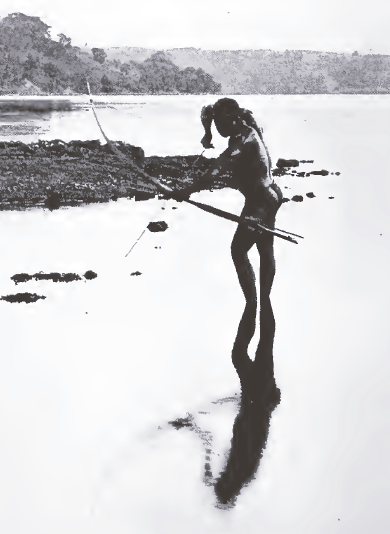
Alfred Reginald Radcliffe-Brown, 1881-1955, An Andaman Islander shooting fish with bow and arrow on the reefs at Port Blair (partial, from "The Anderman Islanders," 1922. 解説:池田光穂
A.R. ラドクリフ=ブラウン
Alfred Reginald Radcliffe-Brown, 1881-1955, An Andaman Islander shooting fish with bow and arrow on the reefs at Port Blair (partial, from "The Anderman Islanders," 1922. 解説:池田光穂
Alfred Reginald Radcliffe-Brown(1881-1955)は、英国出身の社 会人類学者。ブラニスロウ・マリノフスキーとならび機能主義人類 学者の創始者とされる。ただし、[心理・生理学的機能の充足を重視した]マリノフスキーとは異なり、社会を 有機体とみて、制度や慣習を(それまでの学派の)伝播や起源ではなく、社会全体からみた時の機能について考察すべきだと主張した。デュル ケームの影響を受け、社会関係の網の目としての社会構造の研究を強調した。
| Alfred
Reginald
Radcliffe-Brown, FBA (born Alfred Reginald Brown; 17 January 1881 –
24
October 1955) was an English social anthropologist who helped further
develop the theory of structural functionalism. |
アルフレッド・レジナルド・ラドクリフ=ブラウン(Alfred
Reginald Radcliffe-Brown, FBA、1881年1月17日 -
1955年10月24日)は、イギリスの社会人類学者で、構造機能主義の理論のさらなる発展に貢献した。 |
| Biography Alfred Reginald Radcliffe-Brown was born Alfred Reginald Brown in Sparkbrook, Birmingham, England, the second son of Alfred Brown (d.1886), a manufacturer's clerk, and his wife Hannah (née Radcliffe). He later changed his last name, by deed poll, to Radcliffe-Brown, Radcliffe being his mother's maiden name. He was educated at King Edward's School, Birmingham, and Trinity College, Cambridge (B.A., 1905; M.A., 1909), graduating with first-class honours in the moral sciences tripos. At Trinity College, he was elected Anthony Wilkin student in 1906 and 1909.[1] While still a student, he earned the nickname "Anarchy Brown" for his close interest in the writings of the anarcho-communist and scientist Peter Kropotkin.[2] "Like other young men with blood in their veins, I wanted to do something to reform the world – to get rid of poverty and war, and so on. So I read Godwin, Proudhon, Marx and innumerable others. Kropotkin, revolutionary, but still a scientist, pointed out how important for any attempt to improve society was a scientific understanding of it."[3] He studied psychology under W. H. R. Rivers who, with A. C. Haddon, led him toward social anthropology.[4] Under the latter's influence, he travelled to the Andaman Islands (1906–1908) and Western Australia (1910–1912, with biologist and writer E. L. Grant Watson and Australian writer Daisy Bates) to conduct fieldwork into the workings of the societies there.[5] His time in the Andaman Islands and Western Australia were the basis of his later books The Andaman Islanders (1922) and The Social Organization of Australian Tribes (1930). At the 1914 meeting of the British Association for the Advancement of Science, in Melbourne, Bates accused him of plagiarising her work, based on an unpublished manuscript she had sent him for comment.[5] Before departing for Western Australia, Brown married Winifred Marie Lyon in Cambridge; they had one daughter, Mary Cynthia Lyon Radcliffe.[6] The couple became estranged by about 1926. They may have divorced in 1938 (sources disagree on whether a divorce was completed).[6][7] In 1916 Brown became a director of education in Tonga. In 1921 he moved to Cape Town to become professor of social anthropology, founding the School of African Life. Further university appointments were University of Cape Town (1921–25), University of Sydney (1925–31) and University of Chicago (1931–37). Among his most prominent students during his years at the University of Chicago were Sol Tax and Fred Eggan. While at the University of Sydney, he was a cultivator of the arts and championed Edward de Vere, 17th Earl of Oxford, as the author of the works attributed to Shakespeare. Fearing that Depression may lead to financial collapse Radcliffe-Brown departed in 1931 to fill a chair at the University of Chicago, leaving his successors to solicit Rockefeller grants and government funds to save the Sydney Department.[1] After these various far-flung appointments, he returned to England in 1937 to take up an appointment to the first chair in social anthropology at Oxford University in 1937. He held this post until his retirement in 1946.[8] Survived by his daughter, he died in London in 1955 at the age of 74.[1] While Radcliffe-Brown founded the Institute of Social and Cultural Anthropology at Oxford, according to Rodney Needham his absence from the institute during the war years prevented his theories and approach from having a major influence on Oxford anthropology.[9] |
略歴 アルフレッド・ブラウン(1886年没)とその妻ハンナ(旧姓ラドクリフ)の次男として、イングランドのバーミンガム、スパークブルックに生まれる。ラド クリフは母の旧姓である。バーミンガムのキング・エドワーズ・スクールとケンブリッジのトリニティ・カレッジで学び、1905年に学士号、1909年に修 士号を取得。トリニティ・カレッジでは、1906年と1909年にアンソニー・ウィルキンの学生に選ばれている[1]。在学中、無政府共産主義者で科学者 のピーター・クロポトキンの著作に親しんだことから、「アナーキー・ブラウン」というニックネームで呼ばれるようになった[2]。 「血の通った他の若者たちと同じように、私も世界を改革するために何かしたかった。だからゴドウィン、プルードン、マルクス、その他無数の人たちを読ん だ。革命家でありながら科学者でもあったクロポトキンは、社会を改善しようとする試みにとって、社会を科学的に理解することがいかに重要であるかを指摘し た」[3]。 彼はW.H.R.リヴァースの下で心理学を学び、 A.C.ハドンとともに彼を社会人類学へと導いた[4]。後者の影響下、彼はアンダマン諸島(1906- 1908年)と西オーストラリア(1910-1912年、生物学者で作家のE.L.グラント・ワトソンとオーストラリア人作家のデイジー・ベイツととも に)を訪れ、現地の社会の仕組みについてフィールドワークを行った[5]。 アンダマン諸島と西オーストラリアでの滞在は、後に出版される『The Andaman Islanders』(1922年)と『The Social Organization of Australian Tribes』(1930年)の基礎となった。1914年にメルボルンで開催された英国科学振興協会(British Association for the Advancement of Science)の会合で、ベイツは、彼女がコメントを求めて送った未発表の原稿をもとに、自分の研究を盗用したとして彼を非難した[5]。 西オーストラリアに旅立つ前、ブラウンはケンブリッジでウィニフレッド・マリー・リオンと結婚し、一女メアリー・シンシア・リオン・ラドクリフをもうけた [6]。1938年に離婚した可能性がある(離婚が成立したかどうかについては資料によって見解が分かれる)[6][7]。 1916年、ブラウンはトンガの教育局長となる。1921年にはケープタウンに移り、社会人類学の教授となり、アフリカ生活学校を設立した。さらにケープ タウン大学(1921-25年)、シドニー大学(1925-31年)、シカゴ大学(1931-37年)で教鞭をとった。シカゴ大学時代の最も著名な教え子 には、ソル・タックスとフレッド・エガンがいる。 シドニー大学在学中は芸術の育成に努め、シェイクスピアの著作とされる作品の作者としてオックスフォード伯爵17世エドワード・ド・ヴェールを支持した。 ラドクリフ=ブラウンは、大恐慌による財政破綻を恐れ、1931年にシカゴ大学の講座に移るためシドニー大学を去り、後任者たちはシドニー大学を救うため にロックフェラーからの助成金や政府資金を募ることになった[1]。 こうしたさまざまな遠方での任命を経て、1937年にイギリスに戻り、オックスフォード大学で社会人類学の最初の講座に就任した。娘に先立たれ、1955 年にロンドンで74歳の生涯を閉じた[1]。 ラドクリフ=ブラウンはオックスフォード大学に社会文化人類学研究所を設立したが、ロドニー・ニーダムによれば、戦時中に研究所に不在であったため、彼の 理論やアプローチがオックスフォード大学の人類学に大きな影響を与えることはなかった[9]。 |
| Influences Radcliffe-Brown was influenced by his tutor, W. W. Rouse Ball, to study a moral science (psychology, philosophical subjects, and economics) instead of a natural science which he originally wanted to pick. During his time at Cambridge, professors Haddon and Rivers encouraged him to study anthropology and discover his interests in the field. Haddon led him towards the comparative method in specific societies in anthropology, classification and morphology, inductive generalization, and to sympathize with Durkheim's approaches. Rivers inspired Radcliffe in psychology to approach anthropology with many different qualities of mind.[10] |
影響 ラドクリフ=ブラウンは、家庭教師のW.W.ラウス・ボールの影響を受け、当初志望していた自然科学ではなく、道徳科学(心理学、哲学的科目、経済学)を 学ぶことにした。ケンブリッジ大学在学中、ハドンとリバーズの両教授は彼に人類学を学ぶよう勧め、この分野での自分の興味を発見させた。ハドンは、彼を人 類学の特定の社会における比較法、分類学と形態学、帰納的一般化へと導き、デュルケムのアプローチに共感させた。リヴァースは心理学においてラドクリフ に、様々な心の質で人類学にアプローチするよう促した[10]。 |
| Work He has been described as "the classic to Bronisław Malinowski's romantic".[11] Radcliffe-Brown brought French sociology (namely Émile Durkheim) to British anthropology, constructing a rigorous battery of concepts to frame ethnography.[12] Durkheim inspired Radcliffe-Brown throughout the entirety of his profession in anthropology. One of Radcliffe-Brown's goals was to "transform anthropology into a 'real' science based on the natural sciences."[13] He demonstrated these ideologies in his book published in 1957, A Natural Science of Society. In 1906, one of Alfred's primary focuses in the field [Andaman Islands] was kinship and familial relations of Western Australians. Within these communities, he uncovered distinct social organizations that proved adaptation and fusion were essential in keeping the system functioning. The term "Structural Functionalism" would later be used to describe the idea that "the life of a society may be viewed as an active system of functionally consistent, interdependent elements."[14] |
業績 彼は「ブロニスワフ・マリノフスキーのロマン主義に対する古典的存在」と評されている。[11] ラドクリフ=ブラウンは、フランスの社会学(すなわちエミール・デュルケーム)を英国の人類学に取り入れ、民族誌を体系化する厳密な概念群を構築した。 [12] デュルケームは、ラドクリフ=ブラウンの人類学者としてのキャリア全体を通じて彼に影響を与えた。ラドクリフ=ブラウンの目標の一つは、「人類学を自然科 学に基づいた『真の』科学へと変革すること」であった。[13] 彼は1957年に出版された著書『社会の自然科学』において、こうしたイデオロギーを明らかにした。 1906年、アルフレッドが現地(アンダマン諸島)で主に焦点を当てたのは、西オーストラリア人の親族関係と家族関係であった。これらの共同体において、 彼は独自の社会組織を明らかにし、システムの機能を維持するには適応と融合が不可欠であることを証明した。「構造機能主義」という用語は、後に「社会の生 活は、機能的に一貫した相互依存的な要素からなる能動的なシステムとして捉えることができる」という考えを表すために用いられることになる。[14] |
| Concept of function Radcliffe-Brown has often been associated with functionalism, and is considered by some to be the founder of structural functionalism. Structural Functionalism, which can be traced back to sociologist Émile Durkheim, is the social theory that assumes societal institution (e.g. Government, school systems, family structures, etc.) play a role in its success. Through the two different group dynamics; Mechanical solidarity a "sentimental attraction of social units or groups that perform the same or similar functions" & Organic solidarity, which is relies on "interdependence based on differentiated functions and specialization", a society creates a web that allows a cohesive existence of heterogenous groups. Alfred built off of these principles believing that studying social structures like kinship ties would be evidence enough for understanding how social structures affect the maintenance of a society stating, "human beings are connected by a complex network of social relations. I use the term "social structure" to denote this network of actually existing relations". (On Social Structure, 190) He also clarifies that "We may define it as a condition in which all parts of the system work together with a sufficient degree of harmony or internal consistency, i.e., without producing persistent conflicts which can neither be resolved nor regulated". (On the Concept of Function in Social Science, 181).[15] Nonetheless, Radcliffe-Brown vehemently denied being a functionalist, and carefully distinguished his concept of function from that of Malinowski, who openly advocated functionalism. While Malinowski's functionalism claimed that social practices could be directly explained by their ability to satisfy basic biological needs, Radcliffe-Brown rejected this as baseless. Instead, influenced by the process philosophy of Alfred North Whitehead, he claimed that the fundamental units of anthropology were processes of human life and interaction. Because these are by definition characterized by constant flux, what calls for explanation is the occurrence of stability. Why Radcliffe-Brown asked, would some patterns of social practices repeat themselves and even seem to become fixed? He reasoned that this would at least require that other practices must not conflict with them too much; and that in some cases, it may be that practices grow to support each other, a notion he called 'coadaptation', deriving from the biological term. Functional analysis, then, was just the attempt to explain stability by discovering how practices fit together to sustain that stability; the 'function' of practice was just its role in sustaining the overall social structure, insofar as there was a stable social structure (Radcliffe-Brown 1957). Malinowski has explained that he is the inventor of functionalism, to which he gave its name. His definition of it is clear; it is the theory or doctrine that every feature of culture of any people past or present is to be explained by reference to seven biological needs of individual human beings. I cannot speak for the other writers to whom the label functionalist is applied by the authors, though I very much doubt if Redfield or Linton accept this doctrine. As for myself I reject it entirely, regarding it as useless and worse. As a consistent opponent of Malinowski's functionalism I may be called an anti-functionalist.[16] |
機能の概念 ラドクリフ=ブラウンはしばしば機能主義と結びつけられ、構造機能主義の創始者と見なされることもある。社会学者エミール・デュルケームにその源流をたど ることができる構造機能主義とは、社会的制度(政府、学校制度、家族構造など)がその成功に役割を果たすと仮定する社会理論である。「機械的連帯」—— 「同一または類似の機能を果たす社会単位や集団間の感情的な結びつき」——と、「有機的連帯」——「機能の分化と専門化に基づく相互依存」——という二つ の異なる集団力学を通じて、社会は異質な集団が結束して存在できるネットワークを形成する。アルフレッドはこれらの原理を発展させ、親族関係のような社会 構造を研究することが、社会構造が社会の維持にどのように影響するかを理解する上で十分な証拠となると考え、「人間は複雑な社会的関係のネットワークに よって結びついている。私は、実際に存在する関係のこのネットワークを指すために『社会構造』という用語を用いる」(『社会構造について』、190頁)。 また彼は、「社会構造とは、システムのすべての部分が、十分な調和や内部の一貫性を持って、すなわち、解決も調整もできないような持続的な対立を生じさせ ることなく、共に機能する状態として定義できる」と明確にしている。(『社会科学における機能の概念について』、181頁)。[15] それにもかかわらず、ラドクリフ=ブラウンは自身が機能主義者であることを強く否定し、機能主義を公然と提唱したマリンノフスキーの機能概念とは、自身の 概念を慎重に区別した。マリンノフスキーの機能主義は、社会的慣行が基本的な生物学的欲求を満たす能力によって直接説明できると主張したが、ラドクリフ= ブラウンはこれを根拠のないものとして退けた。その代わりに、アルフレッド・ノース・ホワイトヘッドのプロセス哲学に影響を受け、彼は人類学の根本的な単 位は人間の生活と相互作用のプロセスであると主張した。これらは定義上、絶え間ない変動を特徴とするため、説明を要するものは安定性の発生である。ラドク リフ=ブラウンは問うた。なぜ、ある種の社会的慣行のパターンは繰り返され、さらには固定化されたようにさえ見えるのか?彼は、少なくとも他の慣行がそれ らと過度に衝突してはならないことが必要だと推論した。また、場合によっては、慣行が互いに支え合うように発展することもあり得るとした。彼はこの概念 を、生物学用語に由来する「共適応(coadaptation)」と呼んだ。したがって、機能分析とは、実践がどのように組み合わさってその安定性を維持 しているかを発見することで、安定性を説明しようとする試みに過ぎなかった。実践の「機能」とは、安定した社会構造が存在する限りにおいて、その社会構造 全体を維持する上での役割に他ならなかった(ラドクリフ=ブラウン 1957)。 マリノフスキーは、自身が機能主義の創始者であり、その名称を付けたと説明している。彼の定義は明確だ。それは、過去または現在のいかなる民族の文化のあ らゆる特徴も、個々の人間が持つ7つの生物学的欲求に照らして説明されるべきであるという理論、あるいは教義である。著者が「機能主義者」というレッテル を貼っている他の著者たちについては、私が代弁することはできないが、レッドフィールドやリントンがこの教義を受け入れているとは、私は大いに疑ってい る。私自身に関しては、これを無用であり、それ以上に有害であると見なし、完全に拒否する。マリンノフスキーの機能主義に対する一貫した反対者として、私 は反機能主義者と呼ばれるかもしれない。[16] |
| Concept of social structure While Lévi-Strauss (1958) claimed that social structure and the social relations that are its constituents are theoretical constructions used to model social life, Radcliffe-Brown only half-agreed: to say we are studying social structures is not exactly the same thing as saying that we study social relations, which is how some sociologists define their subject. A particular social relation between two persons (unless they be Adam and Eve in the Garden of Eden) exists only as part of a wide network of social relations, involving many other persons, and it is this network which I regard as the object of our investigations. I am aware, of course, that the term "social structure" is used in a number of different senses, some of them very vague. This is unfortunately true of many other terms commonly used by anthropologists. The choice of terms and their definitions is a matter of scientific convenience, but one of the characteristics of a science as soon as it has passed the first formative period is the existence of technical terms which are used in the same precise meaning by all the students of that science. By this test, I regret to say, social anthropology reveals itself as not yet a formed science.[17] In addition to identifying abstract relationships between social structures, Radcliffe-Brown argued for the importance of the notion of a 'total social structure', which is the sum total of social relations in a given social unit of analysis during a given period. The identification of 'functions' of social practices was supposed to be relative to this total social structure. Lévi-Strauss saw social structure as a model.[18] Within his research, Radcliffe-Brown focused on so-called "primitive" societies. He believed kinship played a large role in these societies, and that patrilineages, clans, tribes and units all relate to kinship rules in society and are essential in political organization.[19] Radcliffe-Brown claimed that all research on social structure is based on observations, what anthropologists see and hear about individual peoples.[20] Radcliffe-Brown also argued that the study of social structure encompassed culture, therefore there is no need for a separate field dedicated to culture.[20] |
社会構造の概念 レヴィ=ストロース(1958)は、社会構造とその構成要素である社会関係は、社会生活をモデル化するために用いられる理論的構築物であると主張したが、 ラドクリフ=ブラウンはこれに半分しか同意しなかった: 「我々は社会構造を研究している」と言うことは、「我々は社会関係を研究している」と言うこととは厳密には同じではない。後者は、一部の社会学者が自らの 研究対象を定義する方法である。二人の人間間の特定の社会的関係(彼らがエデンの園のアダムとイヴでない限り)は、他の多くの人々を巻き込んだ広範な社会 的関係のネットワークの一部としてのみ存在し、私が我々の調査の対象と見なすのは、まさにこのネットワークである。 もちろん、「社会構造」という用語が異なる意味で用いられ、その中には非常に曖昧なものもあることは承知している。これは残念ながら、人類学者が一般的に 用いる他の多くの用語にも当てはまる。用語の選択とその定義は科学的な便宜の問題であるが、ある科学が初期の形成期を過ぎるとすぐに現れる特徴の一つは、 その科学を学ぶすべての研究者によって、同じ厳密な意味で用いられる専門用語が存在することである。この基準に照らせば、残念ながら、社会人類学はまだ確 立された科学ではないことが明らかになる。[17] ラドクリフ=ブラウンは、社会構造間の抽象的な関係を特定することに加え、特定の分析単位における特定の期間中の社会関係の総体である「総体的な社会構 造」という概念の重要性を主張した。社会実践の「機能」の特定は、この総体的な社会構造を基準とするべきものとされた。レヴィ=ストロースは社会構造をモ デルとして捉えた。[18] ラドクリフ=ブラウンは自身の研究において、いわゆる「原始」社会に焦点を当てた。彼は、これらの社会において親族関係が大きな役割を果たしており、父 系、氏族、部族、および各単位はすべて社会における親族規則と関連し、政治組織において不可欠であると信じていた。[19] ラドクリフ=ブラウンは、社会構造に関するすべての研究は、人類学者が個々の民族について見聞きした観察に基づいていると主張した。[20] ラドクリフ=ブラウンはまた、社会構造の研究は文化を包含するものであり、したがって文化に特化した別の分野を設ける必要はないと論じた。[20] |
| Evolutionism, diffusionism, and
the role of social anthropology A major view in the study of tribal societies had been that all societies follow a unilineal path ('evolutionism'), and that therefore 'primitive' societies could be understood as earlier stages along that path; conversely, 'modern' societies contained vestiges of older forms. Another view was that social practices tend to develop only once, and that therefore commonalities and differences between societies could be explained by a historical reconstruction of the interaction between societies ('diffusionism'). According to both of these views, the proper way to explain differences between tribal societies and modern ones was historical reconstruction.[citation needed] Radcliffe-Brown rejected both of these views because of the untestable nature of historical reconstructions. Instead, he argued for the use of the comparative method to find regularities in human societies and thereby build up a genuinely scientific knowledge of social life.[citation needed] For social anthropology the task is to formulate and validate statements about the conditions of existence of social systems (laws of social statics) and the regularities that are observable in social change (laws of social dynamics). This can only be done by the systematic use of the comparative method, and the only justification of that method is the expectation that it will provide us with results of this kind, or, as Boas stated it, will provide us with knowledge of the laws of social development. It will be only in an integrated and organised study in which historical studies and sociological studies are combined that we shall be able to reach a real understanding of the development of human society[21] To that end, Radcliffe-Brown argued for a 'natural science of society'. He claimed that there was an independent role for social anthropology here, separate from psychology, though not in conflict with it. This was because psychology was to be the study of individual mental processes, while social anthropology was to study processes of interaction between people (social relations). Thus he argued for a principled ontological distinction between psychology and social anthropology, in the same way as one might try to make a principled distinction between physics and biology. Moreover, he claimed that existing social scientific disciplines, with the possible exception of linguistics, were arbitrary; once our knowledge of society is sufficient, he argued, we will be able to form subdisciplines of anthropology centred around relatively isolated parts of the social structure. But without extensive scientific knowledge, it is impossible to know where these boundaries should be drawn.[citation needed] Radcliffe-Brown was often criticised for failing to consider the effect of historical changes in the societies he studied, in particular changes brought about by colonialism. Nevertheless, he is now considered, along with Bronisław Malinowski, as one of the fathers of modern social anthropology.[22] |
進化論、拡散論、そして社会人類学の役割 部族社会研究における主要な見解の一つは、すべての社会が一本の直線的な道筋をたどる(「進化論」)というものであり、したがって「原始的」な社会はその 道筋上の初期段階として理解でき、逆に「近代的」な社会には古い形態の名残が含まれているというものであった。もう一つの見解は、社会的慣行は通常一度し か発展しないというものであり、したがって社会間の共通点や異なる点は、社会間の相互作用の歴史的再構築によって説明できるというものであった(「拡散主 義」)。これら両方の見解によれば、部族社会と近代社会との異なる点を説明する適切な方法は、歴史的再構築であった。[出典必要] ラドクリフ=ブラウンは、歴史的再構築が検証不可能であるという理由から、これら両方の見解を退けた。その代わりに、彼は比較方法を用いて人間社会におけ る規則性を発見し、それによって社会生活に関する真に科学的な知識を構築することを主張した。[出典必要] 社会人類学の課題は、社会システムの存立条件(社会静力学の法則)および社会変化において観察可能な規則性(社会力学の法則)に関する命題を定式化し、そ の妥当性を検証することにある。これは比較方法の体系的な使用によってのみ可能であり、その方法の唯一の正当化は、それがこの種の結果をもたらすという期 待、あるいはボアズが述べたように、社会発展の法則に関する知識をもたらすという期待にある。歴史的研究と社会科学的研究が組み合わされた、統合的かつ組 織的な研究においてのみ、我々は人間社会の発展に対する真の理解に到達することができるのである[21] その目的のために、ラドクリフ=ブラウンは「社会の自然科学」を提唱した。彼は、社会人類学には心理学とは別個の役割があり、心理学と対立するものではな いと主張した。なぜなら、心理学は個人の精神過程の研究であるのに対し、社会人類学は人々の間の相互作用の過程(社会的関係)を研究するものだからであ る。したがって彼は、物理学と生物学の間に原理的な区別を設けようとするのと同様に、心理学と社会人類学の間にも原理的な存在論的区別を設けるべきだと主 張した。さらに、言語学を除いては、既存の社会科学の分野は恣意的なものであると主張した。社会に関する知識が十分になれば、社会構造の比較的孤立した部 分を中核とする人類学のサブ分野を形成できるようになると彼は論じた。しかし、広範な科学的知識がなければ、これらの境界線をどこに引くべきかを知ること は不可能である。[出典必要] ラドクリフ=ブラウンは、研究対象とした社会における歴史的変化、特に植民地主義によってもたらされた変化の影響を考慮しなかったとして、しばしば批判さ れた。それにもかかわらず、彼は現在、ブロニスワフ・マリノフスキーと共に、近代社会人類学の父の一人と見なされている。[22] |
| Ethnography Radcliffe-Brown carried out extensive fieldwork in the Andaman Islands, Australia, and elsewhere. On the basis of this research, he contributed extensively to the anthropological ideas on kinship, and criticised Lévi-Strauss's Alliance theory. He also produced structural analyses of myths, including on the basis of the concept of binary distinctions and dialectical opposition,[23] an idea later echoed by Lévi-Strauss.[citation needed] |
民族誌 ラドクリフ=ブラウンは、アンダマン諸島やオーストラリアなどで広範な現地調査を行った。この研究に基づき、彼は親族関係に関する人類学的な考え方に多大 な貢献を果たし、レヴィ=ストロースの「同盟」理論を批判した。また、二項対立や弁証法的対立の概念に基づいた神話の構造分析も行い[23]、この考えは 後にレヴィ=ストロースによって受け継がれた。[出典必要] |
| Views on religion According to Radcliffe-Brown, the function of religion is to install a sense of dependence on fear and other emotional strain on the human body into a society.[24] Therefore, a major function of religion is to affirm and strengthen sentiments necessary for a society to continue. This idea was developed in Radcliffe-Browns book, The Andaman Islanders (Free Press 1963).[25] |
宗教に関する見解 ラドクリフ=ブラウンによれば、宗教の機能とは、恐怖やその他の身体的・精神的な緊張感に基づく依存意識を社会に定着させることにある。[24] したがって、宗教の主要な機能は、社会が存続するために必要な感情を肯定し、強化することにある。この考えは、ラドクリフ=ブラウンの著書『アンダマン諸 島の人々』(フリープレス、1963年)で展開された。[25] |
| Selected publications 1912, "The Distribution of Native Tribes in Part of Western Australia", Man, 12: 143–146. 1913, "Three Tribes of Western Australia", The Journal of the Royal Anthropological Institute of Great Britain and Ireland, 43: 143–194. 1922, The Andaman Islanders; a study in social anthropology. 1926, 'Arrangements of Stones in Australia', Man, 26: 204–205. 1931, Social Organization of Australian Tribes. Radcliffe-Brown, A. R. (July 1940). "On Joking Relationships". Journal of the International African Institute. 13 (3): 195–210. doi:10.2307/1156093. JSTOR 1156093. S2CID 11011777. 1948,[26] A Natural Science of Society: based on a series of lectures at the University of Chicago in 1937 and posthumously published by his students Radcliffe-Brown, A. R. (1952). Structure and Function in Primitive Society: Essays and Addresses. Glencoe, Illinois: Free Press. |
主な著作 1912年、「西オーストラリア州の一部における先住部族の分布」、『Man』、12号:143–146頁。 1913年、「西オーストラリア州の3つの部族」、『The Journal of the Royal Anthropological Institute of Great Britain and Ireland』、43号:143–194頁。 1922年、『アンダマン諸島民:社会人類学的研究』。 1926年、「オーストラリアにおける石の配置」、『Man』、26: 204–205。 1931年、『オーストラリアの部族の社会組織』。 ラドクリフ=ブラウン, A. R. (1940年7月). 「冗談の関係について」. 『国際アフリカ研究所誌』. 13 (3): 195–210. doi:10.2307/1156093. JSTOR 1156093. S2CID 11011777. 1948年、[26] 『社会の自然科学』:1937年にシカゴ大学で行われた一連の講義に基づき、死後に弟子たちによって出版された ラドクリフ=ブラウン, A. R. (1952). 『原始社会における構造と機能:エッセイと講演集』. イリノイ州グレンコー:フリー・プレス. |
| References 01. Hogbin, Ian, "Radcliffe-Brown, Alfred Reginald (1881–1955)", Australian Dictionary of Biography, Canberra: National Centre of Biography, Australian National University, retrieved 2 December 2022 David Graeber, Fragments of an Anarchist Anthropology, Chicago, 2004, p.16. George W. Stocking Jr., After Tylor, British Social Anthropology, 1888–1951, Madison, University of Wisconsin, 1995, p. 305. "The Andaman islanders; a study in social anthropology (Anthony Wilkin studentship research, 1906". Retrieved 19 October 2014. Hogbin, Ian (1988). "Radcliffe-Brown, Alfred Reginald (1881–1955)". Australian Dictionary of Biography. 11. National Centre of Biography, Australian National University. Retrieved 10 November 2015. Maddock, Kenneth (23 September 2004). "Brown, Alfred Reginald Radcliffe (1881-1955)". Oxford Dictionary of National Biography (online ed.). Oxford University Press. doi:10.1093/ref:odnb/37877. (Subscription, Wikipedia Library access or UK public library membership required.) 05. Hogbin, Ian (1988). "Radcliffe-Brown, Alfred Reginald (1881–1955)". Australian Dictionary of Biography. National Centre of Biography, Australian National University. ISBN 978-0-522-84459-7. ISSN 1833-7538. OCLC 70677943. Retrieved 29 March 2019. Adam Kuper, Anthropology and Anthropologists: The Modern British School, London, Penguin, 1973, pp. 45–46) "Rodney Needham". Alanmacfarlane.com. Archived from the original on 16 January 2009. Retrieved 19 October 2014. 10. "Alfred Reginald Radcliffe-brown | Encyclopedia.com". www.encyclopedia.com. Retrieved 2 December 2022. Kuper, Anthropology and Anthropologists, p. 34. Kuper, Anthropology and Anthropologists, p. 36. Arushi (2 June 2020). "Radcliffe Brown: Biography, Contributions and Books". Sociology Group: Sociology and Other Social Sciences Blog. Retrieved 29 November 2022. "A.R. Radcliffe-Brown | British anthropologist | Britannica". www.britannica.com. Retrieved 29 November 2022. 15. "Structural functionalism | Definition, Development, & Criticisms | Britannica". www.britannica.com. Retrieved 29 November 2022. A. R. Radcliffe-Brown. 1949. "Functionalism: A Protest", American Anthropologist 51(2): 320–321. A. R. Radcliffe-Brown. 1940. "On Social Structure". Journal of the Royal Anthropological Institute of Great Britain and Ireland 70(1): 3. Claude Lévi-Strauss, Anthropologie structurale (1958, Structural Anthropology, trans. Claire Jacobson and Brooke Grundfest Schoepf, London 1963.) "Social Structure" (PDF). University of Mustansiriyah. Retrieved 21 November 2022. 20. Bhatt, Tara. "Functionalism and Structural Functionalism" (PDF). University of Lucknow. Retrieved 21 November 2022. A. R. Radcliffe-Brown. 1951. "The Comparative Method in Social Anthropology". Journal of the Royal Anthropological Institute of Great Britain and Ireland 81(1/2): 22. Eriksen, Thomas Hylland; Nielsen, Finn Sivert (2013). "Four Founding Fathers". A History of Anthropology. Anthropology, Culture and Society. Pluto Press. pp. 46–67. doi:10.2307/j.ctt183gzx9.8. ISBN 9780745333526. JSTOR j.ctt183gzx9.8. A. R. Radcliffe-Brown. 1951. The Comparative Method in Social Anthropology. Journal of the Royal Anthropological Institute of Great Britain and Ireland 81(1/2): 15–22. Bhatt, Tara. "Magic and Religion" (PDF). Lucknow University. Retrieved 21 November 2022. 25. "Content Pages of the Encyclopedia of Religion and Social Science". hirr.hartsem.edu. Retrieved 1 December 2022. History of anthropological thought by v.s Upadhayay and Gaya Panday |
参考文献 01. ホグビン、イアン、「ラドクリフ=ブラウン、アルフレッド・レジナルド(1881–1955)」、『オーストラリア人名事典』、キャンベラ:オーストラリ ア国立大学国立人物伝記センター、2022年12月2日取得 デイヴィッド・グレイバー、『アナーキスト人類学の断片』、シカゴ、2004年、16頁。 ジョージ・W・ストッキング・ジュニア、『タイラーの後に――英国社会人類学、1888–1951』、マディソン、ウィスコンシン大学、1995年、 305頁。 「アンダマン諸島の住民:社会人類学的研究(アンソニー・ウィルキン奨学金研究、1906年)」。2014年10月19日取得。 ホグビン、イアン(1988年)。「ラドクリフ=ブラウン、アルフレッド・レジナルド(1881–1955)」。『オーストラリア人名事典』。第11巻。 オーストラリア国立大学、国立伝記センター。2015年11月10日閲覧。 マドック、ケネス(2004年9月23日)。「ブラウン、アルフレッド・レジナルド・ラドクリフ(1881-1955)」。『オックスフォード英国人名事 典』(オンライン版)。オックスフォード大学出版局。doi:10.1093/ref:odnb/37877。(購読、ウィキペディア・ライブラリへのア クセス、または英国の公共図書館の会員資格が必要。) 05. ホグビン、イアン(1988年)。「ラドクリフ=ブラウン、アルフレッド・レジナルド(1881–1955)」。『オーストラリア人名事典』。オーストラ リア国立大学国立伝記センター。ISBN 978-0-522-84459-7。ISSN 1833-7538。OCLC 70677943。2019年3月29日閲覧。 アダム・クーパー、『人類学と人類学者:近代英国学派』、ロンドン、ペンギン、1973年、45–46頁) 「ロドニー・ニーダム」。Alanmacfarlane.com。2009年1月16日にオリジナルからアーカイブ。2014年10月19日 閲覧。 10. 「アルフレッド・レジナルド・ラドクリフ=ブラウン | Encyclopedia.com」。www.encyclopedia.com。2022年12月2日閲覧。 クーパー、『人類学と人類学者』、p. 34。 クーパー、『人類学と人類学者』、p. 36。 Arushi (2020年6月2日). 「ラドクリフ=ブラウン:略歴、業績、著書」. Sociology Group: Sociology and Other Social Sciences Blog. 2022年11月29日閲覧. 「A.R. ラドクリフ=ブラウン | 英国の人類学者 | ブリタニカ」. www.britannica.com. 2022年11月29日閲覧. 15. 「構造機能主義 | 定義、発展、および批判 | ブリタニカ」。www.britannica.com。2022年11月29日閲覧。 A. R. ラドクリフ=ブラウン。1949 年。「機能主義:抗議」、『アメリカン・アンソロポロジスト』51(2): 320–321。 A. R. ラドクリフ=ブラウン。1940年。「社会構造について」。『英国・アイルランド王立人類学協会誌』70(1): 3。 クロード・レヴィ=ストロース、『構造人類学』(1958年、Structural Anthropology、クレア・ジェイコブソンおよびブルック・グランドフェスト・シェープフ訳、ロンドン 1963年。) 「社会構造」(PDF)。ムスタンシリヤ大学。2022年11月21日閲覧。 20. タラ・バット。「機能主義と構造機能主義」(PDF)。ラクナウ大学。2022年11月21日閲覧。 A. R. ラドクリフ=ブラウン。1951年。「社会人類学における比較方法」。『英国・アイルランド王立人類学協会誌』81(1/2): 22。 エリクセン、トーマス・ヒランド;ニールセン、フィン・シヴァート(2013)。「4人の創始者」。『人類学の歴史』。Anthropology, Culture and Society。Pluto Press。pp. 46–67。doi:10.2307/j.ctt183gzx9.8。ISBN 9780745333526. JSTOR j.ctt183gzx9.8. A. R. ラドクリフ=ブラウン. 1951. 『社会人類学における比較方法』. 『英国・アイルランド王立人類学協会誌』 81(1/2): 15–22. バット、タラ。「呪術と宗教」(PDF)。ラクナウ大学。2022年11月21日閲覧。 25. 「『宗教と社会科学百科事典』の目次」。hirr.hartsem.edu。2022年12月1日閲覧。 V.S. ウパダヤイとガヤ・パンデイによる『人類学的思想の歴史』 |
| https://en.wikipedia.org/wiki/Alfred_Radcliffe-Brown |
[年譜]
1881 1月17日イングランド・バー ミンガムのスパークブルックに生まれる。父アルフレッド・ブラウン(1886年に死亡)と母アンナ (旧姓:ラ ドクリフ)の次男として。したがって当時の名前Hあアルフレッド・レジナルド・ブラウンである。後年よく言われることだが、ラドクリフ=ブラウンは、同世 代の多くの人類学者の出自階級(富裕階級)とは異なり労働者階級の息子であった。
(1898 トレス海峡調査隊: W.H.R Rivers, A.C. Haddon)
1904 W.H.R リヴァーズ(1864-1922)の学生 になる(トリニティカレッジ、ケンブリッジ大学)。もちろんハッドンらの教育も受ける。
1905 学士号:クロポトキンの無政府
主義的共産主義に魅了されて「アナーキー・ブラウン」の異名をとる。
1906-08 ケンブリッジ大学を卒業 後、W.H.R リヴァーズの 影響を受け、アンダマン諸島調査に従事。
1909 修士号
1910-12 オーストラリア・アボリ ジニー(アボリジナルズ)の調査: with biologist and writer E. L. Grant Watson and Daisy Batesとある。
1916-1919 イギリス保護領トン
ガの教育長官に赴任。
1922 『アンダマン島民』(→人類学年表参 照)[マ リノフスキー『西太平洋の遠洋航海者』]
1923 Method in Social Anthropology.
1914 -18 トンガ諸島で先住民教育に従事
1920 ケープタウン大学初代社会人類学教授
1926 オーストラリア・シドニー大学初代社会人類学教授(〜1930)、この 時以来、母方の姓であるラドクリフ姓を付ける。
1930 Oceania 誌 の発刊, The Social Organization of Australian Tribes. (vol.1)/シドニー大学退職、後任は、レイモンド・ファースで、Oceania誌 の編集にも携わる。
1931
シカゴ大学客員教授 (教え子の一人にジョン・エンブリーが いる):関係をもったり指導された研究者には、ロバート・レッドフィールド(Robert Redfield, 1897-1958)、フレッド・エガン(Fred Eggan, 1906-1991)、ソ ル・タックス(Sol Tax, 1907-1995)などがいる。RBはエンブリーが、須恵村でフィールドワークをする以前に、九州を訪問して、エンブリーと邂逅しているという。
1935 「社会科学における機能の概念について」『未開社会における構造と機 能』に収録
1935
-1936 燕京大学
1937 F. Eggan et al., Social Anthropology of North American Tribes.
1937 オックスフォード大学社会人類学教授(この年にオックスフォード大学に 創設されラドクリフ=ブラウン教授は初代教授となる)
1946- オックスフォード退職(後任 はエヴァンズ=プリチャード)。以後アレキ サンドリア、ロンドン、マンチェスター、南アフリカで教鞭をとる
1949 G.P.Murdock, Social Structure.
1950 African Systems of Kunship and Marriage.
1955 10月24日、ロンドンで死去 (74歳)
1958 Method in social anthropology : selected essays / by A.R. Radcliffe-Brown ; edited by M.N. Srinivas, Chicago : University of Chicago Press , 1958
1965 Structure and Function in Primitive Society. Essays and Addresses / by A. R. Radcliffe-Brown. [London] : Cohen & West Ltd. , 1965.
1968 Military organization and society / by Stanislav Andreski ; with a foreword by A.R. Radcliffe-Brown. 2nd ed. - London : Routledge & K. Paul , 1968. - (International library of sociology and social reconstruction / founded by Karl Mannheim ; editor, W.J.H. Sprott)
1974 法人類学入門 / ラドクリフ=ブラウン [ほか] 著 ; 千葉正士編、弘文堂 , 1974
[謝辞]文化表象学2、3 年生の「は組」のメンバー(=鵜島、坂本、東、賀来のみなさん)に 人たちの熱心な発表に刺激をうけました。このページが、は組のレジュメより充実しているのであれば、それはは組の方々の地道な努力のおかげです。ここに記 して感謝します(2003.05.20)。
リンク
文献
その他の情報
Copyleft,
CC, Mitzub'ixi Quq Chi'j, 1996-2099
