自由民主主義
Liberal democracy
☆
自由民主主義[Liberal democracy]は、西洋式民主主義[1]とも呼ばれ、民主主義の体制と自由主義的政治哲学の思想を融合させた政体である。自由民主主義に共通する要素として
は、複数の有力政党が存在し、普通選挙が実施される代表民主制、独立した司法機関を含む三権分立、開かれた社会の一環としての日常生活における法の支配、
私有財産を伴う市場原理に基づく資本主義経済、そして法的に平等な市民の人権、公民権、市民的自由、政治的自由に対する国家による保障が挙げられる。
自由民主主義の下では、政府の権限は、確立された手続きに従って採択・施行され、文書化され公に開示された法律に従ってのみ、正当に行使される。実際に
は、こうした制度は、政府の権限を明確にし、社会契約を明文化するために、成文憲法または不成文憲法のいずれかを基盤とすることが多い。自由民主主義は、
立憲君主制や共和制といった立憲体制、議会制、大統領制、半大統領制といった政府体制、そしてコモン・ロー、大陸法、慣習法といった法体系など、多様かつ
複合的な形態をとりうる。自由民主主義体制は、非自由主義的民主主義、ハイブリッド体制、独裁体制、独裁政権、さらには直接民主主義や社会主義民主主義と
対比される。一部のリベラル・デモクラシー、特に人口の多い国々では、権力の乱用を防ぎ、地方自治体、州、中央政府の間で統治権限を分担することで国民の
参画を促進するため、垂直的な権力分立として連邦制を採用している。権威主義体制と比較して、リベラル・デモクラシーの特徴は、政治的安定性の向上
[2]、汚職の低減[3]、資源管理の改善[4]、そして平均寿命や乳児死亡率といった健康指標の向上と相関関係にある。[5]
自由民主主義の起源――そしてその名称――は、啓蒙時代まで遡る。君主制や貴族制を支持する従来の見解は、当初、比較的少数の啓蒙思想家たちによって疑問
視された。彼らは、人間社会は理性と自由・平等の原則によって導かれるべきだと信じていた。彼らは、すべての人間は平等に生まれ、政府は国民に奉仕するた
めに存在し(その逆ではない)、法律は統治される者だけでなく統治する者にも適用されるべきだと主張した(これは「法の支配」として知られる概念であり、
ヨーロッパでは「Rechtsstaat」として定式化された)。イギリスでは、ジョン・ロック(1632–1704)ら思想家が、すべての人間は平等に
生まれ、政府は被統治者に奉仕するために存在し、法律は統治者と市民の双方に等しく適用されなければならない(後に「法の支配」として表現される概念)と
主張した。一方、ヨーロッパ大陸では、フランスの哲学者たちも同様に影響力のある理論を展開した。モンテスキューの『法の精神』(1748年)は三権分立
の学説を提唱し、ルソーの『社会契約論』(1762年)は国民主権と「一般意志」の原則を明文化し、ヴォルテールは良心の自由と表現の自由を擁護した。こ
れらの思想はフランス革命の核心をなすものであり、ヨーロッパ全土およびその先へと広く普及した。また、これらはアメリカ独立革命や、より広範な自由民主
主義の発展にも影響を与えた。20世紀後半の拡大期を経て、自由民主主義は世界において主流の政治体制となった。[6]
| Liberal democracy,
also called Western-style democracy,[1] is a form of government that
combines the organization of a democracy with ideas of liberal
political philosophy. Common elements within a liberal democracy are: a
representative democracy with multiple viable political parties and
universal suffrage; a separation of powers into different branches of
government, including an independent judiciary; the rule of law in
everyday life as part of an open society; a market-based capitalist
economy with private property; and state-guaranteed protections for the
human rights, civil rights, civil liberties, and political freedoms of
legally equal citizens. Under liberal democracy, government authority is legitimately exercised only in accordance with written, publicly disclosed laws adopted and enforced in accordance with established procedure. In practice, such systems often draw upon a constitution, either codified or uncodified, to delineate the powers of government and enshrine the social contract. Liberal democracies may take various and mixed forms, such as a constitutional monarchic or republican constitutional system; a parliamentary, presidential, or semi-presidential governmental system; and a common, civil, or customary legal system. Liberal-democratic regimes are contrasted with illiberal democracies, hybrid regimes, autocracies, and dictatorships; as well as direct democracies and socialist democracies. Some liberal democracies, especially those with large populations, adopt federalism—as vertical separation of powers—in order to prevent abuse and increase public input by dividing governing powers between municipal, provincial, and national governments. Relative to authoritarian regimes, the characteristics of liberal democracies are correlated with increased political stability,[2] lower corruption,[3] better management of resources,[4] and better health indicators such as life expectancy and infant mortality.[5] Liberal democracy traces its origins—and its name—to the Age of Enlightenment. The conventional views supporting monarchies and aristocracies were challenged at first by a relatively small group of Enlightenment intellectuals, who believed that human affairs should be guided by reason and principles of liberty and equality. They argued that all people are created equal, that governments exist to serve the people—not vice versa—and that laws should apply to those who govern as well as to the governed (a concept known as rule of law), formulated in Europe as Rechtsstaat. In England, thinkers such as John Locke (1632–1704) argued that all people are created equal, that governments exist to serve the governed, and that laws must apply equally to rulers and citizens alike (a concept later expressed as the rule of law). At the same time, on the European continent, French philosophers developed equally influential theories: Montesquieu's The Spirit of the Laws (1748) advanced the doctrine of separation of powers, Rousseau's The Social Contract (1762) articulated the principle of popular sovereignty and the "general will", and Voltaire championed freedom of conscience and expression. These ideas were central to the French Revolution and spread widely across Europe and beyond. They also influenced the American Revolution and the broader development of liberal democracy. After a period of expansion in the second half of the 20th century, liberal democracy became a prevalent political system in the world.[6]  The Eduskunta, the parliament of the Grand Duchy of Finland (then part of Russia), had universal suffrage in 1906. Several states and territories can present arguments for being the first with universal suffrage. |
自由民主主義[Liberal democracy]は、西洋式民主主義[1]とも呼ばれ、民主主義の体制と自
由主義的政治哲学の思想を融合させた政体である。自由民主主義に共通する要素としては、複数の有力政党が存在し、普通選挙が実施される代表民主制、独立し
た司法機関を含む三権分立、開かれた社会の一環としての日常生活における法の支配、私有財産を伴う市場原理に基づく資本主義経済、そして法的に平等な市民
の人権、公民権、市民的自由、政治的自由に対する国家による保障が挙げられる。 自由民主主義の下では、政府の権限は、確立された手続きに従って採択・施行され、文書化され公に開示された法律に従ってのみ、正当に行使される。実際に は、こうした制度は、政府の権限を明確にし、社会契約を明文化するために、成文憲法または不成文憲法のいずれかを基盤とすることが多い。自由民主主義は、 立憲君主制や共和制といった立憲体制、議会制、大統領制、半大統領制といった政府体制、そしてコモン・ロー、大陸法、慣習法といった法体系など、多様かつ 複合的な形態をとりうる。自由民主主義体制は、非自由主義的民主主義、ハイブリッド体制、独裁体制、独裁政権、さらには直接民主主義や社会主義民主主義と 対比される。一部のリベラル・デモクラシー、特に人口の多い国々では、権力の乱用を防ぎ、地方自治体、州、中央政府の間で統治権限を分担することで国民の 参画を促進するため、垂直的な権力分立として連邦制を採用している。権威主義体制と比較して、リベラル・デモクラシーの特徴は、政治的安定性の向上 [2]、汚職の低減[3]、資源管理の改善[4]、そして平均寿命や乳児死亡率といった健康指標の向上と相関関係にある。[5] 自由民主主義の起源――そしてその名称――は、啓蒙時代まで遡る。君主制や貴族制を支持する従来の見解は、当初、比較的少数の啓蒙思想家たちによって疑問 視された。彼らは、人間社会は理性と自由・平等の原則によって導かれるべきだと信じていた。彼らは、すべての人間は平等に生まれ、政府は国民に奉仕するた めに存在し(その逆ではない)、法律は統治される者だけでなく統治する者にも適用されるべきだと主張した(これは「法の支配」として知られる概念であり、 ヨーロッパでは「Rechtsstaat」として定式化された)。イギリスでは、ジョン・ロック(1632–1704)ら思想家が、すべての人間は平等に 生まれ、政府は被統治者に奉仕するために存在し、法律は統治者と市民の双方に等しく適用されなければならない(後に「法の支配」として表現される概念)と 主張した。一方、ヨーロッパ大陸では、フランスの哲学者たちも同様に影響力のある理論を展開した。モンテスキューの『法の精神』(1748年)は三権分立 の学説を提唱し、ルソーの『社会契約論』(1762年)は国民主権と「一般意志」の原則を明文化し、ヴォルテールは良心の自由と表現の自由を擁護した。こ れらの思想はフランス革命の核心をなすものであり、ヨーロッパ全土およびその先へと広く普及した。また、これらはアメリカ独立革命や、より広範な自由民主 主義の発展にも影響を与えた。20世紀後半の拡大期を経て、自由民主主義は世界において主流の政治体制となった。[6] 1906年、フィンランド大公国(当時はロシアの一部)の議会であるエドゥスクンタでは、普通選挙が実施された。いくつかの国や地域が、自らが普通選挙を最初に導入したとの主張を立てている。 |
| Origins See also: History of liberalism and History of democracy  John Locke was the first to develop a liberal philosophy as he coherently described the elementary principles of the liberal movement, such as the right to private property and the consent of the governed.  The Agreement of the People (1647), a manifesto for political change proposed by the Levellers during the English Civil War, called for freedom of religion, frequent convening of Parliament and equality under the law. Liberal democracy traces its origins—and its name—to 18th-century Europe, during the Age of Enlightenment. At the time, the vast majority of European states were monarchies, with political power held either by the monarch or the aristocracy. The possibility of democracy had not been a seriously considered political theory since classical antiquity and the widely held belief was that democracies would be inherently unstable and chaotic in their policies due to the changing whims of the people. It was further believed that democracy was contrary to human nature, as human beings were seen to be inherently evil, violent and in need of a strong leader to restrain their destructive impulses. Many European monarchs held that their power had been ordained by God and that questioning their right to rule was tantamount to blasphemy. These conventional views were challenged at first by a relatively small group of Enlightenment intellectuals, who believed that human affairs should be guided by reason and principles of liberty and equality. They argued that all people are created equal and therefore political authority cannot be justified on the basis of noble blood, a supposed privileged connection to God or any other characteristic that is alleged to make one person superior to others. They further argued that governments exist to serve the people—not vice versa—and that laws should apply to those who govern as well as to the governed (a concept known as rule of law). Some of these ideas began to be expressed in England in the 17th century.[7] There was renewed interest in Magna Carta,[8] and passage of the Petition of Right in 1628 and Habeas Corpus Act in 1679 established certain liberties for subjects. The idea of a political party took form with groups debating rights to political representation during the Putney Debates of 1647. After the English Civil Wars (1642–1651) and the Glorious Revolution of 1688, the Bill of Rights was enacted in 1689, which codified certain rights and liberties. The Bill set out the requirement for regular elections, rules for freedom of speech in Parliament and limited the power of the monarch, ensuring that, unlike almost all of Europe at the time, royal absolutism would not prevail.[9][10] This led to significant social change in Britain in terms of the position of individuals in society and the growing power of Parliament in relation to the monarch.[11][12] By the late 18th century, leading philosophers of the day had published works that spread around the European continent and beyond. One of the most influential of these philosophers was English empiricist John Locke, who refuted monarchical absolutism in his Two Treatises of Government. According to Locke, individuals entered into a social contract with a state, surrendering some of their liberties in exchange for the protection of their natural rights. Locke advanced that governments were only legitimate if they maintained the consent of the governed and that citizens had the right to instigate a rebellion against their government if that government acted against their interests. These ideas and beliefs influenced the American Revolution and the French Revolution, which gave birth to the philosophy of liberalism and instituted forms of government that attempted to put the principles of the Enlightenment philosophers into practice. When the first prototypical liberal democracies were founded, the liberals themselves were viewed as an extreme and rather dangerous fringe group that threatened international peace and stability. The conservative monarchists who opposed liberalism and democracy saw themselves as defenders of traditional values and the natural order of things and their criticism of democracy seemed vindicated when Napoleon Bonaparte took control of the young French Republic, reorganized it into the first French Empire and proceeded to conquer most of Europe. Napoleon was eventually defeated and the Holy Alliance was formed in Europe to prevent any further spread of liberalism or democracy; nonetheless, liberal democratic ideals soon became widespread among the general population and over the 19th century traditional monarchy was forced on a continuous defensive and withdrawal. The Dominions of the British Empire became laboratories for liberal democracy from the mid 19th century onward. In Canada, responsible government began in the 1840s and in Australia and New Zealand, parliamentary government elected by male suffrage and secret ballot was established from the 1850s and female suffrage achieved from the 1890s.[13] |
起源 関連項目:自由主義の歴史、民主主義の歴史 ジョン・ロックは、私有財産権や被統治者の同意といった自由主義運動の基本原則を首尾一貫して論じたことで、自由主義哲学を初めて体系化した人物である。 イングランド内戦中にレベラーズが提唱した政治変革のマニフェスト『人民の協定』(1647年)は、信教の自由、議会の頻繁な召集、法の下の平等を求めた。 自由民主主義の起源――そしてその名称――は、18世紀のヨーロッパ、すなわち啓蒙時代まで遡る。当時、ヨーロッパ諸国の圧倒的多数は君主制であり、政治 権力は君主または貴族階級が握っていた。民主主義の可能性は、古代ギリシャ・ローマ時代以来、真剣に検討された政治理論とはなっておらず、民主主義は、民 衆の気まぐれな変化によって、本質的に不安定で政策が混沌とするものだという見方が広く信じられていた。さらに、人間は本質的に邪悪で暴力的であり、その 破壊的な衝動を抑制するために強力な指導者を必要とする存在と見なされていたため、民主主義は人間の本性に反するものだと信じられていた。多くのヨーロッ パの君主は、自らの権力が神によって授けられたものであり、統治する権利に疑問を呈することは冒涜に等しいと主張していた。 こうした従来の見解に最初に異議を唱えたのは、比較的少数の啓蒙思想家たちであった。彼らは、人間社会は理性と自由・平等の原則によって導かれるべきだと 信じていた。彼らは、すべての人間は平等に創造されたものであり、したがって政治的権威は、貴族の血筋や、神との特権的な結びつきとされるもの、あるいは ある人物を他者より優位に立たせるとされるその他のいかなる特性をも根拠として正当化することはできないと主張した。さらに彼らは、政府は国民に奉仕する ために存在するものであり、その逆ではないと主張し、法律は被統治者だけでなく統治者にも適用されるべきだと論じた(これは「法の支配」として知られる概 念である)。 こうした思想の一部は、17世紀のイングランドで表明され始めた[7]。『マグナ・カルタ』への関心が再び高まり[8]、1628年の『権利請願』および 1679年の『人身保護法』の成立により、臣民に対する一定の自由が確立された。政党という概念は、1647年のパトニー討論において、政治的代表権をめ ぐって議論を交わしたグループによって形を成した。イングランド内戦(1642年~1651年)と1688年の名誉革命を経て、1689年に権利章典が制 定され、特定の権利と自由が法典化された。同法は、定期的な選挙の実施要件や議会における言論の自由に関する規則を定め、君主の権力を制限した。これによ り、当時のヨーロッパのほぼ全域とは異なり、王権絶対主義が支配することはないことが保証された。[9][10] これは、社会における個人の地位や、君主に対する議会の権力の拡大という点で、英国に大きな社会変革をもたらした。[11] [12] 18世紀後半までに、当時の主要な哲学者たちは、ヨーロッパ大陸およびその先へと広まった著作を発表していた。その中でも最も影響力があった哲学者の一人 が、イギリスの経験論者ジョン・ロックであり、彼は『政府二論』において王権絶対主義を反駁した。ロックによれば、個人は国家と社会契約を結び、自然権の 保護と引き換えに自由の一部を放棄するのだ。ロックは、政府が被統治者の同意を維持してこそ正当性を持ち、政府が市民の利益に反する行動をとった場合に は、市民にはその政府に対して反乱を起こす権利があると主張した。これらの思想や信念は、アメリカ独立革命やフランス革命に影響を与え、それによって自由 主義という哲学が生まれ、啓蒙思想家たちの原則を実践しようとする政体がつくり出された。 最初の典型的な自由主義民主主義国家が樹立された当初、自由主義者たちは、国際的な平和と安定を脅かす過激かつかなり危険な周辺集団と見なされていた。自 由主義や民主主義に反対した保守的な王政主義者たちは、自分たちを伝統的価値観や自然の秩序の擁護者だと見なしており、ナポレオン・ボナパルトが若きフラ ンス共和国を掌握し、それを第一フランス帝国へと再編してヨーロッパの大部分を征服し始めたとき、彼らの民主主義に対する批判は正当化されたかのように見 えた。ナポレオンは最終的に敗北し、自由主義や民主主義のさらなる拡大を防ぐため、ヨーロッパで神聖同盟が結成された。それにもかかわらず、自由民主主義 の理想はまもなく一般大衆の間で広まり、19世紀を通じて伝統的な君主制は絶えず守勢に立たされ、後退を余儀なくされた。大英帝国の自治領は、19世紀半 ば以降、自由民主主義の実験場となった。カナダでは1840年代に責任政府が始まり、オーストラリアとニュージーランドでは、1850年代から男性普通選 挙と秘密投票による議会制政府が確立され、1890年代からは女性参政権が実現した。[13] |
 K. J. Ståhlberg (1865–1952), the first President of the Republic of Finland, defined Finland's anchoring as a country defending liberal democracy.[14] Ståhlberg at his office in 1919. Reforms and revolutions helped move most European countries towards liberal democracy. Liberalism ceased being a fringe opinion and joined the political mainstream. At the same time, a number of non-liberal ideologies developed that took the concept of liberal democracy and made it their own. The political spectrum changed; traditional monarchy became more and more a fringe view and liberal democracy became more and more mainstream. By the end of the 19th century, liberal democracy was no longer only a liberal idea, but an idea supported by many different ideologies. After World War I and especially after World War II, liberal democracy achieved a dominant position among theories of government and is now endorsed by the vast majority of the political spectrum.[citation needed] Although liberal democracy was originally put forward by Enlightenment liberals, the relationship between democracy and liberalism has been controversial since the beginning and was problematized in the 20th century.[15] In his book Freedom and Equality in a Liberal Democratic State, Jasper Doomen posited that freedom and equality are necessary for a liberal democracy.[16] In his book The End of History and the Last Man, Francis Fukuyama says that since the French Revolution, liberal democracy has repeatedly proven to be a fundamentally better system (ethically, politically, economically) than any of the alternatives, and that democracy will become more and more prevalent in the long term, although it may suffer temporary setbacks.[17][18] The research institute Freedom House today simply defines liberal democracy as an electoral democracy also protecting civil liberties. |
フィンランド共和国の初代大統領であるK. J. シュタールベリ(1865–1952)は、フィンランドの立ち位置を「自由民主主義を守る国」と定義した[14]。1919年、執務室にいるシュタールベリ。 改革と革命により、ほとんどのヨーロッパ諸国は自由民主主義へと向かっていった。自由主義はもはや周縁的な意見ではなくなり、政治の主流となった。同時 に、自由民主主義の概念を取り入れ、それを自らのものとした非自由主義的なイデオロギーも数多く発展した。政治的スペクトルは変化し、伝統的な君主制はま すます周縁的な見解となり、自由民主主義はますます主流となっていった。19世紀末までに、自由民主主義はもはや単なる自由主義の思想ではなく、多くの異 なるイデオロギーによって支持される思想となっていた。第一次世界大戦後、とりわけ第二次世界大戦後、自由民主主義は政治体制論の中で支配的な地位を確立 し、現在では政治的スペクトルの圧倒的多数から支持されている。[出典必要] 自由民主主義はもともと啓蒙主義の自由主義者たちによって提唱されたが、民主主義と自由主義の関係は当初から議論の的となっており、20世紀には問題視さ れるようになった。[15] ジャスパー・ドゥーメンは著書『自由民主主義国家における自由と平等』において、自由と平等は自由民主主義にとって不可欠であると論じた。[16] フランシス・フクヤマは著書『歴史の終わりと最後の人間』において、フランス革命以来、自由民主主義は他のいかなる代替案よりも(倫理的、政治的、経済的 に)根本的に優れた体制であることを繰り返し証明してきたとし、一時的な後退はあるかもしれないが、長期的には民主主義がますます普及していくと述べてい る。[17][18] 研究機関フリーダム・ハウスは現在、自由民主主義を、市民的自由も保護する選挙による民主主義と単純に定義している。 |
| Rights and freedoms Main articles: Political freedom and Democracy and human rights Political freedom is a central concept in history and political thought and one of the most important features of democratic societies.[19] Political freedom was described as freedom from oppression[20] or coercion,[21] the absence of disabling conditions for an individual and the fulfillment of enabling conditions,[22] or the absence of life conditions of compulsion, e.g. economic compulsion, in a society.[23] Although political freedom is often interpreted negatively as the freedom from unreasonable external constraints on action,[24] it can also refer to the positive exercise of rights, capacities and possibilities for action and the exercise of social or group rights.[25] The concept can also include freedom from internal constraints on political action or speech (e.g. social conformity, consistency, or inauthentic behaviour).[26] The concept of political freedom is closely connected with the concepts of civil liberties and human rights, which in democratic societies are usually afforded legal protection from the state. Laws in liberal democracies may limit certain freedoms. The common justification for these limits is that they are necessary to guarantee the existence of democracy, or the existence of the freedoms themselves. For example, democratic governments may impose restrictions on free speech, with examples including Holocaust denial and hate speech. Some discriminatory behavior may be prohibited. For example, public accommodations in the United States may not discriminate on the basis of "race, color, religion, or national origin." There are various legal limitations such as copyright and laws against defamation. There may be limits on anti-democratic speech, on attempts to undermine human rights and on the promotion or justification of terrorism. In the United States more than in Europe during the Cold War, such restrictions applied to communists; now, they are more commonly applied to organizations perceived as promoting terrorism or the incitement of group hatred. Examples include anti-terrorism legislation, the shutting down of Hezbollah satellite broadcasts and some laws against hate speech. Critics[who?] argue that these limitations may go too far and that there may be no due and fair judicial process. Opinion is divided on how far democracy can extend to include the enemies of democracy in the democratic process.[citation needed] If relatively small numbers of people are excluded from such freedoms for these reasons, a country may still be seen as a liberal democracy. Some argue that this is only quantitatively (not qualitatively) different from autocracies that persecute opponents, since only a small number of people are affected and the restrictions are less severe, but others emphasize that democracies are different. At least in theory, opponents of democracy are also allowed due process under the rule of law. Since it is possible to disagree over which rights are considered fundamental, different countries may treat particular rights in different ways. For example: The constitutions of Canada, India, Israel, Mexico and the United States guarantee freedom from double jeopardy, a right not provided in some other legal systems. Legal systems that use politically elected court jurors, such as Sweden, view a (partly) politicized court system as a main component of accountable government. Other democracies employ trial by jury with the intent of shielding against the influence of politicians over trials. Liberal democracies usually have universal suffrage, granting all adult citizens the right to vote regardless of ethnicity, sex, property ownership, race, age, sexuality, gender, income, social status, or religion; some countries historically regarded as liberal democracies have had a more limited franchise. Even in the 21st century, some countries, considered to be liberal democracies, do not have truly universal suffrage. In some countries, members of political organizations with connections to historical totalitarian governments (for example formerly predominant Communist and fascist or Nazi governments in some European countries) may be deprived of the vote and the privilege of holding certain jobs. In the United Kingdom, people serving long prison sentences are unable to vote, a policy that has been ruled a human rights violation by the European Court of Human Rights.[27] A similar policy is also enacted in most of the United States.[28] According to a study by Coppedge and Reinicke, at least 85% of democracies provided for universal suffrage.[29] Many nations require positive identification before allowing people to vote. For example, in the United States two thirds of the states require their citizens to provide identification to vote, which also provide state IDs for free.[30] The decisions made through elections are made by those who are members of the electorate and who choose to participate by voting. In 1971, Robert Dahl summarized the fundamental rights and freedoms shared by all liberal democracies as eight rights:[31] 1. Freedom to form and join organizations. 2. Freedom of expression. 3. Right to vote. 4. Right to run for public office. 5. Right of political leaders to compete for support and votes. 6. Freedom of alternative sources of information 7. Free and fair elections. 8. Right to control government policy through votes and other expressions of preference. |
権利と自由 主な記事:政治的自由、民主主義と人権 政治的自由は、歴史や政治思想における中心的な概念であり、民主主義社会の最も重要な特徴の一つである。[19] 政治的自由は、抑圧[20]や強制[21]からの解放、個人にとって行動を阻害する条件の不在と行動を可能にする条件の充足[22]、あるいは社会におけ る経済的強制などの強制的な生活条件の不在として説明されてきた。[23] 政治的自由は、行動に対する不合理な外部からの制約からの解放として否定的に解釈されることが多いが[24]、権利や能力、行動の可能性の積極的な行使、 あるいは社会的・集団的権利の行使を指す場合もある。[25] この概念には、政治的行動や言論に対する内的制約(例えば、社会的同調、一貫性、あるいは不誠実な行動)からの自由も含まれることがある。[26] 政治的自由の概念は、市民的自由や人権の概念と密接に関連しており、民主主義社会においては通常、国家による法的保護が保障されている。 自由民主主義国家の法律は、特定の自由を制限することがある。こうした制限に対する一般的な正当化理由は、民主主義の存在、あるいは自由そのものの存在を 保証するために必要であるという点にある。例えば、民主的な政府は言論の自由に制限を課すことがあり、その例としてはホロコーストの否定やヘイトスピーチ などが挙げられる。一部の差別的行為は禁止される場合がある。例えば、米国の公共施設は「人種、肌の色、宗教、または出身国」を理由に差別してはならな い。著作権や名誉毀損防止法など、様々な法的制限が存在する。反民主主義的な言論、人権を損なう試み、テロリズムの助長や正当化に対しては、制限が設けら れることがある。冷戦時代、欧州よりも米国において、こうした制限は共産主義者に適用されていたが、現在では、テロリズムを助長したり集団への憎悪を煽っ たりしていると見なされる組織に対して、より一般的に適用されている。例としては、反テロリズム法、ヒズボラの衛星放送の遮断、およびヘイトスピーチを禁 止する一部の法律などが挙げられる。批判者[誰?]は、こうした制限が過度であり、適正かつ公正な司法手続きが欠如している可能性があると主張する。民主 主義がどこまで拡大し、民主主義の敵をも民主的プロセスに包含できるかについては、意見が分かれている。[要出典] こうした理由で比較的少数の人々がこうした自由から排除されている場合でも、その国は依然として自由民主主義国家と見なされることがある。影響を受けるの はごく少数であり、制限もそれほど厳しくないため、これは反対派を迫害する独裁体制と量的には(質的にはではないが)異なるに過ぎないと主張する者もいる が、他方では民主主義は異なるものであると強調する者もいる。少なくとも理論上は、民主主義の反対者に対しても、法の支配の下で適正手続きが保障されてい る。 どの権利が基本的権利とみなされるかについては意見が分かれる可能性があるため、国によって特定の権利の扱いが異なる場合がある。例えば: カナダ、インド、イスラエル、メキシコ、および米国の憲法は、二重起訴の禁止を保障しているが、この権利は他の法制度では認められていない場合もある。 スウェーデンなど、政治的に選出された陪審員を採用する法制度では、(部分的に)政治化された司法制度を、説明責任のある政府の主要な構成要素と見なしている。一方、他の民主主義国では、裁判に対する政治家の影響力を遮断する意図で陪審裁判を採用している。 自由民主主義国家では通常、普通選挙制が採用されており、民族、性別、財産の有無、人種、年齢、性的指向、ジェンダー、所得、社会的地位、宗教にかかわら ず、すべての成人市民に投票権が与えられている。しかし、歴史的に自由民主主義国家と見なされてきた国の中には、より限定的な選挙権しか認められていな かったところもある。21世紀になってもなお、自由民主主義国家と見なされている国の中には、真の意味での普通選挙制を採用していない国がある。一部の国 では、歴史的に全体主義政権と関係のある政治組織の構成員(例えば、一部の欧州諸国におけるかつて支配的だった共産主義政権やファシスト・ナチス政権な ど)は、投票権や特定の職に就く特権を剥奪される場合がある。英国では、長期の懲役刑に服している者は投票できないが、この政策は欧州人権裁判所によって 人権侵害であると判断されている。[27] 同様の政策は、米国のほとんどの州でも施行されている。[28] コッペッジとライニッケによる研究によれば、民主主義国家の少なくとも85%が普通選挙を規定している。[29] 多くの国では、投票を許可する前に本人確認を義務付けている。例えば、米国では3分の2の州が、投票に際して市民に身分証明書の提示を義務付けており、こ れらの州では州発行の身分証明書を無料で発行している。[30] 選挙を通じて下される決定は、有権者であり、投票によって参加することを選択した人々によってなされる。 1971年、ロバート・ダールは、すべての自由民主主義国家に共通する基本的権利と自由を、以下の8つの権利として要約した。[31] 1. 団体を結成し、それに加入する自由。 2. 表現の自由。 3. 投票権。 4. 公職に立候補する権利。 5. 政治指導者が支持と票を争う権利。 6. 代替的な情報源へのアクセス自由。 7. 自由かつ公正な選挙。 8. 投票やその他の意思表示を通じて政府の政策を左右する権利。 |
| Preconditions For a political regime to be considered a liberal democracy it must contain in its governing over a nation-state the provision of civil rights- the non-discrimination in the provision of public goods such as justice, security, education and health- in addition to, political rights- the guarantee of free and fair electoral contests, which allow the winners of such contests to determine policy subject to the constraints established by other rights, when these are provided- and property rights- which protect asset holders and investors against expropriation by the state or other groups. In this way, liberal democracy is set apart from electoral democracy, as free and fair elections – the hallmark of electoral democracy – can be separated from equal treatment and non-discrimination – the hallmarks of liberal democracy. In liberal democracy, an elected government cannot discriminate against specific individuals or groups when it administers justice, protects basic rights such as freedom of assembly and free speech, provides for collective security, or distributes economic and social benefits.[32] According to Seymour Martin Lipset, although they are not part of the system of government as such, a modicum of individual and economic freedoms, which result in the formation of a significant middle class and a broad and flourishing civil society, are seen as pre-conditions for liberal democracy.[33] For countries without a strong tradition of democratic majority rule, the introduction of free elections alone has rarely been sufficient to achieve a transition from dictatorship to democracy; a wider shift in the political culture and gradual formation of the institutions of democratic government are needed. There are various examples—for instance, in Latin America—of countries that were able to sustain democracy only temporarily or in a limited fashion until wider cultural changes established the conditions under which democracy could flourish.[citation needed] One of the key aspects of democratic culture is the concept of a loyal opposition, where political competitors may disagree, but they must tolerate one another and acknowledge the legitimate and important roles that each play. This is an especially difficult cultural shift to achieve in nations where transitions of power have historically taken place through violence. The term means in essence that all sides in a democracy share a common commitment to its basic values. The ground rules of the society must encourage tolerance and civility in public debate. In such a society, the losers accept the judgement of the voters when the election is over and allow for the peaceful transfer of power. According to Cas Mudde and Cristóbal Rovira, this is tied to another key concept of democratic cultures, the protection of minorities,[34] where the losers are safe in the knowledge that they will neither lose their lives nor their liberty and will continue to participate in public life. They are loyal not to the specific policies of the government, but to the fundamental legitimacy of the state and to the democratic process itself. One requirement of liberal democracy is political equality amongst voters (ensuring that all voices and all votes count equally) and that these can properly influence government policy, requiring quality procedure and quality content of debate that provides an accountable result, this may apply within elections or to procedures between elections. This requires universal, adult suffrage; recurring, free elections, competitive and fair elections; multiple political parties and a wide variety of information so that citizens can rationally and effectively put pressure onto the government, including that it can be checked, evaluated and removed. This can include or lead to accountability, responsiveness to the desires of citizens, the rule of law, full respect of rights and implementation of political, social and economic freedom.[35] Other liberal democracies consider the requirement of minority rights and preventing tyranny of the majority. One of the most common ways is by actively preventing discrimination by the government (bill of rights) but can also include requiring concurrent majorities in several constituencies (confederalism); guaranteeing regional government (federalism); broad coalition governments (consociationalism) or negotiating with other political actors, such as pressure groups (neocorporatism).[36] These split political power amongst many competing and cooperating actors and institutions by requiring the government to respect minority groups and give them their positive freedoms, negotiate across multiple geographical areas, become more centrist among cooperative parties and open up with new social groups. In a new study published in Nature Human Behaviour, Damian J. Ruck and his co-authors take a major step toward resolving this long-standing and seemingly irresolvable debate about whether culture shapes regimes or regimes shape culture. This study resolves the debate in favor of culture's causal primacy and shows that it is the civic and emancipative values (liberty, impartiality and contractarianism) among a country's citizens that give rise to democratic institutions, not vice versa.[37][38] |
前提条件 ある政治体制が自由民主主義と見なされるためには、国民国家の統治において、市民権――司法、治安、 教育、保健といった公共財の提供における非差別――に加え、政治的権利――自由かつ公正な選挙の保証。これにより、選挙の勝者は、他の権利によって定めら れた制約の範囲内で政策を決定できる(そうした権利が保障されている場合に限る)――および財産権――資産保有者や投資家を、国家やその他の集団による収 用から保護する――を包含していなければならない。このように、自由民主主義は選挙民主主義とは一線を画している。なぜなら、選挙民主主義の象徴である自 由で公正な選挙は、自由民主主義の象徴である平等な扱いと非差別から切り離すことができるからである。自由民主主義において、選出された政府は、司法を執 行し、集会の自由や言論の自由といった基本的権利を保護し、集団的安全保障を提供し、あるいは経済的・社会的利益を分配する際、特定の個人や集団に対して 差別を行ってはならない。[32] シーモア・マーティン・リップセットによれば、それ自体は政府体制の一部ではないものの、相当な中産階級の形成と、広範かつ活気ある市民社会の醸成をもた らす最低限の個人および経済的自由は、自由民主主義の前提条件と見なされている。[33] 民主的な多数決の伝統が根付いていない国々において、自由選挙の導入だけでは、独裁体制から民主主義への移行を達成するにはほとんど不十分であり、政治文 化のより広範な変容と、民主的政府の制度の漸進的な形成が必要とされる。例えばラテンアメリカなどには、より広範な文化的変化によって民主主義が繁栄する ための条件が整うまで、一時的あるいは限定的な形でしか民主主義を維持できなかった国の例がいくつかある。[出典必要] 民主主義文化の重要な側面の一つは、「忠実な野党」という概念である。これによれば、政治的競争相手は意見が異なっても、互いを容認し、それぞれが果たす 正当かつ重要な役割を認めなければならない。これは、歴史的に権力の移行が暴力によって行われてきた国々において、達成するのが特に困難な文化的転換であ る。この用語は本質的に、民主主義におけるすべての陣営がその基本的価値観に対する共通のコミットメントを共有していることを意味する。社会の基本ルール は、公の議論における寛容さと礼節を奨励するものでなければならない。そのような社会では、選挙が終わると敗者は有権者の判断を受け入れ、平和的な権力移 譲を認める。カス・ムッデとクリストバル・ロヴィラによれば、これは民主主義文化のもう一つの重要な概念である「少数派の保護」[34]と結びついてお り、敗者は、自らの命も自由も失うことなく、引き続き公的生活に参加できるという確信のもとで安全が保障される。彼らが忠誠を誓うのは、政府の特定の政策 ではなく、国家の根本的な正当性と民主主義のプロセスそのものである。 自由民主主義の要件の一つは、有権者間の政治的平等(すべての声とすべての票が等しく扱われることの保証)であり、これらが政府の政策に適切に影響を及ぼ せることである。これには、説明責任のある結果をもたらす質の高い手続きと質の高い議論の内容が求められ、これは選挙内でも選挙間の手続きにおいても適用 される。これには、普遍的かつ成人による普通選挙権、定期的かつ自由な選挙、競争的かつ公正な選挙、複数の政党、そして多様な情報が求められる。これによ り、市民は政府に対して合理的かつ効果的に圧力をかけることができ、政府の監視、評価、解任も可能となる。これには、説明責任、市民の要望への対応、法の 支配、権利の完全な尊重、そして政治的・社会的・経済的自由の実現が含まれるか、あるいはそれらにつながるものである。[35] その他の自由民主主義国家では、少数派の権利の保障や多数派による専制の防止が求められる。最も一般的な方法の一つは、政府による差別を積極的に防止する こと(権利章典)であるが、複数の選挙区における同時過半数の要件(連邦主義)、地域自治の保証(連邦制)、幅広い連立政権(コンソシアティオニズム)、 あるいは圧力団体などの他の政治主体との交渉(新コーポラティズム)なども含まれる。[36] これらは、政府に対し、少数派グループを尊重し、彼らに積極的自由を保障すること、複数の地理的領域にわたって交渉を行うこと、協力関係にある政党間では より中道的な立場をとること、そして新たな社会集団に対して門戸を開くことを求めることで、多くの競合・協力関係にある主体や機関の間で政治権力を分散さ せる。 『Nature Human Behaviour』誌に掲載された新たな研究において、ダミアン・J・ラックとその共著者は、文化が体制を形作るのか、それとも体制が文化を形作るのか という、長年にわたり続いている一見解決不可能なこの議論の解決に向けて大きな一歩を踏み出した。本研究は、文化の因果的優位性を支持する形でこの論争に 決着をつけ、民主的な制度を生み出すのは、その国の市民が持つ市民的・解放的価値観(自由、公平性、契約主義)であり、その逆ではないことを示している。 [37][38] |
| Liberal democracies around the world Further information: List of democracy indices This section needs to be updated. Please help update this article to reflect recent events or newly available information. (June 2025)  Map reflecting the findings of Freedom House's 2022 survey concerning the state of freedom by country / region in 2021. The concept of freedom used in the survey is closely connected to liberal democracy. Free Partly free Not free  Percentage of countries in each category from Freedom House's 1973 through 2021 reports: Free Partly free Not free Electoral democracies Several organizations and political scientists maintain lists of free and unfree states, both in the present and going back a couple centuries. Of these, the best known may be the Polity Data Set,[39] and that produced by Freedom House and Larry Diamond. There is agreement amongst several intellectuals and organizations such as Freedom House that the states of the European Union (with the exception of Poland and Hungary), United Kingdom, Norway, Iceland, Switzerland, Japan, Argentina, Brazil, Chile, South Korea, Taiwan, United States, Canada,[40][41][42][43][44] Uruguay, Costa Rica, Israel, South Africa, Australia, and New Zealand[45] are liberal democracies. Liberal democracies are susceptible to democratic backsliding and this is taking place or has taken place in several countries, including, but not limited to, the United States, Poland, Hungary, and Israel.[6] Freedom House considers many of the officially democratic governments in Africa and the former Soviet Union to be undemocratic in practice, usually because the sitting government has a strong influence over election outcomes. Many of these countries are in a state of considerable flux. Officially non-democratic forms of government, such as single-party states and dictatorships, are more common in East Asia, the Middle East and North Africa. The 2019 Freedom in the World report noted a fall in the number of countries with liberal democracies over the 13 years from 2005 to 2018, citing declines in "political rights and civil liberties".[46] The 2020 and 2021 reports document further reductions in the number of free countries in the world.[47][48] |
世界中の自由民主主義 詳細情報:民主主義指数一覧 この節は更新が必要だ。最近の出来事や新たに得られた情報を反映させるため、この記事の更新に協力してほしい。(2025年6月) 2021年の国・地域ごとの自由の状況に関するフリーダム・ハウスの2022年調査結果を反映した地図。この調査で使用されている「自由」という概念は、自由民主主義と密接に関連している。 自由 部分的に自由 自由ではない フリーダム・ハウスの1973年から2021年までの報告書に基づく、各カテゴリーに属する国の割合: 自由 部分的に自由 自由ではない 選挙による民主主義 いくつかの組織や政治学者は、現在および過去数世紀にわたる自由な国家と自由でない国家のリストを管理している。その中でも最もよく知られているのは、ポ リティ・データセット[39]や、フリーダム・ハウスとラリー・ダイアモンドが作成したリストだろう。フリーダム・ハウスをはじめとする多くの知識人や組 織の間では、欧州連合(ポーランドとハンガリーを除く)、イギリス、ノルウェー、アイスランド、スイス、日本、アルゼンチン、ブラジル、チリ、韓国、台 湾、アメリカ、カナダ[40][41] [42][43][44] ウルグアイ、コスタリカ、イスラエル、南アフリカ、オーストラリア、ニュージーランド[45]は、自由民主主義国家である。自由民主主義国家は民主主義の 後退に陥りやすく、これは米国、ポーランド、ハンガリー、イスラエルなどを含む(ただしこれらに限定されない)いくつかの国で現在進行中であるか、あるい は過去に発生している。[6] フリーダム・ハウスは、アフリカや旧ソ連諸国の公式には民主主義とされる政府の多くを、実際には非民主的であると見なしている。その理由は、通常、現政権 が選挙結果に強い影響力を持っているためである。これらの国の多くは、かなりの変動状態にある。一党独裁や独裁政権といった、公式には非民主的な政体形態 は、東アジア、中東、北アフリカでより一般的である。2019年の『世界の自由度』報告書は、2005年から2018年までの13年間で自由民主主義国家 の数が減少したことを指摘し、その理由として「政治的権利と市民的自由」の後退を挙げている。[46] 2020年および2021年の報告書は、世界の自由な国の数がさらに減少したことを記録している。[47][48] |
| Types icon This section does not cite any sources. Please help improve this section by adding citations to reliable sources. Unsourced material may be challenged and removed. (August 2012) (Learn how and when to remove this message) Proportional vs. plurality representation Plurality voting or first-past-the-post voting awards seats according to regional majorities. The political party or individual candidate who receives the most votes, wins the seat that represents that locality. There are other democratic electoral systems, such as the various forms of proportional representation, which award seats according to the proportion of individual votes that a party receives nationwide or in a particular region. One of the main points of contention between these two systems is whether to have representatives who are able to effectively represent specific regions in a country, or to have all citizens' vote count the same, regardless of where in the country they happen to live. Some countries, such as Germany and New Zealand, address the conflict between these two forms of representation by having two categories of seats in the lower house of their national legislative bodies. The first category of seats is appointed according to regional popularity and the remainder are awarded to give the parties a proportion of seats that is equal—or as equal as practicable—to their proportion of nationwide votes. This system is commonly called mixed member proportional representation. Others, such as Australia and the Czech Republic, incorporate both systems in different houses of a bicameral legislature: for example, in Australia, the lower House of Representatives is elected in single-member constituencies by preferential voting while the upper house, the Senate, employs proportional representation by state; in the Czech Parliament, the opposite arrangement occurs, with the Chamber of Deputies elected in proportional representation by region and the Senate elected from single-member constituencies in a two-round system. This system, particularly in cases where the proportional house is the upper one (and therefore, does not grant or deny confidence to the government), is argued to result in a more stable government, while having a better diversity of parties to review its actions. Presidential vs. parliamentary systems A presidential system is a system of government of a republic in which the executive branch is elected separately from the legislative. A parliamentary system is distinguished by the executive branch of government being dependent on the direct or indirect support of the parliament, often expressed through a vote of confidence. The presidential system of democratic government has been adopted in Latin America, Africa and parts of the former Soviet Union, largely by the example of the United States. Constitutional monarchies (dominated by elected parliaments) are present in Northern Europe and some former colonies that peacefully separated, such as Australia and Canada. Others have also arisen in Spain, East Asia and a variety of small nations around the world. Former British territories such as South Africa, India, Ireland and the United States opted for different forms at the time of independence. The parliamentary system is widely used in the European Union and neighbouring countries. |
種類 アイコン この節には出典が記載されていない。信頼できる出典を引用して、この節の改善に協力してほしい。出典のない記述は異議を唱えられ、削除される可能性がある。(2012年8月)(このメッセージの削除方法と時期について) 比例代表制と単純多数代表制 単純多数代表制(ファースト・パス・ザ・ポスト方式)では、地域ごとの得票数に応じて議席が割り当てられる。最も多くの票を獲得した政党または個人候補 が、その地域を代表する議席を獲得する。他にも、全国または特定の地域で政党が獲得した得票率に応じて議席を配分する、様々な形態の比例代表制など、民主 的な選挙制度が存在する。これら二つの制度間の主な論点の一つは、国内の特定の地域を効果的に代表できる議員を置くべきか、それとも居住地に関係なくすべ ての市民の投票に同等の重みを持たせるべきかという点にある。 ドイツやニュージーランドなどの一部の国では、国会の下院に2種類の議席を設けることで、これら2つの代表形態の対立に対処している。1つ目の種類の議席 は地域での人気に応じて割り当てられ、残りの議席は、各政党が全国得票率に等しい――あるいは可能な限り等しい――割合で議席を獲得できるように配分され る。この制度は一般に「混合比例代表制」と呼ばれる。一方、オーストラリアやチェコ共和国などでは、二院制議会の異なる院に両方の制度を取り入れている。 例えばオーストラリアでは、下院(衆議院)は小選挙区制による優先投票で選出されるのに対し、上院は州ごとの比例代表制を採用している。チェコ議会では逆 の仕組みとなっており、下院(代議院)は地域ごとの比例代表制で選出され、上院は小選挙区制による二回投票制で選出される。この制度は、特に比例代表制を 採用する院が上院である場合(したがって、政府への信任を付与したり否決したりする権限を持たない場合)、政府の安定性を高める一方で、その行動を監視す る政党の多様性を高める結果になると主張されている。 大統領制と議会制 大統領制とは、行政府が立法府とは別個に選出される共和制の政府形態である。議会制は、行政府が議会の直接的または間接的な支持に依存している点で特徴づ けられ、その支持はしばしば信任投票を通じて表明される。民主的な大統領制は、主に米国の例に倣って、ラテンアメリカ、アフリカ、および旧ソ連の一部で採 用されている。立憲君主制(選出された議会が主導する)は、北欧や、オーストラリアやカナダのように平和的に独立を果たした旧植民地の一部に見られる。ま た、スペイン、東アジア、そして世界中のさまざまな小国でも同様の体制が確立されている。南アフリカ、インド、アイルランド、米国といった旧英国領は、独 立の際、それぞれ異なる政体を選択した。議会制は、欧州連合(EU)および近隣諸国で広く採用されている。 |
| Impact on economic growth 21st-century academic studies have found that democratization is beneficial for national growth; to that end, however, the effect of democratization has not been studied as yet. The most common factors that determine whether a country's economy grows or not are the country's level of development and the educational level of its newly elected democratic leaders. As a result, there is no clear indication of how to determine which factors contribute to economic growth in a democratic country.[49] There is also disagreement regarding how much credit the democratic system can take for this growth. One observation is that democracy became widespread only after the Industrial Revolution and the introduction of capitalism. On the other hand, the Industrial Revolution started in England, which was one of the most democratic nations for its time within its own borders, and yet this democracy was very limited and did not apply to the colonies, which contributed significantly to its wealth.[50] Several statistical studies support the theory that a higher degree of economic freedom, as measured with one of the several Indices of Economic Freedom that have been used in numerous studies,[51] increases economic growth and that this in turn increases general prosperity, reduces poverty and causes democratization. This is a statistical tendency and there are individual exceptions like[52] Qatar, which arguably has the highest GDP per capita in the world but has never been democratic. There are also other studies suggesting that more democracy increases economic freedom, although a few find no or even a small negative effect.[53][54][55][56][57][58] Some argue that economic growth due to its empowerment of citizens will ensure a transition to democracy in countries such as Cuba; other dispute this, and argue that even if economic growth has caused democratization in the past, it may not do so in the future. Dictators may now have learned how to have economic growth without this causing more political freedom.[59][60] A high degree of oil or mineral exports is strongly associated with nondemocratic rule. This effect applies worldwide and not only to the Middle East. Dictators who have this form of wealth can spend more on their security apparatus and provide benefits that lessen public unrest. Also, such wealth is not followed by the social and cultural changes that may transform societies with ordinary economic growth.[61] A 2006 meta-analysis found that democracy has no direct effect on economic growth; nonetheless, it has strong and significant indirect effects that contribute to growth. Democracy is associated with higher human capital accumulation, lower inflation, lower political instability, and higher economic freedom. There is also some evidence that it is associated with larger governments and more restrictions on international trade.[62] If leaving out East Asia, then during the last forty-five years poor democracies have grown their economies 50% more rapidly than nondemocracies. Poor democracies such as the Baltic countries, Botswana, Costa Rica, Ghana and Senegal have grown more rapidly than nondemocracies such as Angola, Syria, Uzbekistan and Zimbabwe.[4] Of the eighty worst financial catastrophes during the last four decades, only five were in democracies. Similarly, poor democracies are half likely as non-democracies to experience a 10 per cent decline in GDP per capita over the course of a single year.[4] Since democracy's impact on economic development may not always be positive or negative, depending on the type of government in the country and the institution or the historical context of the region. In this context, it can be confirmed that democracy is not a necessary condition for economic growth, and it does not directly affect economic growth. Meanwhile, many academic efforts have been made to determine which of the democratic or authoritarian government systems has a relatively positive effect on economic growth. It is difficult to determine the superiority of the two systems easily. In fact, there are examples of Singapore, which achieved economic development by rejecting the Western-style liberal democracy system in the 1980s and promoting a strong economic development policy through authoritarian rule, and Chile, which achieved economic development by introducing a neoliberal policy under the military regime. In the Eurasian region, it can be seen that the weakening of authoritarianism or progress in democratization is not in a positive relationship with economic growth. In the Eurasian region, Ukraine, Georgia, and Moldova, whose democracy is considered to have advanced the most, are among the countries with the lowest economic growth in the 1991-2008 period, while Kazakhstan, Belarus, and Uzbekistan, which are considered to have the lowest level of democracy, are classified as the countries with the highest economic growth.[63] This is limited to the Eurasian region, but it can be presented as evidence that economic growth and democracy are in conflict in the process of system transition and economic development. Korea is also a good example of the complexity of this problem. Under the authoritarian regime, Korea achieved rapid economic development through state-led industrialization and export-oriented growth strategies. Through the two periods of former Presidents Park Chung-hee and Chun Doo-hwan, the Korean economy transformed its system from a traditional and static agricultural economy to a modern and dynamic industrial economy. If the focus was on political oppression, it should have been criticized. There is also an aspect that political authoritarianism had a positive functional effect on the promotion of economic development at the time.[64] In other words, the authoritarian system at the time was difficult to avoid criticism if it focused on political oppression, but there were also some positive functional aspects in that it was able to control unstable social needs and consistently pursue long-term growth plans. The military and bureaucratic groups that grew up maintaining autonomy from the existing production means control class dominated the state government and built a modern industrial society through 'reforms from above'. Nevertheless, it is necessary to discuss the relationship between the two in that the democratic system can affect the guarantee of freedom and equality necessary for economic growth and the raising of awareness of private property rights. The characteristics of democracy are closely related to endogenous growth factors. Democracy increases the awareness of private property rights by ensuring the people the freedom and equality necessary for sustainable economic growth. These changes increase the level of individual capital and the motivation to participate in economic activities to pursue profits. In addition, if the level of human capital in the market tends to increase overall, the productivity of the country also increases, which can promote national industrial development. In addition, the importance of high-quality human resources has emerged as the industrial structure changes. The causal relationship between the level of democracy, endogenous growth factors (high-quality human resources), and economic growth was analyzed, centering on member states of the Commonwealth of Independent States that transformed into a democratic system with the collapse of the former Soviet Union. The analysis results show that as the level of democracy increases in transition countries, such as CIS member states, the level of high-quality human resources can also increase, which can have a positive effect on economic growth. In transition countries such as CIS member states that have undergone the transition of political and economic systems from socialism to democracy, if the level of democracy increases, the level of high-quality human resources can also increase, which can have a positive effect on economic growth. In other words, it has been confirmed that in some countries, the level of democracy affects high-quality human resources and also has a positive effect on economic growth.[65] Since the relationship between democracy level – high-quality human resources – economic growth has been statistically verified, it suggests that the formation and growth of a democratic system may be one of the goals that must be pursued for economic growth. In addition, it is also important that economic growth through the level of democracy goes beyond a simple relationship to affect high-quality human resources through the activation of individual citizens' motivation to participate, leading to economic growth. Beyond simply accepting the system of democracy, social maturity needs to be achieved in relation to the establishment of institutions and laws to revitalize the motivation for individual citizens to participate. Nevertheless, simply expanding and applying democracy does not help economic growth, and it is necessary to consider the relationship with the exogenous economic growth factors mentioned in existing economic growth theories. No matter how it affects economic development goals, democracy has clear values on its own, so the question of how to realize democratization without causing decisive sacrifices to other development goals is important. If democracy is only discussed in terms of economy and efficiency, it can lead to the negative consequences of dictatorship and totalitarianism in the extreme. Securing institutional transparency and social inclusion at the core of sustainable and long-term development, even at the expense of short-term efficiency, can be a necessary condition for qualitative growth, not a constraint on economic development. Nonetheless, it is acknowledged that democracy and economic development have an affinity, but they are likely to conflict while forming a value-for-value tension.[66] Nevertheless, we should pay attention to the complementary relationship rather than the mutually exclusive concept of democracy and economic growth. This is due to the fact that through institutional stability and political freedom, democracy can form a foundation for trust in the market economy, and economic growth can in turn form a circular structure that enables institutional maturity of democracy. Therefore, social inclusion and long-term sustainability should be pursued rather than short-term growth rates when understanding the relationship between the two. These complementary structures demonstrate that democracy is a key factor in solidifying the qualitative foundation of economic development. In addition, to analyze the relationship between different regional economic development experiences and various characteristics in a more generalized framework, it is necessary to analyze not only the relationship between the two, democratization and economic growth, but also separate factors such as institutional quality and legal order and the relationship between these variables. |
経済成長への影響 21世紀の学術研究によれば、民主化は国の成長に有益であることが明らかになっている。しかし、その点に関して、民主化が及ぼす影響についてはまだ研究さ れていない。ある国の経済が成長するかどうかを決定づける最も一般的な要因は、その国の開発水準と、新たに選出された民主的な指導者の教育水準である。そ の結果、民主主義国においてどの要因が経済成長に寄与しているかを判断する方法については、明確な指針がない。[49] また、この成長に対して民主主義体制がどの程度の功績を認められるかについても意見が分かれている。一つの指摘として、民主主義が広まったのは産業革命と 資本主義の導入以降であるという点が挙げられる。一方で、産業革命はイギリスで始まったが、同国は当時、国内においては最も民主的な国家の一つであった。 しかし、その民主主義は非常に限定的なものであり、イギリスの富に大きく貢献した植民地には適用されなかった。[50] 数多くの研究で使用されてきたいくつかの「経済自由度指数」[51]のいずれかで測定される経済自由度が高いほど、経済成長が促進され、それがひいては全 般的な繁栄をもたらし、貧困を削減し、民主化を招くという説を裏付ける統計的研究がいくつか存在する。これは統計的な傾向であり、世界最高水準の一人当た りGDPを誇るが、これまで一度も民主主義国家となったことがないカタール[52]のような個別の例外も存在する。また、民主主義の進展が経済的自由を高 めることを示唆する研究もあるが、その一方で、影響が見られない、あるいはわずかなマイナス効果しか認められないとする研究もいくつか存在する。[53] [54][55][56][57] [58] 経済成長は市民の力を高めるため、キューバのような国々において民主主義への移行を確実にするという主張がある。一方で、これに異議を唱える者もおり、た とえ過去に経済成長が民主化をもたらしたとしても、将来はそうならない可能性があると論じている。独裁者たちは今や、政治的自由の拡大を招くことなく経済 成長を実現する方法を学んだのかもしれない。[59] [60] 石油や鉱物の輸出比率が高いことは、非民主的な統治と強く関連している。この影響は中東だけでなく、世界中で見られる。こうした富を持つ独裁者は、治安機 関への支出を増やし、民衆の不安を和らげる恩恵を提供することができる。また、こうした富には、通常の経済成長に伴うような社会や文化の変化が伴わない。 [61] 2006年のメタ分析によると、民主主義は経済成長に直接的な影響を与えないことが判明した。とはいえ、成長に寄与する強力かつ有意な間接的な影響は存在 する。民主主義は、人的資本の蓄積の増加、インフレ率の低下、政治的不安定性の低減、および経済的自由度の向上と関連している。また、政府規模の拡大や国 際貿易への規制強化と関連しているという証拠も一部存在する。[62] 東アジアを除外した場合、過去45年間において、貧しい民主主義国は非民主主義国よりも50%速いペースで経済成長を遂げてきた。バルト諸国、ボツワナ、 コスタリカ、ガーナ、セネガルといった貧しい民主主義国は、アンゴラ、シリア、ウズベキスタン、ジンバブエといった非民主主義国よりも急速に成長してい る。[4] 過去40年間に発生した最悪の金融危機80件のうち、民主主義国で発生したのはわずか5件に過ぎない。同様に、貧しい民主主義国が1年間で1人当たり GDPが10%減少する確率は、非民主主義国の半分である。[4] 民主主義が経済発展に与える影響は、その国の政府形態や制度、あるいは地域の歴史的背景によって異なり、必ずしも肯定的でも否定的でもないからだ。こうし た文脈において、民主主義は経済成長の必要条件ではなく、経済成長に直接的な影響を与えるものではないことが確認できる。一方、民主主義と権威主義のどち らの政治体制が経済成長に比較的プラスの効果をもたらすかを明らかにしようと、多くの学術的な取り組みがなされてきた。 この2つの体制の優劣を簡単に判断することは難しい。実際、1980年代に欧米式の自由民主主義体制を拒否し、権威主義的な統治を通じて強力な経済開発政 策を推進することで経済発展を成し遂げたシンガポールや、軍事政権下で新自由主義政策を導入して経済発展を成し遂げたチリといった事例がある。ユーラシア 地域においては、権威主義の弱体化や民主化の進展が、経済成長と正の相関関係にあるわけではないことが見て取れる。ユーラシア地域において、民主主義が最 も進んだとされるウクライナ、ジョージア、モルドバは、1991年から2008年にかけての期間において経済成長率が最も低い国々に含まれている一方、民 主主義の水準が最も低いとされるカザフスタン、ベラルーシ、ウズベキスタンは、経済成長率が最も高い国々に分類されている。[63] これはユーラシア地域に限った話ではあるが、体制移行や経済発展の過程において、経済成長と民主主義が対立関係にあることを示す証拠として提示できる。韓 国もまた、この問題の複雑さを示す好例である。権威主義体制下で、韓国は国家主導の工業化と輸出志向型の成長戦略を通じて急速な経済発展を遂げた。朴正煕 (パク・チョンヒ)元大統領と全斗煥(チョン・ドゥファン)元大統領の2つの政権期間を通じて、韓国経済は、伝統的で停滞した農業経済から、近代的でダイ ナミックな工業経済へと体制を転換させた。もし政治的抑圧に焦点が当てられていたならば、批判されていたはずだ。一方で、当時の政治的権威主義が経済発展 の促進に肯定的な機能的効果をもたらしたという側面もある。[64] つまり、当時の権威主義体制は、政治的抑圧に焦点を当てれば批判を免れ難かったが、不安定な社会的ニーズを抑制し、長期的な成長計画を一貫して追求できた という点で、肯定的な機能的側面も存在した。既存の生産手段支配階級から自律性を保ちながら成長した軍部や官僚グループが国家政権を掌握し、「上からの改 革」を通じて近代的な産業社会を築き上げた。とはいえ、民主主義体制が経済成長に必要な自由と平等の保障や、私有財産権に対する意識の向上に影響を与え得 るという点において、両者の関係について議論する必要がある。民主主義の特徴は、内生的成長要因と密接に関連している。民主主義は、持続可能な経済成長に 必要な自由と平等を国民に保障することで、私有財産権に対する意識を高める。こうした変化は、個人の資本水準を高め、利益を追求するための経済活動への参 加意欲を高める。さらに、市場における人的資本の水準が全体的に上昇する傾向にある場合、国の生産性も向上し、それが国家の産業発展を促進し得る。また、 産業構造の変化に伴い、質の高い人的資源の重要性が浮き彫りになっている。旧ソ連の崩壊に伴い民主主義体制へと移行した独立国家共同体(CIS)加盟国を 中心に、民主主義の水準、内生的成長要因(質の高い人的資源)、および経済成長の間の因果関係を分析した。分析結果によると、CIS加盟国のような移行期 にある国々において、民主主義の水準が高まるにつれて、質の高い人的資源の水準も向上し、それが経済成長にプラスの効果をもたらすことが示された。社会主 義から民主主義への政治・経済体制の移行を経験したCIS加盟国などの移行国において、民主主義の水準が高まれば、質の高い人的資源の水準も高まり、それ が経済成長にプラスの効果をもたらす。つまり、一部の国々において、民主主義の水準が質の高い人的資源に影響を与え、さらに経済成長にもプラスの効果をも たらすことが確認された。[65] 民主主義の水準-質の高い人的資源-経済成長の関係が統計的に検証されていることから、民主主義体制の形成と発展は、経済成長のために追求すべき目標の一 つであると考えられる。さらに重要なのは、民主主義の水準を通じた経済成長が、単なる関係にとどまらず、個々の市民の参加意欲を活性化させることで質の高 い人的資源に影響を与え、ひいては経済成長につながるという点である。単に民主主義の制度を受け入れるだけでなく、個々の市民の参加意欲を活性化させるた めの制度や法律の確立に関連して、社会的成熟度を達成する必要がある。とはいえ、単に民主主義を拡大・適用するだけでは経済成長にはつながらず、既存の経 済成長理論で言及されている外生的経済成長要因との関係も考慮する必要がある。経済開発目標にどのような影響を与えるにせよ、民主主義はそれ自体に明確な 価値を有しているため、他の開発目標に決定的な犠牲を強いることなく、いかにして民主化を実現するかという問いが重要である。もし民主主義が経済や効率性 の観点からのみ議論されれば、極端な場合には独裁や全体主義といった負の結果を招きかねない。持続可能かつ長期的な発展の中核として、たとえ短期的な効率 性を犠牲にしても、制度の透明性と社会的包摂を確保することは、経済発展の制約ではなく、質的な成長のための必要条件となり得る。とはいえ、民主主義と経 済発展には親和性があることは認められているが、それらは「価値対価値」の緊張関係を形成しつつ、対立する可能性が高い。[66] とはいえ、民主主義と経済成長を相互に排他的な概念として捉えるのではなく、その相補的な関係に注目すべきである。これは、制度的安定と政治的自由を通じ て、民主主義が市場経済への信頼の基盤を形成し、経済成長が逆に民主主義の制度的成熟を可能にする循環構造を形成し得るという事実によるものである。した がって、両者の関係を理解するにあたっては、短期的な成長率よりも、社会的包摂と長期的な持続可能性を追求すべきである。こうした相補的な構造は、民主主 義が経済発展の質的基盤を強固にする上で重要な要素であることを示している。さらに、異なる地域の経済発展の経験と様々な特徴との関係を、より一般化され た枠組みで分析するためには、民主化と経済成長という両者の関係だけでなく、制度の質や法的秩序といった個別の要因、およびこれらの変数間の関係について も分析する必要がある。 |
| Justifications and support Increased political stability Several key features of liberal democracies are associated with political stability, including economic growth, as well as robust state institutions that guarantee free elections, the rule of law, and individual liberties.[2] One argument for democracy is that by creating a system where the public can remove administrations, without changing the legal basis for government, democracy aims at reducing political uncertainty and instability and assuring citizens that, however much they may disagree with present policies, they will be given a regular chance to change those who are in power, or change policies with which they disagree. This is preferable to a system where political change takes place through violence.[citation needed] One notable feature of liberal democracies is that their opponents (those groups who wish to abolish liberal democracy) rarely win elections. Advocates use this as an argument to support their view that liberal democracy is inherently stable and can usually only be overthrown by external force, while opponents argue that the system is inherently stacked against them despite its claims to impartiality. In the past, it was feared that democracy could be easily exploited by leaders with dictatorial aspirations, who could get themselves elected into power; nonetheless, the actual number of liberal democracies that have elected dictators into power is low. When it has occurred, it is usually after a major crisis has caused many people to doubt the system or in young/poorly functioning democracies. Some possible examples include Adolf Hitler during the Great Depression and Napoleon III, who became first President of the Second French Republic and later Emperor.[citation needed] Better information on and corrections of problems A democratic system may provide better information for policy decisions. Undesirable information may more easily be ignored in dictatorships, even if this undesirable or contrarian information provides early warning of problems. Anders Chydenius put forward the argument for freedom of the press for this reason in 1776.[67] The democratic system also provides a way to replace inefficient leaders and policies, thus problems may continue longer and crises of all kinds may be more common in autocracies.[4] Reduction of corruption 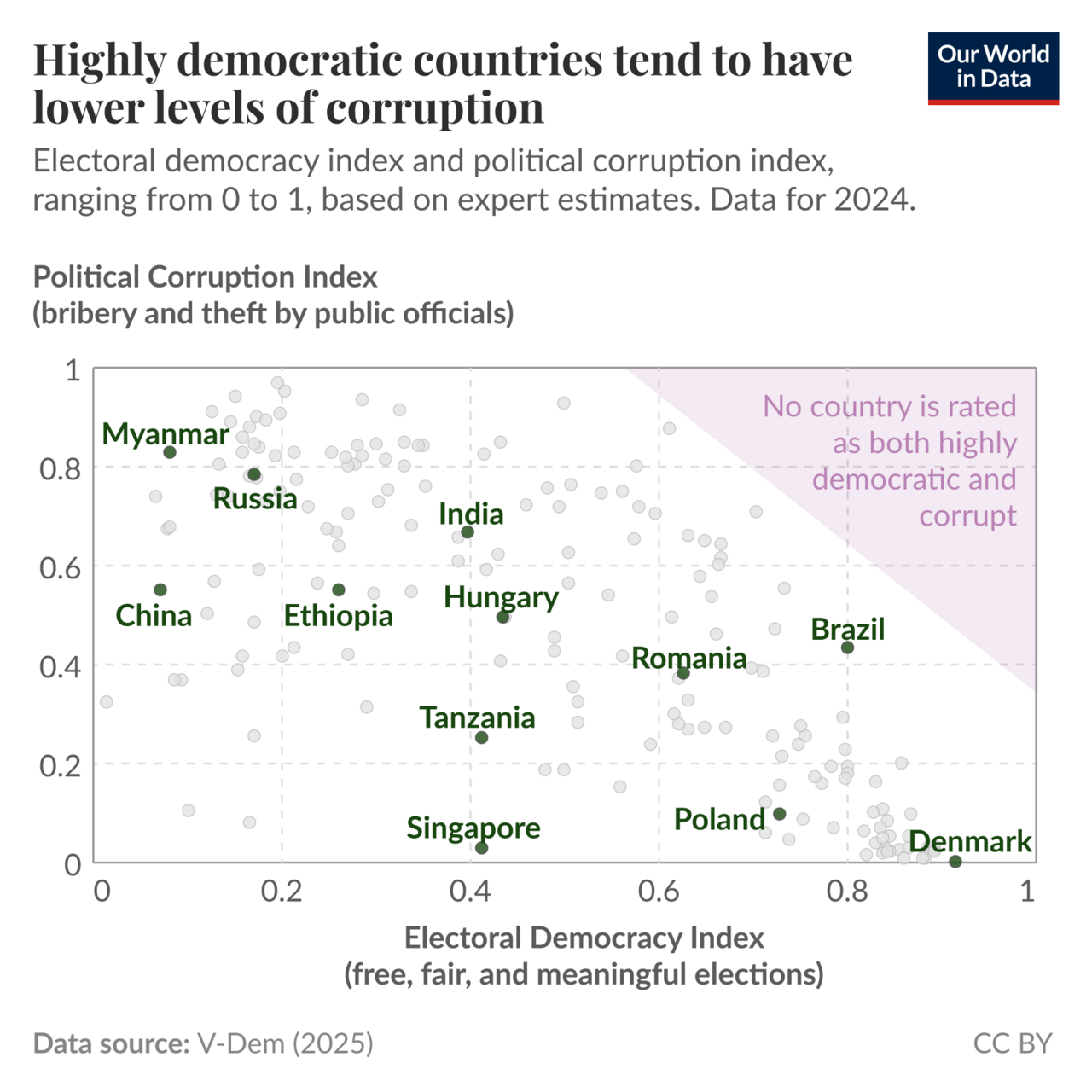 Highly democratic countries tend to have lower levels of corruption. Research by the World Bank suggests that political institutions are extremely important in determining the prevalence of corruption. Democracy, parliamentary systems, political stability and freedom of the press are all associated with lower rates of corruption.[3] Freedom of information legislation is important for accountability and transparency. For example, the Indian Right to Information Act "has already engendered mass movements in the country that is bringing the lethargic, often corrupt bureaucracy to its knees and changing power equations completely".[68] Better use of resources  Famines by political regime (1870-2023). Famines tend not to happen in democracies. Democracies are better at managing the resources they have available than autocracies.[4] This means democracies can operate the same government services as a comparable autocracy while spending less, allowing them to lower taxes, improve social services, and otherwise invest in their national well-being. It also reduces their odds of experiencing crises caused by poor resource allocation. Prominent economist Amartya Sen observed that no functioning democracy has ever suffered a large scale famine.[69] He argued that elections give democratic governments strong incentives to respond to food shortages, while an independent press helps to spotlight such crises and increases public pressure on officials to act.[70] Similarly, refugee crises are far less likely to occur in democracies than autocracies. From 1985 to 2008, the eighty-seven largest refugee crises occurred in autocracies.[4] Health and human development 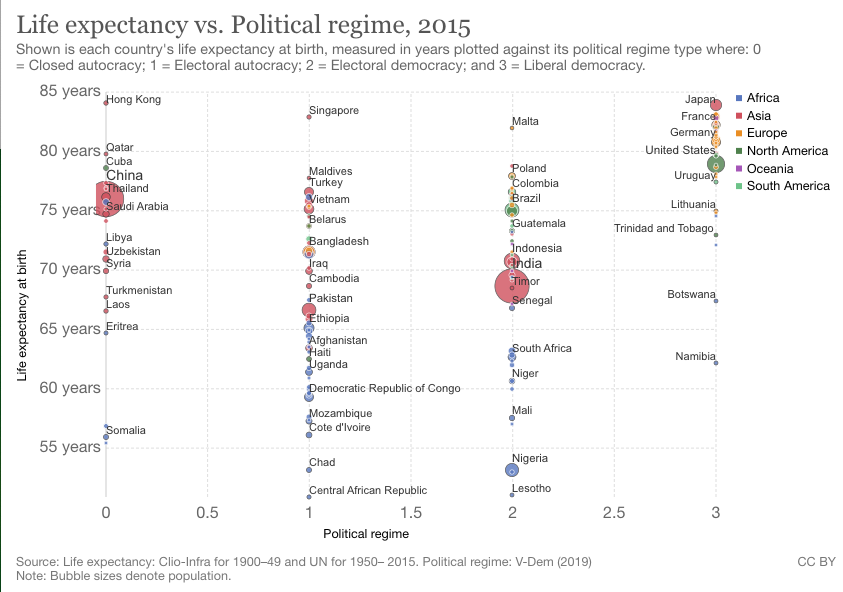 Liberal democracies (on the right) score on average higher in life expectancy than other regime types. Democracy correlates with a higher score on the Human Development Index and a lower score on the human poverty index. Several health indicators, most notably life expectancy and infant and maternal mortality, have a stronger and more significant association with democracy than they have with GDP per capita, rise of the public sector or income inequality.[5] In the post-Communist states, the countries that have achieved the greatest gains in life expectancy since the end of the post-Communist economic crash have been the ones that are most democratic.[71] Minimization of political violence Rudolph Rummel's Power Kills says that liberal democracy, among all types of regimes, minimizes political violence and is a method of nonviolence. Rummel attributes this firstly to democracy instilling an attitude of tolerance of differences, an acceptance of losing and a positive outlook towards conciliation and compromise.[72] A study published by the British Academy, on Violence and Democracy, argues that in practice liberal democracy has not stopped those running the state from exerting acts of violence both within and outside their borders. The paper also argues that police killings, profiling of racial and religious minorities, online surveillance, data collection, or media censorship are a couple of ways in which successful states maintain a monopoly on violence.[73] Effective response in wartime Research has shown that democracies are more likely to win wars than non-democracies.[74] Several theories have been advanced to explain this phenomenon. One posits that since losing wars harms democratic leaders' chances of re-election, they will only declare war when the odds of victory are high. For the same reason, democratic leaders are often swift to abandon unsuccessful military strategies and pivot to new ideas. Autocratic leaders do not face the same pressures, making them more likely to start ill-conceived wars or refuse to abandon losing strategies.[74] Another theory holds that democratic states are more effective at mobilizing their resources than autocracies, an advantage that is particularly crucial to success in modern warfare. Others believe that democratic countries' relatively stable foreign policy improves their ability to cooperate with each other in military alliances, leading to more coordinated campaigns that improve battlefield outcomes.[75] American political scientists Allan C. Stam and Dan Reiter also note that the emphasis on individuality within democratic societies means that their soldiers fight with greater initiative and superior leadership. Officers in autocracies are often selected for political loyalty rather than military ability. Sometimes, they may be exclusively selected from a small class or religious/ethnic group that support the regime, further limiting the talent pool available. Leadership often responds harshly to any perceived criticisms or disobedience, which may make soldiers and officers afraid to raise any objections or do anything without explicit authorization. This lack of initiative may be particularly detrimental in modern warfare.[76] Enemy soldiers may more easily surrender to democracies since they can expect comparatively good treatment. In World War II, autocratic Nazi Germany committed atrocities against Soviet prisoners of wars, leading to roughly half dying in custody.[77][78] When knowledge of these atrocities became widespread in the USSR, rates of defection among Soviet soldiers dropped markedly.[79] By contrast, many German soldiers were pleased to be captured by American and British soldiers, knowing those two democracies treated their prisoners of war well.[80] Democratic peace theory Main article: Democratic peace theory Democratic peace theory holds that democratic countries are reluctant to go to war with one another. Therefore, the theory posits that as more countries adopt democracy, the frequency and severity of armed conflict between states should decline. Numerous studies using many different kinds of data, definitions and statistical analyses have found a strong negative correlation between the number of democratic countries and the number of wars.[citation needed] Democracies have few militarized interstate disputes with one another, and those that do occur often result in less than 1,000 battle deaths. Democracies also have far fewer civil wars.[81][82] This theory remains disputed, however. Some critics argue that increased peace leads to more democracy, rather than the other way around. Others argue both phenomena are the result of a third factor, or perhaps not causally linked at all.[83][page needed] |
正当化と支持 政治的安定性の向上 自由民主主義のいくつかの重要な特徴は、経済成長をはじめ、自由な選挙、法の支配、個人の自由を保障する強固な国家機関など、政治的安定と関連している。 [2] 民主主義を支持する論拠の一つとして、政府の法的根拠を変えることなく国民が政権を交代させることができる制度を構築することで、民主主義は政治的な不確 実性や不安定性を低減し、市民に対し、現在の政策にどれほど反対していても、権力者を交代させたり、反対する政策を変更したりする機会が定期的に与えられ ることを保証することを目指しているという点が挙げられる。これは、暴力によって政治的変化が起こる制度よりも望ましいものである。[要出典] 自由民主主義の顕著な特徴の一つは、その反対派(自由民主主義の廃止を望む集団)が選挙で勝利することはめったにないという点だ。支持者はこれを、自由民 主主義は本質的に安定しており、通常は外部の力によってのみ打倒され得るという自らの見解を裏付ける論拠として用いる一方、反対派は、この制度が公平性を 標榜しているにもかかわらず、本質的に自分たちに不利に働いていると主張する。かつては、独裁的野心を持つ指導者が民主主義を容易に悪用し、選挙を通じて 権力の座に就くことが懸念されていた。しかし、実際に独裁者を権力の座に選出した自由民主主義国家の数は少ない。そのような事態が発生した場合、それは通 常、重大な危機によって多くの人々が制度に疑念を抱いた後、あるいは設立間もない、あるいは機能不全に陥っている民主主義国家においてである。考えられる 例としては、大恐慌時のアドルフ・ヒトラーや、フランス第二共和国の初代大統領となり、後に皇帝となったナポレオン3世などが挙げられる。[出典必要] 問題に関するより良い情報と是正 民主主義体制は、政策決定のためのより良い情報を提供し得る。独裁体制下では、たとえその望ましくない情報や反対意見が問題の早期警告となる場合でも、そ うした情報はより容易に無視されがちである。アンデルス・キデニウスは、この理由から1776年に報道の自由を主張した。[67] また、民主主義体制は非効率な指導者や政策を交代させる手段も提供するため、独裁体制下では問題が長引いたり、あらゆる種類の危機がより頻繁に発生したり する可能性がある。[4] 汚職の削減 民主主義の度合いが高い国ほど、汚職の水準は低い傾向にある。 世界銀行の調査によると、政治制度は汚職の蔓延を決定づける上で極めて重要である。民主主義、議会制、政治的安定、報道の自由はすべて、汚職率の低下と関 連している。[3] 情報公開法は、説明責任と透明性の確保にとって重要である。例えば、インドの「情報公開法」は、「すでに国内で大規模な運動を引き起こしており、無気力で しばしば汚職にまみれた官僚機構を屈服させ、権力構造を完全に変えつつある」。[68] 資源の有効活用 政治体制別の飢饉(1870年~2023年)。民主主義国家では飢饉が発生しにくい傾向にある。 民主主義国家は、独裁国家よりも利用可能な資源の管理に優れている。[4] これは、民主主義国家が、同等の規模の独裁国家と同じ政府サービスを提供しながら、より少ない支出で運営できることを意味する。これにより、税金を引き下 げ、社会サービスを改善し、国民の福祉に投資することが可能になる。また、資源配分の不備によって引き起こされる危機に見舞われる確率も低くなる。著名な 経済学者アマルティア・センは、機能している民主主義国家が大規模な飢饉に見舞われたことは一度もないと指摘している。[69] 彼は、選挙によって民主主義政府には食糧不足に対応する強いインセンティブが働き、一方で独立した報道機関がそうした危機を浮き彫りにし、当局者に行動を 求める世論の圧力を高めるのだと論じた。[70] 同様に、難民危機も、独裁体制に比べ民主主義国家では発生する可能性がはるかに低い。1985年から2008年にかけて、87件の最大規模の難民危機はす べて独裁体制下で発生した。[4] 健康と人間開発 自由民主主義国家(右側)は、他の政体タイプに比べて平均して平均寿命のスコアが高い。 民主主義は、人間開発指数(HDI)のスコアが高く、人間貧困指数のスコアが低いことと相関している。いくつかの健康指標、とりわけ平均寿命や乳児・妊産 婦死亡率は、一人当たりGDP、公共部門の拡大、あるいは所得格差よりも、民主主義との関連性がより強く、有意である。[5] ポスト共産主義諸国において、ポスト共産主義時代の経済崩壊以降、平均寿命の伸びが最も大きかった国々は、最も民主的な国々であった。[71] 政治的暴力の最小化 ルドルフ・ルメルの著書『Power Kills』によれば、あらゆる種類の体制の中で、自由民主主義は政治的暴力を最小限に抑え、非暴力の手段であるという。ルメルは、その理由として第一 に、民主主義が「違いへの寛容」「敗北の受容」「和解や妥協に対する前向きな姿勢」を人々に植え付けることを挙げている。[72] 英国学士院が発表した「暴力と民主主義」に関する研究は、実際には自由民主主義が、国家を運営する者たちが国境の内外で暴力行為を行使することを阻止でき ていないと論じている。同論文はまた、警察による殺害、人種的・宗教的マイノリティに対するプロファイリング、オンライン監視、データ収集、あるいはメ ディアの検閲などが、成功した国家が暴力の独占を維持するための手段の一部であると論じている。[73] 戦時下における効果的な対応 研究によれば、民主主義国家は非民主主義国家よりも戦争に勝利する可能性が高いことが示されている。[74] この現象を説明するために、いくつかの理論が提唱されている。その一つは、戦争に敗北すると民主主義指導者の再選の可能性が損なわれるため、勝利の見込み が高い場合にのみ宣戦布告するというものである。同じ理由から、民主主義指導者は、成果の上がらない軍事戦略を迅速に見切りをつけ、新たな方針へと転換す ることが多い。独裁的な指導者は同様の圧力に直面しないため、不適切な戦争を開始したり、敗北が確実な戦略を放棄することを拒んだりしやすい。[74] 別の理論では、民主主義国家は独裁国家よりも資源の動員に優れており、この優位性は現代戦争での成功にとって特に重要であるとされている。また、民主主義 国の比較的安定した外交政策が、軍事同盟における相互協力の能力を高め、その結果、より協調的な作戦が展開され、戦場の成果が向上すると考える者もいる。 [75] 米国の政治学者アラン・C・スタムとダン・ライターも、民主主義社会における個性の重視が、兵士たちにより高い自主性と優れたリーダーシップをもって戦う ことを意味すると指摘している。独裁体制下の将校は、軍事的能力よりも政治的忠誠心に基づいて選抜されることが多い。場合によっては、政権を支持する特定 の階級や宗教・民族集団からのみ選抜されることもあり、その結果、利用可能な人材の幅がさらに狭まってしまう。指導部は、批判や不服従とみなされる行為に 対してしばしば厳しく対応するため、兵士や将校は異議を唱えたり、明確な許可なしに行動したりすることを恐れるようになる。この自主性の欠如は、現代の戦 争において特に有害となり得る。[76] 敵兵は、比較的良好な待遇が期待できるため、民主主義国家にはより容易に降伏する可能性がある。第二次世界大戦において、独裁体制下のナチス・ドイツはソ 連の捕虜に対して残虐行為を行い、その結果、捕虜の約半数が収容中に死亡した。[77] [78] こうした残虐行為の事実がソ連国内で広く知られるようになると、ソ連兵の脱走率は著しく低下した。[79] 対照的に、多くのドイツ兵は、米国や英国という二つの民主主義国が捕虜を良く扱っていることを知っていたため、両国の兵士に捕らえられることを喜んだ。 [80] 民主主義平和論 本記事:民主主義平和論 民主主義平和論は、民主主義国同士が互いに戦争を仕掛けることを躊躇すると主張する。したがって、この理論は、民主主義を採用する国が増えるにつれて、国家間の武力紛争の頻度と深刻度は低下すべきであると提唱している。 多種多様なデータ、定義、統計分析を用いた数多くの研究により、民主主義国の数と戦争の件数との間に強い負の相関関係があることが示されている。[要出 典] 民主主義国同士の軍事的な国家間紛争は少なく、発生したとしても戦死者は1,000人未満に留まることが多い。また、民主主義国家では内戦の発生もはるか に少ない。[81][82] しかし、この理論については依然として議論がある。一部の批判者は、平和の拡大が民主主義の拡大につながるものであり、その逆ではないと主張する。また、 両現象は第三の要因による結果であるか、あるいは因果関係が全くない可能性もあると主張する者もいる。[83][ページ番号必要] |
| Objections and criticism See also: Criticism of democracy Campaign costs In Athenian democracy, some public offices were randomly allocated to citizens, in order to inhibit the effects of plutocracy. Aristotle described the law courts in Athens, which were selected by lot, as democratic[84] and described elections as oligarchic.[85] Political campaigning in representative democracies can favor the rich due to campaign costs, a form of plutocracy where only a very small number of wealthy individuals can actually affect government policy in their favor and toward plutonomy.[86] Stringent campaign finance laws can correct this perceived problem.[citation needed] Other studies predicted that the global trend toward plutonomies would continue, for various reasons, including "capitalist-friendly governments and tax regimes".[87] They also say that, since "political enfranchisement remains as was—one person, one vote, at some point it is likely that labor will fight back against the rising profit share of the rich and there will be a political backlash against the rising wealth of the rich."[88] Economist Steven Levitt says in his book Freakonomics that campaign spending is no guarantee of electoral success. He compared electoral success of the same pair of candidates running against one another repeatedly for the same job, as often happens in United States congressional elections, where spending levels varied. He concludes: "A winning candidate can cut his spending in half and lose only 1 percent of the vote. Meanwhile, a losing candidate who doubles his spending can expect to shift the vote in his favor by only that same 1 percent."[89] On 18 September 2014, Martin Gilens and Benjamin I. Page's study concluded "Multivariate analysis indicates that economic elites and organized groups representing business interests have substantial independent impacts on U.S. government policy, while average citizens and mass-based interest groups have little or no independent influence. The results provide substantial support for theories of Economic-Elite Domination and for theories of Biased Pluralism, but not for theories of Majoritarian Electoral Democracy or Majoritarian Pluralism."[90] Media Critics of the role of the media in liberal democracies allege that concentration of media ownership leads to major distortions of democratic processes. In Manufacturing Consent: The Political Economy of the Mass Media, Edward S. Herman and Noam Chomsky argue via their Propaganda Model[91] that the corporate media limits the availability of contesting views and assert this creates a narrow spectrum of elite opinion. This is a natural consequence, they say, of the close ties between powerful corporations and the media and thus limited and restricted to the explicit views of those who can afford it.[92] Furthermore, the media's negative influence can be seen in social media where vast numbers of individuals seek their political information that is not always correct and may be controlled. For example, as of 2017, two-thirds (67%) of Americans report that they get at least some of their news from social media,[93] as well as a rising number of countries are exercising extreme control over the flow of information.[94] This may contribute to large numbers of individuals using social media platforms but not always gaining correct political information. This may cause conflict with liberal democracy and some of its core principles, such as freedom, if individuals are not entirely free since their governments are seizing that level of control on media sites. The notion that the media is used to indoctrinate the public is also shared by Yascha Mounk's The People Vs Democracy, which states that the government benefits from the public having a relatively similar worldview and that this one-minded ideal is one of the principles in which Liberal Democracy stands.[95] Defenders responding to such arguments say that constitutionally protected freedom of speech makes it possible for both for-profit and non-profit organizations to debate the issues. They argue that media coverage in democracies simply reflects public preferences and does not entail censorship. Especially with new forms of media such as the Internet, it is not expensive to reach a wide audience, if an interest in the ideas presented exists. Limited voter turnout Further information: Voter turnout Low voter turnout, whether the cause is disenchantment, indifference or contentment with the status quo, may be seen as a problem, especially if disproportionate in particular segments of the population. Although turnout levels vary greatly among modern democratic countries and in various types and levels of elections within countries, at some point low turnout may prompt questions as to whether the results reflect the will of the people, whether the causes may be indicative of concerns to the society in question, or in extreme cases the legitimacy of the electoral system. Get out the vote campaigns, either by governments or private groups, may increase voter turnout, but distinctions must be made between general campaigns to raise the turnout rate and partisan efforts to aid a particular candidate, party or cause. Other alternatives include increased use of absentee ballots, or other measures to ease or improve the ability to vote, including electronic voting. Several nations have forms of compulsory voting, with various degrees of enforcement. Proponents argue that this increases the legitimacy—and thus also popular acceptance—of the elections and ensures political participation by all those affected by the political process and reduces the costs associated with encouraging voting. Arguments against include restriction of freedom, economic costs of enforcement, increased number of invalid and blank votes and random voting.[96] Bureaucracy A persistent right-wing libertarian and monarchist critique of democracy is the claim that it encourages the elected representatives to change the law without necessity and in particular to pour forth a flood of new laws, as described in Herbert Spencer's The Man Versus The State.[97] This is seen as pernicious in several ways. New laws constrict the scope of what were previously private liberties. Rapidly changing laws make it difficult for a willing non-specialist to remain law-abiding. This may be an invitation for law-enforcement agencies to misuse power. The claimed continual complication of the law may be contrary to a claimed simple and eternal natural law—although there is no consensus on what this natural law is, even among advocates. Supporters of democracy point to the complex bureaucracy and regulations that has occurred in dictatorships, like many of the former Communist states. The bureaucracy in liberal democracies is often criticized for a claimed slowness and complexity of their decision-making. The term "red tape" is a synonym of slow bureaucratic functioning that hinders quick results in a liberal democracy. Short-term focus By definition, modern liberal democracies allow for regular changes of government. That has led to a common criticism of their short-term focus. In four or five years, the government will face a new election and it must think of how it will win that election. That would encourage a preference for policies that will bring short term benefits to the electorate or to self-interested politicians before the next election, rather than unpopular policy with longer term benefits. This criticism assumes that it is possible to make long term predictions for a society, something Karl Popper criticized as historicism. Besides the regular review of governing entities, short-term focus in a democracy could also be the result of collective short-term thinking. For example, consider a campaign for policies aimed at reducing environmental damage while causing temporary increase in unemployment; nonetheless, this risk applies also to other political systems. Majoritarianism Main articles: Majority rule and Tyranny of the majority icon This section needs more citations. Please help improve this section by adding citations to reliable sources. Unsourced material may be challenged and removed. (August 2012) (Learn how and when to remove this message) The "tyranny of the majority" is the fear that a direct democratic government, reflecting the majority view, can take action that oppresses a particular minority. For instance, a minority holding wealth, property ownership or power (see Federalist No. 10), or a minority of a certain racial and ethnic origin, class or nationality. Theoretically, the majority is a majority of all citizens. If citizens are not compelled by law to vote, it is usually a majority of those who choose to vote. If such of group constitutes a minority, then it is possible that a minority could in theory oppress another minority in the name of the majority; such an argument could apply to both direct democracy or representative democracy. Several de facto dictatorships also have compulsory but not "free and fair" voting in order to try to increase the legitimacy of the regime, such as North Korea.[98][99] In her book World on Fire, Yale Law School professor Amy Chua posits that "when free market democracy is pursued in the presence of a market-dominant minority, the almost invariable result is backlash. This backlash typically takes one of three forms. The first is a backlash against markets, targeting the market-dominant minority's wealth. The second is a backlash against democracy by forces favorable to the market-dominant minority. The third is violence, sometimes genocidal, directed against the market-dominant minority itself".[100] Cases that have been cited as examples of a minority being oppressed by or in the name of the majority include[citation needed] the practice of conscription and laws against homosexuality, pornography, and recreational drug use. Homosexual acts were widely criminalised in democracies until several decades ago and in some democracies like Ghana, Kenya, Tanzania, Tunisia, Nigeria, and Malaysia, they still are, reflecting the religious or sexual mores of the majority. The Athenian democracy and the early United States practiced slavery, and even proponents of liberal democracy in the 17th and 18th century were often pro-slavery, which is contradictory of a liberal democracy. Another often quoted example of the "tyranny of the majority" is that Adolf Hitler came to power by legitimate democratic procedures on the grounds that the Nazi Party gained the largest share of votes in the Weimar Republic in 1933; his regime's large-scale human rights violations took place after the democratic system had been abolished. The November 1932 German federal election, which resulted in losses for the Nazi Party, is considered the last free and fair election in Weimar Germany, and even in the March 1933 German federal election, despite waging what has been described as a campaign of terror against their opponents, the Nazis did not achieve a majority of the votes or seats. Although the Weimar Constitution included an enabling act that in emergency situations, real or imagined, allowed dictatorial powers and suspension of the essentials of the constitution itself without any vote or election, which was used to pass the Enabling Act of 1933, this happened after the not free nor fair 1933 election and it was successfully implemented only after a strategy of coercion, bribery, and manipulation. In The Coming of the Third Reich, British historian Richard J. Evans argued that the Enabling Act was legally invalid.[101] Proponents of democracy make a number of defenses concerning "tyranny of the majority". One is to argue that the presence of a constitution protecting the rights of all citizens in many democratic countries acts as a safeguard. Generally, changes in these constitutions require the agreement of a supermajority of the elected representatives, or require a judge and jury to agree that evidentiary and procedural standards have been fulfilled by the state, or two different votes by the representatives separated by an election, or sometimes a referendum. These requirements are often combined. The separation of powers into legislative branch, executive branch, and judicial branch also makes it more difficult for a small majority to impose their will. This means a majority can still legitimately coerce a minority, which is still ethically questionable, but that such a minority would be very small, and as a practical matter it is harder to get a larger proportion of the people to agree to such actions. Another argument is that majorities and minorities can take a markedly different shape on different issues. People often agree with the majority view on some issues and agree with a minority view on other issues. One's view may also change, thus the members of a majority may limit oppression of a minority since they may well in the future themselves be in a minority. A third common argument is that despite the risks majority rule is preferable to other systems and the tyranny of the majority is in any case an improvement on a tyranny of a minority. All the possible problems mentioned above can also occur in non-democracies with the added problem that a minority can oppress the majority. Proponents of democracy argue that empirical statistical evidence strongly shows that more democracy leads to less internal violence and mass murder by the government. This is sometimes formulated as Rummel's Law, which states that the less democratic freedom a people have, the more likely their rulers are to murder them. |
異論と批判 関連項目:民主主義への批判 選挙運動費 アテネの民主制では、金権政治の影響を抑制するため、一部の公職が市民に無作為に割り当てられていた。アリストテレスは、くじ引きによって選出されるアテ ネの法廷を民主的であると述べ[84]、選挙については寡頭制的であると記述した[85]。代表民主制における選挙運動は、選挙費用の負担により富裕層に 有利に働くことがある。これは、ごく少数の富裕層のみが実際に政府の政策を自分たちに有利な方向、すなわちプルトノミーへと導くことができるという、一種 の金権政治である[86]。厳格な選挙資金規制法は、この問題と見なされている状況を是正し得る[出典必要] 他の研究では、「資本主義に友好的な政府や税制」など様々な理由から、プルトノミーへの世界的な傾向は今後も続くと予測されている。[87] また、彼らは「政治的参政権は従来通り――一人一票――のままであるため、ある時点で労働者が富裕層の利益シェアの拡大に反撃し、富裕層の富の増加に対す る政治的反発が起こる可能性が高い」とも述べている。[88] 経済学者のスティーブン・レヴィットは著書『フリークノミクス』の中で、選挙運動費が選挙での成功を保証するものではないと述べている。彼は、米国議会選 挙で頻繁に見られるように、同じ役職をめぐって繰り返し対立する同一の候補者ペアの選挙での勝敗を、支出水準が異なるケースで比較した。そして次のように 結論づけている。「勝利した候補者は支出を半減させても、得票率をわずか1%しか落とさない。一方、敗北した候補者が支出を倍増させても、得票率を同じ 1%だけ自分有利に動かすことしか期待できない」[89] 2014年9月18日、マーティン・ギレンズとベンジャミン・I・ペイジによる研究は、「多変量分析によれば、経済エリートや企業の利益を代表する組織化 された団体は、米国政府の政策に相当な独立した影響を及ぼしているのに対し、一般市民や大衆を基盤とする利益団体には、独立した影響力がほとんど、あるい は全くないことが示されている。この結果は、「経済エリート支配論」や「偏った多元主義論」を強力に裏付けるものであるが、「多数決型選挙民主主義論」や 「多数決型多元主義論」を裏付けるものではない。」[90] メディア 自由民主主義におけるメディアの役割に対する批判者は、メディア所有権の集中が民主的プロセスの重大な歪みにつながると主張している。『合意の製造:マス メディアの政治経済学』において、エドワード・S・ハーマンとノーム・チョムスキーは、彼らの「プロパガンダ・モデル」[91]を通じて、企業メディアが 対立する見解の流通を制限しており、これがエリート層の意見の幅を狭めていると論じている。これは、有力企業とメディアの密接な結びつきから生じる当然の 結果であり、その結果、資金力のある者たちの明確な見解に限定・制約されていると彼らは言う。[92] さらに、メディアの悪影響は、膨大な数の個人が政治情報を求めているソーシャルメディアにも見られ、その情報は必ずしも正確ではなく、操作されている可能 性もある。例えば、2017年時点で、アメリカ人の3分の2(67%)が、ニュースの少なくとも一部をソーシャルメディアから得ていると報告している [93]ほか、情報の流れに対して極端な統制を行使する国も増えている[94]。これにより、多くの個人がソーシャルメディアプラットフォームを利用して いるものの、必ずしも正確な政治情報を得られているとは限らない。政府がメディアサイトに対してその程度の統制を敷いているため、個人が完全に自由ではな い場合、これは自由民主主義や、自由といったその中核的な原則の一部と矛盾を引き起こす可能性がある。メディアが大衆を教化するために利用されているとい う見解は、ヤシャ・ムンクの著書『The People Vs Democracy』でも共有されており、同書では、政府は国民が比較的類似した世界観を持つことから利益を得ており、この「一元的な理想」こそが自由民 主主義の原則の一つであると述べられている。[95] こうした主張に対して反論する支持者たちは、憲法で保障された言論の自由により、営利・非営利を問わずあらゆる組織が問題について議論できると主張する。 彼らは、民主主義社会におけるメディアの報道は単に大衆の好みを反映したものであり、検閲を伴うものではないと論じている。特にインターネットのような新 しいメディア形態においては、提示された考えに関心があれば、広範な聴衆にリーチするのに多額の費用はかからない。 低い投票率 詳細情報:投票率 投票率の低さは、その原因が幻滅、無関心、あるいは現状への満足のいずれであれ、特に人口の特定の層で不均衡に見られる場合、問題とみなされる可能性があ る。現代の民主主義諸国間や、各国内の様々な種類・レベルの選挙において投票率は大きく異なるが、ある時点で投票率が低すぎると、その結果が国民の意思を 反映しているのか、その原因が当該社会における懸念を示唆しているのか、あるいは極端な場合には選挙制度の正当性そのものについて疑問が投げかけられる可 能性がある。政府や民間団体による「投票促進キャンペーン」は投票率を向上させる可能性があるが、投票率を高めるための一般的なキャンペーンと、特定の候 補者、政党、あるいは大義を支援するための党派的な取り組みとは区別しなければならない。その他の対策としては、不在者投票の利用拡大や、電子投票を含む 投票の利便性を向上させる措置などが挙げられる。いくつかの国では、執行の程度は様々だが、何らかの形の義務投票制度が導入されている。支持者は、これに より選挙の正当性――ひいては国民の受容度――が高まり、政治プロセスに影響を受けるすべての人々の政治参加が確保され、投票促進に伴うコストが削減され ると主張する。反対論としては、自由の制限、執行に伴う経済的コスト、無効票や白票の増加、無作為な投票などが挙げられる。[96] 官僚主義 民主主義に対する右派のリバタリアンや君主制支持者による根強い批判の一つは、民主主義が選出された代表者に対し、必要性がないにもかかわらず法律を変更 させ、特にハーバート・スペンサーの『人間対国家』[97]で述べられているように、新たな法律を氾濫させるよう促すという主張である。これはいくつかの 点で有害であると見なされている。新しい法律は、以前は私的自由とされていた範囲を狭める。法律が急速に変化するため、善意の非専門家が法を遵守し続ける ことは困難になる。これは、法執行機関による権力の濫用を招く恐れがある。法律が絶えず複雑化しているという主張は、単純かつ永遠の自然法という主張と矛 盾する可能性がある――もっとも、この自然法が何であるかについては、その支持者たちの間ですら合意は得られていない。民主主義の支持者は、多くの旧共産 主義国家のような独裁政権下で生じた複雑な官僚機構や規制を例に挙げる。自由民主主義における官僚機構は、意思決定の遅さや複雑さについてしばしば批判さ れる。「レッドテープ」という言葉は、自由民主主義において迅速な成果を妨げる、遅々とした官僚機構の機能を指す同義語である。 短期志向 定義上、現代のリベラル民主主義では定期的な政権交代が許容されている。そのため、短期志向であるという批判がしばしば寄せられる。4~5年後には政府は 新たな選挙に直面することになり、その選挙にどう勝利するかを考えなければならない。その結果、長期的な利益をもたらすが不人気な政策よりも、次の選挙ま でに有権者や自己利益を追求する政治家に短期的な利益をもたらす政策が優先されがちになる。この批判は、社会について長期的な予測が可能であるという前提 に立っているが、カール・ポッパーはこれを「歴史主義」として批判した。統治機関の定期的な見直しに加え、民主主義における短期志向は、集団的な短期思考 の結果である可能性もある。例えば、環境破壊の軽減を目的とする政策の推進が、一時的な失業率の上昇を招く場合を考えてみよう。とはいえ、このリスクは他 の政治体制にも当てはまる。 多数決主義 主な記事:多数決、多数派の専制 アイコン この節には出典が不足している。信頼できる情報源への引用を追加し、この節の改善に協力してほしい。出典のない記述は異議を唱えられ、削除される可能性がある。(2012年8月)(このメッセージの削除方法と時期について) 「多数派の専制」とは、多数派の意見を反映する直接民主制の政府が、特定の少数派を弾圧するような措置を講じる恐れを指す。例えば、富や財産、権力を有す る少数派(『フェデラリスト第10号』参照)、あるいは特定の人種・民族、階級、国籍に属する少数派などが挙げられる。理論上、多数派とは全市民の過半数 を指す。市民が法律によって投票を義務付けられていない場合、通常は投票を選択した者の過半数が多数派となる。もしそのような集団が少数派を構成している 場合、理論上、ある少数派が多数派の名の下に別の少数派を抑圧する可能性がある。このような議論は、直接民主制と代議制民主制の双方に当てはまる。北朝鮮 のように、政権の正当性を高めようとするため、投票を義務付けているものの「自由かつ公正」ではない事実上の独裁政権もいくつか存在する。[98] [99] イェール大学ロースクールのエイミー・チュア教授は著書『World on Fire』の中で、「市場を支配する少数派が存在する状況下で自由市場民主主義が追求されると、ほぼ例外なく反発が生じる。この反発は通常、3つの形態の いずれかをとる。第一は、市場を支配する少数派の富を標的とした、市場に対する反発である。第二は、市場を支配する少数派に有利な勢力による民主主義への 反発だ。第三は、市場を支配する少数派そのものを標的とした、時にはジェノサイドに至る暴力である」。[100] 多数派によって、あるいは多数派の名の下に少数派が抑圧された例として挙げられているものには[出典必要]、徴兵制や、同性愛、ポルノ、娯楽目的の薬物使 用を禁じる法律などがある。同性愛行為は数十年前のまで民主主義国家で広く犯罪とされていたが、ガーナ、ケニア、タンザニア、チュニジア、ナイジェリア、 マレーシアなどの一部の民主主義国家では、現在もなお犯罪とされており、これは多数派の宗教的または性的道徳観を反映している。アテネの民主主義や初期の アメリカ合衆国では奴隷制が実践されており、17世紀から18世紀にかけてのリベラル・デモクラシーの支持者でさえ、しばしば奴隷制を支持していたが、こ れはリベラル・デモクラシーと矛盾するものである。 「多数派の専制」としてよく引用されるもう一つの例は、1933年にワイマール共和国においてナチ党が最多得票を獲得したことを根拠に、アドルフ・ヒト ラーが正当な民主的手続きを経て権力を掌握したことだ。彼の政権による大規模な人権侵害は、民主主義体制が廃止された後に発生した。ナチ党が敗北した 1932年11月のドイツ連邦議会選挙は、ワイマール共和国における最後の自由かつ公正な選挙と見なされている。また、1933年3月のドイツ連邦議会選 挙においても、ナチ党は対立勢力に対して「恐怖の選挙運動」と評されるような攻勢を繰り広げたにもかかわらず、得票数や議席数において過半数を獲得するこ とはできなかった。ワイマール憲法には、現実の、あるいは想像上の緊急事態において、投票や選挙を経ることなく独裁的権限の行使や憲法そのものの基本条項 の停止を認める授権条項が含まれており、これが1933年の授権法の可決に利用されたが、これは自由でも公正でもなかった1933年の選挙の後に行われた ものであり、強制、買収、操作という戦略を経て初めて成功裏に実施されたのである。『第三帝国の到来』において、英国の歴史家リチャード・J・エヴァンス は、授権法は法的に無効であると論じた。[101] 民主主義の支持者たちは、「多数派の専制」に関していくつかの反論を展開している。その一つは、多くの民主主義国において、すべての市民の権利を保護する 憲法が存在することが、安全装置として機能するという主張である。一般的に、こうした憲法の改正には、選出された代表者の過半数以上の同意、あるいは証拠 および手続き上の基準が国家によって満たされていることを裁判官と陪審員が認めること、あるいは選挙を挟んで行われる2回の異なる代表者による投票、時に は国民投票が必要とされる。これらの要件はしばしば組み合わされる。また、立法府、行政府、司法府への権力分立も、わずかな過半数が自らの意志を押し付け ることをより困難にしている。これは、多数派が依然として合法的に少数派に圧力をかけることができることを意味する。これは倫理的には依然として疑問が残 るが、そのような少数派の規模は非常に小さく、現実問題として、より多くの国民にそのような行動に同意させることは困難である。 もう一つの論点は、問題によって多数派と少数派の構成が著しく異なる場合があるということだ。人々は、ある問題では多数派の見解に賛同し、別の問題では少 数派の見解に賛同することがよくある。また、個人の見解は変わる可能性もあるため、多数派の構成員は、将来自分たちが少数派になる可能性もあることを踏ま え、少数派への抑圧を控えるかもしれない。3つ目の一般的な論点は、リスクはあるものの、多数決制は他の制度よりも望ましく、「多数派の専制」は、いずれ にせよ「少数派の専制」よりはましだということだ。上記で言及されたあらゆる問題は、非民主主義体制においても発生し得るが、そこに「少数派が多数派を弾 圧する」という追加の問題が加わる。民主主義の支持者は、経験的・統計的証拠が、民主主義が進めば進むほど、国内の暴力や政府による大量殺戮が減少するこ とを強く示していると主張する。これは時に「ルメルの法則」として定式化されており、国民が持つ民主的自由が少ないほど、支配者が国民を殺害する可能性が 高くなるというものである。 |
| Socialist and Marxist criticism Further information: Democracy in Marxism This section has multiple issues. Please help improve it or discuss these issues on the talk page. (Learn how and when to remove these messages) This section may contain original research. (July 2022) This section needs more citations. (April 2023) Some socialists, such as The Left party in Germany,[102] say that liberal democracy is a dishonest farce used to keep the masses from realizing that their will is irrelevant in the political process. Marxists and communists, as well as some non-Marxist socialists and anarchists, argue that liberal democracy under capitalism is constitutively social class-based and therefore can never be democratic or participatory. They refer to it as "bourgeois democracy" because they say that politicians ultimately fight mainly for the interests of the bourgeoisie,[103] and thus argue that liberal democracy represents "the rule of capital".[104] According to Karl Marx, representation of the interests of different classes is proportional to the influence that a particular class can purchase (through bribes, transmission of propaganda through mass media, economic blackmail, donations for political parties and their campaigns and so on). Thus, the public interest in liberal democracies is systematically corrupted by the wealth of those classes rich enough to gain the appearance of representation. Because of this, he said that multi-party democracies under capitalism are always distorted and anti-democratic, their operation merely furthering the class interests of the owners of the means of production, and the bourgeois class becomes wealthy through a drive to appropriate the surplus value of the creative labours of the working class. This drive obliges the bourgeois class to amass ever-larger fortunes by increasing the proportion of surplus-value by exploiting the working class through capping workers' terms and conditions as close to poverty levels as possible. Incidentally, this obligation demonstrates the clear limit to bourgeois freedom even for the bourgeoisie itself. According to Marx, parliamentary elections are no more than a cynical, systemic attempt to deceive the people by permitting them, every now and again, to endorse one or other of the bourgeoisie's predetermined choices of which political party can best advocate the interests of capital. Once elected, he said that this parliament, as a dictatorship of the bourgeoisie, enacts regulations that actively support the interests of its true constituency, the bourgeoisie, such as bailing out Wall Street investment banks, direct socialization/subsidization of business (GMH, American/European agricultural subsidies), and even wars to guarantee trade in commodities such as oil. Vladimir Lenin once argued that liberal democracy had simply been used to give an illusion of democracy whilst maintaining the dictatorship of the bourgeoisie, giving as an example the United States's representative democracy, which he said consisted of "spectacular and meaningless duels between two bourgeois parties" led by "multimillionaires".[105] The Chinese Communist Party political concept of whole-process people's democracy criticizes liberal democracy for excessively relying on procedural formalities without genuinely reflecting the interests of the people.[106] Under this primarily consequentialist concept, the most important criterion for a democracy is whether it can "solve the people's real problems", while a system in which "the people are awakened only for voting" is not truly democratic.[106] For example, the Chinese government's 2021 white paper "China: Democracy that Works" criticizes liberal democracy's shortcoming based on principles of whole process people's democracy.[107] Religion See also: Religious democracy Religious stances on democracy and liberalism vary and can change.[108] The Catholic Church opposed liberal democracy until 1965, when the Second Vatican Council endorsed religious freedom.[108] Religious democracy, which prioritizes non-liberal religious values over liberal values, has been criticized for not being a liberal democracy.[109] Religious identity can create ingroup-outgroup preferences that may influence policy preferences. Public support for religion in government influences policies directed towards state religion.[110] State religion policies that restrict religious freedom can lead to conflict, including terrorism, although some countries that have a state religion do inhibit terrorism.[110] Some democracies that do uphold a state religion nonetheless safeguard religious freedom. For example, Article 37 of the constitution of Liechtenstein recognises "the Roman Catholic Church as the State Church" while also granting freedom of practise for other faiths.[111] In 2023, the country scored 4 out of 4 for religious freedom from Freedom House.[112] |
社会主義およびマルクス主義による批判 詳細:マルクス主義における民主主義 この節には複数の問題点がある。改善に協力するか、トークページでこれらの問題について議論してほしい。(このメッセージを削除する方法と時期について) この節には独自研究が含まれている可能性がある。(2022年7月) この節には出典の追加が必要だ。(2023年4月) ドイツの「左翼党」[102]などの一部の社会主義者は、自由民主主義とは、大衆が政治プロセスにおいて自らの意志が無関係であることを悟らないようにす るための、不誠実な茶番劇であると主張している。マルクス主義者や共産主義者、および一部の非マルクス主義的社会主義者やアナキストは、資本主義下におけ る自由民主主義は本質的に社会階級に基づいているため、決して民主的でも参加型でもあり得ないと主張する。彼らはこれを「ブルジョア民主主義」と呼ぶ。そ の理由は、政治家たちが最終的には主にブルジョアジーの利益のために争っている[103]と主張し、したがって自由民主主義は「資本の支配」を表している と論じるからである[104]。 カール・マルクスによれば、異なる階級の利益の代表性は、特定の階級が(賄賂、マスメディアを通じたプロパガンダの流布、経済的脅迫、政党や選挙運動への 寄付などを通じて)購入できる影響力に比例する。したがって、自由民主主義における公共の利益は、代表されているかのような外観を得られるほど裕福な階級 の富によって、体系的に腐敗させられている。このため、マルクスは、資本主義下の多党制民主主義は常に歪められ、反民主的であると述べた。その運営は単に 生産手段の所有者の階級的利益を促進するに過ぎず、ブルジョア階級は、労働階級の創造的な労働から生じる剰余価値を収奪しようとする欲求を通じて富を蓄積 するのだ。この駆動力により、ブルジョア階級は、労働者の労働条件を可能な限り貧困レベルに近づけることで労働者を搾取し、剰余価値の割合を高めることに より、ますます巨額の富を蓄積せざるを得なくなる。ちなみに、この義務は、ブルジョアジー自身にとっても、ブルジョワ的自由には明確な限界があることを示 している。マルクスによれば、議会選挙とは、時折、資本の利益を最もよく擁護できる政党としてブルジョアジーが予め定めた選択肢のいずれかを、民衆に承認 させることを許すことで、民衆を欺こうとする、冷笑的で体系的な試みに過ぎない。マルクスは、一旦選出されると、この議会はブルジョアジーの独裁として、 ウォール街の投資銀行への救済措置、企業への直接的な社会化・補助金(GMH、米国・欧州の農業補助金)、さらには石油などの商品取引を保証するための戦 争など、その真の支持基盤であるブルジョアジーの利益を積極的に支援する規制を制定すると述べた。ウラジーミル・レーニンはかつて、自由民主主義は単にブ ルジョアジーの独裁を維持しつつ、民主主義の幻想を与えるために利用されてきたと論じた。その例として、彼は米国の代議制民主主義を挙げ、それが「数百万 長者」が率いる「二つのブルジョア政党間の派手で無意味な対決」に過ぎないと述べた。[105] 中国共産党の政治概念である「全過程人民民主主義」は、リベラル・デモクラシーが手続き上の形式に過度に依存し、人民の利益を真に反映していないと批判し ている。[106] この主に結果主義的な概念の下では、民主主義の最も重要な基準は「人民の実際の問題を解決できるか」であり、「投票の時だけ人民が呼び起こされる」ような 体制は真の民主主義ではないとされる。[106] 例えば、中国政府が2021年に発表した白書『中国:機能する民主主義』は、「全過程人民民主主義」の原則に基づき、自由民主主義の欠点を批判している。 [107] 宗教 関連項目:宗教的民主主義 民主主義や自由主義に対する宗教の立場は様々であり、変化することもある。[108] カトリック教会は、第2バチカン公会議が信教の自由を承認した1965年まで、自由民主主義に反対していた。[108] 自由主義的価値観よりも非自由主義的な宗教的価値観を優先する「宗教的民主主義」は、自由民主主義ではないとして批判されてきた。[109] 宗教的アイデンティティは、政策選好に影響を与えうる「イングループ・アウトグループ」の選好を生み出すことがある。政府における宗教への公的支援は、国 教に向けた政策に影響を与える。[110] 宗教の自由を制限する国教政策は、テロリズムを含む紛争につながる可能性があるが、国教を有する国の中にはテロリズムを抑制している国もある。[110] 国教を擁護する民主主義国家の中には、それにもかかわらず宗教の自由を保障しているものもある。例えば、リヒテンシュタインの憲法第37条は、「ローマ・ カトリック教会を国教とする」と認める一方で、他の信仰に対する信教の自由も保障している。[111] 2023年、同国はフリーダム・ハウスによる宗教の自由の評価で4点満点中4点を獲得した。[112] |
| Vulnerabilities Authoritarianism  The V-Dem Institute's indices of democracy indicate that worldwide democracy peaked in 2012, and has since declined, with the decline accelerating in the early 2020s.[113] Authoritarianism is perceived by many to be a direct threat to the liberalised democracy practised in many countries. According to American political sociologist and authors Larry Diamond, Marc F. Plattner and Christopher Walker, undemocratic regimes are becoming more assertive.[114] They suggest that liberal democracies introduce more authoritarian measures to counter authoritarianism itself and cite monitoring elections and more control on media in an effort to stop the agenda of undemocratic views. Diamond, Plattner and Walker uses an example of China using aggressive foreign policy against Western countries to suggest that a country's society can force another country to behave in a more authoritarian manner. In their book Authoritarianism Goes Global: The Challenge to Democracy, they argue that Beijing confronts the United States by building its navy and missile force and promotes the creation of global institutions designed to exclude American and European influence, and as a result authoritarian states pose a threat to liberal democracy as they seek to remake the world in their own image.[115] Various authors have also analysed the authoritarian means that are used by liberal democracies to defend economic liberalism and the power of political elites.[116] War There are ongoing debates surrounding the effect that war may have on liberal democracy, and whether it cultivates or inhibits democratization. War may cultivate democratization by "mobilizing the masses, and creating incentives for the state to bargain with the people it needs to contribute to the war effort".[117] An example of this may be seen in the extension of suffrage in the United Kingdom after World War I. War may inhibit democratization by "providing an excuse for the curtailment of liberties".[117] Terrorism Globe icon. The examples and perspectives in this section may not represent a worldwide view of the subject. You may improve this section, discuss the issue on the talk page, or create a new section, as appropriate. (January 2014) (Learn how and when to remove this message) Several studies[citation needed] have concluded that terrorism is most common in nations with intermediate political freedom, meaning countries transitioning from autocratic governance to democracy. Nations with strong autocratic governments and governments that allow for more political freedom experience less terrorism.[118] Populism Main article: Populism The neutrality of this section is disputed. Relevant discussion may be found on the talk page. Please do not remove this message until conditions to do so are met. (May 2024) (Learn how and when to remove this message) There is no one agreed upon definition of populism, with a broader definition settled upon following a conference at the London School of Economics in 1967.[119] Academically, the term "populism" faces criticism that it should be abandoned as a descriptor due to its vagueness.[120] It is typically not fundamentally undemocratic, but it is often anti-liberal. Many will agree on certain features that characterize populism and populists: a conflict between "the people" and "the elites", with populists siding with "the people",[121] and strong disdain for opposition and negative media using labels such as "fake news".[122] Populism is a form of majoritarianism, threatening some of the core principles of liberal democracy, such as the rights of the individual. Examples of these can vary from freedom of movement via control on immigration, or opposition to liberal social values such as gay marriage.[123] Populists do this by appealing to the feelings and emotions of the people whilst offering solutions, often vastly simplified, to complex problems. Populism is a particular threat to liberal democracy because it exploits the weaknesses of the liberal democratic system. A key weakness of liberal democracies highlighted in How Democracies Die is the conundrum that suppressing populist movements or parties can be seen to be illiberal.[124] Populism also exploits the inherent differences between democracy and liberalism.[125] For liberal democracy to be effective, a degree of compromise is required,[126] as protecting the rights of the individual take precedence if they are threatened by the will of the majority, more commonly known as a tyranny of the majority. Majoritarianism is so ingrained in populism that this core value of a liberal democracy is under threat. This brings into question how effectively liberal democracy can defend itself from populism.[original research?] According to Takis Papas in his work Populism and Liberal Democracy: A Comparative and Theoretical Analysis, "democracy has two opposites, one liberal, the other populist". Whereas liberalism accepts a notion of society composed of multiple divisions, populism only acknowledges a society of "the people" versus "the elites". The fundamental beliefs of the populist voter consist of: the belief that oneself is powerless and is a victim of the powerful; a "sense of enmity" rooted in "moral indignation and resentfulness"; and a "longing for future redemption" through the actions of a charismatic leader. Papas says this mindset results in a feeling of victimhood caused by the belief that the society is "made up of victims and perpetrators". Other characteristic of a populist voter is that they are "distinctively irrational" because of the "disproportionate role of emotions and morality" when making a political decision like voting. Moreover, through self-deception they are "wilfully ignorant". In addition, they are "intuitively… and unsettlingly principled" rather than a more "pragmatic" liberal voter.[127] An example of a populist movement is the 2016 Brexit campaign.[128] The role of "the elite" in this circumstance was played by the European Union (EU) and "London-centric liberals",[129] while the Brexit campaign appealed to workers in industries such as agriculture who were allegedly worse off due to EU membership. This case study also illustrates the potential threat populism can pose to a liberal democracy with the movement heavily relying on disdain for the media. This was done by labeling criticism of Brexit, as well as the economic effects of Brexit and its consequences,[130] as "Project Fear".[131][132][133] |
脆弱性 権威主義 V-Dem研究所の民主主義指数によると、世界の民主主義は2012年にピークを迎え、それ以降は低下傾向にあり、2020年代初頭にはその低下ペースが加速している。[113] 権威主義は、多くの国で実践されている自由主義的民主主義に対する直接的な脅威であると、多くの人々に認識されている。米国の政治社会学者であり著者のラ リー・ダイアモンド、マーク・F・プラットナー、クリストファー・ウォーカーによれば、非民主的な政権はますます強硬な姿勢を見せている。[114] 彼らは、自由主義的民主主義国家が権威主義そのものに対抗するために、より権威主義的な措置を導入していると指摘し、非民主的な見解の推進を阻止するため の選挙監視やメディアへの統制強化を例に挙げている。ダイアモンド、プラットナー、ウォーカーは、中国が西側諸国に対して攻撃的な外交政策を展開している 例を挙げ、ある国の社会が他国に対し、より権威主義的な振る舞いを強いる可能性があることを示唆している。著書『Authoritarianism Goes Global: The Challenge to Democracy』の中で、彼らは、北京が海軍やミサイル戦力を増強することで米国に対抗し、米国や欧州の影響力を排除するように設計された国際機関の 創設を推進していると論じている。その結果、権威主義国家は、世界を自らの理想像に作り変えようとする中で、自由民主主義に対する脅威となっている。 [115] また、さまざまな著者が、経済的自由主義や政治エリートの権力を守るために自由民主主義国家が用いる権威主義的な手段についても分析している。[116] 戦争 戦争が自由民主主義に与える影響、および戦争が民主化を促進するのか阻害するのかについては、現在も議論が続いている。戦争は、「大衆を動員し、国家が戦 争遂行に貢献する必要がある国民と交渉するインセンティブを生み出す」ことで、民主化を促進する可能性がある。[117] その一例として、第一次世界大戦後のイギリスにおける選挙権の拡大が挙げられる。一方で、戦争は「自由の制限を正当化する口実を与える」ことで、民主化を 阻害する可能性もある。[117] テロリズム 地球のアイコン。 この節の事例や見解は、この主題に関する世界的な見解を必ずしも代表しているわけではない。必要に応じて、この節を改善するか、トークページで議論するか、あるいは新しい節を作成してもよい。(2014年1月)(このメッセージを削除する方法と時期について) いくつかの研究[出典必要]は、テロリズムが政治的自由度が中程度の国、すなわち独裁政治から民主主義へと移行しつつある国で最も多く発生すると結論づけ ている。強固な独裁政権を持つ国や、より多くの政治的自由を認める政府を持つ国では、テロリズムの発生頻度は低い。[118] ポピュリズム 本記事:ポピュリズム この節の中立性については議論がある。関連する議論はトークページで確認できる。条件が満たされるまで、このメッセージを削除しないでほしい。(2024年5月)(このメッセージを削除する方法と時期について) ポピュリズムについて、普遍的に合意された定義は存在しないが、1967年にロンドン・スクール・オブ・エコノミクスで開催された会議を契機に、より広範 な定義が定着した。[119] 学術的には、「ポピュリズム」という用語は、その曖昧さゆえに記述用語として放棄すべきだという批判に直面している。[120] 通常、ポピュリズムは根本的に非民主的というわけではないが、しばしば反リベラル的である。ポピュリズムやポピュリストを特徴づける特定の特徴について は、多くの人が同意するだろう。「民衆」と「エリート」との対立、ポピュリストが「民衆」の側に立つこと[121]、そして「フェイクニュース」といった レッテルを用いて、反対勢力や否定的なメディアに対して強い軽蔑を示すことである。[122] ポピュリズムは多数決主義の一形態であり、個人の権利など、自由民主主義の中核をなす原則のいくつかを脅かすものである。その例としては、移民規制による 移動の自由の制限や、同性婚といったリベラルな社会的価値観への反対などが挙げられる。[123] ポピュリストたちは、人々の感情や心情に訴えかけつつ、複雑な問題に対して、しばしば過度に単純化された解決策を提示することで、こうした行動をとる。ポ ピュリズムは、自由民主主義体制の弱点を悪用するため、自由民主主義にとって特に大きな脅威となる。『民主主義はいかにして死ぬか』で指摘されている自由 民主主義の主要な弱点の一つは、ポピュリスト運動や政党を抑制することが非自由主義的と見なされかねないというジレンマである。[124] また、ポピュリズムは民主主義と自由主義の間に内在する相違点も悪用する。[125] 自由民主主義が機能するためには、ある程度の妥協が必要である[126]。なぜなら、個人の権利が多数派の意思――一般に「多数派の専制」として知られる ――によって脅かされた場合、個人の権利の保護が優先されるからである。多数決主義はポピュリズムに深く根ざしており、自由民主主義のこの中核的価値が脅 かされている。これにより、自由民主主義がポピュリズムから自らをどれほど効果的に守れるのかという疑問が生じる[独自研究?] タキス・パパスは著書『ポピュリズムと自由民主主義:比較・理論的分析』において、「民主主義には二つの対極があり、一方はリベラル、もう一方はポピュリ ズムである」と述べている。リベラリズムが複数の区分から成る社会という概念を受け入れるのに対し、ポピュリズムは「民衆」対「エリート」という二分法に よる社会のみを認める。ポピュリスト有権者の根本的な信念は、次のようなものである。すなわち、自分は無力であり、権力者の犠牲者であるという信念、「道 徳的な憤りと恨み」に根ざした「敵意」、そしてカリスマ的な指導者の行動による「将来の救済への憧れ」である。パパスによれば、この考え方は、社会が「被 害者と加害者で構成されている」という信念によって引き起こされる被害者意識につながるという。ポピュリスト有権者のもう一つの特徴は、投票のような政治 的決定を行う際に「感情や道徳が不釣り合いなほど大きな役割を果たす」ため、「際立って非合理的」であるという点だ。さらに、自己欺瞞を通じて彼らは「意 図的に無知である」。加えて、彼らはより「実利的な」リベラル有権者とは異なり、「直感的で……そして不安を覚えるほど原則に忠実」である。[127] ポピュリスト運動の一例として、2016年のブレグジット運動が挙げられる。[128] この状況における「エリート」の役割は、欧州連合(EU)と「ロンドン中心のリベラル派」が担った[129]一方、ブレグジット運動は、EU加盟によって 生活が悪化したとされる農業などの産業に従事する労働者に訴えかけた。この事例はまた、ポピュリズムがリベラル民主主義に及ぼしうる潜在的な脅威を浮き彫 りにしている。この運動はメディアへの軽蔑に大きく依存しており、ブレグジットへの批判や、ブレグジットの経済的影響およびその結果[130]を「プロ ジェクト・フィア」[131][132][133]とレッテル貼りすることで、これを実現した。 |
| Constitutional liberalism Classical liberalism Centrism Conservative liberalism Democratic backsliding Democratic ideals Economic liberalism Elective rights Good governance History of democracy Illiberal democracy Index of politics articles Jeffersonian democracy Liberal conservatism Minority rights Neoliberalism Republicanism Social democracy Social liberalism |
立憲自由主義 古典的自由主義 中道主義 保守的自由主義 民主主義の後退 民主主義の理想 経済自由主義 選挙権 グッドガバナンス 民主主義の歴史 非自由主義的民主主義 政治関連記事索引 ジェファーソン主義的民主主義 自由主義的保守主義 少数者の権利 新自由主義 共和主義 社会民主主義 社会自由主義 |
| References 01. He, Jiacheng (8 January 2022). "The Patterns of Democracy in Context of Historical Political Science". Chinese Political Science Review. 7 (1). Springer Science and Business Media LLC: 111–139. doi:10.1007/s41111-021-00201-5. ISSN 2365-4244. S2CID 256470545. Carugati, Federica (2020). "Democratic Stability: A Long View". Annual Review of Political Science. 23: 59–75. doi:10.1146/annurev-polisci-052918-012050. In sum, this literature suggests that stable democracies look very much like liberal democracies, whose critical features are... Lederman, Daniel; Loayza, Norman; Soares, Rodrigo R. (November 2001). "Accountability and Corruption: Political Institutions Matter". SSRN 632777.. Retrieved 19 February 2006. Halperin, Morton; Siegle, Joseph T.; Weinstein, Michael. "The Democracy Advantage: How Democracies Promote Prosperity and Peace". Carnegie Council. Archived from the original on 28 June 2006. Franco, Álvaro; Álvarez-Dardet, Carlos; Ruiz, Maria Teresa (2004). "Effect of democracy on health: ecological study (required)". British Medical Journal. 329 (7480): 1421–23. doi:10.1136/bmj.329.7480.1421. PMC 535957. PMID 15604165. Anna Lührmann, Seraphine F. Maerz, Sandra Grahn, Nazifa Alizada, Lisa Gastaldi, Sebastian Hellmeier, Garry Hindle and Staffan I. Lindberg. 2020. Autocratization Surges – Resistance Grows. Democracy Report 2020. Varieties of Democracy Institute (V-Dem). Archived 18 December 2021 at the Wayback Machine. Kopstein, Jeffrey; Lichbach, Mark; Hanson, Stephen E., eds. (2014). Comparative Politics: Interests, Identities, and Institutions in a Changing Global Order (4, revised ed.). Cambridge University Press. pp. 37–39. ISBN 978-1139991384. Archived from the original on 30 June 2020. Retrieved 6 June 2020. Britain pioneered the system of liberal democracy that has now spread in one form or another to most of the world's countries. "From legal document to public myth: Magna Carta in the 17th century". The British Library. Archived from the original on 18 October 2017. Retrieved 16 October 2017; "Magna Carta: Magna Carta in the 17th Century". The Society of Antiquaries of London. Archived from the original on 25 September 2018. Retrieved 16 October 2017. "Britain's unwritten constitution". British Library. Archived from the original on 8 December 2015. Retrieved 27 November 2015. The key landmark is the Bill of Rights (1689), which established the supremacy of Parliament over the Crown.... The Bill of Rights (1689) then settled the primacy of Parliament over the monarch's prerogatives, providing for the regular meeting of Parliament, free elections to the Commons, free speech in parliamentary debates, and some basic human rights, most famously freedom from 'cruel or unusual punishment'. "Constitutionalism: America & Beyond". Bureau of International Information Programs (IIP), U.S. Department of State. Archived from the original on 24 October 2014. Retrieved 30 October 2014. The earliest, and perhaps greatest, victory for liberalism was achieved in England. The rising commercial class that had supported the Tudor monarchy in the 16th century led the revolutionary battle in the 17th, and succeeded in establishing the supremacy of Parliament and, eventually, of the House of Commons. What emerged as the distinctive feature of modern constitutionalism was not the insistence on the idea that the king is subject to law (although this concept is an essential attribute of all constitutionalism). This notion was already well established in the Middle Ages. What was distinctive was the establishment of effective means of political control whereby the rule of law might be enforced. Modern constitutionalism was born with the political requirement that representative government depended upon the consent of citizen subjects. ... However, as can be seen through provisions in the 1689 Bill of Rights, the English Revolution was fought not just to protect the rights of property (in the narrow sense) but to establish those liberties which liberals believed essential to human dignity and moral worth. The 'rights of man' enumerated in the English Bill of Rights gradually were proclaimed beyond the boundaries of England, notably in the American Declaration of Independence of 1776 and in the French Declaration of the Rights of Man in 1789. "Citizenship 1625–1789". The National Archives. Archived from the original on 11 January 2016. Retrieved 22 January 2016; "Rise of Parliament". The National Archives. Archived from the original on 17 August 2018. Retrieved 22 January 2016. Heater, Derek (2006). "Emergence of Radicalism". Citizenship in Britain: A History. Edinburgh University Press. pp. 30–42. ISBN 978-0748626724. Geoffrey Blainey (2004), A Very Short History of the World, Penguin Books, ISBN 978-0143005599. "War or Peace for Finland? Neoclassical Realist Case Study of Finnish Foreign Policy in the Context of the Anti-Bolshevik Intervention in Russia 1918–1920". Archived from the original on 23 July 2020. Retrieved 22 July 2020. Schmitt, Carl (1985). The Crisis of Parliamentary Democracy. Cambridge: MIT Press. pp. 2, 8 (chapter 1). ISBN 978-0262192408. Doomen, Jasper (2014). Freedom and Equality in a Liberal Democratic State. Brussels: Bruylant. pp. 88, 101. ISBN 978-2802746232. Fukuyama, Francis (1989). "The End of History?". The National Interest (16): 3–18. ISSN 0884-9382. JSTOR 24027184. Glaser, Eliane (21 March 2014). "Bring Back Ideology: Fukuyama's 'End of History' 25 years On". The Guardian. Archived from the original on 17 April 2019. Retrieved 18 March 2019. Hannah Arendt, "What is Freedom?", Between Past and Future: Eight Exercises in Political Thought, (New York: Penguin, 1993). Iris Marion Young, "Five Faces of Oppression", Justice and the Politics of Difference (Princeton University press, 1990), 39–65. Michael Sandel, Justice: What's the Right Thing to Do? (Farrar, Straus and Giroux, 2010). Amartya Sen, Development as Freedom (Anchor Books, 2000). Karl Marx, "Alienated Labour" in Early Writings. Isaiah Berlin, Liberty (Oxford 2004). Charles Taylor, "What's Wrong With Negative Liberty?", Philosophy and the Human Sciences: Philosophical Papers (Cambridge, 1985), 211–229. Ralph Waldo Emerson, "Self-Reliance"; Nikolas Kompridis, "Struggling Over the Meaning of Recognition: A Matter of Identity, Justice or Freedom?" in European Journal of Political Theory July 2007 vol. 6 no. 3 pp. 277–289. Factsheet – Prisoners' right to vote Archived 7 August 2020 at the Wayback Machine European Court of Human Rights, April 2019. "Felon Voting Rights". National Conference of State Legislatures. Archived from the original on 7 March 2016. Retrieved 23 April 2021. Coppedge, Michael; Reinicke, Wolfgang (1991). Measuring Polyarchy. New Brunswick: Transaction. "Voting requirements". USA Gov. Archived from the original on 22 January 2021. Retrieved 21 January 2021. Dahl, Robert A. (1971). Polyarchy: participation and opposition. New Haven: Yale University Press. ISBN 0-585-38576-9. OCLC 49414698. Mukand, S. W., & Rodrik, D. (2016). The Political Economy of Liberal Democracy. The Economic Journal, 130(627), 765–792. https://drodrik.scholar.harvard.edu/files/dani-rodrik/files/the_political_economy_of_liberal_democracy_june_2016.pdf Archived 18 November 2022 at the Wayback Machine. Lipset, Seymour Martin (1959). "Some Social Requisites of Democracy: Economic Development and Political Legitimacy". The American Political Science Review. 53 (1): 69–105. doi:10.2307/1951731. ISSN 0003-0554. JSTOR 1951731. S2CID 53686238. Archived from the original on 9 February 2023. Retrieved 25 January 2021. Mudde, Cas; Rovira Kaltwasser, Cristóbal (2012). Populism in Europe and the Americas: threat or corrective for democracy?. Cambridge: Cambridge University Press. ISBN 978-1-139-42423-3. OCLC 795125118. Morlino L. (2004) "What is a 'good' democracy?", Democratization, 11(5), pp. 10–32. Available at: https://doi.org/10.1080/13510340412331304589. Schmitter P.C. and Karl T.L. (1991) "What Democracy Is...and Is Not", Journal of Democracy, 2(3), pp. 75–88. Available at: https://doi.org/10.1353/jod.1991.0033. Ruck, Damian J.; Matthews, Luke J.; Kyritsis, Thanos; Atkinson, Quentin D.; Bentley, R. Alexander (2020). "The cultural foundations of modern democracies". Nature Human Behaviour. 4 (3): 265–269. doi:10.1038/s41562-019-0769-1. PMID 31792400. S2CID 256726148. Welzel, Christian (2020). "A cultural theory of regimes". Nature Human Behaviour. 4 (3): 231–232. doi:10.1038/s41562-019-0790-4. PMID 31792403. S2CID 256707649. "Policy Data Set". Archived from the original on 4 May 2020. Retrieved 28 October 2008. Benhabib, Seyla, ed. (1996). Democracy and difference: contesting the boundaries of the political. Princeton University Press. ISBN 978-0691044781. Alain Gagnon, Intellectuals in liberal democracies: political influence and social involvement. Yvonne Schmidt, Foundations of Civil and Political Rights in Israel and the Occupied Territories. William S. Livingston, A Prospect of purple and orange democracy Mazie, Steven V. (2006). Israel's higher law: religion and liberal democracy in the Jewish state. Lexington Books. ISBN 978-0739114858. Mulgan, Richard; Peter Aimer (2004). "chapter 1". Politics in New Zealand (3rd ed.). Auckland University Press. p. 17. ISBN 1869403185. Archived from the original on 22 September 2020. Retrieved 26 June 2009. "Freedom in the World: Democracy in Retreat". freedomhouse.org. Freedom House. Archived from the original on 5 February 2019. Retrieved 7 December 2019. "Freedom in the World 2020" (PDF). Freedom House. 4 March 2020. Archived (PDF) from the original on 4 March 2020. Retrieved 4 March 2020. "Freedom in the World 2021" (PDF). Freedom House. 3 March 2021. Archived (PDF) from the original on 26 December 2021. Retrieved 3 March 2021. Newculturalfrontiers (2022). "The Effects of Democracy on Economic Growth". New Cultural Frontiers. Archived from the original on 26 January 2022. Retrieved 8 October 2022. "The economic impact of colonialism". 2017. Archived from the original on 17 August 2022. Retrieved 8 October 2022. Free the World. Published Work Using Economic Freedom of the World Research Archived 14 May 2011 at the Wayback Machine. Retrieved 19 February 2006. According to their website, freedom house lists Mali as a not free country. Bergren, Niclas (2002). "The Benefits of Economic Freedom: A Survey" (PDF). Archived from the original on 28 June 2007. John W. Dawson, (1998). "Review of Robert J. Barro, Determinants of Economic Growth: A Cross-Country Empirical Study" Archived 20 April 2006 at the Wayback Machine. Economic History Services. Retrieved 19 February 2006. W. Ken Farr, Richard A. Lord, J. Larry Wolfenbarger, (1998)."Economic Freedom, Political Freedom, and Economic Well-Being: A Causality Analysis" (PDF). Archived from the original on 3 February 2007. Retrieved 11 April 2005.. Cato Journal, Vol 18, No 2. Wenbo Wu, Otto A. Davis, (2003). "Economic Freedom and Political Freedom Archived 24 May 2006 at the Wayback Machine", Encyclopedia of Public Choice. Carnegie Mellon University, National University of Singapore. Ian Vásquez, (2001). "Ending Mass Poverty" Archived 24 May 2011 at the Wayback Machine. Cato Institute. Retrieved 19 February 2006. Susanna Lundström, (April 2002). "The Effects of Democracy on Different Categories of Economic Freedom" Archived 24 May 2006 at the Wayback Machine. Retrieved 19 February 2006. Bueno de Mesquita, Bruce; Downs, George W. (September–October 2005). "Development and Democracy". Foreign Affairs. 84 (September/October 2005). Council on Foreign Relations. Archived from the original on 22 October 2018. Retrieved 22 October 2018. Single, Joseph T.; Weinstein, Michael M.; Halperin, Morton H. (28 September 2004). "Why Democracies Excel". New York Times. Archived from the original on 13 November 2016. Retrieved 2 March 2017. Ross, Michael Lewin (2001). "Does Oil Hinder Democracy?". World Politics. 53 (3): 325–61. doi:10.1353/wp.2001.0011. S2CID 18404. Doucouliagos, H., Ulubasoglu, M (2006). "Democracy and Economic Growth: A meta-analysis". School of Accounting, Economics and Finance Deakin University Australia. Young Jin, Kim (2010). "Authoritarianism and Economic Development in Eurasian Countries: Focused on the Relations between Democracy and Growth". Center for International Regional Studies, Hankuk University of Foreign Studies. 14 (2): 55. doi:10.18327/jias.2010.07.14.2.55. Se-joong, Kim (2017). "The merits of conservatism in Korea's Economic Development: Focusing on the connection between economic development and authoritarian politics". Korean Peninsula Advancement Foundation: 94. Yong Kyu, Lee (2019). "The Effect of Endogenous Growth Factors on Economic Growth After Democratization: Focused on the CIS(Commonwealth of Independent States) Member Countries". Seoul National University Institute for International Studies. 28 (2): 57. doi:10.56115/RIAS.2019.06.28.2.57. Jin-man, Cho (2016). "Democracy vs. Economic Development: The Choice of the Korean Voter". Yonsei University Institute for East-West Studies. 28 (4). Luoma, Jukka. "Helsingin Sanomat – International Edition". Archived from the original on 20 November 2007. Retrieved 26 November 2007. "Right to Information Act India's magic wand against corruption". AsiaMedia. Archived from the original on 26 September 2008. Retrieved 28 October 2008. Sen, Amartya (1999). "Democracy as a Universal Value". Journal of Democracy. 10 (3): 3–17. doi:10.1353/jod.1999.0055. Archived from the original on 27 April 2006 – via Johns Hopkins University Press Project MUSE. Herre, Bastian; Samborska, Veronika; Hasell, Joe; Roser, Max (7 December 2017). "Famines". Our World in Data. Retrieved 19 November 2025. McKee, Marin; Ellen Nolte (2004). "Lessons from health during the transition from communism". British Medical Journal. 329 (7480): 1428–29. doi:10.1136/bmj.329.7480.1428. PMC 535963. PMID 15604170. R. J. Rummel, Power Kills. 1997. p. 6. "Violence and Democracy" (PDF). The British Academy. September 2019. Archived (PDF) from the original on 7 March 2023. Retrieved 25 January 2021. Reiter, Dan; Stam, Allan C. (7 May 2020). "Democracies Have an Edge in Fighting Wars". Foreign Affairs. ISSN 0015-7120. Retrieved 12 November 2025. Ajin Choi, (2004). "Democratic Synergy and Victory in War, 1816–1992". International Studies Quarterly, Volume 48, Number 3, September 2004, pp. 663–82 (20). doi:10.1111/j.0020-8833.2004.00319.x. Dan, Reiter; Stam, Allan C. (2002). Democracies at War. Princeton University Press. pp. 64–70. ISBN 0691089485. Pohl, Dieter (2009). Die Herrschaft der Wehrmacht: Deutsche Militärbesatzung und einheimische Bevölkerung in der Sowjetunion 1941-1944. Quellen und Darstellungen Zeitgeschichte 10-2012 (2. Aufl ed.). München: Oldenbourg. ISBN 978-3-486-70739-7. Gerlach, Christian (2016). The extermination of the European Jews. New approaches to European history. Cambridge, United Kingdom: Cambridge University Press. pp. 229–230. ISBN 978-0-521-88078-7. Edele, Mark (20 July 2017). Stalin's Defectors. Vol. 1. Oxford University Press. pp. 51–52, 54. doi:10.1093/oso/9780198798156.001.0001. ISBN 978-0-19-879815-6. Carlson, Lewis H. (1997). We were each other's prisoners: an oral history of World War II American and German prisoners of war (1 ed.). New York: Basic Books. pp. 42–45, 148, 163. ISBN 978-0-465-09120-1. Hegre, Håvard; Ellingsen, Tanja; Gates, Scott; Gleditsch, Nils Petter (2001). "Towards A Democratic Civil Peace? Opportunity, Grievance, and Civil War 1816–1992". American Political Science Review. 95: 33–48. doi:10.1017/s0003055401000119. S2CID 7521813. Archived from the original on 9 February 2006. Ray, James Lee (2003). A Lakatosian View of the Democratic Peace Research Program From Progress in International Relations Theory, edited by Colin and Miriam Fendius Elman (PDF). MIT Press. Archived from the original (PDF) on 25 June 2006. Haas, Michael (2014). Deconstructing the "democratic peace" : how a research agenda boomeranged. Los Angeles, CA: Publishinghouse for Scholars. ISBN 9780983962625. Aristotle, Politics 2.1273b. Aristotle, Politics 4.1294b. Draper, Hal (1974). "Marx on Democratic Forms of Government". The Socialist Register. 11. Archived from the original on 5 August 2019. Retrieved 22 October 2018. Kapur, Ajay, Niall Macleod, Narendra Singh: "Plutonomy: Buying Luxury, Explaining Global Imbalances", Citigroup, Equity Strategy, Industry Note: 16 October 2005. p. 9f. Kapur, Ajay, Niall Macleod, Narendra Singh: "Revisiting Plutonomy: The Rich Getting Richer", Citigroup, Equity Strategy, Industry Note: 5 March 2006. p. 10. Levitt, Steven; Dubner, Stephen J. (2006). Freakonomics: A Rogue Economist Explores the Hidden Side of Everything. HarperCollins. p. 14. ISBN 978-0061245138. Archived from the original on 22 September 2020. Retrieved 6 June 2020. Gilens, M., & Page, B. (2014). Testing Theories of American Politics: Elites, Interest Groups, and Average Citizens. Perspectives on Politics, 12(3), 564–81. doi:10.1017/S1537592714001595. Edward S. Herman "The Propaganda Model Revisited" Archived 6 January 2012 at the Wayback Machine, Monthly Review, July 1996, as reproduced on the Chomsky.info website. James Curran and Jean Seaton Power Without Responsibility: the Press and Broadcasting in Britain, London: Routledge, 1997, p. 1. Shearer, Elisa; Gottfried, Jeffrey (7 September 2017). "News Use Across Social Media Platforms 2017". Pew Research Center's Journalism Project. Archived from the original on 16 March 2021. Retrieved 14 January 2021. Chapman, Terri (27 October 2019). "Liberal democracy is under threat from digitisation as govts, tech firms gain more power". ThePrint. Archived from the original on 15 April 2021. Retrieved 14 January 2021. Girard, Raphaël (2019). "Yascha Mounk, The People vs. Democracy: Why Our Freedom Is in Danger and How to Save It, Cambridge, MA and London: Harvard University Press, 2018, 400 pp, hb £21.95". The Modern Law Review. 82 (1): 196–200. doi:10.1111/1468-2230.12397. ISSN 1468-2230. S2CID 149968721. Archived from the original on 20 April 2021. Retrieved 25 January 2021. "International IDEA | Compulsory Voting". Idea.int. Archived from the original on 12 June 2009. Retrieved 28 October 2008. Spencer, Herbert; Beale, T. (1916). The Man Versus the State: A Collection of Essays. M. Kennerley. "DPRK Holds Election of Local and National Assemblies". People's Korea. Archived from the original on 10 May 2012. Retrieved 28 June 2008. "The Parliamentary System of the Democratic People's Republic of Korea" (PDF). Constitutional and Parliamentary Information. Association of Secretaries General of Parliaments (ASGP) of the Inter-Parliamentary Union. p. 4. Archived (PDF) from the original on 3 March 2012. Retrieved 1 October 2010. Chua, Amy (2002). World on Fire. Doubleday. ISBN 0385503024. Evans, Richard J. (2003). The Coming of the Third Reich. New York: Penguin Press. ISBN 978-0-1410-0975-9. "Democracy". Left Party in Germany. Archived from the original on 16 December 2017. Retrieved 15 December 2017. Segrillo, Angelo (2012). "Liberalism, Marxism and Democratic Theory Revisited: Proposal of a Joint Index of Political and Economic Democracy". Brazilianpoliticalsciencereview: 15. Kuttner, Robert (21 November 2019). "Blaming Liberalism". The New York Review of Books. Retrieved 18 January 2025. Christopher, Rice (1990). Lenin: Portrait of a Professional Revolutionary. London: Cassell. p. 121. ISBN 978-0-304-31814-8. Pieke, Frank N; Hofman, Bert, eds. (2022). CPC Futures The New Era of Socialism with Chinese Characteristics. Singapore: National University of Singapore Press. pp. 60–64. doi:10.56159/eai.52060. ISBN 978-981-18-5206-0. OCLC 1354535847. "China criticises US democracy before Biden summit". Hindustan Times. 4 December 2021. Archived from the original on 7 December 2021. Retrieved 11 January 2023. Minkenberg, Michael (2007). "Democracy and Religion: Theoretical and Empirical Observations on the Relationship between Christianity, Islam and Liberal Democracy". Journal of Ethnic and Migration Studies. 33 (6): 887–909. doi:10.1080/13691830701432731. ISSN 1369-183X. Bader, Veit (1999). "Religious Pluralism: Secularism or Priority for Democracy?". Political Theory. 27 (5): 597–633. doi:10.1177/0090591799027005002. ISSN 0090-5917. Fox, Jonathan (2019). "The correlates of religion and state: an introduction". Religion, State and Society. 47 (1): 2–9. doi:10.1080/09637494.2018.1529269. ISSN 0963-7494. Constitution Religion at the Wayback Machine (archived 26 March 2009) (archived from the original on 2009-03-26). "Liechtenstein: Freedom in the World 2022 Country Report". Freedom House. "Country Graph". V-Dem Institute. March 2026. Archived from the original on 1 March 2026. (Choose "World" and under "VDem Indices" select "Election Democracy Index" and "Liberal Democracy Index". Click on the three horizontal lines in the upper right, and in the resulting drop-down menu choose "Download Graph Data as CSV"). Diamond, Larry; Plattner, Marc F.; Walker, Christopher (2016) 'Authoritarianism Goes Global: The Challenge to Democracy' Baltimore: Johns Hopkins University Press, Summary. Available at: https://diamond-democracy.stanford.edu/ Archived 20 May 2023 at the Wayback Machine [Last accessed 23 January 2021]. Diamond, Larry; Plattner, Marc F.; Walker, Christopher (2016) 'Authoritarianism Goes Global: The Challenge to Democracy' Baltimore: Johns Hopkins University Press, p. 23. See for example, Renato Cristi, Carl Schmitt and authoritarian liberalism: strong state, free economy, Cardiff : Univ. of Wales Press, 1998; Michael A. Wilkinson, 'Authoritarian Liberalism as Authoritarian Constitutionalism', in Helena Alviar García, Günter Frankenberg, Authoritarian constitutionalism: comparative analysis and critique, Cheltenham, UK: Edward Elgar Publishing Limited, 2019. Krebs, Ronald R., and Elizabeth Kier. In War's Wake : International Conflict and the Fate of Liberal Democracy. New York: Cambridge University Press, 2010. "Harvard Gazette: Freedom squelches terrorist violence". News.harvard.edu. Archived from the original on 19 September 2015. Retrieved 28 October 2008. Berlin, Isiah; Schapiro, Leonard; Deakin, F.W; Seton-Watson, Hugh; Worsley, Peter; Gellner, Ernest; McRae, Donald (1967). "Conference on Populism 1967". The London School of Economics. Serhan, Yasmeen (14 March 2020). "Does anyone know what Populism means? Populism is meaningless". The Atlantic. Archived from the original on 5 April 2023. Retrieved 2 February 2021. Mudde, Cas (2013). "Are Populists Friends or Foes of Constitutionalism?". The Social and Political Foundations of Constitutions. Archived from the original on 6 April 2023. Retrieved 7 January 2020 – via ORA. Cooke, Nicole (2018). Fake News and Alternative Facts : Information Literacy in a Post-Truth Era. Chicago: ALA Editions. Fitzgibbon, John. "Populists are not anti-democratic, they are anti-liberal democracy". London School of Economics. Levitsky, Steven; Ziblatt, Daniel (2019). How Democracies Die. London: Penguin. ISBN 978-0241381359. OCLC 1084729957. "The Enduring Vulnerability of Liberal Democracy". Journal of Democracy. Archived from the original on 24 January 2021. Retrieved 25 January 2021. Galston, William A. (William Arthur) (2018). Anti-pluralism : the populist threat to liberal democracy. Hunter, James Davison, Owen, John M. (John Malloy). New Haven. ISBN 978-0300235319. OCLC 1026492265. Pappas, Takis (2019). Populism and Liberal Democracy: A Comparative and Theoretical Analysis. Oxford Scholarship Online. p. 219. Norris, Pippa (February 2019). Cultural Backlash: Trump, Brexit, and Authoritarian Populism. Cambridge University Press. p. 368. Dunin-Wasowicz, Roch (November 2018). "London Calling Brexit: How the rest of the UK views the capital". London School of Economics. Hawkins, Benjamin (23 June 2022). "Deconstructing Brexit discourses: A critical logics approach to understanding the 2016 referendum result". EUROPP. London School of Economics and Political Science. Archived from the original on 6 August 2024. Retrieved 18 January 2025. Taylor, Ros (9 March 2016). "Project Fear is the legacy of decades of Euroscepticism. Dare Cameron make a positive case for the EU?". LSE Brexit. London School of Economics and Political Science. Archived from the original on 3 August 2024. Retrieved 18 January 2025. Bongardt, Annette; Torres, Francisco (August 2016). "The Political Economy of Brexit: Why Making It Easier to Leave the Club Could Improve the EU". Intereconomics. 51 (4): 214–219. doi:10.1007/s10272-016-0605-z. hdl:10419/156705. Retrieved 18 January 2025. 133. Alix, Green (8 September 2016). "Project Fear: A Post-Brexit View on Hostile Voices". Public History Weekly. 4 (28). doi:10.1515/phw-2016-7088. |
参考文献 01. 何家成(2022年1月8日)。「歴史政治学の文脈における民主主義のパターン」。『Chinese Political Science Review』. 7 (1). Springer Science and Business Media LLC: 111–139. doi:10.1007/s41111-021-00201-5. ISSN 2365-4244. S2CID 256470545. カルガティ、フェデリカ(2020年)。「民主主義の安定性:長期的な視点」。『政治学年次レビュー』。23: 59–75. doi:10.1146/annurev-polisci-052918-012050. 要約すると、これらの文献は、安定した民主主義は自由民主主義と非常に似ており、その重要な特徴は…… レダーマン、ダニエル;ロアイザ、ノーマン;ソアレス、ロドリゴ・R.(2001年11月)。「説明責任と汚職:政治制度の重要性」。SSRN 632777。2006年2月19日取得。 ハルペリン、モートン;シーグル、ジョセフ・T.;ワインスタイン、マイケル。「民主主義の優位性:民主主義がいかに繁栄と平和を促進するか」。カーネギー・カウンシル。2006年6月28日にオリジナルからアーカイブされた。 フランコ、アルバロ;アルバレス=ダルデット、カルロス;ルイス、マリア・テレサ (2004). 「民主主義が健康に及ぼす影響:生態学的研究(必須)」。『ブリティッシュ・メディカル・ジャーナル』. 329 (7480): 1421–23. doi:10.1136/bmj.329.7480.1421. PMC 535957. PMID 15604165. アンナ・リュールマン、セラフィーン・F・マーツ、サンドラ・グラーン、ナジファ・アリザダ、リサ・ガスタルディ、セバスチャン・ヘルマイ ヤー、ギャリー・ヒンドル、スタッファン・I・リンドバーグ。2020年。『独裁化の急増――抵抗の拡大』。Democracy Report 2020。Varieties of Democracy Institute (V-Dem)。2021年12月18日、ウェイバックマシンにアーカイブ済み。 コプスタイン、ジェフリー;リッヒバッハ、マーク;ハンソン、スティーブン・E.(編)(2014)。『比較政治学:変化する世界秩序における利益、アイ デンティティ、そして制度』(第4版、改訂版)。ケンブリッジ大学出版局。37–39頁。ISBN 978-1139991384。2020年6月30日にオリジナルからアーカイブされた。2020年6月6日に閲覧。英国は、現在では何らかの形で世界の ほとんどの国に広まっている自由民主主義の制度を開拓した。 「法的文書から公的神話へ:17世紀のマグナ・カルタ」。大英図書館。2017年10月18日にオリジナルからアーカイブされた。2017年 10月16日に閲覧。「マグナ・カルタ:17世紀のマグナ・カルタ」。ロンドン考古学会。2018年9月25日にオリジナルからアーカイブされた。 2017年10月16日に閲覧。 「英国の不文憲法」。大英図書館。2015年12月8日にオリジナルからアーカイブされた。2015年11月27日に閲覧。重要な画期的な出来事は権利章 典(1689年)であり、これにより議会が王権に優先することが確立された……。権利章典(1689年)は、君主の特権に対する議会の優位性を確立し、議 会の定期的な会期、庶民院への自由な選挙、議会討論における言論の自由、そしていくつかの基本的な人権、中でも最も有名な「残虐または異常な刑罰」からの 自由を規定した。 「立憲主義:アメリカとその先」。米国国務省国際情報局(IIP)。2014年10月24日にオリジナルからアーカイブされた。2014年 10月30日に閲覧。最も初期の、そしておそらく最大の、 自由主義の勝利は、イングランドで達成された。16世紀にチューダー王政を支えた新興の商業階級が、17世紀には革命の先頭に立ち、議会の優位性、ひいて は庶民院の優位性を確立することに成功した。近代立憲主義の際立った特徴として浮上したのは、国王が法の支配下にあるという考えの主張ではなかった (もっとも、この概念はあらゆる立憲主義に不可欠な属性ではある)。この考え方は中世の時点で既に十分に確立されていた。特徴的だったのは、法の支配を執 行し得る効果的な政治的統制手段の確立であった。近代立憲主義は、代議制政府が市民である臣民の同意に依存するという政治的要件とともに誕生した。……し かし、1689年の権利章典の条項からもわかるように、イングランド革命は(狭義の)財産権を保護するためだけでなく、自由主義者たちが人間の尊厳と道徳 的価値に不可欠であると信じた自由を確立するために戦われたのである。英国の権利章典に列挙された「人権」は、徐々にイングランドの境界を越えて宣言され るようになった。特に、1776年のアメリカ独立宣言や1789年のフランス人権宣言において顕著である。 「市民権 1625–1789」。国立公文書館。2016年1月11日にオリジナルからアーカイブされた。2016年1月22日閲覧。「議会の台頭」。国立公文書館。2018年8月17日にオリジナルからアーカイブされた。2016年1月22日閲覧。 ヒーター、デレク(2006年)。「急進主義の台頭」。『英国における市民権:その歴史』。エディンバラ大学出版局。30–42頁。ISBN 978-0748626724。 ジェフリー・ブレイニー(2004年)、『世界の超短史』、ペンギン・ブックス、ISBN 978-0143005599。 「フィンランドにとっての戦争か平和か?1918–1920年のロシアにおける反ボルシェビキ介入を背景としたフィンランド外交政策に関する新古典派現実主義的ケーススタディ」。2020年7月23日にオリジナルからアーカイブされた。2020年7月22日閲覧。 シュミット、カール(1985)。『議会制民主主義の危機』。ケンブリッジ:MITプレス。pp. 2, 8(第1章)。ISBN 978-0262192408。 ドゥーメン、ジャスパー(2014)。『自由民主主義国家における自由と平等』。ブリュッセル:ブリュラン。pp. 88, 101。ISBN 978-2802746232。 フクヤマ、フランシス(1989年)。「歴史の終わり?」。『ザ・ナショナル・インタレスト』(16):3–18。ISSN 0884-9382。JSTOR 24027184。 グレイザー、エリアン(2014年3月21日)。「イデオロギーを取り戻せ:フクヤマの『歴史の終わり』から25年」。『ガーディアン』。2019年4月17日にオリジナルからアーカイブされた。2019年3月18日閲覧。 ハンナ・アーレント、「自由とは何か?」、『過去と未来の間:政治思想における8つの演習』(ニューヨーク:ペンギン、1993年)。 アイリス・マリオン・ヤング、「抑圧の5つの顔」、『正義と差異の政治学』 (プリンストン大学出版局、1990年)、39–65頁。 マイケル・サンデル、『正義:正しい行動とは何か?』(ファラー・ストラウス・アンド・ジルー、2010年)。 アマルティア・セン、『自由としての開発』(アンカー・ブックス、2000年)。 カール・マルクス、「疎外された労働」『初期著作集』所収。 アイザイア・ベルリン、『自由』(オックスフォード、2004年)。 チャールズ・テイラー、「『否定的自由』の何が問題なのか?」、『哲学と人間科学:哲学論文集』(ケンブリッジ、1985年)、211–229頁。 ラルフ・ワルド・エマーソン、「自立」; ニコラス・コンプリディス、「承認の意味をめぐる葛藤:アイデンティティ、正義、それとも自由の問題か?」『European Journal of Political Theory』2007年7月、第6巻第3号、277–289頁。 ファクトシート – 受刑者の選挙権 2020年8月7日ウェイバックマシンにアーカイブ 欧州人権裁判所、2019年4月。 「前科者の選挙権」。全米州議会会議。2016年3月7日にオリジナルからアーカイブされた。2021年4月23日に閲覧。 コッペッジ、マイケル;ライニッケ、ヴォルフガング(1991)。『ポリアルキーの測定』。ニューブランズウィック:トランザクション。 「投票要件」。米国政府。2021年1月22日にオリジナルからアーカイブされた。2021年1月21日に閲覧。 ダール、ロバート・A.(1971)。『ポリアーキー:参加と反対』。ニューヘイブン:イェール大学出版局。ISBN 0-585-38576-9。OCLC 49414698。 ムカンド、S. W.、& ロドリック、D.(2016)。『自由民主主義の政治経済学』。『The Economic Journal』, 130(627), 765–792. https://drodrik.scholar.harvard.edu/files/dani-rodrik/files/the_political_economy_of_liberal_democracy_june_2016.pdf 2022年11月18日、ウェイバックマシンにアーカイブ済み。 リプセット、シーモア・マーティン(1959)。「民主主義の社会的要件:経済発展と政治的正当性」。『アメリカ政治科学レビュー』。53 (1): 69–105. doi: 10.2307/1951731. ISSN 0003-0554. JSTOR 1951731. S2CID 53686238. 2023年2月9日にオリジナルからアーカイブされた。2021年1月25日閲覧。 ムッデ、カス;ロヴィラ・カルトワッサー、クリストバル(2012年)。『ヨーロッパとアメリカにおけるポピュリズム:民主主義への脅威か、 是正策か?』。ケンブリッジ:ケンブリッジ大学出版局。ISBN 978-1-139-42423-3。OCLC 795125118。 Morlino L. (2004) 「『良い』民主主義とは何か?」、『Democratization』、11(5)、pp. 10–32。以下から入手可能:https://doi.org/10.1080/13510340412331304589。 シュミッター P.C. およびカール T.L. (1991) 「民主主義とは何か……そして何ではないか」、『Journal of Democracy』、2(3)、75–88頁。以下から入手可能:https://doi.org/10.1353/jod.1991.0033。 ラック, ダミアン・J.; マシューズ, ルーク・J.; キリシス, タノス; アトキンソン, クエンティン・D.; ベントレー, R. アレクサンダー (2020). 「現代民主主義の文化的基盤」. 『Nature Human Behaviour』. 4 (3): 265–269. doi:10.1038/s41562-019-0769-1. PMID 31792400. S2CID 256726148. ウェルツェル、クリスチャン(2020)。「体制の文化理論」。『Nature Human Behaviour』. 4 (3): 231–232. doi:10.1038/s41562-019-0790-4. PMID 31792403. S2CID 256707649. 「政策データセット」。2020年5月4日にオリジナルからアーカイブされた。2008年10月28日閲覧。 ベンハビブ、セイラ(編)。(1996). 『民主主義と差異:政治の境界をめぐる争い』. プリンストン大学出版局. ISBN 978-0691044781. アラン・ガニョン, 『自由民主主義における知識人:政治的影響力と社会的関与』. イヴォンヌ・シュミット, 『イスラエルおよび占領地域における市民的・政治的権利の基礎』. ウィリアム・S・リビングストン, 『紫とオレンジの民主主義の展望』 マジー、スティーブン・V.(2006)。『イスラエルの最高法:ユダヤ国家における宗教と自由民主主義』。レキシントン・ブックス。ISBN 978-0739114858。 マルガン、リチャード;ピーター・エイマー(2004)。「第1章」。『ニュージーランドの政治』(第3版)。オークランド大学出版局。p. 17。ISBN 1869403185。2020年9月22日にオリジナルからアーカイブされた。2009年6月26日閲覧。 「世界の自由:後退する民主主義」。freedomhouse.org。フリーダム・ハウス。2019年2月5日にオリジナルからアーカイブされた。2019年12月7日閲覧。 「世界の自由度2020」(PDF)。フリーダム・ハウス。2020年3月4日。2020年3月4日にオリジナルからアーカイブ(PDF)された。2020年3月4日に閲覧。 「世界の自由度2021」(PDF)。フリーダム・ハウス。2021年3月3日。(PDF) 2021年12月26日時点のオリジナルからアーカイブされた。2021年3月3日閲覧。 Newculturalfrontiers (2022). 「民主主義が経済成長に与える影響」。New Cultural Frontiers。2022年1月26日時点のオリジナルからアーカイブされた。2022年10月8日閲覧。 「植民地主義の経済的影響」。2017年。2022年8月17日にオリジナルからアーカイブされた。2022年10月8日に閲覧。 Free the World。『世界の経済的自由度』調査を用いた出版物。2011年5月14日にウェイバックマシンでアーカイブされた。2006年2月19日に閲覧。 フリーダム・ハウスのウェブサイトによると、マリは「自由でない国」に分類されている。 ベルグレン、ニクラス(2002) 。「経済的自由の恩恵:概観」(PDF)。2007年6月28日にオリジナルからアーカイブされた。 ジョン・W・ドーソン(1998)。「ロバート・J・バロー著『経済成長の決定要因:国際比較実証研究』の書評」2006年4月20日にウェ イバックマシンでアーカイブされた。Economic History Services。2006年2月19日に閲覧。 W・ケン・ファー、リチャード・A・ロード、J・ラリー・ウォルフェンバーガー(1998年)。「経済的自由、政治的自由、および経済的福祉:因果関係分 析」(PDF)。2007年2月3日にオリジナルからアーカイブされた。2005年4月11日に閲覧。『Cato Journal』第18巻第2号。 ウェンボ・ウー、オットー・A・デイヴィス(2003年)。「経済的自由と政治的自由 2006年5月24日ウェイバックマシンにアーカイブ済み」、『パブリック・チョイス百科事典』。カーネギーメロン大学、シンガポール国立大学。 イアン・バスケス(2001年)。「大規模な貧困の解消」 2011年5月24日ウェイバックマシンにアーカイブ済み。カトー研究所。2006年2月19日閲覧。 スザンナ・ルンドストローム、(2002年4月)。「民主主義が経済的自由のさまざまなカテゴリーに及ぼす影響」2006年5月24日ウェイバックマシンにアーカイブ済み。2006年2月19日閲覧。 ブエノ・デ・メスキータ、ブルース;ダウンズ、ジョージ・W. (2005年9月~10月)。「開発と民主主義」。『フォーリン・アフェアーズ』。84号(2005年9月/10月)。外交問題評議会。2018年10月 22日にオリジナルからアーカイブされた。2018年10月22日に閲覧。 シングル、ジョセフ・T.;ワインスタイン、マイケル・M.;ハルペリン、モートン・H.(2004年9月28日)。「なぜ民主主義国家は優れているの か」。『ニューヨーク・タイムズ』。2016年11月13日にオリジナルからアーカイブされた。2017年3月2日に閲覧。 ロス、マイケル・ルーウィン(2001)。「石油は民主主義の妨げとなるか?」。『ワールド・ポリティクス』. 53 (3): 325–61. doi:10.1353/wp.2001.0011. S2CID 18404. ドゥクーリアゴス, H., ウルバソグル, M (2006). 「民主主義と経済成長:メタ分析」. オーストラリア・ディーキン大学 会計・経済・金融学部. キム・ヨンジン(2010)。「ユーラシア諸国における権威主義と経済発展:民主主義と成長の関係に焦点を当てて」。韓国外国語大学国際地域研究センター。14 (2): 55. doi:10.18327/jias.2010.07.14.2.55. キム・セジュン(2017)。「韓国経済発展における保守主義の利点:経済発展と権威主義的政治の関連性に焦点を当てて」。朝鮮半島振興財団:94。 イ・ヨンギュ(2019)。「民主化後の経済成長に対する内生的成長要因の影響:CIS(独立国家共同体)加盟国に焦点を当てて」。ソウル国立大学国際研究所。28 (2): 57. doi:10.56115/RIAS.2019.06.28.2.57. チョ・ジンマン(2016)。「民主主義対経済発展:韓国有権者の選択」。延世大学東西研究所。28 (4)。 ルオマ、ユッカ。「ヘルシンギン・サノマット – 国際版」。2007年11月20日にオリジナルからアーカイブされた。2007年11月26日に閲覧。 「情報公開法:汚職に対するインドの魔法の杖」。AsiaMedia。2008年9月26日にオリジナルからアーカイブされた。2008年10月28日に閲覧。 セン、アマールティア(1999)。「普遍的価値としての民主主義」。『Journal of Democracy』10(3): 3–17. doi:10.1353/jod.1999.0055。2006年4月27日にオリジナルからアーカイブされた – ジョンズ・ホプキンス大学出版局 Project MUSE 経由。 ヘレ、バスティアン;サンボルスカ、ヴェロニカ;ハセル、ジョー;ローザー、マックス(2017年12月7日)。「飢饉」。『Our World in Data』。2025年11月19日閲覧。 マッキー、マリン;エレン・ノルテ(2004年)。「共産主義からの移行期における保健分野からの教訓」。『British Medical Journal』。329 (7480): 1428–29。doi:10.1136/bmj.329.7480.1428。PMC 535963。PMID 15604170。 R. J. ラムメル、『権力は人を殺す』。1997年。p. 6。 「暴力と民主主義」(PDF)。英国アカデミー。2019年9月。2023年3月7日にオリジナルからアーカイブ(PDF)された。2021年1月25日閲覧。 Reiter, Dan; Stam, Allan C. (2020年5月7日). 「民主主義国家は戦争において優位にある」. 『Foreign Affairs』. ISSN 0015-7120. 2025年11月12日に閲覧。 Ajin Choi, (2004). 「民主主義の相乗効果と戦争における勝利、1816–1992年」。『International Studies Quarterly』、第48巻、第3号、2004年9月、663–82頁 (20)。doi:10.1111/j.0020-8833.2004.00319.x。 ダン、ライター;スタム、アラン・C.(2002)。『戦争下の民主主義国家』。プリンストン大学出版局。64–70頁。ISBN 0691089485。 ポール、ディーター(2009)。『国防軍の支配:1941–1944年のソビエト連邦におけるドイツ軍占領と現地住民』。『Quellen und Darstellungen Zeitgeschichte 10-2012』(第2版)。ミュンヘン:オルデンブルク。ISBN 978-3-486-70739-7。 ゲルラッハ、クリスチャン(2016)。『The extermination of the European Jews』。『ヨーロッパ史への新たなアプローチ』。英国ケンブリッジ:ケンブリッジ大学出版局。229–230頁。ISBN 978-0-521-88078-7。 エーデレ、マーク(2017年7月20日)。『スターリンの亡命者たち』。第1巻。オックスフォード大学出版局。51–52、54頁。 doi: 10.1093/oso/9780198798156.001.0001. ISBN 978-0-19-879815-6. カールソン、ルイス・H.(1997年)。『我々は互いの捕虜だった:第二次世界大戦におけるアメリカ人およびドイツ人捕虜のオーラル・ヒス トリー』(第1版)。ニューヨーク:ベーシック・ブックス。pp. 42–45, 148, 163。ISBN 978-0-465-09120-1。 ヘグレ、ホーヴァルド;エリングセン、タンヤ;ゲイツ、スコット;グレディッチ、ニルス・ペッター(2001)。「民主的な市民的平和に向け て? 機会、不満、そして内戦 1816–1992年」。『アメリカ政治科学レビュー』。95: 33–48. doi:10.1017/s0003055401000119. S2CID 7521813. 2006年2月9日にオリジナルからアーカイブされた。 レイ、ジェームズ・リー(2003)。『国際関係理論の進展』(コリン・エルマン、ミリアム・フェンディウス・エルマン編)所収、「民主的平和研究プログ ラムに関するラカトシュ的見解」(PDF)。MITプレス。2006年6月25日にオリジナル(PDF)からアーカイブされた。 ハース、マイケル(2014)。『「民主的平和」の脱構築:研究アジェンダがいかにブーメラン効果をもたらしたか』。カリフォルニア州ロサンゼルス:パブリッシングハウス・フォー・スカラーズ。ISBN 9780983962625。 アリストテレス、『政治学』2.1273b。 アリストテレス、『政治学』4.1294b。 ドレイパー、ハル(1974)。「民主的な政府形態に関するマルクスの見解」。『ザ・ソーシャルリスト・レジスター』。11。2019年8月5日にオリジナルからアーカイブされた。2018年10月22日に取得。 カプール、アジャイ、ナイアル・マクラウド、ナレンドラ・シン:「プルトノミー:高級品の購入、世界的な不均衡の説明」、シティグループ、株式戦略、業界ノート:2005年10月16日。p. 9f。 カプール、アジャイ、ナイアル・マクラウド、ナレンドラ・シン:「 『プルトノミーの再考:富める者はますます富む』」、シティグループ、株式戦略、業界ノート:2006年3月5日。p. 10。 レヴィット、スティーブン;ダブナー、スティーブン・J. (2006). 『フリークノミクス:型破りな経済学者が探る、あらゆるものの隠された側面』。ハーパーコリンズ。p. 14。ISBN 978-0061245138。2020年9月22日にオリジナルからアーカイブされた。2020年6月6日に閲覧。 ギレンズ, M., & ページ, B. (2014). 『アメリカ政治の理論の検証:エリート、利益団体、そして一般市民』。『Perspectives on Politics』, 12(3), 564–81. doi:10.1017/S1537592714001595. エドワード・S・ハーマン「プロパガンダ・モデルの再考」2012年1月6日時点でウェイバックマシンにアーカイブ済み、『Monthly Review』, 1996年7月号、Chomsky.infoウェブサイトに転載。 ジェームズ・カラン、ジャン・シートン『責任なき権力:英国の報道機関と放送』、ロンドン:Routledge、1997年、p. 1。 シェアー、エリサ;ゴットフリード、ジェフリー(2017年9月7日)。「2017年ソーシャルメディアプラットフォームにおけるニュースの 利用状況」。ピュー・リサーチ・センターのジャーナリズム・プロジェクト。2021年3月16日にオリジナルからアーカイブされた。2021年1月14日 閲覧。 チャップマン、テリー(2019年10月27日)。「政府やテクノロジー企業がより多くの権力を得るにつれ、デジタル化によって自由民主主義 が脅かされている」。『ThePrint』。2021年4月15日にオリジナルからアーカイブされた。2021年1月14日閲覧。 ジラール、ラファエル(2019年)。「ヤシャ・ムンク著『The People vs. Democracy: Why Our Freedom Is in Danger and How to Save It』(ケンブリッジ(マサチューセッツ州)およびロンドン:ハーバード大学出版局、2018年、400ページ、ハードカバー £21.95)」。『The Modern Law Review』82 (1): 196–200。doi:10.1111/1468-2230.12397. ISSN 1468-2230. S2CID 149968721. 2021年4月20日にオリジナルからアーカイブされた。2021年1月25日閲覧。 「International IDEA | 義務投票」。Idea.int。2009年6月12日にオリジナルからアーカイブされた。2008年10月28日に閲覧。 スペンサー、ハーバート;ビール、T.(1916)。『個人対国家:エッセイ集』。M. ケナーリー。 「北朝鮮、地方議会および全国人民会議の選挙を実施」. People's Korea. 2012年5月10日にオリジナルからアーカイブされた。2008年6月28日閲覧。 「朝鮮民主主義人民共和国の議会制度」 (PDF). 『憲法および議会に関する情報』。各国議会総連合(IPU)議会事務総長協会(ASGP)。p. 4。2012年3月3日にオリジナルからアーカイブ(PDF)された。2010年10月1日に閲覧。 チュア、エイミー(2002)。『World on Fire』。ダブルデイ。ISBN 0385503024。 エヴァンス、リチャード・J.(2003年)。『第三帝国の到来』。ニューヨーク:ペンギン・プレス。ISBN 978-0-1410-0975-9。 「民主主義」。ドイツ左翼党。2017年12月16日にオリジナルからアーカイブされた。2017年12月15日に閲覧。 セグリロ、アンジェロ(2012年)。「リベラリズム、マルクス主義、そして民主主義理論の再考:政治的・経済的民主主義の統合指標の提案」。『Brazilianpoliticalsciencereview』:15。 カットナー、ロバート(2019年11月21日)。「リベラリズムを非難する」。『ニューヨーク・レビュー・オブ・ブックス』。2025年1月18日に閲覧。 クリストファー、ライス(1990)。『レーニン:プロフェッショナルな革命家の肖像』。ロンドン:カッセル。p. 121。ISBN 978-0-304-31814-8。 ピーケ、フランク・N;ホフマン、バート、編(2022)。『CPC Futures:中国の特色ある社会主義の新時代』。シンガポール:シンガポール国立大学出版局。pp. 60–64. doi:10.56159/eai.52060. ISBN 978-981-18-5206-0. OCLC 1354535847. 「中国、バイデン大統領との首脳会談を前に米国の民主主義を批判」。『ヒンドゥスタン・タイムズ』。2021年12月4日。2021年12月7日にオリジナルからアーカイブされた。2023年1月11日閲覧。 ミンケンバーグ、マイケル(2007)。「民主主義と宗教:キリスト教、イスラム教、自由民主主義の関係に関する理論的・実証的考察」。『民 族・移民研究ジャーナル』。33 (6): 887–909. doi:10.1080/13691830701432731. ISSN 1369-183X. バダー、ファイト(1999)。「宗教的多元主義:世俗主義か、それとも民主主義の優先か?」。『政治理論』。27 (5): 597–633. doi:10.1177/0090591799027005002. ISSN 0090-5917. フォックス、ジョナサン(2019)。「宗教と国家の相関関係:序論」。『Religion, State and Society』。47 (1): 2–9. doi:10.1080/09637494.2018.1529269. ISSN 0963-7494. ウェイバックマシン上の「Constitution Religion」(2009年3月26日アーカイブ)(2009年3月26日にオリジナルからアーカイブされた)。 「リヒテンシュタイン:フリーダム・イン・ザ・ワールド 2022 年国別報告書」。フリーダム・ハウス。 「国別グラフ」。V-Dem研究所。2026年3月。2026年3月1日にオリジナルからアーカイブされた。(「World」を選択し、「VDem Indices」の下で「Election Democracy Index」と「Liberal Democracy Index」を選択する。右上の3本の水平線をクリックし、表示されるドロップダウンメニューから「Download Graph Data as CSV」を選択する)。 ダイヤモンド、ラリー; プラットナー、マーク・F.;ウォーカー、クリストファー(2016)『権威主義のグローバル化:民主主義への挑戦』ボルチモア:ジョンズ・ホプキンス大 学出版局、要約。参照先:https://diamond-democracy.stanford.edu/ 2023年5月20日、ウェイバックマシンにアーカイブ済み [最終アクセス日:2021年1月23日]。 ダイヤモンド、ラリー;プラットナー、マーク・F.;ウォーカー、クリストファー(2016)『権威主義のグローバル化:民主主義への挑戦』ボルチモア:ジョンズ・ホプキンス大学出版局、p. 23。 例えば、レナート・クリスティ『カール・シュミットと権威主義的自由主義:強固な国家、自由な経済』カーディフ:ウェールズ大学出版局、 1998年;マイケル・A・ウィルキンソン、「権威主義的立憲主義としての権威主義的自由主義」、ヘレナ・アルビア・ガルシア、ギュンター・フランケンベ ルク編『権威主義的立憲主義:比較分析と批判』、英国チェルトナム:エドワード・エルガー・パブリッシング・リミテッド、2019年。 クレブス、ロナルド・R.、およびエリザベス・キア。『戦争の余波:国際紛争と自由民主主義の運命』。ニューヨーク:ケンブリッジ大学出版局、2010年。 「ハーバード・ガゼット:自由がテロリストの暴力を抑え込む」。News.harvard.edu。2015年9月19日にオリジナルからアーカイブされた。2008年10月28日閲覧。 ベルリン、イザイア;シャピロ、レナード;ディーキン、F.W.;セトン=ワトソン、ヒュー;ウォースリー、ピーター;ゲルナー、アーネスト;マクレー、ドナルド(1967年)。「1967年ポピュリズム会議」。ロンドン・スクール・オブ・エコノミクス。 セルハン、ヤスミン(2020年3月14日)。「ポピュリズムの意味を知っている人はいるか? ポピュリズムには意味がない」。『アトランティック』。2023年4月5日にオリジナルからアーカイブされた。2021年2月2日に閲覧。 ムッデ、カス(2013年)。「ポピュリストは立憲主義の友か敵か?」。『憲法の社会的・政治的基盤』。2023年4月6日にオリジナルからアーカイブされた。2020年1月7日に閲覧 – ORA経由。 クック、ニコール(2018)。『フェイクニュースとオルタナティブ・ファクト:ポスト・トゥルース時代における情報リテラシー』。シカゴ:ALAエディションズ。 フィッツギボン、ジョン。「ポピュリストは反民主主義ではなく、反自由民主主義である」。ロンドン・スクール・オブ・エコノミクス。 レヴィツキー、スティーブン;ジブラット、ダニエル(2019)。『民主主義はいかにして死ぬか』。ロンドン:ペンギン。ISBN 978-0241381359。OCLC 1084729957。 「リベラル・デモクラシーの根強い脆弱性」。『ジャーナル・オブ・デモクラシー』。2021年1月24日にオリジナルからアーカイブされた。2021年1月25日に閲覧。 ガルストン、ウィリアム・A.(ウィリアム・アーサー)(2018)。『反多元主義:リベラル・デモクラシーに対するポピュリストの脅威』。 ハンター、ジェームズ・デイヴィソン、オーウェン、ジョン・M.(ジョン・マロイ)。ニューヘイブン。ISBN 978-0300235319。OCLC 1026492265。 パパス、タキス(2019)。『ポピュリズムと自由民主主義:比較・理論的分析』。オックスフォード・スカラーシップ・オンライン。p. 219。 ノリス、ピッパ(2019年2月)。『文化的反動:トランプ、ブレグジット、そして権威主義的ポピュリズム』。ケンブリッジ大学出版局。p. 368。 ドゥニン=ワソヴィッチ、ロック(2018年11月)。「ロンドン・コーリング・ブレグジット:英国の他の地域が首都をどう見ているか」。ロンドン・スクール・オブ・エコノミクス。 ホーキンス、ベンジャミン(2022年6月23日)。「ブレグジット言説の脱構築:2016年の国民投票結果を理解するための批判的論理学的アプロー チ」。EUROPP。ロンドン・スクール・オブ・エコノミクス・アンド・ポリティカル・サイエンス。2024年8月6日にオリジナルからアーカイブされ た。2025年1月18日に閲覧。 テイラー、ロス(2016年3月9日)。「『プロジェクト・フィア』は数十年にわたるEU懐疑主義の遺産だ。キャメロンはEUの肯定的な主張を敢えてでき るだろうか?」。LSE Brexit。ロンドン・スクール・オブ・エコノミクス・アンド・ポリティカル・サイエンス。2024年8月3日にオリジナルからアーカイブされた。 2025年1月18日に閲覧。 ボンガルト、アネット;トーレス、フランシスコ(2016年8月)。「ブレグジットの政治経済学:EUからの離脱を容易にすることが、なぜ EUを改善し得るのか」。『Intereconomics』。51 (4): 214–219。doi:10.1007/s10272-016-0605-z。hdl:10419/156705。2025年1月18日閲覧。 133. アリックス・グリーン(2016年9月8日)。「プロジェクト・フィア:ブレグジット後の視点から見た敵対的な声」。『パブリック・ヒストリー・ウィークリー』。4 (28)。doi:10.1515/phw-2016-7088。 |
| Shils, Edward (1995). "Some of
the Modern Roots of Liberal Democracy". International Journal on World
Peace. 12 (3). Professors World Peace Academy: 3–37. ISSN 0742-3640.
JSTOR 20752038. "Introduction: Political Representation in Liberal Democracies". The Oxford Handbook of Political Representation in Liberal Democracies. Oxford University Press. 28 July 2020. ISBN 978-0-19-882508-1 – via academic.oup.com. Ghasemi, Mehdi (2019). "Paradigms of Postmodern Democracies". SAGE Open. 9 (2) 2158244019843698. doi:10.1177/2158244019843698. Haas, Michael (2014). Deconstructing the 'Democratic Peace': How a Research Agenda Boomeranged. Los Angeles, CA: Publishinghouse for Scholars. [ISBN missing] Willard, Charles Arthur (1996). Liberalism and the Problem of Knowledge: A New Rhetoric for Modern Democracy. University of Chicago Press. ISBN 0226898458, 0226898466. OCLC 33967621. |
シルズ、エドワード(1995)。「自由民主主義の現代的ルーツの一
部」。『International Journal on World Peace』12巻3号。Professors World Peace
Academy:3–37頁。ISSN 0742-3640。JSTOR 20752038。 「序論:自由民主主義における政治的代表制」。『自由民主主義における政治的代表制に関するオックスフォード・ハンドブック』。オックスフォード大学出版 局。2020年7月28日。ISBN 978-0-19-882508-1 – academic.oup.com 経由。 ガセミ、メフディ(2019)。「ポストモダン民主主義のパラダイム」。SAGE Open. 9 (2) 2158244019843698. doi:10.1177/2158244019843698. ハース, マイケル (2014). 『「民主的平和」の脱構築:研究アジェンダがいかにブーメランとなったか』. カリフォルニア州ロサンゼルス: Publishinghouse for Scholars. [ISBN 記載なし] ウィラード、チャールズ・アーサー(1996)。『自由主義と知識の問題:現代民主主義のための新たなレトリック』。シカゴ大学出版局。ISBN 0226898458, 0226898466。OCLC 33967621。 |
| https://en.wikipedia.org/wiki/Liberal_democracy |
リ ンク
文 献
そ の他の情報
CC
Copyleft,
CC, Mitzub'ixi Quq Chi'j, 1996-2099
