Wednesday, October 11, 2006

Missing the Night Sky...

By some chance this morning I happened across a microscopic bright twinkling star outside my window. After making sure it wasn't a satellite or an airplane, I sat down to my cereal and tea watching... It was so pretty..., and living in a big city I had forgotten there were such things as stars.

I remember my first night hike in sixth grade. Our camp counselor took us to a wide opening in the forest. It was winter and the ground was marshmallow white... I saw Venus, the Evening Star, for the first time in my life with my naked eyes. There were so many stars in the sky! I could hardly believe it! It felt almost as though I was standing on another planet so far away... I remember feeling soothed and comforted--not so alone anymore.

Have you ever been to a planetarium? When I lived in L.A., I used to go to The Griffith Park Observatory. It was akin to getting a soul massage, or drinking water after a long run. Even though the stars aren't real, in a way it's more authentic because the representation is more accurate of how our sky really is minus light pollution.

On the first night of my very first backpacking trip we slept just with our sleeping bags underneath the sky. I've never done it before: sleeping so exposed to the elements. Frankly I imagined all these scenarios of wildcats or bears dragging my body off into the bushes, but fears aside there was nothing like falling asleep with my glasses on, looking out into endless space... The soft cool summer breeze against my cheek and the smooth rock underneath my belly. Turning, I saw a little ant crawl past as I tucked my hand inside my sleeping bag. Incredible, I woke to a large moon hanging over the horizon, the blue morn just turning gold.

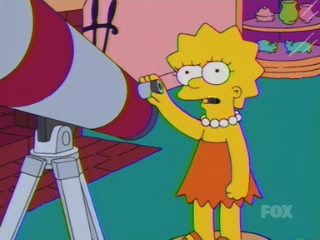
How can design address the problem of light pollution? I'm reminded of the Simpsons episode "Scuse Me While I Miss the Sky." In this episode Lisa campaigns against light pollution, and The City of Springfield decide to turn the lights off. Since it causes a crime wave, Springfield then decide to keep the lights on extra bright all night. No one is able to sleep, and the Simpsons are going mad. It ends with Lisa and Bart convincing a sleep-deprived-Homer to go to the power plant and overload it. The lights go out and Springfield citizens hunts after Homer, but stops short when they are distracted by a meteor shower. While Homer collapses into a deep sleep, the rest of the family watches the night show from their rooftop.

Friday, October 06, 2006

What Do Feral Children and Fairytale Mythologies Have To Do With Design?

Everything.

Yup it's all interrelated. The problem addressed in a Feral Child deals with how the human brain and psychology structures language and make sense of the world. Fairy tale mythologies reflect a culture and society's values, traits demonized or made sacred, similar threads between various versions, and transformation of interpretations throughout history. Design deals with human interaction (i.e. a product, a chair, a remote control), and communication (i.e. magazine layouts, films, billboards, commercials). So ultimately a designer is a myth maker.

When fashion designers decide to design little girl's clothes in pink they further propagate the "pink for girl" myth. While pink does not inherently hold any meaning anymore than blue or gray or fuschia does, our culture have come to associate pink with girls. This was not so before World War II. In fact during Renaissance times blue was associated with girls as paintings of the Virgin Mary often depicted her in blue robes (as coincidentally it was the most precious and expensive color made out of the rare Lapis Lazuli stone for Ultramarine paint, thereby being reserved only for important figures of the Bible).

The findings by psychologists and linguists learned from a Feral Child begs the question of how does one firstly design a better society where neighbors might be more responsible for each other, and not allow something like this to happen. Secondly, if a child constructs a world from the moment they are born, and an interpretation of this world is derived from their experience, then what sort of world does one impart with a new human being? And how can the public school system better educate a youngster not just to be a good citizen but an actualized self?

I don't claim to have the answers, I'm merely making a point that these issues are related to the design of our everyday lives: of life systems, linguistic structures, what we believe to be true, permanent, or possible. If blue and pink are myths, then could other things in our lives be as well? Could our beliefs about our own capability to do something positive about our environmental problem also a myth? That while the problems are real, could it be that the belief "it's too late" a myth as well?

Lastly, I don't claim that designers have the answers either, only that psychologists devising a therapy strategy, teachers creating their curriculums, and storytellers crafting their fairytales are in a way designers too.


NOTES: I learned about pink from Richard Keyes, my color theory professor, however there are some threads on-line discussing this topic:
  1. Lapis Lazuli

  2. Re: Pink -- why feminine?

  3. Gender Specific Colors

Thursday, October 05, 2006

Cinderella Kicks Ass!

I just watched the film Ever After the one with Drew Barrymore and Angelica Huston. Skeptical I thought the film was going to be ultra cheese. I borrowed it to play on the background while I work, but it turned out to be good! It really redefines and expand the Cinderella mythology.

[WARNING SLIGHT PLOT SPOILER FOLLOWS]

For the first time in history Cinderella has a personality! Drew Barrymore is great as the spunky Danielle whom the film alludes to as the "real life story origin" of the fairytale. In Ever After Cinderella is well read and is a vocal civil rights advocate. She is a gal who takes matter into her own hands, and saves herself. There is no Fairy Godmother, no carriage of pumpkin, nor a speck of magic dust. The prince does not save Danielle, she saves the prince.

Angelica Huston plays a deliciously evil step mother. There is an AWESOME scene where both Cinderella and her stepmother crouches over Cinderella's father as he is dying. Suddenly the stepmother is seen not as a villain, but a human being who is jealous of her husband's love for his daughter. Of course there is a touch of Hollywood involved for in reality we could not possibly believe such a string of coincidences, but overall I was impressed!

Other redefinition of fairytale mythologies:
  1. The book:The Stinky Cheese Man by John Sciezska and Lane Smith.

  2. The musical: Into the Woods that was based on the book by James Lapine.

*Also on mythologies: Mythologies by Roland Barthes