(2) BOSKONE 2026 BOOK KICKSTARTER. The New England Science Fiction Association (NESFA) has launched a Kickstarter appeal to fund publication of Dubious Pleasures, a group of previously published short stories by Greg Cox, Writer Guest of Honor at Boskone 63, to be held in February, 2026. The cover art is by Charles Urbach, Official Artist of Boskone 63.
Ray Bradbury is perhaps the bridge between the early visionaries of science fiction and our currently catalogue of Marvel and Star Wars. And it all started just north of Chicago, in Waukegan, Illinois. Larry Potash unearths the true genius of Ray Bradbury in this piece for Backstory. Backstory with Larry Potash airs Sunday nights at 11 on WGN-TV and on smart TVs on the free WGN+ app.
(4) HOME IS WHERE THE HAUNT IS. Henry Corrigan has done a fascinating analysis of the psychology behind Haunted Houses: “Halloween Haunts: This Haunted House Will Save You” at the Horror Writers Association blog.
Everything we do, tends to have a purpose behind it. We humans might be weird, but we don’t really do random. That’s because randomness is risky. It invites chaos and if there’s one thing that both scares and offends us, it’s that something could be done to us, and we’re left with no recourse. We’re just done.
So, to deal with this inescapable fact, we do what we do best. We play pretend. We create stories, structures and scenarios where we can come to grips with it safely. We give ourselves a place where we can put the worst parts of ourselves, all the fear, selfishness, violence and greed, in the hopes that by offering up a safer alternative, we’ll prevent the reality from encroaching on us, if for just a little while.
Everything we do, we do for a reason. They might be twisted to hell and back, but the things we create are meant to keep something worse from happening. And that is as true of seatbelts and airbags as it is of…well, haunted houses.
I’ve loved haunted houses ever since I was a child. The eerie lights, the sounds, the crackling tension that builds before someone or something jumps out at me…it brings a smile to my face even to this day.
I can vividly remember building a mini haunted house with my brother on the second floor of our home. I can’t for the life of me remember why. It wasn’t for Halloween, that much I know. But every once in a while, we’d sneak upstairs and grab anything that came to hand.
We’d stick string to the walls and pretend they were guts or vines. We’d take our old clothes, stuff them with pillows and suspend a ‘body’ from the ceiling. Then, once everything was set, we’d turn off all the lights and tell our parents to come upstairs. We’d make them close their eyes and walk blind into whatever horrors we’d created, laughing our heads off the entire time.
No one really knows where the haunted house came from. Its actual origins are one more thing lost to history. But the story I like most comes from Lisa Morton, author of Trick or Treat, A History of Halloween. She believes that the haunted house was born from much the same activities as my brother and I engaged in. Homemade frights built out of whatever could be brought to hand….
It wouldn’t be spooky season without ghosts. The otherworldly white apparitions are a standby of Halloween celebrations.
But they weren’t always the stereotypical evil spirits we see in books and movies today. The messengers from the afterlife have gone through a variety of makeovers over the centuries, and the word continues to influence the English language in many ways.
Part of the reason for that, said Lisa Morton, author of Ghosts: A Haunted History, is just like ghosts themselves, our fascination with the afterlife just won’t die.
“I think one of the reasons we fear them is that sense that this is the worst part of us and this is what’s going to survive after death,” she said….
A detailed etymology of “ghost” follows.
(6) KEITH RAYMOND DIES. [Item by Steven French.] Dr. Keith ‘Doc’ Raymond, co-founder of the science-fiction magazine Savage Planets, died October 21 after a long illness. (On a personal note, Savage Planets has published a number of my short stories over the past couple of years and Keith was always helpful with his comments and generous with his praise.) Click for larger image.
(7) TODAY’S BIRTHDAY.
[Written by Cat Eldridge.]
October 22, 1938 — Derek Jacobi, 87.
Remember I’m not covering everything here, just what I find interesting.
Derek Jacobi
First, I fondly remember Derek Jacobi from the Cadfaelseries where he played Brother Cadfael, the monk mystery solver. He had an edge to him that belied his supposed monkness.
It lasted for a much shorter period than I thought as the series only went thirteen episodes. There were twenty-one novels, not all of which were filmed, and there are many differences between the plots and characters in the novels.
(Neat note here: Sean Pertwee was Sheriff Hugh Beringar in four episodes (not all).)
Much earlier and certainly less gentle was I, Claudiusin which he played Claudius who was considered rather sane after Caligula, who didn’t survive assassination, and before Nero who succeeded him. He plays the role brilliantly over the twelve episodes and I recommend it to anyone who hasn’t yet seen it.
By no means a major character in it, but he is Probert, Sir William’s valet in Gosford Park. He, in his scenes, is spot on. And this film is of my favorite of the Manor House mysteries.
He was in The Golden Compass film as Magisterial Emissary which according to the film wiki “was a man from Lyra’s world who worked for the Magisterium. He talked to Pavel Rasek about Bolvangar and how it should be protected. He said that Marisa Coulter was going to demonstrate the intercision process on Lyra Belacqua. His dæmon was a black panther.” Now if you read the series and don’t recognize him that’s because they invented his character for the film.
I just discovered he was in Tolkien, a biography of, well, you can guess who. He played as Joseph Wright, Professor of Comparative Philology at the University of Oxford. Tolkien himself was played by Nicholas Hoult, with a younger one performed by Harry Gilby as he would been at eighteen, so presumably during the War.
I’m going to finish off with his performance as Professor Yanna the Tenth Doctor’s “Utopia” episode.
Derek Jacobi here plays the fifth version of the Master whom the Doctor will encounter on screen, and John Simm will the sixth of eight to be so far. This will be the first of three episodes that form a single story along with “The Sound of Drums” and “Last of the Time Lords”.
The episode serves to re-introduce the Master (John Simm), a Time Lord villain of the show’s original run who last appeared in the 1996 television movie Doctor Who.”
Those are my choices. I’m sure yours might be different.
P.S. Cadfael is available on BritBox; I, Claudius is on Acorn; Gosford Park is available to rent on Amazon Prime, as is The Golden Compass; Tolkien’s on Hulu; the new Doctor Who is on Disney+. Did I say yet there’s too many streaming services?
(9) THE HEALING ARTS. [Item by Paul Riddell.] In time for Halloween, may I recommend taking a look at “The Annals of St. Remedius Medical College”, probably the wildest take on alternate Dallas history you’re likely to see for a while? Where else are you going to get the lowdown on Galveston kaiju, the transformation of the State Fair of Texas to an alternative to Burning Man, screenings of “Space Battleship Edmund Fitzgerald,” and the city’s plague of earwax vampires?
(10) IT’S MY PARTY AND I’LL CRY IF I WANT TO. The premise of AppleTV’s Plur1bus is: “The most miserable person on Earth must save the world from happiness.” Premieres November 7.
Edward Stratemeyer had a plan to get American children reading. An ambitious paper merchant in Newark, New Jersey, he’d founded a publishing company, the Stratemeyer Syndicate, in 1906, with the goal of dominating the emerging juvenile fiction market. The company’s success came largely from series books, written by an army of ghostwriters spinning wholesome adventure stories under company-owned pseudonyms. Over the next quarter-century, the Stratemeyer Syndicate would create some of the most enduring characters in children’s literature—Tom Swift, the Bobbsey Twins—whose plucky exploits instilled in young people a love of reading that arguably wouldn’t be duplicated until the Harry Potter books came out at the end of the century.
It was in 1927 that Stratemeyer introduced the characters who would become the company’s tentpole: the Hardy Boys, two small-town brothers of impeccable virtue and daring who would define what it meant to be a 20th-century American boy. They would also inspire the creation of their female counterpart, Nancy Drew, introduced just three years later.
The brothers, Frank, 18, and Joe, 17, live in the Atlantic coastal town of Bayport, where they embody the values of self-reliance, hard work and rigorous honesty. As amateur sleuths, the Hardys traverse gloomy cemeteries and dank caves, forbidding mansions and shadowy hideouts, darting through danger with breezy guile and Boy Scout winsomeness. Their father, Fenton, is a private investigator who encourages his sons’ sleuthing, while their doting mother, Laura, worries…
Everyone who has ever lived on Earth has been well-aware of the moon, but it turns out Earth also has some frequent temporary companions. These “quasi-moons” are small asteroids that enter into a kind of resonance with Earth’s orbit, although they aren’t technically orbiting Earth. In August, this small group of asteroids, called Arjunas, offered another companion to add to the list.
Astronomers at the Pan-STARRS observatory in Hawaii discovered the new quasi-moon, referred to as “2025 PN7,” on August 2, 2025. Their research was recently published in Research Notes of the AAS. Using JPL’s Horizons system and Python tools, they analyzed the orbital data and compared it to other Arjunas and quasi-satellites.
The team found that 2025 PN7 had been in a quasi-orbit for about 60 years already and would likely be nearby for another 60 or so years before departing. Compared to other quasi-moons, this period is relatively short. The quasi-moon Kamo’oalewa has an expected near-Earth orbit of around 381 years, while the total time for 2025 PN7 is 128 years.
Scientists have been aware of these quasi-satellites since 1991, when they first discovered 1991 VG—which some believed was an interstellar probe at the time….
[Thanks to Steven French, Kathy Sullivan, Mike Kennedy, N., Mike Kerpan, Steven H Silver, Paul Riddell, JJ, Andrew Porter, John King Tarpinian, Chris Barkley, Cat Eldridge, SF Concatenation’s Jonathan Cowie, Mark Roth-Whitworth for some of these stories. Title credit belongs to File 770 contributing editor of the day Dan’l.]
Apple TV+ has officially picked up Murderbot, a 10-episode sci-fi drama series starring and executive produced by Emmy winner Alexander Skarsgård (Succession). Based on Martha Wells’ bestselling Hugo- and Nebula Award-winning book series The Murderbot Diaries, the project hails from Chris and Paul Weitz (About a Boy) and Paramount Television Studios.
The action-packed Murderbot received a blinking green light a year ago, with the casting of the title character interrupted by the strikes. The series centers on a self-hacking security android (Skarsgård) who is horrified by human emotion yet drawn to its vulnerable “clients.” Murderbot must hide its free will and complete a dangerous assignment when all it really wants is to be left alone to watch futuristic soap operas and figure out its place in the universe….
The streamer has renewed Good Omens, the fantasy-comedy that started as a limited series, for a third and final season. Production on the show from BBC Studios, and based on the novel by Neil Gaiman and Terry Pratchett, is expected to begin soon in Scotland.
“I’m so happy finally to be able to finish the story Terry and I plotted in 1989 and in 2006,” Gaiman said in a release announcing the news Thursday. “Terry was determined that if we made Good Omens for television, we could take the story all the way to the end. Season one was all about averting Armageddon, dangerous prophecies and the End of the World. Season two was sweet and gentle, although it may have ended less joyfully than a certain Angel and Demon might have hoped. Now in season three, we will deal once more with the end of the world. The plans for Armageddon are going wrong. Only Crowley [David Tennant] and Aziraphale [Martin Sheen] working together can hope to put it right. And they aren’t talking.”…
Star of stage and screen, and one of Britain’s national treasures, Sir Derek Jacobi portrayed the Master (and his alter ego, Professor Yana) opposite David Tennant in 2007’s “Utopia,” fulfilling a life-long ambition of the actor to star in Doctor Who. He also voices the character in audio adventures for Big Finish Productions, credited as the War Master; also voiced the Master in the 2003 Doctor Who audio play “Scream of the Shalka”; and starred as Martin Bannister in the Doctor Who Unbound audio release “Deadline.”
…We are honored to be able to welcome Sir Derek to Gallifrey One this year, his first-ever Doctor Who appearance in North America, courtesy our friends at Showmasters Events. Sir Derek will participate in two main stage interviews during his visit, one on Friday afternoon, and one Saturday, included with general admission. He will also be autographing and doing photo ops on Saturday and Sunday, will do a VIP script reading on Sunday morning, will participate in our guest receptions on Friday & Saturday evenings, and has a separate Diamond Pass; all of these require purchase (see below.) Additionally, he is included in the TARDIS Tag package….
The con will also have Billie Piper, Alex Kingston, and a flock of other Doctor Who actors, writers, and production people.
… With this episode being the first one to contain Gatwa as the sole Doctor, this could mean a shift in the Doctor Who we know and love. Original reboot showrunner Russell T. Davies may be back, but there’s a new Doctor and a new companion at the start of a new season, why not try a new (old) genre as well?
Even if this is just a temporary jaunt into the world of fantasy, it’s proof of exactly what the third special “The Giggle” established: The Doctor took a break to rest and deal with the literal centuries of trauma that he has undergone, and now he can find himself in silly high jinks that are more suited to a classic children’s novel instead of a hardboiled sci-fi paperback….
Eccleston, who played the ninth Doctor in the first season of the show’s revival in 2005, had a relatively brief spell at the helm before being replaced by David Tennant. Eccleston has since been vocal about his mixed feelings about his time on the show. While speaking at the For The Love of Sci-Fi fan convention over the weekend, Eccleston was asked about if he would come back to Doctor Who, and what the BBC would need to do in order to make that happen. Eccleston was brutally honest with his answer, telling audiences, “Sack Russell T Davies. Sack Jane Tranter. Sack Phil Collinson. Sack Julie Gardner. And I’ll come back. So can you arrange that?”…
Netflix is going to start publishing a new report twice a year that details the most popular shows and movies on the platform. The first report, released today, details the most-watched content from January to June 2023, and it’s perhaps the best look yet at how much people are actually watching Netflix’s gargantuan library of titles.
“What We Watched: A Netflix Engagement Report” will track three metrics: hours watched, whether a show is available globally, and a show’s release date. In this first report, the first season of The Night Agent tops the list with more than 812 million hours viewed, followed by Ginny & Georgia’ssecond season (665.1 million hours viewed), The Glory’sfirst season (622.8 million hours viewed), Wednesday’s first season (507.7 million hours viewed), and Queen Charlotte: A Bridgerton Story (503 million hours viewed). Those are only the top five; the full list contains more than 18,000 titles. (Content is included if it has been watched for more than 50,000 hours.)
I’m taking part in a collective action on Substack today. I did not help draft the letter below, but I agree with it. I’ve been planning to shift this newsletter off Substack for a while now, and this is one of the reasons why.
Gladstone signal-boosted a mass letter which begins:
According to a piece written by Substack publisher Jonathan M. Katz and published by The Atlantic on November 28, this platform has a Nazi problem:
“Some Substack newsletters by Nazis and white nationalists have thousands or tens of thousands of subscribers, making the platform a new and valuable tool for creating mailing lists for the far right. And many accept paid subscriptions through Substack, seemingly flouting terms of service that ban attempts to ‘publish content or fund initiatives that incite violence based on protected classes’…Substack, which takes a 10 percent cut of subscription revenue, makes money when readers pay for Nazi newsletters.”
As Patrick Casey, a leader of a now-defunct neo-Nazi group who is banned on nearly every other social platform except Substack, wrote on here in 2021: “I’m able to live comfortably doing something I find enjoyable and fulfilling. The cause isn’t going anywhere.” Several Nazis and white supremacists including Richard Spencer not only have paid subscriptions turned on but have received Substack “Bestseller” badges, indicating that they are making at a minimum thousands of dollars a year….
Filer Robin Anne Reid also circulated the letter to her Substack readers.
(8) CHENGDU CATCHUP. [Item by Ersatz Culture.]
Two new articles published by Southern Weekly
On Wednesday 13th, Southern Weekly published two long articles following up from the Worldcon.
“In those two years, I was in so much pain that I couldn’t communicate with people normally, and I couldn’t take care of myself to a certain extent. My daily spiritual support was to communicate with a group of science fiction fans on the Internet,” he said. “They could give me some comfort. Even if I risk my life, I can do something for them.” For a young man who is used to being self-isolated, these kindnesses and comforts from strangers are almost unbelievable…
He decided that he was not a “science fiction fan” in the strict sense, but a “fan of science fiction fans.”
So, he found another way to do something for his friends. The idea of starting a fan magazine was mentioned by someone in the group, and it stirred something in his heart. He searched for public information about Chinese science fiction fans and found that there was almost no specialized research in the country. “Why do the groups of science fiction fans who cared about me seem to have no part in the narrative of the entire history of Chinese science fiction and seem to have disappeared?”
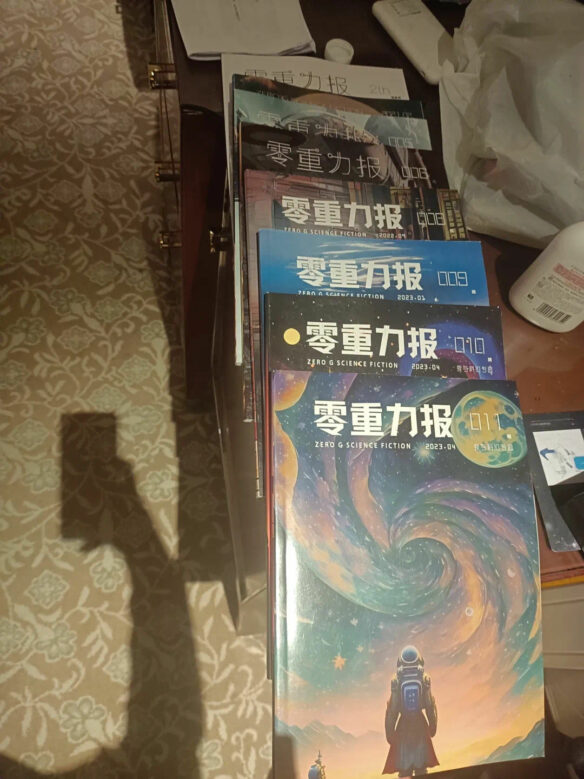
In July 2020, the first issue of “Zero Gravity News” was released. RiverFlow only took one day to typeset it in Word. The issue was not detailed, just excerpting some science fiction news, group discussions, etc. But the sci-fi fanzine had taken one small step.
The second article is ‘A conversation with science fiction scholar San Feng: Why is science fiction fan culture important?’ Much of the article covers the history of the Worldcon, western SF fandom etc and seems to be aimed at a general audience, and so will be already familiar ground to File 770 readers. Later on it moves onto SF in China, which will probably be of more interest. (Again, this is via Google Translate with manual edits.)
Southern Weekly: Does the Chinese science fiction circle also have a similar structure [to SF in the West]?
San Feng: Our science fiction fan culture is relatively recent. According to our research, it was not until the late 1970s and early 1980s that science fiction fans in the strict sense began to appear.
Liu Cixin said that he is the first generation of science fiction fans, including Han Song, Yao Haijun, etc. It can be understood that people born in the 1960s fell in love with science fiction in the early 1980s. At that time, Chinese science fiction did not have a distinct cultural identity of science fiction. Science fiction clubs or science fiction research societies were established in many places, but most of them were in a top-down manner. Many places wanted to organize people to write science fiction, so they set up science fiction research associations.
To truly build a science fiction fan community from the bottom up, I think the landmark event was Yao Haijun’s founding of the science fiction fan magazine “Nebula” in 1988 (note: some say it was 1986). At that time, he was still working as a lumberjack in Yichun [in northeast China]. Because he liked science fiction, he used a mimeograph in his spare time to publish a science fiction fan magazine “Nebula”, which was shared with science fiction fans all over the country. If you got in touch with him and sent a little money to him, maybe a few cents, he would send you a mimeographed magazine.
(Note: both of the above links are to mobile versions of the articles, and have subheadings stating that they will only be freely available for some unstated time period, before going behind a paywall. There are desktop versions of those pages, but those have truncated content, requiring a login to see the full article.)
Three Worldcon reports
The following Chinese-language con reports all strike quite different tones from each other. (All extracts via Google Translate, with manual cleanup edits.)
The first one is by Shen Yusi, and was posted on the Zero Gravity Weixin/WeChat account on November 15th. This one is very positive about the event.
If Liu Cixin won the Hugo Award and let the world hear the strongest voice in Chinese science fiction, then in 2023 the World Science Fiction Convention held in Chengdu allows the world to truly see what the Chinese science fiction community looks like…
I had seen the aerial view of the Chengdu Science Fiction Museum on the official website, which is quite shocking. It looks like a huge piece of silver metal foil flying down by the lake. I once joked that I would never be able to witness this form of the venue with my naked eyes – after all, I can’t fly. From the ground, the venue looks like a huge alien aircraft, with a silver-white outer shell and mostly icy blue light inside. From an aesthetic point of view, this sci-fi feel is relatively avant-garde, rather than being something from the present day…
There were many young people and children at the event, which I had never thought about before. Groups of primary school students visited this event under the guidance of their teachers. There was also an award ceremony for the essay competition in an exhibition hall on the second floor. I can’t do anything other than praise Chengdu’s education sector! Maybe the next Liu Cixin will emerge from these children?
There were many college students on site, including booth staff and student media interviewing guests. As a person who was very capable of making waves when they were in college, I can’t help but sigh and think that it’s great to be young! Many of these college students have not yet shed their youthfulness, and they are full of bookishness and strong idealism. After all, science is “fantastical”. If you don’t have a little bit of the second spirit, how can you have the ambition to conquer the stars and the sea?
The second report was posted to Zhihu – which I think usually gets compared to Western Q&A websites like Stack Overflow or Quora – by Chen Mengyu on November 6th. This one is slightly more mixed; it seems like they enjoyed the more literary, fannish or creative activities, but were bored stiff by some of the more “corporate” events that they stumbled into.
At lunch, the sun was just right and the lake was like a mirror. I lay on a soft chair and had a bite of fried chicken and a Coke, feeling comfortable.
[A woman I’d met previously] invited her friends over, and there were more people. Everyone had finished eating and wandered around chatting. While chatting, I felt that most of the people who like science fiction are middle-class people. There was also a man who flew over from Guangzhou to attend the conference.
I went to the Trisolaris [Three-Body Problem] fan meeting and found that there was a queue of two to three hundred meters. Haha, the last time I saw such a queue was at the National Museum. We gave up on queuing.
Soon we found an area where people were playing a creative game. We were divided into several groups, and given a common starting prompt, each group would start writing one sentence at a time, and at the end there was a vote for the group with the best writing…. My group won first place, and as a reward each person chose a book. I chose
Then I went to the Shenzhen Science and Fantasy Growth Fund panel. My friends became bored, so instead they queued up for the The Three-Body Problem panel. I was the only one who stayed, and I have to admit that it was really boring… The top ten sci-fi cities in the country, as calculated by complex formulas, were announced in the panel: Shanghai, Beijing, Shenzhen, Chongqing, Guangzhou, Xi’an, Chengdu, Hangzhou, Wuhan and Nanjing. This looked familiar to me – the top ten cities ranked by GDP. The list was exactly the same except that Xi’an is not in the top ten by GDP… Then I wrote down a piece of data and was shocked! Beijing and Chengdu have the highest density of science fiction writers, reaching a level of 27 science fiction writers per million people…
Because I drew a lottery ticket for the closing ceremony, I attended it on the next day, but there was nothing interesting in the closing ceremony… there were only two things worth mentioning; one was the simultaneous interpretation, either English to Chinese or Chinese to English. After choosing, if someone speaks English, the interpreter would translate it on the spot and read it out into the earphones, which I found very interesting.
[The other was that] next year’s science fiction convention was represented by Vincent in a kilt. It is foreseeable that there will be many Scottish hunks in kilts at next year’s Worldcon.
(Attached images: chenmengyu[123].jpg)
The final report is a Weibo post from October 23rd, which to be honest is a bit of a snarky rant. This isn’t completely unjustified, as the poster was unable to attend due to the rescheduling, despite living relatively close to Chengdu in a neighbouring province, nor did they have much success with the online component of the con, with both the livestreams and the Hugo voting failing for them.
Your science fiction conference this year is really terrible. I really can’t help but want to curse, but after thinking about it, I might as well forget it…
Since I couldn’t attend in person, I bought an online ticket. However the website locked up, and I couldn’t get in to watch the live broadcast. They didn’t give me a refund. When I asked, they said it wasn’t allowed.
It’s 2023, and a “science fiction conference” that can’t even be broadcast online is awesome.
The Hugo Awards have always been voted for by members who spend money, and I have been a member for a long time. I have been voting for the Hugo Awards in the past few years, but this year I was inexplicably unable to vote. I really admire this organizer.
(9) TODAY’S BIRTHDAY.
[Written by Cat Eldridge.]
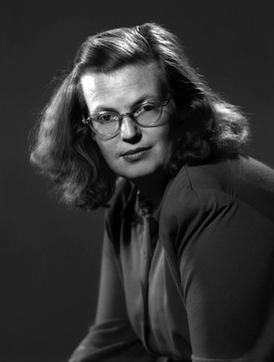
Born December 14, 1916 — Shirley Jackson. (Died 1965.) I was surprised to learn how prolific she was — she composed six novels, two memoirs, and more than two hundred short stories!
Shirley Jackson in 1940.
Her first novel, The Bird’s Nest, she considered a mainstream work of fiction but the publisher didn’t and marketed it as the publishing house marketed it as a psychological horror story. She was right as it’s a woman with multiple personalities, not horror at all.
Her following novel, The Sundial, concerned a family of wealthy eccentrics who believe they have been chosen to survive the end of the world, and was definitely genre as there’s a ghostly presence.
Jackson’s fifth novel, The Haunting of Hill House, Is one that we all know about it. It has been made into two feature films and a play, and is the basis of a Netflix series. It was done as The Haunting in 1963, and then as, errr, The Haunting thirty-six years later. The latter is not faithful to the novel as it is (SPOILER ALERT) an explicit fantasy horror film in which all the main characters are terrorized and two are killed as explicitly supernatural deaths (END SPOILER).
Elizabeth Hand’s A Haunting on the Hill is the first authorized novel set in the world of Hill House. The novel takes place decades after the events of The Haunting of Hill House, as a group of theater professionals rent Hill House to workshop a new play. Lis is reviewing it for us.
The same year she wrote The Bad Children, a one-act children’s musical based on the “Hansel and Gretel” tale. She wrote the book and lyrics with the music being by Allan Jay Friedman.
I’d talk about “The Lottery” short story but I’ve honestly never figured out the appeal of that frankly abhorrent story, so I won’t. If you won’t to, go ahead. Now “The Missing Girl” short story first published in The Magazine of Fantasy and Science Fiction in their December 1957 issue is a chilling work of horror well worth you reading.
It’s available in a collection comprising fifty four stories of the hundred and four that she did called Just an Ordinary Day. Remarkably it’s a Meredith Moment I’d say at just $7.99!
Though in extremely poor health, she produced two final works of note. The first being We Have Always Lived in the Castle, a Gothic mystery novel. Time magazine noted it as one of the Ten Best Novels of 1962.
The following year, she published Nine Magic Wishes, an illustrated children’s novel about a child who encounters a magician who grants him numerous enchanting wishes.
At just one forty-eight years of age, her heart failed, according to both of her biographers, due to a combination of heavy smoking, alcoholism and extreme dependence on pain killers prescribed by physicians who didn’t know better at the time.
…Ask yourself the question, “What if all your imaginary friends were real?” And what if your superpower was you could see them all? Then your life would look a lot like the story of IF, John Krasinski’s upcoming comedy adventure about a girl who discovers that she can see everyone’s imaginary friends and the magical adventure she embarks upon to reconnect forgotten ‘IFs’ with their kids….
Leave the World Behind,Sam Esmail’s first feature film since the success of his tech-thriller series Mr. Robot, deals with themes similar to those of his acclaimed USA Network show. But the connections may not stop there. As one keen-eyed Reddit user noted, the film references a hacking in the tri-state area that nearly led to a catastrophic meltdown at a nuclear power plant. This seems to clearly be a nod to the 11th episode of Season 4, “eXit,” in which Rami Malek’s Elliot nearly hacks a nuclear plant, with catastrophic potential damage….
…Meta Platforms’ (META.O) lawyers had warned it about the legal perils of using thousands of pirated books to train its AI models, but the company did it anyway, according to a new filing in a copyright infringement lawsuit initially brought this summer.
The new filing late on Monday night consolidates two lawsuits brought against the Facebook and Instagram owner by comedian Sarah Silverman, Pulitzer Prize winner Michael Chabon and other prominent authors, who allege that Meta has used their works without permission to train its artificial-intelligence language model, Llama.
… In the chat logs quoted in the complaint, researcher Tim Dettmers describes his back-and-forth with Meta’s legal department over whether use of the book files as training data would be “legally ok.”
“At Facebook, there are a lot of people interested in working with (T)he (P)ile, including myself, but in its current form, we are unable to use it for legal reasons,” Dettmers wrote in 2021, referring to a dataset Meta has acknowledged using to train its first version of Llama, according to the complaint.
The month prior, Dettmers wrote that Meta’s lawyers had told him “the data cannot be used or models cannot be published if they are trained on that data,” the complaint said….
NASA’s Voyager 1 spacecraft has experienced a computer glitch that’s causing a bit of a communication breakdown between the 46-year-old probe and its mission team on Earth.
Engineers are currently trying to solve the issue as the aging spacecraft explores uncharted cosmic territory along the outer reaches of the solar system.
Voyager 1 is currently the farthest spacecraft from Earth at about 15 billion miles (24 billion kilometers) away, while its twin Voyager 2 has traveled more than 12 billion miles (20 billion kilometers) from our planet. Both are in interstellar space and are the only spacecraft ever to operate beyond the heliosphere, the sun’s bubble of magnetic fields and particles that extends well beyond the orbit of Pluto.
Voyager 1 has three onboard computers, including a flight data system that collects information from the spacecraft’s science instruments and bundles it with engineering data that reflects the current health status of Voyager 1. Mission control on Earth receives that data in binary code, or a series of ones and zeroes.
But Voyager 1’s flight data system now appears to be stuck on auto-repeat, in a scenario reminiscent of the film “Groundhog Day.”
A long-distance glitch
The mission team first noticed the issue November 14, when the flight data system’s telecommunications unit began sending back a repeating pattern of ones and zeroes, like it was trapped in a loop.
While the spacecraft can still receive and carry out commands transmitted from the mission team, a problem with that telecommunications unit means no science or engineering data from Voyager 1 is being returned to Earth.
The Voyager team sent commands over the weekend for the spacecraft to restart the flight data system, but no usable data has come back yet, according to NASA….
Set during the Stone Age, the horror film “Out of Darkness” brings a modern twist to the survival story.
The film, which marks both director Andrew Cumming and screenwriter Ruth Greenberg’s respective feature debuts, centers on a teenager (Safia Oakley-Green) who must survive immigrating across the sea and into a foreign land that may or may not house monsters.
The official synopsis for the indie horror film reads: “A group of six have struggled across the narrow sea to find a new home. They are starving, desperate, and living 45,000 years ago. First they must find shelter, and they strike out across the tundra wastes towards the distant mountains that promise the abundant caves they need to survive. But when night falls, anticipation turns to fear and doubt as they realize they are not alone. Terrifying sounds suggest something monstrous at large in this landscape, something that could kill or steal them away. As relationships in the group fracture, the determination of one young woman reveals the terrible actions taken to survive.”…
(16) VIDEO OF THE DAY. [Item by Joel Zakem.] Loontown is a nearly 18-minute animated noir set in a city reminiscent of Los Angeles, whose denizens are talking balloons, gasbags and others of their ilk. It was written by World Fantasy Award winning author Lavie Tidhar and directed, animated and scored by Nir Yaniv, who had previously collaborated with Tidhar on the 2009 novel The Tel Aviv Dossier. Loontown can currently be viewed on YouTube.
[Thanks to Andrew Porter, John King Tarpinian, Chris Barkley, Ersatz Culture, Joel Zakem, Kathy Sullivan, Soon Lee, Cat Eldridge, SF Concatenation’s Jonathan Cowie, and Mike Kennedy for some of these stories. Title credit belongs to File 770 contributing editor of the day JJ.]