(1) MAKE-A-WISH AT WORLDCON. A child’s wish came true at the Seattle Worldcon. (Republished with permission from Facebook.)
The Royal Manticoran Navy would like to extend its heartfelt thanks to the Make-A-Wish Foundation, Seattle Worldcon 2025, Mr. and Mrs. David Weber, and the Talbott Fleet (10th Fleet) for making a very special wish come true for a local Seattle child.
Thanks to your generosity and coordination, this young fan received several autographed books from David Weber, was awarded an honorary Parliamentary Medal of Valor, was named honorary Captain of HMS Truculent for the convention, and received a collection of TRMN-branded materials during a ceremony at Seattle Worldcon 2025.
(2) CORRECTED HUGO REPORTS. The Seattle Worldcon 2025 Hugo Administrators have uploaded a second version of their reports, making some small corrections. They can be downloaded from the following links.
- Administrators’ Report v2: Best Graphic Story or Comic section updated to note that Warp Your Own Way had two nominations in the Best Game or Interactive Work category, not zero.
- 2025 Hugo Voting Statistics: Lodestar vote table updated to correct the No Award tally on the first round, from zero to 17.
(3) KUANG PROFILE. The New Yorker has an article about “The Otherworldly Ambitions of R. F. Kuang”. (Behind a paywall.)
Rebecca F. Kuang finished her second year of college with little sense of what she wanted to do with her life. In the fall of 2015, she took a leave from Georgetown, where she was studying international economics, and got a job in Beijing as a debate instructor. In her spare time, she took coding classes online. “I really like mastering the rules of something and then seeing if I can crack it and get really good at it,” she told me. One day, while on a coding website, she came across an ad for Scrivener, a popular word-processing application. Though she had dabbled in fan fiction, she had little experience as a writer. But Scrivener seemed so easy to use that she downloaded it and began writing a fantasy story. Kuang didn’t know much about structuring a story, so she searched Google for how-to books about plotting, world-building, and character development. Each time she finished a chapter, she e-mailed it to her father in Texas, where she’d grown up. He was an ideal reader, offering nothing but praise and a desire for more. When she sent him the final chapter, he asked, “What are you going to do now?” She consulted Google again and, about seven months after she’d begun writing, found an agent….
(4) THE BIG ONE. Dina of SFF Book Reviews offers “My Thoughts On the Hugo Award Winners 2025”. Dina totally endorses the winner. So I’m going to have to buy a copy after all. (You see, I could never massage the edition provided in the HVP into something that was readable on my Kindle…)
Best Novel
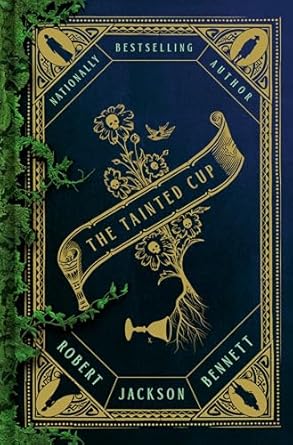
We’ll start with the Big One, because it made me so, so happy that The Tainted Cup by Robert Jackson Bennett won! Congratulations, sir!
I managed to read all the finalists and would have been okay with any of them winning, but The Tainted Cup remained my favorite book of 2024. I’m glad that Robert Jackson Bennett’s AI tweets did not end up costing him a win.
The book was brilliant (and I’m going to read the sequel very soon, I promise). I would also have been glad to get another T. Kingfisher speech as A Sorceress Comes to Call may have been my favorite book of hers yet. I was also pleasantly surprised by Service Model by Adrian Tchaikovsky, which had me chuckle throughout the entire book. The other finalists were all fine books in their own right, but I believe The Tainted Cup is a worthy winner who truly represents the best the genre had to offer in 2024.
(5) EASTERN EUROPEAN SFF FILM PICKS. BFI recommends “10 great Eastern European sci-fi films”.
August 2025 sees the extremely belated British premiere release of Václav Vorlíček’s Who Wants to Kill Jessie? (1966), courtesy of Second Run’s Blu-ray. Anyone more accustomed to the gentler comic observations of Vorlíček’s Czechoslovak New Wave contemporaries Miloš Forman and Jiří Menzel won’t initially know what hit them when confronted with this wild farce in which three characters from the comic-strip ‘Who Wants to Kill Jessie?’ invade the real world as flesh-and-blood humans (albeit still communicating exclusively via speech bubbles that pop up above their heads).
But the film also amply qualifies as science fiction, the above-mentioned situation arising as an unintended side-effect of a process designed to make cows more productive. And the whole notion of utopian visions going disastrously wrong has always underpinned much sci-fi, perhaps especially in Eastern Europe, whose films were often made by people living in would-be utopias that in practice turned out to be anything but….
… This list could easily be doubled in length without sacrificing quality, and the final selection was partly dictated by a need for balance – for instance, a cap of three films per nationality, to avoid Soviet and Czechoslovak films swamping the rest….
The list includes —
Invention for Destruction (1958)
Director: Karel Zeman
Jules Verne’s novels are among the foundational texts of the sci-fi genre, and this visually and conceptually dazzling Czechoslovak adaptation of multiple Verne novels (chiefly 1896’s Facing the Flag) pays simultaneous visual tribute to the iconic etchings of Gustave Doré.
Indeed, no other film looks quite like this one, with director-designer Karel Zeman making extensive use of his background as an animator to incorporate live actors into a world that could have been designed by Doré, down to the black-and-white quasi-engraved line drawing and hatching. Decades before the term was coined, Zeman’s film has also been cited as a pioneering piece of steampunk, for reasons that will be obvious from the first sight of Victorian-era technology standing in for a notionally futuristic weapon – this being the means by which evil Count Artigas (Miloslav Holub) plans to achieve world domination.
Zeman’s other Verne-inspired films include Journey to the Beginning of Time (1955), The Stolen Airship (1967) and On the Comet (1970), with his much-loved The Fabulous Baron Munchausen (1962) being very much a fellow traveller.
(6) NEWBERRY CRIME WRITING WORKSHOP. [Item by Mike Bracken.] Newberry College today announced the launch of the Newberry Crime Writing Workshop (NCWW), an intensive 4-week writers’ workshop for developing crime and mystery authors, taught by major figures in the field. The inaugural workshop will take place July 6-31, 2026, on the historic campus of Newberry College.
Newberry College has always been about helping people grow and develop their vocations, whether that has meant a traditional career or some other gift,” said Professor of English and NCWW co-director Dr. Warren Moore. “This workshop is another way of doing that – we’re working to grow the community of crime and mystery writers, and to keep a popular and powerful genre of fiction vital for today and tomorrow.”
Attendees will take part in daily sessions where they will develop and share their work with one another. Each week’s sessions will be led by an instructor who is active in the crime writing field. The instructors for 2026 include Joe R. Lansdale, Cheryl Head, Michael Bracken, and Moore.
Participants will live and work on the college’s historic campus, with meals provided at the college as well. Part class, part writers’ colony, NCWW is adapting the model of other successful workshops (most notably the famed Clarion Science Fiction and Fantasy Writers’ Workshop) and applying it to a genre with a wide range of fans and writers.
Fifteen applicants will be selected based on samples of work and statements of purpose – writers of any level of publishing experience are welcome to apply. The workshop’s $4000 tuition will cover room and board for the four-week term, as well as instruction, and some financial aid may be available. Applications and further information will be available at the NCWW website: www.newberry.edu/ncww
For further information on NCWW, please contact Prof. Mooreat [email protected].
(7) TODAY’S BIRTHDAY.
[Written by Paul Weimer.]
August 18, 1925 — Brian Aldiss. (Died 2017.)
By Paul Weimer: I first came across the work of Brian Aldiss as an editor in a used copy of an anthology that I fell hard for. That anthology was Galactic Empires, a seminal anthology of SF stories, a two-volume set of over two dozen stories set in such realms, with authors ranging from Arthur C. Clarke, Isaac Asimov and Poul Anderson to A.E. Van Vogt and Clifford Simak. The age of the stories spanned from the 1940’s to the 1970’s, showing not only a wide range of themes and ideas revolving around Galactic Empires, their rises, heights and falls, but also showed the breadth of style changes in the genre over that period. It was a snapshot of the subgenre, right at the time that Star Wars was dominating the cinema and changing SF forever, and a look backward to the roots of the subgenre as well.

I decided after reading it that I needed to learn more about Aldiss’ work. So through the rest of the 80’s and 90’s, I started tracking down his work in used bookstores where and how I could. I hit upon the Helliconia books, which is the original Long Season books (sorry, Mr. Martin) and do a better job of showing how civilization rises and falls and adapts to such long and often tumultuous seasons. The books also lack a central protagonist because they jump forward hundreds of years at a time, as well. So these books worked for me on the worldbuilding much more than characterization or plotting.
I remember trying to read Report on Probability A and bouncing off of it, and I have not dared to try it again. Maybe too literary and experimental for me? I found much better traction with the Hothouse stories, set on an Earth overrun with plantlife, and the few remaining humans looking for a way out of their increasingly restrictive circumstances. I thought of these stories a lot when reading Adrian Tchaikovsky’s Saturation Point, and I wonder how much he was influenced by those stories himself. Certainly, too, the far future of Cage of Souls feels like Aldiss’ Hothouse world in its positively feral jungles.
But where I landed on Aldiss is where I began with him–criticism and editorial work. Billion Year Spree was the second book length piece of SF criticism I read (after Panshin’s Heinlein in Dimension) and it opened up my eyes to the possibility of the form. Was it a germ for me to eventually do my own reviews and genre work? Maybe! As far as his editorial anthology work, I came across a bunch in used bookstores, his Year’s Best Science Fiction works. Hell’s Cartographers showed me the person behind a number of writers of stories I had read.
I always have had a feeling, no matter what I read from Aldiss, be it a story, an anthology he edited, a piece of criticism, that Aldiss had a sense of the SF field in a way that was irreplicable. And that he wanted to share this sense with readers, to express what he was seeing and feeling. He had his fingers on the pulse of science fiction–where it had been, where it was now, and where it might be going. Yes, the SF field was smaller then, and it might be impossible, now. But the breadth of his ability, from writing it, curating it to criticizing it, showed his love and understanding, warts and all, of the field.
Finally of course, his story “Supertoys last all summer long” was a basis for the Spielberg/Kubrick movie A.I.: Artificial Intelligence. I did go down and track down the story, afterwards, and found it and its sequel, both of which have elements in the movie. And the end of Supertoys When Winter Comes hit me in the feels in a way that the movie doesn’t quite land. I can see how Kubrick and Spielberg tried to capture the spirit of the stories, but didn’t quite, in the end, succeed. But the work of Aldiss remains unblemished, important, and strong.
(8) COMICS SECTION.
- Dinosaur Comics gets the lowdown on outer space.
- Free Range has a reunion where the Lincoln green might be turning blue.
- Saturday Morning Breakfast Cereal sees how a human sacrifice plays out.
(9) THE TWO-MINUTE FATE. [Item by Mike Kennedy.] Dopamine city. More cheese than Wisconsin. With all the charm of a soap that’s been through a Veg-O-Matic. (If I sound somewhat cynical and curmudgeonly, well, those are two of my best qualities.) “Vampires, romance and billionaires: The bite-size Chinese shows gaining U.S. fans” at NBC News.
Known as minidramas, micro dramas or vertical dramas, they are soap operas condensed into a minute or two per episode.
Each show, reminiscent of a telenovela, is divided into dozens of chapters, each about two minutes long and with all the soapy elements: cheesy romance, over-the-top drama and abundant cliff-hangers.
“The revenge ones, oh, my God, they’re so good,” California-based retail business owner Jacarius Murphy told NBC News in a video interview.
Murphy is a fan of the minidramas, known as duanju in Chinese, which focus heavily on romance, revenge and fantasy. The stories tend to involve wealthy characters such as a chief executive who’s secretly a vampire or a billionaire living a double life — characters often played by American actors.
“People want this fast dopamine hit, and they can snack on it while they’re waiting,” said Anina Net, an American actor based in Los Angeles who has worked on minidramas for the past four years.
The genre originated in China, where production companies have tapped into the popularity of short-form, vertical-produced, TikTok-style video content. About half of China’s 1.4 billion people consume dramas in this style, according to a report released in March by the state-owned China Netcasting Services Association.
The industry made $6.9 billion in revenue last year, more than China’s total box office sales….
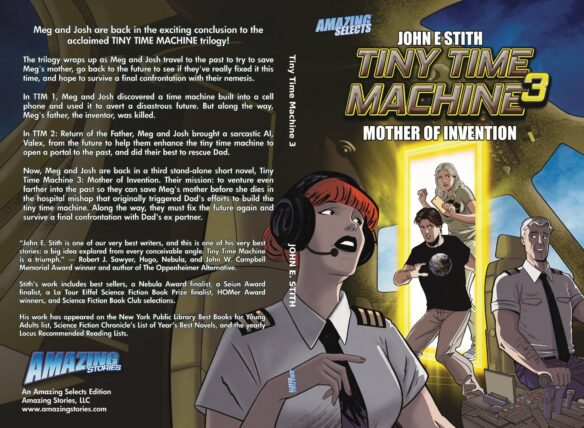
(10) NEW GERROLD NOVEL. Starship Sloane has just published The Girl Who Was Silver by David Gerrold, with cover art by Bob Eggleton, and a foreword by A J Dalton. It has already hit Amazon and soon will be available everywhere.

DAVID GERROLD—Hugo, Nebula, Locus & Heinlein Award winner—presents: The Girl Who Was Silver, a thrilling new dark science fantasy short novel!
Mandarin is torn between worlds, his love for an immortal Silver barely dampened by booze and loathing. The Change is to blame. When a youthful redhead turns up brutally slaughtered in Mandarin’s bathtub, he is yanked headfirst into the churning underbelly of a warring city and its factionalized inhabitants. Someone is playing a murderous game of chess—but to what end? Working for a shadowy enforcement agency in the hunt for answers is only part of the equation for Mandarin—the rest is clear-eyed vengeance. High-tech weaponry may let the light in, but no answers are to be found in the murky realms of trolls, halflings and furies. In the calm after the chaos, Mandarin will find the answers, but at a great and unexpected cost.
“A powerful story. . . . The Silvers can live forever, yet immortality is a dangerous trap. ‘The real world of the immortals remained hidden and secret, deeply removed from the knowledge of lesser beings.’ Every page of the novel is a glimpse into fear, a step towards creatures one would not like to encounter or even think of, and strangely enough—a love song that rings true and holds everything together. The Girl Who Was Silver is an alloy of wisdom, tension and the impossibility to stop reading.”
—Zdravka Evtimova, author of He May Wear My Silence & 4x winner for best novel of Bulgaria
(11) UNKNOWN COUSIN. “New Human Ancestor Identified from Fossil Teeth” reports Scientific American.
Researchers working in northeastern Ethiopia have discovered remains of a previously unknown branch of humanity. The fossils, which include teeth that date to between 2.8 million and 2.6 million years ago, belong to a never-before-seen member of the genus Australopithecus—the same genus to which the famous Lucy fossil belongs. They show that this newly identified member of the human family lived alongside early representatives of our own genus, Homo. The findings were published in Nature on August 13.
The discovery team, led by investigators at Arizona State University, has yet to name the new species because the researchers need more fossils from other parts of the body to do so. But comparisons of the teeth with other fossils from the same site—Ledi-Geraru in the Afar Region of Ethiopia—as well as with other hominin fossils, revealed that they are distinctive enough to represent a species of Australopithecus that is new to science….
(12) THE SPEECH THAT NEVER WAS. [Item by SF Concatenation’s Jonathan Cowie.] ‘The speech that never was’, was the subject of a BBC Radio 4 programme this weekend. Had the Apollo 11 mission failed, and the astronauts could not lift off and rendezvous back with the orbiting command module, President Nixon would have had to make a speech…
You can listen to the 10-minute programme here.
In 1969, William Safire wrote a speech for President Richard Nixon to read in case the Moon landing astronauts never made it back to Earth.
(13) EVERYBODY MUST GET STONED. Selected clips from “The Sorcerer’s Stone but Kermit is Harry Potter”.
[Thanks to Teddy Harvia, Mike Kennedy, Andrew Porter, Paul Weimer, Olav Rokne, Michael Hanscom, John King Tarpinian, Chris Barkley, Cat Eldridge, SF Concatenation’s Jonathan Cowie, Mark Roth-Whitworth, Steven French, and Kathy Sullivan for some of these stories. Title credit belongs to File 770 contributing editor of the day Cat Eldridge.]