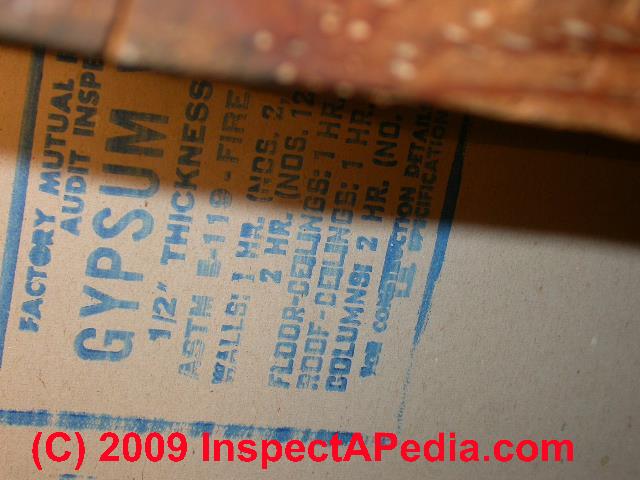
 Drywall Type Identification

- POST a QUESTION or COMMENT about drywall, gypsum board, "sheetrock" panels, brands, manufacturers
Guide to drywall identification
Here we illustrate identifying stamps, labeling, paper imprints, and other details that can help identify specific drywall or gypsum board products.
These markings can help forming an estimate of building age and also help identify drywall products that might contain asbestos.
This article series discusses the identification and history of both modern and older interior building surface materials such plaster and lath, Beaverboard, and Drywall - materials that were used to form the (usually) non-structural surface of building interior ceilings and walls. Our page top photo shows hand-split wooden lath backing for a plaster interior wall.
InspectAPedia tolerates no conflicts of interest. We have no relationship with advertisers, products, or services discussed at this website.
- Daniel Friedman, Publisher/Editor/Author - See WHO ARE WE?
Identifying Stamps on Drywall Used for Interior Wall & Ceiling Surfaces
Here we provide an index to drywall identification stamps, date codes, and markings that help identify brands and types of drywall or gypsum board.
We discuss and illustrate the various types and forms of drywall or gypsum board product identification markings.
General Format of Drywall Identification Stamp Codes
Since 2017, in North America, the following general format is used for drywall identification stamps (USGA 2017)

COMPANY NAME AAA2 0101010930 CCC
- COMPANY NAME of the drywall manufacturer (the company is permitted to encode this data using other characters)
- AAA 2 indicates manufacturing facility and production line number
- 0101010930 identifies the date and time that the drywall was manufactured - in this example, 1 January 2001, at 09:30 hrs.
- CCC - 3-character country ID code as given in the table below
Watch out: depending on when it was manufactured, your drywall may be unmarked or may use stamps and imprints that pre-date or for other reasons do not follow the 2017 guideline given above.
Details for all drywall manufacturers' identifying stamps are
at DRYWALL MANUFACTURER IDENTIFICATION STAMPS & DATE CODES
How to Decode the Information in Drywall / Gypsum Board Stamps, Codes, Numbers
If using the 2017-and-later drywall date stamp decoder just above does not give sensible results then here are more drywall ID stamp decoding tools:
- DRYWALL MANUFACTURER COUNTRY CODES
- DRYWALL TYPE & DATE CODES, OLDER
- DRYWALL TYPE STAMP DECODE by CONTEXTUAL CLUES
- EXTERIOR-USE GYPSUM BOARD - separate article
- FIRE RESISTANT DRYWALL TYPES
- GYPSUM BOARD GYP ROCK SHEATHING - separate article
- GYPSUM BOARD PLASTER LATH SYSTEMS - separate article, solid & perforated gypsum board used under plaster
- MOLD RESISTANT DRYWALL - separate article
- ROCK LATH GYP LATH PLASTER BASE
- TYPE C & TYPE X DRYWALL & TYPE X-Shaftliner - Summary of Fire-Resistant Drywall Types
- TYPE FC3 DRYWALL - Underwriters Laboratories Classifications
- TYPE FSW / FSW6 DRYWALL
- TYPE FSW-C / eXP-C DRYWALL
- TYPE SF3 - R3660 5/8" DRYWALL - fire hazard classification
- TYPE SLX R-1319-BA DRYWALL - fire rating & other information
- TYPE VI DRYWALL R-4155 R
- TYPE X FIRE RESISTANT DRYWALL - & related ASTM Standards
...
Fire Resistant Drywall Type C, Type VI, Type X Drywall & Type X Shaftliner Drywall
Summary of Fire-Resistant Drywall Types |
|||
| Drywall Type 1 | Thickness | Fire Rating | Comments |
| Type C Drywall | 1/2" (12.7mm) 5/8" (15.9mm) |
1-hour | Fire resistant drywall |
| Type eXP-C Core | 1/2" / 5/8" | Fire resistant drywall with extra moisture resistance | |
| Type FSW-C / eXP-C | 5/8" / 1" | Fire-Shield Wallboard, special additives improve fire resistance of type C drywall | |
| Type FSW-C Core | 1/2" / 5/8" | Improved fire resistance of fire-rated drywall | |
| Type FSW / FSW-6 | 5/8" | Fire Shield Drywall with moisture resistance | |
| Type VI Drywall | ... | ... | citation & details needed |
| Type X | 1/2" (12.7mm) 5/8" (15.9mm) 1" |
1-hour | Fire resistant drywall, ASTM C1396,Standard Specification for Gypsum Board - different definitions for each board thickness |
| Type X Shaftliner 5, 6 | 1" (24.5 mm) | 1-hour+ | Type X-Shaftliner drywall is a still-thicker fire-resistant drywall used in areas where extra fire-resistance is needed such as in elevator shaft walls and area separation firewalls, typically in commercial buildings. |
Notes to the table above
- Sources:
Gypsum Association [GA Website] GA-605-2024 PROPRIETARY GYPSUM PANEL PRODUCTS FOR USE IN UL CLASSIFIED SYSTEMS [PDF] available if you sign up with an email and password - local backup copy saved as Gypsum-Board-Products-GA-605-2024.pdf [Difficult to download from the GA website, but if you print to a PDF the download will work - Ed.]
This GA document is the most-complete list of drywall type designations we have found - for currently-manufactured products in 2025.
This document illustrates that for each UL Drywall Type Designation each manufacturer has their own product names, and more-confusing, not all manufacturers produce drywall or gypsum board products of every UL type designation.
CertainTeed Corp. "Types of Fire Rated Gypsum", CertainTeed Corporation, retrieved 2021/07/17 original source: https://www.certainteed.com/drywall/what-fire-rated-gypsum/
(2016)
CertainTeed TYPE C GYPSUM BOARD PRODUCT DATA [PDF] (2016) CertainTeed Corporation P.O. Box 860 Valley Forge, PA 19482 USA Tel: Professional: 800-233-8990 Consumer: 800-782-8777 Website: www.certainteed.com , retrieved 2021/07/17 original source: https://www.certainteed.com/resources/CTG_TypeC_Eng.pdf
Excerpt: CertainTeed Type C Gypsum Board is an interior gypsum board consisting of a solid set, fire-resistive, Type C gypsum core enclosed in ivory-colored face paper and a strong liner back paper. CertainTeed Type C board features a specially formulated Type X core providing superior fire performance when used in specific fire-rated Type C assemblies.
Long edges are slightly tapered, allowing joints to be reinforced and concealed with joint tape and joint compound.
CertainTeed TYPE X GYPSUM BOARD PRODUCT DATA [PDF] (2017) CertainTeed, Op. Cit., retrieved 2021/07/17 original source: https://www.certainteed.com/resources/CTG_2337_TypeX_%20DSS_EN.pdf
Excerpt: CertainTeed Type X Gypsum Board is an interior gypsum board consisting of a solid set, fire-resistive, Type X gypsum core enclosed in ivory-colored face paper and a strong liner back paper. CertainTeed Type X board features a specially formulated core providing fire resistance ratings when used in tested assemblies.
Long edges are slightly tapered, allowing joints to be reinforced../interiors/Drywall-Manufacturer-Identification-Stamps.php#CertainTeedand concealed with joint tape and joint compound.
CertainTeed M2Tech SHAFTLINER TYPE X GYPSUM BOARD PRODUCT DATA [PDF] (2009) CertainTeed Corporation P.O. Box 860 Valley Forge, PA 19482 USA Tel: Professional: 800-233-8990 Consumer: 800-782-8777 Website: www.certainteed.com , retrieved 2021/07/17 original source: https://www.certainteed.com/resources/CTG_CT012_M2TechShaft_E.pdf
CertainTeed FIREWALLS INFORMATION for Canada [PDF] CertainTeed, Op. Cit., retrieved 2021/07/17 original source: https://www.certainteed.com/resources/CTG-2950 Firewalls Info Sheet E R2-14-FINAL.pdf
Excerpt:
M2Tech® technology combines a specially formulated, fire resistive noncombustible core, enclosed in a moisture and mould resistant paper which is 100% recycled with double beveled edges for ease of installation. M2Tech achieves a score of 10 for mould resistance as per ASTM D3273, the best possible scores for these tests.
Note that CertainTeed and probably other drywall manufacturers provide additional product data sheets and environmental products declarations offering varying details describing their products produced by different manufacturing facilities in different locations and serving different countries, states or in Canada, provinces.
Example:
CertainTeed TYPE X GYPSUM BOARD ENVIRONMENTAL PRODUCT DECLARATION [PDF] (2015) for CertainTeed Gypsum manufacturing facilities based at Toronto, Ontario, Canada, retrieved 2021/07/17 original source: https://www.certainteed.com/resources/CTG_TypeX_EPD_Toronto.pdf
National Gypsum, DECODING UL TYPE DESIGNATIONS [Website] for gypsum board products approved for UL fire-rated [and moisture resistant or impact resistant] systems, retrieved 2025/12/02, local backup copy saved as UL-Type-Designations-NG.pdf
USG, US Gypsum, Technical Support: 1-800-USG-4YOU US Gypsum formed the United States Gypsum Company by combining a group of gypsum companies in 1902, introducing the Sheetrock brand in 1916.
At the company's USG Wall Assemblies [Website] USG lists gypsum board UL codes such as UL U407, UL U419, UL V465, etc., and pertinent UL fire codes: such as UL U419 (49) UL U305 (19) UL U493 (18) GA WP 3371 (8) GA WP 5513 (8) PER UL U305 (8) UL U415 UL System B (8) UL U415 UL System A (7)
- Typical 1-hour fire-rated wall construction: Type C and Type X:
Type X or Type C drywall installed on both sides of 2x4 (nom.) wood stud walls 16" o.c. or 3 5/8" steel stud walls 24" o.c. as per various building codes
Type C gypsum board is not defined in any ASTM standard.
Type C products are Type X products with special additives and have a “C” in their trade names to designate they have increased fire resistance. (Thanks to National Gypsum for this detail)
Type X gypsum board is defined by ASTM C1396,Standard Specification for Gypsum Board, and has a different definition for each board thickness: 1/2", 5/8" and 1". - Typical residential locations requiring fire-rated walls/ceilings
include around boiler or furnace rooms, rooms locating a wood stove or coal stove, and on the common wall and adjacent ceiling of garages attached to living space - Typical commercial locations requiring fire-rated walls/ceilings
include most building walls where fire partitions or assemblies are specified, particularly stairwells, fire separation walls, etc. - Shaftwall drywall system Codes / Standards:
ASTM C1396, C475, C645, C754, C840, C1002, C1047, E84, E119; CAN/ULC-S101, CAN/ULC-S102, CAN/CSA-A82.27, GA-600, GA-216, GA-238; UL U417, ULC W446; ICBO ES ER-3579; NER-506; ICBO ES ER-4924 - Area Separation Firewall System Codes / Standards:
ASTM C1396, C475, C645, C754, C840, C1002, C1047, E84, E119; CAN/ULC-S101, CAN/ULC-S102, CAN/CSA-A82.27, GA-600, GA-216, GA-238; UL U366, ULC W311 - Additional Fire Resistant Drywall Identification - paper colors:
besides from the identifying stampings or labeling cited above on this page include the color of the paper covering the drywall sides- CertainTeed Type C fire resistant drywall paper: solid set, fire-resistive, Type C gypsum core enclosed in ivory-colored face paper and a strong liner back paper.
- CertainTeed Type X Gypsum Board paper: solid set, fire-resistive, Type X gypsum core enclosed in ivory-colored face paper and a strong liner back paper.
- CertainTeed Type X Shaftliner paper: Heavy moisture and mold resistant light blue-grey colored face and back paper
...
Table of Drywall Manufacturer Country Codes
If necessary, you can also identify the country where the drywall was probably manufactured (if you don't already know), using the table just below.
ISO Country Codes |
|
| ISO Code | Country Name (English) |
| BEL | Belgium |
| BRA | Brazil |
| CAN | Canada |
| CHN | China |
| COL | Columbia |
| DEU | Germany |
| DNK | Denmark |
| HON | Honduras |
| ITA | Italy |
| MEX | Mexico |
| USA | United States of America |
Notes to the table above
- Sources:
American Gypsum Assoication, IDENTIFICATION CODES on DRYWALL, USGA STANDARDS [PDF] (2017) Gypsum Association, 6525 Belcrest Road, #480 Hyattsville, MD 20782 USA, Tel: 301‐277‐8686 Website: www.gypsum.org - retrieved 2021/07/07 original source: American Gypsum Co americangypsum.com/sites/default/files/documents/GA-1000%20Identification%20of%20Gypsum%20Board.pdf - U.S. ASTM, ASTM C1396/C1396M-17 Standard Specification for Gypsum Board, ASTM, https://www.astm.org/c1396_c1396m-17.html
- U.S. CPSC, NOTICE of INQUIRY, Identifying Labels for Drywall Under
Section 14(c) of the Consumer Product
Safety Act; Notice of Inquiry; Request
for Comments and Information [PDF] (2009)
- U.S. CPSC, NOTICE of INQUIRY: IDENITFYING LABELS for DRYWALL [PDF] U.S. Consumer Product Safety Commission, 24 November 2009, retrieved 2021/07/07 original source: https://www.cpsc.gov/s3fs-public/pdfs/foia_drywalllabels.pdf
- USG US GYPSUM MANUFACTURING LOCATIONS [PDF] US Gypsum, retrieved 2021/07/07 original source: https://www.usg.com/content/usgcom/en/about-usg/worldwide-locations/manufacturing-locations.html
- Details about these drywall identification standards & codes & stamps are
at DRYWALL / GYPSUM BOARD IDENTIFYING STAMP / DATA CODES & STANDARDS
...
Other Methods for Identifying Drywall Manufacturer, Product, & Production Date

Review the formats and decodings of drywall stamps by various drywall manufacturers given below at this page starting at
Look for patent numbers in the drywall stamp
as often we can research the patent number to identify both the manufacturer and to set a ceiling on guesses at the age of the product.
- Find the drywall production date stamp code on the back surface of the product:
this production code can be seen on installed drywall IF the back surface of the drywall remains exposed, for example when only one side of a wall or ceiling has been finished.
Even in a completed structure where all walls are fully enclosed, you might find the production data stamp on drywall in the attic space by lifting insulation there.
The production time stamp shown below was posted by Duncan McAleavy 11 Dec 2023 as he asked the meaning of this stamp.

The drywall stamp shown above is part of a production run identification time stamp, telling when during the production day that drywall came off of the production line. Looks as if it's about 3:10 AM
- Find the drywall end-tape:
Find the manufacturer's name and product name and other information such as drywall dimensions and type on the paper end-tape found on the ends of drywall segments.
You will have trouble finding the end tape after drywall has been installed, because usually those ends are fastened to wall studs or wall sill and top plates where the 2x lumber obscures the tape.
The end tape is also color-coded on modern drywall products, allowing quick identification of drywall thickness and type, such as fire-rated, mold-resistant, moisture-resistant. - Find other printing on the back of the drywall:
some drywall products such as CertainTeed's GlasRoc sheathing and Diamondback don't use end-tapes but have text printed across the whole board surface, indicating the manufacturer, product, and other data such as fire-rating.
Here is an end-tape from USG's Sheetrock drywall brand that we think was produced in the 1930s - cited and discussed below on this page

Below is an example of a drywall stamp that identifies water-resistant wallboard, from Murphy Wall Products, courtesy of InspectApedia reader Kris E.

- Find a stamp along the tapered drywall edge:
modern drywall is often stamped with the manufacturer's name along the paper-enclosed tapered long-edge. These edges, too, will be impossible to see once drywall has been installed. Unless you remove it. - Find patent numbers on the drywall end tape or on inked stamps
on the drywall back: even when end tapes are only partially available or when only partial drywall data stamps are visible, patent numbers can often point to the manufacturer.
...
Context Information Adds Confidence to Guesses at Drywall Date Code Decoding
The ABC's of Decoding or Guessing Older Drywall Age From the Numbers on its Back Surface
Can you decode the manufacturing date stamp on the back of my drywall?
Hello i got this Number on back of my drywall anyone knows when it was manufactured ?
07226505112 Thank you On 2022-05-05 by Sly Bryjak
Reply by Inspectapedia Com Moderator (mod) - suggestions for decoding unknown drywall numeric stamp: 07226505112
@Sly Bryjak,
Have you tried entering that number into one of the online UPC decoders?
I gave that a shot - doesn't look like a UPC.
So we treat the number sequence as a production date-code.
At the start of this article we note that since 2017 there has been a standard drywall date code format used in the U.S. But for older drywall in older buildings or older remodeling efforts, there is not one single standard format for drywall production time/date stamps.
We could guess at decoding the numeric string you gave from the back of your drywall, but we could make a far more-credible guess if we had some contextual information including
- Identity of the manufacturer of the drywall:
found in other stamps on the drywall back surface and/or on the remains of paper tape found on the ends of the drywall. (Usually these are hidden from view against the 2x4 that forms the wall top or bottom plate until or unless the drywall is removed. ) Different manufacturers use different drywall date code formats. - Age of the building
- Age of remodeling
or renovations that may mark the time when the drywall was installed - making it newer than the original building's construction - Area of use:
specific room(s) where we think that drywall was installed (a boiler room may use fire rated drywall where a bedroom may not and where a bath may use a moisture-resistant product). - Building type
(residential, commercial) - Country and city
of the building where the drywall was installed
Armed with that information that permits a reasonableness or "sanity check" on your (or our) guess at the drywall age date code-decoding, then take a look at the drywall date code decoding suggestions found in the article above.
The content of your numeric drywall stamp suggests that your building and this drywall were put up before 2017.
I guess that because since that year the date is encoded as YYMM in the first four digits of the stamp. But 0722 does not yield a year - month (since we just have 12 months in a year).
You might then try several guesses at the drywall's date code translation, checking them for reasonableness against what else we know about the building.
So 07226505112
might be
YYDDDNNNNNN or year -07 day 226 followed by a production plant and sequence number
or
NNNNNNYYDD or plant and sequence number followed by year -05 day 112
...
Type FC3 Classified Wallboard - Drywall

Shown above is an Underwriters Laboratories Inc., drywall (gypsum board) classification stamp R-5482, Classified Wallboard Type FC3, Issue No. B-912. Additional text tell us that this is a 5/8" thick fire rated drywall product.
What is Type FC3 Drywall?
Type FC refers to a fire resistant Floor/Ceiling Assembly designation (FC1-FC8) ) for fire resistance. FC-3 has a 1-hour fire resistance rating.
In more detail, Type FC3 (or Firecode Type C) identifies Type C gypsum board (drywall). Type C drywall is an enhanced version of Type-X fire-rated drywall that is rated to keep its structural integrity longer than the original Type-X.
The number R-5482 refers to the Underwriter Laboratories' file number UL File R5492 that identifies "specialized gypsum board products" including type X fire-rated products.
The Issue No. B-912 is a tracking number used by Underwriters' Laboratories Inc. to identify the specific manufacturer. (Possibly Georgia-Pacific).
UL U312 also refers to a 1-hour fire design rating as we show in the tab le below excerpted from this
National Gypsum CONSTRUCTION GUIDE (2000) [PDF] (National Gypsum website)

...
Type FSW / FSW-6 Drywall - "Fire-Shield Wallboard"
UL drywall type designations FSW and FSW-6 refer to gypsum board or wallboard that are both fire resistant and moisture resistant.
Type FSW Core drywall are designed to meet fire and moisture code requirements in both commercial and residential buildings.
Type FSW drywall is manufactured / sold in thickness ranging from 5/16" to 1" and, using National Gypsum's gypsum board Gold Bond® CP XP products as an example, are also labeled as Type X drywall that the company describes as fire-shield, hi-abuse, hi-impact, or for 1-inch thick drywall, Shaftliner gypsum board.
Type FSW-6 Core drywall describes "glass mat" (fiberglass reinforced" drywall designed for extra moisture resistance for use in high-humidity environments including use as (exterior) sheathing, interior Extreme® Fire-Shield® Type X gypsum board panels, also sold as Gold Bond® eXP® Tile backer (Type X) drywall and even as a 5/8" Glass Mat roof board (DEXcell FA®) .
Sources
- National Gypsum, Decoding UL type Designations [Website] for gypsum board products approved for UL fire-rated [and moisture resistant or impact resistant] systems, retrieved 2025/12/02, local backup copy saved as UL-Type-Designations-NG.pdf
...
Type SF3 R-3660 Wallboard

Photo, SF3 R-3660 - Issue No. B 2068 shown above is provided by reader Pepe Cortez who wrote:
Building is circa 1978-1980, duplex in Central TX near Austin. Does the wallboard label attached provide enough information to determine if the wall contains asbestos? Thank you in advance for taking a look. - Pepe Cortez · Aug 21, 2024
Our reply: @Pepe Cortez,
Your photo shows the Underwriters Laboratories data stamp for SF3 wallboard but not the end tapes or other details that might identify the manufacturer.
SF3 Wallboard was a designation for fire-rated gypsum board, one providing a 15-minute fire resistance rating and cited in various design publications including this Portland Oregon Design Document L507 that describing SF3 as a wallboard produced by BPB Celotex - Type FRP or SF3.
CertainTeed Gypsum, Inc. also produced Type 1, Type SF3, FRPC, ProRoc Type C, ProRoc Type X or Type EGRG wallboard products.
To guess at the age of this drywall we could research the fire resistance standards included in that data stamp, but you already have a ballpark guess at the age of your home. As it's original to the building, this wallboard will have been manufactured at or not long before the date of the home.
Older wallboard or drywall might contain asbestos, and more likely the joint compound used to finish joints on the interior or room side may contain asbestos.
But most often in simple residential applications it won't.
In the same years as when your home was constructed, I built and repaired buildings using 5/8 in thick fire rated drywall.
It was the 5/8 inch thickness (rather than standard 1/2" thickness) -without asbestos - that provided that fire rating.
For example we used standard, non-asbestos 5/8 inch drywall on the common wall between the garage and the home interior (and in certain other areas) to meet fire code requirements.
More significant, it's absolutely no hazard whatsoever if you are leaving it undisturbed.
...
Type FSW-C / Type eXP-C Drywall / FSW-C Core Drywall
Quoting from the source below:
Type FSW-C and Type eXP-C are the UL type designations that identify Gold Bond gypsum board products that are formulated with special additives to improve their fire resistance beyond standard gypsum boards.
Type FSW-C Core: This core type enhances the fire-resistant properties of XP and Fire-Shield boards, making them suitable for more demanding fire-rated wall assemblies.
- National Gypsum, Decoding UL type Designations [Website] for gypsum board products approved for UL fire-rated [and moisture resistant or impact resistant] systems, retrieved 2025/12/02, local backup copy saved as UL-Type-Designations-NG.pdf
...
Type VI R-4155 Wallboard

Our reader asked:
What is the modern equivalent of this Type VI R-4155 R wallboard? What is the "R" designation after the R-4155 number? - Lindsey Watson, 1 December 2025
Type VI Wallboard is a fire resistant drywall classification from UL. This fire resistant drywall board rated for use in some indoor wall & partition & ceiling structures.
The R-4155 R stamp is what UL (Underwriters Laboratories) calls a "Unique Identifier" that accesses more product details in UL's product database. For drywall R-4155 provides what UL calls "Conditions of Acceptability".
In turn, those conditions include a description of the tests that the product underwent, how the product should be installed, and the identity of companies who manufacture this product.
Really? OPINION: Well yes but regrettably, because in the United States product rating, testing, and certification is generally handled by for-profit private companies such as UL, it can be next to impossible for a normal consumer to access those details. You can, however, sign with UL for limited free access (if you can navigate their system) or for more-detailed paid-access.
I spent half an hour trying to search UL's database for R-4155 details, finally stumbling onto 166 rows of documents in UL's Product iQ system and for "Type VI Wallboard" findin 734 entry lines, not one of which was decipherable nor helpful.
Type VI Wallboard R4155 in a 1980's home
Hi - I found this within the chimney chase of my home built in the mid 1980s. I am wondering what type VI wall board is.? The type A chimney pipe is almost touching it.

On 2022-09-13 by Craig Kafura
by InspectApedia-911 (mod) - Type VI fire rated gypsum board
@Craig Kafura,
Type VI gypsum board meets U.S. Federal Standard SS-L-30D describing specific intended uses such as for interior walls and ceilings, plasterbase, fire resistant plasterboard intended to receive 1 or 2 coats of veneer plaster as its finished surface.That is also a fire-rated gypsum board, as we see in the text of the stamp itself as well.
Please tell us
- the location of your building: country and city
- the age of your building
- whether or not you have observed that the interior (room) side of the plaster board whose stamp you show is in fact coated with plaster.2022 guide to contemporary gypsum board types and identification codes
Readers:
For a more recent guide to gypsum board types and identification codes see
GYPSUM PANEL PRODUCTS TYPES, USES, SIZES, AND STANDARDS [PDF] (2022) US Gypsum Association, 6525 Belcrest Road, Ste 480 Hyattsville, MD 20782 USA, Tel: 301-277-8686 Web: www.gypsum.org - retrieved 2022/09/13, original source: https://www.gypsum.org/wp-content/uploads/2011/11/223-04.pdf
And for the older standard see
GYPSUM PANEL PRODUCTS TYPES, USES, SIZES, AND STANDARDS [PDF] (2017) USGA, Op. Cit., - retrieved 2022/09/13,original source https://www.americangypsum.com/sites/default/files/2022-01/ga-223_gypsum_panel_products_types_uses_sizes_and_standards.pdf
Members in 2017:
- American Gypsum Company LLC
- Certainteed Gypsum Canada, Inc.
- Certainteed Gypsum, Inc. Cgc Inc.
- Continental Building Products Operating Company LLC
- Georgia–Pacific Gypsum LLC
- National Gypsum Company
- Pabco® Gypsum
- United States Gypsum Company
...
Type SLX Fire Resistant Drywall, Underwriters Laboratory Drywall Stamp R-1319-BA Issue NO. B5299
Below: an Underwriters Laboratories wallboard fire-rating stamp

See details at
...
Type X Drywall - & Related ASTM Standards
Type X is a fire rated drywall product defined by ASTM E119 and ASTM C1396, that we cite below. Note that some of thes standards will use a different definition for each gypsum board thickness: 1/2", 5/8" and 1".
Type X drywall may be installed on both sides of 2x4 (nom.) wood stud walls 16" o.c. or 3 5/8" steel stud walls 24" o.c. as per various building codes.
Here is what CertainTeed says about Type X drywall in our article
Type X Drywall
Both regular and Type X gypsum board are covered under the ASTM C 1396, gypsum board standard specification.
Regular drywall has naturally occurring fire resistance due to the presence of gypsum in the core but is not fire rated.
Type X drywall has special core additives that allow it to be used in fire rated designs and usually comes in 5/8” thickness.
Type X drywall products will have a UL/ULC Marking printed on the back of each board identifying it as a fire-resistance rated board. - Certainteed, retrieved 2021/07/17 original source: https://www.certainteed.com/drywall/what-difference-between-regular-and-type-x-gypsum-board/
and
Fire rated gypsum drywall is more fire resistant because it contains glass fiber reinforcement and other additives within its specially formulated gypsum core to help it hold up longer to a fire exposure.
Fire rated drywall is referred to as “Type X” and must be third-party certified by an independent testing and listing agency such as UL (Underwriters Laboratories Inc.) and ULC (Underwriters’ Laboratories of Canada) to meet the fire performance requirements prescribed in the ASTM C1396 (CAN/CSA-A82.27) Standard Specification for Gypsum Board. - 2021/07/17 Certainteed, https://www.certainteed.com/drywall/what-fire-rated-gypsum/
We add that in comparison with Type X drywall, Type C products are Type X drywall with special additives and have a “C” in their trade names to designate they have increased fire resistance. (Thanks to National Gypsum for this detail)
- ASTM E119-20 Standard Test Methods for Fire Tests of Building Construction and Materials [ANSI Webstore]
Excerpt:
Significance and Use
4.1 These test methods are intended to evaluate the duration for which the types of building elements noted in 1.1 contain a fire, retain their structural integrity, or exhibit both properties during a predetermined test exposure.
4.2 The test exposes a test specimen to a standard fire controlled to achieve specified temperatures throughout a specified time period. When required, the fire exposure is followed by the application of a specified standard fire hose stream applied in accordance with Practice E2226.
The test provides a relative measure of the fire-test-response of comparable building elements under these fire exposure conditions. - ASTM C1396/C1396M-01
Standard Specification for Gypsum Board [ANSI Webstore]
Excerpt:
This specification covers gypsum boards which include the following:
gypsum wallboard for use on walls, ceilings, or partitions and that affords a surface suitable to receive decoration;
predecorated gypsum board for use as the finished surfacing for walls, ceilings, or partitions; gypsum backing board, coreboard, and shaftliner board for use as a base in multilayer systems or as a gypsum stud or core in semisolid or solid gypsum board partitions, or in shaft wall assemblies;
water-resistant gypsum backing board to be used as a base for the application of ceramic or plastic tile on walls or ceilings; exterior gypsum soffit board for exterior soffits and carport ceilings that are completely protected from contact with liquid water;
gypsum sheathing board for use as sheathing on buildings;
gypsum base for veneer plaster;
gypsum lath for use as a base for gypsum plaster application;
and gypsum ceiling board for interior ceilings and walls.
Gypsum board shall consist of a noncombustible core, essentially gypsum, surfaced with paper bonded to the core.
The specimens shall comply with the following required physical properties: core, end, and edge hardness; straightness of the edges and ends; length; tapered edge depth; flexural strength; humidified deflection; nail pull resistance; permeance; water resistance; and surface water absorption.
Related to ASTM C1396 are these ASTM Standards:
- ASTM C22/C22M-00(2021) Standard Specification for Gypsum - This specification covers gypsum, calcium sulfate combined with two molecules of water in crystalline form. If necessary, gypsum shall be crushed or ground, or both, to the size specified. Different test methods shall be performed in order to determine the chemical composition and physical properties of gypsum.
- ASTM C471M-24 Standard Test Methods for Chemical Analysis of Gypsum and Gypsum Products (Metric)
- ASTM 840-20 Standard Specification for Application and Finishing of Gypsum Board
- This specification covers requirements for the methods of application and finishing of gypsum board.
Construction details for a specific assembly to achieve the required fire resistance shall be obtained from reports of fire-resistance tests, engineering evaluations, or listings from recognized fire testing laboratories.
Gypsum board assembly shall conform to acoustical tests of the specification where sound control is required. Moreover, gypsum assembly shall conform to framing size, fasteners spacing, ventilation, substrate, surface preparation, cutting, and installation application as indicated in the specification.
Materials categorized under this specification include: gypsum boards, gypsum wallboards, gypsum backing board and coreboard, water-resistant gypsum backing board, exterior gypsum soffit board, and gypsum ceiling board.
Finishing materials include: compounds, joint tape, fasteners, nails, screws, and staples. A fire test of assemblies shall be conducted to determine a fire resistance rating required for gypsum board assembly.
Gypsum board shall be cut by scoring and breaking or by sawing, working from the face side.
Masonry or concrete walls shall be dry, free of dust, oil, or form release agents, protrusions or voids, or foreign matter that inhibit bond for adhesively applied gypsum board.
All materials shall be kept dry. Where gypsum board is stored outside, it shall be off the ground, properly supported on a level platform and fully protected from the weather or direct sunlight exposure.
Related to Type X is Type C drywall, but unlike Type X, Type C drywall (an "enhanced" product) isn't described by an ASTM standard.
See also
- TYPE C & TYPE X DRYWALL & TYPE X-Shaftliner - Summary of Fire-Resistant Drywall Types - how are they different
...
Drywall Manufacturers' Identification Stamps & Codes
Moved to DRYWALL MANUFACTURER IDENTIFICATION STAMPS & DATE CODES - alphabetical list - separate web page
Gypsum Board Lath Sheets Used for Plaster Walls & Ceilings = Rock Lath, Plaster Lath, Rock Lathe & Button Board
Now moved to GYPSUM BOARD PLASTER LATH SYSTEMS.
...
...
Continue reading at DRYWALL MANUFACTURER IDENTIFICATION STAMPS & DATE CODES - who made this drywall?, or select a topic from the closely-related articles below, or see the complete ARTICLE INDEX.
Or see DRYWALL TYPE IDENTIFICATION STAMP ID FAQs - questions & answers posted originally on this page
Or see these
Recommended Articles
- AGE of a BUILDING, HOW to DETERMINE
- ASBESTOS in DRYWALL
- DRYWALL, FIBERBOARD, PLASTER INTERIORS - home
- DRYWALL & GYPSUM BOARD COMPOSITION & HISTORY - composition of drywall & drywall history
- DRYWALL MANUFACTURER IDENTIFICATION STAMPS & DATE CODES - alphabetical list of drywall & plasterboard manufacturers & their identifying stamps & list of standards
- DRYWALL TYPE IDENTIFICATION STAMPS - Type codes, letters, numbers, and date codes stamped on drywall
- EXTERIOR-USE GYPSUM BOARD
- GYPSUM BOARD GYP ROCK SHEATHING
- GYPSUM BOARD PLASTER LATH SYSTEMS
- MOLD RESISTANT DRYWALL
- PLASTER TYPES & METHODS in BUILDINGS
Suggested citation for this web page
DRYWALL TYPE IDENTIFICATION STAMPS at InspectApedia.com - online encyclopedia of building & environmental inspection, testing, diagnosis, repair, & problem prevention advice.
Or see this
INDEX to RELATED ARTICLES: ARTICLE INDEX to BUILDING INTERIORS
Or use the SEARCH BOX found below to Ask a Question or Search InspectApedia
Ask a Question or Search InspectApedia
Share this article:Questions & answers or comments about ages & types of wall & ceiling materials, installations & practices.
Search the InspectApedia website
One image per comment; please Bookmark this page to find our response. Comments with an Image or a web link appear after moderator approval.
Private comment? Email editor@inspectApedia.com
Citations & References
In addition to any citations in the article above, a full list is available on request.
- In addition to citations & references found in this article, see the research citations given at the end of the related articles found at our suggested
CONTINUE READING or RECOMMENDED ARTICLES.
- Carson, Dunlop & Associates Ltd., 120 Carlton Street Suite 407, Toronto ON M5A 4K2. Tel: (416) 964-9415 1-800-268-7070 Email: info@carsondunlop.com. Alan Carson is a past president of ASHI, the American Society of Home Inspectors.
Thanks to Alan Carson and Bob Dunlop, for permission for InspectAPedia to use text excerpts from The HOME REFERENCE BOOK - the Encyclopedia of Homes and to use illustrations from The ILLUSTRATED HOME .
Carson Dunlop Associates provides extensive home inspection education and report writing material. In gratitude we provide links to tsome Carson Dunlop Associates products and services.
 |
HOME | ABOUT | ASK a QUESTION | CONTACT | CONTENT USE POLICY | DESCRIPTION | POLICIES | PRIVACY | |
| © 2026 - 1985 Publisher InspectApedia.com - Daniel Friedman | |||||||||
