 Water Well Casing Size

- POST a QUESTION or COMMENT about how to detect, find, and repair leaks in water well casings
Water well casing diameters:
This article explains the reasons that a well driller might recommend installing a larger diameter well bore or well casing.
We include simple calculations showing the change in the volume of water in the well's static head with larger diameters.
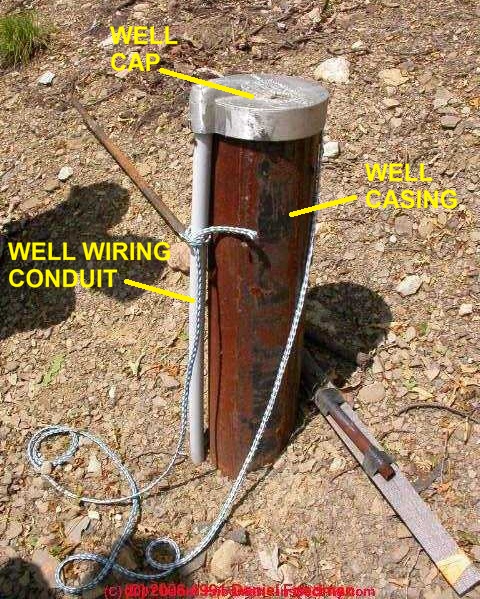
A photo of the above-ground portion of a typical residential 6-inch diameter steel well casing is shown in the photo at the top of this page.
InspectAPedia tolerates no conflicts of interest. We have no relationship with advertisers, products, or services discussed at this website.
- Daniel Friedman, Publisher/Editor/Author - See WHO ARE WE?
Well Casing Size or Well Casing Diameter Choices
 A well casing is a steel pipe that is used to seal and support the sides of a drilled water well.
The diameter of a residential water well casing is 4", 5", 6" or less-often, 8" across. Much larger steel casings are used in high capacity community water wells, commercial or agricultural wells, and in some other water wells.
While soil and well designs vary as ground, soil, rock and water availability also vary in different areas, generally, after the well has been drilled the casing is driven into the drilled opening in the earth to a dept that (usually) inserts the bottom of the casing in bedrock. The drilled well depth continues downwards into bedrock, through which water flows into the well.
The well casing is shown in cross section, represented by the two vertical red lines in our drawing at left. But of course actually the well casing is a round steel pipe. The water piping that picks up water from the well near its bottom is routed up the center of the well casing until it reaches that exit opening in the casing side.
There the piping (and the water it carries) exits the well casing through a pitless adapter (a fitting that seals the hole in the casing), continuing on to bring water to the building the well is serving.
Would an eight inch well as opposed to a six inch well deliver more water pressure?
Our reader asked:
Would an eight inch well as opposed to a six inch well deliver more water pressure? Are plastic or metal pipes better for a residential well? - Di.
Reply: no. but you might want a larger diameter well casing for other reasons we'll give here
Di:
THANK YOU for asking a great question: why would we want to drill a larger-diameter well bore or put in an 8" casing rather than a 6" well casing?
Summary: Larger casing diameter = more static head reserve
In short, a larger diameter well casing will not quite give you more water pressure, but it might give you more water while saving your pump.
Summary: Using plastic well pipe casings, benefits, risks
Some sources, no surprise the manufacturers of plastic or PVC well casings describe the advantages of PVC rather than the traditional steel well casing materials.
In my amateur OPINION, the title of one of the best documents I found on this also hints at where there could be an achilles heel in plastic well casings: the risk of breakage or hydraulic collapse from the pressure of surrounding earth, a problem that will be more-likely to occur if the installer chooses the wrong material.
Improper installation of PVC well casing can also lead to a later collapse. Certainteed (2013) points out that the heat generated by curing portland cement used as well bore grout around the plastic pipe can generate heat that causes the plastic to become more prone to breakage. The company recommends using bentonite clay instead of portland cement for well bore grout around PVC casings.
Resources on Using Plastic or PVC Well Casings
- "SELECTION of PVC WELL CASING Based on Hydraulic Collapse Considerations" [PDF], (2013) CertainTeed Saint-Gobain, PO Box 860, Valley Forge PA 19482, USA, Tel: 866-274-7473 retrieved 2017/08/22, original source: https://www.certainteed.com/resources/HydraulicCollapseBroch40-37-02C_LR_single.pdf
Summary excerpt:
PVC offers many familiar advantages to the well driller, including excellent corrosion resistance and ease of assembly. However, unlike conventional PVC pipe, the primary loading on well casing is external pressure rather than internal pressure. Because of this distinction, understanding the effect of external pressure on PVC well casing is vitally important, as is use of this information in the well casing selection process. - Kurt, Carl E., Roy C. Johnson, and James C. Warman. Engineering Performance of Thermoplastic Water Well Casings. Water Resources Research Institute, Auburn University, 1980.
- Manual on the Selection and Installation of Thermoplastic Water Well Casing, National Water Well Association and The Plastic Pipe Institute, Worthington, Ohio October, 1980. This manual is available in many libraries.
- Parker, Louise V. "Suggested guidelines for the use of PTFE, PVC and stainless steel in samplers and well casings." In Current Practices in Ground Water and Vadose Zone Investigations. ASTM International, 1992.
Abstract:
This paper reviews the literature on PTFE, PVC and stainless steel well casings and samplers and develops a series of suggested guidelines for use of these materials in sampling programs. Three factors are considered: the resistance of these materials to chemical reaction and thus degradation by the environment, the effect these materials have on the integrity of ground water samples, and the physical strength of these materials.
Specifically, factors involved in the corrosion of stainless steel and the ability of aqueous solutions of organics to degrade PVC are discussed. Also considered are sorption and leaching of organic and metal species by these materials. The differences in the behavior of flexible vs. rigid PVC are emphasized.
At PLASTIC PIPE LEAK CAUSES we discuss common causes of leaks in plastic piping.
Comparison of 6-Inch vs 8-Inch Water Well Casings
Now I'll carry on with the reasons to go to a larger diameter well casing. Or not.
Definitions of Water Quantity, Water Pressure, Water Flow
- Well water quantity limit - how much water can you get out of a well
- Water pressure limit - what is the highest water pressure in psi that a pump can deliver
- Water flow rate - how many gallons per minute can you get out of a system or will you see at a faucet
I admit that normal people refer to the force of water exiting their shower head or sink faucet as "water pressure" and it's true that at higher system pressure more water will be delivered through a pipe. But a lager diameter water pipe system could also give more gallons of water flow at the same fixture at the same actual water pressure!
Provided we are not changing the water piping size in the building itself, the well or water pump type, location, horsepower and other features determine both the water pressure and water flow rate - as it is taking water out of the well and sending it to the building.
If you want more details about how we measure the actual water flow rate in a building or through a pipe,
see WATER FLOW RATE CALCULATE or MEASURE
Limitations on Building Water Supply Flow or "Pressure" from a Pump
The pump's flow rate in gallons per minute (GPM) to the building is limited by
- By the capacity of the pump itself, its design and horsepower. We describe the range of water pump capacities
at WATER PUMP CAPACITIES TYPES RATES GPM - By the lift height - how high the pump has to lift the water to get it to you since lifting higher reduces the flow's output GPM. Lift height is also discussed in the pump capacities article above.
- By restrictions in the water piping system: pipe diameter, lengths, number of bends or elbows, even to a degree by the actual material of the pipe and its internal friction
- By the well's in-flow rate: this is the upper limit of the water system once any reserve of water in pipes or casing or tank has been exhausted: the rate at which water flows INTO the well while you're taking water out.
Details are at WELL FLOW RATE - By the presence of flow-limiting devices like a water regulator or a tailpiece in the well or something else designed to protect the pump from running dry
See WELL PIPING TAIL PIECE or take a look
at WATER PUMP PROTECTION SWITCH - for examples of devices to protect the pump if a well runs dry
What If the Pump Exceeds the Well Flow Rate?
A pump that has a GPM rate (GPM-PF) that's taking water out of the well that is above than the rate at which water from the earth flows into the well (GPM-WF) can deliver water to the building at GPM-PF only long as it is drawing water out of the well bore itself.
The volume of water available at a well during pumping is the sum of
- The static head or total volume of water that is in the well bore (from foot valve or submersible pump inlet to top of water column) when the well is at rest and fully recovered.
Details of "static head height, volume, pressure" as used in this discussion are
at WELL DYNAMIC HEAD & STATIC HEAD DEFINITION - The well recovery rate: the rate at which water flows into the well bore from the aquifer into which the well is tapped. (GPM-WF) - in many wells this is a complex number as there may be a number of fissures or passages through which water flows into the well bore, varying in flow rate and flow duration at different heights in the bore.
A well's recovery rate is normally defined as the sustainable flow rate the well can provide over 24 hours.
Details are at WATER FLOW RATE CALCULATE or MEASURE
Watch out: But if GPM-PF is higher than GPM-WF, once the pump has drawn water down to where the pump's intake opening is in the well, one of two things happens:
1. The pump starts to suck air, or runs dry, or burns up -
or
2. A pump limiting device built into the water system right at the pump or at other controls that may be elsewhere will actually begin to operate to slow the pump's output to protect it from running dry and being ruined.
Benefits of a Larger Diameter Well Casing or Well Bore
If for the same depth we drilled for and installed a larger diameter well bore and well casing, what do we get?
The larger diameter increases the volume of water in the well bore or the well's static head.
I found my numbers on the volume of water you'll get in a foot or meter of well casing for different casing diameters like a 6-inch or 8-inch casing by using our on-page search box of InspectApedia.com to look for “volume of water in a well casing”
Among other well casing diameters given in that article in
this TABLE OF WELL WATER VOLUME / QUANTITY you'll see that
- one foot (12") of six inch well casing holds about 1.5 gallons of water
- one foot (12") of eight inch well casing holds about 2.8 gallons of water
If you want to see how to calculate the volume for a well of any diameter and depth, that same article includes the formula
at STATIC HEAD VOLUME CALCULATION where we describe static head height, total dynamic head and other well hyrdraulics terms as well as showing how to calculate the volume of water in a well casing in gallons or liters.
Really? As used by well drillers in describing well properties and in many textbooks cited in this article series, static head, used as we have defined it here, could more-properly be called "static head height" since we are focused on the height of the water column and the volume of water it represents.
Alternatively, in hydraulics, static head is sometimes used as a synonym for pressure head - the water pressure measured at the bottom of a column of water. Static head in this use could for clarity be called pressure head, or static head pressure.
Thanks to reader Dave for critique of this discussion by comment 2019/03/30.
How Much More Water is in a Two-Inch Larger Diameter Well Casing?
That means that your 8-inch well casing gives you almost double the volume of water in the static head (actually 1.86 times as much as a 6 inch casing if my math is right).
So you will NOT get more PRESSURE from your fatter water well casing but your well will have a larger static head.
When Do We Want a Larger Diameter WelL Casing?
Whether or not that makes the slightest difference depends entirely on the total well depth and even more-so on the actual height of water in the well at rest - the true static head.
If your particular well were just twenty feet deep (chosen to make the math easy) and if the static head were ten feet, then you'd have a static head of (2.8 x 10) = 28 gallons instead of (1.5 x 10) 15 gallons.
Now suppose somebody actually installed that not-very-deep well.
Suppose the installer also put in a pump that has a capacity of GPM-PF just 5 gallons per minute GPM of output. And let’s pretend that the lift height nd piping and other restrictions were zero.
Then the pump in the 6-inch well could run for just 3 minutes (15 gallons / 5 GPM-WP) before it would depend entirely on the flow rate INTO the well - not so nice, right,
But suppose the well has a well inflow rate GPM-WF that is 10 gallons a minute.
A pump with a GPM-PF of 5 is sucking water out at 5 gallons a minute but the well admits water in to its static head at 10 GPM-WF - the well is always ahead and the pump can keep sending water to you.
Hot dog!
For that case, an 8-inch well casing and the 28 gallons didn’t buy you anything because the well flow rate was already greater than the pumping rate.
BUT
What if the well flow rate is terrible, say 1 gallon per minute.
In our well with a 10 foot static head holding 15 gallons, during the 3 minutes we are sucking water out at 5 gpm and getting water in at 1 gpm so over 3 minutes we took in 3 gallons and sent out 5.
We have 2 gallons spare - that gets sent out in the next minute and the pump quickly falls behind the well's flow-rate.
The pump either runs dry and burns up or its output must be limited by a controller to that of the well: 1 gallon a minute - and that’s all you’ll ever see in the house after the first 3 minutes (approximately)
Big Well Casing to the Rescue
So what does the well driller do about this mess?
She drills a deeper well AND / OR she uses a larger well casing (perhaps both) so that she gives you a well with a huge static head, maybe a 100 foot static head holding 150 gallons of water, figuring that you’ll usually turn off the shower well before you’ve sucked out all of that 150.
THAT’s why a driller might want a bigger diameter well casing - you might get a bigger static head without having to drill deeper in nasty ground.
Well flow rate is explained in detail at a live link we give below WELL FLOW RATE
The total water quantity that can be gotten out of a well is explained at a live link given below for WELL QUANTITY TOTAL
...
...
Continue reading at WELL DYNAMIC HEAD & STATIC HEAD DEFINITION or select a topic from the closely-related articles below, or see the complete ARTICLE INDEX.
Or see these
Recommended Articles
- WATER PUMPS, TANKS, DIAGNOSTICS for explanation of well pumps and water storage tanks or pressure tanks and their controls.
- WELL CASING LEAK REPAIRS
- WELL CAPS & COVERS - well casing cap sealing and venting requirements
- WELL FLOW RATE
Suggested citation for this web page
WELL CASING DIAMETER CHOICE at InspectApedia.com - online encyclopedia of building & environmental inspection, testing, diagnosis, repair, & problem prevention advice.
Or see this
INDEX to RELATED ARTICLES: ARTICLE INDEX to WATER SUPPLY, PUMPS TANKS WELLS
Or use the SEARCH BOX found below to Ask a Question or Search InspectApedia
Ask a Question or Search InspectApedia
Share this article:Search the InspectApedia website
One image per comment; please Bookmark this page to find our response. Comments with an Image or a web link appear after moderator approval.
Private comment? Email editor@inspectApedia.com
Citations & References
In addition to any citations in the article above, a full list is available on request.
- [1] J.E. Johns, TecWel; D.N. Cary, Seal-Tite International; J.C. Dethlefs, ConocoPhillips; B.C. Ellis, Seal-Tite International; and M.L. McConnell and G.L. Schwartz, ConocoPhillips, " Locating and Repairing Casing Leaks with Tubing in Place - Ultrasonic Logging and Pressure-Activated Sealant Methods", Society of Petroleum Engineers, Offshore Europe, 4-7 September 2007, Aberdeen, Scotland, U.K., Document 108195 (Conference Paper), 2007
- [2] Link-Pipe, Inc., 27 West Beaver Creek Road - Unit #2 Richmond Hill, ON CANADA L4B 1M8, Link-Pipe manufactures "no-dig" pipe repair products for wells. Tel: 800-265-5696 or email: info@linkpipe.com or website: http://www.linkpipe.com/wells.htm
- [3] Prentice Creel and Ronald J. Crook, Halliburton Energy Services, Inc., " Injectrol® and PermSeal Sealants Repair Leaks, Restore Integrity to Casings", Halliburton Service Center, 877-263-6071, web search 6/27/12, original source: http://www.halliburton.com/public/cem/contents/Papers_and_Articles/web/I_through_O/InjPerm.pdf [copy on file as Injectrol.pdf]
- [9] W. B. Allen, Flowing Wells in Michigan, 1974 U. S. Geological Survey, Water Information Series Report 2
- [10] ASTM D 5299-92, Standard for Decommissioning of Ground Water Wells, Vadose Zone Monitoring Devices, Boreholes, and Other Devices for Environmental Activities, 1993, American Society for Testing Materials, West Conshohocken, Pennsylvania.
- "Freezeproof Your House," Mike McClintock, Rodale's New Shelter, p. 30, October 1985 (approximate date)
- "How to Winterize Your Pipes," Mike McClintock, Homeowners How-To Magazine, p. 59-62, Nov-Dec 1979.
- Thanks to reader Dan Babb for discussing well piping leaks, July 2010
- Our recommended books about building & mechanical systems design, inspection, problem diagnosis, and repair, and about indoor environment and IAQ testing, diagnosis, and cleanup are at the InspectAPedia Bookstore. Also see our Book Reviews - InspectAPedia.
- In addition to citations & references found in this article, see the research citations given at the end of the related articles found at our suggested
CONTINUE READING or RECOMMENDED ARTICLES.
- Carson, Dunlop & Associates Ltd., 120 Carlton Street Suite 407, Toronto ON M5A 4K2. Tel: (416) 964-9415 1-800-268-7070 Email: info@carsondunlop.com. Alan Carson is a past president of ASHI, the American Society of Home Inspectors.
Thanks to Alan Carson and Bob Dunlop, for permission for InspectAPedia to use text excerpts from The HOME REFERENCE BOOK - the Encyclopedia of Homes and to use illustrations from The ILLUSTRATED HOME .
Carson Dunlop Associates provides extensive home inspection education and report writing material. In gratitude we provide links to tsome Carson Dunlop Associates products and services.
 |
HOME | ABOUT | ASK a QUESTION | CONTACT | CONTENT USE POLICY | DESCRIPTION | POLICIES | PRIVACY | |
| © 2026 - 1985 Publisher InspectApedia.com - Daniel Friedman | |||||||||
