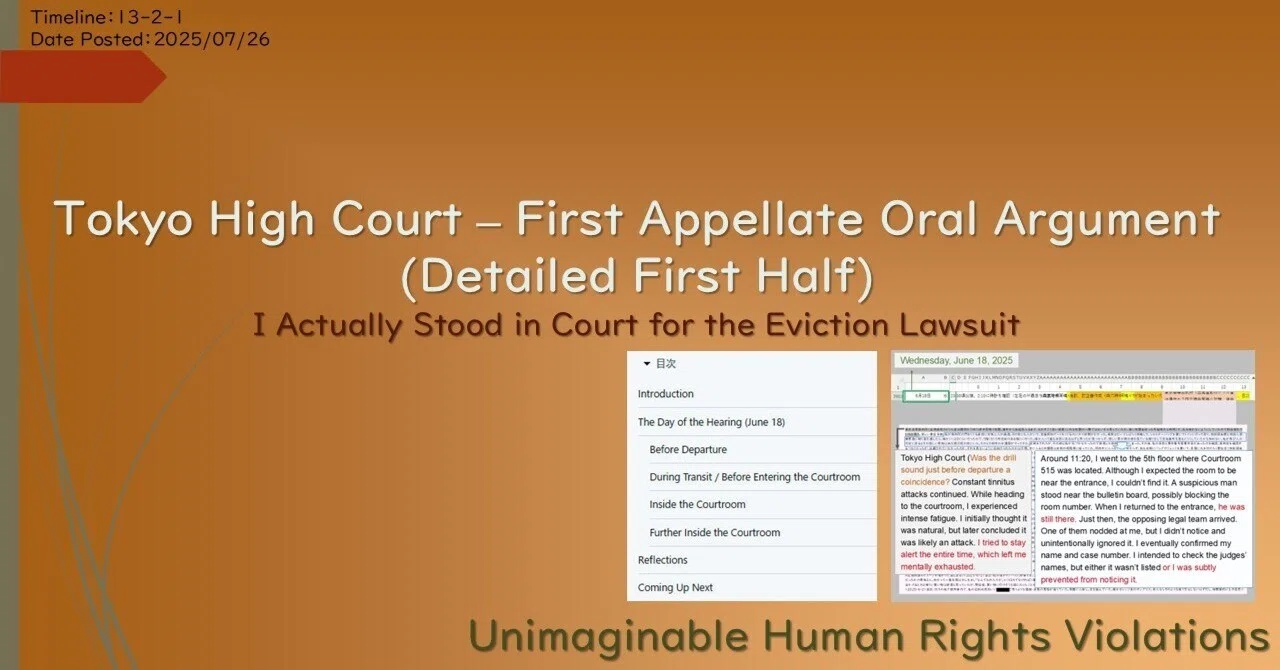
Tokyo High Court – First Appellate Oral Argument (Detailed First Half)

Introduction
On Wednesday, June 18, 2025, the first oral argument of the appellate trial regarding the eviction lawsuit (Appellant = Defendant in the original trial = myself) was held.
A summary of this hearing was posted on June 20.
This article, together with the next installment, offers a detailed account of what happened on that day.

The Day of the Hearing (June 18)
Before Departure
Below is a transcription of the sleep log and pre-departure activities on the day of the hearing.

I likely slept no more than 2–3 hours.
I had discovered errors in documents I had previously submitted, and decided that it would be more appropriate to submit a written correction than to try to explain orally.
I also feared that I might be made to oversleep again, so I deliberately got up early.
The mention of "considering the possibility of settlement" reflects my prior knowledge that settlement proposals are often strongly encouraged in civil appellate trials.
To briefly summarize my core argument:
"The eviction negotiation process was conducted in violation of the principle of good faith (Civil Code, Article 1, Paragraph 2), and the termination notice itself is legally invalid."
Therefore, if a settlement were to be proposed without considering this core argument, I believed I would need to object.
Shortly before leaving home, I began to feel a type of fatigue distinctly different from the usual.

During Transit / Before Entering the Courtroom
Figure 2 transcribes the events during my travel to the courthouse and just before entering the courtroom.

Just before leaving, while still in my room, I heard drilling sounds.
In my diary, I noted "Was this a coincidence?" because, similarly, loud drilling noises had echoed from the walls just before I left for my second oral argument at the Tokyo District Court.
The fatigue I sensed before leaving intensified during transit.
I strongly suspected this to be a new type of "fatigue attack."
Uncertain what might happen if I let my guard down, I endured it with all my strength.
At both the Tokyo District and High Courts, multiple courtrooms (e.g., Courtroom 515–520) are listed on each floor, with branching corridors.
According to the signage, Courtroom 515 should have been at the near end of a corridor—but I couldn't find the sign for "Courtroom 515" and ended up walking all the way down the corridor.
Upon returning to the entrance of the corridor, I finally found the sign.
From the moment I entered the corridor, a suspiciously large man was standing beside the entrance to Courtroom 515, partially blocking the sign.
I believe this is what caused my confusion.
I instinctively judged him to be suspicious and avoided approaching him, which likely contributed to me missing the sign altogether.
If he was affiliated with an organization conducting human experimentation, it’s likely he anticipated I would behave this way—suggesting he may have deliberately positioned himself there.
While I waited for him to move, the opposing party’s attorneys arrived, though I did not initially recognize them as lawyers.
The case schedule posted outside Courtroom 515 was densely packed with small text.
I managed to locate my name, case number, and case title, but could not identify the presiding judges.
The suspicious man remained firmly planted in front of the board.

Inside the Courtroom
Figure 3 shows the situation upon entering the courtroom.
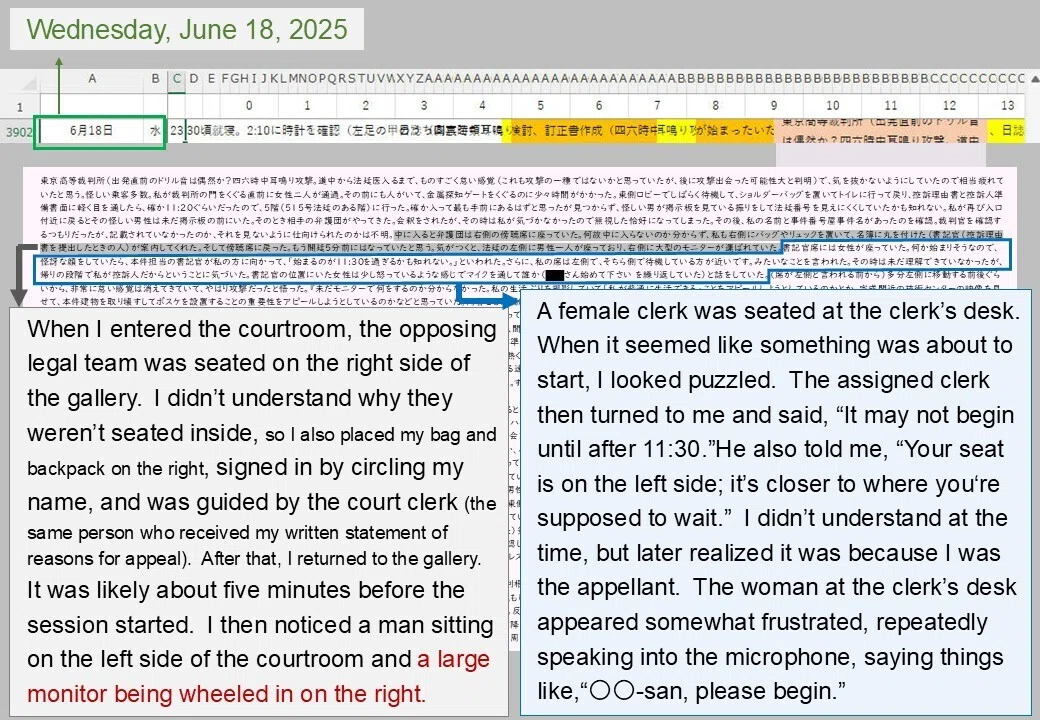
When I entered the courtroom, the legal team was seated on the right side of the gallery.
I wondered, “Why aren’t they entering the courtroom proper?” and “Why are they sitting on the right side?”
Still, I first marked the attendance sheet and handed two copies of the correction document (one for the court and one for the appellee) to the clerk assigned to my hearing, who had approached me.
Afterward, I returned to the right-side gallery seats.
A large monitor was brought in on the right side, and I noticed one man already seated on the left side.
A woman was seated at the clerk’s desk—she later turned out to be the clerk from the previous session. She was repeatedly saying “○○-san, please begin” through a microphone.
I had no idea what was going on.
At some point—though I don’t recall exactly when—the clerk informed me that the hearing might be delayed.

Further Inside the Courtroom
Figure 4 presents additional developments inside the courtroom.
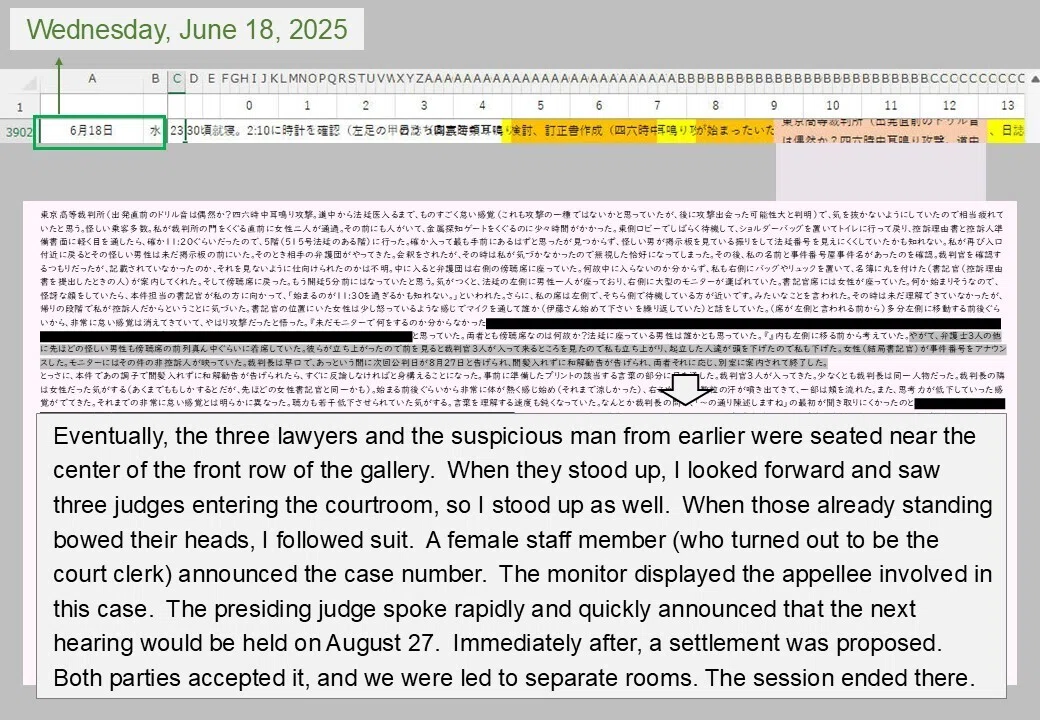
The same suspicious man who had blocked the bulletin board earlier was now seated in the center of the front row of the gallery.
Soon, the assigned clerk (a man) told me, “Your seat is on the left; that’s where you should wait.”
I was confused, not understanding the reason.
A woman—who was seated in front of me, eyeing me with apparent suspicion—kept glancing at me three or four times, always with the same look.
Unbeknownst to me, the lead attorney from the opposing team and the clerk had stepped outside the courtroom and returned while chatting.
Eventually, the legal team stood, and when I looked forward, I saw three judges entering.
I stood up, still not understanding the situation, and bowed in haste when the attorneys did.
A person appeared on the monitor, and the female clerk announced the case number.
At that moment, I finally realized it was a remote oral hearing.
From there, everything proceeded with extreme speed.
The presiding judge spoke rapidly, and both parties responded in kind—it was over in a flash.
A settlement proposal was announced, and both sides agreed.
We were then guided to separate rooms.
Reflections
The unusual fatigue I sensed shortly before leaving home, which intensified during transit and then diminished while waiting in the courtroom, strongly suggests that it was a deliberate attack aimed at interfering with the oral argument.
Had I been able to properly read the bulletin board, I likely would have realized it was a remote hearing and that there was a delay.
I believe the primary causes of my confusion were:
(1) the interference from the large man, and
(2) the cognitive impairment due to the fatigue attack during transit.
What happened after the hearing (to be detailed in the next installment) confirmed my suspicion that the man had indeed been there with intent.
It was only on my way home that I remembered I was supposed to be seated on the left—something I had looked up in the past.
Appellants typically sit on the left side.
I also suspect the delay in the remote session may have been intentional.
I believe I was already in a state of confusion before the hearing even began.
Coming Up Next
In June 2025, I posted a summary article titled "Tokyo High Court – First Oral Argument (Overview)," which included an X (Twitter) post written shortly after I returned home.
I somehow managed to reach the courtroom, though I wouldn’t say I was “safe.”
Strange things had already been happening even before the hearing began.
During the session, I experienced simultaneous attacks: sudden hearing loss, cognitive impairment, intense heat in my body, and profuse sweating from my forehead. On the way home, I was subjected to even more.
I continue to suspect that the unimaginable human rights violations I’ve endured are linked to the development of horrifying technologies—technologies capable of remotely controlling brain activity.
I have previously shared posts on X expressing concerns about such technologies.
If there are influencers from both 'Group A' and 'Group B,' and the technology currently being tested on me becomes widespread, allowing Group A to acquire it, there is a possibility that Group B's influencers may suffer from unexplained health or cognitive issues, rendering them… pic.twitter.com/mRxxiGaYpq
— えむたや (@emtaya_3) August 30, 2024
During this hearing, I believe I actually experienced exactly what I had been warning about.
In the next installment, I will explain these points in further detail.
※ The second half was posted on July 31, 2025.

