
Interference Just Before Submitting the Written Statement of Reasons for Appeal and the Moment I Nearly Broke

Introduction
The other day, I posted about the events from April 24 to 26, a few days before I submitted my written statement of reasons for appeal on April 28, 2025.
This time, I will report on what happened from the day before to the day of submission, based on my diary records.
As in the previous post, I have transcribed records of events that I believe may be related to human experimentation, such as attempted image transmissions. I plan to explain these in more detail at another time.

April 27 (The Day Before Submission)
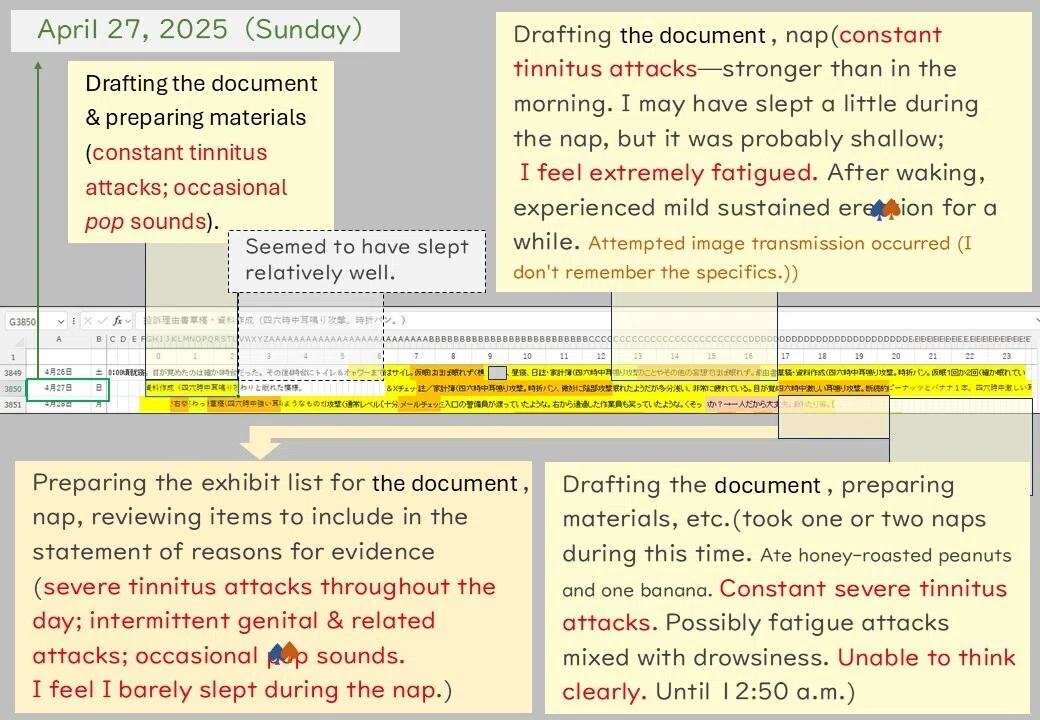
The following illustration (Figure 1) visualizes the entire record for that day.
< the document = the written statement of reasons for appeal >
I continued working on the draft and supporting materials for the written statement until around 2:40 a.m., following on from the night of April 26.
After that, I seemed to have slept relatively well for about four hours. Although not shown in Figure 1, I also seemed to have had a relatively restful nap in the afternoon.
However, starting in the afternoon, the tinnitus attacks intensified, and even several nap attempts were disrupted.
As noted in my diary entries—such as “extremely fatigued” and “can’t think”—the interference against the preparation of the written statement was particularly intense.
I cannot speak for those who experience tinnitus due to aging or illness, but even when it is not particularly loud, such attacks interfere with my ability to think or concentrate.
This condition has persisted for over seven years.

April 28 (Day of Submission)
Morning
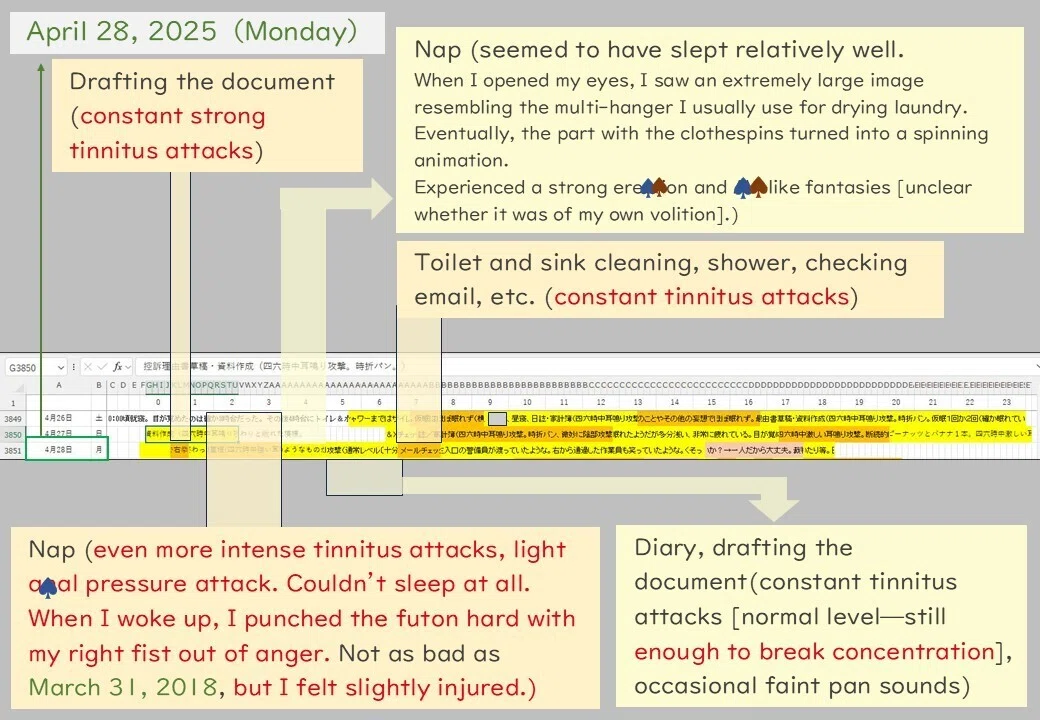
The following illustration (Figure 2) visualizes the morning records of the day.
< the document = the written statement of reasons for appeal >
It was nearly an all-nighter.
Because of light a♠al pressure attacks and complete sleeplessness, I ended up punching my futon hard with my right fist.
This reflects the frustration I felt from the relentless interference in trying to complete the statement.
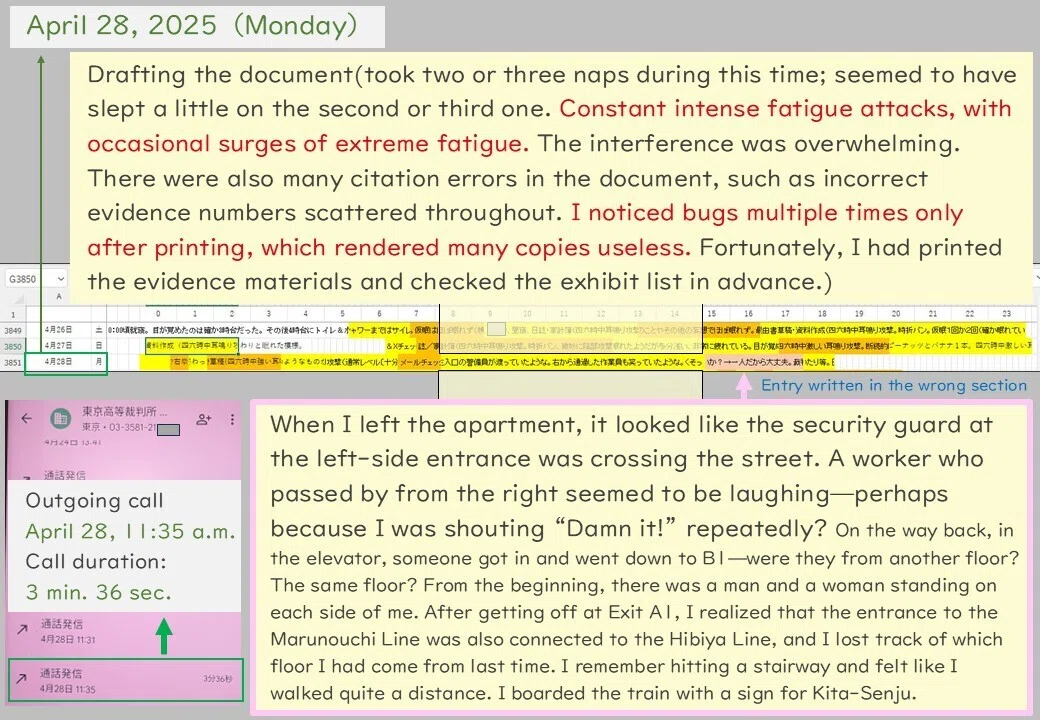
The following illustration (Figure 3) visualizes the time just before I left for the Tokyo High Court.
The latter half (highlighted in pink) was mistakenly recorded in the wrong section after I returned home.
< the document = the written statement of reasons for appeal >
The record says, “Constant heavy fatigue attacks, with occasional severe ones. Extremely disrupted.”
In the morning, I had the sense that I could submit the statement in the early afternoon—or possibly even in the morning. However, I determined it would be impossible and called the relevant section at the Tokyo High Court to inform them I would be late.
Still, at the time, I believed I could submit it by around 3:00 p.m.
The person I spoke to replied something like, “It should only take 20–30 minutes, so I’ll stay until the end.”
I interpreted this to mean that the officer would remain in the room, as checking the documents wouldn’t take too long, even if the submission was right before closing.
During this period, I attempted two or three naps and recorded that “I seemed to have slept a little,” but I was made to wake up far later than expected during the final nap.
This, combined with discovering numerous mistakes, left me panicking and repeatedly shouting, “Damn it!” while correcting them.
During that time, I genuinely felt like I was about to break. And so, once again, I made up my mind to say, “To hell with it.”

While Out
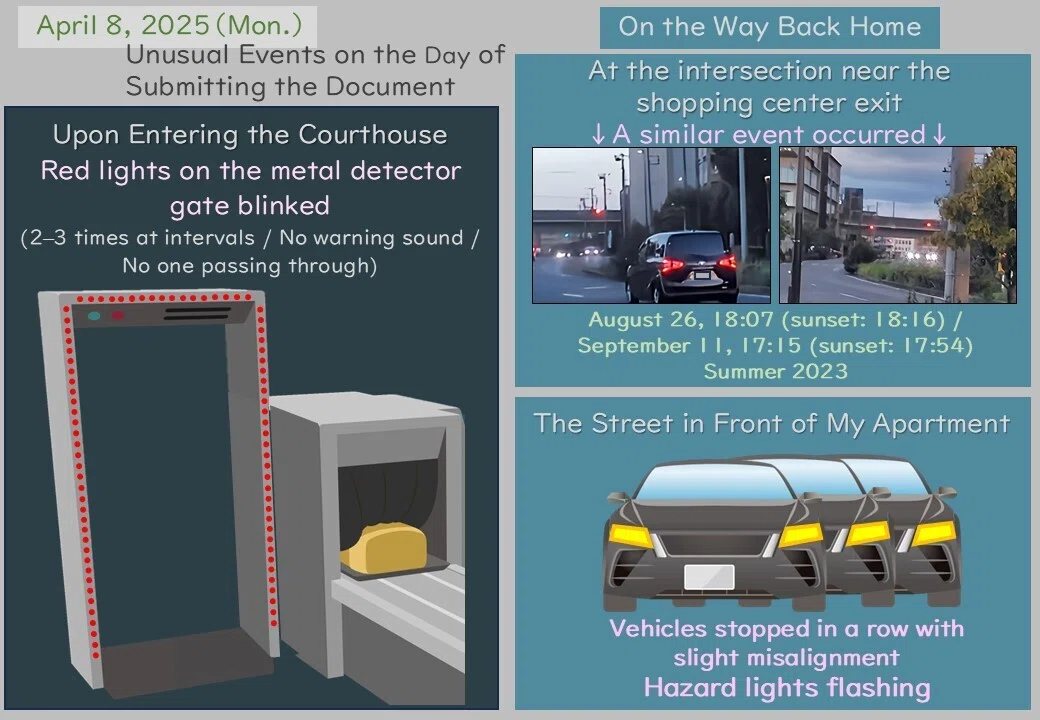
The following illustration (Figure 4) visualizes the events during my outing and at the Tokyo High Court.
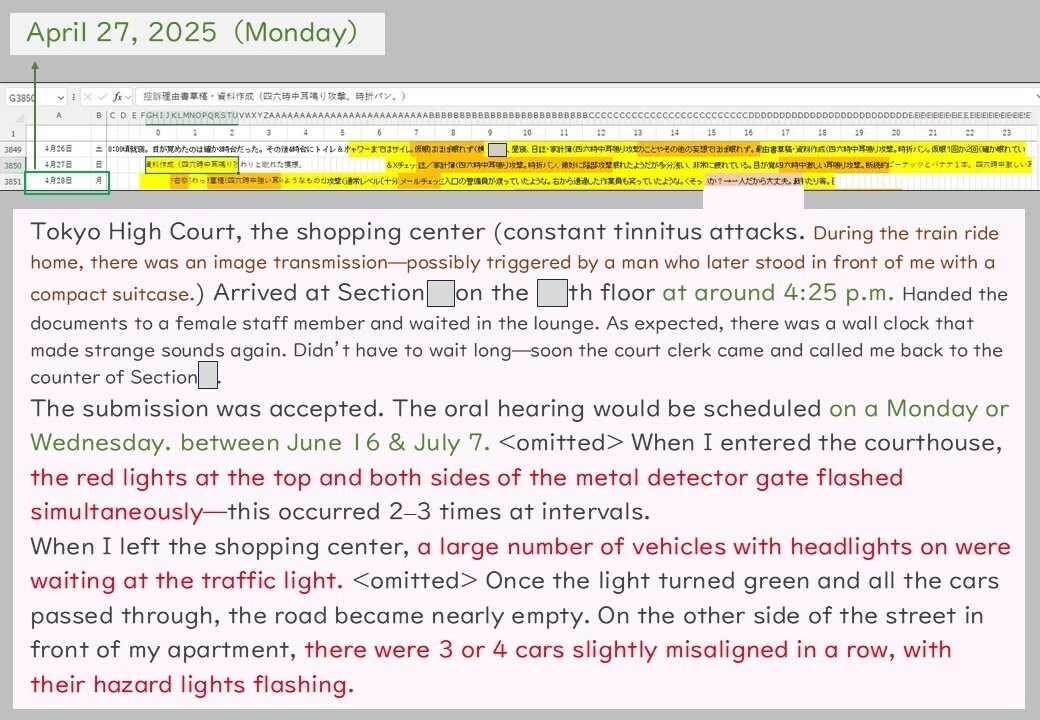
When I entered the courthouse, the red lights on the top and both sides of the metal detector gate flashed simultaneously—despite no one passing through it.
This occurred two or three times, and I recall the same thing happening once at the adjacent gate used by non-general visitors.
I am convinced this was intentionally triggered against me.
I arrived at the assigned division at 4:25 p.m.—just barely in time.
If I remember correctly, the adjacent division was empty and the lights were off.
After handing the documents to a female staff member, I was told to wait in the lounge.
There, too, was a wall clock that emitted a loud, strange sound every time the hands moved.
I remember feeling startled each time it chimed.
Before long, the clerk came to the lounge and called me over. We returned to the counter at the division, where the documents were checked and some explanations given.
The statement was successfully accepted.
At that time, I was told that the first oral argument would be scheduled on a Monday or Wednesday between June 16 and July 7.
(As it turned out, it was set for Wednesday, June 18.)
On the way home, I stopped to shop at a shopping center near the nearest station to my home.
Right after leaving the center, at the nearby intersection, multiple cars with their headlights on were stopped at a red light.
Near my apartment building, about three cars were parked with their hazard lights blinking.
Afterword
On Light-Based Attacks
Considering the red flashing lights on the metal detector gate, the interference during document preparation, the ceiling sounds during the first trial session, and the abnormal incidents in the record-viewing room at the Tokyo High Court, I believe these events were intentionally orchestrated against me.
Normally, a flashing red light on such a gate would be accompanied by a warning sound, but in this case, there was none.
Perhaps it was suppressed to avoid drawing attention from people in the lobby who were unaware of the situation.
I used to frequently encounter cars with their headlights on waiting at the intersection right after exiting the shopping center.
As recorded in my diary that day, once the light turned green and those cars left, the volume of passing traffic dropped significantly.
This suggests a high possibility that the cars were coordinated to be there when I left the center, and that the traffic signal may have been adjusted accordingly.
I have also often seen multiple cars parked with their hazard lights blinking.
Even when it was just one car, I suspect that some were deliberately doing this to make sure the blinking lights entered my field of vision—though of course, I don’t assume every case was intentional.

Why My Actions Are Not Completely Blocked
In this lawsuit, I submitted four types of documents to the court: the answer, preparatory statement, written statement of reasons for appeal, and the appellant’s preparatory statement.
Of these, I felt that the preparation of the written statement was disrupted the most severely.
This was the first time I truly experienced the feeling of “breaking” or being on the verge of breaking.
Until then, it wasn’t so much that I was about to break—it was more that I had resigned myself to the futility of resisting an unknown and incomprehensible adversary.
I believe that for those conducting human experimentation, it would have been easy to completely prevent me from appealing or even responding.
The only reason they didn’t do so is likely because they still see value in continuing to monitor and extract data from me.
If I were to act out in despair, that would be inconvenient for them.

What’s Next
In the next post, I plan to report either on additional incidents that occurred in the Tokyo High Court’s record-viewing room, or on the details of the day of the appellate oral argument.

