
Main Text of the First Instance Judgment & Actions Taken After Receiving the Judgment Document

Introduction
On June 4, 2025, I posted an article about the suspicious events that occurred inside the courthouse during the third oral argument held on January 9, 2025, the date of conclusion of the first-instance trial.
Originally, I intended to report on the events that took place on the day I received the judgment and the day I submitted the notice of appeal.
However, in the afternoon of June 5, I received the appellee's (plaintiff in the original trial) answer to the appeal. In order to prioritize my rebuttal, I changed my plan.
Since I needed to submit my written statement before the first oral argument in the appeal trial on June 18, I focused on that task after briefly reporting on a particularly notable incident in my "Court Series"—my experience viewing the court records on April 17, 2025, at the Tokyo High Court Record Viewing Room, which I posted on June 7.
I managed to submit my written statement on June 16, and the trial concluded two days later during the first oral argument. The judgment is scheduled to be handed down on August 27.
I also posted on June 20 a summary of this oral argument, including my thoughts on the so-called "possibility of withdrawing the appeal."
Though this has been a long preamble, in this article I will instead report on the contents of the first-instance judgment's main text and my actions taken after receiving the judgment document.

Date of Receipt of the Judgment Document: Saturday, February 22, 2025
During lunch, I received the original copy of the judgment document via special delivery from the court. The judgment date was February 20 (Thursday), so it appears to have been sent out the following day.
Main Text
The full text of the judgment's main section is as follows.
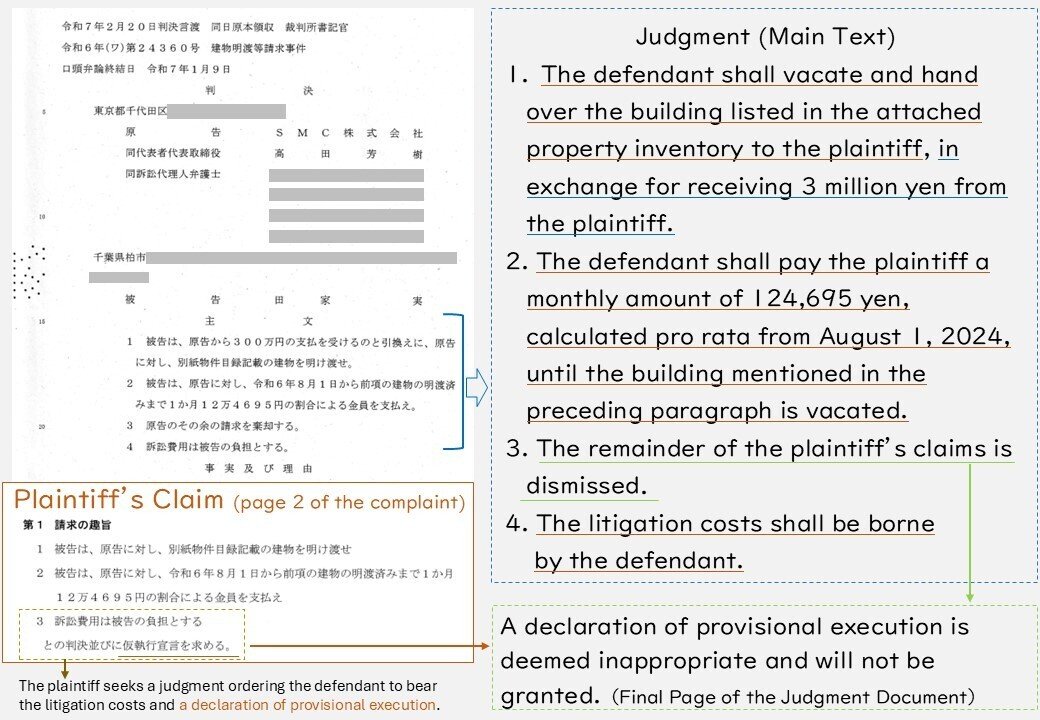
The phrase in Main Text Item 3, "the remainder of the plaintiff's claims is dismissed," means that the request in Item 3 of the plaintiff's claims—"...and a declaration of provisional execution"—was not granted. This indicates that the judgment was not a complete defeat for me.
Furthermore, the wording in Main Text Item 1, "The defendant shall, in exchange for receiving 3 million yen from the plaintiff, ..." was not part of the plaintiff's original claim.
It is believed that this reflects the fact that, during pre-litigation negotiations, the plaintiff initially offered a relocation fee of 500,000 yen, which was later raised to 3 million yen. It also reflects the plaintiff’s statement during oral argument that the defendant (me) must vacate the premises in exchange for receiving 3 million yen.
The amount of "124,695 yen" stated in Main Text Item 2 includes the room rent plus 50% of the rent as stipulated in the lease agreement as compensation for damages. It should be noted that rent has not been withdrawn since August 2024.
As a layperson, I interpret the judge’s intent as not only rejecting my claims but also urging me to accept the settlement proposal put forward by the plaintiff. That said, this may not have been the sole intention.

Actions Taken After Receiving the Judgment
The following illustration visualizes entries from my journal for the time surrounding the receipt of the judgment document.

On that day, I was researching the appeal process. I believe I was preparing for the possibility that the plaintiff might appeal or that I might need to do so in the event of a defeat.
However, given the abnormal events that occurred just before the first oral argument in the first instance, I had a sense that such an outcome could not be dismissed as mere possibility.
The appeal period begins the day after the judgment is delivered and lasts for two weeks. In my case, the deadline was March 9. Since that day was a Sunday, the actual deadline was Monday, March 10.
I scanned each page of the complaint and converted them to JPEG format, which I then arranged and analyzed using PowerPoint.

Afterword
Had I accepted the judgment at that time, even after paying rent including the damages portion and court costs, I could have vacated the premises with a sum exceeding the 500,000 yen initially offered in the relocation negotiations (five months after the start of discussions).
However, that option was not available to me.
Since March 5, 2018, when I was subjected to psychological destruction using sound and light at a hotel and convenience store in Shinjuku while residing in Kawasaki City, Kanagawa Prefecture, I have continued to suffer even harsher treatment than before.
This situation has not ended even after moving to Kashiwa City, Chiba Prefecture—in fact, it has worsened.
I do not believe vacating the premises would have improved my situation. On the contrary, relocating would likely have caused further harm to nearby facilities and residents (including the possibility of being forced to cooperate with human experimentation organizations).
Moreover, since the plaintiff intends to demolish this building to establish a green space called "Posque" on the premises of the technical center, the demolition of this site—where many incidents have taken place—would result in the destruction of critical evidence and eliminate the possibility of future on-site verification.
I believe the torture and human experimentation I continue to endure are related to the "Anomalous Health Incidents (AHI)" that have affected numerous U.S. government personnel.
According to legal procedure, a statement of reasons for the appeal must be submitted within 50 days after submitting the notice of appeal.
I submitted my notice of appeal to the Tokyo District Court on Friday, March 8.
Even at that time, several suspicious events occurred. I plan to report on those in a future post.

