Welcome, dear visitor, to this small and humble museum. Everything has been realised as simply as
possible, so it should run comfortably on all your devices!
Aside from the ludic and aesthetic aspects of the moiré effects that I hope you will enjoy, this museum
aims to highlight the increasingly important role they play in research and provide links to further
resources.
A moiré pattern is a visual phenomenon that occurs when repetitive structures are superimposed or viewed
against each other. It consists of a new pattern of alternating dark and light areas, which does not
occur in the original structures, britannica.com. Let’s take a look at
some of them and discover more along the way.
There is also valuable content for the moiré effect on Wikipedia (en.wikipedia.org, fr.wikipedia.org), but with the
persistent misleading information that the moiré itself is a physical interference phenomenon. If there
is no optical path difference, it is clearly not, as the Italian physicist Prof. Massimo Gurioli
correctly points out, cf. youtube/@fisica_astro_unifi.
Nevertheless, moiré patterns can often be used to illustrate physical wave phenomena, as we will see below; see also Amidror2009, volume I,
problems 10-19 and 10-20.
Groups of Circles
Circles, hyperbolas, ellipses, limaçons and Cartesian ovals: (.html), a variant (.svg)/(.webp)
In this museum mostly vector graphics are used; they are great, yet their rendering depends on your
browser. Compare it via the files (.png)/(.pdf)/(.ps) or in action
(.html).
Non-concentric nested circles (.html) | Circle
machine (.html)
Spirals and Circles I (.html), II zooming (.html), deformed circular moiré patterns with WebGL (dual state
coloring, evenodd color fill-rule) (.html); circle family on the
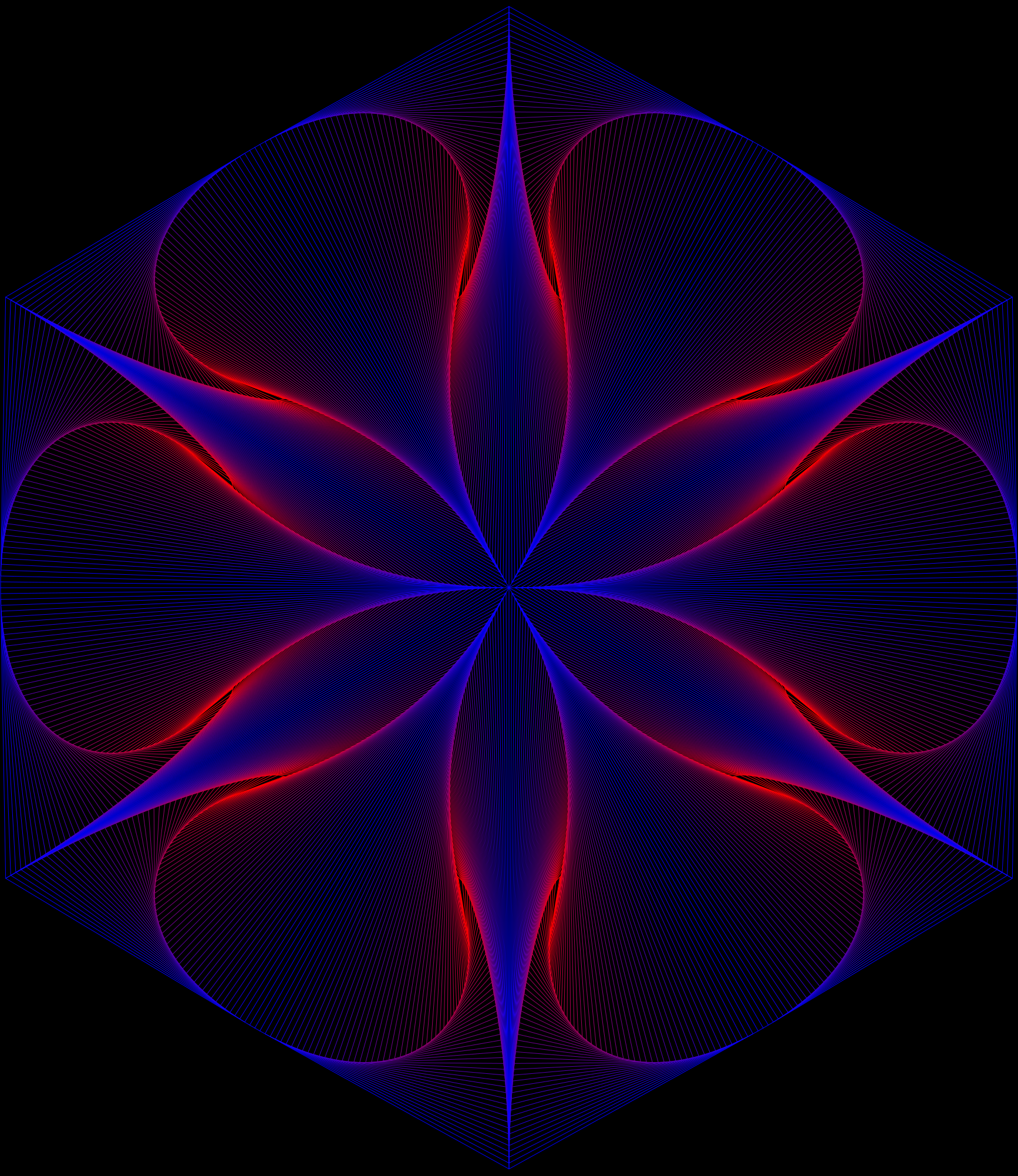
corners of a square (.pdf)/(.ps), a hexagon (.pdf);
GeoGebra applets for circles and parallels: parabolas
(.html), conic sections (.html)
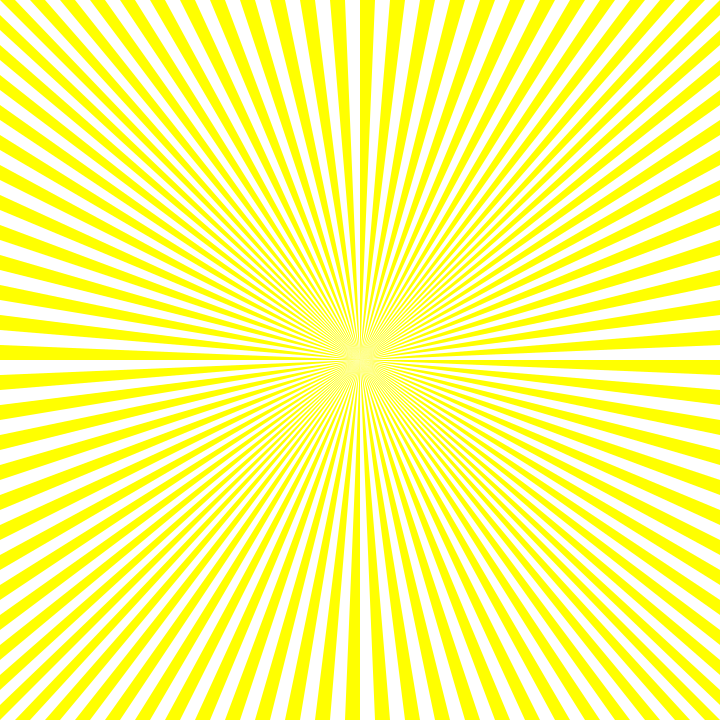
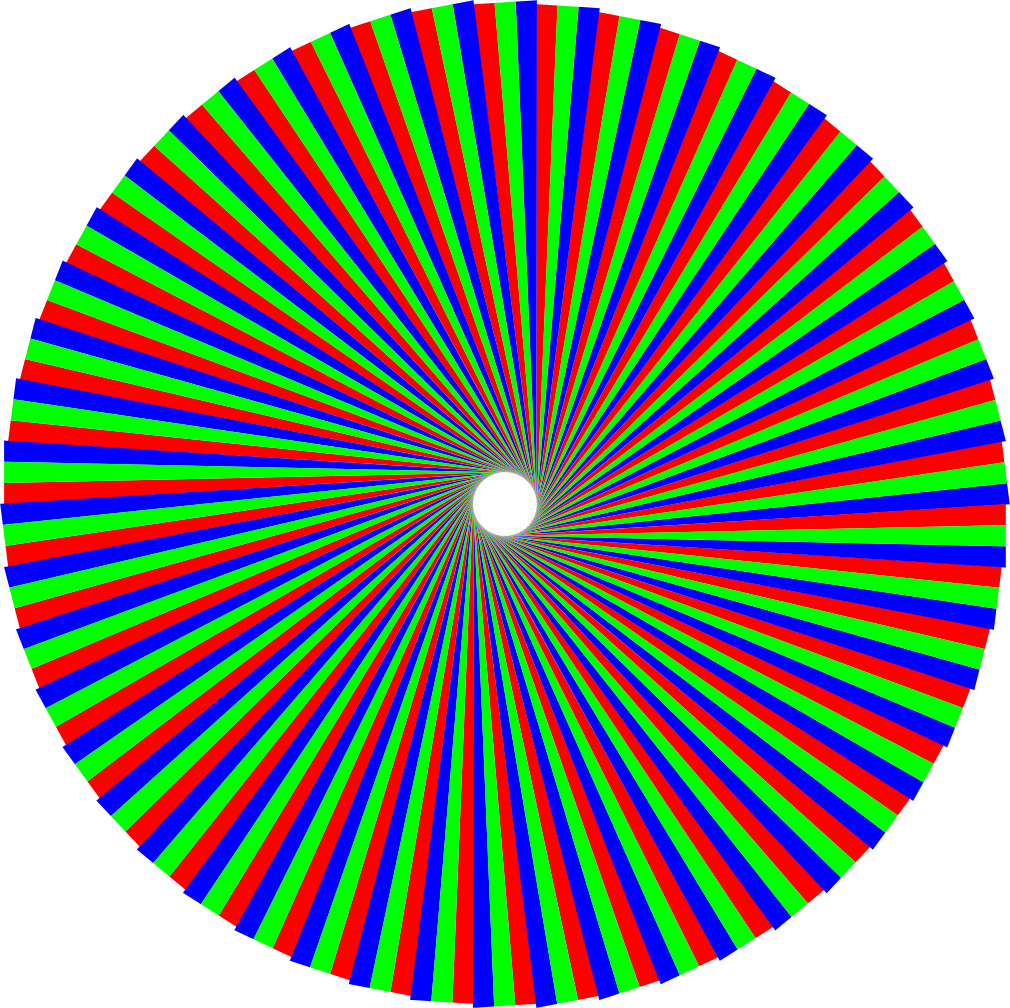
Colored Rays
Square Inversion
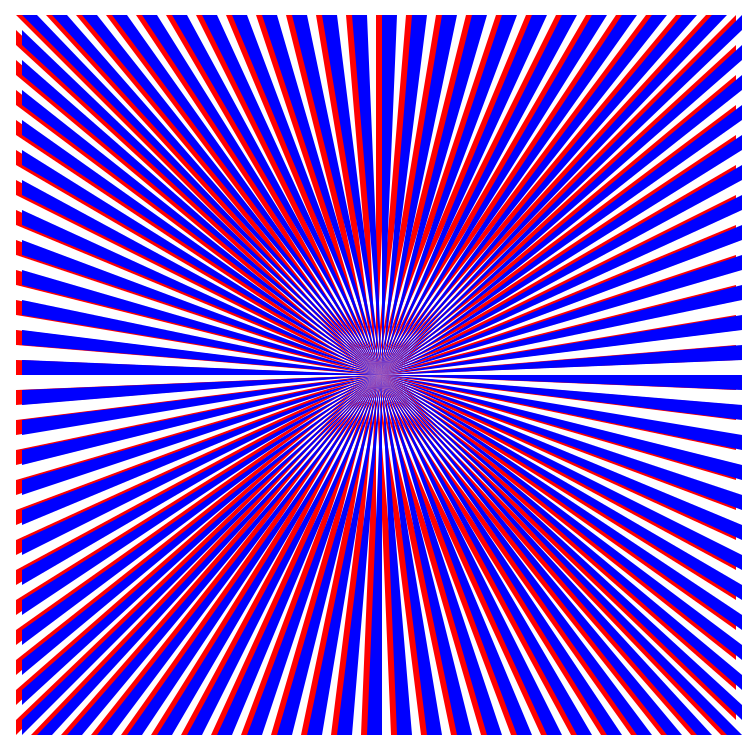
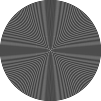
You can move the cursor over the picture below, or touch it if you like.
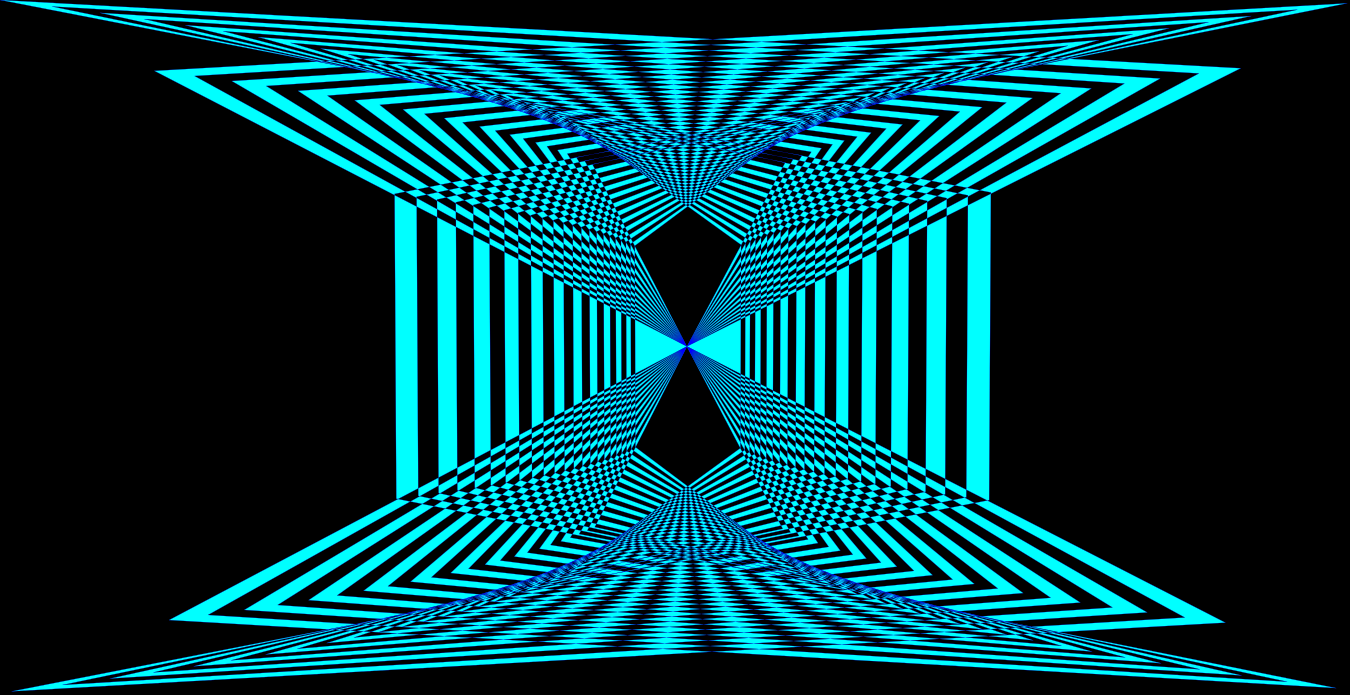
The resulting moiré in the image above consists of parabolas ending in straight line segments cf. (.html)/(.pdf), a shape that also results under “square inversion”,
see the derivation (.pdf); under “circular inversion” one would
obtain circles, see Conformal Map below or play with (.html)
the rotation, please.
Move the image by your hand ☛ (.html), simple rays in a square (.html), in a rose (.html). If
not exactly centred one obtains some prodigious outlines (.html). Tiled
ray patterns ☛ (.html).
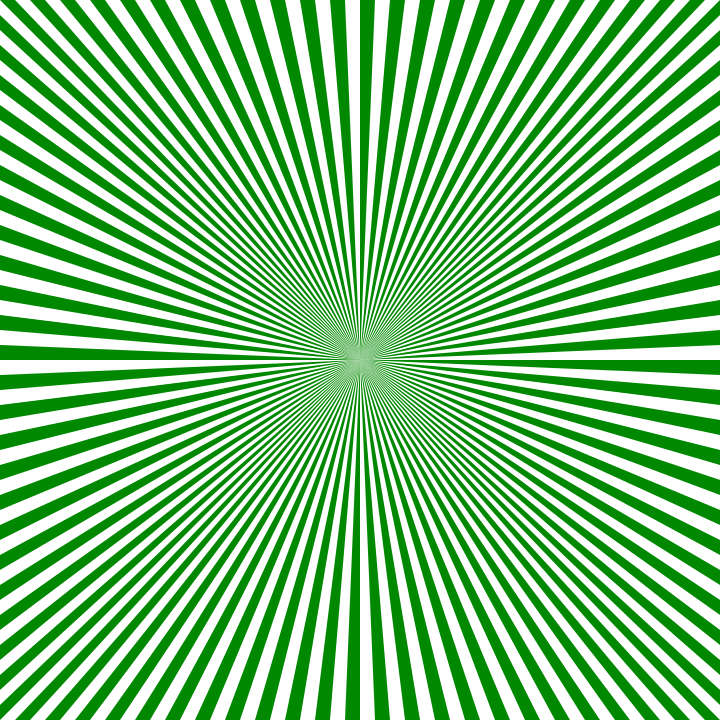
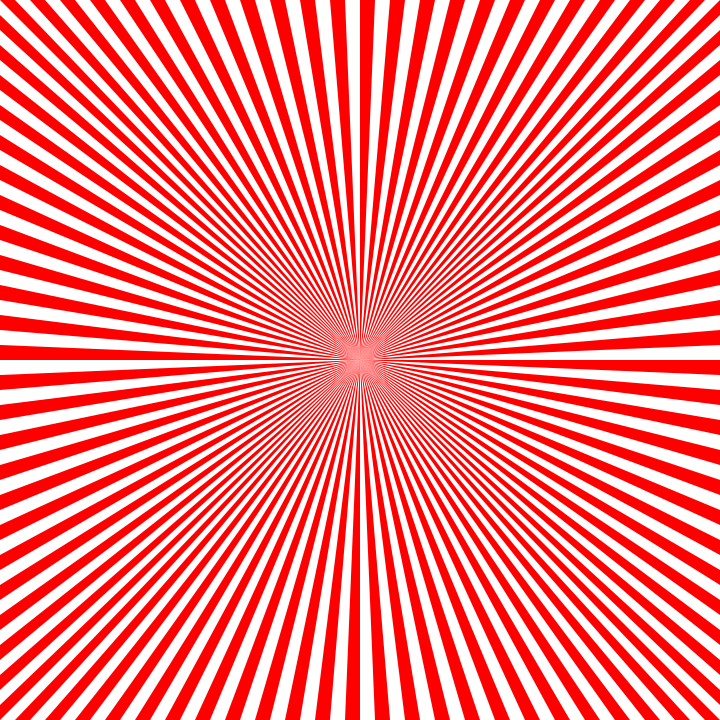
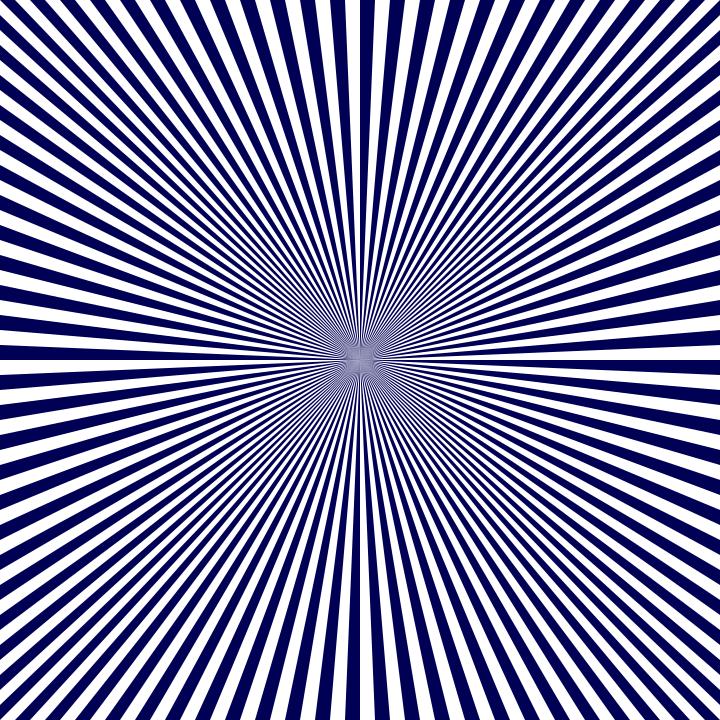
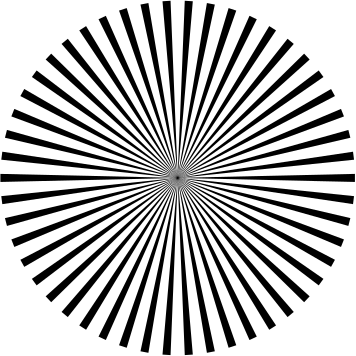
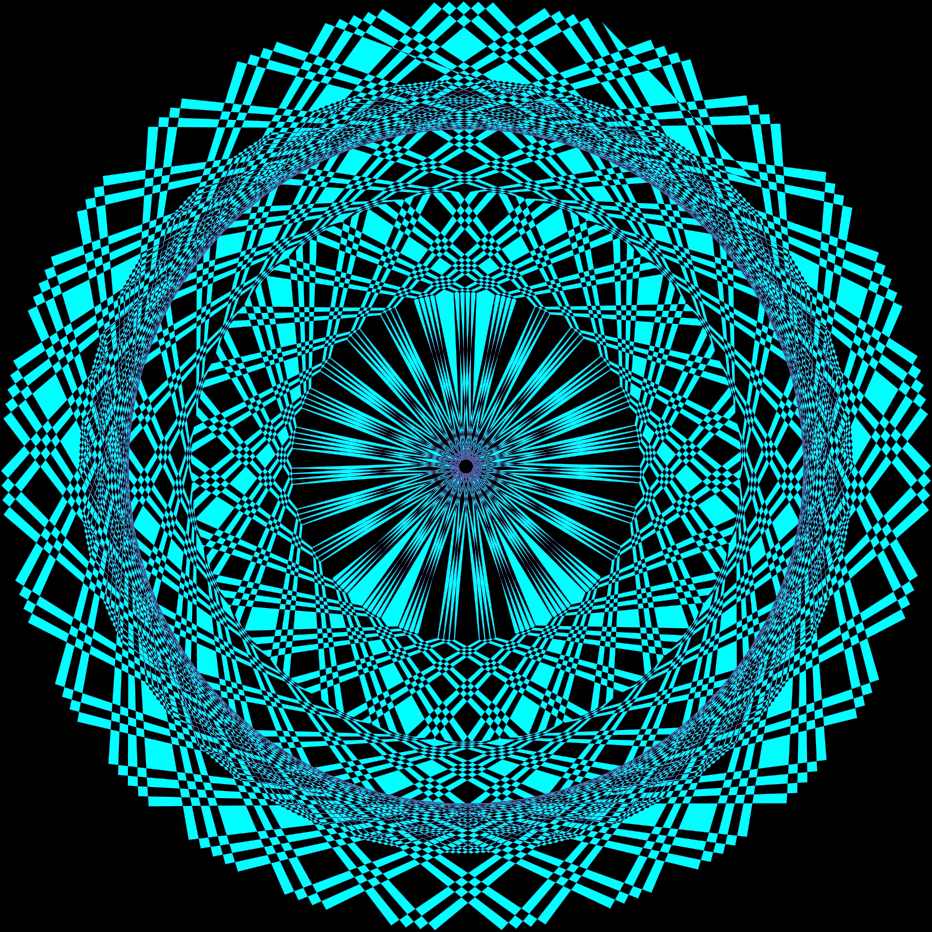
Radial Rays
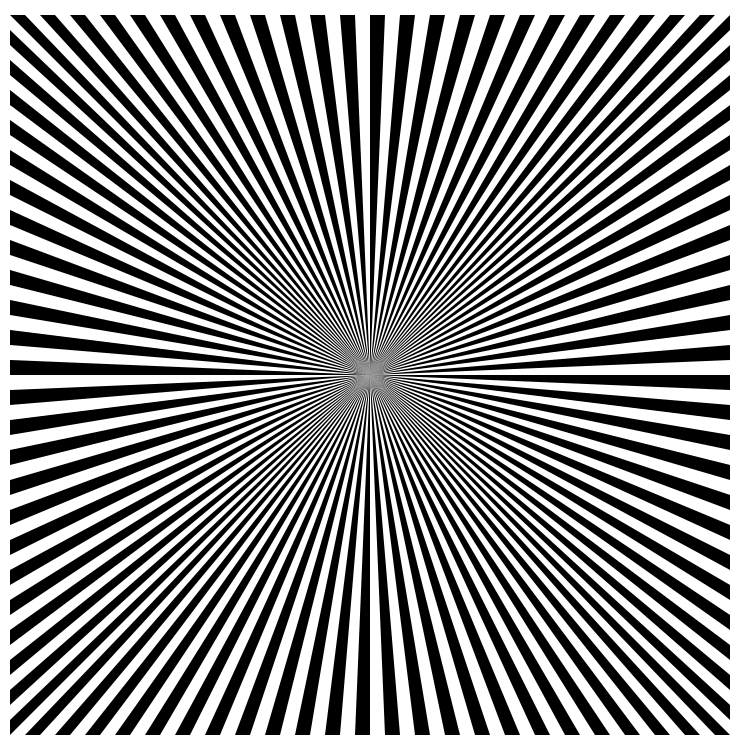
Rotation and/or touch the image, please.
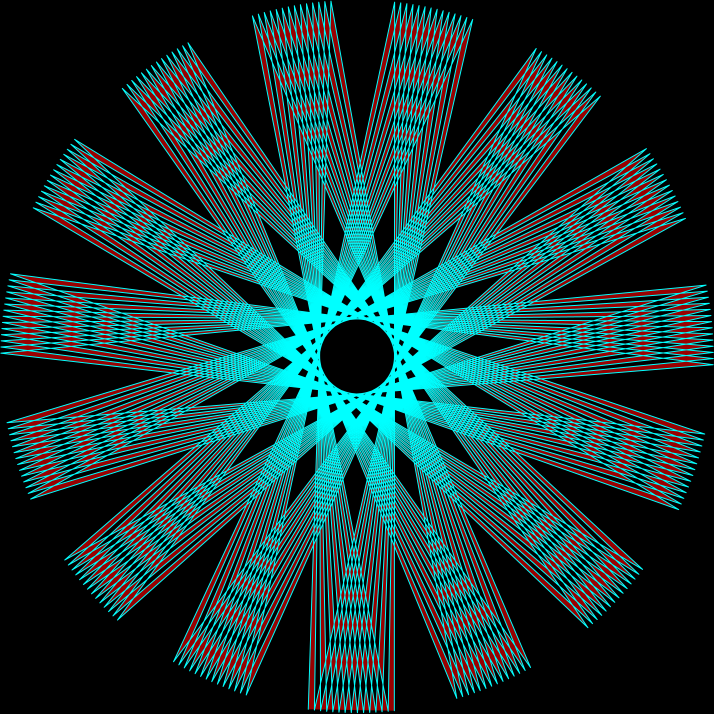
A spiral shaped moiré pattern (.html), circles and quadratrix
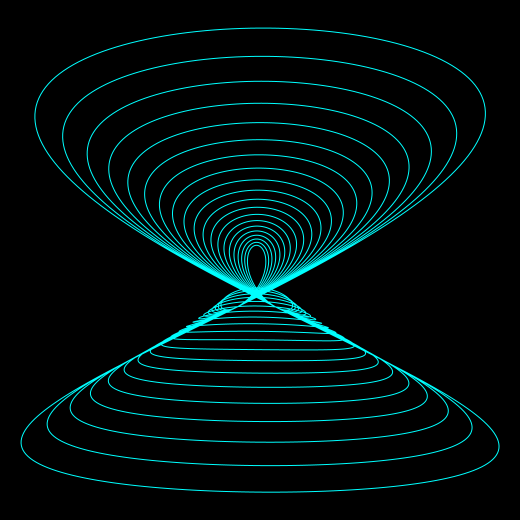
(.html). The moiré curves generated by rays with constant angular separation form an elliptical pencil of circles, for a derivation with the link to circular inversion see: (.pdf). Ellipse over ellipse (.html); a moiré simulator for bundels of beams (.html)
A lovely Turkish resource, in which some of my graphical ideas came to life already in the 90s. “Tekdüze
Çizgilerin Geometrik Doğurganlığı” (1999), “Moiré Motifleri” by Özgür Kurtuluş, tubitak.gov.tr,
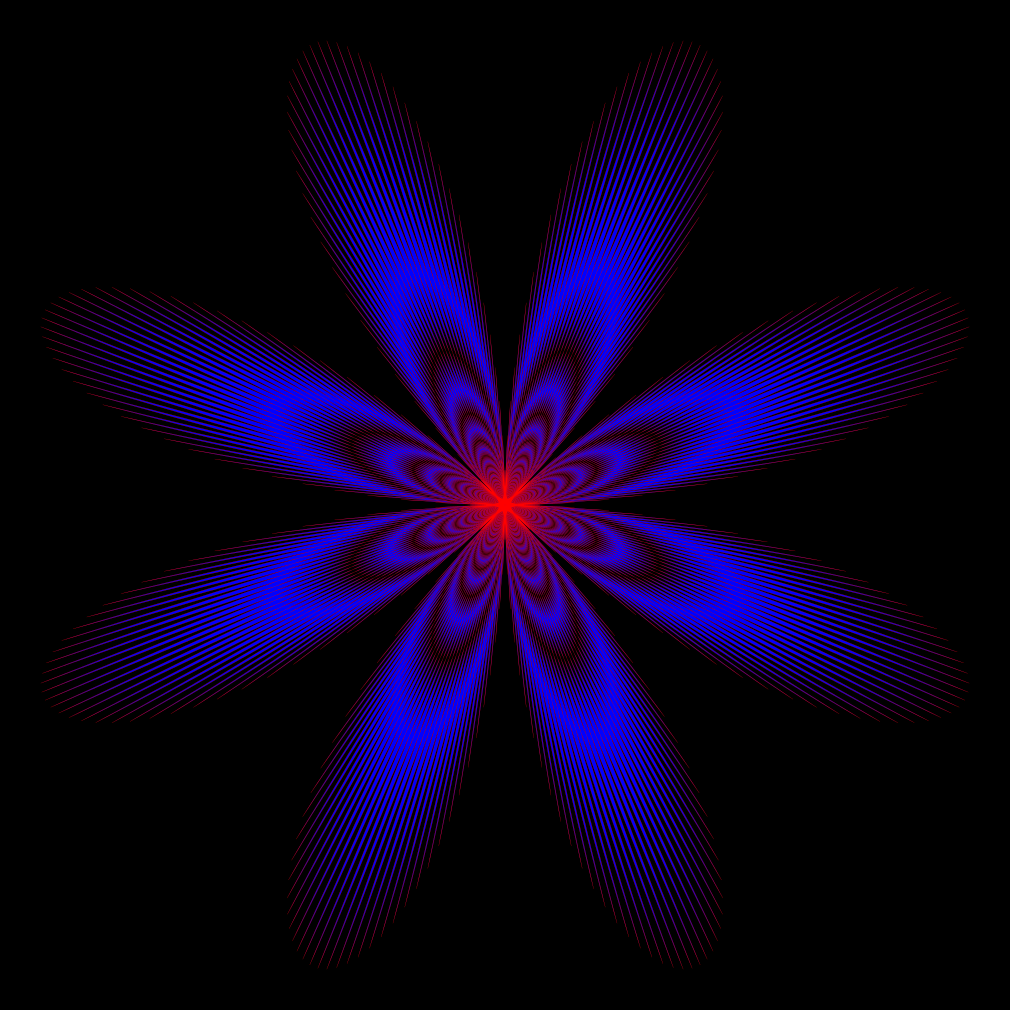
cover image: (.svg)/(.pdf), square variant (.svg)/(.pdf), rectangles (.svg); colorful (.html), (.svg), (.svg)/(.pdf).
Color Perception
You may have noticed that colors behind bars or a mesh appear different from what you’d see in plain
view and often some color mixing is along the way. If you’d like to learn more about the witty visual
(color) perception of our brain, here are some excellent resources:
Some physical and mathematical routes to the description
A moiré effect is not always aesthetically pleasing (as it should on this page), it can be quite
annoying at times. Therefore, when planning a screen or a projection surface, you have to calculate
first in order to minimise the moiré effects. Apart from elementary lattice algebra and the mathematical
function approach, I would like to propel the analogy to a beat in physics. Beating the moiré over a
beat, so to speak.
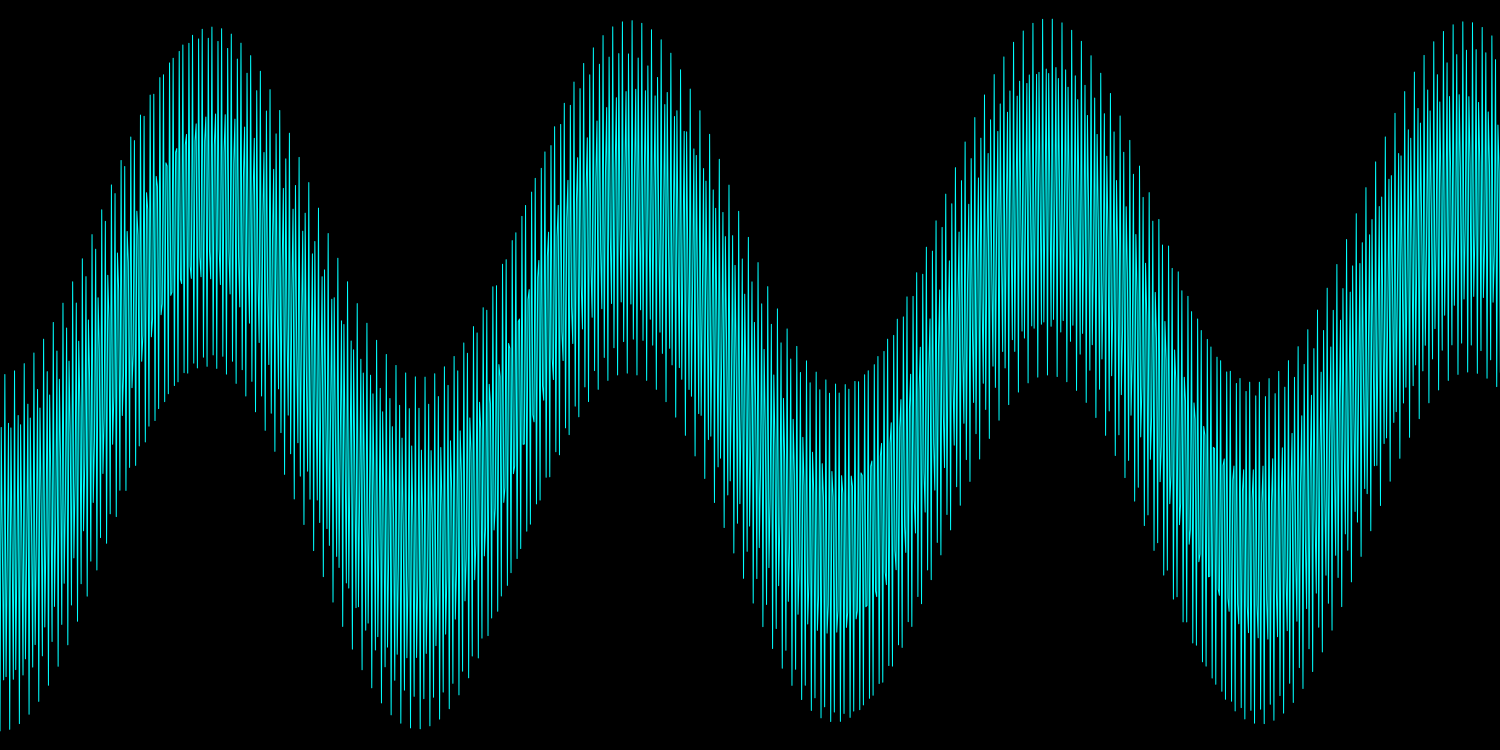
Hear a beat. Typically, you have two sine tones with frequencies close to each other e. g. 440 Hz
(.opus) and 444 Hz (.opus). Adding them up
together you get a louder signal with a beat:
What does a frequency have to do with the moiré effect? Well, if you have a line grating with black bars
on a white background, the fineness of this grating can be read as “frequency”: How many black bars are
there per meter or: how often black changes to white, while translating the image at constant speed.
Basic formula for a moiré pattern with line gratings
A line grating consists of parallel lines. For two line gratings twisted by the angle with the same line spacing , a brightness modulation is observed in the form of more or less diffuse parallel lines, the
moiré lines with the distance
If two line gratings with the spacings and are placed parallel () on top of each other, the moiré lines have the distance
Cf. (.pdf).
If two line gratings with the spacings and are placed on top of each other and rotated by , moiré lines with the distance
can be observed. This is the equation for the general case. Some other derivations using lattice algebra
through the so-called “Indicial Equation Method”, along with additional excellent resources, can be
found in (.pdf), GeoGebra applet for the case of parallel lines
with different slopes: (.html)
See a beat (.html). Create beat frequencies without
bothering your neighbours (.html).
Overlaying bars (scales) of different periods shows off an ingenious invention, the “vernier scale”
(nonius) miniphysics.com. A
clock based on this principle by Siegfried Wetzel: “Schiebelehre und eine Nonius-Uhr”,
Chronométrophilia, No 52, DGC-Jahresschrift, 2003. swetzel.ch. Time-lapsed (.gif)
de.wikipedia.org.
Whatever elementary method you take, it quickly becomes complicated. Using a bit more sophisticated
“beat” maths, the Fourier series (first harmonic) and the Fourier transform (.html) for the spectral approach, it is still manageable though. For a
deeper description of moiré patterns by this approach, see:
Isaac Amidror: “The Theory of the Moiré Phenomenon”, Volume I: Periodic Layers. Springer, 2009. (Vol. II
treats aperiodic layers and appeared in 2007, the first edition of volume I appeared in 2000), moire.is-great.org.
At the École polytechnique fédérale de Lausanne (EPFL), where Amidror led his group, they are currently
working with high resolution moirés as counterfeit security features nature.com, epfl.ch.
It is a striking example of how two phenomena from completely different areas of perception (auditory /
visual) are virtually the same, since described by identical mathematics.
Perhaps you have already heard of Joseph Fourier or seen how his series produce
quite baffling, yet extremely useful results. Learn more at bbc.co.uk or watch a video by Grant Sanderson
(3Blue1Brown): “But what is a Fourier series? From heat flow to drawing with circles.”, youtube.com.
Biographical
notes by François Arago in French (.pdf).
Éclaircissements du moiré en français
Pour une introduction aux mathématiques des moirés veuillez ouvrir les « Mirifiques &
miribolants moirés » mathkang.org. En
créant leur prodigieuse macro en LaTeX, Manuel Luque, Jean-Michel Sarlat et Jürgen Gilg ont ajouté
des « Petites contributions mathématiques » ctan.org/(.pdf), où
ils citent le travail pionnier
« Vision et reproduction des formes et des couleurs », archive.org, par le physicien
français Henri Bouasse. Une autre contribution détaillée, également en français, a été réalisée par
Jacques Harthong en 1981, voir sciencedirect.com.
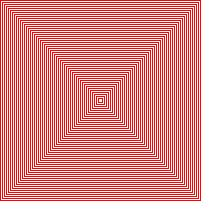
Nested Squares
Rotation and/or move over the image, please.
Four layers of nested squares ☛ (.html), Fresnel (or Newton?) squares
☛ (.html).
Huang, B. et al.: “Moiré-Based Alignment Using Centrosymmetric Grating Marks for High-Precision Wafer
Bonding”, Micromachines 2019; 10(5):339, mdpi.com.
Rotating Nesting of Polygons
Poly-Moiré in B&W ☛ (.html), (.webp); colored (.svg). A PostScript® program that lets you draw any nested regular polygons with or without rotation (.ps)/(.txt)
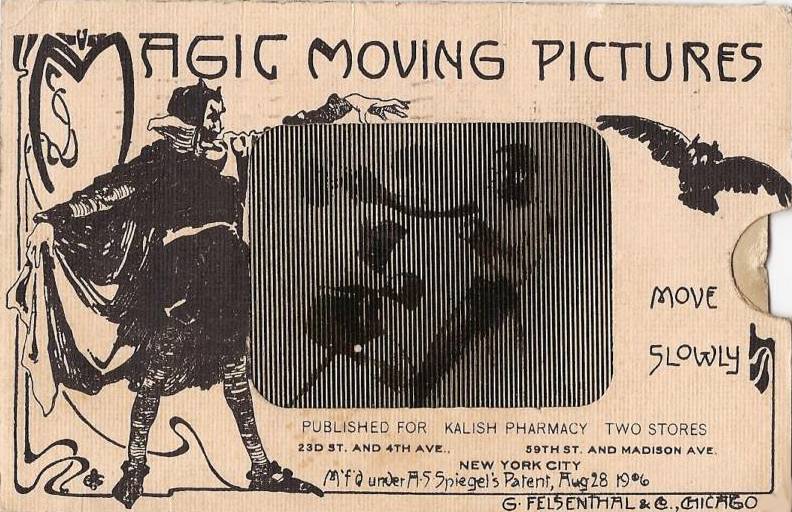
Barrier-grid Animation
A Magic Moving Pictures promo card by G. Felsenthal & Co., 1906.
Source: wikimedia.org.
Ride the famous horse (.html), triple color barrier (.html), rotate a tesseract (.html), running balls (.html),
lettering (.html), Ombro-Cinéma (1921) (.html); skip to Beat the sine
below to see some other barriers in action.
“Poemotion”, book by Takahiro Kurashima, takahirokurashima.com, ISBN: 978-3037782774, Lars
Müller 2012.
“Kinegrams” by Gianni A. Sarcone, giannisarcone.com / behance.net; “Make Your
Own 3D Illusions” book by Sarcone & Waeber, Carlton Books, 2007. ISBN: 978-1780970059.
“Mes Robots en Pyjamarama”, cahier d’activités, Michaël Leblond et Frédérique Bertrand, éditions du
Rouergue 2013. Livre animé basé sur une ancienne technique d’animation : l’ombro-cinéma, yt@enpyjamarama.
“Gallop”, A Scanimation Picture Book by Rufus Butler Seder, Workman Publishing Company 2007. ISBN:
978-0761147633. Turning a page triggers the animation.
“Living pictures”, book by Henry V. Hopwood, 1866-1919, archive.org.
Moiré Clock by Twisted & Tinned
Made by Moritz von Sivers, a German physicist, part time maker and electronics enthusiast. Moiré Clock
Explained: instructables.com.
Emin Gabrielyan: “Fast optical indicator created with multi-ring moiré patterns”, docs.switzernet.com.
Curved barrier-grid
Moiré fringes with a curved line grating ☛ (.html). Other deformations ☛
(.html).
Moiré patterns of this type can be used for interferometry in optical engineering, see: Daniel Malacara,
“Optical Shop Testing”, Wiley 2006, ISBN 978-0-471-48404-2, wiley.com.
Pericles S. Theocaris: “Moiré fringes in strain analysis”, Pergamon Press 1969, ISBN 978-0-08-012974-7.
Oded Kafri & Ilana Glatt: “The Physics of Moiré Metrology”, 1990, researchgate.net.
Checkerboard Pattern
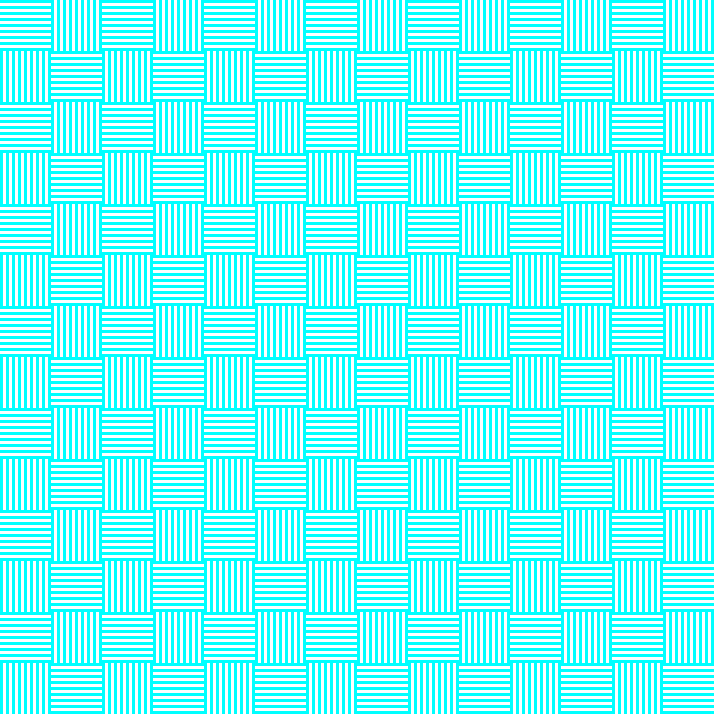
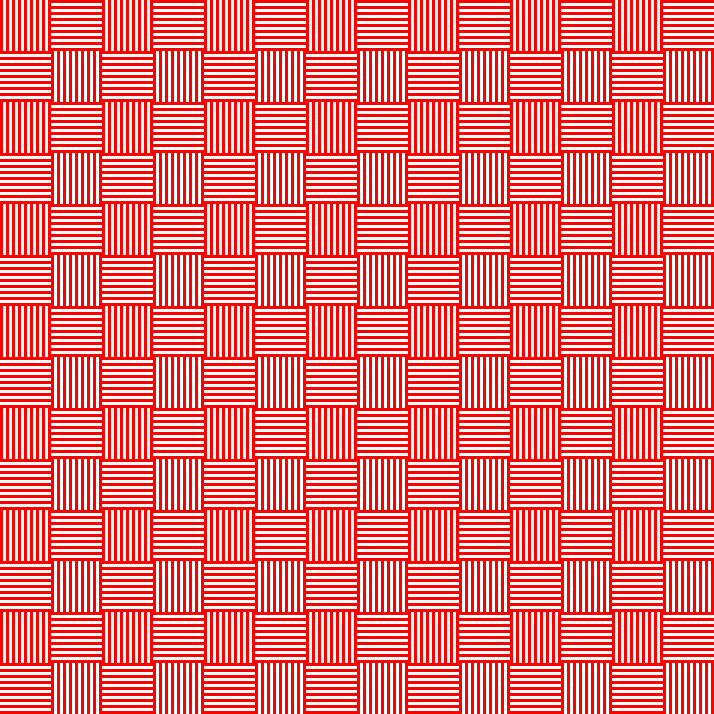
the rotation, please.
Move it by your hand in B&W ☛ (.html), green-blue-black
moving, 3 layers ☛ (.html), magenta-blue 4 layers (.html).
Shuo Liu et al.: “Moiré metasurfaces for dynamic beamforming”, Sci. Adv. 8, eabo1511 (2022), science.org.
XOR-Grids
An eXclusive OR-grid (XOR-grid) is a digital pattern where the coloring of the layers is based on binary
logic. We have used this e. g. with the even-odd color rule in SVG. A checkerboard is a basic
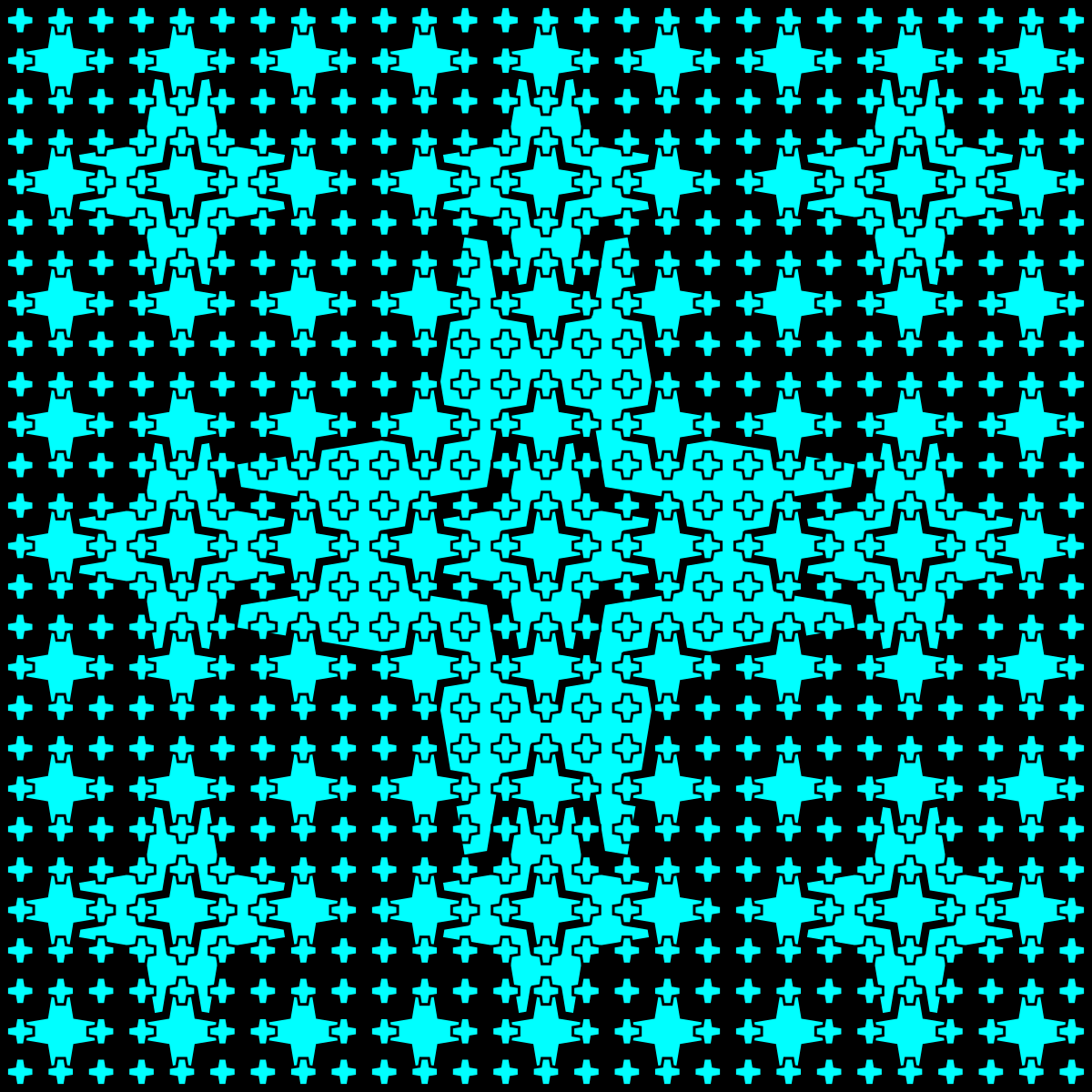
example, but we can use the principle for other settings. Some emergent symmetries in the superposition
of regular lattices become thereby more clearly visible: (.html).
Op Art
The somewhat pejorative term “Op art”, coined from “optical art” in 1964 by Time magazine, is today
quasi the “Big Bang” of this art form, already celebrated at the MoMA in 1965: “The Responsive Eye” ☛ moma.org,
inauguration film youtube.com.
As so often, a heated debate arose about this art form and whether it was art at all – rather
abstruse, considering what else is traded as art at completely exorbitant prices nowadays. In my
opinion, the aspect of optical irritation, which forces one to take a second look, is a core
characteristic of fine art: learning how to see.
Artists who worked or are still working with the moiré effect
Find some of the best known op artists, like Bridget Riley or Victor Vasarely on op-art.co.uk. In case you are aware of an artist who should be on
the above list, let me know!
pOp artists
Already in the 60s pop artists such as Robert Rauschenberg, Gerhard Richter, James Rosenquist, Ed Ruscha
experimented with moiré patterns emerging in print. As the art historian Prof. Jennifer L. Roberts, harvard.academia.edu,
explains in her
Charles C. Eldredge Prize Lecture “The Moiré Effect: Print and Interference” (2018), youtube.com/@americanartmuseum, some of
these
works demonstrate that photography is essentially associated with texture, whether on screen or in
print.
HALFTONE from “The Atlas of Analytical Signatures of Photographic Processes.” by Dusan C. Stulik &
Art Kaplan. The Getty Conservation Institute, Los Angeles 2013, ISBN: 978-1-937433-09-3, getty.edu
(.pdf)
Emergent SQRT
Rotation and see what happens!
Does emergence only occur when an entity is observed having properties its parts do not have on their
own? See quantamagazine.org.
Apart from emergence you might also have noticed a kind of “convex lens effect” here. Recently, it has
been shown that it is possible to build lenses using the moiré effect: Zheng Liu et al.: “Wide-angle
Moiré metalens with continuous zooming”, optica.org, Stefan Bernet et al.: “Demonstration
of focus-tunable diffractive Moiré-lenses”, optica.org.
√ in black & white ☛ (.html), points over points and additive
color mixing (.html), 30° symmetry rotation (.svg), point pattern and its complement (.html), simple point grids for symmetry studies (.html), Amidror’s emergent 1, curved (.html)
Randomness
The emergence does also work with a random distribution point pattern if tuned to your object pattern (.html). A Glass pattern ☛ (.html), a random star (.webp)
Glass, Leon: “Moiré Effect from Random Dots”. Nature 223, 578-580 (1969). nature.com.
Amidror, Isaac “Glass patterns as moiré effects: new surprising results”, Opt. Lett. 28, 7-9 (2003). optica.org.
Equilateral Triangles
rotation, please and find some 3D effects.
Move the triangle pattern yourself (.html). Base = height ☛ (.html), in contemplation (.html); Kreuzform
B&W (.html)
The above 3D effect is a kind of layer effect, one gets the impression that triangle objects move
forward and backwards. See also Lothar Spillmann: “The perception of movement and depth in moire
patterns.” Perception, 22(3), 287-308. sagepub.com.
3D and stereoscopic art
You can find more on 3D moiré patterns in the book by the theoretical physicist Yitzhak Weissman: “The 3D Moiré Effect for Fly-Eye, Lenticular, and Parallax-Barrier Setups”. Pop3dart 2023. ISBN-10: 9655985202.
Here you can get an idea of this stunning 3D effect (.html). Moiré of a WebGL based 3D cube ☛ (.html), a tetrahedron (.html), a spinning icosahedron ☛ (.html), a sphere I (.html), II ☛ (.html).
Wade, Nicholas J.: “The Stereoscopic Art of Ludwig Wilding”. Perception, 36(4), 479-482(2007), sagepub.com.
“On Stereoscopic Art”. I-Perception, 12(3), 2021, sagepub.com. Book: “Art and Illusionists”,
Springer 2016. ISBN: 978-3319252292, springer.com.
Saveljev V.: “Moiré effect in multilayered 3D lattice”. Appl Opt. 2023 Apr 10;62(11):2792-2799, opg.optica.org.
Hexagon Grid
You might have observed some hexagonal structures while rotating the triangle grid above. What if we
started with patterns of hexagons?
When centred around the edge of three hexagons, one can observe a cube illusion (isometric cube) (.html). More layers and a flickering screen ☛ (.html) and here you get the triangles back ☛ (.html), four layers B&W (.html),
see
also XOR-Grids above.
Moiré superlattices can play a pivotal role in nano physics: “New Generation of Moiré Superlattices in
Doubly Aligned hBN/Graphene/hBN Heterostructures”, 2019, acs.nanolett.8b05061 (University of Basel).
When ultra-thin crystal layers are stacked on top of each other and slightly twisted, moiré materials
with entirely new quantum properties are created. Recent observations show in detail how a unique form
of superconductivity emerges within such materials: “Resolving intervalley gaps and many-body
resonances in moiré superconductors”, 2026, nature.com.
Moiré physics in 2D crystals nature.com, geometrymatters.com.
Oh yes, geometry matters, especially when matter is concerned!
Nested Squares and Circles
Move over the circles, please.
Please note that on some mobile devices a moving vector image might be roughly pixelated. If you can see
it accurately, you will perhaps notice an aliasing (moiré) effect between the circles and your screen at
the end. You’d like to explore this moiré pattern with your screen any further? ☛ (.html).
“How to Deal with the Moire Effect on LED Screens Effectively”, some hints by Kris Liang (2023): doitvision.com.
Determination of screen resolution by JuliaPoo: “Magnifying the Micro with Moiré Patterns” (2020):
github.io.
xyzzy: “realDPI. Finding the physical screen resolution by using moiré patterns” (2020): github.io.
The Nyquist Frequency
Digital devices like a camera sensor, a scanner, or a microphone don’t capture continuous reality; they
take individual snapshots (or samples) at regular intervals. The Nyquist frequency is the maximum amount
of detail a system can correctly capture at a given sampling rate, en.wikipedia.org;
is exactly half the sampling rate
When a high-frequency pattern (like a fine fabric or a grid) is finer than the Nyquist frequency, the
system doesn’t just miss the detail; it gets confused and interprets the high frequency as a completely
different, much lower frequency. This corruption is called aliasing, and the visual result is the
(alleged) moiré pattern.
Jay Holben: “Shot Craft: Moiré and the Fashion of Harry Nyquist” (2022): theasc.com.
Isaac Amidror: “Tutorial: Sub-Nyquist artifacts and sampling moiré effects” (2015): royalsocietypublishing.org.
the rotation, step back and contemplate the resulting symmetrical
patterns!
Maple leaves and other more spectacular patterns ☛ (.html)
Saveljev, V., Kim, J., Son, JY. et al.: “Static moiré patterns in moving grids” Sci Rep 10, 14414
(2020). nature.com. Saveljev Vladimir: “The
Geometry of the Moiré Effect in One, Two and Three Dimensions”. Cambridge Scholar Publishing , 2022. cambridgescholars.com.
Space-filling curves
Voss, Henning U. and Ballon, Douglas J.: “Moiré patterns of space-filling curves” Phys. Rev. Research 6,
L032035(2024). journals.aps.org.
Lines, spaced as a function of a Gaussian distribution (.html),
such a graphic already formed the cover of one of the most famous articles on the moiré effect by Gerald Oster and Yasunori Nishijima: scientificamerican.com/jstor.org. Oster even experimented with LSD
and
other drugs to enhance the visual effects. This was very much in the spirit of a psychedelic interest at
the time. Capturing that particular mood does the film “Moirage” by Stan VanDerBeek with Paul
Motian’s soundtrack (1970, 16 mm).
Groups of function graphs
B&W Sinusschar (.html); Groups of parabolas superimposed (no
drugs needed) ☛ (.html), Hyperbelschar B&W (.html), Cotangent B&W (.html)
Rendering groups of functions in GLSL shaders (WebGL) produces stunning moiré effects, like the ones by
Dylan Ferris: the Lemniscate of Bernoulli polynumber.com [1] or the Folium of
Descartes [2] (zoom out a bit if you like).
Another way to obtain similar moiré effects results from pixel art, as does Serhii Herasymov in his
devoted study of “Billiard Fractals” on github.com, e. g. like this: (.webp)/(.pdf).
Lunometer
Hans Peter Luhn, a researcher in the field of computer science for IBM, entered the textile field after
the Second World War, which eventually led him to the United States, where he invented a thread-counting
gauge, the Lunometer, still on the market. When laid across the sample material and oriented properly,
the thread or wire count can be instantly determined within an accuracy of ± 1%.
That is exciting insofar as the term “moiré” originates exactly from the textile area. The old English
word “mohair” (a soft yarn or cloth made from the outer hair of angora goats) originates from the Arabic
mukhayyar (مُخَيَّر, lit. “selected, chosen”, meant in the sense of “a choice, or excellent cloth”;
cited after etymonline.com). In French this word
was used in the verb “moirer” (to produce a watered textile by weaving or pressing) in the 18th century.
The adjective “moiré” is also associated with “brown, black” from a source written in 1540, cf. cnrtl.fr.
In any case, the textile circle is perfectly closed with this clever invention!
By the way: there are tales about ominous gentlemen, who are said to have been the patron saint of the
moiré phenomenon. Thus, a certain Swiss, Ernst Moiré, failed photographer, is said to be the father of
the name (see “The Moiré Effect” by Lytle Shaw cabinetmagazine.org, ISBN-10: 395233913X,
Lehni-Trueb, 2012). As the etymology in the section above shows, this fictional one would be a pretty
late name patron.
Luminescent Curves
Mutual Pursuit in a Square
Leonhard Euler’s method for approximating solutions to differential equations lets you draw
appealing images. The pictures illustrate the so called Mice Problem wikipedia.org and, who knows, the Mouse
Problem from “Monty Python’s Flying Circus”: “… there’s a big clock
in the middle of the room, and about 12:50 you climb up it and then… eventually, it strikes one
and you all run down”. Drawn using Python, python.org!
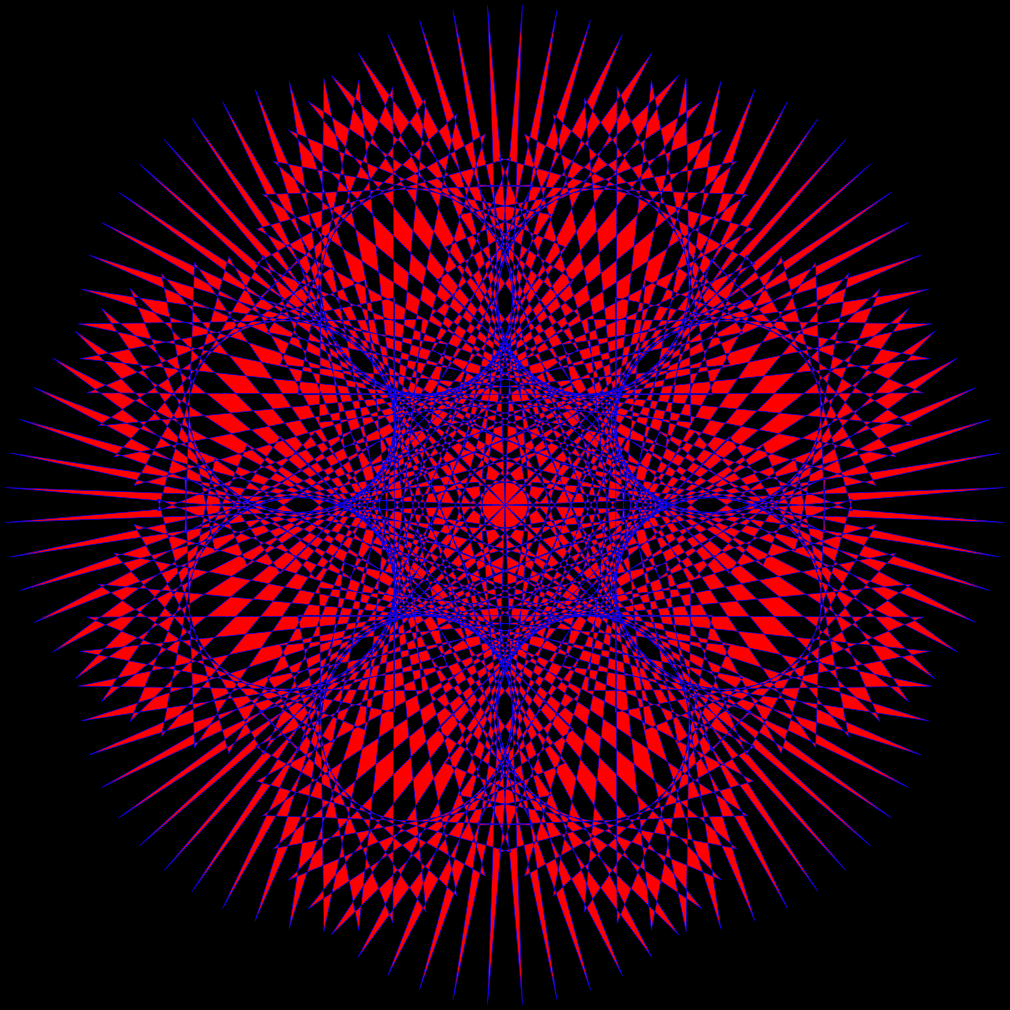
A faint moiré pattern can already be seen when we overlap the stroked versions. In order to enhance it, we use the even-odd color fill rule again, B&W: (.svg)/(.pdf), for a constant step-size (.svg)/(.pdf).
The problem became popular due to the “Mathematical Games” by Martin Gardner in his article
“On the relation between mathematics and the ordered patterns of Op art” in Scientific
American, 1965-07, Vol.213 (1), p.100-105; scientificamerican.com.
PostScript® program that lets you draw any nested regular polygons for a chosen angle with color fill (.txt)/(.ps)/(.pdf)
Read more on these “inspiraling” images (in German (.html)).
String Models
Spotlight Lines
Envelopes
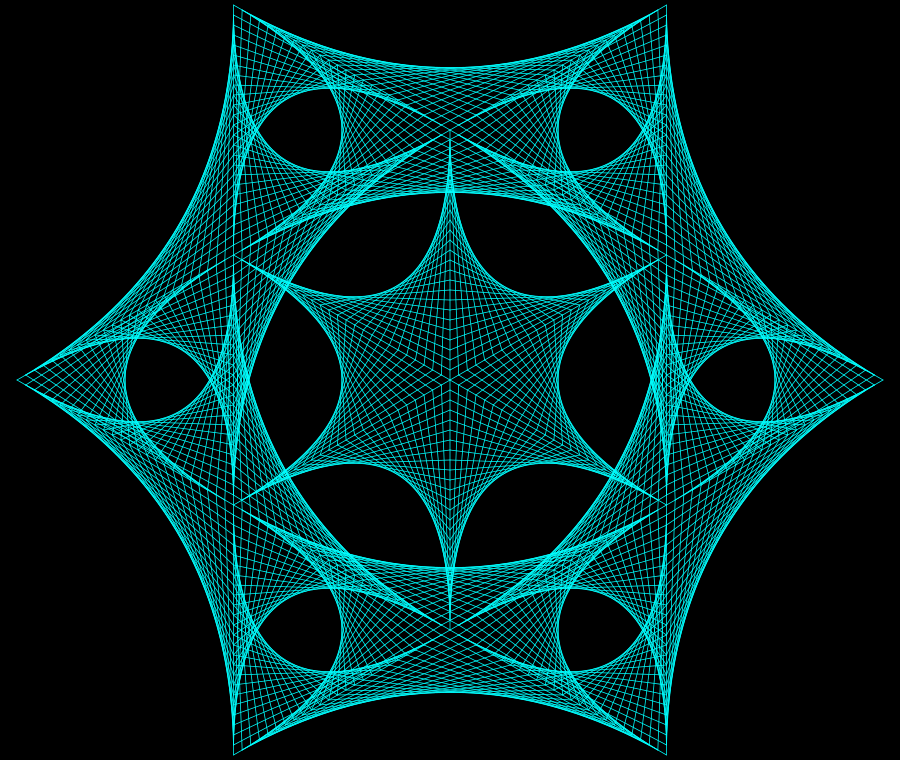
String models built from nails and threads are an appealing type of modelling in mathematics. Normally,
one looks for the resulting curve, the so-called envelope (a basic example as a function (.svg), as a quadratic Bézier curve (.svg)). Does this pique your interest? Then I recommend
“Bridges, string art and Bézier curves” by Renan Gross: degruyter.com/archive.org.
As you may have noticed in the section above on the mutual pursuit problem, these curves, some of which
are not so simple, do not have to be drawn at all, they simply result visually from their tangents. An
aesthetically stunning appearance!
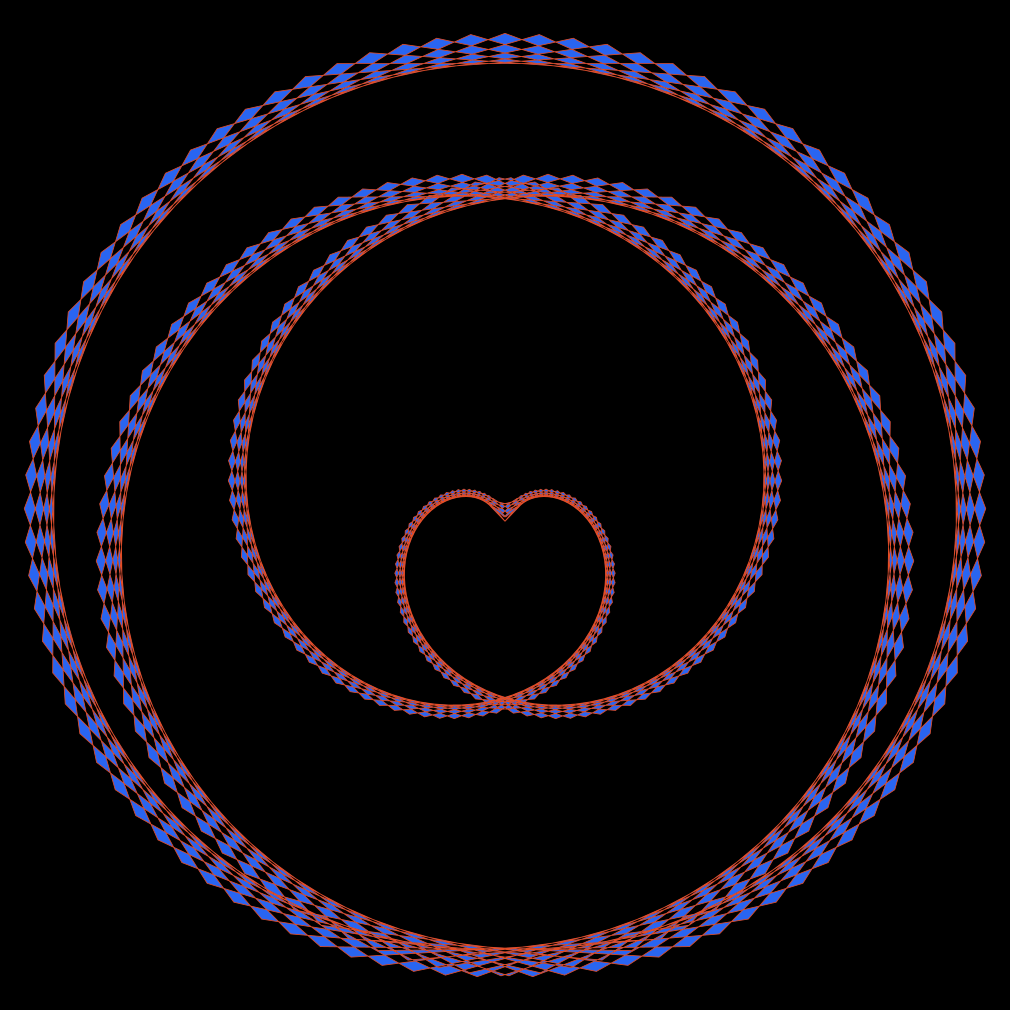
A cardioid (.svg)/(.pdf) results
here from the straight lines connecting the n edges of a polygon by the connection rule k ↦ 2k mod
n (i. e. connect edge 1 with edge 2, edge 2 with edge 4, edge 3 with edge 6 and so on); a
generalisation with k ↦ 6k (.svg), with 2000 edges and k
↦ 211k (.svg), awesome k ↦ 223k (.svg)/(.pdf), k ↦ 301k edges (.svg).
Play with Mathias Lengler’s colored animation: lengler.dev, inspired by Burkard Polster; its basics
come from the French mathematician Simon Plouffe, plouffe.fr.
Sir John also provided some of his drawings for the masterpiece “Vertigo” by Alfred
Hitchcock in 1958. Combined with the brilliant music by Bernard Herrmann, the opening of this film alone
sets an exceptional atmosphere, not to speak of the whole movie.
Moiré patterns are particularly prominent in the film “Catalog” (1961) archive.org.
Luminaries in Moiré Research
Augusto Righi
Augusto Righi, born in 1850 in Bologna, was a professor of physics at the University of Padua and later
at the University of Bologna, where he remained until his death in 1920, cf. en.wikipedia.org, storiaememoriadibologna.it.
Righi, A. (1887): “Sui fenomeni che si producono colla sovrapposizione di due reticoli e sopra alcune
loro applicazioni”. Il Nuovo Cimento, Series 3, Vol. 21, 1887, pp. 203–229.
museogalileo.it.
Cesar A. Sciammarella
Cesar Augusto Sciammarella (born August 22, 1924) is an Argentine civil engineer who made significant
contributions to the field of experimental mechanics with pioneering contributions in moiré, holography
and speckle interferometry, cf. en.wikipedia.org.
Sciammarella, Cesar (1982): “The moiré method—A review”, Experimental Mechanics 22, 418–433 (1982). springer.com.
Cesar Sciammarella, 101 anni, il prof di Chicago che partecipò al progetto Apollo: “Una sfida che
sembrava impossibile”,
corriere.it
(25 09 2025).
Gerald Oster
Gerald Oster was an American physicist whose influential studies in the 1960’s of moiré patterns
combined rigorous optical analysis with insights from perception science, helping to establish the
phenomenon as a legitimate subject of scientific research.
Arnauld, P.: “Magic moirés: Gerald Oster et l’art des moirages”, Éditions Macula, Paris 2022.
ISBN:978-2865891443, editionsmacula.com.
Isaac Amidror
Isaac Amidror is a retired professor at the École polytechnique fédérale de Lausanne (EPFL). His
two-volume book, “The Theory of the Moiré Phenomenon”, is a cornerstone for research on moirés using the
Fourier transform, moire.is-great.org. He is also the author of
“Mastering the Discrete Fourier Transform in One, Two or Several Dimensions: Pitfalls and Artifacts”,
ISBN 978-1447151661, springer.com. Skilled at
creating high-quality vector graphics, some of the graphic ideas here are inspired by Amidror’s books.
[...]
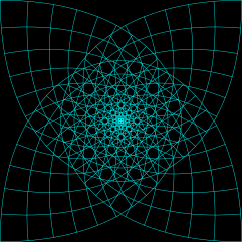
Conformal Map
A conformal map is a transformation that changes one graph into another while keeping the angles between
intersecting curves the same, cf. mathworld.wolfram.com.
As a result, the aesthetic quality of symmetrical patterns is maintained.
Above you see a square grid, centred around (0, 0), after the conformal transformation with the function
f(z) = z3, a finer grid (.png), centred near to (1, i) under
f(z) = ln(z) (.png), superposed (.png); repeated element from f(z) = sqrt(z) (.png); a triangle grid in a hexagon shape (.png) under f(z) = z4(.png), under f(z) = z2 superposed (.png); sin(z) superposed (.png); 1/z (circular inversion) (.png)
A checkerboard pattern under f(z) = sin(z) etc. ☛ (.html); stirring
moiré pattern with WebGL (.html)/(.webp)
Nested squares (.png) transformed under f(z) = tan(z) (.webp)/(.pdf), f(z) = sin(z)
(.png) and finally, Pac-Man is back: f(z) = z/2 sin(z) (.svg)/(.webp)!
Nested equilateral triangles with centroid at (0, 0) (.png)
transformed under f(z) = z−2(.png), “The
Tangent at Heart” (.png), (.png)
Tilted square illusion (.png) (can you see the flipping squares?) from a
hexagon grid under f(z) = cosh(z) (.png)/(.pdf), a regular triangle pattern (.png)
under f(z) = 1/z + z (.png)/(.pdf),
again the lovely tan(z) (.svg)/(.pdf); moiré from concentric circles under z2,
overlapped (.webp)
A tiny bit of explanation? ☛ (.html) (in German) or play with J.
C. Ponce Campuzano’s app on dynamicmath.xyz, a talented mathematician
and teacher, who happens to live in Brisbane, where ... well, see the next section.
Moiré Patterns in Architecture
Building of the Topography of Terror Foundation, image by Josef Streichholz, wikimedia.org.
The product of two “beat tracks” of slightly different speeds overlaid. It takes 82.499427 seconds
(roughly 1 minute and 22 seconds) for them to permute unevenly. “Unevenly” meaning they have crossed
over but have not yet. Source: wikimedia.org by X-Fi6.
“Phase music is a form of music that uses phasing as a primary compositional process.” en.wikipedia.org.
Moiré Fringes in Physics Teaching
There are mainly two topics where in some physics books you find a moiré effect for a visualisation. One
is interference of elementary waves. You can see such circular waves by just dropping a pebble stone
into unmoved water. If you keep dropping two pebbles (or your feet youtube.com) you’ll get an interference
pattern, that not only looks like, but is this: (.html)/(.html), namely hyperbolas.
Bernero, B.: “The Moiré Effect in Physics Teaching”, The Physics Teacher, 1989, pubs.aip.org.
Patorski, K. and M. Kujawinska: “Handbook of the Moiré Fringe Technique”, Elsevier Science, 1993,
ISBN: 978-0-444-88823-5. Ch. 12:
“Moiré as a graphical solution to physical problems”.
Walker, C. A.: “Handbook of Moiré Measurement”, CRC Press, 2003, taylorfrancis.com.
Cullen, M. R.: “Moiré Fringes and the Conic Sections”, The College Mathematics Journal Vol. 21, No.
5 (1990), pp. 370-378, tandfonline.com.
Kinneging, A. J.: “Demonstrating the Optical Principles of Bragg's Law with Moiré Patterns”, Journal
of Chemical Education, 1993, pubs.acs.org.
Witschi, W. “Moirés”, Computers & Mathematics with Applications 12B (1-2), 1986, pp. 363-378, sciencedirect.com.
One other topic where a moiré might show up is electromagnetism. If you want to visualise how a dipole
(or two electric charges wikimedia.org)
works, for example as an emitter, you can use two circles where you draw radial triangles or just lines,
the radii. To represent the field lines (direction that a small positive charge would take)
qualitatively let the students play a bit with this analogue (.html).
Just for fun. Some gripping moirés might appear in a solenoid coil (.html).
Keun Cheol Yuk, Soo Chang: “Analysis of moiré fringes by a solenoidal coil grating”, Optics
Communications, 195, Issues 1-4, 2001, pp. 119-126, sciencedirect.com.
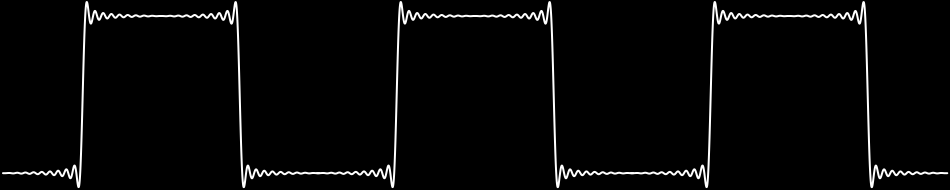
Lissajous curve with the first summands of the Fourier square wave function ☛ (.svg)/(.pdf). Watch
the video “Math is Art” yt@ComplexityAndChaos
(moiré at 1:05). Even “Lieutenant Columbo” (Peter Falk) liked in a lovely scene Bowditch/Lissajous
curves on a screen set in “Make Me a Perfect Murder” (1978).
When using a client for plotting it is sometimes advisable not to export a vector graphic or a pdf;
nowadays I use and adore matplotlib.org, yet so far the export is
limited, providing a jagged path whatever one sets for the step size (.svg), while the png export takes the full command (.png)!
In order to obtain a made-to-measure plot, instead of a jagged vector graph, it is worthwhile to take
your own program, e. g. (.c) or (.py), in which the steps can be selected individually; the vector
can then be converted to a (.png) or a (.pdf); a proposition for a python SVG class (.html).
Spirograph apps are widespread due to the iconic playset, playmonster.com (no affiliation).
Therefore, I will not present any own implementations. A neat app is the one by Alvin Penner, github.com, that was used for some
of the
spirographs here: (.svg)/(.pdf), (.svg)/(.pdf), with an enhanced moiré effect resulting from the
even-odd color fill rule (.svg), (.svg)/(.pdf).
Spiromoiré (.html).
Mitchell Warr used three wheels and made some interesting findings, see github.io, video youtube.com; e. g. (.svg) (zoom to see a moiré)
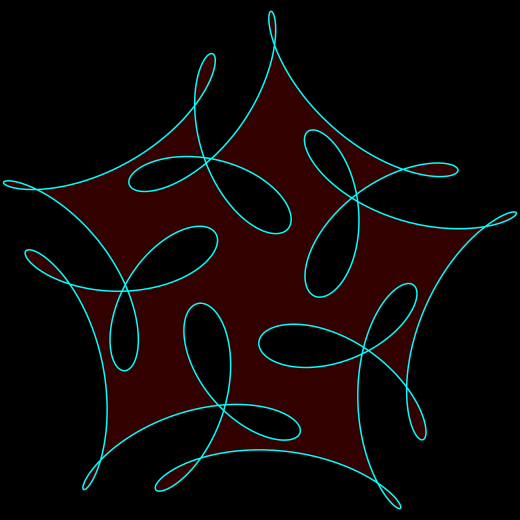
Whether there is really no permanent place for ugly mathematics in the world, as G. H. Hardy suggested,
I ultimately do not know (as a physicist I doubt it), yet there is a huge amount of beauty in
and from mathematics. I suggest, you and I read now a bit in the marvelous book by Frank A. Farris,
“Creating Symmetry: The Artful Mathematics of Wallpaper Patterns” princeton.edu, where this
‘mystery curve’ (.svg) is taken from.
Epilogue
In the hope of having sparked your interest in the moiré effect, I would like to conclude with a
conjecture. We have seen that a moiré pattern can be identical to an inversive geometry (Square Inversion, circle or circular inversion: (.pdf)). For the circle inversion we have a corresponding
conformal mapping f(z) = 1/z. And we know that the Fourier transform can predict nearly any moiré
pattern. This raises the question, whether there is a deeper and more general connection between:
I guess, the witty moiré will continue to impress us with (mathematical) patterns!
Would you like to learn more on vector graphics or just see further of my images? Then, please visit my
“Vektorgrafiken” (.html) page. In any case, I express my thanks for
your kind visit here.












#/media/File:Moireband.jpg)


