Against Necropolotics I:
Prolegomena to
deconstruction of Medical Anthropology in situ
☆この発表は、アシ ル・ムベンベ(2016[2019])が提唱した、全世界の人々が直面する「死の政治学( politics of death)」すなわちnecropilitics に対して世界の医療人類学者たちが協力してnecropilitics という秩序を、分析、批判、解体し、きたるべき生き生きとした健康の秩序と生活を取り戻す試みである。
| 1. What is Necropolitics? 2. What is Medical Anthropology in situ? 3. What is the Act of De/Reconstruction? 4. Examples of the De/Reconstruction of MA 4.1 Repartition of the Human Body; Hauntological Practices 4.2 The Nazi’s Eugenics as Necropolitics 4.3 Social Defense vs. Clients’ Autonomies: Buttlefield of Medical Discourse 5. Medical Anthropology in Question |
1. ネクロポリティクスとは何か? 2. 現場における医療人類学とは何か? 3. 脱/再構築の行為とは何か? 4. 医療人類学の脱/再構築の事例 4.1 人体の再配分;ハウントロジー=憑在論的な実践 4.2 ネクロポリティクスとしてのナチスの優生学 4.3 社会的防衛対クライアントの自律性:医療言説の戦場 5. 問われる医療人類学 2026年臺灣醫療人類學學會での発表 |
| This
presentation should be an attempt by medical anthropologists worldwide
to collaborate in analyzing, critiquing, and dismantling the
necropolitics—the “politics of death”—proposed by Achille Mbembe (2016)
that confronts all the people globally, to reclaim a future order of
“vibrant health and life”. Mbembe points out that the principles of
biopolitics—which govern characteristics defining population groups,
such as health, hygiene, birth rates, life expectancy, ethnicity, or
“race,” etc. —have shifted to necropolitics. This new political order
centers on criminal groups, psychological predispositions to violence,
terrorist activities and their surveillance, collateral damage from
terrorism, war casualties, and comparative assessments of enemy
casualties. In other words, the health issues confronting all humanity
can be placed within this sphere of necropolitics. Within this context,
medical anthropologists who have previously conducted research within
the sphere of biopolitics are also required to deconstruct and
reconstruct their discipline. This constitutes the deconstruction and
reconstruction of medical anthropology. Traditional medical
anthropology, based on medical ethnography, forms a local descriptive
system; we shall call this medical anthropology in situ. The new
medical anthropology replacing it is termed medical anthropology in the
pluriverse (Escobar 2016). Medical anthropology in the pluriverse
requires, in addition to existing scholarship, frameworks from
historical research, ethics, and critical race studies. The speaker
will examine how biopolitics and necropolitics are involved in three
current research projects: Jacques Derrida's Hauntology, Eugenics
during the Nazi era, and the Anti-vaccine movement in a global setting.
In this pluriverse where the world's people face the suspension of
democracy and attempt to resolve international conflicts through
localized warfare without formal declaration, medical anthropologists
are expected to contribute in some way to the lives and deaths of these
people. |
この発表は、アシ
ル・ムベンベ(2016[2019])が提唱した、全世界の人々が直面する「死の政治学( politics of
death)」すなわちnecropilitics に対して世界の医療人類学者たちが協力してnecropilitics
という秩序を、分析、批判、解体し、きたるべき生き生きとした健康の秩序と生活を取り戻す試みである。ムベンベは次のように指摘する。すなわち、人口集団
を把握する特徴、すなわち、健康、衛生、出生率、寿命、人種などを管理するバイオポリティクスの原理から、今日では、人種主義、テロとの戦争、あるいは統
治権力が主張する「例外状況」によって政治は、犯罪者集団、暴力の心理的素因、テロリズム活動とその監視、テロによるコラテラルダメージ、戦争による死傷
者、敵の死傷者との比較考量などを中心としたネクロポリティクスの政治に移行している。ネクロポリティクスは、世界の先住民のみならずアジア、アフリカ、
ラテンアメリカ、スラブ、中東諸国の人たちのみならず、世界に離散する人々とともに共存している中枢の国々の人たちも含まれる。つまり全世界の人々が直面
する保健問題がこのネクロポリティクスの圏内に置くことができる。このような状況のなかでこれまでバイオポリティクスの圏内で研究に従事してきた医療人類
学者たちもまた自分たちの学問の解体と再編成がもとめられる。それが医療人類学のデコンストラクションとリコンストラクションの意味であり、従来の医療人
類学は医療民族誌にもとづくローカルな記述体系であり、それを medical anthropology in situ
と呼ぼう。それに代替した新しい医療人類学をmedical anthropology in pluriverse と呼ぶ。Pluriverse
の医療人類学はこれまでの学問に加え、歴史研究、倫理学、批判的人種研究の枠組みが求められる。演者が現在格闘中の3つの研究(ジャック・デリダの
Hauntology, ナチズム時代の優生学,
反ワクチン運動)においてバイオポリティクスとネクロポリティクスがどのように関与しているかを検証する。このような活動を通して1970年代に全世界の
各地で伝統的医療概念の見直しと生物医学批判として医療人類学が登場し、in situ
のなかで保健活動に従事している研究者や活動家たちが批判的想像力を育んできた。いま全世界が直面している民主主義の停止や国際紛争を宣戦布告なしの局地
戦で解決しようとするpluriverse の中にいる世界人民の生命と死について医療人類学者は何らかの寄与が期待されるだろう。 |
☆
 |
The meaning of “Against Necropolitics I” & “Against Necropolitics II” Necropolitics refers to a political system that forces the dead to remain silent. Medical anthropology in the context of necropolitics is an academic endeavor that breaks the silence of the dead and listens to their voices through fieldwork. |
 |
Our world can be devided to the world of the living and the world of the dead. |
☆
☆
|
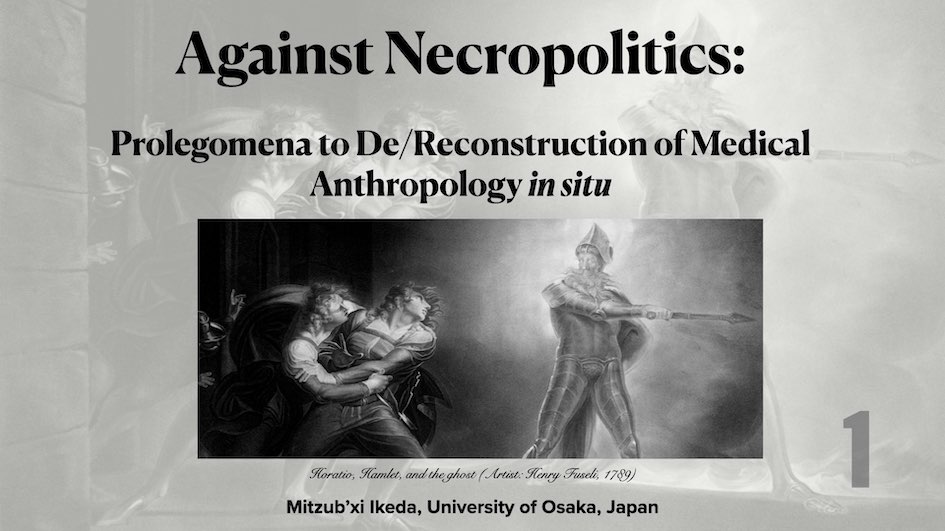
Against Necropolitics: Prolegomena to De/Reconstruction of Medical Anthropology in situ Mitzub’xi Ikeda, University of Osaka, Japan |
|
Scenario 1. What is Necropolitics? 2. What is Medical Anthropology in situ? 3. What is the Act of De/Reconstruction? 4. My Examples of the De/Reconstruction of MA 4.1 Repatriation of the Human Body; Hauntological Practices 4.2 The Nazi’s Eugenics as Necropolitics 4.3 Social Defense vs. Clients’ Autonomies: Buttlefield of Medical Discourse: Pro/Anti-Vaccination 5. Concluding Remarks: Medical Anthropology in Question |

|
1. What is Necropolitics? (I) Necropolitics is a concept of cultural politics proposed by Achille Mbembe (2016, 2019), drawing inspiration from biopolitics. Necropolitics is a theory concerning the exercise of cultural, social, and political power to determine how certain people live and how others must die. Mbembe is a Cameroonian historian, political theorist, and intellectual who serves as a research professor of history and political science at the Wits Institute for Socio-Economic Research at the University of the Witwatersrand. He is the author of numerous works on colonialism and its consequences. |
|
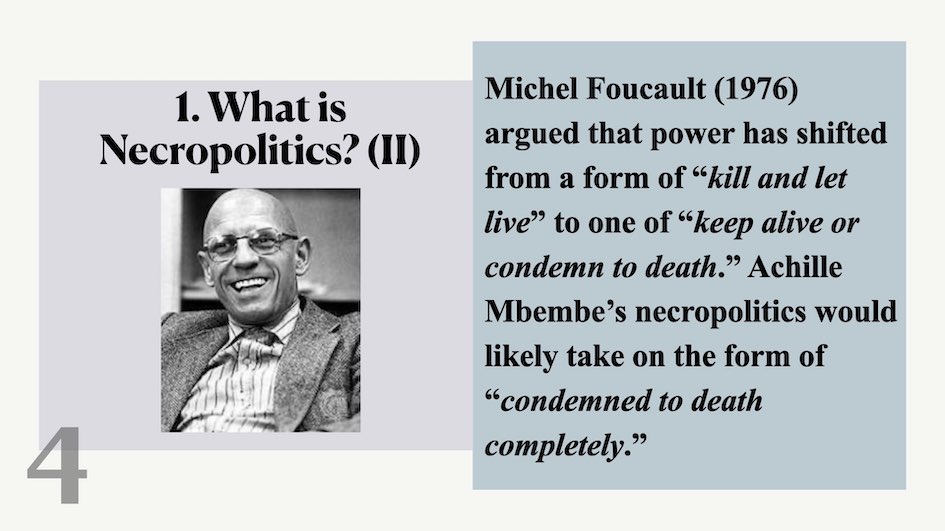
1. What is Necropolitics? (II) Michel Foucault (1976) argued that power has shifted from a form of “kill and let live” to one of “keep alive or condemn to death.” Achille Mbembe’s necropolitics would likely take on the form of “condemned to death completely.” |

|
2. What is Medical Anthropology in situ?(I) ・“In situ” is Latin for “on the spot.” Therefore, “anthropology in situ” refers to research described through traditional ethnographic methods involving fieldwork conducted on-site. ・Researchers believe that, guided by the principle of in situ, anthropologists can understand the culture under study by describing their experience of the differences between their own culture and that of the research subject. ・In addition to recognizing these differences, medical anthropology incorporates another point of reference—biomedical universalism—into its analysis. Through this “triangulation” of three analytical perspectives, researchers can not only understand the culture of the subject but also adopt a perspective that relativizes biomedical universalism. |
|
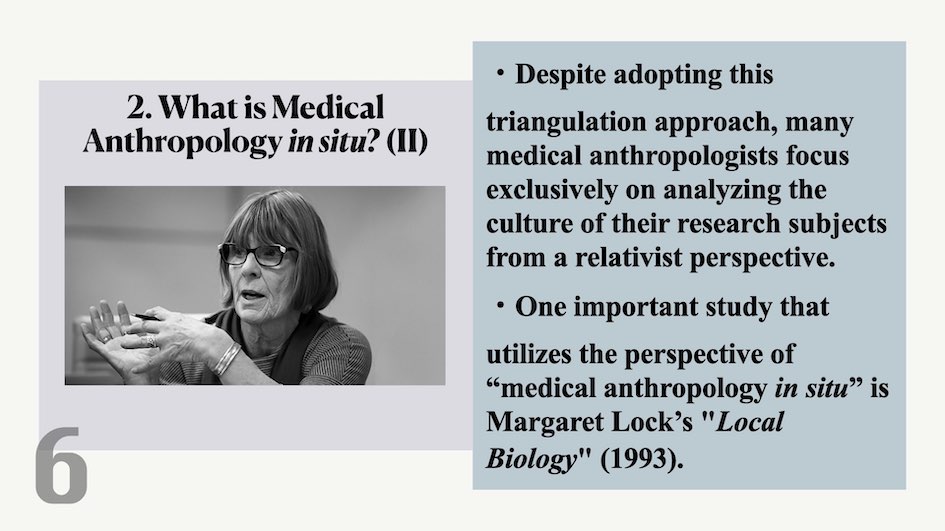
2. What is Medical Anthropology in situ? (II) ・Despite adopting this triangulation approach, many medical anthropologists focus exclusively on analyzing the culture of their research subjects from a relativist perspective. ・One important study that utilizes the perspective of “medical anthropology in situ” is Margaret Lock’s "Local Biology" (1993). |

|
3. What is the Act of De/Reconstruction of Medical Anthropology? (I) ・The concept of “Anthropology in situ” is critically understood in light of Jacques Derrida’s (1967) ideas of deconstruction and “différance.” -the Critique of “Metaphysics of Presence.” ・Compared to the evolutionary anthropology that preceded it, the history of modern anthropology has developed theories that prioritize “presence”—that which is visibly there—over “absence.” ・The production of ethnography does not take place during fieldwork, but rather after fieldwork has been conducted, within the researcher’s home base. ・Ethnography reconstructs the presence of what the researcher has seen and heard to prove the researcher’s own existence. |

|
3. What is the Act of De/Reconstruction of Medical Anthropology? (II) ・Critics of modern anthropology point out that this “presence” is described using the present tense of grammatical verbs, a concept referred to as the “ethnographic present.” As Johannes Fabian criticized, while the researcher lives within a changing flow of time, the “other”—the subject of study—becomes fixed in time and space, existing merely as a specimen. ・What is required to revitalize medical anthropology is the liberation of research subjects who are fixed in time and space; to achieve this, the medical ethnographies must be deconstructed. |
|
4. My Examples of the De/Reconstruction of Medical Anthropology 4.1 Repartition of the Human Body; Hauntological Practices 4.2 The Nazi’s Eugenics as Necropolitics 4.3 Social Defense vs. Clients’ Autonomies: Buttlefield of Medical Discourse |

|
4.1 Repatriation of the Human Body; Hauntological Practices (I) ・Currently, people in former colonies and Indigenous communities around the world are launching campaigns demanding the return of artifacts, human remains, and burial goods from ancient sites that are preserved in museums and universities. Here, we focus on the movement for the repatriation of Indigenous human remains. ・With the exception of cases where state laws governing the return of human remains and grave goods have been established (such as the U.S. NAGPRA), the return of cultural artifacts and human remains from the center to the periphery—that is, to local communities—has been slow. ・The reason for this is that the “logic of the colonizing power”—arguing that the historical context surrounding the collection by museums and universities is unclear, that responsibility is not clearly defined, or that there were no research ethics constraints at the time of collection—still prevails. Furthermore, the issue of who determines the legitimacy of the parties requesting repatriation and how remains unresolved. |
|
|
4.1 Repatriation of the Human Body; Hauntological Practices (II) ・Museums and universities emphasize the academic value of the human remains in their custody while ignoring the colonial nature of the research. On the other hand, Indigenous peoples emphasize that the “absence” of the remains leaves ancestral worship rituals incomplete and highlights the spiritual debt descendants owe to their ancestors. Scientists criticize the Indigenous side for being “unscientific,” while the Indigenous side accuses scientists of having “lost too much of their humanity.” ・The psychological trauma stemming from descendants’ ethical debt to the spirits of their ancestors can be interpreted within the framework of “Hauntology”—in which, like the protagonist of Shakespeare’s Hamlet, a ghost reveals the true responsibility (the ethical deficiency of scientists) and the [both scientific and secular]truth (Derrida 1993). |

|
4.2 The Nazi’s Eugenics as Necropolitics: Limits of Medical Ethics (I) ・In 1883, Francis Galton coined the term “eugenics.” The ideal of eugenics was to apply Charles Darwin’s concept of natural selection to human populations, thereby eliminating “inferior genetic factors.” ・Despite widespread criticism, eugenics gained support from both capitalists and socialists (except religious devotees and theologians), and in European countries and the United States, it began with the sterilization of people with genetic disorders and mental disabilities. In the United States, a system for registering sterilization records was launched on an experimental basis, and by the early 20th century, Britain and the United States had become the leading nations in this field - the birth of biomedical states. ・It is said that while Adolf Hitler was imprisoned for high treason, he read works on the German version of eugenics—namely, “Erblichkeitslehre und Rassenhygiene”—and became obsessed with the superiority of the Aryan race and anti-Semitism. After the Nazis came to power in 1933, Nazi racial hygiene (Rassenhygiene) became a kind of national science, surpassing the eugenics of the United States and other European countries. |
|
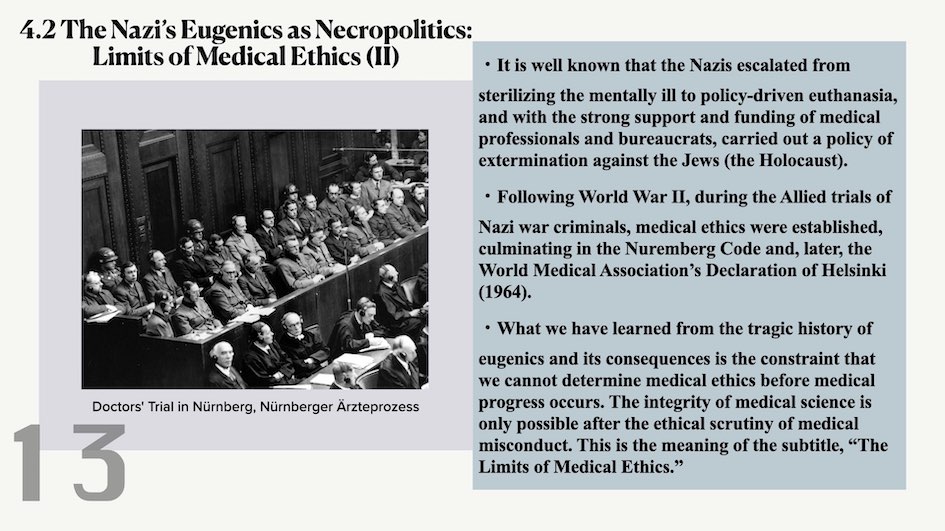
4.2 The Nazi’s Eugenics as Necropolitics: Limits of Medical Ethics (II) ・It is well known that the Nazis escalated from sterilizing the mentally ill to policy-driven euthanasia, and with the strong support and funding of medical professionals and bureaucrats, carried out a policy of extermination against the Jews (the Holocaust). ・Following World War II, during the Allied trials of Nazi war criminals, medical ethics were established, culminating in the Nuremberg Code and, later, the World Medical Association’s Declaration of Helsinki (1964). ・What we have learned from the tragic history of eugenics and its consequences is the constraint that we cannot determine medical ethics before medical progress occurs. The integrity of medical science is only possible after the ethical scrutiny of medical misconduct. This is the meaning of the subtitle, “The Limits of Medical Ethics.” Doctors' Trial in Nürnberg, Nürnberger Ärzteprozess |
|
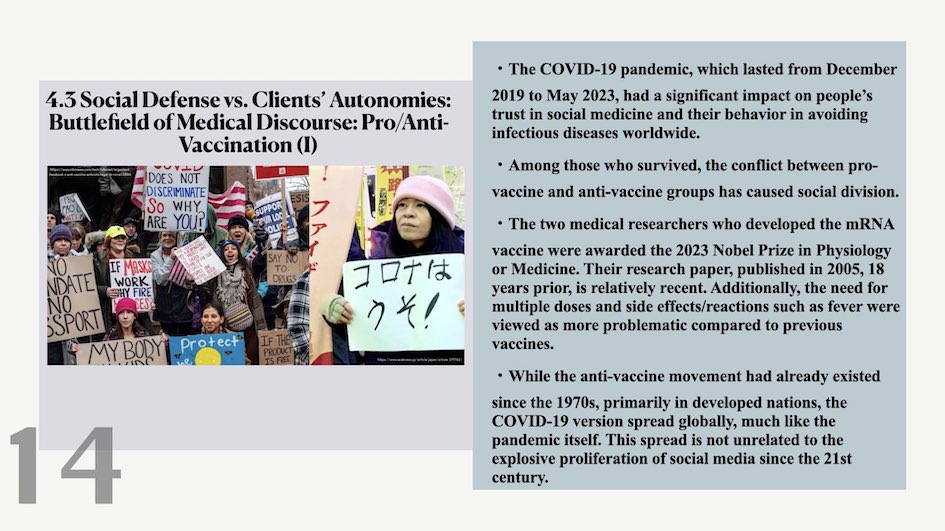
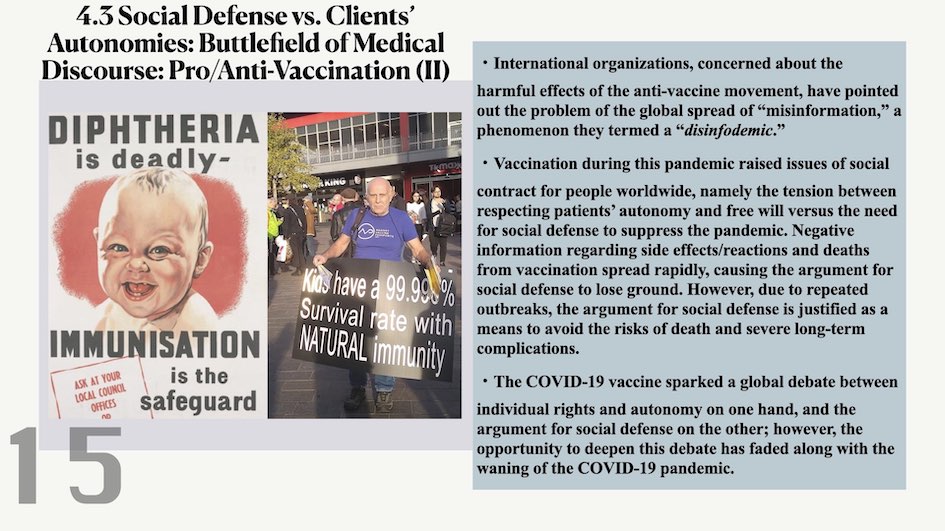
4.3 Social Defense vs. Clients’ Autonomies: Buttlefield of Medical Discourse: Pro/Anti-Vaccination (I) ・The COVID-19 pandemic, which lasted from December 2019 to May 2023, had a significant impact on people’s trust in social medicine and their behavior in avoiding infectious diseases worldwide. ・Among those who survived, the conflict between pro-vaccine and anti-vaccine groups has caused social division. ・The two medical researchers who developed the mRNA vaccine were awarded the 2023 Nobel Prize in Physiology or Medicine. Their research paper, published in 2005, 18 years prior, is relatively recent. Additionally, the need for multiple doses and side effects/reactions such as fever were viewed as more problematic compared to previous vaccines. ・While the anti-vaccine movement had already existed since the 1970s, primarily in developed nations, the COVID-19 version spread globally, much like the pandemic itself. This spread is not unrelated to the explosive proliferation of social media since the 21st century. |
|
4.3 Social Defense vs. Clients’ Autonomies: Buttlefield of Medical Discourse: Pro/Anti-Vaccination (II) ・International organizations, concerned about the harmful effects of the anti-vaccine movement, have pointed out the problem of the global spread of “misinformation,” a phenomenon they termed a “disinfodemic.” ・Vaccination during this pandemic raised issues of social contract for people worldwide, namely the tension between respecting patients’ autonomy and free will versus the need for social defense to suppress the pandemic. Negative information regarding side effects/reactions and deaths from vaccination spread rapidly, causing the argument for social defense to lose ground. However, due to repeated outbreaks, the argument for social defense is justified as a means to avoid the risks of death and severe long-term complications. ・The COVID-19 vaccine sparked a global debate between individual rights and autonomy on one hand, and the argument for social defense on the other; however, the opportunity to deepen this debate has faded along with the waning of the COVID-19 pandemic. |
|
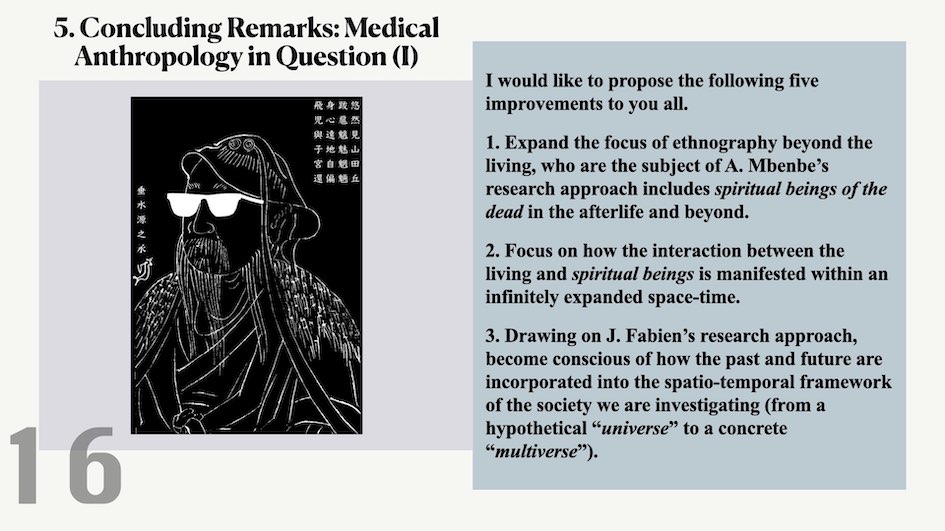
5. Concluding Remarks: Medical Anthropology in Question (I) I would like to propose the following five improvements to you all. 1. Expand the focus of ethnography beyond the living, who are the subject of A. Mbenbe’s research approach includes spiritual beings of the dead in the afterlife and beyond. 2. Focus on how the interaction between the living and spiritual beings is manifested within an infinitely expanded space-time. 3. Drawing on J. Fabien’s research approach, become conscious of how the past and future are incorporated into the spatio-temporal framework of the society we are investigating (from a hypothetical “universe” to a concrete “multiverse”). |
|
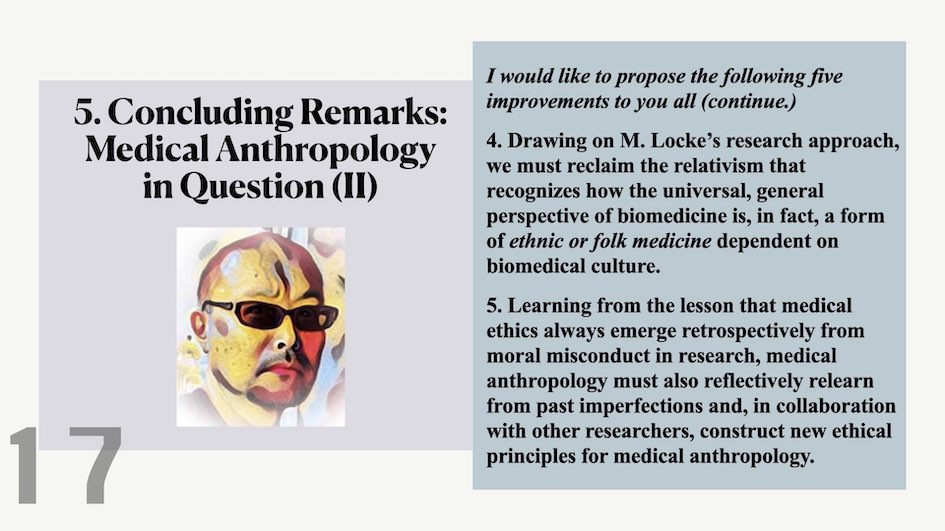
5. Concluding Remarks: Medical Anthropology in Question (II) I would like to propose the following five improvements to you all (continue.) 4. Drawing on M. Locke’s research approach, we must reclaim the relativism that recognizes how the universal, general perspective of biomedicine is, in fact, a form of ethnic or folk medicine dependent on biomedical culture. 5. Learning from the lesson that medical ethics always emerge retrospectively from moral misconduct in research, medical anthropology must also reflectively relearn from past imperfections and, in collaboration with other researchers, construct new ethical principles for medical anthropology. |

|
Bibliography - Denzin, Norman. 1989. The research act: A theoretical introduction to sociological methods. New York: McGraw-Hill. - Derrida, Jacques. 2006. Specters of Marx : the state of the debt, the work of mourning and the New International. translated from the French by Peggy Kamuf. New York : Routledge. - Foucault, Michel . 1998. The will to knowledge. translated from the French by Robert Hurley. London: Penguin. - Ikeda, Mitsuho. 2020. Repatriation of human remains and burial materials of Indigenous peoples: Who owns cultural heritage and dignity ? CO*Design 7:1-20, https://info:doi/10.18910/75574 - Ikeda, Mitsuho. 2025. The Social role of Racial Hygiene in Nazi Germany (in Japanese). In Anthropology in the Fascist Era: Intelligence, Propaganda, and Agents. K. Nakao and T. Iida (eds), Pp.54-84. Tokyo: Fukyo-sha. - Lock, Margaret. 1993. Encounters with aging : mythologies of menopause in Japan and North America. Berkeley : University of California Press. - Mbembe, Achille. 2019. Necropolitics, Translated by Corcoran, Steve. Durham: Duke University Press. - Shakespeare, William , Hamlet. |
 |
Thank you for listening! And see you on June 28 in Seoul, Korea, at the meeting of the East Asian Medical Anthropology Network. 感謝各位的聆聽!6月28日於首爾舉行的「東亞醫學人類學網絡」活動上見 |
 |
To be continued …. 待續…… Against Necropolitics II: Anthropological Zombie or Anthropology as Zombie existence. 反對死亡政治學 II:人類學上的殭屍,抑或作為殭屍般存在的人類學 |
| To be continued....: Mitzub'ixi Quq Chi'j, Against Necropolotics II: Anthropological Zombie or Anthropology as Zombie existence. |
(続く)Against Necropolotics II: Anthropological Zombie |
★
☆
リンク(理論)
リ ンク
文 献
そ の他の情報
CC

Copyleft,
CC, Mitzub'ixi Quq Chi'j, 1996-2099

