(1) GURATHIN FAN. Leah Schnelbach says, “I Didn’t Expect Dr. Gurathin To Be My Favorite Part of Murderbot” at Reactor. Beware spoilers.
If you want to make me love your work, take a scene or a character who could have been flat or cliche or basic, and write them a wildly new direction. In Murderbot, to my surprise and delight, it was what the Weitzes did with the character of Dr. Gurathin. In the books, Gurathin is the one member of the PresAux team who’s a little more suspicious of their assigned SecUnit. He clocks that Murderbot is acting weird, and he questions it in front of the rest of the group to figure out whether they’re in danger. Once they figure out that it’s autonomous, he needles Murderbot occasionally just to make sure it’s not going to go rogue and kill them all. This is brave of him, from a certain point of view, but also stupid, and Dr. Mensah mostly seems to be annoyed when he does it.
When I learned that David Dastmalchian had been cast in the Murderbot adaptation, I figured he was playing Dr. Gurathin, and that Gurathin’s role was going to be expanded a bit. My first thought was that he would be the Dr. Smith of the group, which would have been fun, but nowhere near as meaningful as the path they took….
(2) LIBRARY POLICIES AND USE. “EveryLibrary Releases Legislative Update and Library Use Survey” – Publishers Weekly gives an overview.
Advocacy organization EveryLibrary has shared some of its latest research on the status of library-related policymaking and patrons’ library usage across the U.S. In a summary titled “Codifying Censorship or Reclaiming Rights? The State-by-State 2025 Legislative Landscape for Libraries,” EveryLibrary compiles an eye-opening stack of bills that have been passed, enacted, vetoed, or left to wither on the vine. The document also details how coalitions are forming in support of intellectual freedom nationwide.
The legislative update concludes that library advocates “must actively build coalitions across our own sectors,” including outreach to “legitimate conservative or libertarian organizations.” EveryLibrary observes that coalitions “tend to skew older,” necessitating outreach to Gen Z free speech activists too. The emphasis on expanding partnerships echoes a pillar of the American Library Association’s new strategic plan.
Separately, in this year’s Freckle Project report, supported by EveryLibrary and generated annually since 2019, consumer survey data indicates that library visits and print circulation have declined more than 50% since 2011, while digital circulation has risen from 8% to 45% in the past decade. Though digital is up, the report also attests that patron demand for “more nonfiction and more backlist” print titles is going unmet.
The first six months of this year has brought 133 “negative bills” in 33 states, threatening public libraries, school libraries, librarianship, and the rights of readers, according to EveryLibrary’s “Codifying Censorship” white paper. Concurrently, another 76 bills in 32 states aim to protect or extend library services and intellectual freedom. In all of 2024, only 121 such “bad bills” came under consideration, and only 36 right to read bills were proposed….
(3) MEET ISIS ASARE. SFWA’s new Executive Director Isis Asare, announced last month, is featured in today’s Shelf Awareness.
Isis Asare has been named executive director of the Science Fiction and Fantasy Writers Association. She is the fifth executive director and the first African-American executive director of the association, and will work with SFWA board president Kate Ristau and operations director Russell Davis (the previous interim executive director) to implement the strategic direction set by the SFWA board of directors.
SFWA described Asare as “a queer Afrofuturist, technology entrepreneur, Stanford, Harvard, and Columbia alum, and the CEO/founder of Sistah Scifi, the first Black-owned bookstore focused on science fiction and fantasy in the U.S.,” which is located in Oakland, Calif. She was honored as Norwescon 47’s special guest of honor and served as executive director of Aunt Lute Books, the nonprofit press that has a history of championing underrepresented authors.
Asare aims, SFWA wrote, to “cultivate a space at SFWA where more conversation can happen, and where consensus on next steps can be achieved through a thoughtful inclusion of different points of view. SFWA is home to both traditional and transformative forms of SFF, and that wide array of approaches to the genre is not a source of schism. Rather, it is the rich foundation of creative practice on which the next phase of our advocacy journey–and our community uplift–will unfold.”
Asare said, “Continuing the legacy of the Science Fiction and Fantasy Writers Association is a true honor. It was a privilege to present the Nebula Award for Best Novel to John Wiswell for Someone You Can Build a Nest In, and I cheered as A.W. Prihandita became the first Indonesian to win–or even be nominated for–the prestigious Nebula Award for Best Novelette, for ‘Negative Scholarship on the Fifth State of Being.’ It is a joy to celebrate the work of speculative fiction writers that inspire all readers to imagine futures beyond our wildest dreams.”
(4) CHARACTERS COUNT. The New York Times recounts “A Professor’s Search for the MingKwai, a Lost Chinese Typewriter”. (Behind a paywall.)

…Dr. Mullaney’s mania for clunky text appliances began in 2007, when he was preparing a talk on the disappearance of Chinese characters and found himself contemplating the disintegration of everything.
Among the vast number of characters in the Chinese language — around 100,000, by some estimates — there are hundreds that no one alive knows how to pronounce. They are written down, plain as day, in old books, but their sounds, even their meanings, have been lost.
Sitting in his office, wondering at how something seemingly immortalized in print could be forgotten, Dr. Mullaney went down a mental rabbit hole.
It would have been physically impossible to build a typing machine to include all the characters that were historically written out by hand, he thought. Some characters must have made the cut, while others were left behind. He sat back in his chair and asked himself: Could he recall ever having seen a Chinese typewriter?
Two hours later, he was lying on the floor of his office, looking at patent documents for such devices. There had been, over the last century and a half, dozens of different Chinese typewriters made. Each one was an inventor’s take on how to incorporate thousands of characters into a machine without making it unusable — a physical manifestation of their ideas about language. Never plentiful, the typewriters were now increasingly rare, gone the way of most obsolete technology.
Dr. Mullaney was fascinated.
That evening turned into months of research, which turned into years of searching, as Chinese typewriters became one of his areas of historical expertise.
He cold-called strangers and left voice mail messages for private collectors, people whom he suspected, from faint traces left on the internet, of having typewriters. He pored over Ancestry.com, looking for the next of kin of the last known owner of a particular machine. He called museums and asked, “Do you, by any chance, have a Chinese typewriter?”
Sometimes, they said yes. A private museum in Delaware happened to have a surviving IBM Chinese typewriter, of which only two or three were ever made. Someone at a Chinese Christian church in San Francisco got in touch with him to say they owned a typewriter that they were trying to get rid of. Dr. Mullaney took it off their hands.
Then there was the fellow in Northern California who had held on to two Japanese typewriters, as rare as the Chinese varieties, for some decades. “He looked at me and said, ‘Is your trunk big enough?’” Dr. Mullaney recalled. It was, just.
Dr. Mullaney took home those typewriters, and the typewriter in London and others like them, because it had begun to dawn on him that he might soon be one of the only people alive who knew what these machines were, who really understood their stories. He might be the last thing standing between these machines and oblivion….
(5) IN THE DAYS OF ‘KIM’. Francis Hamit has accumulated over a thousand books in his Intelligence and Espionage Research Library. At his new Substack he will be reviewing some of them for his “Intelligence Bookshelf” feature – which will be a free feature, not behind the paywall. Hamit’s starting with Spying For Empire: The Great Game In Central And South Asia, 1757 to 1947 by Robert Johnson (Greenhill Books, 2006) in “The Real World Spies In Kipling’s KIM”.
… Spying For Empire explores the reality behind Kipling’s novel, beginning with the British conquest of India by both military and diplomatic means. Spies were needed for tactical military intelligence, but also to explore the lands beyond the frontier. The main adversary then, as now, was Russia, with an expanding empire of its own. Between lay Persia (now Iran), Afghanistan, Tibet, and the edge of China, another empire. Lone agents, often in disguise, were posted in market towns to gather information and hired correspondents known as “pundits” to write reports that were sent back to London….
(6) IS THIS NUTS, OR WHAT? The New York Times takes us “Behind the Squirrel Scene That James Gunn, ‘Superman’ Director, Says Almost Got Cut”. (Link bypasses paywall.)
…James Gunn’s new take on “Superman,” in theaters now, has its fair share of flight scenes and they’re all convincingly done. But the movie’s mission statement has more to do with a pure spirit than a special effect: In the middle of one frenetic action sequence, after noticing a tiny squirrel is in danger of being crushed by debris, Superman leaps into action to rush the animal out of harm’s way.
Sure, you’ll believe a man could fly. But would you believe that man would go to the trouble of saving a squirrel?
“The squirrel moment is probably one of the most debated,” Gunn told me recently. In early test screenings, some audiences were confused about why Superman (David Corenswet) would prioritize a tiny critter when all of Metropolis was in jeopardy. But to Gunn, that was exactly the point: His cleareyed, upbeat incarnation of Superman prizes saving every life, human or not.
“A lot of people were anti-squirrel. They thought it was too much,” he said. “And I think it really comes down to, do you like squirrels or not?”
Gunn’s own answer to that question should come as no surprise, given the empathy he extended to a raccoon in his “Guardians of the Galaxy” trilogy.
“I love squirrels,” he said. “If a monster’s tail was coming at the squirrel, I would save the squirrel if I could. I’ve done it before: Every day, I’m honking at squirrels on the road.”
Even though he stripped the squirrel moment from one early cut of the film, Gunn ultimately decided that keeping it was fundamental to understanding his main character, who had been portrayed in a much darker fashion by Henry Cavill in recent films like “Batman v. Superman: Dawn of Justice.” When Corenswet’s Superman saves the squirrel, the message couldn’t be clearer: This is not that.
(7) TALES OF GALACTIC PEST CONTROL FROM AMAZING SELECTS. The containment fields are holding, the exterminator bots are standing by, and the newest anthology from Amazing Selects has officially landed! Tales of Galactic Pest Control is now available for purchase.

It’s crawling with weirdness (in the best way). Edited by science fiction legends David Gerrold (The Trouble with Tribbles) and Tom Easton (Analog), this one-of-a-kind anthology features 34 original stories about the unglamorous, underappreciated, and utterly essential job of pest control… in space.
List of authors: Stephen Antczak, Sarah Arnette, Lauren Taylor Bak, Marleen S. Barr, Charles Barouch, Reginald Bretnor, Pete Carter, Jenny Perry Carr, Stephen Chappell, Dave Creek, Tom Easton, David Gerrold, Galen Gower, Dana Gricken, Nissa Harlow, Henry Herz, Liam Hogan, S. E. M. Ishida, Leonid Kaganov, John Leahy, Edward M. Lerner, Nicola Lombardi, Brian K. Lowe, Jeff Parsons, Matt Rouse, Steven H. Silver, Al Sirois, Sarah Smith, Ryk E. Spoor, Allen Steele, Ian Randal Strock, Alex Shvartsman, Matt Thompson, Joe Weintraub, Jay Werkheiser
(8) MEMORY LANE.
[Written by Cat Eldridge.]
Agatha Christie’s The Secret Adversary (1923)

One hundred and two years ago, Agatha Christie’s The Secret Adversary was published in the United Kingdom by The Bodley Head, a young company then just thirty-six years of age. The novel introduces Tommy and Tuppence who will be featured in three more novels and a collection of short stories. The five Tommy and Tuppence books would span Christie’s writing career.
The story here is that the Great War is over, and jobs are almost impossible to find, so childhood friends Tommy Beresford and Prudence “Tuppence” Cowley decide to start their own business as The Young Adventurers. In this novel, they are hired for a job that leads them into many dangerous situations, and meeting allies as well, including an American millionaire in search of his cousin.
The critics liked it. The Times Literary Supplement said it was “a whirl of thrilling adventures” and the Daily Chronicle was very happy with it: “It’s an excellent yarn and the reader will find it as impossible as we did to put it aside until the mystery has been fathomed.”
It would be the second Christie work to be turned into a film as it would be made in Germany by the Orplid Film company in 1929 as a silent movie which ran for 76 minutes. Thought to be lost, it wasn’t and was shown at the National Film Theatre in 2001.
The novel was adapted twice for television, in 1983 and in 2014. Significant changes were made to story. A graphic novel was done. Several theatre productions were staged. It’s been made into an audiobook, errr, at least twenty-three times according to what I see over at Audible.
(9) COMICS SECTION.
- Saturday Morning Breakfast Cereal surprises no one by revealing that people who don’t read have literary opinions.
- Thatababy flunks a pop comics quiz.
- The Argyle Sweater complains about the menu.
- Wumo has a race car with a spoiler. For some values of spoiler.
- xkcd reports on the plants and birds most often mentioned in the U.S.
(10) DOCUMENTARY LOOKS AT A FANDOM. “‘Thomas the Tank Engine clung to me like a disease’: the film about the choo-choo’s global superstardom” – the Guardian explains why its grown-up fans have issues.
‘I kept it a huge, dark secret,” says Matt Michaud. “I tried to push people away. I wouldn’t call it shame. I wasn’t sure if it was right or wrong. I wasn’t sure if it was something I could share with other people.”
It is curious to hear these words spoken at the outset of a disarmingly sweet documentary. What kind of perversion, or even crime, is twentysomething Michaud confessing to in his own living room? A glimpse behind him provides a clue to his obsession and anxiety: displayed on a table is a collection of toy locomotives and model railway books. And the centrepiece is a model of Thomas the Tank Engine.
In one of his letters to the Corinthians, St Paul wrote that when he became a man he put away childish things. Brannon Carty’s documentary, called An Unlikely Fandom: The Impact of Thomas the Tank Engine, is a rebuke to that philosophy. It celebrates the men (and the fans Carty interviews are overwhelmingly male) who have found friendship, community and creativity in what, as far as I can judge, is the most wholesome of subcultures.
Yet a sense of shame pervades Thomas the Tank Engine fandom. “Aside from a handful of people,” says Carty, “no one’s really out and proud about it – because it’s socially unacceptable, especially here in the States.” Why? “I think Thomas gets looped in with Sesame Street and other preschool TV shows over here, whereas in the UK it’s seen more as a children’s show.”
(11) APPROPRIATE. The actor who plays Freddy Krueger will be added to the Hollywood Walk of Fame on Halloween.

(12) X MARKS THE SPOT. “Elon Musk devotees camp out for hours to get a glimpse of new Tesla diner” reports NBC News. (Running this item because John King Tarpinian and I remember eating there when it was a Shakey’s.)
Tesla enthusiasts began lining up outside Elon Musk’s long-awaited Tesla Diner & Drive-In in Hollywood early Monday, eager to get their first glimpse of what’s inside.
But with little clarity about when the gates would open, some of Musk’s most ardent fans waited hours before they were finally allowed in at 4:20 p.m., a classic reference Musk often makes to marijuana.
Built in the bustling Hollywood location where a Shakey’s Pizza used to be, the retro-futuristic diner, which also doubles as a drive-in movie theater, is filled with Tesla technology — including its humanoid robot, Optimus — and merch, such as Cybertruck-themed food containers.
The menu, created by chef Eric Greenspan, featured diner staples, such as fried chicken & waffles, grilled cheese and tuna melts, as well as some themed items, such as the “Tesla Burger” with “Electric Sauce.” Prices range from $4 for a side of fries to $15 for biscuits & red gravy.
As they entered the facility, guests were greeted by servers on roller skates, who rolled up with ice cream samples. The drive-in projector played the 1960s animated sitcom “The Jetsons,” which depicted life in the 21st century and featured flying cars and a housekeeper robot. Guests could order items from a kiosk at the counter….
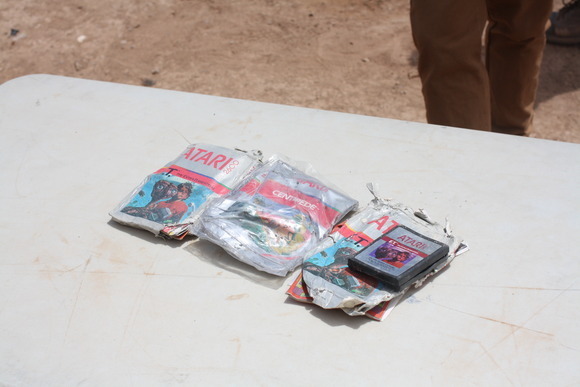
(13) THE GRAVE OF MISFIT GAMES. Wikipedia invites us to remember the “Atari video game burial”. File 770 followed that story step by step. Here’s the whole journey in one article.
… Excavation started on April 26, 2014 as an open event to the public. E.T. the Extra-Terrestrial designer Howard Scott Warshaw, Ready Player One author Ernest Cline, and film director Zak Penn attended the event as part of a documentary about the burial,[43] as did local residents such as Armando Ortega, a city official who was reportedly one of the original children to raid the dump in 1983. Ortega stated that although he and his friends found dozens of quality games, they gave the E.T. cartridges away because the “game sucked … you couldn’t finish it”. James Heller, the former Atari manager in charge of the original burial, was also on hand at the excavation. Heller revealed that he had originally ordered the site to be covered in concrete. Contrary to the urban legend that claims millions of cartridges were buried there, Heller stated that only 728,000 cartridges were buried.
Remnants of E.T. and other Atari games were discovered in the early hours of the excavation, as reported by Microsoft’s Larry Hryb. A team of archaeologists was present to examine and document the Atari material unearthed by excavation machinery: Andrew Reinhard (American School of Classical Studies at Athens), Richard Rothaus (Trefoil Cultural and Environmental), Bill Caraher (University of North Dakota), with support from video game historian Raiford Guins (Stony Brook University) and historian Bret Weber (University of North Dakota)…
(14) THESE WERE THE JOKES, MY FRIEND. The Guardian says “Edinburgh funniest fringe joke award scrapped for 2025”. Here’s the kind of thing we’ll be missing.
…The award was launched in 2008 and has been held every year since apart from during the Covid-19 pandemic. Last year, Mark Simmons won for his nautical one-liner “I was going to sail around the globe in the world’s smallest ship but I bottled it”. The shortlist of jokes was chosen by a panel of UK comedy critics and comedians, then submitted anonymously to 2,000 members of the public who were asked to pick their favourites. Upon winning last year’s prize, Simmons said: “I needed some good news as I was just fired from my job marking exam papers, can’t understand it, I always gave 110%.”…
…Lorna Rose Treen, the second woman to win the award, triumphed in 2023 for the joke “I started dating a zookeeper, but it turned out he was a cheetah.”…
(15) ALL SHOOK UP. “Android Phones Can Detect Earthquakes Before the Ground Starts Shaking” – Gizmodo tells how it works.
… Researchers in the U.S. and Germany have tested a global earthquake detection and alert system that makes use of a device many people already own, including in less developed countries—Android smartphones. According to their study, published today in the journal Science, the Android Earthquake Alerts (AEA) system’s efficacy rivaled traditional seismic networks in its ability to detect seismic activity and deliver alerts.
“The global adoption of smartphone technology places sophisticated sensing and alerting capabilities in people’s hands, in both the wealthy and less-wealthy portions of the planet,” the researchers, including Richard Allen from the University of California in Berkeley’s Seismological Laboratory, wrote in the study. “Although the accelerometers in these phones are less sensitive than the permanent instrumentation used in traditional seismic networks, they can still detect the ground motions and building response in hazardous earthquakes.”
According to the study, 70% of the world’s smartphones are Android phones, which by default come with the aforementioned sensing and alerting capabilities. From 2021 to 2024, the AEA system detected an average of 312 earthquakes per month across 98 countries. The earthquakes had a magnitude between 1.9 and 7.8, and the system alerted users of earthquakes at or over a magnitude of 4.5, averaging around 60 events and 18 million alerts per month.
The AEA system also collected user feedback, revealing that 85% of users who received alerts experienced shaking, with 36% receiving the alert before, 28% during, and 23% after the shaking began….

(16) GRUMPY AND DOC. [Item by SF Concatenation’s Jonathan Cowie.] Former Doctor Who script writer of nine episodes, Mark Gatiss (who helped bring the show back) has tried to support the current season of the show stating that ‘grumpy old’ fans need to realize that the present-day show is not for them but a younger audience. He said that old fans have fallen in to a ‘space-time trap’.
Right. Let’s get this straight. The new season is aimed at new younger fans and so older fans should not complain. And this explains the UK viewing figures for Gatwa in 2025 halving compared to the three-episode Tennant reprise in 2022, exactly how!???
“’It’s Not for You Any More’: Mark Gatiss Takes Aim at ‘Grumpy Old Doctor Who Fans’ and Nostalgia” at DoctorWhoTV.
Mark Gatiss must have a new show to promote, because he’s been making a lot of headlines lately. Now he’s turned his attention to calling out “grumpy old Doctor Who fans” and warning that nostalgia is holding the show back.
In a wide-ranging conversation with Radio Times, the writer and actor looked back on his time working on the series, highlighting the importance of looking forward.
“The actual process of trying to make a modern show for a new audience is not about nostalgia,” Gatiss explained. “And I think that’s the great difference. You have to get right. Why is this going to work now? It doesn’t really matter what worked for Jon Pertwee and Tom Baker. It’s about now.”
Gatiss, who wrote nine episodes for the revived series, noted the recurring temptation for both writers and fans to fall back on the familiar…
[Thanks to John King Tarpinian, Chris Barkley, Cat Eldridge, Francis Hamit, SF Concatenation’s Jonathan Cowie, Mark Roth-Whitworth, Steven French, Kathy Sullivan, Teddy Harvia, Mike Kennedy, and Andrew Porter for some of these stories. Title credit belongs to File 770 contributing editor of the day Randall M.]