(1) HARRY POTTER GAME KERFUFFLE UPDATE. Earlier this week we reported that some reviewers were boycotting Czech Games Edition’s (CGE) Harry Potter-themed version of Codenames over J.K. Rowling’s anti-trans campaigning (see Pixel Scroll 8/6/25 item #1).
On August 8, CGE announced that they will donate all the profits from this game – an amount equal to or exceeding the license fee — to trans charities. They have apologized for all the harm caused. Their full statement follows.


(2) ROBOSLUR. “There’s Officially A Term Used To Insult AI, And You’re Going To See It Everywhere” says Brittany Wong at HuffPost.
You know exhaustion over artificial intelligence has reached a pinnacle when people start coming up with slurs to talk about robots.
While there are a number of contenders for dissing AI (and people who slavishly make it a part of their everyday lives), so far, the pejorative front-runner is “clankers,” a term that’s straight out of the “Star Wars” universe.
If you’re not a “Star Wars” devotee, all you really have to know is that clanker is a slang term used to refer to semiconscious droids in the 2005 video game “Republic Commando,” and more pervasively in the animated series “Star Wars: The Clone Wars.”(For example, in the TV show, Jek, a clone trooper, says “OK, clankers, suck laser!” to some battle droids before shooting them.)…
…. “Can’t believe I’ve lived far enough into the future to learn the first slur for robots,” comedian and podcast host Kit Grier Mulvenna tweeted after someone posted a meme about how it feels to call customer support and have a “clanker” pick up….
(3) 2027 WORLDCON SITE SELECTION DEADLINE APPROACHING. Seattle Worldcon 2025 reminds everyone that site selection voting closes at 5 p.m. on Friday, August 15. The Montréal 2027 Worldcon bid is the only one to have filed in time to make the ballot. Write-ins are allowed.
You will be able to vote by postal mail, online, and at the convention. Voting tokens are available for purchase now through the registration portal and will remain on sale until 5 p.m. on Friday, August 15.
To assist you in navigating the purchase of a token, we have provided a set of step-by-step instructions (963 KB .pdf). If you have any questions, email [email protected].
(4) AUREALIS AWARDS NEWS. The 2025 Aurealis Awards are now open for immediate entry. See the Rules at the link.
The 2025 Aurealis Awards, Australia’s premier awards for speculative fiction, are for works created by an Australian citizen or permanent resident, and published for the first time between 1 January 2025 and 31 December 2025.
We strongly encourage publishers and authors to enter all works published already this year by September 30, 2025, then subsequent publications as they are released. We have introduced a tiered entry fee structure to help encourage early entry, in order to allow our judges time to consider each entry carefully.
Entries for the Aurealis Awards main categories close on November 30, 2025. Please note this is inclusive of all work scheduled for publication in December.
(5) 2025 LAUREATE AWARD WINNERS. The National Fantasy Fan Federation has announced the winners of the Laureate Awards. First given in 1941, they are the oldest awards in science fiction fandom. They are given by vote of the members of the N3F.
- Best Fan Writer – Heath Row
- Best Fan Artist – Tiffanie Gray
- Best SF Poet – Pedro Iniguez
- Best Fan Editor – Mindy Hunt
- Best Fan Website – Galactic Journey
- Best N3F Fanzine – FanActivity Gazette
- Best Non-N3F Fan Publication – Lofgeornost, ed. by Fred Lerner
- Best Novel – To Turn the Tide by S.M. Stirling
- Best Shorter Work – The Dragonfly Gambit by A. D. Sui
- Best Magazine – Utopia Science Fiction
- Best Book Editor – Toni Weisskopf
- Best Pro Artist – Dante Luiz
- Best Historical Work – History of the Sam Moskowitz Award from First Fandom
- Best Podcast – Simultaneous Times
The N3F also presented 2025 Kaymar Award to Jean-Paul L. Garnier. It is a club service award, named for K. Martin Carlson [1904-1986], who originated, maintained, and financed it for 25 years. Carlson was a long-time N3F member who held many positions in the club, including club historian. He went by the fan name of Kaymar.
(6) MEMORY LANE.
[Written by Cat Eldridge.]
Brokedown Palace
I asked Brust where Brokedown Palace as a name came from as I assumed it was named after the Dead song, and he confirmed it was.

There are certain novels that I return to from time to time and Steve Brust’s Brokedown Palace is one of them. It’s the only stand-alone novel set in Dragaera series, which runs currently to over twenty five novels. (I’ve read or listened to quite a few of them.) It leads off the series, and it is also notable for being set in Fenario, the human-populated portion of that world where the rest are mostly not.
The novel is heavily influenced by Hungarian myth and culture, not surprising giving that Brust is of Hungarian descent. Brust uses that tradition’s folklore to great effect while combining it with family dynamics King László, the oldest of the brothers, is a fair and just ruler along the Princies of the Lands. All live in Brokedown Palace.
Once upon a time, there were four brothers who lived in the land of Fenario. These were the King and Princes of the land, and they lived together in the decrepit Old Palace in the center of the city of Fenario. Ahhh but things are not as they seem as things well become very complicated… I won’t say more than that as it’d spoil things if you’ve not read it yet. And this really deserved not to be spoiled in any way at all.
This is a more complex novel than Brust usually writes and the characters here actually have more agency, more feel of being actual individuals than that they usually get in his novels including much of this series. That’s a reflection of it being a family-based novel so it feels more intimate than usual.
The art is by Alan which was done for the 1996 Ace edition and later used by Ace and Orb, the latter twenty years back in a most excellent trade edition which is still available as a “new” edition.
(7) BELATED BIRTHDAY.
[Written by Paul Weimer.]
August 9, 1927 — Daniel Keyes. (Died 2014.)
By Paul Weimer: Yes, I am here for one book, but what a book! Flowers for Algernon is one of the most potent and melancholy books in science fiction, but I think that the short story is even stronger in some ways. Both tell the same story, of a man with intellectual disability who is given the brief ability to have human and then superhuman intelligence, but only for a short time. The story shows us his gradual increase in intelligence, erudition and perception. It shows us the keystone, when he reads a book and finds out there is no more to the story, and asks WHY?
That why is a hinge of the entire story. It shows his breakthrough into the world of thought and cognition. It shows he has transcended (although it will be brief) his disabled origins and can now do more, read more, and be more. But, again, it is at a heavy cost and a tragic end that even if you never heard of the story before, you can guess. The novel is a masterpiece in showing Charlie’s rise and fall, using the epistolary format to best effect I’ve ever seen (Best Epistolary SF novel ever? Maybe!)
But the wonder of the story is the path up and then down again, and the emotional bond that the novel makes with the reader to follow Charlie’s story. It’s a novel that makes us feel deeply for the plight of the main character, to cheer for the brief success of the operation, and then the tragedy of its brief effectiveness. When Charlie starts slipping, it’s subtle. And then it becomes a landslide and my heart breaks just thinking of those passages.
I think the novel was robbed of a Hugo by The Moon is a Harsh Mistress. Sorry, Bob. Flowers for Algernon is a more powerful, potent and a better book. Period.

(8) COMICS SECTION.
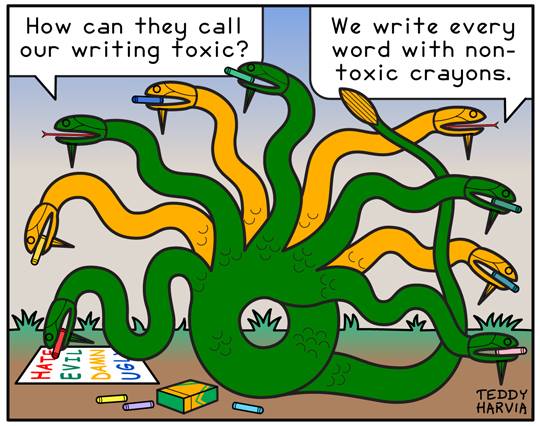
- Cornered finds a niche.
- Strange Brew depicts a protest.
- Tom Gauld mourns the outcome of another book vs. phone encounter.
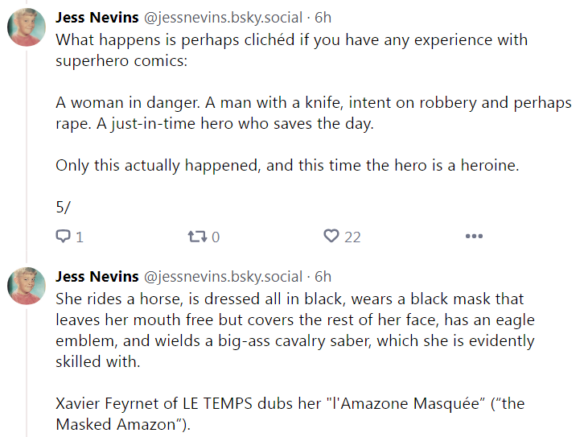
(9) JUST WHEN I THOUGHT I WAS OUT, THEY PULL ME BACK IN. Jess Nevins told Bluesky followers about his detective series idea. Thread starts here.


(10) FEED YOUR HEAD. Christopher Lockett’s essay “On Cooking Slow” uses meal prep as an opening for a discussion of cultural evolution.
…Thinking and cooking are related in ways that are more than metaphorical. In his excellent book Cooked: A Natural History of Transformation (2013), Michael Pollan considers the various ways in which we cook our food and delves into the history of how these different methods reflect on who we are. In a profoundly elemental way, he suggests, cooking made us who we are: the rapid evolution of the human brain, one theory goes, was made possible by a diet of cooked food:
According to the “cooking hypothesis,” the advent of cooked food altered the course of human evolution. By providing our forebears with a more energy-dense and easy-to digest diet, it allowed our brains to grow bigger (brains being notorious energy guzzlers) and our guts to shrink. (6)
Prior to cooking, our ancestors would have spent a huge amount of time chewing and digesting. Freedom from that exercise meant “humans could now devote their time, and their metabolic resources, to other purposes, like creating a culture” (7). Pollan cites Richard Wrangham, a British anthropologist and primatologist who makes the case for the cooking hypothesis in his book Catching Fire: How Cooking Made Us Human (2009). “Cooking was a great discovery not merely because it gave us better food,” Wrangham writes. “It did something even more important: it helps make our brains uniquely large, providing a dull human body with a brilliant human mind” (127).
And not for nothing, but a significant contributor to the creation of culture would have been the way cooking food facilitates, indeed in some ways necessitates, a greater sense of community in the form of shared meals. As Pollan points out, foragers would likely have fed themselves on the go and alone. “But sitting down to common meals, making eye contact, sharing food and exercising self-restraint served to civilize us” (7). Pollan notes with irony the fact that food conveniences have served to atomize us and have made us mimic our pre-cooking forager forebears, “grazing at gas stations and eating by ourselves whenever and wherever.” (Or, in the era of the gig economy, ordering food from delivery apps and having it left on the doorstep.)…
(11) QUIET, PLEASE. [Item by Steven French.] This article by Paul Sutter of Universe Today (reprinted at Phys.org) made me smile and think, which is always a good combo: “The future of astronomy might be on the moon”.
But wait, before you go out to build a moon casino we need to talk about a couple things. One, you really have to figure out how the roulette wheel is going to work in a low gravity environment. Second, we’re going to need you to keep the noise down.
Not noise noise—the airless environment is pretty good at blocking sounds as it is. But radio noise. The pristine nature of the lunar environment provides the absolute cleanest, purest, silent places in the local solar system for radio astronomy.
Radio observatories dot the world, like the Very Large Array in New Mexico, the Parkes Observatory in Australia, and the FAST telescope in China. These telescopes reveal…well, just about everything about the universe. They tell us about quasars, the most powerful engines in the universe driven by the gravitational energies of supermassive black holes. They tell us about the flow of charged particles in star-forming regions. They tell us about the distribution of matter in the largest galaxy clusters in the cosmos. The radio view of the cosmos is nothing short of stunning.
But if you’ve ever visited one of these sites, you’ll find that you have to drop off your electronics—they are interference-free zones, sensitive enough that they can pick up the signal from your cellphone miles away. Human sources of radio emission, of which there are…a lot, make astronomical observations challenging.
It’s not just cell phones, but radio and television broadcasts, aircraft guidance and communication, even GPS signals that all cause interference. To help reduce this, astronomers prefer to build new observatories way out in the middle of nowhere, like the upcoming Square Kilometer Array—the largest radio observatory ever built—which will be distributed across western Australia (a giant desert) and the interior of south Africa (also a giant desert).
But even those remote places aren’t good enough for the holy grail of radio astronomy: a weak signal emitted by neutral hydrogen during the cosmic dark ages, a time before the first stars and galaxies when our universe was less than a hundred million years old. This signal contains precious information about the nature of dark matter and the growth of cosmic structures, but it’s completely swamped by terrestrial radio emission. We essentially have little to no hope of ever detecting this signal with Earth-bound telescopes.
But the moon gives us another chance. The moon’s rotation is locked; it always keeps one face pointed towards Earth. And that means that it always keeps one face pointed away. The lunar farside is the most radio quiet environment in the nearby solar system, with the body of the moon shielding any observatory from Earthly radio emissions….
(12) INTERSTELLAR TRAVEL – A NEW PROPOSAL. [Item by SF Concatenation’s Jonathan Cowie.] Do you remember the Breakthrough Starshot back in 2017 to reach the nearest star in 20 years. Well, that idea went nowhere. Of course, if you can’t go there, there are both grand and weird telescopic options to view exoplanets’ main surface features, but these come with their own problems. But what if you could do a different type of Breakthrough Starshot? One that did not require a super weapon laser? Well, Brit physicist David Kipping at the Cool Worlds YouTube Channel and his team at has a few ideas as to how to get a probe to the Sun’s escape velocity very, very cheaply. “A New Interstellar Propulsion Method: T.A.R.S.”
OK, let’s be clear, what he is proposing will not get to Breakthrough Starshot’s 20% the speed of light, but it will get to 1,000 kilometres per second which is 0.3% the speed of light at a tiny fraction of the cost and with zero military risk. Yes, this way, interstellar exploration by probes remain a multigenerational venture, but perhaps we need to think in these terms. And yes, Kipping’s idea is not the answer-all to interstellar probes but it is a realistic and practical, low-cost option that has other benefits: it could also protect a Mars base from Solar wind radiation. Maybe future science and tech will bring other options, but for now, we possibly have this…!
Light sails are a promising method for travelling through space – indeed, Breakthrough Starshot proposed a laser driven version could reach nearby stars. But the exorbitant costs and engineering challenges of such a proposal have stymied its realization. What if there was a way of using the Sun – no lasers required – but keeping our dream of interstellar travel intact? Introducing TARS.
You can see the half-hour proposal below and make up your own mind.
[Thanks to Andrew Porter, John King Tarpinian, Chris Barkley, Jean-Paul L. Garnier, Paul Weimer, Cat Eldridge, SF Concatenation’s Jonathan Cowie, Mark Roth-Whitworth, Steven French, Kathy Sullivan, Teddy Harvia, and Mike Kennedy for some of these stories. Title credit belongs to File 770 contributing editor of the day Dan’l.]