
(定義を追記)中学でも分かる⑧「三角関数」

前回までの三角比では、角度の範囲は $${0\degree\leqq\theta\leqq180\degree}$$ でした。ここでは、その角度を任意の角度(一般角)まで拡張した三角関数を勉強します。
前回やった単位円の議論を進め、新しい角度の測り方である弧度法まで内容を進めていきます。三角比の定義や単位円の復習から始めたい方は、前回の中学でも分かる➆「三角比」をご覧ください。
なお、ここでは主に三角関数のグラフだけに話をとどめ、重要な公式については最後に紹介する程度にします(必要があれば別の記事で)。
前回の復習
前回の、中学でも分かる➆「三角比」では、$${\sin\theta, \cos\theta, \tan\theta}$$ を単位円で考えました。 $${\sin\theta, \cos\theta}$$ は単位円周上の動点の座標、$${\tan\theta}$$ は動径 $${\text{OP}}$$ の延長と直線 $${x=1}$$ の交点の $${y}$$ 座標とみることができます。
(case1) 鋭角、つまり $${0\degree<\theta<90\degree}$$ のとき
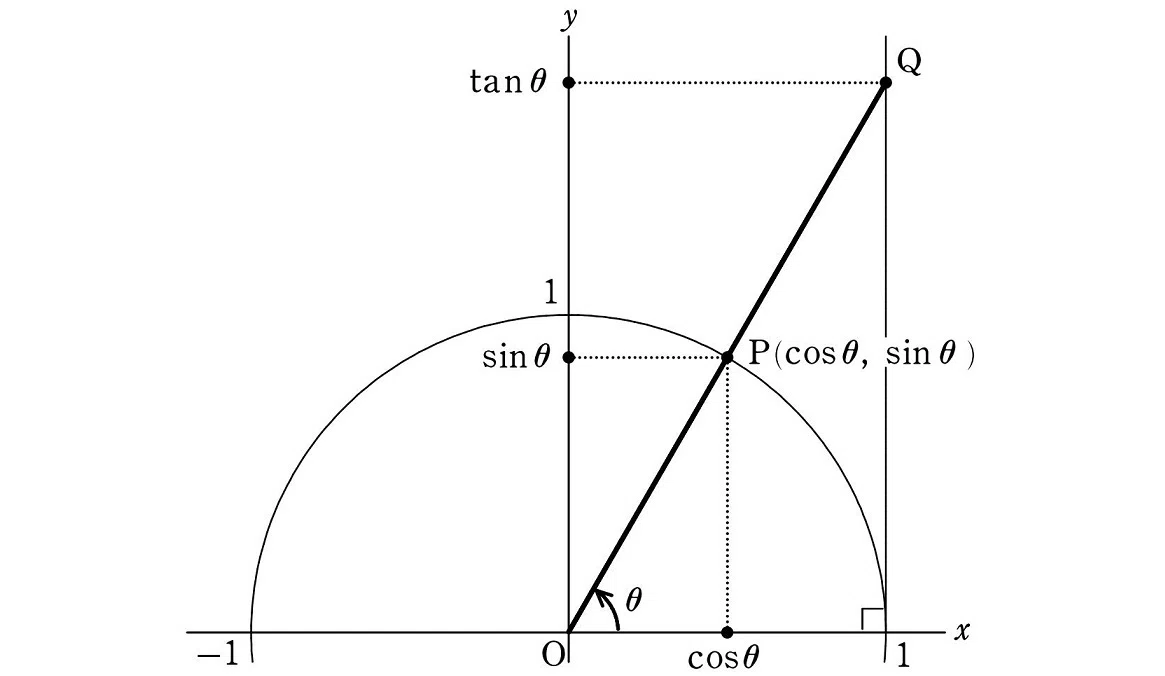
取り得る値の範囲は
$$
\begin{alignat*}{2}
&\sin\theta & &>0\\
&\cos\theta & &>0\\
&\tan\theta & &>0
\end{alignat*}
$$
となり、すべてプラスの値となります。
$${\tan\theta}$$ は、点 $${\text{Q}}$$ から $${y}$$ 軸に垂線を下ろし、その交点との $${y}$$ 座標と考えると、図形的にイメージしやすくなります。
このように考えることによって、$${\sin\theta, \cos\theta, \tan\theta}$$ のそれぞれの”居場所”がビジュアル化でき、これが単位円で考えるメリットになります。
例 $${60\degree}$$ の三角比は、下図より
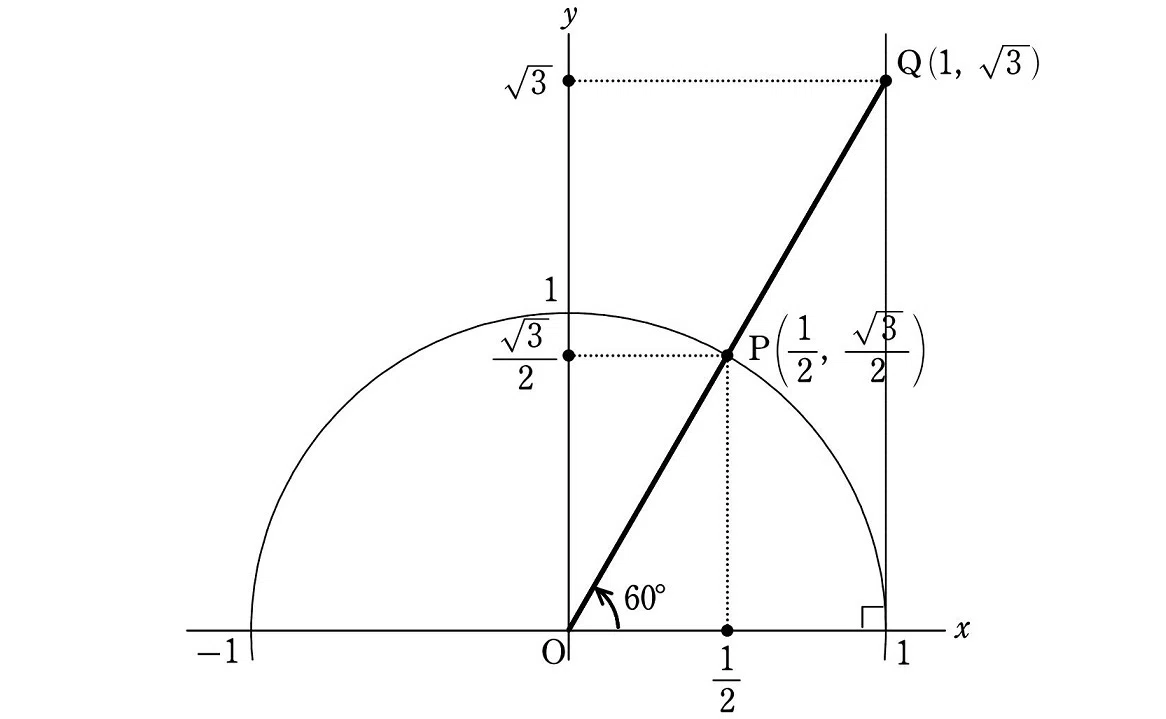
点 $${\text{P}}$$ の座標は $${\underset{\hspace{1pt}\cos60\degree\hspace{0pt}\sin60\degree}{\left(\dfrac{1}{2}, \dfrac{\sqrt{3}}{2}\right)}}$$
点 $${\text{Q}}$$ の座標は $${\underset{\hspace{18pt}\tan60\degree}{(1, \sqrt{3}\,)}}$$
なので
$$
\begin{alignat*}{2}
&\sin60\degree & &=\frac{\sqrt{3}}{2}\\[6pt]
&\cos60\degree & &=\frac{1}{2}\\[10pt]
&\tan60\degree & &=\sqrt{3}
\end{alignat*}
$$
(case2) 鈍角、つまり $${90\degree<\theta<180\degree}$$ のとき
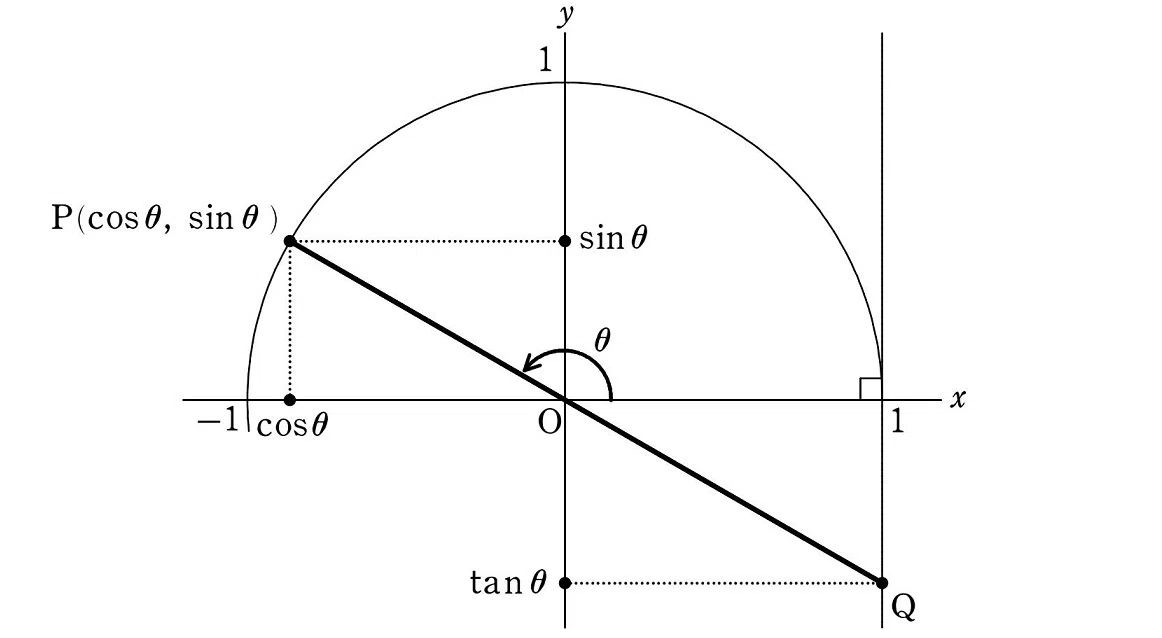
取り得る値の範囲は
$$
\begin{alignat*}{2}
&\sin\theta & &>0\\
&\cos\theta & &<0\\
&\tan\theta & &<0
\end{alignat*}
$$
となり、$${\cos\theta}$$ と $${\tan\theta}$$ がマイナスの値をとります。$${\sin\theta}$$ だけがプラスの値です。
例 $${150\degree}$$ の三角比は、下図より
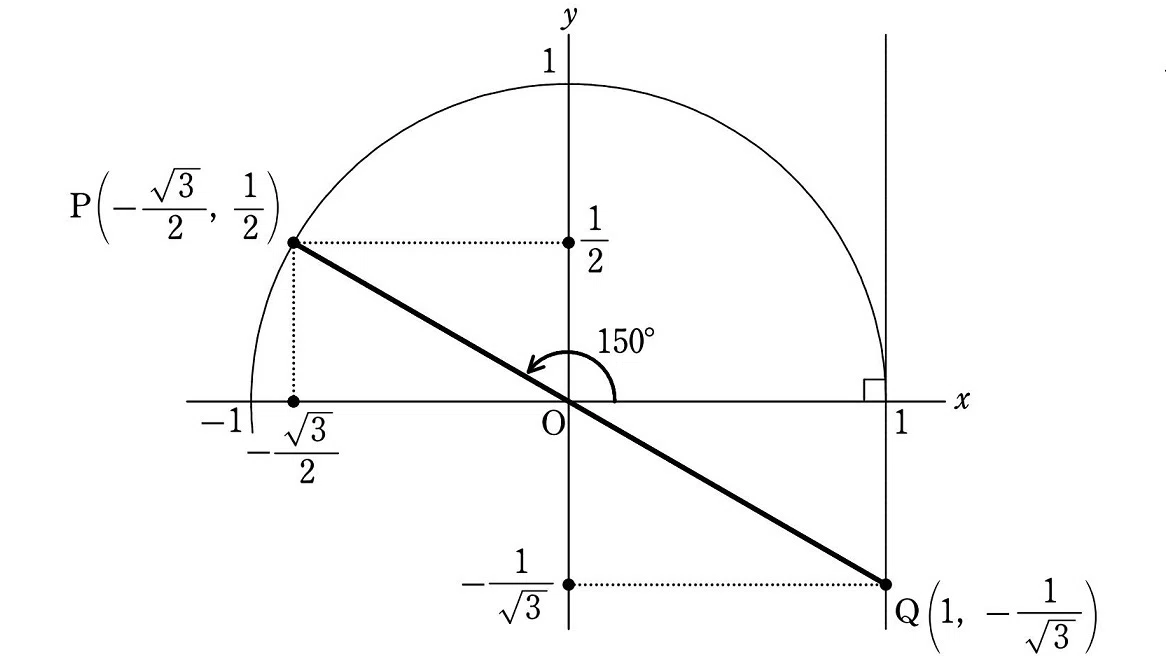
点 $${\text{P}}$$ の座標は $${\underset{\hspace{12pt}\cos150\degree\hspace{1pt}\sin150\degree}{\left(-\dfrac{\sqrt{3}}{2}, \dfrac{1}{2}\right)}}$$
点 $${\text{Q}}$$ の座標は $${\underset{\hspace{18pt}\tan150\degree}{\left(1, -\dfrac{1}{\sqrt{3}}\right)}}$$
なので
$$
\begin{alignat*}{2}
&\sin150\degree & &=\frac{1}{2}\\[6pt]
&\cos150\degree & &=-\frac{\sqrt{3}}{2}\\[6pt]
&\tan150\degree & &=-\dfrac{1}{\sqrt{3}}
\end{alignat*}
$$
ここまでは、前回の「三角比」でやりました。
三角比を一般角に拡張
ここから、角度の範囲を $${0\degree\leqq\theta\leqq180\degree}$$ から任意の角度(一般角)に拡張します。つまり、単位円をぐるぐる回る円関数と考えます。
まずは、一般角について定義を与えます。
一般角
動径 $${\text{OP}}$$ が $${\text{O}}$$ の周りを回転するとき、$${x}$$ 軸の正の部分(始線)から反時計回り(正の方向)に測った角を正の角、時計回り(負の方向)に測った角を負の角とする。角度は $${x}$$ 軸の正の部分から測ることに注意。これを始線という。
例えば、正の角 $${120\degree}$$、負の角 $${-60\degree}$$ は下図のようになる。
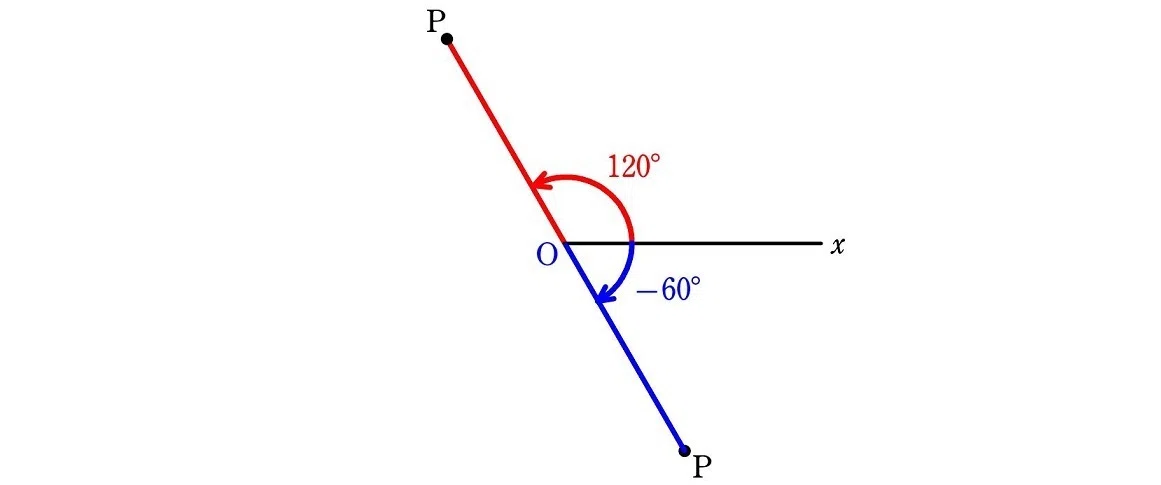
動径 $${\text{OP}}$$ が $${\text{O}}$$ の周りを回転すると、その回転量に応じて、いくらでも絶対値の大きい角度が考えられる。このように角を”回転の量”ととらえ、$${360\degree}$$ より大きい角や、負の角まで意味をひろげた角を一般角という。
$${360\degree}$$ 回転すると、動径はちょうど $${1}$$ 回転してもとと同じ位置にくる。したがって、1つの動径 $${\text{OP}}$$ と始線とのなす角は無数に考えられるが、その1つを $${a\degree}$$ とすると、$${\text{OP}}$$ を表す一般角 $${\theta}$$ は次の式で表される。
$$
\begin{align*}
\theta=a\degree+360\degree\times n\small{(n は整数)}
\end{align*}
$$
***
例1 $${420\degree}$$ は
$${420\degree=60\degree+360\degree\times1}$$
で表せます。
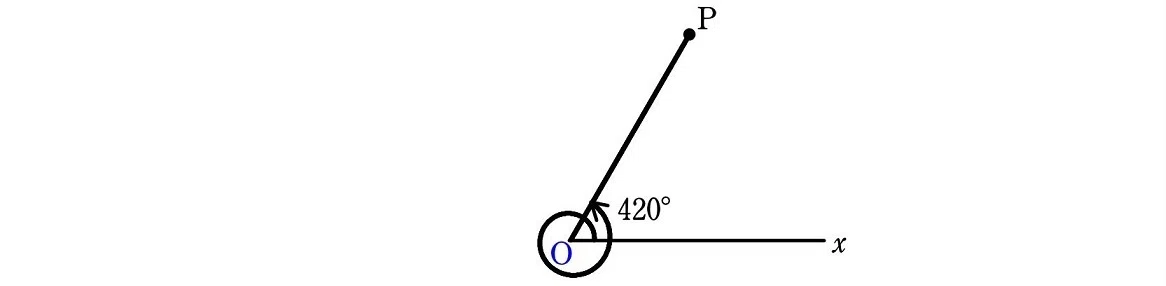
半時計周りに1周回って $${60\degree}$$ 進んだ角度です。
例2 $${780\degree}$$ は
$${780\degree=60\degree+360\degree\times2}$$
で表せます。
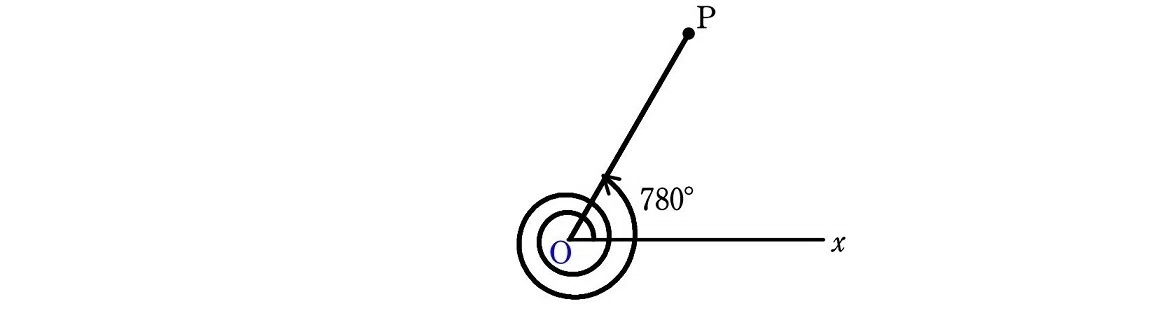
半時周りに2周回って $${60\degree}$$ 進んだ角度です。
例3 $${-300\degree}$$ は
$${-300\degree=60\degree+360\degree\times(-1)}$$
で表せます。
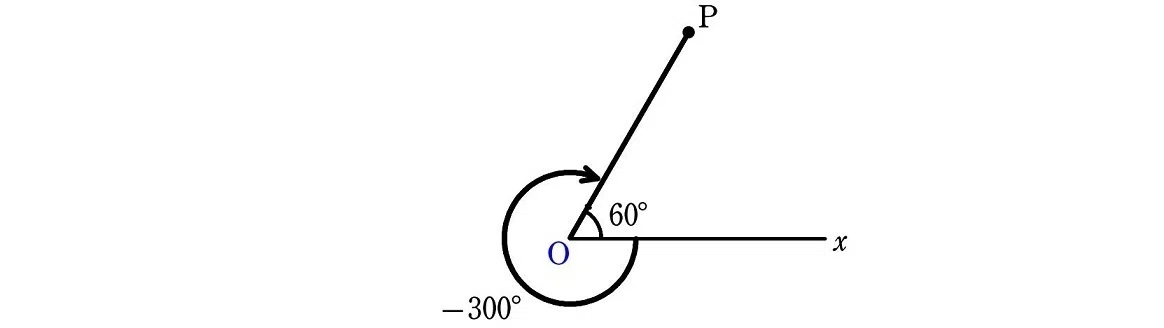
負の角なので、時計回りに $${300\degree}$$ 進んだ角度です。
すると、例1、例2、例3はすべて同じ動径を表し、$${60\degree}$$ のときと同じであることが分かります。よって、このときの動径 $${\text{OP}}$$ を表す一般角 $${\theta}$$ は
$$
\begin{align*}
\theta=60\degree+360\degree\times n\small{(n は整数)}
\end{align*}
$$
となります。
三角関数
三角比 $${\sin\theta, \cos\theta, \tan\theta}$$ はいずれも $${\theta}$$ の関数です。$${\theta}$$ が決まれば、それぞれの三角比は一通りにきまります。そこで三角比を一般角で定義します。$${\theta}$$ を一般角で定義した $${\sin\theta, \cos\theta, \tan\theta}$$ を三角関数といいます。
あらためて、教科書的に三角関数の定義を与えます。
三角関数とは、前回の<三角比の定義>を一般角に対しても成り立つように拡張し、角度を入力とする新しい関数としてとらえ直したものです。
<三角関数の定義>
座標平面において、中心が原点 $${\text{O}}$$、半径が $${r}$$ の円を考える。$${x}$$ 軸の正の部分(始線)と動径 $${\text{OP}}$$ のなす反時計回りの角(一般角)を $${\theta}$$ とする。
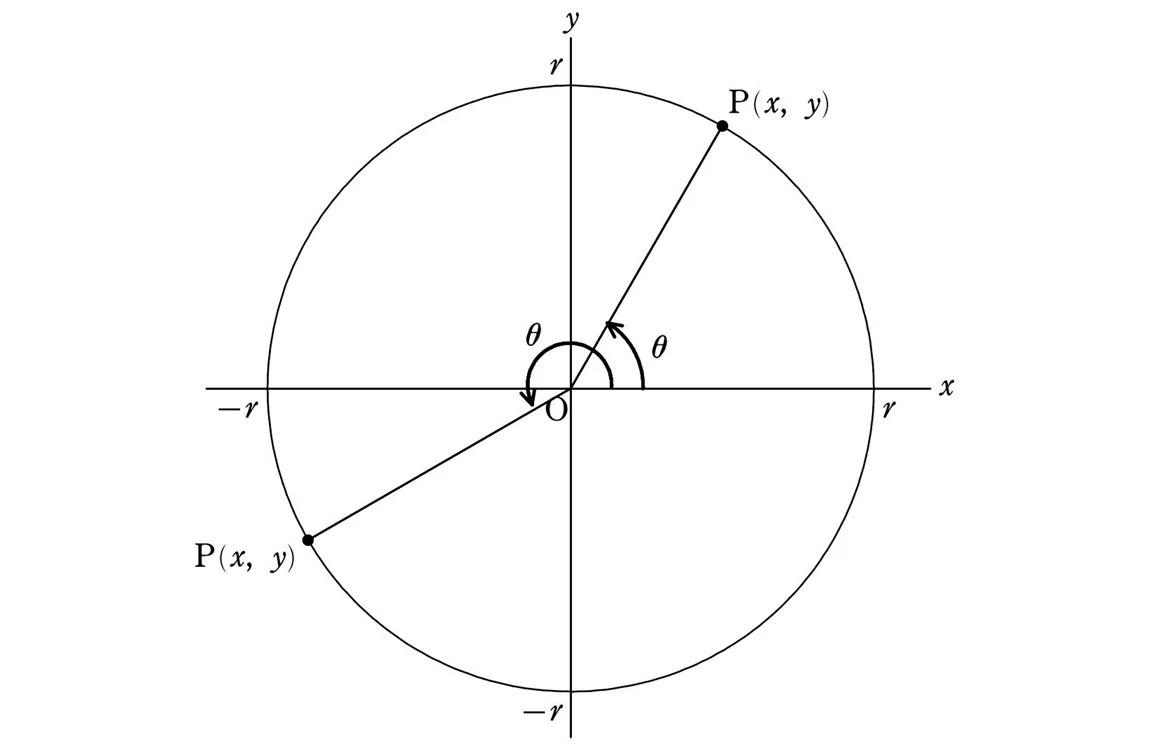
このとき、点 $${\text{P}(x, y)}$$ とすると、三角関数 $${\sin\theta, \cos\theta, \tan\theta}$$ は次のように定義される。
$$
\begin{align*}
\sin\theta&=\dfrac{y}{r}\\[8pt]
\cos\theta&=\dfrac{x}{r}\\[8pt]
\tan\theta&=\dfrac{y}{x}
\end{align*}
$$
***
定義式自体は<三角比の定義>と同じですが、扱える角度が三角比の $${0\degree\leqq\theta\leqq180\degree}$$ から、一般角へと拡張されています。
ここで、$${\sin\theta, \cos\theta}$$ について、両辺に $${r}$$ を掛けると
$$
\begin{align*}
y&=r\sin\theta\\
x&=r\cos\theta
\end{align*}
$$
したがって、点 $${\text{P}(x, y)}$$ の座標は、半径 $${r}$$ と三角関数 $${\sin\theta, \cos\theta}$$ を用いて
$$
\begin{align*}
\text{P}(r\cos\theta, r\sin\theta)
\end{align*}
$$
と表せます。
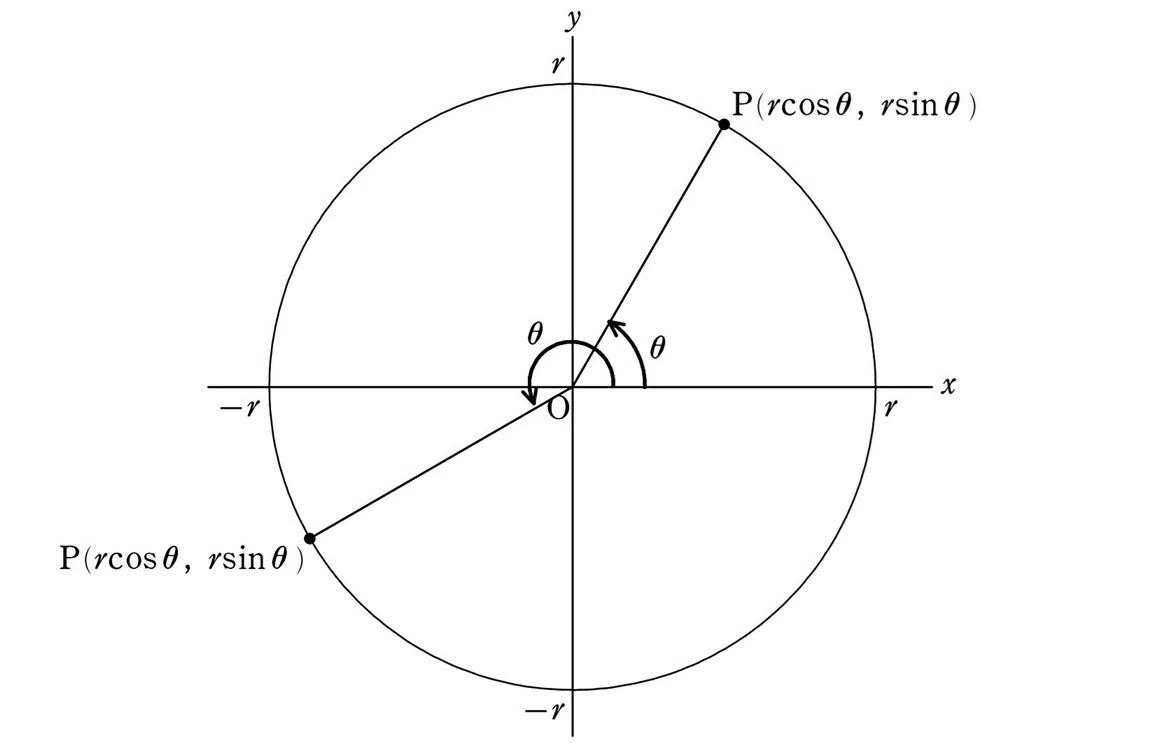
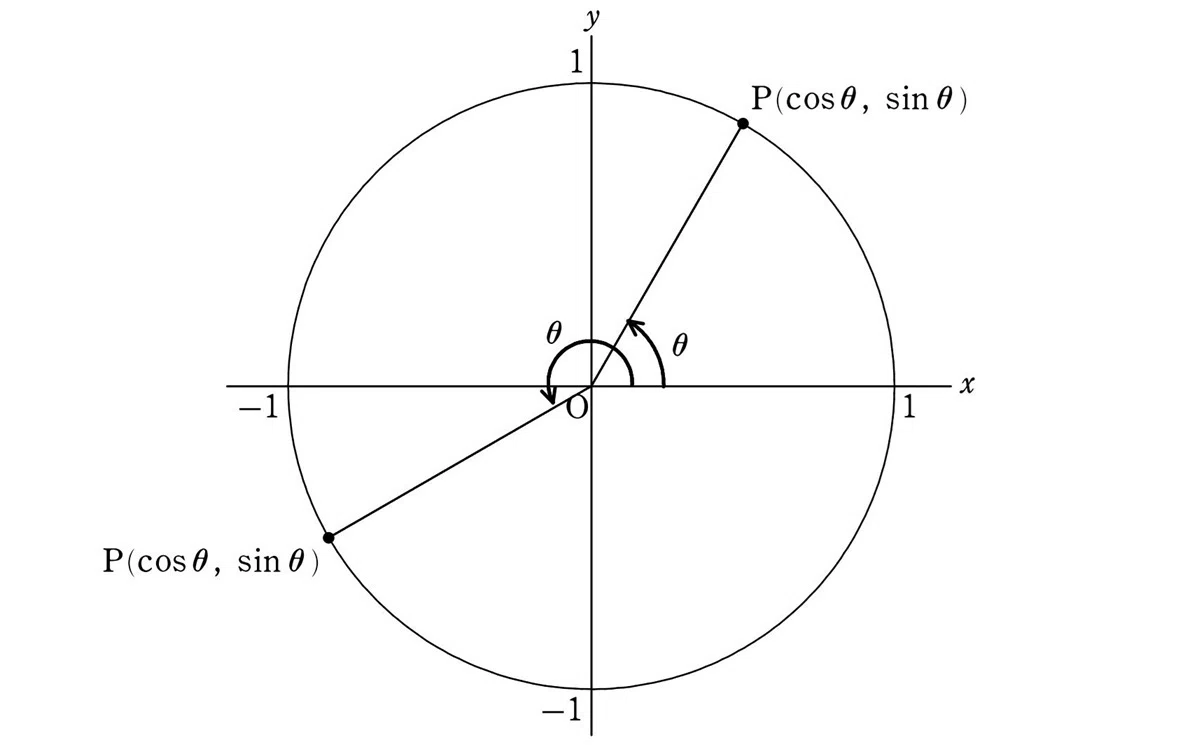
ここで、半径を $${r=1}$$ としましょう。この中心が原点で、半径 $${1}$$ の円を単位円といいます。このとき、単位円周上の点 $${\text{P}}$$ の座標は、三角関数だけを用いて次のように表せます。
$$
\begin{align*}
\text{P}(\cos\theta, \sin\theta)
\end{align*}
$$
$${\tan\theta}$$ についても、単位円周上ではどこに現れるのかを示すために、より詳しくみていきましょう。
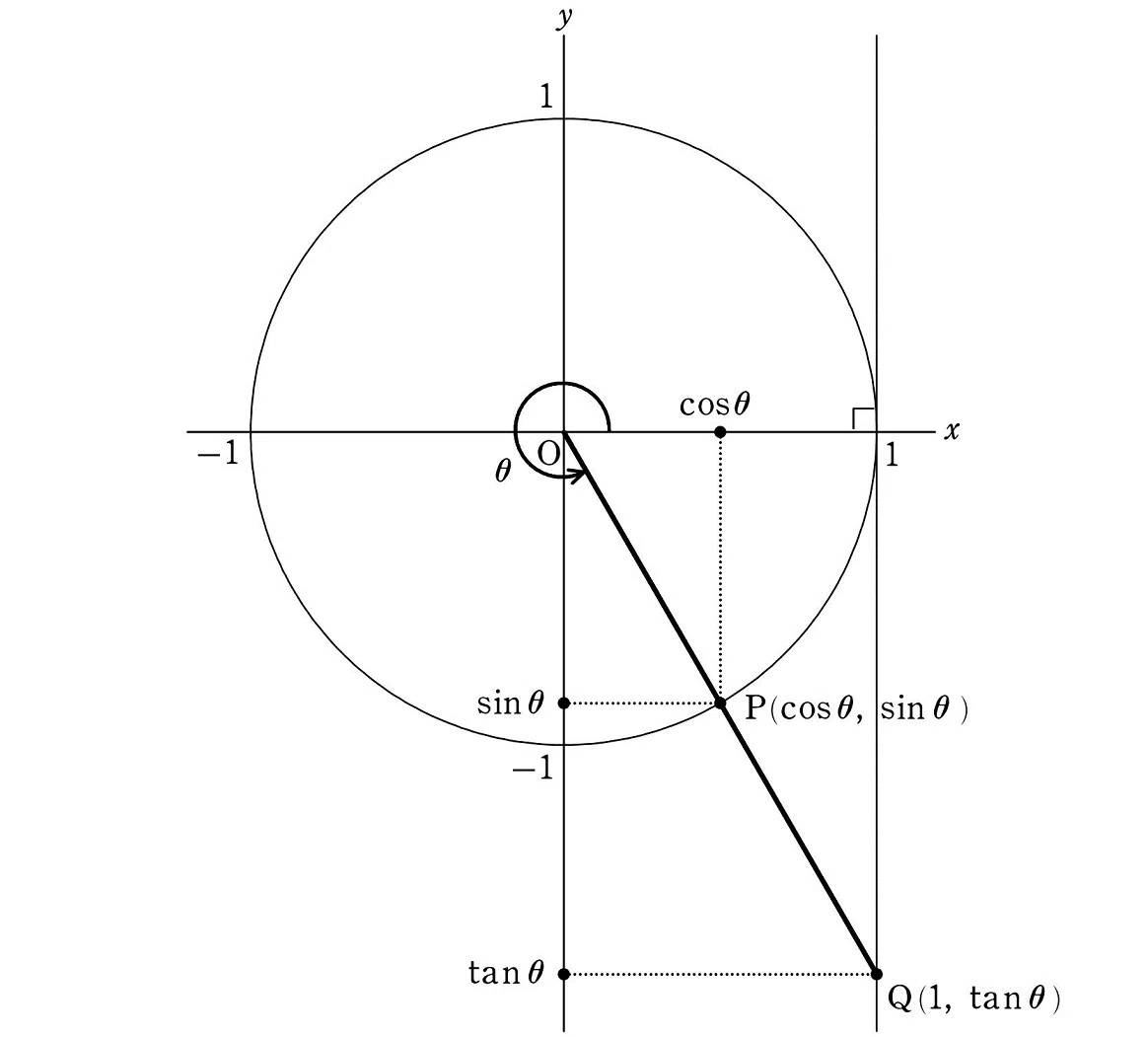
$${\sin\theta, \cos\theta, \tan\theta}$$ の各三角関数は、単位円周上で次のように視覚化できます。
(ⅰ) 点 $${\text{P}(x, y)}$$ が第1象限($${0\degree<\theta<90\degree}$$)、または第3象限($${180\degree<\theta<270\degree}$$)にあるとき。
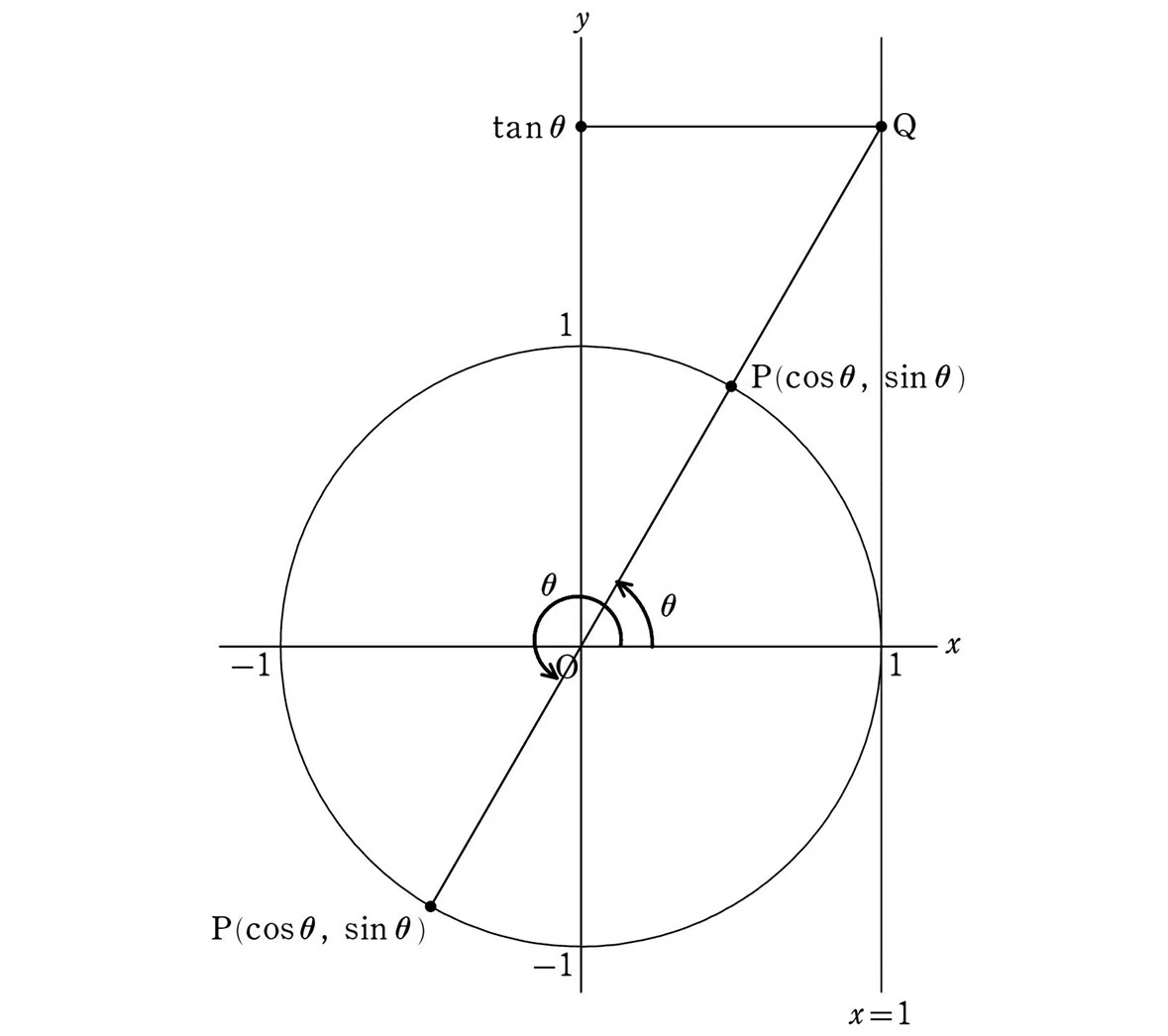
三角関数 $${\sin\theta, \cos\theta}$$ は、単位円周上の点の座標となります。
特に $${\tan\theta}$$ は、直線 $${\text{OP}}$$ と直線 $${x=1}$$ との交点の $${y}$$ 座標として特徴付けられます。三角関数の新しい意味づけです(中学でも分かる⑦「三角比」)。
(ⅱ) 点 $${\text{P}(x, y)}$$ が第2象限($${90\degree<\theta<180^{\circ}}$$)、または第4象限($${270\degree<\theta<360\degree}$$)にあるとき
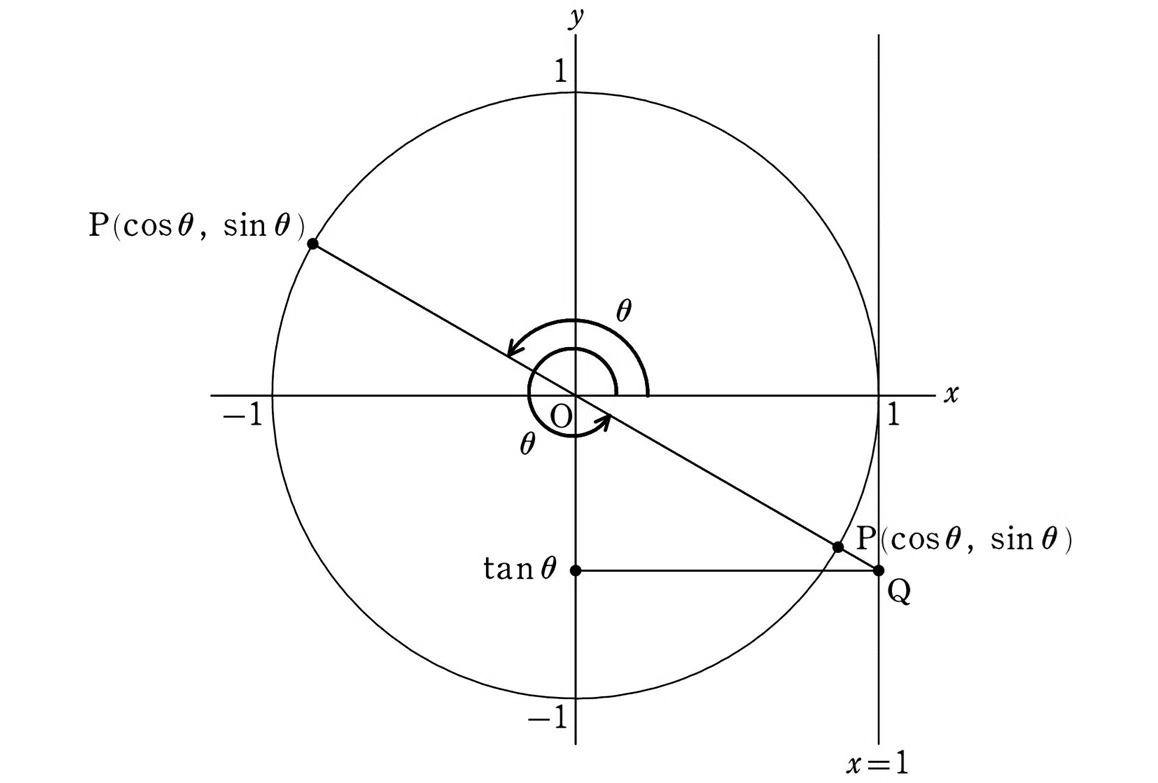
このときも $${\tan\theta}$$ は、半直線 $${\text{OP}}$$ と直線 $${x=1}$$ との交点の $${y}$$ 座標として特徴付けられます。その交点 $${y}$$ 座標が、 $${x}$$ 軸より下のエリアになることに注意してください(中学でも分かる⑦「三角比」)。
このように、単位円を用いることで、各三角関数に図形的な新しい意味を与えることができます。
$${0\degree\leqq\theta\leqq180\degree}$$ のときの三角関数の考え方は、先ほど復習した通りです。その拡張として、先ほどの単位円を用いて、$${180\degree}$$ より大きな角度についての三角関数をみていきます。
例えば、$${240\degree}$$ の三角関数の値は、下図より
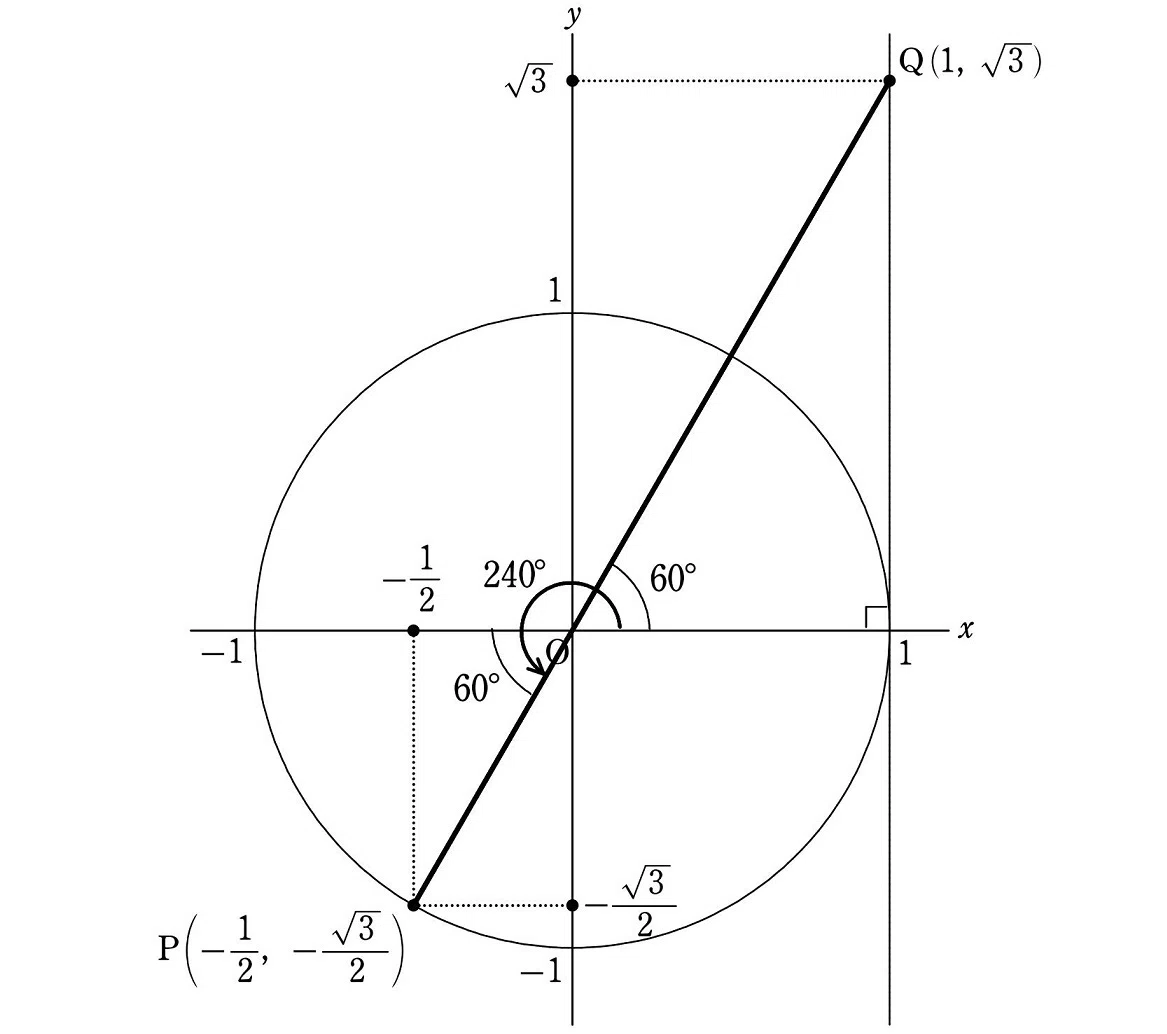
点 $${\text{P}}$$ の座標は $${\underset{\hspace{1pt}\cos240\degree\hspace{5pt}\sin240\degree}{\left(-\dfrac{1}{2}, -\dfrac{\sqrt{3}}{2}\right)}}$$
点 $${\text{Q}}$$ の座標は $${\underset{\hspace{18pt}\tan240\degree}{(1, \sqrt{3}\,)}}$$
なので
$$
\begin{alignat*}{2}
&\sin240\degree & &=-\frac{\sqrt{3}}{2}\\[6pt]
&\cos240\degree & &=-\frac{1}{2}\\[10pt]
&\tan240\degree & &=\sqrt{3}
\end{alignat*}
$$
$${300\degree}$$ の三角関数の値は、下図より
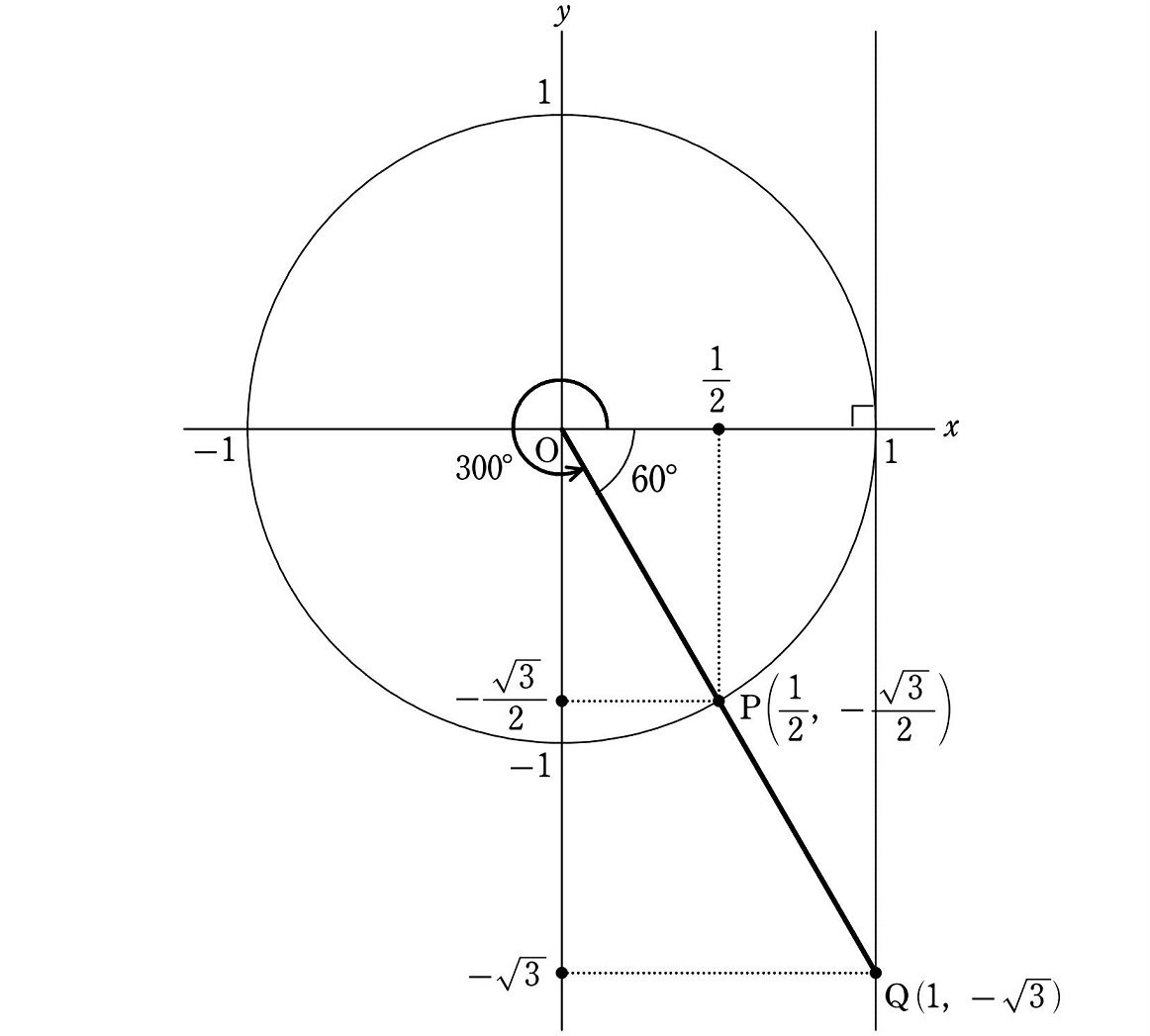
点 $${\text{P}}$$ の座標は $${\underset{\hspace{-2pt}\cos300\degree\hspace{3pt}\sin300\degree}{\left(\dfrac{1}{2}, -\dfrac{\sqrt{3}}{2}\right)}}$$
点 $${\text{Q}}$$ の座標は $${\underset{\hspace{18pt}\tan300\degree}{(1, -\sqrt{3}\,)}}$$
なので
$$
\begin{alignat*}{2}
&\sin300\degree & &=-\frac{\sqrt{3}}{2}\\[6pt]
&\cos300\degree & &=\frac{1}{2}\\[10pt]
&\tan300\degree & &=-\sqrt{3}
\end{alignat*}
$$
と決定されます。
一般に、次のようにまとめられます。
(case3) $${180\degree<\theta<270\degree}$$ のとき
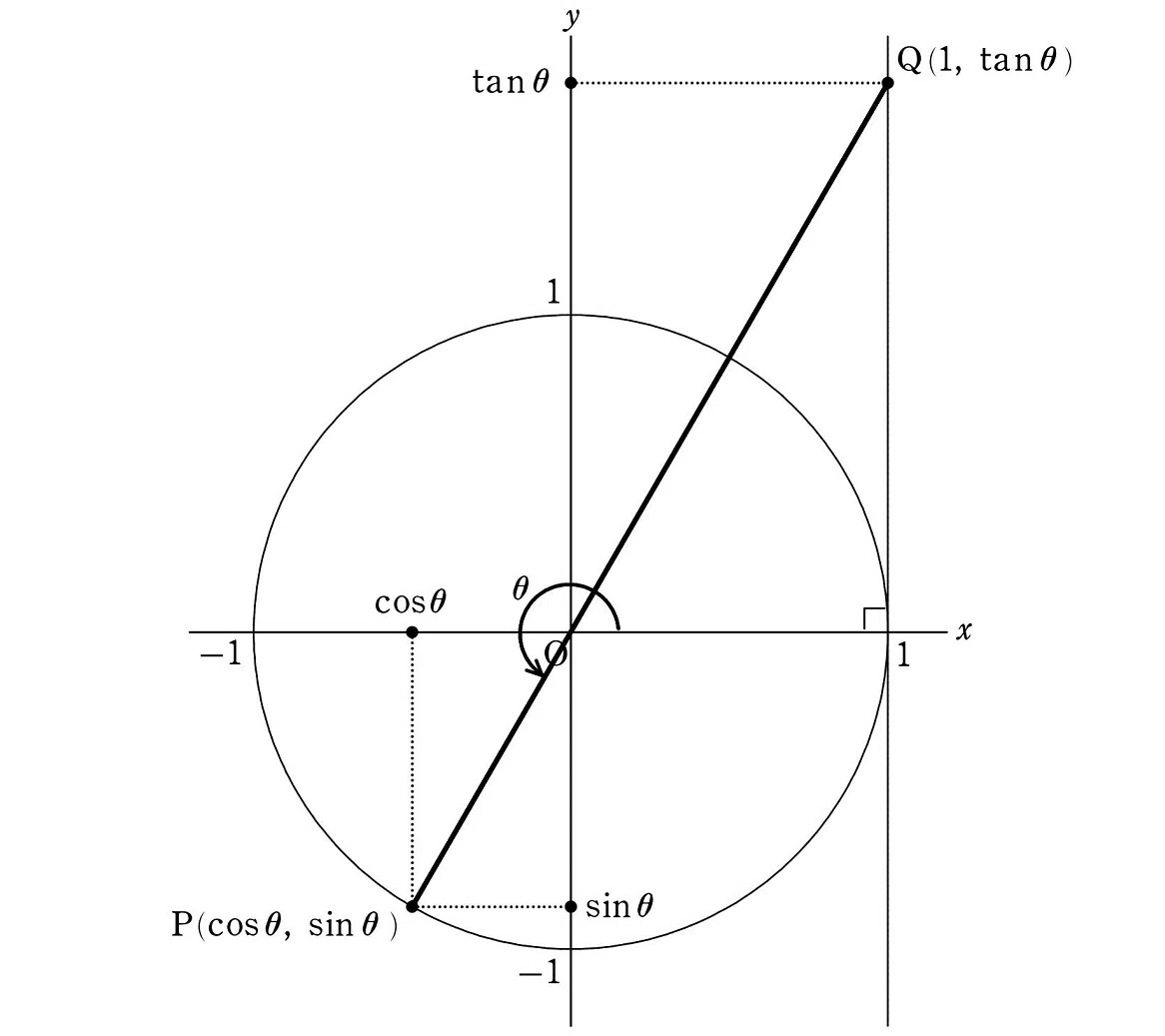
取り得る値の範囲は
$$
\begin{alignat*}{2}
&\sin\theta & &<0\\
&\cos\theta & &<0\\
&\tan\theta & &>0
\end{alignat*}
$$
となり、$${\sin\theta}$$ と $${\cos\theta}$$ がマイナスの値をとります。$${\tan\theta}$$ だけがプラスの値です。
(case4) $${270\degree<\theta<360\degree}$$ のとき
取り得る値の範囲は
$$
\begin{alignat*}{2}
&\sin\theta & &<0\\
&\cos\theta & &>0\\
&\tan\theta & &<0
\end{alignat*}
$$
となり、$${\sin\theta}$$ と $${\tan\theta}$$ がマイナスの値をとります。$${\cos\theta}$$ だけがプラスの値です。
sinθ、cosθ のグラフ
ここから、三角関数のグラフを考えましょう。
前回やりましたが、$${0\degree\leqq\theta\leqq180\degree}$$ のときの $${\sin\theta}$$ と $${\cos\theta}$$ の値は次のようになります。
$$
\def\arraystretch{1.5}
\begin{array}{c|c|c|c|c|c|c|c|c|c}
& 0\degree & 30\degree & 45\degree & 60\degree & 90\degree
& 120\degree & 135\degree & 150\degree & 180\degree\\ \hline
\sin & 0 & \frac{1}{2} & \frac{\sqrt{2}}{2} & \frac{\sqrt{3}}{2} & 1
& \frac{\sqrt{3}}{2} & \frac{\sqrt{2}}{2} & \frac{1}{2} & 0\\ \hline
\cos & 1 & \frac{\sqrt{3}}{2} & \frac{\sqrt{2}}{2} & \frac{1}{2} & 0
& -\frac{1}{2} & -\frac{\sqrt{2}}{2} & -\frac{\sqrt{3}}{2} & -1
\end{array}
$$
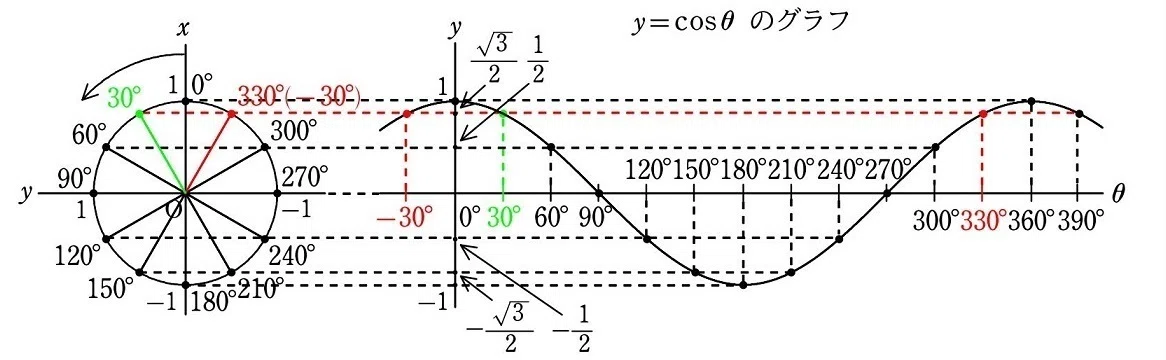
関数 $${y=\sin\theta}$$、$${y=\cos\theta}$$ と見立てて、この値を $${30\degree}$$ 刻みで $${y-\theta}$$ 座標にプロットしていくと、下図のようになります。
$${y=\sin\theta}$$ について
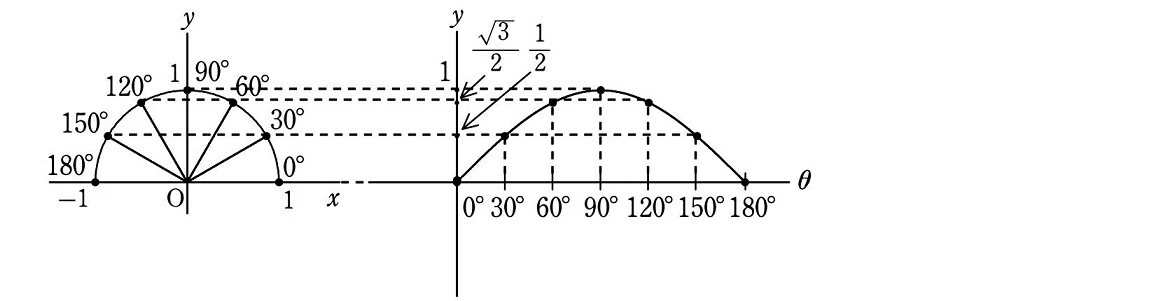
$${\sin\theta}$$ の値は単位円周上の $${y}$$ 座標なので、それぞれの $${\theta}$$ に対して $${y}$$ の値を横にスライドさせていけば $${y=\sin\theta}$$ のグラフが得られます。
ちょうど $${\theta=90\degree}$$ のとき最大値 $${1}$$ を取り、なだらかな山のような形です。
$${y=\cos\theta}$$ について
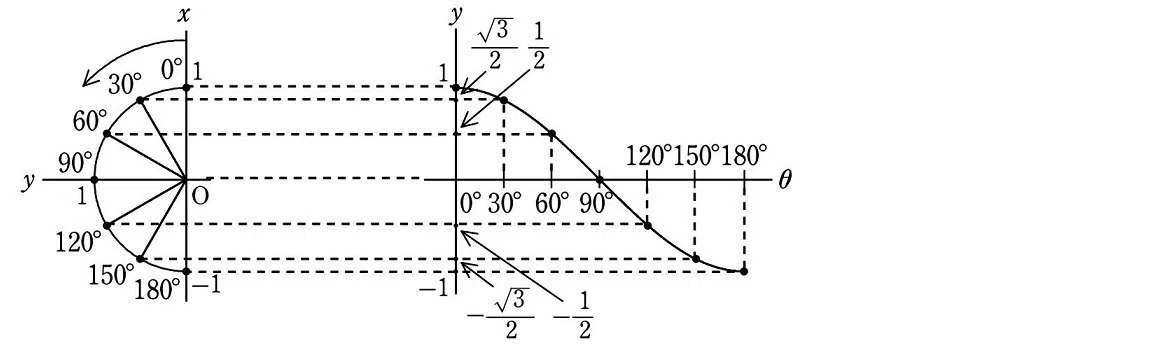
$${\cos\theta}$$ の値は単位円周上の $${x}$$ 座標なので、$${x}$$ 軸が縦になるように、単位円を反時計回りに $${90\degree}$$ 回転させています。もちろん、角度は $${x}$$ 軸の正の部分(始線)からの角度です(上図の矢印)。 それぞれの $${\theta}$$ に対して $${x}$$ の値を横にスライドさせていけば $${y=\cos\theta}$$ のグラフが得られます。
これを、すべての角度 $${\theta}$$ に拡張します。
はじめに、$${180\degree\leqq\theta\leqq360\degree}$$ のときの $${\sin\theta}$$ と $${\cos\theta}$$ の値を調べてみましょう。(case3)、(case4) でやったように、単位円を用いることによって下の表が得られます(各自確認)。
$$
\def\arraystretch{1.5}
\begin{array}{c|c|c|c|c|c|c|c|c|c}
& 180\degree & 210\degree & 225\degree & 240\degree & 270\degree
& 300\degree & 315\degree & 330\degree & 360\degree\\ \hline
\sin & 0 & -\frac{1}{2} & -\frac{\sqrt{2}}{2} & -\frac{\sqrt{3}}{2} & -1
& -\frac{\sqrt{3}}{2} & \frac{\sqrt{2}}{2} & -\frac{1}{2} & 0\\ \hline
\cos & -1 & -\frac{\sqrt{3}}{2} & -\frac{\sqrt{2}}{2} & -\frac{1}{2} & 0
& \frac{1}{2} & \frac{\sqrt{2}}{2} & \frac{\sqrt{3}}{2} & 1
\end{array}
$$
$${\theta}$$ を $${180\degree}$$ から大きくしていきましょう。
$${\sin\theta}$$ は $${y}$$ 軸の動きをみます。
$${180\degree}$$ を超えると、$${\sin\theta}$$ はマイナスの値をとりながら
$${-\dfrac{1}{2}, -\dfrac{\sqrt{2}}{2}, -\dfrac{\sqrt{3}}{2}}$$
と減少し(茶矢印)、最小値 $${-1}$$ を境に、マイナスの値をとりながら
$${-\dfrac{\sqrt{3}}{2}, -\dfrac{\sqrt{2}}{2}, -\dfrac{1}{2}}$$
と増加に転じで再び $${0}$$ になります(緑矢印)。
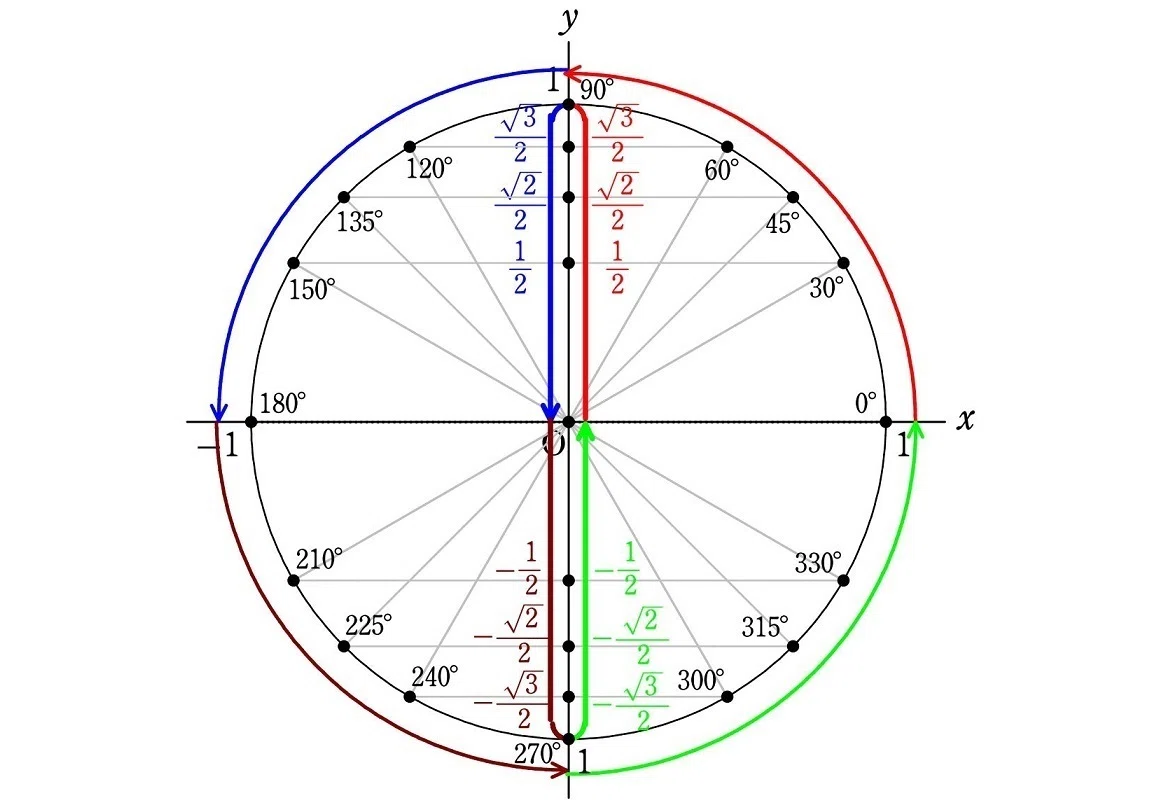
$${\cos\theta}$$ は $${x}$$ 軸の動きをみます。
$${\cos\theta}$$ はマイナスの値をとりながら
$${-\dfrac{\sqrt{3}}{2}, -\dfrac{\sqrt{2}}{2}, -\dfrac{1}{2}}$$
と増加し(茶矢印)、$${0}$$ を境にプラスの値をとりながら
$${\dfrac{1}{2}, \dfrac{\sqrt{2}}{2}, \dfrac{\sqrt{3}}{2}}$$
とさらに増加し、再び最大値 $${1}$$ になります(緑矢印)。
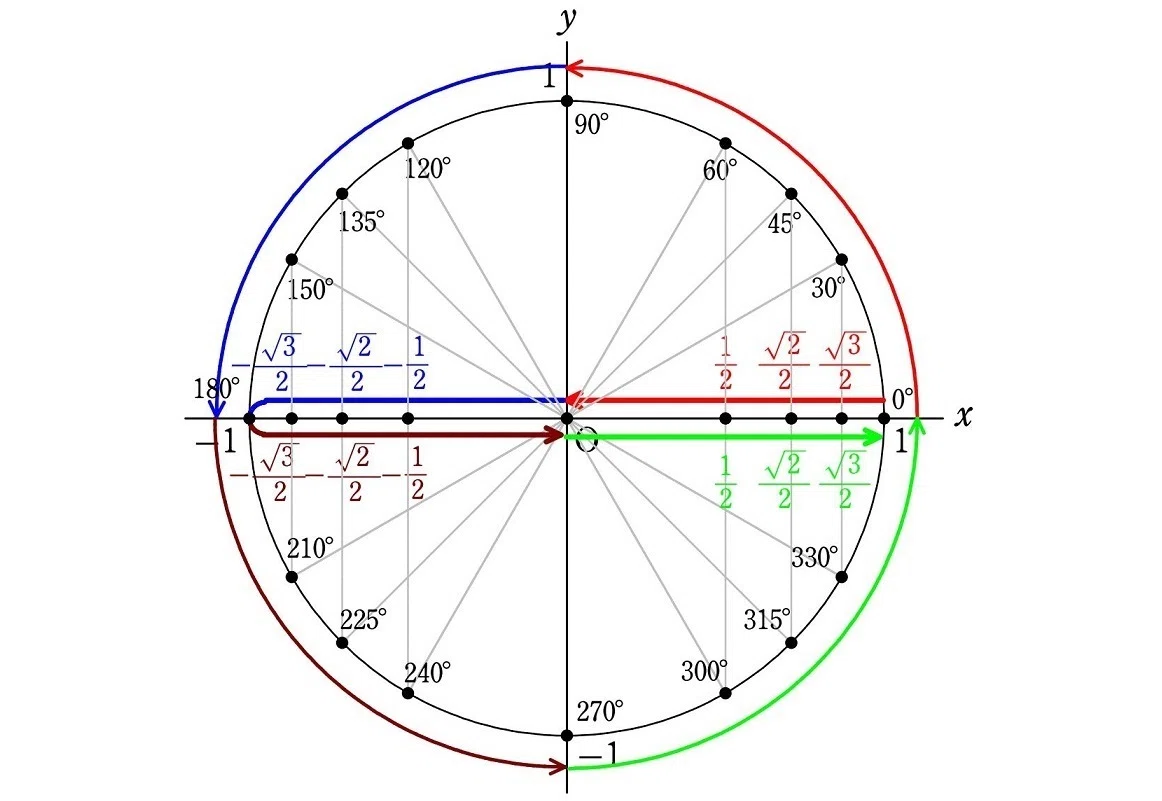
円の回転と、その三角比の値がきちんと対応していることを是非とも確認ください。
これを書き足し、一般角で $${y=\sin\theta}$$ と $${y=\cos\theta}$$ のグラフを描くと下図のようになります。
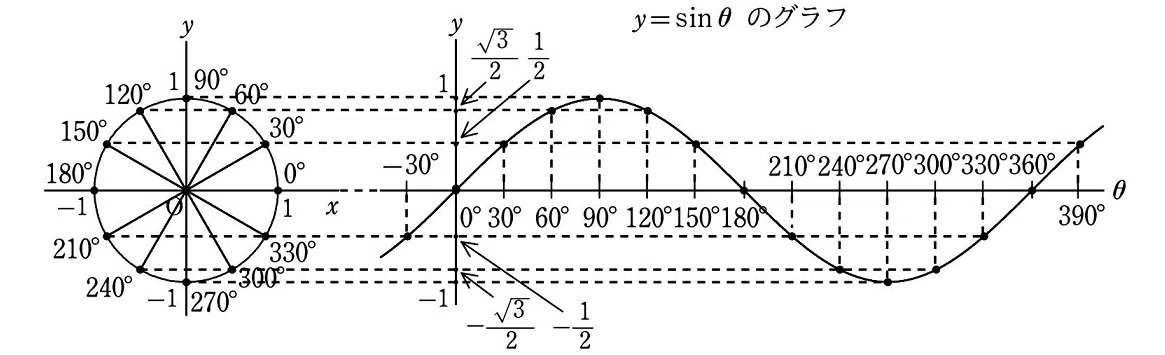
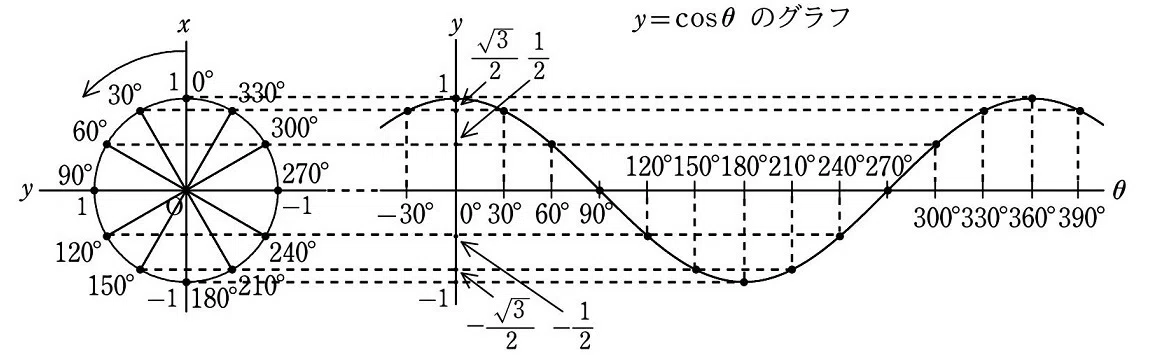
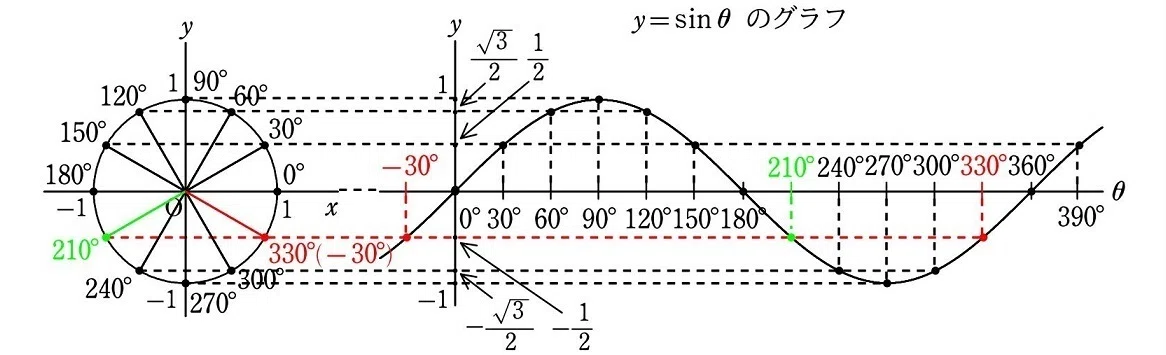
一般角のところで、反時計回りを正の角、時計回りを負の角と定義しました。つまり $${-30\degree}$$ とは、始線から時計回りに $${30\degree}$$ 回転したときの角度です。
このときの動径 $${\text{OP}}$$ は、始線から反時計回りに $${330\degree}$$ 回転したときと同じになるので
$$
\begin{alignat*}{3}
&\sin(-30\degree) & &=\sin330\degree & &=-\dfrac{1}{2}\\[6pt]
&\cos(-30\degree) & &=\cos330\degree & &=\dfrac{\sqrt{3}}{2}
\end{alignat*}
$$
となります(下図の赤字)。
なお、$${\sin\theta}$$ に関しては $${210\degree}$$ 回転したときとも同じ値になり、$${\cos\theta}$$ に関しては $${30\degree}$$ 回転したときとも同じ値になることを注意しておきます(下図の緑字)。
$$
\begin{alignat*}{4}
&\sin(-30\degree) & &=\sin225\degree & &=\sin330\degree & &=-\dfrac{1}{2}\\[6pt]
&\cos(-30\degree) & &=\cos30\degree & &=\cos330\degree & &=\dfrac{\sqrt{3}}{2}
\end{alignat*}
$$
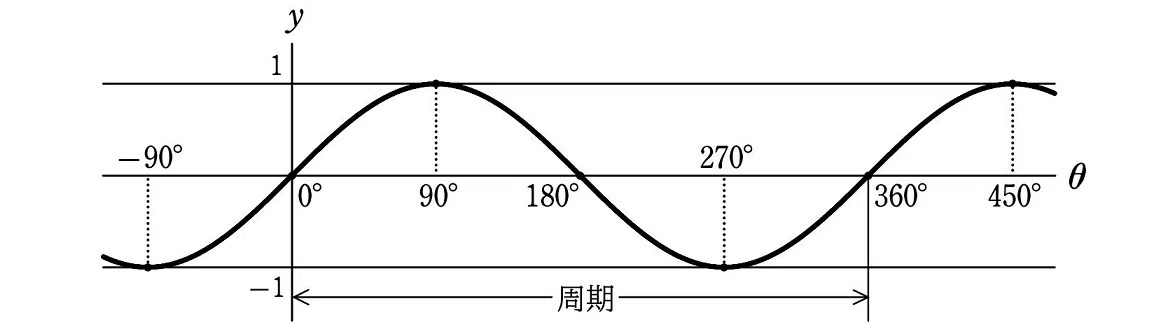
以上より、$${y=\sin\theta}$$ と $${y=\cos\theta}$$ のグラフは次のようになります。
$${y=\sin\theta}$$ のグラフ
$${y=\cos\theta}$$ のグラフ
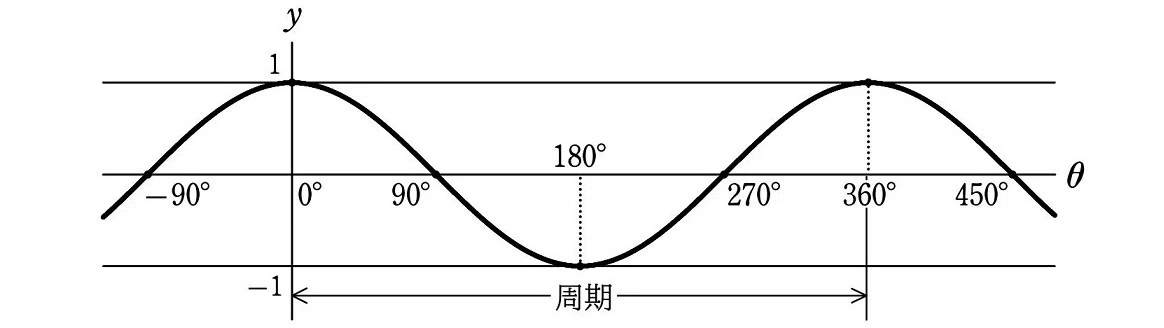
どちらも $${0\degree\leqq\theta\leqq360\degree}$$ の部分が繰り返し現れるので、周期は $${360\degree}$$ です。また、$${y}$$ の範囲(値域)はどちらも $${-1\leqq y \leqq1}$$ です。
$${y=\sin\theta}$$ のグラフを $${90\degree}$$ だけマイナスの方向にずらすと、$${y=\cos\theta}$$ のグラフと重なります。
tanθ のグラフ
つぎは $${y=\tan\theta}$$ のグラフです。
$${\tan\theta}$$ は動径 $${\text{OP}}$$ の延長と直線 $${x=1}$$ との交点の $${y}$$ 座標でした。
前回やりましたが、$${0\degree\leqq\theta\leqq180\degree}$$ のときの $${\tan\theta}$$ の値は次のようになります。
$$
\def\arraystretch{1.5}
\begin{array}{c|c|c|c|c|c|c|c|c|c}
& 0\degree & 30\degree & 45\degree & 60\degree & 90\degree
& 120\degree & 135\degree & 150\degree & 180\degree\\ \hline
\tan & 0 & \frac{1}{\sqrt{3}} & 1 & \sqrt{3} & {\small なし} & -\sqrt{3} & -1 & -\frac{1}{\sqrt{3}} & 0
\end{array}
$$
関数 $${y=\tan\theta}$$ と見立てて、この値を $${y-\theta}$$ 座標にプロットしていくと、下図のようになります。
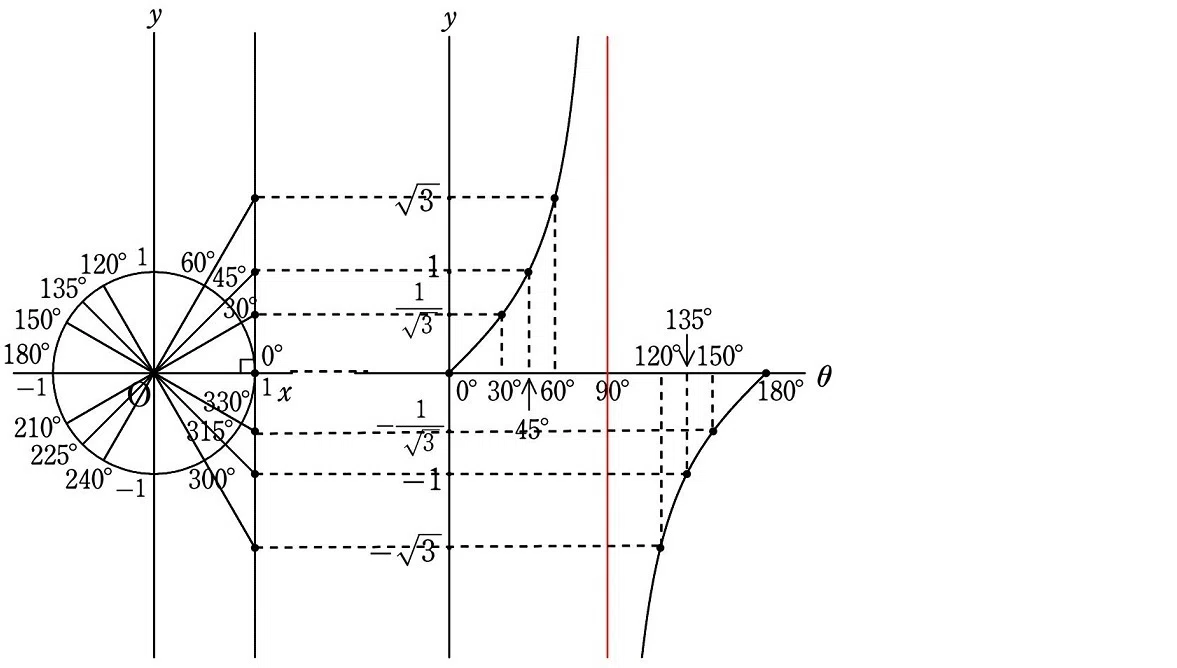
$${\theta}$$ が正の方向から $${90\degree}$$ に近づくと、グラフは直線 $${y=90\degree}$$(赤線)に限りなく近づいていくことが見て取れます。また、$${\theta}$$ が負の方向から $${90\degree}$$ に近づいても、グラフは直線 $${\theta=90\degree}$$(赤線)に限りなく近づいていくことが見て取れます。ただ、どこまでも近づくだけであって、接したり交わることはありません。
このように、接触しないで無限に近づいていく直線を漸近線といいます。
これを、すべての角度 $${\theta}$$ に拡張します。
はじめに、$${180\degree\leqq\theta\leqq360\degree}$$ のときの $${\tan\theta}$$ の値を調べてみましょう。(case3)、(case4) でやったように、単位円を用いることによって下の表が得られます(各自確認)。
$$
\def\arraystretch{1.5}
\begin{array}{c|c|c|c|c|c|c|c|c|c}
& 180\degree & 210\degree & 225\degree & 240\degree & 270\degree
& 300\degree & 315\degree & 330\degree & 360\degree\\ \hline
\tan & 0 & \frac{1}{\sqrt{3}} & 1 & \sqrt{3} & {\small なし} & -\sqrt{3} & -1 & -\frac{1}{\sqrt{3}} & 0
\end{array}
$$
$${\theta}$$ を $${180\degree}$$ から大きくしていきましょう。
$${\tan\theta}$$ は $${y}$$ 軸の動きをみます。
$${\tan\theta}$$ は、$${\theta=180\degree}$$ のときは $${0}$$ で、そこからプラスの値をとりながら
$${\dfrac{1}{\sqrt{3}}, 1, \sqrt{3}}$$
と増加していき(茶矢印)、$${\theta}$$ が大きくなるにつれて $${\tan\theta}$$ は無限大(限りなく大きい値)まで大きくなります。
$${\theta=270\degree}$$ のときは $${\tan\theta}$$ は存在せず、$${\theta=270\degree}$$ より大きい角度では、今度はマイナスの無限大から
$${-\sqrt{3}, -1, -\dfrac{1}{\sqrt{3}}}$$
とマイナスの値をとりながら増加していき(緑矢印)、$${\theta=360\degree}$$ のときに再び $${0}$$ になります。
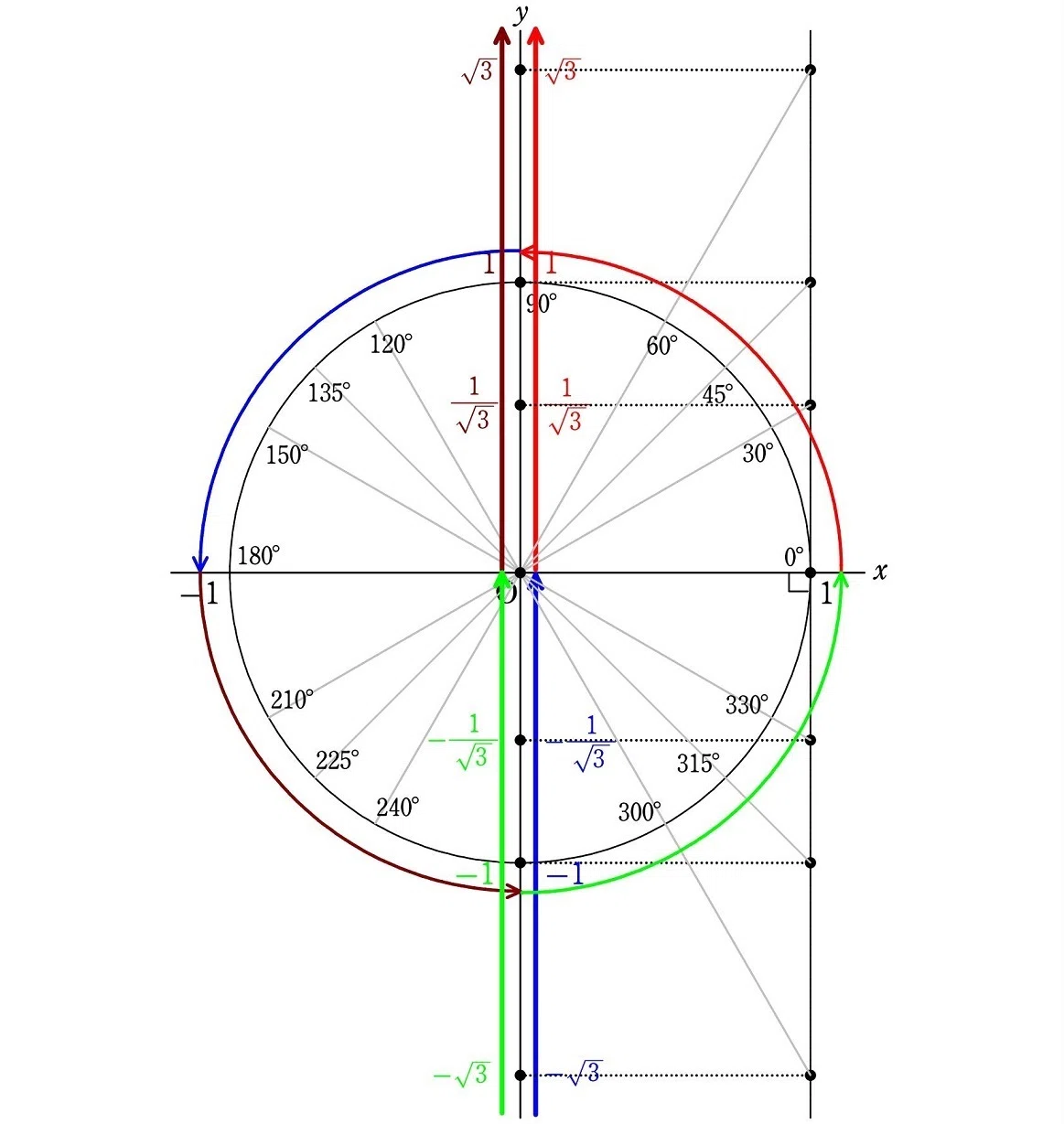
これを書き足し、一般角で $${y=\tan\theta}$$ のグラフを描くと下図のようになります。
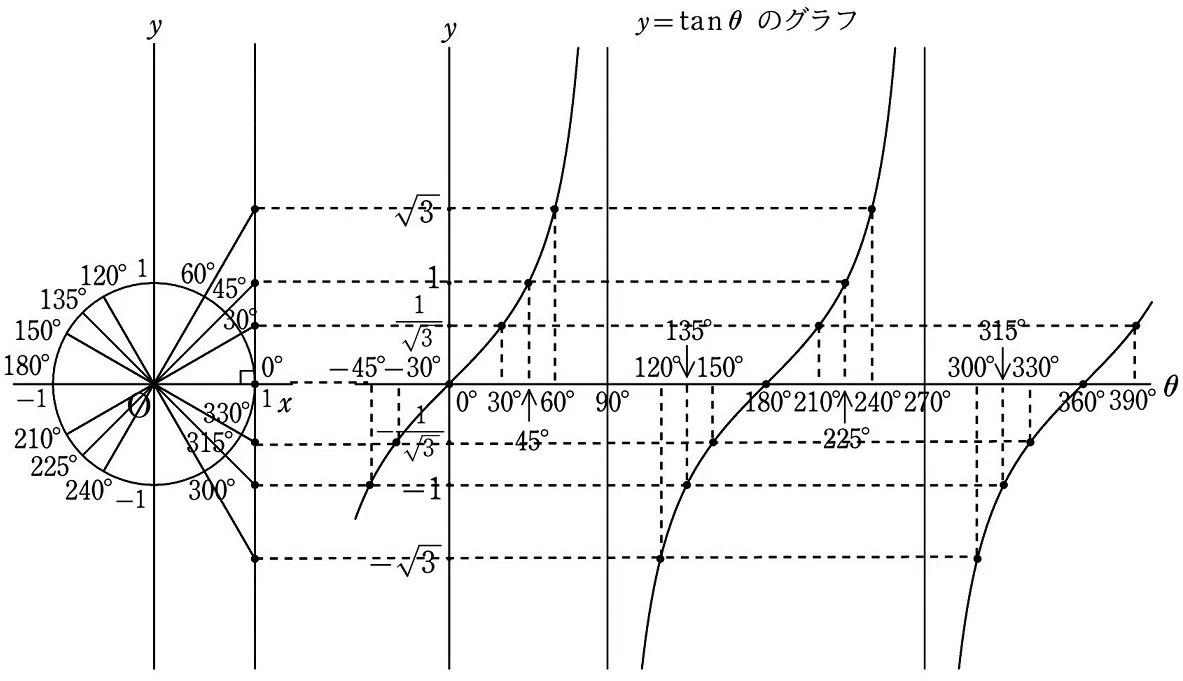
以上より、$${y=\tan\theta}$$ のグラフは次のようになります。
$${y=\tan\theta}$$ のグラフ
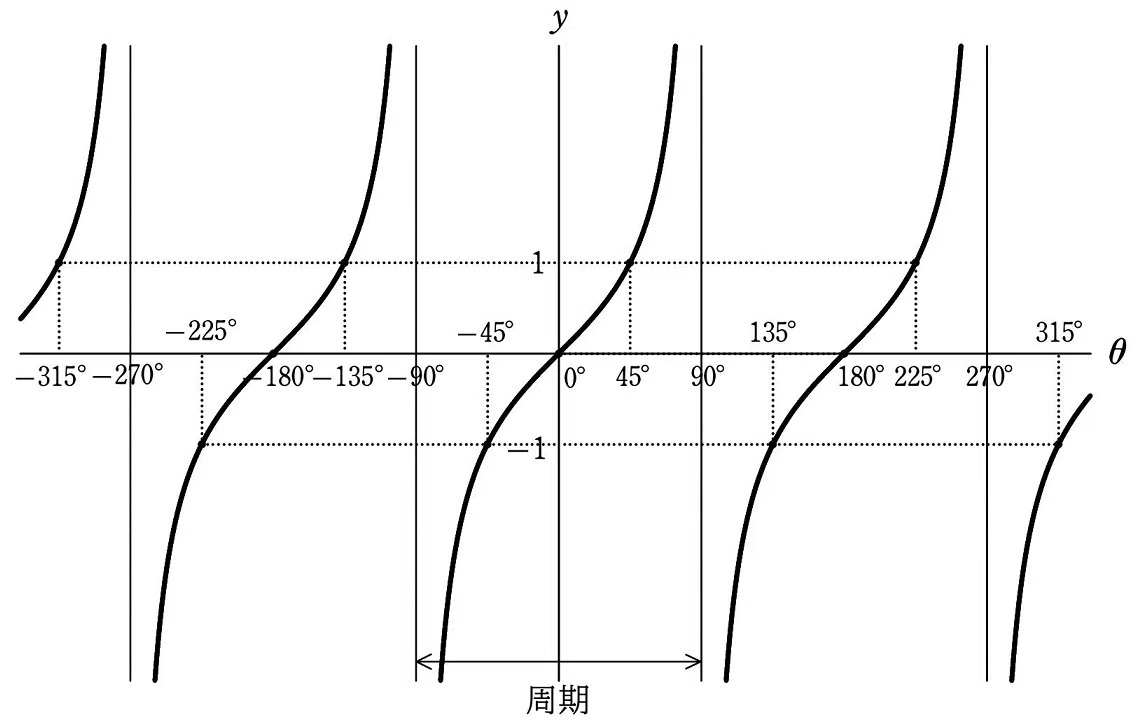
$${-90\degree<\theta<90\degree}$$ の部分が繰り返し現れるので、周期は $${180\degree}$$ です。$${y}$$ の範囲(値域)はすべての実数です。
また、直線
$${\theta=-270\degree, -90\degree, 90\degree, 270\degree}$$
は漸近線で、漸近線は周期的にあらわれます。一般に漸近線は
$$
\begin{align*}
\theta=90\degree+180\degree\times n{\small(n は整数)}
\end{align*}
$$
となります。$${n=-2}$$ のとき
$${\theta=90\degree+180\degree\times (-2)=-270\degree}$$
$${n=-1}$$ のとき
$${\theta=90\degree+180\degree\times (-1)=-90\degree}$$
$${n=0}$$ のとき
$${\theta=90\degree+180\degree\times 0=90\degree}$$
$${n=1}$$ のとき
$${\theta=90\degree+180\degree\times 1=270\degree}$$
$${\hspace{23pt}\vdots}$$
以下同様となります。
三角比・三角関数の重要公式
高校で習う三角比・三角関数の公式です。主要なものを並べていきます。証明は教科書などを参照してください。前回やった三角比、およびその拡張としての三角関数の定義は非常にシンプルですが、ひとたびそのように定義すると、美しい公式が数多く現れることが驚きです。
次の $${\triangle\text{ABC}}$$ と外接円について
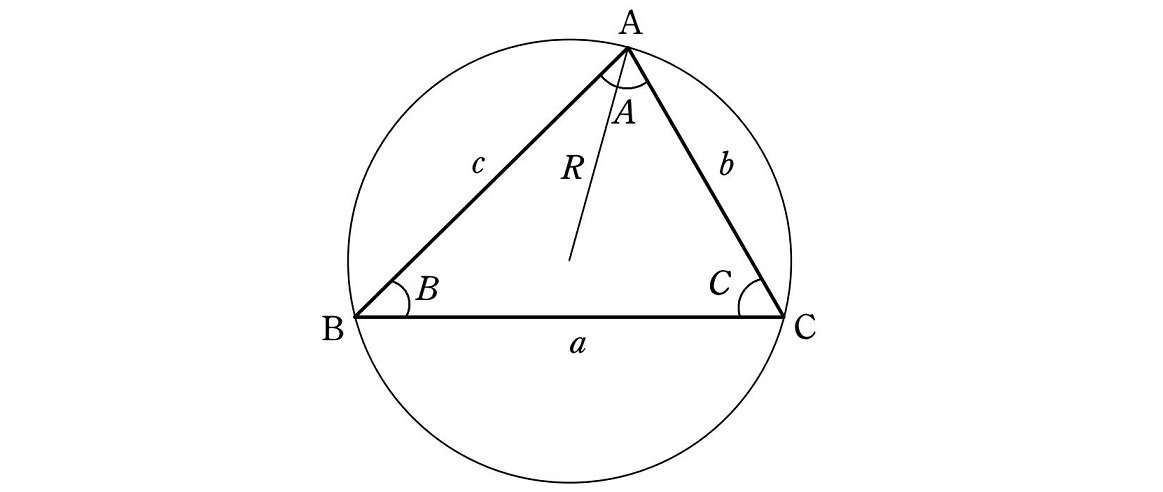
<正弦定理>
$${\triangle\text{ABC}}$$ の外接円の半径を $${R}$$ とすると
$$
\begin{align*}
\dfrac{a}{\sin A}=\dfrac{b}{\sin B}=\dfrac{c}{\sin C}=2R
\end{align*}
$$
<余弦定理>
$$
\begin{align*}
a^2&=b^2+c^2-2bc\cos A\\
b^2&=c^2+a^2-2ca\cos B\\
c^2&=a^2+b^2-2ab\cos C
\end{align*}
$$
<三角形の面積>
$${\triangle\text{ABC}}$$ の面積を $${S}$$ とすると
$$
\begin{align*}
S=\dfrac{1}{2}bc\sin A=\dfrac{1}{2}ca\sin B=\dfrac{1}{2}ab\sin C
\end{align*}
$$
ここまでは、三角形の内角で定義された公式です。
次からは三角形の図形的制約から放れ、一般角 $${\theta, \alpha, \beta}$$ について成り立つ公式です。
<三角関数の相互関係>
$$
\begin{align*}
&\sin^2\theta+\cos^2\theta=1\\[6pt]
&\tan\theta=\dfrac{\tan\theta}{\cos\theta}\\[6pt]
&1+\tan^2\theta=\dfrac{1}{\cos^2\theta}
\end{align*}
$$
<加法定理>
$$
\begin{alignat*}{2}
&\sin(\alpha+\beta) & &=\sin\alpha\cos\beta+\cos\alpha\sin\beta\\
&\sin(\alpha-\beta) & &=\sin\alpha\cos\beta-\cos\alpha\sin\beta\\
&\cos(\alpha+\beta) & &=\cos\alpha\cos\beta-\sin\alpha\sin\beta\\
&\cos(\alpha-\beta) & &=\cos\alpha\cos\beta+\sin\alpha\sin\beta\\
&\tan(\alpha+\beta) & &=\dfrac{\tan\alpha+\tan\beta}{1-\tan\alpha\tan\beta}\\[8pt]
&\tan(\alpha-\beta) & &=\dfrac{\tan\alpha-\tan\beta}{1+\tan\alpha\tan\beta}
\end{alignat*}
$$
<2倍角の公式>
$$
\begin{alignat*}{2}
&\sin2\alpha & &=2\sin\alpha\cos\beta\\
&\cos2\alpha & &=\cos^2\alpha-\sin^2\alpha\\
& & &=1-2\sin^2\alpha\\
& & &=2\cos^2\alpha-1\\
&\tan2\alpha & &=\dfrac{2\tan\alpha}{1-\tan^2\alpha}
\end{alignat*}
$$
<半角の公式>
$$
\begin{alignat*}{2}
&\sin^2\dfrac{\alpha}{2} & &=\dfrac{1-\cos\alpha}{2}\\[6pt]
&\cos^2\dfrac{\alpha}{2} & &=\dfrac{1+\cos\alpha}{2}\\[6pt]
&\tan^2\dfrac{\alpha}{2} & &=\dfrac{1-\cos\alpha}{1+\cos\alpha}
\end{alignat*}
$$
弧度法
三角関数の角度の表し方として、今までは度数法で表してきました。度数法とは「度 ($${\degree}$$)」という単位を用いた、小学校で習う角度の表し方です(いわゆる分度器の角度)。
この角度を、その中心角に対する「単位円の弧の長さ」で表す方法を弧度法といいます。弧度法の単位はラジアン (rad) です。円の"弧"で"角度"を表す方法です。
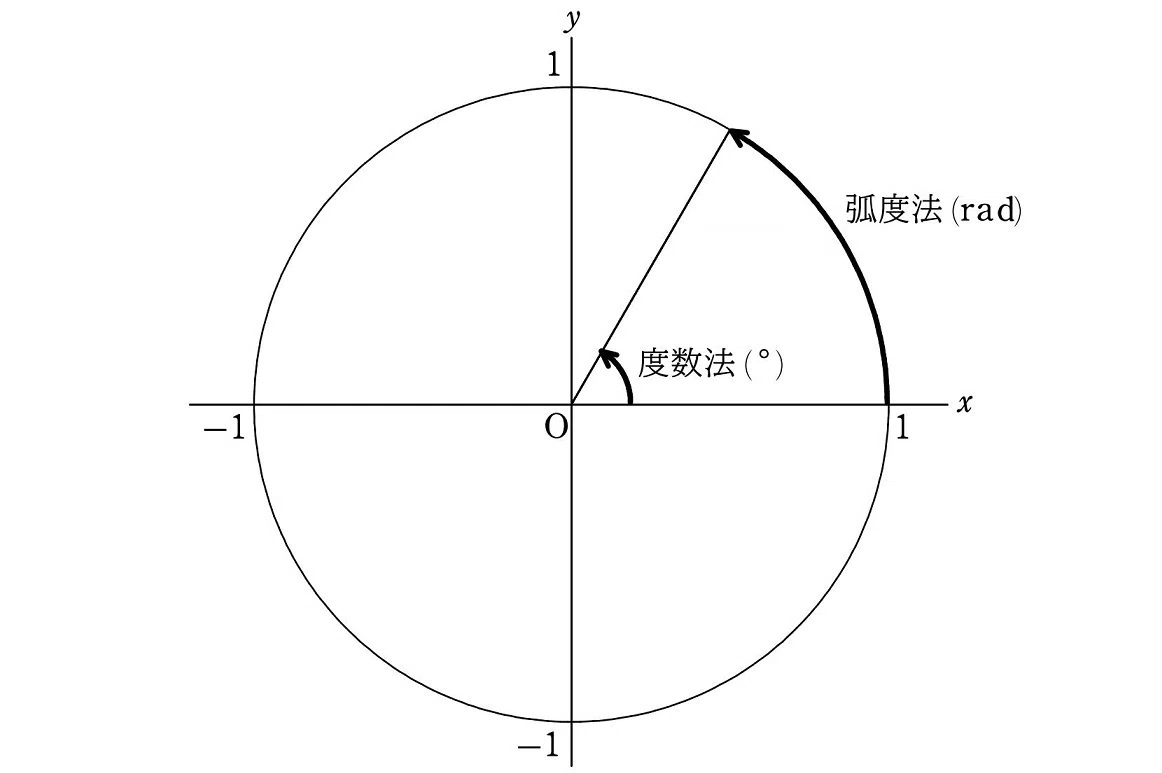
一周の角度の大きさは、度数法では $${360\degree}$$ です。単位円の円周(一周)の長さは $${2\pi}$$ なので、$${360\degree}$$ に対応する角度は、弧度法では $${2\pi}$$ ラジアンになります。
$$
\begin{align*}
360\degree \longleftrightarrow 2\pi \small{ラジアン}
\end{align*}
$$
弧度法では、単位のラジアンを省略して、$${360\degree}$$ を単に $${2\pi}$$ と書きます。
$$
\begin{align*}
360\degree \longleftrightarrow 2\pi
\end{align*}
$$
すると、中心角(度数法)と、それに対する弧の長さは比例するので
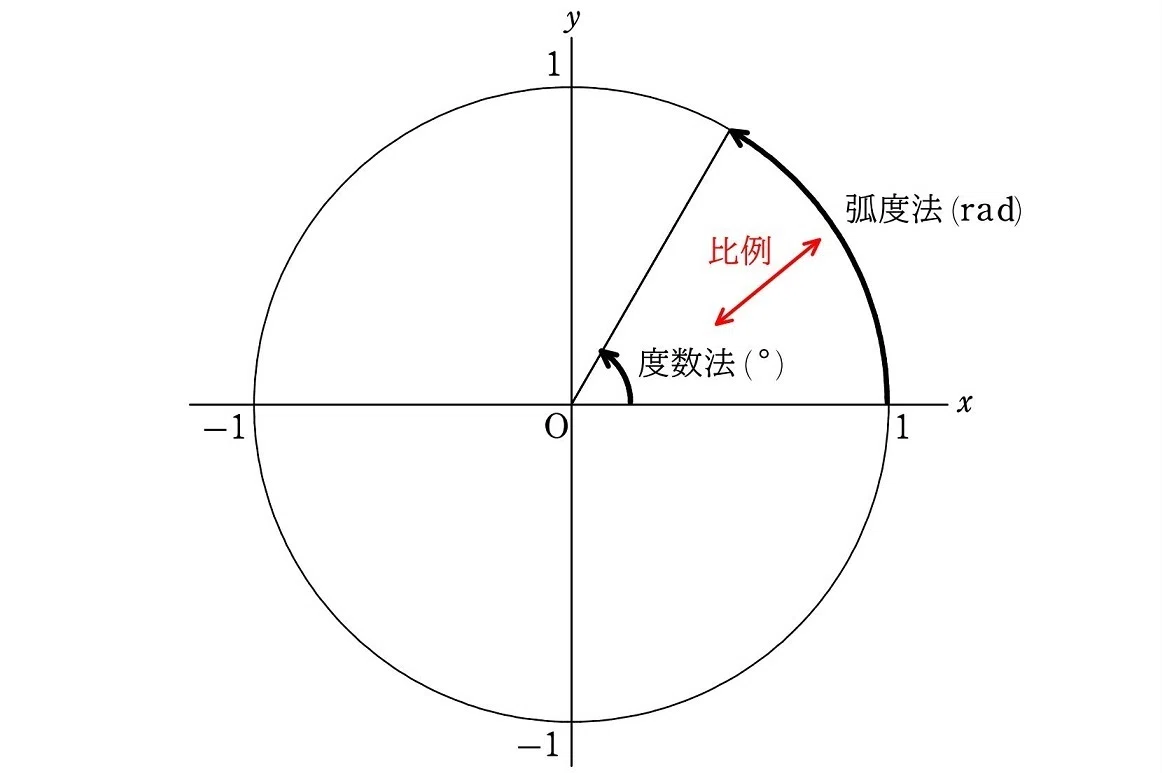
この「$${360\degree \longleftrightarrow 2\pi}$$」を基準に、その $${\dfrac{1}{2}}$$ 倍、$${\dfrac{1}{4}}$$ 倍、$${\cdots}$$ と刻んでいくことによって、次のように度数法と弧度法の対応関係が分かります。いわゆる有名角の弧度法です。
$$
\begin{alignat*}{2}
360\degree &\longleftrightarrow 2\pi & &\small{基準}\\[6pt]
180\degree &\longleftrightarrow \pi & &\small{基準の \dfrac{1}{2} 倍}\\[6pt]
90\degree &\longleftrightarrow \dfrac{\pi}{2} & &\small{基準の \dfrac{1}{4} 倍}\\[6pt]
60\degree &\longleftrightarrow \dfrac{\pi}{3} & &\small{基準の \dfrac{1}{6} 倍}\\[6pt]
45\degree &\longleftrightarrow \dfrac{\pi}{4} & &\small{基準の \dfrac{1}{8} 倍}\\[6pt]
30\degree &\longleftrightarrow \dfrac{\pi}{6} & &\small{基準の \dfrac{1}{12} 倍}\\[8pt]
0\degree &\longleftrightarrow 0 & &\small{基準の 0 倍}
\end{alignat*}
$$
単位円で書くと次のようになります。内側が度数法、外側が弧度法です。
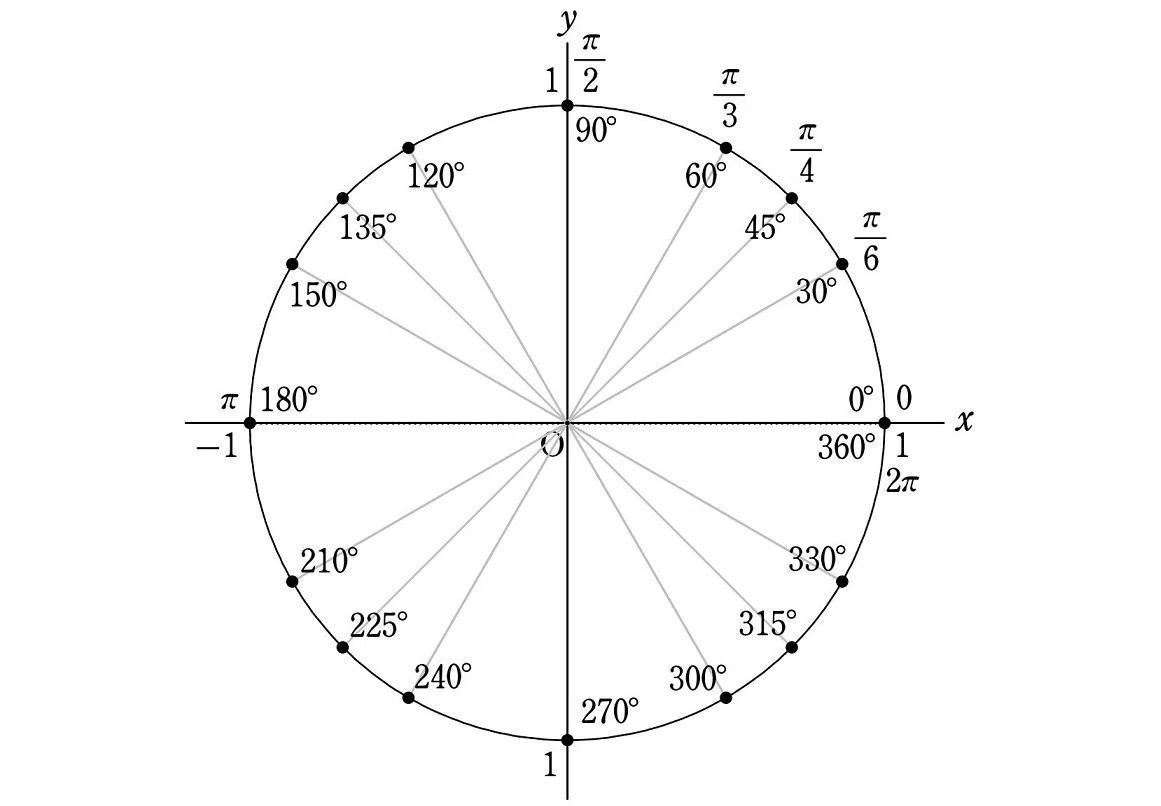
例えば、$${30\degree}$$ は弧度法では $${\dfrac{\pi}{6}}$$、$${45\degree}$$ は弧度法では $${\dfrac{\pi}{4}}$$ となります。頻繁に出てくるので、上記の値は覚えておくのがよいでしょう。
すると、この最小単位である「$${30\degree \longleftrightarrow \dfrac{\pi}{6}}$$」を基準にして、その $${2}$$ 倍、$${3}$$ 倍、$${\cdots}$$ を考えることによって、$${30\degree}$$ 刻みの弧度法が求まります。下線部があらたに求められた値です。
$$
\begin{alignat*}{2}
30\degree &\longleftrightarrow \dfrac{\pi}{6} & &\small{基準}\\[6pt]
60\degree &\longleftrightarrow \dfrac{2\pi}{6}=\dfrac{\pi}{3} & &\small{基準の 2 倍}\\[6pt]
90\degree &\longleftrightarrow \dfrac{3\pi}{6}=\dfrac{\pi}{2} & &\small{基準の 3 倍}\\[6pt]
\underline{120\degree} &\longleftrightarrow \dfrac{4\pi}{6}=\dfrac{2\pi}{3} & &\small{基準の 4 倍}\\[6pt]
\underline{150\degree} &\longleftrightarrow \dfrac{5\pi}{6} & &\small{基準の 5 倍}\\[6pt]
180\degree &\longleftrightarrow \dfrac{9\pi}{6}=\pi & &\small{基準の 6 倍}\\[6pt]
\underline{210\degree} &\longleftrightarrow \dfrac{7\pi}{6} & &\small{基準の 7 倍}\\[6pt]
\underline{240\degree} &\longleftrightarrow \dfrac{8\pi}{6}=\dfrac{4\pi}{3} & &\small{基準の 8 倍}\\[6pt]
\underline{270\degree} &\longleftrightarrow \dfrac{9\pi}{6}=\dfrac{3\pi}{2} & &\small{基準の 9 倍}\\[6pt]
\underline{300\degree} &\longleftrightarrow \dfrac{10\pi}{6}=\dfrac{5\pi}{4} & &\small{基準の 10 倍}\\[6pt]
\underline{330\degree} &\longleftrightarrow \dfrac{11\pi}{6} & &\small{基準の 11 倍}\\[6pt]
360\degree &\longleftrightarrow \dfrac{12\pi}{6}=2\pi & &\small{基準の 12 倍}\\[6pt]
\end{alignat*}
$$
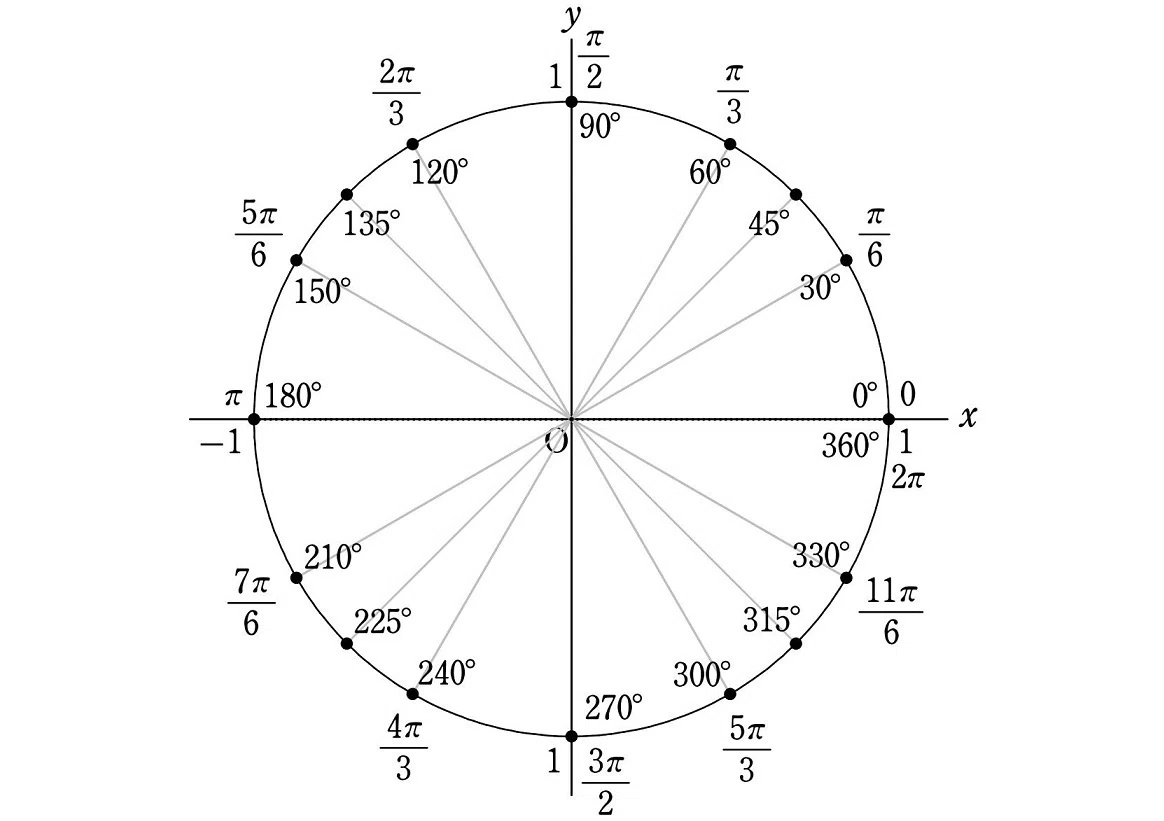
これに、今度は「$${45\degree \longleftrightarrow \dfrac{\pi}{4}}$$」を基準にして、その $${2}$$ 倍、$${3}$$ 倍、$${\cdots}$$ を考えることによって、$${45\degree}$$ 刻みの弧度法が求まります。下線部があらたに求められた値です。
$$
\begin{alignat*}{2}
45\degree &\longleftrightarrow \dfrac{\pi}{4} & &\small{基準}\\[6pt]
90\degree &\longleftrightarrow \dfrac{2\pi}{4}=\dfrac{\pi}{2} & &\small{基準の 2 倍}\\[6pt]
\underline{135\degree} &\longleftrightarrow \dfrac{3\pi}{4} & &\small{基準の 3 倍}\\[6pt]
180\degree &\longleftrightarrow \dfrac{4\pi}{4}=\pi & &\small{基準の 4 倍}\\[6pt]
\underline{225\degree} &\longleftrightarrow \dfrac{5\pi}{4} & &\small{基準の 5 倍}\\[6pt]
270\degree &\longleftrightarrow \dfrac{6\pi}{4}=\dfrac{3\pi}{2} & &\small{基準の 6 倍}\\[6pt]
\underline{315\degree} &\longleftrightarrow \dfrac{7\pi}{4} & &\small{基準の 7 倍}\\[6pt]
360\degree &\longleftrightarrow \dfrac{8\pi}{4}=2\pi & &\small{基準の 8 倍}
\end{alignat*}
$$
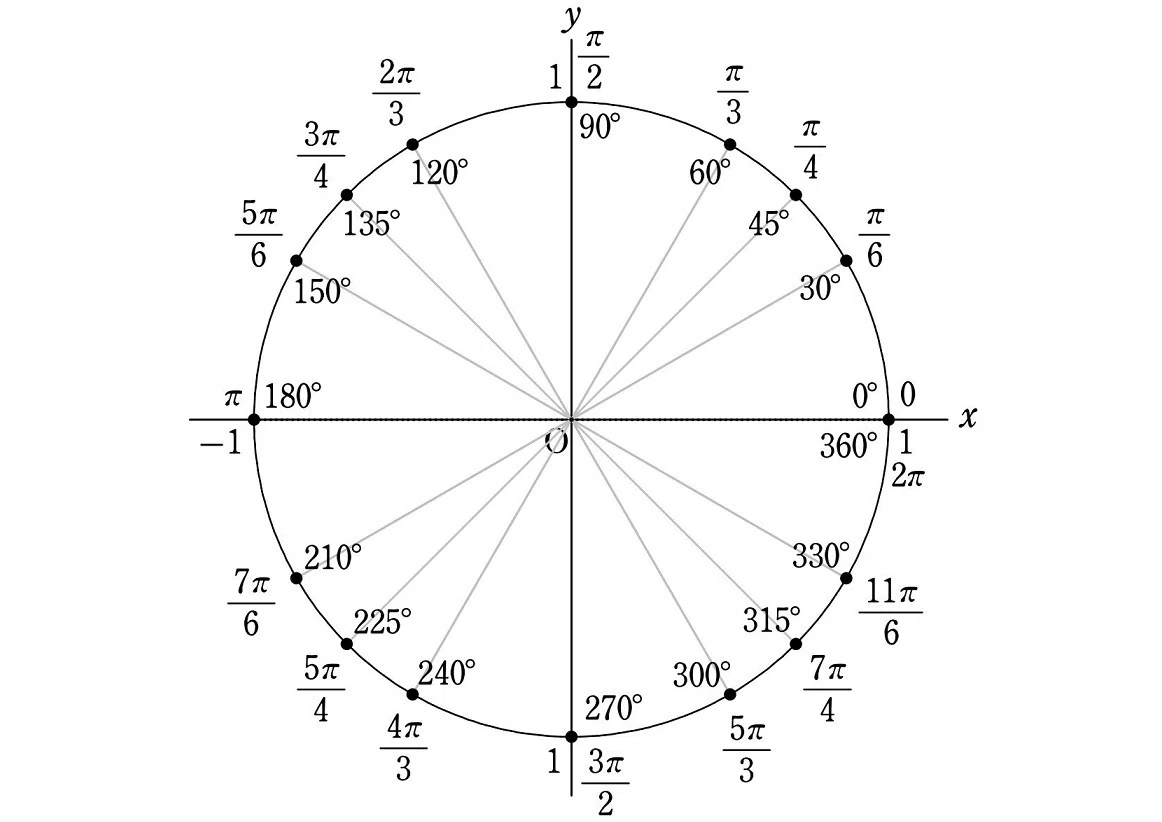
さらに「$${60\degree \longleftrightarrow \dfrac{\pi}{3}}$$」を基準にして、その $${2}$$ 倍、$${3}$$ 倍、$${\cdots}$$ を考えることもできますが、それらの値はすでに求めています。
以上で、単位円周上の主要な角度について、度数法を弧度法に変換することができました。分母に現れる数を見て「6432346」とリズムで覚えてもよいでしょう。
あとは度数法と同じように、反時計回りをプラス(2周目からは $${2\pi}$$ よりも大きい角度)、時計回りをマイナスで表すことによって、弧度法による三角関数を考えることができます。
三角比の表(弧度法)
参考までに、弧度法で考えた時の三角関数の表です。$${0}$$ から $${\pi}$$ の範囲で与えます。ぱっとすぐに引き出せることが重要です。
特に、鋭角の場合は覚えておくのがよいでしょう。鋭角の場合を覚えておけば、それを基準に、単位円上の回転や線対称で移すなどして他の値も引き出しやすくなります。度数法と同じなので、単位円を描いて導き出せるようにしましょう。
$$
\begin{alignat*}{3}
&\sin 0=0\hspace{32pt} & &\cos 0=1\hspace{32pt} & &\tan 0=0\\[6pt]
&\sin \dfrac{\pi}{6}=\dfrac{1}{2} & &\cos \dfrac{\pi}{6}=\dfrac{\sqrt{3}}{2} & &\tan \dfrac{\pi}{6}=\dfrac{1}{\sqrt{3}}\\[6pt]
&\sin \dfrac{\pi}{4}=\dfrac{\sqrt{2}}{2} & &\cos \dfrac{\pi}{4}=\dfrac{\sqrt{2}}{2} & &\tan \dfrac{\pi}{4}=1\\[6pt]
&\sin \dfrac{\pi}{3}=\dfrac{\sqrt{3}}{2} & &\cos \dfrac{\pi}{3}=\dfrac{1}{2} & &\tan \dfrac{\pi}{3}=\sqrt{3}\\[8pt]
&\sin \dfrac{\pi}{2}=1 & &\cos \dfrac{\pi}{2}=0 & &\tan \dfrac{\pi}{2} {\small はなし}\\[6pt]
&\sin \dfrac{2\pi}{3}=\dfrac{\sqrt{3}}{2} & &\cos \dfrac{2\pi}{3}=-\dfrac{1}{2} & &\tan \dfrac{2\pi}{3}=-\sqrt{3}\\[6pt]
&\sin \dfrac{3\pi}{4}=\dfrac{\sqrt{2}}{2} & &\cos \dfrac{3\pi}{4}=-\dfrac{\sqrt{2}}{2} & &\tan \dfrac{3\pi}{4}=-1\\[6pt]
&\sin \dfrac{5\pi}{6}=\dfrac{1}{2} & &\cos \dfrac{5\pi}{6}=-\dfrac{\sqrt{3}}{2} & &\tan \dfrac{5\pi}{6}=-\dfrac{1}{\sqrt{3}}\\[10pt]
&\sin \pi=0\hspace{32pt} & &\cos \pi=-1\hspace{32pt} & &\tan \pi=0
\end{alignat*}
$$
三角関数のグラフ(弧度法)
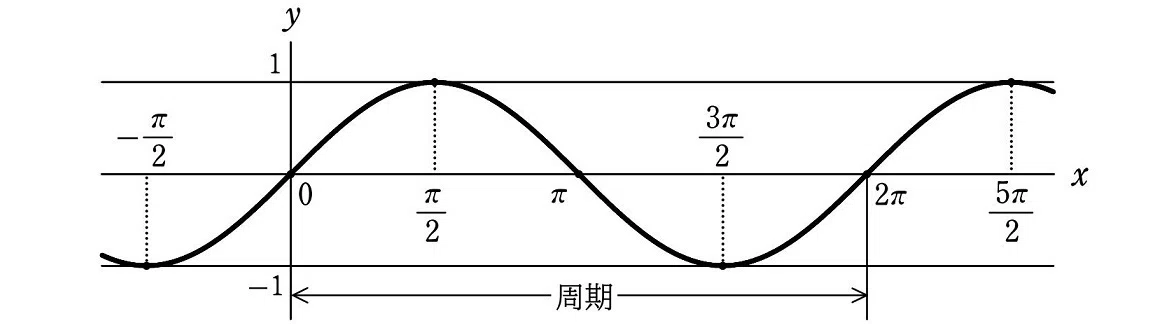
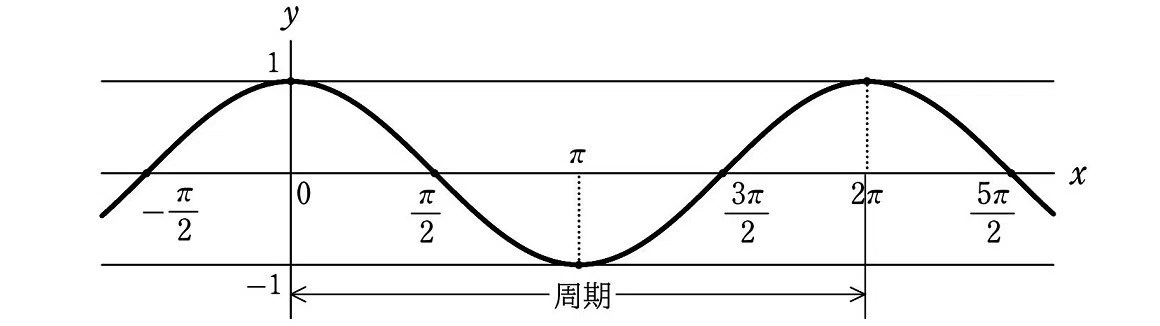
弧度法で表したときのそれぞれの三角関数のグラフは、次のようになります。弧度法のときは $${x}$$ の関数として考えます($${\theta}$$ は度数法)。見慣れた $${x-y}$$ 座標でのグラフです。
$${y=\sin x}$$ のグラフ
$${y=\cos x}$$ のグラフ
$${y=\tan x}$$ のグラフ
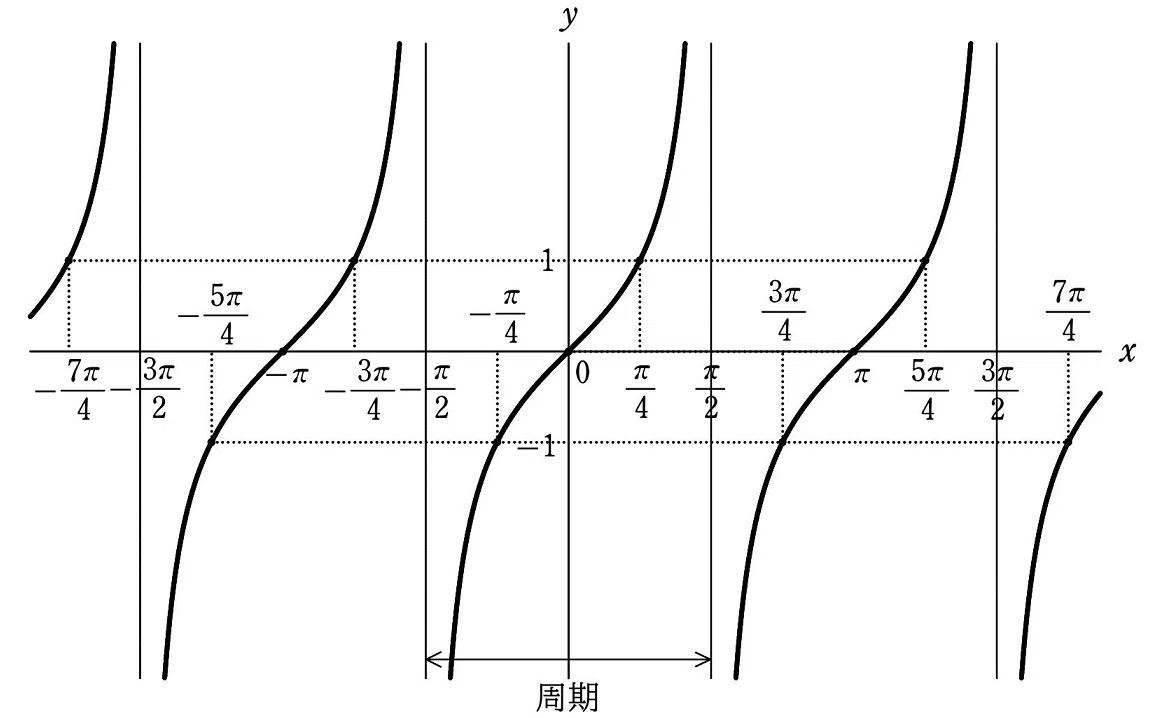
弧度法を導入することによって、$${x}$$ 軸と $${y}$$ 軸で同じ実数値のメモリを使うことになり、次のように三角関数の微分積分が美しく求まります。これが弧度法で考えるメリットの1つです。高校の数学Ⅲ以降、大学の数学では弧度法が使われます。
<三角関数の微分>
$$
\begin{alignat*}{2}
&(\sin x)' & &=\cos x\\[5pt]
&(\cos x)' & &=-\sin x\\
&(\tan x)' & &=\dfrac{1}{\cos^2x}
\end{alignat*}
$$
<三角関数の積分>
$$
\begin{alignat*}{2}
&\int\sin x\,dx& &=-\cos x+c\\
&\int\cos x\,dx& &=\sin x+c\\
&\int\dfrac{1}{\cos^2x}dx& &=\tan x+c
\end{alignat*}
$$
なお、$${\tan x}$$ そのものの積分は公式ではないですが、次の結果が得られます。
$$
\begin{align*}
\int\tan x\,dx=-\log|\tan x|+C
\end{align*}
$$
三角比の歴史(再掲)
(前回の「三角比」でも書いた記事の再掲です。三角関数の歴史を加筆したかったのですが、調べても詳しい歴史が分からないのでそのまま再掲します。なにか新しいことが分かったら加筆予定。)
三角比の起源は、紀元前の三角法にさかのぼります。三角法とは、直角三角形の辺の比と角度を用いた、図形に関する計算方法です。測量、航海、天文学などの実用上の必要により、古代から研究されてきました。
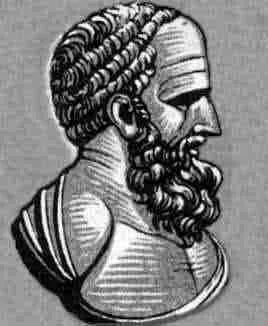
古代ギリシャの数学者、天文学者である、ヒッパルコスは、円周角と弦の長さの対応表(今の三角比の表の原型となるもの)を作り、幾何学の研究や測量を行いました。これによりヒッパルコスは「三角法の父」とよばれています。
なお、高校で習う三角比の定義は、ヒッパルコスによるものではなく、スイスの数学者、レオンハルト・オイラーが最初だといわれています。
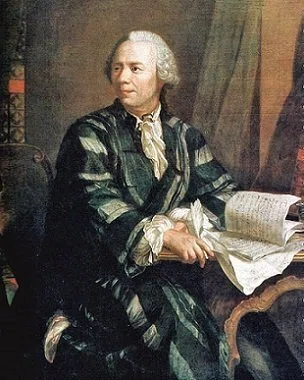
オイラーは三角比を円関数として見直すことで(まさに単位円の考え方)、一般の角度(一般角)$${\theta}$$ に対して $${\sin\theta, \cos\theta, \tan\theta}$$ を定義しました。三角関数の誕生です。
数式ミステリー
いいなと思ったら応援しよう!
 数学・物理をわかりやすく。チップは書籍の購入費用に使わせていただきます。
購入したい本「初学の編集者がわかるまで書き直した 基礎から鍛える量子力学 基本の数理から現実の物理まで一歩一歩」
数学・物理をわかりやすく。チップは書籍の購入費用に使わせていただきます。
購入したい本「初学の編集者がわかるまで書き直した 基礎から鍛える量子力学 基本の数理から現実の物理まで一歩一歩」