
































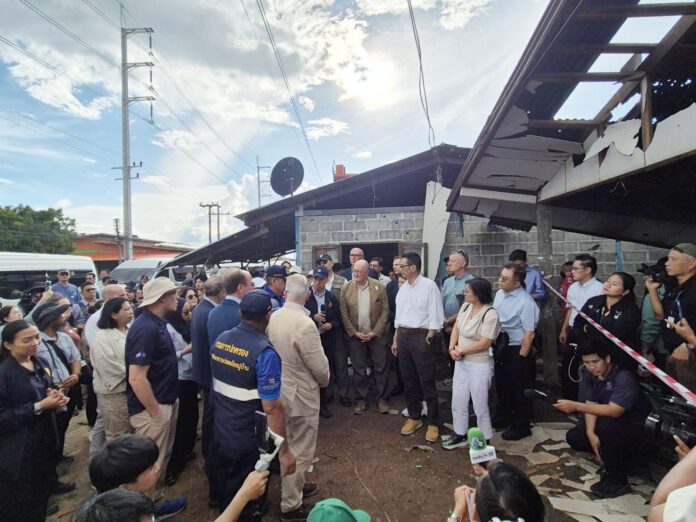
SISAKET — A Thai-Dutch couple living in Si Sa Ket Province, who were caught up in military clashes along the Thai-Cambodia border, traveled to meet the Dutch Ambassador to Thailand during his visit to observe affected areas on Saturday. They wanted to share their firsthand account of what really happened.
Phitsamai Angkana and her Dutch boyfriend, known as Mr. Ruud, who moved to Thailand over two years ago, described how they had to flee for their lives from artillery shells fired by Cambodian forces into Thai territory in Kantharalak District, Si Sa Ket Province, from the very first day of fighting on July 24.
“We came here specifically to tell them about what happened – both what we experienced ourselves and what Thai people had to endure from Cambodia’s actions against Thailand. We wanted the ambassador to know that his own citizens are living in Thailand too,” Phitsamai said.
Mr. Ruud recounted the day when weapons attacks came from the Cambodian side. He was riding his motorcycle home in a panic while other villagers were evacuating after hearing the sounds of battle. He and his girlfriend decided they had to leave their home too, waiting an hour for her brother to pick them up by car. Just as they were getting into the vehicle, five more shells hit the road nearby, confirming that the area was no longer safe. They then drove 45 kilometers north, thinking they would be safe there.
International Delegation Visits Border Areas
Dutch Ambassador Remco van Wijngaarden was part of a 33-country delegation including diplomats from ASEAN member states, Ottawa Convention signatories, international organization representatives, and civil society groups involved in landmine clearance. The group accompanied a Thai delegation led by Foreign Minister Maris Sangiampongsa to observe areas affected by anti-personnel landmines in Si Sa Ket Province – mines that Thailand insists were recently planted by Cambodia.
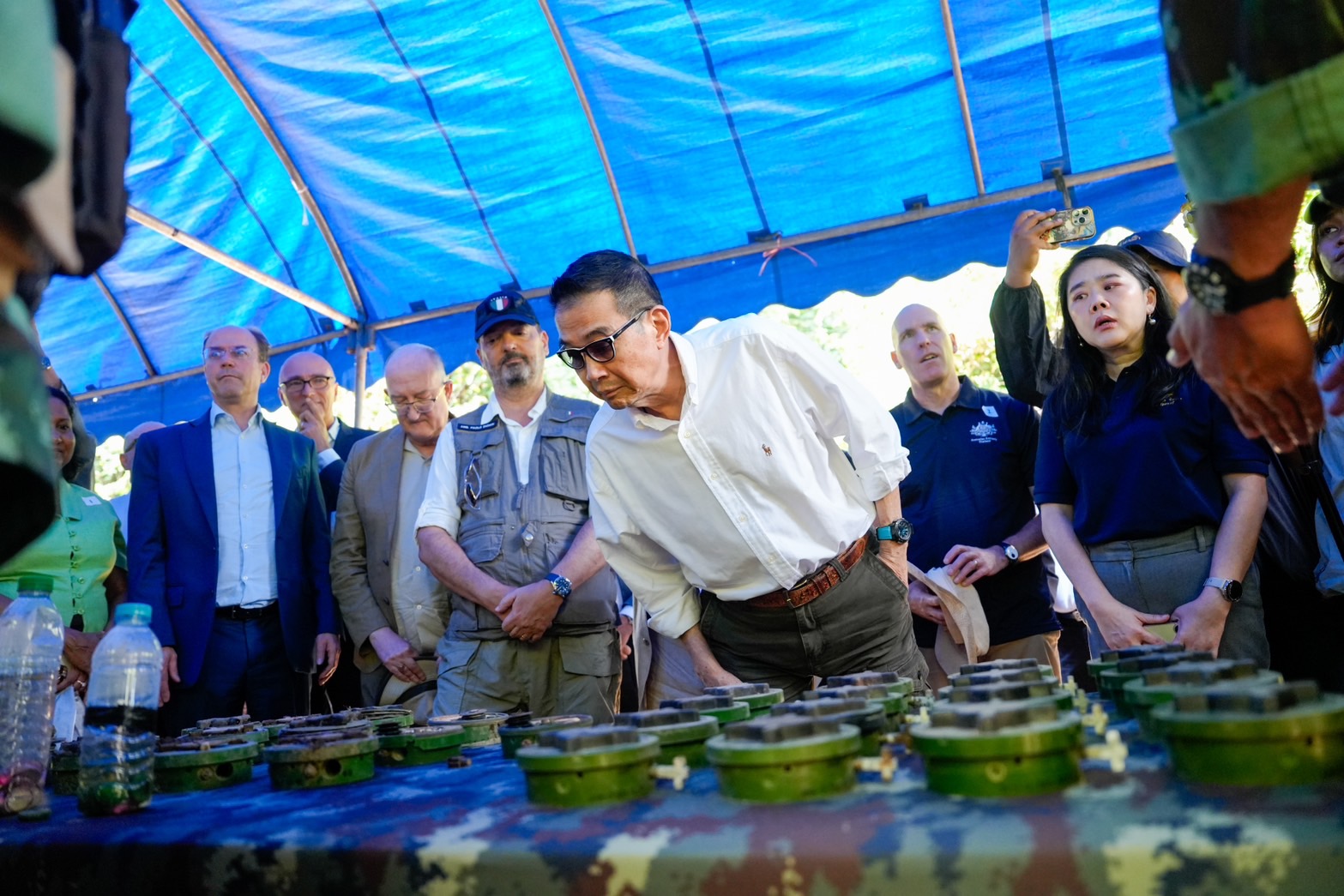
The delegation visited the Phu Ma Khuea operational unit in Kantharalak District to observe landmine clearance operations and examine various ordnance found in the area, with media present to witness the recovery efforts.
Officers from the 4th Engineer Battalion reported that they had successfully cleared 46 anti-personnel landmines, with 16 ready for immediate use. They also discovered anti-tank mines, RPG rockets, and 60mm and 82mm mortar rounds.
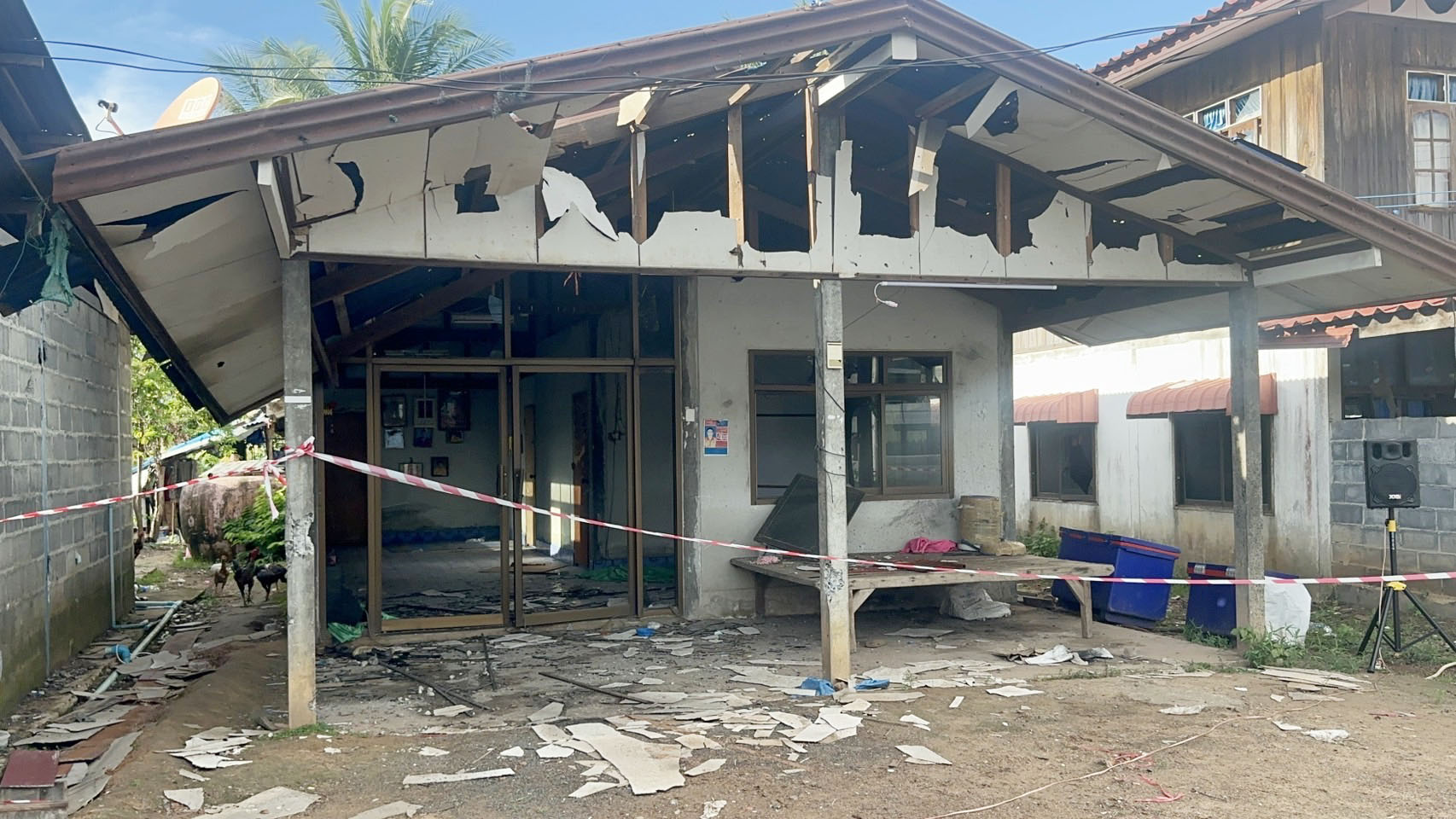
The delegation then surveyed damaged civilian homes in Kantharalak District hit by Cambodian weapons. This village, just 5 kilometers from the border, suffered the worst damage in the district. The observers closely inspected the destruction, visiting another completely destroyed house about 100 meters away, where the homeowner came out to provide information personally.
Thailand’s Position on International Law
Foreign Minister Maris reaffirmed Thailand’s commitment to international law, particularly the Ottawa Convention and International Humanitarian Law. He called on the international community to review assistance given to Cambodia for demining while urging Cambodia to cooperate on mine clearance and stop spreading disinformation to improve bilateral cooperation and resolve tensions.
Army Responds to Cambodia’s Denials
Major General Winthai Suvaree, Army spokesperson, said during the briefing that Cambodia continues to distort facts about using landmine weapons against Thai forces, systematically trying to deny evidence by claiming Thailand’s proof is staged or consists of old war remnants – claims that contradict the facts.
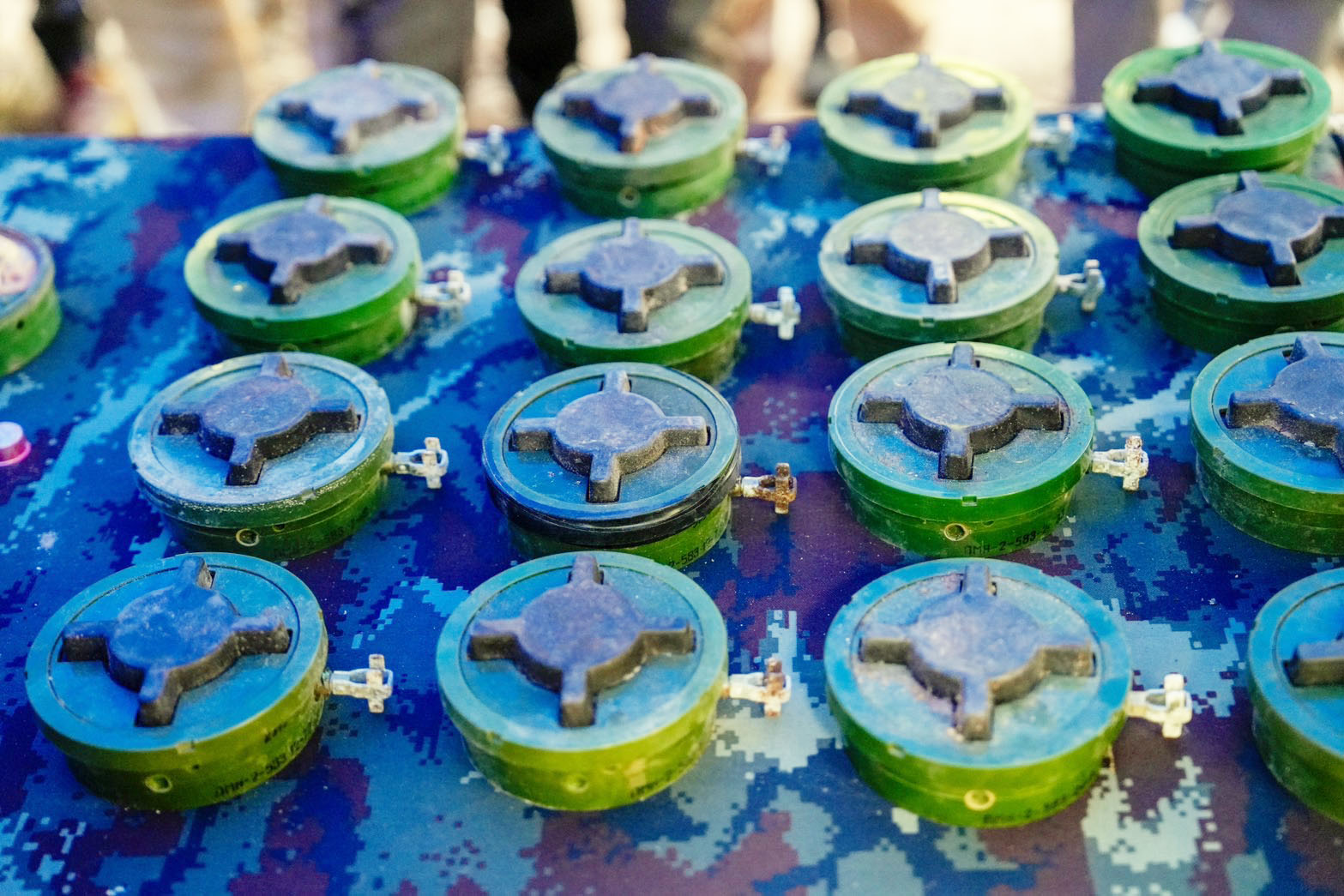
The Royal Thai Army presented eight key points of evidence proving Cambodia used landmines against Thai forces:
- Tactical Patterns: Every time Cambodia deploys forces, landmine defensive lines appear in forward positions. At five separate incidents between July and August 2025, Thai personnel discovered systematic placement of 3-5 additional PMN-2 landmines.
- Who’s in the Area: Only Thai and Cambodian forces operate there, yet in all five incidents, only Thai forces were harmed – making it impossible that Thailand would endanger its own personnel.
- Post-Ceasefire Discoveries: After fighting stopped, Thai engineers found numerous hidden PMN-2 landmines along former Cambodian positions.
- Social Media Evidence: Photos showed Cambodian influencers creating content near Ta Kwai Temple with clusters of PMN-2 landmines visible in the background.
- Intelligence: Audio recordings captured Cambodian soldiers discussing collecting and relocating PMN-2 landmines to new areas.
- Diplomatic Stance: Cambodia refuses Thailand’s proposal for joint landmine clearance operations, despite Cambodia’s international image as opposing landmine use and receiving substantial annual funding support.
- Previous Clearance: Thai mine action teams had already cleared 1,300 remnant landmines from these areas in 2019, with no PMN-2-type mines found then.
- Non-Cooperation: Cambodia frequently fails to cooperate in landmine clearance operations near the border demarcation line, suggesting suspicious behavior and lack of transparency.
Major General Winthai emphasized that all evidence presented consists of verifiable facts that must be shared with the international community to clearly demonstrate Cambodia’s use of landmine weapons against Thai forces – actions that violate humanitarian principles and international obligations.
_________