
『ブラック・アトランティック』
The Black Atlantic, by Paul Gilroy
Paul Gilroy, b.1956
☆ 『ブラック・アトランティック:モダニティと二重の意識』は、アフリカ、アメリカ、イギリス、カリブ海の文化の要素を取り入れた、独特なブラック・アトラ ンティック文化に関する1993年の歴史書である。ポール・ギルロイ著、ハーバード大学出版局およびヴァーソ・ブックス刊。
★ギルロイは、民族絶対主義(ethnic absolutism)とみなされる可能性のあるあらゆる文化的形態から離れ、国境を越えた文化の構築の場として「ブラック・アトランティック」という 概念を提示している。この新しい概念は、ディアスポラの人々は共通の源や起源によって分断されているという考えに基づく従来のディアスポラのモデルを打ち 破り、ハイブリッド性を重視する第二のモデルを提示している。

第1章 近代のカウンターカルチャーとしてのブラック・アトランティック
ディアスポラに暮らすアフリカ人が抱える二重の意識(Double consciousness)について述べられている
第2章 主人、愛人、奴隷、そして近代のアンチノミー
・近代性(Modernity)に関する議論には、人種やエスニシティについての関心が抜け落ちている。
第3章 「奴隷制から持ち帰った宝石」:ブラック・ミュージックと真正性の政治
・黒人の音楽について
・黒人の音楽が表象されるときに、エスニック、真正性、ジェンダーアイデンティティと音楽の結びつきが不可分になる。
第4章 「疲れた旅人を励ます」:W. E. B. デュボイス、ドイツ、そして(置換の)政治
・デュボイスの「二重意識」論
・デュボイスのヨーロッパ経験が重要
第5章 「涙の慰めなしに」:リチャード・ライト、フランス、そしてコミュニティの二面性
・リチャード・ライトの作品論
最終章 「語り継ぐべき物語ではない」:生きた記憶と奴隷の崇高
・アフリカ中心主義と、ディアスポラ
※
・この本には、フランツ・ファノンと、CLR ジェームズ に関する議論はほとんど何もない。
| The Black Atlantic:
Modernity and Double Consciousness is a 1993 history book about a
distinct black Atlantic culture that incorporated elements from
African, American, British, and Caribbean cultures. It was written by
Paul Gilroy and was published by Harvard University Press and Verso
Books. |
『ブラック・アトランティック:モダニティと二重の意識』は、アフリ
カ、アメリカ、イギリス、カリブ海の文化の要素を取り入れた、独特なブラック・アトランティック文化に関する1993年の歴史書である。ポール・ギルロイ
著、ハーバード大学出版局およびヴァーソ・ブックス刊。 |
| Chapter titles 1. The Black Atlantic as a Counterculture of Modernity 2. Masters, Mistresses, Slaves, and the Antinomies of Modernity 3. "Jewels Brought from Bondage": Black Music and the Politics of Authenticity 4. "Cheer the Weary Traveller": W. E. B. Du Bois, Germany, and the Politics of (Dis)placement 5. "Without the Consolation of Tears": Richard Wright, France, and the Ambivalence of Community 6. "Not a Story to Pass On": Living Memory and the Slave Sublime |
章タイトル 1. 近代のカウンターカルチャーとしてのブラック・アトランティック 2. 主人、愛人、奴隷、そして近代のアンチノミー 3. 「奴隷制から持ち帰った宝石」:ブラック・ミュージックと真正性の政治 4. 「疲れた旅人を励ます」:W. E. B. デュボイス、ドイツ、そして(置換の)政治 5. 「涙の慰めなしに」:リチャード・ライト、フランス、そしてコミュニティの二面性 6. 「語り継ぐべき物語ではない」:生きた記憶と奴隷の崇高 |
| Chapter 1 The first chapter of the Black Atlantic describes the double-consciousness maintained by Africans in the diaspora.[1] The chapter asserts that Black identity is multifaceted and difficult to define due to the multinational position of Blackness. Gilroy utilizes the imagery of the slave ship to demonstrate the position of Black bodies between two (or more) lands, identities, cultures, etc. which is unable to be defined by borders.[1] Additionally, Gilroy discusses how western nationalism results from a narrative created by whites that ties western nationalism to whiteness.[1] This narrative inherently others Black folk who often partly belong to the same national identity. He highlights artistic expression (particularly through music from Black diasporic communities) as a means of exploring the transient nature of Blackness.[1] Pointedly, he speaks of the song "Keep on Moving" which he asserts expresses "the restlessness of spirit which makes that diaspora culture vital".[1] In many ways, the song exemplifies the state of the diaspora as Black bodies have existed in numerous spaces and cannot be defined solely by where they have been, where they are, or where they are going. Black diasporic music remains of great importance to Gilroy's narrative as it is demonstrative of the manner in which Black individuals are able to embrace a communal identity despite many individuals in the diaspora's original cultures being stolen from them. Ultimately, Gilroy asserts that the Black experience is coupled with the varied narratives relating to belonging and history, still, in many ways, the narratives are mitigated by music which allows for Black expression and community to be shared beyond borders.[1] |
第1章 『ブラック・アトランティック』の第1章では、ディアスポラに暮らすアフリカ人が抱える二重の意識(Double consciousness)について述べられている。[1] この章では、ブラック・アイデンティティは多面的であり、ブラックネスが多国籍的な立場にあるため定義が難しいと主張している。ギルロイは奴隷船のイメー ジを用いて、2つ(またはそれ以上)の土地、アイデンティティ、文化などの間で、境界線では定義できない黒人の身体の位置を示している。[1] さらにギルロイは、西洋のナショナリズムが、西洋のナショナリズムを白人と結びつける白人が作り出した物語から生じていることを論じている。[1] この物語は、本質的に、同じ国民的アイデンティティに部分的に属していることが多い黒人たちを他者として扱っている。彼は、黒人のディアスポラのコミュニ ティの音楽を中心とした芸術表現を、黒人であることの儚さを探究する手段として強調している。[1] 彼は、とりわけ「Keep on Moving」という歌について語っている。この歌は、「 ディアスポラ文化を活気あるものにしている」と主張している。[1] さまざまな意味で、この歌は、黒人の身体が数多くの空間で存在してきたというディアスポラのあり方を象徴している。ディアスポラの黒人音楽は、ディアスポ ラの黒人たちが、元々の文化の多くが奪われたにもかかわらず、いかにして共同のアイデンティティを受け入れることができたかを物語るものであり、ギルロイ の主張にとって非常に重要な意味を持つ。最終的にギルロイは、黒人の経験は帰属と歴史に関するさまざまな物語と結びついていると主張するが、それでもな お、さまざまな意味で、黒人の表現とコミュニティを国境を越えて共有することを可能にする音楽によって、その物語は和らげられている。[1] |
| Black Europeanness Gilroy's attention to "Black Europeanness" in The Black Atlantic brings up themes of double consciousness and its presence in Black Europeans. He expresses how the existence of racist and nationalist discourse have interacted in a manner that portrays them as separate identities and opinions. They contrive political relationships in a way that isolates each identity, making them seem mutually exclusive. The effect of this is that there exists no blending or interweaving of these identities and any effort in forming connections or walking the middle ground between them is politically provocative and insubordinate.[2] Gilroy connects this to the black Atlantic, which he defines as a "modern political and cultural formation", by expressing his desire for it to break free from the structures and nation states that facilitate racist and nationalist politics.[3] https://en.wikipedia.org/wiki/The_Black_Atlantic +++++++++++++++++++++++++ References 01. Gilroy, Paul (1993). The Black Atlantic. Harvard University Press. pp. 1–40. 02. Gilroy, Paul (1993). The Black Atlantic. Harvard University Press. pp. 1–15. 03. Gilroy, Paul (1993). The Black Atlantic. Harvard University Press. pp. 1–19. ++++++++++++++++++++++++ Further reading Anderson, Paul A. (1995). "Ellington, Rap Music, and Cultural Difference". Musical Quarterly. 79 (1): 172–206. doi:10.1093/mq/79.1.172. ISSN 0027-4631. JSTOR 742521. Aronowitz, Stanley (1996). "The Double Bind". Transition (69): 222–235. doi:10.2307/2935249. ISSN 0041-1191. JSTOR 2935249. Benjamin, Richard M. (1994). "Review of Small Acts: Thoughts on the Politics of Black Cultures". The Journal of Blacks in Higher Education (3): 105. doi:10.2307/2963122. ISSN 1077-3711. JSTOR 2963122. Burton, Antoinette (October 1998). "Some Trajectories of 'Feminism' and 'Imperialism.'". Gender & History. 10 (3): 558–568. doi:10.1111/1468-0424.00121. ISSN 0953-5233. S2CID 144400215. Chrisman, Laura (September 1997). "Journey to death: Gilroy's Black Atlantic". Race & Class. 39 (2): 51. doi:10.1177/030639689703900204. ISSN 0306-3968. S2CID 143530599. Chude-Sokei, Louis (1996). "The Black Atlantic Paradigm: Paul Gilroy and the Fractured Landscape of "Race"". American Quarterly. 48 (4): 740–745. doi:10.1353/aq.1996.0037. ISSN 0003-0678. JSTOR 30041559. S2CID 144625621. Critchley, Simon (October 1994). "Review of The Black Atlantic, Modernity and Double Consciousness". Sociology. 28 (4): 1008–1010. doi:10.1177/0038038594028004016. ISSN 0038-0385. JSTOR 42857785. S2CID 220644266. Curry, Renee R. (May 1994). "Book reviews". Canadian Review of American Studies. 24 (2): 158. ISSN 0007-7720. Elmer, Jonathan (2005). "The Black Atlantic Archive". American Literary History. 17 (1): 160–170. doi:10.1093/alh/aji009. ISSN 0896-7148. S2CID 143995712. Erickson, Peter (1997). "Review of The Black Atlantic: Modernity and Double Consciousness". African American Review. 31 (3): 506–508. doi:10.2307/3042577. ISSN 1062-4783. JSTOR 3042577. Gikandi, Simon (1996). "In the shadow of Hegel: Cultural theory in an age of..." Research in African Literatures. 27 (2): 139–150. ISSN 0034-5210. Griffin, Iverson (1995). "Review of The Black Atlantic: Modernity and Double Consciousness". Contemporary Sociology. 24 (3): 399–400. doi:10.2307/2076536. ISSN 0094-3061. JSTOR 2076536. Howe, Stephen (November 5, 1993). "Ocean waves". New Statesman & Society. 6 (277): 37. ISSN 0954-2361. Jaji, Tsitsi Ella (2014). "Stereomodernism: Amplifying the Black Atlantic". Africa in Stereo: Modernism, Music, and Pan-African Solidarity. Oxford University Press, USA. ISBN 9780199346455. Judy, Ronald A.T. (1997). "Paul Gilroy's Black Atlantic and the place(s) of English in the global". Critical Quarterly. 39 (1): 22–29. doi:10.1111/1467-8705.00076. ISSN 0011-1562. Kale, Madhavi (April 1996). "Review of The Black Atlantic: Modernity and Double Consciousness". Social History. 21 (2): 252–256. ISSN 0307-1022. JSTOR 4286351. King, Richard H. (June 1995). "The Black Atlantic: Modernity and Double Consciousness (Book)". Ethnic & Racial Studies. 18 (3): 659–661. ISSN 0141-9870. Lipsitz, George (1995). "The scar of race (Book Review); Living with racism (Book Review); Race in America (Book Review); The black Atlantic (Book Review) (Undetermined)". American Literary History. 7: 700–725. doi:10.1093/alh/7.4.700. ISSN 0896-7148. Lipsitz, George (January 1995). "Book reviews". Social Identities. 1 (1): 193. ISSN 1350-4630. Lott, Tommy Lee (January 1995). "Book reviews". Social Identities. 1 (1): 200. ISSN 1350-4630. McArdle, Molly (2014). "Retrieving the Human: Reading Paul Gilroy". Library Journal. 139 (18): 100. ISSN 0363-0277. McBride, Dwight (1995). "Comparative and cultural studies". Modern Fiction Studies. 41 (2): 388. doi:10.1353/mfs.1995.0070. ISSN 0026-7724. S2CID 162292935. Moses, Yolanda T. (August 1994). "Review of The Black Atlantic: Modernity and Double Consciousness". American Anthropologist. 96 (3): 733–734. doi:10.1525/aa.1994.96.3.02a00370. ISSN 0002-7294. JSTOR 682330. S2CID 162823007. Mostern, Kenneth (1998). "Review Essay: Social Marginality/Blackness: Subjects of Postmodernity". MELUS. 23 (4): 167–187. doi:10.2307/467834. ISSN 0163-755X. JSTOR 467834. Palumbo-Liu, David (January 2001). "Against Race, Yes, but at What Cost?". Review of Education, Pedagogy & Cultural Studies. 23 (1): 1–21. doi:10.1080/1071441010230102. ISSN 1071-4413. S2CID 145526844. Pettinger, Alasdair (1998). "Enduring Fortresses: A Review of "The Black Atlantic"". Research in African Literatures. 29 (4): 142–147. ISSN 0034-5210. JSTOR 3820848. Piot, Charles (2001). "Atlantic Aporias: Africa and Gilroy's Black Atlantic". South Atlantic Quarterly. 100 (1): 155–170. doi:10.1215/00382876-100-1-155. ISSN 0038-2876. S2CID 143582040. Silverman, Max (December 31, 1993). "Neither volkish nor voguish". Times Higher Education Supplement (1104): 21. ISSN 0049-3929. Thomas, Deborah A.; Wells, Diana E. (November 1997). "The Black Atlantic: Modernity and Double Consciousness/Cut 'N Mix: Culture, Identity, and Caribbean Music (Book)". Identities. 2 (1/2): 177. ISSN 1070-289X. Tomich, Dale (1996). "The Black Diaspora". History Workshop Journal (42): 230–235. doi:10.1093/hwj/1996.42.230. ISSN 1363-3554. JSTOR 4289480. Walker Jr., Theodore (1998). "The Black Atlantic (Book)". Journal of Religious Thought. 54/55 (2/1): 81. ISSN 0022-4235. Wild, Rosie (March 2004). "{Radical Narratives of the Black Atlantic} (Undetermined)". Journal of American Studies. 38 (1): 159–160. doi:10.1017/S0021875804478396. ISSN 0021-8758. S2CID 143620680. Williams, Brackette F. (January 1995). "Book reviews". Social Identities. 1 (1): 175–220. doi:10.1080/13504630.1995.9959432. ISSN 1350-4630. |
黒人のヨーロッパ性 ギルロイは著書『ブラック・アトランティック』において、「黒人のヨーロッパ性」に注目し、黒人ヨーロッパ人における二重の意識とその存在をテーマにして いる。彼は、人種差別的および民族主義的な言説の存在が、それらを別個のアイデンティティや意見として描くような形で相互に作用してきたことを表現してい る。それらは、各アイデンティティを孤立させるような形で政治的関係を構築し、それらが相互に排他的であるかのように見せている。この影響により、これら のアイデンティティの融合や織り交ぜは存在せず、それらの間に繋がりを作ったり、中間的な立場を歩もうとする試みは政治的に挑発的で反抗的である。[2] ギルロイはこれを「近代の政治的・文化的形成」と定義する黒大西洋と結びつけ、人種差別主義や民族主義の政治を助長する構造や国家から脱却したいという自 身の願望を表現している。[3] +++++++++++++++++++++++++ 参考文献 01. ギルロイ、ポール(1993)。『ブラック・アトランティック』。ハーバード大学出版局。pp. 1–40。 02. ギルロイ、ポール(1993)。『ブラック・アトランティック』。ハーバード大学出版局。pp. 1–15。 03. ギルロイ、ポール(1993)。『ブラック・アトランティック』。ハーバード大学出版局。pp. 1–19。 ++++++++++++++++++++++++ 参考文献 アンダーソン、ポール・A. (1995). 「エリントン、ラップ・ミュージック、そして文化的差異」. 『Musical Quarterly』. 79 (1): 172–206. doi:10.1093/mq/79.1.172. ISSN 0027-4631. JSTOR 742521. アロノウィッツ、スタンリー(1996)。「ダブル・バインド」。『Transition』 (69): 222–235. doi:10.2307/2935249. ISSN 0041-1191. JSTOR 2935249. ベンジャミン、リチャード・M.(1994).「『Small Acts: Thoughts on the Politics of Black Cultures』の書評」.『The Journal of Blacks in Higher Education』 (3): 105.doi:10.2307/2963122.ISSN 1077-3711.JSTOR 2963122. バートン、アントワネット(1998年10月)。「『フェミニズム』と『帝国主義』のいくつかの軌跡」。『ジェンダー・アンド・ヒストリー』。10 (3): 558–568。doi:10.1111/1468-0424.00121. ISSN 0953-5233. S2CID 144400215. クリスマン、ローラ(1997年9月)。「死への旅:ギルロイの『ブラック・アトランティック』」。『Race & Class』39(2): 51. doi:10.1177/030639689703900204. ISSN 0306-3968. S2CID 143530599. チュード=ソケイ、ルイス(1996年)。「ブラック・アトランティック・パラダイム:ポール・ギルロイと『人種』の断片化された風景」。『アメリカン・ クォーターリー』. 48 (4): 740–745. doi:10.1353/aq.1996.0037. ISSN 0003-0678. JSTOR 30041559. S2CID 144625621. クリッチリー、サイモン(1994年10月)。「『ブラック・アトランティック』、モダニティ、そして二重意識の書評」。『Sociology』。28 (4): 1008–1010。doi:10.1177/0038038594028004016。ISSN 0038-0385. JSTOR 42857785. S2CID 220644266. カリー、レネー・R.(1994年5月)。「書評」。『Canadian Review of American Studies』。24 (2): 158. ISSN 0007-7720. エルマー、ジョナサン(2005年)。「『ブラック・アトランティック』アーカイブ」。『アメリカン・リテラリー・ヒストリー』。17 (1): 160–170. doi:10.1093/alh/aji009. ISSN 0896-7148. S2CID 143995712. エリクソン、ピーター(1997)。「『ブラック・アトランティック:近代性と二重の意識』の書評」。『アフリカン・アメリカン・レビュー』。31 (3): 506–508. doi:10.2307/3042577. ISSN 1062-4783. JSTOR 3042577. ギカンディ、サイモン(1996)。「ヘーゲルの影の中で:…の時代の文化理論」。『リサーチ・イン・アフリカン・リテラチャーズ』。27 (2): 139–150。ISSN 0034-5210。 グリフィン、アイバーソン(1995)。「『ブラック・アトランティック:近代性と二重の意識』の書評」。『Contemporary Sociology』。24 (3): 399–400。doi:10.2307/2076536。ISSN 0094-3061。JSTOR 2076536。 ハウ、スティーブン(1993年11月5日)。「オーシャン・ウェーブズ」。『ニュー・ステーツマン・アンド・ソサエティ』。6 (277): 37。ISSN 0954-2361。 ジャジ、ツツィ・エラ(2014)。「ステレオモダニズム:『ブラック・アトランティック』の拡大」。『アフリカ・イン・ステレオ:モダニズム、音楽、そして汎アフリカ的連帯』。オックスフォード大学出版局(米国)。ISBN 9780199346455. ジュディ、ロナルド・A・T.(1997年)。「ポール・ギルロイの『ブラック・アトランティック』とグローバルな文脈における英語の位置づけ」。『クリ ティカル・クォータリー』。39 (1): 22–29. doi:10.1111/1467-8705.00076. ISSN 0011-1562. ケール、マダヴィ(1996年4月)。「『ブラック・アトランティック:モダニティと二重の意識』の書評」。『ソーシャル・ヒストリー』。21 (2): 252–256. ISSN 0307-1022. JSTOR 4286351. キング、リチャード・H.(1995年6月)。「『ブラック・アトランティック:モダニティと二重意識』(書評)」。『エスニック・アンド・レイシャル・スタディーズ』。18 (3): 659–661。ISSN 0141-9870。 リプシッツ、ジョージ(1995年)。「人種の傷跡(書評);人種差別と生きる(書評);アメリカにおける人種(書評);『ブラック・アトランティック』 (書評)(未確定)」。『American Literary History』。7: 700–725. doi:10.1093/alh/7.4.700. ISSN 0896-7148. リプシッツ、ジョージ(1995年1月)。「書評」。『Social Identities』。1 (1): 193。ISSN 1350-4630。 ロット、トミー・リー(1995年1月)。「書評」。『Social Identities』。1 (1): 200。ISSN 1350-4630。 マクアーデル、モリー(2014年)。「人間性の再発見:ポール・ギルロイの読み解き」。『Library Journal』139巻18号:100頁。ISSN 0363-0277。 マクブライド、ドワイト(1995年)。「比較文化研究」。『Modern Fiction Studies』41巻2号:388頁。doi:10.1353/mfs.1995.0070. ISSN 0026-7724. S2CID 162292935. モーゼス, ヨランダ・T. (1994年8月). 「『ブラック・アトランティック:近代性と二重意識』の書評」. 『アメリカン・アンソロポロジスト』96巻3号:733–734頁。doi:10.1525/aa.1994.96.3.02a00370。ISSN 0002-7294。JSTOR 682330。S2CID 162823007。 モスターン、ケネス (1998)。「書評エッセイ:社会的周縁性/ブラックネス:ポストモダニティの主体」。『MELUS』。23 (4): 167–187. doi:10.2307/467834. ISSN 0163-755X. JSTOR 467834. パルンボ=リウ、デビッド(2001年1月)。「人種に反対、それはいいが、その代償は何か?」。『Review of Education, Pedagogy & Cultural Studies』. 23 (1): 1–21. doi:10.1080/1071441010230102. ISSN 1071-4413. S2CID 145526844. ペティンガー、アラスデア(1998年)。「不朽の要塞:『ブラック・アトランティック』の書評」。『アフリカ文学研究』。29 (4): 142–147。ISSN 0034-5210。JSTOR 3820848。 ピオット、チャールズ(2001)。「大西洋のジレンマ:アフリカとギルロイの『ブラック・アトランティック』」。『サウス・アトランティック・クォータ リー』。100 (1): 155–170. doi:10.1215/00382876-100-1-155. ISSN 0038-2876. S2CID 143582040. シルバーマン、マックス(1993年12月31日)。「フォルク的でもなく、流行的でもない」。『タイムズ・ハイヤー・エデュケーション・サプリメント』(1104):21。ISSN 0049-3929。 トーマス、デボラ・A.;ウェルズ、ダイアナ・E.(1997年11月)。「『ブラック・アトランティック:モダニティと二重の意識/カット・アンド・ ミックス:文化、アイデンティティ、そしてカリブ音楽』(書籍)」。『アイデンティティーズ』。2 (1/2): 177. ISSN 1070-289X. トミッチ、デール(1996年)。「ブラック・ディアスポラ」。『ヒストリー・ワークショップ・ジャーナル』(42):230–235。doi:10.1093/hwj/1996.42.230。ISSN 1363-3554。JSTOR 4289480。 ウォーカー・ジュニア、セオドア(1998)。「『ブラック・アトランティック』(書評)」。『Journal of Religious Thought』。54/55 (2/1): 81。ISSN 0022-4235。 ワイルド、ロージー(2004年3月)。「『ブラック・アトランティックの急進的ナラティブ』(未確定)」。『Journal of American Studies』. 38 (1): 159–160. doi:10.1017/S0021875804478396. ISSN 0021-8758. S2CID 143620680. ウィリアムズ、ブラケット・F.(1995年1月)。「書評」。『ソーシャル・アイデンティティーズ』。1 (1): 175–220. doi:10.1080/13504630.1995.9959432. ISSN 1350-4630. |
| The Black Atlantic(Paul Gilroy からの引用) Main article: The Black Atlantic Summary Gilroy's 1993 book The Black Atlantic: Modernity and Double Consciousness marks a turning point in the study of diasporas.[23] Applying a cultural studies approach, he provides a study of African intellectual history and its cultural construction.[24] Moving away from all cultural forms that could be deemed ethnic absolutism, Gilroy offers the concept of the black Atlantic as a space of transnational cultural construction.[25] In his book, Gilroy makes the peoples who suffered from the Atlantic slave trade the emblem of his new concept of diasporic peoples. This new concept breaks with the traditional diasporic model based on the idea that diasporic people are separated by a communal source or origin, offering a second model that privileges hybridity.[23] Gilroy's theme of double consciousness involves black Atlantic striving to be both European and black through their relationship to the land of their birth and their ethnic political constituency being absolutely transformed.[25] Rather than encapsulating the African-American tradition within national borders, Gilroy recognizes the actual significance of European and African travels of many African-American writers. To prove his point, he re-reads the works of African-American intellectuals against the background of a trans-Atlantic context.[26] Gilroy's concept of the black Atlantic fundamentally disrupts contemporary forms of cultural nationalism and reopens the field of African-American studies by enlarging the field's interpretive framework.[26] Gilroy offers a corrective to traditional notions of culture as rooted in a particular nation or history, suggesting instead an analytic that foregrounds movement and exchange. In an effort to disabuse scholars of cultural studies and cultural historians in the UK and the US from assuming a "pure" racial, ethnic, and class-based politics/political history, Gilroy traces two legacies of political and cultural thought that emerge through cross-pollination. Gilroy critiques New Leftists for assuming a purely nationalist identity that in fact was influenced by various black histories and modes of exchange. Gilroy's initial claim seeks to trouble the assumptive logics of a "pure" western history (canon), offering instead a way to think these histories as mutually constituted and always already entangled.[27] Gilroy uses the transatlantic slave trade to highlight the influence of "routes" on black identity. He uses the image of a ship to represent how authentic black culture is composed of cultural exchanges since the slave trade stifled blacks' ability to connect to a homeland. He claims that there was a cultural exchange as well as a commodity exchange that defines the transatlantic slave trade and thus black culture. In addition, he discusses how black people and black cultures were written out of European countries and cultures via the effort to equate white people with institutions and cultures, which causes whiteness to be conflated with Europe as a country and black people being ignored and excluded. This causes blackness and "Europeanness" to be viewed as separate entities lacking symbiosis. Whiteness and Europeanness even went so far as to create a culture such that blackness becomes a threat to the sanctity of these European cultures.[28] An example of how Gilroy and his concepts in The Black Atlantic directly affected a specific field of African-American studies is its role in defining and influencing the shift between the political black British movement of the 1960 and '70s to the 1980 and '90s.[29] Gilroy came to reject outright the working-class movements of the 1970s and '80s on the basis that the system and logic behind the movements were fundamentally flawed as a result of their roots in the way of thinking that not only ignored race but also the trans-Atlantic experience as an integral part of the black experience and history.[30] This argument is expanded upon in one of his previous co-authored books, The Empire Strikes Back (1983), which was supported by the (now closed) Centre for Contemporary Cultural Studies of the University of Birmingham in the UK. The Black Atlantic received an American Book Award in 1994. The book has subsequently been translated into Italian, French, Japanese, Portuguese and Spanish. The influence of the study is generally accepted to be profound, though academics continue to debate in exactly what form its greatest significance may lie.[31] The theoretical use of the ocean as a liminal space alternative to the authority of nation-states has been highly generative in diasporic studies, in spite of Gilroy's own desire to avoid such conflations.[32] The image of water and migration has been taken up as well by later scholars of the black diaspora, including Omise’eke Natasha Tinsley, Isabel Hofmeyr, and Stephanie E. Smallwood, who expand Gilroy's theorizations by engaging questions of queerness, transnationality, and the middle passage.[33][34][35] Academic responses and criticisms Among the academic responses to Gilroy's black Atlantic thesis are: Africadian Atlantic: Essays on George Elliott Clarke (2012), edited by Joseph Pivato, and George Elliott Clarke's "Must All Blackness Be American? Locating Canada in Borden's 'Tightrope Time,' or Nationalizing Gilroy's The Black Atlantic" (1996, Canadian Ethnic Studies 28.3).[36] Additionally, scholar Tsiti Ella Jaji discusses Gilroy and his conceptualization of the black Atlantic as the "inspiration and provocation" for her 2014 book Africa in Stereo: Modernism, Music, and Pan-African Solidarity.[37] While finding Gilroy's discussion of music in the black diaspora compelling and inspiring, Jaji has two main points of contention that provoked her to critique and to dissect his theories. Her first critique of Gilroy's theories are that they neglect continental Africa in this space of music production, creating an understanding of black diaspora that is exclusive of Africa. Jaji's second point is that Gilroy does not examine the role that gender plays in black music production. Jaji discusses how Gilroy's The Black Atlantic, while enriching the collective understanding of trans-Atlantic black cultural exchange, devalues the incorporation of gender into his analysis; she uses as an example chapter one of The Black Atlantic, in which Gilroy says: "Black survival depends upon forging a new means to build alliances above and beyond petty issues like language, religion, skin colour, and to a lesser extent gender."[38] Further, Gilroy does not include female voices in his discussion of music and trans-Atlantic black cultural exchange, which Jaji argues contributes to a gendered understanding of pan-Africanism that is largely male-dominated.[37] An additional academic response to Gilroy's work is by scholar Julian Henriques. Gilroy concludes the first chapter of his book The Black Atlantic Modernity and Double Consciousness with the quote: "social self-creation through labour is not the centre-piece of emancipatory hopes....Artistic expression...therefore becomes the means towards both individual self-fashioning and communal liberation" (Gilroy, 40).[27] This quote about the liberatory potential of art as a transatlantic cultural product exemplifies Gilroy's argument that for black people, forms of culture take on a heightened meaning in light of black persons being excluded from representation in the traditional political apparatus. As such, Gilroy argues that culture is the mode through which black persons should aspire to liberation. In working to understand black culture, Gilroy asks readers to focus on routes of movement of black persons and black cultural production, as opposed to focusing on roots of origin. However, Henriques argues that Gilroy's focus on routes in themselves is limiting to one's understanding of the black diaspora. Henriques introduces the idea of "propagation of vibration", described as the diffusion of a spectrum of frequencies through a variety of media, in his essay, "Sonic Diaspora, Vibrations, and Rhythm: Thinking Through the Sounding of the Jamaican Dancehall Session" (Henriques, 221).[39] This theory of the propagation of vibrations provides language to understand the diffusion of vibrations beyond the material (accessible) sonic and musical fields or the physical circulation of objects that can be tracked through Gilroy's routes. Henriques described vibrations as having corporeal (kinetic) and ethereal (meaning based) qualities that can be diffused similarly to the accessible fields, and argues that Gilroy's routes language does not encapsulate these frequencies of vibrations (224–226).[27] https://en.wikipedia.org/wiki/Paul_Gilroy |
ブラック・アトランティック 詳細は「ブラック・アトランティック」を参照 概要 ギルロイの1993年の著書『ブラック・アトランティック:モダニティと二重の意識』(The Black Atlantic: Modernity and Double Consciousness)は、ディアスポラ研究における転換点となった。[23] ギルロイは、文化研究のアプローチを適用し、アフリカの知的歴史とその文化的構築についての研究を提示している。[24] ギルロイは、民族絶対主義(ethnic absolutism)とみなされる可能性のあるあらゆる文化的形態から離れ、国境を越えた文化の構築の場として「ブラック・アトランティック」という 概念を提示している。この新しい概念は、ディアスポラの人々は共通の源や起源によって分断されているという考えに基づく従来のディアスポラのモデルを打ち 破り、ハイブリッド性を重視する第二のモデルを提示している。[23] ギルロイの二重の意識というテーマは、黒人たちが生まれ育った土地との関係や、彼らの民族的・政治的基盤が完全に変容する中で、ヨーロッパ人であると同時 に黒人であることを目指す大西洋黒人の努力を意味する。[25] ギルロイは、アフリカ系アメリカ人の伝統を国境内に封じ込めるのではなく、多くのアフリカ系アメリカ人作家のヨーロッパやアフリカへの旅の実際の意義を認 めている。その主張を裏付けるために、彼は大西洋を越えた文脈を背景に、アフリカ系アメリカ人の知識人の作品を再読している。[26] ギルロイの「ブラック・アトランティック」の概念は、現代の文化ナショナリズムのあり方を根本的に覆し、アフリカ系アメリカ人研究の解釈の枠組みを拡大す ることで、その分野を再開拓している。[26] ギルロイは、特定の国家や歴史に根ざした伝統的な文化概念を修正し、その代わりに、移動と交流を前面に押し出した分析を提案している。英国と米国のカル チュラル・スタディーズや文化史の研究者が、「純粋な」人種、民族、階級に基づく政治や政治史を想定することをやめさせるために、ギルロイは、相互受粉に よって生じる政治的・文化的思考の2つの遺産をたどっている。ギルロイは、実際にはさまざまな黒人の歴史や交流形態の影響を受けているにもかかわらず、純 粋なナショナリストとしてのアイデンティティを想定しているニューレフトを批判している。ギルロイの当初の主張は、「純粋な」西洋史(正史)の想定論理を 問題視し、代わりにこれらの歴史は相互に構成され、常にすでに絡み合っていると考える方法を提示しようとするものである。 ギルロイは大西洋奴隷貿易を例に挙げ、黒人のアイデンティティに「ルート」が与えた影響を強調している。奴隷貿易によって黒人が祖国とつながる能力を奪わ れたため、本物の黒人文化が文化交流によって構成されていることを、船のイメージを使って表現している。彼は、大西洋間奴隷貿易を特徴づけ、ひいては黒人 文化を特徴づけるのは、商品交換だけでなく文化交換もあったと主張している。さらに、黒人と黒人文化がヨーロッパの国々や文化から排除された経緯について も論じている。それは、白人および白人文化を制度や文化と同一視する努力によって引き起こされたものであり、その結果、白さが国としてのヨーロッパと混同 され、黒人が無視され排除されることになった。このため、黒人と「ヨーロッパ性」は共生のない別個の存在として見られるようになった。白人とヨーロッパ性 は、黒人がこれらのヨーロッパ文化の神聖さを脅かす存在となるような文化を作り出すまでに至った。 ギルロイと『ブラック・アトランティック』の概念が、アフリカ系アメリカ研究の特定の分野に直接影響を与えた例として、1960年代から70年代の政治的 な黒人運動から、1980年代から90年代の政治的な黒人運動への変化を定義し、影響を与えた役割が挙げられる。ギルロイは、1970年代と80年代の労 働者階級の運動を全面的に否定するようになった。その理由は、 その運動の背後にあるシステムと論理は、人種だけでなく、黒人の経験と歴史の不可欠な一部である大西洋を越えた経験をも無視する思考様式に根ざしていると いう理由で、根本的に欠陥があるという理由からである。[30] この主張は、ギルロイが以前に共著で発表した著書『The Empire Strikes Back』(1983年)の中でさらに詳しく展開されている。この本は、英国バーミンガム大学の現代文化研究センター(現在は閉鎖)の支援を受けて出版さ れた。 『ブラック・アトランティック』は1994年にアメリカン・ブック・アワードを受賞した。その後、この本はイタリア語、フランス語、日本語、ポルトガル 語、スペイン語に翻訳された。この研究の影響は一般的に広く受け入れられているが、学者たちは、その最大の意義がどのような形にあるのかについて、引き続 き議論を続けている。 国家の権威に代わる境界領域としての海洋の理論的利用は、ディアスポラ研究において非常に創造的なものとなっているが、ギルロイ自身はこのような混同を避 けたいと考えていた。[32] 水と移民のイメージは、 オミセイケ・ナターシャ・ティンスリー、イザベル・ホフマイヤー、ステファニー・E・スモールウッドなど、黒人ディアスポラの研究を専門とする後続の学者 たちも、このテーマを取り上げている。彼らは、クィアネス、トランスナショナリティ、ミドル・パッセージといった問題を取り上げることで、ギルロイの理論 化をさらに発展させている。 学術的な反応と批判 ギルロイの「ブラック・アトランティック」論文に対する学術的な反応としては、ジョセフ・ピヴァート編集の『アフリカ系大西洋民:ジョージ・エリオット・ クラーク論集』(2012年)や、ジョージ・エリオット・クラークの「黒人らしさはすべてアメリカ的でなければならないのか?ボーデンの『タイトロープ・ タイム』におけるカナダの位置づけ、あるいはギルロイの『ブラック・アトランティック』のナショナリズム化」(1996年、カナダ民族研究28巻3号)な どがある。 さらに、学者のツィティ・エラ・ジャジは、2014年の著書『ステレオで聴くアフリカ:モダニズム、音楽、そして汎アフリカの連帯』において、ギルロイと 彼による「黒人大西洋」の概念化を「インスピレーションと挑発」として論じている。[37] ジャジは、ギルロイによる黒人ディアスポラの音楽に関する議論を説得力があり、インスピレーションに富むものだと認めながらも、彼の理論を批判し、分析す るに至った主な論点が2つある。彼女がギルロイの理論に対して最初に指摘した批判は、音楽制作の場においてアフリカ大陸を無視していることであり、アフリ カを排除した黒人ディアスポラの理解を生み出しているというものである。 ジャジの第二の指摘は、ギルロイが黒人音楽の制作におけるジェンダーの役割を考察していないという点である。ジャジはギルロイの著書『ブラック・アトラン ティック』が大西洋を越えた黒人文化の交流に関する理解を深める一方で、ジェンダーを分析に取り入れることを軽視していると論じている。彼女は『ブラッ ク・アトランティック』の第1章を例に挙げ、ギルロイが「黒人の生存は、言語、宗教、肌の色といった些細な問題を越え、同盟を結ぶための新たな手段を構築 することにかかっている。言語、宗教、肌の色といった些細な問題を超えて、また、より限定的な意味でのジェンダーを超えて、同盟を築くための新たな手段を 編み出すことにかかっている」[38] さらに、ギルロイは音楽と大西洋横断の黒人文化の交流に関する議論に女性の声を盛り込んでいないが、ジャジはこれが、主に男性が主導する汎アフリカ主義の ジェンダー化された理解に寄与していると主張している。[37] ギルロイの研究に対する学術的な反論として、学者ジュリアン・エンリケスの研究がある。ギルロイは著書『ブラック・アトランティック・モダニティと二重の 意識』の第1章を次の一節で締めくくっている。「労働による社会的自己創造は、解放への希望の中心ではない。芸術的表現は、それゆえ、個人の自己形成と共 同体の解放の両方への手段となる」(ギルロイ、40ページ)。[27] この大西洋を越えた文化産物としての芸術の解放の可能性に関する引用は、黒人にとって、文化の形態は、伝統的な政治機構における表現から黒人が排除されて いるという観点から、より高い意味を持つというギルロイの主張を例証している。ギルロイは、文化こそが黒人が解放を求めるべき手段であると主張している。 黒人文化を理解しようとする際に、ギルロイは読者に対して、黒人の起源に焦点を当てるのではなく、黒人の移動経路や黒人文化の生産に注目するよう求めてい る。しかし、ヘンリクスの主張によると、ギルロイがルートそのものに焦点を当てることは、黒人のディアスポラに対する理解を限定するものである。ヘンリク スは、さまざまなメディアを通じてスペクトルの周波数が拡散するという「振動の伝播」という概念を、自身の論文「音のディアスポラ、振動、リズム:ジャマ イカのダンスホール・セッションのサウンドを通して考える」(Henriques, 221)で紹介している。[39] この振動伝播理論は、ギルロイのルートを通じて追跡可能な物質的な(アクセス可能な)音や音楽の分野、あるいは物体の物理的な循環を超えた振動の拡散を理 解するための言語を提供する。ヘンリクスの説明によると、振動には、アクセス可能な音や音楽の領域と同様に拡散する、肉体的な(運動的な)性質と、非物質 的な(意味に基づく)性質がある。また、ギルロイのルート言語は、これらの振動の周波数を内包していないと主張している(224-226)。[27] |
Paul Gilroy FRSL FBA (born 16 February 1956) is an English sociologist and cultural studies scholar who is the founding Director of the Sarah Parker Remond Centre for the Study of Race and Racism at University College London (UCL).[1] Gilroy is the 2019 winner of the €660,000 Holberg Prize, for "his outstanding contributions to a number of academic fields, including cultural studies, critical race studies, sociology, history, anthropology and African-American studies".[2][3] Biography Early life Gilroy was born on 16 February 1956[4] in the East End of London to a Guyanese mother, novelist Beryl Gilroy, and an English father, Patrick, who was a scientist.[5][6] He has a sister, Darla. He was educated at University College School and obtained his bachelor's degree at the University of Sussex in 1978. He moved to Birmingham University, where he completed his PhD in 1986.[7] Career Gilroy is a scholar of cultural studies and black Atlantic diasporic culture with interests in the "myriad manifestations of black British culture".[8] He is the author of There Ain't No Black in the Union Jack (1987), Small Acts (1993), The Black Atlantic (1993), Between Camps (2000; also published as Against Race in the United States), and After Empire (2004; published as Postcolonial Melancholia in the United States), among other works. Gilroy was also co-author of The Empire Strikes Back: Race and Racism in 1970s Britain (1982), a path-breaking, collectively produced volume published under the imprint of the Centre for Contemporary Cultural Studies at Birmingham University, where he was a doctoral student working with the Jamaican intellectual Stuart Hall. Other members of the group include Valerie Amos, Hazel Carby and Pratibha Parmar.[9] Gilroy taught at South Bank Polytechnic, Essex University, and then for many years at Goldsmiths, University of London, before taking up a tenured post in the US at Yale University, where he was the chair of the Department of African American Studies and Charlotte Marian Saden Professor of Sociology and African American Studies.[10] He was the first holder of the Anthony Giddens Professorship in Social Theory at the London School of Economics before he joined King's College London in September 2012.[11] Gilroy worked for the Greater London Council for several years in the 1980s before becoming an academic. During that period, he was associated with the weekly listings magazine City Limits (where he was a contributing editor between 1982 and 1984) and The Wire (where he had a regular column from 1988 to 1991).[4] Other publications for which he wrote during this period include New Musical Express, The New Internationalist and New Statesman and Society.[4] Gilroy is known as a path-breaking scholar and historian of the music of the black Atlantic diaspora, as a commentator on the politics of race, nation and racism in the UK, and as an archaeologist of the literary and cultural lives of blacks in the western hemisphere. According to the US Journal of Blacks in Higher Education he has been consistently among the most frequently cited black scholars in the humanities and social sciences.[12] He held the top position in the humanities rankings in 2002, 2004, 2006, 2007 and 2008. Gilroy holds honorary doctorates from the Goldsmiths University of London,[13] the University of Liège 2016,[14] the University of Sussex,[15] and the University of Copenhagen.[16] In Autumn 2009 he served as Treaty of Utrecht Visiting Professor at the Centre for Humanities, Utrecht University.[17] Gilroy was awarded a 50th Anniversary Fellowship of Sussex University in 2012.[18] In 2014 he was elected a fellow of the British Academy, the United Kingdom's national academy for the humanities and social sciences.[19] In the same year, he was elected Fellow of the Royal Society of Literature.[20] He was elected an international honorary member of the American Academy of Arts & Sciences in April 2018.[21] In 2020, Gilroy became the founding director of University College London's Sarah Parker Remond Centre (formerly the Centre for the Study of Racism & Racialisation), named in honour of the transatlantic abolitionist and women's rights activist.[22] Personal life Gilroy is married to writer, photographer and academic Vron Ware. The couple live in north London, and have two children, Marcus and Cora. https://en.wikipedia.org/wiki/Paul_Gilroy |
ポール・ギルロイ FRSL FBA(1956年2月16日生まれ)は、イギリスの社会学者であり、文化研究学者である。ロンドン大学ユニバーシティ・カレッジ(UCL)のサラ・パー カー・レモンド人種と人種主義研究センターの初代所長である。[1]ギル 「文化研究、批判的人種研究、社会学、歴史学、人類学、アフリカ系アメリカ研究など、多くの学術分野への顕著な貢献」により、2019年のホルベルグ賞 (賞金66万ユーロ)受賞者となった。[2][3] 経歴 幼少期 ギルロイは1956年2月16日、ロンドンのイーストエンドでガイアナ人の小説家ベリル・ギルロイを母とし、科学者のパトリックを父として生まれた。 [5][6] 妹にダーラがいる。ギルロイはユニバーシティ・カレッジ・スクールで教育を受け、1978年にサセックス大学で学士号を取得した。バーミンガム大学に移 り、1986年に博士号を取得した。[7] 経歴 ギルロイは、文化研究および黒人大西洋ディアスポラ文化の学者であり、「黒人英国文化の多様な様相」に関心を抱いている。[8] 著書に『ユニオンジャックに黒人はいない』(1987年)、『Small Acts』(1 1993年)、『The Black Atlantic』(1993年)、『Between Camps』(2000年、米国では『Against Race in the United States』として出版)、『After Empire』(2004年、米国では『Postcolonial Melancholia』として出版)などがある。ギルロイは、バーミンガム大学の現代文化研究センターの出版で、1970年代の英国における人種と人種 差別について論じた画期的な共著『帝国の逆襲』(1982年)の共同執筆者でもある。同センターでは、ジャマイカ出身の知識人スチュアート・ホールのもと で博士課程の学生として学んでいた。このグループの他のメンバーには、ヴァレリー・アモス、ヘーゼル・カービー、プラティバ・パルマーなどがいる。 ギルロイは、サウスバンク・ポリテクニック、エセックス大学で教鞭をとり、その後、ロンドン大学ゴールドスミス・カレッジで長年教えた後、米国のイェール 大学で終身在職権のある職に就き、アフリカ系アメリカ人研究学科の主任教授およびシャーロット・マリアン・セイデン 。2012年9月にキングス・カレッジ・ロンドンに移る前は、ロンドン・スクール・オブ・エコノミクスで社会理論のアンソニー・ギデンズ教授職の初代教授 であった。 ギルロイは、学者になる前の1980年代に数年間、グレーター・ロンドン・カウンシルで働いていた。その間、彼は週刊誌『シティ・リミッツ』 (1982年から1984年までは寄稿編集者) や『ザ・ワイヤー』 (1988年から1991年まではレギュラーコラムを担当) とも関わりを持っていた。[4] この期間に彼が執筆したその他の出版物には、『ニュー・ミュージカル・エクスプレス』、『ザ・ニュー・インターナショナリスト』、『ニュー・ステーツマ ン・アンド・ソサエティ』などがある。[4] ギルロイは、大西洋を渡った黒人の音楽の分野における先駆的な学者および歴史家として、また、英国における人種、国家、人種差別に関する政治の解説者とし て、さらには西半球における黒人の文学および文化的生活の考古学者として知られている。米国の『Journal of Blacks in Higher Education』誌によると、人文科学および社会科学分野において、ギルロイ氏は最も頻繁に引用される黒人学者の一人である。[12] 2002年、2004年、2006年、2007年、2008年には、人文科学分野のランキングでトップに輝いた。 ギルロイはロンドン・ゴールドスミス大学[13]、リエージュ大学2016年[14]、サセックス大学[15]、コペンハーゲン大学[16]から名誉博士 号を授与されている。 2009年秋にはユトレヒト大学人文科学センターのユトレヒト条約客員教授を務めた。[17] 2012年にはサセックス大学の50周年記念フェローシップを授与された。[18] 2014年には、英国の人文・社会科学のナショナル・アカデミーである英国学士院のフェローに選出された。[19] 同年、王立文学協会のフェローにも選出された。[20] 2018年4月には、アメリカ芸術科学アカデミーの国際名誉会員に選出された。[21] 2020年、ギルロイは、大西洋奴隷制度廃止論者であり、女性の権利活動家であったサラ・パーカー・レモントの名誉を称して名付けられた、ユニバーシ ティ・カレッジ・ロンドンのサラ・パーカー・レモント・センター(旧人種差別・人種化研究センター)の初代所長に就任した。 私生活 ギルロイは、作家、写真家、学術研究者であるヴロン・ウェアと結婚している。夫妻はロンドン北部に住み、マーカスとコーラという2人の子供がいる。 |
| Robert Farris Thompson, 1932-2021 |
ロバート・ファリス・トンプソン |
| Selected awards (Paul Gilroy) 2005: honorary doctorate from Goldsmiths College, University of London 2012: 50th Anniversary Fellowship of University of Sussex 2014: elected a Fellow of the British Academy 2016: honorary doctorate from the University of Liège 2017: honorary doctorate from University of Sussex 2018: elected an international honorary member of the American Academy of Arts & Sciences 2019: The Holberg Prize (€600,000)[40] 2020: Fellow of King's College London[41] 2020: honorary doctorate University of Copenhagen[42] 2023: honorary doctorate from University of Oxford[43] 2024 honorary doctorate from University of St. Andrews[44] |
主な受賞歴 2005年:ロンドン大学ゴールドスミス・カレッジより名誉博士号を授与 2012年:サセックス大学創立50周年記念フェローに選出 2014年:英国学士院フェローに選出 2016年:リエージュ大学より名誉博士号を授与 2017年:サセックス大学より名誉博士号を授与 2018年:米国芸術科学アカデミーの国際名誉会員に選出 2019年:ホルベルグ賞(60万ユーロ) [40] 2020年:キングス・カレッジ・ロンドンのフェロー[41] 2020年:コペンハーゲン大学から名誉博士号を授与[42] 2023年:オックスフォード大学から名誉博士号を授与[43] 2024年:セント・アンドルーズ大学から名誉博士号を授与[44] |
| Bibliography 1982: (co-author) The Empire Strikes Back: Race and Racism in '70s Britain, London: Hutchinson/Centre for Contemporary Cultural Studies 1987: There Ain't No Black in the Union Jack: The Cultural Politics of Race and Nation, London: Hutchinson 1993: The Black Atlantic: Modernity and Double Consciousness, London: Verso Books 1993: Small Acts: Thoughts on the Politics of Black Cultures, London: Serpent's Tail 1995: (with Iain Chambers) Hendrix, hip-hop e l’interruzione del pensiero, Costa & Nolan. 2000: Against Race: Imagining Political Culture Beyond the Color Line, The Belknap Press of Harvard University Press 2000: Between Camps: Nations, Culture and the Allure of Race, London: Allen Lane 2000: Without Guarantees: Essays in Honour of Stuart Hall (co-edited with Angela McRobbie and Lawrence Grossberg), London: Verso 2004: After Empire: Melancholia or Convivial Culture, London: Routledge 2007: Black Britain - A Photographic History (with an introduction by Stuart Hall), London: Saqi 2009: (co-author) Kuroi Taiseiyo to Chishikijin no Genzai (The Black Atlantic and Intellectuals Today), Shoraisha 2010: Darker Than Blue: On The Moral Economies of Black Atlantic Culture, Harvard University Press |
参考文献 1982年:(共著)『帝国の逆襲――70年代英国における人種と人種差別』、ロンドン:ハッチンソン/現代文化研究センター 1987年:『ユニオンジャックに黒はない――人種と国家の文化政治学』、ロンドン:ハッチンソン 1993年:『ブラック・アトランティック――近代性と二重の意識』、ロンドン:ヴェルソ・ブックス 1993年:『スモール・アクト:ブラック・カルチャーの政治に関する考察』、ロンドン:サーペント・テイル 1995年:(イアン・チェンバーズとの共著)『ヘンドリックス、ヒップホップ、そして思考の断絶』、コスタ&ノーラン 2000年:『人種に抗して:カラー・ラインを超えた政治文化の想像』、ハーバード大学出版局ベルナップ・プレス 2000年:『陣営の間:国家、文化、そして人種の魅力』、ロンドン:アレン・レーン 2000年:『保証なき世界:スチュアート・ホールに捧げるエッセイ集』(アンジェラ・マクロビー、ローレンス・グロスバーグとの共編)、ロンドン:ヴェルソ 2004年:『帝国の後:メランコリアか、あるいは共生文化か』、ロンドン:ラウトリッジ 2007年:『ブラック・ブリテン ― 写真の歴史』(スチュアート・ホールによる序文付き)、ロンドン:サキ 2009年:(共著)『黒い大西洋と今日の知識人』、ショライシャ 2010年:『ブルーよりも暗い:ブラック・アトランティック文化の道徳経済学について』、ハーバード大学出版局 |
| References 01. Professor Paul Gilroy | Founding Director, Sarah Parker Remond Centre | Emeritus Professor of Humanities. UCL.AC.uk. Retrieved 29 March 2021. Sandmo, Ole (13 March 2019). "2019 Holberg Prize and Nils Klim Prize Laureates Announced". Holbergprisen. Archived from the original on 21 May 2021. Retrieved 14 March 2019. Schuessler, Jennifer (14 March 2019). "Paul Gilroy, Scholar of the Black Atlantic, Wins Holberg Prize". The New York Times. ISSN 0362-4331. Retrieved 14 March 2019. Paul Gilroy Curriculum Vitae. Archived 12 December 2014 at the Wayback Machine Fraser, Peter D. (18 April 2001). "Obituary | Beryl Gilroy". The Guardian. Williams, Paul (2013). Paul Gilroy. Routledge Critical Thinkers. Oxford, England: Routledge. p. 19. ISBN 978-0-415-58397-8. Corr, John (2012). "Gilroy, Paul". In Groden, Michael; Kreiswirth, Martin; Szeman, Imre (eds.). Contemporary Literary and Cultural Theory: The Johns Hopkins Guide. Baltimore, Maryland: Johns Hopkins University Press. pp. 240–44. ISBN 978-1-4214-0639-8. Lane, Richard J. (2006). Fifty Key Literary Theorists. Oxford, England: Routledge. p. 138. ISBN 978-0-415-33847-9. "Meeting Stuart Hall": Reflections on cultural theorist Stuart Hall. By Sara Ahmed, Gargi Bhattacharyya, Yasmin Gunaratnam, Vera Jocelyn, Patricia Noxolo, Pratibha Parmar, Ann Phoenix, Nirmal Puwar, Suzanne Scafe. Curated by Yasmin Gunaratnam for Media Diversified, openDemocracy, 20 February 2014. "Paul Gilroy is designated as the Charlotte Marion Saden Professor" Archived 7 April 2015 at the Wayback Machine, Yale Bulletin & Calendar, Volume 32, Number 31, 4 June 2004. "Academic Staff: Professor Paul Gilroy", King's College London. "JBHE's Annual Citation Rankings of Black Scholars in the Social Sciences and the Humanities". The Journal of Blacks in Higher Education. Stroudsburg, Pennsylvania: BRUCON Publishing. 2009. "Honorary degrees of the University of London, conferred at Goldsmiths' College" Archived 29 July 2020 at the Wayback Machine, Goldsmiths University of London. "Paul Gilroy" Archived 1 April 2019 at the Wayback Machine, Université de Liège. Tremlett, Rose (18 July 2017). "University of Sussex graduation brings record numbers to Brighton" (Press release). Brighton, England: University of Sussex. "Welcome to Zhang Xihua and Paul Gilroy" (Press release). Copenhagen, Denmark: Faculty of Humanities, University of Copenhagen. 7 November 2019. "Prof. Paul Gilroy first Treaty of Utrecht Visiting Professor" (Press release). Utrecht, Netherlands: Centre for the Humanities, Utrecht University. 27 August 2009. "50th Fellowships". www.sussex.ac.uk. Brighton, England: University of Sussex. Else, Holly (18 July 2014). "British Academy announces 42 new fellows". The Times Higher Education. Retrieved 18 July 2014. "Paul Gilroy". The Royal Society of Literature. Retrieved 26 April 2018. "British Academy President and Fellows elected to American Academy of Arts & Sciences". British Academy. 20 April 2018. Retrieved 30 June 2018. UCL (11 March 2020). "UCL centre renamed in memory of transatlantic abolitionist". UCL News. University College London. Retrieved 6 July 2022. Chivallon, Christine (Winter 2002). "Beyond Gilroy's Black Atlantic: The Experience of the African Diaspora". Diaspora: A Journal of Transnational Studies. 11 (3). Toronto, Ontario, Canada: University of Toronto Press: 359. Barnes, Natasha (Winter 1996). "Black Atlantic: Black America". Research in African Literatures. 27 (4). Bloomington, Indiana: University of Indiana Press: 106. Braziel, Jana Evans; Mannur, Anita (2006). Theorizing Diaspora. Malden, Massachusetts: Blackwell Publishing. p. 49. Erickson, Peter (Fall 1997). "Reviews". African American Review. 31 (3). Baltimore, Maryland: Johns Hopkins University Press: 506. doi:10.2307/3042577. JSTOR 3042577. Gilroy, Paul (1993). The Black Atlantic: Modernity and Double Consciousness. Harvard University Press. Michel, Noémi (20 November 2018). "The Relationship between Blackness and Europeanness". Black Perspectives. Shukra, Kalbir (July 1997). "The Death of a Black Political Movement". Community Development Journal. 32 (3). Oxford, England: Oxford University: 233. doi:10.1093/cdj/32.3.233. Shukra (1997), p. 234. Evans, Lucy (August 2009). Gunning, Dave; Ward, Abigail (eds.). "The Black Atlantic: Exploring Gilroy's Legacy". Atlantic Studies. Tracing Black America in Black British Culture. 6 (2). New York City: Taylor & Francis: 255–68. doi:10.1080/14788810902981308. S2CID 143850871. Edwards, Brent Hayes (Spring 2001). "The Uses of Diaspora". Social Text. 66 (19). Durham, North Carolina: Duke University Press: 45–73. doi:10.1215/01642472-19-1_66-45. S2CID 146350203. Tinsley, Omise’eke Natasha (1 June 2008). "Black Atlantic, Queer Atlantic: Queer Imaginings of the Middle Passage". GLQ: A Journal of Lesbian and Gay Studies. 14 (2–3). Durham, North Carolina: Duke University Press: 191–215. doi:10.1215/10642684-2007-030. S2CID 145200933. Hofmeyr, Isabel (2008). "The Black Atlantic Meets the Indian Ocean: Forging New Paradigms of Transnatinalism for the Global South – Literary and Cultural Perspectives". Social Dynamics: A Journal of African Studies. 33 (2). Oxford, England: Taylor & Francis: 37–41. Smallwood, Stephanie E. (2007). Saltwater Slavery: A Middle Passage from Africa to American Diaspora. Cambridge, Massachusetts: Harvard University Press. ISBN 978-0-674-03068-8. Clarke, George Elliott (11 October 2012). "Must All Blackness Be American?: Locating Canada in Borden's 'Tightrope Time,' or Nationalizing Gilroy's The Black Atlantic". Canadian Writers. Athabasca, Alberta, Canada: Athabasca University. Jaji, Tsitsi (2014). Africa in Stereo: Modernism, Music, and Pan-African Solidarity. Oxford, England: Oxford University Press. p. 8. ISBN 978-0-19-993638-0. OCLC 1039085133. Patrić, A. S. (2017). Atlantic Black. Melbourne, Victoria: Transit Lounge. p. 28. ISBN 978-0-9954098-2-8. OCLC 980586261. Henriques, Julian (2008). "Sonic Diaspora, Vibrations, and Rhythm: Thinking Through the Sounding of the Jamaican Dancehall Session" (PDF). African and Black Diaspora. 1 (2): 215–236. doi:10.1080/17528630802224163. S2CID 14966354. Schuessler, Jennifer (14 March 2019). "Paul Gilroy, Scholar of the Black Atlantic, Wins Holberg Prize". The New York Times. ISSN 0362-4331. Retrieved 12 March 2023. "Fellows and Honorary Fellows of the College as at March 2022" (PDF). King's College London. Archived from the original (PDF) on 1 October 2023. Retrieved 1 November 2023. "Welcome to Zhang Xihua and Paul Gilroy". University of Copenhagen | Faculty of Humanities. 7 November 2019. "Honorary degrees awarded at Encaenia 2023". University of Oxford. 21 June 2023. 44. "Laureation Address: Professor Paul Gilroy BA PhD FRSL FKC FBA". University of St. Andrews. 3 December 2024. |
参考文献 01. ポール・ギルロイ教授 | サラ・パーカー・レモンド・センター創設所長 | 人文科学名誉教授。UCL.AC.uk。2021年3月29日閲覧。 サンドモ、オーレ(2019年3月13日)。「2019年ホルベルグ賞およびニルス・クリム賞の受賞者が発表された」。Holbergprisen。2021年5月21日にオリジナルからアーカイブされた。2019年3月14日閲覧。 シュエスラー、ジェニファー(2019年3月14日)。「『ブラック・アトランティック』の研究者、ポール・ギルロイ氏がホルベルグ賞を受賞」。『ニューヨーク・タイムズ』。ISSN 0362-4331。2019年3月14日閲覧。 ポール・ギルロイの略歴。2014年12月12日にウェイバックマシンにアーカイブ済み フレイザー、ピーター・D.(2001年4月18日)。「訃報 | ベリル・ギルロイ」。『ガーディアン』。 ウィリアムズ、ポール(2013)。『ポール・ギルロイ』。Routledge Critical Thinkers。イングランド、オックスフォード:Routledge。p. 19。ISBN 978-0-415-58397-8. コア、ジョン(2012年)。「ギルロイ、ポール」。グローデン、マイケル;クライスワース、マーティン;シェマン、イムレ(編)。『現代文 学・文化理論:ジョンズ・ホプキンス・ガイド』。メリーランド州ボルチモア:ジョンズ・ホプキンス大学出版局。pp. 240–44。ISBN 978-1-4214-0639-8. レーン、リチャード・J.(2006)。『50人の主要な文学理論家』。イングランド、オックスフォード:ラウトリッジ。138頁。ISBN 978-0-415-33847-9。 「スチュアート・ホールとの出会い」:文化理論家スチュアート・ホールに関する考察。サラ・アーメド、ガルギ・バタチャリヤ、ヤスミン・グナラトナム、 ヴェラ・ジョセリン、パトリシア・ノクソロ、プラティバ・パルマー、アン・フェニックス、ニルマル・プワール、スザンヌ・スカフェ著。ヤスミン・グナラト ナムがMedia Diversifiedのために編集、openDemocracy、2014年2月20日。 「ポール・ギルロイがシャーロット・マリオン・セイデン教授に任命される」2015年4月7日ウェイバックマシンにアーカイブ、『Yale Bulletin & Calendar』、第32巻第31号、2004年6月4日。 「教員:ポール・ギルロイ教授」、キングス・カレッジ・ロンドン。 「JBHEによる社会科学・人文科学分野の黒人学者に関する年次被引用ランキング」。『ジャーナル・オブ・ブラックス・イン・ハイアー・エデュケーション』。ペンシルベニア州ストラウズバーグ:BRUCON Publishing。2009年。 「ゴールドスミス・カレッジにて授与されたロンドン大学の名誉学位」2020年7月29日ウェイバックマシンにアーカイブ、ロンドン大学ゴールドスミス校。 「ポール・ギルロイ」2019年4月1日ウェイバックマシンにアーカイブ、リエージュ大学。 トレムレット、ローズ(2017年7月18日)。「サセックス大学の卒業式でブライトンに過去最多の人出」(プレスリリース)。イングランド、ブライトン:サセックス大学。 「張西華およびポール・ギルロイの着任を歓迎」(プレスリリース)。デンマーク、コペンハーゲン:コペンハーゲン大学人文学部。2019年11月7日。 「ポール・ギルロイ教授、初の『ユトレヒト条約』客員教授に」(プレスリリース)。オランダ、ユトレヒト:ユトレヒト大学人文科学センター。2009年8月27日。 「第50回フェローシップ」。www.sussex.ac.uk。イングランド、ブライトン:サセックス大学。 エルス、ホリー(2014年7月18日)。「英国アカデミー、42名の新フェローを発表」。『タイムズ・ハイヤー・エデュケーション』。2014年7月18日閲覧。 「ポール・ギルロイ」。王立文学協会。2018年4月26日閲覧。 「英国アカデミーの会長およびフェローが米国芸術科学アカデミーに選出」。英国アカデミー。2018年4月20日。2018年6月30日閲覧。 UCL(2020年3月11日)。「UCLのセンター、大西洋横断の奴隷制度廃止運動家を記念して改名」。『UCLニュース』。ユニバーシティ・カレッジ・ロンドン。2022年7月6日閲覧。 クリスティン・チヴァロン(2002年冬)。「ギルロイの『ブラック・アトランティック』を超えて:アフリカ・ディアスポラの経験」。『ディアスポラ:トランスナショナル研究誌』。11 (3)。カナダ・オンタリオ州トロント:トロント大学出版局:359。 バーンズ、ナターシャ(1996年冬)。「ブラック・アトランティック:ブラック・アメリカ」。『Research in African Literatures』。27 (4)。インディアナ州ブルーミントン:インディアナ大学出版局:106。 ブラジエル、ジャナ・エヴァンス;マヌール、アニタ(2006)。『ディアスポラの理論化』。マサチューセッツ州モールデン:ブラックウェル・パブリッシング。49頁。 エリクソン、ピーター(1997年秋)。「書評」。『アフリカン・アメリカン・レビュー』。31巻3号。メリーランド州ボルチモア:ジョンズ・ホプキンス大学出版局:506頁。doi:10.2307/3042577。JSTOR 3042577。 ギルロイ、ポール(1993年)。『ブラック・アトランティック:近代性と二重の意識』。ハーバード大学出版局。 ミシェル、ノエミ(2018年11月20日)。「ブラックネスとヨーロピアンネスの関係」。『ブラック・パースペクティブス』。 シュクラ、カルビル(1997年7月)。「黒人政治運動の死」。『コミュニティ・デベロップメント・ジャーナル』. 32 (3). イングランド、オックスフォード:オックスフォード大学:233. doi:10.1093/cdj/32.3.233. シュクラ(1997)、p. 234. エヴァンス、ルーシー(2009年8月)。ガニング、デイブ;ウォード、アビゲイル(編)。「ブラック・アトランティック:ギルロイの遺産を 探る」。『アトランティック・スタディーズ』。黒人英国文化における黒人アメリカの軌跡。6 (2)。ニューヨーク市:テイラー&フランシス:255–68。doi:10.1080/14788810902981308。S2CID 143850871。 エドワーズ、ブレント・ヘイズ(2001年春)。「ディアスポラの活用」。『ソーシャル・テキスト』。66 (19)。ノースカロライナ州ダーラム:デューク大学出版局:45–73。doi:10.1215/01642472-19-1_66-45。S2CID 146350203。 ティンスリー、オミセエケ・ナターシャ(2008年6月1日)。「ブラック・アトランティック、クィア・アトランティック:ミドル・パッセージのクィアな 想像」。『GLQ:レズビアン・ゲイ研究誌』。14 (2–3)。ノースカロライナ州ダーラム:デューク大学出版局:191–215。doi:10.1215/10642684-2007-030. S2CID 145200933. ホフマイヤー、イザベル(2008年)。「ブラック・アトランティックとインド洋の出会い:グローバル・サウスにおけるトランスナショナリズ ムの新たなパラダイムの構築――文学的・文化的視点から」。『Social Dynamics: A Journal of African Studies』33巻2号。イングランド、オックスフォード:テイラー&フランシス:37–41頁。 スモールウッド、ステファニー・E.(2007)。『Saltwater Slavery: A Middle Passage from Africa to American Diaspora』。マサチューセッツ州ケンブリッジ:ハーバード大学出版局。ISBN 978-0-674-03068-8。 クラーク、ジョージ・エリオット(2012年10月11日)。「すべての『黒さ』はアメリカ的であるべきか?:ボーデンの『Tightrope Time』におけるカナダの位置づけ、あるいはギルロイの『The Black Atlantic』の国家化」。『Canadian Writers』。カナダ、アルバータ州アサバスカ:アサバスカ大学。 ジャジ、ツィツィ(2014)。『ステレオのアフリカ:モダニズム、音楽、そして汎アフリカ的連帯』。イングランド、オックスフォード:オックスフォード大学出版局。p. 8。ISBN 978-0-19-993638-0。OCLC 1039085133。 パトリッチ、A. S.(2017年)。『アトランティック・ブラック』。ビクトリア州メルボルン:トランジット・ラウンジ。p. 28。ISBN 978-0-9954098-2-8。OCLC 980586261。 エンリケス、ジュリアン (2008)。「ソニック・ディアスポラ、振動、そしてリズム:ジャマイカのダンスホール・セッションの音響を通じた考察」 (PDF)。『African and Black Diaspora』。1 (2): 215–236。doi:10.1080/17528630802224163。S2CID 14966354。 シュエスラー、ジェニファー(2019年3月14日)。「『ブラック・アトランティック』の研究者ポール・ギルロイ、ホルベルグ賞を受賞」。『ニューヨーク・タイムズ』。ISSN 0362-4331。2023年3月12日閲覧。 「2022年3月時点の同カレッジのフェローおよび名誉フェロー一覧」(PDF)。キングス・カレッジ・ロンドン。2023年10月1日にオリジナル(PDF)からアーカイブされた。2023年11月1日閲覧。 「張西華およびポール・ギルロイの就任を歓迎する」。コペンハーゲン大学 | 人文科学部。2019年11月7日。 「2023年エンカエニア式典における名誉学位授与」。オックスフォード大学。2023年6月21日。 44. 「授与式演説:ポール・ギルロイ教授 BA PhD FRSL FKC FBA」。セント・アンドルーズ大学。2024年12月3日。 |
| Further reading McNeil, Daniel. Thinking While Black: Translating the Politics and Popular Culture of a Rebel Generation. New Brunswick, NJ: Rutgers University Press, 2023. |
参考文献 マクニール、ダニエル。『黒人として考える:反逆の世代の政治と大衆文化の解釈』。ニュージャージー州ニューブランズウィック:ラトガース大学出版局、2023年。 |
| https://en.wikipedia.org/wiki/Paul_Gilroy |
☆フランス語版ウィキペディア
| L'Atlantique noir
est un livre de Paul Gilroy publié en anglais en 1993, à propos de la
diaspora africaine qui s'est formée autour de l'océan Atlantique en
conséquence de la traite négrière occidentale. |
『黒い大西洋』は、ポール・ギルロイによる1993年に英語で出版された著作であり、西アフリカ奴隷貿易の結果として大西洋周辺に形成されたアフリカのディアスポラについて論じている。 |
| Idées Dans l'historiographie avant Gilroy, les diasporas noires créées par l'esclavage autour de l'Atlantique étaient déjà regroupées, surtout autour de l'idée du commerce triangulaire et aussi sur la base de la race, qui a longtemps été considérée comme un critère scientifique naturel. Le paradigme proposé par Gilroy se démarque parce qu'il refuse l'essentialisme, et présente l'Atlantique noir comme un territoire politique, qui n'est pas fondé par des « racines » mais par des « voies ». Gilroy souligne l'émergence d'une culture noire transatlantique: des genres musicaux spécifiques, des réseaux littéraires, des modes vestimentaires ou capillaires[1]. |
考え方 ギルロイ以前の歴史学において、大西洋周辺で奴隷制によって生じた黒人ディアスポラは、すでに、とりわけ三角貿易という概念を中心に、また長らく自然な科 学的基準と見なされてきた人種に基づいて、ひとまとめにされていた。ギルロイが提唱したパラダイムは、本質主義を拒絶し、黒人大西洋を「ルーツ」ではなく 「経路」によって築かれた政治的領域として提示している点で際立っている。ギルロイは、特定の音楽ジャンル、文学ネットワーク、服装や髪型といった、大西 洋を横断する黒人文化の出現を強調している[1]。 |
| 1. (de) Sérgio Costa, «
Essentialismuskritik, transnationaler Antirassismus, Körperpolitik.
Paul Gilroy und der »Black Atlantic« », dans Schlüsselwerke der
Postcolonial Studies, VS Verlag für Sozialwissenschaften, 2012, 153–163
p. (ISBN 978-3-531-17577-5, DOI 10.1007/978-3-531-93453-2_12, lire en
ligne [archive]) |
1.
(de)
セルジオ・コスタ、「本質主義批判、越境的反人種差別、身体政治。ポール・ギルロイと『ブラック・アトランティック』」、『ポストコロニアル・スタディー
ズの主要著作』所収、VS Verlag für Sozialwissenschaften、2012年、153–163頁。(ISBN
978-3-531-17577-5、 DOI 10.1007/978-3-531-93453-2_12、オンラインで読む [アーカイブ]) |
| Bibliographie Paul Gilroy (trad. Charlotte Nordmann), L'Atlantique noir: modernité et double conscience, Éd. Amsterdam, coll. « Atlantique noir », 2010 (ISBN 978-2-35480-033-8, présentation en ligne [archive])  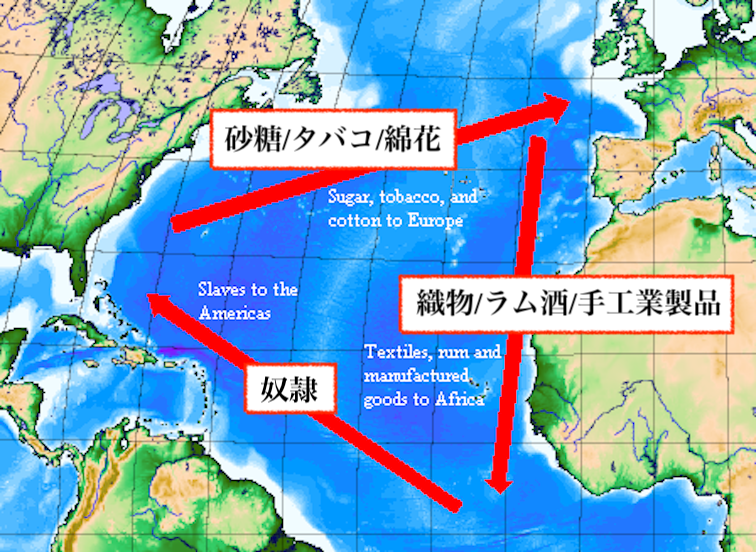 The classical model of the triangular trade./三角貿易の古典的モデル。 |
参考文献 ポール・ギルロイ(訳:シャルロット・ノードマン)、『ブラック・アトランティック:近代性と二重の意識』、エディション・アムステルダム、「ブラック・ アトランティック」叢書、2010年(ISBN 978-2-35480-033-8、オンライン紹介 [アーカイブ]) 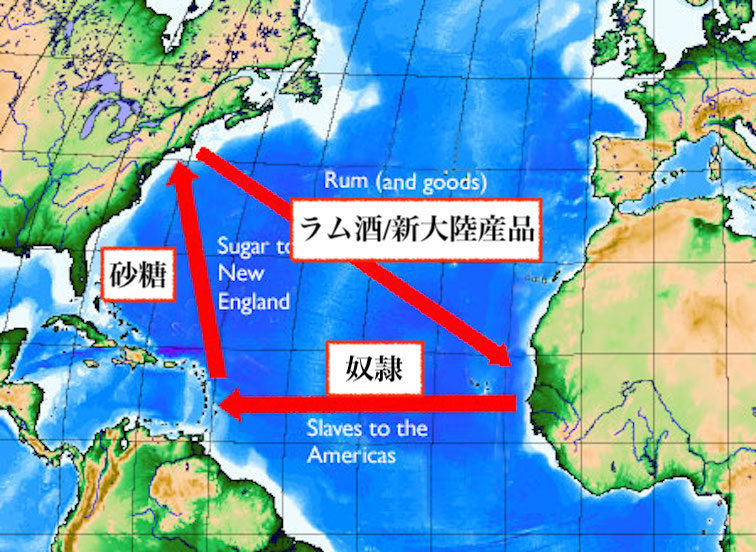 The triangular trade of slaves, sugar, and rum, with New England instead of Europe as the third corner. 奴隷、砂糖、ラム酒をめぐる三角貿易。その第三の拠点として、ヨーロッパの代わりにニューイングランドが位置していた(三角貿易の第二のパターン) |
| Comptes-rendus, actes et enregistrements de colloques Luna Kondombo, « « L’Atlantique noir » de Paul Gilroy, 30 ans après », Transatlantica. Revue d’études américaines. American Studies Journal, no 1, 30 avril 2024 (ISSN 1765-2766, DOI 10.4000/11x2h, lire en ligne [archive]) Capucine Boidin Carlos Agudelo, Autour de l'« Atlantique noir »: Une polyphonie de perspectives, Éditions de l’IHEAL, 2009 (ISBN 978-2-915310-52-8 et 978-2-915310-93-1) Colloque de 2007 : introduction [archive], présentation [archive], discussion [archive] |
シンポジウムの報告、議事録、および記録 ルナ・コンドンボ、「ポール・ギルロイの『ブラック・アトランティック』、30年を経て」、Transatlantica. Revue d’études américaines. 『American Studies Journal』第1号、2024年4月30日(ISSN 1765-2766、DOI 10.4000/11x2h、オンラインで読む [アーカイブ]) カプシーヌ・ボワダン、カルロス・アグデロ、「『黒い大西洋』をめぐって: 視点のポリフォニー、IHEAL出版、2009年(ISBN 978-2-915310-52-8 および 978-2-915310-93-1) 2007年シンポジウム:序論 [アーカイブ]、発表 [アーカイブ]、討論 [アーカイブ] |
| https://fr.wikipedia.org/wiki/L%27Atlantique_noir |
★ユニオンジャックに黒はない : 人種と国民をめぐる文化政治 / ポール・ギルロイ著 ; 田中東子, 山本敦久, 井上弘貴訳, 月曜社 , 2017
| ユニオンジャックに黒はない : 人種と国民をめぐる文化政治 / ポール・ギルロイ著 ; 田中東子, 山本敦久, 井上弘貴訳, 月曜社 , 2017 |
|
| 人種差別とポピュリズムの結託に抗する闘いと思考—警察による過剰な取り締まりと暴動、レゲエやパンクなどの抵抗的音楽をつうじて戦後英国における人種差別の系譜を批判的に辿りながら、法と秩序、そして愛国心のもとで神話化された国民というヴェールを引き剥がす。 |
|
| 序章 人種は月並みなものである 第1章 「人種」、階級、行為体 第2章 「囁きが起き、戦慄が走る」—「人種」、国民、エスニック絶対主義 第3章 無法な異邦人たち 第4章 反人種差別のふたつの側面 第5章 ディアスポラ、ユートピア、資本主義批判 第6章 結論—都市の社会運動、「人種」、コミュニティ |
1 |
| https://ci.nii.ac.jp/ncid/BB24219706 |
+++++++++++++++++
☆ロバート・ファリス・トンプソン[Robert Faris Thompson](1932-2021)

| Robert Faris Thompson (1932–2021) — The Coiner of the Term “Black Atlantic” | ロバート・ファリス・トンプソン(1932-2021)——ブラック・アトランティックの命名者 |
| Robert Farris Thompson
(December 30, 1932 – November 29, 2021) was an American art historian
and writer who specialized in Africa and the Afro-Atlantic world. He
was a member of the faculty at Yale University from 1965 to his
retirement more than fifty years later and served as the Colonel John
Trumbull Professor of the History of Art.[1] Thompson coined the term
"black Atlantic" in his 1983 book Flash of the Spirit: African and
Afro-American Art and Philosophy – the expanded subject of Paul
Gilroy's book The Black Atlantic.[2] |
ロバート・ファリス・トンプソン(Robert Farris Thompson、1932年12月30日 - 2021年11月29日)は、アフリカとアフロ・アトランティック世界を専門とするアメリカの美術史家、作家である。1965年から50年以上後に引退す るまでイェール大学の教授を務め、美術史のジョン・トランブル大佐講座の教授を務めた[1]。トンプソンは1983年の著書『Flash of the Spirit』で「ブラック・アトランティック」という言葉を生み出し た: これはポール・ギルロイの著書『The Black Atlantic』(邦題『ブラック・アトランティック』)の拡大版である[2]。 |
He lived in the Yoruba region of southwest Nigeria while he conducted his research of Yoruba arts history. He was affiliated with the University of Ibadan and frequented Yoruba village communities. Thompson studied the African arts of the diaspora in the United States, Mexico, Argentina, Brazil, Cuba, Haiti, Puerto Rico, Surinam and several Caribbean islands. |
彼はナイジェリア南西部のヨルバ地方に住み、ヨルバ芸術史の研究を行った。彼はイバダン大学に所属し、ヨルバの村落共同体に頻繁に出入りしていた。アメリ カ、メキシコ、アルゼンチン、ブラジル、キューバ、ハイチ、プエルトリコ、スリナム、カリブ海の島々で、ディアスポラのアフリカ芸術を研究した。 |
| Career at Yale | エール大学でのキャリア |
| In 1955, Thompson received his B.A. from Yale University. After
receiving his bachelor's degree and serving in the 7th Army in
Stuttgart, he continued his studies at Yale, where he received his
Master's degree in 1961 and his Ph.D. in 1965.[3] He was the first Yale
professor and second person in the United States (the first being Roy
Sieber at the University of Iowa in 1956) to receive a professorship in
African Art history.[4] Having served as Master of Timothy Dwight College from 1978 until 2010, he was the longest serving master of a residential college at Yale. Thompson was one of America's most prominent scholars of African art,[5] and presided over exhibitions of African art at the National Gallery of Art in Washington D.C. He was one of the longest-serving alumni of Yale. |
955年、トンプソンはイェール大学で学士号を取得した。学士号取得後、シュトゥットガルトの第7軍に従軍した後、イェール大学で研究を続け、1961
年に修士号、1965年に博士号を取得した[3]。アフリカ美術史の教授職を得た最初のイェール大学教授であり、アメリカでは2人目(1人目は1956年
にアイオワ大学のロイ・シーバー)である[4]。 1978年から2010年までティモシー・ドワイト・カレッジの校長を務め、イェール大学の全寮制カレッジの校長としては最も長く在任した。アメリカで最 も著名なアフリカ美術研究者の一人であり[5]、ワシントンD.C.の国民美術館でアフリカ美術展を主宰した。 |
|
Publications and areas of study Beginning with an article on Afro-Cuban dance and music (published in 1958), Thompson dedicated his life to the study of art history of the Afro-Atlantic world.[3] His first book was Black Gods and Kings, which was a close reading of the art history of the Yoruba people of southwestern Nigeria (population of approximately 40 million).[3] Other published works include African Art in Motion, Flash of the Spirit (1983), Face of the Gods, and Tango: The Art History of Love.[3] Thompson also published an introduction to the diaries of Keith Haring. Some of his works have even been translated into German, Portuguese, French and Flemish.[3] Additionally, Thompson also studied the art of Guillermo Kuitca and José Bedia, and was anthologized 15 times.[3] |
著作と研究分野 1958年に発表されたアフロ・キューバの舞踊と音楽に関する論文を皮切りに、トンプソンはアフロ・アトランティック世界の美術史の研究に生涯を捧げた。 [3] 彼の最初の著書は『Black Gods and Kings』であり、これはナイジェリア南西部のヨルバ族(人口約4000万人)の美術史を詳細に分析したものであった。[3] その他の著作には、『African Art in Motion』、『Flash of the Spirit』(1983年)、『Face of the Gods』、そして『Tango: The Art History of Love』がある。[3] トンプソンはまた、キース・ヘリングの日記への序文も執筆した。彼の著作の一部は、ドイツ語、ポルトガル語、フランス語、フラマン語にも翻訳されている。 [3] さらに、トンプソンはギジェルモ・クイトカやホセ・ベディアの芸術も研究し、15回にわたりアンソロジーに収録された。[3] |
|
Awards The College Art Association presented its inaugural Distinguished Lifetime Achievement Award for Art Writing to Thompson in 2003,[6] and was named CAA's Distinguished Scholar in 2015.[7] In 2007, Thompson was given the "Outstanding Contribution to Dance Research" award, by the Congress on Research in Dance.[1] |
受賞歴 2003年、カレッジ・アート・アソシエーションはトンプソンに第1回アート・ライティング特別生涯功労賞を授与し[6]、2015年にはCAAの特別奨 学生に選出された[7]。2007年、トンプソンはダンス研究会議から「ダンス研究への顕著な貢献」賞を授与された[1]。 |
|
Personal life and death Thompson was born in El Paso, Texas.[8] He spoke French, Italian, Portuguese, and Spanish fluently and could speak Yoruba, Ki-Kongo[9] and German, Flemish, and Kreyol[which?][10] at an intermediate level. He has been to nearly all 47 countries of Africa and is survived by a sister, two children, four grandchildren and a great granddaughter.[9] Thompson died from COVID-19-complicated Parkinson's disease on November 29, 2021, at a nursing home in New Haven, Connecticut. He was 88.[11][12] |
私生活と死 フランス語、イタリア語、ポルトガル語、スペイン語を流暢に話し[8]、ヨルバ語、キ・コンゴ語[9]、ドイツ語、フラマン語、クレヨール語[どの] [10]を中級レベルで話すことができた。彼はアフリカのほぼ47カ国すべてに行ったことがあり、妹、2人の子供、4人の孫、ひ孫がいる[9]。 トンプソンは2021年11月29日、コネチカット州ニューヘイブンの老人ホームでCOVID-19合併パーキンソン病により死去した。88歳だった [11][12]。 |
| Bibliography 1971 Black Gods and Kings: Yoruba Art at UCLA 1974 African Art in Motion: Icon and Act in the Collection of Katharine Coryton White 1981 The Four Moments of the Sun: Kongo Art in Two Worlds 1983 Flash of the Spirit: African and Afro-American Art and Philosophy 1993 Face of the Gods: Art and Altars of Africa and the African Americas 1999 The Art of William Edmondon 2005 Tango: The Art History of Love 2011 Aesthetic of the Cool: Afro-Atlantic Art and Music |
書誌 1971年 黒い神々と王たち UCLAのヨルバ美術 1974年 動くアフリカ美術: キャサリン・コリントン・ホワイトのコレクションにおけるアイコンと行為 1981年 太陽の4つの瞬間: 二つの世界におけるコンゴ美術 1983 精神の閃光 アフリカとアフロ・アメリカンの芸術と哲学 1993年 神々の顔:アフリカとアフリカ系アメリカ人の芸術と祭壇 1999年 ウィリアム・エドモンドンの芸術 2005 タンゴ 愛の美術史 2011年 クールの美学 アフリカ系アメリカ人の芸術と音楽 |
| References 01. "Robert Thompson". Yale University, The Ethnicity, Race, and Migration Program. Archived from the original on August 28, 2016. Retrieved July 3, 2016. Valkeakari, Tuire (2009). "Between Camps: Paul Gilroy and the Dilemma of "Race"". In Nyman, Jopi (ed.). Post-National Enquiries: Essays on Ethnic and Racial Border Crossings. Cambridge Scholars Publishing. ISBN 9781443815611. "Yale University :: Department of the History of Art". arthistory.yale.edu. Archived from the original on October 20, 2015. Retrieved October 15, 2015. Cotter, Holland (December 12, 2021). "Robert Farris Thompson, 'Guerrilla Scholar' of African Art, Dies at 88". The New York Times. ISSN 0362-4331. Retrieved February 7, 2023. 05. "Aesthetic of the Cool: Dr. Robert Farris Thompson in conversation with Dr. Lowery Stokes Sims". The Studio Museum in Harlem. October 31, 2011. Retrieved August 20, 2020. "Distinguished Lifetime Achievement Award for Art Writing" (PDF). CAA News. March 2003. "Annual Conference | Programs | CAA". www.collegeart.org. Retrieved August 20, 2020. Robert Farris Thompson, Flash of the Spirit: African & Afro-American Art & Philosophy (Random House, 1984: ISBN 0-394-72369-4), p. 398. Shufro, Cathy (July–August 2010). "Professor of mambo". Yale Alumni Magazine. pp. 2 and 5. 10. Iseman, Fred (November 22, 1984). "Robert Farris Thompson: Canons of the Cool". Rolling Stone. Cotter, Holland (December 12, 2021). "Robert Farris Thompson, 'Guerrilla Scholar' of African Art, Dies at 88". The New York Times. Retrieved December 12, 2021. 12. "Robert F. Thompson Obituary (2021) New Haven Register". Legacy.com. Retrieved November 30, 2021. |
参考文献 01. 「ロバート・トンプソン」。イェール大学、民族・人種・移住プログラム。2016年8月28日にオリジナルからアーカイブされた。2016年7月3日に閲覧。 ヴァルケアカリ、トゥイレ(2009)。「キャンプの間:ポール・ギルロイと『人種』のジレンマ」。ナイマン、ジョピ(編)『ポスト・ナショナル・エン クワイアリーズ:民族と人種の境界を越えるエッセイ』ケンブリッジ・スカラーズ・パブリッシング。ISBN 9781443815611。 「イェール大学 :: 美術史学科」。arthistory.yale.edu。2015年10月20日にオリジナルからアーカイブされた。2015年10月15日に閲覧。 コッター、ホランド(2021年12月12日)。「アフリカ美術の『ゲリラ・スカラー』、ロバート・ファリス・トンプソン氏、88歳で死去」。『ニューヨーク・タイムズ』。ISSN 0362-4331。2023年2月7日に閲覧。 05. 「クールな美学:ロバート・ファリス・トンプソン博士とロウリー・ストークス・シムズ博士の対談」。ハーレム・スタジオ・ミュージアム。2011年10月31日。2020年8月20日閲覧。 「美術評論における卓越した生涯功労賞」(PDF)。CAAニュース。2003年3月。 「年次大会 | プログラム | CAA」。www.collegeart.org。2020年8月20日閲覧。 ロバート・ファリス・トンプソン、『精神の閃光:アフリカおよびアフリカ系アメリカ人の芸術と哲学』(ランダムハウス、1984年:ISBN 0-394-72369-4)、398ページ。 シュフロ、キャシー(2010年7月–8月)。「マンボの教授」。『イェール・アルムナイ・マガジン』。pp. 2および5。 10. アイズマン、フレッド(1984年11月22日)。「ロバート・ファリス・トンプソン:クールな規範」。『ローリング・ストーン』。 コッター、ホランド(2021年12月12日)。「アフリカ美術の『ゲリラ学者』ロバート・ファリス・トンプソン、88歳で死去」。『ニューヨーク・タイムズ』。2021年12月12日閲覧。 12. 「ロバート・F・トンプソン追悼記事(2021年)ニューヘイブン・レジスター」。Legacy.com。2021年11月30日閲覧。 |
| Further reading Cosentino, Donald J., and Robert Farris Thompson. “Interview with Robert Farris Thompson.” African Arts, vol. 25, no. 4, 1992, pp. 53–63. Accessed 7 Jun. 2022. Copy |
追加文献(さらに読む) コセンティーノ、ドナルド・J.、およびロバート・ファリス・トンプソン。「ロバート・ファリス・トンプソンへのインタビュー」。『African Arts』、第25巻第4号、1992年、53–63頁。2022年6月7日閲覧。コピー |
| https://en.wikipedia.org/wiki/Robert_Farris_Thompson |
|
 After many years of thinking I had mistakenly thrown this out, I found my Keith Haring today! Haring came to a class being taught by Robert Ferris Thompson, 1932-2021 (Master T) in 1986, and he came with a sharpie. If you gave him a sheet of paper he would give you a little drawing. I handed him the xerox map that we were given in class (showing the path of African culture through the Americas), and he added the figures to make the map dance. Time to get it framed! By @blakeatphillips |
「長年、間違って捨ててしまったと思っていたが、今日、ついにキース・ヘリングの作品を見つけた! 1986年、キース・ヘリングはロバート・フェリス・トンプソン[Robert Ferris Thompson](マスターT)[このページの上掲]の授業に出席し、マジックペンを持ってやって来た。彼に紙を渡すと、小さな 絵を描いてくれた。私は彼に、授業で渡されたコピーの地図(アメリカ大陸におけるアフリカ文化の伝播経路を示す)を手渡した。すると、彼はその地図に踊っ ているような人物を描き加えた。額縁に入れて飾る時が来た!」 By @blakeatphillips |
☆
リ ンク
文 献
そ の他の情報
Copyleft, CC, Mitzub'ixi Quq Chi'j, 1996-2099

☆
 ☆
☆
