Death

死
Death
解説:池田光穂
「死は、特定の個人にたいする類の冷厳な 勝利であり、個人と類との統一に矛盾するように見える。しかし、特定の個人は特定の類的存在にすぎない のであって、特定の存在であるからには死をまぬがれえない」——マルクス(1844)翻訳は(長谷川訳 2010:151)。
「社会的な人間にとって初めて、その自然 な生活が人間的な生活となり、自然が人間化される。だとすれば、社会とは、人間と自然とをその本質 において統一するものであり、自然の真の復権(復活)であり。人間の自然主義の達成であり、自然の人間主義の達成である」——カール・マルクス (1844)
| Death is the end of life;
the irreversible cessation of all biological functions that sustain a
living organism.[2] Death eventually and inevitably occurs in all
organisms. The remains of a former organism normally begin to decompose
shortly after death.[3] Some organisms, such as Turritopsis dohrnii,
are biologically immortal; however, they can still die from means other
than aging.[4] Death is generally applied to whole organisms; the
equivalent for individual components of an organism, such as cells or
tissues, is necrosis.[5] Something that is not considered an organism,
such as a virus, can be physically destroyed but is not said to die, as
a virus is not considered alive in the first place.[6] As of the early 21st century, 56 million people die per year. The most common reason is aging,[7] followed by cardiovascular disease, which is a disease that affects the heart or blood vessels.[8] As of 2022, an estimated total of almost 110 billion humans have died, or roughly 94% of all humans to have ever lived.[9] A substudy of gerontology known as biogerontology seeks to eliminate death by natural aging in humans, often through the application of natural processes found in certain organisms.[10] However, as humans do not have the means to apply this to themselves, they have to use other ways to reach the maximum lifespan for a human, often through lifestyle changes, such as calorie reduction, dieting, and exercise.[11] The idea of lifespan extension is considered and studied as a way for people to live longer. Determining when a person has definitively died has proven difficult. Initially, death was defined as occurring when breathing and the heartbeat ceased, a status still known as clinical death.[12] However, the development of cardiopulmonary resuscitation (CPR) meant that such a state was no longer strictly irreversible.[13] Brain death was then considered a more fitting option, but several definitions exist for this. Some people believe that all brain functions must cease. Others believe that even if the brainstem is still alive, the personality and identity are irretrievably lost, so therefore, the person should be considered entirely dead.[14] Brain death is sometimes used as a legal definition of death.[15] For all organisms with a brain, death can instead be focused on this organ.[16][17] The cause of death is usually considered important, and an autopsy can be done to determine it. There are many causes, from accidents to diseases. Many cultures and religions have a concept of an afterlife. There are also different customs for honoring the body, such as a funeral, cremation, or sky burial.[18] After a death, an obituary may be posted in a newspaper, and the "survived by" kin and friends usually go through the grieving process. |
死とは生命の終わりであり、生物を維持するすべての生物学的機能の不可
逆的な停止である。[2] 死は最終的に、そして必然的にすべての生物に起こる。死後まもなく、かつての生物の遺体は通常、腐敗し始める。[3]
ネムリユスリカ(Turritopsis dohrnii)などの生物は生物学的に不滅であるが、老化以外の原因で死ぬこともある。 [4]
死は一般的に生物全体に適用される。生物の個々の構成要素、例えば細胞や組織に相当するものは壊死である。[5]
ウイルスのように生物とはみなされないものは物理的に破壊されることはあっても、死ぬとは言わない。なぜなら、ウイルスはそもそも生物とはみなされないか
らである。[6] 21世紀初頭の時点で、年間5600万人が死亡している。最も一般的な理由は老化であり[7]、次いで心臓や血管に影響を及ぼす心血管疾患である[8]。 2022年時点で、推定総計1100億人、つまりこれまでに生存した全人類の約94%が死亡している。 [9] 生物学的加齢学として知られる老年学のサブスタディでは、特定の生物に見られる自然なプロセスを応用することで、人間の自然な老化による死をなくそうとし ている。 [10] しかし、人間にはこれを自分自身に適用する手段がないため、カロリー制限、ダイエット、運動などのライフスタイルの変更を通じて、人間としての最大寿命に 達する他の方法を用いる必要がある。[11] 寿命延長という考え方は、人々がより長く生きるための方法として検討され、研究されている。 人が確実に死亡した時点を決定することは困難である。当初、呼吸と心拍が停止した時点が死と定義されていたが、これは現在でも臨床死として知られている。 [12] しかし、心肺蘇生法(CPR)が開発されたことで、そのような状態はもはや厳密には不可逆的ではないことが分かった。[13] その後、脳死がより適切な選択肢と考えられるようになったが、これにはいくつかの定義が存在する。一部の人々は、脳の機能がすべて停止しなければならない と考える。一方、脳幹が生き残っていても人格や同一性が回復不能に失われるため、その人物は完全に死亡したと見なすべきであるという考え方もある。 [14] 脳死は、法律上の死の定義として用いられることもある。[15] 脳を持つすべての生物では、死は代わりにこの器官に焦点を当てることができる。[16][17] 死因は通常重要視され、それを特定するために解剖が行われる。死因はさまざまで、事故から病気まで多岐にわたる。 多くの文化や宗教には死後の世界についての概念がある。また、葬儀、火葬、風葬など、遺体を尊重するための異なる風習もある。[18] 死後、死亡記事が新聞に掲載されることがあり、遺族や友人など「遺された人々」は通常、悲嘆のプロセスを経る。 |
 |
The human skull is used
universally as a symbol of death. Hendrick Andriessen - Vanity Piece - 1914-DE - Museum of Fine Arts Ghent (MSK) |
Diagnosis World Health Organization estimated number of deaths per million persons in 2012 1.054–4.598 4.599–5.516 5.517–6.289 6.290–6.835 6.836–7.916 7.917–8.728 8.729–9.404 9.405–10.433 10.434–12.233 12.234–17.141 Definition Main article: Medical definition of death There are many scientific approaches and various interpretations of the concept. Additionally, the advent of life-sustaining therapy and the numerous criteria for defining death from both a medical and legal standpoint have made it difficult to create a single unifying definition.[19] Defining life to define death One of the challenges in defining death is in distinguishing it from life. As a point in time, death seems to refer to the moment when life ends. Determining when death has occurred is difficult, as cessation of life functions is often not simultaneous across organ systems.[20] Such determination, therefore, requires drawing precise conceptual boundaries between life and death. This is difficult due to there being little consensus on how to define life. 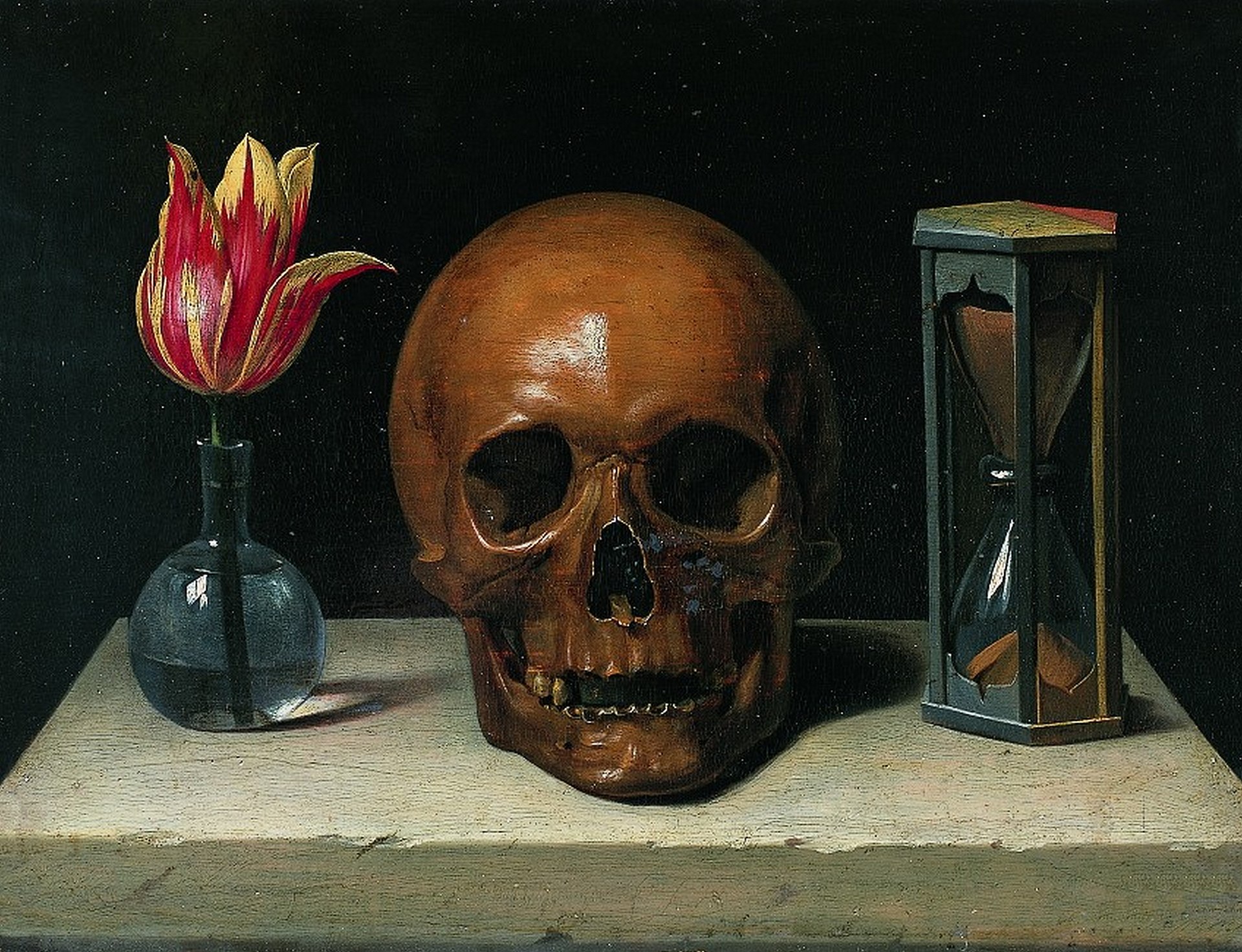 Symbols of death in a painting: it shows a flower, a skull and an hourglass A flower, a skull, and an hourglass stand for life, death, and time in this 17th-century painting by Philippe de Champaigne.[citation needed] It is possible to define life in terms of consciousness. When consciousness ceases, an organism can be said to have died. One of the flaws in this approach is that there are many organisms that are alive but probably not conscious.[21] Another problem is in defining consciousness, which has many different definitions given by modern scientists, psychologists and philosophers.[22] Additionally, many religious traditions, including Abrahamic and Dharmic traditions, hold that death does not (or may not) entail the end of consciousness. In certain cultures, death is more of a process than a single event. It implies a slow shift from one spiritual state to another.[23] Other definitions for death focus on the character of cessation of organismic functioning and human death, which refers to irreversible loss of personhood. More specifically, death occurs when a living entity experiences irreversible cessation of all functioning.[24] As it pertains to human life, death is an irreversible process where someone loses their existence as a person.[24] |
診断 世界保健機関による2012年の100万人当たりの推定死亡者数 1.054~4.598 4.599~5.516 5.517~6.289 6.290~6.835 6.836~7.916 7.917~8.728 8.729–9.404 9.405–10.433 10.434–12.233 12.234–17.141 定義 詳細は「医学的な死の定義」を参照 この概念には多くの科学的アプローチとさまざまな解釈がある。さらに、生命維持療法の出現や、医学的および法的観点からの死の定義に関する多数の基準によ り、統一された定義を定めることが困難になっている。 死を定義するために生を定義する 死を定義する上での課題のひとつは、生との区別である。死とは、ある時点において、生が終焉を迎える瞬間を指すように思われる。しかし、生命機能の停止は 器官系全体で同時に起こるとは限らないため、死がいつ訪れたかを決定することは難しい。[20] したがって、このような決定には、生と死の間に明確な概念上の境界線を引くことが必要となる。しかし、生を定義する方法についてほとんどコンセンサスが得 られていないため、これは難しい。 絵画における死の象徴:花、頭蓋骨、砂時計 フィリップ・ド・シャンパーニュによる17世紀の絵画では、花、頭蓋骨、砂時計が生命、死、時間を象徴している。 生命を意識という観点から定義することは可能である。意識が停止した時点で、生物は死んだと言える。このアプローチにおける欠点のひとつは、生きているが 意識はないであろう生物が数多く存在することである。[21] もうひとつの問題は、意識の定義である。現代の科学者、心理学者、哲学者によって、意識には多くの異なる定義が存在する。[22] さらに、アブラハムの宗教やダルマの宗教を含む多くの宗教的伝統では、死は意識の終わりを意味しない(または意味しないかもしれない)とされている。特定 の文化では、死は単一の出来事というよりも、むしろプロセスである。それは、ある精神状態から別の精神状態への緩やかな変化を意味する。[23] 死の他の定義では、生物学的機能の停止と人間としての死に焦点を当て、人格の不可逆的な喪失を指す。より具体的には、生物がすべての機能を不可逆的に停止 したときに死が訪れる。[24]人間の生命に関わる場合、死は不可逆的なプロセスであり、その人物の人格が失われることを意味する。[24] |
| Definition of death by heartbeat
and breath Historically, attempts to define the exact moment of a human's death have been subjective or imprecise. Death was defined as the cessation of heartbeat (cardiac arrest) and breathing,[12] but the development of CPR and prompt defibrillation have rendered that definition inadequate because breathing and heartbeat can sometimes be restarted.[13] This type of death where circulatory and respiratory arrest happens is known as the circulatory definition of death (CDD). Proponents of the CDD believe this definition is reasonable because a person with permanent loss of circulatory and respiratory function should be considered dead.[25] Critics of this definition state that while cessation of these functions may be permanent, it does not mean the situation is irreversible because if CPR is applied fast enough, the person could be revived.[25] Thus, the arguments for and against the CDD boil down to defining the actual words "permanent" and "irreversible," which further complicates the challenge of defining death. Furthermore, events causally linked to death in the past no longer kill in all circumstances; without a functioning heart or lungs, life can sometimes be sustained with a combination of life support devices, organ transplants, and artificial pacemakers. |
心拍と呼吸による死の定義 歴史的に、人間の死の正確な瞬間を定義しようとする試みは主観的または不正確であった。死は心停止(心臓の停止)と呼吸停止と定義されていたが[12]、 心肺蘇生法(CPR)と迅速な除細動器の開発により、呼吸と心拍が再開されることがあるため、この定義は不適切となった。[13] 循環と呼吸の停止が起こるこの種の死は、循環死の定義(CDD)として知られている。CDDの支持者たちは、循環および呼吸機能が恒久的に失われた人格は 死んでいると見なすべきであるため、この定義は妥当であると考えている。[25] この定義の批判者たちは、これらの機能停止が恒久的なものであっても、CPRが迅速に実施されれば人格は蘇生しうるため、その状況が不可逆的であることを 意味するわけではないと主張している。 [25] したがって、CDDに対する賛成意見と反対意見は、実際の言葉である「永続的」と「不可逆的」の定義に帰着する。これは、死の定義という課題をさらに複雑 にする。さらに、過去に死と因果関係のある出来事は、もはやあらゆる状況で死をもたらすわけではない。心臓や肺が機能していなくても、生命維持装置、臓器 移植、人工ペースメーカーを組み合わせることで、生命が維持されることもある。 |
| Brain death Main article: Brain death Today, where a definition of the moment of death is required, doctors and coroners usually turn to "brain death" or "biological death" to define a person as being dead;[26] people are considered dead when the electrical activity in their brain ceases.[27] It is presumed that an end of electrical activity indicates the end of consciousness.[28] Suspension of consciousness must be permanent and not transient, as occurs during certain sleep stages, and especially a coma.[29] In the case of sleep, electroencephalograms (EEGs) are used to tell the difference.[30] The category of "brain death" is seen as problematic by some scholars. For instance, Dr. Franklin Miller, a senior faculty member at the Department of Bioethics, National Institutes of Health, notes: "By the late 1990s... the equation of brain death with death of the human being was increasingly challenged by scholars, based on evidence regarding the array of biological functioning displayed by patients correctly diagnosed as having this condition who were maintained on mechanical ventilation for substantial periods of time. These patients maintained the ability to sustain circulation and respiration, control temperature, excrete wastes, heal wounds, fight infections and, most dramatically, to gestate fetuses (in the case of pregnant "brain-dead" women)."[31]  Ivory pendant of a Monk's face. The left half of the pendant appears skeletal, while the right half appears living French 16th-/17th-century ivory pendant, Monk and Death, recalling mortality and the certainty of death (Walters Art Museum)[citation needed] While "brain death" is viewed as problematic by some scholars, there are proponents of it[who?] that believe this definition of death is the most reasonable for distinguishing life from death. The reasoning behind the support for this definition is that brain death has a set of criteria that is reliable and reproducible. Also, the brain is crucial in determining our identity or who we are as human beings. The distinction should be made that "brain death" cannot be equated with one in a vegetative state or coma, in that the former situation describes a state that is beyond recovery.[32] EEGs can detect spurious electrical impulses, while certain drugs, hypoglycemia, hypoxia, or hypothermia can suppress or even stop brain activity temporarily;[33] because of this, hospitals have protocols for determining brain death involving EEGs at widely separated intervals under defined conditions.[34] |
脳死 詳細は「脳死」を参照 今日、死の瞬間を定義する必要がある場合、医師や監察医は通常、その人格が死んでいると定義するために「脳死」または「生物学的死」に頼る。[26] 人格は、脳の電気的活動が停止した時点で死亡したとみなされる。 [27] 電気的活動の停止は、意識の消失を意味すると考えられている。[28] 意識の停止は、一時的なものではなく、恒久的なものでなければならない。これは、特定の睡眠段階、特に昏睡状態において起こる。[29] 睡眠の場合、脳波(EEG)を用いて、その違いを判断する。[30] 「脳死」というカテゴリーは、一部の学者から問題視されている。例えば、米国立保健研究所(NIH)生命倫理部の上級研究員であるフランクリン・ミラー博 士は次のように指摘している。「1990年代後半には、この状態と正確に診断された患者が長期間にわたって人工呼吸器で維持されている間に示した、さまざ まな生物学的機能に関する証拠に基づいて、脳死を人間の死と同一視することに学者の間でますます疑問が呈されるようになった。これらの患者は、循環と呼吸 を維持し、体温を調節し、老廃物を排泄し、傷を癒し、感染と戦い、そして最も劇的なことには、胎児を妊娠(妊娠中の「脳死」女性の場合)する能力を維持し ていた。」[31] 僧侶の顔の象牙のペンダント。左半分は骸骨のように見え、右半分は生きているように見える 16世紀から17世紀のフランス象牙製ペンダント、修道士と死、死の不確実性と死の確実性を想起させる(ウォルター美術館所蔵)[要出典] 一部の学者は「脳死」を問題視しているが、この死の定義が生命と死を区別する上で最も合理的であると考える支持者もいる[誰?]。この定義を支持する理由 として、脳死には信頼性と再現性のある一連の基準があることが挙げられる。また、脳は人間のアイデンティティや人間としての存在を決定する上で極めて重要 である。「脳死」は植物状態や昏睡状態と同一視されるべきではない。なぜなら、前者は回復の見込みのない状態を指すからである。 脳波は偽陽性の電気インパルスを検出することがあるが、特定の薬物、低血糖、低酸素症、低体温症は一時的に脳活動を抑制したり停止することさえある。 [33] このため、病院では、定義された条件下で、脳波を測定する間隔を大きく空けて脳死を判定する手順が定められている。[34] |
| Neocortical brain death One view is that the neocortex of the brain is necessary for consciousness, and that therefore only electrical activity of the neocortex should be considered when defining death. Eventually, the criterion for death may be the permanent and irreversible loss of cognitive function, as evidenced by the death of the cerebral cortex. All hope of recovering human thought and personality is then gone, given current and foreseeable medical technology.[14] Even by whole-brain criteria, the determination of brain death can be complicated. |
新皮質脳死 一つの見解によると、意識には脳の新皮質が必要であり、したがって死を定義する際には新皮質の電気的活動のみを考慮すべきである。最終的には、大脳皮質の 死によって証明されるように、認知機能の永続的かつ不可逆的な喪失が死の基準となる可能性がある。現在の医療技術および予測可能な医療技術を考慮すると、 人間の思考や人格が回復する可能性は完全に失われることになる。[14] 脳死の判定は、全脳基準によっても複雑になる可能性がある。 |
| Total brain death At present, in most places, the more conservative definition of death (irreversible cessation of electrical activity in the whole brain, as opposed to just in the neo-cortex) has been adopted. One example is the Uniform Determination Of Death Act in the United States.[35] In the past, the adoption of this whole-brain definition was a conclusion of the President's Commission for the Study of Ethical Problems in Medicine and Biomedical and Behavioral Research in 1980.[36] They concluded that this approach to defining death sufficed in reaching a uniform definition nationwide. A multitude of reasons was presented to support this definition, including uniformity of standards in law for establishing death, consumption of a family's fiscal resources for artificial life support, and legal establishment for equating brain death with death to proceed with organ donation.[37] |
完全な脳死 現在、ほとんどの場所では、より保守的な死の定義(大脳新皮質のみではなく、脳全体の電気的活動の不可逆的な停止)が採用されている。その一例が、米国の 「Uniform Determination of Death Act(死の判定に関する統一法)」である。[35] 過去においては、1980年に大統領の医学および生物医学・行動研究における倫理的問題に関する委員会が、この全脳死の定義を採用する結論を下している。 [36] 委員会は、死の定義に関するこのアプローチは、全国的に統一された定義を導くのに十分であると結論づけた。この定義を支持する理由として、死亡を認定する 法律上の基準の統一、人工生命維持のための家族の財源の消費、脳死を死と見なし臓器提供を進めるための法的確立など、マルチチュードの理由が提示された。 [37] |
| Problems in medical practice Aside from the issue of support of or dispute against brain death, there is another inherent problem in this categorical definition: the variability of its application in medical practice. In 1995, the American Academy of Neurology (AAN) established the criteria that became the medical standard for diagnosing neurologic death. At that time, three clinical features had to be satisfied to determine "irreversible cessation" of the total brain, including coma with clear etiology, cessation of breathing, and lack of brainstem reflexes.[38] These criteria were updated again, most recently in 2010, but substantial discrepancies remain across hospitals and medical specialties.[38] Donations The problem of defining death is especially imperative as it pertains to the dead donor rule, which could be understood as one of the following interpretations of the rule: there must be an official declaration of death in a person before starting organ procurement, or that organ procurement cannot result in the death of the donor.[25] A great deal of controversy has surrounded the definition of death and the dead donor rule. Advocates of the rule believe that the rule is legitimate in protecting organ donors while also countering any moral or legal objection to organ procurement. Critics, on the other hand, believe that the rule does not uphold the best interests of the donors and that the rule does not effectively promote organ donation.[25] |
医療現場における問題 脳死の支持または反対という問題とは別に、このカテゴリー定義にはもう一つの本質的な問題がある。医療現場におけるその適用におけるばらつきである。 1995年、米国神経学会(AAN)は神経学的死を診断するための医学的基準となる基準を策定した。当時、脳全体の「不可逆的な停止」を決定するには、原 因が明らかな昏睡状態、呼吸停止、脳幹反射の欠如という3つの臨床的特徴を満たす必要があった。[38] これらの基準は2010年に最近更新されたが、病院や医療専門分野によって依然として大きな相違がある。[38] 臓器提供 死の定義の問題は、死体提供者ルールに関連して特に重要である。このルールは、臓器摘出を開始する前に、その人格が公式に死亡と宣言されなければならな い、または臓器摘出によってドナーが死亡してはならない、という解釈のひとつとして理解される可能性がある。[25] 死の定義と死体提供者ルールについては、多くの論争が巻き起こっている。この規定の支持者たちは、この規定は臓器提供者の保護を正当化するものであり、臓 器提供に対する道徳的または法的反対意見に対抗するものであると信じている。一方、この規定の批判者たちは、この規定は臓器提供者の最善の利益を保護する ものではなく、また、この規定は臓器提供を効果的に促進するものではないと考えている。[25] |
| Signs Main article: Stages of death Signs of death or strong indications that a warm-blooded animal is no longer alive are:[39] Respiratory arrest (no breathing) Cardiac arrest (no pulse) Brain death (no neuronal activity) The stages that follow after death are:[40] Pallor mortis, paleness which happens in 15–120 minutes after death Algor mortis, the reduction in body temperature following death. This is generally a steady decline until matching ambient temperature Rigor mortis, the limbs of the corpse become stiff (Latin rigor) and difficult to move or manipulate Livor mortis, a settling of the blood in the lower (dependent) portion of the body Putrefaction, the beginning signs of decomposition Decomposition, the reduction into simpler forms of matter, accompanied by a strong, unpleasant odor. Skeletonization, the end of decomposition, where all soft tissues have decomposed, leaving only the skeleton. Fossilization, the natural preservation of the skeletal remains formed over a very long period  Timeline of postmortem changes (stages of death) |
兆候 詳細は「死の段階」を参照 温血動物が死んでいることを示す兆候や強い示唆は以下の通りである:[39] 呼吸停止(呼吸なし) 心停止(脈拍なし) 脳死(神経細胞の活動なし) 死後に続く段階は以下の通りである:[40] 死斑、死後15~120分後に起こる蒼白 死後硬直、死後に体温が低下すること。これは一般的に周囲の温度に一致するまで、一定に低下する 死後硬直、死体の四肢が硬直し(ラテン語の「硬直」)、動かしたり操作したりすることが困難になる 死斑、血液が体の下側(依存側)に沈殿すること 腐敗、分解の初期兆候 分解、不快な強い臭いを伴う、物質がより単純な形態に還元されること スケルトン化:分解の最終段階であり、すべての軟組織が分解され、骨格のみが残る。 化石化:非常に長い期間をかけて形成された骨格の自然保存 死後の変化のタイムライン(死の段階) |
| Legal See also: Legal death The death of a person has legal consequences that may vary between jurisdictions. Most countries follow the whole-brain death criteria, where all functions of the brain must have completely ceased. However, in other jurisdictions, some follow the brainstem version of brain death.[38] Afterward, a death certificate is issued in most jurisdictions, either by a doctor or by an administrative office, upon presentation of a doctor's declaration of death.[41] |
法的 関連項目:法的死亡 人格の死は、法的な影響を及ぼすが、その影響は管轄区域によって異なる。ほとんどの国では、脳のすべての機能が完全に停止した状態である全脳死の基準に 従っている。しかし、他の管轄区域では、脳幹死の基準に従うところもある。[38]その後、ほとんどの管轄区域では、医師または行政機関が医師による死亡 宣言を提示した上で死亡証明書を発行する。[41] |
| Misdiagnosis See also: Premature burial  The Premature Burial by Antoine Wiertz, 1854 There are many anecdotal references to people being declared dead by physicians and then "coming back to life," sometimes days later in their coffin or when embalming procedures are about to begin. From the mid-18th century onwards, there was an upsurge in the public's fear of being mistakenly buried alive[42] and much debate about the uncertainty of the signs of death. Various suggestions were made to test for signs of life before burial, ranging from pouring vinegar and pepper into the corpse's mouth to applying red hot pokers to the feet or into the rectum.[43] Writing in 1895, the physician J.C. Ouseley claimed that as many as 2,700 people were buried prematurely each year in England and Wales, although some estimates peg the figure to be closer to 800.[44] In cases of electric shock, cardiopulmonary resuscitation (CPR) for an hour or longer can allow stunned nerves to recover, allowing an apparently dead person to survive. People found unconscious under icy water may survive if their faces are kept continuously cold until they arrive at an emergency room.[45] This "diving response," in which metabolic activity and oxygen requirements are minimal, is something humans share with cetaceans called the mammalian diving reflex.[45] As medical technologies advance, ideas about when death occurs may have to be reevaluated in light of the ability to restore a person to vitality after longer periods of apparent death (as happened when CPR and defibrillation showed that cessation of heartbeat is inadequate as a decisive indicator of death). The lack of electrical brain activity may not be enough to consider someone scientifically dead. Therefore, the concept of information-theoretic death has been suggested as a better means of defining when true death occurs, though the concept has few practical applications outside the field of cryonics.[46] |
誤診 参照:早すぎる埋葬 アントワーヌ・ヴィエルツ作『早すぎる埋葬』(1854年) 医師によって死亡が宣言された後、「生き返る」という逸話は数多くあり、時には数日後に棺の中で、あるいは防腐処理が始まろうとしている時にそうなること もあった。18世紀半ば以降、誤って生き埋めにされることへの恐怖が一般市民の間で高まり[42]、死の兆候の不確実性について多くの議論が交わされた。 死体に酢やコショウを口に流し込むものから、赤熱した火かき棒を足や直腸に差し込むものまで、さまざまな埋葬前の生命徴候を調べる方法が提案された。イン グランドとウェールズでは毎年2,700人もの人々が早まって埋葬されていると主張したが、その数字は800人という推定値に近いという意見もある。 感電死の場合、心肺蘇生法(CPR)を1時間以上行うことで、麻痺した神経が回復し、一見死んだように見えた人が生き返る可能性がある。氷水の中で意識不 明になっている人が発見された場合、救急外来に到着するまで顔を冷やし続けることで、生存できる可能性がある。[45] この「潜水反応」では、代謝活動と酸素要求量が最小限に抑えられるが、これは人間と鯨類が共有する哺乳類の潜水反射である。[45] 医療技術の進歩に伴い、心肺停止状態が長く続いた後でも人格を回復させることができるという事実(心肺蘇生法や除細動により、心停止が死の決定的な指標と して不十分であることが明らかになった)を踏まえ、死がいつ訪れるかという考え方は再評価される必要があるかもしれない。脳の電気的活動の欠如だけでは、 科学的に死んだと見なすには不十分である。そのため、情報理論的死亡という概念が、本当の死がいつ訪れるかを定義するより良い手段として提案されている が、この概念は、クライオニクス以外の分野ではほとんど実用的な用途がない。[46] |
| Causes See also: List of causes of death by rate and Preventable causes of death The leading cause of human death in developing countries is infectious disease. The leading causes in developed countries are atherosclerosis (heart disease and stroke), cancer, and other diseases related to obesity and aging. By an extremely wide margin, the largest unifying cause of death in the developed world is biological aging,[47] leading to various complications known as aging-associated diseases. These conditions cause loss of homeostasis, leading to cardiac arrest, causing loss of oxygen and nutrient supply, causing irreversible deterioration of the brain and other tissues. Of the roughly 150,000 people who die each day across the globe, about two thirds die of age-related causes.[47] In industrialized nations, the proportion is much higher, approaching 90%.[47] With improved medical capability, dying has become a condition to be managed. In developing nations, inferior sanitary conditions and lack of access to modern medical technology make death from infectious diseases more common than in developed countries. One such disease is tuberculosis, a bacterial disease that killed 1.8 million people in 2015.[48] In 2004, malaria caused about 2.7 million deaths annually.[49] The AIDS death toll in Africa may reach 90–100 million by 2025.[50][51] According to Jean Ziegler, the United Nations Special Reporter on the Right to Food, 2000 – Mar 2008, mortality due to malnutrition accounted for 58% of the total mortality rate in 2006. Ziegler says worldwide, approximately 62 million people died from all causes and of those deaths, more than 36 million died of hunger or diseases due to deficiencies in micronutrients.[52]  American children smoking in 1910. Tobacco smoking caused an estimated 100 million deaths in the 20th century.[53] Tobacco smoking killed 100 million people worldwide in the 20th century and could kill 1 billion people worldwide in the 21st century, a World Health Organization report warned.[53] Many leading developed world causes of death can be postponed by diet and physical activity, but the accelerating incidence of disease with age still imposes limits on human longevity. The evolutionary cause of aging is, at best, only beginning to be understood. It has been suggested that direct intervention in the aging process may now be the most effective intervention against major causes of death.[54] Selye proposed a unified non-specific approach to many causes of death. He demonstrated that stress decreases the adaptability of an organism and proposed to describe adaptability as a special resource, adaptation energy. The animal dies when this resource is exhausted.[55] Selye assumed that adaptability is a finite supply presented at birth. Later, Goldstone proposed the concept of production or income of adaptation energy which may be stored (up to a limit) as a capital reserve of adaptation.[56] In recent works, adaptation energy is considered an internal coordinate on the "dominant path" in the model of adaptation. It is demonstrated that oscillations of well-being appear when the reserve of adaptability is almost exhausted.[57] |
原因 参照:死亡率の高い死因の一覧、予防可能な死因 発展途上国における人間の主な死因は感染症である。先進国における主な死因は、動脈硬化(心臓病や脳卒中)、癌、肥満や老化に関連するその他の疾患であ る。先進国における死因の最大の共通要因は、生物学的加齢であり、[47] これは老化関連疾患として知られる様々な合併症を引き起こす。これらの状態は、恒常性の喪失を引き起こし、心停止につながり、酸素や栄養の供給が失われ、 脳やその他の組織の不可逆的な劣化を引き起こす。世界中で毎日およそ15万人が死亡しているが、その約3分の2は加齢が原因で死亡している。[47] 先進国ではその割合はさらに高く、90%に迫る。[47] 医療能力の向上により、死は管理可能な状態となっている。 発展途上国では劣悪な衛生状態や近代的な医療技術へのアクセスの欠如により、先進国よりも感染症による死亡が一般的である。そのような病気の一つに結核が ある。結核は細菌感染症であり、2015年には180万人が死亡した。[48] 2004年には、マラリアが毎年約270万人の死因となっている。[49] アフリカにおけるエイズによる死者数は、2025年までに9,000万人から1億人に達する可能性がある。[50][51] 国連食糧権利問題担当特別報告官のジャン・ジグレールによると、2000年から2008年3月までの栄養不良による死亡率は、2006年には総死亡率の 58%を占めていた。ジグレールは、世界中でおよそ6200万人があらゆる原因で死亡し、そのうち3600万人以上が飢餓または微量栄養素の欠乏による病 気で死亡したと述べている。 1910年のアメリカの喫煙する子供たち。20世紀には、喫煙が原因で1億人の死者が出たと推定されている。 [53] 喫煙は20世紀に世界で1億人の命を奪い、21世紀には10億人の命を奪う可能性があると、世界保健機関(WHO)の報告書は警告している。 先進国における死因の多くは、食事や運動によって先延ばしにすることは可能であるが、加齢に伴う疾病の発生率の加速は、依然として人間の寿命に制限を課し ている。老化の進化論的な原因は、せいぜい理解され始めたばかりである。老化プロセスへの直接的な介入が、今や主要な死因に対する最も効果的な介入である 可能性が示唆されている。 セリエは、多くの死因に対する統一的な非特異的アプローチを提案した。彼は、ストレスが生物の適応能力を低下させることを実証し、適応能力を特別な資源で ある適応エネルギーとして表現することを提案した。この資源が枯渇すると動物は死ぬ。[55] セリエは、適応能力は出生時に有限の供給量として与えられると仮定した。その後、ゴールドストーンは適応エネルギーの生産または収入という概念を提案し、 適応の資本準備金として(限界まで)蓄積できるとした。[56] 最近の研究では、適応エネルギーは適応モデルにおける「支配的な経路」上の内部座標とみなされている。適応能力の準備金がほぼ枯渇すると、幸福度の振動が 現れることが示されている。[57] |
 Le Suicidé by Édouard Manet In 2012, suicide overtook car crashes as the leading cause of human injury deaths in the U.S., followed by poisoning, falls, and murder.[58] Accidents and disasters, from nuclear disasters to structural collapses, also claim lives. One of the deadliest incidents of all time is the 1975 Banqiao Dam Failure, with varying estimates, up to 240,000 dead.[59] Other incidents with high death tolls are the Wanggongchang explosion (when a gunpowder factory ended up with 20,000 deaths),[60] a collapse of a wall of Circus Maximus that killed 13,000 people,[61] and the Chernobyl disaster that killed between 95 and 4,000 people.[62][63] Natural disasters kill around 45,000 people annually, although this number can vary from thousands to millions on a per-decade basis. Some of the deadliest natural disasters are the 1931 China floods, which killed an estimated 4 million people, although estimates widely vary;[64] the 1887 Yellow River flood, which killed an estimated 2 million people in China;[65] and the 1970 Bhola cyclone, which killed as many as 500,000 people in East Pakistan (present-day Bangladesh).[66] If naturally occurring famines are considered natural disasters, the Chinese famine of 1906–1907, which killed 15–20 million people, can be considered the deadliest natural disaster in recorded history. In animals, predation can be a common cause of death. Livestock have a 6% death rate from predation. However, younger animals are more susceptible to predation. For example, 50% of young foxes die to birds, bobcats, coyotes, and other foxes as well. Young bear cubs in the Yellowstone National Park only have a 40% chance to survive to adulthood from other bears and predators.[67] |
エドゥアール・マネの『自殺者』 2012年には、米国では自殺が交通事故による死因を上回り、主な死因のトップとなった。次いで多いのは中毒、転落、殺人である。 原子力発電所の事故から建造物の崩壊まで、事故や災害も命を奪う。歴史上最も死者数の多い事件のひとつは、1975年のバンキアオダム決壊事故であり、推 定死者数は24万人に上る。 [59] その他の多数の死者を出した事件としては、王公場(Wanggongchang)の爆発(火薬工場で2万人が死亡)[60]、サーカス・マキシムスの壁の 崩壊で1万3000人が死亡[61]、95人から4000人の死者を出したチェルノブイリ原発事故[62][63]などがある。 自然災害による死亡者数は毎年およそ45,000人であるが、この数字は10年単位で数千から数百万人と変動する。最も被害の大きかった自然災害として は、1931年の中国大洪水(推定400万人が死亡したが、推定値には大きな幅がある)[64]、1887年の黄河大洪水(中国で推定200万人が死亡) [65]、1970年のボラサイクロン(東パキスタン(現在のバングラデシュ)で50万人が死亡)[66]などがある。 [66] 自然発生する飢饉を自然災害とみなすのであれば、1500万人から2000万人の死者を出した1906年から1907年の中国大飢饉は、記録史上最も致命 的な自然災害とみなすことができる。 動物においては、捕食が死因となることも多い。家畜の捕食による死亡率は6%である。しかし、若い動物は捕食されやすい。例えば、子狐の50%は、鳥やボ ブキャット、コヨーテ、そして他の狐にも捕食されて死ぬ。イエローストーン国立公園の若い熊の子供たちは、他の熊や捕食動物から生き延びて成獣になる確率 はわずか40%である。[67] |
| Autopsy Main article: Autopsy  A painting of an autopsy, by Rembrandt, entitled "The Anatomy Lesson of Dr. Nicolaes Tulp" The Anatomy Lesson of Dr. Nicolaes Tulp by Rembrandt An autopsy, also known as a postmortem examination or an obduction, is a medical procedure that consists of a thorough examination of a human corpse to determine the cause and manner of a person's death and to evaluate any disease or injury that may be present. It is usually performed by a specialized medical doctor called a pathologist.[68] Autopsies are either performed for legal or medical purposes.[68] A forensic autopsy is carried out when the cause of death may be a criminal matter, while a clinical or academic autopsy is performed to find the medical cause of death and is used in cases of unknown or uncertain death, or for research purposes.[69] Autopsies can be further classified into cases where external examination suffices, and those where the body is dissected and an internal examination is conducted.[70] Permission from next of kin may be required for internal autopsy in some cases.[71] Once an internal autopsy is complete the body is generally reconstituted by sewing it back together.[40] A necropsy, which is not always a medical procedure, was a term previously used to describe an unregulated postmortem examination. In modern times, this term is more commonly associated with the corpses of animals.[72] |
解剖 詳細は「解剖」を参照 レンブラントによる解剖の絵画「ニコラス・トルプ博士の解剖学講義」 レンブラントによる「ニコラス・トルプ博士の解剖学講義 死体解剖(死後検査または死前検査とも呼ばれる)は、死因や死の状況を特定し、存在する可能性のある疾患や外傷を評価するために、人間の死体を徹底的に検 査する医療処置である。通常は病理医と呼ばれる専門の医師によって実施される。 検死は、法的または医学的目的のために実施される。[68] 法医学的検死は、死因が犯罪に関わる可能性がある場合に実施され、臨床的または学術的な検死は、死因を医学的に究明するために実施され、死因が不明または 不確かな場合や研究目的で使用される。[69] 検死は、さらに、外観検査で十分な場合と、遺体を解剖して内部検査を行う場合とに分類される。 [70] 場合によっては、近親者の許可が必要となることもある。[71] 内臓の解剖が完了すると、遺体は通常、縫合によって元通りにされる。[40] 病理解剖は、必ずしも医学的な処置ではないが、以前は規制のない死後検査を指す用語として使われていた。現代では、この用語は動物の死体と関連付けられる ことが多い。[72] |
| Death before birth Death before birth can happen in several ways: stillbirth, when the fetus dies before or during the delivery process; miscarriage, when the embryo dies before independent survival; and abortion, the artificial termination of the pregnancy. Stillbirth and miscarriage can happen for various reasons, while abortion is carried out purposely. Stillbirth Main article: Stillbirth Stillbirth can happen right before or after the delivery of a fetus. It can result from defects of the fetus or risk factors present in the mother. Reductions of these factors, caesarean sections when risks are present, and early detection of birth defects have lowered the rate of stillbirth. However, 1% of births in the United States end in a stillbirth.[73] Miscarriage Main article: Miscarriage A miscarriage is defined by the World Health Organization as, "The expulsion or extraction from its mother of an embryo or fetus weighing 500g or less." Miscarriage is one of the most frequent problems in pregnancy, and is reported in around 12–15% of all clinical pregnancies; however, by including pregnancy losses during menstruation, it could be up to 17–22% of all pregnancies. There are many risk-factors involved in miscarriage; consumption of caffeine, tobacco, alcohol, drugs, having a previous miscarriage, and the use of abortion can increase the chances of having a miscarriage.[74] Abortion Main article: Abortion An abortion may be performed for many reasons, such as pregnancy from rape, financial constraints of having a child, teenage pregnancy, and the lack of support from a significant other.[75] There are two forms of abortion: a medical abortion and an in-clinic abortion or sometimes referred to as a surgical abortion. A medical abortion involves taking a pill that will terminate the pregnancy no more than 11 weeks past the last period, and an in-clinic abortion involves a medical procedure using suction to empty the uterus; this is possible after 12 weeks, but it may be more difficult to find an operating doctor who will go through with the procedure.[76] |
死産 死産にはいくつかの原因がある。死産とは、分娩前または分娩中に胎児が死亡すること、流産とは、胚が独立して生存できる前に死亡すること、そして人工妊娠 中絶とは、妊娠を人為的に中断することである。死産と流産はさまざまな理由で起こりうるが、人工妊娠中絶は意図的に行われる。 死産 詳細は「死産」を参照 死産は、胎児が分娩される直前または直後に起こる可能性がある。死産は、胎児の欠陥や母親の危険因子によって引き起こされる可能性がある。これらの要因の 低減、危険因子がある場合の帝王切開、出生異常の早期発見により、死産率は低下している。しかし、米国では出生の1%が死産で終わっている。[73] 流産 詳細は「流産」を参照 流産は世界保健機関(WHO)により「母親から排出または摘出された、500グラム以下の胎児」と定義されている。流産は妊娠中の最も頻繁な問題のひとつ であり、臨床妊娠の12~15%で報告されている。しかし、月経中の妊娠喪失も含めると、全妊娠の17~22%に上る可能性がある。流産には多くの危険因 子が関与している。カフェイン、タバコ、アルコール、薬物の摂取、以前に流産した経験があること、中絶の経験があることは、流産の可能性を高める。 [74] 中絶 詳細は「中絶」を参照 中絶は、レイプによる妊娠、子供を持つことによる経済的負担、ティーンエイジャーの妊娠、パートナーからのサポートの欠如など、さまざまな理由で行われ る。薬による中絶は、最終月経から11週間以内に妊娠を終了させる薬を服用するもので、クリニックでの中絶は、吸引によって子宮を空にする医療処置を伴 う。これは12週以降に可能となるが、処置を行う医師を見つけるのがより困難になる可能性がある。[76] |
| Senescence Main article: Senescence  Dead camel thorn tree within Sossusvlei Senescence refers to a scenario when a living being can survive all calamities but eventually dies due to causes relating to old age. Conversely, premature death can refer to a death that occurs before old age arrives, for example, human death before a person reaches the age of 75.[77] Animal and plant cells normally reproduce and function during the whole period of natural existence, but the aging process derives from the deterioration of cellular activity and the ruination of regular functioning. The aptitude of cells for gradual deterioration and mortality means that cells are naturally sentenced to stable and long-term loss of living capacities, even despite continuing metabolic reactions and viability. In the United Kingdom, for example, nine out of ten of all the deaths that occur daily relates to senescence, while around the world, it accounts for two-thirds of 150,000 deaths that take place daily.[78] Almost all animals who survive external hazards to their biological functioning eventually die from biological aging, known in life sciences as "senescence." Some organisms experience negligible senescence, even exhibiting biological immortality. These include the jellyfish Turritopsis dohrnii,[79] the hydra, and the planarian. Unnatural causes of death include suicide and predation. Of all causes, roughly 150,000 people die around the world each day.[47] Of these, two-thirds die directly or indirectly due to senescence, but in industrialized countries – such as the United States, the United Kingdom, and Germany – the rate approaches 90% (i.e., nearly nine out of ten of all deaths are related to senescence).[47] Physiological death is now seen as a process, more than an event: conditions once considered indicative of death are now reversible.[80] Where in the process, a dividing line is drawn between life and death depends on factors beyond the presence or absence of vital signs. In general, clinical death is neither necessary nor sufficient for a determination of legal death. A patient with working heart and lungs determined to be brain dead can be pronounced legally dead without clinical death occurring.[81] |
老化 詳細は「老化」を参照 ソススフレイの枯れラクダノキ 老化とは、生き物がすべての災難を生き延びた後、最終的に老齢に関連する原因で死ぬというシナリオを指す。逆に、早死とは、例えば75歳に達する前に人格 が死亡することなど、老齢に達する前に起こる死を指すこともある。[77] 動物や植物の細胞は通常、自然に存在する期間全体にわたって再生と機能を行うが、老化プロセスは細胞活動の劣化と規則的な機能の破綻に由来する。細胞が徐 々に劣化し、死滅していく性質を持つということは、細胞は代謝反応や生存能力が継続しているにもかかわらず、自然に安定した長期的な生活能力の喪失を宣告 されていることを意味する。例えば、英国では毎日発生する死亡例の10件中9件が老化に関連しており、世界全体では毎日発生する15万件の死亡例の3分の 2を占めている。 生物学的機能に対する外部からの危険を生き延びた動物は、ほぼすべて、生命科学では「老化」として知られる生物学的加齢により最終的には死に至る。 生物学的加齢がほとんど見られない生物もおり、生物学的無限の寿命を持つものさえいる。 そのような生物には、クラゲの一種であるツノダシ(Turritopsis dohrnii)[79]、ヒドラ、プラナリアなどが含まれる。 不自然な死因には、自殺や捕食などがある。あらゆる死因の中で、毎日世界中でおよそ15万人が死亡している。[47] そのうち3分の2は直接的または間接的に老化が原因で死亡しているが、米国、英国、ドイツなどの先進工業国では、その割合は90%に近づいている(すなわ ち、全死亡のほぼ90%が老化に関連している)。[47] 生理学的死は、今では出来事というよりも過程として捉えられるようになっている。かつて死の兆候と見なされていた状態は、現在では可逆的である。[80] その過程のどの段階で、生命と死の境界線が引かれるかは、バイタルサインの有無以外の要因に左右される。一般的に、臨床的死亡は法的な死亡の決定には必要 でも十分でもない。心臓と肺が機能している患者が脳死と判定された場合、臨床的死亡が起こらなくても法的に死亡したと宣告される可能性がある。[81] |
| Life extension Main article: Life extension Life extension refers to an increase in maximum or average lifespan, especially in humans, by slowing or reversing aging processes through anti-aging measures. Aging is the most common cause of death worldwide. Aging is seen as inevitable, so according to Aubrey de Grey little is spent on research into anti-aging therapies, a phenomenon known as pro-aging trance.[47] The average lifespan is determined by vulnerability to accidents and age or lifestyle-related afflictions such as cancer or cardiovascular disease. Extension of lifespan can be achieved by good diet, exercise, and avoidance of hazards such as smoking. Maximum lifespan is determined by the rate of aging for a species inherent in its genes. A recognized method of extending maximum lifespan is calorie restriction.[11] Theoretically, the extension of the maximum lifespan can be achieved by reducing the rate of aging damage, by periodic replacement of damaged tissues, molecular repair, or rejuvenation of deteriorated cells and tissues.[82] A United States poll found religious and irreligious people, as well as men and women and people of different economic classes, have similar rates of support for life extension, while Africans and Hispanics have higher rates of support than white people. 38% said they would desire to have their aging process cured.[83] Researchers of life extension can be known as "biomedical gerontologists." They try to understand aging, and develop treatments to reverse aging processes, or at least slow them for the improvement of health and maintenance of youthfulness.[10] Those who use life extension findings and apply them to themselves are called "life extensionists" or "longevists." The primary life extension strategy currently is to apply anti-aging methods to attempt to live long enough to benefit from a cure for aging.[84] |
寿命延長 詳細は「寿命延長」を参照 寿命延長とは、特に人間において、老化防止策によって老化プロセスを遅らせたり逆転させたりすることで、最大寿命や平均寿命を延ばすことを指す。老化は世 界的に最も一般的な死因である。老化は不可避であると見なされているため、オーブリー・デ・グレイによると、老化防止療法の研究にはほとんど資金が費やさ れておらず、この現象は「老化促進トランス」として知られている。 平均寿命は、事故や加齢、あるいは癌や心臓血管疾患などの生活習慣病に対する脆弱性によって決定される。寿命の延長は、適切な食事や運動、喫煙などの危険 因子の回避によって達成できる。 最大寿命は、遺伝子に内在する種固有の老化速度によって決定される。 最大寿命を延長する確立された方法はカロリー制限である。 理論的には、老化による損傷の速度を低下させ、損傷した組織を定期的に交換し、分子修復を行い、劣化した細胞や組織を若返らせることによって、最大寿命を 延長できる。 米国の世論調査では、宗教的・非宗教的な人々、男性・女性、異なる経済階級の人々において、延命に対する支持率はほぼ同じであることが分かった。一方で、 アフリカ系およびヒスパニック系の人々は、白人よりも高い支持率を示している。38%の人が、老化プロセスを治療したいと回答した。[83] 延命研究者は「生物医学老年学者」として知られている。彼らは老化を理解し、老化プロセスを逆行させる治療法を開発、あるいは少なくとも老化を遅らせるこ とで、保健の改善と若々しさの維持を目指している。[10] 寿命延長に関する研究結果を利用し、それを自らに適用する人々は、「寿命延長主義者」または「長寿主義者」と呼ばれる。現在、主な寿命延長戦略は、老化の 治療から利益を得るために十分な長寿を達成しようとするアンチエイジングの方法の適用である。[84] |
| Cryonics Main article: Cryonics 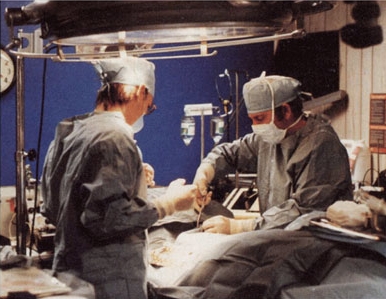 Technicians prepare a body for cryopreservation in 1985. Cryonics (from Greek κρύος 'kryos-' meaning 'icy cold') is the low-temperature preservation of animals, including humans, who cannot be sustained by contemporary medicine, with the hope that healing and resuscitation may be possible in the future.[85][86] Cryopreservation of people and other large animals is not reversible with current technology. The stated rationale for cryonics is that people who are considered dead by current legal or medical definitions, may not necessarily be dead according to the more stringent 'information-theoretic' definition of death.[46][87] Some scientific literature is claimed to support the feasibility of cryonics.[88] Medical science and cryobiologists generally regard cryonics with skepticism.[89] |
クライオニクス(凍結保存) 詳細は「クライオニクス」を参照 1985年、技術者が冷凍保存用の遺体を準備している。 クライオニクス(ギリシャ語の「氷のように冷たい」を意味する「κρύος(クリオス)」に由来)とは、現代の医学では維持できない人間を含む動物を、将 来的に治療や蘇生が可能になるかもしれないという希望のもとに、低温保存するものである。 人間やその他の大型動物の冷凍保存は、現在の技術では不可逆である。 クライオニクスを正当化する理由として、現在の法律や医学上の定義では死とみなされた人でも、より厳密な「情報理論的」死の定義では必ずしも死んでいない 可能性があるということが挙げられている。 低温保存の実現可能性を裏付けるとする科学文献もある。[88] 医学界および低温生物学者は、一般的に低温保存に対して懐疑的な見方をしている。[89] |
Location Kyösti Kallio (middle), the fourth President of the Republic of Finland, had a fatal heart attack a few seconds after this photograph was taken by Hugo Sundström on 19 December 1940, at Helsinki railway station in Helsinki, Finland.[90][91] Around 1930, most people in Western countries died in their own homes, surrounded by family, and comforted by clergy, neighbors, and doctors making house calls.[92] By the mid-20th century, half of all Americans died in a hospital.[93] By the start of the 21st century, only about 20 to 25% of people in developed countries died outside of a medical institution.[93][94][95] The shift from dying at home towards dying in a professional medical environment has been termed the "Invisible Death."[93] This shift occurred gradually over the years until most deaths now occur outside the home.[96] |
場所 フィンランド共和国第4代大統領のキュスティ・カリオ(中央)は、1940年12月19日にフィンランドのヘルシンキのヘルシンキ駅でヒューゴ・スンドス トロームによって撮影されたこの写真の数秒後に心臓発作で死亡した。[90][91] 1930年頃には、西側諸国のほとんどの人は自宅で家族に囲まれて亡くなり、聖職者や近隣住民、往診する医師に慰められていた。[92] 20世紀半ばには、アメリカ人の半数が病院で亡くなっていた。[93] 21世紀の初頭には、先進国では医療施設外で亡くなる人は全体の20~25%程度に過ぎなかった。 [93][94][95] 自宅で死を迎えることから、専門的な医療環境で死を迎えることへの変化は、「目に見えない死」と呼ばれている。[93] この変化は、自宅以外で死を迎えることがほとんどになるまで、長年にわたって徐々に起こってきた。[96] |
| Psychology See also: Death anxiety Death studies is a field within psychology.[97] To varying degrees people inherently fear death, both the process and the eventuality; it is hard wired and part of the 'survival instinct' of all animals.[98] Discussing, thinking about, or planning for their deaths causes them discomfort. This fear may cause them to put off financial planning, preparing a will and testament, or requesting help from a hospice organization. Mortality salience is the awareness that death is inevitable. However, self-esteem and culture are ways to reduce the anxiety this effect can cause.[99] The awareness of someone's own death can cause a deepened bond in their in-group as a defense mechanism. This can also cause the person to become very judging. In a study, two groups were formed; one group was asked to reflect upon their mortality, the other was not, afterwards, the groups were told to set a bond for a prostitute. The group that did not reflect on death had an average of $50, the group who was reminded about their death had an average of $455.[100] Different people have different responses to the idea of their deaths. Philosopher Galen Strawson writes that the death that many people wish for is an instant, painless, unexperienced annihilation.[101] In this unlikely scenario, the person dies without realizing it and without being able to fear it. One moment the person is walking, eating, or sleeping, and the next moment, the person is dead. Strawson reasons that this type of death would not take anything away from the person, as he believes a person cannot have a legitimate claim to ownership in the future.[101][102] |
心理学 関連項目:死への不安 死生学は心理学の一分野である。[97] 程度の差こそあれ、人は生まれつき死を、その過程も結果も恐れる。それは生来の「生存本能」の一部であり、動物には必ず備わっている。[98] 死について考えたり、計画を立てたりすることは、不快感を引き起こす。この恐怖心は、金銭的な計画や遺言の準備、ホスピス組織への支援依頼などを先延ばし にする原因となる。 死の切迫性とは、死が避けられないという認識である。しかし、自尊心や文化は、この影響による不安を軽減する方法である。[99] 自分の死を意識することは、防衛機制として、その人の所属集団内の絆を深める可能性がある。また、このことがその人格を非常に批判的にさせることもある。 ある研究では、2つのグループが形成され、一方のグループには死について考えさせ、もう一方には考えさせなかった。その後、両グループに売春婦との絆を築 くよう指示した。死について考えさせなかったグループの平均額は50ドルだったのに対し、死について考えさせられたグループの平均額は455ドルだった。 死という概念に対する反応は人によって異なる。哲学者のガレン・ストローソンは、多くの人が望む死とは、即座に訪れ、苦痛もなく、経験したことのない消滅 であると書いている。[101] このありそうもないシナリオでは、その人はそれに気づくことも、それを恐れることもできないまま死を迎える。ある瞬間、その人は歩いたり、食べたり、眠っ たりしているが、次の瞬間には死んでいる。ストローソンは、この種の死は人格から何も奪うことはないと考えている。なぜなら、人格は未来に対して所有権を 正当に主張することはできないと信じているからだ。[101][102] |
| Society and culture Main articles: Death and culture and Human skull symbolism  A duke insulting the corpse of Klaus Fleming The regent Duke Charles (later King Charles IX of Sweden) insulting the corpse of Klaus Fleming. Albert Edelfelt, 1878  A naturally mummified body (from Guanajuato) Dead bodies can be mummified either naturally, as this one from Guanajuato, or by intention, as those in ancient Egypt. In society, the nature of death and humanity's awareness of its mortality has, for millennia, been a concern of the world's religious traditions and philosophical inquiry. Including belief in resurrection or an afterlife (associated with Abrahamic religions), reincarnation or rebirth (associated with Dharmic religions), or that consciousness permanently ceases to exist, known as eternal oblivion (associated with secular humanism).[103] Commemoration ceremonies after death may include various mourning, funeral practices, and ceremonies of honoring the deceased.[104][105] The physical remains of a person, commonly known as a corpse or body, are usually interred whole or cremated, though among the world's cultures, there are a variety of other methods of mortuary disposal.[18] In the English language, blessings directed towards a dead person include rest in peace (originally the Latin, requiescat in pace) or its initialism RIP. Death is the center of many traditions and organizations; customs relating to death are a feature of every culture around the world. Much of this revolves around the care of the dead, as well as the afterlife and the disposal of bodies upon the onset of death. The disposal of human corpses does, in general, begin with the last offices before significant time has passed, and ritualistic ceremonies often occur, most commonly interment or cremation. This is not a unified practice; in Tibet, for instance, the body is given a sky burial and left on a mountain top. Proper preparation for death and techniques and ceremonies for producing the ability to transfer one's spiritual attainments into another body (reincarnation) are subjects of detailed study in Tibet.[106] Mummification or embalming is also prevalent in some cultures to retard the rate of decay.[107] The rise of secularism resulted in material mementos of death declining.[108] Some parts of death in culture are legally based, having laws for when death occurs, such as the receiving of a death certificate, the settlement of the deceased estate, and the issues of inheritance and, in some countries, inheritance taxation.[109] Capital punishment is also a culturally divisive aspect of death. In most jurisdictions where capital punishment is carried out today, the death penalty is reserved for premeditated murder, espionage, treason, or as part of military justice. In some countries, sexual crimes, such as adultery and sodomy, carry the death penalty, as do religious crimes, such as apostasy, the formal renunciation of one's religion. In many retentionist countries, drug trafficking is also a capital offense. In China, human trafficking and serious cases of corruption are also punished by the death penalty. In militaries around the world, courts-martial have imposed death sentences for offenses such as cowardice, desertion, insubordination, and mutiny.[110] Mutiny is punishable by death in the United States.[111] Death in warfare and suicide attacks also have cultural links, and the ideas of dulce et decorum est pro patria mori, which translates to "It is sweet and proper to die for one's country", is a concept that dates to antiquity.[111] Additionally, grieving relatives of dead soldiers and death notification are embedded in many cultures.[112] Recently in the Western world—with the increase in terrorism following the September 11 attacks but also further back in time with suicide bombings, kamikaze missions in World War II, and suicide missions in a host of other conflicts in history—death for a cause by way of suicide attack, including martyrdom, have had significant cultural impacts.[113] Suicide, in general, and particularly euthanasia, are also points of cultural debate. Both acts are understood very differently in different cultures.[114] In Japan, for example, ending a life with honor by seppuku was considered a desirable death,[115] whereas according to traditional Christian and Islamic cultures, suicide is viewed as a sin. |
社会と文化 主な記事:死と文化、人間の頭蓋骨の象徴性 クラウス・フレミングの死体を侮辱する公爵 クラウス・フレミングの死体を侮辱する摂政の公爵シャルル(後のスウェーデン王シャルル9世)。アルバート・エデルフェルト、1878年 自然にミイラ化した遺体(グアナフアトのもの) 死体は、グアナフアトのもののように自然にミイラ化する場合と、古代エジプトのように意図的にミイラ化する場合がある。 社会において、死の性質と人間の死に対する認識は、何千年もの間、世界の宗教的伝統と哲学的探究の関心事であった。復活や来世(アブラハムの宗教に関連) への信仰、輪廻や再生(ダルマの宗教に関連)、あるいは永遠の忘却(世俗的ヒューマニズムに関連)として知られる意識の永遠の消滅などである。[103] 死後の追悼式には、さまざまな喪に服す慣習や葬儀、故人を称える儀式が含まれることがある。[104][105] 一般に死体または遺体として知られる人格の物理的な残存物は、通常はそのまま埋葬されるか火葬されるが、世界の文化の中には、死体処理の方法としてさまざ まな他の方法がある。 [18] 英語では、死者に向けられた祝福の言葉として「安らかに眠ってください(もともとはラテン語の「requiescat in pace」)」や、その頭文字をとったRIPがある。 死は多くの伝統や組織の中心であり、死に関する慣習は世界中のあらゆる文化の特徴である。その多くは死者のケア、死後の世界、死の訪れに伴う遺体の処理に まつわるものである。人間の遺体の処理は、通常、重要な時間が経過する前に最後の儀式が行われ、儀式的な儀式がしばしば行われる。最も一般的なのは埋葬ま たは火葬である。これは統一された慣習ではなく、例えばチベットでは遺体はスカイ・バーベキュー(天空葬)され、山頂に放置される。死に対する適切な準備 や、自らの精神的な達成を他の肉体に移す能力(生まれ変わり)を生み出すための技術や儀式は、チベットでは詳細に研究されているテーマである。[106] 腐敗の速度を遅らせるために、ミイラ化やエンバーミングが一部の文化では一般的である。[107] 世俗主義の台頭により、死を象徴する物質的な記念品は減少した。[108] 文化における死の一部は法律に基づくものであり、死亡時に死亡証明書の受理、遺産の清算、相続の問題、そして一部の国では相続税の問題など、法律が定めら れている。 死刑もまた、文化的に意見が分かれる死の側面である。今日、死刑が執行されているほとんどの管轄区域では、死刑は計画殺人、スパイ行為、反逆罪、または軍 事法の一部に限定されている。一部の国では、不倫や同性愛などの性的犯罪、または信仰を正式に放棄する背教などの宗教犯罪に死刑が適用される。多くの死刑 存置国では、麻薬密売も死刑に値する犯罪である。中国では、人身売買や深刻な汚職事件も死刑で処罰される。世界中の軍隊では、軍法会議が臆病、脱走、不服 従、反乱などの罪に対して死刑を宣告している。[110] アメリカでは反乱は死刑に値する犯罪である。[111] 戦死や自爆テロにも文化的なつながりがあり、「祖国のために死ぬことは甘美で正しいことである」という「dulce et decorum est pro patria mori」という考え方は、古代にまで遡る概念である。[111] さらに、戦死した兵士の遺族の悲しみや死亡通知は、多くの文化に根付いている。 [112] 最近では西洋世界において、9月11日の同時多発テロ以降のテロの増加、さらに過去に遡れば自爆テロ、第二次世界大戦における神風特攻隊、歴史上の多くの 紛争における特攻作戦など、殉教を含む自爆テロによる死は、文化に大きな影響を与えている。 自殺、特に安楽死は、文化的な議論の的となる問題でもある。これらの行為は、文化によって大きく異なる解釈がなされている。[114] 例えば、日本では、名誉ある死として切腹が望ましい死とされていたが、[115] キリスト教やイスラム教の伝統文化では、自殺は罪とみなされている。 |
 Santa Muerte, the personification of death in Mexican tradition[116] Death is personified in many cultures, with such symbolic representations as the Grim Reaper, Azrael, the Hindu god Yama, and Father Time. In the west, the Grim Reaper, or figures similar to it, is the most popular depiction of death in western cultures.[117] In Brazil, death is counted officially when it is registered by existing family members at a cartório, a government-authorized registry. Before being able to file for an official death, the deceased must have been registered for an official birth at the cartório. Though a Public Registry Law guarantees all Brazilian citizens the right to register deaths, regardless of their financial means of their family members (often children), the Brazilian government has not taken away the burden, the hidden costs, and fees of filing for a death. For many impoverished families, the indirect costs and burden of filing for a death lead to a more appealing, unofficial, local, and cultural burial, which, in turn, raises the debate about inaccurate mortality rates.[118] Talking about death and witnessing it is a difficult issue in most cultures. Western societies may like to treat the dead with the utmost material respect, with an official embalmer and associated rites.[107] Eastern societies (like India) may be more open to accepting it as a fait accompli, with a funeral procession of the dead body ending in an open-air burning-to-ashes.[119] |
サンタ・ムエルテ(Santa Muerte)は、メキシコの伝統における死の擬人化である[116]。 死は多くの文化で擬人化されており、死神、アザラエル、ヒンドゥー教の神ヤマ、時の神など、象徴的な表現がある。西洋では、死神またはそれに類似した姿が 西洋文化における死の最も一般的な描写である[117]。 ブラジルでは、死亡は、政府公認の登録所であるカルトーリオに遺族が登録した時点で公式に数えられる。公式に死亡を申請する前に、故人はカルトーリオで公 式に出生を登録されていなければならない。公的記録法は、ブラジル国民すべてに、その家族(多くの場合、子供たち)の経済状況に関係なく死亡登録を行う権 利を保証しているが、ブラジル政府は、死亡届の提出に伴う負担や隠れた費用、手数料を免除していない。多くの貧困家庭にとって、死亡届の提出に伴う間接的 な費用や負担は、より魅力的な非公式の地元の文化的な埋葬につながる。その結果、不正確な死亡率に関する議論が巻き起こる。[118] 死について語ること、また死を目撃することは、ほとんどの文化において難しい問題である。西洋社会では、死者は公式なエンバーマー(遺体防腐処理師)や関 連儀式によって、最大限の物質的敬意をもって扱われるのが望ましいとされるかもしれない。[107] 東洋社会(インドなど)では、死体による葬列の末に屋外で火葬して灰にするという、事実として受け入れることの方がより受け入れられやすいかもしれない。 [119] |
| Origins of death Main article: Origin of death The origin of death is a theme or myth of how death came to be. It is present in nearly all cultures across the world, as death is a universal happening.[120] This makes it an origin myth, a myth that describes how a feature of the natural or social world appeared.[121][122] There can be some similarities between myths and cultures. In North American mythology, the theme of a man who wants to be immortal and a man who wants to die can be seen across many Indigenous people.[123] In Christianity, death is the result of the fall of man after eating the fruit from the tree of the knowledge of good and evil.[120] In Greek mythology, the opening of Pandora's box releases death upon the world.[124] |
死の起源 詳細は「死の起源」を参照 死の起源とは、死がどのようにして生じたかというテーマや神話である。死は世界共通の出来事であるため、死の起源は世界中のほぼ全ての文化に見られる。 [120] これにより、死の起源は起源神話、すなわち自然界や社会の特徴がどのようにして現れたかを説明する神話となる。[121][122] 神話と文化の間にはいくつかの類似点がある。北米神話では、不死を求める男と死を求める男というテーマが、多くの先住民の間で見られる。キリスト教では、 死は善悪を知る木の実を食べた後の人間の堕落の結果である。ギリシア神話では、パンドラの箱を開けたことで死が世界に解き放たれた。 |
| https://en.wikipedia.org/wiki/Death |
|
| Religious views Buddhism See also: Anussati § The ten recollections In Buddhist doctrine and practice, death plays an important role. Awareness of death motivated Prince Siddhartha to strive to find the "deathless" and finally attain enlightenment. In Buddhist doctrine, death functions as a reminder of the value of having been born as a human being. Rebirth as a human being is considered the only state in which one can attain enlightenment. Therefore, death helps remind oneself that one should not take life for granted. The belief in rebirth among Buddhists does not necessarily remove death anxiety since all existence in the cycle of rebirth is considered filled with suffering, and being reborn many times does not necessarily mean that one progresses.[147] Death is part of several key Buddhist tenets, such as the Four Noble Truths and dependent origination.[147] |
宗教的見解 仏教 参照:無常 十念 仏教の教義と実践において、死は重要な役割を果たしている。死を意識したことで、シッダールタ王子は「死なないもの」を見つけようと努力し、最終的に悟り を開くことができた。仏教の教義では、死は人間として生まれたことの価値を思い起こさせるものとして機能している。人間として生まれ変わることは、悟りを 開くことができる唯一の状態であると考えられている。したがって、死は、命を当然視してはならないことを思い起こさせる。仏教徒の輪廻転生への信仰は、必 ずしも死への不安を取り除くものではない。なぜなら、輪廻転生を繰り返す存在はすべて苦しみに満ちていると考えられており、何度も生まれ変わることが必ず しも進歩を意味するわけではないからである。 死は、四諦や縁起などの仏教の主要な教義の一部である。 |
| Christianity See also: Soul in the Bible, Second death, and Resurrection of the dead § Christianity  In Dante's Paradiso, Dante is with Beatrice, staring at the highest heavens. While there are different sects of Christianity with different branches of belief, the overarching ideology on death grows from the knowledge of the afterlife. After death, the individual will undergo a separation from mortality to immortality; their soul leaves the body, entering a realm of spirits. Following this separation of body and spirit (death), resurrection will occur.[148] Representing the same transformation Jesus Christ embodied after his body was placed in the tomb for three days, each person's body will be resurrected, reuniting the spirit and body in a perfect form. This process allows the individual's soul to withstand death and transform into life after death.[149] |
キリスト教 関連項目:聖書における魂、第二の死、死者の復活 § キリスト教 ダンテの『神曲』において、ダンテはベアトリーチェとともに、最も高い天を見つめている。 キリスト教には異なる宗派があり、それぞれ異なる信仰の分派があるが、死に関する包括的な思想は、来世の知識から生じている。死後、個人は死から不死へと 分離する。魂は肉体から離れ、霊魂の世界に入る。この肉体と魂の分離(死)の後、復活が起こる。[148] イエス・キリストが肉体が墓に3日間置かれた後に体現したのと同じ変容を表すように、各人格の肉体は復活し、魂と肉体が完璧な形で再び結合する。このプロ セスにより、個人の魂は死に耐え、死後の生へと変容する。[149] |
| Hinduism See also: Reincarnation § Hinduism, Naraka (Hinduism), and Yama (Hinduism)  Illustration depicting Hindu beliefs about reincarnation In Hindu texts, death is described as the individual eternal spiritual jiva-atma (soul or conscious self) exiting the current temporary material body. The soul exits this body when the body can no longer sustain the conscious self (life), which may be due to mental or physical reasons or, more accurately, the inability to act on one's kama (material desires).[150] During conception, the soul enters a compatible new body based on the remaining merits and demerits of one's karma (good/bad material activities based on dharma) and the state of one's mind (impressions or last thoughts) at the time of death.[151] Usually, the process of reincarnation makes one forget all memories of one's previous life. Because nothing really dies and the temporary material body is always changing, both in this life and the next, death means forgetfulness of one's previous experiences.[152] |
ヒンドゥー教 関連項目: 輪廻転生 § ヒンドゥー教、ナラカ(ヒンドゥー教)、ヤマ(ヒンドゥー教) 輪廻転生に関するヒンドゥー教の信仰を描いた図 ヒンドゥー教のテキストでは、死とは個人の永遠の精神であるジヴァ・アートマ(魂または意識的な自己)が現在の仮初めの物質的な身体から離れることである と説明されている。 身体が意識的な自己(生命)を維持できなくなったときに魂は身体から離れるが、その理由は精神的なものか肉体的なものか、あるいはより正確に言えば、カー マ(物質的な欲望)を行動に移すことができないことによるものである。 [150] 受胎の際には、魂は、その人のカルマ(ダルマに基づく善悪の物質的活動)の残りの功徳と罪、そして死の瞬間の精神状態(印象や最後の思考)に基づいて、相 応しい新しい肉体に入る。[151] 通常、輪廻転生の過程で、人は前世の記憶をすべて忘れてしまう。 本当に死ぬものはなく、この世でも来世でも、一時的な物質的な身体は常に変化しているため、死とは、それまでの経験を忘れることを意味する。[152] |
| Islam See also: Islamic view of death The Islamic view is that death is the separation of the soul from the body as well as the beginning of the afterlife.[153] The afterlife, or akhirah, is one of the six main beliefs in Islam. Rather than seeing death as the end of life, Muslims consider death as a continuation of life in another form.[154] In Islam, life on earth right now is a short, temporary life and a testing period for every soul. True life begins with the Day of Judgement when all people will be divided into two groups. The righteous believers will be welcomed to janna (heaven), and the disbelievers and evildoers will be punished in jahannam (hellfire).[155] Muslims believe death to be wholly natural and predetermined by God. Only God knows the exact time of a person's death.[156] The Quran emphasizes that death is inevitable, no matter how much people try to escape death, it will reach everyone. (Q50:16) Life on earth is the one and only chance for people to prepare themselves for the life to come and choose to either believe or not believe in God, and death is the end of that learning opportunity.[157] |
イスラム教 関連項目:イスラム教における死生観 イスラム教の死生観では、死とは魂が肉体から離れることであり、来世の始まりであるとされる。[153] 来世、またはakhirahは、イスラム教の6つの主要な信仰のひとつである。 死を人生の終わりとは考えず、イスラム教徒は死を別の形での人生の継続とみなす。[154] イスラム教では、今この世での人生は短く、一時的なものであり、すべての魂にとっての試練の期間である。真の人生は、審判の日から始まる。この日、すべて の人間は2つのグループに分けられる。正しい信仰を持つ者は、天国である「ジャンナ」に迎え入れられ、信仰を持たない者や悪行を働いた者は、地獄の業火で ある「ジャハンナム」で罰せられる。[155] イスラム教徒は、死は完全に自然なものであり、神によってあらかじめ定められていると信じている。神のみが、ある人格の死の正確な時期を知っておられる。 [156] クルアーンは、人が死から逃れようとどれほど努力しようとも、死は避けられないものであり、いずれは誰にも訪れるものであると強調している。(クルアーン 第50章16節)この世での生活は、来世に備え、神を信じるか信じないかを選択する唯一の機会であり、死は、その学習の機会の終わりである。[157] |
| Judaism See also: Bereavement in Judaism There are a variety of beliefs about the afterlife within Judaism, but none of them contradict the preference for life over death. This is partially because death puts a cessation to the possibility of fulfilling any commandments.[158]  Baruch dayan emet in a 1727 prayerbook, illustrated by Nathan ben Samson of Mezhyrich |
ユダヤ教 関連項目: ユダヤ教における死別 ユダヤ教には死後の世界に関するさまざまな考え方があるが、そのいずれもが「生」を「死」よりも優先するという考え方と矛盾するものではない。その理由の 一つは、死によって戒律を遵守する可能性が絶たれることである。[158] 1727年の祈祷書『Baruch dayan emet』の挿絵は、メジリチ出身のナタン・ベン・サムソンによるもの。 |
| Language The word "death" comes from Old English dēaþ, which in turn comes from Proto-Germanic *dauþuz (reconstructed by etymological analysis). This comes from the Proto-Indo-European stem *dheu- meaning the "process, act, condition of dying."[159] The concept and symptoms of death, and varying degrees of delicacy used in discussion in public forums, have generated numerous scientific, legal, and socially acceptable terms or euphemisms. When a person has died, it is also said they have "passed away", "passed on", "expired", or "gone", among other socially accepted, religiously specific, slang, and irreverent terms. As a formal reference to a dead person, it has become common practice to use the participle form of "decease", as in "the deceased"; another noun form is "decedent". Bereft of life, the dead person is a "corpse", "cadaver", "body", "set of remains", or when all flesh is gone, a "skeleton". The terms "carrion" and "carcass" are also used, usually for dead non-human animals. The ashes left after a cremation are lately called "cremains". |
言語 「死」という言葉は、古英語の dēaþ に由来し、さらにゲルマン祖語の *dauþuz(語源分析により再構成された)に由来する。これは、印欧祖語幹 *dheu-(「死ぬ過程、行為、状態」の意)に由来する。 死の概念や症状、および公共の場で議論される際の微妙さの程度は様々であり、科学、法律、社会的に受け入れられる用語や婉曲表現が数多く生み出されてき た。ある人格が死亡した際には、「亡くなった」、「旅立った」、「息を引き取った」、「逝去した」など、社会的に受け入れられている表現、宗教的に特化し た表現、俗語、不敬な表現が用いられる。 故人について正式に述べる場合、「死亡」の分詞形である「decease」を用いるのが一般的である。「故人」のように。別の名詞形としては 「decedent」がある。 生命を失った死者は、「死体」、「遺体」、「肉体」、「遺骨」、あるいは肉がすべてなくなった場合は「骨格」と呼ばれる。「腐肉」や「死骸」という用語も 使われるが、通常は人間以外の動物の死体を指す。火葬後に残った灰は、最近では「遺灰」と呼ばれる。 |
| Deathbed Death drive Death row Death trajectory Dying declaration End-of-life care Eschatology Faked death Karōshi Last rites List of expressions related to death Spiritual death Survivalism (life after death) Taboo on the dead Thanatology |
臨終 死への衝動 死刑囚監房 死の軌道 臨終宣言 終末期医療 終末論 偽装死 過労死 終油の秘蹟 死に関する表現の一覧 霊的な死 生存主義(死後の世界 死者のタブー タナトロジー |
| Bibliography Bondeson J (2001). Buried Alive: the Terrifying History of our Most Primal Fear. W.W. Norton & Company. ISBN 978-0-393-04906-0. Mullin GH (2008) [1998]. Living in the Face of Death: The Tibetan Tradition. Ithaca, New York: Snow Lion Publications. ISBN 978-1-55939-310-2. Further reading Cochem Mo (1899). "On Death" . The four last things: death, judgment, hell, heaven. Benziger Brothers. Daughters of Charity of St. Vincent de Paul. (1856). "Considerations on Death" . St. Vincent's Manual. John Murphy & Co. Liguori, Alphonsus (1868). Preparation for Death . Rivingtons. Marques SM (2015). Now and At the Hour of Our Death. Translated by Sanches J. And Other Stories. ISBN 978-1-908276-62-9. Massillon JB (1879). "On Death" . Sermons by John-Baptist Massillon. Thomas Tegg & Sons. Rosenberg D (17 August 2014). "How One Photographer Overcame His Fear of Death by Photographing It (Walter Schels' Life Before Death)". Slate. Sachs, Jessica Snyder (2001). Corpse: Nature, Forensics, and the Struggle to Pinpoint Time of Death (270 pages). Perseus Publishing. ISBN 978-0-7382-0336-2. Warraich H (2017). Modern Death: How Medicine Changed the End of Life. St. Martin's Press. ISBN 978-1-250-10458-8. |
参考文献 Bondeson J (2001). Buried Alive: the Terrifying History of our Most Primal Fear. W.W. Norton & Company. ISBN 978-0-393-04906-0. Mullin GH (2008) [1998]. Living in the Face of Death: The Tibetan Tradition. Ithaca, New York: Snow Lion Publications. ISBN 978-1-55939-310-2. 参考文献 Cochem Mo (1899). 「死について」. 死、審判、地獄、天国という最後の四つのこと。ベンツィガー・ブラザーズ。 聖ビンセント・ド・ポール慈善修道女会。 (1856). 「死についての考察」. 聖ビンセントの手引き。ジョン・マーフィー&カンパニー。 リグオーリ、アルフォンサス(1868年)。『死への準備』。リビングトン。 マルケスSM(2015年)。『今、そして死の時』。サンチェスJ訳。その他の物語。ISBN 978-1-908276-62-9。 マシロン JB (1879年). 「死について」. ジョン・バプティスト・マシロンによる説教. トーマス・テッグ・アンド・サンズ. ローゼンバーグ D (2014年8月17日). 「ある写真家が死の恐怖を克服した方法(死の前のウォルター・シェルスの人生)」。 Slate. サックス、ジェシカ・スナイダー (2001年). 死体: 自然、科学捜査、そして死亡時刻の特定をめぐる闘い(270ページ)。ペルセウス・パブリッシング。ISBN 978-0-7382-0336-2。 Warraich H (2017). 現代の死:医学が終末期をどう変えたか。セント・マーチンズ・プレス。ISBN 978-1-250-10458-8。 |
| https://en.wikipedia.org/wiki/Death | |
| References Glennys Howarth, Oliver Leaman, eds. (2003). Encyclopedia of Death and Dying. Routledge. p. 416. ISBN 978-1-136-91360-0. Muzdakis M (12 February 2022). "Vanitas: Paintings by the Dutch Old Masters Inspired by Life and Death". My Modern Met. Archived 2022-02-13 at the Wayback Machine "death". Dictionary.com Unabridged (Online). n.d. Retrieved 27 February 2021. Anil Ramineni, Gregory J. Allam, David P Lerner, Joseph D Burns (2020). "Coma, Vegetative State and Brain Death". In Brian Scott (ed.). Netter's Neurology (3rd ed.). Elsevier, 1600 John F. Kennedy Boulevard, PA. p. 159 - 1st column 2nd paragraph. ISBN 9780323554794. In most medical communities, a person is considered dead once there is irreversible and total cessation of all brain function, regardless of a continuing functional circulatory system. Masamoto Y, Piraino S, Miglietta MP (December 2019). "Transcriptome Characterization of Reverse Development in Turritopsis dohrnii (Hydrozoa, Cnidaria)". G3: Genes, Genomes, Genetics. 9 (12): 4127–4138. doi:10.1534/g3.119.400487. PMC 6893190. PMID 31619459. Routley N (25 March 2022). "How Many Humans Have Ever Lived?". Visual Capitalist. Archived from the original on 28 March 2022. Retrieved 3 October 2023. Li R, Cheng X, Yang Y, C Schwebel D, Ning P, Li L, Rao Z, Cheng P, Zhao M, Hu G (2023). "Global Deaths Associated with Population Aging — 1990–2019". China CDC Weekly. 5 (51): 1150–1154. doi:10.46234/ccdcw2023.216. PMC 10750162. PMID 38152634. Richtie H, Spooner F, Roser M (February 2018). "Causes of death". Our World in Data. Archived from the original on 20 May 2018. Retrieved 14 February 2023. Stambler I (1 October 2017). "Recognizing Degenerative Aging as a Treatable Medical Condition: Methodology and Policy". Aging and Disease. 8 (5): 583–589. doi:10.14336/AD.2017.0130. PMC 5614323. PMID 28966803. Fontana L, Partridge L, Longo VL (16 April 2010). "Extending Healthy Life Span—From Yeast to Humans". Science. 328 (5976): 321–326. Bibcode:2010Sci...328..321F. doi:10.1126/science.1172539. PMC 3607354. PMID 20395504. United States. President's Commission for the Study of Ethical Problems in Medicine and Biomedical and Behavioral Research (1981). Defining Death: A Report on the Medical, Legal and Ethical Issues in the Determination of Death · Part 34. The Commission. p. 63. Archived from the original on 17 August 2023. Retrieved 19 March 2023. United States Department of the Army (1999). Leadership Education and Training (LET 1). United States Department of the Army. p. 188. Archived from the original on 17 August 2023. Retrieved 19 March 2023. DeGrazia D (2021). "The Definition of Death". In Zalta EN (ed.). The Stanford Encyclopedia of Philosophy (Summer 2021 ed.). Metaphysics Research Lab, Stanford University. Archived from the original on 23 July 2022. Retrieved 23 July 2022. Parent B, Turi A (December 2020). "Death's Troubled Relationship With the Law". AMA Journal of Ethics. 22 (12): E1055–1061. doi:10.1001/amajethics.2020.1055. PMID 33419507. Zaner RM (2011). Death: Beyond Whole-Brain Criteria (1st ed.). Springer. pp. 77, 125. ISBN 978-94-010-7720-0. "brain death". Dictionary.com Unabridged (Online). n.d. Retrieved 27 February 2021. Newcomb T (17 October 2019). "7 Unique Burial Rituals Across the World". Encyclopedia Britannica. Archived from the original on 1 April 2020. Retrieved 16 February 2023. Veatch RM, Ross LF (2016). Defining Death: The Case for Choice. Georgetown University Press. ISBN 978-1-62616-356-0. Henig, Robin Marantz (April 2016). "Crossing Over: How Science Is Redefining Life and Death". National Geographic. Archived from the original on 1 November 2017. Retrieved 23 October 2017. Animal Ethics (2023). "What beings are not conscious". Animal Ethics. Archived from the original on 8 November 2014. Retrieved 14 February 2023. Antony M (February 2001). "Is 'consciousness' ambiguous?". Journal of Consciousness Studies. 8 (2): 19–44. Metcalf P, Huntington R (1991). Celebrations of Death: The Anthropology of Mortuary Ritual. New York: Cambridge Press.[page needed] DeGrazia D (2017). "The Definition of Death". In Zalta EN (ed.). The Stanford Encyclopedia of Philosophy (Spring 2017 ed.). Metaphysics Research Lab, Stanford University. Archived from the original on 18 March 2019. Retrieved 19 February 2019. Bernat JL (2018). "Conceptual Issues in DCDD Donor Death Determination". Hastings Center Report. 48 (S4): S26–S28. doi:10.1002/hast.948. PMID 30584853. Belkin GS (2014). Death Before Dying: History, Medicine, and Brain Death. Oxford University Press. p. 220. ISBN 978-0-19-989817-6. New York State Department of Health (2011). "Guidelines for Determining Brain Death". New York State. Archived from the original on 24 January 2012. Retrieved 15 February 2023. National Health Service of the UK (8 September 2022). "Overview: Brain death". National Health Service. Archived from the original on 12 November 2008. Retrieved 15 February 2023. Nitkin K (11 September 2017). "The Challenges of Defining and Diagnosing Brain Death". Johns Hopkins Medicine. Archived from the original on 10 October 2019. Retrieved 15 February 2023. Chernecky CC, Berger BJ (2013). Laboratory Tests and Diagnostic Procedures (6th ed.). Saunders. ISBN 978-1-4557-0694-5. Miller F (October 2009). "Death and organ donation: back to the future" (PDF). Journal of Medical Ethics. 35 (10): 616–620. doi:10.1136/jme.2009.030627. PMID 19793942. "Pendant with a Monk and Death". The Walters Art Museum. Walters Art Museum. Retrieved 8 June 2025. Magnus DC, Wilfond BS, Caplan AL (6 March 2014). "Accepting Brain Death". New England Journal of Medicine. 370 (10): 891–894. doi:10.1056/NEJMp1400930. PMID 24499177. Nicol AU, Morton AJ (11 June 2020). "Characteristic patterns of EEG oscillations in sheep (Ovis aries) induced by ketamine may explain the psychotropic effects seen in humans". Scientific Reports. 10 (1): 9440. Bibcode:2020NatSR..10.9440N. doi:10.1038/s41598-020-66023-8. PMC 7289807. PMID 32528071. New York Department of Health (5 December 2011). "Guidelines for Determining Brain Death". New York State. Archived from the original on 24 January 2012. Retrieved 15 February 2023. National Conference of Commissioners on Uniform State Laws, American Bar Association, American Medical Association (1981). Uniform Determination of Death Act (PDF). Archived (PDF) from the original on 26 March 2023. Retrieved 15 February 2023. Lewis A, Cahn-Fuller K, Caplan A (2017). "Shouldn't Dead Be Dead?: The Search for a Uniform Definition of Death". Journal of Law, Medicine & Ethics. 45 (1): 112–128. doi:10.1177/1073110517703105. PMID 28661278. Sarbey B (1 December 2016). "Definitions of death: brain death and what matters in a person". Journal of Law and the Biosciences. 3 (3): 743–752. doi:10.1093/jlb/lsw054. PMC 5570697. PMID 28852554. Bernat JL (March 2013). "Controversies in defining and determining death in critical care". Nature Reviews Neurology. 9 (3): 164–173. doi:10.1038/nrneurol.2013.12. PMID 23419370. Medical certification of cause of death : instructions for physicians on use of international form of medical certificate of cause of death. World Health Organization. 1979. hdl:10665/40557. ISBN 978-92-4-156062-7.[page needed] Australian Department of Health and Aged Care (June 2021). "The physical process of dying". Health Direct. Archived from the original on 1 March 2020. Retrieved 15 February 2023. Dolinak D, Matshes E, Lew EO (2005). Forensic Pathology: Principles and Practice. Elsevier Academic Press. p. 526. ISBN 978-0-08-047066-5. de Grey AD (21 January 2007). "Life Span Extension Research and Public Debate: Societal Considerations". Studies in Ethics, Law, and Technology. 1 (1). doi:10.2202/1941-6008.1011. roughly 150,000 deaths that occur each day across the globe "Tuberculosis Fact sheet N°104 – Global and regional incidence". WHO. March 2006. Archived from the original on 30 December 2013. Retrieved 6 October 2006. Chris Thomas, Global Health/Health Infectious Diseases and Nutrition (2 June 2009). "USAID's Malaria Programs". USAID. Archived from the original on 26 January 2004. Retrieved 19 September 2016. "Aids could kill 90 million Africans, says UN". The Guardian. London. 4 March 2005. Archived from the original on 29 August 2013. Retrieved 23 May 2010. Leonard T (4 June 2006). "AIDS Toll May Reach 100 Million in Africa". The Washington Post. Archived from the original on 17 December 2013. Retrieved 26 December 2013. Jean Ziegler, L'Empire de la honte, Fayard, 2007 ISBN 978-2-253-12115-2 p. 130.[clarification needed] "WHO Report on the Global Tobacco Epidemic, 2008" (PDF). WHO. 2008. Archived from the original (PDF) on 8 March 2008. Retrieved 26 December 2013. Olshansky SJ, Perry D, Miller RA, Butler RN (March 2006). "In pursuit of the longevity dividend: what should we be doing to prepare for the unprecedented aging of humanity?". The Scientist. 20 (3): 28–37. Gale A143579030. Selye H (31 August 1938). "Experimental Evidence Supporting the Conception of 'Adaptation Energy'". American Journal of Physiology. Legacy Content. 123 (3): 758–765. doi:10.1152/ajplegacy.1938.123.3.758. Goldstone B (1952). "The general practitioner and the general adaptation syndrome". South African Medical Journal. 26 (6): 106–109. hdl:10520/AJA20785135_26742. PMID 14913266. Gorban AN, Tyukina TA, Smirnova EV, Pokidysheva LI (September 2016). "Evolution of adaptation mechanisms: Adaptation energy, stress, and oscillating death". Journal of Theoretical Biology. 405: 127–139. arXiv:1512.03949. Bibcode:2016JThBi.405..127G. doi:10.1016/j.jtbi.2015.12.017. PMID 26801872. Reinberg S (20 September 2012). "Suicide now kills more Americans than car crashes: study". Medical Express. Archived from the original on 6 October 2012. Retrieved 15 October 2012. Mufson S (22 February 1995). "RIGHTS GROUP WARNS CHINA ON DAM PROJECT". The Washington Post. Archived from the original on 6 March 2023. Retrieved 17 February 2023. Liang G, Deng L (29 April 2013). "Solving a Mystery of 400 Years-An Explanation to the "explosion" in Downtown Beijing in the Year of 1626". AllBestEssays. Archived from the original on 20 February 2020. Retrieved 17 February 2023. Humphrey JH (1986). Roman Circuses: Arenas for Chariot Racing. University of California Press. pp. 80, 102, 126–129. ISBN 978-0-520-04921-5. Sovacool BK (May 2008). "The costs of failure: A preliminary assessment of major energy accidents, 1907–2007". Energy Policy. 36 (5): 1802–1820. Bibcode:2008EnPol..36.1802S. doi:10.1016/j.enpol.2008.01.040. Sovacool BK (August 2010). "A Critical Evaluation of Nuclear Power and Renewable Electricity in Asia". Journal of Contemporary Asia. 40 (3): 369–400. doi:10.1080/00472331003798350. "The World's Worst Natural Disasters: Calamities of the 20th and 21st centuries". Canadian Broadcasting Corporation. 30 August 2010. Archived from the original on 19 January 2011. Retrieved 17 February 2023. Means T, Pappas S (3 March 2022). "10 of the deadliest natural disasters in history". LiveScience. Archived from the original on 2 July 2013. Retrieved 17 February 2023. ""The 16 deadliest storms of the last century"". Business Insider India. 13 September 2017. Archived from the original on 7 January 2022. Retrieved 17 February 2023. Dohner JV (2017). The encyclopedia of animal predators: learn about each predator's traits and behaviors: identify the tracks and signs of more than 50 predators: protect your livestock, poultry, and pets. North Adams, Massachusetts: Storey Publishing. ISBN 978-1-61212-705-7. OCLC 970604110.[page needed] Johns Hopkins Medical (19 November 2019). "Autopsy". Johns Hopkins Medical. Archived from the original on 26 June 2020. Retrieved 15 February 2023. Maryland Department of Health. "Forensic Autopsy". Maryland Department of Health. Archived from the original on 4 October 2018. Retrieved 15 February 2023. Madea B, Rothschild M (1 June 2010). "The Post Mortem External Examination". Deutsches Ärzteblatt International (in German). 103 (33): 575–586, quiz 587–588. doi:10.3238/arztebl.2010.0575. PMC 2936051. PMID 20830284. Archived from the original on 6 March 2023. Retrieved 16 February 2023. Duke University School of Medicine. "Autopsy Pathology". Duke Department of Pathology. Archived from the original on 28 June 2022. Retrieved 15 February 2023. Fadden M, Peaslee J (19 March 2019). "What's a Necropsy? The Science Behind this Valuable Diagnostic Tool". Cornell University. Archived from the original on 4 June 2019. Retrieved 15 February 2023. Bondeson 2001, p. 77 Bondeson 2001, pp. 56, 71. Bondeson 2001, p. 239 Limmer, Dan, O'Keefe, Michael F., Bergeron, J. David, Grant, Harvey, Murray, Bob, Dickinson, Ed (21 December 2006). Brady Emergency Care AHA (10th Updated ed.). Prentice Hall. ISBN 978-0-13-159390-9. Merkle R. "Information-Theoretic Death". merkle.com. Archived from the original on 9 August 2016. Retrieved 4 June 2016. A person is dead according to the information-theoretic criterion if the structures that encode memory and personality have been so disrupted that it is no longer possible in principle to recover them. If inference of the state of memory and personality are feasible in principle, and therefore restoration to an appropriate functional state is likewise feasible in principle, then the person is not dead. Goldenberg R, Kirby R, Culhane J (August 2004). "Stillbirth: a review". The Journal of Maternal-Fetal & Neonatal Medicine. 16 (2): 79–94. doi:10.1080/jmf.16.2.79.94. García-Enguídanos A, Calle M, Valero J, Luna S, Domínguez-Rojas V (10 May 2002). "Risk factors in miscarriage: a review". European Journal of Obstetrics & Gynecology and Reproductive Biology. 102 (2): 111–119. doi:10.1016/S0301-2115(01)00613-3. PMID 11950476. Lawrence B, Finer LF, Frohwirth L, Dauphinee A, Singh S, Moore AM (September 2005). "Reasons U.S. Women Have Abortions: Quantitative and Qualitative Perspectives". Perspectives on Sexual and Reproductive Health. 37 (3): 110–118. doi:10.1111/j.1931-2393.2005.tb00045.x. PMID 16150658. Attia (21 November 2019). "What are the different types of abortion?". Planned Parenthood. Archived from the original on 3 May 2022. Retrieved 21 February 2023. "The top five causes of premature death". familyserviceshub.havering.gov.uk. Archived from the original on 21 September 2021. Retrieved 15 August 2023. Hayflick L, Moody HR (2003). Has Anyone Ever Died of Old Age?. International Longevity Center–USA. Archived from the original on 6 March 2023. Retrieved 16 February 2023. "Turritopsis nutricula (Immortal jellyfish)". Jellyfishfacts.net. Archived from the original on 13 October 2016. Retrieved 18 January 2014. Crippen D. "Brain Failure and Brain Death". Scientific American Surgery, Critical Care, April 2005. Archived from the original on 24 June 2006. Retrieved 9 January 2007. Burkle CM, Sharp RR, Wijdicks EF (14 October 2014). "Why brain death is considered death and why there should be no confusion". Neurology. 83 (16): 1464–1469. doi:10.1212/WNL.0000000000000883. PMC 4206160. PMID 25217058. Blagosklonny MV (1 December 2021). "No limit to maximal lifespan in humans: how to beat a 122-year-old record". Oncoscience. 2021 (8): 110–119. doi:10.18632/oncoscience.547. PMC 8636159. PMID 34869788. "Living to 120 and Beyond: Americans' Views on Aging, Medical Advances and Radical Life Extension". Pew Research Center. Pew Research Center's Religion & Public Life Project. 6 August 2013. Archived from the original on 18 September 2016. Retrieved 19 September 2016. Moshakis A (23 June 2019). "How to live forever: meet the extreme life-extensionists". The Guardian. Archived from the original on 23 June 2019. Retrieved 16 February 2023. McKie R (13 July 2002). "Cold facts about cryonics". The Guardian. Archived from the original on 8 July 2017. Retrieved 1 December 2013. Cryonics, which began in the Fifties, is the freezing – usually in liquid nitrogen – of human beings who have been legally declared dead. The aim of this process is to keep such individuals in a state of refrigerated limbo so that it may become possible in the future to resuscitate them, cure them of the condition that killed them, and then restore them to functioning life in an era when medical science has triumphed over the activities of the Banana Reaper "What is Cryonics?". Alcor Foundation. Archived from the original on 3 December 2013. Retrieved 2 December 2013. Cryonics is an effort to save lives by using temperatures so cold that a person beyond help by today's medicine might be preserved for decades or centuries until a future medical technology can restore that person to full health. Whetstine L, Streat S, Darwin M, Crippen D (2005). "Pro/con ethics debate: When is dead really dead?". Critical Care. 9 (6): 538–42. doi:10.1186/cc3894. PMC 1414041. PMID 16356234. Best B (2008). "Scientific justification of cryonics practice". Rejuvenation Research. 11 (2): 493–503. doi:10.1089/rej.2008.0661. PMC 4733321. PMID 18321197. Lovgren S (18 March 2005). "Corpses Frozen for Future Rebirth by Arizona Company". National Geographic. Archived from the original on 14 July 2014. Retrieved 15 March 2014. Many cryobiologists, however, scoff at the idea... Scheffler S (14 November 2013). Kolodny N (ed.). Death and the Afterlife (1 ed.). Oxford University PressNew York. doi:10.1093/acprof:oso/9780199982509.001.0001. ISBN 978-0-19-998250-9. Greyson B, James D, Holden JM (2009). The Handbook of Near-Death Experiences: Thirty Years of Investigation. ABC-CLIO. ISBN 978-0-313-35865-4. Solomon S, Piven JS (2014). "Death and Dying". Oxford Bibliographies Online. doi:10.1093/obo/9780199828340-0144. Jong J, Ross R, Philip T, Chang SH, Simons N, Halberstadt J (2 January 2018). "The religious correlates of death anxiety: a systematic review and meta-analysis" (PDF). Religion, Brain & Behavior. 8 (1): 4–20. doi:10.1080/2153599X.2016.1238844. See also "Study into who is least afraid of death" (Press release). University of Oxford. 24 March 2017. Harmon-Jones E, Simon L, Greenberg J, Pyszczynski T, Solomon S, McGregor H (1997). "Terror management theory and self-esteem: Evidence that increased self-esteem reduced mortality salience effects". Journal of Personality and Social Psychology. 72 (1): 24–36. doi:10.1037/0022-3514.72.1.24. PMID 9008372. Pyszczynski TA (2003). In the wake of 9/11: the psychology of terror. Jeff Greenberg, Sheldon Solomon. Washington, DC: American Psychological Association. ISBN 1-55798-954-0. OCLC 49719188.[page needed] Strawson G (2018). Things that Bother Me: Death, Freedom, the Self, Etc. New York Review of Books. pp. 72–73. ISBN 978-1-68137-220-4. Archived from the original on 30 July 2020. Retrieved 2 July 2019. Strawson G (2017). "'We live beyond…any tale that we happen to enact'". The Subject of Experience. pp. 106–122. doi:10.1093/acprof:oso/9780198777885.003.0006. ISBN 978-0-19-877788-5. Heath PR, Klimo J (2010). Handbook to the Afterlife. North Atlantic Books. p. 18. ISBN 978-1-55643-869-1. Archived from the original on 6 March 2016. Retrieved 12 April 2012. Seremetakis CN. The Last Word: Women, Death, and Divination in Inner Mani. Chicago, IL: University of Chicago Press. Williams V (2016). Celebrating Life Customs Around the World: From Baby Showers to Funerals [3 Volumes]. ABC-CLIO. ISBN 978-1-4408-3659-6. Mullin 1998[page needed] Brenner E (18 January 2014). "Human body preservation – old and new techniques". Journal of Anatomy. 224 (3): 316–344. doi:10.1111/joa.12160. PMC 3931544. PMID 24438435. Lutz D (2011). "The Dead Still Among Us: Victorian Secular Relics, Hair Jewelry, and Death Culture". Victorian Literature and Culture. 39 (1): 127–142. doi:10.1017/S1060150310000306. JSTOR 41307854. Dimond B (2008). Legal Aspects of Death (6th ed.). Quay Books. ISBN 978-1-85642-333-5. "Shot at Dawn, campaign for pardons for British and Commonwealth soldiers executed in World War I". Shot at Dawn Pardons Campaign. Archived from the original on 4 October 2006. Retrieved 20 July 2006. United States Department of the Army (1982). Military Judges' Benchbook: Part 1. United States Department of the Army. Archived from the original on 17 August 2023. Retrieved 19 March 2023. Hassankhani H, Haririan H, Porter JE, Heaston S (July 2018). "Cultural aspects of death notification following cardiopulmonary resuscitation". Journal of Advanced Nursing. 74 (7): 1564–1572. doi:10.1111/jan.13558. PMID 29495080. Carducci BJ (2009). The Psychology of Personality: Viewpoints, Research, and Applications (2nd ed.). Wiley-Blackwell. ISBN 978-1-4051-3635-8.[page needed] Math SB, Chaturvedi SK (December 2012). "Euthanasia: Right to life vs right to die". Indian Journal of Medical Research. 136 (6): 899–902. PMC 3612319. PMID 23391785. Masataka K (March 2005). "The Showa Era (1926–1989)". Daedalus. 119 (3): 24–27. doi:10.1162/daed.2005.134.issue-2. JSTOR 20025315. Chesnut RA (2012). "Introduction: Blue CandleInsight and Concentration". Devoted to Death: Santa Muerte, the Skeleton Saint. pp. 3–26. doi:10.1093/acprof:oso/9780199764662.003.0000. ISBN 978-0-19-976466-2. McKenna A (17 August 2016). "Where Does the Concept of a "Grim Reaper" Come From?". Britannica. Archived from the original on 18 August 2016. Retrieved 16 February 2023. Nations MK, Amaral ML (September 1999). "Flesh, Blood, Souls, and Households: Cultural Validity in Mortality Inquiry". Medical Anthropology Quarterly. 5 (3): 204–220. doi:10.1525/maq.1991.5.3.02a00020. Denise Cush, Catherine A. Robinson, Michael York, eds. (2008). Encyclopedia of Hinduism. London: Routledge. ISBN 978-0-7007-1267-0. OCLC 62133001. Paasonen A (1974). Marsalkan tiedustelupäällikkönä ja hallituksen asiamiehenä [Marshall's chief of intelligence and Government's official] (in Finnish). Weilin & Göös. ISBN 978-951-35-1173-9.[page needed] Hokkanen K. "Kallio, Kyösti (1873–1940) President of Finland". Biografiakeskus, Suomalaisen Kirjallisuuden Seura. Archived from the original on 22 February 2014. Retrieved 10 January 2013. Ariès P (1974). Western attitudes toward death: from the Middle Ages to the present. Baltimore: Johns Hopkins University Press. pp. 87–89. ISBN 978-0-8018-1762-5. Nuland SB (1994). How we die: Reflections on life's final chapter. New York: A.A. Knopf. pp. 254–255. ISBN 978-0-679-41461-2. Ahmad S, O'Mahony M (December 2005). "Where older people die: a retrospective population-based study". QJM. 98 (12): 865–870. doi:10.1093/qjmed/hci138. PMID 16299059. Cassel CK, Demel B (September 2001). "Remembering death: public policy in the USA". J R Soc Med. 94 (9): 433–436. doi:10.1177/014107680109400905. PMC 1282180. PMID 11535743. Ariès P (1981). "Invisible Death". The Wilson Quarterly. 5 (1): 105–115. JSTOR 40256048. PMID 11624731. Green JW (2008). Beyond the good death: the anthropology of modern dying. Philadelphia: University of Pennsylvania Press. ISBN 978-0-8122-0207-6. OCLC 835765644. Dundes A, ed. (1984). Sacred narrative, readings in the theory of myth. Berkeley: University of California Press. ISBN 0-520-05156-4. OCLC 9944508. Patton LL, Doniger W, eds. (1996). Myth and method. Charlottesville: University Press of Virginia. ISBN 0-8139-1656-9. OCLC 34516050. Boas F (October 1917). "The Origin of Death". The Journal of American Folklore. 30 (118): 486–491. doi:10.2307/534498. JSTOR 534498. Lang A (2007). Modern mythology. Middlesex: Echo Library. ISBN 978-1-4068-1672-3. OCLC 269027849. Purvis A, Jones KE, Mace GM (10 November 2000). "Extinction". BioEssays. 22 (12): 1123–1133. doi:10.1002/1521-1878(200012)22:12<1123::AID-BIES10>3.0.CO;2-C. PMID 11084628. Falkowski PG (2001). "Biogeochemical Cycles". Encyclopedia of Biodiversity. pp. 437–453. doi:10.1016/b0-12-226865-2/00032-8. ISBN 978-0-12-226865-6. Wetzel R (2001). Limnology: Lake and River Ecosystems (3rd ed.). Elsevierda. p. 700. ISBN 978-0-12-744760-5. Lindsey-Robbins J, Vázquez-Ortega A, McCluney K, Pelini S (13 December 2019). "Effects of Detritivores on Nutrient Dynamics and Corn Biomass in Mesocosms". Insects. 10 (12): 453. doi:10.3390/insects10120453. PMC 6955738. PMID 31847249. Rousk J, Bengston P (14 March 2014). "Microbial regulation of global biogeochemical cycles". Frontiers in Microbiology. 5: 103. Bibcode:2014FrMic...500103R. doi:10.3389/fmicb.2014.00103. PMC 3954078. PMID 24672519. George M (2018). Carboniferous Giants and Mass Extinction: The Late Paleozoic Ice Age World. Columbia University Press. pp. 98–102. ISBN 978-0-231-18097-9. Gregory TR (June 2009). "Understanding Natural Selection: Essential Concepts and Common Misconceptions". Evolution: Education and Outreach. 2 (2): 156–175. doi:10.1007/s12052-009-0128-1. Haldane JB (December 1957). "The cost of natural selection". Journal of Genetics. 55 (3): 511–524. doi:10.1007/BF02984069. Case TJ, Gilpin ME (1 August 1974). "Interference Competition and Niche Theory". Proceedings of the National Academy of Sciences of the United States of America. 71 (8): 3073–3077. Bibcode:1974PNAS...71.3073C. doi:10.1073/pnas.71.8.3073. PMC 388623. PMID 4528606. National Institute on Aging (2020). "The National Institute on Aging: Strategic Directions for Research, 2020–2025". National Institute on Aging. Archived from the original on 4 June 2020. Retrieved 16 February 2023. Beukeboom LW, Perrin N (2014). "The diversity of sexual cycles". The Evolution of Sex Determination. pp. 18–36. doi:10.1093/acprof:oso/9780199657148.003.0002. ISBN 978-0-19-965714-8. Gilbert S (2003). Developmental biology (7th ed.). Sunderland, Mass: Sinauer Associates. pp. 34–35. ISBN 978-0-87893-258-0. Hallmann A (June 2011). "Evolution of reproductive development in the volvocine algae". Sexual Plant Reproduction. 24 (2): 97–112. doi:10.1007/s00497-010-0158-4. PMC 3098969. PMID 21174128. Brown AE (March 1879). "Grief in the Chimpanzee". The American Naturalist. 13 (3): 173–175. Bibcode:1879ANat...13..173B. doi:10.1086/272298. JSTOR 2448772. King BJ (2014). How Animals Grieve. University of Chicago Press. ISBN 978-0-226-15520-3.[page needed] King BJ (2016). "Animal mourning: Précis of How animals grieve (King 2013)". Animal Sentience. 1 (4). doi:10.51291/2377-7478.1010. King BJ (2019). "The ORCA'S SORROW". Scientific American. 320 (3): 30–35. doi:10.1038/scientificamerican0319-30. JSTOR 27265108. PMID 39010370. Kierszenbaum A (2012). Histology and Cell Biology – An Introduction to Pathology. Philadelphia: Elsevier Saunders. Nirmala JG, Lopus M (April 2020). "Cell death mechanisms in eukaryotes". Cell Biology and Toxicology. 36 (2): 145–164. doi:10.1007/s10565-019-09496-2. PMID 31820165. Darzynkiewicz Z, Juan G, Li X, Gorczyca W, Murakami T, Traganos F (January 1997). "Cytometry in cell necrobiology: analysis of apoptosis and accidental cell death (necrosis)". Cytometry. 27 (1): 1–20. doi:10.1002/(sici)1097-0320(19970101)27:1<1::aid-cyto2>3.0.co;2-l. PMID 9000580. Warnes G, Martins S (March 2011). "Real-time flow cytometry for the kinetic analysis of oncosis". Cytometry. Part A. 79 (3): 181–191. doi:10.1002/cyto.a.21022. PMID 21254392. S2CID 11691981. Blum ML (2004). "Death" (PDF). In Buswell RE (ed.). Encyclopedia of Buddhism. Vol. 1. New York: Macmillan Reference, Thomson Gale. p. 203. ISBN 978-0-02-865720-2. Archived from the original (PDF) on 29 June 2018. Retrieved 15 February 2018. "A Critical and Exegetical Commentary on the Second Epistle of St. Paul to the Corinthians. Alfred Plummer". The Biblical World. 46 (3): 192. September 1915. doi:10.1086/475371. "Resurrection – Resurrection of Christ". Sacramentum Mundi Online. doi:10.1163/2468-483x_smuo_com_003831. The Hindu Kama Shastra Society (1925). The Kama Sutra of Vatsyayana. University of Toronto Archives. pp. 8–11, 172. Yadav R (2018). "Rebirth (Hinduism)". Hinduism and Tribal Religions. Encyclopedia of Indian Religions. pp. 1–4. doi:10.1007/978-94-024-1036-5_316-1. ISBN 978-94-024-1036-5. Sharma A (March 1996). "THE ISSUE OF MEMORY AS A PRAMĀṆA AND ITS IMPLICATION FOR THE CONFIRMATION OF REINCARNATION IN HINDUISM". Journal of Indian Philosophy. 24 (1). Springer: 21–36. doi:10.1007/BF00219274. JSTOR 23447913. Smith JI, Haddad YY (12 December 2002). "From Death to Resurrection: Classical Islam". The Islamic Understanding of Death and Resurrection. Oxford University PressNew York. pp. 31–62. doi:10.1093/0195156498.003.0002. ISBN 0-19-515649-8. Puchalski CM, O'Donnell E (July 2005). "Religious and spiritual beliefs in end of life care: how major religions view death and dying". Techniques in Regional Anesthesia and Pain Management. 9 (3): 114–121. doi:10.1053/j.trap.2005.06.003. Oliver Leaman, ed. (2006). The Qurʼan: an encyclopedia. London: Routledge. ISBN 0-203-17644-8. OCLC 68963889. Tayeb MA, Al-Zamel E, Fareed MM, Abouellail HA (May 2010). "A 'good death': perspectives of Muslim patients and health care providers". Annals of Saudi Medicine. 30 (3): 215–221. doi:10.4103/0256-4947.62836. PMC 2886872. PMID 20427938. Campo JE (2009). Encyclopedia of Islam. New York: Facts On File. ISBN 978-0-8160-5454-1. OCLC 191882169. Raphael SP (May 2021). Jewish Views of the Afterlife (PDF). Archived (PDF) from the original on 11 June 2023. Retrieved 17 February 2023. "Death". Online Etymology Dictionary. Archived from the original on 13 October 2016. Retrieved 5 November 2013. |
参考文献 グレンニス・ハウアート、オリバー・リーマン編(2003年)。『死と死の過程の百科事典』。ラウトリッジ。416頁。ISBN 978-1-136-91360-0。 ムズダキス M(2022年2月12日)。「ヴァニタス:生と死にインスピレーションを得たオランダの巨匠たちの絵画」。My Modern Met。2022年2月13日ウェイバックマシンにアーカイブ 「death」。Dictionary.com Unabridged(オンライン)。発行年不明。2021年2月27日閲覧。 アニル・ラミネニ、グレゴリー・J・アラム、デビッド・P・ラーナー、ジョセフ・D・バーンズ(2020) 。「昏睡、植物状態、および脳死」。ブライアン・スコット(編)。『ネッターの神経学』(第3版)。エルゼビア、1600 John F. Kennedy Boulevard, PA。p. 159 - 第1欄第2段落。ISBN 9780323554794。ほとんどの医学界では、循環器系の機能が維持されていても、脳機能のすべてが不可逆的かつ完全に停止した時点で、その人は死 亡したとみなされる。 マサモト・Y、ピライノ・S、ミグリエッタ・MP(2019年12月)。「Turritopsis dohrnii(Hydrozoa, Cnidaria)における逆発生のトランスクリプトーム解析」 . G3: Genes, Genomes, Genetics. 9 (12): 4127–4138. doi:10.1534/g3.119.400487. PMC 6893190. PMID 31619459. Routley N (2022年3月25日). 「これまでに何人の人間が生きてきたのか?」 . Visual Capitalist. 2022年3月28日にオリジナルからアーカイブされた。2023年10月3日に閲覧。 Li R, Cheng X, Yang Y, C Schwebel D, Ning P, Li L, Rao Z, Cheng P, Zhao M, Hu G (2023). 「人口の高齢化に伴う世界の死亡数 — 1990–2019」 . China CDC Weekly. 5 (51): 1150–1154. doi:10.46234/ccdcw2023.216. PMC 10750162. PMID 38152634. Richtie H, Spooner F, Roser M (2018年2月). 「死因」. Our World in Data. 2018年5月20日にオリジナルからアーカイブされた。2023年2月14日閲覧。 Stambler I (2017年10月1日). 「治療可能な医学的状態としての変性性加齢の認識:方法論と政策」. Aging and Disease. 8 (5): 583–589. doi:10.14336/AD.2017.0130. PMC 5614323. PMID 28966803. フォンタナ L、パートリッジ L、ロンゴ VL(2010年4月16日)。「健康寿命の延伸—酵母からヒトまで」。『Science』. 328 (5976): 321–326. Bibcode:2010Sci...328..321F. doi:10.1126/science.1172539. PMC 3607354. PMID 20395504. アメリカ合衆国。医学・生物医学・行動研究における倫理的問題に関する大統領委員会(1981)。『死の定義:死の判定における医学的、法的、倫理的問題 に関する報告書・第34部』。同委員会。p. 63。2023年8月17日にオリジナルからアーカイブされた。2023年3月19日に閲覧。 アメリカ陸軍省 (1999). 『リーダーシップ教育と訓練(LET 1)』. アメリカ陸軍省. p. 188. 2023年8月17日にオリジナルからアーカイブされた。2023年3月19日に閲覧。 DeGrazia D (2021). 「死の定義」. Zalta EN (編). 『スタンフォード哲学百科事典』(2021年夏版). スタンフォード大学形而上学研究所. 2022年7月23日にオリジナルからアーカイブされた。2022年7月23日に閲覧。 Parent B, Turi A (2020年12月). 「法と死の複雑な関係」. 『AMA Journal of Ethics』. 22 (12): E1055–1061. doi:10.1001/amajethics.2020.1055. PMID 33419507. ザナー RM (2011). 『死:全脳基準を超えて』(第1版). スプリンガー. pp. 77, 125. ISBN 978-94-010-7720-0. 「脳死」. Dictionary.com Unabridged (オンライン版). 発行年不明. 2021年2月27日閲覧. ニューコム T (2019年10月17日). 「世界中の7つのユニークな埋葬儀礼」. ブリタニカ百科事典. 2020年4月1日にオリジナルからアーカイブされた。2023年2月16日閲覧。 Veatch RM, Ross LF (2016). 『死の定義:選択の論拠』. ジョージタウン大学出版局. ISBN 978-1-62616-356-0. Henig, Robin Marantz (2016年4月). 「境界を越えて:科学がいかに生と死を再定義しているか」. ナショナルジオグラフィック. 2017年11月1日にオリジナルからアーカイブされた。2017年10月23日に閲覧。 『アニマル・エシックス』(2023年)。「意識を持たない存在とは」。『アニマル・エシックス』。2014年11月8日にオリジナルからアーカイブされ た。2023年2月14日に閲覧。 アントニー・M(2001年2月)。「『意識』は曖昧か?」。『Journal of Consciousness Studies』8(2): 19–44. メトカーフ・P、ハンティントン・R(1991)。『死の祝祭:葬送儀礼の人類学』。ニューヨーク:ケンブリッジ・プレス。[ページ番号不 明] デグラツィア・D(2017)。「死の定義」。ザルタ・E・N 編)。『スタンフォード哲学百科事典』(2017年春版)。スタンフォード大学形而上学研究所。2019年3月18日にオリジナルからアーカイブされた。 2019年2月19日に閲覧。 ベルナット JL (2018) 。「DCDDドナーの死亡判定における概念的問題」。『ヘイスティングス・センター・レポート』。48 (S4): S26–S28. doi:10.1002/hast.948. PMID 30584853. ベルキン G.S. (2014). 『死に至る前:歴史、医学、そして脳死』。オックスフォード大学出版局。p. 220. ISBN 978-0-19-989817-6. ニューヨーク州健康局 (2011). 「脳死判定ガイドライン」. ニューヨーク州. 2012年1月24日にオリジナルからアーカイブされた。2023年2月15日に閲覧。 英国国民保健サービス(2022年9月8日)。「概要:脳死」。英国国民保健サービス。2008年11月12日にオリジナルからアーカイブされた。 2023年2月15日に閲覧。 ニトキン K(2017年9月11日)。「脳死の定義と診断における課題」。ジョンズ・ホプキンス・メディシン。2019年10月10日にオリジナルからアーカイブ された。2023年2月15日に閲覧。 チェルネッキー CC、バーガー BJ(2013)。『臨床検査と診断手順』(第6版)。サンダース。ISBN 978-1-4557-0694-5。 ミラー F(2009年10月)。「死と臓器提供:バック・トゥ・ザ・フューチャー」 (PDF). 『Journal of Medical Ethics』. 35 (10): 616–620. doi:10.1136/jme.2009.030627. PMID 19793942. 「修道士と死神のペンダント」。ウォルターズ美術館。ウォルターズ美術館。2025年6月8日閲覧。 マグナス DC、ウィルフォンド BS、キャプラン AL(2014年3月6日)。「脳死の受容」。『ニューイングランド・ジャーナル・オブ・メディシン』。370 (10): 891–894. doi: 10.1056/NEJMp1400930. PMID 24499177. Nicol AU, Morton AJ (2020年6月11日). 「ケタミンによって誘発されたヒツジ(Ovis aries)の脳波振動の特徴的なパターンは、ヒトに見られる向精神作用を説明しうる」。Scientific Reports. 10 (1): 9440. Bibcode:2020NatSR..10.9440N. doi:10.1038/s41598-020-66023-8. PMC 7289807. PMID 32528071. ニューヨーク州健康局 (2011年12月5日)。「脳死判定ガイドライン」。ニューヨーク州。2012年1月24日にオリジナルからアーカイブされた。2023年2月15日閲 覧。 全米統一州法委員会議、米国弁護士協会、米国医師会(1981年)。『統一死亡判定法』(PDF)。2023年3月26日にオリジナルからアーカイブ (PDF)。2023年2月15日閲覧。 ルイス A、カーン=フラー K、キャプラン A (2017). 「死者は死んでいるべきではないか?:死の統一的定義の探求」. 『Journal of Law, Medicine & Ethics』. 45 (1): 112–128. doi:10.1177/1073110517703105. PMID 28661278. サーベイ B (2016年12月1日). 「死の定義:脳死と人間にとって重要なこと」. 『Journal of Law and the Biosciences』. 3 (3): 743–752. doi:10.1093/jlb/lsw054. PMC 5570697. PMID 28852554. Bernat JL (2013年3月). 「集中治療における死の定義と判定をめぐる論争」. Nature Reviews Neurology. 9 (3): 164–173. doi:10. 1038/nrneurol.2013.12. PMID 23419370. 死因の医学的証明:死因診断書国際様式の使用に関する医師向け指針。世界保健機関。1979年。hdl:10665/40557. ISBN 978-92-4-156062-7。[ページ番号不明 ] オーストラリア保健・高齢者ケア省(2021年6月)。「死に至る身体的過程」。Health Direct。2020年3月1日にオリジナルからアーカイブされた。2023年2月15日閲覧。 Dolinak D, Matshes E, Lew EO (2005). 『司法医学:原理と実践』. エルゼビア・アカデミック・プレス. p. 526. ISBN 978-0-08-047066-5. de Grey AD (2007年1月21日). 「寿命延長研究と公的議論:社会的考察」. 『倫理・法・技術研究』. 1 (1). doi:10.2202/1941-6008.1011. 世界中で毎日約15万人が死亡している 「結核ファクトシート N°104 – 世界および地域別発生率」. WHO. 2006年3月. 2013年12月30日にオリジナルからアーカイブされた。2006年10月6日に閲覧。 クリス・トーマス、グローバルヘルス/感染症・栄養(2009年6月2日)。「USAIDのマラリア対策プログラム」。USAID。2004年1月26日 にオリジナルからアーカイブされた。2016年9月19日に閲覧。 「エイズで9000万人のアフリカ人が死亡する可能性、国連が指摘」。ガーディアン。ロンドン。2005年3月4日。2013年8月29日にオリジナルか らアーカイブされた。2010年5月23日に閲覧。 レナード・T(2006年6月4日)。「アフリカのエイズ死者数は1億人に達する可能性」。ワシントン・ポスト。2013年12月17日にオ リジナルからアーカイブされた。2013年12月26日閲覧。 ジャン・ジーグラー、『恥の帝国』、ファヤール、2007年 ISBN 978-2-253-12115-2 p. 130。[出典の明示が必要] 「世界保健機関(WHO)の世界タバコ流行に関する報告書、2008年」 (PDF) 。WHO。2008年。2008年3月8日にオリジナル(PDF)からアーカイブされた。2013年12月26日に閲覧。 オルシャンスキーSJ、ペリーD、ミラーRA、バトラーRN(2006年3月)。「長寿の配当を求めて:人類の未曾有の高齢化に備えるために 我々は何をすべきか?」。『The Scientist』. 20 (3): 28–37. Gale A143579030. Selye H (1938年8月31日). 「『適応エネルギー』の概念を支持する実験的証拠」. 『American Journal of Physiology』. Legacy Content. 123 (3): 758–765. doi:10.1152/ajplegacy.1938.123.3.758. ゴールドストーン B (1952). 「一般開業医と一般適応症候群」. South African Medical Journal. 26 (6): 106–109. hdl:10520/AJA20785135_26742. PMID 14913266. ゴルバン AN、チュキナ TA、スミルノワ EV、ポキディシェワ LI(2016年9月)。「適応メカニズムの進化:適応エネルギー、ストレス、および振動的死」。『理論生物学ジャーナル』。405: 127–139. arXiv:1512.03949. Bibcode: 2016JThBi.405..127G. doi:10.1016/j.jtbi.2015.12.017. PMID 26801872. レインバーグ S (2012年9月20日). 「自殺による死者が自動車事故による死者数を上回った:研究」. メディカル・エクスプレス. 2012年10月6日にオリジナルからアーカイブされた。2012年10月15日に閲覧。 Mufson S (1995年2月22日). 「人権団体、ダム建設計画について中国に警告」. The Washington Post. 2023年3月6日にオリジナルからアーカイブされた。2023年2月17日に閲覧。 Liang G, Deng L (2013年4月29日). 「400年の謎を解く――1626年に北京の市街地で起きた『爆発』の説明」. AllBestEssays. 2020年2月20日にオリジナルからアーカイブされた。2023年2月17日閲覧。 ハンフリー・J・H(1986年)。『ローマのサーカス:戦車競走の競技場』。カリフォルニア大学出版局。80、102、126–129頁。 ISBN 978-0-520-04921-5。 ソヴァクール・B・K(2008年5月)。「失敗の代償:1907–2007年の主要なエネルギー事故に関する予備的評価」。『エネルギー・ ポリシー』。36 (5): 1802–1820。Bibcode:2008EnPol..36.1802S。doi:10.1016/j.enpol.2008.01.040。 ソヴァクール・B・K (2010年8月)。「アジアにおける原子力発電と再生可能エネルギーに関する批判的評価」。『Journal of Contemporary Asia』。40 (3): 369–400. doi:10.1080/00472331003798350. 「世界最悪の自然災害:20世紀と21世紀の惨事」。カナダ放送協会。2010年8月30日。2011年1月19日にオリジナルからアーカイ ブされた。2023年2月17日に閲覧。 Means T, Pappas S (2022年3月3日). 「史上最も死者を出した自然災害トップ10」. LiveScience. 2013年7月2日にオリジナルからアーカイブされた。2023年2月17日に閲覧。 「『過去100年間で最も死者を出した16の嵐』」. Business Insider India. 2017年9月13日。2022年1月7日にオリジナルからアーカイブされた。2023年2月17日に閲覧。 Dohner JV (2017). 『動物捕食者百科事典:各捕食者の特徴と行動を学ぶ:50種以上の捕食者の足跡と痕跡を特定する:家畜、家禽、ペットを守る』。マサチューセッツ州ノース アダムズ: Storey Publishing. ISBN 978-1-61212-705-7. OCLC 970604110.[ページ番号不明] ジョンズ・ホプキンス・メディカル (2019年11月19日). 「剖検」. ジョンズ・ホプキンス・メディカル. 2020年6月26日にオリジナルからアーカイブされた。2023年2月15日に閲覧。 メリーランド州保健局. 「司法剖検」。メリーランド州保健局。2018年10月4日にオリジナルからアーカイブされた。2023年2月15日に閲覧。 メデア B、ロスチャイルド M(2010年6月1日)。「死後外部検査」。Deutsches Ärzteblatt International(ドイツ語)。103 (33): 575–586, クイズ 587 –588。doi:10.3238/arztebl.2010.0575。PMC 2936051。PMID 20830284。2023年3月6日にオリジナルからアーカイブされた。2023年2月16日に閲覧。 デューク大学医学部。「剖検病理学」。デューク大学病理学部門。2022年6月28日にオリジナルからアーカイブされた。2023年2月15日に閲覧。 Fadden M, Peaslee J (2019年3月19日)。「 剖検とは何か?この貴重な診断ツールの背後にある科学」。コーネル大学。2019年6月4日にオリジナルからアーカイブされた。2023年2月15日に閲 覧。 ボンデソン 2001, p. 77 ボンデソン 2001, pp. 56, 71. ボンデソン 2001, p. 239 リマー、ダン、オキーフ、マイケル・F、ベルジェロン、J・デイヴィッド、グラント、ハーヴェイ、マレー、ボブ、ディキンソン、エド (2006年12月21日)。『Brady Emergency Care AHA』(第10版改訂版) . プレンティス・ホール. ISBN 978-0-13-159390-9. マークル, R. 「情報理論的死」. merkle.com. 2016年8月9日にオリジナルからアーカイブされた。2016年6月4日に閲覧。情報理論的基準によれば、記憶と人格を符号化する構造が著しく破壊さ れ、原則としてそれらを回復することがもはや不可能となった場合、その人は死んでいるとされる。もし記憶と人格の状態の推論が原則として可能であり、した がって適切な機能状態への回復も同様に原則として可能であるならば、その人は死んでいない。 ゴールデンバーグ R、カービー R、 Culhane J (2004年8月). 「死産:総説」. The Journal of Maternal-Fetal & Neonatal Medicine. 16 (2): 79–94. doi:10.1080/jmf.16.2.79.94. ガルシア=エンギダノス A、カジェ M、バレロ J、ルナ S、ドミンゲス=ロハス V(2002年5月10日)。「流産の危険因子:総説」。European Journal of Obstetrics & Gynecology and Reproductive Biology. 102 (2): 111–119. doi:10.1016/S0301-2115(01)00613-3. PMID 11950476. ローレンス B、ファイナー LF、フロワース L、ドーフィニー A、シン S、ムーア AM(2005年9月)。「米国女性が中絶を行う理由:定量的および定性的視点」. 『Perspectives on Sexual and Reproductive Health』. 37 (3): 110–118. doi:10.1111/j.1931-2393.2005.tb00045.x. PMID 16150658. アッティア(2019年11月21日)。「中絶には異なる種類があるか?」。『Planned Parenthood』。2022年5月3日にオリジナルからアーカイブされた。2023年2月21日に閲覧。 「早死の主な5つの原因」。familyserviceshub.havering.gov.uk。2021年9月21日にオリジナルからアーカイブされ た。2023年8月15日に閲覧。 Hayflick L, Moody HR (2003). 『老衰で亡くなった人はいるのか?』. International Longevity Center–USA. 2023年3月6日にオリジナルからアーカイブされた。2023年2月16日に閲覧。 「Turritopsis nutricula(不死のクラゲ)」。Jellyfishfacts.net. 2016年10月13日にオリジナルからアーカイブされた。2014年1月18日に閲覧。 Crippen D. 「脳機能不全と脳死」。Scientific American Surgery, Critical Care, 2005年4月。2006年6月24日にオリジナルからアーカイブされた。2007年1月9日に閲覧。 Burkle CM, Sharp RR, Wijdicks EF (2014年10月14日). 「なぜ脳死が死とみなされるのか、そしてなぜ混同があってはならないのか」. Neurology. 83 (16): 1464–1469. doi:10.1212/WNL.0000000000000883. PMC 4206160. PMID 25217058. Blagosklonny MV (2021年12月1日). 「人間の最大寿命に制限はない:122歳の記録を打ち破る方法」. Oncoscience. 2021 (8): 110–119. doi:10.18632/oncoscience.547. PMC 8636159. PMID 34869788. 「120歳を超えて生きる:高齢化、医療の進歩、そして急進的な寿命延長に関するアメリカ人の見解」。ピュー・リサーチ・センター。ピュー・リサーチ・セ ンターの宗教・公共生活プロジェクト。2013年8月6日。2016年9月18日にオリジナルからアーカイブされた。2016年9月19日に閲覧。 モシャキス A(2019年6月23日)。「永遠に生きる方法:過激な寿命延長主義者たち」. ガーディアン. 2019年6月23日にオリジナルからアーカイブされた。2023年2月16日に閲覧。 McKie R (2002年7月13日). 「クライオニクスに関する冷徹な事実」. ガーディアン. 2017年7月8日にオリジナルからアーカイブされた。2013年12月1日に閲覧。1950年代に始まったクライオニクスとは、法的に死亡と宣告された 人間を(通常は液体窒素を用いて)凍結することである。このプロセスの目的は、そのような個人を冷凍保存された「中間状態」に保つことであり、将来、医学 が「死神」の活動に打ち勝った時代に、彼らを蘇生させ、死因となった病気を治し、機能的な生活を取り戻せるようにすることにある 「クライオニクスとは?」。アルコル財団。2013年12月3日にオリジナルからアーカイブ。2013年12月2日に取得。クライオニクスとは、今日の医 学では救えない人を、将来の医療技術がその人を完全な健康状態に戻せるようになるまで、数十年あるいは数世紀にわたり保存できるようにする、極低温を利用 する生命保存の試みである。 Whetstine L, Streat S, Darwin M, Crippen D (2005). 「倫理的賛否両論:死とはいつ本当に死なのか?」. Critical Care. 9 (6): 538–42. doi:10.1186/cc3894. PMC 1414041. PMID 16356234. Best B (2008). 「クライオニクス実践の科学的正当性」. Rejuvenation Research. 11 (2): 493–503. doi:10.1089/rej.2008.0661. PMC 4733321. PMID 18321197. Lovgren S (2005年3月18日). 「アリゾナ州の企業が将来の再生のために遺体を凍結」. National Geographic. 2014年7月14日にオリジナルからアーカイブされた。2014年3月15日に閲覧。しかし、多くの低温生物学者はこの考えを嘲笑している... シェフラー S (2013年11月14日). コロドニー N (編). 『死と来世』 (第1版). オックスフォード大学出版局ニューヨーク. doi:10.1093/acprof:oso/9780199982509.001.0001. ISBN 978-0-19-998250-9. グレイソン B、ジェームズ D、ホールデン JM(2009年)。『臨死体験ハンドブック:30年にわたる調査』。ABC-CLIO。ISBN 978-0-313-35865-4。 ソロモン S、ピヴェン JS(2014年)。「死と死の過程」. Oxford Bibliographies Online. doi:10.1093/obo/9780199828340-0144. ジョン J、ロス R、フィリップ T、チャン SH、サイモンズ N、ハルバーシュタット J (2018年1月2日). 「死の不安の宗教的相関:系統的レビューとメタ分析」 (PDF). 『Religion, Brain & Behavior』. 8 (1): 4–20. doi:10.1080/2153599X.2016.1238844. 参照:「死を最も恐れない人々に関する研究」(プレスリリース)。オックスフォード大学。2017年3月24日。 Harmon-Jones E, Simon L, Greenberg J, Pyszczynski T, Solomon S, McGregor H (1997). 「恐怖管理理論と自尊心:自尊心の向上が死の顕在化効果を低減させたという証拠」. Journal of Personality and Social Psychology. 72 (1): 24–36. doi:10.1037/0022-3514.72.1.24. PMID 9008372. ピシュチンスキー T.A. (2003). 『9.11の余波:テロの心理学』. ジェフ・グリーンバーグ、シェルドン・ソロモン. ワシントンD.C.:アメリカ心理学会. ISBN 1-55798-954-0. OCLC 49719188.[ページ番号不明] ストローソン G (2018). 『私を悩ませるもの:死、自由、自己など』. ニューヨーク・レビュー・オブ・ブックス. pp. 72–73. ISBN 978-1-68137-220-4. 2020年7月30日にオリジナルからアーカイブされた。2019年7月2日に取得。 ストローソン G (2017). 「『我々は……たまたま演じているいかなる物語をも超えて生きている』」。『経験の主体』。pp. 106–122。doi:10.1093/acprof:oso/9780198777885.003.0006。ISBN 978-0-19-877788-5。 ヒース PR、クリモ J (2010). 『死後の世界ハンドブック』. ノース・アトランティック・ブックス. p. 18. ISBN 978-1-55643-869-1. 2016年3月6日にオリジナルからアーカイブされた。2012年4月12日に取得。 セレメタキス CN. 『最後の言葉:インナー・マニにおける女性、死、そして占術』. シカゴ、 イリノイ州:シカゴ大学出版局。 ウィリアムズ V (2016). 『世界中の生命を祝う風習:ベビーシャワーから葬儀まで』[全3巻]。ABC-CLIO。ISBN 978-1-4408-3659-6。 マリン 1998[ページ番号不明] ブレナー E (2014年1月18日). 「人体の保存――新旧の技術」。『Journal of Anatomy』. 224 (3): 316–344. doi:10.1111/joa.12160. PMC 3931544. PMID 24438435. ルッツ D (2011). 「死者はなお我らと共に:ヴィクトリア朝の世俗的遺物、髪飾り、そして死の文化」. 『Victorian Literature and Culture』. 39 (1): 127–142. doi:10.1017/S1060150310000306. JSTOR 41307854. ディモンド B (2008). 『死の法的側面』(第6版)。クエイ・ブックス。ISBN 978-1-85642-333-5。 「ショット・アット・ドーン、第一次世界大戦中に処刑された英国および英連邦兵士への恩赦を求める運動」 . 『ショット・アット・ドーン恩赦運動』。2006年10月4日にオリジナルからアーカイブされた。2006年7月20日に閲覧。 米国陸軍省 (1982). 『軍事裁判官ベンチブック:第1部』。米国陸軍省。2023年8月17日にオリジナルからアーカイブされた。2023年3月19日に閲覧。 Hassankhani H, Haririan H, Porter JE, Heaston S (2018年7月). 「心肺蘇生後の死亡通知における文化的側面」. Journal of Advanced Nursing. 74 (7): 1564–1572. doi:10.1111/jan.13558. PMID 29495080. Carducci BJ (2009). 『パーソナリティ心理学:視点、研究、応用』(第2版)。Wiley-Blackwell。ISBN 978-1-4051-3635-8。[ページ番号不明] Math SB, Chaturvedi SK (2012年12月). 「安楽死:生きる権利対死ぬ権利」. 『Indian Journal of Medical Research』. 136 (6): 899–902. PMC 3612319. PMID 23391785. K. 正孝(2005年3月)。「昭和時代(1926–1989)」。『ダイダロス』。119 (3): 24–27. doi:10.1162/daed.2005.134.issue-2. JSTOR 20025315. Chesnut RA(2012)。「 序論:青いろうそく、洞察と集中」。『死に捧げられたもの:サンタ・ムエルテ、骸骨の聖人』。pp. 3–26。doi:10.1093/acprof:oso/9780199764662.003.0000。ISBN 978-0-19-976466-2。 マッケナ A(2016年8月17日)。「『死神』という概念はどこから来たのか?」。『ブリタニカ』。2016年8月18日にオリジナルからアーカイブされた。 2023年2月16日閲覧。 ネイションズ MK、アマラル ML(1999年9月)。「肉体、血液、魂、そして家族:死に関する調査における文化的妥当性」。『メディカル・アンソロポロジー・クォータリー』。5 (3): 204–220. doi:10.1525/maq.1991.5.3.02a00020. デニス・クッシュ、キャサリン・A・ロビンソン、マイケル・ヨーク編(2008年)。『ヒンドゥー教百科事典』。ロンドン:ラウトリッジ。 ISBN 978-0-7007-1267-0。OCLC 62133001。 パアソネン A (1974). 『元帥の諜報部長および政府代表として』 (フィンランド語). ヴァイリン&ゴース. ISBN 978-951-35-1173-9.[ページ番号不明] ホッカネン K. 「カリオ、キョスティ(1873–1940)フィンランド大統領」。伝記センター、フィンランド文学協会。2014年2月22日にオリジナルからアーカイ ブ。2013年1月10日閲覧。 アリエス P (1974). 『死に対する西洋の態度:中世から現代まで』。ボルチモア:ジョンズ・ホプキンス大学出版局。pp. 87–89。ISBN 978-0-8018-1762-5。 ヌランド S.B. (1994)。『私たちはどのように死ぬか:人生の最終章についての考察』。ニューヨーク:A.A. ノップフ。pp. 254–255. ISBN 978-0-679-41461-2. Ahmad S, O'Mahony M (2005年12月). 「高齢者がどこで死ぬか:後ろ向き人口ベースの研究」. QJM. 98 (12): 865–870. doi:10.1093/qjmed/hci138. PMID 16299059. キャッセル C.K., デメル B. (2001年9月)。「死を記憶する:米国の公共政策」。J R Soc Med. 94 (9): 433–436. doi:10.1177/014107680109400905. PMC 1282180. PMID 11535743. アリエス P (1981). 「見えない死」. The Wilson Quarterly. 5 (1): 105–115. JSTOR 40256048. PMID 11624731. グリーン J.W. (2008). 『善き死を超えて:現代の死に関する人類学』. フィラデルフィア:ペンシルベニア大学出版局. ISBN 978-0-8122-0207-6. OCLC 835765644. ダンデス A 編 (1984). 『神聖な物語:神話理論の読本』. バークレー:カリフォルニア大学出版局. ISBN 0-520-05156-4. OCLC 9944508. パットン LL、ドニガー W 編 (1996). 『神話と方法』. シャーロッツビル:バージニア大学出版局. ISBN 0-8139-1656-9. OCLC 34516050. ボアズ F (1917年10月). 「死の起源」. 『アメリカ民俗学雑誌』. 30 (118): 486–491. doi:10.2307/534498. JSTOR 534498. ラング A (2007). 『現代神話学』. ミドルセックス: エコー・ライブラリー. ISBN 978-1-4068-1672-3. OCLC 269027849. パーヴィス A、ジョーンズ KE、メイス GM(2000年11月10日)。「絶滅」。『BioEssays』。22 (12): 1123–1133. doi:10.1002/1521-1878(200012)22:12<1123::AID-BIES10>3.0.CO;2-C. PMID 11084628. Falkowski PG (2001). 「生物地球化学的循環」. 『生物多様性百科事典』. pp. 437–453. doi:10.1016/b0-12-226865-2/00032-8. ISBN 978-0-12-226865-6. ウェッツェル R (2001). 『湖沼学:湖と川の生態系』 (第3版)。エルゼビア。p. 700。ISBN 978-0-12-744760-5。 リンジー=ロビンス J、バスケス=オルテガ A、マクルーニー K、ペリーニ S(2019年12月13日)。「メソコスムにおける分解者が栄養塩動態およびトウモロコシのバイオマスに及ぼす影響」。Insects. 10 (12): 453. doi:10.3390/insects10120453. PMC 6955738. PMID 31847249. Rousk J, Bengston P (2014年3月14日). 「地球規模の生物地球化学的循環における微生物の調節作用」. Frontiers in Microbiology. 5: 103. Bibcode:2014FrMic.. .500103R. doi:10.3389/fmicb.2014.00103. PMC 3954078. PMID 24672519. George M (2018). 『石炭紀の巨人と大量絶滅:古生代後期の氷河期の世界』. コロンビア大学出版局. pp. 98–102. ISBN 978-0-231-18097-9. Gregory TR (2009年6月). 「自然選択の理解:基本概念とよくある誤解」. Evolution: Education and Outreach. 2 (2): 156–175. doi:10.1007/s12052-009-0128-1. Haldane JB (1957年12月). 「自然選択のコスト」. Journal of Genetics. 55 (3): 511–524. doi:10.1007/BF02984069. Case TJ, Gilpin ME (1974年8月1日). 「干渉・競争とニッチ理論」 . 『米国科学アカデミー紀要』. 71 (8): 3073–3077. Bibcode:1974PNAS...71.3073C. doi:10.1073/pnas.71.8.3073. PMC 388623. PMID 4528606. 国立老化研究所 (2020). 「国立老化研究所:研究の戦略的方向性、2020–2025年」. 国立老化研究所. 2020年6月4日にオリジナルからアーカイブされた。2023年2月16日閲覧。 Beukeboom LW, Perrin N (2014). 「性周期の多様性」. 『性決定の進化』. pp. 18–36. doi:10.1093/acprof:oso/9780199657148.003.0002. ISBN 978-0-19-965714-8. Gilbert S (2003) . 『発生生物学』(第7版)。マサチューセッツ州サンダーランド:シナウアー・アソシエイツ。pp. 34–35。ISBN 978-0-87893-258-0。 ハルマン A (2011年6月). 「ボルボシン藻類における生殖発生の進化」。『Sexual Plant Reproduction』. 24 (2): 97–112. doi:10.1007/s00497-010-0158-4. PMC 3098969. PMID 21174128. ブラウン A.E. (1879年3月)。「チンパンジーの悲嘆」. 『アメリカン・ナチュラリスト』. 13 (3): 173–175. Bibcode:1879ANat...13..173B. doi:10.1086/272298. JSTOR 2448772. キング・B・J(2014年)。『動物の悲嘆』。シカゴ大学出版局。ISBN 978-0-226-15520-3。[ページ番号不明] King BJ (2016). 「動物の喪: 『How animals grieve』(King 2013)の要約」. Animal Sentience. 1 (4). doi:10.51291/2377-7478.1010. King BJ (2019). 「オルカの悲しみ」. Scientific American. 320 (3): 30–35. doi:10.1038/scientificamerican0319-30. JSTOR 27265108. PMID 39010370. Kierszenbaum A (2012). 『組織学と細胞生物学 – 病理学入門』. フィラデルフィア: Elsevier Saunders. Nirmala JG, Lopus M (2020年4月). 「真核生物における細胞死のメカニズム」. 『Cell Biology and Toxicology』. 36 (2): 145–164. doi:10.1007/s10565-019-09496-2. PMID 31820165. Darzynkiewicz Z, Juan G, Li X, Gorczyca W, Murakami T, Traganos F (1997年1月). 「細胞死生物学におけるフローサイトメトリー:アポトーシスおよび偶発的細胞死 (壊死)の解析」。Cytometry. 27 (1): 1–20. doi:10.1002/(sici)1097-0320(19970101)27:1<1::aid-cyto2>3.0.co;2-l. PMID 9000580. Warnes G, Martins S (2011年3月). 「オンコシスの動態解析のためのリアルタイムフローサイトメトリー」. Cytometry. Part A. 79 (3): 181–191. doi:10.1002/cyto.a.21022. PMID 21254392. S2CID 11691981. ブルーム ML (2004). 「死」 (PDF). バスウェル RE (編). 『仏教百科事典』. 第1巻. ニューヨーク: マクミラン・リファレンス, トムソン・ゲイル. p. 203. ISBN 978-0-02-865720-2. 2018年6月29日にオリジナル (PDF) からアーカイブされた。2018年2月15日閲覧。 「聖パウロのコリントの信徒への第二の手紙に関する批判的・釈義的注解。アルフレッド・プラマー」。『ザ・バイブリカル・ワールド』。46 (3): 192. 1915年9月。doi:10.1086/475371。 「復活 – キリストの復活」。『サクラメンタム・ムンディ・オンライン』。doi:10.1163/2468-483x_smuo_com_003831。 ヒンドゥー・カーマ・シャストラ協会(1925年)。『ヴァツヤヤーナのカーマ・スートラ』。トロント大学アーカイブズ。pp. 8–11, 172. ヤダヴ R(2018年)。「再生 (ヒンドゥー教)」。『ヒンドゥー教と部族宗教』。インド宗教百科事典。pp. 1–4. doi:10.1007/978-94-024-1036-5_316-1. ISBN 978-94-024-1036-5. シャルマ A (1996年3月). 「プラマーナとしての記憶の問題と、ヒンドゥー教における輪廻転生の立証へのその含意」. 『インド哲学ジャーナル』. 24 (1). Springer: 21–36. doi:10.1007/BF00219274. JSTOR 23447913. Smith JI, Haddad YY (2002年12月12日). 「死から復活へ:古典的イスラム」. 『死と復活に関するイスラムの理解』. Oxford University PressNew York. pp. 31–62. doi:10.1093/0195156498.003.0002. ISBN 0-19-515649-8. プチャルスキー CM、オドネル E(2005年7月)。「終末期ケアにおける宗教的・精神的信念:主要宗教が死と死の過程をどう捉えるか」。『地域麻酔と疼痛管理の技術』。9 (3): 114–121. doi:10.1053/j.trap.2005.06.003. Oliver Leaman編(2006年)。『コーラン:百科事典』。ロンドン:Routledge。ISBN 0-203-17644-8。OCLC 68963889。 Tayeb MA、Al-Zamel E、Fareed MM、Abouellail HA(2010年5月)。「『良い死』:イスラム教徒の患者と医療従事者の視点」。『サウジアラビア医学年報』。30 (3): 215–221. doi:10.4103/0256-4947.62836. PMC 2886872. PMID 20427938. カンポ・J・E(2009年)。『イスラム百科事典』。ニューヨーク:ファクツ・オン・ファイル。ISBN 978-0-8160-5454-1。OCLC 191882169。 ラファエル・SP(2021年5月)。『ユダヤ教における死後の世界観』(PDF)。2023年6月11日にオリジナルからアーカイブ(PDF)。 2023年2月17日閲覧。 「Death」. Online Etymology Dictionary. 2016年10月13日にオリジナルからアーカイブされた。2013年11月5日に閲覧。 |
***
In biology Earthworms are soil-dwelling detritivores. After death, the remains of a former organism become part of the biogeochemical cycle, during which animals may be consumed by a predator or a scavenger.[126] Organic material may then be further decomposed by detritivores, organisms that recycle detritus, returning it to the environment for reuse in the food chain, where these chemicals may eventually end up being consumed and assimilated into the cells of an organism.[127] Examples of detritivores include earthworms, woodlice, and millipedes.[128] Microorganisms also play a vital role, raising the temperature of the decomposing matter as they break it down into yet simpler molecules.[129] Not all materials need to be fully decomposed. Coal, a fossil fuel formed over vast tracts of time in swamp ecosystems, is one example.[130] |
生物学において ミミズは土壌に生息する腐食生物である。 死後、かつての生物の遺骸は生物地球化学循環の一部となり、その過程で動物は捕食者や腐食者に捕食されることもある。[126] 有機物質はその後、腐食生物によってさらに分解され、腐食物をリサイクルする生物によって食物連鎖で再利用される環境に戻される。 [127] 腐食生物の例としては、ミミズ、ヤスデ、ムカデなどが挙げられる。[128] 微生物も重要な役割を果たしており、分解物をさらに単純な分子に分解する際に温度を上昇させる。[129] すべての物質が完全に分解される必要はない。石炭は、湿地の生態系で長い年月をかけて形成された化石燃料の一例である。[130] |
| Natural selection Main articles: Competition (biology) and Natural selection  Dead Molothrus in Lima, Perú The contemporary evolutionary theory sees death as an important part of the process of natural selection. It is considered that organisms less adapted to their environment are more likely to die, having produced fewer offspring, thereby reducing their contribution to the gene pool. Their genes are thus eventually bred out of a population, leading at worst to extinction and, more positively, making the process possible, referred to as speciation. Frequency of reproduction plays an equally important role in determining species survival: an organism that dies young but leaves numerous offspring displays, according to Darwinian criteria, much greater fitness than a long-lived organism leaving only one.[131][132] Death also has a role in competition, where if a species out-competes another, there is a risk of death for the population, especially in the case where they are directly fighting over resources.[133] |
自然淘汰 詳細は「生物の競争」および「自然淘汰」を参照 ペルーのリマで死んだモロトス 現代の進化論では、死は自然淘汰の過程における重要な一部であると見なされている。環境への適応度が低い生物は死滅する可能性が高く、子孫を残す数も少な いため、遺伝子プールの貢献度も低くなる。その結果、その生物の遺伝子は最終的に集団から淘汰され、最悪の場合は絶滅に至るが、より前向きに考えれば、進 化の過程が可能になる。種の存続を決定する上で、繁殖の頻度も同様に重要な役割を果たしている。若くして死ぬが多数の子孫を残す生物は、長生きして1匹し か残さない生物よりも、ダーウィンの基準でははるかに高い適応度を示す。[131][132] 競争においても死は重要な役割を果たしており、ある種が他の種を圧倒的に凌駕する場合、特に資源をめぐって直接的に争っている場合には、個体群の死滅のリ スクがある。[133] |
| Extinction Main article: Extinction  Painting of a dodo A dodo, the bird that became a byword in the English language for the extinction of a species[134] Death plays a role in extinction, the cessation of existence of a species or group of taxa, reducing biodiversity, due to extinction being generally considered to be the death of the last individual of that species (although the capacity to breed and recover may have been lost before this point). Because a species' potential range may be very large, determining this moment is difficult, and is usually done retrospectively.[135] |
絶滅 詳細は「絶滅」を参照 ドードーの絵画 ドードーは、種の絶滅を意味する英語の代名詞となった鳥である[134] 種の絶滅や分類群の存在の停止、生物多様性の減少には死が関与しており、絶滅は一般的にその種の最後の個体の死とみなされている(繁殖能力や回復能力が失 われるのはこの時点より前である場合もあるが)。種の潜在的な生息域は非常に広大である可能性があるため、この瞬間を特定することは困難であり、通常は事 後的に行われる。[135] |
| Evolution of aging and mortality Main article: Evolution of ageing Inquiry into the evolution of aging aims to explain why so many living things and the vast majority of animals weaken and die with age. However, there are exceptions, such as Hydra and the jellyfish Turritopsis dohrnii, which research shows to be biologically immortal.[136] Organisms showing only asexual reproduction, such as bacteria, some protists, like the euglenoids and many amoebozoans, and unicellular organisms with sexual reproduction, colonial or not, like the volvocine algae Pandorina and Chlamydomonas, are "immortal" at some extent, dying only due to external hazards, like being eaten or meeting with a fatal accident. In multicellular organisms and also in multinucleate ciliates[137] with a Weismannist development, that is, with a division of labor between mortal somatic (body) cells and "immortal" germ (reproductive) cells, death becomes an essential part of life, at least for the somatic line.[138] The Volvox algae are among the simplest organisms to exhibit that division of labor between two completely different cell types, and as a consequence, include the death of somatic line as a regular, genetically regulated part of its life history.[138][139] |
老化と死亡率の進化 詳細は「老化の進化」を参照 老化の進化の研究は、なぜ多くの生物や大多数の動物が加齢とともに衰弱し、死に至るのかを説明しようとするものである。しかし、ヒドラやオニヒトデ(学 名:Turritopsis dohrnii)のように、研究により生物学的に不死であることが示されている例外も存在する。 細菌や原生生物の一部、ミドリムシや多くのアメーバのような原生生物、単細胞生物で有性生殖を行うもの、コロニーを形成するものも形成しないもの(ボル ボックス藻類のPandorinaやクラミドモナスなど)は、ある程度「不死」であり、食べられたり致命的な事故に遭ったりといった外的要因によってのみ 死滅する。多細胞生物や、多核繊毛虫[137](ワイスマン説的発生、すなわち、死ぬ体細胞(体)細胞と「不死」の生殖細胞との間の分業)では、死は少な くとも体細胞系列にとっては、生命の不可欠な一部となる。[138] ボルボックス藻類は、2つの全く異なる細胞タイプ間の分業を最も単純な形で示す生物のひとつであり、体細胞系の死を遺伝的に制御された通常の生命活動の一 部として含んでいる。[138][139] |
| Grief in animals Animals have sometimes shown grief for their partners or "friends". When two chimpanzees form a bond together, sexual or not, and one of them dies, the surviving chimpanzee will show signs of grief, ripping out their hair in anger and starting to cry; if the body is removed, they will resist, they will eventually go quiet when the body is gone, but upon seeing the body again, the chimp will return to a violent state.[140] Furthermore, anthropologist Barbara J. King has suggested that one way to evaluate the expression of grief in animals is to look for altered behaviors such as social withdrawal, disrupted eating or sleeping, expression of affect, or increased stress reactions in response to the death of a family member, mate, or friend.[141] These criteria do not assume the ability to anticipate death, understand its finality, or experience emotions equivalent to those of humans, but at the same time do not rule out the possibility of those abilities existing in some animals or that different kinds of emotional experiences might constitute grief.[142] Based on these criteria, King gives examples of observed potential mourning behaviors in animals such as cetaceans, apes and monkeys, elephants, domesticated animals (including dogs, cats, rabbits, horses, and farmed animals), giraffes, peccaries, donkeys, prairie voles, and some species of birds.[141][143] |
動物における悲しみ 動物は、パートナーや「友人」に対して悲しみを示すことがある。2匹のチンパンジーが性的な関係にあるなしに関わらず絆を結んだ場合、そのうちの1匹が死 亡すると、生き残ったチンパンジーは悲しみの兆候を見せ、怒りに任せて自分の髪を引き抜いたり、泣いたりする。遺体を移動させると抵抗し、遺体がなくなる としばらくは静かになるが、遺体を再び見ると、チンパンジーは再び暴力的な状態に戻る。 さらに、人類学者バーバラ・J・キングは、動物における悲嘆の表現を評価する一つの方法として、家族、配偶者、あるいは友人の死に対する反応として、社会 的引きこもり、摂食や睡眠の障害、情動の表現、あるいはストレス反応の増加といった変化した行動を探すことを提案している。 [141] これらの基準は、死を予期する能力や死の最終性を理解する能力、あるいは人間と同等の感情を経験する能力を想定しているわけではないが、同時に、一部の動 物にそれらの能力が存在する可能性や、異なる種類の感情経験が悲嘆を構成する可能性を排除するものではない。 [142] これらの基準に基づき、キングは、クジラ類、類人猿やサル、ゾウ、家畜(犬、猫、ウサギ、馬、家畜を含む)、キリン、ペッカリー、ロバ、プレーリー・ ヴォール、そして一部の鳥類など、動物に見られる可能性のある喪に服す行動の例を挙げている。[141][143] |
| Death of abiotic factors Some non-living things can be considered dead. For example, a volcano, batteries, electrical components, and stars are all nonliving things that can "die," whether from destruction or cessation of function. A volcano, a break in the earth's crust that allows lava, ash, and gases to escape, has three states that it may be in, active, dormant, and extinct. An active volcano has recently or is currently erupting; in a dormant volcano, it has not erupted for a significant amount of time, but it may erupt again; in an extinct volcano, it may be cut off from the supply of its lava and will never be expected to erupt again, so the volcano can be considered to be dead.[citation needed] A battery can be considered dead after the charge is fully used up. Electrical components are similar in this fashion, in the case that it may not be able to be used again, such as after a spill of water on the components,[144] the component can be considered dead.  Kepler's Supernova, after the death of what could have been a white dwarf[citation needed] Stars also have a life-span and, therefore, can die. After it starts to run out of fuel, it starts to expand, this can be analogous to the star aging. After it exhausts all fuel, it may explode in a supernova,[145] collapse into a black hole, or turn into a neutron star.[146] |
非生物的要因の死 一部の非生物は死んだとみなすことができる。例えば、火山、電池、電気部品、そして星はすべて非生物であり、破壊や機能停止によって「死ぬ」可能性があ る。 溶岩、灰、ガスを噴出する地殻の割れ目である火山には、活動中、休眠中、そして死滅したという3つの状態がある。活火山は最近噴火したか、現在噴火中であ る。休火山は、かなりの期間噴火していないが、再び噴火する可能性がある。死火山は溶岩の供給が絶たれ、二度と噴火しないと考えられるため、死火山とみな される。 バッテリーは、充電が完全に使い果たされた後、死んだと見なされる。電気部品も同様であり、部品に水がかかった場合など、再び使用できなくなる可能性があ る場合、その部品は死んだと見なされる。 ケプラーの超新星は、白色矮星であった可能性があるものの死後、[要出典] 恒星にも寿命があり、死ぬことがある。燃料を使い果たすと膨張し始め、これは恒星の老化に例えることができる。燃料を使い果たすと、超新星爆発を起こすか [145]、ブラックホールに崩壊するか、中性子星になることがある[146]。 |
リンク(ゾンビ)
リンク
【文献】

Copyleft, CC, Mitzub'ixi Quq Chi'j, 1996-2099
町で見かけた見かけた雀の屍(かばね)、カミユ『ペスト』の冒頭のように、現代なら、鳥インフルの猛威の予感
++

☆
 ☆
☆
