(1) NO PARKING. LA Review of Books picks up Tolkien’s The Bovadium Fragments, published for the first time last month,in “Isengard in Oxford”.

READERS OF J. R. R. Tolkien are used to dealing with fragments. In the half century since the author’s death, dozens of his unfinished works have been released, including everything from early draft materials to abandoned stories. But despite its title, the latest posthumous Tolkien publication, The Bovadium Fragments (published in November by William Morrow), is a complete work. Given Tolkien’s enduring popularity, it is remarkable that it has taken so long for it to be released.
Tolkien originally tried to have the short story published in the 1960s. His longtime publisher Rayner Unwin was supportive, suggesting he submit it to a magazine. By the end of the decade, however, Tolkien had declared that he no longer had any intention of publishing it, his mind apparently changed by Clyde Kilby, a friend who deemed the work “unpublishable.” Perhaps Kilby’s position had some merit at the time, when only a handful of works had been released under Tolkien’s name, but today, as Tolkien’s bibliography stretches to some 50 volumes, Kilby’s objections seem totally unfounded, and The Bovadium Fragments seems a worthy addition to his corpus.
Anyone who has read Tolkien’s letters will know that he is at his funniest when filled with rage, and The Bovadium Fragments is a work brimming with Tolkien’s fury—specifically, ire over mankind’s obsession with motor vehicles. Tolkien’s anger is expressed through a playful satire told from the perspective of a group of future archaeologists who are studying the titular fragments, which tell of a civilization that asphyxiated itself on its own exhaust fumes. Tolkien’s fictional fragments use the language of ancient myth, reframing modern issues like traffic congestion and parking with a grandeur that highlights their total absurdity. It is Tolkien at his angriest and funniest, making The Bovadium Fragments a minor treasure in his ever-growing catalog.
Of course, “minor” is the operative word, because the shortness of the work makes for a very slender volume. The page count for the story itself is around 50, but much of that is in Latin. (Tolkien presents some sections of the story in the ancient language, before repeating the same content in English.) And several pages are taken up by editorial notes, interspersed between each section to explain Tolkien’s more obscure allusions and philological references….
(2) INFORMATION CRISIS: WHY SOCIAL MEDIA BANS AREN’T THE ANSWER. [Item by SF Concatenation’s Jonathan Cowie.] Radical is a Radio 4 show of the intellectual ilk. It is hosted by Amol Rajan who is a news reader but also host of the BBC2 TV University Challenge quiz show who has brought a more mellow tone to the show (compared to somewhat arts academically snooty predecessors).
In this week’s edition of Radical he talks to SF author Naomi Alderman about digital communication.
What happens when a new technology transforms how we communicate ideas and information? Best-selling science fiction writer Naomi Alderman joins Amol to explain why she thinks the digital age has pushed us into a “third information crisis”, which is as profound as the invention of writing or the printing press.
Drawing on those past revolutions, Naomi offers some solutions to help us navigate the era we’re living through. She suggests new laws to regulate the online world and potentially even a “checked internet” like Wikipedia, which is home to verified facts rather than misinformation.
But at the heart of her argument is the need to prioritise real world, human connection and resist the urge to move everything online.
Naomi also tells Amol how therapy has helped her and why she’s written her first non-fiction book after a series of successful novels.
You can access it here (but if outside British Isles you may need to subscribe).
(3) ARE PEOPLE GOING TO SEE ‘AVATAR’? The New York Times counted the receipts and learned “‘Avatar’ Sequel Is Neither Fire Nor Ash at North American Box Office”. “’Avatar: Fire and Ash’ took in $88 million over the weekend, a sizable No. 1 total that nonetheless fell 34 percent behind the opening for its franchise predecessor.” (Article is behind a paywall.)
The third “Avatar” movie got off to a comparatively slow start at the North American box office.
“Avatar: Fire and Ash” took in about $88 million at 3,800 theaters in the United States and Canada from Thursday through Sunday, according to Comscore, which compiles ticketing data. In 2022, “Avatar: The Way of Water,” the second movie in the epic science-fiction series, collected $134 million over the same period. In 2009, the first “Avatar” posted $77 million for its debut weekend, or $118 million after adjusting for inflation.
Directed by James Cameron and stretching to three hours and 17 minutes, “Avatar: Fire and Ash” introduces a violent clan that lives in Pandora’s volcanic region. Critics were lukewarm on the film, which cost 20th Century Studios, a division of Disney, an estimated $500 million to make and market. Ticket buyers were more forgiving: The Rotten Tomatoes audience score stood at 91 percent positive on Sunday.
“Avatar: Fire and Ash” collected an additional $257 million overseas, including nearly $58 million in China, for a worldwide opening total of about $345 million. IMAX delivered nearly 13 percent of the global debut of “Avatar: Fire and Ash” on less than 1 percent of screens worldwide.
Initial results for end-of-year openings can be misleading; movies tend to start slower and exhibit more staying power through the Christmas and New Year holidays.
“This isn’t one where you can look at opening weekend and get a sense of, ‘Did this movie work or didn’t it?’” said Richard Gelfond, IMAX’s chief executive. “It’s a question of how long it stays on screens and what repeat business looks like.” Mr. Gelfond noted that IMAX scrambled to install its technology at 27 new locations over the past three weeks….
(4) B&N EXPANSION. Here’s a type of bookstore news you never see anymore: “Barnes & Noble opening 60 more stores in 2026. See new locations.” At USA Today.
Barnes & Noble is opening more stores for readers to shop at in the new year.
After nearly two decades of “declining store numbers,” the bookseller has plans to open 60 new locations across the country in 2026, in addition to the dozens opened this year.
While the details are still “being worked out” as far as locations and grand opening dates, the expansion follows a period of “strong sales” in existing stores, Barnes & Noble confirmed to USA TODAY….
(5) TRAILER PARK. Universal dropped a trailer for Christopher Nolan’s The Odyssey today. In theaters July 17, 2026.
(6) POTUS44’S READING LIST: OBAMA’S FAVORITE BOOKS OF 2025. Former President Barack Obama shared lists of his favorite books, movies, and music from 2025 on Facebook. All three lists are at the link.
As 2025 comes to a close, I’m continuing a tradition that I started during my time in the White House: sharing my annual lists of favorite books, movies, and music. I hope you find something new to enjoy–and please send any recommendations for me to check out!”
Obama’s favorite reads were:
Paper Girl by Beth Macy
Flashlight by Susan Choi
We the Peopleby Jill Lepore
The Wildernessby Angela Flournoy
There Is No Place for Us by Brian Goldstone
North Sunby Ethan Rutherford
1929by Andrew Ross Sorkin
The Loneliness of Sonia and Sunny by Kiran Desai
Dead and Aliveby Zadie Smith
What We Can Knowby Ian McEwan
And obviously I’m biased,
The Look by Michelle Obama
His favorite movies include some clear-cut sff choices.

(7) VINCE ZAMPELLA (1970-2025). “Vince Zampella Dead: Call of Duty Creator Dies in Car Accident at 55” reports Variety.
Vince Zampella, the co-creator of hit video game franchise “Call of Duty,” died in a single-car accident on Sunday near Los Angeles, NBC LA confirmed Monday. He was 55.
Zampella was involved in a Ferrari crash on Southern California’s Angeles Crest Highway around 12:45 p.m. on Sunday. The accident happened north of Los Angeles in the San Gabriel Mountain as the car was heading south and hit a concrete barrier. The car caught on fire, and the driver was pronounced dead at the scene, according to NBC Los Angeles. The passenger was ejected from the vehicle and later died at a hospital….
…With Jason West, Zampella was the co-founder of video game developer Infinity Ward, which created the hugely successful “Call of Duty” series in 2003. After being fired by parent company Activision, for which he later sued for wrongful termination and received a settlement, Zampella co-founded Respawn Entertainment in 2010. After Zampella left in 2013, the studio was acquired by EA and went on to make hit games like “Titanfall,” “Apex Legends,” “Star Wars Jedi: Survivor” and more. In 2021, EA put Zampella in charge of the popular “Battlefield” franchise….
(8) MEMORY LANE.
[Written by Cat Eldridge.]
Letters from Father Christmas by J.R.R. Tolkien

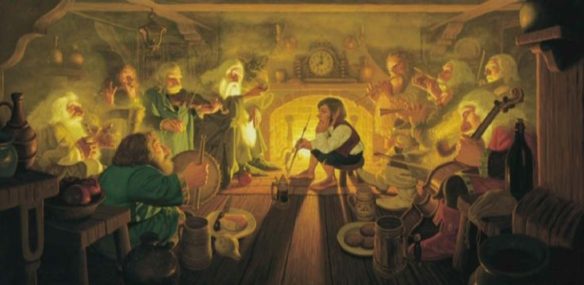
Every Christmas between the years 1920 and 1943, the ever-so-blessed children of J.R.R. Tolkien received some of the most unique mail that a child could ever hope for: letters from Father Christmas himself! Beautifully illustrated and delivered in various ways, they told of all kinds of things that happened at the North Pole, and about the folk who lived there with Santa. There is the accident-prone and sleepy North Polar Bear and his two cousins who cause havoc, the evil goblins, and of course the elves and gnomes, not to mention snowfolk and cave bears. The letters came, or so it is claimed by those who don’t believe in Father Christmas, from the Tolkien children’s father, J.R.R. Tolkien himself.
In the published collection of these charming letters, we can read how the North Pole came to be snapped in half, why Santa had to move house, what a polar bear’s writing looks like (blocky is the best description) and how Santa had to defend his home from goblins. While this book does not directly connect to Tolkien’s Middle Earth mythos, it is easy for anyone versed in that mythos to recognize the origin of some of its characters in these letters. The goblin attack on Santa’s cellar will become the Goblin-Elf wars in The Lord of the Rings, and Santa’s elf-secretary Ilbereth is the obvious progenitor of the ancient elf-queen Elbereth. We even get a fully developed look at elvish writing and the goblin alphabet!
I’ll return to the book that is Letters From Father Christmas, but let me turn now to a reading of the Letters that I recently attended. In my opinion, the Letters truly don’t come to life for modern-day readers unless they are treated to an oral performance of them by accomplished actors. Surely the Tolkien children had the Letters read aloud to them when they received them as ‘mail’ from Father Christmas. The reading I attended took place in the front area of Longfellow Books, a wonderful independent store in downtown Portland, Maine. Kirsten Cappy, publicity manager for Longfellow, gave this introduction before the reading:
On September 3rd, 1973, my father sat at the breakfast table with a bowed head and proclaimed, “Children (he never called us that), today, a god passed from this world.” Now this was a confusing statement from an ardent atheist who declared even our brief foray into the Unitarian church to have been ‘too constricting’. ‘God’ was placed in the same category as ‘Santa Claus’ in our family. Both were classified as something ‘other children believed in and that we could believe in if we felt so inclined.
The ‘god’ my father spoke of was J.R.R. Tolkien, who had passed away the previous day. My brother and I managed to breathe out the question of ‘who?’ before we were waved away and my father dug mournfully into his cornflakes. Our question was answered that night at bedtime when my father opened his battered copy of The Hobbit and began to read.
The three of us read through The Hobbit and each volume of The Lord of the Rings over a year’s worth of bedtimes. Tolkien’s stories are still synonymous with the bedroom I had at that age and the gaping closet that surely housed Orcs.
I have gone on to like fiction of all sorts, but nothing has matched the intensity and obsession that Tolkien brought to his creation of Middle Earth. His professional, scholarly fascination with the dead and evolved languages of England led him to read Norse myth. He then began to create myths of his own and to create languages to feed the mouths of his myth-makers.
Lying in my bed at night I often pictured Tolkien writing, but I never pictured my father’s god with children. He had, in fact, three children and took the time from his research and his conquest of Middle Earth to play the role of Father Christmas each year. Each year for 23 years there would be a letter on the mantle piece from Father Christmas addressed to the Tolkien children. The letters spoke of each year’s chaotic preparation for Christmas, about Father Christmas’ helpers and about the mishaps that would cause some of the promised gifts to never arrive. The Tolkien children would also address letters to the North Pole. The letters were full of Christmas wishes and curious questions about life at the North Pole and about Father Christmas’ companions, Polar Bear and Ilbereth The Elf. Answers would come from Father Christmas and his helpers with lavish descriptions and detailed drawings.
With us tonight are our favorite Portland actors, Moira Driscoll, Mark Honan and Daniel Noel who comprise The Usual Suspects. The Usual Suspects give dramatic readings of modern and classic fiction bi-monthly at Longfellow Books, where they are the resident performance group. (You will note the extravagant whiskers on Daniel and Mark — they are both appearing in The Christmas Carol at Portland Stage Co.) Tonight they will be reading aloud Tolkien’s Letters from Father Christmas in the voices of Father Christmas, Polar Bear and Ilbereth The Elf. I will pass around copies of the book, so you can look at Tolkien’s sweet, obsessive drawings of the North Pole.
By the end of this introduction, the crowd of some forty folks, half adults and half children, including the offspring of several of the performers, had settled in their seats with cookies and hot drinks in hand. Now it was time for the reading…
Two of the actors, Mark Honan and Daniel Noel, were members of the cast of the recent run of A Christmas Carol at the Portland Stage Company, which was staged at Portland Performing Arts Center. Mark Honan, (Cratchit in A Christmas Carol), who played Father Christmas, is a native of England; Daniel Noel (Marley’s Ghost and several other roles, including the Narrator) was the North Polar Bear — fitting given his charming bear-like nature; and Moira Driscoll played the supercilious elf Ilbereth. They sat side by side with their copies of Letters From Father Christmas in hand — I have the copy Daniel read from complete with his post-it notes! — looking absolutely tinkly. And each read the letters as if they were Father Christmas, the North Polar Bear, or Ilbereth. I truly believed that these were letters from Father Christmas to the Tolkien children (keep in mind that this Father Christmas is not by any means a Christian-based being, but rather a sort of friendly teller of tales about what happens during the course of the year at the North Pole).
And oh, what adventures they told on that cold night! They did not read all the Letters — for that pleasure, you’ll need to listen to Derek Jacobi and his friends do it. But they read for about forty-five minutes, the right amount of time on a cold winter’s night, and their selections gave the enthralled listeners a delightful time indeed. Tolkien’s language in these letters is clearer and more playful than in The Lord of The Rings. Just read these lines, which Daniel performed with a gruff voice and a glimmer in his eye: “Polar Bear was allowed to decorate a big tree in the garden, all by himself and a ladder. Suddenly are heard terrible growly squealy noises. We rushed out to find Polar Bear hanging on the tree himself! ‘You are not a decoration,’ said Father Christmas. ‘Anyway, I am alight,’ he shouted. He was. We threw a bucket of water on him. Which spoilt a lot of the decorations, but saved his fur.”
If Tolkien intended The Lord of The Rings to be a ‘mythology for England,’ it’s clear to me that these Letters were a personal mythology for him and his children. No matter that there are reflections of his darker work here — this reading shows beyond any doubt that the Letters were a refuge from the stark realities of being a relatively poorly compensated academic. Even if the children didn’t always get Christmas presents, they did get a letter from Father Christmas.
I turn my attention back to the new edition of Letters From Father Christmas, which was the basis of this performance. This is the first time that all of the letters have been published. What you get are facsimiles of the letters in all their glorious messiness along with a printed version on the facing page in what appears to be a Palatino font so that you can actually read them. This is important, as the handwriting of Father Christmas (roundish like ink dripping from a fountain pen on its last legs), North Polar Bear (chunky — he has big paws), and Ilbereth (best described as spidery) is less than readable.
And the Letters are most definitely worth reading, as they do form an ongoing story that Tolkien very obviously relished telling in the same manner that he first told The Hobbit to his children: as an unfolding narrative over a period of time. It’s worth your time to see how much effort he put into the Letters — handwritings, drawings, quirky borders — all are here. What his children made of them is not known, nor I suppose does it matter now that they belong to all who read them, but I would have preferred Baillie Tolkien, daughter-in-law of J.R.R., to have given us just a bit more context. I even checked The Letters of J.R.R Tolkien to see if there was anything there about these letters, but not according to the index.
My recommendation is that you read these aloud to anyone who will listen, as hearing them does enhance their charm. Barring that, turn the lights down low, sink deep into that overstuffed chair by the fireplace, drink your cocoa, and listen to the cold winter’s wind howl outside as you read. Listen… Is that the North Polar Bear making his way across the roof? Or is it the Goblins attacking again?
(9) COMICS SECTION.
- Frank and Ernest find a rhythm.
- Imagine This adopts a hero.
- Loose Parts witnesses a North Pole rivalry.
- Reality Check refuses its destiny.
- The Argyle Sweater lists what should stay forgotten.
(10) SANTA FE WRITERS PROJECT LITERARY AWARDS SHORTLIST. Congratulations to Oghenechovwe Donald Ekpeki whose soon-to-be-released Afropantheology debut novel Birth of Orisha made the Santa Fe Writers Project literary award shortlist, out of 1700 entries.

(11) ANOTHER BLOW TO U.S. RESEARCH. “A Somber Mood at Science Meeting as Trump Budget Cuts Continue” – the New York Times has the story. (Article is behind a paywall.)
American science is wobbling right now.
After cuts to federal funding and the firing or early retirement of thousands of government scientists this year, another blow to scientific research landed this week. The Trump administration on Tuesday night announced a plan to dismantle the National Center for Atmospheric Research in Boulder, Colo., one of the world’s premier climate and weather science institutions.
News of the planned closure rippled through the annual gathering of the American Geophysical Union, an organization of Earth and space scientists, being held this week in New Orleans.
“You could feel the energy in the room, and it was very sad,” said Mohammed Shehzaib Ali, a graduate student at North Carolina State University who uses NCAR’s supercomputer to run programs to understand how weather patterns affect air pollution from wildfires. “Atmospheric science is built on collaboration, and NCAR is the pathway through which we collaborate,” Mr. Shehzaib Ali said.
The center’s 830 employees conduct research on weather, climate and energy systems, and operate supercomputers that are used by thousands of scientists across the globe. In his announcement, Russell Vought, the director of the Office of Management and Budget, called NCAR “one of the largest sources of climate alarmism in the country.”
Antonio Busalacchi Jr., president of the University Corporation for Atmospheric Research, which manages NCAR, told reporters on Thursday that the center’s research had led to technological advances in aviation, hurricane prediction and space weather. It has also collaborated with the insurance industry to better predict risk from extreme weather.
“We are talking about a significant impact on the scientific enterprise in this country,” Dr. Busalacchi said. Closing the center would be “setting back science in this country by decades.”
(12) TMNT VS. AI. Animation World Network tells readers to look forward to “Ugly Mugs and AI Gone Wrong in ‘Teenage Mutant Ninja Turtles: Chrome Alone 2 – Lost in New Jersey’”.
In the short, produced by Nickelodeon and Paramount Animation with Point Grey Pictures, a mysterious toy company – Authentic Imitations (AI) – looks to profit off the mutant turtles’ new hero status. While brothers Leo, Donnie, Raph and Mikey are out Christmas shopping for their adopted mutant rat dad Splinter, they see a window ad for AI’s new turtle toys which bear a disturbing, twisted and only slightly recognizable resemblance to the heroes.
“I don’t know,” says Seki. “Tortoise Karate Warriors really rolls off the tongue. It’s so natural.”
Determined to stop the copyright madness, the turtle brothers make a trip to AI’s headquarters in New Jersey only to come face to face with a shocking new foe….
…“It took a little bit of time for us to really hone in on the central message of the short,” shared [screenwriter Andrew] Joustra. “There was always a little bit of commentary on consumerism and capitalism. That’s always something holiday shorts like this are great for making conversations about. It got to a point where we were thinking of this toy company taking shortcuts and making these really cheap, blasphemous toys, and probably using AI to do that. Everything started to focus on that and that’s where Chrome Dome entered as a character.”
The original design of Chrome Dome, a long-time TMNT franchise villain, straddled the line somewhere between a shogun warrior and Egyptian pharaoh. But, in Seki’s short, Chrome Dome’s boxy figure looks like someone tried to 3D print TARS from Interstellar and then added a vector graphics screen for a face.
“He’s very shiny and looks very high-tech and fancy,” shares Joustra. “But when you get a little bit closer, you start to ask questions like, ‘Why does this robot have abs?’”…
(13) IN MEMORIAM. “TCM Remembers 2025”.
As the year comes to a close, TCM remembers the actors, filmmakers and creatives we lost this year.
[Thanks to Cat Eldridge, SF Concatenation’s Jonathan Cowie, Mark Roth-Whitworth, N., Steve Vertlieb, Kathy Sullivan, Steven French, Mike Kennedy, Andrew Porter, John King Tarpinian for some of these stories. Title credit belongs to File 770 contributing editor of the day OGH (with a hat-tip to Roger Zelazny).]