Pixel Scroll 12/25/25 Scroll Hard

(0) I’ll start today by thanking the devoted friends who do so much to make the daily Scroll possible. Cat Eldridge, who consults his calendar to provide the spine that centers every edition, often assisted by the fantastically generous Paul Weimer. John King Tarpinian, keeper of the flame of Ray Bradbury, secret sharer of our admiration of the charity of Guillermo del Toro, and minder of genre history. Kathy Sullivan, indefatigable watcher of the daily comics. Chris Barkley, who makes sure I miss no genre news from the trade papers, NPR, or the innumerable other sources he follows. Steven French, who covers the full spectrum of literature and astrophysics. Mark Roth-Whitworth, all-round contributor, and ever alert for science features. Andrew Porter, always finding provocative literature essays and publishing industry news. Plus SF Concatenation’s Jonathan Cowie, our reporter on the best of things in Brit Cit, and a scientist in his own right who knows what’s news.

(1) JUST WHAT HE NEEDED. And next I’d like to play you “Tom Baker’s Christmas message 2025”.

Tom Baker in a 1970s living room, with a Christmas message for his fans.

(2) THE YEAR’S BEST – THAT IS, 55 YEARS AGO. Galactic Journey’s post “[December 24, 1970] ‘oh my God! – it’s full of stars!’” announces their choices for the Galactic Stars of 1970.

The first year of the 1970’s is over, and boy, has compiling statistics been a delight! (and a choreâ€Ķ) I can safely say that it’s been a year of superlatives, and if you spend the next few months plowing through this list, I guarantee you’ll be in for a good experienceâ€Ķ.

Here are the Novelettes that earned stars that year:

Best Novelettes (20-40 pages)

Slow Sculpture, by Theodore Sturgeon

“It’s about a man and a woman, the former an engineer, the latter a cipher, both troubled.  It involves electricity and bonsai and an understated romance.”

This is a story pretty much everyone knew was going to get the Star even when it came out at the beginning of the year.  It got an overwhelming number of nominations.

The Second Inquisition, by Joanna Russ

A visitor from the future(?) arrives in 1925 to upend the social order of things.

The Pressure of Time, by Thomas M. Disch

In the future, social outcasts plan to leave an embattled Ireland for the freedom of England.

Through a Glass—Darkly?, by Zenna Henderson

A woman from the present is witness to the tragic life of a fierce woman of the 19th Century.

(3) NO FUTURE TENSE FOR THESE SHOWS. There are several genre favorites on The Hollywood Reporter’s list. “Canceled After One Season: 26 of The Best TV Shows That Didn’t Last”.

It is not a stretch to say that the contemporary TV audience often feels entitled: to more seasons, to their idea of a perfect ending and even to a reboot — which they sometimes get if the IP is deemed valuable enough. TV has become a wish fulfillment factory. Where viewers don’t get their way, and never really did, is when platforms and networks pull the plug on promising shows after just one season. Plenty of history’s one-season shows, well, they might have been better off as no-season shows. But the list of one-offs that were gone too soon is far too long. And since it’s also too long (and subjective) to get into all of them, let’s stick to the standouts. Here is a look at 26 such series over the past three decades that are still spoken of for having left fans wanting moreâ€Ķ

Here’s one you may have forgotten:

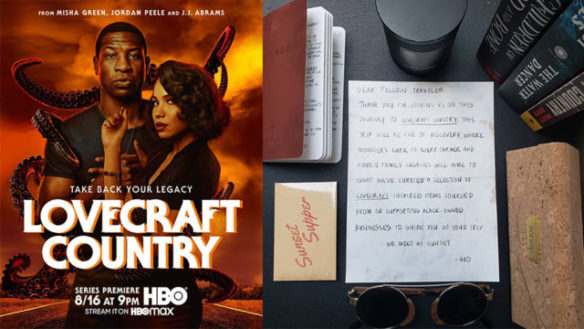
‘Lovecraft Country’ (2020)

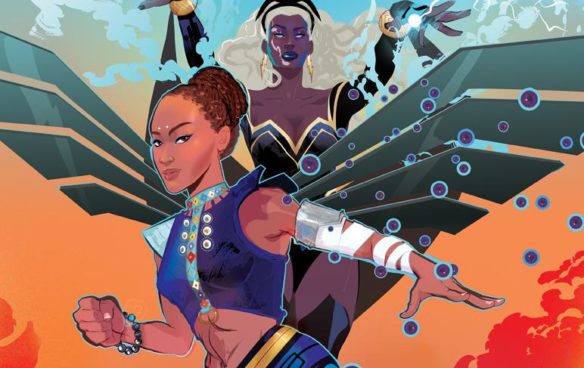
This one is complicated now, knowing what we do about what later happened in real life with male lead Jonathan Majors, so let’s just focus on how this bonkers, expensive and often deeply scary fantasy drama was an incredible showcase for three actresses. Starring Jurnee Smollett, Lovecraft Country also included future King Richard Oscar nominee Aujenue Ellis-Taylor and Sinners scene-stealer Wunmi Mosaku, the three of them forging one of the stronger female ensembles in recent TV history. It ended with enough closure for the one season to stand on its own, but you can’t help but wonder what else they could have done â€Ķ

(4) BAD FOLK OF FANTASY. Yesterday, File 770 published Cora Buhlert’s “Review: Figura Obscura Mouse King Action Figure from Four Horsemen Studios”. She also shared this photo of the figure on Bluesky.

The Mouse King is in his element. #Christmas2025 #FiguraObscura #FourHorsemenStudios #ToyPhotography

Cora Buhlert (@corabuhlert.bsky.social) 2025-12-24T22:59:35.394Z

And Cora also put up another photo of the Evil Horde who are helping decorate her home for the season.

Have a very merry Hordemas. The Mighty Motherboard is so big that she only fits on the living room table, so I left her there when I decorated for Christmas and added a few fellow Horde members. #Christmas2025 #MastersOfTheUniverse #PrincessOfPower

Cora Buhlert (@corabuhlert.bsky.social) 2025-12-24T22:36:48.485Z

(5) BECAUSE OF COURSE IT DOES. Why would I click if it didn’t? “A faster-than-light spaceship would actually look a lot like Star Trek’s Enterprise” asserts Fast Company.

The USS Enterprise was an impossible dream rendered in fiber glass. Designed for Star Trek, it looked like a creation straight out of creator Gene Roddenberry’s imagination: Twin nacelles—those long, gleaming engine pods held by elegant pylons—extended from a central saucer holding the engines that allowed Captain Kirk, Mr. Spock, Dr. Bones, and the rest of the crew to travel across the cosmos.

Inside those nacelles, the show’s creators imagined, lay the secret that made those trips possible: a warp drive that could crease spacetime itself, folding the universe in front of the ship while unfurling it behind, allowing faster-than-light travel not through speed but through geometry. For decades, physicists dismissed it as beautiful nonsense—a prop master’s fever dream.

But now the math has caught up to the dream.

Harold “Sonny” White—a mechanical engineer and applied physicist who worked on warp drive concepts at NASA’s Advanced Propulsion Physics Laboratory—has published a peer-reviewed paper in the prestigious Classical and Quantum Gravity that proposes a new design for a warp drive that happens to look a lot like the Enterprise.

(6) GEORGE BARR’S REASONS FOR THE SEASON. A year ago Black Gate helped promote a Kickstarter to collect “George Barr’s Christmas Card Fantasies” with a post that included a large gallery of examples. Here’s one of the art panels they published:

(7) TODAY’S BIRTHDAY.

[Written by Paul Weimer.]

December 25, 1899Humphrey Bogart. (Died 1957.)

By Paul Weimer: Sure, Humphrey Bogart was never in a SF/F film but his work in allied genres classifies him as being worthy of the scroll.  

I’ll begin with Casablanca, since that is where I first recall seeing him. WPIX again, of course, this black and white film came on, apparently set during the war. Watching it without context gave me some weird ideas what was going on until I finally saw it start to finish. I’ve watched it many many times, since.

My next encounter with Bogart was on the African Queen, one of the best adventure movies ever made. I had already seen Katherine Hepburn (in The Lion in Winter), so this looked like a fun pairing. And it is!  Katherine Hepburn and Humphrey Bogart take on Nazis in Africa is a swell way to spend a Saturday Afternoon. 

With The Maltese Falcon, I got the Bogart-Lorre reunion I didn’t know but I wanted. The two actors work wonderfully together, and it was that which inspired me for years to “play” Peter Lorre in Skiffy and Fanty Torture Cinema skits.  But indeed, if anyone could ever find the real Maltese Falcon, it would be Bogart. 

I encountered other Bogart noir films, especially The Big Sleep, which has one of my all time favorite scenes as Bogart and an uncredited Dorothy Malone as a bookstore owner flirt outrageously. Sexy? Darn right it is.

Since I was and am still late to westerns, it took me awhile to get to movies like Treasure of the Sierra Madre.  I still don’t think of Bogart as one for the country or the wilderness in his roles. Even with movies like the aforementioned African Queen and The Caine Mutiny notwithstanding, a dark nightclub, the mean streets of a city, that’s where Bogart is always in my mind.  And yes, frequently with Lauren Bacall somewhere around. Why mess with one of the best actor-actress pairings in movie history in my brain?

And I return to Casablanca, one of the best movies ever made and Bogart is a big part of that. Sure, he has a dream cast to work with, and a killer script, but the world weary Rick could not be portrayed by a better actor, before, then or since. 

Cheers, Mr. Bogart. Cheers.

(8) MEMORY LANE.

[Written by Cat Eldridge.]

How The Grinch Stole Christmas (1966)

Once upon a Christmas season, there was a television show called How The Grinch Stole Christmas. A television show that explicitly had a message that Christmas was neither a celebration of the birth of Christ, nor was it something that comes in a box, but rather is a matter of remembering that we hold each other in our hearts. Warm, fuzzy, and aggressively secular. In 1966 no less!

Aired on December 18 on CBS, the short film, just 26 minutes long, aired on that network for 21 years; ABC has aired it starting 2006, and then Turner Broadcasting has been airing, well until now as you’ll see below. I just watched it after getting it off iTunes where it comes bundled with Horton Hears A Who. (Both of these would be made into films that were awful.) This animated version was written by Christine Kenne from the brief children’s book by Theodore Geisel writing as Dr. Suess; it was produced by him and Chuck Jones who also directed it rather brilliantly.

The animation style looks more than a little flat but that just adds to the feel of it being a folk tale about a villain in his lair high on the mountain, The Grinch, who decides he can’t stand all the noise and commotion of the Whos down in Whoville enjoying Christmas. Not to mention his disgust at them eating the rare roast beast. So he concocts a brilliant scheme to dress as Santie (sic) Claus and take a sleigh down into Whoville (his dog Max with an antler tied to his head being a poor substitute for a reindeer) and steal everything down and including a crumb of food so small that even a mouse wouldn’t eat it.

So up to the top of Mount Crumpet he rides waiting for them to all go ‘boo who’ when they discover everything is gone, but instead he hears them all signing out in joyful voices thereby providing the upbeat moral of this which I noted previously. Hearing this, his heart grows multiple sizes and he rescues the now falling load with ‘the strength of ten Grinches plus two’. Riding into Whoville, he grins ear to ear, and he, the now reformed Grinch, has the honor of carving the roast beast.

I watch it every year this as I really like it. I love the bit, used twice, of increasingly small Whos, once serving tea and the second time a strawberry to a small Who girl, by coming out of a series of covered dishes.

A final note must be devoted to this being I believe the last performances of Boris Karloff who both narrated it, voiced and made the sounds of The Grinch and of this tale which I noted above sung all of its songs save ‘You’re a Mean One, Mr. Grinch’ which was, though uncredited, sung by Thurl Ravenscroft, one of the booming voices for Kellog’s Frosted Flakes. Karloff won the only performance award he got as he was awarded a Grammy in the Spoken Word category!

It’s one of the best Christmas shows ever!

It is streaming on Peacock now. So go watch it. The red-haired, green-eyed Suck Fairy says you really should.

(9) MEMORY LANE.

[Written by Aurora Winter.]

The Lion in Winter (1968 and 2004)

In 1968 MGM Studios teamed up with James Goldman to adapt his play The Lion in Winter for the screen. At the time the play had been a flop, running for a mere eighty-three performances on Broadway two years previous. The movie was made and was not only a success, but also breathed new interest into the stage version. I first encountered the 1968 film in university and read the script.

The title, for those of you rusty with your English history, refers to King Henry II (the lion was his crest) being in the “winter” of his life. At this point in history King Henry II had a kingdom that stretched into France and was in need of choosing his heir. Eleanor of Aquitaine, Henry’s wife, was imprisoned in a castle (thanks to Henry who was the key keeper). Goldman’s story is a fictional account of the Christmas court held to determine the future king. A complicated story this is, the wit in the script combined with the actors’ stellar timing make it worth watching again and again.

Seven characters, each tremendously important, make up the cast . . . and what a cast it is. The role of the fifty-year-old (quite old for 1183) King Henry is played by a mature Peter O’Toole. Katherine Hepburn was granted the role of the spunky and vivacious Eleanor of Aquitaine. The three sons up for the throne are: Richard (Anthony Hopkins), John (Nigel Terry), and Geoffrey (John Castle). Let us not forget Alais (Jane Merrow) either, the young girl given to Henry by the French king sixteen years before to one day be the bride for the chosen king. Beyond this it is useless to explain more of the plot as it is far too complicated.

I said that the timing was crucial to the success and enjoyment one can experience with this film. While some may not appreciate a film that finds its humor through fast paced, verbal, intelligent wit with little ‘sight gags’ and no slapstick, I adore it. Each scene seems half the length it actually is because these actors are so tight in their character that they can fire one-liners back and forth without ever seeming fake or forced. One gets the sense that these conversations might have occurred between Eleanor and Henry, Henry and Alais, Richard and Philip, John and Geoff.

The technical aspects of this film are quite impressive too, period costume more accurate than those generally seen in such films. The whole movie takes place within Henry’s castle in Chinon, a vast castle in the cold of December, and the production crew made sure we felt the draft from the open spaces and cold stone. The cinematography often mirrors the long walking shots that we now see all the time on West Wing, creating the feeling that we have been transported back centuries to drop in on this family crisis.

While this film does have some minor downfalls — Morrow’s Alais is a bit too whiny for my taste and a few gems were cut from the original text and replaced with extraneous muck (I’m still holding out for the version that leaves those gems in) — they are easily ignored and outdone by the beauty of the final work. It is no surprise that this launched Anthony Hopkins into stardom, or how so many see Hepburn (she did win the Best Actress Oscar for this role) and O’Toole as the definitive Eleanor and Henry. If, somehow, you have missed this piece of film history, go rent the DVD, sit back, and allow yourself to be transported back to 1183.

I am not a big fan of remakes when it comes to the film industry, especially when the original was so fantastic. But every now and then someone comes along and surprises me with a new-old movie that is as good, or better than the original. This was what I discovered after I watched the 2004 version of The Lion in Winter.

(10) COMICS SECTION.

(11) TRUE MOB. “Nuts & Bolts: George Anastasia of Netflix’s ‘Mob War’” tells readers of the Horror Writers Association blog how write more realistic criminals.

Mobsters have a long history with horror. No, this is not an exposÃĐ. Stephen King, Clive Barker, and Laird Barron have written about them. They’ve prowled the shadowy underworlds of John Constantine and Felix Castor, and taken center stage in everything from survival horror to Twilight Zone episodes.

If your horror fiction includes mobbed-up characters and you’d like them to ring true, legendary crime writer George Anastasia offers some advice in this month’s edition of Nuts & Bolts.

Nearly 50 years ago, George started covering the local Mafia for the Philadelphia Inquirer, and did such a good job that mob boss John Stanfa put out a hit on him. He’s since released six books, profiling real-life criminals including mafiosi and outlaw bikersâ€Ķ.

Q: WHAT ADVICE WOULD YOU GIVE A FICTION AUTHOR WHO WANTS TO WRITE A REALISTIC PORTRAYAL OF MOBSTERS?

A: Read newspaper and magazine accounts about organized crime figures and look for documented (federal court records, defense attorney filings, etc.) examples of mobsters talking in unguarded moments. There’s a lot out there.

The biggest problem with writing non-fiction is the lack of dialogue but given the extensive use of electronic surveillance, there plenty of examples of mobsters talking about anything and everything – from petty gossip to murders.

(12) TOY HISTORY ENDS. [Item by Cora Buhlert.] Playmates Toys have lost the license for Teenage Mutant Ninja Turtles after 38 years: â€œTeenage Mutant Ninja Turtles Are Moving Away from Playmates in 2027” at Bleeding Cool. This is huge news, because not only were Playmates Toys the first to make TNMT toys, but apparently TNMT also makes up half of their entire revenue, so this is a huge blow to them. Playmates were also pretty open to sublicense TNMT to other companies for higher end collector figures, crossovers, etc… 

…After 2026, Playmates can no longer manufacture or sell TMNT toys unless a new agreement is reached. TMNT has been a significant part of Playmates’ business, accounting for nearly half (or more) of their yearly revenue in recent years, so this is a major change for the company. Losing the license marks the end of an era, and figures released before 2027 may become more desirable to collectors over time. Playmates will instead continue to focus on their other brands, such as Power Rangers, MonsterVerse, and Winx, going forward. It’s unclear where the Teenage Mutant Ninja Turtles will go next, but they still have figures arriving from NECA and Super7 in the meantime. Check out â€Ķ the Playmates Press Release â€Ķ online.

 (13) FOR EVERYONE ELSE. Merry Christmas to those who are merry. Season’s greetings to those who are well seasoned!

[Thanks to Kathy Sullivan, Steven French, Mike Kennedy, Cora Buhlert, Andrew Porter, John King Tarpinian, Cat Eldridge, SF Concatenation’s Jonathan Cowie, and Mark Roth-Whitworth for some of these stories. Title credit belongs to File 770 contributing editor of the day OGH. It is a Christmas movie Scroll, so I keep reading.]

Pixel Scroll 9/10/21 It Was A Pixel Scroll Of Rare Device

(1) EATING THE FANTASTIC. Scott Edelman offers listeners a chance to feast on Indian food with Veronica Schanoes in episode 153 of his Eating the Fantastic podcast.

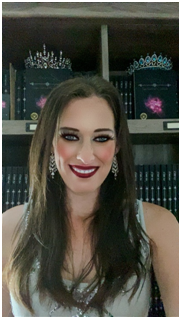
Veronica Schanoes

Award-winning writer Veronica Schanoes and I shared Indian food though there were hundreds of miles between us — hers from Brooklyn, New York’s Masala Grill, me from Hagerstown, Maryland’s Sitar of India.

Veronica Schanoes has published fiction in the magazines Lady Churchill’s Rosebud WristletSybil’s Garage, and Fantasy; the anthologies The Doll CollectionQueen Victoria’s Book of Spells: An Anthology of Gaslamp FantasyThe Mammoth Book of Cthulhu: New Lovecraftian Fiction; and online at Strange Horizons and Tor.com. Her novella “Burning Girls” was nominated for the Nebula Award and the World Fantasy Award, and won the Shirley Jackson Award for Best Novella in 2013. Her first scholarly monograph, Fairy Tales, Myth, and Psychoanalytic Theory: Feminism and Re-telling the Tale, was published by Ashgate in 2014. Her collection Burning Girls and Other Stories was published earlier this year.

We discussed what it’s been like trying to write her first novel during a pandemic, why she can only read Jane Yolen’s intro to her new collection half a page at a time, how she makes sure her fairy tale-inspired fiction works even for those who don’t catch the allusions, the joy which comes from putting the right words in the right order, how Kelly Link convinced her she should take herself seriously as a writer, whether research inspires stories or stories inspire research (and how writers make sure they don’t force readers to suffer for that research), the way fairy tales take place “outside of historical space-time,” the importance of Joe Strummer and the Clash, and much more.

(2) MODERN THOUGHT. S.E. Lindberg interviews pulp scholar and sword-and-sorcery author and editor Jason Ray Carney at Black Gate. “Sublime, Cruel Beauty: An Interview with Jason Ray Carney”.

What is this concept of Modernity, and why did it haunt/inspire you to write a thesis on it?

Modernity is one of those concepts with a rich intellectual history, and people spill a lot of ink over it, but it is not very complicated (in my opinion): sometimes around the 1780s, the world changed. Feudalism gave way to democracy. New technologies upset how human economies and cities were organized. Religious belief waned and changed. We stopped believing (for the most part) in the supernatural. Let me cite Max Weber again: with modernity, the world became “disenchanted.” This, of course, is only part of the story. Though this story is myopic in its Eurocentrism, it is not less valid for its narrow purview. The story of modernization outside of Europe can be told, but it will be different, with maze-like branching conversations that posit multiple “modernities.” Anyway, modernity really intrigues me.

(3) VINDICATION. In “confirmation”, former Hugo Awards administrator David Bratman tells how he once found himself at loggerheads with Locus’ Charles N. Brown.  

When I was administrator for the Hugo Awards in 1996, one of the Best Novel finalists* was Remake by Connie Willis. By that time, SF novels were tending very long, but Remake was short. Though published as a standalone volume, it made a small one.

Charles Brown of Locus,** the newsletter of the SF field, insisted to me that Remake was under 40 thousand words and thus, by Hugo rules (which were shared in this respect by most other awards in the field), it fell in the Novella category, not Novel. And indeed, in the Locus awards it was put in the Novella category, which it won (not surprisingly, being one of the longest in the category as well as being by Connie Willis)â€Ķ.

The rest of the analysis is at the link.

(4) FICTION IN TRANSLATION. Jennifer Croft argues “Why translators should be named on book covers” in The Guardian.

“Translators are like ninjas. If you notice them, they’re no good.” This quote, attributed to Israeli author Etgar Keret, proliferates in memes, and who doesn’t love a pithy quote involving ninjas? Yet this idea – that a literary translator might make, at any moment, a surprise attack, and that at every moment we are deceiving the reader as part of an elaborate mercenary plot – is among the most toxic in world literature.

The reality of the international circulation of texts is that in their new contexts, it is up to their translators to choose every word they will contain. When you read Nobel laureate Olga Tokarczuk’s Flights in English, the words are all mine. Translators aren’t like ninjas, but words are human, which means that they’re unique and have no direct equivalents. You can see this in English: “cool” is not identical to “chilly”, although it’s similar. “Frosty” has other connotations, other usages; so does “frigid”. Selecting one of these options on its own doesn’t make sense; it must be weighed in the balance of the sentence, the paragraph, the whole, and it is the translator who is responsible, from start to finish, for building a flourishing lexical community that is both self-contained and in profound relation with its modelâ€Ķ.

(5) MARTIN ON MALTIN. [Item by Martin Morse Wooster.] I listened to this 2018 podcast Leonard and Jessie Maltin did with Floyd Norman, a pioneering Black animator and cartoonist (Maltin on Movies: Floyd Norman).

Norman started working for Walt Disney in the mid-1950s, and remembers being at Disneyland during its opening week (but not opening day, a legendary disaster). He recalls what it was like producing feature-length animation before computers and how everyone involved in animated film “worked like Marines” until the job was done, although Walt Disney insisted everyone leave the studio at 9 to spend some time with their families. People who remember the “string of pearls” sequence in Mary Poppins should realize that was a sequence that stressed out the animators.

Norman talked about how he was hired and quit Disney several times, and was involved in developing the stories for PIxar’s Toy Story 2 and Monsters Inc.  He also self-published his own books of cartoons, including one entirely devoted to making fun of Disney CEO Michael Eisner, who Norman thinks a major egotist.  Norman says Eisner didn’t mind the criticism, “as long as the book was about him.”

This may be too DIsney-centric for some but I enjoyed this episode.

(6) CHECK IT OUT. The New Yorker’s Daniel A. Gross analyzes “The Surprisingly Big Business of Library E-books”.

The sudden shift to e-books had enormous practical and financial implications, not only for OverDrive but for public libraries across the country. Libraries can buy print books in bulk from any seller that they choose, and, thanks to a legal principle called the first-sale doctrine, they have the right to lend those books to any number of readers free of charge. But the first-sale doctrine does not apply to digital content. For the most part, publishers do not sell their e-books or audiobooks to libraries—they sell digital distribution rights to third-party venders, such as OverDrive, and people like Steve Potash sell lending rights to libraries. These rights often have an expiration date, and they make library e-books “a lot more expensive, in general, than print books,” Michelle Jeske, who oversees Denver’s public-library system, told me. Digital content gives publishers more power over prices, because it allows them to treat libraries differently than they treat other kinds of buyers. Last year, the Denver Public Library increased its digital checkouts by more than sixty per cent, to 2.3 million, and spent about a third of its collections budget on digital content, up from twenty per cent the year beforeâ€Ķ.

(7) UP ALL NIGHT. It so happens the only time I ever watched Adult Swim was sitting in a hospital waiting room after driving someone to ER — but that’s not a knock, what I saw was pretty amusing. The New York Times celebrated the program block’s 20th anniversary with an oral history: “Adult Swim: How an Animation Experiment Conquered Late-Night TV”.

By all accounts, it was a minor miracle that Adult Swim ever made it off the drawing board 20 years ago. Money was next to nonexistent. The editor of Cartoon Network’s first original series worked from a closet. A celebrity guest on that series, unaware of the weirdness he had signed up for, walked out mid-taping.

In retrospect, it seems right that one of modern TV’s most consistent generators of bizarro humor — and cult followings — had origins that were, themselves, pretty freewheeling.

WILLIS The idea for “Aqua Teen Hunger Force” started with a [expletive] fast food restaurant that tried to use all the scraps of meat they weren’t allowed by the F.D.A. to put into a hamburger, wadded together. We saw Meatwad as this poor, neglected creature — I think his line in his first script was like [in Meatwad voice], “Please, God, kill me.” I did the voice, and I can’t tell you how many times people said, “I don’t understand what he’s saying; you need to recast him.” But we stuck to our guns. I always thought of it like Willie Nelson, who sings real quietly, and so everyone is on the edge of their seat trying to listen to what he’s saying. As a result, you’re more into it. At least, that was my excuse! [Laughs.]

(8) LIFE OF LEWIS. A trailer dropped for the C.S. Lewis biopic titled The Most Reluctant Convert: The Untold Story Of C.S. Lewis that arrives in theaters November 3.

(9) TIME HAS BEEN BROKEN. So they tell us. The new season of Star Trek: Picard premieres February 2022 on Paramount+.

(10) BUCKS AND BUCK ROGERS. Think of it as the military-industrial-entertainment complex: “The making of an Enterprise: How NASA, the Smithsonian and the aerospace industry helped create Star Trek” in The Space Review.

â€ĶAt the end of WWII, 60–70% of the American aerospace industry was based in Southern California. The good climate and open land that helped draw aviation to the region also helped lure the motion picture industry. When Roddenberry began developing Star Trek, 15 of the 25 largest aerospace companies were located in the greater Los Angeles area. Many were situated close to Paramount’s Desilu Studios where the series was made.

Roddenberry drew upon the most current spaceflight technology then available to incorporate into Star Trek. He read, wrote, phoned and even dumpster-dived to get material for his new series.

A direct example of how the aerospace industry influenced Star Trek appears in the episode “The Trouble With Tribbles.” In this episode furry little creatures that “coo” and have a tremendous desire for eating and breeding overrun the Federation’s K-7 space station.

The principal elements of the K-7 as it is shown in the episode first appeared in a report done by Douglas Aircraft. The 1959 study outlined the operational requirements of an extendable orbiting space station. Constructed on Earth then launched atop a “Saturn-type missile,” the station was designed to automatically unfold in space into a donut-shape with a conical reentry vehicle at its center.[3]

Richard Datin, a model maker who helped build the original production model Enterprise, described how the K-7 design materialized. “I was told upon viewing the original model, and maybe by Roddenberry, that he obtained it [the Douglas space station model] from Douglas Aircraft whose main office was in nearby Santa Monica. Apparently, Gene had a following from people in the space industry, particularly Caltech in Pasadena.”

(11) MICHAEL K. WILLIAMS (1966-2021). Actor Michael K. Williams died September 6 at the age of 54 reports the New York Times.  While famous for his work in cop and crime series including The Wire and Boardwalk Empire, sff fans knew him as the lead in Lovecraft Country, and saw him in the 2014 RoboCop remake, The Purge: Anarchy (2014), and Ghostbusters (2016).

(12) MEDIA BIRTHDAY.

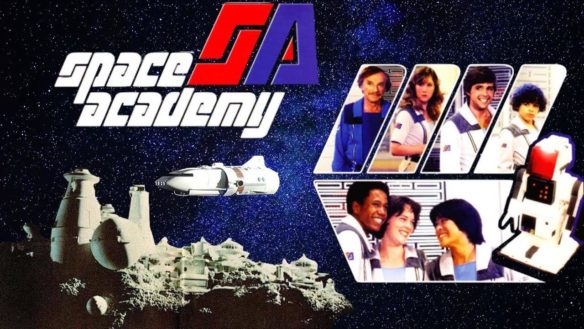
  • 1977 – Forty-four years ago this evening on CBS, Space Academy, a Filmation children’s series, first aired. (Jason of Star Command would come out of it.) It was created by Allen Ducovny who previously only done such animated shows as The New Adventures of Superman and Aquaman. The program starred Jonathan Harris in the lead role; co-starring were Pamelyn Ferdin, Ric Carrott, Maggie Cooper, Brian Tochi, Ty Henderson, and Eric Greene. There was a cute robot as well named Peepo. Would I kid you?  It would last for just fifteen half-hour episodes. 

(13) TODAY’S BIRTHDAYS.

[Compiled by Cat Eldridge.]

  • Born September 10, 1914 — Robert Wise. Film director, producer, and editor. Among his accomplishments are directing The Curse of The Cat People, The Day the Earth Stood Still, The Haunting, The Andromeda Strain and Star Trek: The Motion Picture. Though not at all genre, he also directed West Side Story and edited Citizen Kane,  two exemplary accomplishments indeed. (Died 2005.)
  • Born September 10, 1937 — Spencer Milligan, 84. He’s best known for playing Rick Marshall, the father of Will and Holly Marshall, on the first two seasons of Land of the Lost. (He left because he didn’t get a cut of the merch sales.) Genre wise, he’d previously been in Woody Allen’s Sleeper as Jeb Hrmthmg, and later appeared in an episode of The Bionic Woman. That’s it.
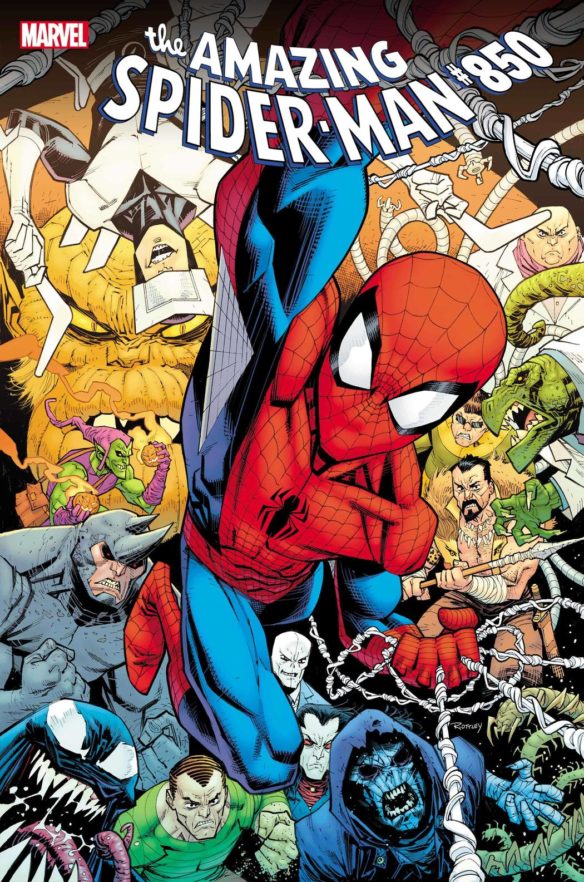
  • Born September 10, 1952 — Gerry Conway, 69. He’s  known for co-creating  the Punisher (with artists John Romita Sr. and Ross Andru) as well as the first Ms. Marvel and scripting the death of the character Gwen Stacy during his run on The Amazing Spider-Man. He shares the story credit for Conan the Destroyer with Roy Thomas. At DC, he created a number of characters including Firestorm, Count Vertigo and Killer Croc. Not genre at all, but he wrote a lot of scripts for Law and Order: Criminal Intent, one of my favorite series.
  • Born September 10, 1953 — Stuart Milligan, 68. He first shows up as Walters on the Sean Connery-led Outland and a few years later we see him as a Police Sergeant on Sky Captain and the World of Tomorrow. He’ll play Richard Nixon in Doctor Who for two Eleventh Doctor stories, “The Impossible Astronuat” and “Day of The Moon”. His latest genre role is in Wonder Woman 1984 as the U.S. President.
  • Born September 10, 1953 — Pat Cadigan, 68. Tea from an Empty Cup and Dervish is Digital are both amazing works. And I’m fascinated that she has co-written with Paul Dini, creator of Batman: The Animated Series, a DCU novel called Harley Quinn: Mad Love. Her only Hugo win was at LoneStarCon 3 for the “The Girl-Thing Who Went Out for Sushi” novelette.  Her latest work is the novelization of the first-draft Alien 3 screenplay by William Gibson. She’s well stocked at the usual suspects. 
  • Born September 10, 1955 — Victoria Strauss, 66. Author of the Burning Land two novel series, and she should be praised unto high for being founder along with AC Crispin of the Committee on Writing Scams. She maintains the Writer Beware website and blog. 
  • Born September 10, 1959 — Nancy A. Collins, 62. Author of the Sonja Blue vampire novels, some of the best of that genre I’ve ever had the pleasure to read. She had a long run on Swamp Thing from issues 110 to 138, and it is generally considered a very good period in that narrative.  She also wrote  Vampirella, the Forrest J Ackerman and Trina Robbins creation, for awhile. 
  • Born September 10, 1968 — Guy Ritchie, 53. Director of Sherlock Holmes and its sequel Sherlock Holmes: A Game of Shadows, both of each I rather liked, and the live-action Aladdin. He did also directed / wrote / produced the rebooted The Man from U.N.C.L.E. which got rather nice reviews to my surprise as well as King Arthur: Legend of the Sword which apparently is quite excellent as audience reviewers at Rotten Tomatoes give it a seventy percent rating. 

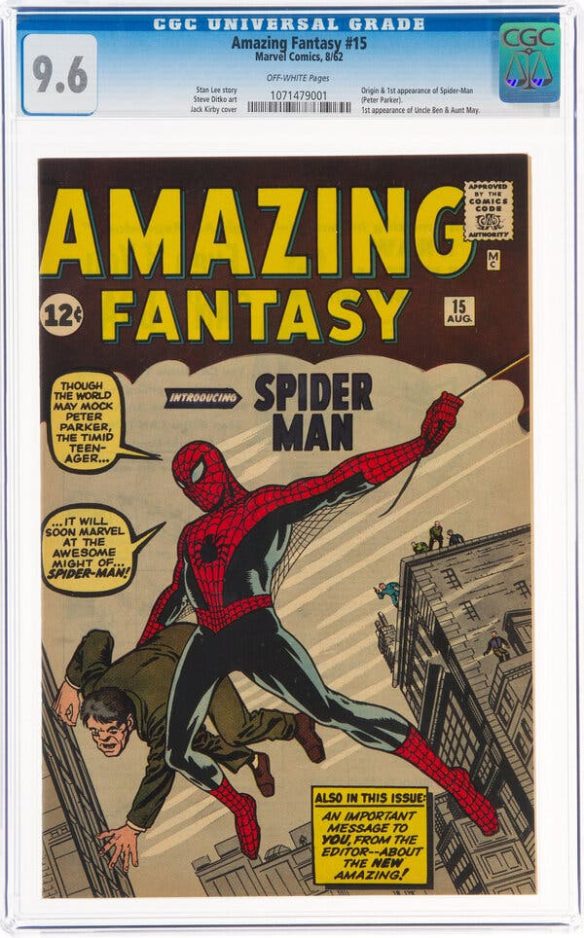
(14) FRIENDLY NEIGHBORHOOD RECORD-SETTER. The Hollywood Reporter knows it’s worth a headline when “First Spider-Man Comic Book Sets Record for Biggest Sale Ever”.

The sale of Amazing Fantasy no. 15, featuring the first appearance of Spider-Man, has set the record for the most expensive comic ever sold.

The comic sold Thursday for $3.6 million as part of Heritage Auction’s Signature Comics & Comic Art auction being held Sept. 8 to 12.

The senses-shattering sale beat out the previous record, Action Comics no. 1, published in 1938 and featuring the first appearance of Superman, which sold privately for $3.25 million earlier this year.

(15) A SLEIGHLOAD TO ADD TO YOUR MT. TBR. SFÂē Concatenation has posted its list of “Forthcoming SF books in the run-up to Christmas UK SF book releases September – 31st December 2021” from the major UK imprints (available/or on order elsewhere from specialist bookshops). This is an advance posting (6th September) of the ‘forthcoming books’ sections’ of SFÂē Concatenation’s autumnal news page whose full edition will be posted September 15. 

With just 90, or thereabouts, shopping days to Christmas, time to see what SF will be published. The SFÂē Concatenation seasonal news page’s forthcoming books listings are an amalgamation of the titles in the catalogues sent by major UK publishers. 

As they these titles already in the catalogues, they can be ordered, or advance-ordered, now either from the publisher directly or – if you are outside the UK – from specialist SF bookshops and their related retail websites.

The books are listed alphabetically by author.

(16) SPEAKER FOR THE READ. The next episode of Essence of Wonder with Gadi Evron is “You’re Not Ender Wiggins, and That’s Okay – A Show on Strategy, Leadership, and Modern Conflict by Way of Scifi.” Streams Saturday, September 11 at 3:00 p.m. Eastern via YouTube, Facebook Live, and Twitch.

Steven Leonard, Max Brooks, Major General Mick Ryan, and Jon Klug, join us to discuss strategy, leadership, and modern conflict from the perspective of science fiction.

One of the chapters in the book is called “You’re Not Ender Wiggins, and That’s Okay” (by Will Meddings). Be still, my heart.

(17) HUGE NEWS. A T-Rex might have made a nice snack for one of these: “Researchers Identify Dinosaur Species 5 Times Larger Than the T-Rex: ‘This Is Very Exciting’” – Yahoo! News has the story.

Researchers have discovered a new species of dinosaur that loomed over Tyrannosaurus Rex.

The Calgary Herald reports that University of Calgary scientists helped identify the massive new species named Ulughbegasaurus, which roamed the earth as an apex predator 90 million years ago.

Researchers were able to identify the new species — which was five times bigger than the fearsome T-Rex — through the dinosaur’s fossilized jaw, which was likely first found by a Russian paleontologist during a dig in the 1980s.

â€ĶThe researchers found that the dinosaur was between 7.5 to eight meters (24 to 26 feet) in length and likely weighed over 1,000 kilograms (2,204 lbs). At the time Ulughbegasaurus roamed the earth, the T-Rex wasn’t fully evolved and was much smaller in comparison, weighing less than 200 kilograms (440 lbs).

Comparing the two species, Zelenitsky said Ulughbegasaurus “was like a grizzly bear” if T-Rex had been a coyoteâ€Ķ.

(18) CUBE ROOTS. The New York Times shares scientists’ curiosity about a relic that lends itself to alternate history: “Did Nazis Produce These Uranium Cubes? Researchers Look for an Answer.”

The failure of Nazi Germany’s nuclear program is well established in the historical record. What is less documented is how a handful of uranium cubes, possibly produced by the Nazis, ended up at laboratories in the United States.

Scientists at the Pacific Northwest National Laboratory and the University of Maryland are working to determine whether three uranium cubes they have in their possession were produced by Germany’s failed nuclear program during World War II.

The answer could lead to more questions, such as whether the Nazis might have had enough uranium to create a critical reaction. And, if the Nazis had been successful in building an atomic bomb, what would that have meant for the war?

Researchers at the laboratory believe they may know the origins of the cubes by the end of October. For the moment, the main evidence is anecdotal, in the form of stories passed down from other scientists, according to Jon Schwantes, the project’s principal investigator.

The lab does not have scientific evidence or documentation that would confirm that Nazi Germany produced the black cubes, which measure about two inches on each side. The Nazis produced 1,000 to 1,200 cubes, about half of which were confiscated by the Allied forces, he said.

“The whereabouts of most all of those cubes is unknown today,” Dr. Schwantes said, adding that “most likely those cubes were folded into our weapons stockpile.”â€Ķ

(19) THE TRUTH MAY BE OUT THERE, IT’S NOT HERE. Samantha Bee of Full Frontal shares“Sam Bee’s Not-Solved Mysteriez: UFOs” on YouTube.

Sam once again dons her trench coat to take one small step for man and one giant leap for a late night television host with an “Unsolved Mysteries” obsession. That’s right…she’s trying to figure out WTF is up with UFOs!

[Thanks to Mike Kennedy, Andrew Porter, Martin Morse Wooster, JJ, Cora Buhlert, SF Concatenation’s Jonathan Cowie, Michael Toman, John King Tarpinian, and Cat Eldridge for some of these stories. Title credit belongs to contributing editor of the day Jayn.]

Pixel Scroll 7/3/21 Neunundneunzig Scrollballons

(1) LOVECRAFT COUNTRY: WHAT MIGHT HAVE BEEN. The show was not renewed. Deadline has a glimpse of what was planned: “Lovecraft Country Season 2 Teased By Creator Misha Green After HBO Cancelation”.

A very very different America was going to be unveiled in Season 2 of Lovecraft Country, creator Misha Green revealed today after HBO officially pulled the plug on the acclaimed horror drama.

A couple of hours after Deadline exclusively reported on the surprising demise of the the Jurnee Smollett, Jonathan Majors and Michael Kenneth Williams starring series, showrunner Green took to social media to paint a picture of what might have been. It was certainly something to see, especially leading into the July 4th weekend:

https://twitter.com/MishaGreen/status/1411123731653566466

(2) BARBARIC YAWP. Cora Buhlert’s provocatively-titled “Conan the Socialist” lives up to its billing. (You never suspected that about Conan, did you?) BEWARE SPOILERS about the Thirties Robert E. Howard tale under discussion.

â€Ķ My teenaged self certainly enjoyed the Conan stories as great and glorious adventures. Plus, there was the thrill of reading “violent American trash” that sensible educated people weren’t supposed to read or enjoy. However, upon rereading these stories as an adult, I find that there is a lot of depth and subtext in the Conan series that my teenaged self missed.

(3) I’LL BE BACK. And he was. The Ringer talked to filmmakers and actors to come up with “The Oral History of ‘Terminator 2: Judgment Day’”

T2 is a departure from the far bleaker original, 1984’s The Terminator, which its creator calls a “science-fiction slasher film.” Linda Hamilton’s franchise protagonist, Sarah Connor, has transformed from a put-upon heroine to a self-trained commando whose attempts to thwart the coming apocalypse land her in a psychiatric hospital. Her son, John, the future leader of the resistance in the war against the genocidally self-aware defense system Skynet, is in foster care. And the T-800, once a remorseless killer with a curious but hypnotic Austrian accent, somehow helps bring them together as a family—then helps them save the world.

â€Ķ Cameron: I talked to Dennis Muren at ILM. I said, “I’ve got an idea. If we took the water character from The Abyss, but it was metallic so you didn’t have the translucency issues, but you had all the surface reflectivity issues and you made it a complete human figure that could run and do stuff, and it could morph back into a human, and then turn into the liquid metal version of itself, and we sprinkled it through the movie, can we do it?” He said, “I’ll call you back tomorrow.”

â€Ķ Cameron: Linda, I called her up and I said, “Look, they want to pay us a lot of money to make a sequel. Are you in or are you out? But just between you and me, I don’t really want to do it if Sarah doesn’t come back and I don’t want to recast Sarah, so you got to say you’re in.” And she and I weren’t involved. [Editor’s note: Cameron and Hamilton were married from 1997 to 1999.] We hadn’t even really hung out at all much since the first film. She was making a movie somewhere down South.

And so she said, “Yeah, in principle, I’m in, but I want to be crazy.” I said, “Well, what do you mean, crazy? How crazy?” She said, “Crazy, like I’ve been driven crazy.” I said, “Like you’re in an insane asylum, like you’re institutionalized?” She said, “Yeah, sure. Let me play crazy. Let me go nuts.” I said, “All right. Well, you’re going to get my version of nuts,” and she said, “All right. I’m down.”

(4) ROBOHOP. New Scientist’s reviewer says “A Psalm for the Wild-Built by Becky Chambers is joyful sci-fi reading”.

â€ĶThe book is set some time after this Transition, and follows a tea monk, Sibling Dex, who goes from settlement to settlement as a travelling salesperson-slash-roaming therapist. Despite bringing joy and comfort to those visited, Dex is unsatisfied and heads out into the wilds, looking for a new purpose – eventually making contact with a robot, Mosscap, the first time humans and robots had met in centuries.

(5) TALKIN’ ABOUT MY REGENERATION. Here’s your latest next-Doctor-Who rumor. From The Guardian: “Olly Alexander tipped to be new lead”.

Olly Alexander, the pop singer and actor who this year shone brightly in the Russell T Davies drama It’s a Sin, is reportedly set to be the next lead in Doctor Who.

On Sunday the Sun said Alexander was thrashing out final details with the BBC to succeed Jodie Whittaker and become the 14th Doctor.

If it happens, Alexander, 30, would be the first out gay actor to play the Time Lord.

Whittaker’s departure from Doctor Who has not been announced, although rumours abound that the next series and two special episodes, to be broadcast next year, will be her final outingsâ€Ķ

(6) PAST IN PERSPECTIVE. Lovecraft and Howard scholar Bobby Derie discusses how segregation and Jim Crow laws affected the 1951 and 1953 Worldcons: â€œJim Crow, Science Fiction, and WorldCon”.

â€Ķ There were less than 200 attendees. Nolacon Bulletin #2 (July 1951) lists 196 members; Harry Warner, Jr. in in his memoir of fandom in the 50s A Wealth of Fable says 183 were officially registered “and 300 or more persons were believed to be on hand at one time or another” (352).

â€ĶOne highlight was a midnight showing of The Day the Earth Stood Still at the local Saenger Theater. Seating was segregated. Black attendees would have had to enter through a side door, to sit up on the balcony. Had any black science fiction fans done so, the film they watched could have stood as a metaphor for the mythic white space they found themselves in: a film of the possibilities of the future starring white people, for white people; the few non-white actors such as Rama Bai and Spencer Chan went uncreditedâ€Ķ.

â€Ķ “Sectional discrimination” in 1952 was the “reverse racism” of the 2020s—a fallacy used by those who claim that efforts to combat or reverse racial discrimination are themselves a form of discrimination. Boggs’ claims break down what might be the typical white fan’s mindset of the era: philosophically displeased with Jim Crow, but unwilling to actually do anything about itâ€Ķ.

(7) MEDIA BIRTHDAY.

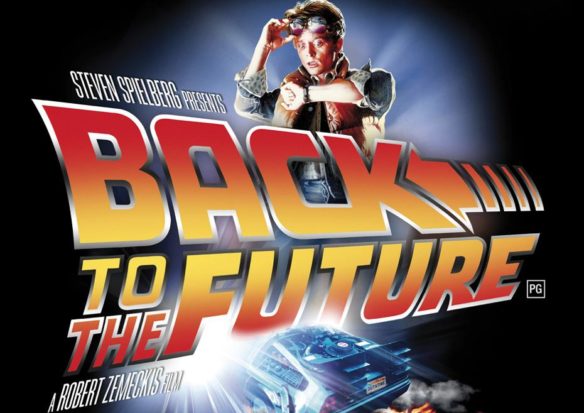
  • July 3, 1985 – Thirty-six years ago, Back to the Future premiered. It was directed by Robert Zemeckis from a screenplay by Zemeckis and Bob Gale. Bob Gale and Neil Canton were the producers. It of course starred Michael J. Fox, Christopher Lloyd, Lea Thompson and Crispin Glover. It would win the Hugo Award for Best Dramatic Presentation at ConFederation besting Ladyhawke, Cocoon, Brazil and Enemy Mine. Critics loved it with Ebert comparing it to Capra’s It’s A Wonderful Life. It was a box office success being the top grossing film of the year. And audience reviewers at Rotten Tomatoes currently give it an absolutely superb ninety-four percent rating. 

(8) TODAY’S BIRTHDAYS.

[Compiled by Cat Eldridge.]

  • Born July 3, 1926 — William Rotsler. An artist, cartoonist, pornographer and SF author. Well that is his bio. Rotsler was a many time Hugo Award winner for Best Fan Artist and one-time Nebula Award nominee. He also won a Retro Hugo for Best Fan Artist of 1946 and was runner-up for 1951. He is responsible for giving Uhura her first name, and he wrote “Rotsler’s Rules for Costuming.” (Died 1997.)
  • Born July 3, 1927 — Ken Russell. Film director whose Altered States based off of Paddy Chayefsky’s screenplay is certainly his best-remembered film. Though let’s not overlook The Lair of the White Worm he did off Bram Stoker’s novel, or The Devils, based at least in part off The Devils of Loudun by Aldous Huxley. (Died 2011.)
  • Born July 3, 1937 — Tom Stoppard, 84. Playwright of Rosencrantz and Guildenstern Are Dead. He co-wrote the screenplays for Brazil (with Terry Gilliam) and Shakespeare in Love (with Marc Norman). He’s uncredited but openly acknowledged by Spielberg for his work on Indiana Jones and the Last Crusade.
  • Born July 3, 1943 — Kurtwood Smith, 78. Clarence Boddicker in Robocop, Federation President in Star Trek VI: The Undiscovered Country, and voiced Kanjar Ro in the most excellent Green Lantern: First Flight. He’s got series appearances on Blue Thunder, The Terrible Thunderlizards (no, I’ve no idea what it is), The X-Files, Star Trek: Deep Space Nine, Star Trek: Voyager, Men in Black: The Series, 3rd Rock from the Sun, Todd McFarlane’s Spawn, Justice League, Batman Beyond, Green Lantern, Beware the Batman, Agent Carter and Star Trek: Lower Decks. His latest genre role was Old Man Miller on the Netflix series Jupiter’s Legacy.
  • Born July 3, 1946 — Michael Shea. Shea’s first novel, A Quest for Simbilis was  an authorized sequel to the first two Jack Vance’s Dying Earth novels. Vance was offered a share of the advance but declined it. (It was declared non-canon when the next novels in the series were written by Vance.) A decade, he’d win a World Fantasy Award for his Nifft the Lean novel, and a second twenty years later for a novella, “The Growlimb.” (Died 2014.)
  • Born July 3, 1948 — Marc Okrand, 73. A linguist in Native American languages who’s  the creator of the Klingon language. He first applied it by dubbing in Vulcan language dialogue for Star Trek II: The Wrath of Khan, and then was involved in the Search for Spock, The Final Frontier, The Undiscovered Country, and the both rebooted Trek films. Later he developed the language for the Kelpien race in the second season of Discovery.
  • Born July 3, 1962 — Tom Cruise, 59. His first genre role was as Jack in Legend. Next up was Lestat de Lioncourt in Interview with the Vampire followed by being Ethan Hunt in the first of many excellent Mission Impossible films. Then he was John Anderton in Minority Report followed by Ray Ferrier in War of The Worlds. I’ve not see him as Maj. William Cage in Edge of Tomorrow so I’ve no idea how good he or the film is. Alas he was Nick Morton in, oh god, The Mummy. 
  • Born July 3, 1964 — Payton Reed, 57. Did you know there was A Back to the Future TV series? Well there was and he directed it back in 1991. It was animated and only Christopher Lloyd was involved as a voice actor. He went on to much later direct Ant-Man, Ant-Man and the Wasp and the forthcoming Ant-Man and the Wasp: Quantumania. He directed two episodes of The Mandalorian. 

(9) STAND UP GUY. [Item by Cora Buhlert.] From 2017, a full cast audio adaptation of the short story “Waterfront Fists” by Robert E. Howard, performed by a group called the Violet Crown Radio Players. This is not an SFF story, but one of the Sailor Steve Costigan stories about the adventures of a not very smart boxing sailor and his faithful bulldog (Howard wrote more Costigan stories than he ever wrote Conan stories), but very nicely done. Hosted by The Cromcast, a Weird Fiction Podcast: “The VCRP Present Waterfront Fists!”

(10) STONE SOUP. Sarah Gailey’s “Building Beyond” writing prompt “Optimus Prime Time” brings her together with Elizabeth Kestrel Rogers and Julian Stuart to play with this idea —

The AI uprising has come and gone and after a brief period of discomfort, we’re all mostly pretty cool with each other at this point. There’s a television network that is strictly dedicated to entertainment by robots, for robots.

(11) YOUNG RAY HARRYHAUSEN. First Fandom Experience remembers when “Ray Harryhausen Released the Kraken in 1938”. They show the creature’s evolution from Harryhausen’s fanzine art to the movie Clash of Titans.

The Kraken debuts

More from Harryhausen’s conversation with David Kyle:

“In the mid-1930s when I was still in high school, Forry told me about the little brown room in Clifton’s Cafeteria where the Los Angeles chapter of the Science Fiction League would meet every Thursday. Members included Russ Hodgkins, Morojo, and T. Bruce Yerke. Robert Heinlein used to come around, and a guy named Bradbury. We were a group who liked the unusual. There was a fellow named Walt Daugherty, who was an anthropologist by trade, and a photographer. He would make presentations about Egyptology. Another young fellow named Ray Bradbury would arrive wearing roller skates. After selling newspapers on the street corner he would skate to meetings because he had no money. He used to go meet the stars at the Hollywood Theater where they did weekly radio broadcasts. Ray was writing for Forry’s magazine called Imagination. I did one of the covers for an issue, which was mimeographed.”â€Ķ

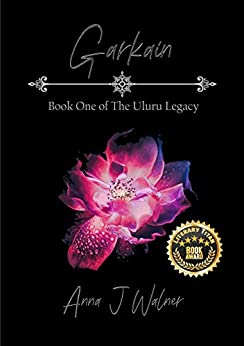
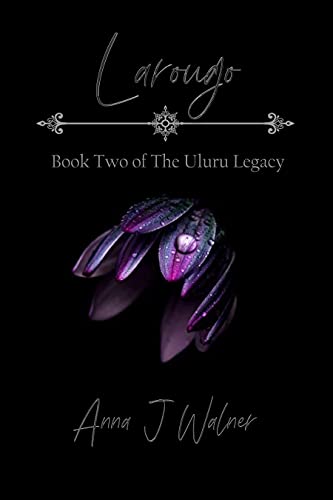
(12) VAMPIRES AND WEREWOLVES. Anna J Walner has two books in The Uluru Legacy Series, the first out in June, the second coming in November.

Anna J. Walner

A girl in search of her family finds more than she ever dreamed possible. Blending myth with reality, this award-winning debut provides a truly unique and realistic spin on the genre you love.
 
Enter a world hidden to human eyes for over three centuries. A safe haven for both Vampire and Werewolf. She’ll become something she never thought existed, agree to things she never thought she would, and find a life worth dying for.

In Garkain:

Amelia’s journey to find the truth behind her adoption twenty-five years ago, might end up being just a quick tour around the sights and a visit with her biological family.

Or it could reveal a more mysterious and shocking history to her lineage than she thought possible. The realization that vampires and werewolves have existed all along in secret. A place called The Colony.

Amelia realizes she must make a choice. Join The Colony and her family, or literally be made to forget they ever existed in the first place.

The thrilling debut of The Uluru Legacy Series will change the vampire and werewolf rulebook. Blending myth with reality, it provides a truly unique and realistic spin on the genre you love.

In Larougo —

While some questions will be answered, more will be raised. As new truths come to light, and new evils make themselves known, not everyone will survive.

The vision for a new Colony is at stake as Amelia and Roan discover they’re part of something even larger than they thought.

(13) VIDEO OF THE DAY. Mind Matters says about Sarah Gross’ short film BolÃĐro:

The theme is very topical indeed: Ending crime on the part of private citizens via total surveillance (in this case via a sort of enhanced telepathy) results in unlimited crime on the part of the government. 

The synopsis continues:

In a future where telepaths are used by the government to monitor the public and root out insurgents, Maya, a non-speaking teen, witnesses her father’s brutal and unjust execution. Set on a path of revenge and destruction, Maya joins the Resistance, hellbent on tracking down Reader 8, the telepath responsible for her father’s death. However, when Maya finally locates her target after years of searching, she is confronted with a choice: either capture Reader 8 and deliver essential intelligence to the Resistance or take him out and fulfill her vengeful quest.

[Thanks to Martin Morse Wooster, JJ, Michael Toman, Alan Baumler, John King Tarpinian, Cat Eldridge, Mike Kennedy and Andrew Porter for some of these stories. Title credit belongs to contributing editor of the day Soon Lee.]

2021 VES Awards

The Visual Effects Society named the winners of the 2021 VES Awards in a ceremony hosted by Patton Oswalt on April 6. The VES Awards recognize VFX artistry in 25 categories spanning film, TV, animation, commercials and video games.

Netflix thriller The Midnight Sky, Disney/Pixar’s animated Soul, the Disney+ Star Wars spinoff series The Mandalorian, and Lovecraft Country each won multiple categories, while Peter Jackson received the VES Lifetime Achievement Award.

The winners of genre interest for the 19th annual VES Awards follow the jump. The complete list is here.

Continue reading

Pixel Scroll 10/10/20 SchrÃķdinger’s Box Remains Both Ticked And Unticked At The Same Time Until You Pixel It

(1) A NOT-SO-LITTLE LIST. BookRiot concocted a way of assessing an interesting question: “How Do Readers Rate The New York Times Best-Selling Books?”

â€ĶFor their research, the organization pooled all titles on the NYT List from June 22, 2008 to March 29, 2020. They then determined the top 100 titles from the NYT list based on the number of times it appeared on the lists in that time frame, and each of those titles was subtracted from its average ranking on the list. This made for a total of 716 unique titles.

Once those titles were identified, the top 100 reviews on Goodreads—the reader’s view of books—were pulled. The researchers looked at how many times those titles appeared on the NYT List, then subtracted this from the average list ranking. A book’s total score was calculated using this number, as well as the average Goodreads starred rating for the titleâ€Ķ.

READERS RANK THE BEST BESTSELLERS

Using the methodology laid out above, which books that landed on the NYT List were among the most well-reviewed by readers on Goodreads? The researchers calculated 20 titles among the top.

â€Ķ The top ranking best seller for readers was Diary of a Wimpy Kid by Jeff Kinney. The book appeared on the bestseller list over 600 times, ranking at an average of #3, and readers gave it an average rating of 4.1 stars on Goodreads.

Interestingly, 11 of the titles on this list are children’s, middle grade, or YA books, and of the remaining titles, six are self-help/productivity books. Given that the NYT List has primarily featured white authors until more recently—and it’s still primarily white in some categories—it’s not a surprise to see that only a small number of the top 20 books are by authors of colorâ€Ķ

(2) HOW HUMANS RELATE TO PROGRAMS. Future Tense ran a piece by Torie Bosch about “Shouting at Alexa”.

â€Ķ For years now, commentators have reminded us that the gendered dynamics of digital assistants are troubling. In September, Future Tense ran an excerpt from The Smart Wife: Why Siri, Alexa, and Other Smart Home Devices Need a Feminist Reboot by Yolande Strengers and Jenny Kennedy . “Friendly and helpful feminized devices often take a great deal of abuse when their owners swear or yell at them. They are also commonly glitchy, leading to their characterization as ditzy feminized devices by owners and technology commentators—traits that reinforce outdated (and unfounded) gendered stereotypes about essentialized female inferior intellectual ability,” they write.

That’s me, swearing and yelling at my feminized device even though it only wants to be friendly and helpful.

What I tell myself, though, is that I’m really trying to avoid anthropomorphizing the Echo and the rest of the tech in my life. It’s a tendency I’ve had ever since I got to know ELIZA, the chatbot created by an MIT researcher in the 1960s. ELIZA was designed to mimic Rogerian therapy—which basically means that this simple program turns everything you say into a question. For some reason, it was installed on some of the computers in my middle-school library in the ’90s. Most of the time, I tried to get her—I mean it!— to swear, but I also spilled my tweenage heart out occasionally. And I’m not the only one. As a Radiolab episode from 2013 detailed: “At first, ELIZA’s creator Joseph Weizenbaum thought the idea of a computer therapist was funny. But when his students and secretary started talking to it for hours, what had seemed to him to be an amusing idea suddenly felt like an appalling reality.”â€Ķ

(3) THE WRITER’S CRAFT. Delilah S. Dawson on how to write a synopsis. Thread starts here. (H/t to Cat Rambo.)  

https://twitter.com/DelilahSDawson/status/1313905215003930628

(4) IT’S A NOPE. The Mary Sue checked the social media response from two people whose opinions we’d like to hear: “Rhianna Pratchett and Neil Gaiman React To the First Trailer for The Watch.  

â€ĶTerry Pratchett’s daughter, Rhianna Pratchett, responded to the clips on Twitter, writing “Look, I think it’s fairly obvious that
@TheWatch shares no DNA with my father’s Watch. This is neither criticism nor support. It is what it is.”

â€Ķ Beloved author Neil Gaiman also weighed in on Twitter in response to fan questions on the faithfulness of adaptions. Gaiman, who collaborated with Terry Pratchett on Good Omens, personally oversaw the novel’s adaptation into a miniseries on Amazon Prime, serving as writer and showrunner for the series. Gaiman defended the creator’s original vision of their work, stating “If you do something else, you risk alienating the fans on a monumental scale. It’s not Batman if he’s now a news reporter in a yellow trenchcoat with a pet bat.”

(5) VINTAGE DARKNESS. “25 years of His Dark Materials: Philip Pullman on the journey of a lifetime” as told by the author in The Guardian.

It was 1993 when I thought of Lyra and began writing His Dark Materials. John Major was prime minister, the UK was still in the EU, there was no Facebook or Twitter or Google, and although I had a computer and could word-process on it, I didn’t have email. No one I knew had email, so I wouldn’t have been able to use it anyway. If I wanted to look something up I went to the library; if I wanted to buy a book I went to a bookshop. There were only four terrestrial TV channels, and if you forgot to record a programme you’d wanted to watch, tough luck. Smart phones and iPads and text messaging had never been heard of. The announcers on Radio 3 had not yet started trying to be our warm and chatty friends. The BBC and the National Health Service were as much part of our identity, of our idea of ourselves as a nation, as Stonehenge.

Twenty-seven years later I’m still writing about Lyra, and meanwhile the world has been utterly transformed.

To some extent, my story was protected from awkward change because I set it in a world that was not ours. It was like ours, but different, so I could take account of the real-world changes that helped my story, and ignore those that didn’t. 

(6) SATISFIED CUSTOMER. “One Good Thing: The wonderful sci-fi novel A Memory Called Empire makes diplomacy enthralling” – a review at Vox.

Arkady Martine’s A Memory Called Empire, which recently won the Best Novel award at science fiction’s prestigious Hugo Awards, reads like its author was simultaneously influenced by Game of Thrones, histories of the Cold War, various anti-colonialism writings, and the Star Wars prequels. It’s a grand, galaxy-spanning space opera that is mostly about diplomacy. Or, if you prefer, it’s an impressively wonky novel about galactic geopolitics that just happens to feature spaceships and aliens. I love it.

It’s difficult to talk about A Memory Called Empire without spoiling some of its best surprises because the core of the book sounds impossibly dry. But let me give it a shot anyway, because the best way to read this book is to know almost nothing about what happens after its first few chaptersâ€Ķ.

(7) AFTERGLOW. The Guardian’s Matt Kamen asks — “Cancel culture: is Netflix killing off series too soon?”

Another day, another cancellation – or at least, that’s how it’s starting to feel when it comes to Netflix. Having culled the likes of Sense8, The OA, Santa Clarita Diet and Altered Carbon in recent years, all after two or three seasons and often leaving viewers on major cliffhangers, the streaming service has turned its bloodlust on to Glow, which had already started filming its fourth season before the pandemic hit, and The Dark Crystal: Age of Resistance.

The latter, a prequel to the cult-favourite 1983 Jim Henson movie, produced and performed entirely with staggeringly intricate puppets and animatronics, and featuring an all-star cast, premiered on Netflix in August 2019. It garnered near-universal acclaim from critics, and a slate of awards nominations – including, crucially, picking up a 2020 Emmy for outstanding children’s program. Yet even awards success hasn’t spared it the axe, with the executive producer, Lisa Henson, confirming it won’t be returningâ€Ķ.

(8) MEDIA ANNIVERSARY.

  • 1993 – Twenty-seven years ago, The Flash Girls released their first album, The Return of Pansy Smith and Violet Jones. The Minneapolis based band consisted of Emma Bull and Lorraine Garland, also known as The Fabulous Lorraine. Garland is notable as being Neil Gaiman’s personal assistant. Among the songwriters were Jane Yolen, Alan Moore, and Neil Gaiman. Bull and Garland adopted the names Pansy Smith and Violet Jones as their alternate personas and would become characters in the DC Sovereign Seven series where they run a coffee shop. They would release two more albums, Maurice and I and Play Each Morning Wild Queen. Bull and Shetterly moved to California which broke up the band and Garland formed Folk Underground which also had songs written by Neil Gaiman and Jane Yolen. 

(9) TODAY’S BIRTHDAYS.

[Compiled by Cat Eldridge and John Hertz.]

  • Born October 10, 1895 – Lin Yutang, Ph.D.  Author, editor, translator, gifted popularizer (yes, it’s possible).  One SF novel.  Built a working Chinese typewriter (yes, it’s –) never developed commercially but pivotal in machine-translation research.  My Country, My People a best-seller.  (Died 1976) [JH]
  • Born October 10, 1929 Robin Hardy. Wicker Man is the film he’s known for though he followed that up with The Wicker Tree, an adaptation of his Cowboys for Christ novel. Anyone seen it? The Bulldance is at least genre adjacent. (Died 2016.) (CE) 
  • Born October 10, 1931 Victor Pemberton. Writer of the script for the “Fury from the Deep”, a Second Doctor story in which he created the Doctor’s sonic screwdriver. He had appeared as an actor in the series, in a non-speaking role as a scientist in “The Moonbase”, a Second Doctor story. In the Seventies, he wrote the BBC Doctor Who and the Pescatons audio drama which I remember hearing. It was quite excellent. (Died 2007.) (CE)
  • Born October 10, 1931 – Jack Jardine.  Writing under another name, four Agent of T.E.R.R.A. novels, three others.  Indeed many other names.  Radio disc jockey, humorist.  See Bill Mills’ appreciation here.  (Died 2009) [JH]
  • Born October 10, 1942 – Wojtek Siudmak, 78.  More than seven hundred covers, seventy interiors.  Six artbooks (in French).  Two Chesleys.  Here is Double Star.  Here is a volume of Norman Spinrad.  Here is Dune.  Here is The Return of the King.  Here is Expansion.  [JH]
  • Born October 10, 1957 – Rumiko Takahashi, 63.  (Names would be reversed in Japanese style.)  Manga artist with 200 million copies of her work in circulation.  Two Shogakukan Awards, two Seiun Awards.  Inkpot.  Science Fiction & Fantasy Hall of Fame, Eisner Hall of Fame.  Grand Prix de la ville d’AngoulÊme, second woman and second Japanese to win.  Scottish rock band named for Urusei Yatsura, her first to be animated.  This cover reprinting vols. 1&2 of Ranma 1/2 shows Ranma’s dad changed into a panda and Ranma into a girl.  [JH]
  • Born October 10, 1959 Kerrie Hughes, 61. Anthologist, some of which impressively have had several printings. Favorite titles for me for me include Chicks Kick Butt (co-edited with Rachael Caine), Zombie Raccoons & Killer Bunnies (with Martin H. Greenberg) and Shadowed Souls (with Jim Butcher). She’s written short fiction and essays as well. It looks like almost all of her anthologies are available from the usual digital suspects. (CE)
  • Born October 10, 1968 Mark Bould, 52. British academic whose done a number of interesting genre-related works including Red Planets: Marxism and Science Fiction, co-edited with China MiÃĐville, Parietal Games: Critical Writings by and on M. John Harrison with M. John Harrison and Michelle Reid, and Fifty Key Figures in Science Fiction written with Andrew M. Butler and Adam Roberts and Sherryl Vint. (CE) 
  • Born October 10, 1976 Marjan Neshat, 44. Best remembered for her recurring role as Samar Hashmi on Quantico which is at least genre related. She’s also had roles in the Robocop reboot, FringeElementaryNew Amsterdam and Person of Interest. (CE)
  • Born October 10, 1971 – Jeff Miracola, 49.  Magic, the Gathering (over a hundred cards) and Shadowrun; children’s books e.g. The Book of Impossible Objects; Electronic Arts video game Mini-Golf.  In eight issues of Spectrum so far (2-5, 15-16, 19-20); Advanced Photoshop magazine; 30 Years of Adventure (Dungeons & Dragons).  Here is a cover for Tower of Babel.  â€œContinue to work on your craft.  Draw, paint, and create always.  Consider getting together with other artists…. actually creating and feeding off each other’s energy.”  [JH]
  • Born October 10, 1984 Jenna LÊ, 36. Minnesota-born daughter of Vietnam War refugees, her genre poetry is collected in A History of the Cetacean American Diaspora along with other poems. That collection placed second for an Elgin Award. You can find an excellent interview with her here. (CE) 

(10) COMICS SECTION.

(11) SMILE FOR THE CAMERA. This weekend, the New York Comic Con managed to run a cosplay competition despite being a virtual event: “Sew And Tell! Virtual Championships Of Cosplay Winners Announced At NYCC 2020” at SYFY Wire.

â€Ķ The Beginners victor was Commander Poptart, a U.S. entrant who dressed as Ahsoka Tano from Star Wars: The Clone Wars. “This was an incredible build for a beginner. Well, done, Commander Poptart,” said JediManda, who was dressed as Baby Yoda from The Mandalorian

No runner-up was announced.

The runner-up in Needlework was Demorafairy from the U.K., who dressed as Little Red Ashe from Overwatch. “We loved this costume, the letterwork is so impressive on it. All her engineering, like the vest, was done in three different layers, so every piece would lay correctly,” said Yaya Han. “I thought that was just really genius and it just has such a great balance of different techniques used. All her sewing was very clean and the skirt was the right length and everything was finished.”

Sewcialist Revolution from the U.S. nabbed the top honor for the Needlework category with her Claire Fraser costume inspired by Outlander. She spent five years learning how to make 18th-century clothing and then hunkered down for an extra six months putting the dress together. “This is needlework in its best representation,” Han added. “She used period-accurate methods, so much of it was hand-done … We really appreciated all of the efforts that she went into.”â€Ķ

And more.

(12) LOVECRAFT COUNTRY EFFECTS. “Making the Monsters of ‘Lovecraft Country’” is discussed in the New York Times.

â€ĶConsider the monstrous, man-eating Shoggoths of HBO’s “Lovecraft Country,” last seen decimating a squad of racist police officers on Sunday night. They may not be the mind-bending series’s most terrifying menace — that title goes to vintage, 1950s white supremacy — but it isn’t for lack of trying.

Shoggoths are hideous to look at — pale, bulbous, covered in scabby, asymmetric eyes — and deadly to encounter, with concentric rows of gnarled teeth that turn trespassers into tartare. H.P. Lovecraft first wrote about blob-like creatures called Shoggoths in the late ’20s in a series of sonnets, and they appeared in his 1936 novella “At the Mountains of Madness.”

But the original Shoggoths, described by Lovecraft as “normally shapeless entities composed of a viscous jelly which looked like an agglutination of bubbles,” bear little resemblance to the fast-moving, gorilla-like beasts that first terrorized Tic, Leti and co. in the series premiere.

(13) IN SPACE THEY CAN HEAR YOU SING. Earlier this year NPR’s “Science-Fiction Music: Monsters, Aliens In ‘Filk'” covered all pop music, including work by fans.

As science fiction spread within music, fans began to share songs with one another, and the movement became known as Filk. It took its name from a 1950s article about these unusual songs, which misspelled “Folk” as “Filk.” Bill Sutton is the president of Interfilk, an organization that helps fans and musicians attend Filk conventions. Sutton says otherworldly ideas in popular music, combined with excitement about the space program, made people believe that technology could save everything.

(14) 007, MUNSTER, AND RIPLEY, OH MY! Want to buy the Green Hornet’s car? At Profiles in History’s “The Icons & Legends of Hollywood Auction” on November 12-13, many extraordinary costumes, props and relics are going under the hammer. 

Following is just a glimpse of the items awaiting you in these pages that left indelible marks in Hollywood history: 

  • John Travolta “Tony Manero” screen worn signature leather jacket from Saturday Night Fever.
  • Leonardo DiCaprio “Jack Dawson” poker game/boarding costume from Titanic.
  • Roger Moore “James Bond” Royal Navy uniform jacket from The Spy Who Loved Me.
  • Jane Seymour “Solitaire” psychic medium cape and headdress from Live and Let Die.
  • Orson Welles “Charles Foster Kane” coat from Citizen Kane.
  • Marilyn Monroe “The Girl” fantasy tiger gown from The Seven Year Itch.
  • Gene Kelly “Don Lockwood” legendary rain suit from the Singin’ in the Rain.
  • Gary Cooper “Lou Gehrig” Yankee uniform from The Pride of the Yankees.
  • James Dean “Jett Rink” tuxedo from Giant.
  • Elizabeth Taylor “Leslie Benedict” arrival to Reata ensemble from Giant.
  • Vivien Leigh “Scarlett O’Hara” traveling dress from Gone With the Wind.
  • Fred Gwynne “Herman Munster” signature costume from The Munsters.
  • Tina Louise “Ginger” signature glamor dress from Gilligan’s Island.
  • Sir Richard Attenborough “John Hammond” signature cane from Jurassic Park
  • Sigourney Weaver “Ripley” signature Nostromo jumpsuit from Alien.
  • Hero “ramming” Chestburster with articulating jaw and “whiplash” tail from Alien
  • Hero “Ra” Cheops class Pyramid Warship filming miniature from Stargate.
  • Hero X-71 Shuttle “Independence” filming miniature from Armageddon.
  • Zed’s “Grace” Harley chopper ridden by Bruce Willis “Butch Coolidge” in Pulp Fiction

[Thanks to John King Tarpinian, John Hertz, JJ, Andrew Porter, Mike Kennedy, Martin Morse Wooster, Michael Toman, and Cat Eldridge for some of these stories. Title credit goes to File 770 contributing editor of the day Niall McAuley.]

Pixel Scroll 9/8/20 If You Can’t Be With The Scroll You Pixel, Pixel The Scroll You’re With

(1) STAR TREK DAY. io9’s James Whitbrook tells how “Star Trek: Discovery’s New Trailer Brings the Fight for the Federation to the Far Future”.

The crew of the Discovery made a terrible sacrifice at the end of season two, leaving their lives as they knew them behind and flinging the ship 930 years into the future, where the Federation is in some dire straits of its own (again). Now it seems it’s up to Michael and her friends to remind them of what the Federation has fought hard to stand for.

Star Trek’s all-encompassing Star Trek Day livestream event just kicked off with the latest look at the third season of Discovery, our first since that major glimpse at New York Comic-Con last year.

(2) KLINGON GOES POSTAL. Robert J. Sawyer celebrated Star Trek Day on Facebook with this observation:

If you’d told Canadian actor John Collicos that his country would honour him with a stamp 50-odd years later for the four or five days of work he did as one of countless guest-starring roles over his career, he’d have thought you were out of your mind.

It’s part of this 2016 set:

(3) POD TREK. Tawny Newsome, of the Star Trek: Lower Decks voice cast, announced an upcoming podcast, Star Trek: The Pod Directive, which she will co-host with actor-comedian Paul F. Tompkins (BoJack Horseman).

Guests will include actor Ben Stiller, author Reza Aslan, “Star Trek: Picard” star Michelle Hurd, “Lower Decks” executive producer Mike McMahan, politician Stacey Abrams, comedian and “Discovery” costar Tig Notaro, astronaut Samantha Cristoforetti, and “Picard” and “Short Treks” composer Jeff Russo.

Newsome also debuted a preview for the show, which runs weekly Sept. 14 through Nov. 9.

(4) MULAN. Jeannette Ng’s article “‘Mulan’ Has a Message: Serve China and Forget About the Uighurs” at Foreign Policy challenges the terms under which the film was made, then sharply criticizes the film itself.

All art is political. Strangely, Disney’s live-action Mulan is more obviously so than most.

Mulan makes the current nationalist mythology of a Han-dominated China the foundation of its story. That would be bad enough. But parts of it were also filmed at the location of current and ongoing mass human rights abuses, including cultural genocide, against ethnic minorities.

The credits of Mulan specifically thank the Publicity Department of the Chinese Communist Party’s Xinjiang Uighur Autonomous Region Committee, as well as the Public Security Bureau in the city of Turpan and other state entities there. The Public Security Bureau is one of the main forces administering the internment camps, enforcing the surveillance and interrogation of even nominally “free” Uighurs, forcing people into slave labor, demanding that Uighurs host Han guests employed by the government to spy on them, and sterilizing Uighur women. The Publicity Department—a term that used to be more honestly translated as the Propaganda Department—justifies these atrocities. Most of these policies were well in place—and some of them known in the West—by the time the film was shot, partly in Xinjiang, in 2018.

That should be the only thing that needs to be written. But there’s more.

Even before the film—which was not previously known to have been filmed  in Xinjiang—arrived, it had blundered right into politics. Two of the film’s stars, Liu Yifei (Mulan) and Donnie Yen (Commander Tung), have voiced their support of the Hong Kong police against the city’s pro-democracy protests, thus sparking an online movement to boycott the filmâ€Ķ. 

(5) DISNEY AMBITIONS. In a Washington Post opinion piece, “Why Disney’s new ‘Mulan’ is a scandal”, Isaac Stone Fish says that Disney credits “four Chinese Communist party propaganda departments in the region of Xinjiang and the Public Security Bureau of the city of Turpan in the same region–organizations that are facilitating crimes against humanity.”  He says we need to know the extent to which Disney cooperated with instruments of Chinese repression against the Uighurs and that by filming in Xinjiang the 2020 version of Mulan is “Disney’s most problematic movie” since the racist Song Of The South. Fish also adds perspectives about Disney’s historic efforts to do business in China.

â€ĶDisney executives had thought that the original “Mulan” would please both the Chinese government and Chinese filmgoers. But because Disney had distributed “Kundun” (1997), a film glorifying the Dalai Lama, Beijing restricted the studio’s ability to work in China. Disney spent the next several years trying to get back into the party’s good graces. “We made a stupid mistake in releasing ‘Kundun,’” the then-CEO of Disney Michael Eisner told Premier Zhu Rongji in October 1998. “Here I want to apologize, and in the future we should prevent this sort of thing, which insults our friends, from happening.”

Since then, Disney has endeavored to please Beijing. The rewards have been immense, culminating in the successful opening of Shanghai Disneyland in June 2016. This park, Disney’s Executive Chairman Bob Iger said, is the “greatest opportunity the company has had since Walt Disney himself bought land in Central Florida.” Partnering with Xinjiang is another step that binds Disney closer to the party.

(6) HARD SF. [Item by Eric Wong.] Rocket Stack Rank has posted their annual compilation — “Outstanding Hard Science Fiction of 2019” — with 19 stories that were that were finalists for major SF/F awards, included in “year’s best” SF/F anthologies, or recommended by prolific reviewers in short fiction.

Included are some observations obtained by changing the Highlight from Free Online to Podcasts, changing the table View by Publication and Author, and Filtering the table by awards, year’s best anthologies, and reviewers.

(7) SLEEPING IN THE FACTORY. In “How Speculative Fiction Becomes Reality” on CrimeReads, Rob Hart says his 2018 novel The Warehouse has “an outside world so hostile people are forced indoors” and “an online retail merchant dominating the economy while the small business landscape is wiped out,” but that when he wrote his novel he thought the future he foresaw would happen a decade from now, not in 2020.

â€ĶInstead of the slow march of climate change and the steady drip of private interest trumping public good, it was a pandemic that ground the economy to a halt in a matter of weeks. We may not be housed in giant, city-sized live-work facilities, but most of us are now living at our jobs.

And hasn’t that been the whole point of the 21st century economy? Forcing you to come in sick, making you accept unpaid overtime and check your e-mail on the weekends—it was all about making it so you were always working. Even better if you barely left the office. Now you don’t.

Not to say there’s any fun in being right. Not with so much suffering and loss. Not with so many monumental failures in leadership. Not when facing the realization of just how fragile the system is, and how many holes there are in the safety net.

(8) THE FATHER OF HIS COUNTRY. Andrew Liptak has an interview with Matt Ruff at Reading List: “Lovecraft Country: making the best of the horror icon”.

Your book came out in 2016 on the heels of a larger movement and reckoning within fandom about the role of authors of color and from marginalized communities. How does that longer history of marginalization and exclusion play into your view with the book or the world you’ve set up?

I knew that stuff was going on while I was writing, but history of dissatisfaction of fans of color goes back a lot further. In my research for the novel, I would be reading back issues of the Chicago Defender (the historic black newspaper in Chicago in the 1950s) to get a sense of what the issues of the day were in the black community at that time, and I would read the reviews section for movies and books and the things coming out then. A lot of it was very familiar in terms of the complaints that the reviewers had: we’ve got money, we want to buy movie tickets, we want to buy books, please make stuff that recognizes that we exist and that plays to us too.

The problem was that back then was that you could complain all you want it, but the only folks reading the Black press were Black folks who did not get to make decisions in Hollywood. So this dissatisfaction has always been there. It was expressed by friends of mine growing up, and there’s a woman named Pam Noles, who wrote an essay called Shame that was very influential when I was thinking about Lovecraft Country, which sort of talks about her evolution as a young Black nerd. One of the things she talks about that’s heartbreaking is experience going to see Star Wars for the first time and which for her as for me, was like a quasi-religious experience. But for her, it was also the moment where she finally understood what her parents had been trying to tell her about: this genre that you like doesn’t really appreciate you the way you seem to think it does.

(9) BUTCHER PREVIEW. The book trailer for Jim Butcher’s Battle Ground debuted at Virtual Dragon Con. The trailer was filmed back in December, concurrently with the trailer for Peace Talks, directed by Priscilla Spencer. Dragon Con also hosted a virtual cast and crew panel for both trailers: “The Dresden Files: Peace Talks Trailer Cast and Crew Panel” with Jim Butcher, Spencer, and the rest. 

(10) MEDIA ANNIVERSARY.

  • September 8, 1973 Star Trek: The Animated Series premiered on NBC. Featuring the voice work of the original cast with the exception of Walter Koenig which was apparently due to budget constraints. Most other voices were done by the cast but Sarek, Cyrano Jones and Harry Mudd were performed by the original actors. It would air for two seasons and twenty two episodes winning an Emmy for Outstanding Entertainment in a Children’s Series for its second season. David Gerrold, Chuck Menville, D.C. Fontana and Larry Niven would write scripts as would Walter Koenig. Roddenberry decided it wasn’t canon after it ended which didn’t stop scriptwriters from referring to it down the years in inventive ways, i.e. Elim Garak on DS9 mentions Edosian orchids, a reference to the character Arex here who’s an Edosian. (CE)

(11) TODAY’S BIRTHDAYS.

[Compiled by Cat Eldridge and John Hertz.]

  • Born September 8, 1925 Peter Sellers. Chief Inspector Clouseau in the Pink Panther films which are surely genre, aren’t they? Of course, he had the tour de force acting experience of being Group Captain Lionel Mandrake, President Merkin Muffley and Dr. Strangelove in Dr. Strangelove or: How I Learned to Stop Worrying and Love the Bomb. Amusingly he was involved in another of folk tale production over various mediums (film, radio, stage) including Cinderella, Tom Thumb, Mother Goose and Jack and The Beanstalk. (Died 1980.) (CE) 
  • Born September 8, 1932 – John Boardman, Ph.D., 88.  Physicist, fanziner, filker.  Master of Diplomacy i.e. the board game.  Treasurer of Nycon 3 (25th Worldcon).  Life Member of the Lunarians, Fan Guest of Honor (with wife Perdita) at Lunacon 41.  Officer of the Puddleby-on-the-Marsh Irregulars.  Co-founder of the Beaker People’s Libation Front.  “Science for Science Fiction” in Ares.  Active in the Society for Creative Anachronism, served as Mural Herald of the East Kingdom.  To be seen in Amra, Asimov’s, Locus, Riverside Quarterly, SF Review, Trumpet, Xero.  “Because you are not John Boardman, is why.”  [JH]
  • Born September 8, 1936 – Don Punchatz.  Ninety covers, two hundred interiors for us; more outside our field.   Here are Foundation, Foundation and Empire, Second Foundation.  Here is Nightwings.  Here is Night of the Cooters.  Artbook Don Punchatz, a retrospective.  Spectrum Grandmaster.  (Died 2009) [JH]
  • Born September 8, 1945 Willard Huyck, 75. He’s got a long relationship with Lucas first writing American Graffiti and being the script doctor on Star Wars before writing Indiana Jones and the Temple of Doom, andbefore being the writer and director on Howard the Duck which, yes, is a Lucasfilm. It’s the lowest rated on Rotten Tomatoes Lucasfilm production ever at 15% followed by Radioland Murders, the last script he’d write for Lucasfilm which would be a still dismal 24%.  (CE) 
  • Born September 8, 1947 – Bill Burns, 73.  Attended every Eastercon (Unted Kingdom nat’l con) since 1965.  Doc Weir Award (U.K. service award).  Best known for founding and maintaining eFanzines.com.  Fan Guest of Honour (with wife Mary) at Eastercon LX; at 77th Worldcon.  A dozen FAAn (Fan Activity Achievement) Awards. [JH]
  • Born September 8, 1952 – Linda Addison, 68.  For us, two dozen stories, ninety poems, in Apex, Asimov’s, Dark Matter, Tales of the Unanticipated, Tomorrow, three hundred fifty all told.  Poetry editor of Space & Time, “Word Ninja” there.  B.S. (mathematics) from Carnegie-Mellon.  2002 Rhysling anthology.  First black Stoker winner; won four more.  Horror Writers’ Lifetime Achievement award.  [JH]
  • Born September 8, 1954 Mark Lindsay Chapman, 66. Sorry DCU but the best Swamp Thing series was done nearly thirty years ago and starred the late Dick Durock as Swamp Thing and this actor as his chief antagonist, Dr. Anton Arcane. Short on CGI, but the scripts were brilliant. Chapman has also shown up in Poltergeist: The Legacy, The New Adventures of Superman, The Langoliers and Max Headroom to name a few of his genre appearances. (CE)
  • Born September 8, 1958 – Danny Flynn, 62.  Hundreds of covers, computer-game illustrations, in and out of our field; biology, detective fiction, golf.  Here is the May 94 Interzone.  Here is I Will Fear No Evil (surely one of our best book titles).  Here is Wild Seed.  Artbook Only Visiting This Planet.  [JH]
  • Born September 8, 1965 Matt Ruff, 54. I think that his second book Sewer, Gas & Electric: The Public Works Trilogy is his best work to date though I do like Fool on The Hill a lot. Any others of his I should think about reading? And, of course, there the adaptation of Lovecraft Country which I’ve not see as I don’t have HBO. (CE) 
  • Born September 8, 1966 Gordon Van Gelder, 54. From 1997 until 2014, he was editor of The Magazine of Fantasy & Science Fiction, (and later publisher, which he remains), for which he has awarded twice, and quite well deserved they were, the Hugo for Best Editor Short Form at Nippon 2007 and at Denvention 3.  He was also a managing editor of The New York Review of Science Fiction from 1988 to 1993, for which he was nominated for the Hugo a number of times. (CE)
  • Born September 8, 1975 C. Robert Cargill, 45. He, along with Scott Derrickson and Jon Spaihts, worked on the script for Doctor Strange. More intriguingly they’re writing the script for The Outer Limits, a movie based on the television show. The film, produced by MGM, will be adapted from just the “Demon with a Glass Hand” episode begging the question of what they’re writing for a script given that Ellison did write the Writers Guild of America Awards  winning Outstanding Script for a Television Anthology script. (CE) 
  • Born September 8, 1979 – Bianca Turetsky, 41.  Three novels, four shorter stories with Courtney Sheinmel.  In the novels, illustrated by Sandra Suy, Louise Lambert buying dresses on sale from strange folk finds they take her back in time, pleasing Kirkus, Seventeen, and the Historical Novel Society.  [JH]

(12) WEARING THE HORNS. Added to the fanhistory site THEN, Ken Cheslin’s 1989 piece “SADO and the 1960s Brum Group – a memoir”. Curator Rob Hansen says, “This might interest a few people, if only for how much Ken Cheslin’s Viking character Olaf coincidentally resembles the later ‘Hagar the Horrible’.”

(13) WINNING NAME. L. Jagi Lamplighter has decided her new column at Superversive SF will be called “Slice of Light”, and follows the title announcement with a heartwarming preview of coming attractions. Even you heathens might enjoy this one.

(14) HALO OVER JUPITER.

(15) TEARS OF A CLOWN.  “Ted Cruz, longtime fan of ‘The Princess Bride,’ swipes at cast members’ plans to reunite to raise money for Democrats” – The Hill has the story.

Sen. Ted Cruz (R-Texas), a longtime fan of “The Princess Bride,” took aim at cast members of the cult classic over the weekend after reports emerged of their plans to reunite for a fundraiser supporting Democrats in Wisconsin.

Cast members from the film will be taking part in a virtual table read for the fundraiser — which a site for the event said will feature actors Robin Wright, Cary Elwes, Mandy Patinkin and Billy Crystal. 

In a tweet reacting to the news on Saturday, Cruz referred to lines from Inigo Montoya, a character portrayed by Patinkin in the 1987 film.

“Do you hear that Fezzik? That is the sound of ultimate suffering. My heart made that sound when the six-fingered man killed my father,” he wrote in the tweet.

“Every Princess Bride fan who wants to see that perfect movie preserved from Hollywood politics makes it now,” Cruz, who has been vocal in the past about his feelings for the film and acted out a scene from the flick when he was running for president in 2015, addedâ€Ķ.

(16) LOST AND FOUND. “Roanoke’s ‘Lost Colony’ Was Never Lost, New Book Says” – the New York Times sifts the scholarship.

â€ĶHistorians and archaeologists not involved in the recent research on Hatteras were more skeptical, saying that the evidence was inconclusive and that they wanted to see peer-reviewed work. They also said the argument was not new: The idea that the Croatoans, as the Native people on Hatteras were called, adopted at least some of the settlers has long been considered plausible.

“Sure, it’s possible — why wouldn’t it be?” said Malinda Maynor Lowery, a professor of history at the University of North Carolina at Chapel Hill. “People don’t get lost. They get murdered, they get stolen, they get taken in. They live and die as members of other communities.”

Dr. Maynor Lowery presented a similar possibility in her 2018 book on the history of the Lumbee people, the descendants of dozens of tribes in a wide region including eastern North Carolina. Despite violence by the English against Croatoan villagers, she wrote, the settlers probably took refuge with them.

“The Indians of Roanoke, Croatoan, Secotan and other villages had no reason to make enemies of the colonists,” she wrote. “Instead, they probably made them kin.”

The English landed into a complicated fray of conflict and shifting alliances, said Lauren McMillan, a professor at the University of Mary Washington in Fredericksburg, Va.

“They’re all interfighting, and these different groups are trying to use the English against one another,” she said. “The Croatoans perhaps saw the English as a powerful ally and sources of valuable new things.”

Dr. Maynor Lowery, who is Lumbee, added that the “lost colony” story is itself based on the incorrect premise “that Native people also disappeared, which we didn’t.”

The story, she said, was like “a monument that has to come down,” adding that “it’s harder to dismantle an origin story than a statue.”

(17) ESSENCE OF WONDER. “AI and Ethics: Professionals Speak” on the next Essence of Wonder with Gadi Evron.

Not Mute in the Winterâ€Ķ
In the first part of the show, we’ll be discussing the potential of AI to be useful to society in general, but we’ll be taking a greater look at where there are possibilities for AI to be misused or even abused if not properly handled.  Our primary questions in this part of the show will be to ask where AI can be biased, how bias is introduced into AI systems, examples of attacks on AI and how these then manifest in the world. We’ll be looking at the social implications of using AI in situations where previously only human judgement has been deployed and how this is spreading to encompass more decision-making processes.

Turing Test Failed, They Suspect Nothingâ€Ķ
Our show corner will be looking at theoretical examples of how a number of simple and sensible decisions could give rise to AI that can go from beneficial to nefarious.

Terminating Skynetâ€Ķ
In the second part of the show, we’ll be looking will be how to ensure an ethical approach to the development and control of Artificial Intelligence.  How we should go about securing AI systems and the methods of embedding ethics throughout the lifecycle of AI and its usages. We will also delve into the social vs institutional approaches to Ethical AI.

The panelists include:

  • Steve Orrin â€“ Federal CTO, Intel Corp
  • Dr. Jim Short â€“ Research Director, Lead Scientist and co-founder of the Center for Large Scale Data Systems (CLDS) at the San Diego Supercomputer Center.
  • Chloe Autio â€“ AI Policy Lead for Intel Corp
  • Dr. Andrew Harding â€“ Senior Technology and Policy Adviser at Centre for Data Ethics & Innovation for the UK Government
  • Tamara Zubatiy â€“ CEO of VeriCrypt

(18) AI SPEAKS BACK. On Onion Public Radio, “Robots Inform Artificial Intelligence Researchers That They’ll Take It From Here”.

The A.I. research team at MIT is hailing it as a breakthrough in their field that will finally allow them to kick back and relax a little bit. We have the latest on what the now-sentient robotic life forms have planned next.

(19) THE RIGHT TO BEAR ARMS. “Realistic False Arm Dinosaur Puppet” – several different versions are available. Here’s one of them.

(20) VIDEO OF THE DAY. In “Honest Trailers: Batman:  Mask of the Phantasm” on Youtube, the Screen Junkies take on the fine film that entertained a “generation of latch-key kids” in the 1990s.

[Thanks to John King Tarpnian, N., JJ, Alan Baumler, Eric Wong, Mike Kennedy, Martin Morse Wooster, Cat Eldridge, John Hertz, Michael Toman, and Andrew Porter for some of these stories. Title credit goes to File 770 contributing editor of the day C.A. Collins.]

Pixel Scroll 9/2/20 He’s Just A Poor Scroll From A Poor Pixelry, Spare Him Comments From This File 770

(1) MARGINALIZED BY STAR WARS. “John Boyega: ‘I’m the only cast member whose experience of Star Wars was based on their race'” – a British GQ interview.

With the Lucasfilm-branded elephant in the room acknowledged, it is even harder to ignore. This is Boyega’s first substantial interview since finishing the franchise – his first since last year’s The Rise Of Skywalker tied a highly contentious, hurried ribbon on the 43-year-old space saga. How does he reflect on his involvement and the way the newest trilogy was concluded?

“It’s so difficult to manoeuvre,” he says, exhaling deeply, visibly calibrating the level of professional diplomacy to display. “You get yourself involved in projects and you’re not necessarily going to like everything. [But] what I would say to Disney is do not bring out a black character, market them to be much more important in the franchise than they are and then have them pushed to the side. It’s not good. I’ll say it straight up.” He is talking about himself here – about the character of Finn, the former Stormtrooper who wielded a lightsaber in the first film before being somewhat nudged to the periphery. But he is also talking about other people of colour in the cast – Naomi Ackie and Kelly Marie Tran and even Oscar Isaac (“a brother from Guatemala”) – who he feels suffered the same treatment; he is acknowledging that some people will say he’s “crazy” or “making it up”, but the reordered character hierarchy of The Last Jedi was particularly hard to take.

“Like, you guys knew what to do with Daisy Ridley, you knew what to do with Adam Driver,” he says. “You knew what to do with these other people, but when it came to Kelly Marie Tran, when it came to John Boyega, you know fuck all. So what do you want me to say? What they want you to say is, ‘I enjoyed being a part of it. It was a great experience…’ Nah, nah, nah. I’ll take that deal when it’s a great experience. They gave all the nuance to Adam Driver, all the nuance to Daisy Ridley. Let’s be honest. Daisy knows this. Adam knows this. Everybody knows. I’m not exposing anything.”

(2) IN PLAIN SIGHT. On June 25 Gollancz (the SF/Fantasy/Horror imprint of Orion Books) released the first three books in McCaffery’s Dragonflight series as audiobooks. Artist Allison Mann noticed something about the art that was used. Thread begins here.

Someone else tweeted a possible source for the art on their Dragonflight audiobook as well.

(3) JETPACK CROSSING. The Los Angeles Times reports an incident near the airport: “A jet pack at LAX? Maybe. Jet packs are very real”.

It sounds like something out of a movie: An American Airlines pilot calls the control tower at Los Angeles International Airport to warn that his plane just flew past someone in midair — a person wearing a jet pack.

But the pilot really did give that warning Sunday night, and it wasn’t laughed off. The FBI is investigatingâ€Ķ.

JetPack Aviation Corp., based in Van Nuys, says it’s the only one to have developed a jet pack that can be worn like a backpack. The technology is real: Chief Executive David Mayman demonstrated it five years ago by flying around the Statue of Liberty, and his company has created five of them.

So it’s not out of the question that someone could have been soaring above the airport last weekend, giving pilots a scare.

Mayman was quick to say that if a jet pack was involved, it wasn’t one of his. JetPack Aviation keeps its five packs locked down, he said, and they’re not for sale. The company does offer flying lessons at $4,950 a pop, but he said students are attached to a wire and can’t stray too far.

None of the company’s competitors sell their products to consumers either, Mayman said.

The weekend incident “got us all wondering whether there’s been someone working in skunkworks on this,” he said, using a term for a secret project. Or maybe, he mused, the airline pilot saw some kind of electric-powered drone with a mannequin attached.

CNN reports the exchanges wth the tower went like this:

“Tower. American 1997. We just passed a guy on a jetpack,” the first plane called in. “Off the left side maybe 300 — 30 yards or so. About our altitude.”

About 10 minutes later, another plane spotted the man.

“We just saw the guy fly by us on the jetpack,” the crew told the traffic controller.

According to the communications, air traffic control warned a JetBlue flight to “use caution… person on a jetpack reported 300 yards south.”

After the plane acknowledged the instruction, the controller concluded with: “Only in LA.”

(4) YOUR OVERDUE FUTURE. The Irish Times constructed their checklist with the help of a 1974 sf collection: “Promises, promises: What is 2020 not delivering?” Everything besides jetpacks, I guess.

2020 is one of those years. No, not in that sense (well, obviously in that sense but that’s not what we’re talking about hereâ€Ķ). No, 2020 is one of those years that tends to crop up in 20th century science fiction as a key year, a momentous one. A year by which time certain prophecies will have come true.

Back in the seventies, publisher Jerry Pournelle published an anthology book called 2020 Vision, for which he sought contributions from such noted sci-fi authors as Harlan EllisonLarry Niven, and Ben Bova. While some of the predictions, such as robot chefs, deep-space exploration by humans, and, erm, “An adult playground where law is enforced by remote control” haven’t come to pass (unless I’m missing somethingâ€Ķ) a few did. Several of the stories have mentions of mobile communication technology, while Prognosis: Terminal by David McDaniel posits a future where there is “a gigantic world brain to which everyone is infinitely connected.” Sounds like the internet to meâ€Ķ

(5) LOVECRAFT COUNTRY. At the Jewish Telegraphic Agency, Philissa Cramer asks “HBO’s ‘Lovecraft Country’ contains a plot point that resembles an age-old anti-Semitic lie. Why?”

â€ĶHiram Epstein, the episode reveals, was a University of Chicago scientist who conducted gruesome experiments on Black children and adults in the basement of the Winthrop House, a decrepit mansion in a white neighborhood that a main character, Leti Lewis, purchases and renovates. His spirit haunts the home, making it unsafe for Leti and her tenants and friends, until an exorcism summons the mutilated bodies of his victims and restores psychic order.

Epstein’s story calls to mind the way that Jews have been accused for centuries of stealing the blood of non-Jewish children to use in religious rituals, often to make matzah for Passover, in what is known as a “blood libel.” The blood libel charge was leveled routinely at Jews beginning in the Middle Ages, and it was used to justify countless deadly pogroms and vigilante actions. A blood libel charge tore apart an upstate New York town in 1928, and the trope featured prominently in Nazi propaganda.

Could “Lovecraft Country,” which deals so elegantly with the Black American experience, really have a blood libel embedded in its plot? On Twitter, I found a single reaction to Hiram Epstein’s name — one that matched my own.

â€ĶScholars who study anti-Semitism had more to say. The plot point “falls right into the category of a new version of the blood libel,” Elissa Bemporad, a scholar of Jewish history at Queens College who recently published a book about blood libels in the Soviet Union, told me. “The name Epstein gives it away. This clearly builds on the blood libel trope and narrative — the question of children as victims of the alleged crime, and the fact that the perpetrator is a man. Anti-Semitism, like racism, is so often gendered.”

The Epstein name isn’t present in the original novel on which the series is based, “Lovecraft Country” by Matt Ruff. There, the ghost that haunts the house Leti buys is named Hiram Winthrop — explaining the mansion’s name — and he isn’t a doctor. (He also isn’t nearly as scary.) The series adds a more recent owner who colluded with local police to facilitate abductions and experimentation.

â€ĶBut intention is only part of the picture when assessing stereotypes in popular culture, according to Aryeh Tuchman, the associate director of the Anti-Defamation League’s Center on Extremism.

“I don’t want to say you can never have a villain in a movie or TV show have a stereotypically Jewish name,” Tuchman said. “But you need to educate yourself. When you’re dealing with a topic that is so fraught as allegations of ritual murder, then to know that these allegations have been leveled against Jews for thousands of years is something you need to pay attention to.”

(6) BEST PRACTICE? John Scalzi delivered “A Quick Note on the Malleting of Comments” to Whatever readers today.

I’ve recently begun to see an upswing in comments which begin with some variation of “I expect this comment to be deleted/malleted/otherwise expunged, but…” I think this is done for two reasons. About five percent of the time it’s someone genuinely not knowing whether what they’re about to write is going to cross the line with regard to my moderation policies. The rest of the time it’s a warding spell and/or pre-emptive smugness at transgression; either “not in the face!” or “see, I told you.”

Either way I find it passive-aggressive and annoying, so here’s a new guideline I’ve begun implementing: When I see some variation of “I expect this comment to get the Mallet,” I’m going to stop reading the comment there, and will most likely then Mallet the comment — not necessarily because the comment was in itself mallet-worthy (although it might have been, who knows), but simply because I’m a people-pleaser and don’t want to disappoint the person making the commentâ€Ķ.

(7) BLACK SUN. “Rebecca Roanhorse’s Genre-bending New Novel” – a Publishers Weekly profile by Dhonielle Clayton.

â€ĶShe encountered many half-Native characters in popular urban fantasy series, but noticed how those characters were divorced from their heritages. “They didn’t interact with the heroes and gods and monsters of Native cultures,” she explains. She says she started thinking: “Wouldn’t it be great if there was a story where a character was very Native? Very attached to her culture and surrounded by brown people, and in a world that I knew?”

She’d been practicing Indian law and living in the Navajo nation with her husband and daughter when she started thinking about writing more seriously. It was at this point that she began working on what would become her debut fantasy, the Locus-winning and Hugo-nominated novel Trail of Lightning (Saga Press), which was published in 2018, when Roanhorse was in her 40s.

“So I just decided to write it. I wrote it purely for myself and for the joy of writing, and to keep myself sane while being a lawyer,” she says. “I didn’t even know people like me could be writers. An editor asked me why I waited so long to start writing, and I said ‘I didn’t know that I could be a science fiction and fantasy writer.’ I didn’t come to see people like Octavia Butler and N.K. Jemisin until later, so I didn’t see anyone writing this genre that looked like me. So I didn’t even know it was an option.”

(8) WOMEN IN COMICS. When The Society of Illustrators in New York reopens on September 9, one of its exhibits will be “Women in Comics: Looking Forward and Back”. Afua Richardson, a Dublin 2019 Feautured Artist, is one of the many who will have work on display.

Over 50 women cartoonists from vintage comic strips to cutting edge graphic novels explore themes common to the female experience such as love, sexuality, motherhood, creativity, discrimination, and independence. 75 works drawn from the collection of the author and herstorian Trina Robbins show a progression of witty women from the Flapper era to the psychedelic women’s comix of the 1970sâ€Ķ

Building on this foundation, 20 contemporary women cartoonists will be showing work from new or upcoming publicationsâ€Ķ

By Afua Richardson.

(9) EX CATHEDRA. In Episode 35 of their Two Chairs Talking podcast, David Grigg and Perry Middlemiss say a sad farewell to John Bangsund, and discuss three quirky films of Terry Gilliam: Time Bandits, Brazil and 12 Monkeys: ?“The gifted grotesqueries of Gilliam”.

(10) MEDIA ANNIVERSARY.

September 2013 – NESFA Press published The Road to Amber: Volume 6: The Collected Stories of Roger Zelazny. It reprinted the first of the Francis Sandow series, “Dismal Light”, published in the May 1986 issue of If, where this character first appears. The story comes before Isle Of Dead, the prequel to To Die in Italbar. (Zelazny would narrate the audiobook version of this as he did Isle of Dead and Home is The Hangman but they were never digitized.) It would also include the not-previously-collected piece in the series, “Sandow’s Shadow (Outline)”. 

(11) TODAY’S BIRTHDAYS.

[Compiled by Cat Eldridge and John Hertz.]

  • Born September 2, 1899 Martin Miller. He played Kublai Khan in the completed erased by the BBC First Doctor story, “Marco Polo.” He’s in the first Pink Panther film as Pierre Luigi, a photographer, and has roles in Danger Man, Department S, The Avengers and The Prisoner. In the latter, he was number Fifty-four in “It’s Your Funeral”. The Gamma People in which he played Lochner is I think his only true genre film. (Died 1969.) (CE) 
  • Born September 2, 1911 Eileen Way. She shows up on Doctor Who twice, first as Old Mother in the First Doctor story, “The Forest of Fear,” and later in a major role as Karela in the Fourth Doctor story, “The Creature from the Pit”. She’d also shows up on the non-canon Daleks’ Invasion Earth 2150 A.D. as simply Old Woman at the age of fifty-five. Other genre appearances i think is limited to an appearance on Alcoa Presents: One Step Beyond. Well unless you count The Saint which is at best genre adjacent. (Died 1994.) (CE) 
  • Born September 2, 1918 – Allen Drury.  I came to Advise and Consent long after its years as a NY Times Best Seller; it’s first-rate; it’s moved by 1950s values – what else would people write in 1959? and I don’t read books to be agreed with.  Five SF sequels (Advise isn’t SF), a novel about a Mars mission, two about ancient Egypt, a dozen others outside our field, five nonfiction books. Two of the Advise sequels are mutually incompatible, each supposing a different assassination.  (Died 1998) [JH]
  • Born September 2, 1925 Peter Hunt. He was the Editor, yes Editor, on five of the better Bond films (Dr. No, From Russia with Love, Goldfinger, Thunderball and You Only Live Twice), and also the much lesser On Her Majesty’s Secret Service. He was also responsible for a Gulliver’s Travels and, I’m not kidding about the title, Hyper Sapien: People from Another Star which I’ve never heard of but gets a stellar 75% rating from audience reviewers at Rotten Tomatoes. He directed the title sequence of Chitty Chitty Bang Bang. (Died 2002.) (CE)
  • Born September 2, 1942 – Demi, 78.  Born in Massachusetts, M.A. from Univ. Baroda.  Seventy books she illustrated herself, e.g. Liang and the Magic Paintbrush, Dragon Kites and Dragonflies, The Magic Boat, One Grain of Rice, The Firebird; illustrated for others, e.g. Yolen’s Dragon Night, James’ Eucalyptus Wings.  [JH]
  • Born September 2, 1944 – Roland Green, 76.  Seventy novels, thirty shorter stories, some with co-authors e.g. wife Frieda Murray.  Three dozen reviews in Far Frontiers including Bridge of Birds and Heart of the Comet.  One anthology with Bujold, another with Turtledove.  Inconsequential SF Tales for the Worldcon bid that won and hosted Chicon 7 (70th Worldcon).  [JH]
  • Born September 2, 1946 Walter Simonson, 74. Comic writer and artist who’s best known I think for his run on Thor during the Eighties in which he created the character Beta Ray Bill. An odd character that one is. He’s worked for DC and Marvel, and a number of independent companies as well. His artwork on the RoboCop Versus The Terminator that Dark Horse did is amazing. (CE) 
  • Born September 2, 1951 Mark Harmon, 69. Much better known for his work on NCIS and yes, I’m a fan, but he’s done some genre work down the decades. An early role was as Gacel Sayah in Tuareg: Il guerriero del deserto, a Spanish-Italian pulp film. He was Jack Black in Magic in the Water, and voiced Clark Kent/Superman on Justice League: Crisis on Two Earths. He was in the Wally Schirra in the genre adjacent From the Earth to the Moon miniseries, and shows as Bob Markham in the “Tarzan and The Outbreak” episode of The Legend of Tarzan. (CE)
  • Born September 2, 1953 – Gary Lippincott, 67.  Thirty covers, a score of interiors.  Here is the Jan 95 F&SF.  Here is Little, Big.  Here is “Tori and Friends”.  Here is The Prince and the Pauper (M. Mayer adaptation).  Artbook Making Magic.  Three Chesleys.  [JH]
  • Born September 2, 1955 Steve Berry, 65. Author of the Cotton Malone series which is either genre or genre adjacent depending on where your personal boundaries fall. There’s five in the series now with the first being The Templar Legacy. He also self-published a Captain America novel, Never Forgotten, and a Star Wars story as well, “Crash Landing”, which makes him a fanfic writer as well. (CE) 
  • Born September 2, 1972 – Justine Musk, 48.  In a highly various life she’s written three novels for us, three shorter stories.  Taught English as a Second Language in Japan.  “Love without power is anemic, as Martin Luther King, Jr., pointed out, and power without love is tyranny….  We *cannot* … dismiss the subject altogether because it is distasteful to us.  The point is not to play the same old game, whether we’re buying into it or rebelling against it.”  [JH]
  • Born September 2, 1977 – Fuminori Nakamura, 43.  KenzaburÃī Ôe Prize for The Thief, called a chilling philosophical novel.  Evil and the Mask is ours.  A dozen more novels (five translated into English so far), four collections of shorter stories.  David Goodis Award.  [JH]

(12) COMICS SECTION.

  • At The Far Side, all the mathematicians go: oh, the horror. 

(13) BUSIEK, AHMED HAVE STORIES IN SPIDER-MAN MILESTONE ISSUE. Spider-Man reaches another milestone this month with Amazing Spider-Man #850, the latest issue in writer Nick Spencer’s run on the title. The issue features the return of Spider-Man’s greatest villain, the Green Goblin. There’s a trailer for it here.

There will also be a trio of back-up stories by “Spidey legends of past, present and future to drive home that Spider-Man is the greatest character in all of fiction!”

Those back-up tales are by Kurt Busiek, Chris Bachalo, Tradd Moore, Saladin Ahmed, and Aaron Kuder. Amazing Spider-Man #850 hits stands September 30.

(14) SAVING THROW. “Neil Gaiman Endorses Petition To Save Constantine Comic” – ScreenRant has the story.

The effort to save the Constantine comic book from cancellation just won a welcome ally; author Neil Gaiman. Not only has Gaiman shared a Change.Org petition regarding the endangered book on his social media, but he has allowed his name to be officially tied to the fan-driven effort to save John Constantine: Hellblazer.

The recent acquisition of Warner Bros. by AT&T has led to widespread turmoil across the entertainment industry. This is particularly true at DC Entertainment, which lost one-third of its staff in the wake of the latest round of lay-offs. This coincided with the cancellation of a number of low-selling titles, including John Constantine: Hellblazer, which had only seen eight issues hit the stands since its premiere in 2019

Despite not having a lengthy run on the original Hellblazer series, Gaiman is still closely associated with the character of John Constantine. Gaiman wrote a one-off story for Hellblazer, “Hold Me,” which was printed in Hellblazer #27 and centered around Constantine trying to put the spirit of a homeless man who froze to death to rest. “Hold Me” is widely considered to be one of the best one-shot stories to feature John Constantine ever written. Gaiman also gave Constantine a prominent role in the first Sandman graphic novel, Preludes and Nocturnes, with Dream of the Endless turning to Constantine for assistance in recovering his magical bag of sand, which Constantine had owned at one time.

(15) DISCOVERING DRESDEN. [Item by Daniel Dern.] Similar to my belatedly recentish reading of Lois McMaster Bujold’s Miles Vorkosigan series (only one more to go now, I think, waiting for library loan request to be fulfilled), I’d seen references to The Dresden Files — Jim Butcher’s Harry Dresden books — I hadn’t investigated (read) any until a year or two ago, when a friend recommended them, and lent me one, to prime the pump.

I enjoy this kind of thing in a limited amount, but enjoyed ’em enough to add Dresden to my reading list.

As of yesterday, having finished Peace Talks, the newest, I’m caught up —  until the end of this month, when Battle Ground comes out. (I’m like 30th in line on my library’s request queue, so hopefully I’ll get my loan fulfilled by Halloween.)

Harry’s a wizard. Not to be confused with that British kid, either. Dresden is a wizard operating as a PI in Chicago, in a world where there’s magic beings and stuff — fae, vamps, spirits, etc — although most of the world remains unaware of such. Like any PI, Dresden’s cases and other events means that he takes a lot of lumps, to say the least. Like Spenser (and, to be fair, >75% of PIs, it would seem), Dresden is a wise-cracking hard-ass, and he does it well.

If you’re already a Dresden fan, you’ve probably already read this newest book. If you haven’t, you’ll enjoy it. One non-spoiler note, Peace Talks doesn’t wrap up its events, so it’s a good thing Battle Ground is coming out soon.

If you like this kind of stuff, consider ’em. (Start in order, with Storm Front.)

BTW, here’s the video trailer from March 2020 announcement.

(16) REFERENCE DROPPED — FROM A GREAT HEIGHT. [Item by Martin Morse Wooster.] In the August 29 Financial Times, Guy Chazan interviews Italian astronaut Samantha Christoforetti, who was aboard the International Space Station in 2015.

The expedition her crew joined was number 42 — the answer to the Ultimate Question of Life, The Universe, and Everything in Douglas Adams’s classic Hitchhiker’s Guide To The Galaxy. Christoforetti describes the coincidence as ‘awesome.’  An avid Adams fan, she made sure the poster for Expedition 42 was modelled after the one for the Hitchhiker’s Guide movie, while her last tweet from the ISS said ‘So long and thanks for all the fish” — a reference to the message left by the dolphins in Adams’s book when they abandoned a shortly-to-be-demolished Planet Earth.

(17) FUTURE TENSE. The August 2020 entry in the Future Tense Fiction series is “How to Pay Reparations: a Documentary,” by Tochi Onyebuchi, a story about artificial intelligence, systemic racism, and reparations.

It was published along with a response essay by Charlton McIlvain, a historian of race and technology,  “Racism Cannot Be Reduced to Mere Computation” which begins –

Tochi Onyebuchi’s “How to Pay Reparations” spoke to me. Its themes rang virtually every note of my twentysomething-year-long career. In 1998, I made my first digital footprint with a signed online petition in support of reparations for the Tulsa race riots. I endured countless run-ins with Oklahoma good ol’ boys while crisscrossing the state, working for candidates representing a perpetually losing political party. As an academic, I researched Black politicians and white racial resentment, and testified as an expert in federal court about cases of reverse redlining and housing discrimination. And as a historian of technology, I’ve chronicled—like Onyebuchi—the stories of hope and despair wrought by computing technology on Blackness and Black people, in the service of an ever-triumphant white racial order.

(18) WHAT VASICEK STANDS FOR. Joe Vasicek’s title “White Science Fiction and Fantasy Doesn’t Matter” [Internet Archive] is far from the most hallucinatory claim uttered in his post, which conflates the Worldcon’s awards with the state of the sff field, and adds to a Lost Cause mythology that ignores Vox Day’s central (and Sad Puppy-sanctioned)  role in what happened in 2015.

The United States of America is currently engaged in a violent struggle that will determine whether this hyper-racist intersectional ideology will defeat the populist uprising that has its champion in Trump, or whether the country will reject this new form of Marxism and come back from the brink of insanity. But in science fiction and fantasy, the war is already over, and the intersectionalists have won. It is now only a matter of time before they purge the field of everything—and everyone—that is white.

The last chance for the SF&F community to come back from the brink was probably in 2015. The intersectionalists were ascendant, but they hadn’t yet taken over the field. (That happened in 2016, when N.K. Jemisin, an avowed social justice warrior and outspoken champion for anti-white identity politics, won the Hugo Award for best new novel for the next three consecutive years.) A populist uprising within fandom known as the Puppies attempted to push back, and were smeared as racists, sexists, misogynists, homophobes, and Nazis. Whatever your opinion of the Puppies (and there were some bad eggs among them, to be sure), they did not deserve to be silenced, ridiculed, shouted down, and threatened with all manner of violence and death threats for their grievances. After the Puppies were purged, the intersectionalists took over and began to reshape the field in their image.

The John W. Campbell Award for Best New Writer wasn’t renamed the Astounding Award because Campbell was a racist (even though he was). His name was stripped from the award because the people who renamed it are racists—not in the bullshit way the intersectionalists have redefined it, but in the true sense of the word: discrimination based based on raceâ€Ķ.

(19) SECOND LIFE LIMITS VIRTUAL CAMPAIGNS. After yesterday’s story about Biden-Harris yard signs in Animal Crossing it’s interesting to read New World Notes reporting “Second Life Bans Political Billboards From Public Lands After Pro-Trump & Anti-Trump Signs Choke The Virtual Sky”.

Another US Presidential election year, another clash of ideas in Second Life. As has been the case since 2004, the virtual world has recently been festooned with political billboards, much or most of them pro-Trump or anti-Trump — though as with Facebook, it seems like the pro-Trump forces have had the upper hand.

“There was a couple of people setting up lots of mini ad farms for Trump and some places had been plastered in far right slogans and adverts,” SL veteran “0xc0ffea” tells me. 

Some commonly trafficked areas in Second Life have devolved into a veritable battle of billboards, with “Re-elect Trump” and other Trump friendly signs such as “Police Lives Matter” having to share the same space with snarky rejoinders like: “Trump/Putin – Make America Hate Again”. 

This time, however, Second Life owner Linden Lab responded, updating its policy on virtual world advertising to prohibit ad content that are “political in nature” from the SL mainland, which the company maintains. (This policy does not apply to privately-owned regions and continents.)

(20) GHOSTS IN AMERICA. Brett Riley is “Searching For Haunted Fiction In American Literature” at CrimeReads.

Back in college, one of my American Literature professors once argued that the problem with trying to write American gothic fiction is that the country isn’t old enough to have any ruined castles or ancient bloodlines. She had a point, but with ghost stories, you don’t necessarily need ancient history or locales that haven’t changed in hundreds of years. You just need “unfinished business.” A character might die under mysterious circumstances. Foul play is suspected, but the perpetrators are never brought to justice. Or maybe an untimely death stops a character from completing a crucial task or realizing a lifelong goal. In general, something terrible or tragic happens, and the victim of these circumstances suffers so much pain, despair, or outrage that their essence cannot “move on.” A piece of themselves remains—sometimes benign, sometimes dangerous or even murderous.

When a work is labeled a “ghost story,” the reader likely assumes a certain set of tropes—the spectral figure floating through a darkened room or across a foggy landscape; a crumbling, moldy, dank, littered building set on a hill, or on the outskirts of town, or behind a rotting fence; a quirky harbinger of doom who tries to warn the protagonists of the dangers they will soon face; moonlit graveyards; and, perhaps most crucially, a particular history that weighs down the characters with specifically emotional tonnageâ€Ķ.

(21) VIDEO OF THE DAY. The other day we introduced some ambience recordings. On Facebook John DeChancie pointed out another one — an hour’s worth of “Spaceship Nostromo Sounds.” Yeah, that will put me perfectly at ease!

In this video you can experience the digital recreation of the USCSS Nostromo from the game Alien Isolation. The main story of Alien Isolation is about Amanda Ripley who is searching for her missing mother Ellen. It takes place 15 years after the first Alien movie and the disappearance of the Nostromo. In the main story you don’t really come in contact with the ship but the DLC “Expandable Crew” lets you play an iconic scene from the first movie which takes place on the Nostromo. This video showcases the interior of that ship including space ship ambience sounds. So try to relax on a ship that might have a Xenomorph on board 🙂

[Thanks to Mike Kennedy, Martin Morse Wooster, John King Tarpinian, John Hertz, JJ, Cat Eldridge, Michael Toman, Lise Andreasen, Joey Eschrich, Rose Embolism, and Andrew Porter for some of these stories. Title credit goes to File 770 contributing editor of the day Soon Lee.]

Pixel Scroll 8/27/20 Don’t Pixel Me, ’Cause I’m Scrolled To The Edge, I’m Trying Not To Get Outraged

(1) PAPERS PLEASE? Here in the future, an unpredictable surge in demand for books on paper has run afoul of a world-threatening pandemic: “Printer Jam: Serious Supply Issues Disrupt the Book Industry’s Fall Season” reports the New York Times.

This spring, when the pandemic forced bookstores across the country to close and authors to cancel their tours, many editors and publishers made a gamble. They postponed the publication of dozens of titles, betting that things would be back to normal by the fall.

Now, with September approaching, things are far from normal. Books that were bumped from spring and early summer are landing all at once, colliding with long-planned fall releases and making this one of the most crowded fall publishing seasons ever. And now publishers are confronting a new hurdle: how to print all those books.

The two largest printing companies in the United States, Quad and LSC Communications, have been under intense financial strain, a situation that has grown worse during the pandemic. LSC declared bankruptcy in April, and the company’s sales fell nearly 40 percent in the fiscal quarter that ended June 30, a drop that the company attributed partly to the closure of retailers during the pandemic and the steep fall of educational book sales. In September, LSC’s assets will be put up for auction. Quad’s printing business is also up for sale; this spring, the company had to temporarily shut down its printers at three plants due to the pandemic.

At the same time, there has been a surprising spike in sales for print books, a development that would normally be cause for celebration, but is now forcing publishers to scramble to meet surging demand. Unit sales of print books are up more than 5 percent over last year, and sales have accelerated over the summer. From early June to mid-August, print sales were up more than 12 percent over the previous 10 weeks, according to NPD BookScan. The surge has been driven by several new blockbuster titles, including books by Suzanne Collins, Stephenie Meyer, John Bolton and Mary Trump. Publishers have also seen an unexpected demand for older titles, particularly books about race and racism, children’s educational workbooks and fiction.

“The infinite printer capacity hasn’t been there for a while, now enter Covid and a huge surge in demand, and you have an even more complex situation,” said Sue Malone-Barber, senior vice president and director of Publishing Operations for Penguin Random House, which is delaying titles at several of its imprints as a result of the crunch.

(2) DIAL M. A trailer dropped for Come Play, a horror movie about creatures that live inside a cellphone.

Newcomer Azhy Robertson stars as Oliver, a lonely young boy who feels different from everyone else. Desperate for a friend, he seeks solace and refuge in his ever-present cell phone and tablet. When a mysterious creature uses Oliver’s devices against him to break into our world, Oliver’s parents (Gillian Jacobs and John Gallagher Jr.) must fight to save their son from the monster beyond the screen. The film is produced by The Picture Company for Amblin Partners.

(3) HUGO RULES PROPOSAL. Jay Blanc tweeted a link to their first draft of a proposed amendment to the WSFS Constitution that would provide a standing Advisory Committee for the Hugo Awards. See the text at Google Docs. Blanc’s commentary justifies the need for a new committee:

Commentary:

The intent of this amendment is to correct a point of failure in the current way the Hugo Awards are administered, a flawed institutional memory and a lack of any consistent infrastructure.

The innate problems of “reinventing the wheel” when it comes to infrastructure became obvious when the 2020 Hugo Awards online-ballot process failed to be ready for use for the ballot deadline. When it did become ready to use, after the ballot deadline was pushed back, it was discovered that it did not correctly register votes for some users. 

There had been a pre-existing online ballot system, used by Helsinki and Dublin, this system was robust and had an open development process. However it is unclear why this system was not used, or if it was why it was heavily modified and those modifications kept private and unreviewed. This is a clear failure of infrastructure that can be fixed by having standing advice on applying online balloting systems.

Further, there appears to have been some issue with confusion over information provided to Hugo Award finalists, and a lack of clear communication lines and recording of any complaints raised.

While the unique localised structure of the Worldcon is overall beneficial, these problems can only be addressed by having some form of standing committee. This amendment does not mandate this committee as replacement for the Worldcon Committee’s handling of the Hugo Awards, but does establish a weight of advice and infrastructure. I would expect Worldcon Committees to opt-in to accepting this advice and infrastructure, rather than continue to reinvent the wheel. But this amendment leaves it open to any individual Worldcon to choose to go it’s own way in the administration of the Hugo Awards if it decides that is correctâ€Ķ.

(4) OPTIONS. “‘No aspect of writing makes you rich’ – why do authors get a pittance for film rights?” The Guardian tries to answer the question.

â€ĶStephen King requests only a token amount from anyone optioning one of his novels; the “option” reserves a book for a limited time, usually a year, with the big bucks coming if and when that option is exercised. “I want a dollar,” King said in 2016, “and I want approvals over the screenwriter, the director and the principal cast.” That’s a snip until you realise that the back end is where he makes his real movie money: he got an eight-figure cheque from the recent adaptation of It.

More common are those tales of writers whose work takes an interminable time to reach the screen – Caren Lissner, for instance, whose book Carrie Pilby was optioned on several occasions between publication in 2003 and the film’s production in 2016 – or those that never get greenlit at all.

How realistic is it for writers to get rich from selling adaptation rights? “It’s just not,” says Joanna Nadin, whose YA novel Joe All Alone was adapted into a Bafta-winning 2018 television series. “It’s unrealistic to think any aspect of writing can make you rich.” Nadin confesses that she gets dollar signs in her eyes when she learns that a book of hers has been optioned. “For about 10 minutes, I revamp my Oscar acceptance speech, choose my mansion and dine out on imaginary caviar. Then I try not to think about it, knowing that, if anything happens, it won’t be for many years.”

(5) SCRIBE OF MARADAINE. The Austin Chronicle’s Wayne Alan Brennervisits “The Many Worlds of Author Marshall Ryan Maresca”.

Marshall Ryan Maresca’s debut novel, The Thorn of Dentonhill, came out from DAW Books in February of 2015. Five years later – now, in 2020, smack in the midst of a global pandemic – Maresca is publishing four different series of novels with DAW, each series already three books in, each one set in his originally devised city of Maradaine. And there are many more books on the way.

Even those of us who write almost creatively, day-in, day-out, to meet the relentless deadlines of journalism are like, “Maresca, how the hell? How do you write so much so quickly? And how do you sell novel after novel after novel when other writers we know can’t even seem to land a publisher?”

â€Ķ”When I started this particular project,” says Maresca over a cup of java and safely distanced at a picnic table outside Thunderbird Coffee on Manor, “I’d already had the world stuff built out, but it wasn’t quite working for me. I thought that, since I’d done all the world-building, I needed to show all of it to the reader at once. Which was a terrible idea, and it didn’t work. But when I was working on that book – which is now sitting in a drawer and will never see the light of day – I had this sort of wild idea, that drew in part from inspiration from comic books.”

Note: Maresca’s favorites among comics are West Coast Avengers, Chris Claremont’s classic run of X-Men, and Mark Gruenwald’s many-charactered D.P.7 â€“ all adding, he tells us, to the authorial influence of such unillustrated story cycles as Zilpha Keatley Snyder’s Green Sky trilogy and David Eddings’ Belgariad. But, the wild idea?

“I thought, instead of trying to show everything,” says Maresca, “why don’t I just show one city, different aspects of that? And from there, I could tell different kinds of stories and have them be somewhat interconnected. And so, somewhere in my file cabinets, there’s a handwritten piece of paper, where I’ve written four story tracks: one vigilante-by-night, one old-time warrior, one two-brothers-heists, one two-cops-solve-murders. And that was the origin of everything. And so I slowly built up my outlines of what all these were – and part of that also came from just the way the publishing industry is. I wrote Thorn of Dentonhill first, and then, while I was shopping for agents, I was also like, well, I should just keep writing. But it’d be silly to write a book two of this series without knowing if I sold book one. So I wrote a different book one – the first book of a different series. And then, as I was looking for someone to buy Thorn, I got that second book one done. And I was like, okay, now that I have an agent interested, I’m gonna write another book one. So that, by the time my agent Mike Kabongo was shopping things around, and the editor at DAW was interested, I had the first book of each of the four series already done.”

 (6) ILLUSTRATING KINDRED. Artist James E. Ransome is interviewed by Aaron Robertson for LitHub in “An Illustrator Brings Realism into Octavia Butler’s Speculative Fiction”.

The Folio Society recently published a special edition of Octavia Butler’s 1979 novel Kindred, a time-travel narrative set between modern-day Los Angeles and a pre-Civil War US. I interviewed the book’s illustrator, James E. Ransome, about what it took to depict scenes of slavery, Ransome’s artistic influences, his dream projects, and moreâ€Ķ.

AR: Had you read the Damian Duffy/John Jennings graphic novel of Kindred before working on this?

JR: I hadn’t read it beforehand, but I came across it at a bookfair in the middle of working on this project. I was impressed. It was good to see a graphic novel with an illustration for every scene, and as a creator I enjoyed getting another take on the material.

AR: How did you decide which scenes to showcase?

JR: The Folio Society’s art director, Sheri Gee and I discussed it in a series of conversations. We were looking for dramatic scenes that would be interesting to capture. Things that were more dynamic than, say, two people sitting at a table talking. The very beginning scene, with the boy drowning, was a natural choice. Butler’s chapter titles—“The River,” “The Fire,” etc.—were also helpful leads.

(7) RUH-ROH. Scooby-Doo’s co-creator and former children’s TV mogul Joe Ruby passed away August 26. The Hollywood Reporter has the story: “Joe Ruby, Co-Creator of Scooby-Doo, Dies at 87”.

Ruby met Ken Spears when both were sound editors and then staff writers at the cartoon powerhouse Hanna-Barbera, and they created the supernatural kids show Scooby-Doo, Where Are You!, which centered around a talking Great Dane and bowed on CBS in September 1969. All but four of the first 25 episodes were written and story-edited by them.

In the early 1970s, then-CBS president of children’s programming Fred Silverman hired Ruby and Spears to supervise the network’s Saturday morning cartoon lineup, and they followed the executive to ABC for similar duties in 1975. (Scooby-Doo joined that network’s lineup as well.)

Two years later, ABC set up Ruby-Spears Productions as a subsidiary of Filmways, and the company launched Saturday morning animated series around such characters as Fangface, Plastic Man, Mister T and Alvin and the Chipmunks.

Ruby-Spears was acquired by Hanna-Barbera parent Taft Entertainment in 1981.

â€ĶIn the 1980s, legendary comic book artist Jack Kirby was hired by Ruby to bring his vision to Ruby-Spears Productions. As a result, the Ruby family owns the rights to hundreds of original Kirby-designed characters and more than two dozen projects developed by Ruby. The intellectual property rights to those characters, artwork and projects are now being offered for sale.

(8) BOOK ANNIVERSARY.

  • In August sixteen years ago, Catherynne M. Valente published her first novel, The Labyrinth. Described by the publisher as “a journey through a conscious maze without center, borders, or escape–a dark pilgrim’s progress through a landscape of vicious Angels, plague houses, crocodile-prophets, tragic chess-sets, and and the mind of an unraveling woman”, it was published by Prime Books with an introductory essay by Jeff VanderMeer. It is not currently in-print. (CE)

(9) TODAY’S BIRTHDAYS.

[Compiled by Cat Eldridge and John Hertz.]

  • Born August 27, 1922 – Frank Kelly Freas.  Three hundred covers, over a thousand interiors (I think; I lost count twice) for us; five hundred saints for the Franciscan Order; MAD magazine 1957-1964 with Alfred E. Neuman front, advertising-parody back covers; airplanes while serving in the U.S. Air Force; Skylab; comics; gaming.  Interviewed in GalileoInterzone, LighthouseLocus, PerigeeSF ReviewShadowsSolarisThrust.  Eleven Hugos; three Chesleys (with wife Laura).  LASFS (L.A. Science Fantasy Soc.) Forry Award (service to SF); Skylark; Inkpot; Phoenix; Frank Paul Award.  Writers & Illustrators of the Future Lifetime Achievement Award.  Fellow, Int’l Ass’n Astronomical Artists.  SF Hall of Fame.  Guest of Honor at DeepSouthCon 10, 14, 26; Boskone 10, Lunacon 34, Balticon 31, Loscon 27; Chicon IV (40th Wordcon), Torcon 3 (61st Worldcon; could not attend).  Eight artbooks e.g. A Separate StarAs He Sees It.  This famous image was adopted by the Judith Merril Collection in Toronto.  This famous image was adapted by the band Queen for its album News of the World.  Here is John Cross in Slan. (Died 2005) [JH]
  • Born August 27, 1929 Ira Levin. Author of Rosemary’s BabyThe Stepford Wives and The Boys from Brazil. All of which became films with The Stepford Wives being made twice as well as having three of the television sequels. I’ve seen the first Stepford Wives film but not the latter version. Rosemary’s Baby would also be made into a two-part, four hour miniseries. (Died 2007.) (CE) 
  • Born August 27, 1942 – Robert Lichtman, 78.  Leading fanwriter, faneditor.  Fourteen FAAn (Fan Activity Achievement) awards, as a correspondent and for his fanzine Trap Door.  TAFF (Trans-Atlantic Fan Fund) delegate.  Secretary-Treasurer of FAPA (Fantasy Amateur Press Ass’n, our oldest and highest-regarded apa, founded 1937) since 1986.  Edited Ah! Sweet Laney! (F.T. Laney collection; named for FTL’s I’m-leaving-goodbye zine Ah! Sweet Idiocy!), Some of the Best from “Quandry” (Lee Hoffman collection; her zine Quandry so spelled), Fanorama (Walt Willis collection; his columns in Nebula); co-edited last issue of Terry Carr’s fanzine Innuendo.  Fan Guest of Honor, Westercon 55.  [JH]
  • Born August 27, 1945 Edward Bryant. His only novel was Phoenix Without Ashes which was co-authored with Harlan Ellison and was an adaptation of Ellison’s pilot script for The Starlost. The only short stories of his that I’m familiar with are the ones in the Wild Cards anthologies. Phoenix Without Ashes and all of his short stories are available from the usual digital suspects. (Died 2017.) (CE)
  • Born August 27, 1947 Barbara Bach, Lady Starkey, 73. She’s best known for her role as the Bond girl Anya Amasova in The Spy Who Loved Me.  (A Roger Moore Bond, not one of my favored Bonds.) One of her other genre appearances is in Caveman which her husband Ringo Starr is also in. It’s where they first hooked up. (CE) 
  • Born August 27, 1952 – Darrell Schweitzer, 68.  Three novels; two hundred fifty shorter stories, as many poems; anthologist, bookseller, correspondent, editor, essayist, historian, interviewer, reviewer.  â€œBooks” in Aboriginal, “The Vivisector” in SF Review, “Words & Pictures” (motion-picture reviews) in Thrust and Quantum.  Editor, Weird Tales 1987-2007 (sometimes with J. Betancourt 1963-  , G. Scithers 1929-2010).  If sandwich man were still a current expression one could pun that DS often serves dark and horror on wry.  A few essay titles: “Naked Realism versus the Magical Bunny Rabbit”, “Prithee, Sirrah, What Dostou Mean by Archaic Style in Fantasy?”, “Halfway Between Lucian of Samosata and Larry Niven”.  Two Best Short Fiction of DS volumes expected this year.  [JH]
  • Born August 27, 1955 – Steve Crisp, 65.  Two hundred twenty-five covers, a dozen interiors, for us; illustration, photography, outside our field.  Here is Best Fantasy Stories from The Magazine of Fantasy & Science Fiction.  Here is The Worlds of Frank Herbert.  Here is a Fahrenheit 451.  Here is a Neuromancer.  Website here.  [JH]
  • Born August 27, 1957 Richard Kadrey, 63. I’m admittedly way behind on the Sandman Slim series having only read the first five books. I also enjoyed Metrophage: A Romance of the Future and The Everything Box. I’ve got The Grand Dark on my interested in listening to list. (CE)
  • Born August 27, 1962 Dean Devlin, 58. His first produced screenplay was Universal Soldier. He was a writer/producer working on Emmerich’s Moon 44. Together they co-wrote and produced Stargate, the first movie to have a website.The team then produced Independence Day, the rather awful Godzilla rebootand Independence Day: Resurgence which so far I’ve avoided seeing. They’re also credited for creating The Visitor series which lasted just thirteen episodes, and The Triangle, a miniseries which I’ll bet you guess the premise of. (CE) 
  • Born August 27, 1965 – Kevin Standlee, 55.  Long active in San Francisco Bay Area fandom. Fan Guest of Honor at Baycon 1993, Marcon 43, CascadiaCon (8th NASFiC; North America SF Con, since 1975 held when Worldcon is overseas), Westercon 72 (with wife Lisa Hayes and her bear Kuma); co-chaired ConJosÃĐ (60th Worldcon; with T. Whitmore); chair of Westercon 74 (scheduled for 2022).  Has chaired World SF Society’s Hugo Awards Marketing Committee, Mark Protection Committee; has chaired Worldcon and other con Business Meetings, no small task, notably and heroically at Westercon 64, when no bid for Westercon 66 got enough votes and site selection fell to the Bus Mtg in a contentious 3-hr session.  Patient explainer of parliamentary procedure.  [JH]
  • Born August 27, 1970 – Ann Aguirre, 50.  Forty novels, a dozen shorter stories, some under other names, some with co-authors.  Honor Bound (with R. Caine) a Hal Clement Notable Young Adult Book for 2020.  Withdrew Like Never and Always from RITA Award consideration.  â€œCan you tell us a two-sentence horror story?”  â€œIt’s just like the flu.  Don’t worry about taking precautions.”  [JH]
  • Born August 27, 1978 Suranne Jones, 42. Not a long genre performance history but she shows up on the Doctor Who spin-off, The Sarah Jane Adventures as Mona Lisa in “Mona Lisa”. Yes, that Mona Lisa. More importantly, she’s in “The Doctor’s Wife”, an Eleventh Doctor story as written by Neil Gaiman. She’s Idris, a woman hosting the Matrix of the TARDIS. She’s Eve Caleighs in The Secret of Crickley Hall series, an adaption of the James Herbert novel. (CE) 

(10) YOU ARE DEEP SIX. Camestros Felapton takes notes while “Timothy and I Watch Patriotic Submarines”.

  • Camestros: There is literally nothing I want to watch hereâ€Ķ
    • Timothy: We couldâ€Ķ
  • Camestros: No, no, we are not watching Cats again. Look, maybe it’s time to go outside?
    • Timothy: No way! It’s a hellscape out there! A seething dystopian nightmare! Woke mobs are cancelling cats for not wearing masks! It’s EU commissioners herding us inside our borders and stealing our holiday homes in the South of France and forcing us to use metric! It’s Attack on Titan but with giant buck naked Boris Johnsons eating people! There are SCOTTISH people about!

(11) PRESELLING LOVECRAFT COUNTRY. Variety delves into “How HBO’s ‘Lovecraft Country’ Marketing Campaign Spotlighted the Blerd Community”.

â€ĶIn late July and early August before the series aired, the network sent out stylized packages made up of “Lovecraft Country”-inspired items from Black-owned businesses, brands and creatives. The gift bag included a backpack from Life on Autopilot, sunglasses from BÃīhten Eyewear, a “Sundon” candle by Bright Black, a Grubhub gift card for recipients to order from Black-owned restaurant; as well as the novels “Children of Blood and Bone” by Tomi Adeyemi, “The Water Dancer” by Ta-Nehisi Coates and “Lovecraft Country” by Matt Ruff (provided by Amalgram Comics & Coffeehouse).

For Gagne and her team, the creation of the kit was also about saluting “Lovecraft Country’s” creator Misha Green and the Black heroes of her story, so the package also included direct nods to the show with a “South Side Futuristic Science Fiction Club” sweatshirt from BLK MKT Vintage and a notebook which serves as a “field guide” to understanding the cultural context behind all of the items in the bag, as well as information on the businesses themselves.

With “influencer kits” and their focus on Black-owned businesses, Gagne says, “given everything that’s going on, I think that that’s something that people really embrace and honor and really want to support in a big way.”â€Ķ

(12) READING TIMES. Amal El-Mohtar’s Otherworldly column for the New York Times deals with “Power and Passage: New Science Fiction and Fantasy”.

The discourse about reading fiction during the pandemic has followed two broad tracks: There are those who take comfort in the activity, and those who have found reading impossibly difficult. I belong to the latter camp, but I’m all the more excited to share the following books, which, while very different in genre and mode, shook me out of listless distraction with their originality.

DANCE ON SATURDAY (Small Beer Press, 318 pp., paper, $17) is Elwin Cotman’s third collection of short fiction. We tend to call fiction “short” when it’s not a novel, but the six stories in “Dance on Saturday” are long, deep and rich, each so thoroughly engrossing and distinctive in its style that I had to take long breaks between themâ€Ķ

Also praised:

THE SPACE BETWEEN WORLDS (Del Rey, 327 pp., $28) is Micaiah Johnson’s debut, but that word is utterly insufficient for the blazing, relentless power of this book, suggesting ballroom manners where it should conjure comet tailsâ€Ķ

(13) THE HYDROGEN BOOM. “New Video Shows Largest Hydrogen Bomb Ever Exploded”  reports the New York Times.

Hydrogen bombs — the world’s deadliest weapons — have no theoretical size limit. The more fuel, the bigger the explosion. When the United States in 1952 detonated the world’s first, its destructive force was 700 times as great as that of the atomic bomb that destroyed Hiroshima.

And in the darkest days of the Cold War, the Soviets and the Americans didn’t only compete to build the most weapons. They each sought at times to build the biggest bomb of all.

“There was a megatonnage race — who was going to have a bigger bomb,” said Robert S. Norris, a historian of the atomic age. “And the Soviets won.”

Last week, the Russian nuclear energy agency, Rosatom, released a 30-minute, formerly secret documentary video about the world’s largest hydrogen bomb detonation. The explosive force of the device — nicknamed Tsar Bomba, or the Tsar’s bomb, and set off on Oct. 30, 1961 — was 50 megatons, or the equivalent of 50 million tons of conventional explosive. That made it 3,333 times as destructive as the weapon used on Hiroshima, Japan, and also far more powerful than the 15 megaton weapon set off by the United States in 1954 in its largest hydrogen bomb blastâ€Ķ

(14) THE EYES HAVE IT. Cora Buhlert shows off her handiwork.

(15) VIDEO OF THE DAY. Check out Klaatu on top of the Capital Records building (along with some other famous guy named Ringo)… From 1974.

[Thanks to David Doering, Mike Kennedy, Martin Morse Wooster, John King Tarpinian, JJ, John Hertz, Cat Eldridge, Michael Toman, and Andrew Porter for some of these stories. Title cedit goes to File 770 contributing editor of the day Soon Lee.]

Pixel Scroll 8/24/20 The Word For Scroll Is Pixel

(1) CULTURE CANCEL. Andrew Liptak tells Tor.com readers “Amazon’s Culture TV Series No Longer in the Works”. He also reports, “Ringworld doesn’t seem to be moving forward.” His source is Den of Geek, which has it from Utopia creator Dennis Kelly who said:

“In the end, I just think the estate didn’t want to go through with it. It wasn’t the material. They hadn’t seen anything [he had written], it was just because I think they weren’t ready to do it, for whatever reason. I’m a little mystified myself, to be honest.”

(2) ANOTHER NASFIC GOODY. The Columbus 2020 NASFiC published a Coloring Book of illustrations by some of their art show participants, including Artist Guest of Honor Stephanie Law. Download from Google Drive here.

(3) LEVYING A TAXONOMY. James Wallace Harris asks “When Did E. M. Forster’s ‘The Machine Stops’ Become Science Fiction?” at Classics of Science Fiction.

In 1909 E. M. Forster’s story “The Machine Stops” was published in the November issue of The Oxford and Cambridge Review. It is a dystopian tale about a future society run by a machine. Forster was replying to H. G. Wells novel, A Modern Utopia serialized in the Fortnightly Review in 1904 and 1905. Neither writer thought they were writing science fiction because, first, the term did not yet exist, and second, because Wells was promoting scientific socialism and Forster was protesting it. However, both stories had all the trappings of science fiction.

A Modern Utopia is seldom remembered by science fiction fans, but “The Machine Stops” is considered one of the classics of the genre, and often reprinted in retrospective anthologies of science fiction short stories.

(4) MERCURY RISING. The Right Stuff, a new scripted original series begins airing October 9 on Disney+.

Tor.com’s Andrew Liptak, in “The First Trailer for Disney+’s The Right Stuff Shows Off a Familiar Story of Heroics”, takes this approach:

â€ĶWhat many of these stories boil down to is that a group of white men worked really hard to reach the Moon, and did.

To be sure, it’s an incredible achievement. But it’s not the full story, and a new body of works like Hidden Figures, Apple’s For All Mankind, Mercury 13, and Mary Robinette Kowal’s Lady Astronaut novels have begun to reinterpret and puncture the mythos that’s surrounded Apollo for decades, highlighting the role that marginalized mathematicians, engineers, designers, and astronaut candidates played in that epic story.

(5) ANOTHER STAY-AT-HOME RECOMMENDATION. From the Time to Eat the Dogs podcast, “The Argument Against Human Colonies in Space”, via LitHub.

Time to Eat the Dogs is a podcast about science, history, and exploration. Each week, Michael Robinson interviews scientists, journalists, and adventurers about life at the extreme.

In today’s episode, Daniel Deudney makes the argument against the human colonization of space. He suggests that Space Expansionism is a dangerous project, a utopian ideal that masks important risks to human civilization. His latest book is Dark Skies: Space Expansionism, Planetary Geopolitics, and the Ends of Humanityâ€Ķ.

Michael Robinson: You make the point in your book that futurists are people who are kind of connected to this idea of technological futurism, especially in space. Futurists are also usually space expansionists. I was thinking about that. I’m like, why would that have to be? Because there are all kinds of, let’s say, technologies of space that don’t require expansionism. You have all kinds of remote rovers, for example, and telescopes. So what’s the connection between space, futurism, and people who want to expand or colonize space?

Daniel Deudney: Well, there’s lots of different ideas in space expansionism. And certainly one of the most basic is exploration to acquire knowledge. Think about geographic exploration as a type of scientific activity where one goes to different places and makes, you know, empirical observations about those places. That’s what exploration is. So geography is a science in an important way. And that activity, as you intimated, doesn’t really require humans nearly as much as it will get in the past. This is one of the unique features of space exploration to date in comparison, say, to the exploration of the ocean or the Arctic or the atmosphere. We have robotic vehicles that have gone to Mars. Many of the bodies in the solar system have been visited by probes of increasing capability. And humans have only been briefly—50 years ago—to the moon. And so there is a sense in which a kind of prostatic or a robotic exploration has been occurring.

And the reason for this is kind of obvious, which is that the cost of putting a human into space and keeping a human alive is about the same as it was 50 years ago. Very high, very difficult. And the cost of sending a probe has been getting successively cheaper. This is, of course, because the generic technologies people say, oh, space technology has been advancing. Well, the technologies that have been advancing that are most important have not really been unique to space. They’ve been the same technologies rooted in revolutions and solid-state physics that underlay the Internet censors, obviously computing capability, communications. Think about the amount of bandwidth that we now etch into tiny parts of the electromagnetic spectrum, say, compared to what the electric telegraph could do. Bandwidth has been the big story.

(6) INFORMED TERROR. Spacefaring Kitten is “Paying a visit to Lovecraft Country” at Nerds of a Feather.

â€ĶWhen the bulby-eyed Lovecraft statue was finally retired in 2015, his most ardent admirers were so unhappy that they even returned the trophies they had previously won. As much Lovecraftiana is published as before, but the most memorable new works explicitly take aim at the racial attitudes of Lovecraft and his works. Victor LaValle’s “Ballad of Black Tom” rewrote the “The Horror at Red Hook” from the viewpoint of a black protagonist, and other such works are making it hard to even think about Lovecraft without considering his politics.

In Lovecraft Country, all the Lovecraftian monstrosities are there to make a very specific political point. Indeed, Shoggoths are roaming the night and there are things with way too many eyes and tentacles (and consonants in their names), but evil-wise they are nothing compared to the darkness of Jim Crow. It’s a good premise, even though it reduces the Lovecraftian to a gallery of slimy monsters, missing all the bleak lonely horror that I would actually consider Lovecraft’s claim to fame. Beings from alien dimensions and the fact that there used to be towns where non-whites are killed if they don’t leave before the sun sets are both terrifying.

(7) TODAY’S DAY.

August 24 – Pluto Demoted Day

PLUTO’S STATUS [NASA]:

Pluto’s classification as a planet has had a history of changes. Since 2006, per the International Astronomical Union’s planetary criteria, Pluto isn’t considered a planet because it hasn’t cleared the neighborhood around its orbit of other objects. However, it does meet IAU’s criteria for what constitutes a dwarf planet.

Pluto Demoted Day now takes place every year to mark that very occasion. 

(8) MEDIA BIRTHDAY.

August 24, 1966  — Fantastic Voyage premiered. It would lose out at NYCon 3 to Star Trek’s “The Menagerie” for Best Dramatic Presentation. It was directed by Richard Fleischer and produced by Saul David. The screenplay by Harry Kleiner from a story by Jerome Bixby and Otto Clement. The cast was Stephen Boyd, Raquel Welch, Edmond O’Brien, Donald Pleasence, and Arthur Kennedy. Asimov wrote the novelization which came out six months before the film leading to the belief that it’s based on that novel. Critics generally liked it with one saying saying it was the best SF film since Destination Moon. It however didn’t catch on with public and was a box office failure. Audience reviewers at Rotten Tomatoes currently give it an incredible 91% rating.

(9) TODAY’S BIRTHDAYS.

[Compiled by Cat Eldridge and John Hertz.]

  • Born August 24, 1872 – Sir Henry Maximilian Beerbohm.  Signed caricatures and was generally known as “Max”; when Bernard Shaw, whom he succeeded as drama critic for the (British) Saturday Review, wrote â€œThe younger generation is knocking at the door; and as I open it there steps spritely in the incomparable Max”, that too stuck.  MB, then 26, celebrated since his Oxford days, was and remained deft and immaculate, treating himself as he did others, e.g. “I was a modest, good-natured boy.  It was Oxford that made me insufferable.”  Unfortunately for satire a blade seems just a strip of metal if we don’t see it cut.  Love of MB, or Jane Austen, or Lady Murasaki, calls for knowing their world.  MB is ours by virtue of Zuleika (rhymes with bleak-ahDobson, one further novel, six shorter stories, fictional memoirs in Seven Men and Two Others (expanded 1950 from Seven Men); he did much more.  Here is a caricature of himself.  (Died 1956) [JH]
  • Born August 24, 1896 – Stanton Coblentz.  A score of novels, six dozen shorter stories, fifty poems; more in history, criticism, other nonfiction.  Clute and Langford complain “never a smooth stylist, nor an imaginative plotter”, but “he had a strong gift for the description of ingeniously conceived alien environments, and was often regarded as … best capable of conveying the sense of wonder”.  Memoir Adventures of a Freelancer.  (Died 1982) [JH]
  • Born August 24, 1899 Jorge Luis Borges. I’m reasonably sure my first encounter with him was at University with the assignment of The Library of Babel. I’m not deeply read in him but I also loved The Book of Imaginary Beings, and though not genre, recommend The Last Interview and Other Conversations for an excellent look at him as a writer. (Died 1985.) (CE) 
  • Born August 24, 1915 – Alice Sheldon. Alice Sheldon who wrote as James Tiptree Jr. was one of our most brilliant short story writers ever. She only wrote two novels, Up the Walls of the World and Brightness Falls from the Air but they too are worth reading even if critics weren’t pleased by them. And who here knows why Up the Walls of the World waswithdrawn from the Hugo nominations at Seacon ‘79?  (Died 1987.) (CE)
  • Born August 24, 1926 – Bea Mahaffey.  Edited MysticScience Stories and Other Worlds Science StoriesUniverse with Ray Palmer (sometimes jointly as “George Bell”).  Member of the Cincinnati Fantasy Group.  Spoke at Hydracon.  Visiting the United Kingdom she was celebrated in Northern Ireland with BEACon.  Here she is pulling strings at NYcon II (14th Worldcon; left, Lee Hoffman; center, Dave Kyle).  First Fandom Hall of Fame.  (Died 1987) [JH]
  • Born August 24, 1932 William Morgan Sheppard. Best remembered I think as Blank Reg in Max Headroom: 20 Minutes into the Future. Genre wise I’d add him being the Klingon Prison Warden In Star Trek VI: The Undiscovered Country, Merrit in The Prestige, the rather scary Soul Hunter on Babylon 5 and a Vulcan Science Minister in Star Trek. (Died 2019.) (CE) 
  • Born August 24, 1936 A. S. Byatt, 84. Author of three genre novels, two of which I’m familiar with, Possession: A Romance which became a rather decent film, and the Mythopoeic Fantasy Award for Adult Literature-winning The Djinn in the Nightingale’s Eye, and one I’ve never heard of, Ragnarok: The End of the Gods,  but I’m actually much, much more fond of her short fiction. I’d start with the Little Black Book of Stories and Angels & Insects collections. (CE) 
  • Born August 24, 1951 Tony Amendola, 69. Prolly best known for being the Jaffa master Bra’tac on Stargate SG-1. He’s also had recurring roles as Edouard Kagame of Liber8 on Continuum and on Once Upon a Time as Pinocchio’s creator, Geppetto. His list of one-off genre appearances is extensive and includes AngelCharmed,  Lois & Clark, Space: Above and Beyond, the Crusade spin-off of Babylon 5X FilesVoyagerDirk Gently’s Holistic Detective AgencyTerminator: The Sarah Connor ChroniclesAliasShe-Wolf of London and Kindred: The Embraced. He’s also been a voice actor in gaming with roles in such games as World of Warcraft: Warlords of DraenorWorld of Warcraft: Legion and World of Final Fantasy. (CE)
  • Born August 24, 1951 – Orson Scott Card, 69.  Five dozen novels, a hundred shorter stories, a score of poems; video games, comics, film; nonfiction.  â€œBooks to Look For” in The Magazine of Fantasy & Science Fiction May 87 – Dec 93.  InterGalactic Medicine Show 2005-2019.  Letters, essays, reviews in DestiniesGalaxies (France), The Green PagesSF Magazine (Japan), SF ReviewStarship.  Interviewed in ÂŦAlien ContactÂŧ JahrbuchFiction (France), The Leading EdgeLightspeedLocus, NY Rev of SFPhÃĐnixSF Eye.  Campbell Award for Best New Writer (as it then was); first author to win both Hugo and Nebula in consecutive years; three more Hugos; Mythopoeic Award; Phoenix; Skylark; Ditmar; two Geffens; Grand Prix de l’ImaginaireKurd Laßwitz PreisSeiun.  Website here.  [JH]
  • Born August 24, 1957 Stephen Fry, 62. He’s Gordon Deitrich in V for Vendetta, and he’s the Master of Laketown in The Hobbit franchise. His best role is as Mycroft Holmes in Sherlock Holmes: A Game of Shadows though he made an interesting narrator in the film version of The Hitchhiker’s Guide to the Galaxy, and not to be overlooked is that he’s the narrator  for all seven of the Potter novels for the UK audiobook recordings. (CE)
  • Born August 24, 1961 – H.R.H. Sophie Audouin-Mamikonian, 59.  A score of novels for us, many young-adult fantasy.  Medals of the Legion d’Honneur and of Art et Lettres.  An heiress to the ancient throne of Armenia (thus entitled “Her Royal Highness”).  [JH]
  • Born August 24, 1983 – Jessica Wick, 37.  Short stories; poems in Aoife’s Kiss, Chi*ZineIdeomancerMythic DeliriumStar*LineStrange HorizonsUncanny; 2008 Rhysling anthology.  Can be found now in Shimmerzine.  [JH]

(10) COMICS SECTION.

Editor’s Note: These links worked earlier today but now I can’t get the images to load at that site.

  • Half Full raises 2020 to mythical heights.
  • Bliss thinks there are some songs spacemen should let alone.

(11) RACE IN ASTERIX. Brigid Alverson and  Calvin Reid, in the Publishers Weekly story: “Race and Representation: Relaunching Asterix in America”, say that Papercutz is reprinting the Asterix comics in America, but is worried about what to do about the “blatant white supremacy” of Asterix scenes with Black characters.

â€ĶAcclaimed cartoonist Ronald Wimberly is an Eisner Award nominee, a Glyph Award-winner, was resident comics artist at the Maison des Auteurs in AngoulÊme, home of the annual French comics festival, and is a media and cultural critic. He is also the editor/founder of the broadsheet pop culture and art critical journal LAAB: An Art Magazine, where he has written about depictions of Blackness in comics. He described the Asterix comics as “blatantly white supremacist.”

“It’s clear that Uderzo has the chops to draw a myriad of things,” said Wimberly, who saw some of the original Asterix art while living in France. “It’s true that he has a limited bag of tricks for characters, but he takes the time to differentiate by type and by importance. He has three traits to differentiate slaves from other characters: black skin, full lips, and ‘oriental’ clothing and accessories.”

Wimberly continued, “Even a child knows that the Romans kept all types of slaves and promoted ethnicities of all types to high position, so it’s easy to see that the purpose of making all of the slaves black is a modern, white supremacist device.”

â€Ķ[Papercutz president and publisher Terry Nantier] says that the publisher did agree to a few subtle changes—the enormous red lips have been recolored and subdued, up to a point. Asked about adding, for example, an explanatory essay to each book that provides context about the history of race and representation, Nantier said he continues to negotiate with Hachette. “But this is a classic, and we have to keep that in mind,” he says.

“The series has caricatures of absolutely everyone, including the Gauls,” Nantier says in its defense. “Everyone is skewered, every nationality, and this was the way 50-60 years ago that Black people were caricatured. There are issues of stereotypical representation which by today’s standards are a problem. We weren’t able to get much changed, but there were some changes.”

(12) ELLER’S THIRD BRADBURY BOOK. The University of Illinois Press is running a “Ray Bradbury Birthday Bundle Sale” with prices good til August 28. (See prices at the link.)

Happy 100th birthday, Ray Bradbury! The Press is excited to announce that today, on the Bradbury Centennial, we are releasing the final addition to Jonathan Eller’s Ray Bradbury trilogy, Bradbury Beyond Apollo. Drawing on numerous interviews with Bradbury and privileged access to personal papers and private collections, Eller, the director of the Bradbury Center, uses this final installment to examine the often-overlooked second half of Bradbury’s working life.

(13) WHAT DOES YOUR EMPLOYER REALLY MEAN? “Five Pocket-Sized Paperbacks and the Art of Sneaky Reading” — James Davis Nicoll initiates his Tor.com audience in the way to improve each shining hour:

â€Ķ Passing the long hours reading was officially forbidden.  Butâ€Ķthey can’t have meant it. The security uniform boasted a breast pocket just the right size and shape to conceal a mass market paperback.  There’s a hint right there.

Which books made their way into that pocket? I am glad you asked. Here are my top five.

(14) LOOKNG OVER THE SHELVES. Paul Weimer leads a Q&A with the author of Annihilation Aria in “6 Books with Michael Underwood” at Nerds of a Feather.

5) What’s one book, which you read as a child or a young adult, that has had a lasting influence on your writing?

A series I’ve thought about recently that I think made a bigger impact on me than I’d realized is the Death’s Gate Cycle by Margaret Weis and Tracy Hickman (starts with Dragon Wing). The series presents a universe where the four elements each have their own world in a multiverse. I remember a strong travelogue/magical setting tourism angle in those books, and they made a big impression on me in terms of worldbuilding and the idea of several connected worlds, each with their own unique characteristics and cultures. I’ve riffed on that type of worldbuilding in Genrenauts as well as in different ways in some projects that haven’t yet reached publication.

(15) VIDEO OF THE DAY. In “The Lord of the RIngs: The Return of the King Pitch Meeting” on ScreenRant, Ryan George warns us to be prepared for Frodo’s “armor that looks like a prom dress,” terrifying scenes of cherry tomato eating, and seven different climaxes a half hour after the film should have ended.

[Thanks to Martin Morse Wooster, Mike Kennedy John Hertz, John King Tarpinian, JJ, Cat Eldridge, Michael Toman, and Andrew Porter for some of these stories. Title credit goes to File 770 contributing editor of the day Rev. Bob.]

Pixel Scroll 8/16/20 I Holler As I Overturn Mike’s BBQ And Turn The Pixel Of Scroll Into, Uh, Something Something

(1) THE POSTMAN RINGS FIRST. David Brin can be good at thinking things up – and he’s put his creative powers to work to support the US Postal Service: “Going Postal? And the ‘TOC’ you want… the book no one has read.”

Below, find the TOC you’ll want to tick… the Table of Contents of a book that might help…. but first… yes, there are countless times I’d prefer to be wrong!  Especially when it comes to the predictions made in THE POSTMAN!

TIME Magazines called EARTH one of “8 best predictive novels,” and there have been many other hits. But I always figured that my portrayal of lying-betraying-prepper “Holnists” in THE POSTMAN would prove to be artistic exaggeration — not a how-to manual for evil and treason.

Just as Adolf Hitler described his approach in Mein Kampf — and no one took him at his word — Nathan Holn is recalled having laid it all in the open… but Americans didn’t believe anyone would so baldly offer such a despicable program. The warning went unheeded till it was too late. 

Likewise, Donald Trump has said publicly that his attack on the U.S. Postal Service is intended directly to interfere in the election. Of course crashing USPS also undermines rural America, a major part of the GOP base. So how is this supposed to benefit Republicans? The answer is… it’s not. Chaos and dysfunction are the goal. To Trump’s puppeteers, it doesn’t matter if he loses, so long as America dissolves into bitterness and pain. 

Already it’s clear we need to start a mass movement akin to BLM to support Postal Workers!

(2) NOT EVERYTHING NEEDS TO BE COMIC-CON. Robert J. Sawyer challenges some assumptions about Canadian sff award voters in a Facebook post.

Yesterday, I attended the annual general meeting of the Canadian Science Fiction and Fantasy Association, which was held by Zoom, due to the COVID pandemic.

The first issue the chair raised was what he considered to be a precipitous drop in the number of voters over the years. Years ago, he said, the number was in the mid-two-hundreds and he cited year-by-year figures showing a steady decline down to the current tally of 140 or so. Much discussion ensued about how to beef up the number.

My feeling is two-fold. First, it’s NOT an Aurora-specific issue, and, second, it’s NOT even a problemâ€Ķ.

When people talk about bringing in vast new swaths of fans to beef up Aurora voting numbers, they usually mean finding a way to get young fans involved. But young fans, by and large, AREN’T SF&F readers, and have their own fandom traditions — they expect, for instance, their events to be high-cost and run to professional standards (even if mostly staffed by volunteers).

These are the fine folk who enjoy the Calgary Comic and Entertainment Expo; Fan Expo in Toronto; Anime North, also in Toronto; OtakuThon in Montreal; and so-called “comic-cons” across the country. They want to see actors and comic-book artists. Politely, they don’t need us — AND WE DON’T NEED THEM.

If traditional fandom is shrinking — and it IS, mostly through attrition as people get old and finally go on to that great hucksters’ room in the sky — then so be it. But is that hurting the Aurora Awards?

I say no. I had no horse in the race this year — I was not even eligible in any category except for related work (for my bimonthly columns in GALAXY’S EDGE magazine) and wasn’t nominated. But I studied the ballot and, even more important for posterity, the actual winners this year, and my verdict is this: the Auroras are doing just fine.

â€Ķ In the past, we’ve also seen ballots with conspicuous omissions and even more conspicuous inclusions. When a Canadian work is nominated for the Hugo, the Nebula, or the World Fantasy Award, it SHOULD raise eyebrows when it has been squeezed off the Aurora ballot by lesser creations.

This year, though, the best short-form Aurora went to the most-generally-lauded Canadian-authored (or, at least, co-authored) work on the ballot: THIS IS HOW YOU LOSE THE TIME WAR by Amal el-Mohtar and Max Gladstone, which had already won the Hugo AND the Nebula Awards.

In the past, we’ve seen huge numbers of votes of dubious pedigree: people who have no known connection to fandom but a personal connection to one of the nominees nominating and voting en masse, propelling dubious works onto the ballot and sometimes shamefully even winning the award.

Thankfully, those days of hustling seem to have fallen by the waysideâ€Ķ.

(3) NASFIC 2020. The virtual Columbus 2020 NASFiC Opening Ceremonies start 3:00 p.m. on Friday, August 21. Here’s =“How To Attend”:

Attending the North American Science Fiction and Fantasy Convention will now be easy as everything will be online!

On the day the convention begins, the page you are viewing now will provide you with a virtual “log book”. When you have signed it, this website will provide you access to several more pages, with embedded chat channels and streaming video.

It will be free, but we will still accept donations.

(4) SFF AROUND THE GLOBE. FutureCon, a new virtual international sff convention, will launch September 17-20. Cheryl Morgan gives an overview in “Introducing FutureCon”. (See the schedule here.)

While we might all be stuck at home wishing that we could sit in a bar with our friends, one of the benefits of the new virtual world in which we find ourselves is that travel is instantaneous and free. This means that we can have conventions that are genuinely global, and very cheap or free to attend.

Into this space comes FutureCon. It is being organised primarily by folks in Brazil, but with a lot of help from Francesco Verso in Italy, and also a bunch more people around the world. It will take place from September 17th-20th, and will be free to all on YouTube. All of the programming will be in English. Confirmed guests include Ann Vandermeer, Aliette de Bodard, Chen Qiufan, Ian McDonald, Lavie Tidhar and Nisi Shawl. But more importantly there will be speakers from over 20 different countries including Argentina, Croatia, India, Mexico, Nigeria, Pakistan, Turkey & Uganda.

â€Ķ Francesco can read in many different langauges, and he said something today in a launch meeting for the event that really struck a chord. I’m paraphrasing slightly, but the gist was, “the quality of science fiction is evenly distributed around the world, but it is unevenly visible.” I hope that FutureCon can be an important step along the road to changing that.

(5) IN THE ZOOM WHERE IT HAPPENS. Cora Buhlert has written up everything else at CoNZealand that was not the Hugo ceremony: “Cora’s Adventures at CoNZealand, the Virtual 2020 Worldcon, and Some Thoughts on Virtual Conventions in General”.

â€Ķ After the 1960s SF panel, I had only ten minutes to get to my next panel “Translation: The Key to Open Doors to Cultural Diversity in SFF”. I was moderating again and the panelists were Libia Benda from Mexico, Luis F. Silva from Portugal, Wataru Ishigame, speaking from the POV of a publisher publishing translated SFF in Japan, and Neil Clarke of Clarkesworld Magazine as the token American. Though that would be mean, because Neil Clarke has done more than pretty much any other magazine editor to bring translated SFF to English speaking readers.

Again, we had a lively e-mail debate before the panel and just as lively a debate during the panel, complete with an audio zoombombing by a Mexican street vendor. I had also asked all panelists to recommend some SFF books or stories from their country that had been translated into English (and Neil Clarke generally recommended SFF in translation), so there were book recommendations as well.

The translation panel also overran by almost half an hour, because once the Zoom recording  was stopped, the Zoom meeting just remained open. After ascertaining that the audience could still hear us, we just continued talking about SFF in translation for another twenty five minutes or so, until the Zoom host shut down the room.  Now that’s something that could never have happened at a physical con, unless you were the last panel of the day and the room wasn’t needed againâ€Ķ. 

(6) RUNNING THE NUMBERS. Steve Mollman studies the “No Award” tea leaves in “The 2020 Hugo Awards: Interesting Statistics” at Science’s Less Accurate Grandmother. Lots of graphs.

I called my post from last week “Results and Final Thoughts“… but after it went up, I had another thought. So that title was a lie! Many people out there analyze various aspects of the results, but I want to look at two things: how many people vote in each category, and how many people vote No Award.

â€Ķ Voting No Award in first place usually means one of two things, I would claim. First, it could mean that you find the concept of the category invalid. Every year, I vote No Award for Best Series, Best Editor, and a couple other categories, for example, and leave the rest of my ballot blank. I have some fundamental disagreements with the premises of those categories, and do not think they should be awarded. (Very few Hugo voters agree with me, though, clearly.) It could also mean that you just found everything in that category subpar: this year I voted No Award for Best Short Story, but still ranked finalists below it.

How well does Mollman’s interpretation hold up? And what is there to learn in the voting pattern from Jeannette Ng’s acceptance speech for the 2019 Campbell Award?

(7) BEYOND THE GREEN BOOK. NPR’s Glen Weldon chimes in: “‘Lovecraft Country’: Facing Monsters—And A Monstrous History”.

Here is a list of things that the HBO series Lovecraft Country, premiering Sunday, August 16th, has in common with the 2018 film Green Book:

1. Setting: Jim Crow-era America

2. Acting: Subtle, nuanced performances (Viggo Mortenen’s dese-and-dose Green Book gangster notwithstanding).

3. Subject: Story features a road trip involving a travel guidebook written to inform Black people where they can safely eat and stay. (Green Book: Entire film; Lovecraft Country: Opening episodes only.)

And here is a brief, incomplete list of the things that Lovecraft Country prominently features that Green Book emphatically does not:

1. A story centered on the lives of Black characters.

2. Black characters with agency, absent any White Savior narrative

3. Shoggoths.

Shoggoths, of course, are creatures imagined by writer H.P. Lovecraft — blobs covered with eyes that continuously arise and dissolve back into their putrid, pulsating flesh. (The Shoggoths of Lovecraft Country are shaped more like Pit-bulls than protoplasm, though they’ve got that whole creepy-eyes thing covered.)

Lovecraft Country is only the latest in a series of movies, television series and novels to engage with America’s greatest moral, economic, social and psychological wound — the legacy of slavery — by way of the fantastic. Creators like Jordan Peele, Damon Lindelof, Toni Morrison and Colson Whitehead didn’t avail themselves of, respectively, body-swapping, superheroes, an angry ghost and an entirely literal subterranean mass-transit system as a means to distract from, or to trivialize, racial injustice. No: They knew that when grappling with a foundational truth so huge and ugly and painful, utilizing the metaphorical imagery of science-fiction and horror offered them a fresh way in — an opportunity to get their audiences to re-examine, to re-feel, the enduring impact of that evil.

…Though it’s sure to be compared to Watchmen, given both its prominent HBO Sunday night berth and its determination to view race in America through the prism of science fiction, Lovecraft Country is lighter in tone, and far pulpier in sensibility, than Lindelof’s comparatively grand, sweeping epic. It’s much more apt to go looser and loopier, sprinkling magic spells, sacred codexes, secret passages and the occasional light tomb-raiding into the mix. It’s also far more eager to serve up the satisfyingly grisly thrills of pulp horror — bad guys getting their bloody, cosmic comeuppance, for example.

But for every fun, if wildly anachronistic, element — needle-drops like Rihanna’s “Bitch Better Have My Money,” say, or abdominal muscles like Majors’ — Lovecraft Country is always careful to re-center itself on its characters, and their hemmed-in status as Black women and men in 1950s America. Between every narrow escape and exposition dump about “finding the missing pages from the forbidden tome” or whatever, it gives its characters and their relationships breathing room. Case in point: Letitia’s contentious bond with her sardonic, disapproving sister Ruby (the quietly astonishing Wunmi Mosaku, in a warm, deeply compelling performance) gets a chance to grow and complicate. And in a later episodes (only the first five were screened for press), Ruby happily manages to step off the sidelines and mix it up with the series’ deep, abiding weirdness.

(8) YS REVIEW. NPR’s Etelka Lehoczky offers “Feeling Deluged By News? Let ‘The Daughters Of Ys’ Wash Over You”.

Though M. T. Anderson couldn’t possibly have planned it, his new book The Daughters of Ys feels like it was created for just this moment. The story’s driving force and key image — a torrential flood of natural and unnatural origin that sweeps away a city — is the perfect symbol for our era. If you’ve felt your brimming anxiety about the coronavirus overflow as you’ve tried to keep up with the never-ending tide of news about it, you’ll sympathize with Anderson’s characters.

This book is an excellent read right now for other reasons, too. Trying to keep abreast of your daily news feed may have made you impatient of any pleasure reading that isn’t perfectly absorbing (OK, that’s the last flood pun, I swear). A graphic novel, The Daughters of Ys is fun and easy to read. Anderson’s story, a reinterpretation of a Breton folktale, is effortlessly page-turning and actually feels a bit like a young adult title — not surprisingly, considering YA is Anderson’s preferred genre. But like Anderson’s National Book Award-winning The Astonishing Life of Octavian Nothing, this book is both accessible to a wide age range and rich with ideas that will intrigue adults. (Note, however, that due to dark themes, some gore and the fact that the characters have sex, it may be best kept away from immature readers.)

Best of all, Daughters of Ys is a terrific respite for eyes weary of scanning headlines. Artist Jo Rioux isn’t as well-known as her coauthor — as is often the fate of illustrators who focus on children’s books — but she should be. Her drawings here aren’t just beautiful, with their deep, layered colors and elegant compositions; they’re also smart. Nodding to the original tale’s 5th-century setting, Rioux uses the style and motifs of Anglo-Saxon art (think of the Bayeux Tapestry and the metalwork of Sutton Hoo). But she doesn’t just replicate the style, she uses it to explore the evocative possibilities of minimalist cartooning. The characters’ faces have flat-looking eyes and minimal features, but they express intense, ambiguous emotions. Rioux also borrows the glowing lights and velvety shadows of Maxfield Parrish’s work for certain scenes, including a wonderful interlude set inside a circle of standing stones. The reader is encouraged to recall Parrish’s turn-of-the-20th-century America, when astonishing and alarming technological advances triggered a yearning for the romantic past, and to compare it with our own time.

(9) CHECK OUT COUNTER. WorldCat’s Library100 – I’ve read 41 of these.

What makes a novel “great”? At OCLC, we believe literary greatness can be measured by how many libraries have a copy on their shelves.

Yes, libraries offer access to trendy and popular books. But, they don’t keep them on the shelf if they’re not repeatedly requested by their communities over the years. We’ve identified 100 timeless, top novels—those found in thousands of libraries around the world—using WorldCat, the world’s largest database of library materials.

So, check out The Library 100, head to your nearest library, and enjoy the read!

(10) GOLDENBERG OBIT. American music composer, conductor and arranger Billy Goldenberg (William Leon Goldenberg) died on August 3, aged 84 reports Stephen Jones.

His many credits include Fear No Evil, Silent Night Lonely Night, Ritual Of Evil, Steven Spielberg’s Duel, Don’t Be Afraid Of The Dark (1973), The Legend Of Lizzie Borden, The Ufo Incident, Metamorphoses, This House Possessed, Massarati And The Brain, Prototype, Frankenstein (1986), 18 Again! and Sherlock Holmes And The Leading Lady. On TV Goldenberg composed music for the pilots of Night Gallery (again for Spielberg), Future Cop and Gemini Man, plus episodes of The Name Of The Game (Spielberg’s ‘LA 2017’), The Sixth Sense and Circle Of Fear (along with the theme music for both shows), Amazing Stories and the 1989 mini-series Around The World In 80 Days. He also composed one of the themes to the Universal logo.

(11) MEDIA BIRTHDAY.

  • August 16, 1951 Dimension X’s “The Vital Factor” was first broadcast. The story is that a ruthless millionaire is determined to be the first man to conquer space…no matter what the cost. The script was used later on X Minus One. It was written by Nelson Bond who is the holder of a Nebula Author Emeritus award for lifetime achievement. He’s also the recipient of First Fandom Hall of Fame Award. His Meg the Priestess stories gave us one of the first powerful female characters in the genre. Daniel Ocko and Guy Repp are the actors here.  You can listen to it here.

(12) TODAY’S BIRTHDAYS.

[Compiled by Cat Eldridge and John Hertz.]

  • Born August 16, 1884 Hugo Gernsback. Publisher of the first SF magazines, Amazing Stories in 1926, and Wonder Stories in 1929. He  also played a key role in creating fandom through the Science Fiction League. Writer of the Ralph 124C 41+ novel which most critics think is utterly dreadful but Westfahl considers “essential text for all studies of science fiction.” And of course he’s who the Hugos were named after back in 1953. (Died 1967.) (CE) 
  • Born August 16, 1913 – Will Sykora.  Active at least as early as Jan 30 letter in Science Wonder Stories.  With Sam Moskowitz, thought the true fannish spirit meant promotion of science.  President of ISA (Int’l Scientific Ass’n) which sought to include amateur scientists, maybe the first fan club, unless disqualified in retrospect for insufficient frivolity – or insufficient leftism, which the Futurians were charged with excess of.  Charter member of FAPA (Fantasy Amateur Press Ass’n).  (Died 1994) [JH]
  • Born August 16, 1930 – Paul Lehr.  Three hundred covers, fifty interiors.  Here is his beginning, Satellite E One.  Here is his famous Nineteen Eighty-four (no mustache on Big Brother!).  Here is Spectrum 4.  Here is The Ringworld Engineers.  Here is the Mar 81 Analog.  Here is the Aug 96 Tomorrow.  What a giant.  (Died 1998) [JH]
  • Born August 16, 1930 Robert Culp. He’d make the Birthday Honors solely for being the lead in the Outer Limits episode “Demon with a Glass Hand” which Ellison wrote specifically with him in mind. He would do two more appearances on the show, “Corpus Earthling” and “The Architects of Fear”. Around this time, he makes one-offs on Get Smart! and The Man from U.N.C.L.E. before being Special FBI Agent Bill Maxwell in The Greatest American Hero. Did you know there was a Conan the Adventurer series in the Nineties in which he was King Vog in one episode?  (Died 2010.) (CE)
  • Born August 16, 1931 – Walt Lee.  Monumental if only for his 20,000-entry Reference Guide to Fantastic Films (with Bill Warren) – which, allowing for differences in scale, is like saying Cheops (or Khnum Khufu if you prefer) is monumental if only for the Great Pyramid of Giza.  OGH’s appreciation here.  (Died 2014) [JH]
  • Born August 16, 1933 Julie Newmar, 87. Catwoman in Batman. Her recent voice work includes the animated Batman: Return of the Caped Crusaders and Batman vs. Two-Face, both done in the style of the Sixties show. They feature the last voice work by Adam West. Shatner btw plays Harvey Dent aka Two Face.  She was on the original Trek in the “Friday’s Child” episode as Eileen. She also has one-offs on Get Smart!Twilight ZoneFantasy IslandBionic WomanBuck Rogers in the 25th CenturyBewitched and Monster Squad. (CE) 
  • Born August 16, 1934 Andrew J. Offutt. I know him through his work in the Thieves’ World anthologies though I also enjoyed the Swords Against Darkness anthologies that he edited. I don’t think I’ve read any of his novels. And I’m not Robert E. Howard fan so I’ve not read any of his Cormac mac Art or Conan novels but his short fiction is superb. (Died 2013.) (CE) 
  • Born August 16, 1934 Diana Wynne Jones. If there’s essential reading for her, it’d be The Tough Guide to Fantasyland with a playful look at the genre. Then I’d toss in Deep Secret for its setting, and Fire and Hemlock for her artful merging of the Scottish ballads Tam Lin and Thomas the Rhymer. Now what’s the name of the exemplary short story collection she did late in life? Ahhh it was Unexpected Magic: Collected Stories with the great cover by artist Dan Craig. (Died 2011.) (CE)
  • Born August 16, 1952 – Edie Stern, F.N., 68. â€œAndre Norton’s Diamond Celebration” (with husband Joe Siclari) in Fantasy Review.  â€œFancy Jack” (Jack Speer; with Siclari) in Noreascon 4 Souvenir Book, hello Guy Lillian III (62nd Worldcon).  Fellow of NESFA (New England SF Ass’n; service award).  Introduction (with Siclari) to Virgil Finlay Centennial book for 2014 World Fantasy Convention.  â€œLeeH” (Lee Hoffman, or for some of us, Hoffwoman), Journey Planet 27.  â€œWheels of IF” (Irish fandom; with Siclari) for 77th Worldcon Souvenir Book.  Noted SF art collector (with Siclari), very helpful with SF con Art Shows.  Fan Guest of Honor, Loscon 46.  Big Heart (our highest service award; with Siclari).  Since 2016, Webmaster of the FANAC Fanhistory Project (fanac = fan activity; Florida Ass’n for Nucleation And Conventions was originally formed for MagiCon the 50th Worldcon, Orlando).  [JH]
  • Born August 16, 1958 Rachael Talalay, 62. She made her directorial debut with Freddy’s Dead: The Final Nightmare, and she also worked on the first four of the Nightmare on Elm Street films. Moving from horror to SF, she directed Tank Girl next. A long time Who fan, she directed all three of Twelfth Doctor’s series finales: series 8’s “Dark Water” and “Death in Heaven”,  along with series 9’s “Heaven Sent” and “Hell Bent” before directing series 10’s “World Enough and Time” and “The Doctor Falls”. She capped who Who work with “Twice Upon a Time”, the last Twelfth Doctor story. (CE) 
  • Born August 16, 1967 – Betsy Dornbusch, 53. Five novels, fifteen shorter stories. Co-editor Electric Spec 2006-2015.  Essays & interviews there.  Likes writing, reading, snowboarding, punk rock, the Denver Broncos, and how are you, Mr. Wilson?  [JH]
  • Born August 16, 1969 – Michael Buckley, 51.  A score of novels, some about the Nat’l Espionage, Rescue, & Defense Society (which spells –  ), NY Times Best Sellers; some about the Sisters Grimm (yes).  Robotomy for the Cartoon Network.  Finn and the Intergalactic Lunchbox just released (April).  Used to be in a punk rock band called Danger, Will Robinson.  [JH]

(12) COMICS SECTION.

(13) MALTINS TALK ANIMATION. [Item by Martin Morse Wooster.] Leonard and Jessie Maltin’s latest Maltin on Movies podcast, which dropped on the 14th, is with animation expert Jerry Beck

Beck runs two websites: animationscoop.com for news and cartoonresearch.com for longer articles.  One recent article on cartoonresearch.com by Keith Scott lists all the voice actors on Tex Avery’s cartoons, which did not give credits for voice work.

Beck in the interview discusses many aspects of his career, including his providing the commentary for DVDs of Fritz Freleng cartoons to running a popular panel at Comic-Con called “Worst Cartoons Ever” so that fans can howl at a smorgasbord of stinkers.  Beck also has written several histories of animation.  But he was also one of the first Americans to understand the importance of anime.  He recalled that when Hayao Miyazaki’s NausicaÃĪ of the Valley of the Wind was released in the mid-1980s, Roger Corman controlled the rights and released it in a heavily-cut, badly dubbed version.  Beck realized Miyazaki’s importance and was the first to distribute Miyazaki’s films uncut to theaters.

As part of his anime distribution, Beck talked to the producers of Akira, who explained that they were shutting down their studio and offered Beck the contents.  Eight months later, Beck got a call from the Port of Los Angeles (“and I’ve never gotten a call from a port before”) with eight giant containers of cels and other stuff, which Beck sold to the delight of serious collectors.

Also in the podcast, Maltin revealed that he learned Roman numerals from Popeye cartoons, which taught him that MCMXXXVI meant “1936”.

(14) BRING ME THE HEAD OF ADMIRAL ACKBAR. Coming right up! The Nerdist says it will be one of the lots available for bid in a Star Wars prop auction happening August 26-27.

For sci-fi movie prop collectors, items from the Star Wars saga are the Holy Grail. Now, fans who have wanted to get their hands on authentic items from a galaxy far, far away are in for a treat. Several props and costumes from the saga are going up for auction by The Prop Store of Los Angeles and London. Some very coveted pieces are among the items, including a full Darth Vader costume from 1977.

These Star Wars items are part of a much larger sci-fi/horror movie auction, being held on August 26th and 27th. One lucky fan will have a chance to get their hands on one of the great heroes of the Rebel Alliance: this Admiral Ackbar sculpt. Made after Return of the Jedi, from the original mold, it will set you back at least $3,000 to $5,000.

(15) BLESSED EVENT. Queen Elizabeth II has revealed her favourite film and it’s an SF movie, namely the 1980 Flash Gordon – The Guardian has the story: “Brian Blessed: Flash Gordon is the Queen’s favourite film”.

Brian Blessed has claimed that the Queen revealed to him that her favourite film is Flash Gordon, the 1980 sci-fi in which he stars as Prince Vultan.

Speaking about the film’s 40th anniversary to Edith Bowman on Yahoo Movies, the actor said that whenever he goes, people demand he recite his character’s catchphrase.

“Everywhere I go, they all want me to say ‘Gordon’s alive!’,” said Blessed. “The butcher, the baker, the candlestick maker, horses and queens, and prime ministers, they all want me to say ‘Gordon’s alive!’, it’s their favourite film.”

He continued: “The Queen, it’s her favourite film, she watches it with her grandchildren every Christmas.”

The actor then assumed the Queen’s accent, quoting her as saying: “You know, we watch Flash Gordon all the time, me and the grandchildren. And if you don’t mind, I’ve got the grandchildren here, would you mind saying ‘Gordon’s alive’?”

(16) STAR TREK, THE NEXT GAG. ScreenRant is sure they know: “The 10 Funniest Star Trek Episodes, Ranked”.

6. TNG: Qpid

From this fourth season episode of The Next Generation comes one of Worf’s most famous quotes. Transported to Sherwood Forest by Q and adorned in the costume of Will Scarlett, one of Robin Hood’s Merry Men,  Worf exclaims, “I am not a merry man.”

“Qpid” has one of the series lightest touches, to the point it feels like an old Errol Flynn film. While Picard plays Robin Hood, the rest of his Merry Men try to get used to their temporary roles. One of the funniest parts is during the fight between Robin’s friends and Nottingham’s guards. Both Doctor Crusher and Counselor Troi knock two of the bad guys out by bashing large vases over their heads.

(17) STOP-AND-POP. Ethan Alter, in “How Netflix’s new Black superhero movie ‘Project Power’ addresses real-life policing and ‘how police should be held accountable'” on Yahoo! Entertainment, interviews writer Matthew Tomlin (whose next project is co-writer of The Batman) and co-star Joseph Gordon-Levitt about Project Power, which dropped on Netflix this week.

When screenwriter Mattson Tomlin sat down to write Project Power in 2016, he knew that he wanted to create a superhero universe that put Black heroes front and center. The film that arrives on Netflix on Aug. 14 stays true to that vision, with Jamie Foxx and Dominique Fishback portraying the dynamic duo of Art and Robin, who take on a top-secret government agency that’s dispensing ability-enhancing pills on the streets of New Orleans. But there’s also a third superhero in the mix: a white police officer named Frank (played by Joseph Gordon-Levitt), who is the kind of “plays by his own rules” cop that’s been a popular Hollywood protagonist for decades.

As the film begins, Frank’s personal rules include popping those contraband pills to get a super-powered boost for daring busts. But after Art and Robin awaken him to the sordid story behind those drugs — a story that includes the exploitation of Black research subjects — he opts to join their cause. “Ultimately, the character goes through the movie trying to do the right thing,” Tomlin says. “Sometimes he goes about it in a messy way, but that’s where his heart is.”

(18) ROBOTIC VOYAGE TO THE BOTTOM OF THE SEA. “Robot boat completes three-week Atlantic mission”.

A UK boat has just provided an impressive demonstration of the future of robotic maritime operations.

The 12m Uncrewed Surface Vessel (USV) Maxlimer has completed a 22-day-long mission to map an area of seafloor in the Atlantic.

SEA-KIT International, which developed the craft, “skippered” the entire outing via satellite from its base in Tollesbury in eastern England.

The mission was part-funded by the European Space Agency.

Robot boats promise a dramatic change in the way we work at sea.

Already, many of the big survey companies that run traditional crewed vessels have started to invest heavily in the new, remotely operated technologies. Freight companies are also acknowledging the cost advantages that will come from running robot ships.

But “over-the-horizon” control has to show it’s practical and safe if it’s to gain wide acceptance. Hence, the demonstration from Maxlimer.

(19) LIKE YOU DO. “How Do You Solve a Moon Mystery? Fire a Laser at It” – the New York Times explains. Tagline: “Researchers have used reflective prisms left on the moon’s surface for decades, but had increasingly seen problems with their effectiveness.”

â€ĶOne obvious culprit is lunar dust that has built up on the retroreflectors. Dust can be kicked up by meteorites striking the moon’s surface. It coated the astronauts’ moon suits during their visits, and it is expected to be a significant problem if humans ever colonize the moon.

While it has been nearly 50 years since a retroreflector was placed on the moon’s surface, a NASA spacecraft launched in 2009 carries a retroreflector roughly the size of a paperback book. That spacecraft, the Lunar Reconnaissance Orbiter, circles the moon once every two hours, and it has beamed home millions of high-resolution images of the lunar surface.

The Lunar Reconnaissance Orbiter “provides a pristine target,” said Erwan Mazarico, a planetary scientist at NASA Goddard Space Flight Center who, along with his colleagues, tested the hypothesis that lunar dust might be affecting the moon’s retroreflectors.

(20) MARGE SIMPSON FIRES BACK. The New York Daily News urges you to “SEE IT: Marge Simpson ‘p—ed off’ at Kamala Harris comparison”.

On Wednesday, senior Trump adviser Jenna Ellis compared Democratic vice presidential contender Kamala Harris to Marge Simpson, who’s voiced by actress Julie Kavner.

“Kamala sounds like Marge Simpson,” [Ellis] tweeted.

Marge responded on “The Simpsons” Twitter account with a 27-second clip in which she says the matter makes her uncomfortable.

“I usually don’t get into politics,” Marge said Friday, adding that her show-daughter Lisa informed her the comparison wasn’t meant as a compliment to either woman.

“As an ordinary suburban housewife I’m starting to feel a little disrespected,” the cartoon mom said. “I teach my children not to name-call, Jenna.”

? [Thanks to Cat Eldridge, Andrew Porter, JJ, Cora Buhlert, Cheryl Morgan, John King Tarpinian, John Hertz, Chip Hitchcock, Martin Morse Wooster, Nicholas Whyte, Michael Toman, Daniel Dern, and Mike Kennedy for some of these stories. Title credit goes to File 770 contributing editor of the day Jake.]