Pixel Scroll 11/19/25 ELIZA, Where The Devil Are My Pixels?

(1) STARGATE REOPENING. Variety reports “New ‘Stargate’ TV Series Ordered at Amazon”.

Amazon is officially moving forward with a new “Stargate” TV series, Variety has learned.

The new project hails from Martin Gero, who began his career in the original “Stargate” TV franchise. Exact plot details for the series are being kept under wraps. The series will be produced by Amazon MGM Studios and air on Prime Video.

“Twenty years ago, my first real job in television was as a Story Editor on ‘Stargate: Atlantis,’” Gero said. “I spent five years at the franchise working across all three series, ‘Stargate’ taught me everything about making television — it’s written into my DNA. I’m beyond thrilled that Amazon MGM Studios has entrusted me with guiding this incredible franchise into its next phase. For those who’ve kept the gate active through conventions, rewatches, and unwavering faith — this one’s for you. And for those that are new to our world — I promise you’re in for something extraordinary.”

This news has given people an excuse to reminisce with John Scalzi, who consulted on the franchise’s previous iteration, Stargate Universe.

IN FACT one of my consistent notes early on in SGU was "every bullet you fire is one you don't have for later," because the conceit of the show was they were entirely cut off from supply restock. Likewise, fewer people died over the series run because of me, but a lot more got survivably injured.

John Scalzi (@scalzi.com) 2025-11-19T18:07:44.433Z

(2) CONGRATULATIONS. Rob Thornton, a frequent File 770 contributor (including yesterday’s “Freakflag Guitar Technology: Way Huge’s Atreides Analog Weirding Module”) received some great news:

I am happy and proud to announce that my story “Dark Was The Night, Cold Was The Ground” has been accepted by Ion Newcombe for Issue 328 of AntipodeanSF, which will celebrate its 28th anniversary of publication.

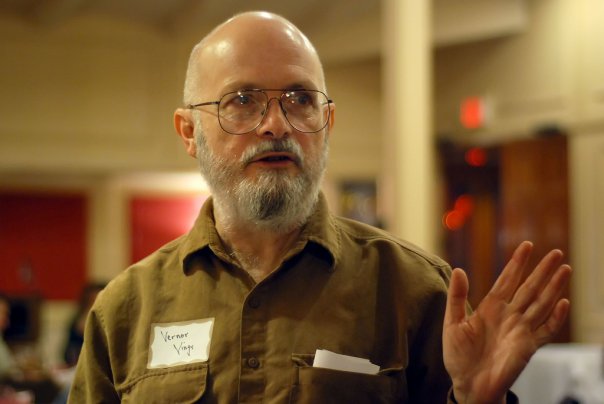
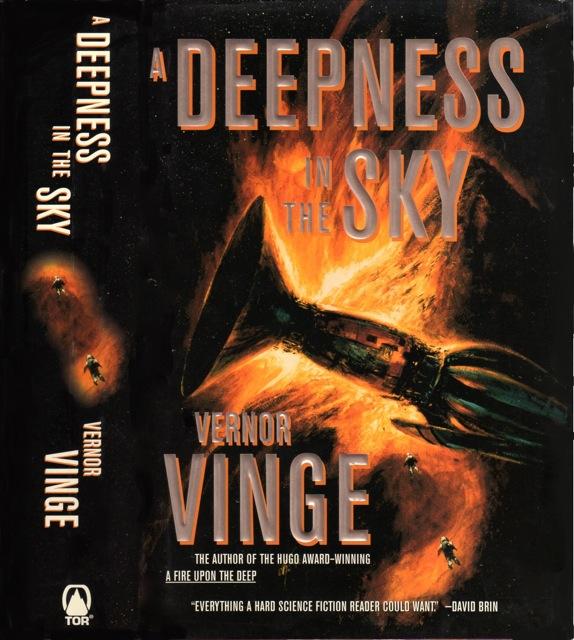
(3) FBI LOOKED AT VINGE. Reason Magazine has the story — “Declassified FBI file reveals surveillance of author Vernor Vinge”.

… Despite his clear libertarian leanings, the FBI worried about Vinge’s association
with socialists. His recently declassified file shows he was investigated for alleged “contact with Karl Amatneek,” a computer engineer involved in TecNICA, an organization that sent technologically skilled volunteers to aid Nicaragua during the socialist Sandinista revolution….

…A teletype message from January 1983 says the relationship between Vinge and Amatneek “has not yet been established,” requesting more time to investigate. Ironically, Vinge had already mocked the incompetence of the surveillance state in True Names, describing a federal agent confidently insisting the government could catch any lone troublemaker if it devoted enough resources. Pollack, the character being questioned, knew better. “He had snooped on enough secret memos to realize that the Feds really believed it, but it was very far from true.”

Vinge foresaw a world where individuals could outmatch governments. That made him a target of the very state machinery he critiqued.

(4) THE ROOM WHERE IT (SOMETIMES) HAPPENS. Curbed New York tells us “The Novelists Are Fighting at the Center for Fiction”.

Around four on a recent Thursday afternoon, the second floor of the Center for Fiction buzzed with a near-silent hum of productivity. Light streamed through the floor-to-ceiling windows as writers hunched over their laptops. A giant mural of Toni Morrison smiled in the stairwell. A lost-and-found table bore more forgotten water bottles than an Ultimate Frisbee tournament. But all was not well at the literary nonprofit: Sometimes, especially on weekday mornings, there aren’t enough desks. “Everybody is complaining,” says a current member, a novelist. And there was more trouble on the horizon: “It’s going to get worse when it’s too cold to use the outdoor terrace.”

Originally known as the Mercantile Library, the Center was founded in 1820, decades before the city’s public-library system, backed by the businessmen of Manhattan’s growing merchant class who wanted to keep their employees “away from the rumshop and the billiard room.” Membership has two tiers: General members pay $180 a year for access to several bright, airy, bookshelf-lined rooms on the second floor of the BKSK-designed space. But for $250 a month, 100 or so Writers Studio members can secure access to a separate, even brighter and airier space with individual desks. (This is significantly more expensive than, say, bringing a laptop to a coffee shop but significantly cheaper than the WeWork on Dean Street, which is comparatively charmless and where one might have to share a kitchen with unsavory AI-start-up types.) All desks and table space exist on a first-come, first-served basis, which, when they’re all full, has led to about as much aggression as the average writer can muster — piercing glares, raised eyebrows, and uncharitable speculation: “A lot of whispering about who’s really a writer and who’s just a ‘creative’ doing Zoom calls,” says a former member who left the Center over the apparent overcrowding….

(5) RATIONAL ACTORS AND EVERYONE ELSE. J. D. Harlock advises writers about “Verisimilitude in Speculative International Relations with Game Theory” at SFWA’s Planetside.

Game theory is the study of strategic decision-making when outcomes depend on a player’s actions and the actions of others involved. Analyzing interactions between political actors using game theory allows us to theorize why specific actions are taken. As an academic with a master’s degree in International Relations (IR), it’s helped me conceptualize fictional scenarios through theoretical modeling. In this article, I’ll share one approach for creators to use game theory to build believable political tensions, strategic standoffs, and high-stakes diplomacy in their speculative IR stories….

(6) GOODNIGHT MOONS. [Item by Jim Janney.] This has been around, apparently, since 2011 but it was new to me: “Goodnight Dune”.

“In a great green room, tucked away in bed, a young bunny gazes upon the two remaining moons of Arrakis…”

This book is inspired by Frank Herbert’s 1965 science fiction novel Dune. Many of the visual motifs come from the 1984 David Lynch movie adaptation of Dune, and drawn in the style of Margaret Wise Brown / Clement Hurd’s classic children’s book Goodnight Moon. Originally created in 2011, (finally) updated in 2021.

(7) TODAY’S BIRTHDAY.

[Written by Cat Eldridge.]

November 19, 1911 — Mary Elizabeth Counselman. (Died 1995.) 

Writer of genre short stories and poetry. “The Three Marked Pennies” which she wrote while she was in her teens published in Weird Tales in 1934 is considered one of the three most popular stories in all of that zine’s history.

There’s but a smattering of her at the usual suspects but she did get published— Masters of Horrors, Vol. Three, Mary Elizabeth Counselman: Hostess of Horror and Fantasy collects seventeen of her short stories and it’s readily available, and The Face of Fear and Other Poems collected much of her poetry.  It was published by Eidolon Press in an edition of 325 copies, so good luck on finding a copy. (Died 1995.)

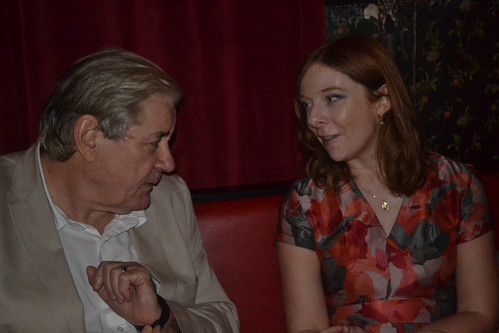
Mary Elizabeth Counselman

(8) COMICS SECTION.

(9) BLACK PANTHER AT 60. This February, Marvel Comics proudly pays tribute to one of its most groundbreaking super heroes in Black Panther Anniversary Special #1. The one-shot celebrates 60 years of T’Challa and Wakanda with brand-new, stories from a lineup of fan-favorite writers, artists, and those who have helped define Black Panther’s legacy, including writer Christopher Priest.

 Here are some of the stories fans can look forward to: 

  • Writer Evan Narcisse (WakandaSam Wilson: Captain America) and artist George Jeanty (Star Wars: Mace Windu) bring back former Black Panther, Kasper Cole! In this framing story, join Cole as he searches for Wakanda’s exiled king, learning about some of T’Challa’s never-before-told adventures in the process.
  • Cole also pays a visit to the former Queen of Wakanda in a tale by acclaimed Storm writer Murewa Ayodele and rising star artist Eder Messias (Sam Wilson: Captain America). Listen in as Storm shares an intimate memory from her time by T’Challa’s side, when their love was powerful enough to overcome any threat against them!
  • Cody Ziglar (Miles Morales: Spider-Man) joins forces with veteran Black Panther artist Alitha E. Martinez for a Black Panther/Blue Marvel team-up! Dr. Adam Brashear recounts their time together in the Ultimates, and reveals what T’Challa taught him about strength and leadership!
  • Superstar writer Christopher Priest returns to his groundbreaking Black Panther with a surprising encounter T’Challa had with Magneto, set during the time the Master of Magnetism ruled his own African nation, Genosha.

 Black Panther’s 60th anniversary coincides with an exciting new status quo for the character. The king of Wakanda is currently trying to unite his kingdom—both on Earth and in the stars—in Black Panther: Intergalactic, a four-issue limited series by Victor La Valle and Stefano Nesi debuting next month. [Based on a press release.]

(10) AI, AI, OH! [Item by Steven French.] It’s everywhere! Keza Macdonald looks at the intrusion of AI into gaming in the latest “Pushing Buttons” newsletter in the Guardian: “How generative AI in Arc Raiders started a scrap over the gaming industry’s future”.

Arc Raiders is, by all accounts, a late game-of-the-year contender. Dropped into a multiplayer world overrun with hostile drones and military robots, every human player is at the mercy of the machines – and each other. Can you trust the other raider you’ve spotted on your way back to humanity’s safe haven underground, or will they shoot you and take everything you’ve just scavenged? Perhaps surprisingly, humanity is (mostly) choosing to band together, according to most people I’ve talked to about this game.

In a review for Gamespot, Mark Delaney paints a beguiling picture of Arc Raiders’s potential for generating war stories, and highlights its surprisingly hopeful tone as the thing that elevates it above similar multiplayer extraction shooters: “We can all kill each other in Arc Raiders. The fact that most of us are choosing instead to lend a helping hand, if not a sign that humanity will be all right in the real world, at the very least makes for one of the best multiplayer games I’ve ever played.”

But, but, but, but … There is a small irony to Arc’s depiction of humanity united against the machines. The game uses AI-generated text-to-speech voices, trained on real actors. (The game also uses machine learning to improve the behaviour and animation of its robot enemies, a different type of “AI”, which video games have been using for ever.) Games writer Rick Lane found this to be so ethically compromising that he couldn’t look past it. “For Arc Raiders to ride the wave of human sociability all the way to the bank, while also being so contemptuous of the thing that makes us social animals – carving up human voices and reassembling them like a digital Victor Frankenstein – demonstrates a lack of artistic integrity that I find impossible to ignore,” he wrote for Eurogamer….

(11) DON’T. LOOK. NOW. [Item by Mark Roth-Whitworth.] So, effectively we could be inside a tin-can universe. Alternativesly, as I’ve endorsed since my teens, it could be a *four* dimensional torus… “Cosmic Paradox Reveals the Awful Consequence of an Observer-Free Universe” at Quanta Magazine.

Tinkering at their desks with the mathematics of quantum space and time, physicists have discovered a puzzling conundrum. The arcane rules of quantum theory and gravity let them imagine many different kinds of universes in precise detail, enabling powerful thought experiments that in recent years have addressed long-standing mysteries swirling around black holes.

But when a group of researchers examined a universe intriguingly like our own in 2019, they found a paradox: The theoretical universe seemed to admit only a single possible state. It appeared so simple that its contents could be described without conveying even a single bit of data, not even a choice of a zero or a one. This result clashed with the fact that this type of universe should be capable of hosting black holes, stars, planets — and people. Yet all those rich details were nowhere to be seen…

(12) THAT UFO? “Comet C/2025 K1 (ATLAS) breaks apart in incredible telescope photos” – see them at Space.com.

A comet discovered earlier this year continues to break apart after its close brush with the sun this month.

Astronomer Gianluca Masi of the Virtual Telescope Project captured breathtaking imagery of solar system comet C/2025 K1 (ATLAS) as its central icy core, or nucleus, appears to have broken into multiple pieces after being warmed by the sun. The comet made its closest approach to the sun on Oct. 8, and astronomers captured images following the solar flyby that appear to show it dramatically breaking apart.

These most recent images seem to confirm that, as multiple distinct fragments can be seen. The images appear to show “three fragments of the original nucleus and possibly a fourth one,” Masi wrote in a statement accompanying the images.

(13) TRAILER PARK. ‘”Project Hail Mary’ Second Trailer: Ryan Gosling in Space” at IndieWire.

…An official synopsis for the film reads: “Science teacher Ryland Grace (Gosling) wakes up on a spaceship light years from home with no recollection of who he is or how he got there. As his memory returns, he begins to uncover his mission: solve the riddle of the mysterious substance causing the sun to die out. He must call on his scientific knowledge and unorthodox ideas to save everything on Earth from extinction… but an unexpected friendship means he may not have to do it alone.”…

[Thanks to Kathy Sullivan Mike Kennedy, Andrew Porter, Gary McGath, Jim Janney, John King Tarpinian, Chris Barkley, Cat Eldridge, SF Concatenation’s Jonathan Cowie, Mark Roth-Whitworth, and Steven French for some of these stories. Title credit belongs to File 770 contributing editor of the day Daniel Dern.]
Pixel Scroll 10/2/25 Up The Airy Pixel, Down The Skiffy Glen, We Daren’t Go A-Scrolling, For Fear Of Little Fen

Sturgeon Award

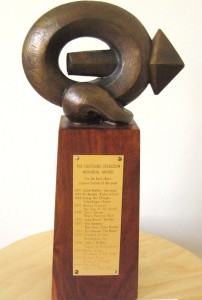
(1) THEODORE STURGEON AWARD. Conrad Loyer’s “The Carcossa Pattern,” published by Fiyah Magazine, is the winner of the 2025 Theodore Sturgeon Memorial Award for best science fiction short story published in 2024. The announcement was made today by the Gunn Center for Science Fiction.

(2) SFPA POETRY AWARDS. The Science Fiction and Fantasy Poetry Association has revealed the 2025 Rhysling Award Winners and the 2025 Elgin Award Winners. See full details at File 770’s posts.

(3) THE PEEPS LOOK UP. The Anthropic Copyright Settlement website now features a “Works Lookup” tool where writers can search by ISBN/AIN, Title, Author or Publisher to determine if their works are included in the settlement.

The FAQ says:

To ensure that you are eligible to receive a payment, you must submit a valid Claim Form by March 23, 2026.

Submitting a valid Claim Form is the only way to guarantee that you will receive a payment from this Settlement. You can receive payment for each qualifying work you own. You also give up the right to sue Anthropic over the legal claims this Settlement resolves.

Claims can be filed at the website.

(4) MARKOWITZ AWARD. 2024 Otherwise Award honoree Emet North is one of two winners of the 2025 Judith A. Markowitz Award for Exceptional New LGBTQ Writers.

Lambda Literary is pleased to announce Aaron H. Aceves and Emet North as the winners of the 2025 Judith A. Markowitz Award for Exceptional New LGBTQ Writers!

The prize recognizes LGBTQ-identified writers whose work demonstrates their strong potential for promising careers. The award includes a cash prize of $1,500. Two prizes are awarded annually.

Aaron H. Aceves is a bisexual, Mexican-American writer born and raised in East L.A. He graduated from Harvard College and received his MFA from Columbia University. His fiction has appeared in or is forthcoming from Passages North,  Epiphany, and The Iowa Review, among other places. He currently lives in Southern California after serving as an Early Career Provost Fellow at UT Austin. His debut young adult novel, This Is Why They Hate Us, was released by Simon & Schuster. It received multiple starred reviews and was named a Best Young Adult Book of 2022 by Kirkus Reviews.

Emet North has lived in a dozen states over the past decade and has no fixed residence, though they feel most at home in the mountains. In previous lives, they worked in an observational cosmology lab on a grant from NASA, taught snowboarding in Montana, researched Lie algebras, trained horses, and wrote a thesis on the many-worlds interpretation of quantum mechanics. Their debut novel, In Universes, was the winner of the 2024 Otherwise Award and was named one of the New York Times’ 10 Best Science Fiction and Fantasy Novels of 2024. They translate from Spanish to English with a particular focus on queer and trans voices and are always looking for new projects.

(5) AI AI AI! Camestros Felapton revisits a Murray Leinster classic in “RF:Ph02:Ch35: A Logic Named Joe”.

…“A Logic Named Joe” was published under the name Will F. Jenkins3 in the March 1946 edition of Astounding Science Fiction. The tag line of the story explains:

“Joe was a machine , and Joe wanted to he helpful, Joe was immensely helpful. So horribly helpful he very nearly destroyed civilisation with his accurate answers!”

…It is an entertaining story whose prescience has been remarked upon for many years now. The added parallels with the way people are using/abusing generative AI chat bots has added an extra layer of surprising insight to the story….

(6) WALL OF FAME. “Jewel Box Platinum Go-To for Music Plaques”The Hollywood Reporter tells why these are still in demand.

For all the ways in which the music industry has been transformed in the digital age, one tradition remains unchanged: Nothing signifies success in the business more effectively than a custom plaque on the wall. For years, the place to turn to for a record-shaped wall flex has been an Inglewood company called Jewel Box Platinum, founded in 1995.

Steve Driss, who took over Jewel Box Platinum two years ago, says his team produces 8,000 to 10,000 pieces a year, and that business is growing. Jewel Box offers standard packages to commemorate Gold or Platinum records or a high Billboard chart placement, ranging from $400 to $600. But Driss has fielded his share of outrageous custom requests. One of his largest commissions was a 10-foot-by-6-foot plaque for Rick Ross’ house, which featured all the rapper’s album covers. Driss recalls Ross telling him, “I want that plaque right there, so when I’m on my Zoom calls, everybody can see it.”

Jewel Box Platinum has pieced together guitars that had been smashed onstage for Post Malone and designed a plaque in a diamond frame for Michael Jackson. But Driss notes the requests go beyond just the music industry. He also recalls making a plaque for the blockbuster Barbie movie, which was later presented to star Ryan Gosling.

Unlike sales of physical records, requests for plaques are showing no signs of slowing down. What has changed is the client. As digital downloads and streaming ate into their business, major labels, which “used to be the ones ordering hundreds of plaques” for everyone involved in the success of a song or album, have reduced — but by no means eliminated — their order volume.

But as labels reduced their requests, other players came knocking. Driss says music streaming services, such as Spotify, iTunes and Apple Music, “opened up a lot of doors” for his business. Making up for the dwindling number of orders from labels are artists themselves, turning to Jewel Box to commemorate their own streaming achievements. Driss also has noticed more requests from the live events space, with people wanting to celebrate their involvement in a successful tour.

The present and future of the music industry may be digital-first, but when it comes to flexing, there’s been no digital substitute for the good old shiny, tangible, conspicuously hung plaque….

(7) GEORGE SMOOT (1945-2025). “Big Bang theorist and Nobel laureate George Smoot dies”AP News pays tribute.

Nobel laureate Dr. George Smoot, who conducted groundbreaking research into the origins of the universe during a long career at the University of California, Berkeley, and the Lawrence Berkeley National Laboratory, has died, the school said. He was 80.

Smoot died on Sept. 18 in Paris of a heart attack, according to a statement Monday by UC Berkeley.

Along with John Mather of the NASA Goddard Space Flight Center, Smoot won the 2006 Nobel Prize for physics for finding the background radiation that finally pinned down the Big Bang theory, the idea that the universe was born in a rapid cosmic expansion some 14 billion years ago.

The Florida native earned a PhD in particle physics at the Massachusetts Institute of Technology in 1970. He soon joined the Berkeley Lab, “where he spent a distinguished career uncovering the secrets of the universe,” lab director Mike Witherell wrote in a tribute.

At the lab, George led a research team that produced detailed maps of the infant universe.

“They revealed a pattern of minuscule temperature variations in the cosmic microwave background, relic light from billions of years ago. Those early tiny fluctuations evolved into the galaxies we observe today,” Witherell wrote. It was that research that led to Smoot and Mather winning the Nobel Prize.

He used $500,000 of his Nobel money to launch the Berkeley Center for Cosmological Physics at UC Berkeley. He traveled the world after retiring from the Berkeley Lab in 2014, and took a keen interest in climate change.

Smoot also appeared as himself — twice — on the hit CBS sitcom “The Big Bang Theory,” including in an episode where he lectured at a fictional physics symposium. In 2009 he won the top prize on the Fox TV game show “Are You Smarter Than A 5th Grader?”…

(8) TODAY’S BIRTHDAY.

[Written by Paul Weimer.]

October 2, 1944Vernor Vinge. (Died 2024.)

By Paul Weimer: I heard about Vernor Vinge’s work long before I actually got to read it.  True Names, Vinge’s 1982 early look at cyberspace, was famous in SF circles, and also out of print, when I first heard about in the late 1980’s. I had heard his work was visionary but it took a reissue of True Names some years later for me to get what the fuss is all about.

Vernor Vinge

Then of course, in short order came the Deep series, possibly one of the most mindblowing trilogies of books in science fiction (even as I recognize the scale shrunk considerably from book to book). Vinge’s work has always been in conversation with the digital landscape of its time, and of the near future, A Fire Upon the Deep’s FTL communication is Usenet in Space, for example. Rainbow’s End, with its digitization of books, was a herald of the questions we have with the digitization of works and what might be lost in the process (c.f. The Internet Archive). Although the form of the Internet is nothing like True Names, the idea of online versus personal identities is all right there, and before Neuromancer and its kin.

My favorite of his books is Marooned in Realtime. While The Peace War is a fascinating setting and an interesting puzzle book introducing the stasis bubbles, I think Marooned in Realtime, with its small cast of the end of humanity, and an innovative murder in such an environment is the real gem of the pair. I’d like to think you can read Marooned alone without the Peace War, but I think that as fabulous as Marooned is, it does not quite stand alone.

Vernor Vinge’s oeuvre is readily completely consumable, he hasn’t written much, but the shadow of what he writes, even if not intended at the time, casts long over SF, even when he didn’t intend to.  I am thinking here of the last, in Rainbow’s End again, and how in that world we got many more novels than our world did from the amazing Terry Pratchett.  If only I could step over to that world and pick up the Discworld novels he never got to write in ours.

(9) COMICS SECTION.

(10) SMASH AND GRAB. “Texas Senators Want to Chop Up Space Shuttle Discovery”Gizmodo has the latest developments.

…According to NASA Watch, the White House budget office has asked the Smithsonian to begin chopping up Discovery in preparation to move it to Houston, Texas. NASA Watch called the development “unprecedented and alarming,” as NASA did not design Discovery to be disassembled, and doing so could result in irreparable damage, particularly to the shuttle’s frame, heat shield, and thermal insulation fabric….

The “One Big Beautiful Bill” Act, signed into law on July 4, included a bill introduced by Senators Ted Cruz (R-TX) and John Cornyn (R-TX) to “bring Discovery home to Texas.” In a recent letter addressed to Congressional Authorizing and Appropriating Committees—obtained by NASA Watch—the Smithsonian states that the White House budget office has asked it to work with NASA to prepare to move Discovery within the 18 months specified in the reconciliation bill.

“While an engineering study will be necessary due to the size and weight of the space vehicle, both NASA and the Smithsonian believe that Discovery will have to undergo significant disassembly to be moved,” the letter reads. “Discovery is the most intact shuttle orbiter of the NASA program, and we remain concerned that disassembling the vehicle will destroy its historical value.”

The move would come at a significant financial cost as well. The Smithsonian and NASA estimate the minimum cost of Discovery’s relocation is in the range of $120 million to $150 million, not taking into account the costs associated with building a new facility in Houston to house the shuttle. The letter also notes that NASA transferred “all rights, title, interest and ownership” of the shuttle to the Smithsonian.

State Senator and former NASA astronaut Mark Kelly (D-AZ)—who flew two missions aboard Discovery during his previous career—has joined forces with Senators Mark Warner (D-VA), Tim Kaine (D-VA), and Dick Durbin (D-IL) to prevent Discovery’s relocation.

In a letter sent to the Senate Appropriations Committee on September 23, they call for fiscal year 2026 spending measures to pause any efforts to move the space shuttle to Houston, citing the “competitive” process that selected the Smithsonian as the resting place for Discovery.

“Houston’s disappointment in not being selected is wholly understandable, but removing an item from the National Collection is not a viable solution,” the letter reads. “It is worth noting that there is little evidence of broad public demand for such a move.”…

(11) TRIPPING THE LIGHTNING FANTASTIC. [Item by Steven French.] From dancing bones to the origins of life, it’s bubbles all the way: “Mysterious will-o’-the-wisps ignited by microlightning” in Science.

The eerie phenomenon has been said to be dancing bones, the hovering souls of dead children, and ghost lights meant to confuse travelers. For hundreds of years, folklore has sought to explain the will-o’-the-wisp, the fleeting flames occasionally seen above swamps and graveyards in the dark of night. Scientists have long suspected the flickers arise from flammable methane gas produced by decaying organic matter. But it’s been unclear how this gas could catch fire. Now, new research suggests that tiny lightning bursts jumping between microscopic bubbles can spark the phenomena, sometimes also called a jack-o’-lantern.

“This is really an interesting step forward,” says James Anderson, a chemist at Harvard University. “It reveals a mechanism by which chemical reactions can be initiated.” Anderson says the power of microbubbles to trigger reactions could also help explain how essential biomolecules formed prior to the dawn of life. The work is published today in the Proceedings of the National Academy of Sciences.

(12) JUICY MOON. “A hidden ocean may have once existed on Uranus’ moon Ariel” reports Space.com.

Ariel, one of Uranus’ icy moons, may once have concealed a vast ocean more than 100 miles (170 kilometers) deep beneath its frozen crust, according to new research. The findings add to growing evidence that Uranus’ moons could have been ocean worlds in the distant past.

At 720 miles (1,159 kilometers) across, Ariel is smaller than many of the moons orbiting the planets Jupiter and Saturn. Yet, its surface is exceptionally bright and unusually complex, with ancient cratered terrain lying alongside much younger, smoother plains likely shaped by cryovolcanism, a type of volcanism that happens on icy bodies

“Ariel is pretty unique in terms of icy moons,” study co-author Alex Patthoff, a senior scientist at the Planetary Science Institute in Arizona, said in a statement….

… The analysis concluded Ariel’s orbit once had an eccentricity of about 0.04, roughly 40 times greater than what it exhibits today. That would have made its orbit four times more eccentric than Europa, Jupiter’s icy moon that displays a fractured, geologically active surface.

The scale of Ariel’s cracks and ridges, the researchers inferred, could only be explained if the crust was flexing over a liquid layer. Either Ariel harbored a massive ocean covered by a relatively thin ice shell, or a smaller ocean paired with stronger orbital stresses.

[Thanks to SF Concatenation’s Jonathan Cowie, Mark Roth-Whitworth, Steven French, Kathy Sullivan, Mike Kennedy, Andrew Porter, John King Tarpinian, Chris Barkley, Cat Eldridge, for some of these stories. Title credit belongs to File 770 contributing editor of the day Xtifr.]

Pixel Scroll 9/4/25 Aren’t You a Little Short for a Pixel Scroll?

(1) CIXIN LIU AND ROBERT J. SAWYER ANNOUNCED GUESTS AT CHINA SF CONFERENCE. [Item by Ersatz Culture.] China’s Science Fiction World magazine today released details of an impending convention, the details of which might cause a little bit of déjà vu, given that two of the three headline guests are Cixin Liu and Robert J. Sawyer, and the venue is a brand new building dedicated to science, situated by a lake in Chengdu.

CG promotional image for the convention

The 2025 Galaxy Science Fiction Convention is a rebranding of the biennial China (Chengdu) International Science Fiction Conference (CISFC).  Those who attended the Chengdu Worldcon may recall that the sixth CISFC was the “other” event that ran in parallel with the Worldcon, at the Sheraton hotel on the other side of the lake from the SF Museum.  The “new” Galaxy name isn’t really, as it comes from the long-running award of that name (银河/Yinhe in Chinese), and the 36th set of those awards will be given out on the evening of Friday 19th, at this convention.

(The footer of some of the promotional images uses the shortened English name “Galaxycon”, which might raise eyebrows given the similarly named US cons.)

As mentioned, Cixin Liu and Robert J. Sawyer are listed as two of the three main guests.  Joining them is A Lai, who is described in a promotional image as:

A famous contemporary Chinese writer, Vice Chairman of the 10th National Committee of the China Writers Association, Director of the Ethnic Minority Literature Committee of the China Writers Association, Member of the 14th National Committee of the Chinese People’s Political Consultative Conference and Member of the Ethnic and Religious Committee, and Chairman of the Sichuan Writers Association.

It is probably more relevant that he is a former editor of SF World.  Some of the other guests are listed in another image attached to the Weibo post; names that would be recognizable to File 770 readers include Liza Groen-Trombi of Locus, Neil Clarke of Clarkesworld, and 2024 Hugo finalists Wang Jinkang, Han Song, and He Xi.

It may be worth noting that yesterday Robert J. Sawyer was asked on Facebook whether “[he was] heading back to China?”, to which he replied “No current plans”.

The venue is a newly opened – August 22nd per this Xiaohongshu/RedNote post – pavilion that is part of the Chengdu Science City complex to the south of Chengdu, by Xinglong Lake.

Weibo posts say the venue is “Pavilion 3”, which I *think* is the flat dome with the triangular lattice ceiling, rather than the silver doughnut with blue windows.

Curiously, this is not the only SF convention with an award ceremony taking place in Chengdu on the weekend of the 19th-21st.  At the Chengdu SF Museum will be the 16th Xingyun (Chinese Nebula) Celebration.  I’ve seen much less information about this event, but I’m told the Xingyun Award ceremony will be on Saturday 20th, hopefully indicating a degree of coordination between the two events to allow attendees to partake in both.

It may also be worth noting that the announcements I’ve seen from the Xingyun organizers include the following text:

华语科幻星云奖坚持新发展理念,启动逐年改革步骤,不仅对核心领导班子进行了年轻化换届,在评奖机制上,公正透明、开拓进取,邀请英语星云奖、日语星云赏及世界科幻大会雨果奖组织者来华参会,增进文化交流互鉴,积极吸收国际化办奖经验,优化顶层设计,通过系统谋划,认真实践探索,实现高质量发展,并稳步推进国际传播能力建设。截止2024年12月有关影响力指数统计,华语科幻星云奖百度词条查询浏览量超17万次,微博话题相关阅读量达9000万次,均名列中国科幻奖项前茅。

which Google Translate renders as follows, with minor manual edits:

The Chinese Science Fiction Nebula Award adheres to the new development philosophy and has initiated annual reforms. Not only has it undergone a rejuvenation of its core leadership team, but it has also established a fair, transparent, and progressive award evaluation mechanism. Organizers of the English and Japanese language Nebula and Seiun Awards, as well as the Hugo Awards of the World Science Fiction Convention, have been invited to participate in China to promote cultural exchange and mutual learning. The award actively draws on international awards experience, optimizes its top-level design, and through systematic planning and diligent practical exploration, aims to achieve high-quality development and steadily advance its international communication capabilities. As of December 2024, according to influence index statistics, the Chinese Science Fiction Nebula Award has received over 170,000 page views on Baidu and 90 million views on Weibo, both ranking among the top science fiction awards in China.

(Thanks to Arthur Liu for clarification on the award ceremony dates.)

(2) WOMEN IN SFF. A Deep Look by Dave Hook is about “Women in Science Fiction/Speculative Fiction: 2025”.

…A few weeks ago I was on a panel at Seattle Worldcon 2025, “Women Write: An Overview of Women in SFF history”. Preparing for that panel and thinking about the need to update my 2022 essay led me to this 2025 essay, “Women in Science Fiction/Speculative Fiction”…

Here for example are the final three, from the 2020s:

Ai Jiang‘s first work published was short story “Hello“, The Dark April 2021. Her first story I have read is short story “Give Me English“, F&SF May-June 2022. It was a great story, and was a Nebula and Locus Award finalist. Other great short fiction by her includes novelette “I Am AI“, 2023 Shortwave Media (Locus Award runner-up and Hugo and Nebula Award finalist). Linghun, a novella, 2023 Dark Matter Ink, was a Nebula Award winner, but I lost interest. She has published quite a bit of short fiction, and I need to read more of it. Maybe there will be a collection soon?

Isabel J. Kim‘s first work published was short story “Homecoming Is Just Another Word for the Sublimation of the Self“, Clarkesworld March 2021. I thought it was a very good first story. Other great stories by her include the short stories “You’ll Understand When You’re a Mom Someday“, Khōréō August 2021, “The Massage Lady at Munjeong Road Bathhouse“, Clarkesworld February 2022, “You, Me, Her, You, Her, I“, Strange Horizons Fund Drive 2022 (perhaps my favorite of her stories so far, about a very interesting synthetic intelligence), “Calf Cleaving in the Benthic Black“, Clarkesworld November 2022, “The Big Glass Box and the Boys Inside“, Apex Magazine January 2023, “Zeta-Epsilon“, Clarkesworld March 2023, “Day Ten Thousand“, Clarkesworld June 2023, and “Why Don’t We Just Kill the Kid In the Omelas Hole“, a short story, Clarkesworld February 2024 (Nebula and Locus Award winner, and Hugo and Sturgeon Award finalist). She was a finalist for the 2023 Astounding Award for Best New Writer. I will definitely continue to look for her fiction.

Kaliane Bradley‘s first work of genre interest was “Doggerland”, the winner of the VS Pritchett Short Story Prize 2022 by the Royal Society of Literature for previously unpublished work. It was first published in March 2023 in Prospect online. I need to read it. Most of us became aware of Kaliane Bradley after her first novel The Ministry of Time, 2024 Avid Reader Press/Simon & Schuster was a Locus, Hugo and Clarke Award finalist. I loved it, voting it to be runner-up in the Hugo Best Novel Award. I need more work by her to be able to judge her career and interest in genre fiction….

(3) VINGE FOIA DISCOVERY. According to Reason, “FBI spied on libertarian sci-fi author Vernor Vinge in ‘espionage’ case”. “The late friend of Reason, who coined the term ‘technological singularity,’ landed on the feds’ radar for his association with a foreign policy dissident.”

The FBI, however, knew Vinge as a potential threat. His file, which was declassified in February 2025 and released under the Freedom of Information Act (FOIA) last week, includes papers from a 1982 investigation into Vinge. While the full context of the case is redacted, one of the memos notes that Vinge “may have been in contact with Karl Amatneek,” a fellow computer engineer who “is the subject of a current espionage investigation.”

The FBI files gave another reason why Vinge was someone to watch: “Subject has a security clearance and works at a sensitive facility.” That clearance, which was active from July to August 1981, came from Vinge’s work with Tetra Tech, a government contractor in Pasadena, California.

Amatneek came under FBI scrutiny in the 1980s for his involvement in TecNICA, an organization that sent delegations of technologically-skilled volunteers to aid Nicaragua during the socialist Sandinista revolution. The FBI made its interest in Amatneek very clear to the people it interrogated, according to fellow TecNICA volunteers who spoke to the Los Angeles Times in 1987. They accused the Reagan administration, which was trying to overthrow the Sandinista government, of running a harassment campaign against foreign policy critics….

(4) FANX SLC NOT ALLOWING AI-GENERATED WORKS. Salt Lake City’s FanX convention has sided with conrunners who are banning the display and sale of AI artwork at their event. They’re offering refunds to any artist or vendor who needs to withdrawal as a result of the policy.

(5) AI ART ALSO BANNED HERE. The U.S. event-running company GalaxyCon also has barred the gates to AI art in its shows. “GalaxyCon LLC Announces Sweeping AI Art Ban” in Animation Magazine.

GalaxyCon, the consumer and fan engagement company behind numerous events across the country throughout the year, has announced a ban on all AI-generated art from its shows, effective immediately. This ban applies to artists, exhibitors and guests at GalaxyCon’s roster of shows, including: GalaxyCon, Nightmare Weekend, Animate! and Superstar Comic Con conventions. GalaxyCon has updated its terms and conditions for anyone exhibiting at its shows with a zero-tolerance policy towards AI-generated art.

The announcement comes just after another convention, Dragon Con in Atlanta, sparked headlines for evicting an exhibiting artist for selling merchandise featuring AI-generated artwork in violation of the event’s policies.

“The way artificial intelligence is currently being trained presents many ethical and moral issues that simply can no longer be ignored in our industry,” said Mike Broder, Founder and President of GalaxyCon. “GalaxyCon has a long, proud history of supporting artists and their creativity, and we will continue to do so as the fight against unethical AI continues.”…

(6) MRM SAGA CONTINUES. P. A. Cornell was never able to get Must Read Magazines to change the unacceptable terms in the contract Analog offered for her story, and now is “Putting unpleasantness in the rear-view”.

Subscribers know my newsletter usually comes out the first of each month, but now and then I make an exception, like I am today. I recently wrote about my experience following an acceptance from Analog magazine in early March of this year, first in this post and then with a complete timeline of the whole ordeal in this post. As I write this, I can tell you this 7-month-long saga of a tale has finally come to an end.

I wish I could say I finally received a contract from Must Read Magazines that I found reasonable and was happy to sign. Unfortunately, that’s not the case.

If you’ve read the previous posts, you’ll know I’d decided to pull my story from Analog back in July, following four-and-a-half months of unsuccessful contract negotiations. At that time MRM responded asking me not to pull my story just yet, assuring me that they wanted to work with authors to iron out the kinks of new ownership….

… I even reached out to ask when I’d be hearing from them, and they requested a bit more patience as they were busy with WorldCon. I agreed to that. I’m not entirely unreasonable. But still no response came.

Not until one day short of a month since I’d passed along those contract notes. (Two days short of seven months since my acceptance)

I wish I could say their response was worth the wait.

Rather than proceed as you might expect from someone who assured me they wanted to work with writers on this contract (by agreeing to some of our suggested changes and maybe explaining why they couldn’t make others), they simply concluded their negotiations with me altogether.

Keep in mind that I was acting as the voice of not just myself, but the aforementioned authors, editors, and other entities as well. So, in a sense, they were telling all of us they weren’t truly willing to work with us, despite their earlier assurances. (Not a good look, if you ask me.)

Some who’ve been following along have noted the timing of this response immediately followed my timeline post. Coincidence, perhaps. Do I regret writing it? No. All along I’ve felt people needed to know what was happening with this situation so that they could make informed decisions and feel empowered to push back on not just this, but any contract that didn’t meet their needs. …

… In their email they said things like not wanting to delay me any further unless I change my mind (by which I assume they mean, unless I agree to accept their contract unchanged). There was also some suggestion that they’d previously been criticized for coming off as condescending when attempting to explain industry standards to authors.

Apparently they were under the impression we were unaware of industry standards in short fiction and required an explanation. I would think someone like Kristine Kathryn Rusch—who has had multiple appearances in Analog and still chose to walk away from MRM’s magazines—has more than a little experience with industry standards. I mention Kristine only because by this point it’s common knowledge she has written extensively about this situation on her patreon…

(7) LITTLE BUG, BIG GAME. [Item by N.] After years of waiting, the hotly-anticipated game Hollow Knight: Silksong is finally here. And Endless Mode says there was an overwhelming rush to play: “Silksong Hype Seems To Have Crashed Steam’s Servers”.

After years of fervor and desperate comments in game convention live streams turned it into a meme, Team Cherry’s highly anticipated Hollow Knight: Silksong finally comes out today. Specifically, it launched at 10 a.m. EST on Steam and other digital storefronts. Or, well, it was supposed to.

At around 10 a.m. EST, Steam was down with the following error message: “Something Went Wrong. We were unable to service your request. Please try again later. E502 L3.” The full downtime featuring the previously mentioned message went on for about another 15 to 20 minutes. However, after this, other technical issues persisted, and at least in my case, I still haven’t been able to get past adding the game to my cart 40 minutes later, with checkout stuck in a loading screen. Honestly, I have a hard time remembering the last time this happened with a game purchase, and the closest thing I can think of is what occurs whenever new console pre-orders open. Steam wasn’t the only storefront affected, and apparently, Xbox, PSN, and the Switch store were also encountering issues.

It goes without saying that these problems are likely a result of the huge number of Hollow Knight superfans flocking to digital storefronts, with the traffic spikes proving more than Valve, Nintendo, Microsoft, and Sony’s servers could handle….

If you can grab ahold of it, Silksong is available for various systems….

(8) MEMORY LANE.

[Written by Cat Eldridge.]

September 4, 1995Xena: Warrior Princess

Thirty years ago Xena: Warrior Princess first aired in syndication by MCA TV on this date (*as did it for the first two years, followed by Universal Television Enterprises for a year, and Studios USA Television Distribution for the rest of the run).  Before ending its six-year run, there would be one hundred and thirty-four roughly forty-eight minute episodes.

It was created by John Schulian and Robert Tapert. Schulian’s previous genre credits included writing for Tremors. Tapert, of course, created Hercules: The Legendary Journeys that same year, along with Christian Williams. Busy year for New Zealand series production. The executive producers were R.J. Stewart and Sam Raimi. The former, other than co-creating Xena, just created the rather fun Cleopatra 2525; Raimi of course has a long list including directing the excellent Tobey Maguire Spider-Man trilogy and the Evil Dead franchise which I’ve not seen. 

The real reason watching was and is now if you catch it on Prime right now, Xena as performed in that amazing leather outfit by Lucy Lawless, and companion Gabrielle as played by Renee O’Connor. Their adventures, episode in and out, were always worth watching. 

A number of fascinating secondary cast were here as well. Bruce Campbell, Karl Urban, Kevin Smith, Alexandra Tydings — all these performers were quite interesting to watch.

NBC announced a reboot, but the Gods were merciful, and it got cancelled without even a pilot being shot.

(9) COMICS SECTION.

My latest cartoon for @theguardian.com books. p.s. I have a new book of cartoons out soon: www.tomgauld.com/comic-books-v2

Tom Gauld (@tomgauld.bsky.social) 2025-08-31T15:31:05.093Z

(10) CAN YOU DIG IT? [Item by Steven French.] On this week’s “Pushing Buttons” newsletter in the Guardian, archaeologist and gamer Florence Smith Nicholls discusses games with an archaeological bent: “Forget Tomb Raider and Uncharted, there’s a new generation of games about archaeology – sort of”.

The game I’m most looking forward to right now is Big Walk, the latest title from House House, creators of the brilliant Untitled Goose Game. A cooperative multiplayer adventure where players are let loose to explore an open world, I’m interested to see what emergent gameplay comes out of it. Could Big Walk allow for a kind of community archaeology with friends? I certainly hope so.

When games use environmental storytelling in their design – from the positioning of objects to audio recordings or graffiti – they invite players to role play as archaeologists. Game designer Ben Esposito infamously joked back in 2016 that environmental storytelling is the “art of placing skulls near a toilet” – which might have been a jab at the tropes of games like the Fallout series, but his quip demonstrates how archaeological gaming narratives can be. After all, the incongruity of skulls and toilets is likely to lead to many questions and interpretations about the past in that game world, however ridiculous.

I used to work as an archaeologist in the analogue world, where my work consisted of excavations, fieldworks and assessment of potential development sites across the UK. Now I’m doing a computer science PhD focusing in video game archaeology, where I get to come up with novel ways to record gameplay experiences, like doing in-game walking interviews with players in the MMO Wurm Online, or recording the location of player messages in Elden Ring.

Because I know what being an archaeologist entails, I often find myself thinking about games that just have you play as a person with that job title, such as Tomb Raider or Uncharted, versus those that have you engage in work similar to what we do in the field. Walking sims like Gone Home and What Remains of Edith Finch invite you to explore a space and interpret what all of the objects left behind in the landscape mean. Dr Melissa Kagen, assistant teaching professor in interactive media and game development at Worcester Polytechnic Institute, refers to this interpretive gameplay in walking simulators as “archival adventuring”….

(11) VIRTUAL TOLKIEN SEMINAR. Here’s a call for papers for the “Tolkien Society Seminar 2025 – Arda’s Entangled Bodies and Environments”. It will run on Zoom from October 18-19. The seminar will be free for all attendees. You can sign up to attend the seminar here.

The Tolkien Society is excited to partner with the Centre for Fantasy and the Fantastic and Medical Humanities Research Centre at the University of Glasgow. The seminar will be co-run by Will Sherwood (The Tolkien Society’s Education Secretary), Clare Moore (University of Glasgow), and Journee Cotton (New Mexico Military Institute).

The relationship between the body and the environment is at the heart of Tolkien’s writing. He even called his secondary world “Arda Marred” after Melkor’s discord led to all matter, vegetal and organic, having a “Melkor ingredient”. Yet even as early as ‘The Book of Lost Tales’ and in his writings not related to the legendarium, Tolkien shows a keen interest in the connection and ongoing relationship between the body and the earth, often linking the land’s health to the beings that inhabit it. Frequently the environs within his writing indicate they might be sentient, suggesting possible greater agency in Arda and his other worlds beyond his humanoid characters. Likewise, over the course of his writing career, Tolkien developed his ideas concerning the body, which play out in complex and even contradictory ways in his metaphysics and within his narratives.

This seminar invites analyses that explore the complexities of bodily experiences and environments. Building on a strong tradition of scholarship on embodiment and ecology in Tolkien’s writings and their adaptations, this seminar invites new and innovative readings of the entangled body and earth across Tolkien’s oeuvre and its adaptions….

(12) AT THE CORE. [Item by Steven French.] Although it doesn’t have a magnetic field, Mars does have a solid core, just like the Earth: “Marsquakes indicate a solid core for the red planet, just like Earth” at Phys.org.

Scientists revealed Wednesday that Mars’ innermost core appears to be a solid hunk of metal just like Earth’s.

The Chinese-led research team based their findings on seismic readings from NASA’s InSight lander on Mars, which recorded more than 1,300 marsquakes before shutting down in 2022. The spacecraft landed on a broad plain near Mars’ equator in 2018.

Previous studies pointed to liquid at the heart of the red planet. The latest findings indicate the inner core, while small, is indeed solid and surrounded by molten metal—a liquid outer core….

(13) CATCH THE WAVE. [Item by Steven French.] A neat piece in Quanta Magazine on the Fourier Transform which underpins so much of modern science: “What Is the Fourier Transform?”

As we listen to a piece of music, our ears perform a calculation. The high-pitched flutter of the flute, the middle tones of the violin, and the low hum of the double bass fill the air with pressure waves of many different frequencies. When the combined sound wave descends through the ear canal and into the spiral-shaped cochlea, hairs of different lengths resonate to the different pitches, separating the messy signal into buckets of elemental sounds.

It took mathematicians until the 19th century to master this same calculation.

In the early 1800s, the French mathematician Jean-Baptiste Joseph Fourier discovered a way to take any function and decompose it into a set of fundamental waves, or frequencies. Add these constituent frequencies back together, and you’ll get your original function. The technique, today called the Fourier transform, allowed the mathematician — previously an ardent proponent of the French revolution — to spur a mathematical revolution as well.

Out of the Fourier transform grew an entire field of mathematics, called harmonic analysis, which studies the components of functions. Soon enough, mathematicians began to discover deep connections between harmonic analysis and other areas of math and physics, from number theory to differential equations to quantum mechanics. You can also find the Fourier transform at work in your computer, allowing you to compress files, enhance audio signals and more.’

(14) VIDEO OF THE DAY. Back in the Sixties, Sean Connery appeared as a mystery guest on What’s My Line?. If your TV doesn’t pick up time-travel broadcasts, YouTube can fix you up.

[Thanks to SF Concatenation’s Jonathan Cowie, Mark Roth-Whitworth, Steven French, Ersatz Culture, Dann, N., Dave Doering, Kathy Sullivan, Mike Kennedy, Andrew Porter, John King Tarpinian, Chris Barkley, and Cat Eldridge for some of these stories. Title credit belongs to File 770 contributing editor of the day Brian Z.]

Pixel Scroll 10/2/24 …And The Pixel May Learn To Scroll

(1) DONATE TO HELP DISASTER-AFFECTED BOOK/COMIC SELLERS. The Binc Foundation and MacMillan invite you to “Be a hero to a book or comic seller today!”

Macmillan will match the first $10,000 in total contributions dollar for dollar. There is no better time than right now to Stand with Book & Comic Stores. Your action today gives those who work in book and comic stores a place to call for help when the unexpected happens. Your contribution will give the gift of peace of mind and hope when they are facing the devestating impact from a hurricane, cancer diagnosis, or the threat of losing one’s home.

Thanks to Macmillan Publishers, gifts made to the Book Industry Charitable (Binc) Foundation will have double the impact. Macmillan will match all gifts, regardless of size, up to $10,000 to meet the needs of the more than 200 bookstores and comic shops and thousands of store employees potentially impacted by Hurricane Helene. Binc has already received 15 calls for help from book and comic people in the path of destruction–more than 500 miles across six states. 

“We are already hearing from book and comic people who are traumatized, unable to find friends and family, and without water and electricity,” said Binc Executive Director Pam French, “and we know there will be more stores in need of disaster relief as the waters recede, the cleanup begins, and cell phone signals return. We are grateful for our friends at Macmillan for their willingness to partner with us in support of bookstores and comic shops.”
 
The foundation receives requests every day from book and comic store employees and owners experiencing unforeseen emergency financial, medical and mental health hardships, and has helped stores around the country recover after natural disasters like hurricanes, wildfires, floods, and the COVID-19 pandemic. 

Double the impact of a gift to Binc by donating today

(2) PS MAGAZINE, RIP.  This was the renamed Army Motors. History here, including a mention of young contributor Will Eisner: “A Brief History of ‘PS Magazine’ and Its Significance” at Global Electronic Services. In January 2024, it was announced PS Magazine would cease operations on September 30, 2024, after 73 years of publication. Here’s the cover of the final issue.

“PS Magazine: The Preventive Maintenance Monthly” traces its roots back to World War II. Originally called “Army Motors,” the magazine began gaining notoriety and popularity around 1944, when established comic writer and illustrator Will Eisner was assigned to the magazine, bringing the character of Joe Dope along with him.

Eisner’s comics, featuring Joe Dope — a hapless soldier who ignored preventive maintenance practices — and his cast of characters, dealt with topics to which military personnel could relate. In 1951, at the outbreak of the Korean War, Eisner created a replacement magazine for “Army Motors” called “PS: The Preventive Maintenance Monthly.” It had a new goal: to improve maintenance practices.

In its new format, the magazine became a full-fledged comic book, illustrating educational concepts and timely issues. Soldiers loved it from the start….

These are some covers of old issues created by Will Eisner.

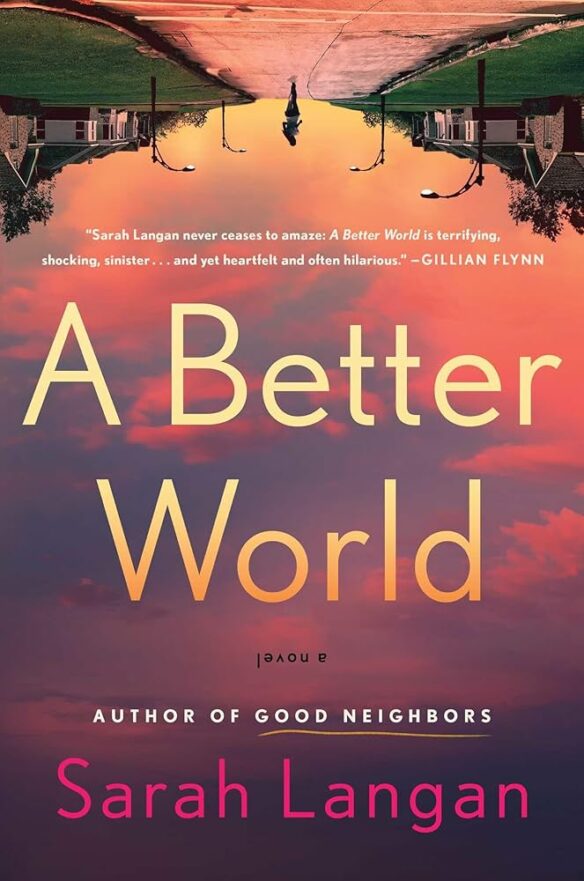
(3) KGB. Fantastic Fiction at KGB reading series hosts Ellen Datlow and Matthew Kressel present Sarah Langan and David Leo Rice on Wednesday, October 9, 2024, at 7:00 p.m. Eastern. At the KGB Bar, 85 East 4th Street, New York, NY 10003 (Just off 2nd Ave, upstairs)

SARAH LANGAN

Sarah Langan’s most recent novels are A Better World, which the Los Angeles Times calls: “A high-water mark in the career of a novelist who’s already won three Bram Stoker Awards,” and Good Neighbors (a NewsweekIrish Times, and Lit Reactor best book of the year). Her previous novels are The Keeper, The Missing, and Audrey’s Door. She has an MFA from Columbia University, an MS in Environmental Health Science/Toxicology from NYU, and lives in Los Angeles with her husband, the writer/director JT Petty, their two daughters, and two maniac rabbits.

DAVID LEO RICE

David Leo Rice was born and raised in Northampton, MA, and now resides in Brooklyn. His novels include Angel HouseThe New House, the Dodge City Trilogy, and The Berlin Wall, named the “#7 Best Indie Book of the 21st Century so far” in Genrepunk Magazine. His first collection, Drifter, was named one of the “10 Must-Read Books of 2021” in the Southwest Review, and his second, The Squimbop Condition, will be out next year. He’s also the co-editor of Children of the New Flesh, an anthology of essays, interviews, and stories responding to the work of David Cronenberg.

(4) BRADBURY SCHOLARSHIP. The latest issue of The New Ray Bradbury Review is now available. NRBR is the online, open access journal of the Ray Bradbury Center at Indiana University. No. 8 (2024) The New Ray Bradbury Review.

In this issue of the Bradbury Review, Roger Terry provides more context for  Ray Bradbury’s   fictional   spaces   by   recounting   some   of   those non-fictional   and   biographical connections between Bradbury and the real-life space program.

Following  this,  John  Gillespie  takes  one  of  Ray  Bradbury’s  simplest  short  stories,  “The Rocket Man”, and shows how its unnamed title character is archetypal. The story is shown to be a (possibly  unconscious)  retelling  of  Tennyson’s  “Ulysses”,  as  well  as  being  intertwined  with popular culture of the twentieth-century and beyond.

Devika Yadav further explores Bradbury’s use of outer space as well as other spaces in The Illustrated Man (1951). Despite that collection’s framing story set in rural Wisconsin, and its mixed contents  ranging  from  science  fiction  to  outright  fantasy,  it  famously  includes  a  number  of Bradbury’s  most  memorable  and  influential  space  stories,  such  as  the  aforementioned  “Rocket Man”, “The Rocket” and “Kaleidoscope”.

Paul  Donatich,  who  has  written  previously  for NRBR,  makes  a  welcome  return  to investigate ways in which Bradbury’s body of work incorporates African American characters. As well as considering the main stories that deal with race (“Way in the Middle of the Air” from The Martian Chronicles and “The Big Black and White Game” from Golden Apples of the Sun being the two which loom large), his essay also weaves in the character of Blind Henry from Death is a Lonely  Business,  a  number  of  Bradbury  fragments originally  published in  this very journal,  and the  by  now  near-mythic  “Mister  Electrico”.  Inevitably,  this  essay  includes  some  outdated  racial words and phrases, but Donatich is careful to contextualise these.

Another regular of NRBR is Jeffrey Kahan, who extends the discussion of race in “Way in the Middle of the Air” to bring in its counterpart “The Other Foot” and—more surprisingly—“The Garbage Collector”, a story he shows to have strong racial connotations. Kahan contrasts the young Bradbury’s actively anti-racist fictions with some of the elder Bradbury’s more contentious non-fiction statements on racial matters.

Christian  Wilken  then  takes  us  to  Bradbury’s  “ravine”,  that  strip  of  wilderness  which divides  the  fictional  Green  Town,  Illinois,  in Dandelion  Wine,The  Halloween  Tree  and  other works. Using perspectives from Object-Oriented Ontology and New Materialism, Wilken shows Bradbury’s Illinois stories to have commonality with other literature involving children, but also reveals a unique aspect in their existential explorations.

(5) DO CATS HAVE FIREPROOF GIZZARDS? With Camestros Felapton as his amanuensis, “Timothy reads A Wizard of Earthsea”.

…As the seasons turn and the English countryside is consumed by fog and falling leaves and squirrels posting lies about me on Facebook, my thoughts turn to a simple truth. Dragons are cats. Every story about dragons is actually a story about what if cats were giant flying lizards. Like cats, dragons sleep a lot. Like cats, dragons like to be cosy. Like cats, dragons are picky about their food. Like cats, dragons can breathe fire but choose not to. This is why I spend early October, stealing copies of The Hobbit and stacking them in the south paddock in preparation for Smaug Memorial Bonfire. When the setting sun and the last moon of autumn are in the sky, I heft my Cybertruck branded flame-thrower and set light to the pile of books, or at least I would if the axis-of-feeble (the county librarians and the county constabulary) don’t stop me….

(6) JOHN WILLIAMS DOCUMENTARY. “‘Music by John Williams’ Trailer: Steven Spielberg and Ron Howard Produce Documentary on Iconic ‘Star Wars’ and ‘Jurassic Park’ Composer” at IndieWire. Premieres November 1 on Disney+. View the trailer online: “Music by John Williams | Official Trailer”.

The iconic scores of John Williams will be celebrated with documentary “Music by John Williams.”

The Disney+ film reunites legendary composer Williams with his frequent collaborators Steven SpielbergRon Howard, and Kathleen Kennedy, who all produce the documentary. Williams has scored films such as “Star Wars,” “Indiana Jones,” and “Jurassic Park,” and in 2023 made history as the oldest Oscar nominee in any category for “The Fabelmans.” The composer has a total of 54 Oscar nominations and five wins.

“Music by John Williams” will “offer a fascinating and insightful look at the prolific life and career of the legendary composer,” according to the official logline. “From his early days as a jazz pianist to his Oscar, Emmy, and Grammy wins, the documentary takes an in-depth look at Williams’ countless contributions to film, including many iconic franchises, as well as his music for the concert stage and his impact on popular culture.”…

(7) BOB BLOCH INTERVIEW. The Robert Bloch Official Website has added “a mid-1980s interview of Bob by Dennis Fischer where Bob discusses his work and thoughts surrounding the horror anthology film. This interview first appeared in Randall Larson’s CineFan #3.” “Robert Bloch Horror Anthology”.

CineFan: The first anthology film you wrote was Amicus’ TORTURE GARDEN, which led to many other successful multi-story films. Were you satisfied with the finished film?

Bloch: I had my reservations about TORTURE GARDEN. First of all, it wasn’t my title; there are no tortures in it, there is no garden, it’s Octave Mirbeau’s title from his novel of about 1900; it had nothing to do with that. I didn’t particularly care for the way the framing story was handled. They saved a lot of money by handling it the way they did, but I didn’t think it was well done. I have heard that during the Edgar Allan Poe sequence the director decided to improve the ending, and I don’t particularly think he did; it got a little murky. There was also a rather lengthy sequence that was cut out of one of the other episodes in the interests of keeping the film to a certain length for theatrical release. I think that that was supposedly incorporated into some of the television releases, though I haven’t seen it, but it changed the tempo and pace of that sequence considerably….

(8) BOB FOSTER (1943-2024). [Item by Steve Green.]  Bob Foster: US comics writer and animation artist, passed away September 30, aged 80. Wrote Marvel’s Toy Story graphic novel and Disney’s Hercules graphic novel; wrote and drew ‘The Evolution and History of Moosekind’ for Crazy, from 1973-1975; wrote the Donald Duck newspaper strip, 1980-89. Screen credits include Bedknobs and Broomsticks (1971, assistant animator); layouts on Godzilla (20 eps, 1978-79), The Incredible Hulk (13 eps, 1982-83), Spider-Man and his Amazing Friends (24 eps, 1981-83); storyboards on Tutenstein (9 eps, 2004-5).

A former film student, he was drafted into the US Army in 1966, spending two years making educational movies at Fort Monmouth in New Jersey, working alongside Steve Stiles (1943-2020).

(9) TODAY’S BIRTHDAY.

[Written by Paul Weimer.]

Born October 2, 1944Vernor Vinge. (Died 2024.)

By Paul Weimer: I heard about Vernor Vinge’s work long before I actually got to read it.  True Names, Vinge’s 1982 early look at cyberspace, was famous in SF circles, and also out of print, when I first heard about in the late 1980’s. I had heard his work was visionary but it took a reissue of True Names some years later for me to get what the fuss is all about.  

Then of course, in short order came the Deep series, possibly one of the most mindblowing trilogies of books in science fiction (even as I recognize the scale shrunk considerably from book to book). Vinge’s work has always been in conversation with the digital landscape of its time, and of the near future, A Fire Upon the Deep’s FTL communication is Usenet in Space, for example. Rainbow’s End, with its digitization of books, was a herald of the questions we have with the digitization of works and what might be lost in the process (c.f. The Internet Archive). Although the form of the Internet is nothing like True Names, the idea of online versus personal identities is all right there, and before Neuromancer and its kin.

My favorite of his books is Marooned in Realtime. While The Peace War is a fascinating setting and an interesting puzzle book introducing the stasis bubbles, I think Marooned in Realtime, with its small cast of the end of humanity, and an innovative murder in such an environment is the real gem of the pair. I’d like to think you can read Marooned alone without the Peace War, but I think that as fabulous as Marooned is, it does not quite stand alone. 

Vernor Vinge’s oeuvre is readily completely consumable, he hasn’t written much, but the shadow of what he writes, even if not intended at the time, casts long over SF, even when he didn’t intend to.  I am thinking here of the last, in Rainbow’s End again, and how in that world we got many more novels than in our world did from the amazing Terry Pratchett.  If only I could step over to that world and pick up the Discworld novels he never got to write in ours. 

Vernor Vinge

(10) COMICS SECTION.

(11) BIRD IS THE WORD. “Robin Animated Movie Focusing On Batman’s Dick Grayson & Jason Todd In The Works At DC Studios” reports ScreenRant.

…On X/Twitter, Gunn has now shared that Dynamic Duo, an animated movie about Dick Grayson and Jason Todd, has been greenlit by DC Studios/Warner Bros. Pictures Animation, and will be released in theaters. Check out Gunn’s post below:

He also revealed that the feature-length movie will be made by Swaybox Studios using a cutting-edge blend of animation, puppetry, and CGI. Dynamic Duo‘s script is being written by Matt Aldrich, whose previous work includes Pixar’s Coco and Lightyear. The DC movie is being produced by 6th and Idaho, the production company of The Batman director Matt Reeves…

(12) SECONDS, PLEASE. [Item by Chris Barkley.] Sugar has a decidedly sf “twist” so hell yeah to the renewal! “’Sugar’ Renewed for Season 2 at Apple TV+”The Hollywood Reporter has the story.

Apple TV+ wants another helping of Sugar.

The tech behemoth’s streaming service has picked up a second season of the drama, which stars Colin Farrell as the title character, Detective John Sugar. The first season followed John’s search for a missing woman — and revealed a big twist late in the season that helps set the stage for season two….

(13) THE FUTURE DRAGONSTEEL PLAZA. “Author Brandon Sanderson Unveils Plan to ‘Build a Bookstore'” reports Shelf Awareness.

Bestselling author Brandon Sanderson’s Dragonsteel Entertainment has purchased land next to the former Evermore Park in Pleasant Grove, Utah, with plans to eventually open a bookstore there. The Salt Lake City Tribune reported that Sanderson announced his plan Saturday during a FanX appearance at the Salt Palace Convention Center.

“We’re going to theoretically build a bookstore,” he said on Saturday. 

The area will be called Dragonsteel Plaza. Sanderson also revealed that Dragonsteel’s headquarters is now located in a warehouse in Pleasant Grove, which fans cannot visit, but he did show a few photos of the property at the panel.

Dragonsteel had a pop-up store on the vendor floor all three days of the convention. 

[Thanks to SF Concatenation’s Jonathan Cowie, Steven French, Kathy Sullivan, Steve Green, Paul Weimer, Rich Lynch, Teddy Harvia, Mike Kennedy, Andrew Porter, John King Tarpinian, Chris Barkley, and Cat Eldridge for some of these stories. Title credit belongs to File 770 contributing editor of the day Paul Weimer.]

Pixel Scroll 3/29/24 Scroll On, You Crazy Pixel

(1) FLOTSAM AND JETSAM. The five-day “Treasures From Planet Hollywood” auction brought in more than $15.6 million from over 5,500 bidders worldwide across some 1,600 lots, according to Heritage Auctions. Here are some items of genre interest that fetched big bucks.

Mechanical Man from Hugo

The whip from Indiana Jones and the Temple of Doom sold for $525,000 to become the most valuable prop or costume from the beloved franchise…

Another first-day smash was the Bapty& Co.-made ax Jack Nicholson used to heeeeeere’s-Johnny his way through the bathroom door in Stanley Kubrick’s The Shining. Among the first props Planet Hollywood secured before its grand opening in New York City in 1991, that ax sold for $125,000. When that sold Wednesday after a fierce bidding war, the auction room erupted in applause — for the first time, but not the last.

Over the five-day event, the hits kept coming: The Barbasol can Wayne Knight uses to smuggle dinosaur embryos out of 1993’s Jurassic Park realized $250,000The blaster Princess Leia carried across the forest moon of Endor in Return of the Jedi sold for $150,000, while an original Stormtrooper blaster from Star Wars, which Bapty & Co. forged from a British Sterling submachine gun, sold for $112,500.

Tobey Maguire’s black symbiote suit from 2007’s Spider-Man 3 swung out the door for $125,000, just a web ahead of one of his signature Spidey suits from the same film, which realized $106,250A “good guy” Chucky doll from 1988’s Child’s Play scared up a winning bid of $106,250….

…. A set of three Sankara stones from Indiana Jones and the Temple of Doom realized $100,000, while “the cup of the carpenter” — the Holy Grail itself — sold for $87,500.

But one of the auction’s first bidding wars was over a display figure wearing Gary Oldman’s Vlad the Impaler reproduced armor from 1992’s Bram Stoker’s Dracula, which Planet Hollywood obtained from technical advisor Christopher Gilman and sold on Wednesday for $87,500. And on the auction’s final day, a bidding war broke out over a prop from one of Martin Scorsese’s most underappreciated masterpieces, his 2011 adaptation of Brian Selznick’s children’s book Hugo, from which the original Mechanical Man automaton realized $81,250….

The top-selling item overall was the “Titanic prop that saved Rose and sparked debate…” reports NPR.

…”The wood panel from Titanic that saved Rose — but, controversially, not Jack — was the king of the auction, realizing $718,750 to float to the top of the five-day event,” auction house Heritage Auctions said in a release….

(2) SPOT RESOLUTION. Camestros Felapton wants you to know “Why I Declined a Hugo Spot”.

…2023 looms large here and there were definitely people I would rather see on the Hugo ballot for Best Fan Writer this year than myself. One was obviously Paul Weimer but I was certain he’d be top of most people’s ballots anyway but I was hoping some Chinese fans would make it onto the category. That didn’t happen but it is a decent list of finalists and there is nobody there that I would have wanted to replace.

Closely related to this was also the sense that I was likely to have gathered additional votes from things that I had written in 2024, specifically on the 2023 Hugo Award stats. Even if that wasn’t the case it would have felt like it was the case to me. So, I thought I’d feel happier skipping this year and putting my hat into the ring for next year…

(3) DREAM FOUNDRY CONTESTS OPEN SOON. The Dream Foundry’s annual contest for emerging artists and writers will take entries from April 1 until May 27, 2024. Every year their contest coordinators select ten finalists from a pool of submissions from around the world. Both contests offer cash prizes, first choice of seats in Flights of Foundry workshops, and other opportunities. Eligibility requirements and full details about prizes are at the links:

  • Art Contest — This year’s art contest will be judged by Lauren Raye Snow & Jessica Cheng, The contest coordinator is Grace P. Fong.
  • Writing Contest — The writing contest will be judged by Valerie Valdes and C.L. Polk, and our contest coordinator is Julia Rios.

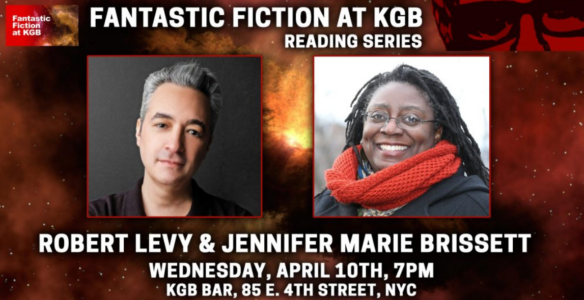
(4) KGB. Fantastic Fiction at KGB reading series hosts Ellen Datlow and Matthew Kressel present Robert Levy and Jennifer Marie Brissett on Wednesday, April 10 at 7:00 p.m. Eastern. Location: KGB Bar, 85 East 4th Street, New York, NY 10003 (Just off 2nd Ave, upstairs).

ROBERT LEVY

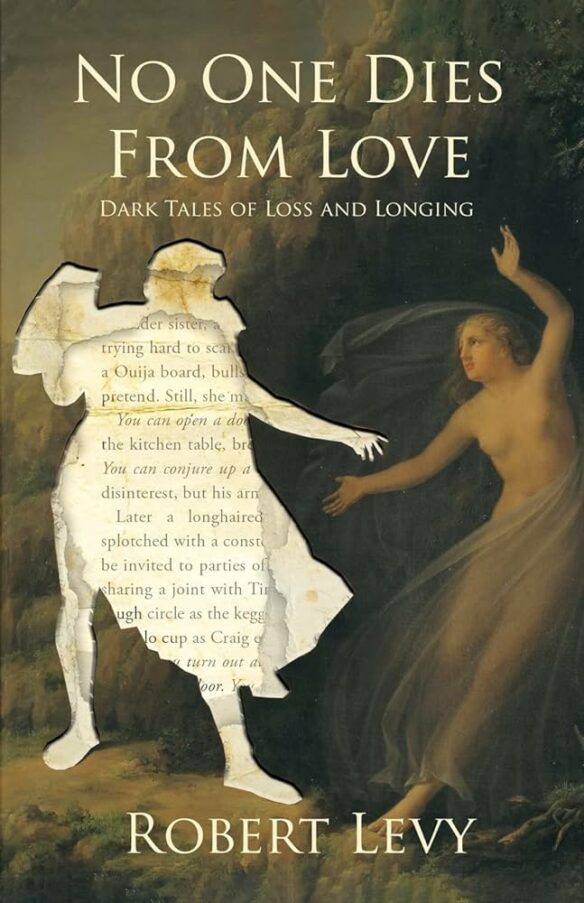
Robert Levy’s novel The Glittering World was a finalist for the Shirley Jackson Award and the Lambda Literary Award. His collection No One Dies from Love: Dark Tales of Loss and Longing was published last year by Worde Horde and includes stories from The Magazine of Fantasy & Science Fiction, Nightmare, Black Static, The Dark, The Best Horror of the Year, and The Year’s Best Gay Speculative Fiction. Trained as a forensic psychologist, he teaches at the Stonecoast MFA Program in Creative Writing and can be found at TheRobertLevy.com.

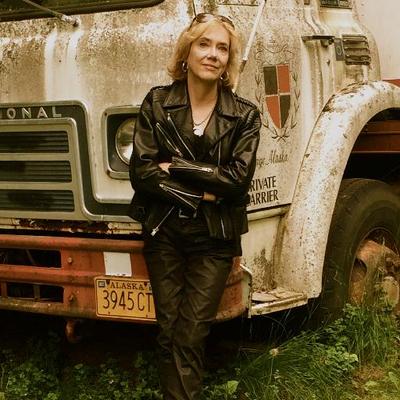
JENNIFER MARIE BRISSETT

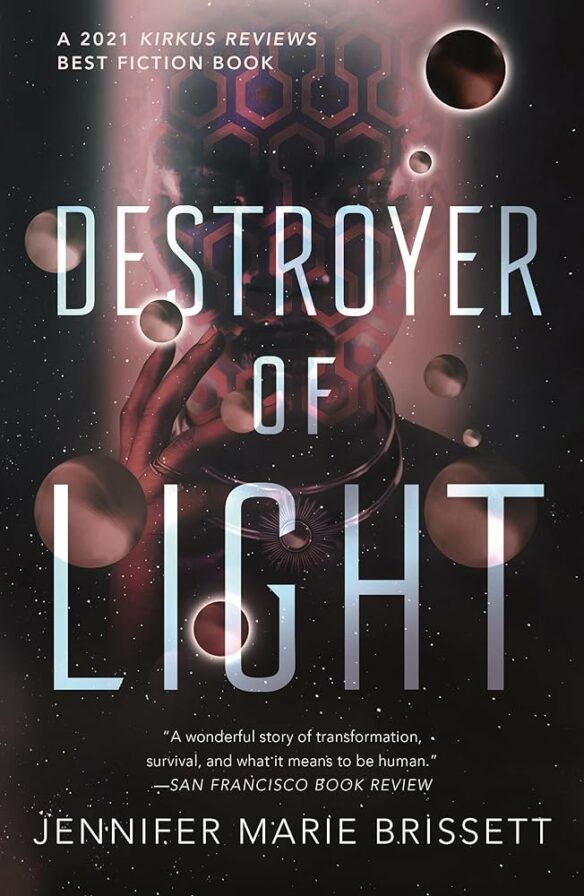
Jennifer Marie Brissett is the author of Destroyer of Light, which received a starred Kirkus Review and was on its list of Best Fiction of the Year. She is also the author of Elysium, which won The Philip K. Dick Award Special Citation and was a finalist for the Locus and Tiptree Awards. And once a long time ago she owned and operated an independent bookstore in Brooklyn. She lives in Manhattan where she is currently working on her next novel Daughters of the Night. Find her via her website at www.jennbrissett.com

(5) CLIMATE FICTION CONTEST OPENS. Grist’s “Imagine 2200 climate fiction contest 2024” is open for submissions through June 24.

Grist is excited to open submissions for the fourth year of our Imagine 2200: Climate Fiction for Future Ancestors short story contest. 

Imagine 2200 is an invitation to writers from all over the globe to imagine a future in which solutions to the climate crisis flourish and help bring about radical improvements to our world. We dare you to dream anew….

…. The winning writer will be awarded $3,000. The second- and third-place winners receive $2,000 and $1,000, respectively. An additional nine finalists will each receive $300. All winners and finalists will have their story published in an immersive collection on Grist’s website. …

We are thrilled to also announce the judges for our 2024/25 contest: Omar El Akkad and Annalee NewitzEl Akkad is an author and journalist whose award-winning debut novel, American War, is an international bestseller and was selected by the BBC as one of 100 Novels That Shaped Our World. Newitz is a science fiction and nonfiction writer whose third novel, The Terraformers is a finalist for the Nebula Award, and whose latest nonfiction book, Four Lost Cities, is a national bestseller.

Imagine 2200 celebrates stories that envision the next decades to centuries of equitable climate progress, imagining futures of abundance, adaptation, reform, and hope. We are looking for stories that are rooted in creative climate solutions and community-centered resilience, showing what can happen as solutions take root, and stories that offer gripping plots with rich characters and settings, making that future come alive.

In 2,500 to 5,000 words, show us the world you dream of building.

Your story should be set sometime between the near future and roughly the year 2200….

(6) WANT TO GO TO SPACE? NASA is accepting applications to “Become An Astronaut” through April 16. The complete guidelines are at the link.

Astronaut requirements have changed with NASA’s goals and missions. Today, to be considered for an astronaut position, applicants must meet the following qualifications:

  1. Be a U.S. citizen
  2. Have a master’s degree* in a STEM field, including engineering, biological science, physical science, computer science or mathematics, from an accredited institution.
  3. Have a minimum of three years of related professional experience obtained after degree completion (or 1,000 Pilot-in-Command hours with at least 850 of those hours in high performance jet aircraft for pilots) For medical doctors, time in residency can count towards experience and must be completed by June 2025.
  4. Be able to successfully complete the NASA long-duration flight astronaut physical.

(7) LOUIS GOSSETT JR. (1936-2024). Actor Louis Gossett Jr., winner of an Oscar for his performance in An Officer and a Gentleman and an Emmy for his role in TV’s Roots,died March 29 at the age of 87.

His genre resume includes the movie Enemy Mine (as the alien soldier), the Watchmen TV series (as the former Hooded Justice, for which he won an Emmy), and an episode of Touched By An Angel (a role which also earned an Emmy nomination). He voiced Lucius Fox in The Batman animated series (2007).

(8) TODAY’S BIRTHDAY.

[Written by Cat Eldridge.]

Born March 29, 1957 Elizabeth Hand, 67. These are my personal choices, not an overview of her career. 

I’ll say up front that my favorite work by Elizabeth Hand is an atypical work by her, Wylding Hall. Using an oral history framing to tell the story of when the young members of a British folk band decide to record a new album, they choose this ancient country house that has a history that is very troubled. The characters are fascinating, the setting is well crafted and the story, well, I think it’s her best story ever and it did win the Shirley Jackson Award. 

Elizabeth Hand

So what else did I like by her? There’s Mortal Love which intertwine the now while reaching back in the Victorian past with the mystery of a woman who holds the key to lost Pre-Raphaelite paintings, appropriate since she seems too akin to one of those of those works herself. 

I will admit that I like her more grounded works better which is why the next pick is Illyria, a short novel set in the theater world (did I mention that I adore Angel Carter’s Wise Children? Well I do.) Twin sisters are now cast in a production of Twelfth Night, and magic will happen this night. It garnered a World Fantasy Award.

Curious Toys is an extraordinary work as a young girl attempts to find a murderer in turn-of-the-century Chicago. That description hardly describes the story awaiting the reader here as the girl is but fourteen and the setting the killer is stalking is the famous Riverview amusement park.  

Finally I find much to appreciate in her Cass Neary private eye series. A smart-assed, substance abusing and always self-destructive punk who means well, the series is that rare series that develops the character novel by novel. 

(9) COMICS SECTION.

(10) FANCY THREADS. “When Hollywood Needs a Historically Accurate Outfit That Looks Just Right, It Turns to Rabbit Goody”Smithsonian Magazine has the story.

… Thistle Hill Weavers, founded by Rabbit Goody in 1989, makes textiles for movies and television shows, historic houses, and high-end furniture and clothing companies. What sets this little mill in Central New York apart from every other cloth manufacturer in the country is Goody’s remarkable ability to re-animate the past: No one else produces short runs of textiles that so faithfully replicate the weave, texture, weight and color of historic fabrics. If you’ve seen “The Gilded Age” or Cinderella Man, you’ve seen Goody’s work in action. The majority of Thistle Hill’s income comes from creating more contemporary fabrics for interior designers and architects, and from the work Goody does with historic houses, such as Mount Vernon, George Washington’s home in Virginia. Yet many of her favorite jobs have come from Hollywood costume designers seeking perfectly rendered, historically accurate textiles to recreate items like Abraham Lincoln’s shawl for the movie Lincoln or much of the colonial-era clothing seen in the 2008 mini-series “John Adams.”…

… Today Thistle Hill Weavers employs seven people whom Goody has trained to run the nine mechanized shuttle looms dating from the 1890s through the 1960s, plus archaic-sounding equipment like a warp winder and a quiller—all necessary to transform big cones of thread into beautiful pieces of fabric. Goody’s workers generally arrive with no knowledge of weaving; she teaches them everything they need to know….

(11) NYT ON VINGE. The New York Times obituary linked here is behind a paywall: “Vernor Vinge, Innovative Science Fiction Novelist, Dies at 79”.

… Mr. Vinge’s immersion in computers at San Diego State University, where he began teaching in 1972, led to his vision of a “technological singularity,” a tipping point at which the intelligence of machines possesses and then exceeds that of humans.

He described an early version of his vision in Omni magazine in 1983.

“We’re at the point of accelerating the evolution of intelligence itself,” he wrote, adding, “Whether our work is cast in silicon or DNA will have little effect on the ultimate results.” He wrote that the moment of the intellectual transition would be as “impenetrable as the knotted space-time at the center of a black hole,” and that at that moment “the world will pass far beyond our understanding.”

A decade later, he fleshed out the intellectual transition — the singularity — in a paper (subtitled “How to Survive in the Post-Human Era”) for a symposium sponsored by the NASA Lewis Research Center and the Ohio Aerospace Institute.

“Within 30 years,” he said, “we will have the technological means to create superhuman intelligence. Shortly after, the human era will be ended. Is such progress avoidable? If not to be avoided, can events be guided so that we may survive?”

That prediction has not come true, but artificial intelligence has accelerated to the point that some people fear that the technology will replace them….

(12) MEASURING THE UNIVERSE. The New York Times makes sure she is “Overlooked No More: Henrietta Leavitt, Who Unraveled Mysteries of the Stars”.

…In the early 20th century, when Henrietta Leavitt began studying photographs of distant stars at the Harvard College Observatory, astronomers had no idea how big the universe was. Debate raged over whether all of the objects visible through the telescopes of the day were within our own Milky Way galaxy, or whether other galaxies — or “island universes,” as they were then called — might exist somewhere out in space.

Leavitt, working as a poorly paid member of a team of mostly women who cataloged data for the scientists at the observatory, found a way to peer out into the great unknown and measure it.

What’s now commonly called Leavitt’s Law is still taught in college astronomy courses. It underpinned the research of other pioneering astronomers, including Edwin Hubble and Harlow Shapley, whose work in the years after World War I demolished long-held ideas about our solar system’s place in the cosmos. Leavitt’s Law has been used on the Hubble Telescope and the James Webb Space Telescope in making new calculations about the rate of expansion of the universe and the proximity of stars billions of light years from earth.

“All of those major discoveries rested on Leavitt’s discovery,” Wendy L. Freedman, a professor of astronomy and astrophysics at the University of Chicago, said in a phone interview, referring to the explosion of knowledge about space over the last century. “It’s the bedrock foundation of so much of what we do today in cosmology and astrophysics in general.”

What Leavitt achieved was essentially twofold. In a groundbreaking observation in 1908, she noticed that certain stars, called Cepheids, photographed in the Large and Small Magellanic Clouds — two relatively nearby galaxies — had a distinctive pattern: The longer it took for the Cepheids to cycle through their variations, the brighter they were in magnitude. Then, in a paper in 1912, she laid out a mathematical formula to explain her observation, called a “period-luminosity” relationship.

That opened the door to a new kind of interstellar triangulation, as Cepheid variables emerged as a reliable way to calculate cosmic scale for Earthbound astronomers. Distances that before then were anyone’s guess suddenly had a formula, and the portrait that emerged was shocking — a universe hundreds of times bigger than most astronomers had imagined….

(13) AT THE CORE. “Astronomers Capture Dazzling New Image of the Black Hole at the Milky Way’s Center” in Smithsonian Magazine.

Astronomers have captured the first-ever image of magnetic fields circling the supermassive black hole at the center of our Milky Way galaxy.

The fields have a similar structure to those around the black hole at the center of Messier 87, a massive elliptical galaxy in the constellation Virgo. This finding suggests that strong magnetic fields may be a common feature of all black holes, the researchers report in a pair of papers published today in the Astrophysical Journal Letters.

“This spiral pattern that we see swirling around the black hole indicates that the magnetic fields must also be a spiral pattern whirling around—and that they’re very strong and very ordered,” Sara Issaoun, a co-leader of the research and an astronomer at the Center for Astrophysics, Harvard & Smithsonian, says to BBC Science Focus’ Tom Howarth….

(14) WEEDS IN SPACE! Yesterday I was frustrated that NASA had not said what plants are part of its lunar-bound experiment. Cat Eldridge found the answer on the Space Lab website: “Lunar Payload LEAF – Lunar Effects on Agricultural Flora”.

…The LEAF β (“LEAF Beta”) payload will protect plants within from excessive Lunar sunlight, radiation, and the vacuum of space, while observing their photosynthesis, growth, and responses to stress. The experiment includes a plant growth chamber with an isolated atmosphere, housing red and green varieties of Brassica rapa (Wisconsin Fast Plants®), Wolffia (duckweed), and Arabidopsis thaliana. By bringing seedling samples back to Earth, as part of Artemis III, the research team will apply advanced system biology tools to study physiological responses at a molecular level…

(15) WHEN DID THE FIRST HOMININS TRULY ENTER EUROPE? [Item by SF Concatenation’s Jonathan Cowie.] (I have never forgiven the dinosaurs for what they did to Raquel Welch.) When did humans first enter Europe has been the subject of some debate. Now, new research from a site in Ukraine at Korolevo has used two different dating methods. These have given a very similar result… “East-to-west human dispersal into Europe 1.4 million years ago” in Nature.

Here, using two methods of burial dating with cosmogenic nuclides [the researchers] report ages of 1.42 ± 0.10 million years and 1.42 ± 0.28 million years…

…this suggests that early hominins exploited warm interglacial periods to disperse into higher latitudes and relatively continental sites—such as Korolevo—well before the Middle Pleistocene Transition.

(16) NEW SF YOUTUBER….? [Item by SF Concatenation’s Jonathan Cowie.] Well, we all (OK, perhaps just some of us) have our favorite SF YouTuber, be it Moid Moidelhoff at Media Death Cult who is particularly popular with those fairly new on their SF journey, or Book Pilled for those that are perhaps more seasoned.  One recent newcomer that some Filers might like to check out is Grammaticus Books.  He recently reminded me of a forgotten Heinlein classic from 1942, Orphans of the Sky.  So I went to see if I had a copy in my library, and lo, it came to pass that I had and that I must have read it the best part of half a century ago…

[Thanks to John King Tarpinian, Chris Barkley, Cat Eldridge, Kathy Sullivan, Olav Rokne, Daniel Dern, Danny Sichel, SF Concatenation’s Jonathan Cowie, Steven French, Mike Kennedy, and Andrew Porter for some of these stories. Title credit belongs to File 770 contributing editor of the day Jon Meltzer.]

Pixel Scroll 3/21/24 Mr. Sandworm, Bring Me A Dream

(1) MASTER OF SF. Vernor Vinge died March 20. One of the many callbacks to this distinguished sf author’s genre contributions comes from the Hugo Book Club Blog: “A Tribute To Vernor Vinge”.

…“Singularity is the point at which our old models will have to be discarded, where a new reality will reign,” Vinge wrote. “This is a world whose outlines will become clearer, approaching modern humanity, until this new reality obscures surrounding reality, becoming commonplace.”

One of these forays into singularitarianism helped launch an entire subgenre of science fiction. First appearing in a Dell paperback alongside George R.R. Martin’s Nightflyers, the story True Names offered a blueprint for cyberpunk that would influence and inspire everything from blockbuster movies to role playing games and television series….

(2) CIXIN LIU ON PRODUCTIVITY ISSUES. [Via Zionius on Weibo] On Wednesday, Singapore newspaper The Straits Times published an article tying in with the release of the Netflix adaptation of The Three-Body Problem.  The piece includes a few quotes from Liu himself, where he talks about his activity in recent years, and his sympathy with one of his peers, George R.R. Martin.

While he yearns to see Martin place the long-delayed sixth book, The Winds Of Winter, in the hands of publishers, Liu, 60, also sympathises with his 75-year-old peer’s plight – Liu himself has been through a long fallow period.

“The Winds Of Winter has been delayed for 10 years. As a writer who also writes fantasy literature, I completely understand this, because I have not been able to publish a new work for more than 10 years,” Liu tells The Straits Times in an e-mail interview…

Other than Of Ants And Dinosaurs (2010), a work that imagines a war between the two species of the title, Liu has not produced a new novel since.

“Martin has at least published other works during that time, and I had done almost nothing,” he says. 

(3) A LIFELINE TO SANITY. The Guardian calls it, “’A fascinating insight into pandemic psychology’: how Animal Crossing gave us an escape”.

“Today is the first day of your new life on this pristine, lovely island. So, congratulations!” says Tom Nook, the benevolent tanuki landlord, a few minutes into Animal Crossing: New Horizons. (Nook is often besmirched online, but you can’t argue that he’s extremely welcoming.) Many players read this comforting message at a destabilising and frightening time in the real world: Animal Crossing: New Horizons came out on Nintendo Switch on 20 March 2020, a few days before the UK entered its first Covid lockdown.

This was fortuitous timing. When we were all stuck at home, the game let us plant our native fruits, tend to our flowers and see what the town shop had on offer, repaying our extensive loans (interest-free, thankfully) to Tom Nook as a way of escaping the chaos and daily death tolls. We opened the gates to our islands and welcomed friends and strangers into our pristine little worlds. As real life crumbled, we started anew with bespectacled catssheep in clown’s coats and rhinos who looked like cakes.

The game’s sudden popularity caused Nintendo Switch sales to skyrocket among pandemic-induced shortages. New Horizons had sold 44.79 million units by December 2023 – nearly three-and-a-half times more than any other game in the Animal Crossing series, which has been running since 2001. It’s the second best-selling Switch game to date, behind Mario Kart 8 Deluxe….

(4) BOT AND PAID FOR. Annie Bot has already been called “A sharp take on a sex robot that becomes human” in a paywalled New Scientist review:

I opened the novel with low hopes, because the idea of a robot learning to be human, then chafing at its bonds, seemed a bit old hat. How wrong I was. Right from the first page, the book is coruscating, unexpected and subtle….

Now Glamour has interviewed author Sierra Green in a Q&A titled “Annie Bot Is a Chillingly Prescient Novel That Asks What Happens When a Sex Robot Realizes Her Worth”.

…The character of Doug felt so real to me (a man who would rather have a sex slave robot than a real human companion), which is scary, to say the least. What does his character represent to you, and why do you think it is important to demonstrate these types of men in the media?

This is a complicated subject. I think it’s important to try to understand what in our society encourages a man to feel like he ought to be in control, even when he’s not. No one likes to feel helpless, but men can feel doubly conflicted when they are denigrated because society has taught them that they deserve respect. Suddenly they have to reassess the entire system. When we see a character like Doug who is lonely and wants to be in control, we understand why he’s reaching out for a connection. We’re not surprised that men turn to the internet for pornography, and Annie is just a step beyond that. What matters to me is that Doug learns from his situation. He experiences deep shame, isolation, and rage, but he’s also willing to reflect on how to become a better man, a better human. Almost despite himself, he takes risks that lead him where he needs to go.

Do you think if Stellas really existed, a lot of men would buy them?

Yes. Women would buy them too, or the male Handy models. People will buy a new toy whether it’s good for them or not….

(5) MONSTER MASHER. Radio Times says “Doctor Who needs Steven Moffat – despite what he might say”.

…Every showrunner has brought something incredible to Doctor Who, from Russell T Davies’s famously skillful writing to Chris Chibnall’s bold new directions, but there’s something that Moffat brings to the show that no other writer does.

He remains unmatched as Doctor Who’s monster maker. By his own admission, his creations are simple and actually a little formulaic, usually riffing on a childhood fear to create a chilling physical embodiment of our nightmares. But it doesn’t get old – because he does it so well.

Moffat’s first episodes, a season 1 two-parter, introduced the Empty Child. Arming his creation with a haunting catchphrase (“Are you my mummy?”) and a gruesome physicality (I’ve never forgotten that transformation scene), he immediately ensured his first Doctor Who monster would be one for the ages. But it was far from his most iconic.

In season 3, Moffat penned what is widely described as one of Doctor Who’s best ever episodes, Blink, creating an all-time classic monster, the Weeping Angels….

(6) A TILT TOWARD NORTH AMERICA. “Doctor Who’s schedule change is inevitable – but still heartbreaking” opines Radio Times.

With the decision being made to debut new Doctor Who episodes at midnight on BBC iPlayer, many Whovians have expressed their disappointment. They argue that the choice was made for US-based audiences, and it undeniably was.

When the first two episodes are released on BBC iPlayer at midnight on Saturday 11th May, they will also be available on Disney Plus at 7pm ET on Friday 10th May, before BBC One airs them again later in the day on Saturday.

This means that while viewers on the US East Coast can enjoy the premiere episode in the late evening, UK fans will have to stay up into the late hours of the night to watch, diminishing the event nature and experience of watching the series…

(7) NEW HORROR. Gabino Iglesias reviewed Premee Mohamed’s The Butcher Of The Forest, C.J. Cooke’s A Haunting In The Arctic, Tim Lebbon’s Among The Living, and Amanda Jayatissa’s Island Witch in “Demons, Haunted Forests and Arctic Nightmares in 4 New Horror Novels” for the New York Times in February.

(8) SPUR AWARDS. The Western Writers of America have presented the 2024 Spur Awards. Complete winners list at the link – there do not appear to be any genre works among them. Not even Thomas Goodman’s Best First Novel The Last Man: A Novel of the 1927 Santa Claus Bank Robbery has much to do with jolly old elves.

(9) TODAY’S BIRTHDAY.

[Written by Cat Eldridge.]

Born March 21, 1946 Timothy Dalton, 78. Timothy Dalton made his film debut sixty-eight years ago as Philip II of France in The Lion in Winter. I remember him distinctly in that role. Of course, I’ve watched that film enough times that I think I’ve memorized much of the script. 

He would do two Bond films, The Living Daylights and Licence to Kill. He made a decent Bond, but then I think the only true Bond was Connery. 

Timothy Dalton in 1987.

Now doing a dive into his genre roles, he was Prince Barin in Flash Gordon, and had a major role as film star Neville Sinclair, one of baddies in The Rocketeer. An absolutely amazing film which is why it got a nomination for a Hugo at MagiCon. 

And he was Lord President Rassilon in “The End of Time”, the last Tenth Doctor story. He made a rather impressive Time Lord indeed. 

I’ll finish up with his role as the Chief on the DC Universe/Max Doom Patrol series which just wrapped up. It was a great role for him, and a most excellent series indeed. 

(10) COMICS SECTION.

(11) TRAINING FOR WAR. James Bacon reviews an issue of Battling Britons, “The Fanzine of Vintage British War Comics”, for Downthetubes.net: “In Review: Battling Britons 6 – Planes, Trains and Giant Vampire Bats!”.

The Book: The latest issue of a fanzine dedicated to British war comics, offering articles, reviews and features on comics such as Commando, still published, and vintage comics such as Battle Picture Weekly, War Picture Library, including items on strips such as “Black Max”, “Dredger”, “Maddock’s Marauders”, “Kommando King” and more…

…Editor and publisher Justin Marriott often writes about subjects that are close to my heart, and this issue he looks at Commando comics that feature trains. He starts this with a fabulous laugh out loud list of the ten things he has learned from reading comics which featured trains. It’s a light hearted and humorous approach, and then lists some 30 Commando stories, and discusses them briefly….

(12) NOT JUST LOOKING AT THE PICTURES. And Downthetubes.net founder John Freeman suggests, “Comics: The Answer to The UK’s Literacy Crisis?”

We’re used to Spider-Man saving the world from the Green Goblin and a multiverse of masked miscreants. But new research by Comic Art Europe, and a separate research project by the National Literacy Trust, suggests that he could have the super-powers to do something even more valuable – something our government has signally failed to do: turn us into a nation of readers again

That’s the view, at least, of Lakes International Comic Art Festival chair Peter Kessler MBE, in an article for the latest issue of Books for Keeps magazine.

“A unique project has been unfolding in a primary school in North Manchester,” he notes, discussing the Comics and Literacy Project the Festival worked on as a partner of Comic Art Europelaunched in 2021, supported by The Phoenix comic, its full, interim report here on the Festival web site.“Abraham Moss is a typical, hard-working community school in an underprivileged area. Most of its students are from ethnic minority backgrounds, and it has a higher-than-average number in receipt of the Pupil Premium subsidy given to disadvantaged students. The school has spent two academic years participating in a Europe-wide research project entitled Comics and Literacy. The aim of the project: to analyse and quantify the impact of exposure to comics on young people.

“The results are jaw-dropping….”

(13) FANAC ZOOM NOW ONLINE. You can view the two-part FANAC History Zoom: “The Women Fen Don’t See” with Claire Brialey, Kate Heffner and Leah Zeldes Smith on YouTube.

Part 1 – 

Description: Women did not magically appear in fandom with the advent of Star Trek, but have been part of science fiction fandom since the earliest days. They’re faneds, and convention chairs, writers and artists, club fans and costumers. Sometimes, they’re all of the above. Our impressive panelists (see bios on the bottom) Claire Brialey, Kate Heffner and Leah Zeldes Smith talk about why early female fans have received less credit than they deserved, or been overlooked entirely, and describe the contributions of a number of them…In this recording (Mar 2024, part 1 of 2), our panelists talk about how this research began, and why women that were cranking the mimeos, writing fanzine articles and going to conventions were not even regarded as fans. Early fan historians didn’t correct this impression, reflecting the attitudes of society and ignoring women’s contributions to fandom, especially married women. In this recording, you’ll learn about what fans did say about women in the community, “the radical hoax of Lee Hoffman”, and Miss Science Fiction 1949 (and the Fake Geek Girl response that ensued).

Women discussed in this part 1 include Jean Bogart, Pam Bulmer, Daphne Buckmaster, Marion Eadie, Helen Finn, Nancy Kemp, Trudy Kuslan, Lois Miles, Frances Swisher, and Jane Tucker. There’s a lot of information, a little hero worship and a dive into those hard-to-research women whose fanac was not primarily in fanzines. The discussion continues in Part 2. For more fan history, go to https://fanac.org and https://fancyclopedia.org. If you enjoyed this video, please subscribe to our channel.

Bios: 

Claire Brialey – Claire encountered fandom in her early teens, in the mid-’80s, after having read SF for five or six years. She’s a fanzine fan and co-editor of Banana Wings, as well as having won the 2011 Best Fan Writer Hugo. She’s a former President of ANZAPA and a conrunner (up to and including the Worldcon level). She’s worked on clubs, fan funds, and awards administration. She is one of the Guests of Honor of the 2024 Worldcon in Glasgow. And she still enjoys reading and watching SF. 

Kate Heffner – Kate Heffner (she/they) is a PhD researcher at the University of Kent England in the Department of History and an adjunct faculty member in the School of Library and Information Science at the University of Iowa. She is completing her dissertation entitled ‘A Fanzine of Her Own: Femme Fans in the Post-War Era.’ She is the recipient of the 2022 Peter Nicholls prize for best essay and a former judge for the Arthur C Clarke Award. For the last several years, she has also been adding to Fancyclopedia.org. 

Leah Zeldes Smith – A retired journalist, Leah has been an actifan for more than 50 years, since she was a young teenager. She is a fanzine fan, and her zine STET was nominated for the Best Fanzine Hugo 3 times (1993, 1994, 2001). She’s a DUFF winner (93). She’s been involved with APAs, clubs and convention running. Leah’s involvement in documenting fanhistory dates back several decades. She has been a mainstay of Fancyclopedia, and has made thousands of updates to the site. Recently she’s pulled together a list of Fandom Firsts.

Part 2: 

Description: Women did not magically appear in fandom with the advent of Star Trek, but have been part of science fiction fandom since the earliest days. They’re faneds, and convention chairs, writers and artists, club fans and costumers. Sometimes, they’re all of the above. In this part 2 of the session (Mar 2024), our panelists Claire Brialey, Kate Heffner and Leah Zeldes Smith continue to talk about why early female fans have received less credit than they deserved, or been overlooked entirely, and describe the contributions of a number of them.

Women discussed here include Ina Shorrock, Bobbie Gray, and Ethel Lindsay. There’s more about Femizine, the impact that early female fans can have on younger generations today, and whether women fans today will experience the same sorts of erasure. At about 32 minutes in, Q&A from the audience begins, with the difficulty of researching women fans, especially those that change their names multiple times, and anecdotes of Nan Gerding, Lynette Mills, Fuzzy Pink Niven, and Noreen Shaw. Maggie Thompson contributes a wonderful anecdote about her mother SF author Betsy Curtis and Tony Boucher. The recording concludes with a welcome discussion of how women have been treated in fandom in recent years.

(14) OSCARS A RISING TIDE FOR THESE ACTORS. JustWatch asked: (1) Which movies featuring Oscar-winners Emma Stone and Cillian Murphy are the most popular with audiences? (2) Are their 2024 Oscar-winning pictures at the top?

Key Insights

Poor Things is topping our popularity ranking, with an overall popularity of 48.6% among global audiences. The Favourite, her other Oscar winning performance, is no surprise in second place. Followed by La La Land, which was also a top contender during the 2016 Oscars. Surprisingly, Cruella ranked lower on the list, even though it was a big budget Disney project. 

Oppenheimer blew away Cillian Murphy’s other movies, garnering more than 60% of global popularity. Inception, another Christopher Nolan project, took second place. Dunkirk, A Quiet Place, and The Dark Knight also ranked in our top 1010. 

We created this report by using our JustWatch Streaming Charts, which are calculated by user activity, including clicking on a streaming offer, adding a title to a watchlist, and marking a title as ‘seen’. This data is collected from >40 million movie & TV show fans per month. It is updated daily for 140 countries and 4,500 streaming services.

(15) DON’T BOTHER ME, I’M BUSY. The form letter Robert A. Heinlein devised to answer his mail is making the rounds again. In the Seventies when I heard this existed I wrote him a fan letter in hopes of receiving a copy in reply, and I did — though it was a later variation than this one. (Click for larger image.)

(16) VIDEO OF THE DAY. Arriving in theaters on September 9: “’Beetlejuice Beetlejuice’ Trailer: ‘The Juice Is Loose’ In Sequel Teaser”. Let Deadline lead the way.

… The logline: Still haunted by Beetlejuice, Lydia’s life is turned upside down when her rebellious teenage daughter, Astrid (Ortega), discovers the mysterious model of the town in the attic and the portal to the Afterlife is accidentally opened. With trouble brewing in both realms, it’s only a matter of time until someone says Beetlejuice’s name three times and the mischievous demon returns to unleash his very own brand of mayhem….

[Thanks to Andrew Porter, John King Tarpinian, Chris Barkley, Kathy Sullivan, Ersatz Culture, Zionius, James Bacon, Cat Eldridge, SF Concatenation’s Jonathan Cowie, Steven French, and Mike Kennedy for some of these stories. Title credit belongs to File 770 contributing editor of the day Daniel Dern.]

Vernor Vinge (1944-2024)

Vernor Vinge

Vernor Vinge, author of many influential hard science fiction works, died March 20 at the age of 79.

Vinge sold his first science-fiction story in 1964, “Apartness”, which appeared in the June 1965 issue of New Worlds.

In 1971, he received a PhD (Math) from UCSD, and the next year began teaching at San Diego State University. It wasn’t until almost thirty years later, in August 2000, that he retired from teaching to write science-fiction full time.

His 1981 novella True Names is often credited as the first story to present a fully fleshed-out concept of cyberspace. 

He won Hugo Awards for his novels A Fire Upon the Deep (1993 — tie), A Deepness in the Sky (2000), Rainbows End (2007), and novellas Fast Times at Fairmont High (2002), and The Cookie Monster (2004). A Deepness in the Sky also won the John W. Campbell Memorial Award, and in translation won Spain’s Ignotus Award, Germany’s Kurd Lasswitz Preis, and Italy’s Italia Award.

Vinge was the guest of honor at ConJosé, the 2002 Worldcon. He won the Prometheus Award for Lifetime Achievement in 2014. He won the Heinlein Award presented by The Heinlein Society in 2020.

He was married to Joan D. Vinge from 1972 to 1979.

David Brin has posted a heartfelt tribute on Facebook which says in part:

It is with sadness – and deep appreciation of my friend and colleague – that I must report the passing of Vernor Vinge. A titan in the literary genre that explores a limitless range of potential destinies, Vernor enthralled millions with tales of plausible tomorrows, made all the more vivid by his polymath masteries of language, drama, characters and the implications of science.

Accused by some of a grievous sin – that of ‘optimism’ – Vernor gave us peerless legends that often depicted human success at overcoming problems… those right in front of us… while posing new ones! New dilemmas that may lie just ahead of our myopic gaze. He would often ask: “What if we succeed? Do you think that will be the end of it?”…

…We spanned a pretty wide spectrum – politically! Yet, we KBs [Killer B’s] (Vernor was a full member! And Octavia Butler once guffawed happily when we inducted her) always shared a deep love of our high art – that of gedankenexperimentation, extrapolation into the undiscovered country ahead.

Right to Left: Vernor Vinge, David Brin, Gregory Benford, Greg Bear.

Pixel Scroll 6/18/23 I Think There Is A World Market For About Five Pixel Scrolls

(1) STOKERCON 2024. Next year the Horror Writers Association will hold StokerCon in San Diego, CA from May 30-June 2. Here’s the Eventbrite listing: StokerCon 2024 Tickets.

(2) 3-BODY TRAILER FROM G-O-T CREATORS. “3 Body Problem: Netflix Show From Game of Thrones Creators Has Trailer” reports Variety.

At long last, Netflix has revealed the first footage of its highly anticipated sci-fi epic from “Game of Thrones” creators David Benioff and D.B. Weiss — their first large-scale project at the streamer since signing a mega overall deal in 2019 — and Alexander Woo.

Based on the book series by Cixin Liu, the eight-episode drama, which recently wrapped production, will launch in January 2024.

Per Netflix’s logline for the sci-fi series, “A young woman’s fateful decision in 1960s China reverberates across space and time to a group of brilliant scientists in the present day. As the laws of nature unravel before their eyes, five former colleagues reunite to confront the greatest threat in humanity’s history.”…

(3) BAD B.O. “Pixar’s ‘Elemental’ Falls Flat, Adding to Worries About the Brand” opines the New York Times.

Pixar is damaged as a big-screen brand.

That was one of the rather glum takeaways from the weekend box office, which found “Elemental,” a $200 million-plus Pixar original, arriving to a disastrous $29.5 million in domestic ticket sales. “The Flash,” a Warner Bros. superhero spectacle that cost about $200 million, also struggled, taking in a lethargic $55.1 million, according to Comscore, which compiles ticketing data.

“Hard to sugarcoat this,” said David A. Gross, a film consultant who publishes a newsletter on box office numbers.

Questions about Pixar’s health have swirled in Hollywood and among investors since last June, when the Disney-owned studio released “Lightyear” to disastrous results. How could Pixar, the gold standard of animation studios for nearly three decades, have gotten a movie so wrong — especially one about Buzz Lightyear, a bedrock “Toy Story” character?

Maybe pandemic-worried families were not quite ready to return to theaters. Or maybe, as some box office analysts speculated, Disney had weakened the Pixar brand by using its films to build the Disney+ streaming service. Starting in late 2020, Disney debuted three Pixar films in a row (“Soul,” “Turning Red” and “Luca”) online, bypassing theaters altogether.

By streaming standards, those three movies were runaway hits. But Pixar’s most recent box office success was in 2019, when “Toy Story 4” took in $1.1 billion worldwide…

(4) MASTERS OF THE UNIVERSE PIECE THEATRE. Cora Buhlert has posted a new Masters of the Universe toy photo story — or rather two short ones in time for the US Father’s Day: “Two Links and a Masters-of-the-Universe-Piece Theatre Double Feature: ‘New Dad’ and ‘Orko Interruptus’”.

…This version of King Randor is based on the 2002 cartoon, where Randor was protrayed as a somewhat younger and more active character than his Filmation counterpart. While the Filmation Randor mostly set around on his throne and occasionally gave a speech, the 2002 Randor charged into battle alongside his warriors on occasion and also seemed to do more actual governing. The 2002 cartoon also established that Randor was captain of the guard, i.e. Teela’s current, before he became king. All in all, I’d say that the 2002 cartoon features the best overall King Randor – and Randor is a difficult character, because his raison d’etre is to be the parent who does not understand or even see their child – though the Netflix CGI features the best version of Randor as a father. In case you’re wondering which version of King Randor is the worst, that would be the King Randor of Masters of the Universe Revelation, who narrowly missed winning the 2021 Darth Vader Parenthood Award

(5) AGENT OF CHAOS. But trolls have made Father’s Day rough for Oghenechovwe Donald Ekpeki as he told Twitter readers:

Hows my Father’s day going? Saw @virtuallyleslie wrote a racist manifesto where she said I only get attention cuz of political correctness. Her supremacist cult friends are on it, including the one impersonating my dead father who was gruesomely murdered, to defame & harass me

Patrick S. Tomlinson also has commented on what Leslie Varney wrote, and the significance of it coming from an agent. Thread starts here.

Leslie Varney wrote a reply thread that starts here.

(6) ONCE UPON A BIRTHDAY. Brian Murphy profiles Lin Carter for what would have been his 93rd birthday: “Lin Carter: Enthusiast of the Fantastic” at Goodman Games.

…. I love Carter’s illuminating and occasionally gushing introductions to the volumes he edited. Introducing readers to William Morris in the BAFS, Carter makes a compelling case that his The Wood Beyond the World (1895) was the first-ever novel of heroic fantasy ever written in a true secondary world, quipping that “it was the first of all such tales of adventurous wanderings through the marvelous landscapes of worlds which have somehow managed to avoid the wear and tear of ever having actually existed.”…

(7) FREE READ. Issue 7 of Whetstone Amateur Magazine of Sword and Sorcery has just come out and is available as a free download: Whetstone: Amateur Magazine of Pulp Sword and Sorcery: Issue 7.

(8) MEMORY LANE.

1999[Written by Cat Eldridge from a choice by Mike Glyer.]

Vernor Vinge’s A Deepness in The Sky is our Beginning this Scroll.  It won a much deserved Hugo at Chicon 2000 along with a John W. Campbell Memorial Award and a Prometheus Award for Best Libertarian SF Novel. It was also nominated for a HOMer and a Nebula as well. Damn impressive I’d say.

The novel is a loose prequel and is set twenty thousand years earlier to his A Fire Upon the Deep which was published previously. 

So let’s get to the Beginning…

The manhunt extended across more than one hundred light-years and eight centuries. It had always been a secret search, unacknowledged even among some of the participants. In the early years, it had simply been encrypted queries hidden in radio broadcasts. Decades and centuries passed. There were clues, interviews with The Man’s fellow-travelers, pointers in a half-dozen contradictory directions: The Man was alone now and heading still farther away; The Man had died before the search ever began; The Man had a war fleet and was coming back upon them. 

With time, there was some consistency to the most credible stories. The evidence was solid enough that certain ships changed schedules and burned decades of time to look for more clues. Fortunes were lost because of the detours and delays, but the losses were to a few of the largest trading Families, and went unacknowledged. They were rich enough, and this search was important enough, that it scarcely mattered. For the search had narrowed: The Man was traveling alone, a vague blur of multiple identities, a chain of one-shot jobs on minor trading vessels, but always moving back and back into this end of Human Space. The hunt narrowed from a hundred light-years, to fifty, to twenty—and a half-dozen star systems. 

And finally, the manhunt came down to a single world at the coreward end of Human Space. Now Sammy could justify a fleet specially for the end of the hunt. The crew and even most of the owners would not know the mission’s true purpose, but he had a good chance of finally ending the search.

(9) TODAY’S BIRTHDAYS.

[Compiled by Cat Eldridge.]

  • Born June 18, 1917 Richard Boone. He did only two genre roles of which one, playing Maston Thrust Jr. in The Last Dinosaur, I’m willing to bet almost all of you have never seen it. (It gets a fifty percent rating among audience reviewers at Rotten Tomatoes.) The other however is one that nearly everyone here has heard, yes heard, as he voiced Smaug in the Rankin/Bass animated version of The Hobbit. Of course his major non-genre role was as Paladin in Have Gun, Will Travel which I’ve seen every episode of at least three times. Really I have. (Died 1981.)
  • Born June 18, 1931 Dick Spelman. A fan and a legendary book dealer who was active at SF conventions from the late Seventies through the early Nineties. He chaired Windycon IX in 1982. He was a member of the board of directors of Chicon IV, and ran the Dealers’ Room at many Worldcons. In 1991 he sold his book business to Larry Smith and retired to Orlando, where he was active in local fannish affairs. (Died 2012.)
  • Born June 18, 1942 Roger Ebert. He got his start as a fanzine writer while in high school, publishing the Stymie zine and having his writing appear in XeroYandro and many other zines such as KippleParsection and Psi-Phi. At university, he was a member of the Champaign-Urbana Science Fiction Association. His fannish  autobiography is  How Propellor-Heads, BNFs, Sercon Geeks, Newbies, Recovering GAFIAtors and Kids in Basements Invented the World Wide Web, All Except for the Delivery System. Mike has much to say about him in a obituary here. (Died 2013.)
  • Born June 18, 1958 Jody Lee, 65. Illustrator with a long career in genre work. Her first cover art was Jo Clayton’s Changer’s Moon for DAW Books in 1985. Her latest is Passages: All-New Tales of Valdemar, a Mercedes Lackey anthology from DAW Books which seems to be her primary client. Her most stellar website is here.
  • Born June 18, 1960 Barbara Broccoli, 63. Daughter of the late James Bond producer Albert R. “Cubby” Broccoli. She has producer or director credit on at least fourteen Bond films which or may not be genre depending on how you view each one of them. Her only acting role is as an uncredited Opera patron in The Living Daylights. She produced the Chitty Chitty Bang Bang production staged in NYC at the Hilton Theater sixteen years ago. 
  • Born June 18, 1947 Linda Thorson, 76. Best known for playing Tara King, the only actual spy in The Avengers. For her role in that series, she received a special BAFTA at the 2000 BAFTA TV Awards along with the other three actresses from the series, Honor Blackman, Joanna Lumley and Diana Rigg. She’s also been in Return of the SaintTales from the DarksideStar Trek: The Next GenerationKung Fu: The Legend ContinuesF/X: The Series and Monsters
  • Born June 18, 1949 Chris Van Allsburg, 74. For some twenty years now until the Pandemic came upon us, the local Narrow Gauge Railroad ran a Polar Express every Christmas season compete with cars decorated in high Victorian fashion and steaming cups of hot chocolate for the children. It always sold out for the entire month they ran it. Allsburg‘s Polar Express book is just magical for me and I enjoy his Jumanji every bit as much. (I’ve never seen the film.) He illustrated A City in Winter which was written by Mark Helprin and I highly recommended it. 

(10) COMICS SECTION.

(11) ROLLING THE CREDITS. [Item by Mike Kennedy.] Descendants of Jack Kirby seem none too happy about the recently-released Disney+ documentary on Stan Lee’s life. Granddaughter Jillian Kirby has published a statement from her father Neal Kirby at the latter’s request. 

Among other things, Neil provides an analogy for Lee having an idea for a character to others bringing the character to life. “In 1501, the Opera del Duomo commissioned a 26-year-old Michelangelo to sculpt a statue of David for the Cathedral of Florence—their idea, their money. The statue is called Michelangelo’s David—his genius, his vision, his creativity.” “Jack Kirby’s Son, Neal Kirby Responds to Stan Lee Disney+ Documentary” at Bleeding Cool.

The following is an excerpt of the statement from Neal Kirby, son of the late Jack Kirby.

…I (000ps!) understand that, as a “documentary about Stan Lee,” most of the narrative is in his voice, literally and figuratively. It’s not any big secret that there has always been controversy over the parts that were played in the creation and success of Marvel’s characters. Stan Lee had the fortunate circumstance to have access to the corporate megaphone and media, and he used these to create his own mythos as to the creation of the Marvel character pantheon. He made himself the voice of Marvel. So, for several decades he was the “only” man standing, and blessed with a long life, the last man standing (my father died in 1994). It should also be noted and is generally accepted that Stan Lee had a limited knowledge of history, mythology, or science.

On the other hand, my father’s knowledge of these subjects, to which I and many others can personally attest, was extensive. Einstein summed it up better; “More the knowledge, lesser the ego. Lesser the knowledge, more the ego.”

If you were to look at a list and timeline of Marvel’s characters from 1960 through 1966, the period in which the vast majority of Marvel’s major characters were created during Lee’s tenure, you will see Lee’s name as a co-creator on every character, with the exception of the Silver Surfer, solely created by my father. Are we to assume Lee had a hand in creating every Marvel character? Are we to assume that the other co-creator never walked into Lee’s office and said, “Stan, I have a great idea for a character!” According to Lee, it was always his idea. Lee spends a fair amount of time talking about how and why he created the Fantastic Four, with only one fleeting reference to my father. Indeed, most comics historians recognize that my father based the Fantastic Four on a 1957 comic he created for DC, “Challengers of the Unknown,” even naming Ben Grimm (The Thing) after his father Benjamin, and Sue Storm after my older sister Susan.

Though the conflict between Lee and my father concerning creator credit gets glanced over with little mention, there is more attention paid to the strife between Lee and Steve Ditko, with Lee’s voice proclaiming, “It was my idea, therefore I created the character,” Ditko’s rebuttal being that his art and storyline is what brought life to Spiderman. In 1501, the Opera del Duomo commissioned a 26-year-old Michelangelo to sculpt a statue of David for the Cathedral of Florence – their idea, their money. The statue is called Michelangelo’s David – his genius, his vision, his creativity.

I was very fortunate. My father worked at home in his Long Island basement studio we referred to as “The Dungeon,” usually 14 – 16 hours a day, seven days a week. Most of the artists, writers, inkers, etc. worked at home, not in the Marvel offices as depicted in the program. Through middle and high school, I was able to stand at my father’s left shoulder, peer through a cloud of cigar smoke, and witness the Marvel Universe being created. I am by no means a comics historian, but there are few, if any, that have personally seen or experienced what I have, and know the truth with first-hand knowledge.

My father retired from comic books in the early 1980s and of course, passed away in 1994. Lee had over 35 years of uncontested publicity, much naturally, with the backing and blessing of Marvel as he boosted the Marvel brand as a side effect of boosting himself. The decades of Lee’s self-promotion culminated with his cameo appearances in over 35 Marvel films starting with “X-Men” in 2000, thus cementing his status as the creator of all things Marvel to an otherwise unknowing movie audience of millions, unfamiliar with the true history of Marvel comics. My father’s first screen credit didn’t appear until the closing crawl at the end of the film adaptation of Iron Man in 2008, after Stan Lee, Don Heck, and Larry Lieber. The battle for creator’s rights has been around since the first inscribed Babylonian tablet. It’s way past time to at least get this one chapter of literary/art history right. ‘Nuff said.

(12) JEOPARDY! [Item by David Goldfarb.] On Thursday’s episode there was a full category of “21st Century horror novels”, which the contestants took in order.

  • Returning champ Holly Hassel
  • Kiran MacCormick
  • Suzanne Goldlust

$200: Christina Henry’s “Looking Glass” is the last book in a chilling trilogy about a woman with this 5-letter name

Returning champ Holly Hassel tried: “What is Megan?”

Her name was Alice. (As in “Through the Looking-Glass”….)

$400: In Grady Hendrix’ “How to Sell” this place, it has a sealed attic & creepy puppet collection & Redfin will be no help

Suzanne Goldlust knew or guessed: “What is a haunted house?”

$600: The Scooby Gang was often accused of being these, the title of a book by Edgar Cantero about 4 teens with a telepathic pooch

Suzanne said, “What are meddling teens?”

Holly tried “What are those meddling kids?” but this was not accepted, as the title of the book was just “Meddling Kids”.

$800: Megan James pays homage to this horror master & his creation Cthulhu with her graphic novel “Innsmouth”

Holly knew this one.

$1000: Clive Barker’s “Scarlet Gospel” revisits the Hellraiser universe where this prickly priest of Hell mans the pulpit

Holly knew this one too: “Who is Pinhead?”

In the Double Jeopardy round, there was one:

TV Criminals, $800: The villainous supe Homelander on this series is the leader of The Seven, a group of some not-so-super heroes

This was triple stumper: nobody was familiar with the comic “The Boys” or its Amazon Prime adaptation. (I quibble with the question here. The Seven are super enough! It’s the “hero” part that should be getting the “not-so-“.)

(13) TURA SATANA. [Item by Steve Green.] Tura Satana, whose movie credits included The Astro-Zombies (1968) and its 2004 ‘reimaging’, is now an action figure, based upon her role in the 1965 cult classic Faster Pussycat… Kill! Kill!

Ms Satana, who died in 2011, was smart enough to trademark her own likeness, and this is apparently the first officially-licensed figure. It’s a collaboration between White Elephant Toyz and the publisher PlaidStallions (as Odeon Toys). “Tura Satana Action Figure Pre-Orders now open!”.

… This limited edition action figure is 8″ tall and features a detailed outfit, natural hair, motorcycle gloves, and boots. Tura is ready to kick your other action figures’ asses.

Each Tura Satana Action figure comes in vintage style packaging with striking artwork by Joseph Michael Linsner, creator of “Dawn.”…

(14) FIRST AMERICAN WOMAN IN SPACE. The National Air and Space Museum remembers “Sally Ride”.

40 years ago today, Dr. Sally K. Ride became the first American woman in space, launching aboard Space Shuttle Challenger on the STS-7 mission.

Dr. Sally Kristen Ride was a physicist, astronaut, educator, and advocate for young people in science, technology, engineering, and mathematics. Best remembered as the first American woman in space, Ride’s tenure as an astronaut was but one chapter in a long and impactful career.

Ride was accepted to the astronaut corps in 1978 as a member of Astronaut Group 8—NASA’s first astronaut class to include women. On June 18, 1983, when Dr. Sally K. Ride became the first American woman in space, she challenged long-held stereotypes about who would make a good astronaut. Ride spent more than two weeks in space over the course of two missions, STS-7 and STS-41G. Ride operated one of the Space Shuttle’s most important tools—the robotic arm—and loved taking photos of Earth from space.

When Ride retired from NASA in 1987, she dedicated herself to educating and inspiring learners. For more than 18 years she taught physics at the University of California San Diego. In 2001, Ride founded Imaginary Lines (now Sally Ride Science) with her partner, Dr. Tam O’Shaughnessy, to inspire girls and young women to explore science careers.

(15) ANKYLOBITERS. [Item by SF Concatenation’s Jonathan Cowie.] A new dinosaur has been found on the Isle of Wight so the BBC reports.

Don’t worry, it’s dead! So we are all safe. (Phew.) If you do go to the Isle of Wight to hunt for dinosaurs (they really all are dead) then I recommend a beer and food at the Crab and Lobster Inn. The view from outside to the left is mainland Brit Cit while straight ahead and left is the English Channel with a view of The Nab tower a few miles offshore and transatlantic liners going around the point.

But if you can’t be bothered then there is the primary research paper.

…It is the first new species of armoured dinosaur to be found on the island since 1865 and belongs to the same family – the ankylosaurs.

Though fearsome in appearance with its blade-like armour, the giant reptile – which has been named Vectipelta barretti – only ate plants.

It was discovered in rocks dating back between 66 and 145 million years….

(16) VIDEO OF THE DAY. Here’s the teaser trailer for One Piece.

Here’s a first look at the live action adaptation of the most popular manga in history, written by Eiichiro Oda. ONE PIECE sets sail on August 31st only on Netflix.

[Thanks to Cat Eldridge, SF Concatenation’s Jonathan Cowie, Mike Kennedy, Cora Buhlert, David Goldfarb, Steve Green, Rich Lynch, Andrew Porter, John King Tarpinian, Chris Barkley, and Michael Toman for some of these stories. Title credit belongs to File 770 contributing editor of the day Soon Lee.]

Pixel Scroll 10/2/18 I’ve Got Two Pixels To Paradox

(1) SETTING THE SCENE. For the premiere of First Man they turned the Cinerama Dome in Hollywood into the moon.

(2) TERRESTRIAL RAYS. The versions available today are much too big to work as phasers, however, Cosmos assures readers that “The ray-gun is no longer science fiction”.

In the last decade we’ve seen spectacular advances in laser technology that may make the ray-gun practical again.

The Laser Weapons System (LaWS) is one of the first of a new breed of more compact systems based on the fibre laser. Fibre lasers can generate laser beams at efficiencies of 40%, far higher than conventional lasers, and achieve kilowatt powers. High power fibre lasers are already used in industrial cutting and welding machines, some with laser power of 100 kW and capable of welding blocks of metal parts 30 cm thick.

A 100 kW infra-red laser is exactly the ‘heat-ray’ that Wells imagined—equivalent to using a giant, kilometre-wide magnifying glass to focus the sun’s heat energy onto a single point the size of your fingernail.

The objective for LaWS is to affordably shoot down cheaply made insurgent rockets and drones, without wasting absurdly expensive missiles. While an anti-air cruise missile might cost hundreds of thousands of dollars, a single shot from LaWS works out at about $1 in energy cost. In 2014, a LaWS prototype installed on the USS Ponce demonstrated it could shoot down drones and disable boats. The US Air Force plans to put a similar device, developed by Lockheed Martin, on a fighter jet by 2021.

One difference from movie sci-fi, these real ray-guns don’t emit exciting ‘Pew! Pew!’ sound effects when they fire. They’re silent. Wells’ ominous words are more apt: “this invisible, inevitable sword of heat.”

(3) CASTING CALL. For a Dublin 2019 production —

(4) CAMPAIGNING AGAINST THE JEDI. The Hollywood Reporter boosts the signal — “‘Star Wars: The Last Jedi’ Negative Buzz Amplified by Russian Trolls, Study Finds”. Or as Rainbow Rowell puts it —

https://twitter.com/rainbowrowell/status/1047079259506978816

An academic paper finds that half of criticism aimed at director Rian Johnson was politically motivated.

Did Star Wars: The Last Jedi destroy the franchise and permanently rupture the fandom as its critics (melodramatically) have accused it of doing? According to a new academic paper by researcher Morten Bay, the answer is clearly no.

The paper, titled Weaponizing The Haters: The Last Jedi and the strategic politicization of pop culture through social media manipulation, examines the online response to 2017’s Last Jedi, a movie that has come to be considered controversial amongst the larger fanbase of the franchise.

Bay suggests that reputation may not be earned, and instead “finds evidence of deliberate, organized political influence measures disguised as fan arguments,” as he writes in the paper’s abstract. He continues, “The likely objective of these measures is increasing media coverage of the fandom conflict, thereby adding to and further propagating a narrative of widespread discord and dysfunction in American society. Persuading voters of this narrative remains a strategic goal for the U.S. alt-right movement, as well as the Russian Federation.”

(5) BLEAK GEEK. Variety discovered “The Connection Between the Brett Kavanaugh Hearings and Gamergate”.

…Following the revelations regarding his potential involvement in the allegations against Kavanaugh, Judge deleted his Twitter account. However, what remains via screenshots and tweets from others shows regular interaction with other prominent figures in the alt-right, including Chuck Johnson and actor Adam Baldwin, who helped coin the term Gamergate.

In his first Gamergate story for the publication in 2015, Judge exclusively takes aim at Feminist Frequency founder Anita Sarkeesian, a frequent target of Gamergate harassment, labeling her arguments as “overly broad.” While he suggests that the harassment campaign against Sarkeesian was “disgusting, sad, and intolerable,” he quickly pivots to talk about how “gamers have absolutely demolished” her points….

(6) S&S. DMR begins a Wollheim retrospective with “The Sword and Sorcery Legacy of Donald A. Wollheim: Part One”.

From the day he published the first part of Robert E. Howard’s “The Hyborian Age” in the Spring 1936 issue of The Phantagraph, Donald A. Wollheim–at the ripe old age of twenty-one–began making his mark as an editor in the field of sword and sorcery literature. REH died soon after and Wollheim never published the entire essay, but his S&S cred had been established. To be able to claim the honor of publishing something Conan-related straight from the typewriter of Howard while he was still alive would be a horn on the helm of any heroic fantasy editor, but Don had much more to contribute in the decades to come.

(7) PIONEERING CHARACTERIZATION. Ira Galdkova’s self-revelatory literary exploration, “Miles Vorkosigan and ‘Excellent Life Choices’: (Neuro)Divergence and Decision-Making in Bujold’s Vorkosigan Saga”, is featured at Uncanny.

But that very preoccupation with appearance is what I want to talk about. Miles spends so much more time and energy working to normalize the way he looks than normalizing the way he thinks that he can come off as downright anosognosic when it comes to his own neurodivergence. It is only halfway through the series, when Miles makes a disastrous decision while neither manic nor depressed, that he truly grapples with how he makes decisions and weighs choices. Miles is clearly meant to be seen as nonnormative, and psychological treatments are explicitly available in his world. His mother Cordelia advocates therapy in cases such as trauma but doesn’t seek to pathologize Miles’s brain or suggest any form of professional psychological treatment. Other characters also comment on Miles’s mental state(s) but eschew the idea of therapy: “You mean psychiatric? Absolutely not. Real bad idea. If the psych boys ever got hold of him, they’d never let him go. No. This is a family matter.”  In other words, Miles may not be aware of his own neurodivergence, but the text explicitly is, and the way Bujold plays with Miles’s decision making is worth examining.

The narrative thrust of the Vorkosigan Saga is predicated largely on Miles’s many questionable decisions, and decision making is a classic casualty of both bipolar disorder and ADHD. In sharing those conditions, I find Miles fascinating as a protagonist—as subject rather than object. Although recent works like Mishell Baker’s Borderline and Rivers Solomon’s An Unkindness of Ghosts feature neurodivergent protagonists, Miles predates them by decades. Society, and by reflection literature, has long framed neurodivergence as a problem to be solved, as a topic rather than a subjective experience. It’s unclear how intentional Bujold was in her portrayal of Miles’s psyche vis-a-vis our pathologized categorizations of conditions such as bipolar and ADHD, but she has consistently captured how those conditions affect the ability to make decisions, and the ability to live with them.

(8) DWYER OBIT. Award-winning set decorator John M. Dwyer has died at the age of 83. The Hollywood Reporter obituary recollected his work on Star Trek, crediting him with the creation of the tribble. (We’ll set aside the role of David Gerrold and Robert Heinlein til another day…)

The 6-foot-6 Dwyer joined the original Star Trek for its second season in 1967, and the first episode on which he was employed was the legendary “The Trouble With Tribbles,” where he got creative using puffy blobs of fur.

He went on to dress up sets for 38 installments of the NBC series, earning an Emmy nomination (shared with Walter M. Jefferies) in 1969 for their art direction and scenic design on the episode “All Our Yesterdays.”

“In the original series we had to be really inventive, because we were dealing with stuff that nobody knew anything about,” he said in “Designing the Final Frontier,” a featurette for a Star Trek DVD. “There was no space shows, and we didn’t have any money, so you had to scrounge; in effect, scrounge everything that you got.”

Dwyer once noted that his budget was usually $500 per show, so he would squirrel away money from one episode to another when he could and picked through trash to use items like packing materials and plastic coffee lids for the Enterprise and alien environments.

“I’m not a scientist by any stretch of the imagination, but I keep in touch with materials that are going around,” he said in 2002. “On the original series, we were the first ones to use refractive Mylar, because it had just come out … and I went crazy with the stuff. In those days, nobody cared what you put on the set, so long as there was something that looked right. I’d take a piece of Masonite and cover it with some adhesive Mylar, put a two-by-four on the backside of it and hang it on a wall.”

(9) TODAY IN HISTORY

  • October 2, 1955Alfred Hitchcock Presents made its television debut.
  • October 2, 1959 — The world was changed with the first aired episode of The Twilight Zone

(10) TODAY’S BIRTHDAYS.

[Compiled by Cat Eldridge and JJ.]

  • Born October 2, 1906 – Willy Ley, Writer, Cryptozoologist, and Spaceflight Advocate who helped to popularize rocketry, spaceflight, and natural history in both Germany and the United States. He wrote a handful of SF stories as Robert Willey, but was best known for his non-fiction science articles for Astounding and Amazing Stories, and later for Galaxy Science Fiction, where he was the science editor for the 16 years before his death. He won two Hugo Awards and a Retro Hugo, and two International Fantasy Awards, for his space-related non-fiction writing. The crater Ley on the far side of the Moon is named in his honor.
  • Born October 2, 1909 – Alex Raymond, Artist, a cartoonist generally only known for creating Flash Gordon for King Features in 1934. The strip has been adapted into many media, from a series of movie serials in the 30s and 40s, to a 70s TV series and the 80s feature film — not to be confused with the American-Canadian TV series of the same vintage. Radio serials, myriad films, comic books, novels — any medium that exists has seen Flash Gordon fiction. There are at least fifteen authorized strips and a number of bootleg strips as well. Needless to say, there are bootleg films and serials too.
  • Born October 2, 1911 – Jack Finney, Writer of many short stories who had great success with the time-travel novel Time and Again, but is best remembered for The Body Snatchers, which has inspired numerous alien possession movies including Invasion of the Body Snatchers, a finalist for the 1979 Hugo for Best Dramatic Presentation. About Time is a collection of his time stories from The Third Level and I Love Galesburg in the Springtime. He was given a World Fantasy Award for Life Achievement in 1987.
  • Born October 2, 1944 – Vernor Vinge, 74, Writer and Mathematician whose numerous short stories and two novel series, both of which I consider excellent, Realtime and Zones of Thought, have garnered many Hugo, Nebula, Campbell, Clarke, Prometheus and Kurd Laßwitz Awards and nominations. He’s done a handful of stand-alone novels; I’ve very fond of Tatja Grimm’s World and Rainbow’s End which won a Hugo. His novellas Fast Times at Fairmont High and The Cookie Monster also won Hugo Awards. He was Writer Guest of Honor at ConJosé, the 60th World Science Fiction Convention, in 2002.
  • Born October 2, 1948 – Persis Khambatta, Actor, a former Miss India who became famous for playing the bald Deltan Ilia in Star Trek: The Motion Picture, a role which garnered her a Saturn nomination. In 1980 she became the first citizen of India to present an Academy Award. Sadly, she died from cardiac arrest two months short of her 50th birthday.
  • Born October 2, 1948 – Avery Brooks, 70, Actor and Director best known to genre fans for playing Captain Benjamin Sisko on Star Trek: Deep Space Nine and lending his majestic voice to videogames in that franchise.
  • Born October 2, 1951 – Gordon Sumner, better known as Sting, 67, Actor, Composer and Musician from England who played Feyd-Rautha in David Lynch’s version of Dune and Baron Frankenstein in The Bride, appeared in The Adventures of Baron Munchausen, and has lent his voice to several animated movies and TV episodes including The Simpsons, Captain Planet and the Planeteers, and Peter and the Wolf.
  • Born October 2, 1967 – Lew Temple, 51, Actor who has played numerous roles in supernatural and horror movies, including The Visitation, Deja Vu, Silent Night, Zombie Night, the reboots of The Texas Chainsaw Massacre and Halloween, and more recently, a part in the TV series The Walking Dead.
  • Born October 2, 1986 – Camilla Belle, 32, Actor who started young, playing genre roles in The Lost World: Jurassic Park, Annie: A Royal Adventure, Practical Magic, and A Little Princess and Back to the Secret Garden, the movie versions of Frances Hodgson Burnett’s well-known childrens’ fantasies.

(11) VINGE. Rich Horton celebrates with a post at Strange at Ecbatan“Birthday Review: A Deepness in the Sky, by Vernor Vinge”.

…As I said, I found the plot inspiring as well. This is a very long book, about 600 pages, but I was never bored. Moreover, as Patrick Nielsen Hayden has taken pains to point out, the prose in this book is quite effective. I believe Patrick used some such term as “full throated scientifictional roar”. Without necessarily understanding exactly what he meant by that, the prose definitely works for me, and in ways which seem possibly particularly “scientifictional” in nature….

(12) WELLEN. Steven H Silver’s winner in today’s birthday sweepstakes was – “Birthday Reviews: Edward Wellen’s ‘Barbarossa’”.

Most of Wellen’s publications were short stories and he was more active in the mystery field than in science fiction, although he began publishing in the genre in 1952 with the non-fact article “Origins of Galactic Slang” in Galaxy.  In 1971, he published his only science fiction novel.

(13) COMICS SECTION.

(14) KEEP BIG BANGING ON. In “The Fourth Copernican Revolution” on Nautilus, Sir Martin Rees, in an excerpt from On the Future: Prospects for Humanity, speculates on if we are living in a multiverse, and if we are, why that would be “the fourth and grandest Copernican revolution.”

At first sight, the concept of parallel universes might seem too arcane to have any practical impact. But it may (in one of its variants) actually offer the prospect of an entirely new kind of computer: the quantum computer, which can transcend the limits of even the fastest digital processor by, in effect, sharing the computational burden among a near infinity of parallel universes.

Fifty years ago, we weren’t sure whether there had been a big bang. My Cambridge mentor Fred Hoyle, for instance, contested the concept, favoring a “steady state” cosmos that was eternal and unchanging. (He was never fully converted—in his later years he espoused a compromise idea that might be called a “steady bang.”) Now we have enough evidence, especially from measurements of the primordial background radiation and the relative abundances of hydrogen, helium, and deuterium created in the first three minutes, to delineate cosmic history back to the ultradense first nanosecond—and to do this with as much confidence as a geologist inferring the early history of Earth. So in 50 more years, it is not overoptimistic to hope that we may have a “unified” physical theory, corroborated by experiment and observation in the everyday world, that is broad enough to describe what happened in the first trillionth of a trillionth of a trillionth of a second—where the densities and energies were far higher than the range in which current theories apply. If that future theory were to predict multiple big bangs we should take that prediction seriously, even though it can’t be directly verified (just as we give credence to what Einstein’s theory tells us about the unobservable insides of black holes, because the theory has survived many tests in domains we can observe).

(15) ABOUT THE FANTASTIC BEASTS 2 PUSHBACK. The Washington Post’s Mili Mitra says in an opinion piece that the controversy over Nagini in Fantastic Beasts 2 shows that “fans are also right to ask for thoughtful representation that does more than haphazardly introduce underrepresented caricatures.” — “Is ‘Fantastic Beasts 2’ racist? Not quite.”

Twenty years after the first Harry Potter book was released in the United States, the franchise still has the power to amaze — and offend. To this day, J.K. Rowling’s series is still banned in some schools and libraries for promoting “witchcraft.” But with the release last week of a new trailer for the next film in the fictional universe, “Fantastic Beasts 2: The Crimes of Grindelwald,” Rowling is facing a different sort of backlash. This one shouldn’t be dismissed so easily.

(16) ANOTHER CENTURY OF AVENGERS. It’s issue #700, and the story’s set in another timezone “as the mystery of the 1M BC Avengers continues!”

There’s no rest for the heroes who protect Earth…not even when it comes to the Avengers! Earth’s Mightiest Heroes will find themselves facing some of their harshest battles yet – including Namor’s fearsome new Defenders of the Deep and the reimagined Russian Super-Soldiers of the Winter Guard!

To celebrate this jam-packed, landmark 700th anniversary issue, Marvel is excited to reveal an all-new cover by legendary artist David Finch!

(17) FIRST OF THE UNCANNY AVENGERS. They’re back….

This November, UNCANNY X-MEN returns with a new ongoing series, bringing together nearly every mutant left on earth in a story that threatens to destroy them. It’s an epic tale of mystery and tragic disappearance, with an adventure so earth-shattering, it could very well be the X-Men’s FINAL mission!

In celebration of the much-anticipated launch of UNCANNY X-MEN #1, Marvel is excited to reveal a new Hidden Gem variant cover from very own Chief Creative Officer Joe Quesada, with colors by Richard Isanove!

(18) WONDER WOMAN VARIATION. LAist studies “Wonder Woman’s Latest Enemies: Nazis, The Patriarchy, And Pick-Up Artists” because Earth One, Volume 2 is being released this week.

WONDER WOMAN VS. PICK-UP ARTISTS

One of the book’s villains, codenamed Doctor Psycho, was presented in his 1940s origins as an obvious bad guy. This time, Morrison’s taken that early interpretation and infused it with the modern idea of the pick-up artist community.

Morrison spoke with a female expert on pick-up artist techniques to use them in the new interpretation of the character.

“The Doctor Psycho sequence where he sits and talks to Diana [Wonder Woman] is actually based on the script used by pick-up artists,” Morrison said. “Even the movements he makes — he mirrors all her gestures, he makes these casting off gestures every time he talks about something that he wants her to perceive as negative.”

Today’s LAist post is based on a DC Comics blog interview published in April, “Morrison and Paquette Discuss Wonder Woman: Earth One Vol. 2”

For those of you unfamiliar, the Earth One graphic novels are special out-of-continuity stories that reimagine some of the DC Universe’s most familiar heroes in a totally unfamiliar light, whether it’s stripping Green Lantern of his willpower or imagining Bruce Wayne getting kidnapped for ransom rather than orphaned in an alleyway.

For Diana Prince, Earth One means a brand-new look at both the origin story of Wonder Woman, the culture of Themyscira altogether and her role as an Amazon ambassador to the world of man, something that gets further explored under the highest of stakes in the upcoming, eagerly anticipated WONDER WOMAN: EARTH ONE VOL. 2….

(19) THE HORROR. Are you and Goodreads still on speaking terms? If so, ‘tis the season to find out if you’ve read the “50 Most Popular Horror Novels on Goodreads”. I’ve only read 5 of these, so you’re bound to score much higher.

From literal monsters to purely psychological terrors, these are tales of madness and pandemonium, retribution and absolution. Long heralded as the “Master of Horror,” Stephen King reigns supreme, with five books on our list, but his son Joe Hill is not far behind, nabbing four spots. And along with classics from Mary Shelley and Edgar Allan Poe, Robert Kirkman‘s end-of-the-world comic, The Walking Dead, made the cut as well as an award-winning children’s ghost story, The Graveyard Book, from Neil Gaiman.

And now we present the top horror books on Goodreads in alphabetical order. Proceed at your own risk—and then tell us how many you’ve read in the comments.

(20) TODAY’S THING TO WORRY ABOUT. It’s being eaten alive! — “Is this the last chance to see the Titanic?” Rust-forming bacteria are rapidly consuming the Titanic. Experts predict it will last only a little more than 20 years. This is especially a problem if you were planning to visit in person.

At least 1,500 people died. Engulfed by deep-sea darkness, the wreck sat for more than 70 years while bacteria ate away at its metal hull, leaving behind millions of delicate, icicle-shaped formations.

“Now, there’s more life on Titanic than there was floating on the surface,” says Lori Johnston, microbial ecologist and a six-time visitor of the wreck.

These ‘rusticles’ are the by-products of bacteria that oxidise the iron they consume. The acidic, oxidised fluid oozes downward with gravity, forming fragile branches of rust. “The rusticles are unique because they’re kind of the dominant species down there,” Johnston says.

(21) WOMAN WINS NOBEL PRIZE. BBC brings word of “First woman Physics Nobel winner in 55 years”“Donna Strickland: The ‘laser jock’ Nobel prize winner”.

Donna Strickland, from Canada, is only the third woman winner of the award, along with Marie Curie, who won in 1903, and Maria Goeppert-Mayer, who was awarded the prize in 1963.

Dr Strickland shares this year’s prize with Arthur Ashkin, from the US, and Gerard Mourou, from France.

It recognises their discoveries in the field of laser physics.

Dr Ashkin developed a laser technique described as optical tweezers, which is used to study biological systems.

(22) THEY BLINDED ME WITH SCIENCE. On the frontiers of research….

ULTRAGOTHA sent the background to the link: a New Scientist article about Gelada monkeys and wolves — “Monkeys’ cosy alliance with wolves looks like domestication” — basically boils down to: (1) the wolves catch more rodents when the monkeys are present and (2) the monkeys will swarm a wolf that attacks a monkey and drive it away, so it behooves the wolf to not eat the monkeys. “Whether this is a precursor to domestication, I leave up to more research,” says ULTRAGOTHA.

(23) ROSARIUM COMICS. Coming from Rosarium on October 16 – Super Sikh #3 – “If this is your vacation, then your job must be really crazy…”

The Sikh superhero comic book from Eileen Kaur Alden, Supreet Singh Manchanda, and Amit Tayal is now being published by Rosarium Publishing!

Meet Deep Singh. He loves Elvis and hates bad guys. By day he works at a tech company and lives with his parents. But that’s just a front. For Deep Singh is really a top secret agent for the United Nations, fighting terrorism all around the world.

(24) STAR TREK: DISCOVERY. Season 2 poster –

[Thanks to JJ, Cat Eldridge, ULTRAGOTHA, Danny SIchel, Mike Kennedy, Andrew Porter, Chip Hitchcock, John King Tarpinian, Martin Morse Wooster, and Carl Slaughter for some of these stories. Title credit goes to File 770 contributing editor of the day John Winkelman.]

Pixel Scroll 9/20/18 The Mad Pixels Have Kneed Us In The Scroll

(1) SAN DIEGO 2049. The School of Global Policy and Strategy is celebrating its 30th anniversary by partnering with the Arthur C. Clarke Center for Human Imagination to produce San Diego 2049, “a series of programs through 2018-19 that will use the imagination and narrative tools of science fiction to stimulate complex thinking about the future and the ways we could shape it through policy, technology, innovation, culture, and social change.”

If we are to leave the earth in better shape than we found it, successful social choices will require us to imagine distant alternate futures that reflect our best knowledge about how humans behave and evolve socially, politically, and cognitively. Science fiction gives us the needed space for long-range speculation and the complex interactions of technological, political, and social change.

Imagining the future helps us react to unanticipated situations–futures that we did not imagine. This competition and event series foster diverse visions for San Diego in 2049 from UC San Diego graduate students and draws on research by faculty across divisions. By bringing together students, science fiction writers, faculty, policy makers, and industry experts, we aim to foster the kind of multi-modal, boundary-crossing thinking that we need today to anticipate the potential shape of the world thirty years from now.

The Opening Events include a lecture by Vernor Vinge that is free and open to the public, and a workshop with Ann Pendleton-Jullian that is limited to participating UCSD graduate students.

Opening Events:

WORLDBUILDING: SCENARIOS, FOR FUN AND FOR SURVIVAL

PROGRAM KICKOFF PUBLIC LECTURE WITH VERNOR VINGE

October 12, 5 – 7pm, Robinson Auditorium, UC San Diego

Free and open to the public; RSVP required (click here)

Light reception to follow

Learn about the complex process of science fiction worldbuilding to construct a dynamic future scenario with one of the masters of the field, Vernor Vinge.

The much acclaimed science fiction writer Vernor Vinge is author, among other books, of Rainbows End, which takes place, in part, on a future UC San Diego campus. Vinge has won five Hugo Awards, including one for each of his last three novels, Upon the Deep (1992), A Deepness in the Sky (1999), and Rainbows End (2006). Known for his rigorous hard-science approach to his science fiction, he became an iconic figure among cybernetic scientists with the publication in 1981 of his novella “True Names,” which is considered a seminal, visionary work of Internet fiction and cyberspace. Dr. Vinge is Emeritus professor of mathematics and computer science at San Diego State University and also noted, among other things, for introducing the term “the singularity.”

(2) HARD SF 2017. Rocket Stack Rank has compiled its annual short story selection of “Outstanding Hard Science Fiction” from 2017.

There are 33 outstanding stories of hard science fiction from 2017 that were either finalists for major SF/F awards , included in “year’s best” SF/F anthologies , or recommended by prolific reviewers  in short fiction (see Q&A). That’s 33 out of 95 hard science fiction stories from that year, and out of 279 outstanding SF/F stories from 2017.

Observations:

(3) HELP WANTED. Social media help, that is. SF2 Concatenation is seeking to approach scientists (those with a BSc degree in science, technology, engineering, maths/medicine [STEM]) who are also professional SF authors: those published by a commercial SF/F genre imprint, to contribute to a special series of articles — “SF authors who are scientists wanted”.

We at SF2 Concatenation have been running a series of short articles by SF authors (folk who have had at least two or more SF books commercially published) who have a degree in science, engineering, mathematics of medicine.  These identify the top ten scientists born in the 20th century that have inspired the scientist SF authors (and by implication perhaps part of their science fiction writing?).

…What we would like you – our readers – to do is to let any SF authors you know who have a science/maths etc, degree know of this series by sending them the link to this page and then they can get in touch with us.  And/or you can get in touch with us yourself and nominate a potential contributor to this series.

You can also spread the word on your social media linking to this article.

Potential scientist authors need not currently be working in science but must have a science degree.

(4) MOOMIN PICTURES. Nicholas Whyte tells why he enjoyed “Five Moomin books, by Tove Jansson”, including Comet in Moominland —

This was the first full Moomin novel, pubished in 1946 but written in the shadow of war, and it’s not too difficult to see the metaphor of the world-altering disaster threatened here in the shape of a comet aproaching the Earth. Against this ominous background, Moomintroll, who is the central character of most of the Moomin books, along with Sniff (who fulfills a younger sibling role) and Snufkin (the Best Friend) go to the Observatory to ask advice from the Astronomer. On the way they make friends with two more siblings, the Snork and the Snork Maiden. After a series of adventures (including a dragon and a carnivorous tree), they get to the Observatory and there the Astronomer nonchalantly informs them that there is no hope – the comet will destroy everything. They return home across a devastated landscape with scurrying refugees, and at the last moment as they prepare for the end, all comes right and the world is saved.

(5) DO MORE THAN JUST RUB TWO STICKS TOGETHER. The B&N Sci-Fi & Fantasy Blog’s Ross Johnson declares that How to Invent Everything Is a Hilariously Essential Guide for Would-Be Time Travelers”.

…The book is purportedly a guide for time travelers, made from futuristic materials and discovered embedded in pre-Cambrian rock. At some point in the future, a Chronotix Solutions will invent the FC3000(tm) personal time machine. Individuals may lease the machine for travel to any point whatsoever in history and, given the particular theory of time travel at play here, do whatever they wish in the past. Since visits to the past generate alternate timelines, there’s no conceivable way to do any damage to the traveler’s original timeline. Successful journeys return the Traveller to their original frame of reference, but the stranded will find themselves stuck in a newly created timeline branching off from the moment of their arrival.

The book suggests a novel solution for the stranded: figure out when you are, and then rebuild civilization from the literal ground up as a means of making life bearable…

(5) PUMPING THE BRAKES. ScreenCrush says “Disney Plans Star Wars Franchise ‘Slowdown’”:

[CEO] Iger says he now believes Disney’s approach to Star Wars was “too much, too fast.” And there will be an adjustment moving forward:

I made the timing decision, and as I look back, I think the mistake that I made — I take the blame — was a little too much, too fast. You can expect some slowdown, but that doesn’t mean we’re not gonna make films. J.J. [Abrams] is busy making [Episode] IX. We have creative entities, including [Game of Thrones creators David] Benioff and [D.B.] Weiss, who are developing sagas of their own, which we haven’t been specific about. And we are just at the point where we’re gonna start making decisions about what comes next after J.J.’s. But I think we’re gonna be a little bit more careful about volume and timing. And the buck stops here on that.

(6) KGB READINGS. Ellen Datlow has posted photos from Fantastic Fiction at KGB’s September readings:

Patrick McGrath read from his most recent novel, a ghost story titled THE WARDROBE MISTRESS and Siobhan Carroll read excerpts from a short story she recently finished.


Patrick McGrath and Siobhan Carroll 2

(7) GETTING READY FOR IRELAND. Something of general interest, and possibly a bit of prep a person might do before traveling to Dublin 2019 — “Free Online Course on the Book of Kells starts next month”.

A new, free, online course developed by Trinity College Dublin will allow learners worldwide to explore the history of Ireland through the remarkable Book of Kells — one of  the world’s most famous medieval manuscripts.

… Now members of the public around the world will have the opportunity to learn more about this precious manuscript through a new four-week online course. The “Book of Kells: Exploring an Irish Medieval Masterpiece” course will start on October 8th, 2018 and is run in partnership with Futurelearn, the social learning platform. The free online course is aimed at anyone with an interest in Ireland, medieval studies, history, art, religion and popular culture.

(8) TODAY’S BIRTHDAYS

[Compiled by Cat Eldridge.]

  • Born September 20, 1878 – Upton Sinclair. Writer of — and would I kid you? — The Gnomobile: A Gnice Gnew Gnarrative With Gnonsense, but Gnothing Gnaughty. They’re gnomes which makes them genre. And Walt Disney himself produced it as a film shortly before his death. Mind you it was released as The Gnome-Mobile. 
  • Born September 20, 1916 – Bradford M. Day. He’s best known as an early bibliographer of science fiction and fantasy. Some of his pubs which are archived in the University of Texas System include The Complete Checklist of Science-Fiction Magazines which is complete up to the late 50s, Edgar Rice Burroughs Biblio: Materials toward a Bibliography of the Works of Edgar Rice Burroughs and Talbot Mundy Biblio: Materials toward a Bibliography of the Works of Talbot Mundy. Anyone recognize the last author?
  • Born September 20, 1935 – Keith Roberts. Best known I think for Pavane where the Catholic Church holds brutal rule over England after the assassination of Queen Elizabeth I. It like most of his novels were a series of linked short stories. There’s a rather good collection of ghost stories by him, Winterwood and Other Hauntings, that has an introduction by Robert Holdstock.
  • Born September 20 – George R.R. Martin, 70. Setting aside A Game of Thrones which is hardly limited to those novels, there’s The Armageddon Rag and Dying of the Light set in his Thousand Worlds universe which I really l like among his myriad novels. There’s a very nice compilation of his excellent short fiction, Dreamsongs: A RRetrospective (not a typo) and I recommend A Song for Lya as well as it’s a collection focused on his early short fiction. Awards? Hugos and  Nebulas, Bram Strokers and so forth almost beyond count.
  • Born September 20 – James P. Blaylock, 58. Writer of the Balumnia trilogy which the author says was inspired by The Wind in The Willows and The Hobbit. Other works include the Narbondo series which has two Victorian London steampunk novels which are wonderful. All of the these stories are collected in The Adventures of Langdon St. Ives. He won World Fantasy Awards for his “Thirteen Phantasms” and “Paper Dragons” stories.

(9) MAJOR PICTURES. Michael Dooley publicizes the just-released DC Comics Before Superman: Major Malcolm Wheeler-Nicholson’s Pulp Comics in his post “Pulp Fiction Facts: the Secret Origin of Comic Books”:

If you’re a fan of Golden Age comic book stories with plenty of action thrills, you should know about the military intelligence officer Malcolm Wheeler-Nicholson. Here’s how Jim Steranko, Silver Age superstar artist on Captain America and Nick Fury, describes him: “He adventured around the globe, from hunting Mexican revolutionary Pancho Villa with famed General John Pershing to fighting with Cossack warriors across Russia during WWI. … As one of the youngest cavalry members serving his country, Wheeler-Nicholson faced enemies from the Philippines to Siberia.” This character could have been the star of his own comics during those early, anything-goes 1930s and ’40s, or the hero of numerous 1920s and ’30s pulp fiction tales. And in a way, he was both….

Most of the first comics publishers came from a background in pulps, but as salesmen. The Major was the only one with the kind of creative background that greatly enhanced his understanding of genre fiction and story structure. It also gave him empathy for his artists and writers, as he crusaded for their financial equality and ownership rights. Nicky’s text provides background details as seen through her eyes and research. They’re interspersed throughout the book, which primarily displays the Major’s seldom-seen comics, drawn by a variety of artists including Jerry Siegel and Joe Schuster, whose careers he was instrumental in launching….

“Jerry Siegel was submitting the Superman story in many different places in the attempt to get it published. … Many people in the burgeoning and close-knit industry knew about the comic, and several had turned it down. There was only one person in that publishing arena who believed in Superman from the very beginning: Major Malcolm Wheeler-Nicholson. … Jerry Siegel would later remark, ‘And so, because Nicholson had not tossed away the wrapping paper sketches, Joe and I broke into print.’”

(10) SET PHASERS TO EPONYMOUS. Space.com makes note that a planet has been found in the canonical place for Mr. Spock’s home (“Hey, Spock! Real-Life ‘Planet Vulcan’ Orbits Sun Featured in ‘Star Trek’“).

“Star Trek’s” planet Vulcan, ancestral home of Spock and his species, just became a little more real, thanks to a team of exoplanet scientists.

Because “Star Trek” creators eventually associated planet Vulcan with a real star, called 40 Eridani A, scientists have wondered for years whether a factual equivalent of the beloved science fiction planet exists, with or without pointy-eared inhabitants. And now, a team of scientists has said that the star really does host at least one planet.

“This star can be seen with the naked eye, unlike the host stars of most of the known planets discovered to date,” Bo Ma, lead author of the new research and an astronomer at the University of Florida, said in a statement. “Now, anyone can see 40 Eridani A on a clear night and be proud to point out Spock’s home.” …

(11) CONGRATULATIONS. Galactic Journey’s Gideon Marcus takes time out for “A Word From Our Sponsor”.

Last month, I transitioned from amateur author to professional.  My first published short story, Andy and Tina, is the lead novelette in the anthology, Tales from Alternate Earths 2 (sequel to the Sidewise Award-winning Tales from Alternate Earths).

My piece starts in 1963 and features some fascinating elements of the Space Race.  I’m told by folks who aren’t even related to me that it’s a great read, as are the other nine stories in the volume.  I would be absolutely delighted (and I think you will be, too) if you would purchase a copy.  If you like my prose, and you must if you’re still here, you’ll love this book.

So go get yourself a copy!  You’ll be supporting the Journey, and you’ll be the proud owner of a fantastic book.

(12) INSPIRED HOMAGES. Scott Edelman’s “Tell Me Like You Done Before” is on sale from Lethe Press:

Wonderful and wry pastiches! Scott Edelman’s newest collection brings together his fiction inspired by master storytellers – Edgar Allan Poe, John Steinbeck, Alice Sheldon among others. Herein can be found the Shakespearean riff of a living son of the mayor of New York City falls in love with the daughter of the zombie king, a Bradburyesque aged carnival attraction who promised patrons immortality, and a Wellsian figure deals with the impossibility of miracles. The collection features notes by Edelman that offer insight into each story’s birth and the importance of the storyteller he sought to emulation.

I’m confident in guessing “The Final Charge of Mr. Electrico” is the Bradbury one.

(13) THE ATLANTIC’S DOPEST CRUSTACEANS. My question is how somebody who’d worry about this could convince themselves to eat a lobster at all — “Maine restaurant sedates lobsters with marijuana”.

A growing body of scientific findings suggest that not only lobsters but other invertebrates, such as crayfish and crabs, are able to feel pain.

The owner of Charlotte’s Legendary Lobster Pound, Charlotte Gill, says eating the sedated lobster will not make customers high and using marijuana leads to better quality meat, as the animal is more relaxed when it dies.

(14) ANOTHER REEFER PLAN. “Jellyfish robots to watch over endangered coral reefs” — can look for reef damage without doing damage itself the way a drone with a propeller would.

A fleet of robotic jellyfish has been designed to monitor delicate ecosystems, including coral reefs.

The underwater drones were invented by engineers at Florida Atlantic University and are driven by rings of hydraulic tentacles.

The robots can squeeze through tight holes without causing damage.

One expert praised the design but warned that the man-made jellyfish might be eaten by turtles.

(15) APEX MAGAZINE. They need a basic number of subscribers to keep their print edition going – if you want to be one of them see details here.

(16) LET ROVER COME OVER. BBC reports “Hayabusa-2: Japan’s rovers ready for touchdown on asteroid”.

Japan’s space agency is preparing to deploy two robotic explorers to the surface of an asteroid.

On Friday, the Hayabusa-2 spacecraft will despatch a pair of “rovers” to the 1km-wide space rock known as Ryugu.

Rover 1A and Rover 1B will move around by hopping in Ryugu’s low gravity; they will capture images of the surface and measure temperatures.

Hayabusa-2 reached the asteroid Ryugu in June this year after a three-and-a-half-year journey.

(17) SORTING OUT SESAME STREET. John Scalzi analyzes the perpetual Bert and Ernie controversy as part of “The Whatever Digest, 9/20/18”.

I posted the tweet above the other day about the recent contretemps regarding whether Bert and Ernie are a gay couple, which was prompted by one of Sesame Street’s former writers noting he always wrote them as if they were a gay couple, which in turn prompted but Sesame Workshop and Frank Oz (creator of Bert) to aver that they were not, which in turn made Twitter explode, because, well, Twitter….

It can be truly said that Frank Oz, when he created him, did not think of Bert as being gay; it can also be truly said that at least one writer on Sesame Street, when writing Bert and Ernie, wrote them as a gay couple; it can also be truly said that the Sesame Workshop, at least publicly, doesn’t want Bert and Ernie to be considered as beings with sexuality at all….

(18) TO BE NAMED LATER. SYFY Wire brings news of a new female led ABC series from the Marvel Cinematic Universe (“Marvel is developing a female-centric superhero show at ABC”)—they just don’t know what superhero will take the lead.

…Marvel is apparently looking for more female heroes on the small screen. Now, with the MCU currently thriving on Netflix, Hulu, and Freeform, an all-new female-fronted Marvel series is in the works at ABC.

According to Deadline, a new superhero show is being developed by the network, which launched the TV side of the MCU with Marvel’s Agents of S.H.I.E.L.D. back in 2013. Allan Heinberg, who wrote DC’s big screen adaptation of Wonder Woman, will be writing the series. Details are still scarce, but it’s reported to be an hour-long drama focusing on lesser-known female superheroes in the Marvel canon.

The complete lack of info on the lead didn’t stop the article’s writer, Christian Long, from taking a few guesses:

An obvious guess would be A-Force, the first all-female Avengers team that resulted from a Secret Wars crossover in 2015. They were also led by She-Hulk, who would certainly be a welcome addition to the MCU. Another possibility is Lady Liberators, who, despite a tone-deaf one-off appearance in Avengers #83 in 1970, was re-launched in 2008. It’s worth noting that they were also led by She-Hulk.

There’s also the Fearless Defenders, though they were led by Misty Knight and Valkyrie. The former is a major character in Netflix’s Luke Cage, played by Simone Missick, while the latter is portrayed on the big screen by Tessa Thompson, so neither character would likely be available.

(19) CUMBERBATCH VOICES DR. SEUSS CHARACTER. The Grinch Movie comes to theaters November 9.

The Grinch tells the story of a cynical grump who goes on a mission to steal Christmas, only to have his heart changed by a young girl’s generous holiday spirit. Funny, heartwarming and visually stunning, it’s a universal story about the spirit of Christmas and the indomitable power of optimism. Academy Award® nominee Benedict Cumberbatch lends his voice to the infamous Grinch, who lives a solitary life inside a cave on Mt. Crumpet with only his loyal dog, Max, for company.


[Thanks to John King Tarpinian, Martin Morse Wooster, JJ, Cat Eldridge, Eric Wong, Chip Hitchcock, Mike Kennedy, Carl Slaughter, ULTRAGOTHA, SF Concatenation’s Jonathan Cowie, and Andrew Porter for some of these stories. Title credit goes to File 770 contributing editor of the day Robert Whitaker Sirignano.]