
Talking about Zombie existence, 2026
☆
| Previous Presentation: Against Necropolotics -- Prolegomena
to deconstruction of Medical Anthropology in situ |
(承前の発表) |
| Against Necropolotics
II:Anthropological Zombie or Anthropology as Zombie existence |
人類学的ゾンビあるいはゾンビ存在としての人類学 |
| Taking as my starting point the encounter with the photograph of “the person who was once Felicia Felix-Mentor”—believed to have been taken by Zora Neale Hurston around 1936 and considered the only surviving photograph of a zombie—I examine the metaphor of infection as it relates to the proliferation of zombies in contemporary society. The topics to be examined are: (1) the characteristics of zombie corporeality; (2) a comparison between proliferating media zombies and real zombies; and (3) the zombie as a mode of existence for the global precariat or those who have lost hope within a postcolonial context. In the current time, where horror and violence are rampant, it describes a situation that moves from Foucault’s “Kill and let live” to “To keep alive or to condemn to death,” and further to “To condemn to death completely”—a situation that can be called necropolitics by Achille Mbembe. Cultural anthropologists should not only treat zombies as subjects of study but also move forward toward a reflective examination of the political power structures within which we encounter zombies—specifically, the negative representation of Haitians—as a representation of the precariat and the multitude in global capitalism implied by zombie representations. | 1936年頃にゾラ・ニール・ハーストンが撮影したとされ、現存する唯 一のゾン ビの写真とされる「かつてフェリシア・フェリックス=メンターであった人 物」の写真との出会いを起点として、現代社会におけるゾンビの蔓延に関連する「感染」という隠喩を考察する。検討するテーマは以下の通りである:(1) ゾンビの身体性の特徴、(2) メディア上で増殖するゾンビと実在するゾンビの比較、そして(3) ポストコロニアルな文脈において、グ ローバル・プレカリアートや希望を失った者たちのための存在様式としてのゾンビ。ホラーと暴力が蔓延する現代におい て、それはフーコーの「殺し、生かす」から「生かし続けるか、死を宣告するか」、さらに は「完全に死を宣告する」へと移行する状況を表しており、アシル・ ムベンベが提唱するネクロポリティクスと呼べる状況である。文化人類学者 は、ゾンビを単なる研究対象として扱うだけでなく、ゾンビ——具体的にはハイチ人 の否定的な表象——と遭遇する政治的権力構造について、ゾンビの表象が示唆するグローバル資本主義におけるプレカリアートやマルチチュードの表象として、 反省的に検証していくべきである。 |
☆
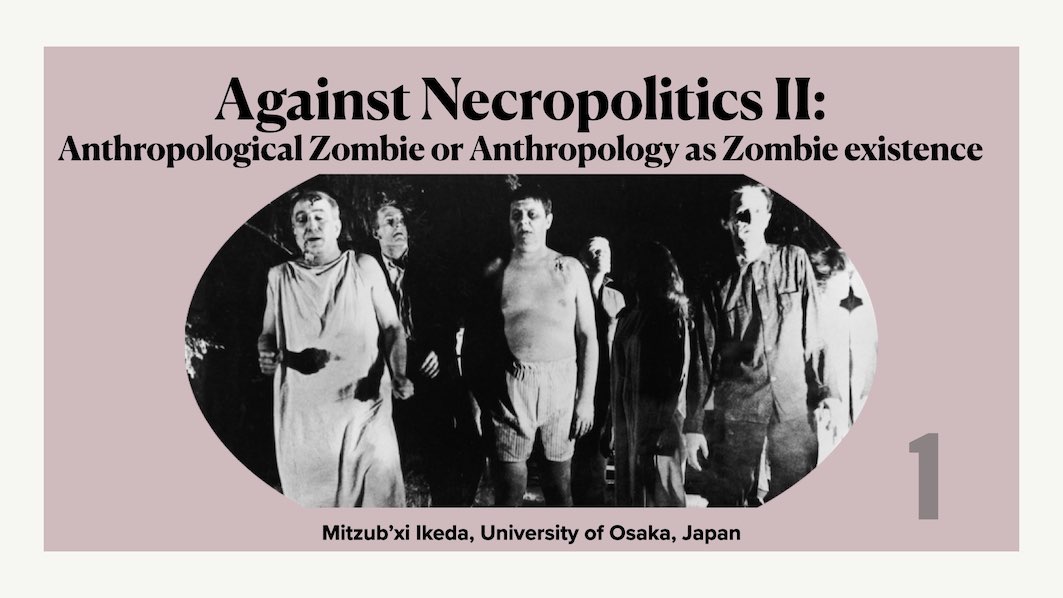 |
Against
Necropolitics II: Anthropological Zombie or Anthropology as Zombie existence Mitzub’xi Ikeda, University of Osaka, Japan |
 |
The
previous presentation in Taipei, 2026, was an attempt by medical
anthropologists worldwide to collaborate in analyzing, critiquing, and
dismantling the necropolitics—the “politics of death”—proposed by
Achille Mbembe (2016) that confronts all the people globally, to
reclaim a future order of “vibrant human health and life.” We do not
live in a universe that consists only of living things, but in a
pluriverse that consists of both living and dead ones. Medical
anthropologists are expected to contribute in some way to the lives and
deaths of these people eople all over the world. |
 |
About the
Presentation: How to Read the Slides Much of the text information contained in this slide corresponds to the text in the conference proceedings; therefore, if there are any parts of the presentation that are difficult to understand, please refer to the proceedings. All the information on the slides is available on the webpage linked via the QR code shown here, so please scan the code with your smartphone to access the URL. The QR code is only available here. |
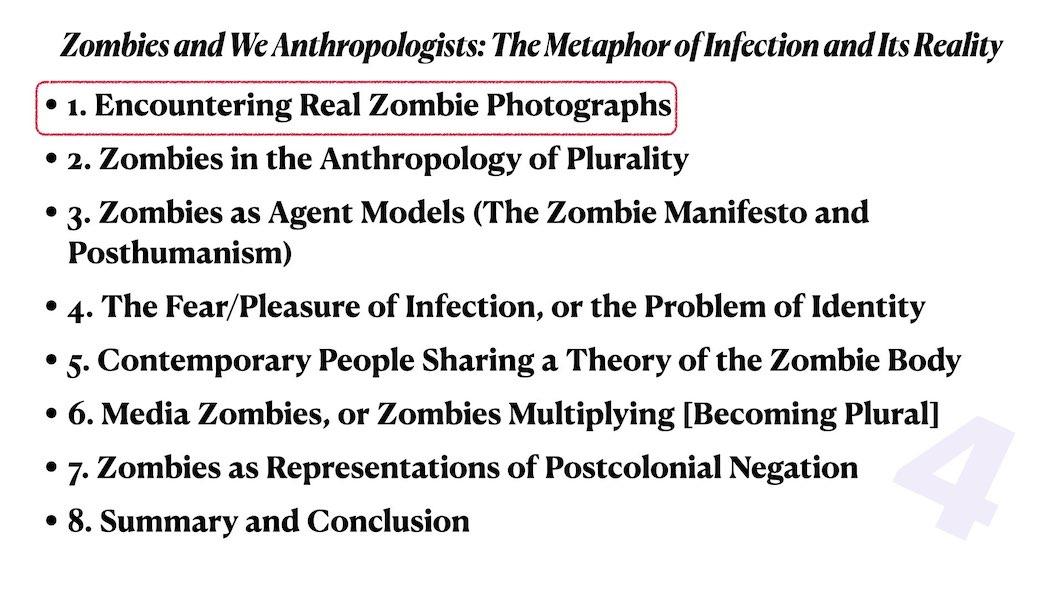 |
Zombies and We
Anthropologists: The Metaphor of Infection and Its Reality 1. Encountering Real Zombie Photographs 2. Zombies in the Anthropology of Plurality 3. Zombies as Agent Models (The Zombie Manifesto and Posthumanism) 4. The Fear/Pleasure of Infection, or the Problem of Identity 5. Contemporary People Sharing a Theory of the Zombie Body 6. Media Zombies, or Zombies Multiplying [Becoming Plural] 7. Zombies as Representations of Postcolonial Negation 8. Summary and Conclusion |
 |
1. Encountering
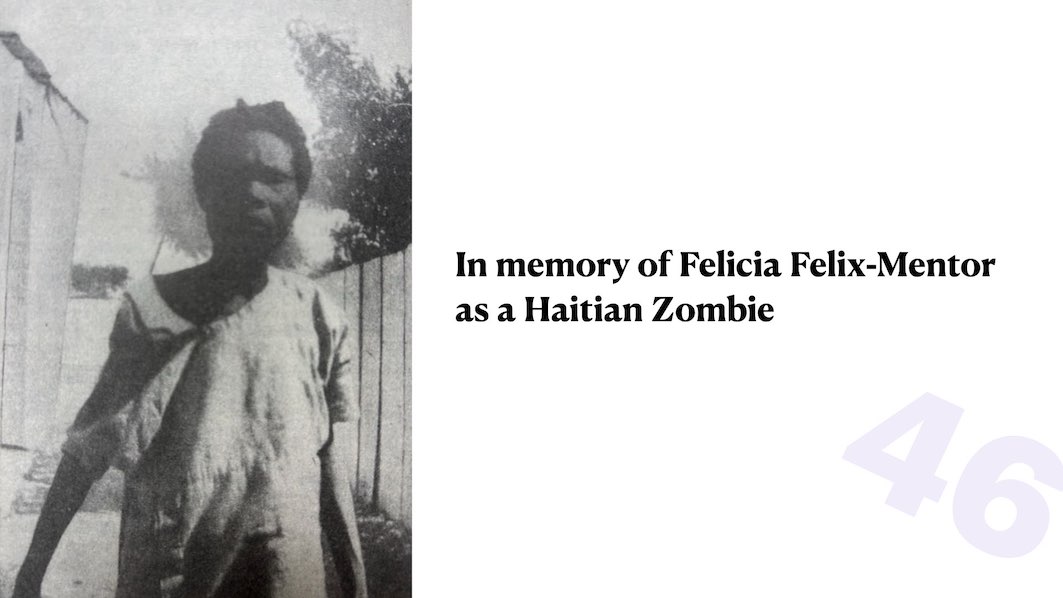
Real Zombie Photographs Zora Neale Hurston (1891–1960) conducted fieldwork in Jamaica and Haiti from 1936 to 1937 with support from the Guggenheim Foundation. The result was *Tell My Horse: Voodoo and Life in Haiti and Jamaica* (Japanese title: *The Gods of Voodoo*), published the following year. Within the book is a photograph capturing the “remains (or shell)” of the person who was once Felicia Felix-Mentor. The photograph of the zombie, taken by the author in the courtyard of the Gonâve hospital, shows the figure standing rigidly, gazing directly at the camera while wearing a hospital patient’s gown. Haxton writes with dismay that, standing before the zombie, she had no words to say to her [it], could gain nothing but by looking, and could not bear to gaze upon the figure of that “living corpse” for long. |
 |
Felicia
Felix-Mentor as a Haitian Zombie from Zora Neale Hurston's "Tell My
Horse: Voodoo and Life in Haiti and Jamaica," 1938 There is someone who encountered a zombie. That person is Zora Neale Hurston (1891–1960). In her 1938 book *Tell My Horse: Voodoo and Life in Haiti and Jamaica*, she describes the circumstances leading up to the photograph as follows. In Port-au-Prince, Haiti, Felicia Felix-Mentor—who was supposed to have died in 1907—was reported to the Director of Public Health, Luxe Léon, 29 years later, murmuring, “This is my father’s farm. I used to live here,” while wandering around naked. Ultimately, Léon himself diagnosed her and had her committed to a facility (hospital). |
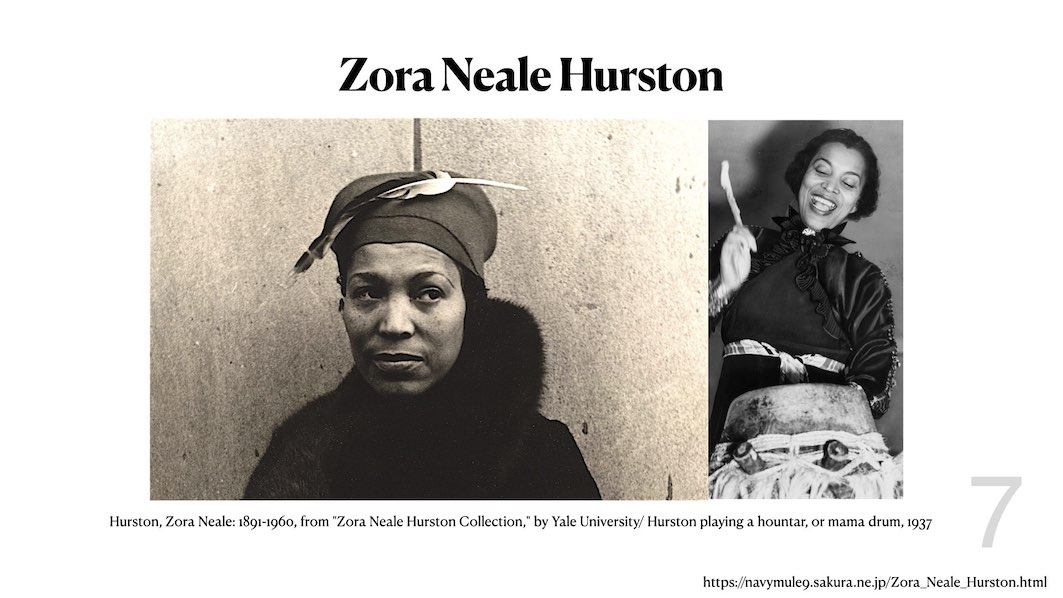 |
Zora Neale Hurston Hurston, Zora Neale: 1891-1960, from "Zora Neale Hurston Collection," by Yale University/ Hurston playing a hountar, or mama drum, 1937 https://navymule9.sakura.ne.jp/Zora_Neale_Hurston.html |
 |
The Gap Between
Real Zombies and Media Zombies Zombie Walk Paris 2017 Zombies in a Sugarcane Field (Uploaded to Wikipedia on May 5, 2021) Felicia Felix-Mentor; estimated to have been taken around winter 1936 |
 |
Zombies and We
Anthropologists: The Metaphor of Infection and Its Reality 1. Encountering Real Zombie Photographs 2. Zombies in the Anthropology of Plurality 3. Zombies as Agent Models (The Zombie Manifesto and Posthumanism) 4. The Fear/Pleasure of Infection, or the Problem of Identity 5. Contemporary People Sharing a Theory of the Zombie Body 6. Media Zombies, or Zombies Multiplying [Becoming Plural] 7. Zombies as Representations of Postcolonial Negation 8. Summary and Conclusion |
 |
2. Zombies in the
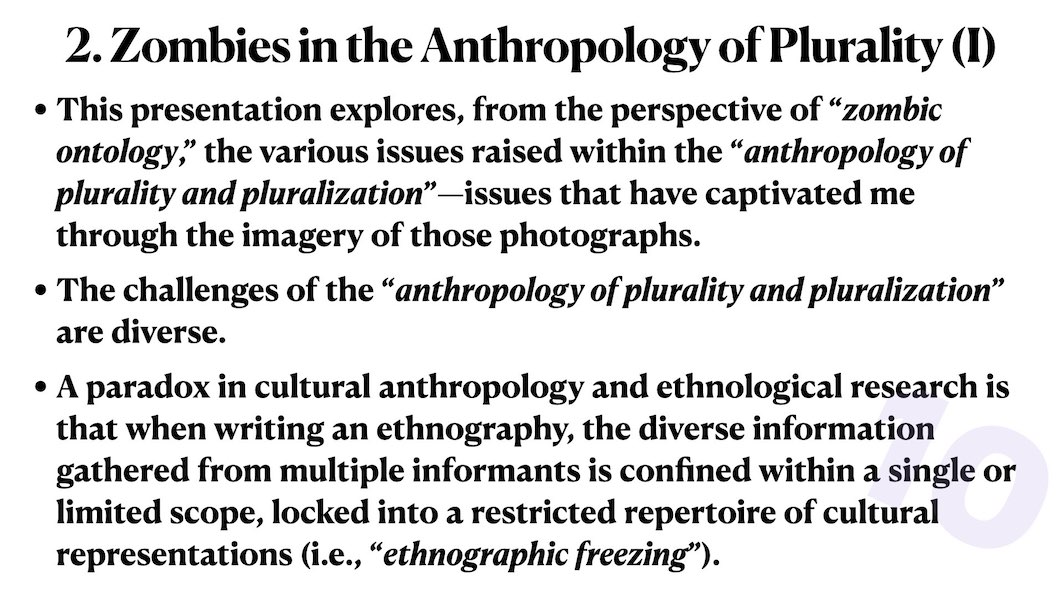
Anthropology of Plurality (I) This presentation explores, from the perspective of “zombic ontology,” the various issues raised within the “anthropology of plurality and pluralization”—issues that have captivated me through the imagery of those photographs. The challenges of the “anthropology of plurality and pluralization” are diverse. A paradox in cultural anthropology and ethnological research is that when writing an ethnography, the diverse information gathered from multiple informants is confined within a single or limited scope, locked into a restricted repertoire of cultural representations (i.e., “ethnographic freezing”). |
 |
2. Zombies in the
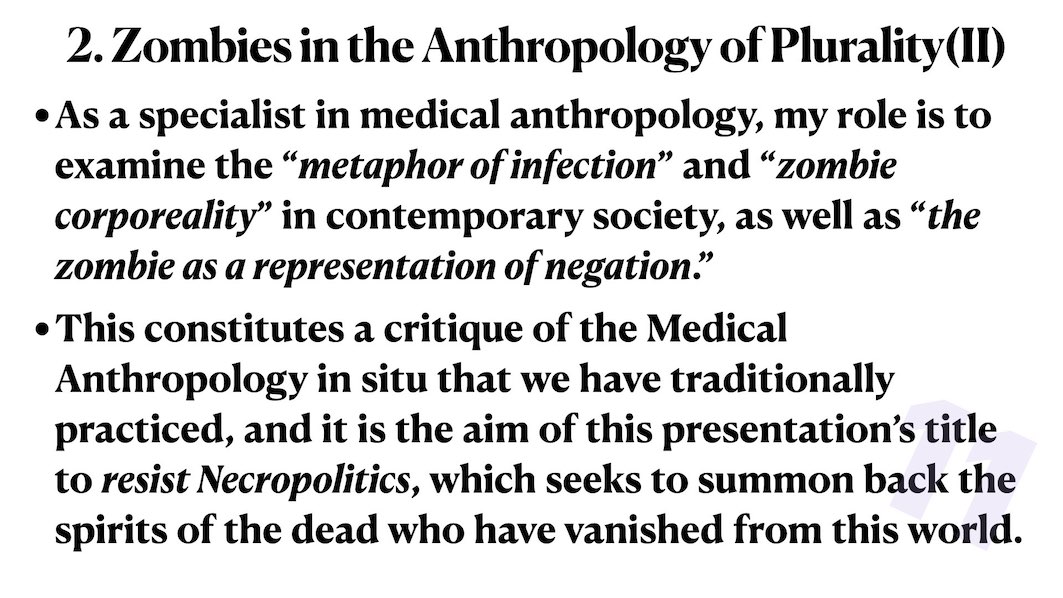
Anthropology of Plurality(II) As a specialist in medical anthropology, my role is to examine the “metaphor of infection” and “zombie corporeality” in contemporary society, as well as “the zombie as a representation of negation.” This constitutes a critique of the Medical Anthropology in situ that we have traditionally practiced, and it is the aim of this presentation’s title to resist Necropolitics, which seeks to summon back the spirits of the dead who have vanished from this world. |
 |
1. Identity and
Plurality "Topic: The Formation of Identity in a
Multicultural Society Description: This topic explores how people possess multiple cultural backgrounds and how this influences their self-perception." 2. Social Networks and Relationships "Theme: Interactions among multiple social networks Content: An analysis of how friendships and family relationships overlap and influence an individual’s social status." 3. Language and Communication "Theme: The Social Significance of Multilingualism Description: Research on language choice in bilingual and multilingual communities and its social and cultural implications." 4. Environment and Sustainability "Theme: Interactions Between Multiple Ecosystems and Humans Description: Exploring how different cultures perceive the environment and shape sustainable lifestyles." 5. Globalization and Local Culture "Theme: Global Impacts and Local Responses Content: An analysis of the impact of globalization on local cultures and the coexistence of multiple cultures within that context." 6. Sex and Gender "Theme: Understanding Multiple Gender Identities Content: Exploring how gender diversity influences social roles and expectations." 7. Immigration and Mobility "Theme: Immigrant Experiences and Plurality Content: Research on the formation of multiple identities as immigrants adapt to a new culture." All of these studies were inspired by anthropology in situ. |
 |
Zombies and We
Anthropologists: The Metaphor of Infection and Its Reality 1. Encountering Real Zombie Photographs 2. Zombies in the Anthropology of Plurality 3. Zombies as Agent Models (The Zombie Manifesto and Posthumanism) 4. The Fear/Pleasure of Infection, or the Problem of Identity 5. Contemporary People Sharing a Theory of the Zombie Body 6. Media Zombies, or Zombies Multiplying [Becoming Plural] 7. Zombies as Representations of Postcolonial Negation 8. Summary and Conclusion |
 |
3. Zombies as an
Agent Model “Zombies” have been represented as imaginary agents [models] that spread and multiply by attacking and harming ordinary living people. Underlying this are themes of a loss of individuality and non-identity [where no two appearances are alike] (= an ambiguous agent). Drawing on various discourses, including Lauro and Embry’s (2008) “A Zombie Manifesto” (→ next slide), let us consider the zombies depicted by Hurston in the mid-1930s—centered on Voodoo beliefs—as the standard model. Let us consider the “real zombie” as a non-subjective agent—a being resurrected from a corpse by a houngan (Voodoo priest) and put to work in various ways. |
 |
Sarah
Juliet Lauro; Karen Embry, A Zombie Manifesto: The Nonhuman Condition
in the Era of Advanced Capitalism. boundary 2 (2008) 35 (1): 85–108
(1/2) Focus on the subtitle → Non-human Conditions in the Age of Advanced Capitalism Influenced by Donna Haraway, A Cyborg Manifesto (1985): an antithesis to the perfect, natural body and subject. It advocated for prosthetics and fusion with machines, the affirmation of monstrous existence, and the plasticity of identity. In response to the Cyborg Manifesto, the authors seek to establish a theory of posthumanism (PH) in opposition to global capitalism. They critique previous forms of PH, arguing that zombie ontology necessitates the death of the subject and implies a shift from ontology to habitation. I felt that the arguments cited pertained more to the death of the subject in postmodernism than to PH itself. |
 |
Sarah
Juliet Lauro; Karen Embry, A Zombie Manifesto: The Nonhuman Condition
in the Era of Advanced Capitalism. boundary 2 (2008) 35 (1): 85–108
(2/2) However, this is not an attempt to construct a subjectivity that transcends the debate over zombies—who are resurrected from the dead as slaves through Hungan’s sorcery—through the dialectic of life and death. Rather, by positing that the zombie itself is a practice of the dialectic of negation, it rejects the subject/object dichotomy and affirms life (and death) as suspended in limbo. Rejecting the Enlightenment rationality that treats zombies as objects of fear, they seek to reclaim a “zombie-like modernity” in the post-human era. The authors boldly assert that such an era can only come about with the end of capitalism. Comment: Although highly abstruse, isn’t this text replete with rhetoric that seeks to cast the “dead subject” (Zombie proletariat?)—which aims for the “end of capitalism”—as the [immortal] subject of that revolution through a paradoxical turn of phrase? A Trotskyist theory of the zombie’s permanent revolution? |
 |
Problems with the
Zombie Agent Model William Seabrook (1929), *The Magic Island: Haiti* / Victor Halperin (1932), *White Zombie* / Jacques Tourneur (1943), *I Walked with a Zombie* / George A. Romero (1968), *Night of the Living Dead*, and so on. While zombies have been prominently featured as a theme in novels and films,…… In addition to the previously mentioned Hurston (1938), *Tell My Horse*, there are works such as Melville J. Herskovits (1937), *Life in a Haitian Valley* (Alfred A. Knopf); Maya Deren (1946–1956), *Divine Horsemen*; and Alfred Métraux (1958), *Le vaudou haïtien* (Voodoo in Haiti, 1959). Gallimard. Karen McCarthy Brown (1976), *The Veve of Haitian Vodou*. and so on; almost all ethnographies introducing Haitian voodoo focus primarily on rituals, symbols, communities of believers, and possession, while the zombie cult is touched upon only briefly and has not become a central theme in ethnographic research. |
 |
Dissecting the
Agent Model: An Analysis of Ambiguity This, too, highlights the striking disparity between “real zombies” and “media zombies.” The reasons for this disparity are: 1) While zombie beliefs proliferate within the media’s imagination, we never encounter real zombies; 2) As seen in Karen McCarthy Brown’s *Mama Lola* (1991), Voodoo belief—including phenomena such as possession—is a vibrant religious experience for living people, not an exotic object of fear. In other words, this indicates that “Media Zombies” have entered a distinct global circulation process as an occult genre detached from its original context (→ the establishment of a division of labor within the field of research). |
 |
Zombies and We
Anthropologists: The Metaphor of Infection and Its Reality 1. Encountering Real Zombie Photographs 2. Zombies in the Anthropology of Plurality 3. Zombies as Agent Models (The Zombie Manifesto and Posthumanism) 4. The Fear/Pleasure of Infection, or the Problem of Identity 5. Contemporary People Sharing a Theory of the Zombie Body 6. Media Zombies, or Zombies Multiplying [Becoming Plural] 7. Zombies as Representations of Postcolonial Negation 8. Summary and Conclusion |
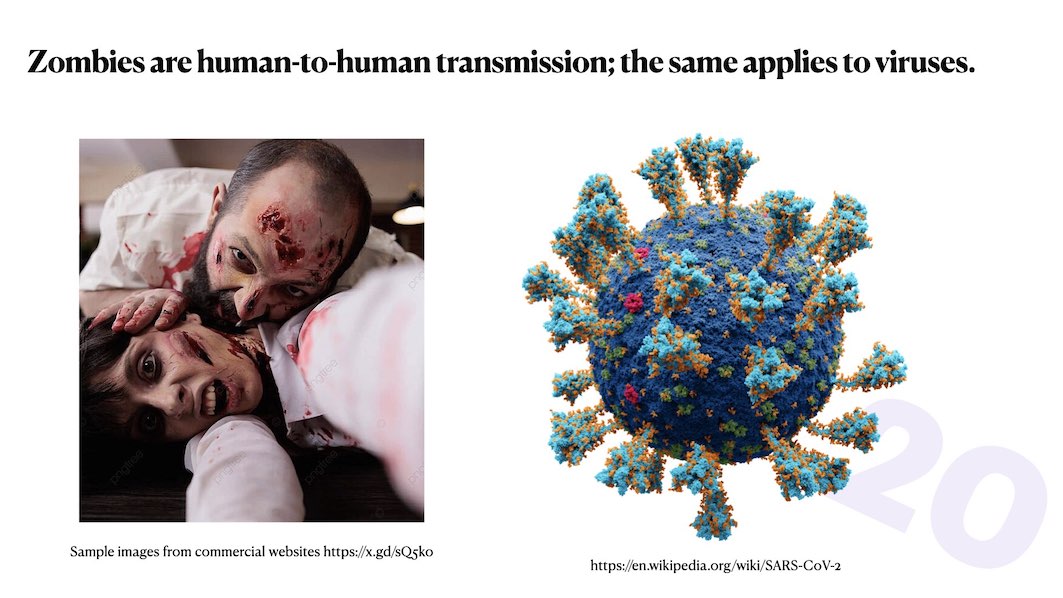 |
Zombies are
human-to-human transmission; the same applies to viruses. Sample images from commercial websites https://x.gd/sQ5ko https://en.wikipedia.org/wiki/SARS-CoV-2 |
 |
4. The Fear of
Infection / The Pleasure of Infection, or Issues of Identity (I) (1) The first characteristic of zombie ontology. It is said that any victim can be resurrected as a zombie, provided they are not elderly. Their gender or social attributes in life are irrelevant. In that sense, much like infection with COVID-19 [= an agent that gains agency], the chance of infection is not determined by social status but can happen to anyone (= a democratic zombie infection phenomenon). Since there is a strong connection between the resurrection potion and the soil of the graveyard, people feel aversion toward such contaminated soil. However, there is a sense of helplessness—that while the infection phenomenon can be prevented to some extent, it cannot be completely stopped. |
 |
4. The Fear of
Infection / The Pleasure of Infection, or Issues of Identity (II) The Fear of Infection drags people into a fear of universal sameness with others—the transformation into a single victim (patient)—and into that fatalism. There, people lose their identities (internal consistency) rooted in individual histories and are universally unified under the identity of a zombie (patient) (zombie identity). |
 |
Zombies and We
Anthropologists: The Metaphor of Infection and Its Reality 1. Encountering Real Zombie Photographs 2. Zombies in the Anthropology of Plurality 3. Zombies as Agent Models (The Zombie Manifesto and Posthumanism) 4. The Fear/Pleasure of Infection, or the Problem of Identity 5. Contemporary People Sharing a Theory of the Zombie Body 6. Media Zombies, or Zombies Multiplying [Becoming Plural] 7. Zombies as Representations of Postcolonial Negation 8. Summary and Conclusion |
 |
5. Modern People
Who Share a “Zombie Body” Philosophy (2) The Second Feature of Zombie Ontology The fear of zombification manifests itself in the impossibility of communication between two parties, as Harston experienced when he encountered the woman formerly known as Felicia. The second feature of ontology is that [it] is a body suspended in limbo, where it is unclear whether it is alive or dead. Within that “body as a prison”—as Plato described it—there is no mind; it is nothing more than an inorganic entity, like a machine that merely obeys its master’s commands. It lacks the vibrant radiance of life possessed by the living. It is situated in a purgatorial state between life and death. |
 |
The Prison of the
Body 1. A replica of the “Tiger Cages” used by the South Vietnamese Army to torture Viet Cong prisoners during the Vietnam War (War Remnants Museum 2. A painting of Loa Danbara (the snake) by Haitian artist Hector Hippolyte. Hippolyte himself was a houngan. |
 |
Zombies and We
Anthropologists: The Metaphor of Infection and Its Reality 1. Encountering Real Zombie Photographs 2. Zombies in the Anthropology of Plurality 3. Zombies as Agent Models (The Zombie Manifesto and Posthumanism) 4. The Fear/Pleasure of Infection, or the Problem of Identity 5. Contemporary People Sharing a Theory of the Zombie Body 6. Media Zombies, or Zombies Multiplying [Becoming Plural] 7. Zombies as Representations of Postcolonial Negation 8. Summary and Conclusion |
 |
6-a. Media
Zombies, or Zombies That Multiply (3-1) The third characteristic of zombie ontology (1) The marked divergence between Haiti’s original “traditional” “real zombies” and “media zombies” (continued from previous section). Lauro and Embry (2008), authors of the “Zombie Manifesto,” skillfully characterize this as an irreconcilable tension between the victims of global capitalism and the theoretical schools of post-humanism. |
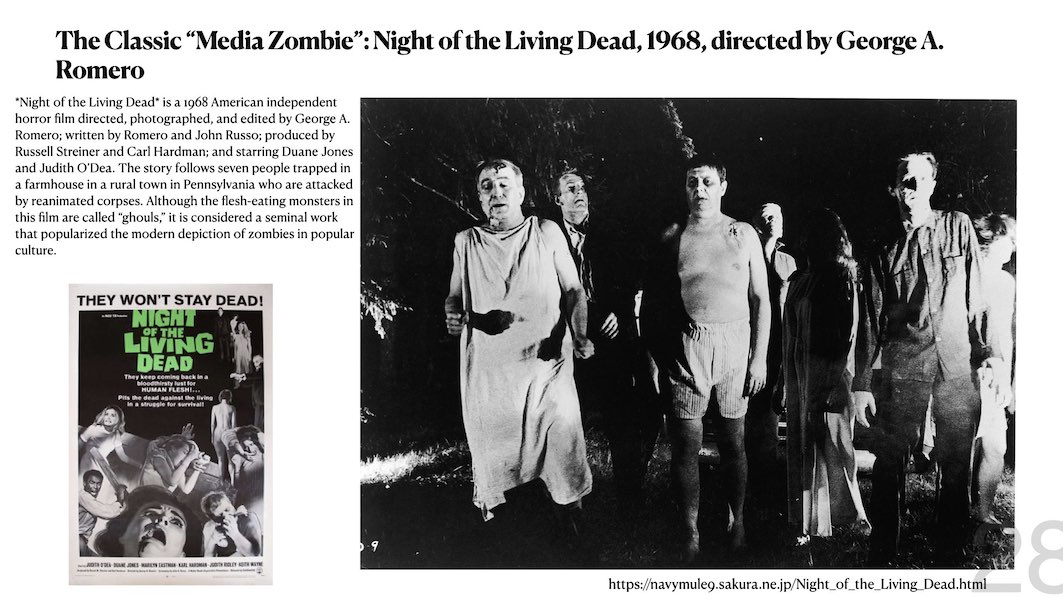 |
The Classic “Media
Zombie”: Night of the Living Dead, 1968, directed by George A. Romero *Night of the Living Dead* is a 1968 American independent horror film directed, photographed, and edited by George A. Romero; written by Romero and John Russo; produced by Russell Streiner and Carl Hardman; and starring Duane Jones and Judith O’Dea. The story follows seven people trapped in a farmhouse in a rural town in Pennsylvania who are attacked by reanimated corpses. Although the flesh-eating monsters in this film are called “ghouls,” it is considered a seminal work that popularized the modern depiction of zombies in popular culture. |
 |
The Classic “Media
Zombie”: Night of the Living Dead, 1968, directed by George A. Romero 1. Judy peering through the open truck window 2. Ben, holding a rifle in the farmer's living room https://navymule9.sakura.ne.jp/Night_of_the_Living_Dead.html |
 |
6-b. Media
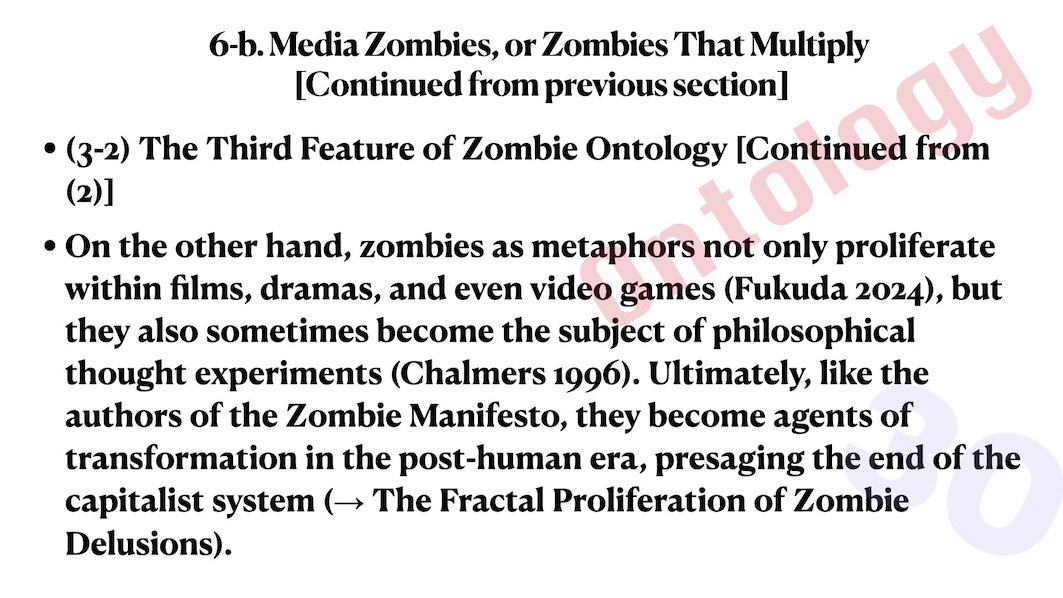
Zombies, or Zombies That Multiply [Continued from previous section] (3-2) The Third Feature of Zombie Ontology [Continued from (2)] On the other hand, zombies as metaphors not only proliferate within films, dramas, and even video games (Fukuda 2024), but they also sometimes become the subject of philosophical thought experiments (Chalmers 1996). Ultimately, like the authors of the Zombie Manifesto, they become agents of transformation in the post-human era, presaging the end of the capitalist system (→ The Fractal Proliferation of Zombie Delusions). |
 |
6-c. Media
Zombies, or Zombies That Multiply (I) [Continued from previous section] (3-3) The Third Feature of Zombie Ontology [Continued from (3)] The “real zombies” are the precariat of the premodern era, who were subjected to economic and human exploitation during their lifetimes; they embody the harsh reality of the colonial situation, in which they are resurrected through sorcery even after death and forced into labor beyond the limits of what is exploitative. At the same time, zombie slaves are the lumpenproletariat of the Marxist era—an inevitable consequence of the structural violence of colonialism and racism—and are the precariat of the neoliberal era itself. |
 |
6-c. Media
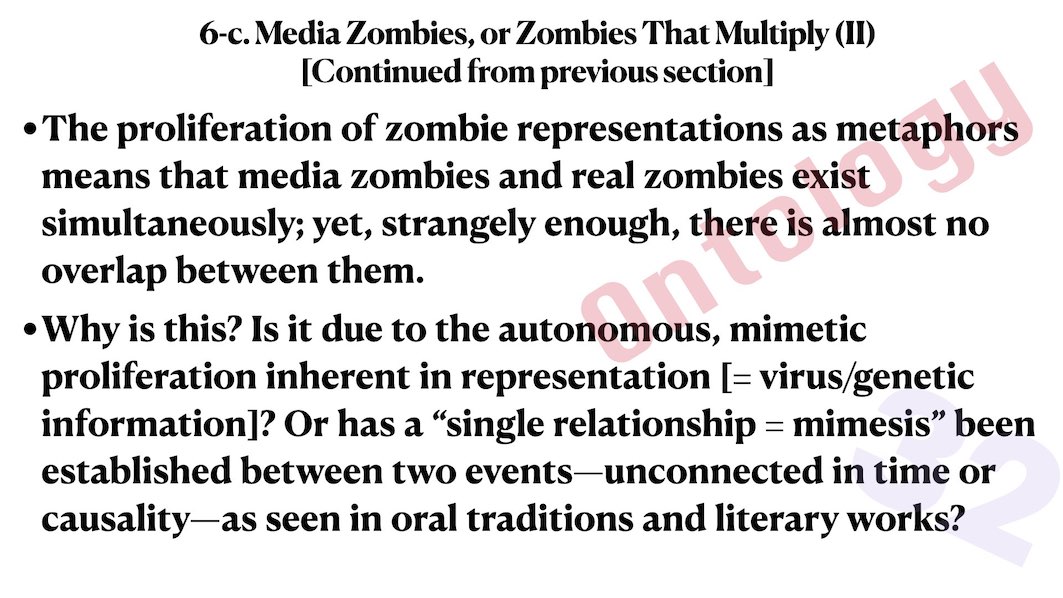
Zombies, or Zombies That Multiply (II) [Continued from previous section] The proliferation of zombie representations as metaphors means that media zombies and real zombies exist simultaneously; yet, strangely enough, there is almost no overlap between them. Why is this? Is it due to the autonomous, mimetic proliferation inherent in representation [= virus/genetic information]? Or has a “single relationship = mimesis” been established between two events—unconnected in time or causality—as seen in oral traditions and literary works? |
 |
Slave Trade https://www.bbc.com/japanese/53550421 |
 |
A GIS-based
representation of John Snow’s epidemiological mapping of the 1854
cholera epidemic in London https://learn.arcgis.com/ja/projects/map-a-historic-cholera-outbreak/ |
 |
Zombies and We
Anthropologists: The Metaphor of Infection and Its Reality 1. Encountering Real Zombie Photographs 2. Zombies in the Anthropology of Plurality 3. Zombies as Agent Models (The Zombie Manifesto and Posthumanism) 4. The Fear/Pleasure of Infection, or the Problem of Identity 5. Contemporary People Sharing a Theory of the Zombie Body 6. Media Zombies, or Zombies Multiplying [Becoming Plural] 7. Zombies as Representations of Postcolonial Negation 8. Summary and Conclusion |
 |
7. Zombies as
Representations of Postcolonial Negation (I) Finally, let us set aside our ontological analysis for a moment and reexamine zombies as a cultural representation of Haiti within their historical context. From the U.S. Marine Corps occupation of 1915–1934 onward, through the rampant dictatorship, poverty, and violence, the homophobic panic during the AIDS epidemic of the 1980s, and the vilification of immigrants in the recent U.S. presidential election, Haiti has remained a repository of postcolonial representations of negation. |
 |
7. Zombies as
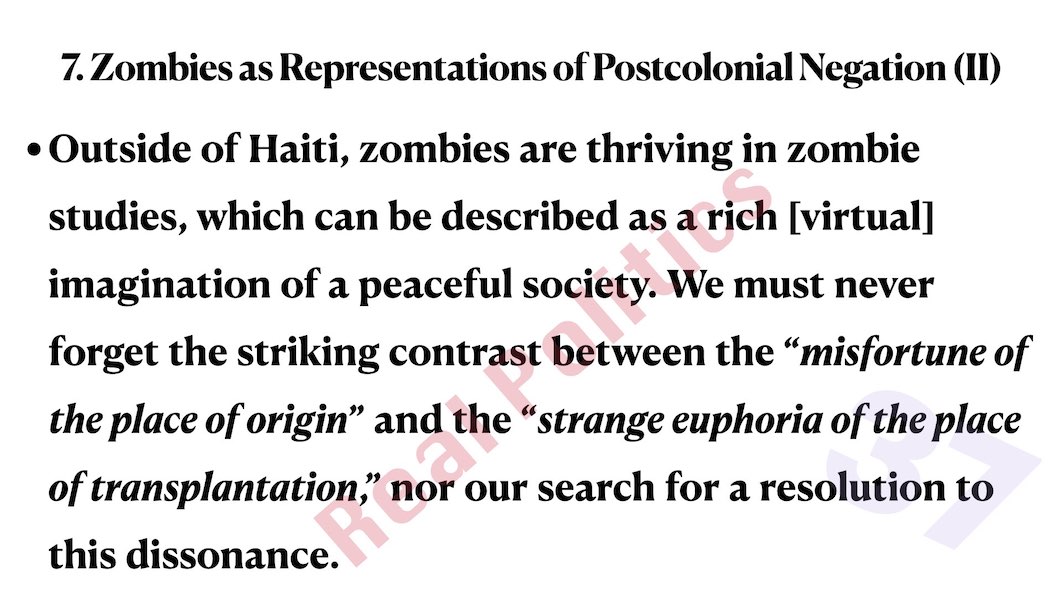
Representations of Postcolonial Negation (II) Outside of Haiti, zombies are thriving in zombie studies, which can be described as a rich [virtual] imagination of a peaceful society. We must never forget the striking contrast between the “misfortune of the place of origin” and the “strange euphoria of the place of transplantation,” nor our search for a resolution to this dissonance. |
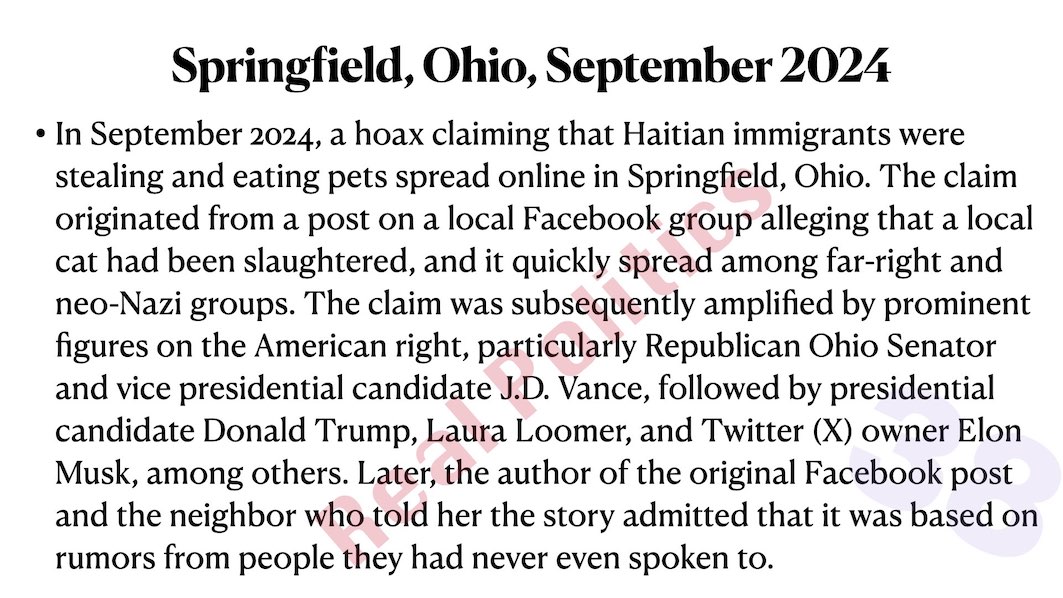 |
Springfield, Ohio,
September 2024 In September 2024, a hoax claiming that Haitian immigrants were stealing and eating pets spread online in Springfield, Ohio. The claim originated from a post on a local Facebook group alleging that a local cat had been slaughtered, and it quickly spread among far-right and neo-Nazi groups. The claim was subsequently amplified by prominent figures on the American right, particularly Republican Ohio Senator and vice presidential candidate J.D. Vance, followed by presidential candidate Donald Trump, Laura Loomer, and Twitter (X) owner Elon Musk, among others. Later, the author of the original Facebook post and the neighbor who told her the story admitted that it was based on rumors from people they had never even spoken to. |
 |
Structural racism
against immigrants in the United States The claim that Haitians eat pets spread amid racial tensions in Springfield, Ohio, where recent legal Haitian immigrants were said to be straining public resources. After this claim spread, there were dozens of bomb threats targeting schools, hospitals, public facilities, and businesses in Springfield, often accompanied by hate messages directed at Haitians. The fact-checking website PolitiFact selected this hoax as its annual “Lie of the Year” for 2025. https://x.gd/aL0Ln |
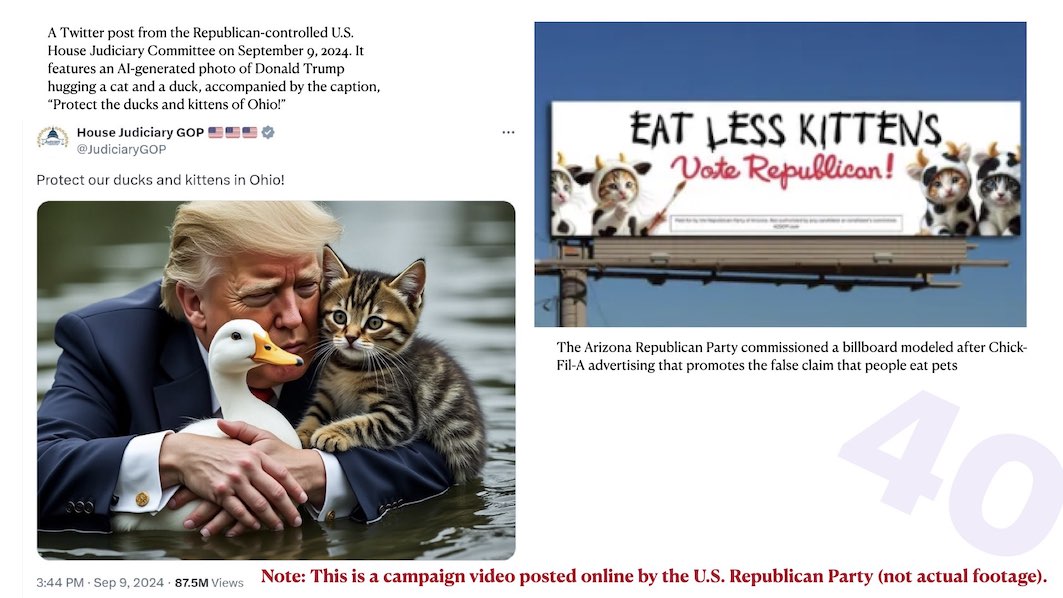 |
A
Twitter post from the Republican-controlled U.S. House Judiciary
Committee on September 9, 2024. It features an AI-generated photo of
Donald Trump hugging a cat and a duck, accompanied by the caption,
“Protect the ducks and kittens of Ohio!” The Arizona Republican Party commissioned a billboard modeled after Chick-Fil-A advertising that promotes the false claim that people eat pets Note: This is a campaign video posted online by the U.S. Republican Party (not actual footage). |
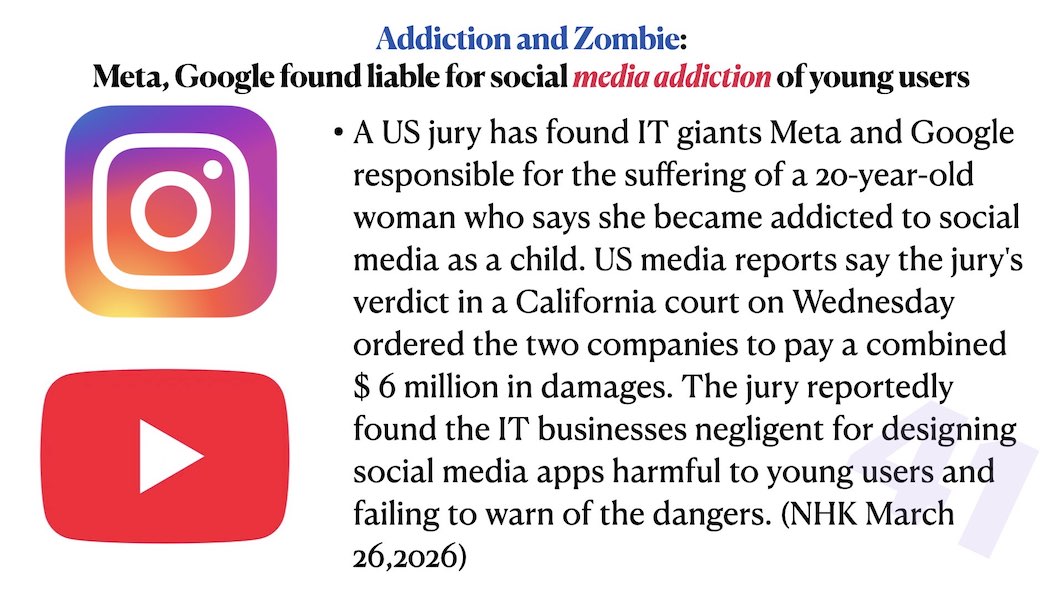 |
Addiction and
Zombie: Meta, Google found liable for social media addiction of young users A US jury has found IT giants Meta and Google responsible for the suffering of a 20-year-old woman who says she became addicted to social media as a child. US media reports say the jury's verdict in a California court on Wednesday ordered the two companies to pay a combined $ 6 million in damages. The jury reportedly found the IT businesses negligent for designing social media apps harmful to young users and failing to warn of the dangers. (NHK March 26,2026) |
 |
Zombies and We
Anthropologists: The Metaphor of Infection and Its Reality 1. Encountering Real Zombie Photographs 2. Zombies in the Anthropology of Plurality 3. Zombies as Agent Models (The Zombie Manifesto and Posthumanism) 4. The Fear/Pleasure of Infection, or the Problem of Identity 5. Contemporary People Sharing a Theory of the Zombie Body 6. Media Zombies, or Zombies Multiplying [Becoming Plural] 7. Zombies as Representations of Postcolonial Negation 8. Summary and Conclusion |
 |
8. Summary and
Conclusion (I) Taking as my starting point my encounter with the photograph of “the person who was once Felicia Felix-Mentor”—believed to have been taken by Zora Neale Hurston (1891–1960) around 1936 and considered the only surviving photograph of a real-life zombie—I examined the metaphor of infection as it relates to representations of zombies and the proliferation of zombies in contemporary society. |
 |
8. Summary and
Conclusion (II) The repertoire of the “Cultural Anthropology of Plurality and Multiplication,” covering: 1) zombies as agent models; 2) the identity of fear or pleasure in infection; 3) characteristics of zombie corporeality; and 4) A comparison between proliferating media zombies and real zombies. |
 |
8. Summary and
Conclusion (III) The hidden title of this presentation, “Zombies as We Anthropologists,” invites not only the study of such zombies as objects of cultural research but also a reflective examination of the political power structures within which we encounter the negative representation of Haitians and the facing a threat to their survival —that is, zombies as representations of the precariat and the multitude within global capitalism and warfare. |
 |
In memory of
Felicia Felix-Mentor as a Haitian Zombie |
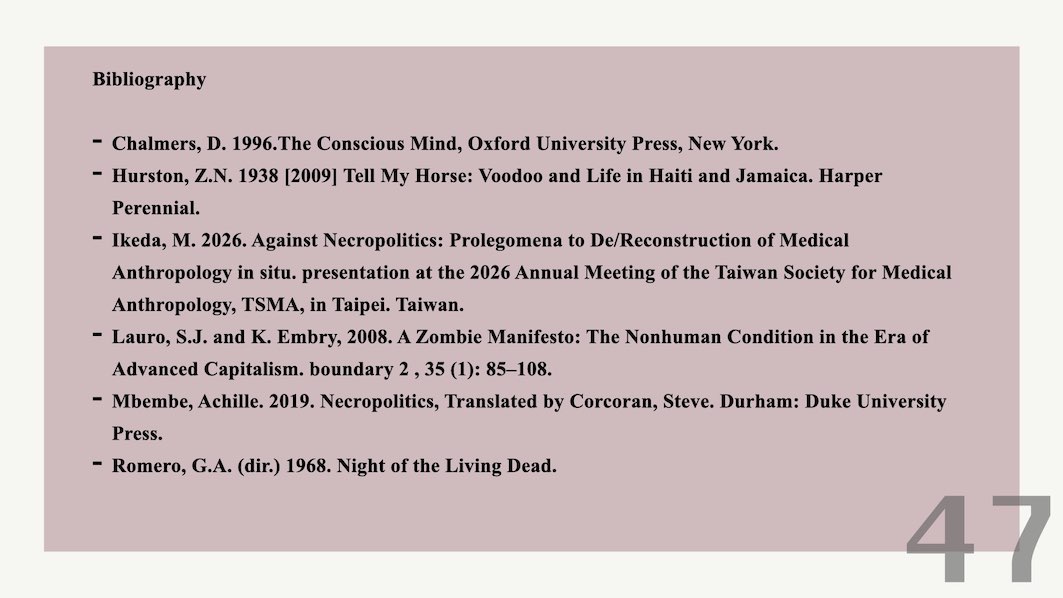 |
Bibliography Chalmers, D. 1996.The Conscious Mind, Oxford University Press, New York. Hurston, Z.N. 1938 [2009] Tell My Horse: Voodoo and Life in Haiti and Jamaica. Harper Perennial. Ikeda, M. 2026. Against Necropolitics: Prolegomena to De/Reconstruction of Medical Anthropology in situ. presentation at the 2026 Annual Meeting of the Taiwan Society for Medical Anthropology, TSMA, in Taipei. Taiwan. Lauro, S.J. and K. Embry, 2008. A Zombie Manifesto: The Nonhuman Condition in the Era of Advanced Capitalism. boundary 2 , 35 (1): 85–108. Mbembe, Achille. 2019. Necropolitics, Translated by Corcoran, Steve. Durham: Duke University Press. Romero, G.A. (dir.) 1968. Night of the Living Dead. |
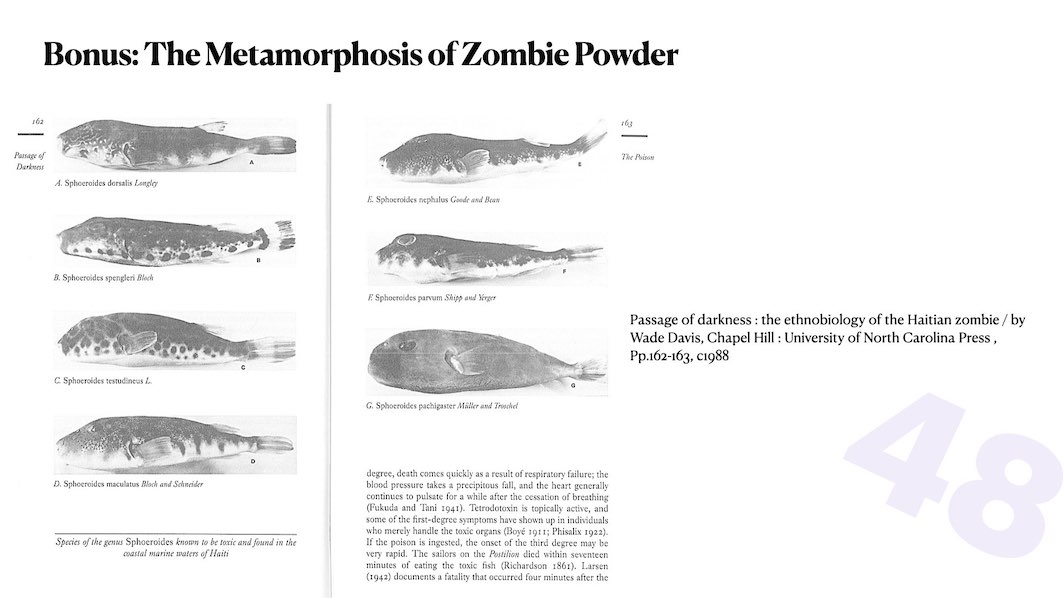 |
Bonus: The
Metamorphosis of Zombie Powder Passage of darkness : the ethnobiology of the Haitian zombie / by Wade Davis, Chapel Hill : University of North Carolina Press , Pp.162-163, c1988 |
★credit
リ ンク
文 献
そ の他の情報
CC
Copyleft,
CC, Mitzub'ixi Quq Chi'j, 1996-2099

