

Durable activity logs, ready when auditors ask
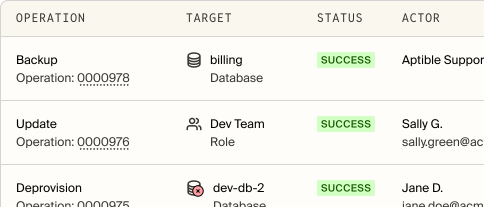
Every deploy, configuration change, and access event is captured automatically and preserved over time, with no CloudWatch queries or SIEM license required, so when auditors ask, the evidence is already there.
Application logs and metrics without custom pipelines
Application and database logs and metrics are available by default across environments, without agents, exporters, or custom pipelines to maintain.
Built-in logs and metrics, with flexible integrations when you're ready
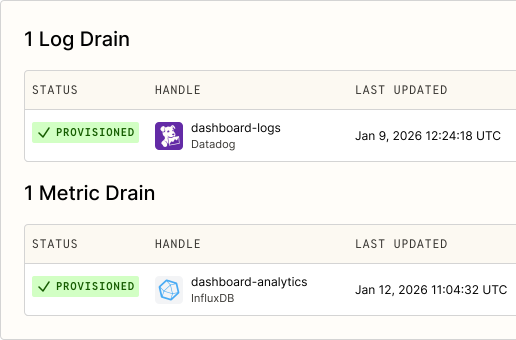
Logs and metrics are available from day one with no setup. Extend to a self-hosted stack or third-party provider through built-in drains, with explicit controls over data flow and PHI exposure.
Low operational overhead by design
Logging and metrics continue to work as systems scale and change without revisiting configuration, permissions, or pipelines.
View docs
your setup, your tools
Integrate, self-host, or just use what's built in
Connect to Datadog and similar providers through built-in drains, or host an ELK or Grafana stack directly on Aptible at infrastructure cost without adding a new vendor BAA. Teams that don't need additional external tools can use Aptible's built-in dashboard without configuring anything.
All three paths keep PHI exposure under one BAA and data flow under explicit control.
learn more
Maintain audit-ready visibility for systems handling PHI
Teams rely on Aptible to maintain a complete, explainable record of application behavior, access, and platform activity. Logs, metrics, and operational events are captured automatically, making it easier to investigate incidents, answer audits, and demonstrate compliance without retroactive reconstruction.
Replace fragile, hard-to-maintain observability pipelines
As systems grow, teams move away from fragmented logs, custom exporters, and inconsistent retention policies. Aptible provides a centralized observability foundation that works consistently across environments without ongoing pipeline or infrastructure maintenance.
Prepare for enterprise reviews and audits with confidence
Enterprise buyers expect clear, defensible evidence of system behavior and operational controls. Aptible makes it easy to export audit trails, logs, and metrics that are straightforward to explain to auditors, customers, and security reviewers.
FAQs
How long are logs and metrics retained?
It depends on the record type.
Activity records (including operations, authentication attempts, and role and permission changes) are retained for the life of the environment. Activity Reports are generated weekly per environment.
App and database logs are available as live streams when you run commands like aptible logs, which creates a temporary log-tail drain to your terminal. For long-term retention, configure log drains or S3 log archiving on Enterprise, where you own the bucket and set the retention policy.
Metrics are available in the dashboard in real time. Long-term retention requires a metric drain.
LLM Gateway request and response logs are retained by Aptible for 6+ years with no configuration, with the last 7 days self-serve in the dashboard and older logs retrieved by support.
Does Aptible monitor my infrastructure, or do I still need Datadog and PagerDuty?
Aptible monitors and responds to platform and infrastructure issues around the clock. Aptible’s reliability documentation and division of responsibilities describe the platform-level work Aptible handles.
Some monitoring stays with you:
Database performance, resource use, latency, and replication lag.
App containers stuck in restart loops.
Failures that Container Recovery can’t catch, such as a container that doesn’t exit properly when it fails.
For those customer-owned signals, Aptible can send logs and metrics to Datadog or other tools through log drains and metric drains.
What happens if PHI ends up in our logs or metrics?
Treat those logs and metrics as regulated data. Aptible’s own guidance for ephemeral SSH sessions is that if you process PHI, it’s likely that PHI will appear in SSH session logs at some point.
Keep telemetry inside Aptible’s compliant infrastructure, where it stays under your existing BAA, or send it only to third-party tools covered by the right agreements. For PHI, that means a BAA with the vendor. This applies to destinations configured through log drains as well.
Can I send logs and metrics to Datadog, Grafana, ELK, or a SIEM?
Yes. Log drains support Datadog, Elasticsearch, Sumo Logic, Papertrail, Mezmo, SolarWinds, Syslog, and custom HTTPS, covering apps, databases, SSH sessions, and endpoints. Metric drains support Datadog, InfluxDB, and New Relic, and there’s a guide for scraping Prometheus metrics.
For activity events, use Aptible’s SIEM/logging integrations. Generate an Activity Logs token (valid up to a year) and stream to your SIEM.
If telemetry may contain regulated data, the destination needs to be approved for it and covered by the right contracts.
Can I search and query logs in the dashboard?
Aptible gives you dashboard visibility into operation logs and account activity, and the Activity dashboard supports search across your organization.
The dashboard does not provide live application log streaming or advanced full-text search over application logs. To view live app logs, run aptible logs, which streams logs to your terminal. For long-term querying, correlation, alerting, and SIEM workflows, configure a log drain or use an external observability system.
What observability do I still need to build in my application?
Aptible provides platform-level visibility into your apps and databases, including container logs, platform metrics such as memory, CPU, and load average, database disk I/O and disk usage, endpoint logs, and activity records. Aptible does not expose host- or instance-level infrastructure visibility for the underlying machines that run your containers.
Your app still needs request tracing, product analytics, business events, application performance monitoring, custom alerts, and error tracking. Aptible’s division of responsibilities is the best reference for where platform responsibility ends and application responsibility begins.
