

What goes wrong in digital health
The moment PHI enters your system, you’re operating under HIPAA
Early infrastructure decisions become compliance liabilities, causing teams to spend months on rework. These are the five failure modes we see most frequently.

Non-prod becomes in-scope
Staging turns into production. A support escalation needs “a real example,” so someone copies a production row into staging. A demo environment quietly keeps real patient data because “we’ll delete it later.” It rarely gets deleted.
Access expands and never retracts
“Temporary admin” becomes permanent. A contractor gets broad access for a migration. A break-glass key gets shared in Slack during an incident. A CI token that can read everything stays alive long after the fire is out.
Documentation drifts from reality
Docs say one thing, infra does another. The security policy says “least privilege,” but IAM roles are wide because tightening them breaks deploys. The runbook says “logs retained,” but retention depends on a tool nobody owns.
Customer security reviews force archaeology
You’re asked to prove, not promise. Buyers ask: “Show me who accessed production,” “How long are logs retained,” “What changed last week,” “Where does PHI go,” “What’s your incident process.” Deals stall or fail because teams can’t produce complete, attributable evidence on demand.

Deploy PHI workloads
Run apps, databases, and AI with encryption, isolation, access logging, and least-privilege IAM enforced by default.
Add services safely
Introduce new apps, workers, databases, or AI endpoints without redefining network boundaries, rewriting IAM, or rebuilding your logging model.
Produce audit artifacts
Export access history, change events, backup posture, and retention settings directly from the platform.
Pass security reviews
Answer diligence questions about PHI flow, isolation, access, and incident response without re-architecting your stack.
FAQs
Can we start building before we're ready to process PHI?
Yes. You can build and test on the Development plan with non-PHI environments, then move regulated apps and databases to a dedicated stack with an executed BAA before handling PHI.
Aptible’s HIPAA documentation recommends that if you know you’ll process ePHI, you should host on a dedicated stack from day one, since every resource there meets HIPAA’s required specifications by default. Support can migrate existing resources from a shared to a dedicated stack.
If you’re prototyping AI workflows, the LLM Gateway security and compliance model has separate BAA coverage and doesn’t require a dedicated stack.
Can we keep some services in AWS, S3, or external AI tools?
Yes. You could host apps and databases on Aptible, with S3, analytics, AI vendors, or other AWS services alongside, connected through VPC peering or a site-to-site VPN on a dedicated stack.
Any of those services that handles PHI needs appropriate controls and contracts of its own. For AI specifically, the LLM Gateway can centralize provider access and compliance controls under one BAA instead of negotiating with each provider. For private access patterns, Aptible also documents integrations such as Twingate.
What do our customers and auditors get as proof of infrastructure compliance?
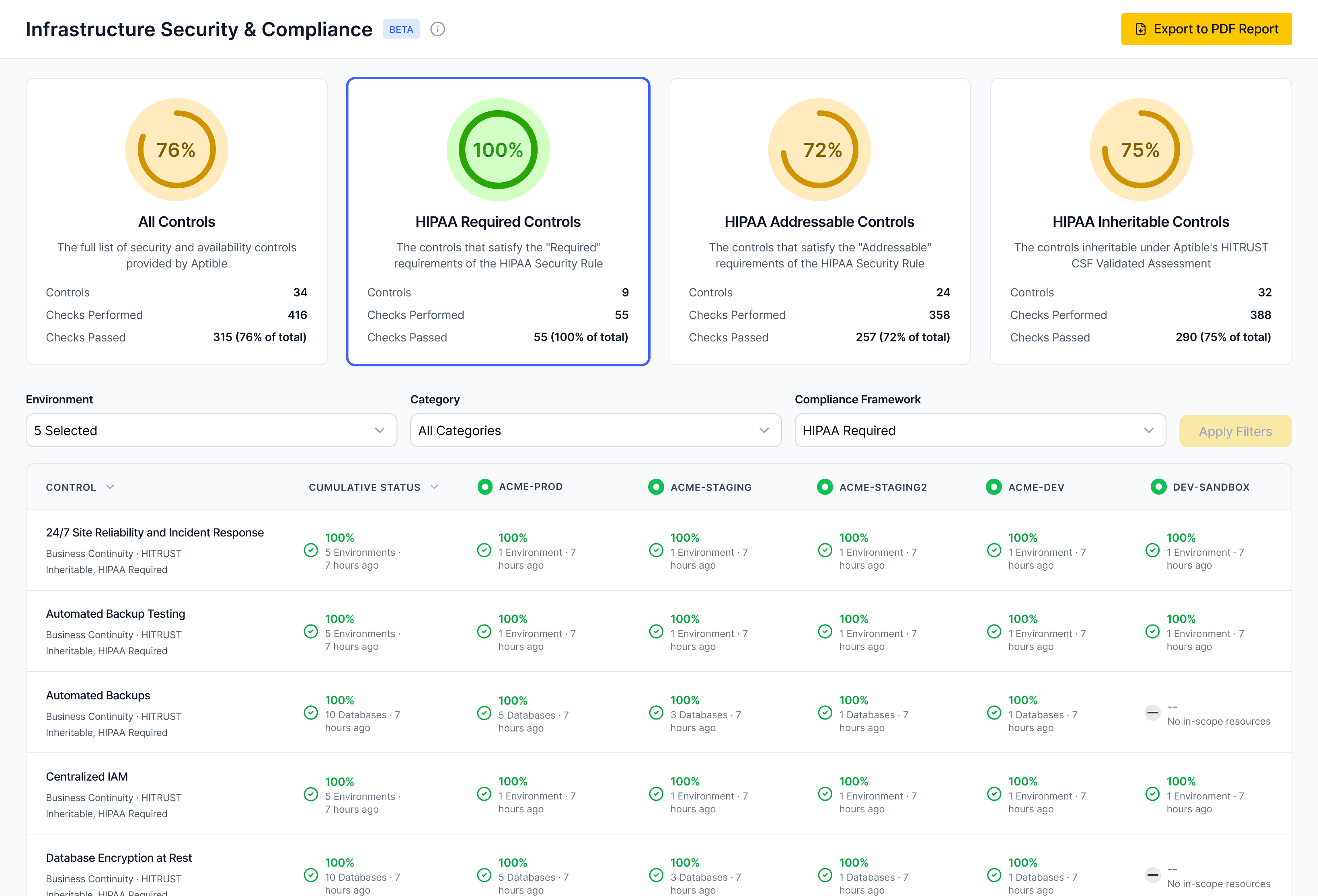
From your own dashboard: a Shareable Compliance Posture Report, a print-friendly PDF showing how each control is implemented against the resources in scope, honoring whatever environment and control filters you’ve applied.
You also get Activity Reports, which export every operation in an environment, including operations on resources since deleted.
From Aptible: the SOC 2 Type 2 Report, Penetration Test Summary, HITRUST CSF Letter of Certification and Validated Assessment Report, and the PCI DSS Service Provider Level 2 attestation are available through trust.aptible.com after e-signing an NDA. Aptible’s Security & Compliance overview summarizes available compliance evidence, and Aptible’s HITRUST shared responsibility matrix is published through the HITRUST Alliance.
You can also add a Secured by Aptible badge linking to the implemented controls.
Which of our telemetry destinations are in scope for PHI?
Treat any destination that receives PHI as in scope for your compliance program. If your app processes PHI, PHI may appear in application logs, SSH session logs, analytics events, traces, or AI prompts and responses unless your team actively prevents it.
Keep telemetry that may contain PHI inside Aptible’s compliant infrastructure, or send it only to vendors with appropriate contractual coverage, including a BAA where required.
For AI workflows, Aptible’s LLM Gateway keeps requests, responses, and audit logs inside compliant infrastructure under one BAA. Gateway providers are contractually prohibited from retaining or training on your data, and Aptible’s LLM Gateway audit logging documentation explains retention and retrieval.
How do we keep staging and other non-production environments out of scope?
Don’t put PHI in staging or development. Use synthetic, anonymized, or de-identified data, and keep production and non-production in separate environments. Our guide to isolating staging and production compares the three common models and when each makes sense.
Shared stacks are built for development, testing, and staging and cannot hold regulated data. Aptible also recommends a leaner backup retention policy for non-production: 1 to 14 daily backups, no monthly or yearly, no cross-region copies, no final backups.
