(1) FREE MURDERBOT. Martha Wells’ new Murderbot novelette is a free read at Reactor: “Rapport: Friendship, Solidarity, Communion, Empathy”.
Perihelion and its crew embark on a dangerous new mission at a corporate-controlled station in the throes of a hostile takeover…
(2) MARTHA WELLS Q&A. “We’re Light-Years Away from True Artificial Intelligence, Says Murderbot Author Martha Wells” in this Scientific American interview.
The Corporation Rim feels so incredibly prescient, perhaps even more now than when you published the first book in the series in 2017.
Yes, disturbingly so. This corporate trend has kind of been percolating over the past 10 or 15 years—this was the direction we’ve been going in as a society. Once we have the idea of corporations having personhood, that a corporation is somehow more of a person than an actual human individual, then it really starts to show you just how bad it can get. I feel like that’s been possible at any time; it’s not just a far-future thing. But depicting it in the far future makes it less horrific, I guess. It allows you to think about these things without feeling like you’re watching the news….
This world that you’ve created is so interesting because it’s a dystopia in some ways. The Corporation Rim certainly is. And yet Preservation is kind of a utopia. Do you think of them in those terms?
Not really, because by that standard, we live in a dystopia now, and I think that the term dystopia is almost making light of reality. It’s like if you call something a dystopia, you don’t have to worry about fixing it or doing anything to try to alleviate the problems. It feels hopeless. And if you have something you call a utopia, then it’s perfect, and you don’t have to think about problems it might have or how you could make it better for people.
So I don’t really think in those terms because they feel very limited. And clearly in the Corporation Rim, there are still people who manage to live there, mostly okay, just like we do here, now. And in Preservation, there are still people who have prejudices, and they still have some things to work on. But they are actually working on them, which sets it apart from the Corporation Rim….
(3) BEWARE MURDERBOT SPOILERS. Collider interviews Alexander Skarsgård about the end of the Murderbot TV series. “Alexander Skarsgård Breaks Down the ‘Messy and Complicated’ ‘Murderbot’ Finale: ‘I Quite Enjoyed That Murderbot Didn’t End Up Having Answers’”.
When Mensah and Murderbot are both stuck on the hopper together, and Mensah is having a panic attack, Murderbot puts on one of its favorite episodes [of Sanctuary Moon]. It’s such a lovely moment for their relationship. Given what we hear Murderbot say about her in the finale, that she’s its favorite human, do you feel like that hopper scene is the moment where it starts thinking of her in those terms, or does it only have that revelation by the end?
SKARSGÅRD: It’s a pivotal moment because it’s the first time, up until that point… they’ve had short interactions, just two of them, but it’s mostly through the whole team. It’s usually Murderbot versus the whole group. Mensah’s obviously the leader of the team and also the one who reaches out the most to Murderbot and tries to get Murderbot involved in the group, but still, it feels very much like a group dynamic. There are short moments when Mensah walks into Murderbot’s regen chamber, but it was really lovely to have a full episode together, as much as I love the rest of the cast, to really go deeper between Murderbot and Mensah and their relationship….
(4) SFF/H REVIEWS. Lisa Tuttle returns to the Guardian with “The best recent science fiction, fantasy and horror – review roundup”, covering Here and Beyond by Hal LaCroix (Bloomsbury); One Yellow Eye by Leigh Radford (Tor); I Who Have Never Known Men by Jacqueline Harpman, translated by Ros Schwartz (Vintage); and The Reaper by Jackson P. Brown (Del Rey).
(5) ERB’S BIGGEST FAN. PulpFest makes one its programs sound very appealing in “Ray Bradbury, Burroughs’ Disciple”.
Although he got his start as a writer of fantasy, horror, detective, and science fiction for the pulp magazines, author Ray Bradbury defied categorization. He referred to himself as a “magician of words.”
Bradbury was born on August 22, 1920, in Waukegan, Illinois and decided to become a writer around the age of twelve. From his earliest memories, he was a voracious reader and consumer of popular genre fiction, silent movies, radio programming, newspaper comic strips, circuses, magicians and more. From his earliest years forward, Ray Douglas Bradbury was enamored with the Buck Rogers newspaper strip and the works of Jules Verne, L. Frank Baum, Edgar Rice Burroughs and others.
Bradbury believed that Edgar Rice Burroughs was “probably the most influential writer in the entire history of the world. . . . I’ve talked to more biochemists and more astronomers and technologists in various fields, who, when they were ten years old, fell in love with John Carter and Tarzan and decided to become something romantic. Burroughs put us on the moon. All the technologists read Burroughs.”
In 1930, ten-year-old Ray Bradbury made the summer “unbearable” for everyone:
“You see my problem was Edgar Rice Burroughs and Tarzan and John Carter, Warlord of Mars. . . . I couldn’t stop reading those books. I couldn’t stop memorizing them line by line and page by page. Worst of all, when I saw my friends, I couldn’t stop my mouth. The words just babbled out. Tarzan this and Jane that, John Carter here and Dejah Thoris there. And when it wasn’t those incredible people it was Tanar of Pellucidar or I was making noises like a tyrannosaurus rex and behaving like a Martian thoat, which, everyone knows, has eight legs. . . . Because of the sheer romantic impossibility of Burroughs’ Mars and its fairytale people . . . how can one resist walking out of a summer night to stand in the middle of one’s lawn to look up at the red fire of Mars quivering in the sky and whisper, ‘Take me home.‘”
We hope you’ll join PulpFest and ERBFest on Saturday, August 9, at 7:40 pm as we welcome Professor Garyn G. Roberts to our stage for “Ray Bradbury, Burroughs’ Disciple.” It’s part of this year’s salute to the sesquicentennial of Edgar Rice Burroughs’ birth….
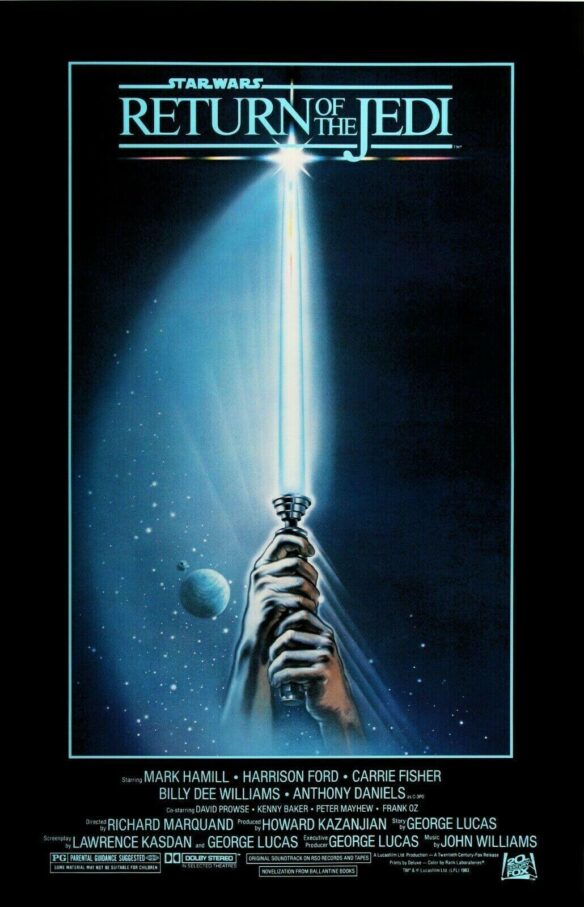
(6) LUCAS PLANS PILGRIMAGE. The Hollywood Reporter reveals “George Lucas Heading to San Diego Comic-Con for First Time Ever”.
The king of the nerds is finally coming to Comic-Con.
George Lucas, whose Star Wars movies helped create many of the ideas of modern fandoms, is coming to San Diego Comic-Con for his first-ever panel.
Lucas will be joined by filmmaker Guillermo del Toro, and artist and Star Wars prequels production designer Doug Chiang for a panel that will explore the power of illustrated story and offer a sneak peek at the new Lucas Museum of Narrative Art.
Queen Latifah, the Grammy- Emmy- and Golden Globe-winning actress and recording artist, will moderate the panel, which will take place Sunday in Hall H, the cavernous and storied arena in the San Diego Convention Centre….
(7) THE BLOB! This weekend’s “Blobfest” begins tonight with “Friday Night Run-Out and Stage Show” at the Colonial Theater in Phoenixville, PA.
(8) UNTOLD SUPERSTORIES. Junot Diaz’ New York Times op-ed discusses “My Problem With Superman”. (Link bypasses paywall.)
…It is obviously an awkward time for a peace-loving refugee American like Superman to return to us. We are in a time when someone like Clark Kent, an undocumented liberal-leaning journalist, could easily be scooped up by masked, unidentified government goons. Beaten, imprisoned and even deported to Sudan or Jarhanpur without due process.
What might a Clark/Superman/Kal-El do in such a situation? What stories might such injustice awaken?
Alexis de Tocqueville wrote that “there are certain truths which Americans can only learn from strangers,” and I will add that there are also truths that Americans can learn only from those whom Americans call strangers who are not strangers.
Truths without which our democracy will not survive.
Superman, like the nation that created him, contains many contradictory stories, but the question that all of us always must face is: Which ones will we listen to? The stories that thrillingly imprison us in the fantasy of our annihilating exceptionalism? The stories of alien invaders and avenging oneself in endless fractious war? Or the stranger stories that remind us how vulnerable we all are, how much we need one another’s help?…
(9) WHAT SCARES THIS HORROR WRITER? Silvia Moreno-Garcia is profiled by Alec Nevala-Lee in the New York Times: “A Best-Selling Horror Writer’s Biggest Fear? Being Recognized.” (Behind a paywall.)
…When you meet Moreno-Garcia, the first thing that you notice are her eyes, which — even behind large glasses — are as observant and expressive as Peter Lorre’s. Over coffee, she’s bracingly intelligent, with a knack for striking turns of phrase. During an interview, she compared the legacy of eugenicist beliefs to the persistence of microplastics in human tissue: “It’s like we have eugenics ideas in our bodies. They’re like a cultural haunting.”
A few minutes later, she said that a lot of popular culture is the equivalent of “sterile Monsanto seeds that don’t germinate,” producing works that never take root in the imagination.
Moreno-Garcia, who was born in Mexico in 1981, attended Endicott College in Massachusetts before eventually relocating to Canada. A vibrant local tradition of folklore and supernatural fiction fed directly into “The Bewitching,” which feels right at home in the region that shaped H.P. Lovecraft, Shirley Jackson and Stephen King. In the afterword, she writes, “New England naturally seems to breed horror writers.”
She described Lovecraft, in particular, as an important gateway into the history of fantasy and horror. Moreno-Garcia wrote her master’s thesis on Lovecraft and coedited an anthology of stories by women inspired by his fiction, which exposed her to criticism for engaging with an author justifiably seen as a white supremacist: “Somebody sent me a picture of Hitler, saying that I should be sent to the gas chambers.”
She pushed back against the assumption that her study of Lovecraft implied forgiving his racism, but further stressful interactions prompted her to pull back from social media.
“In person, people are a lot nicer,” Moreno-Garcia said. At events, she’ll receive friendship bracelets, stories about how her work has guided readers through difficult times, and requests for help in finding a publisher, which she gently declines.
Moreno-Garcia is well aware that her example is an inspiring one. Early in her career, she published five novels that were critically acclaimed but only moderately successful, while managing to avoid the industry pressure to concentrate on a single genre or series.
She credited her ability to create a varied body of work to “a lot of bouncing back and forth through the industry,” as well as the freedom granted by low expectations. “Everybody expected me to fail. So I would just say, ‘Well, I’m going to do this now.’ And they’d be like, ‘Sure.’ Pat [my] head and be like, ‘It’s OK.’”
This all changed with the breakout success of “Mexican Gothic,” an atmospheric work of period horror that landed her on the best-seller lists in 2020….
(10) TODAY’S BIRTHDAY.
[Written by Paul Weimer.]
June 11, 1913 — Cordwainer Smith. (Died 1966.)
By Paul Weimer: Cordwainer Smith, pen name of Paul Myron Anthony Linebarger, was an unusual man with an unusual but sadly small output of science fiction. You probably already know the story. Linebarger, expert in psychological warfare (he literally wrote THE BOOK on it) and a reserve Colonel, and worked with the CIA on psychological warfare and East Asian Studies. (Fun fact: he was the godson of Sun Yat-Sen). The most unusual background I think you could have for a science fiction writer, and none of it known until his death.

His extant output (there is a legendary story where he apparently lost a notebook full of ideas and story concepts somewhere, gone forever) falls mainly into the Nostrilia/Instrumentality of Mankind verse, where a new human civilization thousands of years after ours is devastated by aliens, goes out to space. This is where you get the Nostrilians and their anti-aging drug, and the best weapons in the universe to keep it safe. You get weird walled cities and underground movements on Earth, sterile and risk-averse societies, and of course the cats.
The cats.
The first story I did read from Smith was none other than “The Game of Rat and Dragon”. It’s written in the classic Smith style, more than a little poetic in spots, as we learn about the monsters that lurk in hyperspace, and how cats are the key to making planoforming possible. And how the pilots of such craft can and do become extremely bonded with their cat companions. It’s his most distinctive story, and I think it’s the one (even more than “Scanners Live in Vain”) that I would point to anyone who is mildly curious about his work. His work, “Game” included, is full of unusual coined words and unlike a lot of authors, he really makes it feel like we are thousands of years in the future, with distorted and strange echoes of the past in the words and neologisms of the future. It’s the far future, and Smith always ably and always keeps it exotic, weird, but ultimately human and penetrable.
(11) COMICS SECTION.
- Barney and Clyde know where they all are.
- Bizarro overhears a graphic rivalry.
- Brevity expects you to get the reference.
- Lio gets a complaint.
(12) IN JACK KIRBY’S CORNER. “A little piece of the Marvel Universe just became reality in honor of the Fantastic Four and their legendary co-creator Jack Kirby” reports GamesRadar+.
The Fantastic Four: First Steps begins in its own reality before sending its heroes into the MCU proper. And now, in that reality-bending tradition, a little bit of the Marvel Universe has become part of the real world, thanks to Manhattan renaming the corner of Essex St. and Delancey St. as Jack Kirby Way/Yancy St.
That exact corner marks the neighborhood where Fantastic Four co-creator Jack Kirby grew up, which in turn inspired the fictional Yancy St. in the Marvel Universe, the rough-and-tumble home of Ben Grimm, the Thing.
Members of the Kirby family were in attendance at the dedication of the pair of Fantastic Four-blue signs that mark both Jack Kirby Way and Yancy St. with the FF’s classic 4 emblem.
(13) ERIC IDLE Q&A. “’I’d be proud to be thrown out of America!’ Eric Idle on Trump, life after Python and not talking before lunch” in the Guardian.
…You always seemed to perform so unselfconsciously and with so much abandon and joy – and write so efficiently and quickly and confidently. Was there ever a time you were insecure about your work, either as a writer or an actor? And if so, what did you do to overcome those self-doubts and nerves? Hank Azaria
I think the answer to that is ars est celare artem – “the art is to hide the art”, which is the motto of the Footlights. There’s a great deal of work and effort that goes into making it look effortless. The secret of performing comedy is to really know what you’re gonna do.
Whenever you start, you’re insecure. If you feel secure, you’re a bit of an arsehole. And even now, I’m never secure, but always exploring and trying to improve. I don’t feel I write; I feel I rewrite. Spamalot was about 17 drafts. It got better as my mind resolved things. That’s what I do when I perform: I write a draft, and another, and I keep going until I’m confident with every bit. It’s always a theorem for me: if I say this, they may laugh. And then you find out.
I remember once that the Pythons were on the Tonight Show. We’d been over in Canada touring and they laughed like crazy at everything we did. But on the Tonight Show they were just silent. We did 20 minutes, then ran outside and we laughed and laughed and laughed. There’s nothing funnier than people not laughing at you….
(14) CLOUDY, WITH A CHANCE. “A Bold Mission to Hunt for Aliens on Venus Is Actually Happening” says Gizmodo.
A UK-based mission is aiming to settle, once and for all, whether life exists on Venus. The mission plans to send a probe to the planet in search of microbial life, not on the surface, of course, but in the Venusian clouds.
Over the past half-decade, scientists have detected the presence of phosphine and ammonia—two potential signs of biological activity—in Venus’s clouds. On Earth, both gases are produced only by biological activity and industrial processes, and scientists are unsure of their origin on Venus….
(15) U.S. BUDGET FALLOUT. Ethan Siegel says “American science to soon face its largest brain drain in history” at Big Think. His idea for a solution to the problem is: If we must cancel programs, we should give them away rather than throw them away.
…And yet, even if the worst comes to pass, there’s still a reason to be hopeful. Hitler’s destruction of his nation’s science in 1930s Nazi Germany wound up benefiting the rest of the world through an exodus of scientists that became known as Hitler’s gift. Even if American science becomes gutted to the worst imaginable level, science will still survive and thrive in the rest of the world, and we may be witnessing a pivotal moment that leads to the decline of the US and the rise of other scientific and technological national leaders. Here’s the story from a scientist’s perspective….
…In the most general terms, “Plan B” means looking for opportunities to conduct science and your scientific projects and missions elsewhere: outside of the United States. It looks a lot like “Hitler’s gift” looks, except instead of the US being on the receiving end of this one, it’s the source of the scientific exodus. Many nations have already responded by rising to the challenge.
- Europe has invested nearly a billion dollars in attracting top US scientific talent, including special additional funding for researchers to move their labs/research programs overseas.
- Individual European nations, such as France, have developed special programs to bring in displaced Americans.
- Japan has built a fund of ¥100 billion to attract researchers from abroad, with the Kavli Institute for Physics and Mathematics of the Universe offering additional special postdoctoral positions for displaced scientists.
- Other countries, such as Canada and Australia, are also working to attract displaced American scientists.
… And yet, there’s a tremendous reason to be optimistic: Other nations are aware of the situation in the US and across the world, and they’re stepping up to invest in science. They know what the model for societal success looks like:
- Invest in hiring scientists and building science facilities.
- Build and maintain the infrastructure and talent that conducts it.
- Reap the rewards of economic prosperity, downstream technology development, and hugely positive returns on investment.
It is, after all, how the US became an economic and scientific superpower in the 20th and 21st centuries, and if our nation is going to abandon those principles, other countries will certainly reap those benefits.
It isn’t as though the US is some special nation, or the only place where NASA and NSF projects can be conducted….
(16) IF WE ARE TO GO TO MARS, WE NEED TO DO SO ETHICALLY. [Item by SF Concatenation’s Jonathan Cowie.] In this week’s Nature there is an item on the ethics of space travel.
Long story short, we risk contaminating extraterrestrial life with terrestrial bugs. Think Wells’ War of the Worlds in reverse. (Someone should really make this point to Nature (archive version here).) However, the ethics and even the philosophical basis by which we ought to abide in human space exploration simply has not been developed let alone agreed.
Now, unmanned space exploration poses less of a risk than human space exploration, but there are still ethical considerations to make if we are habitually to send what will end up as ‘junk’ into space.
Many Filers might know that I have often warned that the machines are taking over the world, but no-one ever seems to listen. Today, Mars is solely populated by robots. Perhaps we should keep it that way and let them have it?
Space agencies should allocate funds to integrate trained philosophers in ongoing and future astrobiological research, and create multidisciplinary advisory panels tasked with providing guidance on navigating issues, particularly when it comes to developing missions…
See Haramia, C. et al (2025) “How to chart a moral future for space exploration” Nature, vol. 643, p332-5.

[Thanks to Andrew Porter, John King Tarpinian, Chris Barkley, Steve Vertlieb, Sourdough Jackson, Dennis Howard, Cat Eldridge, SF Concatenation’s Jonathan Cowie, Mark Roth-Whitworth, Steven French, Kathy Sullivan, Teddy Harvia, and Mike Kennedy for some of these stories. Title credit belongs to File 770 contributing editor of the day Andrew (not Werdna).]