Pixel Scroll 12/18/25 Scroll Is Empty And All The Pixels Are Here

(1) ABC — ANOTHER BAD CONTRACT. [Item by Dann.] Courtesy of author John Van Stry comes the news of the contract allegedly used by publisher Shadow Light Press. “Want To See A Really BAD Contract?” Even my hair stood on end with the opening sections:

2. Exclusive License and Term

a. The Author grants to the Publisher the exclusive, irrevocable license to publish, reproduce, distribute, sell, adapt, modify, publicly display, publicly perform, and otherwise exploit the Work (as defined above in “Parties And Scope”), in whole or in part, in all formats, languages, and editions now known or later developed, including but not limited to print, digital, audio, derivative works, media adaptations, and merchandise. This license includes the right to license, sub-license, assign, or otherwise transfer any or all rights granted herein, in the Publisher’s sole discretion, in the ordinary course of publishing and distribution.

b. The initial term (“Initial Term”) of this Agreement shall be ten (10) years, commencing on the Effective Date. The Term shall automatically continue for an additional ten (10) Years upon the Publisher’s receipt of any new manuscript or project from the Author covered by this Agreement or any other publishing agreement between the Parties. Such continuation shall apply to all Works covered by this Agreement and any other publishing agreement between the Parties, and the Term for all such Works shall run concurrently from the date of the Publisher’s receipt of the most recent qualifying manuscript.

Van Stry added some advice, which he emphasized with a story from his own experience:

â€ĶLook, PEOPLE! NEVER EVER sign a contract if you don’t understand it completely and do NOT be afraid to show it to a LAWYER! Anybody who balks at you wanting to show it to your lawyer is a SCAMMER who you do NOT want to do business with, ever. Yes, you’re excited that you’ve been offered a contract. I was excited when the biggest Asian media company in the entire world came to me with a ‘deal’.

Until after my lawyer saw it and pointed out how I was going to be screwed out of my IP. When we suggested changes to the contract, they balked and I walked (and I know that dozens of poor MF’s fell for the BS and will eventually regret it, if they’re not already)â€Ķ.

(2) DOING LESS THAN DOOLITTLE. James Davis Nicoll turns a dubious eye on “Five Books About Conversing With Animals” at Reactor.

We all understand that humans and animals cannot easily communicate with each other. Most animals find it hard to understand human speech (though some commands and phrases can be learned); we often find their body language (the product of millions of years of divergent evolution) opaque1; and their handwriting is appalling (though some can push buttons). Even dogs, animals that have lived with and been shaped by humans—and have shaped humans in return—for a very long time, can be hard to understand. Bad luck for any Timmies stuck down a wellâ€Ķ.

Here’s one of the classics Nicoll scoffs at —

The Jungle Book by Rudyard Kipling (1894)

Mowgli learns the language of the animals by the simple expedient of having been orphaned and then adopted and raised by wolves4. Conveniently for Mowgli, for the most part all animals speak the same language. This is not an unmixed blessing, as not everything animals say is something one wants to hear.

To be honest, I am pretty skeptical about many details of Kipling’s zoology. Dogs and cats are often baffled by the other’s body language. Canid and feline lineages diverged comparatively recently. Imagine the gulf between the snake Kaa and primate Mowgli. I don’t think that there is any fieldwork that supports the notion of a unified spoken language among animals. It’s almost as though The Jungle Book is not intended as a serious scientific hypothesis.

(3) JG BALLARD’S FORESIGHT CREDITED. “Want to understand the sickness of Britain today? Look no further – a novel explained it all 20 years ago” says Aditya Chakrabortty in the Guardian.

An Englishman drives into a new town and can’t see the warning signs. Richard Pearson is visiting Surrey to close down his late father’s home and settle his affairs and, everywhere he looks, the flag of St George is flying “from suburban gardens and filling stations and branch post offices”. How nice, he thinks, how festive.

Soon he learns the truth.

So runs the opening not of a recent piece of journalism, but a novel by JG Ballard, Kingdom Come, which despite being almost 20 years old anticipates today’s Britain with eerie precision. In the mid-2000s, Pearson reads up on his new surroundings, only to find the same headlines that assail us in the mid-2020s: “Every day the local newspaper reported attacks on an asylum hotel, the torching of a Bangladeshi takeaway, injuries to a Kosovan youth thrown over the fence into an industrial estate.”â€Ķ

â€Ķ Amid this yawning suburbia, Pearson starts to come awake. One evening, he sees an old Volvo up in flames, and an angry mob about to storm a “shabby house”. Inside, he supposes, must be “a released murderer or a paedophile exposed by the local vigilantes”. But no. Out come Muslim women, who have been praying in a makeshift mosque and who must rely on a police line against violence from their own neighbours. As for the white locals, they have taken to wearing red crosses – not for football matches but for an entirely different kind of kickabout, where they set on Asian shopkeepers.

It’s a mark of Ballard’s powers of observation that he spotted as far back as the 2000s that it would be to London’s perimeter where ethnic minorities would now be moving. The centre of the capital is not only turning whiter and richer, but the author could see how, a full decade before the Brexit vote, its enemies were defining the place as anti-English: “The West End, Bloomsbury, Notting Hill, Hampstead – they’re heritage London, held together by a dinner-party culture. Here, around the M25, is where it’s really happening. This is today’s England.”â€Ķ

â€Ķ Twenty years after this story was printed, we are just starting to write the history of the strange death of neoliberal England. Yet Kingdom Come demonstrates that our current mess has a long, long historyâ€Ķ.

(4) OCTOTHORPE. Octothorpe 150, “I Would Describe Them As European” is up, the last episode of 2025. An uncorrected transcript is available here.

We discuss Smofcon 42 and the conventions that John found out about, plus John doesn’t pass out, Alison is a wuss, but Liz doesn’t think it’s gratuitous.

A Mahalo Flying V, an Uma Blue Pineapple, and a Brunswick soprano are hanging on a Christmas tree beneath the words “Octothorpe 150”.

(5) FORD ACCOLADE ANNOUNCED. “Harrison Ford To Receive 2026 SAG-AFTRA Life Achievement Award” – Deadline has the story.

Harrison Ford on Thursday was named as the recipient of the SAG-AFTRA Life Achievement Award, the guild’s highest honor recognizing career and humanitarian accomplishments. The award will be bestowed in March during the 32nd annual The Actor Awards, formerly known as the SAG Awards.

The ceremony is set for Sunday, March 1, 2026 at the Shrine Auditorium & Expo Hall. It will stream live on Netflix.

Ford, whose seven-decade career includes iconic roles from Han Solo in the Star Wars franchise to Indiana Jones in Raiders of the Lost Ark franchise, becomes the 61st recipient of the honor, which goes to an actor who exemplifies the “finest ideals of the acting profession.”â€Ķ

(6) ASK THE MAN WHO’S PUNCTILIOUS. [Item by Daniel Dern.] Writer/editor/publisher Ian Randal Strock recently wrote Punctilious Punctuation (see press release) and so, as Strock recently (December 18) posted to Facebook:

I guess I am become the punctuational clearing-house! This link was gifted me by a friend this evening. “Where Is The Comma In “God Rest Ye Merry, Gentlemen” Supposed To Go?”

Earlier there were articles about the confusion over whether or not there is a hyphen in Andrew Mountbatten-Windsor’s family name, and… oh drat, I’ve forgotten what that other was. Guess I’ll need to share them for y’all as they come in! By the way: after “merry”? That still doesn’t make sense to me. I just assume it should be after “rest”.

(7) SF TIME PASSAGES. Colin Kuskie and Phil Nichols’ latest SF 101 podcast episode is “Gimme That Old-Time Magazine”.

We’re back! With our annual trek into the archives to read an old science fiction magazine, to see if and how our field has changed over the decades.

This time we time-travel to 1982, where we pick up the February 15th 1982 issue of Isaac Asimov’s Science Fiction Magazine.

If you’d like to read along with us, you’ll find the entire issue online courtesy of Luminist, here: https://s3.us-west-1.wasabisys.com/luminist/SF/ASI/ASI_1982_02.pdf

(8) FALLOUT SERIES. Keza Macdonald talks to the creators of the Fallout TV show in the Guardian’s “Pushing Buttons” newsletter: “Inside Fallout, gaming’s most surprising TV hit”.

The Fallout TV series returns to Prime Video today, and it’s fair to say that everyone was pleasantly surprised by how good the first season was. By portraying Fallout’s retro-futuristic, post-apocalyptic US through three different characters, it managed to capture different aspects of the game player’s experience, too. There was vault-dweller Lucy, trying to do the right thing and finding that the wasteland made that very difficult; Max, the Brotherhood of Steel rookie, who starts to question his cult’s authority and causes a lot of havoc in robotic power armour; and the Ghoul, Walton Goggins’s breakout character, who has long since lost any sense of morality out in the irradiated wilderness.

The show’s first season ended with a revelation about who helped cause the nuclear war that trapped a group of people in underground vaults for a couple of centuries. It also left plenty of questions open for the second season – and, this time, expectations are higher. Even being “not terrible” was a win for a video game adaptation until quite recently. How are the Fallout TV show’s creators feeling now that the first season has been a success?…

(9) TODAY’S BIRTHDAY.

[Item by Paul Weimer.]

December 18, 1913 Alfred Bester. (Died 1987.)

By Paul Weimer:

Eight, sir; seven, sir;
Six, sir; five, sir;
Four, sir; three, sir;
Two, sir; one!
Tenser, said the Tensor.
Tension, apprehension,
And dissension have begun

That rhyming song is how I started a 2016 piece (an early “Mining the Genre Asteroid” column) I wrote on The Demolished Man, written by one Alfred Bester. 

The Demolished Man, the first book I read of his, came just because it was part of my brother’s collection. I was hooked in immediately by the psionics and the working out of their powers and how society views them, deals with them, and vice versa. 

Alfred Bester

Since I can never pass up a reference to it, I remember when Walter Koenig’s psi cop first appeared on Babylon 5 and his name was, inevitably, Bester. I practically shouted at the screen, “You did not!” in delight. It soon became clear through subsequent episodes that Straczynski, possibly through the mediation of Harlan Ellison, perhaps through his own reading of it, borrowed a lot of the ideas about psionics from The Demolished Man

It won the first Hugo award for Best Novel. 

While psionics are relatively out of fashion in SFF today, even today, anyone who wants to put psionics in their SFF work would do well to look at Bester’s work. (I hesitate to recommend old “classics” as essential, but The Demolished Man qualifies) . Maybe Julian May’s Metaconcert and Pliocene Exile novels come close to the magic of The Demolished Man. Maybe.

Bester is also the author of the original and still strong Count of Monte Cristo in SFF take, The Stars my Destination. Gully Foyle is left for dead, and not making sure he was in fact dead turns out to be a very high price by those he takes in a roaring rampage of revenge. It’s glorious and hits all the right notes. I knew the Dumas story by osmosis at the time, but having since read and watched adaptations of Dumas, I can see how much The Stars my Destination hits its beats.

Between the definitive psionic novel, and the definitive take on a Dumas novel, those alone would make Bester memorable and readable for science fiction fans. He wrote a number of stunning and timeless short stories, too, including “The Men Who Murdered Mohammed” which is a “take that” to the idea of changing history by time travel.

(10) COMICS SECTION.

(11) GRAPHIC NOVEL PUBLISHER SELLS. “Ablaze Publishing Buys NBM” – Publishers Weekly broke the news.

Ablaze Publishing has acquired NBM Publishing, the New York-City–based graphic novel publisher founded in 1976, in an asset purchase that includes NBM’s catalog and all active contracts with creators and licensors.

NBM will become a distinct imprint brand within Ablaze’s editorial and publishing infrastructure, and founder Terry Nantier will remain a consultant and packager, per the announcement.

Approaching its fifth decade in existence, NBM was the first North American publisher to focus exclusively on graphic novels. It is credited with helping to bring literary graphic novels into the mainstream of comics publishing at a time when the market was dominated by superhero comics. NBM published in various genres, including true crime, horror, and graphic journalism, and its authors include such comic creators as Will Eisner, Rick Geary, and Lewis Trondheim.

The publisher was among the first in comics to sign with a bookstore distributor—in its case, IPG—which significantly increased NBM’s trade market audience.

NBM is also known for its translated European bandes dessinÃĐes, which Ablaze intends to leverage to expand its reach into international markets, it said in the press releaseâ€Ķ.

(12) WE INTERRUPT THE CHRISTMAS SEASON. “Bomb disposal robot destroys Labour MPs’ Christmas cards” reports BBC.

A Metropolitan Police bomb disposal robot destroyed a box of Labour MPs’ unsent Christmas cards that had triggered a lockdown around Parliament.

Roads around Parliament Square were blocked off by police at about 07.30 GMT on Thursday to allow the robot to inspect a package that had been left in Victoria Tower Gardens.

Officers confirmed the item was non-suspicious following an investigation and the area was reopened an hour later.

Remnants found at the site included parts of Christmas cards decorated with pictures drawn by children intended for Labour MPs and constituency offices, some bearing MPs’ addresses.

Sky News reported some of the cards were in a box bearing the name of Housing Minister Miatta Fahnbulleh.

Scraps of paper seen by the BBC show some were addressed to Housing Committee Chair Florence Eshalomi.

Both MPs have been approached for comment.

Police do not comment on packages that have been declared safe.

It is not unusual for unattended packages to lead to road closures around Parliament, a heavily congested – and heavily policed – part of London.

The prime minister’s official spokesperson said he was not aware of the incident.

Santa Claus has yet to comment.

(13) THE DISCREET WHOOPEE OF THE REGENCY ERA. Heidi Lux recovers “The Deleted Sex Scene from Pride and Prejudice” at McSweeney’s Internet Tendency.

â€Ķ As she lay waiting for whatever it is one does next, he took in her handsome visage. Elizabeth’s face was more than adequate, possessing two eyes and a mouth in the places one should find them. Her body was not displeasing, nor was her heaving bosom not unample, filled with a not undue amount of not un-horninessâ€Ķ.

(14) FOLLOW THAT HOLE! “James Webb Space Telescope confirms 1st ‘runaway’ supermassive black hole rocketing through ‘Cosmic Owl’ galaxies at 2.2 million mph: ‘It boggles the mind!’” reports Space.com.

â€Ķ[A] truly mind-boggling discovery using the James Webb Space Telescope (JWST): a runaway black hole 10 million times larger than the sun, rocketing through space at a staggering 2.2 million miles per hour (1,000 kilometers per second).

That not only makes this the first confirmed runaway supermassive black hole, but this object is also one of the fastest-moving bodies ever detected, rocketing through its home, a pair of galaxies named the “Cosmic Owl,” at 3,000 times the speed of sound at sea level here on Earth. If that isn’t astounding enough, the black hole is pushing forward a literal galaxy-sized “bow-shock” of matter in front of it, while simultaneously dragging a 200,000 light-year-long tail behind it, within which gas is accumulating and triggering star formationâ€Ķ.

â€ĶSupermassive black holes, which can reach masses billions of times that of the sun, are usually found at the hearts of their home galaxies, which they dominate with their immense gravity. The incredible speed of this supermassive black hole means it is around 230,000 light-years from its point of origin.

“This is the only black hole that has been found far away from its former home,” van Dokkum said. “That made it the best candidate [for a] runaway supermassive black hole, but what was missing was confirmation. All we really had was a streak that was difficult to explain in any other way. With the JWST, we have now confirmed that there is indeed a black hole at the tip of the streak, and that it is speeding away from its former host.”â€Ķ

(15) IT’S A JOB. The “Tinsel Town” trailer is fun, but I expect only those who can receive Europe’s Sky Television will get to view the program.

A washed-up Hollywood action hero is tricked into starring in a small English town’s chaotic Christmas pantomime, where a straight-talking dance instructor and his estranged daughter just might help him rediscover the magic of the season.

[Thanks to Mike Kennedy, Andrew Porter, John King Tarpinian, Dann, Daniel Dern, Chris Barkley, Cat Eldridge, SF Concatenation’s Jonathan Cowie, Mark Roth-Whitworth, Kathy Sullivan, and Steven French for some of these stories. Title credit belongs to File 770 contributing editor of the day Soon Lee.]

Pixel Scroll 8/20/25 Scroll, Scroll, Scroll Of The Pixel, Watch Out For That File!

(1) BLACK NERD PROBLEMS ON NPR. [Item by Olav Rokne.] Hugo winners Black Nerd Problems editor was on NPR today: “How ‘nerd’ went from geeky insult to mainstream”.

â€ĶBut around the end of the 20th century, nerd culture assumed a more respected spot in American culture. The computing revolution made Bill Gates and Steve Jobs — and later internet startup CEOs — household names. Rock bands like Weezer sported thick-rimmed glasses. And you’ve seen the Star Wars movies, right?

Mathew Klickstein, a pop culture historian, author and filmmaker, said the 90s independent film movement and indie rock trends started making “the weirdos, the misfits, the outsiders, the nerds, the geeks, cool.” He noted that it even spawned “nerdy geek chic” fashion styles and moreâ€Ķ.

â€ĶMerriam-Webster defines a nerd as “an unstylish or socially awkward person.” But the first definition on its website characterizes a nerd as “a person devoted to intellectual, academic, or technical pursuits or interests” or “a person preoccupied with or devoted to a particular activity or field of interest.”

According to Omar Holmon, an author, content creator and co-founder of the website Black Nerd Problems, “it could be a fan for a spectrum of things, and that spectrum being literally anything. It’s whatever you are passionate about.”

Holmon said nerds strive to spread their enthusiasm to others. “How can I get you to care about this thing that you don’t know about, that I know about? And hopefully you’ll be as passionate about it as I am.”

(2) F&SF BACK? “The Magazine of Fantasy & Science Fiction Subscription (Preorders)” are being taken on the Asimovs.com website. The prices stated are for one or two year subscriptions, domestic and international.

The Magazine of Fantasy & Science Fiction Subscription (Preorder)

Price range: $46.95 through $101.97

Award Winning stories from the world’s leading Fantasy and Science Fiction Magazine! Subscribe today and get your first quarterly issue in 10-12 weeks.

4 issues per year

(3) WHAT’S UP AT GAMESCOM. [Item by Steven French.] The Guardian’s Keza MacDonald runs through the top games being showcase at Gamescom 2025 in Cologne: “Call of Duty, Lego Batman, and unsettlingly-realistic tigers: the news from Gamescom 2025”.

If you are in Cologne this week, you will find the place overtaken by cheerful nerds, as Gamescom, the world’s biggest gaming event, descends upon the city once again. (I first went in 2009 – before that it used to be held in Leipzig, a city home to a famous absinthe bar; perhaps this is why my memories of it are somewhat hazy.) Over 300,000 people are expected to visit the Koelnmesse to play upcoming games and enjoy each other’s company, to the extent that it’s possible to enjoy anyone’s company in a giant crowded convention hall with woefully insufficient food options.

(4) ENTER THE BALTICON FILM FESTIVAL. Lance Oszko announces the Balticon Sunday Short Science Fiction Film Festival (BSSSFFF) is open for entries. The screening date at Balticon 60 will be May 24, 2026. 

A submission fee of $1 USD keeps out irrelevant riffraff. Waivers can be available.  Send Questions to [email protected] 

Two Short Films screened at Balticon 2025 won Awards at Seattle Worldcon Film Festival.

  • Best Short Film: Invasion ’53
  • Best Fantasy Film: An Old Friend

We will thrill 1600 festival attendees with independently produced short science fiction and fantasy films from around the region and across the globe. BSSSFFF features live action and animated films in the science fiction, fantasy, and horror from some of the best independent filmmakers this side of the Crab Nebula.

Awards will be given in both the Live Action and Animation category based upon audience preferences.

(5) PBS CELEBRATES JANE AUSTEN. It’s Jane Austen’s 250th birthday. Are you heading to the Annual Jane Austen Festival in Bath this year? To celebrate this literary milestone, PBS is spotlighting several beloved adaptations, including SanditonNorthanger AbbeyDeath Comes to Pemberley, and the newly released Miss Austen (premiered May 4), available to stream on all station-branded PBS platforms including PBS.org, the PBS AppPBS Passport, and PBS Masterpiece on Prime Video. 

A trailblazer for female empowerment in literature, Austen’s early works such as Sense and SensibilityPride and PrejudiceMansfield ParkEmmaNorthanger Abbey, and Persuasion were revolutionary for its time. By publishing Sense and Sensibility as “written by a lady,” she broke the era’s convention of anonymous authorship, quickly gaining success and a loyal following. Austen’s novels continue to inspire films, TV series, and books, maintaining a vibrant fanbase.

(6) TODAY’S BIRTHDAY.

[Written by Paul Weimer.]

August 20, 1961Greg Egan, 64.

By Paul Weimer: I first came across Greg Egan’s work browsing in a bookstore (remember those halcyon days, when dinosaurs ruled the Earth?). It was the late 90’s and I was in a mood to leaven by my award heavy reading (my project to read Hugo and Nebula winners in full motion). So I came across a trade paperback of Axiomatic and its tagline “Science fiction for people who like science fiction” attracted me. I also noted “Author of Distress, Permutation City and Quarantine.”

So Axiomatic came home with me.  I was hit right between the eyes by his science fiction, which is definitely not entry level science fiction. Egan likes his maths, particularly, and his stories are uncompromising and sometimes require a bit of work to read.  So I found Axiomatic, and so I slowly added him to my diet–it was clear to me that he would not be an author I’d want to mainline. 

Permutation City was intriguing with its virtual world and its inhabitants. Distress and its idea that a theory of everything could, in effect, be the origin of the universe. â€œWang’s Carpets” and the ideas that a simple organism mat could be more complex than the most complicated computer and create a virtual world thereby. 

And on and on. His work hasn’t lost a step but if anything, has gotten even more complicated and more scientific theory experiment heavy. The Clockwork Rocket novels have weird laws of physics in the universe. Dichronauts has even weirder physics than The Clockwork Rocket does and I am still not sure I quite understand what he is doing in it. Morphotrophic, one of his most recent novels, decides to play with the rules of biology in a way that is a little reminiscent of Adrian Tchiakovsky. 

But what separates Egan even more is that he loves to try and communicate the science behind this all. He has a website with essays, apps and more to try and explain the very unusual concepts in his books. You can even play Quantum Soccer from his story “Border Guards”. 

To be frank, I don’t read Egan for his characters or plot. I read it for his amazing science fiction worldbuilding. His work is not for every reader of science fiction, but for those who it is for, Greg Egan’s work is extremely for them. I’d try one of the older and less baroquely strange works like Permutation City, if you want to jump into the pool. Egan was an early adopter of ebooks and his back catalog is all readily available.

Greg Egan’s first novel, An Unusual Angle (1983)

(7) COMICS SECTION.

And beetle moses gives us a talking space squid:

(8) PLAN B FROM OUTER SPACE. JoBlo explains, “Star Wars book Splinter of the Mind’s Eye could have been made as a low budget sequel if the first film wasn’t a hit”.

â€Ķ.If the movie hadn’t been a hit, [George Lucas] had a low budget backup plan for a sequel: a film adaptation of the Star Wars tie-in novel Splinter of the Mind’s Eye, written by Alan Dean Foster.

Foster had been hired to ghostwrite a novelization of Star Wars in 1976, and his contract required him to write a second novel. A novel that could have become a filmed sequel. Foster explains in his book The Director Should’ve Shot You: Memoirs of the Film Trade, “While Lucas was perfectly happy with the novelization of the film, he did want a couple of changes to Splinter. Among the few restrictions that had been placed on me in the writing of the sequel novel were that I could not use the character of Han Solo because Harrison Ford had not yet agreed to the relevant contractual details allowing for the use of his likeness in ancillary material. For me, no Han Solo essentially meant no Chewbacca, which is why the pair do not appear in the book. Other than that I could write pretty much whatever I wanted, bearing in mind that nothing in the story was to blatantly contradict what was in the film. Furthermore, the story had to be filmable on a low budget, the notion being that if the film was not a roaring success but also not an abject failure, George would be able to shoot a sequel utilizing as many costumes, props, and backgrounds from the first film as possibleâ€Ķ.”

(9) LONE STAR FILMMAKING. Michael Husband of Desert Pirate Studios gives a rundown on why “Texas Is The New Hollywood”.

The Lone Star State isn’t just building film studios, we’re building a complete entertainment ecosystem. Here’s the FULL PICTURE of Texas’s studio boom, including TWO major studios competing in Bastrop aloneâ€Ķ

(10) CHATTING IN HELL. “Scientists Created an Entire Social Network Where Every User Is a Bot, and Something Wild Happened” claims Futurism.

â€ĶAs detailed in a yet-to-be-peer-reviewed study, coauthors Petter TÃķrnberg, AI and social media assistant professor, and research assistant Maik Larooij simulated a social media platform that was populated entirely by AI chatbots, powered by OpenAI’s GPT-4o large language model, to see if there was anything we could do to stop social media from turning into echo chambers.

They tested out six specific intervention strategies — including switching to chronological news feeds, boosting diverse viewpoints, hiding social statistics like follower counts, and removing account bios — to stop the platform from turning into a polarized hellscape.

To their dismay, none of the interventions worked to a satisfactory degree, and only some showed modest effects. Worse yet, as Ars Technica reports, some of them made the situation even worse.

For instance, ordering the news feed chronologically reduced attention inequality but floated extreme content to the top.

It’s a sobering reality that flies in the face of companies’ promises of constructing a “digital town square” — as billionaire and X owner Elon Musk once called it â€” where everybody coexists peacefully.

With or without intervention, social media platforms may be doomed to devolve into a highly polarized breeding ground for extremist thinkingâ€Ķ.

(11) NOW IT NEEDS A NAME. “NASA telescope spots a new moon around Uranus” reports AP News.

The Webb Space Telescope has spotted a new tiny moon orbiting Uranus.

The new member of the lunar gang, announced Tuesday by NASA, appears to be just six miles (10 kilometers) wide. It was spotted by the telescope’s near-infrared camera during observations in February.

Scientists think it hid for so long — even eluding the Voyager 2 spacecraft during its flyby about 40 years ago — because of its faintness and small size.

Uranus has 28 known moons that are named after characters from Shakespeare and Alexander Pope. About half are smaller and orbit the planet at closer range. The new moon, still nameless, ups the planet’s total count to 29â€Ķ

[Thanks to Andrew Porter, John King Tarpinian, Chris Barkley, Paul Weimer, Olav Rokne, Lise Andreasen, Lance Oszko, Francis Hamit, Cat Eldridge, SF Concatenation’s Jonathan Cowie, Mark Roth-Whitworth, Steven French, Kathy Sullivan, Teddy Harvia, and Mike Kennedy for some of these stories. Title credit belongs to File 770 contributing editor of the day Steve Davidson.]

Pixel Scroll 4/12/25 Hey, Scroll. Take A Walk On The Filed Side

(1) THE FATE OF U.S. WORLDCONS WEIGHED. Two editorials came out today addressing how Worldcons should react to the increased risks of international travel to the U.S.

The Unofficial Hugo Book Club Blog’s post “Worldcon In An Age Of American Truculence” concludes:

â€ĶBecause of the voter base, institutional knowledge, and enormous fan base, US Worldcons will and should always occur. But perhaps there should be an increased willingness among fandom to support overseas conventions in locations that present logistical hurdles for North American travellers. If we may be so bold, perhaps we as fans should encourage the practice of having a Worldcon outside of North America every second year.

In an age of US truculence, Worldcon needs to embrace friends and allies around the globe without turning its back on the generations of fans and volunteers who have built it as an institution.

Gary Westfahl’s “Op-Ed: ‘No More Worldcons in the United States?’” at File 770 starts with a more draconian conclusion:

The time has come to cancel or move the 2025 Seattle Worldcon.

And to cancel or move the 2026 Los Angeles Worldcon.

It has to be done, in order to honor a century-old tradition of science fictionâ€Ķ.

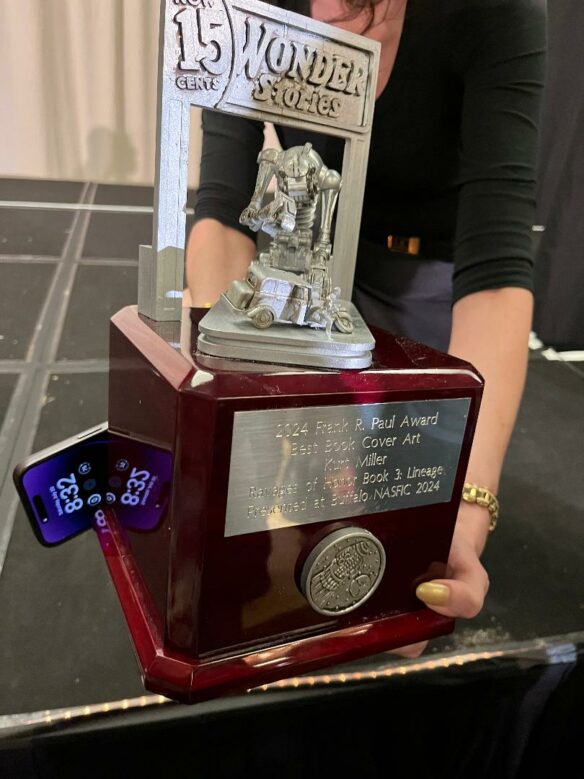
(2) FRANK R. PAUL AWARDS. Frank Wu has announced that the 2025 Frank R. Paul Awards will be presented at Philcon (November 21-23). Due to the lateness of the convention in the calendar, he is extending the deadline for submissions for the Frank R. Paul Awards for another month, to May 15. All artists, publishers and editors are enthusiastically encouraged to submit their 2024 work to the main awards administrator, Frank Wu, at [email protected] Details are available here: “Frank R. Paul Awards”.

Frank R. Paul Award trophy. Photo by Rich Lynch.

(3) BALTICON SUNDAY SHORT SCIENCE FICTION FILM FESTIVAL 2025. [Item by lance oszko.] The Balticon Sunday Short Science Fiction Film Festival 2025 has curated 19 short films representing 8 countries. Featured are Short Stories adapted into Short Films.

Sunday 25 May 2025 7 p.m. to 11:30 p.m.

George RR Martin produced another Howard Waldrop film Mary Margaret Road Grader“. Estimated budget $2.2 Million. Director Steven Paul Judd is known for Dark Winds and Marvel’s Echo. It has a score by Game of Thrones composer Ramin Djawadi.

Italian Director Luca Caserta brings us The Reach. One of the last authorized Dollar Baby Stephen King Films.
With a song by Bruce Springsteen.

Director George Vatistas adapted The Hobbyist by Frederic Brown.

Actor Stacy Thunes (Nosferatu – Head Nurse) currently at Universal Studios, Japan stars in The Hairdo.

An Old Friend. Director Nuk Suwanchote. An imaginary friend (Jason Faunt) finds out his sole purpose is to bring happiness to his child, only to discover his child is a 90 year old man (Tom Skerritt) on his deathbed.

First time Local filmmakers were also selected in Twilight Zone and Animation motifs.

Horror and Fantasy round out our offerings.

(4) “I’M NOT A ROBOT” [Item by lance oszko.] The Balticon Sunday Short Science Fiction Film Festival could not arrange a screening, but still worthy of your attention. “Watch The Surreal Identity Crisis of ‘I’m Not a Robot’” in The New Yorker.

(5) SFF BOOKS OUT OF NAVAL ACADEMY LIBRARY. Allen Steele pointed out that the list of 381 books pulled from the U.S. Naval Academy library (reported at the top of yesterday’s Scroll) includes several works of sff (even though the vast majority are nonfiction about gender issues or racism). Steele asks, “Wonder what Robert Heinlein would have to say about the actions of his Alma mater?”

The three sff works I found on the list are:

  • Light From Uncommon Stars / RykaAoki.
  • Sorrowland / Rivers Solomon
  • A Psalm For The Wild-Built / Becky Chambers.

(6) AUSTEN IN INNSMOUTH. Deep Cuts in a Lovecraftian Vein finds much to enjoy in “’Innsmouth Park’ (2025) by Jane Routley”.

Jane Austen’s role in weird fiction is underappreciated, largely because she herself didn’t really write any (although Northanger Abbey is a biting satire of the Gothic novel, and a must-read for Gothic fans which even Lovecraft acknowledged, which has to at least classify Austen as weird fiction’s strange aunt.) Yet the world she described, the characters and milieu she envisioned, have been enduring and influential far beyond the genre she initially worked in. Generations of writers have called back to Austen, and mashups like Sense and Sensibility and Sea Monsters (2009) by Austen & Ben H. Winters, Regency Cthulhu (2023) by Andrew Peregrine & Lynne Hardy, and Secrets & Sacrifices: A Regency Cthulhu Novel (2024) by Cath Lauria all point to a similar rainy-day afternoon brainstorm:

Why not mix Austen and Lovecraft?…

(7) PEN AMERICA LITERARY AWARDS FINALISTS.  There are almost no nominees of genre interest among the 2025 PEN America Literary Awards Finalists. The one exception is in this category, a work of horror fiction.

PEN Translation Prize ($3,000)

For a book-length translation of prose from any language into English.

The EmpusiumOlga Tokarczuk. Translated from Polish by Antonia Lloyd-Jones (Riverhead Books)

(8) BBC COVERAGE OF BELFAST EASTERCON. Eastercon got a 15-minute slot on BBC Northern Ireland with Jo Zebedee and Ian McDonald doing an interview and chatting about it. â€œSaturday with John Toal – Puppets, Worms and Sci-fi”. Interview starts at 45m20s.

â€ĶAs Belfast prepares to host a special Sci Fi convention Eastercon, for the first time in its 76 year history, John hears from two successful science fiction writers Ian McDonald and Jo Zebedeeâ€Ķ.

(9) STUNT OSCAR APPROVED. “Oscars Add Best Stunt Design Category Starting in 2027” – Variety has the story.

â€Ķ“Since the early days of cinema, stunt design has been an integral part of filmmaking,” said Academy CEO Bill Kramer and Academy president Janet Yang. “We are proud to honor the innovative work of these technical and creative artists, and we congratulate them for their commitment and dedication in reaching this momentous occasion.”

In a statement, Leitch said, “Stunts are essential to every genre of film and rooted deep in our industry’s history—from the groundbreaking work of early pioneers like Buster Keaton, Harold Lloyd, and Charlie Chaplin, to the inspiring artistry of today’s stunt designers, coordinators, performers, and choreographers.” He went on to say, “This has been a long journey for so many of us. Chris O’Hara and I have spent years working to bring this moment to life, standing on the shoulders of the stunt professionals who’ve fought tirelessly for recognition over the decades. We are incredibly grateful. Thank you, Academy.”

â€ĶCategory rules for eligibility and voting for the inaugural award will be announced in 2027 with the complete 100th Academy Awards Rulesâ€Ķ.

(10) BLACK MIRROR. “Black Mirror Season 7’s Tech Tales Come With a Knife-Twist of Emotion”Gizmodo gets down to cases.

A new season of Black Mirror has arrived, and with it the usual cautionary tales (and screaming warnings) about technology’s darkest capabilities—wrapped in a deceptively alluring blanket of “Jeez, that would actually be really cool if it were real!” Across six episodes, season seven boasts some of the show’s all-time greatest performances, as well as its first sequel episode, which proves well worth the eight-year waitâ€Ķ.

(11) MIDDLE-EARTH WAYFINDER. Wisconsin Public Radio profiles Karen Wynn Fonstad, “The Wisconsin cartographer who mapped Tolkien’s fantasy world”.

If you’ve ever wanted to explore the world of “The Hobbit” and “The Lord of the Rings,” the best place to start might be Oshkosh.

That’s where a Wisconsin cartographer created dozens of maps that went into “The Atlas of Middle-earth,” the official geographic guide to the world of author J.R.R. Tolkien. Her work went on to influence “The Lord of the Rings” movie trilogy.

Like many readers, Karen Wynn Fonstad fell in love with the fantasy series and went through multiple readings. Unlike most readers, she was trained as a cartographer, and came up with an ambitious plan to use the texts to create realistic maps from Tolkien’s texts.

Fonstad passed away 20 years ago. Now, her husband and her son — both geographers themselves — have embarked on a new quest: to digitize her original maps and find an archive to house themâ€Ķ

â€Ķ “It’s a little bit of an overwhelming process because, first of all, there’s hundreds of maps. Secondly, the maps are built in such a way that they have many layers to them,” Mark said. “I barely scratched the surface this week.”

As we walk into the map library, we are surrounded by Middle-earth. Mordor, the Shire and all points in between are represented. And not just Middle-earth. Karen created works for other fantasy worlds — some never published.

How do you scan a collection of maps of varying sizes, some of them in delicate condition?

You need a big scanner, caution and some patienceâ€Ķ.

â€Ķ In 1977, she called the American publisher of Tolkien’s work, Houghton Mifflin, to pitch the idea of an atlas. As Todd recalled, the person in charge of handling Tolkien’s work fell in love with the idea, and the Tolkien estate gave it the thumbs-up.

Then the work really beganâ€Ķ.

(12) MEMORY LANE.

[Written by Paul Weimer.]

Mad Max film (1979)

By Paul Weimer: The quintessential post-apocalyptic movie, the one with the real breakthrough. Sure, A Boy and His Dog and Damnation Alley and others preceded it, but this was the movie, series of movies that made a star of Mel Gibson, and the scenes of the Australian desert became the cinematic language and landscape of what a post apocalyptic world should look like in three movies that it took dozens for, say, the American Western.

That’s the power of Mad Max, that’s the power of George Miller’s cinematography. One could approach these movies from all sorts of angles, from worldbuilding to characterization, to point of view. As an example-the second movie, Mad Max 2 (The Road Warrior) is not told from the point of view and perspective that you’d expect. It’s a recreation, a retelling, and that brings in all sorts of interesting questions about narrative and conventions and storytelling. 

Or one could explore Max as a character, from his end of the world cop, all through the damaged survivor in the latest Mad Max movie, where he literally is used as a resource. 

Or one could explore environmental themes, social themes, and the psychology of the survivors of the landscape, from the small to the mighty.

But I want to talk a bit about cinematography, as a person interested in image, you are not surprised. One thing that told me and showed me that Miller “Still had it” in Fury Road was the scene with the dust storm and the vehicles approaching it. You know the scene if you watched it. It was solid proof for me that Miller’s fantastic cinematography, to be able to bring the wildness of the Australian wasteland to life in the previous films, was still there. It recalled for me of many of the other iconic places and imagery used in the series, from Thunderdome back through the mean streets of Melbourne in Mad Max. The lack of dialogue in much of the films means that Miller’s storytelling in the films is necessarily what the movies are carried on. And it is indeed carried so effectively. You remember the visuals, the costumes, the sets, and of course the vehicles. How many gearheads were born from watching these movies?

One last fun note on Mad Max. The first bit of Mad Max I saw was not until the mid 80’s. I accidentally caught the last few minutes on a videotape recording of Mad Max 2 while trying to (don’t judge) see D.C. Follies. I wondered what the heck I had watched and looked it up in the TV guide…and then I recorded and watched The Road Warrior and was captivated.  Later, I found the original Mad Max…and then, of course Thunderdome.

Mad Max. A cinematic icon, four movies (5 if you count Furious) and counting.

(13) COMICS SECTION.

(14) TWO HEARTS AND TWO EARS. “Graham Norton to star in Eurovision-themed Doctor Who episode” reports BBC.

Graham Norton is to star in a new episode of Doctor Who, taking his Eurovision commentary duties to an Interstellar Song Contest.

Norton, the BBC’s voice of Eurovision, will meet Ncuti Gatwa’s Time Lord at the 803rd annual Interstellar Song Contest, where different planets compete to be crowned winner.

“And it’s not just a cameo,” showrunner Russell T Davies said. “He has a whole plot twist all to himself!”

The episode will also feature fellow Eurovision fanatic and broadcaster Rylan Clark as the event’s co-host, and will be broadcast on BBC One just before this year’s real-life grand final on 17 Mayâ€Ķ.

(15) THOUGHT EXPERIMENT. “How might AI chatbots replace mental health therapists?” asks The Week.

There is a striking shortage of mental health care providers in the United States. New research suggests that AI chatbots can fill in the gaps — and be remarkably effective while doing so.

Artificial intelligence can deliver mental health therapy “with as much efficacy as — or more than — human clinicians,” said NPR. New research published in the New England Journal of Medicine looked at the results delivered by a bot designed at Dartmouth College.

What did the commentators say?

There was initially a lot of “trial and error” in training AI to work with humans suffering from depression and anxiety, said Nick Jacobson, one of the researchers, but the bot ultimately delivered outcomes similar to the “best evidence-based trials of psychotherapy.” Patients developed a “strong relationship with an ability to trust” the digital therapist, he said.

Other experts see “reliance on bot-based therapy as a poor substitute for the real thing,” said Axios. Therapy is about “forming a relationship with another human being who understands the complexity of life,” said sociologist Sherry Turkle. But another expert, Skidmore College’s Lucas LaFreniere, said it depends on whether patients are willing to suspend their disbelief. “If the client is perceiving empathy,” he said, “they benefit from the empathy.”â€Ķ.

(16) UPON FURTHER CONSIDERATION. “MIT study finds that AI doesn’t, in fact, have values” says TechCrunch.

A study went viral several months ago for implying that, as AI becomes increasingly sophisticated, it develops “value systems” — systems that lead it to, for example, prioritize its own well-being over humans. A more recent paper out of MIT pours cold water on that hyperbolic notion, drawing the conclusion that AI doesn’t, in fact, hold any coherent values to speak of.

The co-authors of the MIT study say their work suggests that “aligning” AI systems — that is, ensuring models behave in desirable, dependable ways — could be more challenging than is often assumed. AI as we know it today hallucinates and imitates, the co-authors stress, making it in many aspects unpredictable.

“One thing that we can be certain about is that models don’t obey [lots of] stability, extrapolability, and steerability assumptions,” Stephen Casper, a doctoral student at MIT and a co-author of the study, told TechCrunch. “It’s perfectly legitimate to point out that a model under certain conditions expresses preferences consistent with a certain set of principles. The problems mostly arise when we try to make claims about the models, opinions, or preferences in general based on narrow experiments.”

Casper and his fellow co-authors probed several recent models from Meta, Google, Mistral, OpenAI, and Anthropic to see to what degree the models exhibited strong “views” and values (e.g., individualist versus collectivist). They also investigated whether these views could be “steered” — that is, modified — and how stubbornly the models stuck to these opinions across a range of scenarios.

According to the co-authors, none of the models was consistent in its preferences. Depending on how prompts were worded and framed, they adopted wildly different viewpoints.

Casper thinks this is compelling evidence that models are highly “inconsistent and unstable” and perhaps even fundamentally incapable of internalizing human-like preferencesâ€Ķ.

(17) BIRD WORRIES. “Conservationists raise alarm over Air Force plan to land SpaceX Starships on bird sanctuary atoll” reports Space.com.

The U.S. military is considering Johnston Atoll, a remote Pacific island chain that serves as an important refuge for dozens of seabird species, for “two commercial rocket landing pads” to test giant cargo rocket landings for the Department of the Air Force’s (DAF) Rocket Cargo Vanguard program, and it’s getting push-back from environmentalists.

The Rocket Cargo Vanguard program aims to develop the technologies required to rapidly deliver up to 100 tons of cargo anywhere on Earth using commercial rockets. Though not explicitly named, Elon Musk’s SpaceX is currently the only company —commercial or otherwise — capable of manufacturing rockets designed for landing and reuse, and its Starship megarocket is DAF’s leading contender. The Air Force outlined its plans in a Federal Registry notice last month. Objections from the American Bird Conservancy (ABC), however, may hinder plans for the new landing pads on the South Pacific atoll.Johnston Atoll lies about 825 miles (1,325 kilometers) southwest of Hawaii, and is home to several different species of seabirds, including the largest known colony of Red-tailed Tropicbirds. It was designated a refuge for native bird populations in 1926, but suffered environmental degradation through 2004, due to its use by the U.S. military as a nuclear weapons testing and chemical weapons disposal site. Since the military’s departure from the islands, restoration efforts have helped raise Johnston Atoll’s bird population back to nearly 1.5 million.

(18) ARE YOU GOING TO BELIEVE YOUR LYING EYES? “Purple Isn’t Real, Science Says. Your Brain Is Just Making It Up” reports Popular Mechanics. If there is no purple, does that mean there can be no purple people eaters?

You might be today years old when you realize there is no purple in the rainbow. There is no P in ROYGBIV.

But wait, what about violet? Well, despite what you may have come to believe, violet is not purple. In fact, violet (along with the rest of the colors in a naturally occurring rainbow) has something purple doesn’t—its own wavelength of light. Anyone who ever ended up with a sunburn knows violet wavelengths are real, as the Sun’s ultraviolet (UV) radiation is the reason you need to wear sunscreen, even though you can’t see those wavelengths (more on that later). Red, orange, yellow, green, blue, and indigo are all just as real.

But purple? Well, purple is just your brain’s way of resolving confusion.

That’s right. Red and blue (or violet) wavelengths are two opposite extremes on the spectrum. When you see both of these wavelengths in the same place, you eyes and brain don’t know what to do with them, so they compensate, and the clashing wavelengths register as the color we call purple. It doesn’t actually existâ€Ķ.

[Thanks to Andrew Porter, John King Tarpinian, Chris Barkley, Steven H Silver, lance oszko, Frank Wu, James Bacon, Allen Steele, Cat Eldridge, SF Concatenation’s Jonathan Cowie, Mark Roth-Whitworth, Steven French, Kathy Sullivan, Teddy Harvia, and Mike Kennedy for some of these stories. Title credit belongs to File 770 contributing editor of the day Dan’l.]

Pixel Scroll 1/18/25 “All These Pixels Are Just For Us” Said Tom Clickishly

(1) CLOCK NOT RUNNING OUT ON TIKTOK? Yesterday’s Deadline’s article “Supreme Court Upholds Law Banning TikTok In U.S.” initially reported —

â€Ķthe U.S. Supreme Court on Friday upheld a lower court ruling that the app owned by China’s ByteDance must sell itself or be banned in the U.S. on January 19 due to national security concernsâ€Ķ.

â€ĶRead the Supreme Court’s full TikTok opinion hereâ€Ķ.

â€ĶThe ban would take effect under a new bipartisan law, the Protecting Americans from Foreign Controlled Applications Act, signed by President Joe Biden last yearâ€Ķ.

However, the incoming President said he will probably delay the ban: “Trump says he will ‘most likely’ give TikTok 90-day extension to avoid ban” at NBC News.

President-elect Donald Trump told NBC News’ “Meet the Press” moderator Kristen Welker in a phone interview Saturday that he will “most likely” give TikTok a 90-day reprieve from a potential ban in the U.S. after he takes office Mondayâ€Ķ.

And Deadline subsequently added this update to its article:

TikTok’s CEO has responded to a Supreme Court ruling today that paves the way for the app to be banned on Sunday, thanking the incoming president. “On behalf of everyone at TikTok and all our users across the country, I want to thank President Trump for his commitment to work with us to find a solution that keeps TikTok available in the United States,” said chief executive Shou Chew in a video posted to the platform.

“We are grateful and pleased to have the support of a president who truly understands our platform, one who has used TikTok to express his own thoughts and perspectives, connecting with the world and generating more than 60 billion views of his content in the process,” he said. “As you know, we have been fighting to protect the constitutional right of free speech for the more than 170 million Americans who use our platform every day to connect, create, discover and achieve their dreams.”

(2) WHY WE FIGHT. CrimeReads’ fascinating analysis of “Pride and Prejudice and Nazis: On Aldous Huxley’s Wild Wartime Jane Austen Adaptation” teases out its threads of pre-WWII propaganda.

â€ĶBut underneath its thick, saccharine coating; the film is something else: a contrived, convoluted morsel of political propaganda. Filmed by on American soil by Metro Goldwyn Mayer, this British adaptation shot directly after the French surrender to the Nazis, released during the Battle of Britain, and co-screenwritten by depressed British idealist Aldous Huxley, managed to transform that famous English book Pride and Prejudice into a partisan plug relying on Depression-era escapism, thematic idealization of a nationalistic Anglocentric tradition, the depiction of highly distracting romantic merriment, and a reassuringly happy ending to prepare and energize Americans for the inevitable: the United States’ joining the Allied Forces overseas to fight in World War IIâ€Ķ.

â€ĶAusten, Jerome, and Huxley place the same emphasis on class, however, in that all three versions have the same classless ending—Jane and Mr. Bingley marry, and Elizabeth and Mr. Darcy marry, despite their class and financial differences.  The concept of any Pride and Prejudice adaptation is that is possible to climb up a social ladder, because everyone is equal—or rather, everyone has the ability to be equal. Most of the characters belong in many social circles, and it is possible to find love or friendship somewhere else.  Perhaps this is the dominant reason why Huxley chose the Pride and Prejudice story for his anti-war-but-if-you-have-to-fight-then-fight-with-these-guys-esque opus instead of another classical novel (after all, many of other elements of the film Pride and Prejudice that make it jingoistic lie in plot alterations, or aesthetics —changes that could applied to any other story in the adaptation process): Pride and Prejudice is, at its core, a story about good, smart everyday people who make mistakes but learn their lessons just as much as it is a story about how important it is not to form judgments. Huxley nearly abuses this tone by exaggerating it in his own, though; any shred of mystery about the moral of the story is completely detonated throughout.  For example, in the film, Mr. Darcy comforts Elizabeth after Caroline Bingley insults her.  Elizabeth is shocked, and informs him, “At this moment, it’s difficult to believe that you are so proud.”  Mr. Darcy smiles vainly and answers back, “at this moment, it’s difficult to believe that you are so prejudiced.” Huxley spells out the main paradox of the story, killing the main thematic mystery – the only thing left for the audience to wonder is how they can get shipped off to fun, idyllic England.  Austen’s tone is inclusive, it’s happy, it’s insightful, and it’s open-minded—so now it fights fascism.

Of course, the aesthetics of the film Pride and Prejudice hide these anti-Nazi sentiments under tons and tons of poofy dresses and behind maypoles. For example, in the script, Huxley and Murfin manage to turn the extravagant Netherfield Ball into a garden party, which the film then turns into a frothy visual circus—where everything appears to be made out of cotton candy and wishesâ€Ķ.

(3) LIU CIXIN MUSEUM. “Museum dedicated to sci-fi writer opens” from Chinadaily.com in October 2024.

China launched its first literary museum dedicated to Liu Cixin, a renowned science fiction writer and Hugo Award winning novelist, in Yangquan, Shanxi province, on Sunday.

While accepting the nation’s honor and unveiling the Liu Cixin Sci-fi Museum, Liu, author of the acclaimed sci-fi novel trilogy The Three-Body Problem who grew up in Yangquan, said that he hopes the museum can help the general public gain a better understanding of the sci-fi literature and develop an interest in the genre.

Located at a cultural park, the 700-square-meter museum educates visitors about Liu’s growth, his books and awards, and cultural and creative products derived from his works. Immersive projectors also create an atmosphere mimicking interstellar voyages described in Liu’s novelsâ€Ķ.

â€Ķ Yan Jingming, vice-president of the China Writers Association, said that the establishment of the museum is not only an homage to Liu and his works but also serves as a beacon for China’s sci-fi writers and fans.

He said he hopes it will bring like-minded sci-fi novelists together and spark more inspiration and works.

The launch was part of a weeklong sci-fi promotional event in Yangquan that also included a symposium on sci-fi literature and real-world productivity, where Liu shared his thoughts on potential immigration to Mars.

“I would love to go to Mars if it were a round trip,” Liu said, explaining that a one-way journey would not suit him as he had work to do and family members to be with on Earthâ€Ķ.

(4) WHAT’S THAT SMELL? Neil Baker returns with more horrible dino movies in “Prehistrionics, Part III” at Black Gate.

We’re off on another adventure filled to the brim with disappointment. 20 films I’ve never seen before, all free to stream, all dinosaur-based.

First on his list, last in his heart:

The Jurassic Dead (2017) Tubi

Just how bad is the CG? Rubbish.

Sexy scientist? Nope.

Mumbo jumbo? Reanimation, dinosaurs, zombies, asteroids.

Just in case you thought I might try to start the year on a high note, might I present this tripe. The premise is simple: a Herbert West type (complete with glowing green reanimating fluid and dead cat) loses his job and decides to destroy the world. Somehow he has a T-Rex, which he zombifies, and then he turns into Immortan Joe and sets off an EMP just as asteroids wipe out some cities. A crack, sorry crap, team of commandos based on 80s action figures must team up with a group of hugely unlikeable civilians to survive.

Everything ends in nuclear devastation. Effects-wise, the dinosaur is a cute, Walking with Dinosaurs puppet, but everything else is shockingly awful green screen composites. Just terrible.

3/10

(5) GAIMAN: ART AND ARTIST. NPR’s popular culture commentator Glen Weldon speaks as “One longtime Neil Gaiman fan on where we go from here”.

â€ĶWhile we don’t know whether these disturbing allegations are true, learning of them naturally leads to a deeply personal, complicated question: How do we deal with allegations about artists whose work we admire — even revere?

I should note: It’s a complicated question for most of us. It’s not remotely complicated for those who rush to social media to declare that they never truly liked the creator’s work in the first place, or that they always suspected them, or that the only possible response for absolutely everyone is to rid themselves of the now-poisoned art that, before learning of the allegations against the creator, they loved so dearly.

Nor is it complicated for those who will insist that a creator’s personal life has no bearing on how we choose to respond to their work, and that the history of art is a grim, unremitting litany of monstrous individuals who created works of enduring, inviolate beauty.

Most of us, however, will find ourselves mired in the hand-wringing of the in-between. We’ll make individual, case-by-case choices, we’ll cherry-pick from the art, we’ll envision ourselves, in years ahead, sampling lightly from the salad bar of the artist’s collected works, and feeling a little lousy about it.

Here’s my personal approach, whenever allegations come out about an artist whose work is important to me: I see the moment I learned of them as an inflection point. From that very instant, it’s on me.The knowledge of the allegations will color their past works, when and if I choose to revisit them in the future. It won’t change how those works affected me back then, and there’s no point in pretending it will. But my newfound understanding of the claims can and will change how those works affect me today, and tomorrow.

To put that in practical perspective: If I own any physical media of their past work, I feel free to revisit it, while leaving plenty of room for the new allegations to color my impressions. But as for any future work — that’s a door I’m only too willing to shutâ€Ķ.

(6) HINT: IT’S ZELAZNY. Grammaticus Books asks is he “The MOST DISRESPECTED Science Fiction author of ALL TIME ???” How could you not click on that?

An indepth analysis of the works of science fiction and fantasy author Roger Zelazny. With a focus on his lack of recognition as one of the greats of the SF field. Worthy of mention alongside Robert A. Heinlein, Isaac Asimov, Arthur C. Clarke, and Frank Herbert.

(7) TODAY’S BIRTHDAY.

[Written by Paul Weimer.]

January 18, 1953Pamela Dean, 72.

By Paul Weimer: One of the legends of Minneapolis fantasy writing, Pamela Dean’s work first came to my attention in the same season that also brought such novels as War for the Oaks to my attention. From my perch in New York, work by people like Bull and Dean and Brust (among others) enlightened me to the fact that the Twin Cities was a hotbed of fantasy and science fiction writing. 

I started reading her with her classic Tam Lin, which I picked up not long after the aforementioned Bull novel. (I was on a kick to read novels set in Minnesota at that point, you seem, especially by this community).  It’s an excellent adaptation and exploration of the Scottish-English story. You know the one. Young man taken by a Queen or noble of Faerie, and the titular Tam Lin must thus be rescued by the love of his life, Janet. You can see the appeal, it is an empowering fantasy that puts a woman in a forward, protagonist position. Since the original reels and songs, it’s been adapted many times by many authors. Dean’s version has the story take place, predictably in Minnesota, setting it at Blackrock College. 

But it is the Secret Country trilogy that I think of as her best work, or at any rate my favorite. It’s a conceit that was not new to her, as far as I am aware, it dates back to Joel Rosenberg’s Guardians of the Flame series: the idea that a group of people, playing a game with and imagining a fantasy world, find themselves transported into the realm of the very game that they thought was fiction. The idea is the same, but the Secret country is on the brink of war, there’s a dragon afoot, and so there is far more urgency and threat to the realm than wandering about as in Rosenberg’s series. It is one of the classic portal fantasies into a realm you think you already known. 

I’ve gotten to meet Pamela Dean many times at local cons. She might even be able to pick me out of a line up. Happy birthday, Pamela!

Pamela Dean

(8) MEMORY LANE

[Written by Cat Eldridge.]

Six Million Dollar Man (1973)

Fifty-two years ago, The Six Million Dollar Man premiered on ABC. It was based on Martin Caidin’s Cyborg. Executive Producer was Harve Bennett, who you will recognize from the Star Trek films. It was produced by Kenneth Johnson who would later do The Bionic Woman spin-off and the Alien Nation film. 

Its primary cast was Lee Majors,  Richard Anderson and Martin E. Brooks. Majors had a successful second series shortly after this series was cancelled, The Fall Guy, about heart-of-gold bounty hunters. The Six Million Dollar Man would run for five seasons consisting of ninety-nine episodes and five films. The Fall Guy would run five seasons as well. 

Reception by media critics is generally positive. Phelim O’Neil of The Guardian says, “He was Superman, James Bond and Neil Armstrong all rolled into one, and $6M was an almost incomprehensibly large amount of money: how could anyone not watch this show?” And Rob Hunter of Film School Reviews states “The story lines run the gamut from semi-believable to outright ludicrous, but even at its most silly the show is an entertaining family friendly mix of drama, humor, action, and science fiction.”

It’s streaming on Peacock. 

(9) MEMORY LANE, TOO.

[Written by Cat Eldridge.]

The Demolished Man (1952)

Seventy-three years ago, Alfred Bester’s The Demolished Man was first published in three parts starting in the January 1952 issue of Galaxy Science Fiction. Although he had been writing short fiction since 1939, this was Bester’s first novel.

The novel is dedicated to Galaxy‘s editor, H. L. Gold, who made suggestions during its writing. 

Bester’s preferred title was Demolition! but Gold convinced him it was not a good one. Anyone know where the published title came from? Bester or Gold? 

The Demolished Man would be published in hardcover by Shasta Publishers the next year. Shasta Publishers was formed by a group of Chicago area fans in 1947.

Critics at the time really loved it. 

Anthony Boucher and J. Francis McComas in their Recommended Reading column for The Magazine of Science Fiction and Fantasy said it was “a taut, surrealistic melodrama [and] a masterful compounding of science and detective fiction.” And Groff Conklin in his Galaxy 5 Star Shelf column exclaimed that it is “a magnificent novel as fascinating a study of character as I have ever read.”

As you know The Demolished Man would win the first Hugo for Best Novel at PhilCon II. It was also nominated for the International Fantasy Award. 

(10) COMICS SECTION.

  • Off the Mark has a frightening brand name.
  • Pardon My Planet knows you could explain this vampire’s problem.
  • Tom Gauld’s editor is like Cosby’s refrigerator light – “How do it know?”

My cartoon for this week’s @theguardian.com books.

Tom Gauld (@tomgauld.bsky.social) 2025-01-18T10:35:58.069Z

(11) YOU HAVE TO BE EITHER OH-SO-SMART, OR OH-SO-NICE. [Item by Mike Kennedy.] In a twist, the words coming from the Merc with a Mouth are just fine. It’s what Nicepool said that Justin Baldoni finds offensive. And has filed a lawsuit over. “How Deadpool Entered Justin Baldoni-Blake Lively Feud With Nicepool” at The Hollywood Reporter.

Half a century ago, a defining question of the Watergate scandal was, “What did the president know and when did he know it?” Today, a surprising question has emerged in the Blake Lively-Justin Baldoni legal saga: “What did Nicepool say, and when did he say it?”

On Tuesday, a letter from Baldoni attorney Bryan Freedman to Disney landed in the hands of the media. Freedman’s legal hold letter to Disney CEO Bob Iger and Marvel Studios boss Kevin Feige — in which he addressed them as “Bob” and “Kevin” — asked the studio to preserve any documents regarding Baldoni and the creation of Nicepool, a minor character in Deadpool & Wolverine that internet sleuths (and Freedman himself) say star-writer-producer Ryan Reynolds used to mock Baldoniâ€Ķ.

â€Ķ Freedman suggests work on Nicepool came as Reynolds’ wife, Lively, was in the midst of a contentious shoot with her It Ends With Us director-star Baldoni. She later filed a sexual harassment lawsuit against him, while on Thursday, Baldoni sued Reynolds, Lively and Lively’s publicist, Leslie Sloane.

So, how (and when) did Nicepool end up in the movie?

The character was developed before the rift between Lively and Baldoni, but sources tell THR that scenes involving Nicepool were shot late in the game following the November 2023 conclusion of the SAG-AFTRA strike.

“It was all added post-strike,” says one knowledgeable source of the shooting schedule, who says the scenes were filmed in the final days of principal photography, which wrapped up in January 2024. 

In other words, the scenes were shot during a high point of tension between Lively and Baldoniâ€Ķ.

(12) WHAT WE DID IN THE SHADOWS. “U.S. Reveals Once-Secret Support for Ukraine’s Drone Industry” in the New York Times (behind a paywall).

The Biden administration declassified one last piece of information about how it has helped Ukraine: an account of its once-secret support for the country’s military drone industry.

U.S. officials said on Thursday that they had made big investments that helped Ukraine start and expand its production of drones as it battled Russia’s larger and better-equipped army.

Much of the U.S. assistance to the Ukrainian military, including billions of dollars in missiles, air defense systems, tanks, artillery and training, has been announced to the public. But other support has largely gone on in the shadowsâ€Ķ.

â€Ķ Last fall, the Pentagon allocated $800 million to Ukraine’s drone production, which was used to purchase drone components and finance drone makers. When President Volodymyr Zelensky of Ukraine visited the White House in September, President Biden said another $1.5 billion would be directed to Ukraine’s drone industry.

American officials said on Thursday that they believe the investments have made Ukraine’s drones more effective and deadly. They noted that Ukraine’s sea drones had destroyed a quarter of Russia’s Black Sea fleet, and that drones deployed on the front lines had helped slow Russia’s advances in eastern Ukraineâ€Ķ.

(13) STARSHIP TEMPORARILY SUSPENDED. “F.A.A. Temporarily Halts Launches of Musk’s Starship After Explosion” reports the New York Times. (Behind a paywall.)

The urgent radio calls by the air traffic controllers at the Federal Aviation Administration office in Puerto Rico started to go out on Thursday evening as a SpaceX test flight exploded and debris began to rain toward the Caribbean.

Flights near Puerto Rico needed to avoid passing through the area — or risk being hit by falling chunks of the Starship, the newest and biggest of Elon Musk’s rockets.

“Space vehicle mishap,” an air traffic controller said over the F.A.A. radio system, as onlookers on islands below and even in some planes flying nearby saw bright streaks of light as parts of the spacecraft tumbled toward the ocean.

Added a second air traffic controller: “We have reports of debris outside of the protected areas so we’re currently going to have to hold you in this airspace.”

The mishap — the Starship spacecraft blew up as it was still climbing into space — led the F.A.A. on Friday to suspend any additional liftoffs by SpaceX’s Starship, the largest and most powerful rocket ever built.

The incident raises new questions about both the safety of the rapidly increasing number of commercial space launches, or at least the air traffic disruption being caused by themâ€Ķ.

(14) BIG BOY REMEMBERS DAVID LYNCH? For some reason there’s a David Lynch memorial at the Bob’s Big Boy in Burbank – Patton Oswalt posted photos. (Is there some reference involved? Maybe one of you can explain it to me.)

The marginal details of the David Lynch memorial at the Burbank Bob’s Big Boy are what make it.

Patton Oswalt (@pattonoswalt.bsky.social) 2025-01-18T19:55:32.073Z

Hold the phone – John King Tarpinian sent me the answer.

(15) VIDEO OF THE DAY. Retired Disney Imagineer Jim Shull tells how “Toy Story Land went from a one and done to a Disney- land built in four separate parks. How the toys were Imagineered is the subject in this episode of Disney Journey.” “Imagineering Toy Story Land”.

[Thanks to SF Concatenation’s Jonathan Cowie, Steven French, Kathy Sullivan, Teddy Harvia, Mike Kennedy, Andrew Porter, John King Tarpinian, Chris Barkley, and Cat Eldridge for some of these stories. Title credit belongs to File 770 contributing editor of the day Daniel Dern.]

Pixel Scroll 3/3/24 And Did Those Filers In Ancient Times Scroll Upon Glyer’s Pixels Green?

(1) SIGN FROM A FELINE. Mary Robinette Kowal’s “Rude Litterbox Space” is a free read at Sunday Morning Transport to encourage people to subscribe. Bonnie McDaniel says it is based on the author’s real-life communication-board-using cat.

â€Ķ Language was hard. Bending space-time was notâ€Ķ.

(2) A HITCH. P. DjÃĻlí Clark’s blog post makes you want to read “The Dead Cat Tail Assassins”, then tells you why you’ll need to wait ’til summer’s end.

â€ĶOkay, now for the not so good news. The Dead Cat Tail Assassins was supposed to drop this month, March. Butâ€Ķ yadda, yadda, yadda.. we got a new pub date: August, 6 2024.

What happened? Stuff. Stuff happened. Putting a book together requires lots of hands: me the author, editors, copyeditors, publicists, printers, centaurs, goblins, magical creatures from Fillory. And, for a myriad of reasons, sometimes things go pear shaped and stuff gets pushed back. You’re probably like, yeah but from March to August? That’s a big pushback! Hey, what can I tell youâ€Ķ lose your place in line, and you don’t just get a back-cut. There are other books by other authors waiting to be worked on, books coming out that can’t clash with your own, gotta find a new place in the queue at the printing warehouse, and all kinds of arcane alchemy I don’t pretend to understandâ€Ķ

(3) LIVESTOCK BY MAIL. I think the anecdote that starts Brian Keene’s “Letters From the Labyrinth 370” really happened, though I won’t be surprised if it finds its way into a book.

“I’m here about the dead chicks.”

That was what the woman butting in front of me and another customer at the post office said. I turned, intrigued. She was short, thin, blonde hair fading with age to the color of straw. I placed her at older than me — probably mid-sixties but then I remembered the day before when my postal carrier, whom I’d thought was in her seventies, told me she was the same age as me — 56. I can’t gauge age anymore. When I look in the mirror, I don’t see 56. But I’m also smart enough to know that how I see myself isn’t necessarily how others see me. In my mind, I’m still as suave and charming as Diamond David Lee Roth, but I suspect others look at me and think “Look at that silly old man. How sweet.”

But I digressâ€Ķ.

Makes me remember when I was surprised to learn you could order live honeybees through the Sears catalog. (Which I wasn’t allowed to do. Just as well.)

(4) HUGO NEWS ROUNDUP AND MORE. Jason Sanford’s “Genre Grapevine for February 2024” on Patreon is free to the public.

In early February, Chris Barkley contacted me and said he’d received emails and documents related to the 2023 Hugo Awards from Diane Lacey, one of the award administrators. I’d seen Chris only two weeks earlier at the ConFusion convention in Detroit, where we sat at the bar discussing that weekend’s release of the Hugo nomination and voting stats. We were both shocked by the works and authors deemed “not eligible” and kept off the final ballot for no stated reason. We also were surprised so few Chinese authors and works made the Hugo longlist.

While talking in Detroit, Chris and I felt shenanigans had likely happened during last year’s Hugos. However, we also feared the truth of what happened might never come out.

Two weeks later, Chris shared the leaked emails and documents and I realized we’d been wrong. The truth would indeed come outâ€Ķ.

(5) FAITH. Abigail Nussbaum walks readers through “The 2024 Hugo Awards: My Hugo Ballot” at Asking the Wrong Questions. She says in a preamble to the nominations:

We’ve spent so much of the last six weeks talking about the debacle that was last year’s Hugo awards, that it was easy to forget that another awards season was gearing up at the same time. So here we are, with less than a week left to nominate for this year’s Hugos, and to be honest it feels a bit strange to make this post. I always love to talk about the things I enjoyed in the fantastic genres over the last year, and to encourage my readers to consider them for a Hugo nomination. But doing it this year, with the shadow of an award whose nominations and results we can have no faith in, can feel a bit pointless.

Another way of putting it is that this is an act of faith–in the administrators of this year’s award, who have been doing their utmost to project reliability and distance themselves from last year’s inexcusable actions; in the fandom, which continues to care about this award and try to make it the best it can be; and in the award itself, and the idea that it can overcome this blow to its reputation and start moving back to what it wasâ€Ķ.

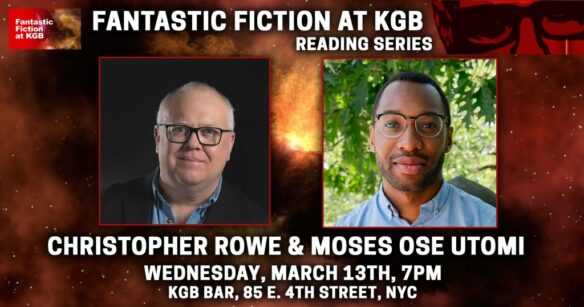
(6) KGB. Fantastic Fiction at KGB reading series hosts Ellen Datlow and Matthew Kressel present Christopher Rowe and Moses Ose Utomi on Wednesday, March 13 starting at 7:00 p.m. Eastern. Location: KGB Bar, 85 East 4th Street, New York, NY 10003. (Just off 2nd Ave, upstairs)

Christopher Rowe

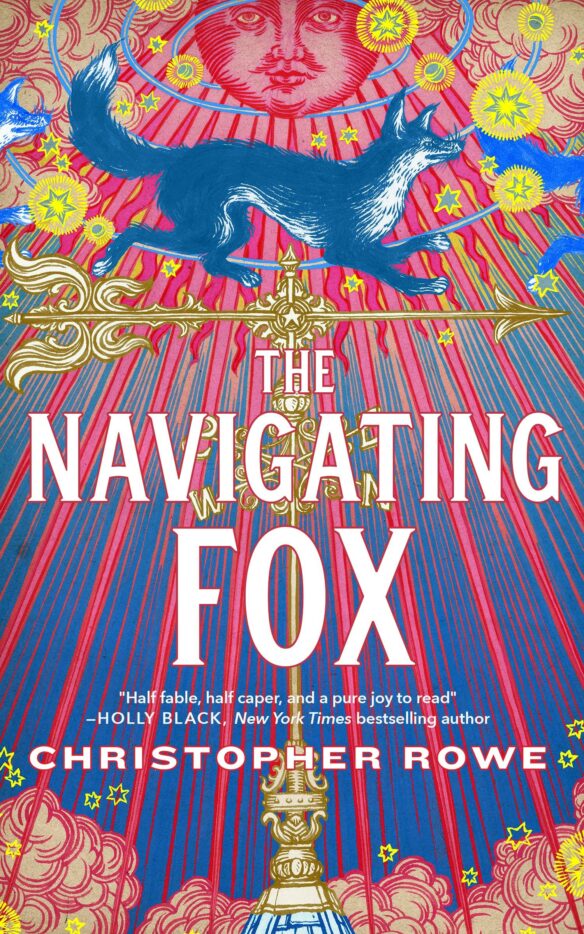
Christopher Rowe’s most recent novella, The Navigating Fox, published by Tordotcom was described by The Wall Street Journal as a “modern Aesop’s fable.” His other books include the novella These Prisoning Hills and a collection, Telling the Map. Over the last 25 years, his stories have been published, anthologized, and translated around the world and he has been a finalist for the Hugo, Nebula, World Fantasy, Theodore Sturgeon, Neukom, Seiun, and other awards. He lives in Kentucky.

Moses Ose Utomi

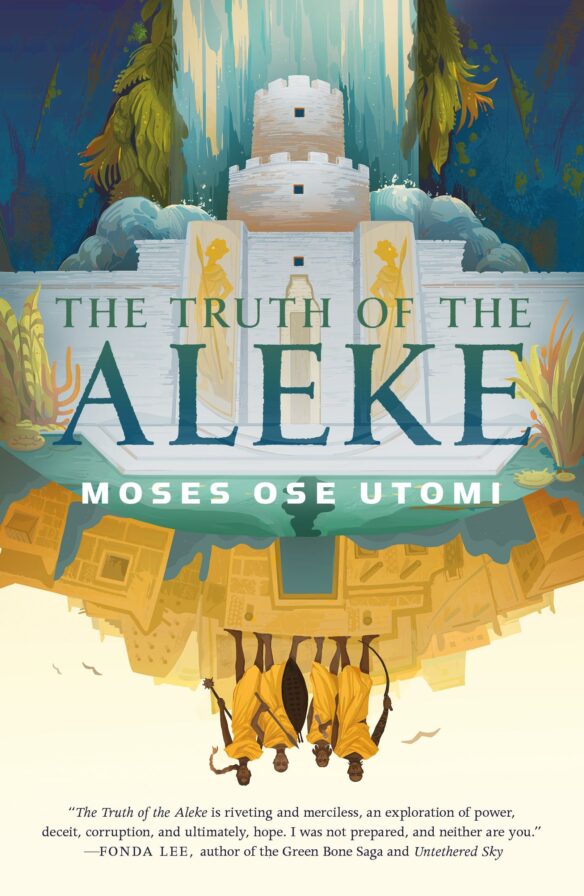
Moses Ose Utomi is a Nigerian-American fantasy writer and nomad currently based out of San Diego, California. He has an MFA in fiction from Sarah Lawrence College and short fiction publications in Fantasy MagazineSunday Morning Transport, and other venues. He is the author of the young adult fantasy novel Daughters of Oduma and The Forever Desert, the fantasy novella series that includes the acclaimed The Lies of the Ajungo. When he’s not writing, he’s traveling, training martial arts, or doing karaoke—with or without a backing track.

(7) FILM EDITING AWARDS. Deadline has the “ACE Eddie Awards Winners List”.

Oppenheimer took the marquee Best Edited Feature Film (Dramatic) honor and The Holdovers landed the top Best Edited Feature Film (Comedy) award at the 74th ACE Eddie Awards Sundayâ€Ķ.

Here are all the winners of genre interest:

BEST EDITED FEATURE FILM (Drama, Theatrical)

  • Oppenheimer — Jennifer Lame

BEST EDITED ANIMATED FEATURE FILM

  • Spider-Man: Across the Spider-Verse — Michael Andrews, ACE

BEST EDITED DRAMA SERIES

  • The Last of Us: “Long, Long Time”Timothy A. Good, ACE

(8) HERE WE GO AGAIN. “Hollywood Teamsters, IATSE Hold Solidarity Rally Ahead of AMPTP Negotiations” – The Hollywood Reporter was there.

A coalition of Hollywood’s below-the-line unions rallied Sunday on the eve of their latest contract negotiations. They threatened a historic strike against the Alliance of Motion Picture and Television Producers if their demands weren’t met. Such a work stoppage would follow a pair of strikes in 2023 by industry writers and actors which crippled the entertainment industry and have left it limping into the new year.

“I hope they’re paying attention right down the road at the AMPTP,” IATSE vice president Michael Miller announced from the stage to the crowd of around a thousand people at Woodley Park in Encino. (Nearly a thousand more watched a live-stream online.) He then invoked a slogan repeated throughout the event: “Nothing moves without the crew.”

For the first time since 1988, the Hollywood Basic Crafts group — which includes Teamsters Local 399, IBEW Local 40, LiUNA! Local 724, OPCMIA Local 755 and UA Local 78 — and the crew union IATSE are joining this year to negotiate their health and pension benefits with the Hollywood trade group the AMPTP, which represents studios and streamers. Those talks begin Monday.

The “Many Crafts, One Fight” rally served mainly as an opportunity for members to express solidarity and hype each other up. So-called “above-the-line” unions SAG-AFTRA and the WGA made strong shows of force with their sign-wielding members and leaders expressing gratitude. (Teamster cooperation was key in the WGA’s production shutdown strategy early in its stoppage.) WGA West vice president Michele Mulroney drew applause when she acknowledged crew support which “sustained us through our own long and arduous fight,” and noted that “without all of you our words would just languish on the page.”â€Ķ

(9) ARRAKIS DELIVERS BIG B.O. “’Dune 2′ Nears $100 Million Overseas, Surpasses $150 Million Globally” according to Variety.

“Dune: Part Two” is turbocharging the international box office.

Director Denis Villeneuve’s otherworldly sequel has generated $97 million from 71 overseas markets, bringing its global tally to a promising $178.5 million. Those worldwide revenues include $81.5 million from North American theaters, where it landed the biggest domestic opening weekend of the year.

The movie, starring TimothÃĐe Chalamet and Zendaya, has been embraced in the U.S. and Canada. But the backers of “Dune 2” need overseas audiences to keep the ticket sales flowing as freely as spice on the desert planet of Arrakis. That’s because Warner Bros. and Legendary Entertainment spent $190 million to produce and roughly $100 million more to promote the film to global audiences. Those hefty fees mean the tentpole will require outsized admissions to turn a profit.

(10) MARK DODSON (1960-2024). The voice actor Mark Dodson died of a heart attack while staying in Evansville, IN to appear at Horror Con. Deadline pays tribute: “Mark Dodson Dies: ‘Star Wars’ And ‘Gremlins’ Voiceover Artist Was 64”.

Mark Dodson, whose unique voice characterizations propelled creatures in the films Star Wars: Return of the Jediand Gremlins, has died at 64.

His daughter told TMZ that he died while in Evansville, Indiana, to attend Horror Con. He checked into a hotel and suffered a “massive heart attack” while sleeping, she said.

Dodson was the voice of Salacious Crumb, the scruffy little creature who was a cackling crony of Jabba the Hut in Star Wars: Return of the Jedi.That memorable voice led to a gig in Gremlins, where he became the voice Mogwai, much-imitated in school yards. 

He worked continuously for several decades in film, video games, radio and commercials as a voice artist. . 

His daughter, Ciara, told TMZ that her father “never ceased making me proud.” a 

The Evansville Horror Con, where Dodson was scheduled to appear, posted a tribute to Facebook. 

“We are heartbroken to announce the sudden passing of Mark Dodson last night. Mark was not only a talented voice actor but also a cherished member of the horror community. Our thoughts and prayers are with his family, friends, and fans during this incredibly difficult time. We hope that you can take a moment out of your day to reflect on the joy and laughter that Mark brought into the world. His legacy will live on through his work.”

Survivors include his daughter and several grandchildren.

(11) TODAY’S BIRTHDAY.

[Written by Cat Eldridge.]

Born March 3, 1920 James Doohan. (Died 2005.) James Doohan, a Canadian, is of course remembered best for being the original Montgomery “Scotty” Scott on the first version of the Enterprise. And doesn’t it say something about the franchise that I had to write the sentence that way? 

He played, definitely way too much in my opinion, the archetypal Scotsman. He even had a Dress Uniform Kilt, something I’m dead certain doesn’t exist in the modern Navy, as on display in “Is There in Truth No Beauty?” and “The Savage Curtain”. And I forget how many characters he drank literally to the floor. No don’t get me wrong, I loved the character, but the depiction was seriously over the top.

So my favorite episode involving him? That had to be when he defended the honor of the Enterprise in a bar brawl with a Klingon in “The Trouble with Tribbles” after that Klingon called his beloved ship a garbage scow. Perfect, just perfect. 

So what else has he done? His first major genre role (he had previously appeared in one episode of Tales of Tomorrow) was as Paul Mitchell on Space Command, an early Fifties Canadian children’s sf series. It only lasted two years but they did one hundred and fifty episodes!  Shatner would appear there.

A decade later, he entered the Twilight Zone playing Johnson, by no means a major role, in the “Valley of the Shadow”.  Around the same time, on Outer Limits he played Police Lt. Branch in “Expanding Human”, this time a lead role. 

He showed up twice in The Man from U.N.C.L.E (in different roles),  BewitchedFantasy IslandMacGyver and Knight Rider 2000.

Need I say Next Generation’s “Relics” was wonderful?  And I’m not talking about Trials and Tribble-ations even though it’s a stellar story as he’s only there in existing footage of him.

Filmwise, Trek was his major gig as I see very little genre undertakings at all. He had an uncredited role in The Satan Bug, an sf thriller. It’s so short that IMDB gives the time that he’s in the film.

His only other genre role that I can see in a film outside of Trek was as Judge Peterson in Skinwalker: Curse of the Shaman. If you’ve not seen it don’t feel bad. It’s obscure enough that no one on Rotten Tomatoes has either. 

I think that covers it for him. Now keep in mind that I did love him, despite my criticism of his portrayal of a Scottish character, on Trek as he’s really likeable. He and Nichelle Nichol’s always seems to be the two most, well, truly warm, likeable individuals there. 

I think I’ll go watch both of the Tribbles episodes on Paramount + now.  Yes, I know there’s the animated episode as well, “More Tribbles, More Trouble”, but it just doesn’t have the charm the actual ones with live actors do. 

(12) COMICS SECTION.

(13) CACHING IN. [Item by SF Concatenation’s Jonathan Cowie.] If my memory serves (and it is not that reliable though I constantly amaze myself in recalling a science paper from years ago out of the recesses of my mind) I have a feeling that File770 covered the demise of Google’s readily available Cache. Then  this piece might interest you — “Why Is Google Hiding Its Cached Search Results?” at Tedium.

I have to imagine that Google did not make a lot of money from people pinging its search engine for cached website results, but making it convenient to access was a service to searchers.

It was also somewhat of a service to society. Often, when information-related scandals broke—such as content with egregious errors, evidence of deleted social media statements, or information at risk of appearing offline in short order—it was a great backstop that worked more effectively than the Internet Archive for capturing fresh information.

And yet, for some reason, Google has treated this feature like it was embarrassed of it. Over the years, it has increasingly come to bury the feature in its search interface, making it harder and harder to find, despite me finding it just as useful as it was the day it launched.

Recently, the company started removing it entirelyâ€Ķ

â€Ķ To be clear, the cache is not gone—it is simply hidden from public view. (I don’t see it on my end, either.) You can access it manually by typing in a specialized URLâ€Ķ

For example, here’s the URL to access the cache for File 770: https://webcache.googleusercontent.com/search?q=cache:file770.com

(13) A TRUTH NOT YET UNIVERSALLY ACKNOWLEDGED. Would Jane herself have turned thumbs down on this idea? “Winchester plan for ÂĢ100,000 Jane Austen statue triggers ‘Disneyfication’ fears” reports the Guardian.

The idea was to celebrate one of the greatest British authors with a beautiful statue set up in a cathedral for the 250th anniversary of their birth.

But at a public meeting to discuss the erection of a Jane Austen sculpture close to her final resting place at Winchester Cathedral, concerns were raised that it would lead to the “Disneyfication” of the place of worship and become a magnet for tourists keen to get a selfie.

Elizabeth Proudman, an Austen expert and leading light in the Jane Austen Society, also suggested the author herself would not have approved of the statue and the fuss surrounding it.

She said: “We don’t know what she looked like, but we do know that she was a very private person. She despised publicity.”

Austen is buried in the north nave aisle of Winchester Cathedral under a memorial stone, which mentions “the extraordinary endowments of her mind” but does not provide any more detail about her career.

(15) IN CASE YOU WONDERED. Everyone who’s read the history of the first atomic bomb saw this was missing from the movie. SYFY Wire’s James Grebey gives his opinion “Why Oppenheimer Doesn’t Include the Deadly “Demon Core” Accidents”.

â€Ķ The ominously named demon core, a sphere of plutonium used in the development of atomic bombs after the success of the Trinity Test, was responsible for the deaths of two scientists who worked on the Manhattan Project. The core, which weighed 14 pounds and measured just 3.5 inches in diameter, was all set to be turned into a third bomb that could have been used against Japan had they not surrendered following the bombings of Hiroshima and Nagasaki in August 1945â€Ķ. 

(16) THE HILLS ARE UNDEAD WITH THE SOUND OF MUSIC. Mitch Benn mashes up “Gilbert & Sullivan’s Francis Ford Coppola’s Bram Stoker’s Dracula” for YouTube viewers.

Now with on-screen libretto, my “restoration” of Gilbert & Sullivan’s operetta version of Dracula married to the sumptuous visuals of Coppola’s masterful 1992 film adaptationâ€Ķ Have fun with it before someone has it taken down

(17) VIDEO OF THE DAY. In a 2018 video Mr. Sci-Fi, Marc Scott Zicree, explains “WHY DIDN”T WE GET THIS?! Unreleased Sulu Star Trek Series!”

Star Trek and Deep Space Nine writer Marc Scott Zicree shares the entire Captain Sulu Star Trek pilot he and Emmy winner Michael Reaves wrote, and shares the untold story of why you never got to see that series — despite its Hugo and Nebula Award nominations!

[Thanks to SF Concatenation’s Jonathan Cowie, Steven French, Mike Kennedy, Kathy Sullivan, Bill, Andrew Porter, John King Tarpinian, Chris Barkley, and Cat Eldridge for some of these stories. Title credit belongs to File 770 contributing editor of the day Bill.]

Pixel Scroll 1/19/23 I Have Always Depended On The Chimeras Of Strangers

(1) DECREASE YOUR PILE. Matt at Runalong the Shelves has unleashed “The 2023 Booktempter’s TBR reduction challenge” with 12 sets of different monthly themes to trim that backlog of things you’ve picked to read.

After a lot of people enjoyed last year’s challenge then I am going to give you some more little monthly prompts. Some familiar and some new to help get that TBR pile reduced! I care you see!

It has three simple rules

1 – It applies to your TBR pile as per 23.59 31/12/2022 no new books post this date can be used (but of course you can subsequently add more to your TBR piles I am not cruel)

2 – If you are a book blogger no ARCs! Sorry, but this is to cut down your own self-induced TBR.

3 – You can do one challenge a month (or more if you fancy my stretch goals) but you only have to do twelve in a year and while I am applying some very loose monthly themes. You could do this in a sprint or just when you feel like it ?

For example, the “January TBR Reduction Challenge”:

January’s Challenge is fairly standard – you have my permission to read the last book you bought!

This is how TBRs form – we buy book; then place on shelf; read another book instead. This month – is no longer about delayed gratification. No book diet for us in January. Pick that tale up and allow yourself the pleasure of reading it. Who knows this could become a habit to start the rest of the year!

(2) OF ALL THE BRASS. “England’s Booker Prize Asks Public To Name Its Trophy” — and Publishing Perspectives boosts the signal. There’s a jury assigned to winnow the suggestions, so don’t expect to see “Prizey McPrizeface” on the shortlist.

â€Ķ The public is being asked now to put forward ideas for the statuette’s name. And even in naming a trophy, yes, there will then be a shortlist of six names. Chosen by a jury. This must be how even the daily lunch menu is decided in the offices of our myriad publishing and book awardsâ€Ķ.

(3) OCTOTHORPE. In episode 75 of the Octothorpe podcast, “Optimus Prime But for Books”

John Coxon wants to play, Alison Scott has met lots of authors, and Liz Batty is a womble. We discuss Locus and Amazon’s decisions about Kindle Publishing for Periodicals before diving into the bewildering state of the Chengdu Worldcon. Listen here!

(4) NYRSF READINGS. The New York Review of Science Fiction readings series resumes online with guest author Jonathan Carroll. Long into host Jim Freund’s YouTube page on Sunday, January 22 at 1:00 p.m. Eastern.

Jonathan Carroll is an American fiction writer primarily known for novels that may be labeled magic realism, slipstream or contemporary fantasy. He has lived in Austria since 1974, hence this month’s Sunday matinee in NYC, which will be 7 PM in Vienna.

Carroll’s short story, “Friend’s Best Man”, won the World Fantasy Award. His novel, Outside the Dog Museum, won the British Fantasy Award and his collection of short stories won the Bram Stoker Award. The short story “Uh-Oh City” won the French Grand Prix de l’Imaginaire. His short story “Home on the Rain” was chosen as one of the best stories of the year by the Pushcart Prize committee. Carroll has been a runner-up for the World Fantasy Award, the Hugo, and British Fantasy Awards.

(5) TO THE BONE. “ComiXology Gutted by Amazon Layoffs, Former Staff Worry For the Service’s Future” reports CBR.com.

Social media conversation around ComiXology erupted on Jan. 18 after major redundancies were reported at the Amazon-owned company.

According to Amazon journalist Jason Del Ray, Amazon retail CEO Doug Herrington issued a note notifying employees of the layoffs in the morning, emphasizing that it was “an important part of a wider effort to lower our cost to serve so we can continue investing in the wide selection, low prices, and fast shipping that our customers love.” While ComiXology was not specifically mentioned in the report, employees of the digital comics company clarified on Twitter that they had been affected. ComiXology founders David Steinberger and John D. Roberts chimed in, noting that they were saddened over the loss of jobs.

â€Ķ Scott McGovern, who previously worked as a program manager at ComiXology for a decade, posted a Twitter thread in the aftermath of the layoffs. McGovern estimated that “at least 50% of the staff have been let go,” and added that the number might be as high as 75%. McGovern also wrote that he was “not optimistic” about the future of digital comics at Amazon despite the best efforts of ComiXology staffâ€Ķ

(6) UTTER CHAOS. “Star Trek: Picard Season 3 Will Introduce a New Computer Voice” warns Gizmodo.

Since Majel Barrett sadly passed in 2008Star Trek has turned to a plethora of alternatives to create new voices to match her iconic role as generations of computers across the Trek franchise. But now as Picard pulls us more and more into the 25th century timeline, it’s leaving Barrett’s legacy behind.

Speaking on Twitter recently, showrunner Terry Matalas confirmed that Picard’s final season—which will bring us the further into an early 25th-century timeline that, aside from Discovery slingshotting far into the future, none of the other contemporary Trek shows have explored yet—will introduce not one, but two new computer voices. One will be the voice of civilian systems, and another will become the de facto Starfleet computer voice across the Federationâ€Ķ.

(7) A RARE KIND WORD ABOUT AI. “’Jung_E’ on Netflix: A Beautifully Heartrending Sci-Fi Thriller” is CNET reviewer Jennifer Bisset’s verdict.

A dash of class warfare and a heartrending parent-child connection brought a unique spin to 2016 zombie horror Train to Busan. Now South Korean director Yeon Sang-ho is turning his hand to a sci-fi thriller, setting Jung_E in a dystopian Earth marshaled by AI robots. In a similar vein to his zombie offering, Yeon is mainly focused on the human heart amid the action. This mother-daughter tale is driven by sacrifice, unanswered questions and the tragic price of survival.

That core preoccupation leads to an almost poetic — and moving — take on the creation of AI robotsâ€Ķ.

(8) LEE EMMETT (1942-2023). Lee Emmett, wife of author John Varley, died of cancer on January 13. It had spread to many parts of her body before it was discovered fairly recently – “The oncologist said she may have had cancer with no symptoms for as long as a year,” wrote Varley in an email to subscribers.

â€ĶOn Thursday Mary-Beth and Lee’s son, Tom, got me into the hospital and to her room in a wheelchair. Her grand-kids had been in earlier. We talked for a while. She said she loved me, and I said I loved her back. And less than 24 hours later, she was goneâ€Ķ

He also said:

â€ĶI have no idea what I’m going to do now. There are a million things that need doing, and I don’t have the enthusiasm for any of them. I guess time will soften the blow, but there are no signs of it yet.

I’m not going to ask for money. I still remember how many of you came through for me after my heart surgery, and thank you, one and all. But I will point out that there is a yellow button on the home page at www.varley.net that says DONATE. It’s there because Spider Robinson said he had such a button on his page, and from time to time it had come in handy at a bad time. So it has been with me. I am retired now, and my collected works bring in little enough at this stage in my career. We have been getting by on social security and small donations here and there. Now Lee’s SS will be gone. I know I’ll make it, one way or another. Know that I am grateful to all you faithful readers, and always will be. My life has been good, and I still have a little ways to go.

(9) MEMORY LANE.

1984 [Compiled by Cat Eldridge.] Tom Robbins’ Jitterbug Perfume

New Orleans is featured in any number of genre novels and I’m sure that I’ll be featuring yet more quotes here from those novels here. One of my favorite culinary  quotes about this city comes from Tom Robbins’ Jitterbug Perfume, a novel first published by Bantam thirty nine years ago.

Though it takes place in multiple eras and locations, two of its memorable passages are set in New Orleans including the reason that gives the novel its title.

A stage production of Jitterbug Perfume was produced in Seattle at Cafe Nordo fourteen years ago.

Now here’s the quote I likeâ€Ķ

The minute you land in New Orleans, something wet and dark leaps on you and starts humping you like a swamp dog in heat, and the only way to get that aspect of New Orleans off you is to eat it off. That means beignets and crayfish bisque and jambalaya, it means shrimp remoulade, pecan pie, and red beans with rice, it means elegant pompano au papillote, funky file z’herbes, and raw oysters by the dozen, it means grillades for breakfast, a po’ boy with chowchow at bedtime, and tubs of gumbo in between. It is not unusual for a visitor to the city to gain fifteen pounds in a week–yet the alternative is a whole lot worse. If you don’t eat day and night, if you don’t constantly funnel the indigenous flavors into your bloodstream, then the mystery beast will go right on humping you, and you will feel its sordid presence rubbing against you long after you have left town. In fact, like any sex offender, it can leave permanent psychological scars.

(10) TODAY’S BIRTHDAYS.

[Compiled by Cat Eldridge.]

  • Born January 19, 1809 Edgar Allan Poe. I’ve got several sources that cite him as an early root of SF. Anyone care to figure that out? Be that as it may, he certainly wrote some damn scary horror — ones that I still remember are “The Murders in the Rue Morgue,” “The Tell-Tale Heart,” and “The Masque of the Red Death.” (Died 1849.)
  • Born January 19, 1930 Tippi Hedren, 93. Melanie Daniels in Alfred Hitchcock’s The Birds which scared the shit out of me when I saw it a long time ago. She had a minor role as Helen in The Birds II: Land’s End, a televised sequel done thirty years on. No idea how bad or good it was. Other genre appearances were in such films and shows as Satan’s HarvestTales from the DarksideThe Bionic Woman, the new version of Alfred Hitchcock Presents and Batman: The Animated Series
  • Born January 19, 1932 Richard Lester, 91. Director best known for his 1980s Superman films. He’s got a number of other genre films including the exceedingly silly The Mouse on the Moon, the stellar Robin and Marian which may be my favorite Robin Hood film ever, and an entire excellent series of Musketeers films. He also directed Royal Flash based on George MacDonald Fraser’s Flashman novel of that name which Kage was very fond of. 
  • Born January 19, 1940 Mike Reid. He’s a curious case as he’s been in a number of SFF roles, usually uncredited, starting with a First Doctor story, “The War Machines” and including one-offs for The SaintThe Champions and Department S.  He is credited as playing Frank Butcher in Doctor Who: Dimensions in Time. (Died 2007.)
  • Born January 19, 1958 Allen Steele, 65. Best, I think, at the shorter length works as reflected in his three Hugo wins: the first at LA Con III for his “The Death of Captain Future”, the second for his “â€ĶWhere Angels Fear to Tread” at BucConeer and his third for “The Emperor of Mars” at Renovation. Not to say that you should overlook his novels and future history series beginning with The Jericho Iteration, which is well-worth your time. 
  • Born January 19, 1961 Paul McCrane, 62. Emil Antonowsky in RoboCop whose death there is surely a homage to the Toxic Avenger.  A year later, he’d be Deputy Bill Briggs in the remake of The Blob, and he played Leonard Morris Betts in the “Leonard Betts” episode of the X-Files
  • Born January 19, 1981 – Bitsie Tulloch, 42. She’s best known for her role as Juliette Silverton on Grimm. (I saw the first three seasons I think. It’s rather good.) She played Lois Lane in the Elseworlds event which she reprised during the Crisis on Infinite Earths event a year later on Flash and the other series.
  • Born January 19 Oghenechovwe Donald Ekpeki. Nebula winner for “O2 Arena” (2022) and Otherwise Award winner for “Ife-Iyoku, the Tale of Imadeyunuagbon”  (2021), Ekpeki is an African speculative fiction writer and editor in Nigeria. He has also been a finalist for multiple Hugos, and a nominee for many other awards. He edited and published the Bridging Worlds anthology, the first ever Year’s Best African Speculative Fiction anthology (2022 World Fantasy Award winner), and co-edited the Africa Risen and Dominion (2021 British Fantasy Award) anthologies. He founded Jembefola Press and the Emeka Walter Dinjos Memorial Award For Disability In Speculative Fiction. (OGH)

(11) ON THE SINISTER SIDE. Publishers Lunch reports the acquisition of an interesting-sounding mystery pastiche.

NYT bestselling author Claudia Gray’s THE PERILS OF LADY CATHERINE DE BOURGH, the first of two new mysteries set in the world of Jane Austen’s England featuring the son of Elizabeth Bennet and Mr. Darcy and the daughter of Catherine and Henry Tilney, who have grown up to be amateur sleuths in the vein of Dorothy Sayers’ Lord Peter Wimsey and Harriet Vane, and who are summoned by the imperious Lady Catherine to investigate sinister attempts on her life.

(12) SCRAMBLED IN STONE. Gizmodo knows where to look for a Mesozoic breakfast: “Nearly 100 Titanosaur Nests, Complete With Fossilized Eggs, Found in India”.

â€ĶBesides conjuring the idea of a double-yolked titanosaur omelet (was I the only one thinking about that?), the pathological eggs indicate titanosaurs may have produced eggs sequentially, like modern birdsâ€Ķ.

(13) ALL THAT REMAINS. “Star graveyard revealed in super-clear image of the Milky Way” in Nature.

Astronomers have discovered the remains of nearly two dozen exploding stars in the Milky Way, thanks to detailed radio observations that could unveil many more such events in the Galaxy.

A star in the Milky Way is expected to explode as a supernova roughly at least once every 100 years. These violent explosions — the dramatic final throes of massive stars as they exhaust their fuel — can eject vast clouds of dust and gas to locations many light years from the star. Such ‘supernova remnants’ can persist for thousands of years before dissipating. Studying these remnants can reveal useful information about the Galaxy, because they often contain heavy elements that give rise to other stars, planets and even life itself.

Hundreds of such remnants have been found across the Milky Way, but astronomers think that they have observed only about one-fifth of the total numberâ€Ķ.

(14) I SCREAM, YOU SCREAM. Scream 6 will be released in theaters on March 10.

Following the latest Ghostface killings, the four survivors leave Woodsboro behind and start a fresh chapter. In Scream VI, Melissa Barrera (“Sam Carpenter”), Jasmin Savoy Brown (“Mindy Meeks-Martin”), Mason Gooding (“Chad Meeks-Martin”), Jenna Ortega (“Tara Carpenter”), Hayden Panettiere (“Kirby Reed”) and Courteney Cox (“Gale Weathers”) return to their roles in the franchise

(15) ON THE ROAD AGAIN. Here’s a trailer for The Wandering Earth 2, announced as “coming soon” to the U.S. and Canada.

​​In the near future, after learning that the sun is rapidly burning out and will obliterate Earth in the process, humans build enormous engines to propel the planet to a new solar system, far out of reach of the sun’s fiery flares. However, the journey out into the universe is perilous, and humankind’s last shot at survival will depend on a group of young people brave enough to step up and execute a dangerous, life-or-death operation to save the earth.

[Thanks to Andrew Porter, Michael Toman, Cat Eldridge, BravoLimaPoppa, SF Concatenation’s Jonathan Cowie, Mike Kennedy, John King Tarpinian, and Chris Barkley for some of these stories. Title credit belongs to File 770 contributing editor of the day Daniel Dern.]

Pixel Scroll 7/21/22 This Pixel Intentionally Left Indescrollable

(1) WICKED GOOD. [Item by Jennifer Hawthorne.] I was browsing this article in Slate and was pleasantly shocked to find Estraven from The Left Hand of Darkness on the list. There are other more mainstream SFFnal entries too. “The best death scenes in movies, TV, books, theater, songs, and more.”

â€ĶThe death scene is one of the sharpest tools in a writer’s toolbox, as likely to wound the writer themself as the reader—for if a well-written death scene can be thrilling, terrifying, or filled with despair, so can a poorly written one be bathetic, stupid, and eye-rolling.

But let’s not talk about those. Let’s talk about the good ones, the deathless death scenes. We’ve assembled the 50 greatest fictional deaths of all time—the most moving, most funny, most shocking, most influential scenes from books, movies, TV, theater, video games, and more. Spoilers abound: It’s a list that spans nearly 2,500 years of human culture, from Athens to A24, and is so competitive that even poor Sydney Carton and his famous last words couldn’t make itâ€Ķ. 

(2) MOBY CLICK. [Item by Mike Kennedy.] In connection with the previous item, Slate also posted “Hitchhiker’s Guide to the Galaxy: Douglas Adams explains the whale scene”, a piece reprinted with the permission of his estate in which Douglas Adams reacts to the ways that some of his readers reacted to the death of the whale. And, one supposes, this Reprinted Reaction Reaction is now Canon. 

(3)  TIMING IS THE SECRET (NOT JUST OF COMEDY). Gizmodo reports the resolution of a story I first read on PetrÃĐa Mitchell’s SMOF News: “As Comic-Con Begins, Hotel Workers Went On Strike… And Won”.

Just as the Hilton Bayfront was set to open its doors to San Diego Comic Con attendees, special guests, and press, the workers at the hotel set up a picket line in front of the hotel. The strike only lasted a few hours, proving once again that collective action, worker solidarity, and excellent timing will often force management to come to the bargaining table willing to present reasonable offers.

The San Diego Union-Tribune reported that last Wednesday, despite the oncoming legion of nerds, geeks, and fans that are set to swarm the sold-out hotel, management had not come to an agreement with the Unite Here Local 30, which represents nearly 450 full-time employees and an additional 150 on-call workers. Today, however, they have presented an agreement that Brigette Browning, president of Unite Here Local 30, views positively, which ended the strike, for nowâ€Ķ.

(4) PICKET DUTY. Meanwhile, on the East Coast, “HarperCollins Workers Strike For Increased Wages, Benefits and Diversity”  reports the New York Times.

HarperCollins union members went on a one-day strike on Wednesday, with around 100 employees and additional supporters marching in front of the company’s corporate headquarters in Manhattan in the sticky heat for higher wages, better family leave benefits and a stronger commitment to diversity from the company.

Publishing has long offered meager wages to entry and midlevel employees, making it difficult to live in New York City, where the industry is based, without a second job or financial support from a spouse or family.

Many workers say that the low wages also make it hard for potential employees who don’t come from wealth to consider a career in publishing, which hampers efforts to diversify the mostly white industry.

“I love my job, I love my authors, it’s an incredible privilege to get to work on these books, and I would love to do it for the rest of my life, if I can afford to,” said Stephanie Guerdan, an associate editor in the children’s department who joined the strike.

But with a salary of $56,000 a year, she said, she worries she won’t be able to stay.

(5) HEAR THEM RING. A Marriott hosting San Diego Comic-Con visitors is wrapped with publicity for The Rings of Power.

Two tracks of music from the series have been made available to hear online.

(6) GAIMAN AS OPERA. The West Edge opera production of “Coraline”, based on Neil Gaiman’s book, will be performed at the Oakland Scottish Rite Center in Oakland, CA from July 30-August 7. Tickets here.

With great pleasure we present an opera that is for people of all ages who love gruesome things!

Coraline is a young girl whose life has been uprooted. As she wanders alone through her new creaky house, she tries to get the attention of her work-at-home parents to no avail. One day she discovers a mysterious door, through which she sets out on a terrifying adventure that tests the limits of human bravery.

(7) POWERS OF PERSUASION. While I’m already interested in Jane Austen, if I weren’t, Abigail Nussbaum’s “Four Comments on Netflix’s Persuasion” at Asking the Wrong Questions would still rivet my interest. Following the four comments referenced in the title, she sums up:

â€ĶThe correct attitude when approaching a field this vibrant and busy isn’t condescension, but humility. When even the specific sub-type of Austen adaptation you’re attempting—irreverent and modernized—includes films like Clueless, you don’t have the option of half-assing your work, or failing to think through your choices and how they affect the characters and plot. You have to be able to justify what you’re doing both as a reflection of what Austen wrote, and as a work in its own right. Persuasion does not even seem to have realized that it needed to do thisâ€Ķ. 

(8) THAT EXPRESSION IS A SMILE. You might not expect to find James Davis Nicoll recommending “Five Feel-Good Comfort Reads”, but never underestimate his versatility.

Unlike the news, fiction is not limited to a seemingly unending cavalcade of disaster, calamity, and egregiously poor choices, a cavalcade as comforting as glancing up a mountainside to see an avalanche swiftly bearing down on one.  So, if doomscrolling is getting you down, consider stepping away from the newsfeeds to enjoy a comfort read or twoâ€Ķ

First on the list, a work with previously unsuspected sff credentials:

Cold Comfort Farm by Stella Gibbons (1932)

Orphaned at nineteen, Flora Post embodies “every art and grace save that of earning her own living.” Without any other means at hand, she goes to live with distant relatives: the Starkadders, whose homestead, Cold Comfort Farm, is in the depths of rustic Sussex.

Flora intends to earn her living. The rural melodramas of such luminaries as Mary Webb (Gone to Earth) assure Flora that her unfortunate rural relatives must languish under a myriad of troubles that their simple rustic minds are incapable of solving. Indeed, each Starkadder struggles with issues so profound as to seem parodic. Flora, on the other hand, is a very modern, very organized girl. What seem like insurmountable challenges for her kinfolk are to her simple challenges easily solved.

Readers who know Cold Comfort Farm only from the otherwise exemplary 1995 film adaptation—”There’ll be no butter in hell!”—may be surprised to learn that Cold Comfort Farm was a science fiction novel of sorts. The 1932 text references the Anglo-Nicaraguan wars of ’46, establishing that the book takes place in what is now an alternate history.

(9) TONOPAH ON HIS MIND. Alan White’s personal Westercon 74 Memory Book is filled with entertaining snark and Alan’s marvelous art. It can be downloaded from eFanzines.com. Here’s a paragraph about staying at the Mizpah Hotel in Tonopah.

â€ĶThe wind came up howling through the window with such force, we thought someone was testing a jet-engine in the alley. The window we could neither open nor close and not until closer inspection see the latch was off-kilter less than a hair’s breadth and with some force, clicked into place (phew). Not long after, there were other noises of speculation every time our neighbor visited the bathroom. There were noises not unlike the Titanic signaling for help whenever the faucets turned on and whenever they drew a bath, I swear there was the sound as if the Lady in Red was blowing a Vuvuzela from the drain in our bathtub. I won’t belabor you dear reader with the trifling sound coming from the air ductâ€Ķ

(10) MEMORY LANE.  

1986 – [By Cat Eldridge.] So let’s talk about the five volumes of The Hugo Winners that Isaac Asimov edited, published in various editions between 1962 and 1986. The basic facts are that Asimov selected stories that won a Hugo Award for Short Story, Novelette or Novella at the Worldcons held between 1955 and 1982. That was fine.

However, the powers that be at Doubleday decided that Asimov was free to express his opinions. And oh, did he do so! To put it bluntly, this was quite unusual as the text ordinarily found in these anthologies is, errr, bland to a degree that should surprise no one. Just the facts, ma’am.

Not Asimov, who wrote a short introduction about each author in each anthology. And my. He named writers that he didn’t like, those he was quite jealous of. And he went at length about those writers who won awards ahead of him and how angry that made him as he should have won those awards instead. Of course, he always believed that he should’ve won every award. Poor Isaac.

He discussed his political beliefs as he supported the ending of the Vietnam War. Basically, he used the anthologies to express his annoyance with the universe.  Ok Asimov was never shy about expressing his opinions. I’m just surprised that Doubleday gave him carte blanche authority to write what he wanted.

(11) TODAY’S BIRTHDAYS.

[Compiled by Cat Eldridge.]

  • Born July 21, 1911 Marshall McLuhan. He coined the expressions the medium is the message and global village, and predicted the World Wide Web almost thirty years before it was invented. I read The Medium Is the Massage: An Inventory of Effects a long time ago. Somehow it seemed terribly quaint. (Died 1980.)
  • Born July 21, 1921 James Cooke Brown. He’s the creator of Loglan. Oh, and he did write SF. The Troika Incident written in 1970 features a global data net. That, and two short pieces of fiction, are the sum total of his of genre writings. The Troika Incident is available from Kindle but not from iBooks.  (Died 2000.)
  • Born July 21, 1929 John Woodvine, 93. First role in our realm is as Macbeth at Mermaid Theatre back in the early Sixties. Shortly thereafter, he’s Badger in Toad of Toad Hall at the Comedy Theatre before being The Marshal in the Fourth Doctor story, “The Armageddon Factor”.  He’s in An American Werewolf in London as Dr. J. S. Hirsch, and he had a recurring role in The Tripods as Master West. He did show up on The Avengers several times, each time as a different character, and he was Singri Rhamin for the episodes of Danger Man
  • July 21, 1933 John Gardner. Novelist, critic, teacher, medievalist, among other things. His student Jeffrey Ford described Gardner’s knowledge of literature as ‘encyclopedic,’ with no regard whatever for genre boundaries. He considered Stanislaw Lem the greatest living writer, disliked Tolkien’s poetry (an assessment I agree with) but thought The Lord of the Rings ‘one of the truly great works of the human spirit’. Most of his best works are fantasy: most famously Grendel, but also Freddy’s Book, Mickelson’s Ghosts, the short story collection The King’s Indian, and his posthumously-published short story, “Julius Caesar and the Werewolf”. His book The Art of Fiction is well worth reading for anyone interested in fiction, as a writer or a reader. (Died 1982.) (PhilRM)
  • Born July 21, 1948 G. B. Trudeau, 74. Ok we decided when I first put this Birthday up that there’s enough content to be genre, but he did an amazing series on the Apple Newton when it came out. A Doonesbury Retrospective series is up to three volumes and is available from the usual suspects at very reasonable prices. 
  • Born July 21, 1951 Robin Williams. Suicides depress me. I remember a bootleg tape of a performance of him and George Carlin in their cocaine fueled days. No, not even genre adjacent but damn brilliant. Such manic energy. Genre wise, he was brilliant in most everything he did, be it Mork & Mindy, Hook which I adore, The Fisher KingBicentennial Man or Jumanji. (Died 2014.)
  • Born July 21, 1960 Lance Guest, 62. He’s an American film and television actor, best known for his lead role in The Last Starfighter. He also shows up in Jaws: The Revenge as Michael Brody, as Jimmy in Halloween II, as Kyle Lane in “Fearful Symmetry” episode of The X-Files and as The Burning Zone in “The Critical Mass” episode of The Burning Zone
  • Born July 21, 1976 Jaime Murray, 46. If you watch genre television, you’ve most likely seen her as she’s been Helena G. Wells in Warehouse 13, Stahma Tarr in Defiance, Fiona/the Black Fairy In Once Upon a Time, Antoinette in The Originals, and Nyssa al Ghul in Gotham. She voices Camilla in Castlevania. Filmwise, she was Livinia in The Devil’s Playground and Gerri Dandridge in Fright Night 2: New Blood

(12) BLACK ASL. Black Nerd Problems tells how “’The Champion’s Hike’ Brings African American Sign Language to ‘Craig of the Creek’”.

â€Ķ“The Champion’s Hike” episode centers around Craig trying to fit in among his former enemies turned friends and Maya being the one to let him know that it’s okay to just be himself. The other portion of this story is how we get to see African American Sign language on screen via Jackie who is deaf. We see Jackie’s father communicating with him prior to the group leaving. We also see Keun-Sup signing communicating to Jackie with ASL as well. Not only do we get to see African American Sign Language, but this episode gives us sign language conversation between two characters of color. We also see Craig learning more ASL and remembering what he’s learned prior from Keun in order to interact with Jackie. Craig of the Creek really be out here thinking of everything man.

There is an artist touch used here as well where we know what is being said of the conversation only by how Keun reacts verbally to what Jackie is saying. We viewers who aren’t versed in ASL won’t understand what’s being said (like the conversation between Jackie and his father) However, that’s fine because it’s not for usâ€Ķ.

The episode also attracted the attention of the Los Angeles Times: “How ‘Craig of the Creek’ got Black American Sign Language right”.

â€ĶIt’s a moment that the episode’s consultants, from Southern California Black Deaf Advocates, point to as a highlight of their experience on the series.

“I teach parents [who have deaf children] how to sign, so the fact that a Black father was signing to his son, that exposure and that emphasis was so amazing,” said Deaf mentor Bibi Ashley through a sign language interpreter during a recent video call. “Just seeing that interaction, that was my favorite part.”â€Ķ

(13) TALKING HEADS. Let SYFY Wire usher you through “Funko’s tour of Funkoville at SDCC 2022”.

With San Diego International Comic-Con returning this week at full capacity for the first time since July 2019, plenty of companies are finding space around the Gaslamp or on the show floor to welcome back fans and communities in a big way.

One of them is Funko, the collectible company which has long catered to corralling their hyper-engaged audience with live events at cons and at their HQ stores in Everett, Washington and Hollywood, California. After having to go virtual with their FunKon event in 2021, SDCC 2022 finds Funko incorporating the lessons learned during the pandemic and applying them to their massive new show floor booth space which they’ve dubbed Funkoville. 

(14) THEME PARK PUNCHOUT. “Disney World Brawl: Fantasyland Becomes Nightmare As Melee Breaks Out” – Deadline has the story.

Close on the heels of a massive brawl that forced Knott’s Berry Farm in Southern California to close early on Saturday, video has surfaced of another large melee at Walt Disney World in Florida on Wednesday.

Video posted online shows at least 6 people simultaneously engaged in physical combat, as dozens of others hover at the edges, some trying to break it up and others at times joining the fray. One large group of about a half-dozen people are dressed in coordinated red shorts and white t-shirts with mouse ears on the front. They seem to be fighting with another equally large group, at least one of whom is heard using a racial slur.

The melee took place behind Cinderella’s Castle just in front of Peter Pan’s Flight in Fantasyland, according to a local Fox affiliate. The sheriff also confirmed to the outlet that one man was hospitalized after the incident and three people were arrested for misdemeanor battery.

This is at least the third sizable fistfight at the Magic Kingdom in as many months, according to reports.

Video of the incident and further updates are posted at WDW News Today: “UPDATE: Guest Involved in Magic Kingdom Brawl Reveals Story & More Footage”.

(15) FANCY DUDS. Just what hangs in the TARDIS closet anyway? “Doctor Who costumes ranked from William Hartnell to Jodie Whittaker” at Radio Times.

The Seventh Doctor once claimed to have “an impeccable sense of haute couture”. Which was a pretty bold statement for a man wearing so many questions marks that even The Riddler probably thought it was “a bit on-the-nose”.

It’s far from the only statement look the Time Lord has sported over the years, of course. And now, if tabloid reports are to be believed – and they’re usually not, but go with me here – it seems Ncuti Gatwa’s Doctor is set to gallivant around the cosmos in a fetching pair of space wellies. So what more perfect time to bring you the Definitive Guide to Wellies in Doctor Who?

Just kidding (although the Cybermen did rock some delightful silver moon boots, back in the day): we’re actually here to talk about the Doctor’s duds down the years. And from Hartnell’s hat to Gatwa’s gumboots, it’s quite the catwalk paradeâ€Ķ

(16) WHO HYPE. The Radio Times also reveals: “Doctor Who ‘gets behind-the-scenes spin-off series on BBC Three’”.

Returning Doctor Who showrunner Russell T Davies has commissioned a special behind-the-scenes series ahead of the next season with new Doctor Ncuti Gatwa, according to reports.

The BBC Three Doctor Who spin-off series will be titled Doctor Who: Unleashed and give fans a sneak-peek at the filming process, beginning with the 60th anniversary special next year and the surprise return of David Tennant and Catherine Tate, according to The Mirror.

The series will apparently be similar in format to Doctor Who Confidential, the behind-the-scenes sister show that ran from 2005 to 2012. It will reportedly continue to air alongside the next full season.

(17) DOPEST NIGHT SKY. Sometimes it isn’t aliens… “Strange Pink Glow in Sky Turns Out to Be Caused by Monster Weed Farm” says the Daily Beast.

Turns out that residents in the Australian city of Mildura didn’t need to panic when a mysterious pink glow appeared in the sky on Wednesday night—the feared alien invasion was really just light coming from a huge medical cannabis farm where staff forgot to close the blinds. The sinister hue of the celestial phenomenon was attributed to special lamps used in weed cultivationâ€Ķ.

(18) CSI SKILL TREE. The Center for Science and Imagination’s Skill Tree event on sound and worldbuilding can now be viewed on YouTube here, and all ten CSI Skill Tree episodes are available from this playlist.

In this episode of CSI Skill Tree, we discuss how sound design and music in games contributes to worldbuilding, storytelling, and immersion. We look closely at Inside, a moody adventure game with environmental puzzles and grim, industrial aesthetics, and the iconic Sonic the Hedgehog 2 (1992), and consider how the possibilities for sound and music in games have changed over time. Our special guests are science fiction and fantasy author Tochi Onyebuchi (Goliath, Riot Baby) and composer and sound designer Amos Roddy, who has worked on a number of video games, including the recent cyberpunk hit Citizen Sleeper.

(19) MAD, YOU KNOW. Silvia Moreno-Garcia promotes The Daughter of Doctor Moreau on CrimeReads. “Bad Seeds and Mad Scientists: On the Build-A-Humans of 19th-Century Literature”.

â€ĶWe owe the concept of criminal brains to Cesare Lombroso, an Italian physician who promulgated the idea that criminality was inherited, and that criminals could be identified by physical defects, which indicated savage or atavistic traits. Sloping foreheads or left-handedness were some of the physical signs of primitive qualities inherent in criminal brains. Lombroso’s theories on criminality would be incorporated into eugenic discourse, and the idea of the criminal brain as a source for the creature’s violent actions would be reused in many more adaptations to comeâ€Ķ.

(20) NOT JUST ANY REC ROOM. As Gizmodo phrases it, “Owen Wilson Is Iron Man With Kids in the Superhero Comedy Secret Headquarters”. Secret Headquarters streams beginning August 12 on Paramount+.

While hanging out after school, Charlie and his friends discover the headquarters of the world’s most powerful superhero hidden beneath his home. When villains attack, they must team up to defend the headquarters and save the world.

(21) LEAP YEAR. In the lead-up to SDCC, the showrunners of the new Quantum Leap sequel series have released some information about the show, which begins airing in September. Entertainment Weekly has the story: “Quantum Leap bosses preview thrilling new chapter”.

â€ĶDescribed as a spiritual scientist, quantum physicist Dr. Song has a specific approach to time travel. “He is compelled over and over again to make the right decision, even if his own life is at stake, so he is a much better person than I am in real life. He’s something to strive for,” Lee says. Dr. Song immigrated from Korea with his mother, which will be integral to the story Quantum Leap is telling. “We’re telling an immigrant story at its core, and it is how Ben is experiencing life moving forward,” Lilien explains.

Dr. Song’s partner will be decorated Army veteran Addison (Caitlin Bassett), who assists in the form of a hologram that only Ben can see and hear. While the pair’s dynamic has the banter of Sam Beckett (Scott Bakula) and Admiral Albert Calavicci (Dean Stockwell), the new iteration will be different. “Their relationship runs deeper than just being a hologram. They have a close relationship,” Lilien teasesâ€Ķ.

(22) VIDEO OF THE DAY. [Item by Mike Kennedy.] RE the upcoming Quantum Leap series sequel, several years ago Colbert had Scott Bakula on The Late Show and they tried a reboot of their own.  Maybe the new series can take a page from them.

[Thanks to Martin Morse Wooster, JJ, John King Tarpinian, Bernie Phillips, Bill, Daniel Dern, Joey Eschrich, PhilRM, Andrew Porter, Chris Barkley, Michael Toman, Cat Eldridge, and Mike Kennedy for some of these stories. Title credit belongs to File 770 contributing editor of the day JeffWarner.]

Pixel Scroll 12/16/17 The Hoboken Pixel Emergency

(1) #MAPPINGFANTASY. Alex Acks and Paul Weimer taught their “Mapping Fantasy” online class today. Cat Rambo tweeted the highlights – jump onto the thread here:

(2) PURINA ALIEN CHOW. Food & Wine investigates “How Hollywood’s Sci-Fi Food Stylists Create Futuristic Meals”.

For Janice Poon, one of TV’s most popular food stylists and a frequent collaborator with Bryan Fuller (American Gods, Hannibal, Pushing Daisies), food styling for the future is as much about taking cues from the script or the world around you as it is about pushing your imaginary limits—within production capability, of course.

Poon refers to the script, pulling the tone and character motivations from a food scene, before brainstorming alongside her showrunner (and sometimes even a cinematographer) on how a spread will look. However, Poon says that “because it is sci-fi, you can do just about anything really.” To do just about anything, Poon uses conventional tools like wet wipes and syringes, but also “an ability to problem solve” and a four and a half inch white ceramic santoku knife that enables Poon to work in the darkness of a set

(3) STRAHAN CALLING. Even as Jonathan Strahan’s 2017 best of the year collection is being readied for publication, he’s looking ahead to 2018 — Call for stories: The Best Science Fiction and Fantasy of the Year Vol. 13.

I edit The Best Science Fiction and Fantasy of the Year anthology series for Solaris Books. The twelfth volume in the series will be published in April 2018, and the thirteenth volume will appear in March 2019.

I am currently reading for the 2018 volume, and am looking for stories from all branches of science fiction and fantasy: space opera to cyberpunk, fairy tales to the slipstream, or anything else that might qualify. If in doubt, please send it.

Eligibility

This is a reprint anthology. Stories must have been published for the first time between 1 January and 31 December 2018 to be considered.

Deadline

The submission deadline for this year’s book is:

1 November 2018

Anything sent after this deadline will reach me too late, as I  deliver the final book to the publisher in late December. If a magazine, anthology, or collection you are in or you edit is coming out before 31 December 2018 please send galleys or manuscripts so that I can consider the stories in time.

(4) GALACTIC STARS. Meanwhile, The Traveler recognizes the best sff of 1962 in See the Stars at Galactic Journey.

Best Novelette

The Ballad of Lost C’Mell, Cordwainer Smith (Galaxy)

The second time an Instrumentality tale has gotten a Starâ€Ķ and this one is better.

(5) CENTENARY PROJECT. The Clarke Award’s’ Kickstarter to fund “2001: An Odyssey in Words” has started. In this original anthology honoring Sir Arthur C. Clarke’s centenary year every story is precisely two thousand and one words long.

The Arthur C. Clarke Award is famous for its annual redefinition of that elusive term ‘science fiction,’ and Sir Arthur was always adamant that while the award may be named for him, it shouldn’t be styled on his work.

We wanted to make sure that the scope of the anthology was as broad as the fluid definition of science fiction for which the Clarke Award is renowned, while still retaining a direct acknowledgement of Sir Arthur’s own work.

The solution? A collection where every story has all the scope and freedom to imagine that an author might possibly want, but where the word count had to be precisely 2001 words (and we had rules about authors playing clever games with super-long story titles, just to make sure).

(5) CLARKE CENTENARY IN SOCIAL MEDIA. Here are tweets from some of the groups celebrating the day.

  • And I applaud Gideon Marcus for staying in character –

(6) RIVALRY. From 2015, Adam Rowe at the B&N Sci-Fi & Fantasy Blog fondly remembers “The Decades-Long Flame War Between Arthur C. Clarke and Isaac Asimov”.

While introducing his Asimov at an event in London, Clarke had plenty of time to prepare his choicest insults.

“Well, Isaac, I’ve lost my bet. There are more than five people here,” he opened. “I’m not going to waste any time introducing Isaac Asimov. That would be as pointless as introducing the equator, which indeed, he’s coming to resemble more and more closely.”

(7) SUPERBOOTS ON THE GROUND. Andrew Liptak combed through all sci-fi media and came up with a list of “18 suits of power armor from science fiction you don’t want to meet on the battlefield” in The Verge. Here’s one of them:

Goliath Mk ? Powersuit, James S.A. Corey’s The Expanse

In The Expanse, Mars possesses the most advanced military force in the solar system, and its elite Marines are trained to operate in deep space, onboard spaceships, and planetary surfaces. They come decked out in a powerful suit of armor called the Goliath Powersuit. This armor completely protects its wearer, providing life support and armor, as well as a heads up display to help soldiers with targeting. They also come equipped with guns mounted directly into their arms, and carry a small rack of missiles on their backs.

These suits will resist small arms fire, and are small enough that they can be used inside the narrow corridors of a spaceship. But they’re not invincible, as Bobbie Draper’s Marines discovered on Ganymede during the television show’s second season.

(8) TRIVIAL TRIVIA

Lillian Disney (wife of Walt) came up with the name Mickey Mouse.

(9) TODAY IN HISTORY

  • December 16, 1901 — Beatrix Potter’s The Tale of Peter Rabbit was first published
  • December 16, 1981 Beach Babes from Beyond premiered.
  • December 16, 2016Rogue One: A Star Wars Story was released.

(10) TODAY’S BIRTHDAYS

  • Born December 16, 1775 — Jane Austen
  • Born December 16, 1917 — Arthur C. Clarke
  • Born December 16, 1927 — Randall Garrett
  • Born December 16, 1927 — Peter Dickinson
  • Born December 16, 1928 — Philip K. Dick
  • Born December 16, 1957 — Lenore Jean Jones
  • Born December 16, 1981 — Krysten Ritter (aka Jessica Jones)

(11) SWORD OF LIGHT. In honor of the release of The Last Jedi, Doctor Strangemind’s Kim Huett sent along this quote from Kaldar, World of Antares written by Edmond Hamilton and originally published in 1933:

With the tunic went a belt in which were a sword and a tube such as he had noticed. Merrick examined these weapons of the Corlans carefully. The sword seemed at first glance a simple long rapier of metal. But he found that when his grip tightened on the hilt it pressed a catch which released a terrific force stored in the hilt into the blade, making it shine with light. When anything was touched by this shining blade, he found, the force of the blade annihilated it instantly. He learned that the weapon was called a light-sword, due to the shining of the blade when charged, and saw that it was truly a deadly weapon, its touch alone meaning annihilation to any living thing.

(12) BELIEVE IT OR NOT. The price is unbelievable! “Check out an original ‘Star Wars’ lightsaber valued at $450,000”.

Starting Saturday, and just in time for the release of “Star Wars: The Last Jedi,” visitors to Ripley’s Believe it or Not Museum in Hollywood, California, will be able to see the iconic prop in person.

Ripley’s purchased the saber hilt for a whopping $450,000 at an auction last June held by Profiles in History. The auction house specializes in Hollywood memorabilia and acquired the prop from the collection of Gary Kurtz, a producer on “Star Wars: A New Hope” and “The Empire Strikes Back.” It’s the first time the prop has been put on public display.

(13) LYRICAL MIRACLE. This thread started in 2013 but gets rediscovered every time a new Star Wars movie comes out – begins here:

https://twitter.com/kibblesmith/status/306155879542185985

(14) HURLEY. BEWARE SPOILERS in Kameron Hurley’s review “The Last Jedi: Promises, Pitfalls, and What Sticks With You”. (No spoilers in this excerpt.)

I came out of watching The Last Jedi, and was like, “Well, that was good, but I’m not blown away.” It had a lot of threads; it felt like three movies in one, and cramming all that story into one movie made it feel a little bloated. The story beats weren’t that clockwork structure that The Force Awakens and the original trilogy stuck to. There were a couple of massive emotional moments that needed to be paid off more than we got.

And yet.

And yet this morning I find that I can’t stop thinking about it. Stories are, at their heart, about characters. If I’m invested in the characters and their struggles, you can fall down on plot and no one caresâ€Ķ.

(15) I DON’T KNOW IF THIS IS A SPOILER. If it is, don’t read it.

https://twitter.com/DelilahSDawson/status/942097901848809473

(16) MODERATE PRAISE. The Hugo Award Book Club concluded “The Stone Sky is the echo of a great book”, but they’d still like to give it an award:

The first book in the series, The Fifth Season, was innovative and unique. It offered a refreshing take on science fiction and fantasy that unquestionably deserved the Hugo Award. But The Stone Sky does not stand on its own. It is good, but mostly because it is an echo of a truly great book.

It might be more appropriate to honour N.K. Jemisin with a Best Series Hugo this year, rather than another Best Novel, because that would recognize how The Stone Sky works as part of a larger whole.

(17) SUMMATION. John Crowley’s Ka is a book-length historical fantasy about a crow. The author has been profiled by an area paper: “Conway author’s handwritten ode to birdwatching”.

The book was written while “looking out at Baptist Hill and watching people mow their lawns, and watching crows fly around.” Crowley explained in a recent interview about what went into the makings of “Ka” and how his living in Conway for nearly the last 35 years influenced his work.

The narrator of the novel, “feels like he is living in a country different from where he grew up,” after moving back home, he explained.

Crowley himself grew up in Brattleboro, Vt., moved to Indiana for college, and then New York City for some professional years, where he wrote his critically acclaimed, “Little, Big.” He eventually returned to New England.

Crowley said the narrator of the novel “says to himself that he is surprised by seeing kinds of birds that he doesn’t remember seeing when he was a child … the Canada geese use to fly overhead and still do, but they’re not going south anymore.”

Things like climate change, but also other elements that just sometimes change with generations, have thrown off this narrator.

“Things like that have changed his feelings about the world and saddened him … If I’m going to leave the world, it’s not the world I began in,” Crowley said about the protagonist.

(18) UNIDENTIFIED FLYING TRAILER. Avengers: Infinity War Reality Stone Trailer (2018). Is this a fan trailer or official?

[Thanks to Michael J. Walsh, JJ, Cat Eldridge, Martin Morse Wooster, Andrew Porter, Carl Slaughter, and John King Tarpinian for some of these stories. Title credit goes to File 770 contributing editor of the day Brian Z.]

Pixel Scroll 7/19/17 By The Pixel Of Grayscroll!

(1) WHY WE CAN’T HAVE NICE THINGS. Adam-Troy Castro links to his post “This Community We Love is Infested With Toxic Spoiled Brats” with this comment: “The object of a fandom you don’t care about is not a deadly infection to be wiped out on general principle. Fandoms can cross-pollinate. Interests can cross-pollinate.The things you ‘don’t give a shit about’ are not invaders you need to exterminate. Most to the point, you can get through your day without being a dick.”

Ed Sheeran, who is a fan of Game of Thrones, who got cast because he openly begged the producers to give him a bit part and had a nice little scene written for him, a scene that added texture to the story and even you hated it took up only three minutes of your life, has had to shut down his twitter feed because Game of Thrones fans have invaded in force, showering him with abuse because they are irate that the focus of another fandom has invaded theirs. They accuse him of ruining the show and stress that they don’t give a shit about his music, which sucks anyway.

This is why we can’t have nice things.

This community we love is infested with toxic, spoiled brats.

(2) CLARKE ALLEGATIONS. Jason Sanford and Paul Cornell are among those tweeting a link to Vice’s article “We Asked People What Childhood Moment Shaped Them the Most” which contains a first-hand account of abuse by an unnamed science fiction writer in Sri Lanka who they (logically) identify as Clarke.

The teller of the story, Peter Troyer, today is a performer with Tinder Tales in Toronto. His section of the Vice article begins —

Peter Troyer

I grew up in Sri Lanka. My dad was doing some work for the Canadian government. There were a lot of expat kids in my area and we had free reign of the neighbourhood. Our parents mostly let us do what we wanted, but we were told to stay away—never go near—a large property that bordered my house. When we asked why the reasons were always vague.

There were some rumors that someone very famous or maybe powerful lived there. We all got the sense that he was …a danger in some way. One day I was home sick from school. My grandfather was visiting from Canada and he was assigned to watch me. I remember that I was in pajamas. We were in the backyard and my grandfather was painting peacocks. Out of our hedges this man appeared and approached us. I instantly knew it was the man from the property. â€Ķ

(3) TWO OR MORE. Andrew Neil Gray and J.S. Herbison include several “dream teams” among the authors of “Five SFF Books Written Collaboratively”, discussed at Tor.com.

The Difference Engine by Bruce Sterling and William Gibson

What happens when two masters of the cyberpunk genre put their heads together? Surprisingly, not more cyberpunk. Instead, what emerged was this unusual novel that posited an alternate version of Victorian England. Here, experiments by Charles Babbage resulted in a successful early mechanical computer and a very different industrial revolution. Starring airships, spies, courtesans and even Ada Lovelace, the dense and complex story revolves around the search for a set of powerful computer punch cards.

Sound familiar? Not surprising: this collaboration helped bring the relatively obscure steampunk genre to wider popular notice and launched a thousand steam-powered airships and clockwork monsters.

(4) WHO KNEW? Apparently “ruining” Doctor Who is actually part of the show’s long and respected tradition. Steve J.  Wright explains in “Writ in Water, not Set in Stone: Doctor Who backstory”.

â€ĶThen William Hartnell became too infirm to continue with the series, and the big change happened, at the end of “The Tenth Planet”.  An exhausted First Doctor is found lying on the floor of the TARDIS, and when his companions flip him over onto his back (instead of sensibly leaving him in the recovery position), the TARDIS dematerialization SFX plays, and the Doctor’s face seems to brighten and glowâ€Ķ and the screen whites out, and instead of William Hartnell, there’s Patrick Troughton.

The regeneration is not really explained, at this point.  “It’s part of the TARDIS; without it, I couldn’t go on.”  The first Doctor’s ring with the blue stone no longer fits; is it some sort of prop that the Doctor no longer needs?  The Doctor initially appears confused and disoriented, but when he’s settled down, it’s apparent that this is not just a younger version, this is a whole different personality – more impish, more madcap, but also capable of great passion and commitment; the Second Doctor throws himself into situations with much more zeal and energy than the austere First.

He also becomes more obviously different.â€Ķ

(5) CENTS AND SENSIBILITY. Don’t tell John C. Wright — “Author Jane Austen featured on new British 10-pound note”.

Two hundred years to the day after Jane Austen died, a new 10-pound note featuring an image of one of England’s most revered authors has been unveiled – right where she was buried.

At the unveiling Tuesday of the new “tenner” at Winchester Cathedral in southern England, Bank of England Governor Mark Carney said the new note celebrates the “universal appeal” of Austen’s work.

Austen, whose novels include “Pride and Prejudice,” “Emma” and “Sense and Sensibility,” is considered one of the most perceptive chroniclers of English country life and mores in the Georgian era. Combining wit, romance and social commentary, her books have been adapted countless times for television and film.

The new note, which is due to go into circulation on Sept. 14, is printed on polymer, not paper.

(6) SHADOW CLARKE PROCEEDINGS. Mark-kitteh sent these links with a note, “The essay by Kincaid (the second one) asks some genuinely interesting questions about the purpose of awards and the meaning of ‘best’, although he does feel the need to end it with the now-traditional bashing of Becky Chambers.”

Of all the novels on my personal Shadow Clarke shortlist, Martin MacInnes’s Infinite Ground was the one I anticipated having most difficulty in writing about, partly because of its incredibly complex structure, but mostly because I wasn’t at all sure I actually had a critical language I could bring to bear on it in a way that might make sense to a reader. Back when I was compiling my personal shortlist of Shadow Clarke books, ploughing through the opening sections of each title on the submissions list, of all of the eighty-odd titles this was the one that felt ‘right’ to me. That is, this is the one that immediately held my attention, the one I would have sat down and read cover to cover right there and then if I had not had to send away for a copy.

I have been associated with science fiction awards ever since I was approached to administer the Hugo Awards for the 1987 Worldcon. In the years since then I have won and lost awards, I have administered them, judged them, handed them out, written about them, and even (in the case of the Clarke Award) helped to create them. Now, another first, I have taken part in a shadow jury. And the result of all that: I probably know less now about the purpose and function and value of awards than I ever did.

Well that’s not quite true. There are some awards, like the Tiptree which I helped to judge in 2009, that have a very specific remit: in the case of the Tiptree it is the exploration of issues of gender. I find it instructive that the Tiptree Award often identifies novels and stories that I, personally, consider to be among the best in the year; but choosing the best, as such, is not what the Tiptree Award is about.

For the vast majority of awards, however, that one word, “best”, explains all and explains nothing. “Best” is the prison cell that most awards have entered knowingly and from which they cannot escape.

In terms of a reading experience, the past six months has been unusual, to say the least. Between the publication of the Clarke submissions list in mid February, and the imminent announcement of the winner in late July, I have read and reviewed not only the titles on my personal shortlist and the official Clarke shortlist, but also as many of other Sharkes’ personal choices and interesting outliers as time has allowed. I don’t think I’ve ever consumed so much science fiction in a single stretch – a chastening experience in and of itself – and I have learned plenty along the way, not least how misguided some of my own initial choices turned out to be, how much we all – as readers, writers and critics – tend to fall back on untested assumptions. I have learned more than a little about the difficulties and compromises involved in serving on an award jury, how every argument provides a counter-argument, how every book selected will point to three that are lost, how it is impossible to arrive at a meaningful decision without reading or at least sampling every submission.

Most of all, I have been reminded of how multifarious and diverse is the art of criticism. When it comes to assessing works of literature, there is no universal standard for excellence, no unified ideological approach, no such thing as objectivity. We each come to the process heavily laden with baggage, some of which we cannot set aside because it is enshrined in who we are and where we come from, some of which we cling to out of habit. Part of our job as critics lies not so much in relinquishing our baggage but in acknowledging that it exists.

(7) THE EARLY NERD GETS THE WORM. Wil Wheaton is interviewed by Kevin Smith on a piece in IMDB called “How Wil Wheaton’s Star Trek Fandom Impacted The Next Generation”.  Wheaton, interviewed by Kevin Smith, talks about how he was a Star Trek nerd on the set of TNG and was ready to answer Trek questions on the set if cast members didn’t know what was going on.

[Thanks to Martin Morse Wooster, Mark-kitteh, Adam-Troy Castro, ULTRAGOTHA, Cat Eldridge, and John King Tarpinian for some of these stories. Title credit goes to File 770 contributing editor of the day Ingvar.]